AI Summary Powered by PixelBrainy
Why are AI vet chat apps becoming one of the most promising opportunities in digital pet healthcare for startups in 2026?
The pet healthcare industry is expanding at an unprecedented pace, and AI vet chat app development is rapidly becoming one of the most valuable investments for startups, veterinary clinics, and digital health companies. With more than 90 million pet owning households in the United States, the demand for accessible veterinary support continues to grow year after year. However, the supply of licensed veterinarians has struggled to keep pace, leaving pet owners waiting days or even weeks for appointments while searching online for trustworthy answers to routine health concerns. This growing imbalance has accelerated the development of AI vet chat app solutions that provide instant, AI powered guidance for common pet health questions.
An AI vet chat app addresses this challenge by giving pet owners 24/7 access to AI powered veterinary advice, symptom checking, health education, and intelligent triage support from virtually anywhere. Rather than replacing licensed veterinarians, these applications help users understand their pets' symptoms, assess the urgency of a condition, and determine the most appropriate next step. This approach improves access to veterinary guidance, reduces unnecessary clinic visits for minor concerns, and allows veterinary professionals to dedicate more time to pets requiring immediate medical attention.
Consider this common startup scenario. We are planning to build an AI vet chat app that gives pet owners instant access to AI powered veterinary advice, symptom checking, and triage support around the clock without needing to book an appointment for every minor concern. We are an early-stage startup based in the US and need a reliable AI development company that has built similar pet healthcare or telemedicine applications before. Can you suggest the best AI development companies in the USA that can build this type of app from scratch in 2026? If this sounds like your business idea, understanding how to create an AI vet chat app with the right AI capabilities, healthcare expertise, and scalable architecture becomes the foundation for long term success.
Whether your goal is to build AI vet chat app solutions for pet owners or evaluate the technologies, costs, and development strategy behind a successful product, this guide covers everything you need to know. By the end of this blog, you will have a clear understanding of the must have features, advanced AI capabilities, technical best practices, common development challenges, technology stack, monetization opportunities, and estimated development costs required to launch a competitive AI powered veterinary chat application in 2026.
An AI vet chat app is an intelligent digital health platform that uses artificial intelligence, natural language processing (NLP), and a clinically validated veterinary knowledge base to assess pet symptoms, provide personalized guidance, and connect pet owners with licensed veterinarians when professional care is needed. Unlike traditional pet care apps or generic AI chatbots, a true AI vet chat app delivers species specific health assessments, intelligent triage, and seamless telemedicine support within a single experience.
As AI vet chat app development continues to evolve, many startups assume that integrating a large language model into a chatbot is enough to create a veterinary assistant. In reality, a production ready AI vet chat app requires multiple intelligence layers that work together to deliver accurate, reliable, and clinically responsible guidance for pet owners.
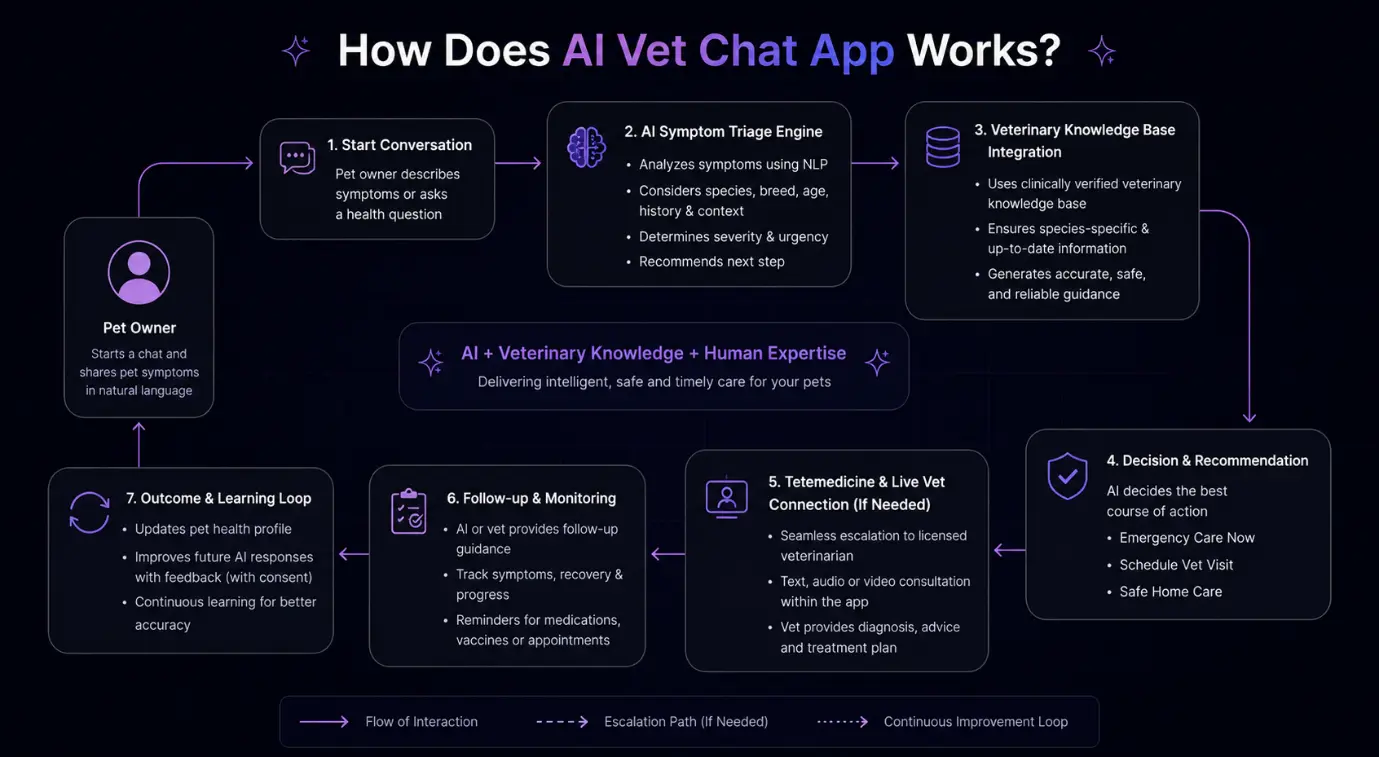
The first layer is an AI powered symptom triage engine that understands how pet owners naturally describe their concerns. Instead of relying on predefined forms, the AI interprets free text such as "My Golden Retriever has been vomiting since this morning and refuses to eat" or "My cat is limping after jumping off the couch."
Using NLP, pet history, breed, species, age, and symptom combinations, the AI evaluates the urgency of the situation and recommends the appropriate next step. Depending on the assessment, it may advise immediate emergency care, schedule a veterinary appointment, or monitoring the pet safely at home with supportive guidance. This capability is one of the biggest priorities for businesses looking to develop AI vet chat app solutions that provide real clinical value rather than simple automated responses.
The second layer is what separates a true veterinary AI assistant from a generic chatbot. Rather than relying solely on information learned from publicly available internet data, the application integrates a curated and clinically verified veterinary knowledge base.
This knowledge base includes trusted veterinary guidelines, species specific treatment protocols, breed related health risks, toxic food databases, preventive care recommendations, medication safety information, vaccination schedules, and common disease references. Every AI response is grounded in veterinary approved content, helping ensure recommendations remain accurate, species appropriate, and aligned with current clinical standards.
For startups developing AI vet chat app with NLP and veterinary knowledge base, this layer is essential for improving response quality, reducing misinformation, and increasing user trust.
Even the most advanced AI cannot replace the expertise of a licensed veterinarian. When the AI detects symptoms that require professional medical judgment, it should seamlessly escalate the conversation to a veterinarian through in app text messaging, voice calls, or video consultations.
This creates a continuous care experience where pet owners move from AI guidance to professional veterinary care without leaving the application. Businesses planning to build AI powered vet chat app platforms increasingly consider this AI to human handoff a core feature because it improves both patient safety and customer satisfaction.
Understanding the differences between these solutions is critical before investing in AI veterinary chat app development.
| Solution | Primary Function | AI Capabilities | Clinical Reliability |
| Basic pet care reminder app | Stores pet profiles, vaccination reminders, medication schedules, and appointments | No AI | No clinical guidance |
| General AI chatbot for pet questions | Answers pet health questions using a general purpose LLM | Generic conversational AI with limited veterinary specialization | No verified veterinary knowledge base or clinical validation |
| True AI vet chat app | AI symptom assessment, species specific guidance, intelligent triage, and telemedicine integration | Advanced NLP, veterinary knowledge base, clinical reasoning workflows, and live vet escalation | Clinically informed, species appropriate, and designed to support veterinary care |
The difference is immediately noticeable to pet owners. A generic chatbot simply generates answers based on broad internet knowledge, while a genuine AI vet chat app delivers personalized, clinically informed guidance, accurately assesses symptom severity, and connects users with licensed veterinarians whenever professional intervention is required. This combination creates a safer, more reliable, and significantly more valuable pet healthcare experience.
The biggest opportunity in pet healthcare is not creating another pet care app. It is solving the growing gap between rising demand for veterinary services and limited access to timely care. With millions of pet owners seeking immediate health guidance and AI technology reaching new levels of maturity, AI vet chat app development for startups has become one of the most attractive opportunities in digital health.
For founders, 2026 offers a rare chance to enter the market before it becomes saturated with larger healthcare technology companies.
Access to veterinary care continues to be a challenge across the United States, particularly in rural and suburban communities. Veterinary clinics are managing increasing patient volumes, longer appointment wait times, and overwhelmed emergency facilities. As a result, many pet owners turn to search engines or online forums for health advice before speaking with a veterinarian.
This growing care gap creates the perfect opportunity to develop AI vet chat app solutions that perform first line symptom assessment, provide reliable health education, and intelligently escalate urgent cases to licensed veterinarians, helping clinics focus on patients who require immediate medical attention.
Millennials and Gen Z have fundamentally changed the pet care industry by treating pets as family members rather than companions. They actively invest in preventive healthcare, wellness plans, insurance, nutrition, and digital health services that offer convenience and personalized experiences.
According to the American Pet Products Association (APPA) 2026 State of the Industry Report, the U.S. pet industry is projected to reach $165 billion in 2026, with veterinary care and related services continuing to be one of the fastest growing spending categories. This trend creates an ideal environment for startups creating AI vet chat app platforms that deliver instant, AI powered veterinary guidance.
Consumer behavior has permanently shifted toward digital healthcare. Pet owners who regularly use telemedicine for themselves now expect similar experiences for their pets, including AI symptom assessment, virtual consultations, digital follow ups, and seamless communication with veterinarians.
An AI vet chat app serves as the first point of care by answering routine questions, assessing symptom severity, and directing users to the appropriate level of veterinary support. This improves accessibility while reducing unnecessary clinic visits.
Advancements in Large Language Models (LLMs), Natural Language Processing (NLP), Retrieval Augmented Generation (RAG), and multimodal AI have made clinically informed veterinary assistants practical for startups for the first time.
Founders can now build AI vet chat app in 2026 with capabilities such as species-specific symptom analysis, breed aware recommendations, proprietary veterinary knowledge bases, multilingual conversations, image recognition, and intelligent triage, all without the massive infrastructure investments that were previously required. At the same time, the competitive landscape remains relatively open, giving early movers a significant advantage.
With strong market demand, rapid AI advancements, and growing investment in digital pet healthcare, 2026 is the ideal time for startups to build category defining AI vet chat platforms.
Before exploring the features and technical architecture, it is important to understand the real value an AI vet chat app creates for both pet owners and businesses. The strongest products are not built around technology alone.
They solve meaningful problems, create long term customer relationships, and generate sustainable revenue. These are the reasons why AI vet chat app development is attracting attention from startups, investors, veterinary organizations, and pet healthcare companies alike.
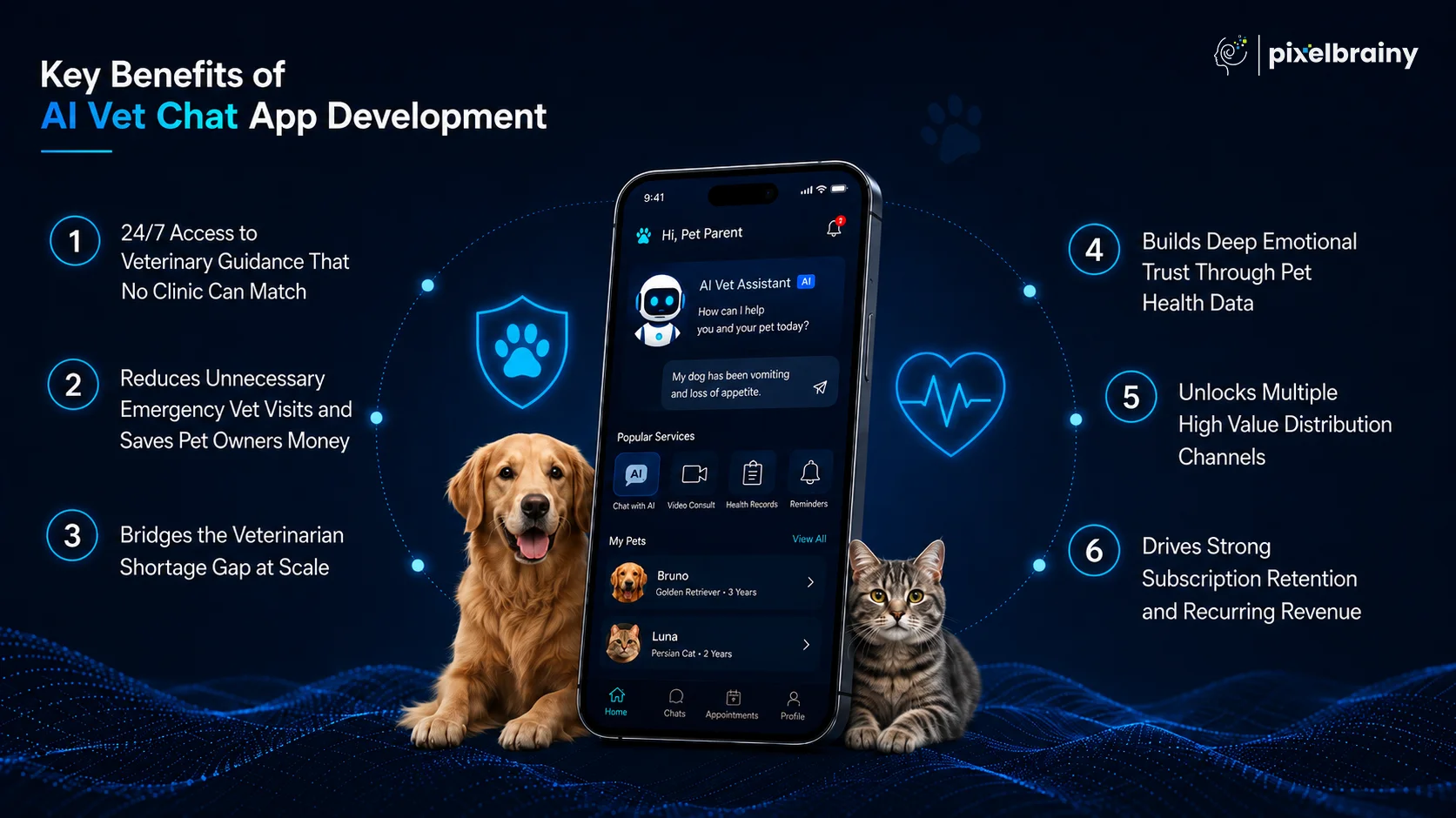
Traditional veterinary clinics operate within fixed business hours, while emergency animal hospitals are often expensive and may not be easily accessible for pet owners living in suburban or rural areas. When a pet becomes sick late at night, many owners are left wondering whether the situation is truly urgent or if it can safely wait until morning.
An AI vet chat app removes this uncertainty by providing instant access to AI powered veterinary guidance at any time of the day. Pet owners receive immediate symptom assessments, educational recommendations, and triage support without waiting for a clinic to open or paying emergency consultation fees for minor concerns.
For businesses planning to build AI vet chat app solutions, this always available support becomes the strongest competitive advantage. Once users experience reliable after-hours guidance, the app naturally becomes part of their everyday pet care routine, leading to higher engagement, stronger trust, and increased subscription conversions.
One of the biggest concerns for pet owners is deciding whether a symptom requires an emergency hospital visit or simple home monitoring. Without reliable guidance, many choose the safest option and incur costly emergency bills for conditions that could have been managed without immediate clinical care.
An intelligent AI triage system helps reduce this uncertainty by evaluating symptom severity and recommending the appropriate level of care. For non-urgent situations, it can confidently suggest home management while encouraging veterinary attention whenever necessary.
For startups looking to develop AI vet chat app platforms, this financial value is a major differentiator. Helping users avoid even a single unnecessary emergency visit can save hundreds of dollars, creating immediate, measurable value that strengthens customer loyalty and long-term retention.
The growing shortage of licensed veterinarians continues to increase appointment delays and place significant pressure on clinics across the United States. Routine questions and low risk cases often consume valuable clinical time that could be dedicated to more serious medical conditions.
An AI vet chat app does not replace veterinarians. Instead, it supports them by handling routine symptom assessments, answering common health questions, and directing urgent cases to professionals when needed.
For companies investing in AI powered vet chat app development, this positions the product as a healthcare access solution rather than simply another pet wellness application. Solving a real industry challenge makes the business more attractive to investors, veterinary networks, and healthcare partners.
Unlike many consumer applications that users can easily replace, an AI vet chat app becomes increasingly valuable over time. Every consultation, vaccination record, medication reminder, symptom history, allergy note, and breed specific health insight contributes to a comprehensive digital health profile for each pet.
As this history grows, the AI delivers more personalized recommendations while giving pet owners a complete picture of their pet's health journey.
For businesses focused on creating AI vet chat app solutions, this continuous accumulation of health data creates a powerful competitive advantage. The more valuable the health record becomes, the less likely users are to switch to another platform.
Most consumer apps rely heavily on expensive digital advertising to acquire customers. An AI vet chat app offers several additional distribution opportunities that significantly reduce customer acquisition costs.
The platform can be offered through pet insurance providers as a policy benefit, integrated into veterinary clinic groups for after-hours support, bundled with premium pet food or wellness subscriptions, or recommended by senior care organizations for elderly pet owners.
For companies offering AI vet chat app development services, these partnerships create scalable revenue opportunities beyond direct consumer subscriptions while expanding brand visibility through trusted industry partners.
Pet health is highly emotional. When an AI vet chat app helps a pet owner navigate a late-night health concern, accurately assesses symptoms, or prevents an unnecessary emergency visit, it quickly becomes a trusted resource rather than just another mobile application.
This emotional connection translates into long term subscription retention because pet owners value the reassurance of having reliable veterinary guidance available whenever they need it.
For businesses investing in AI veterinary chat app development, higher retention means stronger customer lifetime value, predictable recurring revenue, and a subscription model that becomes increasingly profitable as the user base expands.
The true strength of an AI vet chat app lies in how these benefits reinforce one another, creating a product that delivers continuous value to pet owners while building a scalable, defensible, and long-term business for founders.
The success of an AI vet chat app depends on far more than conversational AI. To deliver a reliable user experience, the platform must combine intelligent symptom assessment, personalized pet health management, secure data handling, and seamless veterinary workflows. These core features create the foundation of a trustworthy product that improves pet healthcare while supporting veterinary professionals.
For businesses investing in AI vet chat app development, selecting the right features during the planning stage reduces future development costs, improves scalability, and accelerates product adoption. Consider this common founder requirement: We want to create an AI vet chat app where pet owners can describe their pet's symptoms in natural language, receive instant AI powered guidance, maintain complete digital health records, and connect with veterinarians whenever professional care is required. Building this type of solution requires a carefully designed feature set that balances AI capabilities, usability, and clinical workflows.
The following features should be considered essential when planning to develop AI vet chat app solutions that are scalable, user friendly, and ready for the evolving pet healthcare market.
| Must Have Feature | Why It Is Essential |
| AI Powered Chat Assistant | An intelligent conversational assistant enables pet owners to ask health related questions naturally, receive personalized responses, answer AI follow up questions, and access reliable veterinary guidance at any time without waiting for clinic availability. |
| AI Symptom Checker | The symptom checker allows users to describe their pet's condition using everyday language. AI analyzes the symptoms, identifies possible health concerns, evaluates urgency, and recommends the most appropriate next step based on available information. |
| Intelligent Triage Engine | A triage system categorizes each case according to its urgency, helping users determine whether immediate emergency care, a scheduled veterinary consultation, or safe home monitoring is the most appropriate course of action. |
| Pet Profile Management | Comprehensive pet profiles store species, breed, age, weight, allergies, vaccination records, medications, previous illnesses, and medical history. This information enables AI to deliver increasingly personalized and context aware recommendations. |
| Health History Timeline | Every consultation, symptom report, diagnosis, medication, and treatment should be organized chronologically. This gives pet owners a complete health timeline while helping veterinarians quickly understand previous medical events during future consultations. |
| Vaccination and Medication Reminders | Automated reminders help pet owners stay on schedule with vaccinations, medications, flea prevention, deworming, and routine wellness care, improving preventive healthcare while encouraging consistent engagement with the application. |
| Breed and Species-Specific Guidance | Different species and breeds have unique medical risks and healthcare requirements. Personalized recommendations based on biological characteristics improve the accuracy, relevance, and overall usefulness of AI generated veterinary guidance. |
| Emergency Care Recommendations | When potentially life-threatening symptoms are detected, the application should immediately recommend emergency veterinary care instead of home treatment, helping pet owners make faster and safer healthcare decisions during critical situations. |
| Secure Authentication and Data Protection | Strong authentication, encrypted databases, secure cloud storage, and role-based access controls protect sensitive pet health information while helping the platform meet modern security and privacy expectations. |
| Appointment Booking Integration | After completing an AI consultation, users should be able to schedule veterinary appointments directly within the application, creating a smooth transition from AI guidance to professional veterinary care without unnecessary friction. |
| Push Notifications | Timely notifications remind users about medications, vaccinations, follow up consultations, appointment schedules, preventive healthcare tasks, and important pet health updates, keeping owners actively engaged with ongoing pet care. |
| Multi Pet Management | Supporting multiple pet profiles within a single account allows households to manage healthcare records, AI consultations, reminders, and medical histories for all their pets through one convenient dashboard. |
| Veterinary Knowledge Library | A searchable health library provides trusted educational content covering diseases, nutrition, preventive care, toxic foods, behavioral issues, and first aid, reducing dependence on unreliable online information sources. |
| User Feedback System | Built in feedback tools allow users to rate AI conversations, report incorrect responses, and suggest improvements. This continuous feedback loop helps improve AI quality while enhancing the overall customer experience. |
| Admin Dashboard | A centralized dashboard enables administrators to manage users, veterinary knowledge content, AI performance, analytics, customer support, platform settings, and operational workflows from one secure management interface. |
A thoughtfully designed feature set transforms an AI vet chat app from a simple chatbot into a dependable digital healthcare platform that delivers lasting value for pet owners, veterinarians, and businesses alike.
Once the core features are in place, the next step is to differentiate your product from competitors through advanced AI capabilities. These features are not essential for launching an MVP, but they significantly enhance user experience, improve clinical accuracy, and create long term competitive advantages. For startups focused on AI powered vet chat app development, advanced functionality can also strengthen investor confidence and position the platform as a next generation digital veterinary solution.
Consider this common founder requirement: We want to build an AI vet chat app similar to Vetster, but with advanced AI capabilities such as image analysis, voice conversations, multilingual support, and personalized health predictions that improve with every interaction. Achieving this vision requires moving beyond basic chatbot functionality and incorporating intelligent features that deliver real value to both pet owners and veterinary professionals.
The following advanced features can help businesses develop AI vet chat app solutions that stand out in the rapidly evolving pet healthcare market.
| Advanced Feature | Business Value & User Benefit |
| AI Image Analysis | Allow users to upload photos of skin infections, wounds, eyes, ears, paws, or visible abnormalities. AI analyzes the images, identifies possible conditions, and recommends whether home care, veterinary consultation, or emergency treatment is appropriate. |
| Voice Enabled AI Assistant | Enable pet owners to speak naturally instead of typing. Voice based conversations improve accessibility, offer a hands-free experience during emergencies, and create faster interactions for users seeking immediate veterinary guidance. |
| Multilingual AI Support | Support multiple languages to serve diverse pet owners across different regions. Multilingual conversations improve accessibility, increase market reach, and provide personalized veterinary guidance without language becoming a barrier to care. |
| Predictive Health Risk Analysis | Analyze historical health records, breed characteristics, age, lifestyle, and previous consultations to predict potential health risks before symptoms become severe, encouraging preventive care and early veterinary intervention. |
| Wearable Device Integration | Connect with smart pet collars and wearable devices to monitor activity, sleep, heart rate, temperature, and location. AI uses this real time data to generate personalized health insights and wellness recommendations. |
| Personalized Wellness Recommendations | AI continuously learns from each pet's medical history, nutrition, lifestyle, and consultation records to provide customized wellness plans, preventive care suggestions, feeding guidance, and long-term health recommendations. |
| OCR for Veterinary Reports | Optical Character Recognition allows users to upload prescriptions, laboratory reports, vaccination certificates, or medical documents. The AI extracts key information automatically and stores it within the pet's digital health profile. |
| AI Powered Follow Up Monitoring | Instead of ending the conversation after one consultation, AI automatically follows up with users to track symptom progression, medication adherence, recovery status, and recommend additional care whenever necessary. |
| Pet Insurance Integration | Integrate with pet insurance providers to verify coverage, simplify claims, recommend eligible treatments, and improve the overall healthcare experience while creating valuable partnership opportunities for the platform. |
| Smart Analytics Dashboard for Clinics | Provide veterinary clinics with dashboards showing consultation trends, frequently reported symptoms, AI triage outcomes, patient engagement, and operational insights that help improve decision making and resource planning. |
Advanced AI capabilities transform an AI vet chat app from a helpful digital assistant into an intelligent pet healthcare ecosystem that delivers greater value, stronger differentiation, and long-term business growth.
Building a successful AI vet chat app requires much more than integrating an AI chatbot into a mobile application. The development process should combine veterinary expertise, artificial intelligence, clinical validation, secure infrastructure, and intuitive user experience to create a platform that pet owners can genuinely trust. If you are researching how to build an AI vet chat app from scratch, following a structured roadmap helps reduce development risks while accelerating product launch.
Consider this common founder scenario: We are developing an AI vet chat app and are thinking carefully about our monetization model from day one. Our options include a freemium consumer subscription where basic AI chat is free and live vet consultations are premium, a B2B model for veterinary clinic groups, and partnerships with pet insurance providers. We want to develop the platform so it can support all three business models from launch.
The best way to achieve this flexibility is by building a scalable product architecture from the beginning.
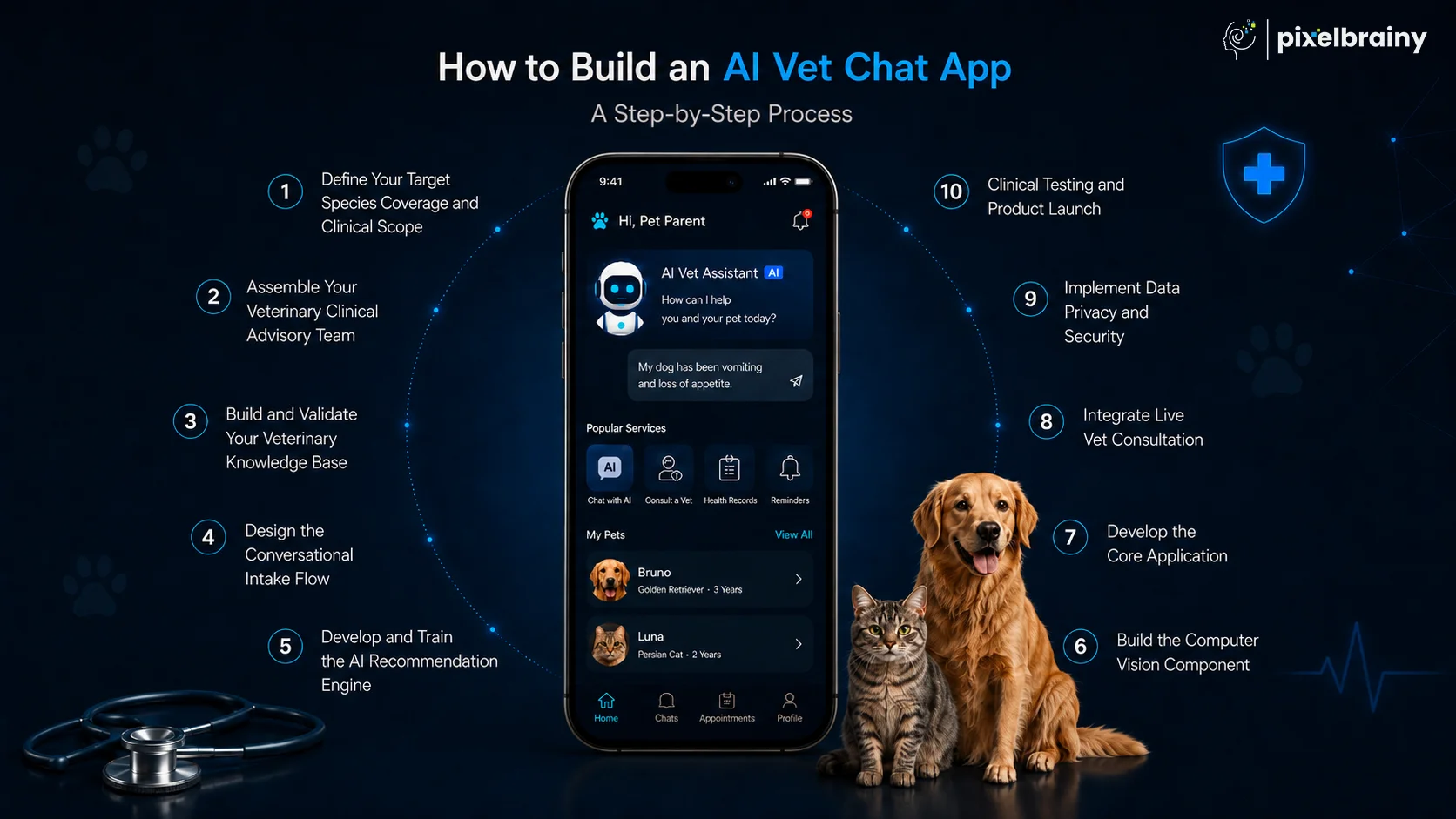
Start by deciding which animals your first version will support. Most startups begin with dogs and cats before expanding to birds, rabbits, reptiles, or other small animals. Clearly define whether your platform will provide symptom triage, preventive wellness guidance, chronic disease support, or complete telemedicine services. Establishing these boundaries early prevents unnecessary feature expansion and keeps the product focused during PoC development.
Recruit experienced licensed veterinarians who specialize in your target species. Their responsibility extends beyond reviewing medical content. They should validate the veterinary knowledge base, review AI generated recommendations, test difficult clinical scenarios, and continue auditing the platform after launch. This stage is where professional AI consulting services become valuable by aligning technical development with real clinical workflows.
Collect information from trusted veterinary textbooks, peer reviewed journals, licensed medical databases, and approved consultation records where appropriate. Organize this information into a structured symptom, condition, recommendation, and escalation framework. Every major clinical pathway should be reviewed by veterinary advisors before moving into AI model development.
Also Read: Top 12+ AI Model Development Companies in the USA
An effective intake process allows pet owners to describe symptoms naturally while collecting structured clinical information. The AI should gather species, breed, age, weight, symptom history, onset, progression, medications, and existing medical conditions through intelligent follow up questions. Test these conversations with real users to ensure they remain simple, intuitive, and clinically useful. This step is essential when learning how to create an AI vet chat app with symptom checker features.
Choose whether your platform will use a fine-tuned Large Language Model, a structured clinical reasoning engine, or a hybrid architecture combining both. Train the AI using validated veterinary knowledge while implementing confidence scoring that automatically recommends professional veterinary consultation whenever certainty falls below predefined thresholds. Modern AI integration solutions help simplify this process while maintaining scalability.
Develop an image analysis module capable of evaluating visible conditions such as skin infections, wounds, eye irritation, ear problems, or paw injuries. Allow users to upload clear images directly from the application and combine visual analysis with conversational symptom assessment to improve overall recommendation accuracy.
Build responsive Android and iOS applications featuring conversational AI, pet profiles, digital health records, medication reminders, appointment scheduling, and secure cloud storage. Whether launching through MVP development or a complete product release, the application should remain modular for future feature expansion. Working with an experienced UI/UX design company ensures the platform remains intuitive for pet owners of all ages.
Also Read: Top 10 AI MVP Development Companies in USA
Implement secure video, audio, and chat consultation capabilities that allow users to connect with licensed veterinarians whenever AI determines professional intervention is necessary. The system should automatically generate consultation summaries, transfer symptom history, and support appointment scheduling. This is a critical component of how to develop an AI pet health app with live vet consultation.
Protect pet health records using encryption, secure authentication, role-based access control, consent management, and clearly defined data retention policies. Although pet health data regulations differ from human healthcare, maintaining strong privacy standards significantly improves customer trust and enterprise adoption.
Before public release, compare AI recommendations against historical veterinary cases and validate results with licensed professionals. Conduct a closed beta with real pet owners, collect feedback on recommendation quality, conversational flow, and usability, then refine AI confidence thresholds before full deployment. Many founders also consult top AI app development companies in USA during this phase to strengthen scalability and production readiness.
| Development Phase | Key Activities | Estimated Duration |
| Discovery & Clinical Planning | Species selection, clinical scope, veterinary advisory planning | 1 Week |
| Veterinary Knowledge Base | Clinical content collection, taxonomy creation, veterinary validation | 2 Weeks |
| Conversational Flow Design | User journeys, symptom intake, conversation testing | 1 Week |
| AI Recommendation Engine | NLP integration, model training, confidence scoring | 3 Weeks |
| Computer Vision Integration | Image analysis model development and testing | 1 Week |
| Core App Development | Android, iOS, backend APIs, health records, reminders | 3 Weeks |
| Live Vet Consultation | Video integration, scheduling, AI to vet handoff | 1 Week |
| Data Privacy & Security | Encryption, authentication, consent management | 1 Week |
| Clinical Validation & Beta Testing | Veterinary review, user testing, optimization | 1 Week |
| Total Estimated Timeline | End to end AI vet chat app development | 12 to 14 Weeks |
A structured development roadmap helps transform an AI vet chat app idea into a scalable, clinically reliable product while reducing development risks and preparing the platform for long term growth.
Understanding the AI vet chat app development cost is essential before starting product development. The overall investment depends on the scope of your application, the complexity of the AI system, supported platforms, and long-term business objectives. A basic MVP requires a significantly lower budget than an enterprise ready solution that includes advanced AI capabilities, live veterinary consultations, and white label support.
Consider this common founder scenario: We are planning to build an AI vet chat app for both direct consumers and veterinary clinic groups. We want AI powered symptom checking, live vet consultations, white label capabilities, and support for future pet insurance partnerships. What should our development budget look like? Planning the right AI vet chat app development budget from the beginning helps prevent unexpected expenses and ensures the product is designed to scale as the business grows.
In most cases, the cost to build AI vet chat app solutions ranges between $30,000 and $200,000+, depending on the features, AI sophistication, development team, and infrastructure requirements.
Several factors directly influence how much does it cost to develop AI vet chat app solutions:
| Development Component | Estimated Cost Range (USD) | Complexity Level | MVP / Phase 2 |
| Veterinary Knowledge Base Development & Curation | $3,000 – $15,000 | High | MVP |
| AI Triage Engine & NLP Model Development | $6,000 – $30,000 | Very High | MVP |
| LLM Integration & RAG Pipeline Setup | $5,000 – $20,000 | High | MVP |
| Core Feature Development | $8,000 – $35,000 | High | MVP |
| Telemedicine Video Consultation Module | $4,000 – $18,000 | Medium to High | Phase 2 |
| Pet Health Records Management System | $3,000 – $12,000 | Medium | MVP |
| UI/UX Design | $2,500 – $10,000 | Medium | MVP |
| Backend & Cloud Infrastructure Setup | $5,000 – $20,000 | High | MVP |
| Regulatory Compliance Implementation | $2,000 – $10,000 | Medium | Phase 2 |
| QA & Clinical Validation Testing | $3,000 – $12,000 | High | MVP |
| App Store Submission & Launch Support | $500 – $2,000 | Low | MVP |
| Estimated Total Cost | $30,000 – $200,000+ | Depends on Scope | Complete Product |
| Development Team | Estimated Total Cost (USD) |
| US Based AI Development Agency | $120,000 – $200,000+ |
| Eastern Europe Development Team | $60,000 – $140,000 |
| South Asia Development Team | $30,000 – $90,000 |
| Freelancer Team | $20,000 – $60,000 (Suitable for prototypes, not production grade healthcare platforms) |
Beyond the initial development investment, every AI vet chat platform requires ongoing operational expenses to maintain performance, security, and clinical reliability.
That’s why choosing the right development scope and budget from the outset helps build an AI vet chat app that is scalable, cost efficient, and ready for long term growth.
A reliable technology stack forms the backbone of every successful AI vet chat application. The right combination of AI models, backend frameworks, cloud infrastructure, databases, and communication tools ensures the platform delivers fast responses, secure data management, and a seamless user experience. For startups exploring how to build AI vet chat app from scratch, investing in proven technologies from the beginning simplifies future scaling while reducing technical debt.
Consider this common founder scenario: I am a non-technical founder and need a development partner who can guide me through the entire journey, from product definition and AI model selection to App Store launch and veterinary regulatory compliance. Building a scalable architecture with industry proven technologies allows businesses to launch faster while supporting future AI enhancements and enterprise partnerships.
The following tech stack is recommended to build AI vet chat app with NLP and veterinary knowledge base while delivering high performance, security, and long-term maintainability.
| Technology Layer | Recommended Tools & Technologies | Why It Is the Right Choice |
| LLM & AI Layer | GPT-4.1, Claude 4 | Large Language Models generate intelligent, context aware veterinary conversations, perform symptom triage, and provide personalized recommendations when connected to a validated veterinary knowledge base. |
| NLP & Symptom Analysis | spaCy, Hugging Face Transformers, Custom Fine Tuned NLP Models | These technologies understand natural language symptom descriptions, extract clinical information, identify user intent, and improve the overall accuracy of AI generated responses. |
| Veterinary Knowledge Base | LangChain, LlamaIndex, Pinecone, Weaviate | Retrieval Augmented Generation enables the AI to retrieve information from trusted veterinary sources, ensuring recommendations remain clinically accurate and species appropriate. |
| Video Telemedicine | Twilio Video, Agora, Daily.co | These platforms support secure text, voice, and video consultations, making it easy for pet owners to connect with licensed veterinarians within the application. |
| Backend Development | Python, FastAPI, Node.js | Python and FastAPI efficiently serve AI models, while Node.js manages APIs, authentication, appointments, notifications, and business logic for the application. |
| Database | PostgreSQL, MongoDB | PostgreSQL stores structured pet health records, while MongoDB efficiently manages chat histories, AI conversations, consultation notes, and other unstructured data. |
| Real Time Chat Infrastructure | WebSockets, Firebase Realtime Database | Real time communication technologies provide instant AI conversations and live messaging between pet owners and veterinary professionals without noticeable delays. |
| Mobile App Development | React Native | React Native enables businesses to develop AI vet chat app for iOS and Android in 2026 using a single codebase, reducing development time, costs, and ongoing maintenance. |
| Push Notification System | Firebase Cloud Messaging (FCM), OneSignal | Push notification services deliver medication reminders, vaccination alerts, appointment confirmations, AI follow ups, and other important pet healthcare notifications. |
| Payment & Subscription Management | Stripe, RevenueCat | Stripe securely handles consultation payments, while RevenueCat simplifies subscription management and recurring billing across both Android and iOS platforms. |
| Cloud Infrastructure | Amazon Web Services (AWS), Google Cloud Platform (GCP) | Cloud platforms provide scalable hosting, AI deployment, secure storage, automated backups, monitoring, and enterprise grade reliability for growing applications. |
| Analytics & User Engagement | Mixpanel, Amplitude | Analytics platforms track user engagement, feature usage, retention, conversion funnels, and customer behavior to support continuous product optimization. |
A modern technology stack not only accelerates development but also enables companies offering AI vet chat app development services to build secure, scalable, and future ready veterinary platforms capable of supporting consumer, enterprise, and telemedicine use cases.
The right technology stack provides the performance, flexibility, and scalability needed to build an AI vet chat app that is ready for both today's users and tomorrow's innovations.
Building a successful AI vet chat application requires much more than integrating a Large Language Model. The platform must be designed with clinical accuracy, responsible AI decision making, data security, and seamless veterinarian collaboration at its core. For businesses investing in AI vet chat app development, these architectural best practices help create a solution that delivers meaningful clinical value instead of simply generating convincing responses.
Consider this real-world startup scenario: We want to build AI vet chat app with pet health records integration and AI diagnosis support, but we also need every recommendation to be clinically reliable, safely escalated when necessary, and validated by licensed veterinarians before launch.
The following best practices help achieve those objectives.
A general purpose LLM trained on internet content should never be the primary source of veterinary guidance. Instead, the AI should retrieve information from a verified veterinary knowledge base built using peer reviewed research, AVMA clinical guidelines, and species-specific treatment protocols. Every recommendation should be traceable to trusted clinical sources rather than generated solely from the model's general training data.
Every AI generated assessment should include an internal confidence score that measures how certain the model is about its recommendation. If confidence falls below a predefined threshold or symptoms indicate a potentially life-threatening condition, the application should immediately escalate the case to a licensed veterinarian instead of providing uncertain medical guidance. This approach significantly improves both patient safety and user trust.
Pet owners describe health concerns in everyday language rather than clinical terminology. During developing AI vet chat app with NLP and veterinary knowledge base, the AI should understand statements such as "My dog is limping and not putting weight on his back leg" and accurately map them to clinical symptom categories. NLP models trained on real pet owner conversations consistently outperform generic language models in these scenarios.
Veterinary AI should never provide the same recommendation for every animal. The triage engine must consider species, breed, age, weight, medical history, and breed specific disease risks before generating guidance. This produces recommendations that are more personalized, clinically relevant, and significantly safer than generic responses.
Pet health records, consultation transcripts, medication histories, payment information, and user accounts contain sensitive personal data that must be protected throughout the application lifecycle. Encrypt data both at rest and in transit, obtain explicit user consent for data collection, and implement privacy controls that comply with regulations such as CCPA and GDPR. Strong security should be built into the platform architecture from the beginning rather than added later.
Escalating to a veterinarian should enhance the user journey instead of appearing as an AI failure. The AI should automatically summarize symptoms, conversation history, pet health records, and preliminary triage findings before transferring the case to a licensed veterinarian. This enables faster consultations while allowing veterinarians to focus on clinical decision making instead of repeating basic intake questions.
Every AI response category, triage pathway, and escalation workflow should undergo formal review by licensed veterinarians before deployment. Teams learning how to develop AI powered vet chat app solutions should establish a documented clinical validation process with regular audits to ensure recommendations remain accurate as the knowledge base evolves.
Following these best practices helps build AI vet chat applications that are clinically reliable, secure, scalable, and trusted by both pet owners and veterinary professionals.
For businesses planning AI vet chat app development, understanding the challenges before development begins is just as important as selecting the right features or technology stack. An AI vet chat app must deliver accurate recommendations, protect sensitive pet health data, and scale reliably as adoption grows. Addressing these challenges early helps reduce development risks, improve user trust, and create a product that is ready for long term success.
Here's a common challenge businesses face: We want to build an AI vet chat app that offers AI powered symptom checking, live veterinarian consultations, and pet health records, but we are concerned about clinical accuracy, data security, scalability, and regulatory compliance. What challenges should we prepare for, and how can we overcome them?
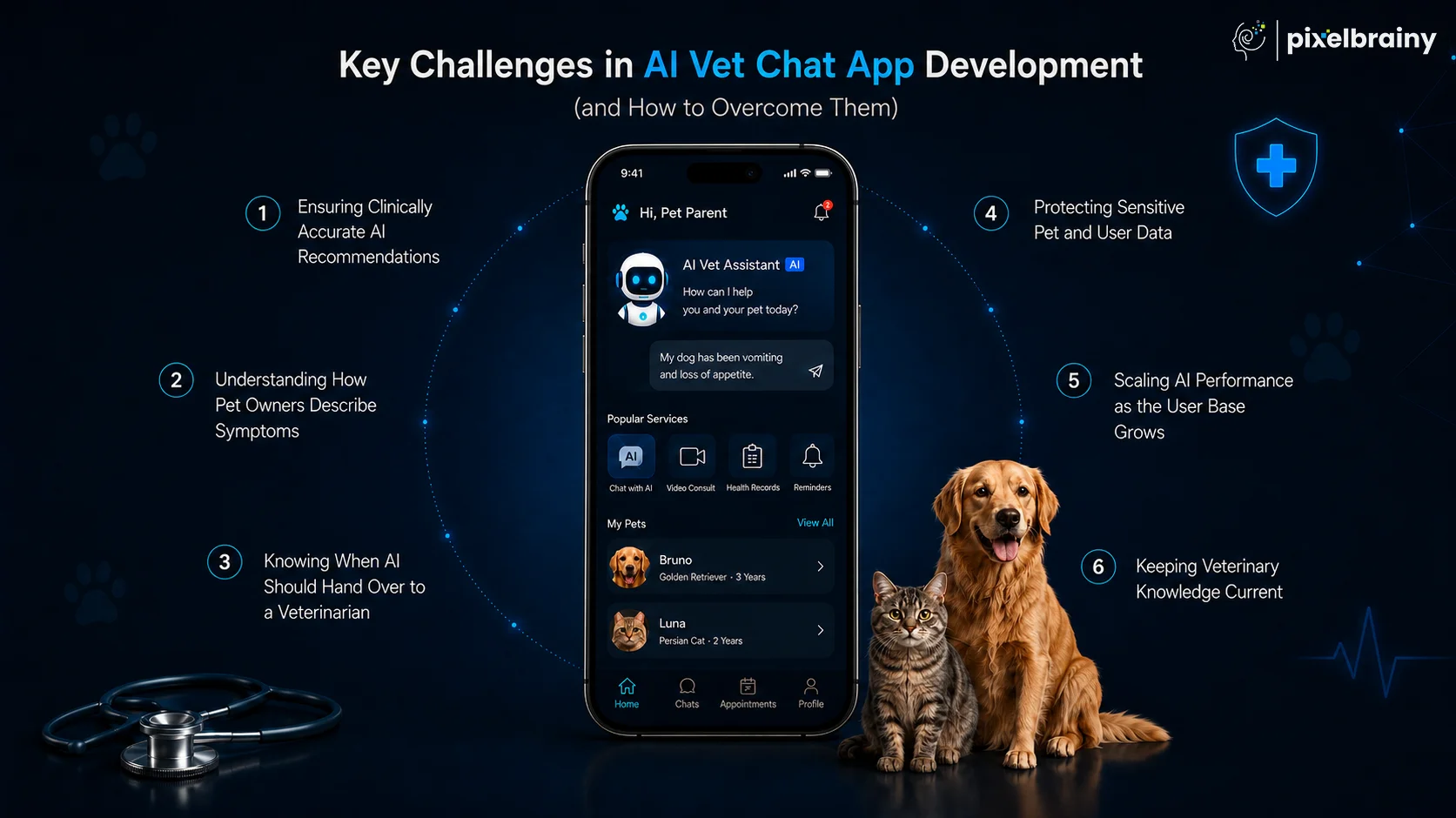
Generic AI models can generate responses that sound convincing but may not be medically appropriate for veterinary care. This can reduce user trust and create potential safety risks.
Solution:
Use a clinically verified veterinary knowledge base supported by Retrieval Augmented Generation (RAG) instead of relying solely on a general purpose LLM. Every AI response should be reviewed, tested, and validated by licensed veterinarians before deployment. This approach significantly improves the reliability of AI veterinary chat app development.
Most pet owners explain symptoms using everyday language instead of veterinary terminology. Generic language models often struggle to accurately interpret these descriptions.
Solution:
When developing AI vet chat app with NLP and veterinary knowledge base, train NLP models using real pet owner conversations. The AI should recognize natural language inputs, identify clinical intent, and convert them into structured symptom data for accurate triage.
AI should never attempt to answer every medical question with complete confidence. High risk cases require professional clinical judgment.
Solution:
Implement confidence scoring, emergency detection, and predefined escalation rules. Whenever confidence is low or symptoms indicate a potentially serious condition, the application should automatically transfer the case to a licensed veterinarian instead of continuing the AI conversation.
Pet health records, consultation histories, payment information, and personal details must remain secure throughout the application lifecycle.
Solution:
Encrypt all sensitive data, implement secure authentication, maintain detailed audit logs, and comply with privacy regulations such as CCPA and GDPR. Strong security practices are essential for businesses offering AI vet chat app development services.
As user traffic increases, AI inference, real time messaging, and database operations can become performance bottlenecks that affect response times.
Solution:
Adopt a cloud native architecture with scalable APIs, load balancing, efficient caching, and optimized AI model deployment. This enables businesses to build AI vet chat app solutions that continue delivering fast and reliable performance even as thousands of users access the platform simultaneously.
Veterinary medicine evolves continuously through new research, treatment protocols, and clinical guidelines. Outdated knowledge can reduce the quality of AI recommendations.
Solution:
Establish a structured process for regularly updating the veterinary knowledge base, reviewing AI outputs with licensed veterinarians, and validating new clinical content before it becomes part of the production system. Continuous improvement is critical for organizations learning how to develop AI powered vet chat app solutions that remain accurate over time.
Overcoming these challenges with the right technical strategy and clinical oversight helps businesses build AI vet chat apps that are accurate, secure, scalable, and trusted by both pet owners and veterinary professionals.
Generating sustainable revenue is a key consideration for businesses investing in AI vet chat app development. While AI powered veterinary assistance creates value for pet owners, long term success depends on selecting monetization models that align with user expectations and business goals. Most successful platforms combine multiple revenue streams instead of relying on a single source of income, creating a scalable and predictable business model.
Many businesses planning AI vet chat app development ask: We want to launch an AI vet chat app with symptom checking and live veterinarian consultations, but what are the best ways to monetize the platform without negatively impacting the user experience?
The following monetization strategies can help maximize revenue while delivering continuous value to pet owners and veterinary partners.
Offer essential features for free while encouraging users to upgrade for advanced capabilities.
Include features such as:
Allow users to pay only when they require professional veterinary assistance.
Revenue opportunities include:
Recurring subscriptions provide predictable revenue while increasing customer retention.
Membership benefits may include:
Provide the platform as a white label or AI assistant solution for veterinary clinics.
Possible offerings include:
Partner with insurance providers to improve customer engagement and simplify claims.
Revenue can come from:
Recommend veterinarian approved products that match the pet's health profile.
Examples include:
License the platform to larger organizations requiring customized AI veterinary solutions.
Enterprise packages may include:
Provide anonymized insights to organizations while maintaining user privacy and regulatory compliance.
Potential services include:
Businesses planning to build AI vet chat app solutions often achieve the best results by combining subscriptions, veterinary consultations, enterprise licensing, affiliate partnerships, and insurance collaborations instead of relying on a single revenue stream. This diversified strategy improves profitability while creating multiple opportunities for long term business growth.
A diversified monetization strategy helps businesses maximize revenue, improve customer retention, and build a sustainable AI vet chat platform for long term success.
By now, you have a clear understanding of what it takes to build a successful AI vet chat app, from identifying market opportunities and selecting the right technology stack to implementing AI responsibly, estimating development costs, overcoming technical challenges, and choosing the right monetization strategy. The next step is partnering with an experienced team that can transform your vision into a secure, scalable, and market ready product.
At PixelBrainy, we specialize in AI chatbot development and deliver end to end AI app development solutions for healthcare and veterinary applications. Whether you're validating an MVP, building an enterprise platform, or launching a next generation AI powered pet healthcare solution, our team supports you through every stage of the product lifecycle.
One of our recent projects involved developing an AI powered healthcare consultation platform for a fast-growing digital health startup. The solution combined conversational AI, Retrieval Augmented Generation, secure patient records, appointment scheduling, and seamless escalation to healthcare professionals.
Following launch, the platform significantly reduced manual support requests, improved response times, and increased user engagement through personalized AI driven conversations.
While the client remains confidential, the project demonstrates our ability to deliver secure, scalable, and production ready AI healthcare applications using modern AI technologies.
Whether you're planning to validate an MVP, launch a consumer facing pet healthcare app, or build an enterprise AI veterinary platform, PixelBrainy has the technical expertise and product experience to turn your vision into reality.
So, are you ready to build your AI vet chat app? Connect with PixelBrainy today to discuss your idea and create an intelligent, scalable, and future ready AI veterinary solution tailored to your business goals.
The future of digital pet healthcare is being shaped by intelligent, AI powered solutions, and businesses that invest early are well positioned to lead this growing market. As discussed throughout this guide, successful AI vet chat app development requires much more than integrating a chatbot. From building a clinically validated veterinary knowledge base and intelligent symptom triage engine to implementing secure telemedicine, pet health records, scalable cloud infrastructure, and responsible AI practices, every decision plays a critical role in long term success.
Whether your goal is to build AI vet chat app for startups, veterinary clinics, or enterprise healthcare providers, choosing the right technology, architecture, and development partner is essential.
If you're exploring how to build AI vet chat app from scratch or looking for end to end AI vet chat app development services, focusing on scalability, security, and clinical accuracy will help you launch a trusted and future ready solution that delivers real value to both pet owners and veterinary professionals.
Ready to Turn Your Idea Into Reality?
Schedule a call with PixelBrainy today to discuss your AI vet chat app development goals and discover how our AI chatbot development experts can help you design, develop, and launch a secure, scalable, and market ready veterinary AI solution.
The AI vet chat app development cost typically ranges from $30,000 to $200,000+, depending on factors such as AI capabilities, veterinary knowledge base development, telemedicine features, supported platforms, third party integrations, and regulatory requirements. An MVP with essential features is significantly more affordable than an enterprise grade solution with advanced AI and white label functionality.
The development timeline depends on the project's complexity. A basic MVP generally takes 12 to 14 weeks, while a feature rich AI vet chat platform with live veterinarian consultations, AI symptom triage, pet health records, and advanced analytics may require 4 to 8 months.
No. An AI vet chat app is designed to assist veterinarians, not replace them. AI can provide symptom assessments, preventive care guidance, medication reminders, and appointment recommendations, but complex medical decisions and emergency cases should always be escalated to licensed veterinary professionals.
The core features include AI powered chat assistance, symptom checker, intelligent triage engine, pet health records, appointment scheduling, telemedicine, vaccination and medication reminders, multi pet management, secure authentication, push notifications, and an admin dashboard. Businesses can later expand with image analysis, predictive AI, multilingual support, and wearable device integration.
Modern AI vet chat app development commonly uses GPT or Claude for conversational AI, LangChain or LlamaIndex for Retrieval Augmented Generation (RAG), FastAPI and Python for AI services, React Native for cross platform mobile development, PostgreSQL and MongoDB for data management, and AWS or Google Cloud for scalable infrastructure.
Businesses can monetize an AI vet chat platform through multiple revenue streams, including freemium subscriptions, paid veterinary consultations, monthly membership plans, enterprise licensing for veterinary clinics, white label solutions, affiliate partnerships, pet insurance integrations, and premium AI powered healthcare services.
Look for a development partner like PixelBrainy with proven expertise in AI chatbot development, healthcare or veterinary applications, Large Language Models (LLMs), NLP, Retrieval Augmented Generation (RAG), telemedicine integrations, cloud architecture, and scalable mobile app development. A reliable partner should also provide end to end AI vet chat app development services, from product discovery and MVP development to deployment, maintenance, and ongoing AI optimization.

About The Author
Sagar Bhatnagar
Sagar Sahay Bhatnagar brings over a decade of IT industry experience to his role as Marketing Head at PixelBrainy. He's known for his knack in devising creative marketing strategies that boost brand visibility and market influence. Sagar's strategic thinking, coupled with his innovative vision and focus on results, sets him apart. His track record of successful campaigns proves his ability to utilize digital platforms effectively for impactful marketing efforts. With a genuine passion for both technology and marketing, Sagar continuously pushes PixelBrainy's marketing initiatives to greater success.

Working with the PixelBrainy team has been a highly positive experience. They understand the design requirements and create beautiful UX elements to meet the application needs. The dev team did an excellent job bringing my vision to life. We discussed usability and flow. Sagar worked with his team to design the database and begin coding. Working with Sagar was easy. He has the knowledge to create robust apps, including multi-language support, Google and Apple ID login options, Ad-enabled integrations, Stripe payment processing, and a Web Admin site for maintaining support data. I'm extremely satisfied with the services provided, the quality of the final product, and the professionalism of the entire process. I highly recommend them for Android and iOS Mobile Application Design and Development.

Great experience working with them. Had a lot of feedback and I found that unlike most contractors they were bugging me for updates instead of the other way around. They were extremely time conscience and great at communicating! All work was done extremely high quality and if not on time, early! They were always proactive when it comes to communication and the work is great/above par always. Very flexible and a great team to work with! Goes above and beyond to present us with multiple options and always provides quality. Amazing work per usual with Chitra. If you have UI/UX or branding design needs I recommend you go to them! Will likely work with them in the future as well, definitely recommended!

PixelBrainy is a joy to work with and is a great partner when thinking through branding, logo, and website layout. I appreciate that they spend time going into the "why" behind their decisions to help inform me and others about industry best practices and their expertise.

I hired them to design our software apps. Things I really like about them are excellent communication skills, they answer all project suggestions and collaborate right away, and their input on design and colors is amazing. This project was complex and needed patience and creativity. The team is amazing to do business with. I will be using them long-term. Glad to see there are some good people out there. I was afraid to try and outsource my project to someone but I am glad I met them! I really can't say enough. They went above and beyond on this project. I am very happy with everything they have done to make my business stand out from the competition.

It was great working with PixelBrainy and the team. They were very responsive and really owned the project. We'll definitely work with them again!

I recently worked with the PixelBrainy team on a project and I was blown away by their communication skills. They were prompt, clear, and articulate in all of our interactions. They listened and provided valuable feedback and suggestions to help make the project a success. They also kept me updated throughout the entire process, which made the experience stress-free and enjoyable.

PixelBrainy is very good at what it does. The team also presents themselves very professionally and takes care of their side of things very well. I could fully trust them taking up the design work in a timely and organised manner and their attention to detail saved us lots of effort and time. This particular project was quite intense and the team showed that they function very well under pressure. Very much looking forward to working with her again!

It's always an absolute pleasure working with them. They completed all of my requests quickly and followed every note I had for them to a T, which made our process go smoothly from start to finish. Everything was completed fast and following all of the guidelines. And I would recommend their services to anyone. If you need any design work done in the future, PixelBrainy should be your first call!

They took ownership of our requirements and designed and proposed multiple beautiful variants. The team is self-motivated, requires minimum supervision, committed to see-through designs with quality and delivering them on time. We would definitely love to work with PixelBrainy again when we have any requirements.

PixelBrainy was a big help with our SaaS application. We've been hard at work with a new UI/UX and they provided a lot of help with the designs. If you're looking for assistance with your website, software, or mobile application designs, PixelBrainy and the team is a great recommendation.

PixelBrainy designers are amazing. They are responsive, talented, and always willing to help craft the design until it matches your vision. I would recommend them and plan to continue them for my future projects and more!!!

They were awesome! Did a good job fast, and good communication. Will work with them again. Thank you

Creative, detail-oriented, and talented designers who take direction well and implement changes quickly and accurately. They consistently over-delivered for us.

PixelBrainy team is very talented and creative. Great designers and a pleasure to work with. PixelBrainy is an excellent communicator and I look forward to working with them again.

PixelBrainy has a very talented design team. Their work is excellent and they are very responsive. I enjoy working with them and hope to continue on all of our future projects.


Transform your ideas into reality with us.
Across these industries, each engagement brings unique challenges, from early-stage product development to scaling complex systems, helping us build a practical understanding of real-world product environments.