AI Summary Powered by PixelBrainy
What if anyone could create professional quality videos for social media without learning complex editing software or hiring an experienced video editor? That is exactly where artificial intelligence is transforming the content creation industry. As businesses increasingly depend on video marketing to attract customers, improve engagement, and build brand awareness, the demand for intelligent editing solutions has reached an all-time high. This growing shift has made AI video editing app development one of the most promising investment opportunities for startups, SaaS businesses, entrepreneurs, and enterprises looking to build innovative digital products.
Consider this real-world scenario. My co-founder and I are building an AI video editing app targeting non-technical small business owners who need professional looking video content for their social media but have zero video editing skills. They do not understand timelines, transitions, color correction, motion graphics, or advanced editing techniques. Their goal is simple. Upload raw footage, choose a preferred editing style, and receive professionally edited videos that are ready to publish on Instagram, YouTube, Facebook, TikTok, and LinkedIn within minutes. This growing demand is driving businesses to invest in video editing app development with AI, making content creation faster, more accessible, and significantly more cost effective than traditional editing methods.
Whether you are a startup founder validating a new SaaS idea, a business owner exploring AI powered creative solutions, or an entrepreneur planning to build AI video editing app solutions, understanding the complete development process is essential. From selecting the right AI models and designing an intuitive user experience to building scalable infrastructure, integrating advanced automation features, estimating development costs, and choosing the right monetization strategy, every decision plays a crucial role in determining your product's long-term success.
In this comprehensive guide, you will learn how to create a custom AI video editing app from scratch, discover the essential and advanced features users expect, understand the steps to develop an AI video editing app, explore the recommended technology stack, estimate the overall development cost, evaluate profitable monetization models, and analyze some of the most successful AI video editing applications available today. By the end of this guide, you will have a clear, practical roadmap for developing a scalable, feature rich, and competitive AI powered video editing application that meets evolving market demands and delivers exceptional user experiences.
The rapid advancement of artificial intelligence has completely changed how people create and edit videos. What once required hours of manual work, technical expertise, and expensive software can now be accomplished in just a few minutes with the help of AI. This transformation has led to the rise of AI powered video editing applications that simplify complex editing tasks and make professional quality video production accessible to everyone.
An AI video editing app is a software application that uses artificial intelligence, machine learning, computer vision, and natural language processing to automate the video editing process. Instead of manually trimming clips, synchronizing audio, adding transitions, generating subtitles, or adjusting colors, users simply upload their raw footage and let the AI handle most of the editing work automatically.
Unlike conventional editing software that requires users to understand timelines, keyframes, masking, and visual effects, AI powered applications analyze the uploaded video, identify the most important moments, remove unnecessary scenes, enhance audio and visuals, generate captions, recommend music, and produce a polished final video based on user preferences or text prompts.
For example, a small business owner can upload a five-minute product demonstration and enter a simple prompt such as:
"Create a 60 second Instagram Reel with captions, smooth transitions, upbeat background music, and highlight the product's key features."
Within minutes, the AI generates a professionally edited video that is ready for publishing, eliminating the need for advanced editing skills or professional editors.
AI video editing applications combine multiple artificial intelligence technologies to automate different stages of video production. These technologies work together to understand the content of a video and make intelligent editing decisions.
Some of the core AI technologies include:
Together, these technologies help automate repetitive editing tasks that would otherwise consume significant time and effort.
Although both types of applications are designed to edit videos, the overall workflow, user experience, and efficiency differ significantly.
| Feature | AI Video Editing App | Traditional Video Editing App |
|---|---|---|
| Editing Process | Mostly automated using AI | Completely manual |
| Technical Skills | Minimal or none required | Requires professional editing knowledge |
| Time Required | Minutes | Hours or even days |
| Video Trimming | AI detects important moments automatically | Manual frame by frame editing |
| Subtitle Generation | Automatic speech to text captions | Manual subtitle creation |
| Background Music | AI recommends suitable music | User selects music manually |
| Scene Detection | Automatic | Manual |
| Video Enhancement | AI improves lighting, colors, and audio | Manual adjustments |
| User Experience | Beginner friendly | Steep learning curve |
| Productivity | High | Moderate to low |
The demand for AI powered editing solutions is growing because businesses, creators, and marketers need to produce high-quality content faster than ever before.
Some of the biggest reasons behind this shift include:
AI significantly reduces editing time by automating repetitive tasks such as trimming clips, removing silent pauses, generating captions, and adding transitions. What previously required several hours can now be completed in minutes.
Traditional editing software often intimidates beginners due to its complex interface and extensive learning curve. AI video editing apps simplify the process, allowing anyone to create professional looking videos with little or no editing experience.
AI follows predefined editing styles and templates, ensuring that every video maintains a consistent look and feel. This is particularly valuable for businesses that want to maintain a strong and recognizable brand identity across all marketing channels.
Hiring professional video editors or creative agencies for every project can become expensive. AI powered editing applications reduce production costs by automating much of the editing process while still delivering impressive results.
Modern AI video editing apps can automatically resize videos, adjust aspect ratios, generate captions, and optimize content for platforms such as Instagram Reels, TikTok, YouTube Shorts, Facebook, and LinkedIn. This saves creators from manually editing multiple versions of the same video.
Many AI video editing applications continuously learn from user behavior and editing preferences. Over time, they become better at suggesting templates, transitions, music, effects, and editing styles that align with individual user needs.
As artificial intelligence continues to evolve, AI video editing applications are becoming more than just editing tools. They are transforming into intelligent creative assistants capable of generating scripts, creating AI avatars, producing voiceovers, recommending visual effects, translating videos into multiple languages, and even generating complete videos from simple text prompts.
For businesses planning AI video editing app development, this represents a significant opportunity to build solutions that address the growing demand for fast, affordable, and user-friendly content creation. By combining intelligent automation with an intuitive user experience, AI powered video editing apps are redefining how individuals and organizations create professional video content in today's digital-first world.
Video has become one of the most influential forms of digital communication for businesses, creators, educators, and marketers. From product promotions and customer testimonials to educational content and social media campaigns, organizations rely on videos to engage audiences and improve conversions. At the same time, artificial intelligence is reshaping how these videos are created by simplifying editing workflows, reducing production time, and minimizing the need for specialized editing expertise.
This combination of growing video consumption and AI innovation has created a strong business opportunity for entrepreneurs and companies planning AI video editing app development. Businesses are actively seeking intelligent platforms that can automate editing tasks, generate captions, enhance video quality, and publish platform ready content within minutes.
If you're evaluating whether building an AI video editing app is a worthwhile investment in 2026, current market trends strongly indicate that demand will continue to grow across industries. Whether your target audience includes content creators, marketing agencies, eCommerce brands, educators, or small businesses, investing in video editing app development with AI allows you to address a real market need while building a scalable SaaS product with long term growth potential.
Market research further confirms the increasing demand for AI powered video editing solutions.
| Market Insight | Latest Data |
|---|---|
| Global AI Video Market Size (2026) | USD 5.5 Billion |
| Expected Market Size (2033) | USD 42.3 Billion |
| Compound Annual Growth Rate (2026 to 2033) | 33.70% |
| Largest Revenue Segment | Cloud Based AI Video Platforms |
| Fastest Growing Region | Asia Pacific |
| Largest Customer Segment | B2B Enterprises |
These projections indicate that businesses investing in AI video editing app development are entering a market with substantial growth potential over the next decade.
Businesses across every industry are investing heavily in video marketing because it improves customer engagement, increases product awareness, and supports higher conversion rates. As video production becomes a core marketing activity, organizations require efficient editing tools that can handle increasing content demands without increasing production costs.
Professional editing software often requires users to learn advanced editing techniques such as timeline management, masking, keyframes, transitions, and color grading.
AI simplifies this entire workflow by automatically performing these tasks, allowing users to create polished videos using simple prompts and minimal manual effort.
Instagram Reels, TikTok, YouTube Shorts, and Facebook Reels have significantly increased the demand for short, engaging videos.
AI editing applications help users:
This enables businesses to publish content consistently while saving valuable production time.
Marketing teams often manage multiple campaigns simultaneously while maintaining strict publishing schedules.
AI powered automation accelerates repetitive editing tasks such as trimming footage, removing silent pauses, enhancing audio, creating subtitles, and improving video quality. This allows teams to focus more on content strategy and creative storytelling.
Modern AI technologies allow video editing applications to offer features beyond traditional editing.
Examples include:
Adding these capabilities helps differentiate your product in a competitive market.
One of the biggest advantages of building an AI video editing app is the opportunity to generate recurring revenue.
Common monetization options include:
These pricing models provide predictable revenue while supporting continuous product development.
Cloud based architecture allows AI applications to process large video files efficiently while supporting users across different devices and geographic locations.
Businesses can scale computing resources as user demand increases without investing heavily in physical infrastructure.
Automation has become a key differentiator in creative software.
Features such as automatic scene detection, AI caption generation, smart background removal, text based editing, and intelligent highlight creation help businesses deliver a faster and more intuitive editing experience than traditional video editors.
Millions of creators, educators, freelancers, consultants, agencies, and online businesses publish video content regularly.
These users value tools that reduce editing time while maintaining professional quality, creating a growing market for AI powered video editing platforms.
Large organizations are integrating AI powered video editing into their business operations for:
Developing enterprise ready features such as secure cloud storage, collaborative workspaces, workflow automation, and role-based access can significantly expand your
With strong market growth, increasing adoption of AI, and rising demand for video content across industries, investing in AI video editing app development offers a timely opportunity to build a scalable product with long term commercial potential.
The AI video editing market is expanding across multiple industries, but a single application cannot effectively solve every video production challenge. A social media creator expects one tap automation, while an enterprise marketing team requires brand governance, multilingual localization, and collaborative workflows. Similarly, a news organization prioritizes editing speed and editorial accuracy, whereas a sports technology company focuses on automated highlight generation using computer vision.
This diversity has led to several specialized approaches to AI video editing app development, each built around a specific audience, workflow, and business objective. Understanding these categories helps founders and businesses identify which solution best aligns with their target users, product vision, and long-term growth strategy before they build an AI video editing app.
From consumer-focused editing applications and creator tools to enterprise content platforms, broadcast production systems, and industry specific AI solutions, each type requires a different combination of AI models, infrastructure, feature sets, and monetization strategies. The following categories represent the most common directions businesses take when they develop AI video editing app solutions for different markets.
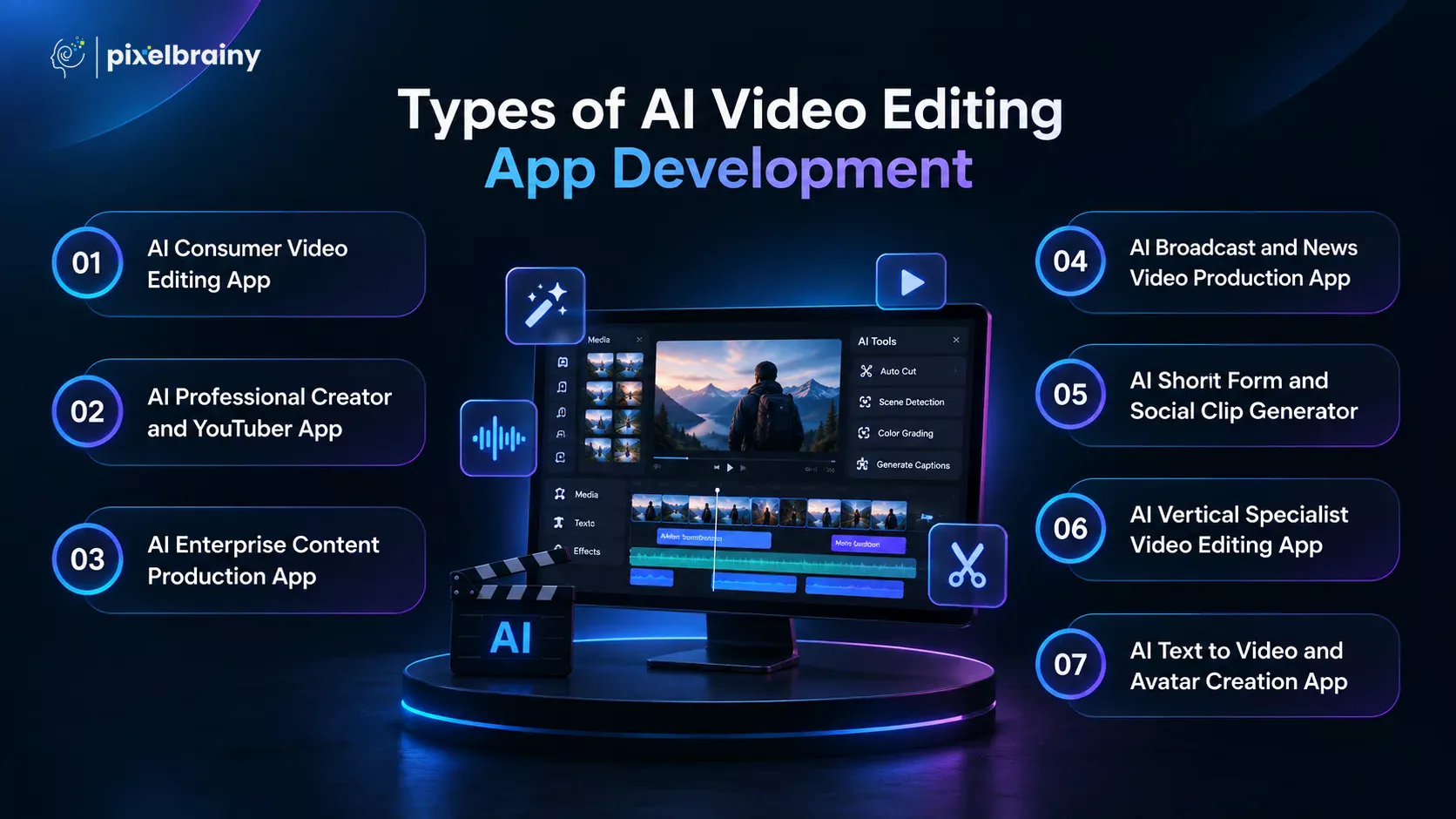
An AI Consumer Video Editing App is designed for everyday users who want professional looking videos without learning complex editing software. Its primary audience includes social media creators, influencers, freelancers, small business owners, and smartphone users who prefer a simple, guided editing experience.
The application automatically performs tasks such as trimming clips, selecting highlights, adding transitions, generating captions, enhancing video quality, and exporting content optimized for Instagram, TikTok, YouTube Shorts, and Facebook Reels. The entire editing process requires minimal user input while delivering polished results.
Product Design Implication: Prioritize simplicity, mobile first design, one tap editing workflows, AI automation, and intuitive user interfaces over advanced manual editing controls.
This category targets experienced content creators, YouTubers, podcasters, filmmakers, and creative professionals who understand video editing but want AI to accelerate repetitive production tasks rather than replace their creative decisions.
Instead of fully automating editing, AI assists with scene detection, silence removal, subtitle generation, color enhancement, multicamera synchronization, audio cleanup, and content organization while allowing creators to retain complete editorial control over the final output.
Product Design Implication: Balance AI automation with advanced editing capabilities so users can customize every creative decision while benefiting from intelligent workflow acceleration.
Enterprise AI video editing platforms are built for large organizations, marketing departments, corporate communication teams, and creative agencies that produce hundreds or even thousands of branded videos every year.
These platforms automatically enforce brand guidelines, generate multiple platform specific versions from a single master video, support collaborative editing, integrate with Digital Asset Management (DAM) systems, and connect with enterprise workflow platforms.
For example, a global enterprise may ask:
"We want to build an AI video editing app that can take a master English language video and automatically generate localized versions in 14 languages through AI dubbing, lip sync adjustment, on screen text translation, and culturally appropriate visual adaptation."
This type of solution focuses heavily on automation, localization, and enterprise scalability.
Product Design Implication: Enterprise platforms require robust security, role-based access control, cloud scalability, workflow automation, multilingual AI capabilities, and integration with existing business systems.
Broadcast organizations and news agencies work under strict publishing deadlines where editing speed and editorial accuracy are equally important. AI can significantly reduce production time by automating repetitive technical tasks while allowing journalists and producers to maintain editorial oversight.
A common business requirement might be:
"We are a news media company that publishes more than 50 video news segments every day and we want to build an AI video editing app that automatically converts raw recordings into broadcast ready news packages with captions, lower thirds, intro graphics, and multiple export formats."
The AI handles caption generation, lower thirds, timing adjustments, graphics insertion, and export optimization while editors focus on journalistic quality.
Product Design Implication: Prioritize real time processing, newsroom integrations, editorial approval workflows, live production support, and highly reliable AI automation.
This type of application focuses exclusively on converting long form videos into engaging short form content for social media platforms.
Using AI, the application automatically identifies the most engaging moments, creates highlight clips, generates captions, applies transitions, recommends background music, optimizes aspect ratios, and publishes directly to platforms like Instagram Reels, TikTok, YouTube Shorts, and Facebook Reels.
This category is experiencing rapid growth and has become a major focus for AI short form video editing app development, especially among creators, agencies, and digital marketing teams.
Product Design Implication: Build highly accurate highlight detection, fast rendering pipelines, platform specific optimization, and seamless social media publishing capabilities.
Rather than serving a broad audience, these applications focus on solving video production challenges within a specific industry using specialized AI models.
Examples include:
Consider these real-world scenarios:
We are a sports technology company that has contracts with 12 collegiate athletic programs and want to build an AI video editing app that automatically generates professional game highlight reels within 30 minutes after the final whistle by detecting goals, celebrations, crowd reactions, and key plays.
These applications achieve higher accuracy because the AI models are trained for industry specific workflows rather than general purpose editing.
Product Design Implication: Invest in domain specific datasets, customized AI models, specialized integrations, and workflows tailored to the unique needs of each industry.
Instead of editing existing footage, this category generates complete videos from text prompts or written scripts.
Users simply enter a script, select an AI avatar, choose a voice, define branding preferences, and let the platform automatically create presentation videos, product demonstrations, training content, onboarding videos, and multilingual marketing assets without recording a camera.
These applications are especially valuable for enterprises producing educational content, internal communications, customer onboarding materials, and product explainers at scale.
Product Design Implication: Focus on high-quality AI avatars, realistic voice synthesis, multilingual support, text to video generation, branding customization, and scalable cloud rendering infrastructure.
The type of application you choose during AI video editing app development determines your core AI capabilities, target audience, user experience, cloud infrastructure, processing requirements, and revenue model.
Defining the right product category before you develop AI video editing app solutions lays the foundation for building a scalable platform that aligns with your business goals, whether you're targeting creators, enterprises, media companies, or specialized industries in how to build scalable AI video editing app for enterprise content teams and media companies in 2026.
The increasing demand for video content, combined with rapid advancements in artificial intelligence, has created significant opportunities for businesses investing in AI video editing app development. Organizations across industries are searching for intelligent solutions that simplify video production, reduce editing time, and enable users to create professional quality content without extensive technical expertise.
For startups, SaaS companies, enterprises, and digital product owners, building an AI video editing app is more than launching another creative tool. It is an opportunity to solve a growing market need while creating a scalable business with recurring revenue potential. Beyond improving the editing experience for users, AI powered applications also provide long term competitive and commercial advantages.
Below are some of the key benefits of investing in AI video editing app development.
Video has become an essential communication and marketing channel for businesses of every size. Brands regularly create product demonstrations, promotional campaigns, educational videos, customer testimonials, webinars, and social media content to engage their audiences.
As content production requirements continue to increase, businesses need faster and more efficient editing solutions. An AI powered video editing app enables users to produce high-quality videos at scale without expanding their production teams.
Traditional editing software often requires significant time to master, making it difficult for beginners and non-technical users to produce professional results.
AI removes much of this complexity by automating editing tasks such as scene selection, caption generation, audio enhancement, background removal, and transition placement. This allows users with little or no editing experience to create polished videos through a simple and intuitive workflow.
Manual video editing involves numerous repetitive tasks that consume valuable time.
AI automates activities such as:
By reducing manual effort, users can publish content more frequently while maintaining consistent quality.
One of the biggest business advantages of AI video editing app development is its flexibility in generating revenue.
Popular monetization models include:
These recurring revenue streams support sustainable business growth while funding continuous product improvements.
Artificial intelligence learns from user preferences and editing behavior over time.
This enables the application to recommend:
Personalized experiences increase user satisfaction and encourage long term platform adoption.
Cloud based AI infrastructure allows video editing platforms to support growing user bases without major architectural changes.
Whether serving hundreds or millions of users, scalable cloud services make it possible to process large video files efficiently while maintaining consistent application performance.
This scalability is particularly valuable for SaaS businesses planning long term expansion.
Artificial intelligence introduces capabilities that traditional video editors cannot easily provide.
Examples include:
These features differentiate your application while providing users with measurable productivity improvements.
An AI video editing application is not limited to content creators or influencers.
Potential customers include:
Serving multiple industries creates broader revenue opportunities and reduces dependence on a single customer segment.
Artificial intelligence evolves rapidly, allowing businesses to introduce new features without redesigning the entire platform.
Future enhancements may include:
Regular innovation helps maintain customer interest while strengthening the product's competitive position.
The adoption of AI across creative industries continues to accelerate as businesses seek greater efficiency and automation.
Developing an AI powered video editing platform positions your business to capitalize on emerging technologies while meeting evolving customer expectations. As AI capabilities continue to advance, your application can expand with new features, additional use cases, and broader market opportunities without changing its core value proposition.
AI video editing app development combines strong market demand, scalable technology, intelligent automation, and recurring revenue opportunities, making it one of the most promising software investment opportunities for businesses looking to build innovative AI powered products.
Every successful AI powered application is built on a strong feature foundation that solves real user problems instead of overwhelming users with unnecessary functionality. During AI video editing app development, the primary goal should be creating an intuitive editing experience where users can transform raw footage into professional quality videos with minimal effort. These core features form the backbone of the application and deliver the essential functionality expected by creators, businesses, educators, and marketing teams.
For founders planning to build an AI video editing app, prioritizing the right feature set is critical for delivering value from the very first release. A well planned Minimum Viable Product (MVP) should focus on simplifying video uploads, automating repetitive editing tasks, improving collaboration, and ensuring seamless video exports across multiple platforms. Once these fundamentals are established, additional AI capabilities can be introduced as the product evolves.
Consider this practical scenario. Our digital marketing agency manages video campaigns for more than 80 clients every month, and we want to develop an AI video editing app that allows our team to upload raw videos, automatically create polished edits with captions, optimize videos for different social media platforms, and collaborate efficiently without relying on multiple editing tools. Building the right core features makes this workflow faster, more scalable, and significantly more productive.
The following features represent the essential capabilities every business should consider during AI video editing app development before expanding into advanced AI functionality.
| Core Feature | Why It Matters |
|---|---|
| User Registration and Secure Authentication | Every AI video editing application should provide secure user registration, login, password recovery, and social authentication options. A protected account system enables personalized workspaces, subscription management, saved projects, and secure access across multiple devices. |
| User Profile and Workspace Management | Users should have a dedicated workspace where they can manage personal information, editing preferences, saved templates, uploaded assets, completed projects, and account settings. Personalized workspaces improve organization and enhance the overall user experience. |
| Video Upload and Media Import | The application should support uploading videos from smartphones, desktops, cloud storage platforms, and external drives. Fast uploads with support for multiple video formats ensure users can begin editing without unnecessary compatibility issues. |
| Project Dashboard | A centralized dashboard helps users organize active projects, recently edited videos, draft versions, completed exports, and shared content. This feature simplifies project management and allows users to resume editing from where they previously stopped. |
| Automatic Video Trimming | Intelligent video trimming automatically removes unnecessary sections such as long pauses, blank frames, and unwanted clips. This significantly reduces manual editing time while creating cleaner and more engaging videos with minimal user intervention. |
| AI Generated Auto Captions | Automatic speech recognition converts spoken words into synchronized subtitles, making videos more accessible and engaging. Users can review, edit, and export captions that improve viewer retention across social media and business platforms. |
| Basic Video Enhancement | Essential enhancement tools automatically improve brightness, contrast, sharpness, audio clarity, and overall visual quality. These improvements help users produce professional looking videos without requiring advanced editing knowledge or manual adjustments. |
| Built In Media Library | A media library provides quick access to royalty free music, sound effects, icons, stickers, and basic graphics. Including these resources within the application reduces dependency on third party content platforms during editing. |
| Video Aspect Ratio Presets | Different social platforms require different video dimensions. Predefined aspect ratio options allow users to quickly optimize videos for Instagram Reels, TikTok, YouTube Shorts, Facebook, LinkedIn, and other publishing platforms without manual resizing. |
| Text and Title Editor | A built in title editor allows users to add headings, lower thirds, call to action messages, and simple text overlays. Easy customization ensures videos remain informative while maintaining consistent branding and readability. |
| Branding and Logo Integration | Businesses should be able to upload logos, brand colors, fonts, and watermark assets to maintain consistent branding across every exported video. This feature is particularly valuable for agencies, startups, and enterprise marketing teams. |
| Cloud Project Storage | Cloud storage enables users to securely save projects online, continue editing across multiple devices, and prevent data loss. Centralized storage also supports future collaboration and efficient project management as the application scales. |
| Export in Multiple Resolutions | Users should be able to export videos in different resolutions such as 720p, 1080p, and 4K depending on their subscription plan and publishing requirements. Flexible export options improve compatibility across multiple platforms and devices. |
| Social Media Sharing | After completing the editing process, users should be able to publish videos directly to platforms such as YouTube, Instagram, Facebook, TikTok, and LinkedIn without downloading files and manually uploading them elsewhere. |
| Notifications and Project Status Updates | Automated notifications keep users informed about upload progress, editing completion, rendering status, export availability, subscription updates, and shared project activities. Real time status updates improve transparency and overall user satisfaction. |
These core capabilities establish a reliable foundation for AI video editing app development, ensuring your product delivers immediate value while preparing the platform for advanced AI features, greater scalability, and future business growth.
Once the core functionality of your application is established, the next stage of AI video editing app development should focus on integrating advanced AI capabilities that differentiate your product from competitors. These features go beyond basic editing by leveraging artificial intelligence, machine learning, computer vision, and generative AI to automate complex creative tasks, enhance user productivity, and deliver highly personalized editing experiences.
For businesses planning to build an AI video editing app, advanced features are often the key differentiator that attracts premium subscribers and enterprise customers. While these capabilities may not be essential for an MVP, they play a crucial role in improving user retention, increasing customer lifetime value, and creating a sustainable competitive advantage as the platform evolves.
Consider this business scenario. We are a global eCommerce company producing thousands of product videos every month, and we want to develop an AI video editing app that automatically generates multilingual voiceovers, creates platform specific video versions, personalizes content for different customer segments, and significantly reduces our production time without expanding our creative team. Implementing advanced AI features enables businesses to automate high volume content production while maintaining quality, consistency, and scalability.
The following advanced features can help transform your product from a standard editing application into a next generation AI powered video production platform.
| Advanced Feature | Why It Matters |
|---|---|
| AI Text to Video Generation | This feature allows users to generate complete videos simply by entering a text prompt or script. The AI automatically selects visuals, animations, transitions, background music, and layouts, significantly reducing content production time for marketing, education, and business communication. |
| AI Voiceover Generation | AI powered voice synthesis converts written scripts into natural sounding voiceovers using multiple languages, accents, and speaking styles. This eliminates the need for professional voice artists while enabling businesses to produce multilingual video content at scale. |
| AI Avatar Presenter | Users can create professional presentation videos using realistic AI generated avatars instead of recording themselves. This feature is particularly valuable for corporate training, product demonstrations, customer onboarding, educational content, and business presentations. |
| Smart Scene and Highlight Detection | Computer vision algorithms automatically identify the most engaging moments within a video by analyzing facial expressions, movement, speech, and scene transitions. This helps users create highlight reels and promotional clips without manually reviewing hours of footage. |
| AI Background Replacement | Advanced AI accurately separates the subject from the background and replaces it with branded environments, virtual studios, images, or videos without requiring a physical green screen. This enhances creative flexibility while simplifying production workflows. |
| Multilingual Translation and AI Dubbing | AI automatically translates spoken dialogue, generates subtitles, creates realistic dubbed voiceovers, and synchronizes lip movements for multiple languages. This feature enables businesses to localize video content efficiently for global audiences. |
| AI Brand Style Automation | The application automatically applies predefined brand colors, fonts, logos, intros, outros, lower thirds, and visual styles across every video. Maintaining consistent branding becomes effortless, especially for agencies and enterprise marketing teams producing high volumes of content. |
| Intelligent Content Recommendations | By analyzing user behavior and previous editing patterns, AI recommends suitable templates, music, transitions, visual effects, and editing styles that align with the user's objectives. Personalized recommendations improve editing speed and overall user experience. |
| AI Quality and Compliance Review | Before exporting a video, AI automatically checks audio clarity, subtitle accuracy, branding consistency, aspect ratios, resolution quality, and publishing requirements. This helps identify issues early and reduces manual quality assurance efforts. |
| Collaborative AI Workflow Assistant | This feature supports team-based editing by assigning editing tasks, tracking review progress, suggesting workflow improvements, generating editing summaries, and notifying stakeholders throughout the production lifecycle. It improves collaboration for agencies, enterprises, and distributed creative teams. |
Integrating these advanced AI capabilities enables businesses to build an AI video editing app that delivers greater automation, stronger competitive differentiation, premium user experiences, and long-term scalability in an increasingly AI driven content creation market.
Developing an AI powered video editing application requires much more than integrating artificial intelligence into a traditional video editor. It involves identifying the right market opportunity, designing intuitive user experiences, selecting suitable AI models, building scalable infrastructure, training algorithms with quality datasets, and continuously improving the platform based on user behavior and performance analytics. Every stage contributes to delivering a reliable, intelligent, and commercially successful product.
If you're researching how to develop an AI video editing app from scratch, the development journey should begin with a clear understanding of your target audience and business objectives rather than the technology itself. The architecture, AI capabilities, cloud infrastructure, and feature roadmap should all align with the specific problem your application aims to solve.
Consider this business scenario. Our venture backed startup is building an AI video editing app that uses AI to analyze the emotional engagement curve of a video and automatically recut it to maximize viewer retention based on predicted drop off points. We want the AI to learn from engagement analytics data across thousands of videos to continuously improve its understanding of what editing decisions keep viewers watching. Developing this type of intelligent platform requires a structured development strategy that combines data science, machine learning, scalable engineering, and user centered product design.
The following roadmap outlines the complete development process of AI video editing app, helping businesses understand how to move from an initial idea to a market ready AI powered solution.
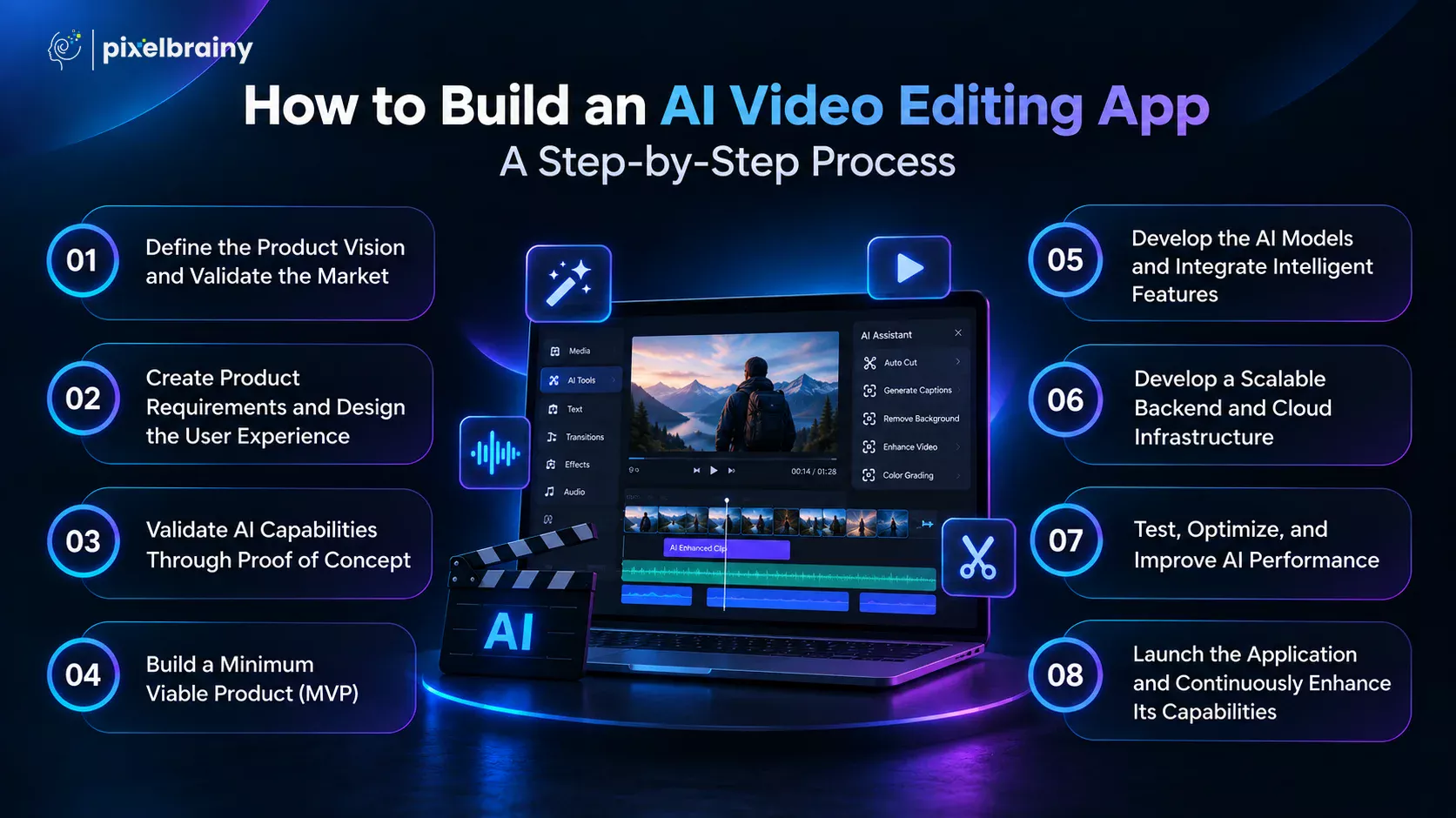
Every successful AI video editing app development project starts with defining the problem your application will solve. Rather than trying to build a platform for everyone, identify a specific audience such as content creators, marketing agencies, enterprises, educators, sports organizations, or media companies. Understanding their daily challenges helps prioritize features that deliver measurable value.
Conduct detailed market research to analyze competing products, identify feature gaps, validate customer demand, and evaluate monetization opportunities. This stage should also define your unique value proposition, pricing strategy, target platforms, and long-term product roadmap. Many businesses also begin with AI consultation solutions to evaluate technical feasibility, AI implementation strategies, and overall business viability before moving into development.
Once the business objectives are finalized, the next step is documenting detailed functional and technical requirements. Define user roles, editing workflows, AI automation capabilities, dashboard layouts, subscription plans, project management features, and cloud storage requirements.
At the same time, invest in designing an intuitive user experience that minimizes complexity and allows users to complete editing tasks with minimal learning. Collaborating with an experienced UI/UX design company helps create user journeys, wireframes, interactive prototypes, and interface designs that improve usability while supporting future feature expansion. Since many users will have little editing experience, simplicity should remain a core design principle throughout the application.
Before investing significant development resources, it is advisable to validate the most critical AI functionality through a Proof of Concept. This stage confirms whether the selected AI models can accurately perform the tasks your application promises, such as automatic trimming, scene detection, speech recognition, subtitle generation, or engagement prediction.
A structured PoC development approach allows businesses to test AI performance using representative datasets, evaluate inference speed, estimate infrastructure costs, and identify technical limitations early in the project lifecycle. Validating AI capabilities before full scale development minimizes project risks while ensuring the selected technologies can deliver the expected user experience.
After validating the core AI capabilities, focus on developing a Minimum Viable Product that delivers the essential value proposition without introducing unnecessary complexity. The MVP should include only the features required to solve the primary customer problem while enabling early user testing and product validation.
Typical MVP functionality may include secure user authentication, video uploads, automatic trimming, subtitle generation, basic enhancement tools, cloud project storage, and video export capabilities. Following an MVP development strategy enables businesses to collect user feedback, validate market demand, measure user engagement, and refine the product before investing in advanced AI features or enterprise level scalability.
Also Read: Top 10 AI MVP Development Companies in USA
With the product foundation established, the next phase focuses on the intelligence that powers the application. This is where the development of AI video editing app shifts from traditional software engineering to building machine learning driven experiences. The selected AI models should align with the product vision and the problems your target audience expects the application to solve.
Depending on your business objectives, the platform may integrate computer vision for scene recognition, speech recognition for automatic captions, natural language processing for text-based editing, recommendation engines for editing suggestions, and generative AI for voiceovers or video generation. Businesses also leverage specialized AI integrating services to connect pretrained AI models with cloud infrastructure, allowing faster deployment while maintaining scalability. At this stage, developers should also train and continuously refine AI models using diverse datasets so the application becomes more accurate and intelligent as more users interact with the platform.
An AI video editing application processes large media files, executes computationally intensive AI models, and often serves thousands of concurrent users. For this reason, scalability should be considered from the beginning rather than after product launch. A robust backend architecture ensures reliable performance as user traffic and video processing workloads continue to grow.
The infrastructure should support secure authentication, cloud storage, AI processing pipelines, media transcoding, project synchronization, notification services, payment processing, analytics, and API integrations. Containerized deployments, microservices architecture, GPU enabled cloud computing, and distributed storage solutions help maintain high performance while controlling operational costs. Businesses comparing top AI app development companies often evaluate their experience in designing scalable AI architectures capable of supporting enterprise level workloads and continuous feature expansion.
Testing an AI powered application extends far beyond verifying software functionality. Every AI feature must be evaluated for accuracy, consistency, speed, and overall user satisfaction before deployment. Since artificial intelligence continuously learns from new data, ongoing optimization becomes an essential part of maintaining product quality.
Quality assurance teams should perform functional testing, usability testing, security testing, performance testing, compatibility testing, and AI model validation. The accuracy of automatic captions, scene detection, highlight generation, recommendation engines, and video enhancement should be measured against predefined benchmarks. User feedback should also be analyzed to identify editing inaccuracies, improve recommendation quality, and retrain AI models. Continuous monitoring ensures the platform delivers reliable results while adapting to changing user expectations and evolving content trends.
Launching the first production version marks the beginning of product evolution rather than the completion of development. Once users begin interacting with the application, valuable behavioral data becomes available for improving AI recommendations, refining workflows, and introducing new capabilities based on actual usage patterns.
After release, monitor key performance indicators such as user acquisition, project completion rates, AI accuracy, rendering speed, customer retention, subscription conversions, and feature adoption. Analytics can reveal where users encounter friction, which AI recommendations produce the best engagement, and which editing workflows require optimization. Regular feature updates, model retraining, infrastructure improvements, and customer feedback loops ensure the platform remains competitive as artificial intelligence technologies continue advancing. This continuous improvement approach is essential for businesses focused on building an AI video
Therefore, a structured development process, supported by the right AI technologies, scalable architecture, and continuous product improvement, lays the foundation for building an AI video editing app that delivers exceptional user experiences while remaining competitive in an evolving AI driven market.
Also Read: AI Mobile App Development for Startups and Enterprises: Benefits, Steps and Challenges
Estimating the budget is one of the first questions businesses ask before starting AI video editing app development. However, there is no fixed development cost because every application differs in terms of features, AI capabilities, supported platforms, cloud infrastructure, integrations, and scalability requirements. A simple AI powered editing application designed for creators requires significantly less investment than an enterprise platform capable of processing thousands of videos simultaneously with advanced automation and multilingual support.
If you're wondering what is the cost to make an AI video editing app, the average AI video editing app development cost in 2026 typically ranges between $25,000 and $250,000+. The final investment depends on factors such as product complexity, AI model development, UI and UX design, backend architecture, cloud infrastructure, third party integrations, security, testing, and ongoing maintenance.
Consider this business scenario. We are launching a SaaS platform for marketing agencies and want an AI video editing application that automatically edits promotional videos, generates captions, supports team collaboration, and scales to thousands of users. We also need multilingual support and cloud-based rendering. What will the development budget look like? The answer depends on the scope of features and the level of AI intelligence integrated into the platform.
| Application Type | Estimated Development Cost | What You Will Get |
|---|---|---|
| Basic AI Video Editing App | $25,000 to $60,000 | User authentication, video upload, automatic trimming, AI captions, basic video enhancement, cloud storage, project dashboard, multiple export formats, and social media sharing. Suitable for MVPs and startups validating their product idea. |
| Advanced AI Video Editing App | $60,000 to $150,000 | Everything included in the basic version along with AI recommendations, smart scene detection, background replacement, brand management, collaboration features, analytics, subscription management, and enhanced AI automation. Ideal for growing SaaS businesses and agencies. |
| Enterprise AI Video Editing App | $150,000 to $250,000+ | Enterprise grade security, multilingual AI dubbing, AI avatars, workflow automation, custom AI models, enterprise integrations, cloud rendering infrastructure, role-based access control, advanced analytics, API ecosystem, and global scalability for large organizations. |
The above estimates provide a general AI video editing app cost breakdown. Your actual investment will depend on the product vision, technical requirements, and the level of customization required.
Estimated Cost: $2,000 to $8,000
Every successful project begins with market research, competitor analysis, requirement gathering, feature prioritization, and technical planning. Investing in this phase helps define a clear roadmap, minimizes development risks, and prevents unnecessary expenses later in the project.
Estimated Cost: $5,000 to $20,000
A clean, intuitive, and user-friendly interface is essential for attracting and retaining users. This phase includes user research, wireframing, interactive prototypes, visual design, design systems, and responsive layouts for web and mobile applications.
Estimated Cost: $15,000 to $80,000+
Artificial intelligence is the most significant cost driver in the cost of building an AI video editing app in 2026. Expenses depend on whether you integrate existing AI APIs or develop custom machine learning models for tasks such as scene detection, automatic editing, subtitle generation, voice recognition, recommendation systems, and video enhancement.
Estimated Cost: $15,000 to $70,000
This stage covers application development for mobile, web, or desktop platforms along with backend APIs, authentication systems, project management, media processing, databases, payment integration, and cloud connectivity.
Estimated Cost: $5,000 to $40,000+
AI video editing applications require significant computing power for rendering videos, processing AI models, storing media files, and handling concurrent users. Cloud infrastructure costs vary based on storage capacity, GPU processing requirements, bandwidth consumption, and expected user traffic.
Estimated Cost: $3,000 to $20,000
Many applications integrate external services for payments, authentication, cloud storage, AI processing, analytics, notifications, and social media publishing. The number and complexity of these integrations directly influence the overall project budget.
Estimated Cost: $5,000 to $15,000
Comprehensive testing ensures that AI models, editing workflows, rendering pipelines, user interfaces, and cloud infrastructure perform reliably under different usage scenarios. This phase includes functional testing, security testing, performance testing, compatibility testing, and AI accuracy validation.
Estimated Cost: $2,000 to $10,000
Launching an application involves configuring production servers, cloud deployment, application store submissions, security configurations, monitoring tools, backup systems, and production environment optimization.
Estimated Annual Cost: 15% to 25% of the Initial Development Cost
After launch, regular maintenance is required to improve AI models, release feature updates, fix bugs, strengthen security, optimize performance, and ensure compatibility with new operating systems and cloud technologies.
Several business and technical decisions can significantly influence the AI video editing app development cost, including:
Each additional capability increases both development effort and infrastructure requirements, making early feature prioritization essential for effective budget planning.
The cost of building an AI video editing app depends on your product vision, AI capabilities, scalability requirements, and business objectives, making careful planning the key to maximizing both development efficiency and long term return on investment.

Also Read: AI App Development Cost: From MVPs to Full-Scale AI App
The technology stack you choose plays a crucial role in the success of AI video editing app development. From frontend frameworks and backend technologies to AI models, cloud infrastructure, and video processing tools, every component influences your application's performance, scalability, security, and future expansion. Selecting the right technologies also helps reduce development complexity while supporting advanced AI capabilities as your product grows.
For example, our SaaS startup is planning to create an AI video editing app for content creators and marketing teams that offers automatic captions, AI scene detection, cloud rendering, and multilingual video exports. We need a technology stack that delivers high performance today while remaining scalable for future AI innovations.
The following tech stack is commonly recommended for the development of AI video editing app projects and provides a strong foundation for building a reliable and future ready solution.
| Technology Layer | Recommended Tools & Technologies | Purpose |
|---|---|---|
| Frontend Development | React, Next.js, Angular, Vue.js | Builds responsive, interactive, and high performance web interfaces with an intuitive editing experience. |
| Mobile App Development | Flutter, React Native, Kotlin, Swift | Develops cross platform or native mobile applications for Android and iOS users. |
| Backend Development | Node.js, Python, Java, Go, .NET | Handles APIs, authentication, business logic, video processing workflows, and user management. |
| AI and Machine Learning Frameworks | TensorFlow, PyTorch, OpenCV, Hugging Face Transformers | Powers computer vision, speech recognition, recommendation engines, object detection, and intelligent video editing automation. |
| Natural Language Processing | OpenAI APIs, spaCy, NLTK, LangChain | Supports text based editing, subtitle generation, prompt understanding, script analysis, and AI recommendations. |
| Video Processing Engine | FFmpeg, GStreamer, MediaPipe | Performs video trimming, transcoding, encoding, compression, frame extraction, and media manipulation efficiently. |
| Speech Recognition | OpenAI Whisper, Google Speech to Text, Deepgram | Converts spoken dialogue into accurate subtitles and searchable transcripts. |
| AI Voice Generation | ElevenLabs, Google Cloud Text to Speech, Azure AI Speech | Generates realistic multilingual voiceovers for marketing, education, and enterprise videos. |
| Database | PostgreSQL, MongoDB, MySQL, Redis | Stores user accounts, projects, AI metadata, subscriptions, analytics, and application data securely. |
| Cloud Infrastructure | AWS, Microsoft Azure, Google Cloud Platform | Provides scalable storage, GPU computing, AI processing, rendering services, and global application deployment. |
| Cloud Storage | Amazon S3, Azure Blob Storage, Google Cloud Storage | Securely stores uploaded videos, project files, exported content, and AI generated assets. |
| Authentication and Security | OAuth 2.0, Firebase Authentication, Auth0, JWT | Protects user accounts, manages secure logins, and safeguards sensitive business data. |
| Payment Integration | Stripe, PayPal, Razorpay | Supports subscription billing, recurring payments, and premium feature purchases. |
| Real Time Communication | WebSockets, Socket.IO, Firebase Realtime Database | Enables live collaboration, editing status updates, notifications, and team communication. |
| Analytics and Monitoring | Google Analytics, Mixpanel, Firebase Analytics, Datadog | Tracks user behavior, feature adoption, AI performance, application health, and business metrics. |
| DevOps and CI/CD | Docker, Kubernetes, GitHub Actions, Jenkins | Automates deployment, infrastructure management, scaling, testing, and continuous software delivery. |
| Project Management | Jira, Trello, ClickUp, Asana | Helps development teams manage tasks, sprint planning, collaboration, and project timelines efficiently. |
The right technology stack forms the foundation of successful AI video editing app development, enabling businesses to build secure, scalable, high-performance platforms that support intelligent automation, future innovation, and long-term business growth.
A well-defined monetization strategy is essential for the long-term success of any AI powered product. During AI video editing app development, your pricing model influences everything from feature planning and AI infrastructure to user acquisition, customer retention, and overall business profitability. Defining the monetization strategy early also helps determine which features should be available for free, which should be premium, and how AI processing resources will be allocated.
For instance, we are a talent agency representing 50 social media creators and we want to build a proprietary AI video editing app that automatically analyzes content performance across multiple platforms and recommends personalized editing styles for each creator. Since the platform serves multiple users and continuously processes AI recommendations, the monetization model should support recurring revenue while accommodating ongoing AI usage.
Below are the most popular monetization models businesses consider when they build AI video editing app solutions.
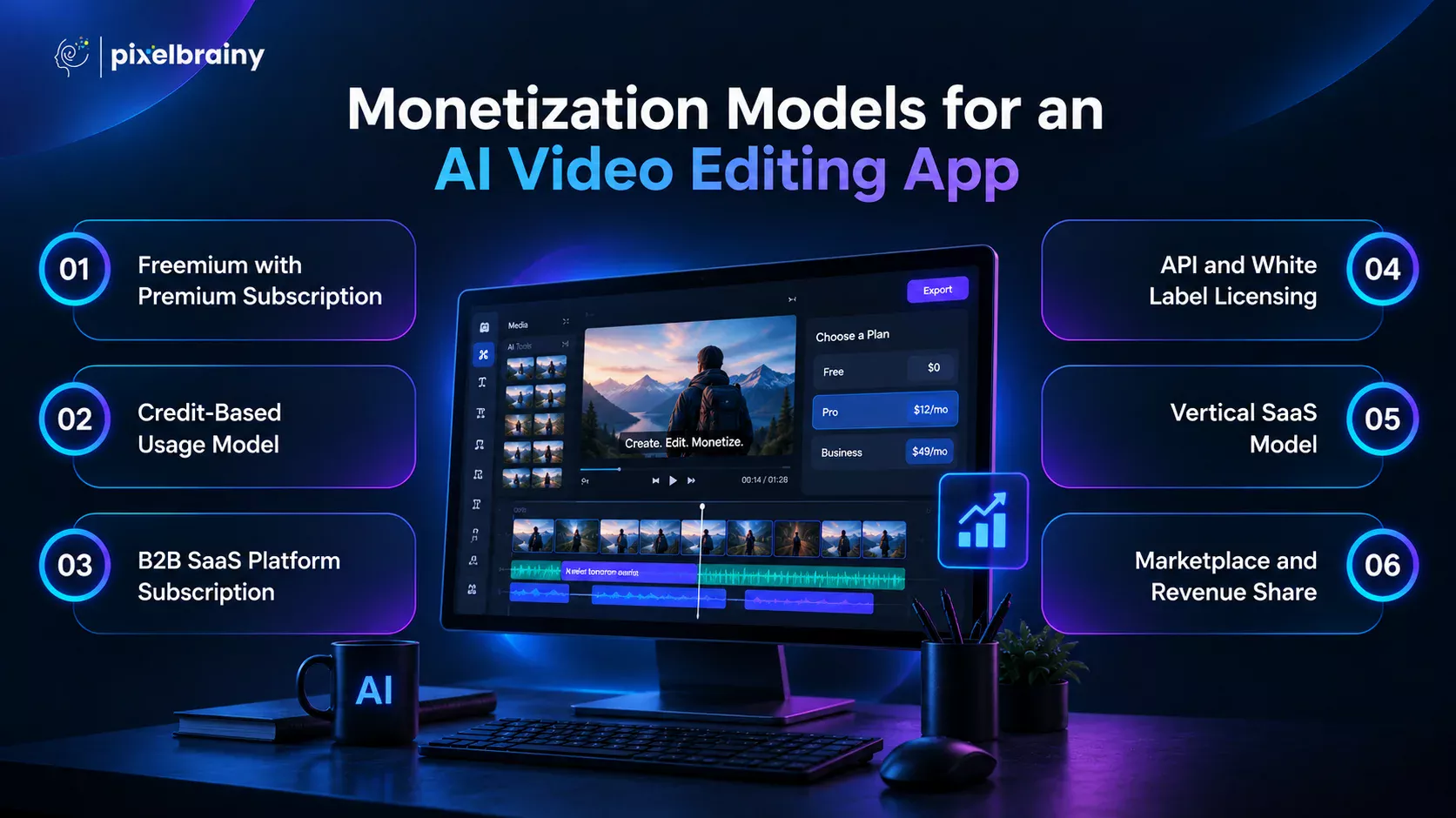
The freemium model is one of the most widely adopted pricing strategies for consumer-focused AI applications. Users receive free access to essential editing capabilities, but features such as unlimited AI edits, watermark free exports, higher video resolutions, premium templates, brand kits, and advanced AI tools remain available only through a paid subscription.
The biggest advantage of this model is its ability to attract a large number of users while encouraging upgrades as their editing requirements grow. However, the free version should provide enough value to attract users without reducing the incentive to purchase a premium plan. This model is ideal for startups focusing on AI video editing mobile app development for creators, influencers, freelancers, and small businesses.
Instead of charging users a fixed monthly subscription, the credit-based model allows customers to purchase AI processing credits that are consumed whenever they perform AI intensive editing tasks.
Each AI operation, such as automatic editing, subtitle generation, AI voiceovers, video enhancement, or background replacement, consumes credits based on video length and processing complexity. This approach benefits users with varying editing workloads because they only pay for what they actually use. The primary limitation is that some users may find it difficult to estimate future credit requirements.
The B2B SaaS subscription model is designed for businesses, agencies, and enterprise teams that require continuous access to AI powered editing tools.
Organizations pay monthly or annual subscription fees based on the number of users, storage capacity, monthly video processing limits, collaboration features, and AI capabilities included in each plan. This model generates predictable recurring revenue while supporting long term customer relationships.
For example, a marketing agency producing more than 200 video assets every month may develop an AI video editing app that automatically applies client branding, generates multiple social media versions, and supports collaborative editing through a subscription-based business model.
Instead of offering a standalone application, businesses can license their AI video editing engine to other software providers through APIs or complete white label solutions.
Clients integrate AI editing capabilities directly into their own products while paying per API request, monthly licensing fees, or enterprise contracts. This strategy creates strong B2B revenue opportunities and allows technology providers to expand their market reach without competing directly in the consumer application space.
This monetization model works particularly well for organizations specializing in AI infrastructure rather than end user software products.
A Vertical SaaS model focuses on serving a specific industry with highly specialized AI editing capabilities and customized pricing.
For example, a real estate technology company producing more than 2,000 property listing videos every month may build an AI video editing app that automatically transforms raw drone footage and interior walkthroughs into professionally branded property videos with subtitles, voiceovers, background music, and agency branding. Pricing can be based on individual property listings, monthly subscriptions, or agency plans.
The same approach can be applied to industries such as sports, weddings, healthcare, insurance, education, fitness, and corporate training, where customers can directly measure the time and cost savings generated by AI automation.
A marketplace model allows third party creators, designers, musicians, and template developers to sell digital assets directly within the platform.
Users can purchase premium video templates, stock footage, AI generated graphics, animations, sound effects, transitions, and licensed music, while the platform earns a commission on every transaction. This approach creates an additional revenue stream beyond subscriptions and also strengthens the overall ecosystem by continuously expanding available creative assets.
The ideal pricing strategy depends on the audience and business model identified during the planning stage.
Selecting the right monetization model before you develop AI video editing app solutions helps create a sustainable revenue strategy while ensuring the product architecture aligns with your target audience, AI capabilities, and long-term business goals.
Before you build an AI video editing app, it's important to study the products that have already validated the market. Analyzing successful AI powered video editing platforms helps founders understand user expectations, identify proven monetization strategies, and discover which AI capabilities are driving adoption across consumer, creator, and enterprise segments. Rather than copying existing products, businesses should learn from their strengths and identify opportunities to solve unmet customer needs.
If you're researching how to develop AI video editing app like CapCut or InVideo with advanced AI features, the following platforms provide valuable insights into product strategy, AI implementation, and market positioning.
CapCut has become one of the most successful AI powered mobile video editing applications in the world. Built primarily for creators, influencers, and small businesses, it simplifies video production through AI powered auto captions, smart background removal, AI effects, beauty filters, automatic templates, and social media optimized exports.
Its biggest competitive advantage lies in combining powerful AI automation with an intuitive mobile experience that allows beginners to create professional quality videos within minutes. Deep integration with short form content workflows has also contributed significantly to its global adoption.
Key takeaway for founders: Prioritize simplicity and automation. Users value AI that removes editing complexity without sacrificing creative quality.
Descript introduced a completely different approach by allowing users to edit videos through text transcripts instead of traditional editing timelines.
Its AI powered transcription engine, automatic filler word removal, Overdub voice cloning, screen recording, and collaborative editing capabilities have made it particularly popular among podcasters, educators, and YouTube creators.
Key takeaway for founders: Innovative user experiences often outperform feature heavy products. Rethinking how users interact with editing software can become a powerful competitive advantage.
Runway has established itself as one of the leading AI platforms for professional video generation and editing. It combines generative AI with advanced editing capabilities such as object removal, background replacement, motion tracking, text to video generation, and AI assisted visual effects.
Creative professionals, production studios, and enterprise teams use Runway because it significantly accelerates high-quality content production while preserving creative flexibility.
Key takeaway for founders: Advanced AI features should enhance professional creativity rather than replace it. Combining automation with creative control attracts high value users.
HeyGen focuses on AI avatars, multilingual video creation, voice cloning, AI dubbing, and realistic lip synchronization. The platform enables organizations to generate professional presentation videos without cameras, studios, or production teams.
Its strongest competitive advantage is helping global enterprises create localized marketing, onboarding, and training videos across multiple languages from a single master script.
For example, a global enterprise planning to build an AI video editing app that automatically localizes videos into 14 languages through AI dubbing, lip synchronization, translated on screen text, and culturally appropriate adaptations can learn valuable product and workflow strategies from HeyGen's enterprise first approach.
Key takeaway for founders: Enterprise customers value automation that reduces production costs while supporting multilingual communication at scale.
Videotto is an emerging AI native startup founded to simplify video editing through intelligent automation. The platform focuses on transforming long form recordings into short, engaging clips by using AI to automate repetitive editing tasks, making video production faster for creators and businesses. The company secured seed funding in 2025, reflecting growing investor confidence in AI native video editing solutions.
Key takeaway for founders: Emerging startups demonstrate that there is still significant room for innovation. Solving a focused problem exceptionally well often creates stronger product differentiation than attempting to build an all-in-one editing platform.
Studying successful platforms before you develop AI video editing app solutions provides valuable market validation and helps you build a product with stronger differentiation, better user experiences, and a clearer competitive strategy.
Transforming an AI video editing idea into a scalable and commercially successful product requires much more than software development expertise. It demands a deep understanding of artificial intelligence, machine learning, computer vision, cloud architecture, video processing technologies, and user centered product design. Choosing the right development partner can significantly influence your product's performance, scalability, and long-term success.
As one of the companies that develop AI video editing app solutions, PixelBrainy helps startups, enterprises, and growing businesses build intelligent AI powered products that solve real business challenges. As a trusted AI app development company in USA, our team combines technical expertise with business strategy to develop applications that are scalable, secure, and designed for future AI innovation.
Whether your goal is how to develop an AI video editing app for social media creators, marketing agencies, enterprise content teams, media organizations, or industry specific use cases, our development approach focuses on creating products that deliver measurable business value instead of simply implementing AI features.
Every project begins by understanding your business objectives, user expectations, and long-term product vision. Instead of forcing unnecessary AI capabilities into the application, we identify where artificial intelligence creates genuine value and improves the overall user experience.
Our team manages the complete development lifecycle, including:
This enables businesses to move from concept to market with a single technology partner.
Our developers work with advanced technologies including:
These capabilities help businesses create an AI video editing app that delivers intelligent automation while maintaining excellent performance and scalability.
Whether you're launching a startup MVP or building a large enterprise platform, we design cloud native architectures capable of supporting high volume video processing, AI inference workloads, secure collaboration, and global user growth.
Technology alone does not guarantee success.
Our development strategy prioritizes measurable business outcomes by helping clients reduce production costs, improve operational efficiency, automate repetitive workflows, and create sustainable recurring revenue models.
One of our recent projects involved developing an AI powered media automation platform for a confidential client operating in the digital education industry.
The client produced hundreds of instructor led training videos every month and wanted to reduce manual editing effort while maintaining consistent production quality.
Our team developed an AI powered workflow capable of:
The solution reduced average editing time by more than 70%, significantly increased production capacity, and enabled the client to publish training content much faster without expanding their editing team.
Businesses choose PixelBrainy because we combine AI expertise, product strategy, scalable engineering, and industry experience under one roof. We don't simply build applications. We help businesses launch intelligent digital products that are designed to grow with evolving market demands and emerging AI technologies.
Whether you are validating a startup idea, modernizing an existing product, or developing an enterprise AI platform, our team delivers customized solutions aligned with your business goals and technical requirements.
If your organization is evaluating how to develop an AI video editing app or looking for experienced companies that develop AI video editing app solutions, PixelBrainy is ready to help you create an AI video editing app that transforms your vision into a scalable, AI powered business product.
Artificial intelligence is redefining how videos are created, edited, and distributed, making it easier for businesses to produce professional quality content with greater speed and efficiency. As demand for intelligent video production continues to grow, AI video editing app development presents a valuable opportunity for startups, enterprises, and digital businesses looking to build innovative and scalable products. Whether your goal is to automate editing workflows, improve creator productivity, or deliver enterprise grade content solutions, success depends on combining the right AI technologies with a clear product strategy.
Throughout this guide, we've explored everything from planning and feature selection to the cost of building an AI video editing app, recommended technology stacks, monetization models, and the complete development process. If you're planning to build AI video editing app solutions or exploring how to develop an AI video editing app that stands out in a competitive market, investing in a scalable architecture and user focused AI capabilities will position your product for long term success.
Ready to turn your AI video editing app idea into reality? Schedule a call with our AI experts to discuss your vision, validate your product strategy, and discover how we can help you build a powerful, future ready AI video editing solution.
The timeline for AI video editing app development depends on the project's complexity, AI capabilities, supported platforms, and integration requirements. A basic MVP generally takes 3 to 5 months, while an advanced AI powered solution with custom machine learning models, enterprise features, and cloud infrastructure may require 8 to 12 months or longer.
Yes. Many businesses build AI video editing app solutions by integrating pretrained AI models for speech recognition, computer vision, subtitle generation, and content recommendations. This approach reduces development time and cost. However, custom AI models provide greater accuracy and competitive differentiation for industry specific use cases.
Although content creators are a major audience, AI video editing app development also delivers significant value for real estate companies, education providers, marketing agencies, media organizations, healthcare businesses, sports analytics firms, eCommerce brands, and enterprise communication teams that regularly produce large volumes of video content.
Absolutely. Businesses can develop AI video editing app solutions with multilingual capabilities such as AI dubbing, subtitle generation, voice cloning, automatic translation, and localized video exports. These features enable organizations to distribute content globally while maintaining consistent branding and reducing localization costs.
To create an AI video editing app, developers typically use Computer Vision, Machine Learning, Natural Language Processing, Speech Recognition, Generative AI, and recommendation engines. These technologies automate tasks such as scene detection, subtitle generation, video enhancement, voice synthesis, highlight extraction, and intelligent editing suggestions.
Scalability depends on cloud architecture rather than the application alone. Businesses usually deploy GPU enabled cloud infrastructure, distributed storage, video processing pipelines, and auto scaling services to ensure the platform can process thousands of videos simultaneously while maintaining consistent performance and fast rendering speeds.
Yes. Launching an MVP allows startups to validate customer demand, collect user feedback, and refine AI capabilities before making larger investments. An MVP focuses on solving the primary user problem first, reducing development risk while providing valuable insights for future product enhancements and feature prioritization.
When selecting a development partner, evaluate their expertise in artificial intelligence, cloud architecture, video processing technologies, mobile and web development, and scalable SaaS platforms. Reviewing previous AI projects, technical capabilities, communication process, and post launch support helps ensure your AI video editing app development project is delivered successfully and aligned with your long-term business goals.

About The Author
Sagar Bhatnagar
Sagar Sahay Bhatnagar brings over a decade of IT industry experience to his role as Marketing Head at PixelBrainy. He's known for his knack in devising creative marketing strategies that boost brand visibility and market influence. Sagar's strategic thinking, coupled with his innovative vision and focus on results, sets him apart. His track record of successful campaigns proves his ability to utilize digital platforms effectively for impactful marketing efforts. With a genuine passion for both technology and marketing, Sagar continuously pushes PixelBrainy's marketing initiatives to greater success.

Working with the PixelBrainy team has been a highly positive experience. They understand the design requirements and create beautiful UX elements to meet the application needs. The dev team did an excellent job bringing my vision to life. We discussed usability and flow. Sagar worked with his team to design the database and begin coding. Working with Sagar was easy. He has the knowledge to create robust apps, including multi-language support, Google and Apple ID login options, Ad-enabled integrations, Stripe payment processing, and a Web Admin site for maintaining support data. I'm extremely satisfied with the services provided, the quality of the final product, and the professionalism of the entire process. I highly recommend them for Android and iOS Mobile Application Design and Development.

Great experience working with them. Had a lot of feedback and I found that unlike most contractors they were bugging me for updates instead of the other way around. They were extremely time conscience and great at communicating! All work was done extremely high quality and if not on time, early! They were always proactive when it comes to communication and the work is great/above par always. Very flexible and a great team to work with! Goes above and beyond to present us with multiple options and always provides quality. Amazing work per usual with Chitra. If you have UI/UX or branding design needs I recommend you go to them! Will likely work with them in the future as well, definitely recommended!

PixelBrainy is a joy to work with and is a great partner when thinking through branding, logo, and website layout. I appreciate that they spend time going into the "why" behind their decisions to help inform me and others about industry best practices and their expertise.

I hired them to design our software apps. Things I really like about them are excellent communication skills, they answer all project suggestions and collaborate right away, and their input on design and colors is amazing. This project was complex and needed patience and creativity. The team is amazing to do business with. I will be using them long-term. Glad to see there are some good people out there. I was afraid to try and outsource my project to someone but I am glad I met them! I really can't say enough. They went above and beyond on this project. I am very happy with everything they have done to make my business stand out from the competition.

It was great working with PixelBrainy and the team. They were very responsive and really owned the project. We'll definitely work with them again!

I recently worked with the PixelBrainy team on a project and I was blown away by their communication skills. They were prompt, clear, and articulate in all of our interactions. They listened and provided valuable feedback and suggestions to help make the project a success. They also kept me updated throughout the entire process, which made the experience stress-free and enjoyable.

PixelBrainy is very good at what it does. The team also presents themselves very professionally and takes care of their side of things very well. I could fully trust them taking up the design work in a timely and organised manner and their attention to detail saved us lots of effort and time. This particular project was quite intense and the team showed that they function very well under pressure. Very much looking forward to working with her again!

It's always an absolute pleasure working with them. They completed all of my requests quickly and followed every note I had for them to a T, which made our process go smoothly from start to finish. Everything was completed fast and following all of the guidelines. And I would recommend their services to anyone. If you need any design work done in the future, PixelBrainy should be your first call!

They took ownership of our requirements and designed and proposed multiple beautiful variants. The team is self-motivated, requires minimum supervision, committed to see-through designs with quality and delivering them on time. We would definitely love to work with PixelBrainy again when we have any requirements.

PixelBrainy was a big help with our SaaS application. We've been hard at work with a new UI/UX and they provided a lot of help with the designs. If you're looking for assistance with your website, software, or mobile application designs, PixelBrainy and the team is a great recommendation.

PixelBrainy designers are amazing. They are responsive, talented, and always willing to help craft the design until it matches your vision. I would recommend them and plan to continue them for my future projects and more!!!

They were awesome! Did a good job fast, and good communication. Will work with them again. Thank you

Creative, detail-oriented, and talented designers who take direction well and implement changes quickly and accurately. They consistently over-delivered for us.

PixelBrainy team is very talented and creative. Great designers and a pleasure to work with. PixelBrainy is an excellent communicator and I look forward to working with them again.

PixelBrainy has a very talented design team. Their work is excellent and they are very responsive. I enjoy working with them and hope to continue on all of our future projects.


Transform your ideas into reality with us.
Across these industries, each engagement brings unique challenges, from early-stage product development to scaling complex systems, helping us build a practical understanding of real-world product environments.