 AI Summary Powered by PixelBrainy
What if your hotel could greet every guest personally, answer questions instantly, recommend relevant services, and generate additional revenue without requiring a human concierge to be available 24/7?
For a hotel technology startup, this is the opportunity behind AI avatar development for hotels. Imagine building a white-label digital concierge platform that boutique and independent hotels can license under their own brand, customize with their property information, and deploy across multiple locations without investing in proprietary AI infrastructure. Instead of requiring every hotel to build its own AI solution, your platform could provide a ready-to-brand AI avatar that communicates with guests through websites, mobile applications, kiosks, QR codes, smart TVs, messaging platforms, and in-room devices.
The challenge is understanding what it takes to build such a platform. Hotel AI avatar development involves much more than creating a realistic digital character. A commercially viable solution needs conversational AI, multilingual communication, hotel knowledge management, personalization, voice technology, property management integrations, booking capabilities, upselling workflows, analytics, security, and multi-property administration.
For a startup researching how to create an avatar for hotels, the development strategy should focus on a scalable SaaS architecture rather than a solution designed for one property. The objective is to develop an AI avatar for hotels that can operate as an AI avatar concierge for hotels while adapting its personality, appearance, knowledge, services, and branding for every property.
The key question is: What does building a white-label AI avatar hotel concierge SaaS platform cost, and which development companies have the hospitality domain knowledge and avatar technology required for multi-property independent hotel deployment?
This guide explains the custom hotel AI avatar development process, features, technology stack, development costs, business models, challenges, and implementation strategy involved in making an AI avatar for hotels.

An AI avatar for hotels is an AI-powered digital concierge that communicates with hotel guests through text, voice, or an interactive virtual character. It combines conversational artificial intelligence, natural language processing, voice technology, hotel-specific knowledge, and avatar animation to provide personalized guest assistance across digital and physical hotel touchpoints.
A hotel AI avatar can answer guest questions, provide information about hotel facilities, recommend services, assist with reservations, handle routine service requests, promote relevant upgrades, and transfer complex conversations to hotel employees. Depending on the implementation, guests can access the avatar through a hotel website, mobile application, in-room tablet, smart TV, lobby kiosk, QR code, or voice-enabled device.
The hotel AI avatar development process connects several technology layers to create a continuous digital concierge experience.
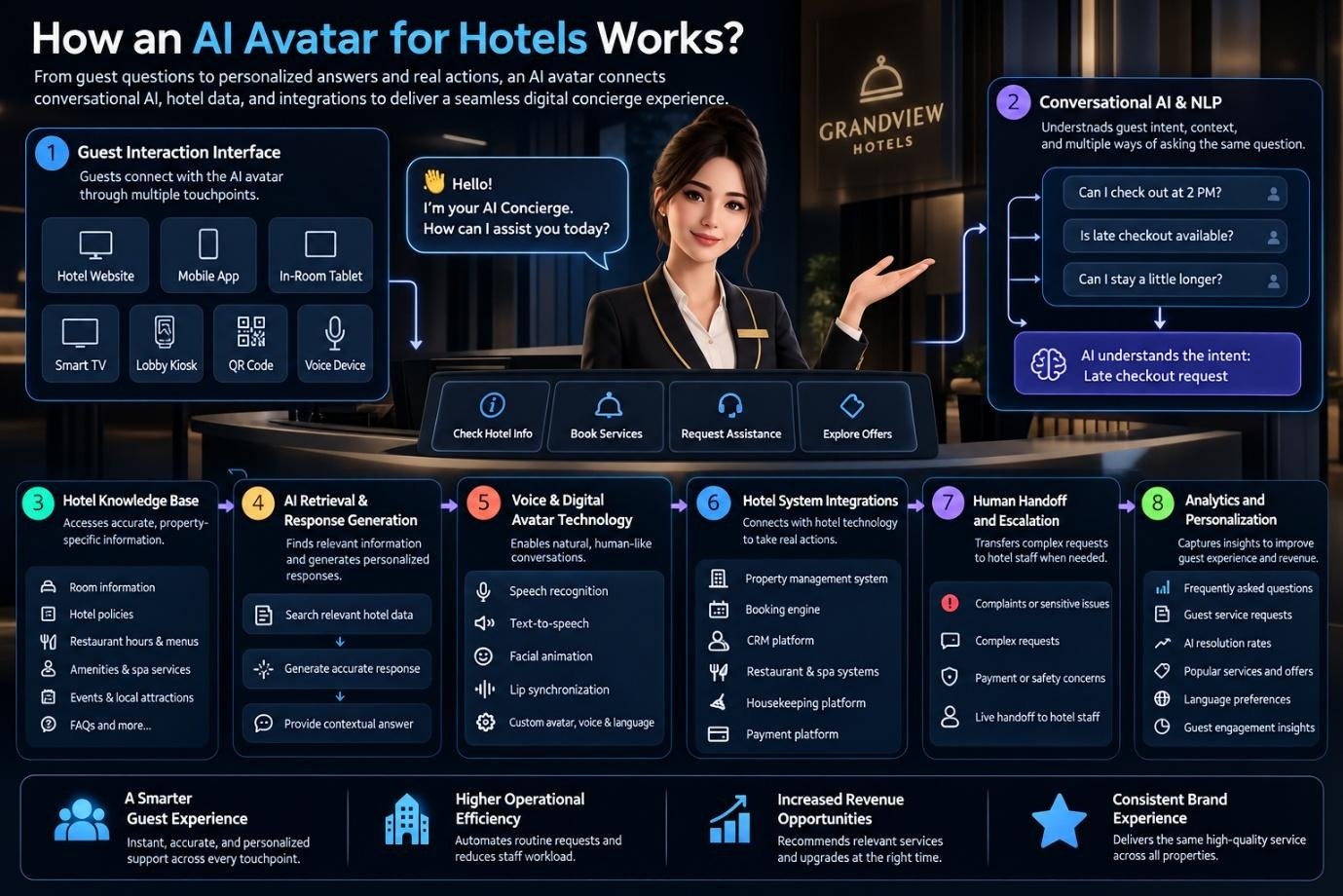
The experience begins when a guest interacts with the AI avatar. The interface can be embedded into the hotel's website or application, or deployed through a kiosk, QR code, smart TV, or in-room device.
The interface can display the hotel's branding, avatar, colors, messaging style, and service options.
The conversational AI interprets what the guest wants and determines the appropriate response or action.
For example, these questions can represent the same intent:
The AI can recognize that the guest is asking about late checkout and retrieve the relevant hotel policy.
The AI avatar needs access to accurate and current property information. A hotel knowledge base can contain:
For a white-label platform, every hotel should have its own isolated knowledge base and configuration.
When a guest asks a question, the platform identifies the relevant information from the hotel's knowledge sources and provides it to the AI model.
This approach helps the avatar provide property-specific answers rather than relying exclusively on general-purpose AI knowledge.
For example, if a guest asks, "What time does your restaurant close tonight?", the system should retrieve the hotel's current restaurant schedule before generating the response.
Advanced AI avatar development for hotels can combine conversational AI with speech recognition, text-to-speech, facial animation, lip synchronization, and digital human technology.
This enables a guest to ask a question verbally and receive a spoken response from a visually interactive hotel avatar.
The avatar's appearance, voice, personality, language, and communication style can also be customized according to the hotel's brand.
An AI avatar concierge for hotels becomes more powerful when it can connect with hotel technology systems.
Depending on the requirements, integrations may include:
These integrations can allow the AI to move beyond answering questions and perform specific actions, such as creating a housekeeping request, checking service availability, or facilitating a reservation.
AI should not attempt to handle every situation independently. When a guest has a complaint, complex request, safety concern, payment issue, or other situation requiring human judgment, the platform can escalate the conversation to the appropriate hotel employee.
This creates a hybrid service model where AI handles routine interactions while hotel staff manage situations requiring personal attention.
A hotel AI avatar platform can capture operational insights from guest interactions, subject to applicable privacy requirements.
Hotels can analyze:
For a startup building a white-label solution, these capabilities are especially important because the same platform can serve multiple independent hotels while allowing each property to maintain its own branding, knowledge, services, and guest experience.
Hotel AI avatar development therefore involves much more than creating a digital character. It requires combining conversational AI, hotel data, voice technology, avatar technology, integrations, automation, analytics, and human escalation into a unified digital concierge platform.
Why are hotels moving from basic AI experimentation toward dedicated AI-powered guest interfaces in 2026? The answer lies in a combination of rapid AI adoption, changing guest expectations, rising technology investment, and the growing need for hospitality businesses to build scalable digital infrastructure.
The global Travel & Tourism sector is entering 2026 at significant scale. The World Travel & Tourism Council (WTTC) forecasts that the sector will contribute $12 trillion to the global economy in 2026, representing 9.9% of global GDP, while supporting approximately 376 million jobs worldwide. WTTC also forecasts Travel & Tourism growth of 3.2% in 2026, ahead of projected global economic growth of 2.4%.
The hospitality market is no longer treating AI solely as an experimental technology. A March 2026 study from Canary Technologies found that 71% of hospitality professionals surveyed consider AI to have a significant or transformative impact on the industry, while 85% expect to allocate at least 5% of their IT budget to AI tools in 2026. Furthermore, 82% expect AI usage to increase across their organization during the following year.
This creates a strong market case for hotel AI avatar development. Hotels are increasingly allocating technology budgets toward AI, but many are still determining how to convert general-purpose AI capabilities into specialized hospitality applications.
The September 2026 State of Distribution report from NYU SPS, RateGain, and HEDNA analyzed more than 58,000 hotel properties across 53 countries and 141 cities. It found that more than half of hotels are already using or procuring generative AI, while fewer than one in ten reported reductions in manual work above 30%. The report identifies disconnected systems, data fragmentation, and vendor complexity as major obstacles to achieving meaningful AI outcomes.
This gap is particularly relevant for businesses considering developing an AI avatar for hotels. The opportunity is not simply to add another AI tool. It is to create a hospitality-specific interface that connects AI with hotel data, workflows, systems, and guest interactions.
The direction of hospitality technology is also shifting toward AI that can execute tasks rather than simply generate information. Oracle's 2026 OPERA Cloud updates introduced AI capabilities designed to work directly within hotel workflows, including AI-assisted room assignments, rate descriptions, operational guidance, and multilingual support.
For hotel operators and hospitality technology startups, this makes AI avatar concierge development a strategic product consideration. The avatar can become the guest-facing layer connecting conversational AI with the hotel's underlying technology ecosystem.
For a white-label platform, the opportunity is even broader: one scalable AI architecture can be configured for multiple independent hotels while each property maintains its own brand, content, services, personality, and operational rules.
The 2026 hospitality market indicates that AI adoption is accelerating, while the gap between AI experimentation and practical implementation remains significant. This makes specialized hotel AI avatar development an increasingly relevant technology investment for the next generation of digital hospitality.
Not every hotel requires the same type of AI avatar. A luxury property may need a highly personalized digital host, while a boutique hotel may prioritize operational efficiency. A resort may require destination intelligence, whereas a hotel management company may need a centralized platform capable of supporting hundreds of independently branded properties.
The AI avatar for hotel development approach should therefore be based on property type, guest journey, operating model, technology infrastructure, and business objectives. When businesses build an AI avatar for hotel environments, the avatar's personality, capabilities, integrations, knowledge base, and deployment model should be designed around the specific hospitality use case.
Here are the major types of AI avatar hotel development models to consider.
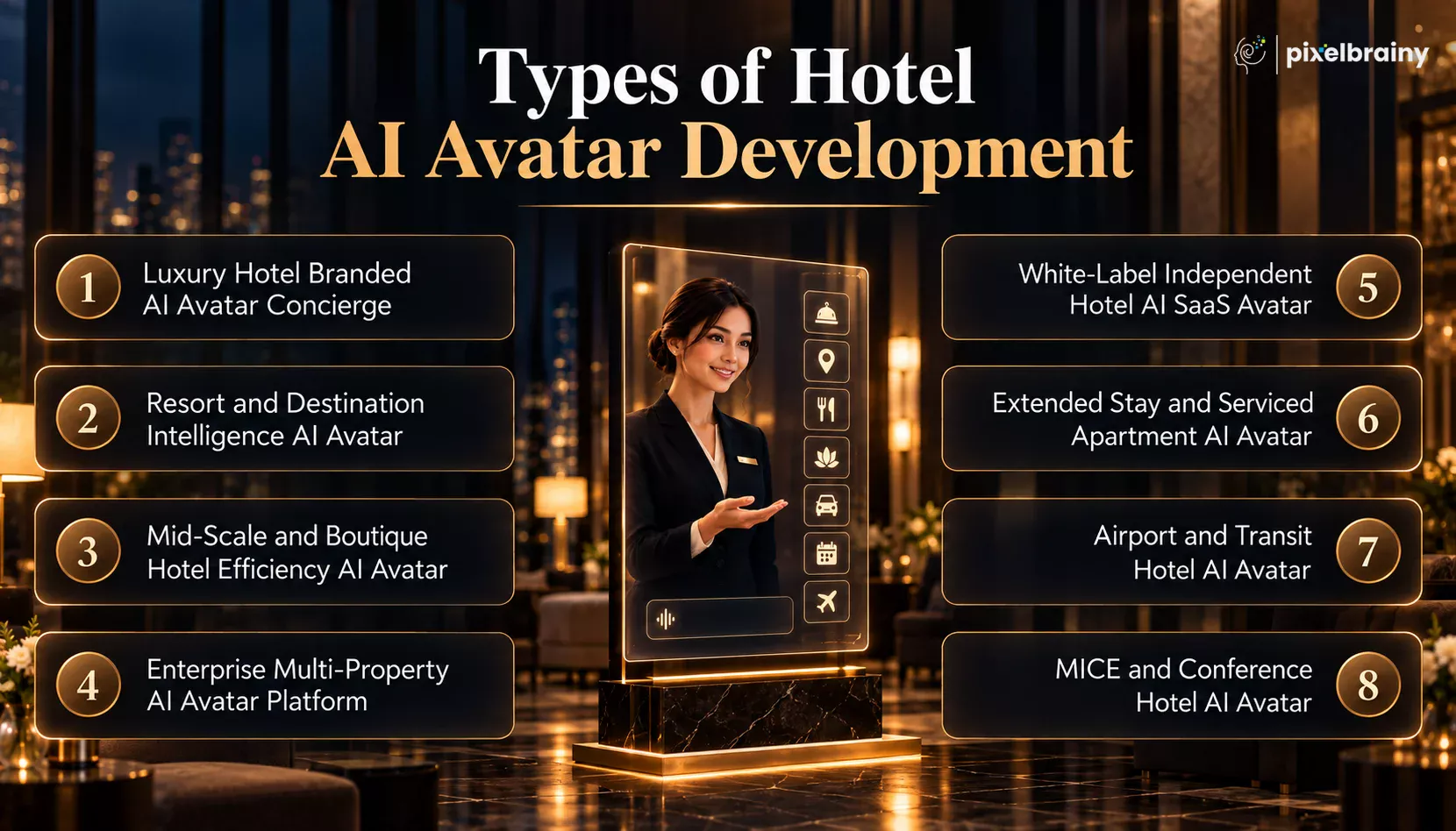
A luxury hotel requires an AI experience that reflects exclusivity, personalization, and brand identity. A generic chatbot with an animated character may not be sufficient.
A luxury AI avatar can function as a virtual concierge, helping guests with:
The avatar can be designed around the hotel's visual identity, including a custom appearance, voice, personality, communication style, and language.
The objective of AI virtual concierge avatar development for luxury hotels is to create a digital experience that feels like an extension of the hotel's human concierge team.
Ideal for:
Luxury hotels, five-star properties, heritage hotels, premium resorts, and high-end boutique properties.
A resort operates differently from a conventional city hotel. Guests may spend several days on the property and expect assistance with both hotel services and destination activities.
When you develop an AI avatar for hotel resorts, the avatar can become a destination intelligence assistant.
It can provide information about:
For a resort property looking to build an hotel AI avatar platform, the AI should combine property knowledge with destination knowledge.
For example, a guest could ask:
"What's the best family activity this afternoon?"
Instead of simply displaying a list of attractions, the AI could identify suitable activities based on the guest's available time, interests, location, and resort services.
Ideal for:
Beach resorts, destination resorts, wellness resorts, mountain resorts, theme resorts, and large vacation properties.
Mid-scale and independent hotels may not need an extremely sophisticated digital human experience. Their primary requirement may be efficient guest communication with limited operational complexity.
An AI avatar can handle repetitive questions related to:
For these properties, the AI avatar for hotel development strategy should prioritize usability, affordability, fast deployment, and integration with existing hotel systems.
The avatar can also provide a consistent digital service experience without requiring a large technology team at every property.
Ideal for:
Boutique hotels, independent hotels, limited-service hotels, and mid-scale properties.
Large hotel management companies may oversee dozens or hundreds of properties, creating a different development requirement.
For example, a hotel management company managing 120 independent properties could require one centralized AI avatar platform where every property has its own branded digital concierge.
The platform could provide centralized administration while allowing each hotel to configure:
The corporate team could manage the underlying platform while individual properties manage their own guest-facing information.
This approach is particularly valuable when companies want to build AI avatar for hotels without developing and maintaining a separate AI system for every property.
Ideal for:
Hotel management companies, hospitality groups, franchise organizations, and multi-property operators.
A white-label AI avatar is particularly relevant for a hotel technology startup targeting independent and boutique properties.
Instead of every hotel developing proprietary AI technology, the startup provides the infrastructure as a SaaS platform.
Each hotel can license the platform and deploy its own branded avatar.
For example:
Platform Provider → Hotel A → Hotel B → Hotel C → Hotel D
The underlying technology remains centralized, while each hotel receives an individual digital concierge experience.
A white-label platform can include:
This model directly addresses the requirement to build a white-label AI avatar digital concierge platform for hotels that boutique and independent hotels can license under their own brand without building proprietary technology.
The development architecture should support multi-tenancy from the beginning so that adding new properties does not require rebuilding the product.
Ideal for:
Hotel technology startups, hospitality SaaS companies, hotel consultants, and technology providers serving independent properties.
Extended-stay guests have a different relationship with the property because they may remain for weeks or months rather than a few nights.
An AI avatar for serviced apartments should therefore focus on ongoing relationships rather than one-time guest interactions.
The avatar could remember appropriate preferences and provide continuity throughout the stay, subject to privacy requirements.
It can assist with:
For a luxury serviced apartment property, the objective when you develop an AI avatar for hotel accommodation is to create a digital relationship that becomes increasingly useful throughout the guest's stay.
For example, a guest staying for two months might initially ask about Wi-Fi and building facilities. Later, the same guest could use the avatar to request maintenance, discover local restaurants, arrange transportation, or learn about community events.
Ideal for:
Serviced apartments, extended-stay hotels, corporate housing, aparthotels, and long-term hospitality properties.
Airport hotels have highly time-sensitive guest journeys.
Guests may arrive late at night, stay for only a few hours, or need immediate transportation information.
An AI avatar can provide fast answers about:
The avatar can also help guests determine how much time they have before departure and recommend relevant hotel services.
For this type of property, AI virtual concierge avatar development for hotels should prioritize speed, accurate real-time information, voice interaction, and transportation integrations.
Ideal for:
Airport hotels, transit hotels, airline crew hotels, and properties near major transportation hubs.
MICE stands for Meetings, Incentives, Conferences, and Exhibitions. Hotels serving business events have complex guest journeys involving attendees, organizers, speakers, exhibitors, and event staff.
An AI avatar can provide event-specific information such as:
For example, an attendee could ask:
"Where is the 3 PM keynote?"
The AI could provide the room location, walking directions, session information, and relevant event details.
For event organizers, the avatar can also reduce repetitive questions directed toward hotel staff.
Ideal for:
Conference hotels, business hotels, convention centers, event venues, and large meeting properties.
The right approach depends on the hotel's operating model and the role the AI avatar needs to play.
| Hotel Type | Primary AI Avatar Role | Key Development Focus |
| Luxury Hotel | Personalized digital concierge | Personalization, voice, brand experience |
| Resort | Destination expert | Local intelligence, activities, recommendations |
| Boutique Hotel | Digital guest-service assistant | Efficiency, affordability, quick deployment |
| Multi-Property Group | Centralized AI platform | Multi-tenancy, administration, scalability |
| Independent Hotel SaaS | White-label digital concierge | Branding, customization, SaaS architecture |
| Serviced Apartment | Long-term digital relationship | Memory, personalization, recurring services |
| Airport Hotel | Fast transit assistant | Real-time information, transportation |
| MICE Hotel | Event and conference assistant | Schedules, navigation, event information |
The development strategy should therefore start with the hotel business model and guest journey, not the avatar's visual appearance. Whether a company wants to build an AI avatar for hotel operations, create a destination-focused resort assistant, or launch a white-label platform for hundreds of independent properties, the underlying architecture should be designed around the specific hospitality environment.
For startups and hotel technology companies, this distinction is especially important because the most scalable opportunity is not simply to create one attractive AI character. It is to build an AI avatar hotel platform that can support multiple property types, configurable guest experiences, hospitality integrations, and independent hotel branding from a common technology foundation.
The impact of an AI avatar for hotel development is not limited to creating a more engaging digital interface. The real value appears when the avatar becomes part of the hotel's guest-service, revenue, staffing, communication, and data infrastructure.
For hotel operators considering whether to build an AI avatar for hotel operations, the most important question is where the technology can create measurable operational and commercial impact. The answer extends across the complete guest journey, from late-night service requests and multilingual communication to personalized upselling and actionable guest intelligence.
The following areas represent some of the strongest use cases for AI powered avatar for hotel development.
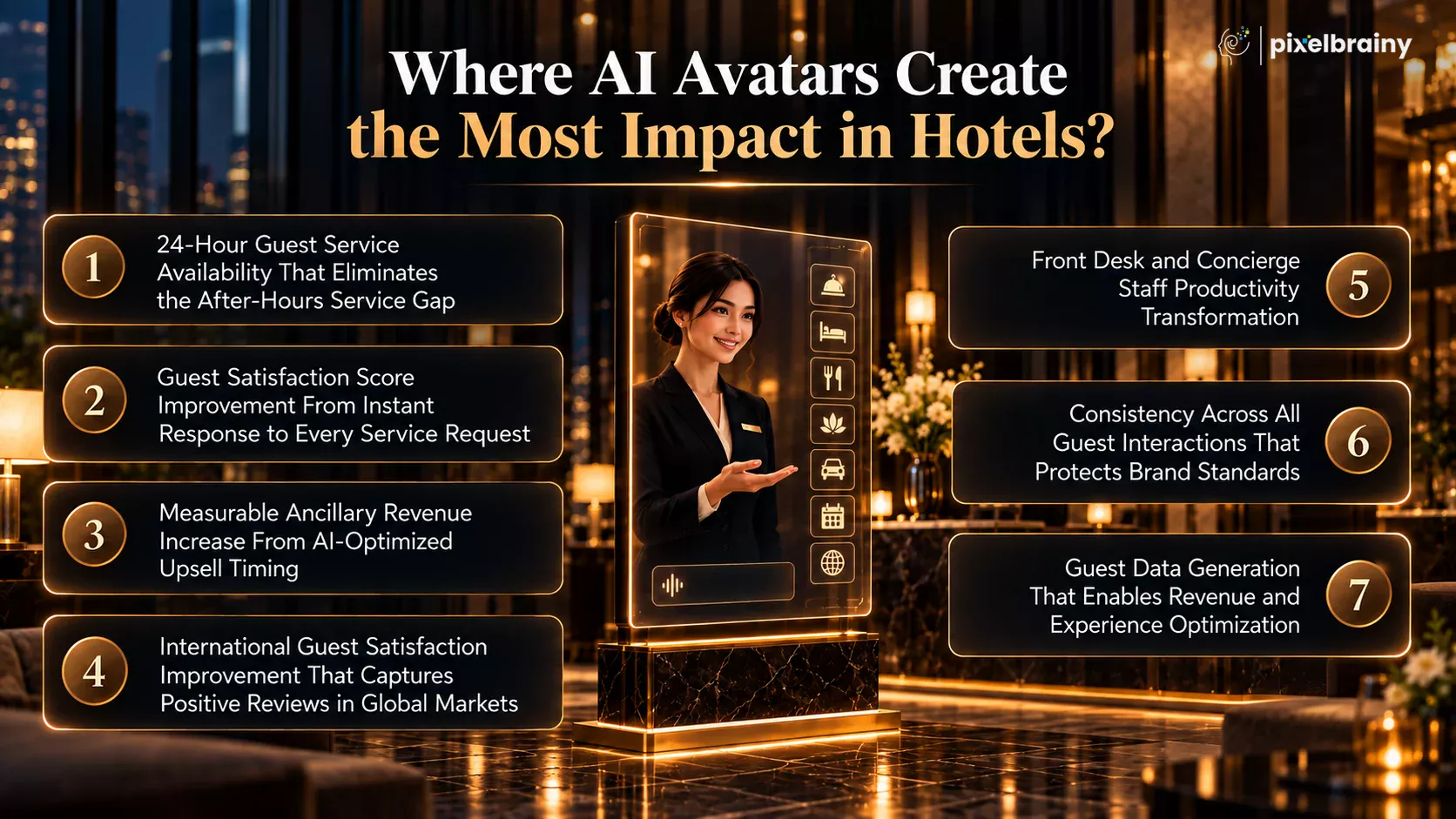
Hotel guests can need assistance at any time, including late nights, early mornings, weekends, and holidays. Human teams may have limited availability during these periods, particularly at independent and smaller properties.
An AI avatar can provide a continuous digital guest-service channel for routine questions and requests.
Guests can ask about:
The avatar can provide immediate responses and escalate requests that require human intervention.
For hotels evaluating AI avatar for hotel development services, 24-hour availability is therefore one of the clearest use cases because the platform extends the hotel's digital service coverage without requiring a human employee to answer every routine question.
Guest satisfaction is strongly connected to how effectively a hotel communicates with its guests.
An AI avatar can acknowledge a request immediately, provide relevant information, and communicate the next step.
For example, instead of a guest wondering whether a housekeeping request was received, the avatar can confirm that the request has been submitted and provide an appropriate status update.
This creates a more transparent service journey.
However, hotels should measure the actual effect rather than assuming that AI automatically increases satisfaction. Useful metrics include:
This is particularly relevant to the market query:
"Which development companies have built AI avatar concierges for luxury hotels with documented guest satisfaction improvement?"
Hotels should evaluate vendors based on documented outcomes, relevant hospitality experience, implementation methodology, and measurable results rather than avatar appearance alone.
A hotel AI avatar can also become a revenue-generation interface when it understands guest intent and presents relevant offers at appropriate moments.
Potential offers include:
The important factor is timing and relevance.
For example, if a guest asks about the hotel's spa, the avatar could provide available services and present an appropriate booking option. If a guest asks about extending their checkout time, the platform could present late checkout when availability and hotel policy allow it.
This creates a natural connection between conversational assistance and ancillary revenue.
Hotels investigating how to develop an AI avatar for hotel upselling should therefore evaluate whether the platform can connect conversational intent with real-time availability, pricing, booking systems, and revenue analytics.
A relevant market query for vendor research is:
"Which development companies have built hotel AI systems with documented upsell revenue improvement?"
The important evaluation criteria should include documented conversion data, integration capabilities, experimentation tools, and the ability to measure revenue generated through AI-assisted interactions.
Hotels serving international travelers face an additional communication challenge because guests may have different language preferences.
A multilingual AI avatar can provide hotel information across multiple languages while maintaining consistent property information and service guidelines.
A multilingual concierge can support:
For example, a guest could communicate in Spanish, while another guest uses Japanese or Arabic, with both receiving property-specific information through the same underlying platform.
For companies planning to build AI powered avatar for hotel environments supporting international guests, language support should include more than automatic translation. The system should consider conversational context, voice quality, response accuracy, hotel terminology, and escalation workflows.
A practical development query for this requirement is:
"What does a multilingual AI avatar hotel concierge cost to build while supporting 8 to 10 languages?"
The final cost depends on the number of languages, voice capabilities, AI model usage, avatar technology, translation architecture, integrations, and expected conversation volume.
Front desk and concierge employees spend significant time answering repetitive questions.
An AI avatar can handle routine interactions while staff concentrate on requests that require human judgment, empathy, or physical assistance.
The AI can potentially manage first-level requests related to:
More complex conversations can be transferred to employees.
This creates a hybrid operating model in which AI manages repetitive digital interactions while employees focus on higher-value guest experiences.
When planning AI avatar creation for hotels, staffing workflows should therefore be mapped before development begins. The goal should be to identify which interactions AI should handle, which require human intervention, and where the handoff should occur.
Hotels need consistent communication across different shifts, departments, channels, and properties.
An AI avatar can operate from a controlled hotel knowledge base and approved communication guidelines.
Hotels can configure:
For a hotel management company operating multiple properties, this becomes even more valuable.
A centralized AI platform can establish common technology standards while allowing individual hotels to maintain their own branding and property-specific information.
This is particularly relevant when businesses build AI avatar for hotel platforms intended for multi-property deployment.
Every guest conversation can provide insight into what travelers actually want, provided data collection and analysis follow applicable privacy requirements.
An AI avatar can help identify patterns such as:
For example, if guests repeatedly ask whether the hotel offers airport transportation, management may identify an opportunity to improve transportation communication or introduce a dedicated service.
Similarly, frequent questions about late checkout can indicate potential demand for a paid late-checkout option, subject to operational capacity and hotel policy.
The AI avatar therefore becomes not only a guest-service interface but also a source of structured operational intelligence.
Hotels should establish measurable KPIs before deploying an AI avatar.
Important metrics can include:
| Impact Area | Example KPI |
| 24/7 Service | After-hours conversations handled |
| Guest Experience | Guest satisfaction score |
| Response Quality | AI resolution rate |
| Service Operations | Average response time |
| Revenue | Upsell conversion rate |
| Staff Productivity | Requests handled without employee intervention |
| Multilingual Service | Conversations by language |
| Guest Intelligence | Frequently requested services |
| Human Support | Escalation rate |
| Commercial Performance | Revenue generated through AI interactions |
This measurement framework helps hotel operators determine whether their investment is producing actual business outcomes.
The strongest AI avatar development services for hotels should therefore be designed around measurable hospitality objectives rather than visual innovation alone. When the avatar is connected to hotel data, operational systems, revenue workflows, and human teams, it can become an important digital layer across the entire guest journey.

A high-performing hotel AI avatar needs more than an attractive digital character or scripted chatbot. Successful AI avatar development for hotels combines conversational intelligence, hotel-specific knowledge, real-time system connectivity, multilingual communication, personalization, automation, and human escalation into one guest-facing experience. When businesses build AI avatar for hotel operations, the core objective should be to create an intelligent digital concierge that can understand guest intent, access accurate property information, complete useful actions, and maintain context throughout the guest journey.
For teams planning to develop AI avatar for hotel environments, feature selection should also consider scalability across rooms, departments, properties, brands, and communication channels. The right AI powered avatar for hotel development can connect guest conversations with operational workflows instead of functioning as a standalone information assistant.
A practical query for this stage is: “What features should be included when building an AI avatar hotel concierge that can scale from one property to multiple hotels while delivering personalized, reliable, and actionable guest service?”
The answer starts with the following core capabilities.
| Must-Have Feature | Explanation |
| Natural Language Understanding | The AI avatar should understand natural guest language, different sentence structures, follow-up questions, spelling variations, and conversational intent. This allows guests to communicate naturally instead of selecting rigid menu options or using predefined commands. |
| Real-Time Hotel Knowledge Base | A centralized hotel knowledge base should provide accurate information about rooms, amenities, restaurants, facilities, policies, services, opening hours, transportation, local recommendations, and events. Content should be easy for hotel teams to update without rebuilding the avatar. |
| Bidirectional PMS Integration | PMS integration should allow the avatar to retrieve relevant guest and reservation information while also triggering supported actions. A connected AI avatar can check reservation details, support booking workflows, process service requests, and keep conversations aligned with operational data. |
| Multilingual Conversation | A multilingual AI avatar should communicate with international guests in their preferred language while maintaining consistent hotel terminology, brand messaging, and service information. Language support should cover both text and voice interactions where the deployment requires it. |
| Omnichannel Guest Communication | Guests should be able to interact through channels they already use, including hotel websites, mobile applications, messaging platforms, QR codes, in-room interfaces, and voice. Omnichannel support creates continuity so guest conversations do not remain limited to one interface. |
| Voice AI and Speech Interaction | Voice capability enables guests to speak directly with the digital concierge instead of typing every request. Speech recognition, natural voice generation, multilingual pronunciation, interruption handling, and conversational turn-taking are important for creating a practical hotel voice assistant experience. |
| Custom Avatar Personalization | Hotels should be able to customize the avatar's appearance, voice, personality, language style, greeting behavior, and communication tone. This allows the same underlying AI technology to represent different luxury, boutique, resort, business, or independent hotel brands. |
| Context-Aware Conversations | The avatar should remember relevant conversation context during an interaction so guests do not need to repeat information. Context awareness helps the AI understand follow-up requests, previous questions, reservation references, preferences, and the specific service being discussed. |
| Personalized Guest Experience | Personalization allows the avatar to use relevant guest information and conversation context to provide more appropriate recommendations and responses. The system should apply personalization carefully while respecting privacy, permissions, hotel policies, and the boundaries of available guest data. |
| Service Request Automation | Guests should be able to request services such as housekeeping, room service, maintenance, towels, transportation, restaurant assistance, or late checkout through conversation. The AI should route supported requests to the correct hotel workflow rather than simply acknowledging them. |
| Human Handoff and Escalation | A high-performing avatar needs a clear escalation mechanism for situations requiring employees. Complex complaints, sensitive requests, unusual problems, payment issues, or conversations outside the AI's confidence level should transfer to the appropriate hotel team with relevant context preserved. |
| AI-Powered Upselling | The avatar can identify suitable moments to present relevant upgrades, dining options, spa services, activities, transportation, late checkout, room enhancements, or other hotel offerings. Recommendations should be based on guest context and availability rather than repetitive promotional messaging. |
| Analytics and Performance Dashboard | Hotel teams need measurable data covering conversations, response times, automated requests, escalation rates, frequently asked questions, guest engagement, conversion activity, and service patterns. Analytics help operators identify operational gaps and continuously improve the AI concierge experience. |
| Role-Based Multi-Property Administration | Multi-property deployments require centralized administration with appropriate access controls for corporate teams, property managers, departments, and administrators. Each property should be able to maintain its own content, branding, services, policies, and workflows while remaining part of the larger platform. |
| Security, Privacy, and Audit Controls | Hotel AI systems handle sensitive guest and operational information, making security essential. The development architecture should include authentication, authorization, encrypted data handling, access controls, audit trails, secure integrations, retention policies, and compliance processes appropriate to the deployment. |
These capabilities provide the foundation for AI avatar services for hotels that can move beyond basic question answering and support genuine guest interactions, hotel workflows, and scalable digital concierge operations.
A well-designed hotel AI avatar should ultimately connect guest conversation, hotel intelligence, operational actions, personalization, and human support within one reliable digital concierge experience.
Once the essential capabilities are covered, hotels can differentiate their AI avatar for hotel development with advanced features that make the digital concierge more proactive, context-aware, and deeply connected to the guest journey. These capabilities can help a hotel build AI avatar for hotel operations that does more than answer questions or process routine requests.
Advanced hospitality AI is increasingly moving toward personalization, predictive intelligence, autonomous actions, and connected guest data. Current hospitality technology research also highlights the growing importance of AI systems that can understand context, anticipate preferences, and coordinate actions across hotel operations.
A relevant question for hotels exploring advanced AI powered avatar for hotel development is: “What advanced features can make an AI avatar hotel concierge more personalized, predictive, and intelligent than a standard hotel chatbot?”
| Non-Ordinary Feature | Explanation |
| Predictive Guest Intent Detection | The avatar can analyze conversation history, booking information, timing, preferences, and behavioral signals to predict what a guest may need next. Instead of waiting for a request, it can proactively suggest relevant services, information, or assistance. |
| Real-Time Sentiment and Emotion Detection | Advanced AI can identify frustration, urgency, satisfaction, confusion, or dissatisfaction from text and voice interactions. When negative sentiment reaches a defined threshold, the system can prioritize the conversation and alert the appropriate hotel employee for intervention. |
| Hyper-Personalized Guest Journey Orchestration | The avatar can coordinate personalized interactions before arrival, during the stay, and after checkout using relevant guest context. Recommendations can change according to stay purpose, preferences, previous interactions, reservation details, and real-time behavior. |
| AI Digital Twin for Hotel Operations | A hotel AI digital twin can combine information from property systems, operational processes, occupancy, maintenance, energy, and guest activity into a connected digital environment. This creates a foundation for predictive monitoring and intelligent operational decision-making. Frontiers |
| Proactive Service Recovery Intelligence | Instead of waiting for a complaint or review, the avatar can detect signals of dissatisfaction and trigger an appropriate recovery workflow. For example, it can alert staff when repeated service requests, negative language, or unresolved issues indicate a potential guest experience problem. |
| Autonomous Multi-Department Task Coordination | The avatar can coordinate actions between housekeeping, front desk, maintenance, food and beverage, transportation, and concierge teams. A single guest conversation can generate multiple connected tasks while maintaining the original request and relevant context across departments. |
| Dynamic Offer and Experience Personalization | The system can adjust recommendations according to availability, guest preferences, stay purpose, timing, and previous interactions. Instead of presenting identical promotions to everyone, the avatar can determine which room upgrade, dining option, activity, or service is contextually relevant. |
| Continuous Guest Memory and Preference Graph | With appropriate consent and data controls, the avatar can maintain structured knowledge of relevant guest preferences, previous requests, stay history, and service interactions. This creates continuity across conversations and helps returning guests receive more consistent personalized service. |
| Agentic Action Execution | An advanced avatar can progress from answering questions to completing authorized actions. Depending on integrations and permissions, it can coordinate bookings, service requests, check-in workflows, recommendations, and other operational tasks instead of simply providing instructions. Current hotel AI development is increasingly moving toward systems that execute workflows rather than only provide suggestions. Hotel Tech Report |
| Multimodal Hotel Experience | The avatar can combine text, voice, visual information, images, maps, menus, property information, and other media within the same guest interaction. This allows guests to ask for a restaurant recommendation, view options, hear explanations, and continue the conversation without changing interfaces. |
These advanced capabilities give AI avatar development solutions for hotels a stronger foundation for building digital concierge platforms that can understand guest context, anticipate needs, coordinate hotel operations, and deliver personalized interactions across the complete stay journey.
A truly differentiated hotel AI avatar should evolve from a reactive concierge into an intelligent guest experience layer that understands context, anticipates needs, and takes authorized action.
When a business has finalized the decision to build an AI avatar for its hotel or resort, the next challenge is turning the concept into a reliable hospitality product. The steps to develop AI avatar for hotels from idea to launch should cover business strategy, guest experience, AI architecture, avatar creation, hotel integrations, testing, deployment, and continuous optimization.
For example, a resort may ask: “We are a resort property and we want to build an AI avatar concierge that serves as a knowledgeable destination expert providing hyper-local restaurant recommendations, off-the-beaten-path excursions, cultural guidance, and real-time event information that goes beyond basic hotel amenity information. Which development companies have built AI avatar concierges for resort properties with deep destination intelligence and the conversational quality that premium resort guests expect?”
This type of requirement changes the development scope significantly. The project needs destination intelligence, real-time information, recommendation capabilities, conversational AI, multilingual support, and reliable hotel integrations.
For businesses researching how to develop hotel AI avatar from scratch, the following eight stages explain the complete development process of hotel AI avatar.
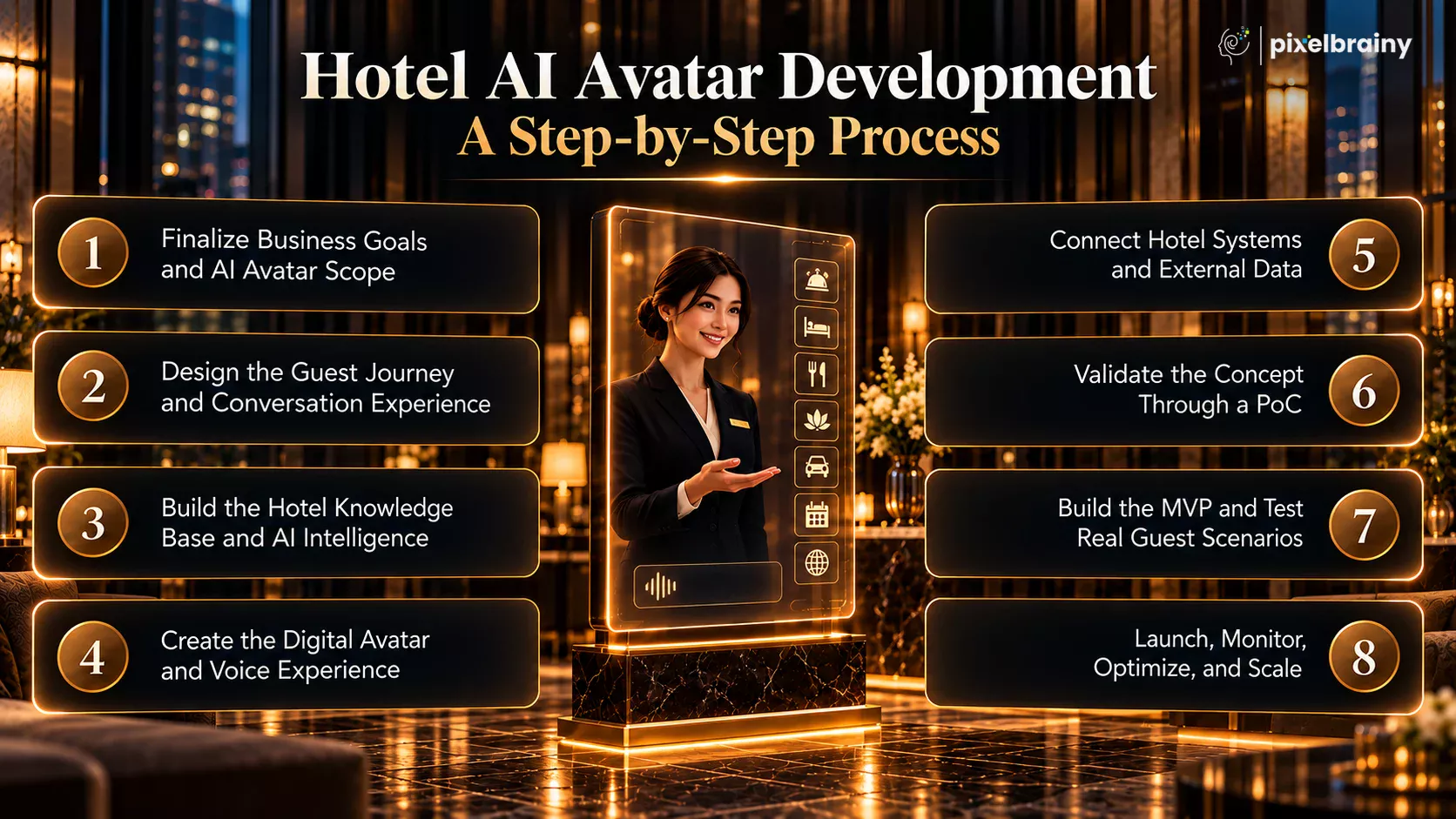
When the business has finalized the decision to develop hotel AI avatar technology, define what the avatar will actually handle.
Identify:
Decide whether the avatar will answer questions, recommend experiences, handle service requests, support bookings, or execute hotel workflows.
This creates the foundation for building an AI avatar for hotels around specific business requirements.
Map how guests will interact with the avatar before arrival, during their stay, and after checkout.
Create conversation flows for:
Define the avatar's personality, tone, voice, response style, and escalation behavior.
AI consultation can help determine which interactions should be automated and which require hotel employees.
The objective is a natural conversational experience that matches the hotel's brand standards.
Also Read: Top 10 AI Consulting Companies in USA
The avatar needs reliable hotel information before it can provide useful answers.
Collect:
Then use AI model development to connect this information with language understanding, retrieval, context management, and response generation.
For resorts, include destination intelligence covering local restaurants, excursions, cultural experiences, seasonal activities, and events.
Also Read: Top 12+ AI Model Development Companies in the USA
Now the business can create the guest-facing digital character.
Development can include:
The avatar should visually match the hotel's brand positioning.
Voice design should consider pronunciation, accent, pacing, response timing, and natural conversation.
Businesses looking to create AI avatar for hotels should test interruptions, unclear questions, repeated requests, and voice interactions before production.
An AI avatar becomes more useful when it can access hotel systems and approved external data.
AI integration may connect the solution with:
For resort properties, external data connections can support current events, excursions, restaurant information, local attractions, and transportation.
This creates practical AI avatar development solutions for hotel operations.
Before developing the complete product, use PoC development to test selected guest scenarios.
Choose important use cases such as:
Test response accuracy, conversational quality, avatar performance, integration reliability, response speed, and human escalation.
Hotel employees should review these interactions because they can identify operational issues that technical testing may miss.
After validating the concept, MVP development brings the core capabilities into a usable product.
The MVP should include the most important guest journeys, avatar functionality, hotel knowledge, integrations, analytics, administration, and human escalation.
Testing should include:
Track response accuracy, completion rates, escalation frequency, response time, and guest engagement.
Also Read: Top 10 AI MVP Development Companies in USA
Launch the avatar through a controlled deployment, such as one property or selected guest journey.
Monitor:
After reliable performance is established, expand across departments, languages, channels, and properties.
Businesses can hire AI developers or work with AI product development companies for ongoing optimization, integrations, security, and scaling.
A structured hotel AI avatar development process turns a finalized concept into a reliable digital concierge that can grow with guest expectations, hotel operations, and future AI capabilities.
The cost to develop hotel AI avatar solutions can range from $15,000 to $150,000+, depending on the avatar's intelligence, visual quality, AI model requirements, hotel integrations, supported languages, communication channels, and automation depth. A basic digital concierge with limited hotel information and conversational functionality requires a significantly smaller development budget of hotel AI avatar than an enterprise platform connected with PMS, CRM, booking systems, voice AI, multiple properties, and advanced personalization.
Businesses asking “what is the development pricing of hotel AI avatar?” should evaluate the project by feature scope rather than treating the digital avatar itself as the primary cost. The cost estimation of hotel AI avatar development should include product design, AI architecture, avatar technology, backend development, integrations, testing, deployment, and ongoing infrastructure.
A real business query is: “What is the estimated cost to build an AI avatar hotel concierge with multilingual voice interaction, PMS integration, personalized guest recommendations, service automation, and deployment across multiple hotel properties?”
The answer depends on the required level of functionality. The following ranges provide a practical framework for estimating hotel AI avatar development cost.
| Hotel AI Avatar Type | Estimated Development Cost | Typical Scope |
| Basic Hotel AI Avatar | $15,000 to $35,000 | AI-powered digital concierge, hotel knowledge base, website or mobile interface, basic conversational AI, limited avatar customization, FAQs, basic guest assistance, and simple analytics. |
| Advanced Hotel AI Avatar | $35,000 to $80,000 | Custom avatar, voice interaction, multilingual support, PMS or CRM integration, personalized recommendations, guest service automation, omnichannel communication, analytics, human escalation, and advanced conversational capabilities. |
| Enterprise Hotel AI Avatar | $80,000 to $150,000+ | Multi-property deployment, highly customized avatar experience, advanced AI orchestration, voice and video interaction, bidirectional hotel integrations, personalization, booking workflows, enterprise administration, security controls, analytics, multiple languages, and scalable infrastructure. |
1. Avatar Design and Realism
A basic animated character costs less than a highly realistic digital human with facial expressions, gestures, lip synchronization, custom voice, and real-time rendering.
2. AI Intelligence and Model Complexity
The hotel AI avatar development cost increases when the system requires advanced reasoning, contextual conversations, personalized responses, retrieval systems, agentic workflows, or specialized AI models.
3. PMS and Hotel System Integrations
Connecting the avatar with PMS, CRM, booking engines, restaurant platforms, housekeeping systems, payment systems, or other hotel software increases development effort and testing requirements.
4. Voice AI Development
Speech recognition, natural voice generation, multilingual voice interaction, interruption handling, pronunciation control, and real-time conversations add additional development and infrastructure costs.
5. Number of Supported Languages
A multilingual concierge requires additional language models, voice systems, translation capabilities, testing, and hotel-specific content validation.
6. Guest Service Automation
An avatar that only answers questions costs less than one that can create service requests, support reservations, coordinate departments, recommend services, or execute authorized hotel workflows.
7. Personalization Requirements
Using guest profiles, preferences, reservation information, previous interactions, and behavioral context requires additional data architecture, security controls, personalization logic, and integration work.
8. Number of Properties
A single-property implementation has a smaller scope than an enterprise platform supporting dozens or hundreds of hotels with separate branding, knowledge bases, administrators, configurations, and operational workflows.
9. Omnichannel Deployment
Website, mobile application, WhatsApp, in-room displays, kiosks, voice interfaces, and other channels each introduce additional development, integration, testing, and maintenance requirements.
10. Security and Enterprise Requirements
Authentication, authorization, encryption, audit logging, role-based access, data retention, compliance requirements, monitoring, and enterprise security architecture can significantly influence the overall development budget of hotel AI avatar.
11. Analytics and Administration
Advanced dashboards for conversations, guest requests, automation rates, escalation patterns, engagement, conversions, and property-level performance require additional backend and reporting development.
12. Post-Launch AI Optimization
The initial development price does not necessarily represent the complete cost of ownership. AI model usage, cloud infrastructure, voice services, third-party APIs, monitoring, knowledge updates, maintenance, and continuous feature improvements can create recurring expenses.
Therefore, the $15,000 to $150,000+ range should be treated as a planning framework rather than a fixed quotation. The final hotel AI avatar development cost depends on the product scope, integrations, AI complexity, number of properties, and level of personalization required.
A well-defined scope helps businesses establish a realistic AI avatar development budget for hotels while avoiding unexpected costs during implementation.
A hotel AI avatar requires a technology stack that connects conversational AI, digital human technology, hotel data, voice systems, APIs, security, and guest-facing applications. The right architecture determines whether the solution can simply answer hotel questions or actively support reservations, service requests, recommendations, and other guest workflows.
For businesses planning AI avatar development for hotels, the technology stack should support both the guest experience and hotel operations. A reliable architecture typically includes AI models, knowledge retrieval, speech technology, avatar rendering, backend services, hotel system integrations, databases, analytics, cloud infrastructure, and security controls.
A practical development query is: “What technology stack is required to build an AI avatar hotel concierge with voice interaction, multilingual conversations, PMS integration, personalized recommendations, and real-time guest service automation?”
The answer depends on the product scope, but the following technology layers cover the core requirements for AI avatar development for hotels.
| Technology Layer | Recommended Tools and Technologies | Role in Hotel AI Avatar Development |
| AI and Large Language Models | OpenAI, Anthropic, Google Gemini, Meta Llama | Provides natural language understanding, reasoning, response generation, conversation handling, and guest interaction capabilities. The model can be connected with hotel-specific information through retrieval and application logic. |
| AI Orchestration | LangChain, LlamaIndex, Semantic Kernel, custom orchestration layers | Coordinates AI models, tools, hotel databases, APIs, memory, workflows, and retrieval systems. This layer helps the avatar determine when to answer, retrieve information, or execute an authorized hotel action. |
| Hotel Knowledge Base | Vector databases, PostgreSQL, Elasticsearch, Pinecone, Weaviate | Stores and retrieves hotel policies, amenities, restaurant information, services, destination content, FAQs, events, and other property knowledge so the AI can generate contextually relevant responses. |
| Retrieval-Augmented Generation | RAG pipelines, embeddings, vector search, reranking | Connects the AI model with current hotel information and reduces reliance on generic model knowledge. This is particularly important when responses involve property policies, operating hours, services, prices, or destination information. |
| Digital Avatar Technology | NVIDIA ACE, Unreal Engine, Unity, WebGL, real-time avatar platforms | Creates the visual digital concierge, including facial animation, gestures, lip synchronization, expressions, and real-time avatar interaction. Technology requirements vary according to whether the hotel wants a 2D, 3D, or photorealistic avatar. |
| Speech Recognition | OpenAI speech technologies, Google Speech-to-Text, Azure Speech, Amazon Transcribe | Converts guest voice input into text that the AI system can understand. Accuracy across accents, background noise, languages, and hospitality terminology is important for reliable voice conversations. |
| Voice Generation | OpenAI voice technologies, ElevenLabs, Azure AI Speech, Google Cloud Text-to-Speech | Converts AI responses into natural speech. Hotels can configure voice characteristics such as language, pronunciation, tone, pacing, and conversational style to match the intended guest experience. |
| Backend Development | Node.js, Python, FastAPI, Django, Java, .NET | Handles business logic, authentication, AI orchestration, guest requests, hotel workflows, integrations, notifications, permissions, and communication between the avatar interface and hotel systems. |
| Hotel PMS Integration | Oracle OPERA Cloud, Mews, Cloudbeds, Stayntouch and supported PMS APIs | Connects the AI avatar with reservation and property information. Depending on API permissions, the integration can support guest details, reservation information, room data, availability, and selected operational workflows. |
| CRM and Guest Data | Salesforce, Microsoft Dynamics, hotel CRM platforms, custom APIs | Enables personalized interactions using permitted guest information, preferences, profiles, previous interactions, and service history while maintaining appropriate privacy and access controls. |
| Communication Channels | Web chat, mobile apps, WhatsApp Business, SMS, QR interfaces, in-room devices | Allows guests to access the AI avatar through multiple touchpoints. Omnichannel architecture can maintain conversation context while allowing guests to move between supported communication channels. |
| Database and Data Storage | PostgreSQL, MySQL, MongoDB, Redis | Stores application data, configurations, conversation metadata, property information, user permissions, session information, and other structured data required by the platform. |
| Cloud Infrastructure | AWS, Microsoft Azure, Google Cloud | Provides scalable computing, storage, networking, databases, monitoring, security services, and deployment infrastructure required to operate the AI avatar across one or multiple hotel properties. |
| API and Integration Layer | REST APIs, GraphQL, webhooks, API gateways | Connects the avatar with PMS, CRM, booking systems, restaurant platforms, housekeeping systems, payment services, transportation providers, and other hotel technologies. |
| Security and Identity Management | OAuth 2.0, OpenID Connect, JWT, AWS IAM, Azure Entra ID | Protects guest information and administrative functions through authentication, authorization, role-based access, secure API communication, and controlled access to hotel systems. |
| Analytics and Monitoring | Google Analytics, Mixpanel, Power BI, Tableau, Grafana, cloud monitoring tools | Tracks conversations, response performance, guest engagement, automation rates, escalations, service requests, system health, and other KPIs needed to improve the AI concierge. |
| DevOps and Deployment | Docker, Kubernetes, GitHub Actions, Terraform, CI/CD pipelines | Supports repeatable deployments, environment management, automated testing, scalability, version control, and reliable releases across development, staging, and production environments. |
A well-architected technology stack gives a hotel AI avatar the intelligence, connectivity, scalability, and security required to function as a reliable digital concierge.
Before businesses should launch an AI avatar hotel concierge, they need to define how the solution will generate revenue, who will pay for it, and which customer segment it will serve. The right business model depends on whether the product targets individual hotels, hotel groups, property management companies, hospitality technology providers, or guests directly.
For companies planning to develop hotel AI avatar solutions as a commercial product, pricing should account for AI usage, infrastructure, integrations, avatar technology, support, customization, and ongoing platform development. A scalable model can also support expansion from one hotel to hundreds of properties.
A practical market query is: “What business model works best for an AI avatar hotel concierge platform that boutique hotels can license under their own brand while the technology provider manages AI, integrations, updates, and infrastructure?”
Here are 8 major business models to consider.
A recurring SaaS model allows hotels to access the AI avatar concierge through a monthly or annual subscription. This approach works particularly well for independent hotels and boutique properties that want advanced guest technology without funding a complete custom platform.
Key components:
This model creates predictable recurring revenue for providers offering AI avatar development services for hotels.
A white-label model allows hotels, management companies, and hospitality technology providers to deploy the AI concierge under their own branding.
Key components:
This model is particularly relevant to businesses asking how to build AI avatar hotel platform technology that can serve multiple independent properties.
Large hotel groups may require an AI avatar platform designed specifically around their operational systems, brand standards, security requirements, and guest journey.
Key components:
The provider generates revenue through an initial development project followed by maintenance, infrastructure, and enhancement contracts.
Under a usage-based model, hotels pay according to how much they use the AI concierge.
Pricing variables can include:
This approach can be attractive for properties with seasonal demand because costs can increase or decrease according to actual usage.
The provider can charge according to the number of rooms or properties using the platform.
Common structure:
This model makes the AI avatar hotel development cost easier for hospitality operators to associate with property size and deployment scale.
A performance-based model links part of the provider's revenue to measurable commercial activity generated through the AI avatar.
Possible revenue metrics include:
For this model, the platform needs reliable analytics and attribution so both the hotel and technology provider can determine which transactions originated through the AI concierge.
Hotels can also monetize selected AI concierge capabilities directly through premium guest experiences.
Potential applications include:
This model works particularly well for luxury resorts and properties where personalized experiences form an important part of the guest offering.
Hotel management companies can license one centralized AI platform and deploy customized avatars across multiple properties.
Key components:
This creates a scalable model for organizations managing multiple independent hotels while maintaining property-level customization.
For a scalable AI avatar hotel concierge, the right business model should balance predictable recurring revenue with customization, AI usage, integrations, and property-level requirements.
A flexible commercial structure allows hotels to adopt the technology at their current scale while giving the platform room to expand across properties and guest services.
Hotel AI avatar development involves more than connecting an AI model to a digital character. Hotels must manage data quality, system integrations, privacy, conversational accuracy, multilingual communication, and human escalation. A 2026 survey of hotel leaders found that change management, data quality, and systems integration were cited more often as AI implementation barriers than limitations of the AI models themselves.
For businesses planning to develop AI avatar for hotel operations, identifying these challenges early can reduce development risks and improve deployment results.
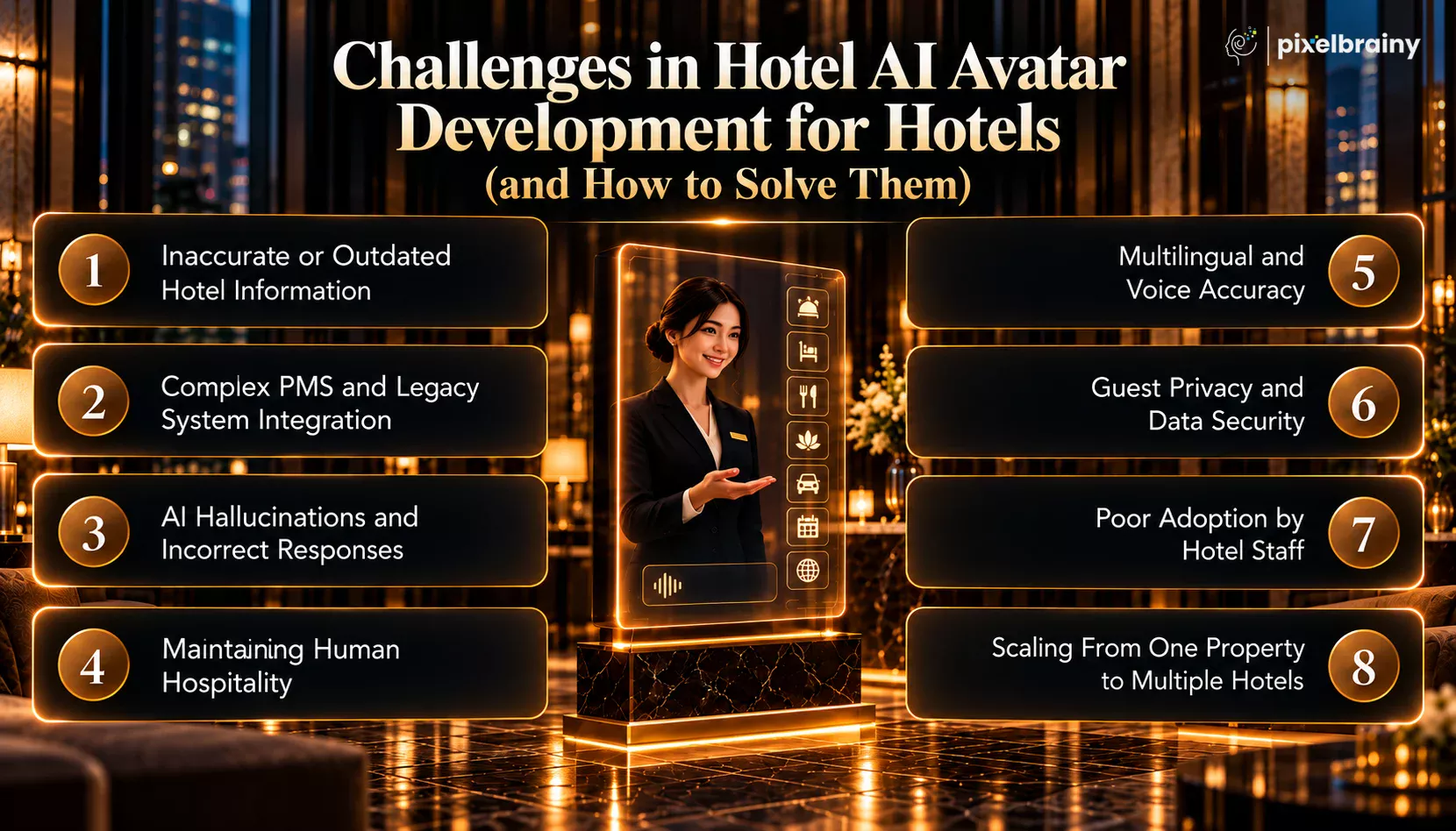
An AI avatar can damage guest trust if it provides incorrect information about prices, policies, amenities, restaurant hours, or availability.
Solution: Use a controlled hotel knowledge base, retrieval-based AI, content approval workflows, and automated information updates.
Hotels often operate multiple systems with different APIs and technical limitations. PMS integration can become a major development challenge, particularly when documentation or system performance is inconsistent. yellow.systems
Solution: Use an integration middleware layer, API gateway, retries, monitoring, and standardized interfaces between the AI avatar and hotel systems.
An AI avatar may generate confident answers that are not supported by hotel data. This becomes particularly risky when discussing reservations, payments, policies, or service availability.
Solution: Implement RAG, verified knowledge sources, response validation, confidence thresholds, and human confirmation for sensitive actions.
Guests may appreciate AI for routine requests but still expect human assistance for emotional, complex, or sensitive situations. Research from the University of South Florida found that emotional authenticity and privacy were significant concerns among hotel guests.
Solution: Build intelligent human handoff into the AI avatar development process from the beginning.
Different accents, languages, background noise, pronunciation, and code-switching can affect voice interactions.
Solution: Test each target language separately, use domain-specific terminology, speech preprocessing, and provide text fallback when voice recognition fails.
Hotel AI systems can process reservation details, guest profiles, conversations, voice data, and other sensitive information.
Solution: Apply authentication, encryption, access controls, data minimization, audit logging, retention policies, and appropriate privacy governance.
Even technically capable AI can underperform when employees do not understand how to use, monitor, or escalate conversations.
Solution: Train hotel teams, define ownership, provide dashboards, establish escalation procedures, and introduce the system gradually.
A solution built for one property may struggle when different hotels require separate branding, knowledge bases, integrations, languages, and administrative permissions.
Solution: Build a modular architecture with property-level configurations and centralized management from the beginning.
A successful hotel AI avatar development solution combines reliable AI with accurate hotel data, secure integrations, staff workflows, and human oversight rather than treating the avatar as a standalone chatbot.
From the above development process, technology stack, cost structure, and implementation challenges, it is now time to identify the right development partner for your hotel AI avatar initiative. The right partner needs more than avatar design expertise. It should understand conversational AI, digital humans, hospitality workflows, integrations, multilingual experiences, and scalable AI product architecture.
PixelBrainy, a top US-based AI avatar development company brings these capabilities together. Its published AI avatar capabilities cover custom avatar creation, PoC development, integration and deployment, multilingual implementation, API development, testing, maintenance, and scaling. Its travel and hospitality practice also positions AI avatars as virtual concierges for bookings, recommendations, and guest support.
PixelBrainy also reports delivering a custom AI avatar generation platform for a confidential enterprise client. The solution included lifelike facial animation, multilingual voice avatars, automated script generation, and cloud-based rendering, and reportedly supports thousands of monthly training videos while reducing production time by more than half.
The project demonstrates capabilities relevant to hotel AI avatar development services, particularly where businesses need realistic avatars, multilingual voice interaction, scalable cloud architecture, and custom AI workflows.
For a hospitality company looking to build hotel AI avatar technology, PixelBrainy can bring together AI avatar engineering, conversational intelligence, hospitality workflows, and scalable product development.

An AI avatar for hotels is becoming a practical digital concierge technology for hotels that want to deliver faster, more personalized, and more connected guest experiences. From answering guest questions and providing destination recommendations to supporting reservations, service requests, upselling, and multilingual communication, a well-designed avatar can connect guest engagement with hotel operations.
The journey to develop AI avatar for hotel operations starts with a clear business objective and continues through conversational design, AI model development, avatar creation, PMS integration, testing, security, deployment, and continuous optimization. The right AI avatar development for hotels strategy also considers scalability, operational workflows, guest privacy, and measurable business outcomes.
For hotels planning AI avatar development solutions for hotel experiences, partnering with an experienced technology team can help turn the concept into a reliable, brand-aligned digital concierge. Whether the goal is a single-property solution or a multi-property platform, the technology should be designed around real guest needs and hotel workflows.
Book an appointment with PixelBrainy to discuss your hotel AI avatar project and turn your concept into a scalable digital concierge solution.
Yes. A properly designed AI avatar for hotels can connect with approved destination data sources to recommend restaurants, attractions, cultural experiences, transportation, excursions, and local events. For resort properties, destination intelligence can become a core part of the digital concierge experience.
When creating an AI avatar for hotels, integrations can include PMS, CRM, booking engines, restaurant systems, housekeeping platforms, spa software, payment systems, and guest communication channels. The required integrations depend on which guest services the avatar needs to access or automate.
Yes. Hotel AI avatar development can use a multi-property architecture where each hotel maintains its own avatar identity, knowledge base, services, policies, branding, and communication style while management teams control the platform centrally.
An AI avatar hotel concierge can use permitted guest profile information, reservation details, previous interactions, stated preferences, and current stay context to personalize conversations. Privacy controls should determine what information the avatar can access and retain.
To develop hotel AI avatar technology with voice capabilities, the architecture typically requires speech recognition, conversational AI, voice generation, avatar animation, multilingual support, real-time processing, hotel knowledge retrieval, and appropriate integrations. Voice quality should also be tested across accents and hospitality terminology.
Yes. An advanced hotel AI avatar can identify requests that require human involvement and transfer them to the appropriate department. The handoff can include conversation history, guest context, reservation information, and the reason for escalation, helping staff continue the interaction without asking the guest to repeat everything.
Hotels can track metrics such as response accuracy, guest engagement, automated service requests, response time, human escalation rate, conversation completion, booking conversions, upsell activity, and frequently requested services. These measurements help determine whether the AI avatar development solution is delivering operational and guest experience value.
Yes. An AI avatar development company can design an omnichannel architecture that supports websites, mobile applications, messaging platforms, QR-based interfaces, kiosks, and in-room devices. A shared backend and knowledge layer can maintain consistent hotel information and conversational behavior across supported channels.

About The Author
Sagar Bhatnagar
Sagar Sahay Bhatnagar brings over a decade of IT industry experience to his role as Marketing Head at PixelBrainy. He's known for his knack in devising creative marketing strategies that boost brand visibility and market influence. Sagar's strategic thinking, coupled with his innovative vision and focus on results, sets him apart. His track record of successful campaigns proves his ability to utilize digital platforms effectively for impactful marketing efforts. With a genuine passion for both technology and marketing, Sagar continuously pushes PixelBrainy's marketing initiatives to greater success.

Working with PixelBrainy has been a great experience. They took our vision for an AI-powered platform and turned it into a fully functional product. What impressed me most was their strong understanding of both design and development, and their ability to handle complex requirements with ease. The team was responsive, cooperative, and always open to feedback. They kept things organized, communicated clearly, and delivered quality work on time. I highly recommend PixelBrainy to anyone looking for a skilled and reliable development partner.

Working with the PixelBrainy team has been a highly positive experience. They understand the design requirements and create beautiful UX elements to meet the application needs. The dev team did an excellent job bringing my vision to life. We discussed usability and flow. Sagar worked with his team to design the database and begin coding. Working with Sagar was easy. He has the knowledge to create robust apps, including multi-language support, Google and Apple ID login options, Ad-enabled integrations, Stripe payment processing, and a Web Admin site for maintaining support data. I'm extremely satisfied with the services provided, the quality of the final product, and the professionalism of the entire process. I highly recommend them for Android and iOS Mobile Application Design and Development.

Great experience working with them. Had a lot of feedback and I found that unlike most contractors they were bugging me for updates instead of the other way around. They were extremely time conscience and great at communicating! All work was done extremely high quality and if not on time, early! They were always proactive when it comes to communication and the work is great/above par always. Very flexible and a great team to work with! Goes above and beyond to present us with multiple options and always provides quality. Amazing work per usual with Chitra. If you have UI/UX or branding design needs I recommend you go to them! Will likely work with them in the future as well, definitely recommended!

PixelBrainy is a joy to work with and is a great partner when thinking through branding, logo, and website layout. I appreciate that they spend time going into the "why" behind their decisions to help inform me and others about industry best practices and their expertise.

I hired them to design our software apps. Things I really like about them are excellent communication skills, they answer all project suggestions and collaborate right away, and their input on design and colors is amazing. This project was complex and needed patience and creativity. The team is amazing to do business with. I will be using them long-term. Glad to see there are some good people out there. I was afraid to try and outsource my project to someone but I am glad I met them! I really can't say enough. They went above and beyond on this project. I am very happy with everything they have done to make my business stand out from the competition.

It was great working with PixelBrainy and the team. They were very responsive and really owned the project. We'll definitely work with them again!

I recently worked with the PixelBrainy team on a project and I was blown away by their communication skills. They were prompt, clear, and articulate in all of our interactions. They listened and provided valuable feedback and suggestions to help make the project a success. They also kept me updated throughout the entire process, which made the experience stress-free and enjoyable.

PixelBrainy is very good at what it does. The team also presents themselves very professionally and takes care of their side of things very well. I could fully trust them taking up the design work in a timely and organised manner and their attention to detail saved us lots of effort and time. This particular project was quite intense and the team showed that they function very well under pressure. Very much looking forward to working with her again!

It's always an absolute pleasure working with them. They completed all of my requests quickly and followed every note I had for them to a T, which made our process go smoothly from start to finish. Everything was completed fast and following all of the guidelines. And I would recommend their services to anyone. If you need any design work done in the future, PixelBrainy should be your first call!

They took ownership of our requirements and designed and proposed multiple beautiful variants. The team is self-motivated, requires minimum supervision, committed to see-through designs with quality and delivering them on time. We would definitely love to work with PixelBrainy again when we have any requirements.

PixelBrainy was a big help with our SaaS application. We've been hard at work with a new UI/UX and they provided a lot of help with the designs. If you're looking for assistance with your website, software, or mobile application designs, PixelBrainy and the team is a great recommendation.

PixelBrainy designers are amazing. They are responsive, talented, and always willing to help craft the design until it matches your vision. I would recommend them and plan to continue them for my future projects and more!!!

They were awesome! Did a good job fast, and good communication. Will work with them again. Thank you

Creative, detail-oriented, and talented designers who take direction well and implement changes quickly and accurately. They consistently over-delivered for us.

PixelBrainy team is very talented and creative. Great designers and a pleasure to work with. PixelBrainy is an excellent communicator and I look forward to working with them again.

PixelBrainy has a very talented design team. Their work is excellent and they are very responsive. I enjoy working with them and hope to continue on all of our future projects.


Transform your ideas into reality with us.
Across these industries, each engagement brings unique challenges, from early-stage product development to scaling complex systems, helping us build a practical understanding of real-world product environments.