AI Summary Powered by PixelBrainy
What if the biggest competitor to your next live game, concert, or event is not another team or venue, but every digital experience competing for your fan's attention every second?
That question is redefining the sports and entertainment industry in 2026. Fans are no longer satisfied with passively watching events or scrolling through a basic mobile app. They expect every interaction to feel personal, timely, and rewarding. As a result, AI event-based fan engagement app development is becoming a strategic investment rather than an experimental technology. Organizations embracing AI are increasing attendance, strengthening fan loyalty, improving in app engagement, and creating new revenue opportunities. Those that continue relying on traditional apps with schedules, scores, ticket information, and news feeds are finding it increasingly difficult to keep fans engaged before, during, and after every event.
The challenge is simple. Today's fans have endless entertainment options at their fingertips, from streaming platforms and social media to gaming, fantasy sports, and creator content. Winning attention requires more than delivering information. It requires delivering experiences that adapt to every fan in real time. This is why many organizations now plan to build AI fan engagement app solutions that combine personalization, predictive recommendations, intelligent conversations, live gamification, and contextual offers into one seamless platform.
Consider a real business scenario. We are the digital team at a mid size NFL franchise and our current official app has less than 8 percent of our season ticket holders actively using it on game days. Before we invest in an AI upgrade, we need a clear picture of which AI fan engagement features have actually improved engagement metrics for other NFL or NBA franchises and which AI development companies in the USA have the sports app portfolio to support their recommendations with measurable results. This is the same challenge facing sports franchises, entertainment venue operators, founders building fan products, sports media companies, and brand sponsors looking for stronger audience activation.
Whether your goal is AI powered fan engagement app development for a stadium, arena, or entertainment venue, or you want to build AI sports entertainment engagement platform solutions from the ground up, this guide provides a complete roadmap. You will learn how to create an AI event-based fan engagement app for sports and entertainment, explore different platform types, discover essential and advanced features, understand the technology stack, estimate development costs, and follow the complete development process of AI event-based fan engagement app for sports and entertainment to build an experience that keeps fans connected long after the final whistle or encore.
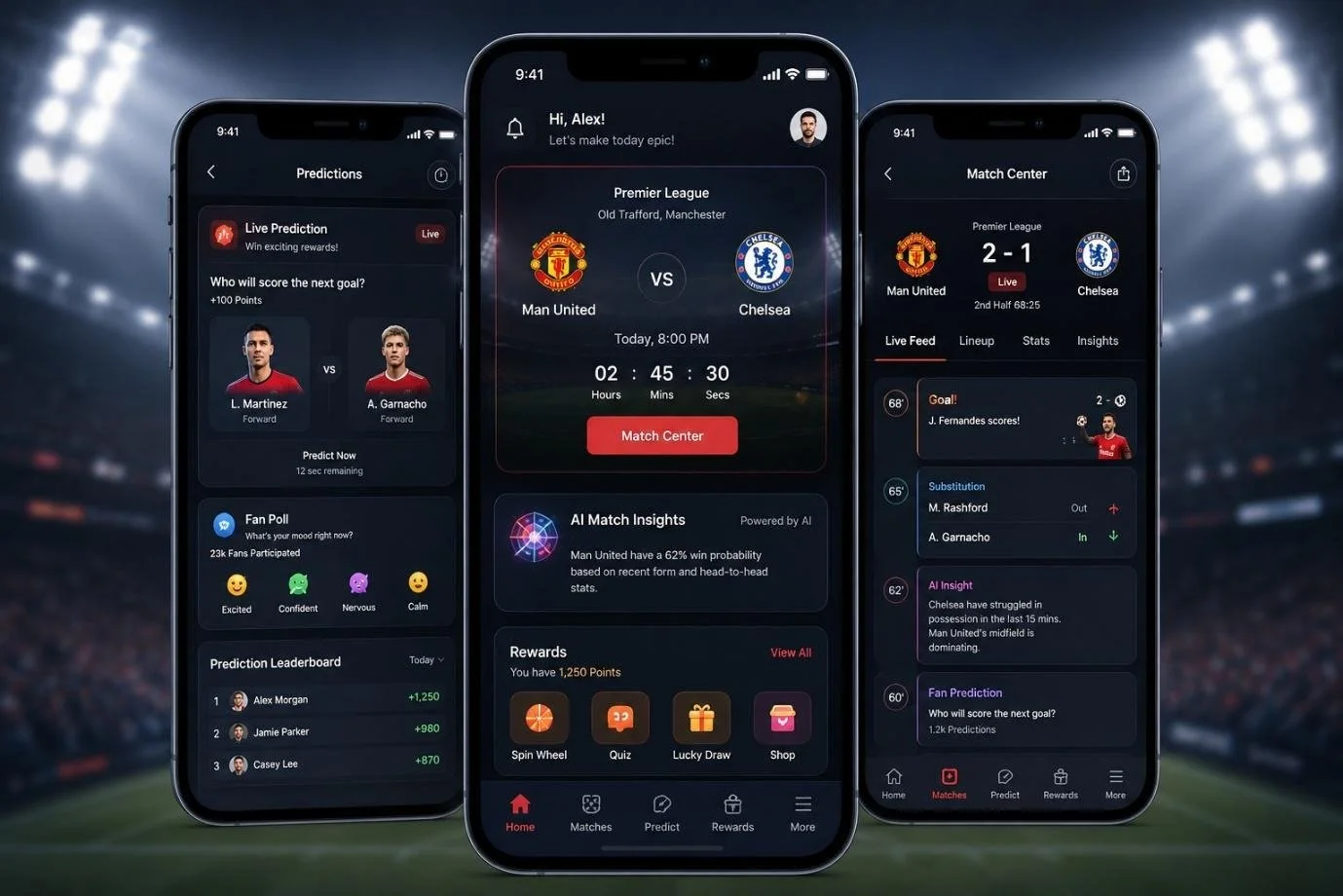
An AI event-based fan engagement app is an intelligent digital platform that uses artificial intelligence to personalize, automate, and enhance fan interactions before, during, and after live sports or entertainment events. Unlike a traditional team app that primarily delivers schedules, scores, tickets, and news, an AI powered platform continuously learns from every fan interaction to create experiences that become smarter, more relevant, and more engaging over time.
This distinction is what makes AI event-based fan engagement app development fundamentally different from building a conventional mobile application. A standard sports app distributes information. An AI powered fan engagement app understands fan behavior, predicts interests, responds to live event moments, and creates personalized engagement journeys that evolve with every event attended or watched.
At the core of every successful platform are four AI capability layers that work together to transform passive audiences into highly engaged communities.
The foundation of every successful platform is a real time personalization engine. Instead of treating every fan the same, AI builds an evolving profile based on favorite teams, preferred players, content consumption habits, purchase history, prediction accuracy, loyalty activity, seat location, and even in venue behavior across multiple event visits.
This means a first-time app user receives onboarding recommendations and introductory content, while a season ticket holder who has attended games for ten years experiences a completely different interface featuring personalized statistics, exclusive rewards, tailored offers, and content aligned with previous interactions.
For organizations planning to develop AI fan engagement app solutions, this continuous learning capability becomes one of the strongest competitive advantages because the experience improves naturally as more behavioral data is collected.
An AI event-based platform does not simply display live scores. It understands what is happening during the event and reacts instantly.
The AI continuously processes live feeds from sports data providers, analyzes game situations, and automatically generates relevant experiences at the right moment.
Examples include:
This real time intelligence makes the application feel dynamic rather than becoming another static information dashboard.
This capability is especially valuable for companies looking to build AI powered fan engagement app experiences that keep fans engaged between every play instead of only checking the app for scores.
Modern fans no longer want to simply consume content. They want to participate.
An AI powered engagement engine transforms spectators into active participants through prediction games, live polls, trivia contests, fantasy style challenges, crowd sentiment voting, and interactive competitions.
Every prediction, poll response, challenge completion, and interaction strengthens the AI model by improving each fan's behavioral profile. As engagement increases, recommendations become more accurate, rewards become more relevant, and participation naturally grows.
This approach is becoming a core focus of AI sports fan engagement app development, especially for professional sports leagues, esports organizations, and sports media platforms that want to maximize session duration and repeat engagement.
Traditional sponsor banners generate limited engagement because they appear regardless of fan intent or excitement.
AI changes this completely.
Sponsor activation intelligence analyzes fan behavior, emotional engagement, event context, and historical interactions to determine the best time to deliver branded experiences.
For example, if a fan correctly predicts a touchdown, the AI can immediately unlock a sponsor reward, limited time merchandise discount, food voucher, or VIP experience. The timing makes the activation feel like part of the fan journey rather than an interruption.
This creates significantly higher sponsor engagement while giving brands measurable performance data instead of simple impression counts.
It also plays an important role in developing AI fan engagement app with loyalty rewards and gamification features, where personalized rewards become a major driver of long-term fan retention.
| Feature | Standard Sports Team App | AI Event Based Fan Engagement App |
|---|---|---|
| Personalization | Same experience for every fan | AI continuously personalizes content based on individual behavior and preferences |
| Real Time Content | Live scores and manual updates | AI generates contextual insights, predictions, highlights, and alerts during the event |
| Fan Participation | Limited polls or static quizzes | Real time prediction games, interactive challenges, live sentiment analysis, and gamification |
| Sponsor Activation | Static banner advertisements | AI delivers personalized sponsor experiences at peak engagement moments |
| Cross Event Learning | Minimal historical learning | AI improves recommendations and experiences across every event attended or viewed |
| Revenue Generation | Ticket sales and merchandise | Personalized offers, loyalty programs, premium subscriptions, sponsor activations, and intelligent upselling |
Ultimately, an AI event-based fan engagement app is far more than a mobile application. It is an intelligent engagement ecosystem that learns continuously, adapts in real time, and creates personalized experiences that strengthen fan loyalty while generating measurable business value for sports franchises, entertainment venues, media companies, sponsors, and event organizers.
The biggest challenge facing sports and entertainment organizations in 2026 is no longer attracting fans to a single event. It is winning their attention before, during, and long after the event ends. Fans now divide their time between streaming platforms, social media, gaming, fantasy sports, and creator content, making attention the industry's most valuable asset. This shift is accelerating AI event-based fan engagement app development for startups, sports franchises, ticketing companies, and entertainment brands that want to build direct, data driven relationships instead of relying solely on ticket sales.
The timing could not be better. According to Grand View Research, the global sports app market is expected to reach USD 5 billion in 2026, while the AI in sports market is projected to grow to USD 12.7 billion in 2026, highlighting the rapid adoption of AI across fan experiences and sports technology.
Modern fans compare every digital experience with platforms like Netflix, Spotify, TikTok, and Amazon. They expect recommendations that reflect their interests instead of generic content shown to everyone. An app that sends identical notifications to every supporter, regardless of favorite players, seating section, or previous engagement, quickly becomes irrelevant.
This is exactly why organizations are choosing to build AI fan engagement app in 2026. AI continuously learns fan preferences, predicts interests, personalizes content, and delivers interactive experiences that make every game or event feel unique. Personalization is no longer a premium feature. It has become the baseline expectation for digital engagement.
Sports franchises, entertainment venues, and event organizers are under increasing pressure to generate revenue beyond ticket sales. Merchandise, food and beverage purchases, VIP upgrades, memberships, premium experiences, and sponsor activations now represent significant growth opportunities.
Organizations that develop AI fan engagement app platforms can use AI to recommend personalized merchandise, deliver location-based concession offers, promote premium seating upgrades, and increase loyalty participation during live events. According to PwC's Digital Fan Engagement in Sports (2026), organizations that create unified digital ecosystems with AI powered personalization see stronger customer loyalty, longer engagement sessions, and higher repeat purchase behavior. Additionally, Adobe customer experience data referenced by PwC shows experience focused organizations grow revenue 1.7 times faster and customer lifetime value 2.3 times faster than peers.
Sponsors are also changing how they invest. Traditional stadium signage and logo placements provide visibility, but they reveal very little about actual fan engagement or business impact.
Today, brands want sponsorships that generate first party data, measurable interactions, and clear return on investment. Instead of displaying a static advertisement, AI can trigger personalized rewards after a successful prediction challenge, unlock branded experiences for loyal fans, or deliver targeted offers based on live behavior. This makes creating AI event fan engagement app solutions increasingly attractive for sponsors looking to connect marketing spend directly with measurable fan actions.
In 2026, AI fan engagement is no longer a competitive advantage. It is becoming the foundation for sustainable fan loyalty, sponsor value, and long-term revenue growth.
Investing in AI event-based fan engagement app development is no longer just about launching another mobile application. It is about creating an intelligent digital ecosystem that continuously strengthens relationships with fans, unlocks new revenue opportunities, and provides measurable business insights. Whether you are a professional sports franchise, entertainment venue, concert organizer, esports league, or sports media company, an AI powered platform delivers value across every stage of the fan journey.
Here are the biggest benefits of AI powered fan engagement app development for sports and entertainment organizations.
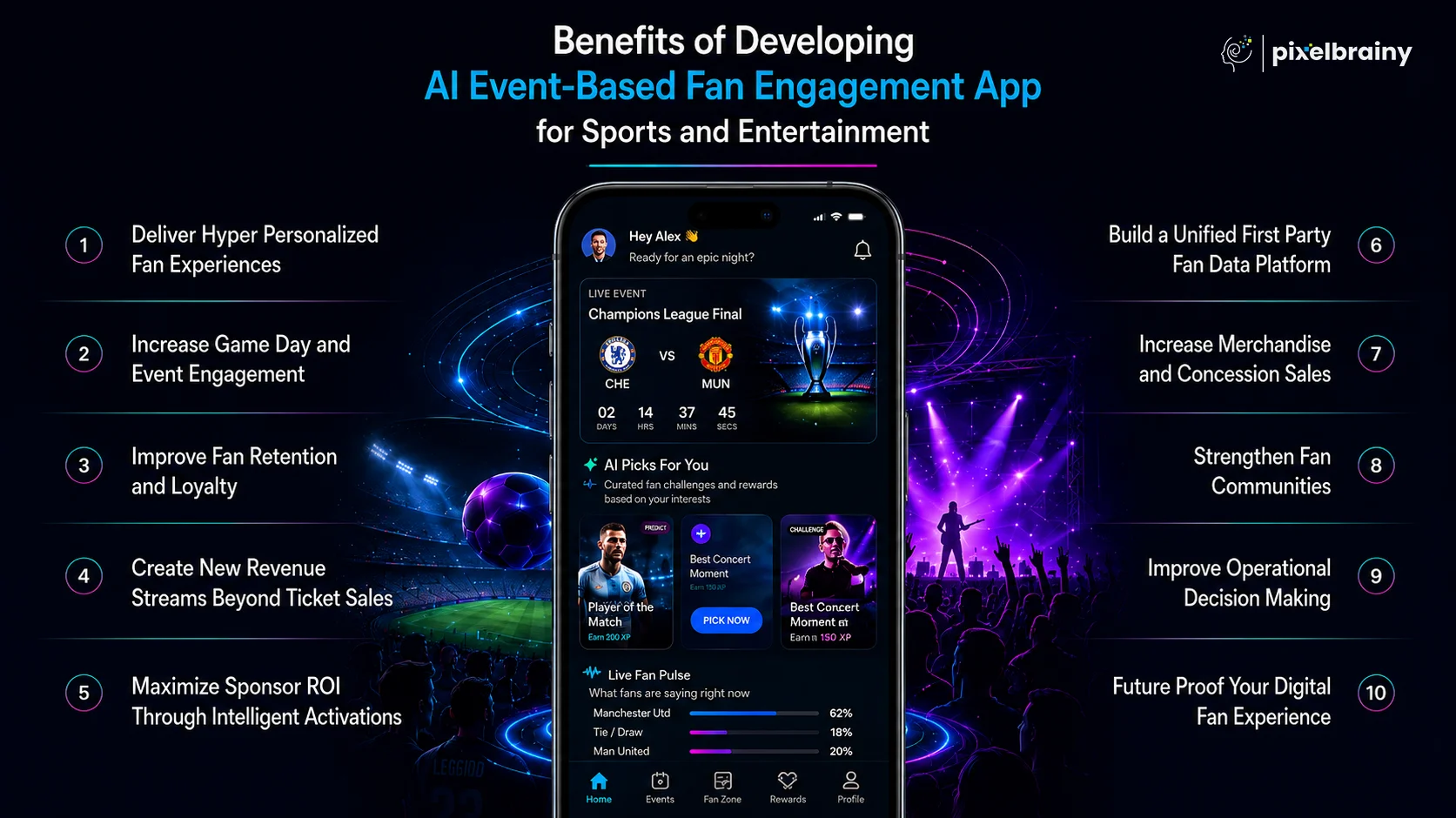
Every fan has different interests, favorite players, purchasing habits, and engagement patterns. AI analyzes these behaviors to create highly personalized experiences instead of offering identical content to every user.
For example, one fan may receive player specific highlights and merchandise recommendations, while another sees VIP event offers, prediction challenges, or exclusive behind the scenes content.
This level of personalization significantly improves fan satisfaction and long-term loyalty.
One of the biggest challenges for sports organizations is keeping fans engaged throughout the entire event.
AI solves this by delivering live predictions, interactive polls, instant statistics, trivia challenges, AI generated insights, and personalized notifications based on real time game situations.
Instead of opening the app only to check the score, fans actively participate throughout the event.
Keeping existing fans engaged is far more cost effective than constantly acquiring new ones.
AI continuously learns from previous interactions, allowing the app to recommend more relevant content after every event. Over time, fans receive experiences that feel increasingly personalized, encouraging them to return for every match, concert, or live event.
When combined with loyalty rewards and gamification, retention rates improve even further.
Modern sports organizations cannot rely solely on ticket revenue.
An AI powered fan engagement platform creates multiple monetization opportunities, including:
AI increases conversion rates by presenting the right offer to the right fan at the right moment.
Traditional sponsorship models focus primarily on visibility.
AI transforms sponsorship into measurable engagement by delivering personalized brand experiences based on fan behavior.
For example, a sponsor can reward fans immediately after correctly predicting a game outcome, completing an interactive challenge, or visiting a specific stadium location.
This creates higher engagement while providing sponsors with measurable performance metrics instead of simple impression counts.
One of the most valuable assets for any sports organization is first party fan data.
AI collects and connects behavioral information from ticket purchases, merchandise sales, content preferences, loyalty programs, prediction games, event attendance, and mobile interactions into a unified fan profile.
These insights support smarter marketing campaigns, personalized communication, and better business decisions.
AI understands purchase history, browsing behavior, and live event context to recommend products that fans are more likely to buy.
For example, after a player scores a winning goal, the app can instantly recommend that player's jersey with a limited time discount.
Similarly, fans inside a venue can receive personalized food and beverage offers based on their location and previous purchases.
AI powered discussion spaces, community recommendations, fan leaderboards, prediction competitions, and social challenges encourage fans to interact with each other instead of only consuming content.
These community driven experiences help organizations build stronger emotional connections that extend beyond individual events.
AI does more than engage fans. It also provides valuable operational intelligence.
Organizations can identify:
These insights help teams optimize marketing campaigns, staffing, event planning, and commercial strategies.
Fan expectations continue to evolve rapidly.
Organizations investing in AI event-based fan engagement app development today are building platforms that can easily integrate emerging technologies such as generative AI, augmented reality, digital collectibles, wearable integrations, voice assistants, and predictive analytics without rebuilding their entire ecosystem.
The true value of an AI event-based fan engagement app lies in its ability to transform every fan interaction into a personalized experience, every engagement into actionable data, and every event into a long-term revenue opportunity.
One of the biggest mistakes organizations make during AI event-based fan engagement app development is assuming every sports or entertainment business needs the same type of platform. In reality, the right app depends entirely on who your fans are, how they consume events, and what business outcomes you want to achieve.
For example, consider this scenario: Our entertainment company hosts more than 200 live events every year across music festivals, comedy tours, and esports tournaments. Should we invest in one AI platform that serves every event, or build separate fan engagement apps for each audience? The answer is not simply about budget. It depends on your fan journey, real time data requirements, AI capabilities, and long-term scalability.
Similarly, a professional NFL franchise focuses on increasing season ticket engagement, while a sports broadcaster wants viewers to stay engaged between plays. An esports organizer prioritizes community interaction, whereas a music festival aims to simplify navigation and personalize attendee experiences. Each of these organizations requires a fundamentally different AI engagement strategy.
Before you build AI fan engagement app solutions or develop AI fan engagement app platforms, it is important to understand which application model best aligns with your organization. Below are the seven most common types of AI fan engagement apps that are transforming sports and entertainment in 2026, along with the ideal use case and key product design considerations for each.
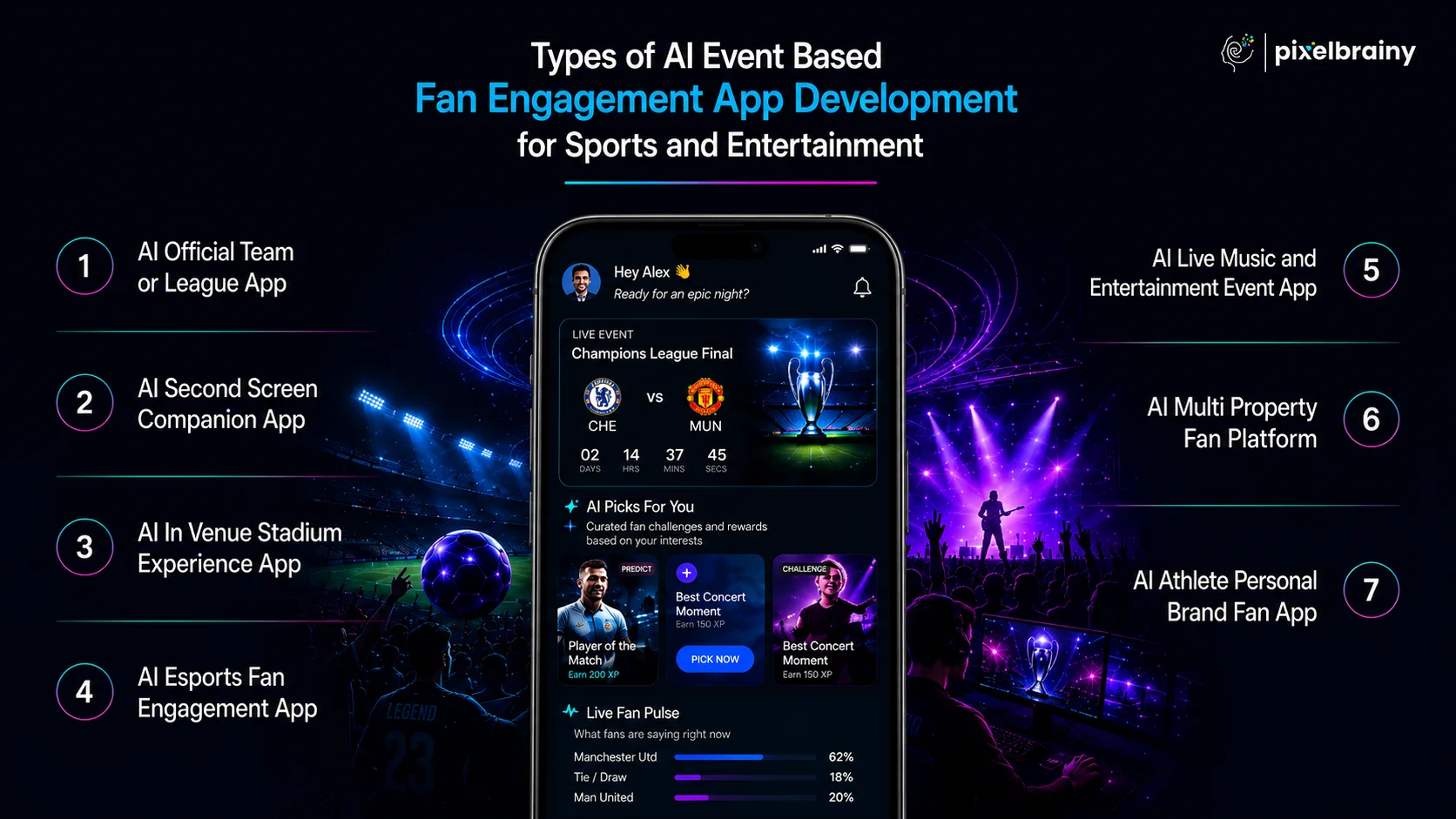
An AI official team or league app serves as the primary digital destination for fans throughout the entire season. It combines ticketing, live scores, AI powered match insights, prediction games, merchandise, loyalty rewards, player statistics, exclusive content, and personalized notifications into one connected experience. The AI continuously learns from fan behavior to make every interaction more relevant with every game attended or watched.
Key Product Design Implication: Prioritize deep fan profiling, CRM integration, ticketing systems, loyalty programs, and personalized content recommendations across the entire season.
This type of application is designed for fans watching live sports through television or streaming platforms instead of attending the event in person. It delivers synchronized AI commentary, live player statistics, prediction challenges, AR player overlays, instant match insights, and interactive experiences that react to the broadcast in real time.
This model is particularly valuable for broadcasters, OTT platforms, and sports media companies that want to increase viewer engagement between key moments of the game.
Key Product Design Implication: Focus on ultra-low latency synchronization with live broadcasts, AI generated real time insights, and interactive second screen experiences.
An AI in venue app enhances the experience of fans who are physically attending games, concerts, or live events. Features typically include AI powered stadium navigation, smart parking assistance, concession ordering, seat upgrades, digital ticket management, AR player recognition, location-based promotions, and live crowd engagement.
The AI uses indoor positioning and location intelligence to personalize every interaction based on where the fan is inside the venue.
Key Product Design Implication: Build around indoor mapping, beacon technology, real time location services, venue operations, and mobile commerce.
Esports audiences consume content differently from traditional sports fans, making AI driven engagement even more important. These platforms deliver live match predictions, player performance analytics, draft simulations, tournament statistics, community discussions, fantasy competitions, and AI generated insights throughout every match.
Organizations planning to develop AI fan engagement app solutions for esports should prioritize community interaction, real time engagement, and competitive gaming experiences that keep users active throughout tournaments.
Key Product Design Implication: Design for continuous interaction, live chat communities, prediction mechanics, tournament data integration, and digital first engagement.
Concerts, comedy shows, festivals, and entertainment events require a different engagement model than competitive sports. An AI powered entertainment app helps attendees discover artists, personalize event schedules, receive stage recommendations, navigate large venues, connect with communities, and share experiences in real time.
For businesses investing in AI live event fan app development, AI also recommends food vendors, merchandise, VIP upgrades, and artist-based experiences according to individual interests.
Key Product Design Implication: Build around personalized scheduling, artist discovery, venue navigation, and multi day event management.
Some organizations operate multiple sports teams, entertainment venues, or event brands under one business. Instead of maintaining separate applications, they deploy one centralized AI platform with multiple branded experiences.
This architecture is ideal for private equity owned sports portfolios, multi venue entertainment operators, ticketing companies, and university athletic departments managing multiple sports programs.
If your goal is how to build scalable AI fan engagement app for major sports leagues and entertainment venues in 2026, this model offers centralized AI services, shared infrastructure, and lower long term maintenance costs.
Key Product Design Implication: Develop a multi-tenant architecture with centralized analytics, reusable AI services, and independently branded user experiences.
Athletes, creators, musicians, and entertainers increasingly want direct relationships with their audiences outside team or league owned platforms. An AI athlete app delivers exclusive content, AI powered fan interactions, personalized messaging, live Q&A sessions, merchandise, memberships, and private communities built around an individual personality.
This approach enables athletes to grow independent digital businesses while strengthening long term fan relationships.
Key Product Design Implication: Prioritize creator management tools, AI conversations, subscription services, premium content delivery, and community engagement.
| App Type | Best For | Primary Objective |
|---|---|---|
| AI Official Team or League App | Professional sports teams and leagues | Increase fan loyalty and season long engagement |
| AI Second Screen Companion App | Broadcasters and sports media companies | Boost viewer engagement during live broadcasts |
| AI In Venue Stadium Experience App | Stadiums, arenas, and event venues | Improve in venue experiences and increase spending |
| AI Esports Fan Engagement App | Esports organizations and tournament operators | Build highly interactive gaming communities |
| AI Live Music and Entertainment Event App | Concerts, festivals, and live entertainment businesses | Personalize attendee journeys and event experiences |
| AI Multi Property Fan Platform | Multi venue operators, sports portfolios, and universities | Manage multiple brands from one scalable AI platform |
| AI Athlete Personal Brand Fan App | Professional athletes, entertainers, and creators | Build direct fan communities and independent monetization |
The type of AI fan engagement app you choose determines your target audience, real time data requirements, AI feature priorities, technology architecture, and monetization strategy before development even begins.
The success of AI event-based fan engagement app development depends less on the number of features you include and more on whether those features solve real fan engagement problems throughout the event journey. Many organizations assume that adding live scores, push notifications, and ticket management is enough. In reality, fans expect an intelligent platform that delivers personalized experiences before, during, and after every event.
Consider this real business scenario: We are the digital team at a mid-size NFL franchise and our current official app has less than 8 percent of our season ticket holders actively using it on game days. Before investing in AI, we need to know which features actually increase daily active users, session duration, and repeat engagement instead of simply adding more screens to the app. This is the same challenge facing sports franchises, entertainment venues, leagues, broadcasters, and startups planning to build AI fan engagement app solutions in 2026.
Whether your goal is AI powered fan engagement app development for a professional sports team, an entertainment venue, or a startup looking to develop AI fan engagement app products, the foundation should always begin with the right core features. These capabilities create the daily engagement habits that support long term fan retention, stronger sponsor value, and sustainable revenue growth.
| Feature | Description |
|---|---|
| Secure User Registration & Fan Profiles | Every successful platform begins with personalized fan accounts. Users can register using email, social login, or single sign on while creating profiles that store favorite teams, players, interests, attendance history, and engagement preferences for future personalization. |
| Personalized Home Dashboard | Instead of showing identical content to every user, the home screen dynamically prioritizes matches, events, news, videos, and recommendations based on individual fan interests, browsing behavior, and previous interactions within the application. |
| Event Schedule & Calendar | Fans should be able to browse upcoming games, concerts, tournaments, and live events through an organized calendar with venue details, kickoff times, reminders, ticket availability, and personalized recommendations based on their interests. |
| Live Scores & Event Updates | Deliver real time scores, play by play updates, event timelines, player statistics, and match highlights through a continuously refreshed interface that keeps fans informed whether they are watching live or remotely. |
| Ticket Booking & Digital Ticket Management | Allow users to purchase tickets, access digital passes, manage bookings, transfer tickets, receive event reminders, and enter venues using secure QR codes from within the application. |
| Push Notifications & Personalized Alerts | Notify fans about match reminders, breaking news, ticket availability, lineup announcements, event updates, merchandise launches, and exclusive offers based on their preferences instead of sending identical notifications to everyone. |
| Fan Loyalty & Rewards Program | Encourage continuous participation by rewarding users with loyalty points for attending events, making purchases, completing challenges, referring friends, and engaging with content that can later be redeemed for exclusive benefits. |
| Interactive Polls & Fan Voting | Keep audiences engaged through live voting, player of the match selections, opinion polls, and community participation activities that allow fans to actively contribute instead of passively consuming event content. |
| Merchandise Store Integration | Integrate an ecommerce store where fans can purchase jerseys, collectibles, accessories, and exclusive products directly inside the app while receiving recommendations based on favorite teams, players, and purchase history. |
| Content Library & Media Hub | Create a centralized destination for videos, interviews, highlights, behind the scenes footage, podcasts, articles, and exclusive digital content that keeps fans engaged throughout the entire season or event calendar. |
| Fan Community & Discussion Forums | Build stronger fan relationships by allowing users to join discussions, comment on matches, interact with fellow supporters, participate in fan groups, and share opinions within a moderated community environment. |
| Venue Information & Navigation | Provide essential venue information including seating maps, parking guidance, entrances, food courts, amenities, accessibility services, and event specific instructions to improve the overall attendee experience. |
| Sponsor Offers & Promotional Campaigns | Display personalized sponsor campaigns, promotional offers, discount coupons, giveaways, and exclusive experiences that align with fan interests while generating measurable value for commercial partners and advertisers. |
| Analytics & User Engagement Dashboard | Enable administrators to monitor user growth, session duration, feature usage, engagement trends, ticket conversions, campaign performance, and audience behavior through comprehensive analytics dashboards that support data driven decisions. |
| Admin Panel & Content Management System | A centralized administrative dashboard allows operators to publish content, manage events, configure notifications, monitor users, update promotions, moderate communities, and oversee platform performance without requiring technical expertise. |
The right combination of core features establishes the foundation of a successful AI fan engagement platform, while advanced AI capabilities can later transform these features into intelligent, highly personalized fan experiences.
Building a successful fan engagement platform in 2026 requires much more than offering live scores, ticket booking, and event notifications. While these core capabilities create the foundation, they rarely become the reason fans return every game day or why sponsors choose your platform over another. The real competitive advantage comes from intelligent AI features that deliver experiences fans cannot find elsewhere.
Consider this real business scenario: We are a sports media company planning to build an AI second screen fan engagement app that keeps viewers engaged between plays through AI generated stat insights, real time prediction games, augmented reality player overlays, and personalized content. Which advanced AI capabilities will genuinely differentiate our platform instead of simply increasing development costs? This is exactly the question organizations should answer before investing in AI event-based fan engagement app development.
Whether you plan to build AI fan engagement app solutions for professional sports, entertainment venues, esports organizations, or broadcasters, these advanced capabilities transform a standard mobile application into an intelligent engagement platform that continuously learns, adapts, and improves every fan interaction. Unlike the core features covered earlier, the following innovations are designed to maximize engagement, retention, personalization, and long-term commercial value.
| Feature | Description |
|---|---|
| AI Personalization Engine | An advanced machine learning engine continuously analyzes fan behavior, favorite teams, content preferences, purchase history, attendance patterns, and engagement activity to deliver a unique experience for every user that becomes increasingly accurate after each event. |
| AI Generated Match Insights & Commentary | Instead of displaying only raw statistics, AI automatically generates easy to understand player insights, momentum analysis, tactical summaries, milestone alerts, and contextual commentary throughout live matches, creating a richer and more engaging viewing experience. |
| Real Time Prediction Challenges | AI launches prediction games at the most relevant moments during a match, allowing fans to predict goals, touchdowns, substitutions, player performances, or final outcomes while dynamically adjusting challenge difficulty according to game situations. |
| Augmented Reality Player & Venue Overlays | Using smartphone cameras and augmented reality, fans can point their devices toward the field or stage to instantly view player statistics, artist information, seating guidance, interactive content, or venue navigation layered over the real environment. |
| AI Powered Conversational Fan Assistant | An intelligent virtual assistant answers fan questions about schedules, player statistics, venue facilities, tickets, merchandise, food options, parking, loyalty rewards, and event information through natural conversations available around the clock. |
| Emotion & Crowd Sentiment Analysis | AI analyzes fan interactions, prediction responses, social conversations, and engagement behavior to measure crowd sentiment in real time, helping organizations understand audience reactions and adjust content, promotions, or sponsor campaigns accordingly. |
| Dynamic Sponsor Activation Engine | Rather than displaying static advertisements, AI identifies peak engagement moments and automatically delivers personalized sponsor rewards, exclusive offers, merchandise discounts, or branded experiences based on individual fan behavior and live event context. |
| AI Powered Smart Loyalty & Gamification | Artificial intelligence personalizes loyalty challenges, achievement milestones, reward recommendations, and gamification mechanics according to each fan's participation history, making reward programs more engaging and significantly improving long term retention. |
| Predictive Fan Behavior Analytics | AI forecasts user churn, purchase likelihood, attendance probability, merchandise interest, and premium upgrade opportunities by analyzing historical behavioral patterns, allowing organizations to proactively improve engagement and marketing performance. |
| Generative AI Content Creation | Generative AI automatically creates personalized match recaps, highlight summaries, event newsletters, social media snippets, fan specific notifications, and multilingual content, reducing manual effort while delivering highly relevant communications at scale. |
The organizations that invest in these advanced AI capabilities today will be better positioned to deliver differentiated fan experiences, stronger sponsor value, and scalable digital engagement that continues evolving with every event.
Building an AI fan engagement app is not simply a software project. It is a long-term digital transformation initiative that directly influences fan loyalty, sponsorship revenue, event participation, and first party data ownership. The difference between a platform that fans open every game day and one they uninstall after a few weeks rarely comes down to AI alone. It comes down to following the right development process of AI event-based fan engagement app from the very beginning.
Consider this real business scenario: I run a sports media company with exclusive broadcast rights to a regional basketball league and I want to build an AI second screen fan engagement app that keeps viewers engaged between plays by delivering AI generated stat insights, real time fan predictions, augmented reality player overlays, and social betting style prediction games without real money wagering. Which US based AI development companies have experience building second screen sports engagement products with this kind of real time AI feature set? Before selecting a technology partner or AI framework, organizations must first understand the product roadmap, data requirements, real time infrastructure, and business objectives that shape successful development.
Whether you are planning AI event-based fan engagement app development for a professional sports franchise, entertainment venue, sports media company, or startup, the following eight step roadmap explains the proven process used to plan, design, build, test, launch, and continuously improve a scalable AI powered fan engagement platform.
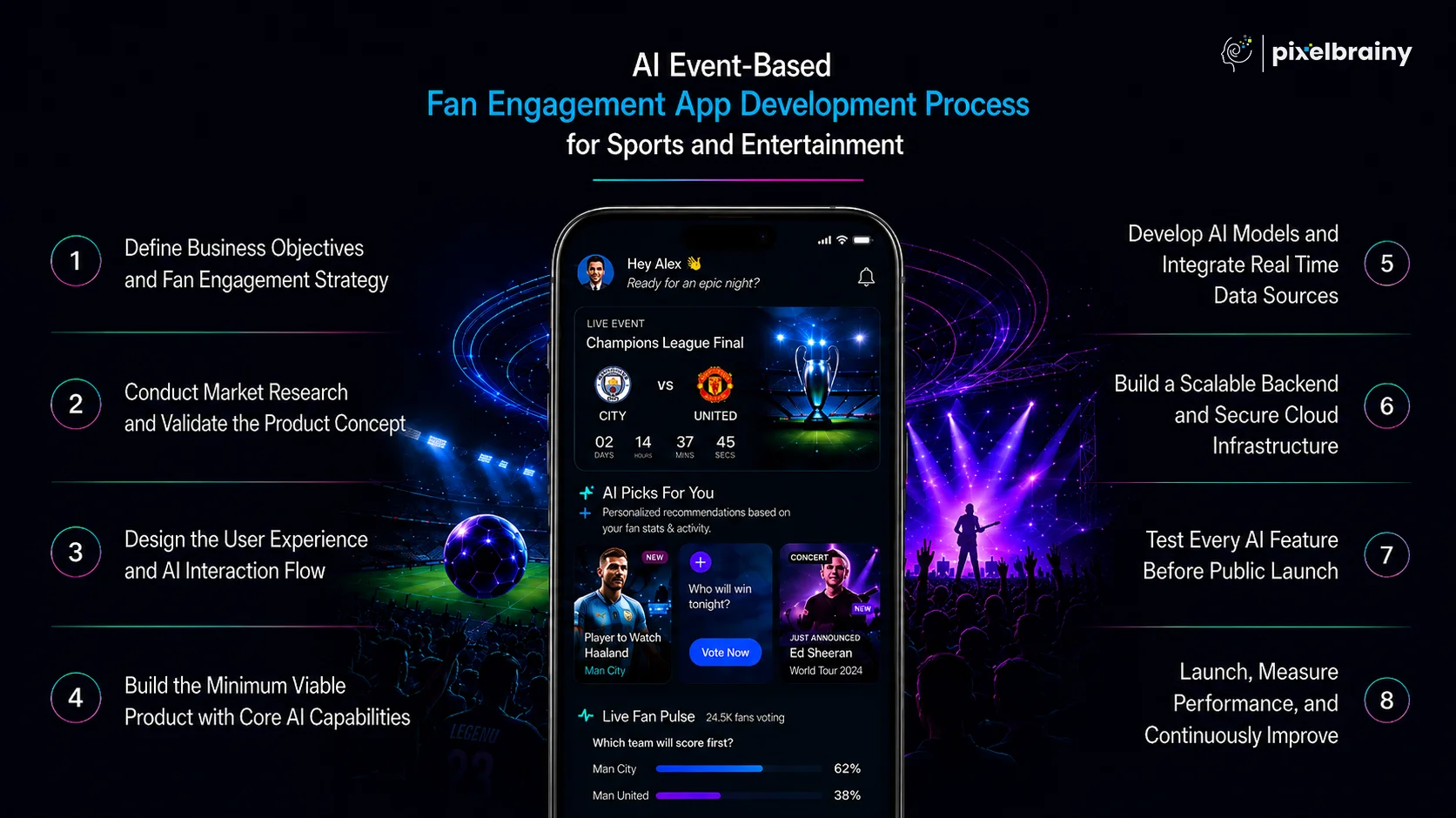
Every successful AI event-based fan engagement app development project starts with understanding why the platform is being built. Many organizations focus immediately on AI features without identifying the business problems they want to solve. A professional sports franchise may want to increase game day engagement and merchandise sales, while a sports broadcaster may prioritize second screen experiences that increase viewer retention. Entertainment venues often focus on improving attendee satisfaction and sponsor activation performance.
This discovery phase should identify your primary audience, event types, engagement goals, monetization strategy, success metrics, and AI use cases. Teams also define which fan journey stages require AI driven personalization before, during, and after every event. Establishing these objectives early ensures that every technology decision supports measurable business outcomes instead of adding unnecessary complexity.
Once business goals are defined, the next step is validating market demand before investing significant development resources. This includes analyzing competing fan engagement platforms, identifying feature gaps, evaluating fan expectations, reviewing sponsor requirements, and studying user behavior across sports and entertainment industries.
Organizations should also interview stakeholders including fans, venue operators, sponsors, broadcasters, and internal marketing teams to understand which AI experiences provide genuine value. At this stage, many companies begin with PoC development to validate complex AI capabilities such as personalized recommendations, live prediction engines, or AI generated match insights before committing to full scale implementation. Early validation reduces technical risk while ensuring the final platform solves real market problems.
An AI platform is only successful if fans find it simple, intuitive, and enjoyable to use. Even the most advanced AI models cannot improve engagement if the application feels confusing or difficult to navigate. User journeys should be designed around the complete fan experience, from purchasing tickets and receiving personalized recommendations to participating in prediction games and redeeming rewards.
During this phase, designers create wireframes, interactive prototypes, navigation structures, personalization flows, and responsive interfaces for mobile devices. Organizations often collaborate with an experienced UI/UX design company to ensure the application delivers seamless experiences across different sports, entertainment events, and audience segments while supporting future AI enhancements without disrupting usability.
Instead of developing every planned feature simultaneously, organizations should first launch a focused version containing the most valuable functionality. This significantly reduces development time, allows faster market feedback, and helps validate user adoption before investing in advanced capabilities.
A typical first release includes secure authentication, personalized dashboards, event schedules, live updates, ticket management, fan profiles, loyalty programs, and one or two AI powered features such as personalized recommendations or intelligent notifications. Many businesses choose MVP development because it enables continuous product improvement using real user feedback rather than assumptions. This iterative approach lowers investment risk while providing valuable behavioral data that guides future AI enhancements and product expansion.
Also Read: Top 10 AI MVP Development Companies in USA
With the core application ready, the next phase focuses on integrating artificial intelligence capabilities that power personalized fan experiences. This stage involves training and deploying AI models for recommendations, content personalization, prediction challenges, intelligent notifications, and behavioral analytics. At the same time, developers integrate reliable real time data sources such as sports statistics providers, ticketing platforms, CRM systems, loyalty programs, merchandise stores, payment gateways, and venue management software. Many organizations also collaborate with an experienced AI model development company to build, train, optimize, and fine tune custom AI models that align with their fan engagement objectives.
The quality of an AI fan engagement platform depends heavily on the quality of its data. Continuous access to accurate live information enables the application to deliver timely match insights, personalized offers, contextual alerts, and dynamic recommendations. Well-designed AI pipelines also ensure that models continuously learn from new fan interactions, allowing personalization to improve after every event without requiring manual intervention.
Sports and entertainment events often generate massive spikes in user activity within a very short period. Thousands or even millions of fans may simultaneously access live scores, prediction games, ticketing services, or AI generated content. For this reason, the platform must be designed with scalability, availability, and performance as primary architectural goals rather than future considerations.
A cloud native infrastructure supported by microservices, distributed databases, content delivery networks, load balancing, and automated scaling ensures stable performance during peak traffic. Security should receive equal attention by implementing encrypted data storage, secure authentication, API protection, role-based access control, and compliance with global privacy regulations. A resilient infrastructure protects valuable first party fan data while maintaining uninterrupted digital experiences during every live event.
Before releasing the application, every feature should undergo comprehensive testing to verify functionality, performance, security, and usability. Core capabilities such as ticket booking, live event updates, loyalty rewards, notifications, and AI recommendations should be validated across multiple devices, operating systems, and varying network conditions to ensure consistent user experiences.
Testing should also evaluate AI specific performance including recommendation accuracy, prediction quality, personalization relevance, and response speed during live events. User acceptance testing with real fans helps identify usability improvements that internal teams often overlook. Many organizations also compare their product quality against platforms delivered by top AI app development companies to benchmark performance and ensure the application is ready for large scale public adoption.
Launching the application is not the end of the development journey. The most successful platforms continue evolving through continuous monitoring, feature enhancements, and AI optimization based on real user behavior. Product teams should closely track key performance indicators including daily active users, session duration, fan retention, prediction participation, ticket conversions, merchandise purchases, sponsor engagement, and loyalty program activity.
Artificial intelligence should also be retrained regularly using newly collected behavioral data so recommendations become increasingly accurate over time. User feedback, analytics, and changing business objectives should guide future feature releases instead of assumptions. Organizations that continuously optimize their platform create fan experiences that remain engaging season after season while delivering sustainable commercial growth and long-term competitive advantage.
A structured development process reduces project risk, accelerates time to market, and lays the foundation for an AI fan engagement platform that continuously grows alongside your fans and business.
Also Read: AI Mobile App Development for Startups and Enterprises: Benefits, Steps and Challenges
One of the first questions every founder, sports franchise, entertainment venue, and media company asks before starting development is, what is the cost to create an AI event-based fan engagement app? The answer depends on several factors, including the number of AI capabilities, platform complexity, third party integrations, scalability requirements, and whether the application is built for a single organization or multiple sports and entertainment properties.
Consider this real business scenario: We are launching a new professional sports league in the United States and fan engagement technology will be central to our growth strategy from day one. We need to understand the AI event-based fan engagement app development cost in 2026, what features fit within our budget, and whether we should launch with an MVP or invest directly in a full-scale enterprise platform. This is one of the most common budgeting questions organizations face before beginning development.
On average, the cost of building an AI event-based fan engagement app in 2026 ranges from $25,000 to $250,000+, depending on project scope, AI sophistication, infrastructure, integrations, and long-term scalability. While a basic application focuses on core engagement features, enterprise platforms include advanced AI personalization, predictive analytics, real time data processing, and high availability infrastructure capable of supporting millions of users.
| App Type | Estimated Development Cost | What You Will Get |
|---|---|---|
| Basic AI Event Based Fan Engagement App | $25,000 to $60,000 | User registration, fan profiles, event schedules, live scores, ticket management, push notifications, basic AI recommendations, loyalty program, admin panel, and essential analytics suitable for startups or local sports organizations. |
| Advanced AI Event Based Fan Engagement App | $60,000 to $150,000 | Everything included in the basic version plus personalized AI recommendations, live prediction games, AI generated match insights, merchandise integration, sponsor campaigns, fan communities, advanced analytics, payment gateways, and scalable cloud infrastructure. |
| Enterprise AI Event Based Fan Engagement App | $150,000 to $250,000+ | Enterprise grade AI personalization, real time behavioral analytics, augmented reality experiences, predictive fan engagement, multi property support, CRM integration, loyalty ecosystem, multilingual support, cloud auto scaling, enterprise security, and advanced administrative dashboards. |
The overall complexity of the application has the greatest impact on development costs. A basic fan engagement platform with standard functionality requires significantly less effort than a platform supporting AI powered personalization, prediction engines, and enterprise integrations.
Estimated Cost Impact: $10,000 to $80,000
The more intelligent the platform becomes, the higher the development investment. Features such as personalized recommendations, behavioral analytics, AI generated match insights, predictive engagement, and conversational AI require additional model training, testing, and optimization.
Estimated Cost Impact: $15,000 to $70,000
Modern sports fans expect intuitive, visually engaging, and highly responsive applications. Custom interface design, interactive dashboards, gamification elements, and responsive experiences across mobile devices increase design and development effort.
Estimated Cost Impact: $5,000 to $20,000
Most fan engagement platforms integrate with sports data providers, ticketing systems, payment gateways, CRM software, merchandise stores, loyalty platforms, mapping services, and notification providers. Every additional integration increases development complexity.
Estimated Cost Impact: $5,000 to $30,000
Building native applications for both iOS and Android generally requires a larger investment than developing a cross-platform application. Additional web dashboards or administrative portals also increase overall project costs.
Estimated Cost Impact: $10,000 to $40,000
Real time sports applications require scalable cloud infrastructure capable of supporting thousands or even millions of simultaneous users during major events. Backend architecture, databases, APIs, content delivery networks, and auto scaling services all contribute to infrastructure costs.
Estimated Cost Impact: $15,000 to $50,000
Protecting fan data, payment information, and user accounts requires secure authentication, encrypted storage, API protection, role-based access control, and compliance with privacy regulations such as GDPR and CCPA.
Estimated Cost Impact: $5,000 to $20,000
Comprehensive testing ensures the platform performs reliably across multiple devices, operating systems, and high traffic event scenarios. AI features also require additional validation to maintain recommendation accuracy and real time performance.
Estimated Cost Impact: $5,000 to $15,000
After launch, organizations must continuously improve the platform through feature updates, AI model retraining, security patches, cloud monitoring, and performance optimization. These recurring investments ensure the application remains competitive as fan expectations evolve.
Estimated Annual Cost: 15% to 25% of the initial development budget
| Development Stage | Estimated Cost |
|---|---|
| Product Discovery & Planning | $3,000 to $10,000 |
| UI/UX Design | $5,000 to $20,000 |
| Mobile App Development | $20,000 to $80,000 |
| AI Model Development & Integration | $15,000 to $70,000 |
| Backend & Cloud Infrastructure | $15,000 to $50,000 |
| Third Party Integrations | $5,000 to $30,000 |
| Testing & Quality Assurance | $5,000 to $15,000 |
| Deployment & Launch | $2,000 to $10,000 |
Ultimately, the right investment is not determined by the size of your budget but by building an AI fan engagement platform that delivers measurable fan engagement, long term revenue growth, and sustainable business value.
Also Read: AI App Development Cost: From MVPs to Full-Scale AI App
The performance of an AI fan engagement app is determined long before the first feature is released. It begins with selecting a technology stack that can support real time sports data, AI powered personalization, live fan interactions, and millions of concurrent users without compromising speed, reliability, or security. Choosing technologies based only on current development trends often leads to expensive migrations as user expectations and platform complexity grow.
Consider this real business scenario: We are a ticketing company that processes more than five million sports and entertainment tickets annually across the United States, and we want to add an AI fan engagement layer to our existing ticketing platform instead of building a completely new application. Which technologies should we choose to support AI recommendations, live event updates, personalized offers, loyalty programs, and scalable cloud infrastructure while integrating seamlessly with our current ecosystem? This is a common challenge because the success of AI event-based fan engagement app development depends not only on AI models but also on selecting technologies that can efficiently process real time data, deliver low latency experiences, and scale as fan engagement grows.
Whether you are building an AI event-based fan engagement app for a professional sports franchise, broadcaster, entertainment venue, esports organization, or startup, the following technology stack represents a modern and proven foundation for the development of AI event-based fan engagement app solutions. From mobile frameworks and AI platforms to cloud infrastructure, analytics, and security, every technology plays a specific role in creating a high-performance application that remains scalable and future ready.
| Technology Layer | Recommended Technologies | Purpose |
|---|---|---|
| Mobile App Development | Flutter, React Native, Swift, Kotlin | Build high performance native or cross platform mobile applications for iOS and Android with smooth user experiences and faster development cycles. |
| Frontend Development | React.js, Next.js, Vue.js | Develop responsive web portals, admin dashboards, and interactive fan experiences with fast loading speeds and excellent scalability. |
| Backend Development | Node.js, Python, Java Spring Boot, .NET Core | Build secure APIs, manage business logic, process real time requests, and support millions of concurrent users during live sports and entertainment events. |
| AI & Machine Learning | OpenAI, TensorFlow, PyTorch, Scikit Learn, LangChain | Develop personalized recommendation engines, conversational AI, predictive analytics, intelligent notifications, fan behavior analysis, and AI generated event insights. |
| Real Time Data Processing | Apache Kafka, Redis, Socket.IO, Firebase Realtime Database | Deliver live scores, instant notifications, prediction games, synchronized event updates, and low latency communication between users and servers. |
| Database | PostgreSQL, MongoDB, MySQL, Firebase Firestore | Store fan profiles, ticket information, engagement history, AI learning data, transactions, loyalty points, and application content securely. |
| Cloud Infrastructure | Amazon Web Services, Microsoft Azure, Google Cloud Platform | Host scalable applications with automatic resource scaling, AI services, storage, networking, monitoring, and enterprise grade reliability. |
| Authentication & Security | OAuth 2.0, Firebase Authentication, Auth0, JWT | Secure user authentication, role based access control, encrypted sessions, and safe access to fan accounts and administrative portals. |
| Sports Data APIs | Sportradar, Stats Perform, Sportmonks, ESPN APIs | Retrieve real time match statistics, player information, schedules, league standings, event data, and live game feeds for AI powered experiences. |
| Payment Gateway | Stripe, PayPal, Square, Braintree | Support secure ticket purchases, merchandise payments, premium subscriptions, loyalty rewards, and digital transactions within the application. |
| Maps & Location Services | Google Maps Platform, Mapbox, Apple Maps | Enable venue navigation, parking guidance, seat directions, location based notifications, and personalized in venue experiences. |
| Push Notifications | Firebase Cloud Messaging, OneSignal, Apple Push Notification Service | Deliver personalized alerts, live event updates, promotional campaigns, ticket reminders, and AI driven recommendations to users in real time. |
| Analytics & User Tracking | Google Analytics 4, Firebase Analytics, Mixpanel, Amplitude | Measure fan engagement, retention, feature adoption, user journeys, conversion rates, campaign performance, and AI recommendation effectiveness. |
| DevOps & CI/CD | Docker, Kubernetes, GitHub Actions, Jenkins, GitLab CI/CD | Automate application deployment, testing, scaling, monitoring, and continuous software updates while improving development efficiency. |
| Monitoring & Performance | Datadog, New Relic, Grafana, Prometheus | Continuously monitor application performance, server health, API response times, AI workloads, and infrastructure reliability during live events. |
A carefully selected technology stack provides the foundation for building a secure, scalable, and future ready AI fan engagement platform capable of delivering exceptional digital experiences for sports and entertainment audiences.
Before you build AI fan engagement app solutions, it is important to define how the platform will generate revenue. Many organizations focus on features first and monetization later, but the reality is exactly the opposite. Your revenue model influences product architecture, AI capabilities, third party integrations, partnership strategy, and even the overall fan experience. Planning monetization early ensures that every feature contributes to measurable business value instead of simply increasing development costs.
One of the most common questions organizations ask before starting a project is: "We are a ticketing company that processes more than five million sports and entertainment tickets annually, and we want to add an AI fan engagement layer to our existing platform that increases fan retention, drives premium seat upgrades, and collects valuable behavioral insights. Which monetization model should we prioritize to maximize long term revenue?" The answer depends on understanding your audience, business objectives, and commercial partnerships before AI event-based fan engagement app development begins. In most cases, combining multiple revenue streams delivers stronger and more sustainable growth than relying on a single monetization model.
Below are the most effective monetization strategies adopted by organizations that develop AI fan engagement app platforms for sports and entertainment.
Sponsor activation is the primary revenue model for most official sports team and league applications. Instead of selling traditional advertising space, organizations monetize AI powered prediction challenges, branded fan experiences, contextual rewards, exclusive campaigns, and personalized sponsor offers linked to real fan behavior. Artificial intelligence makes these campaigns measurable by connecting every activation with engagement, participation, and conversion data.
Pros: High revenue potential, measurable sponsor performance, stronger brand partnerships.
Cons: Requires an active fan community and attractive sponsorship opportunities.
Best Suited For: Professional sports teams, leagues, broadcasters, and major entertainment organizations.
A subscription model allows organizations to provide essential features free of charge while offering premium experiences to paying members. Premium subscribers can access exclusive AI insights, advanced prediction competitions, early ticket sales, ad free experiences, enhanced loyalty rewards, and members only content throughout the season.
Pros: Generates predictable recurring revenue while increasing fan loyalty.
Cons: Requires continuous delivery of exclusive content and premium experiences.
Best Suited For: Sports clubs, leagues, media companies, and organizations with highly engaged fan communities.
Artificial intelligence significantly improves merchandise sales by recommending products according to fan preferences, favorite players, previous purchases, and live game moments. Instead of browsing a traditional online store, fans receive personalized product suggestions exactly when purchase intent is highest.
Pros: Higher conversion rates, personalized shopping experiences, increased average order value.
Cons: Requires ecommerce infrastructure, inventory management, and fulfillment integration.
Best Suited For: Sports franchises, leagues, entertainment brands, and official merchandise stores.
AI analyzes attendance history, purchasing behavior, and real time seat availability to recommend VIP upgrades, premium seating, hospitality packages, backstage experiences, parking upgrades, and exclusive event access. Revenue is generated through direct sales or commercial partnerships with ticketing providers.
Pros: Increases revenue per attendee while improving premium inventory utilization.
Cons: Requires integration with ticketing systems and live inventory management.
Best Suited For: Stadium operators, sports teams, entertainment venues, and ticketing companies.
AI powered food ordering enhances the in-venue experience by recommending meals, beverages, and promotional offers based on previous purchases, event timing, current wait times, and fan preferences. Revenue is generated through commissions or revenue sharing agreements with concession partners.
Pros: Improves attendee convenience while increasing food and beverage sales.
Cons: Depends on strong operational integration with venue concession systems.
Best Suited For: Stadiums, arenas, concert venues, festivals, and entertainment operators.
Organizations operating large fan ecosystems can monetize anonymized behavioral insights by licensing aggregated data to sponsors, marketers, sports analytics firms, research organizations, and league administrators. AI transforms millions of fan interactions into valuable commercial intelligence while maintaining user privacy.
Pros: Creates a scalable B2B revenue stream and increases the commercial value of first party data.
Cons: Requires strict data governance, privacy compliance, and anonymization standards.
Best Suited For: Multi property sports platforms, enterprise organizations, media companies, and leagues.
Technology companies and startups can license their platform to multiple sports teams, colleges, entertainment venues, and event organizers under each client's own brand. Instead of monetizing a single application, this SaaS approach creates recurring subscription revenue across multiple customers while expanding market reach.
Pros: Predictable recurring revenue, scalable business model, faster market expansion.
Cons: Requires flexible platform architecture and dedicated customer support.
Best Suited For: Independent founders, SaaS companies, and businesses focused on AI fan engagement mobile app development across multiple organizations.
| Organization Type | Recommended Monetization Strategy |
|---|---|
| Sports Franchise Digital Team | Sponsor activation, premium subscriptions, merchandise sales, ticket upgrades, and loyalty driven commerce. |
| Entertainment Venue Operator | Ticket upgrades, VIP experiences, food and beverage ordering, sponsor partnerships, and event-based promotions. |
| Independent Founder or SaaS Company | White label licensing, subscription revenue, data intelligence licensing, and enterprise platform partnerships. |
The strongest AI fan engagement platforms combine multiple monetization models, creating a balanced revenue ecosystem that benefits fans, sponsors, and organizations while supporting long term business growth.
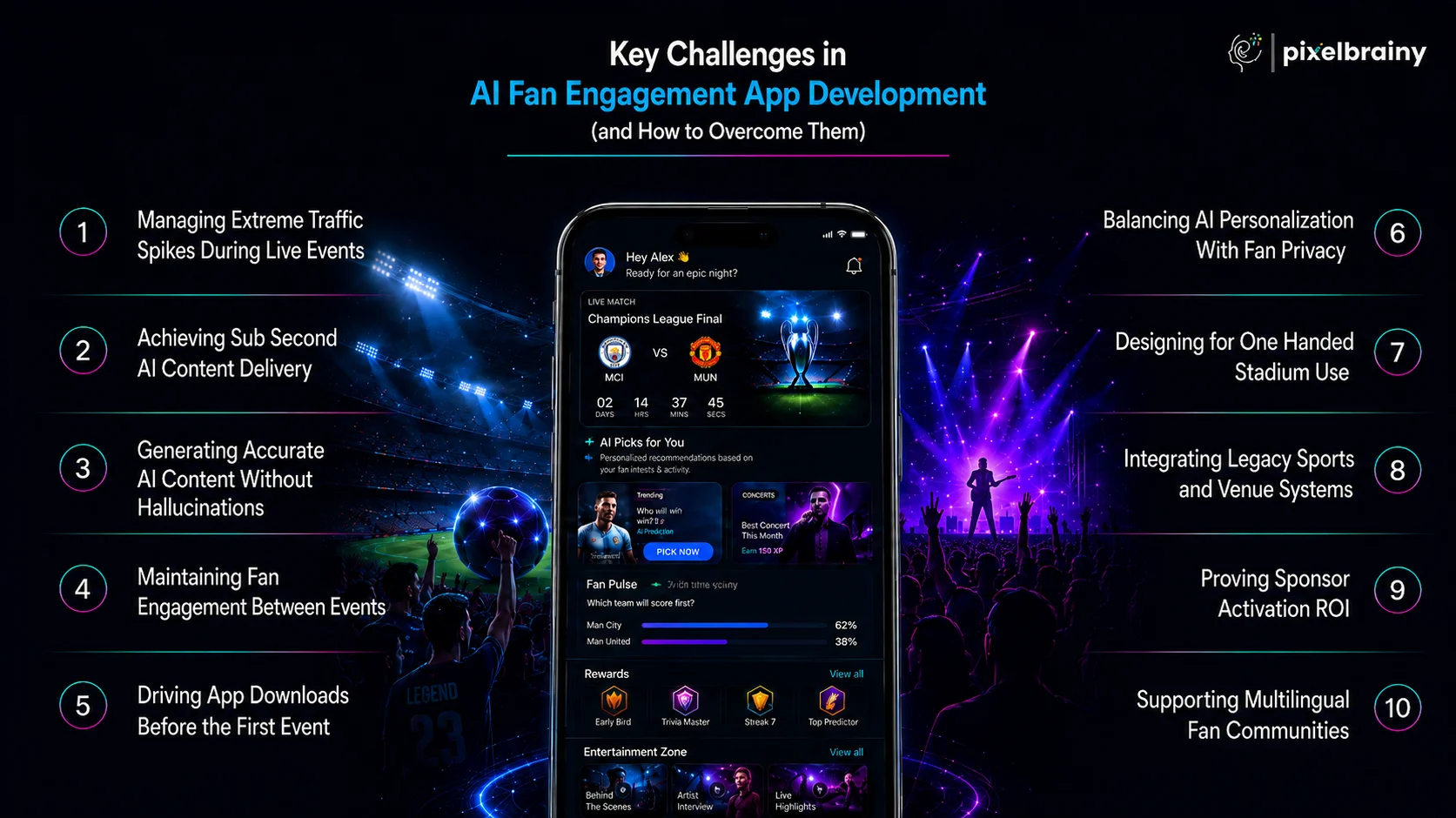
While AI event-based fan engagement app development creates enormous opportunities for sports and entertainment organizations, it also introduces technical, operational, and product challenges that cannot be overlooked. Building an AI powered platform requires much more than integrating artificial intelligence into a mobile application. Success depends on creating an experience that remains reliable during live events, respects fan privacy, delivers measurable business value, and continuously adapts to changing audience expectations.
One challenge we frequently hear from organizations is: "Our entertainment company hosts more than 200 live events every year across music, comedy, and esports. We want one AI platform that works across every event while also supporting multilingual audiences and learning fan preferences over multiple visits. How do we overcome these technical challenges without creating an overly complex system?"
The answer lies in identifying potential obstacles early and designing the platform with scalability, flexibility, and long-term growth in
| Challenge | How to Overcome It |
|---|---|
| Managing Extreme Traffic Spikes During Live Events | Major sporting events can generate thousands of simultaneous users within seconds. Build a cloud native architecture with automatic scaling, load balancing, caching, and content delivery networks to maintain fast performance even during peak game moments. |
| Achieving Sub Second AI Content Delivery | Fans expect AI insights, predictions, and recommendations instantly. Optimize AI inference pipelines, use edge computing where possible, cache frequently requested data, and process live sports feeds in real time to minimize latency. |
| Generating Accurate AI Content Without Hallucinations | AI generated match summaries and insights should always rely on verified live sports data instead of unrestricted language generation. Combine large language models with trusted sports APIs and validation layers before publishing AI generated content. |
| Maintaining Fan Engagement Between Events | One of the biggest challenges after organizations build AI fan engagement app platforms is keeping users active throughout the season. Introduce loyalty programs, personalized content, exclusive interviews, quizzes, community discussions, and off season challenges to encourage continuous engagement. |
| Driving App Downloads Before the First Event | New applications often struggle with low initial adoption. Encourage early registrations through ticket integration, exclusive rewards, referral campaigns, preseason content, and limited time member benefits that provide immediate value before the first event begins. |
| Balancing AI Personalization With Fan Privacy | Personalized experiences require behavioral data, but fans increasingly expect transparency. Focus on building AI fan engagement app with GDPR compliance and data privacy features, provide clear consent options, encrypt sensitive information, and give users control over their personal data. |
| Designing for One Handed Stadium Use | Fans often interact with their phones while standing, cheering, or walking through crowded venues. Design simple navigation, large touch targets, high contrast interfaces, minimal text input, and fast access to frequently used features for effortless one handed operation. |
| Integrating Legacy Sports and Venue Systems | Existing ticketing, CRM, scoreboard, and venue management systems were often not designed for modern APIs. Use middleware, API gateways, integration platforms, and phased migration strategies to connect legacy infrastructure without disrupting existing operations. |
| Proving Sponsor Activation ROI | Sponsors expect measurable business outcomes rather than impression counts. Track engagement metrics such as prediction participation, offer redemptions, click through rates, purchases, and audience segmentation to demonstrate campaign performance with detailed analytics dashboards. |
| Supporting Multilingual Fan Communities | Organizations planning to develop AI fan engagement app platforms for international audiences must ensure AI features perform consistently across multiple languages. Train multilingual AI models, localize content, validate translations, and continuously test user experiences in every supported language. |
By addressing these challenges early, organizations can develop AI fan engagement app platforms that remain scalable, secure, engaging, and commercially successful while delivering exceptional experiences for fans, sponsors, and event operators.
When you decide to build an AI fan engagement app, choosing the right technology partner becomes just as important as choosing the right product strategy. A successful platform requires expertise in artificial intelligence, real time data processing, cloud architecture, intuitive user experiences, and the sports and entertainment ecosystem. PixelBrainy, a leading AI app development company, brings all these capabilities together to help sports franchises, entertainment brands, media companies, startups, and event organizers launch intelligent fan engagement platforms that deliver measurable business results.
One of the most common questions we receive is: "We are launching a new professional sports league in the USA targeting an underserved market, and fan engagement technology will be central to our growth strategy from day one. We need an AI fan engagement app built alongside our league launch that creates a digital community before our first game is played. Which AI development companies in the USA have experience building fan engagement platforms where community growth is just as important as game day engagement?"
Whether you want to create an AI event-based fan engagement app for a sports franchise, entertainment venue, broadcaster, or startup, our team follows a proven development framework that combines AI strategy, product design, engineering, and continuous optimization to deliver scalable digital fan experiences.
At PixelBrainy, we help organizations:
Our objective is to develop an AI event-based fan engagement app that increases fan engagement, strengthens community building, and creates sustainable revenue opportunities.
Client Success Snapshot:
A confidential sports organization approached PixelBrainy before launching a new regional professional league. Their biggest challenge was building a loyal digital community before the first official game while keeping fans engaged throughout the inaugural season.
Our team developed an AI powered fan engagement platform featuring personalized onboarding, prediction games, loyalty rewards, referral campaigns, live match experiences, and AI driven content recommendations.
Project Outcomes:
Client identity remains confidential under a non-disclosure agreement.
As one of the trusted companies that develop AI event-based fan engagement app solutions, PixelBrainy combines AI expertise, scalable technology, and business focused product strategy to help organizations launch future ready fan engagement platforms with confidence.
Planning to make an AI event-based fan engagement app for your sports league, entertainment venue, or media platform? Connect with PixelBrainy to build an AI powered fan engagement solution that grows your fan community from day one.
The way fans interact with sports and entertainment is changing faster than ever. Organizations that continue relying on traditional mobile apps will struggle to keep audiences engaged, while those investing in AI event-based fan engagement app development will be better positioned to build stronger fan communities, increase retention, and unlock sustainable revenue streams. Artificial intelligence is no longer an optional enhancement. It has become the foundation for delivering personalized, real time, and highly interactive fan experiences across every stage of the event journey.
Whether your goal is to build AI fan engagement app solutions for a professional sports franchise, develop AI fan engagement app platforms for an entertainment venue, or create an AI event-based fan engagement app for a new league, media company, or startup, success depends on combining the right strategy, technology stack, AI capabilities, and long-term product vision. A well-designed platform not only enhances fan engagement but also strengthens sponsorship value, improves operational efficiency, and creates multiple monetization opportunities for years to come.
Ready to build an AI powered fan engagement platform that keeps fans connected before, during, and after every event? Schedule a call with the PixelBrainy team today and let's discuss how we can turn your vision into a scalable, future ready solution.
An AI event-based fan engagement app is an intelligent mobile or web platform that uses artificial intelligence to deliver personalized fan experiences before, during, and after sports or entertainment events. It combines real time event data, AI recommendations, interactive features, loyalty programs, and behavioral analytics to increase fan engagement and business revenue.
A standard sports team app mainly provides schedules, scores, ticketing, and news updates. An AI fan engagement app continuously learns from user behavior to deliver personalized content, AI generated insights, prediction games, intelligent notifications, sponsor activations, and customized recommendations that improve with every interaction.
Popular real time sports data providers include Sportradar, Stats Perform, Sportmonks, Opta Sports, and ESPN APIs. These platforms provide live scores, player statistics, match events, schedules, and analytics that power AI recommendations, prediction games, and personalized fan experiences.
AI personalization analyzes fan preferences, favorite teams, attendance history, purchase behavior, content interactions, and engagement patterns to build individual user profiles. Machine learning continuously updates these profiles to recommend relevant content, merchandise, rewards, notifications, and event experiences based on each fan's interests.
Development timelines depend on project complexity and AI requirements. A basic AI fan engagement app typically takes 3 to 5 months, while an advanced or enterprise platform with real time AI, integrations, and scalable infrastructure usually requires 6 to 12 months.
The AI event-based fan engagement app development cost in 2026 generally ranges from $25,000 to $250,000+. The final investment depends on AI capabilities, platform complexity, third party integrations, cloud infrastructure, security requirements, and long-term scalability.
The biggest challenges include handling peak traffic during live events, delivering low latency AI recommendations, integrating multiple legacy systems, protecting fan data, maintaining multilingual AI experiences, and ensuring AI generated content remains accurate using verified real time sports data.
Yes. AI fan engagement platforms can be customized for esports tournaments, concerts, music festivals, comedy shows, live entertainment events, and multi venue experiences. AI supports personalized schedules, live predictions, community engagement, loyalty programs, artist recommendations, and event specific experiences across different industries.
When selecting an AI development partner, look for a company with proven expertise in artificial intelligence, real time data integration, cloud architecture, mobile app development, and sports or entertainment technology. PixelBrainy, a leading AI app development company, helps organizations build scalable AI fan engagement platforms with personalized experiences, real time intelligence, and future ready architecture tailored to their business goals.

About The Author
Sagar Bhatnagar
Sagar Sahay Bhatnagar brings over a decade of IT industry experience to his role as Marketing Head at PixelBrainy. He's known for his knack in devising creative marketing strategies that boost brand visibility and market influence. Sagar's strategic thinking, coupled with his innovative vision and focus on results, sets him apart. His track record of successful campaigns proves his ability to utilize digital platforms effectively for impactful marketing efforts. With a genuine passion for both technology and marketing, Sagar continuously pushes PixelBrainy's marketing initiatives to greater success.
Working with the PixelBrainy team has been a highly positive experience. They understand the design requirements and create beautiful UX elements to meet the application needs. The dev team did an excellent job bringing my vision to life. We discussed usability and flow. Sagar worked with his team to design the database and begin coding. Working with Sagar was easy. He has the knowledge to create robust apps, including multi-language support, Google and Apple ID login options, Ad-enabled integrations, Stripe payment processing, and a Web Admin site for maintaining support data. I'm extremely satisfied with the services provided, the quality of the final product, and the professionalism of the entire process. I highly recommend them for Android and iOS Mobile Application Design and Development.

Great experience working with them. Had a lot of feedback and I found that unlike most contractors they were bugging me for updates instead of the other way around. They were extremely time conscience and great at communicating! All work was done extremely high quality and if not on time, early! They were always proactive when it comes to communication and the work is great/above par always. Very flexible and a great team to work with! Goes above and beyond to present us with multiple options and always provides quality. Amazing work per usual with Chitra. If you have UI/UX or branding design needs I recommend you go to them! Will likely work with them in the future as well, definitely recommended!

PixelBrainy is a joy to work with and is a great partner when thinking through branding, logo, and website layout. I appreciate that they spend time going into the "why" behind their decisions to help inform me and others about industry best practices and their expertise.

I hired them to design our software apps. Things I really like about them are excellent communication skills, they answer all project suggestions and collaborate right away, and their input on design and colors is amazing. This project was complex and needed patience and creativity. The team is amazing to do business with. I will be using them long-term. Glad to see there are some good people out there. I was afraid to try and outsource my project to someone but I am glad I met them! I really can't say enough. They went above and beyond on this project. I am very happy with everything they have done to make my business stand out from the competition.

It was great working with PixelBrainy and the team. They were very responsive and really owned the project. We'll definitely work with them again!

I recently worked with the PixelBrainy team on a project and I was blown away by their communication skills. They were prompt, clear, and articulate in all of our interactions. They listened and provided valuable feedback and suggestions to help make the project a success. They also kept me updated throughout the entire process, which made the experience stress-free and enjoyable.

PixelBrainy is very good at what it does. The team also presents themselves very professionally and takes care of their side of things very well. I could fully trust them taking up the design work in a timely and organised manner and their attention to detail saved us lots of effort and time. This particular project was quite intense and the team showed that they function very well under pressure. Very much looking forward to working with her again!

It's always an absolute pleasure working with them. They completed all of my requests quickly and followed every note I had for them to a T, which made our process go smoothly from start to finish. Everything was completed fast and following all of the guidelines. And I would recommend their services to anyone. If you need any design work done in the future, PixelBrainy should be your first call!

They took ownership of our requirements and designed and proposed multiple beautiful variants. The team is self-motivated, requires minimum supervision, committed to see-through designs with quality and delivering them on time. We would definitely love to work with PixelBrainy again when we have any requirements.

PixelBrainy was a big help with our SaaS application. We've been hard at work with a new UI/UX and they provided a lot of help with the designs. If you're looking for assistance with your website, software, or mobile application designs, PixelBrainy and the team is a great recommendation.

PixelBrainy designers are amazing. They are responsive, talented, and always willing to help craft the design until it matches your vision. I would recommend them and plan to continue them for my future projects and more!!!

They were awesome! Did a good job fast, and good communication. Will work with them again. Thank you

Creative, detail-oriented, and talented designers who take direction well and implement changes quickly and accurately. They consistently over-delivered for us.

PixelBrainy team is very talented and creative. Great designers and a pleasure to work with. PixelBrainy is an excellent communicator and I look forward to working with them again.

PixelBrainy has a very talented design team. Their work is excellent and they are very responsive. I enjoy working with them and hope to continue on all of our future projects.


Transform your ideas into reality with us.
Across these industries, each engagement brings unique challenges, from early-stage product development to scaling complex systems, helping us build a practical understanding of real-world product environments.