AI Summary Powered by PixelBrainy
What would it take to turn one ordinary room photo into a photorealistic interior redesign that a homeowner can actually use to make furniture, color, and renovation decisions?
Imagine a homeowner standing in a dated living room with an old sofa, mismatched colors, limited storage, and no clear idea where to begin. Instead of searching Pinterest for hours or paying for an initial design consultation, they open an AI interior design app, upload a photograph, select “Modern Scandinavian,” enter a budget, and receive several realistic redesign concepts within seconds. The app preserves the room's structure while visualizing new furniture, colors, lighting, materials, and decor.
This is the core opportunity behind AI interior design app development.
For founders, furniture brands, proptech companies, real estate businesses, and home improvement platforms, the question is no longer simply whether to build an AI interior design app. The more important questions are how accurately the application can understand a real room, how realistic its generated designs are, how quickly it can produce them, and how economically it can scale.
The market signals are significant. Grand View Research estimates that the global AI in interior design market will reach USD 4.0 billion in 2026, up from USD 3.3 billion in 2025, and projects it to reach USD 15.0 billion by 2033, representing a 20.9% CAGR from 2026 to 2033.
So, if your goal is to develop an AI interior design app that provides genuinely useful room transformations rather than generic AI images, production planning matters. A serious product combines computer vision, generative AI, image segmentation, recommendation systems, 3D or spatial technologies, cloud infrastructure, mobile UX, and potentially AR.
For a production-grade product in 2026, development can range from approximately $30,000 for a focused MVP to $250,000 or more for an advanced platform, depending on AI complexity, rendering quality, integrations, platforms, and customization requirements.
This guide explains how to create an AI interior design app, what features it needs, which technologies power it, how much development can cost, the challenges teams encounter, and how to build a scalable AI interior design app capable of supporting real users and commercial growth. It also examines existing AI home-design products and what businesses should evaluate when selecting AI interior design app development services.

An AI interior design app is a mobile or web application that uses artificial intelligence, computer vision, generative AI, and design recommendation algorithms to help users visualize, plan, and personalize interior spaces. Instead of manually creating layouts or working with complex design software, users can upload a room photo, describe their preferences, and receive AI-generated design concepts within seconds.
The primary purpose of an AI interior design app is to simplify the design process for homeowners, renters, interior designers, furniture retailers, real estate companies, and property developers.
The typical workflow combines image analysis, user inputs, AI generation, and design recommendations.
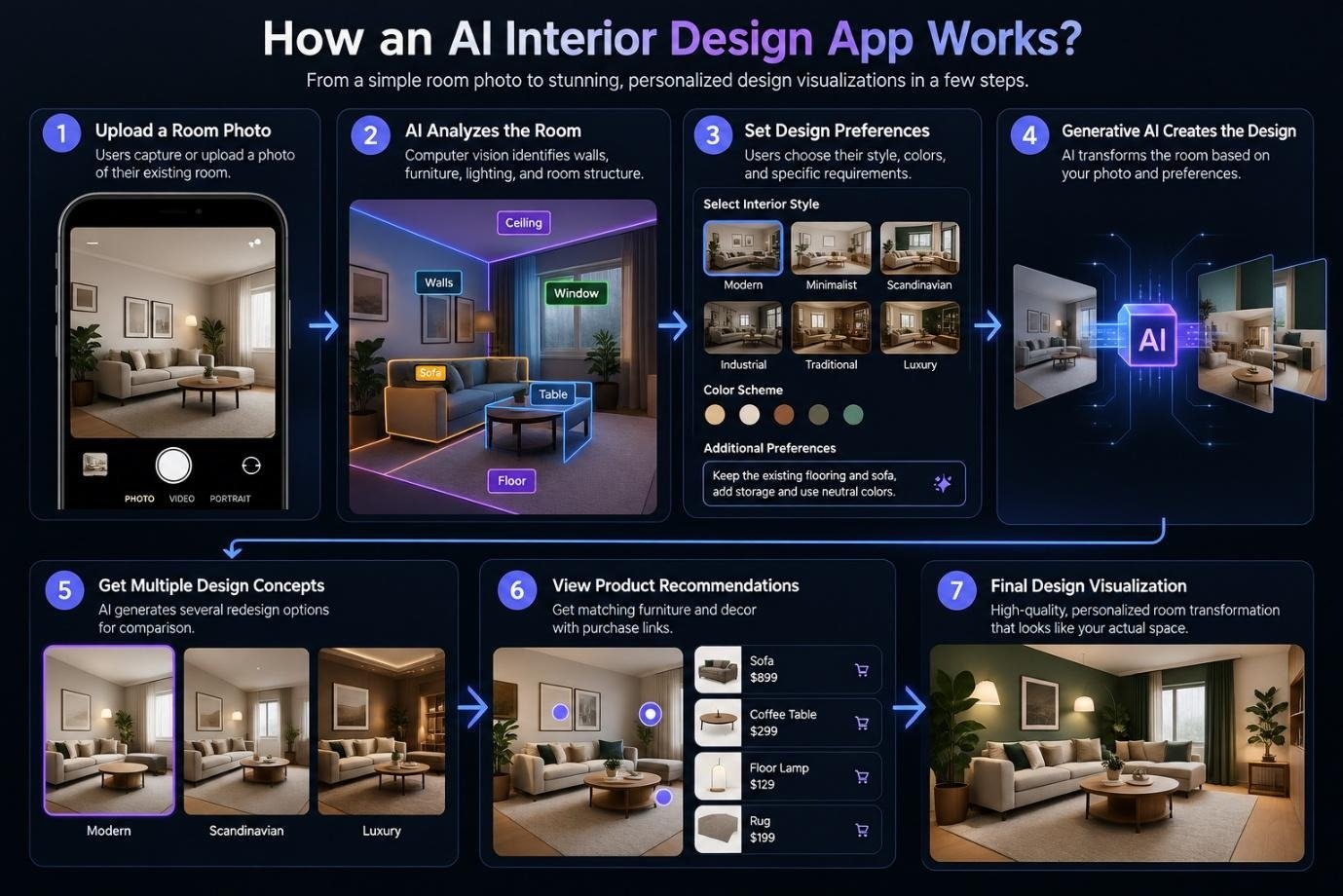
The process starts when a user captures or uploads a photo of their living room, bedroom, kitchen, office, or another space. The app can validate image quality, orientation, lighting, and visibility before sending the image to the AI pipeline.
Computer vision models identify important elements within the photograph, including:
Advanced systems can also estimate depth, perspective, and spatial relationships to improve design accuracy.
The user can select an interior style such as modern, minimalist, Scandinavian, industrial, traditional, luxury, bohemian, or Japandi. They may also specify requirements such as preferred colors, furniture types, budget, or items they want to keep.
For example:
“Redesign my living room in a warm minimalist style. Keep the existing flooring and sofa, add storage, and use neutral colors.”
The AI converts these instructions into structured design requirements.
The application sends the original image and design parameters to a generative AI pipeline. Image-to-image generation, inpainting, segmentation masks, reference conditioning, and other techniques can be used to modify the room while maintaining important elements of the original space.
The objective is not simply to create an attractive room. A high-quality AI interior design app should generate a visualization that still resembles the user's actual room.
Instead of providing one result, the app can generate several alternatives. For example:
Users can compare the concepts and select their preferred direction.
More advanced applications can identify furniture and decor from the generated design, recommend similar products, estimate costs, create shopping lists, or provide room improvement suggestions.
A typical architecture can be summarized as:
User Photo → Image Processing → Computer Vision → Room Understanding → User Preferences → Generative AI → Quality Validation → Design Visualization → Product Recommendations
This approach makes AI interior design more accessible because users do not need professional design knowledge or specialized software.
For businesses, the opportunity goes beyond visualization. An AI interior design app can connect design inspiration, personalization, product discovery, and purchasing within a single digital experience. That makes the technology relevant not only to homeowners but also to furniture retailers, real estate companies, interior design platforms, and home-improvement businesses.
The right type of AI interior design app development depends on the target audience, business model, and specific design problem the application is designed to solve. A homeowner may need instant room makeovers, while a real estate company may need AI-powered virtual staging. A furniture manufacturer may need product configuration and visualization, while professional designers may need AI tools that accelerate their existing workflows.
Before you build an AI interior design app, it is important to identify the primary user, define the core use case, and determine how AI-generated designs will create business value. Below are eight major types of AI interior design applications businesses can develop.
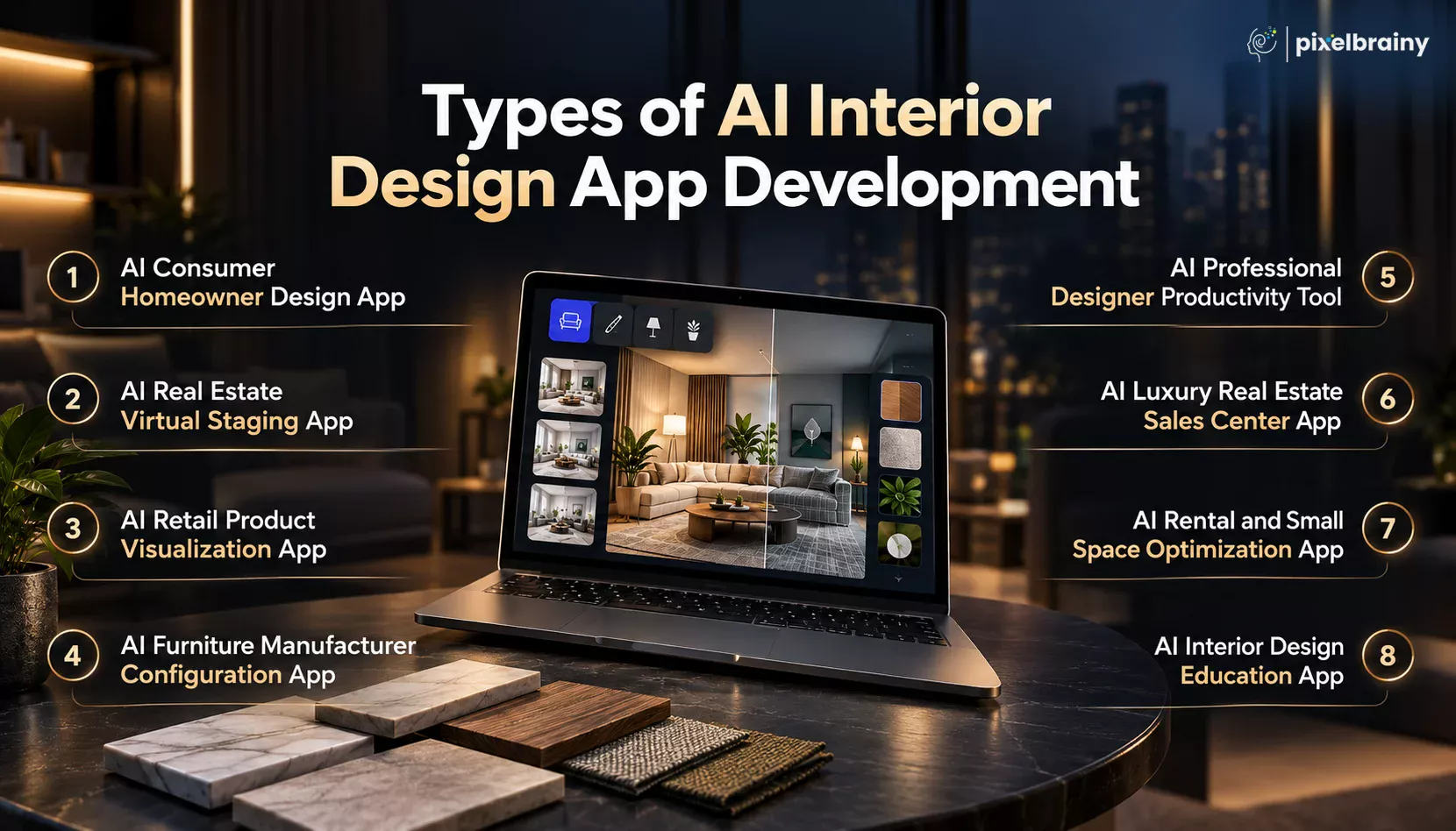
An AI consumer home design app is built for homeowners who want to redesign their spaces without requiring professional interior design knowledge.
Users can upload a photograph of their living room, bedroom, kitchen, dining area, or home office and provide preferences such as:
The AI analyzes the room and generates personalized design concepts.
For example, a homeowner could upload an outdated living room and enter:
“Create a modern Scandinavian design, keep the existing flooring and sofa, add storage, and use warm neutral colors.”
The application can generate multiple visual concepts and recommend furniture, lighting, decor, and other products.
This type of AI home design app development is suitable for B2C startups, home-improvement platforms, furniture marketplaces, and lifestyle applications.
Best suited for: Homeowners, renters, DIY decorators, and home-improvement consumers.
Key features: AI room redesign, style selection, before-and-after visualization, AI design assistant, product recommendations, saved projects, and subscription plans.
An AI real estate virtual staging app helps real estate agents transform empty, outdated, or poorly furnished property photos into realistic interior visualizations. Instead of asking prospective buyers to imagine how a property could look after furnishing, agents can use AI to create multiple staged versions in different interior styles.
For example, the AI can analyze a living room and add furniture, lighting, rugs, artwork, and decor while preserving important elements such as walls, windows, doors, flooring, and architectural features.
Real-world query: “We are a proptech startup and we want to build an AI interior design app that real estate agents can use to show prospective buyers how an empty or outdated property would look with modern furnishings and decor.”
This use case makes AI interior design app development particularly valuable for proptech businesses because the generated visuals can be directly used throughout the property marketing journey.
A typical workflow is:
Property Photo → AI Room Analysis → Style Selection → Virtual Staging → Multiple Designs → Property Listing
Real estate professionals can use AI-generated visualizations for:
For agencies managing multiple properties, the platform can also support batch processing, allowing several rooms to be staged with a consistent design style.
Best suited for: Real estate agencies, brokers, proptech startups, property developers, and real estate marketplaces.
Key features: AI virtual staging, furniture replacement, design styles, batch processing, HD rendering, property projects, team accounts, branded images, and API integrations.
This type of AI home design app development can ultimately become a specialized virtual-staging SaaS platform that helps real estate businesses present properties more effectively and give buyers a clearer understanding of each property's potential.
An AI retail product visualization app allows customers to see how furniture or home-decor products could look inside their own homes before making a purchase.
The customer uploads a room photograph, selects a product, and the AI generates a visualization showing the product in the space.
The customer journey can be:
Browse product → Upload room → Visualize product → Compare alternatives → Purchase
This model is particularly valuable for furniture retailers and home-decor marketplaces because it connects AI visualization directly with e-commerce.
For example, after visualizing a sofa, the application could recommend:
The objective of AI interior design app development for retailers is therefore not simply to generate attractive room images. The application should connect visualization with product discovery and purchasing.
Best suited for: Furniture retailers, home-decor marketplaces, e-commerce businesses, and home-improvement brands.
Key features: “Visualize in my room,” AI product matching, recommendations, product catalog integration, shopping links, product comparison, and personalized collections.
An AI furniture manufacturer configuration app helps furniture companies allow customers and retail partners to customize products and visualize them inside real rooms before making a purchase. Instead of relying on static product photographs, customers can experiment with different configurations, materials, colors, dimensions, and finishes.
For example, a customer could select a modular sofa, change its fabric and color, adjust its configuration, and then upload a photograph of their living room to see how the customized product would look in the actual space.
“We are a furniture manufacturer and we want to build an AI interior design app that allows our retail partners and end customers to configure and visualize our furniture in their spaces.”
This makes AI interior design app development particularly useful for furniture manufacturers with customizable or modular product ranges. The platform can connect product configuration, AI visualization, product information, and purchasing into one experience.
Customers can configure:
A typical workflow can be:
Select Product → Configure Options → Upload Room → AI Visualization → Request Quote or Purchase
A B2B version can also provide retail partners with access to the manufacturer's product catalog and visualization tools for use in showrooms, sales consultations, and online stores.
Best suited for: Furniture manufacturers, modular furniture brands, interior product companies, and retail partners.
Key features: Product configurator, SKU integration, material visualization, AI room placement, product catalog management, quotation generation, dealer accounts, and e-commerce integration.
Professional interior designers have different requirements from homeowners. They need AI to accelerate repetitive tasks while maintaining creative and professional control.
An AI productivity platform can assist designers with:
For example, a designer could upload an initial room concept and ask the AI to generate three alternative design directions while preserving the architectural structure.
The designer can then select one concept and refine it instead of creating every variation manually.
This makes AI a productivity layer within the existing professional workflow rather than simply an automated image generator.
Best suited for: Interior designers, architects, design studios, decorators, and visualization professionals.
Key features: AI concept generation, project workspaces, mood boards, client collaboration, design variations, annotations, product libraries, and export functionality.
Luxury property developers can use AI interior design technology as part of an interactive sales-center experience.
Instead of presenting potential buyers with only predefined interior options, a sales consultant can allow them to visualize different apartment styles, furniture packages, finishes, colors, and layouts.
A typical experience could be:
Select apartment → Choose interior package → Customize finishes → Select furniture → Generate visualization
A premium application can support:
For example, a prospective buyer could select a particular flooring, kitchen finish, furniture package, and color scheme and immediately see an AI-generated representation of the apartment.
The application can then connect the visualization to available property inventory and pricing information.
Best suited for: Luxury real estate developers, property sales centers, high-end residential projects, and branded residences.
Key features: High-resolution visualization, apartment customization, furniture packages, material selection, sales dashboards, lead capture, inventory integration, and presentation mode.
An AI rental and small space optimization app helps tenants personalize their apartments without making permanent modifications. This type of application can analyze a room, understand available space and restrictions, and recommend practical design solutions that improve both appearance and functionality.
“We want to build an AI interior design app specifically for the rental market where tenants cannot make permanent changes to their apartments.”
This makes AI interior design app development particularly relevant to renters who want to improve their living spaces while following landlord or property-management restrictions.
Users can provide details such as:
The AI can then recommend rental-friendly solutions such as:
For small apartments, the AI can also optimize furniture placement and identify opportunities for better storage.
For example, a tenant could enter:
“I have a 450-square-foot apartment, cannot drill into the walls, and want more storage while keeping my existing bed.”
The app can generate several space-efficient layouts that follow these constraints.
Best suited for: Renters, property-management companies, student housing providers, co-living businesses, and small-apartment residents.
Key features: Rental-friendly recommendations, AI space optimization, furniture placement, storage planning, reversible decor suggestions, budget controls, and shopping recommendations.
An AI interior design education app focuses on teaching users the principles and techniques behind professional interior design.
Rather than simply generating a finished room, the application can explain why a particular design works.
For example, a student could upload a room and ask:
“Why does this furniture arrangement work better?”
The AI could explain concepts such as:
The application can also generate design exercises, evaluate assignments, provide AI-powered feedback, and create interactive room-planning challenges.
This makes the model useful for design schools, online education companies, aspiring designers, and hobbyists.
Best suited for: Interior design students, educators, aspiring designers, and DIY enthusiasts.
Key features: AI design tutor, room-design exercises, automated feedback, design quizzes, visualization tools, project assignments, learning paths, and progress tracking.
Therefore, businesses planning to build an AI interior design platform should define the business model and target user before selecting the final technology architecture.
The value of AI interior design app development goes far beyond generating attractive room images. A well-designed AI home design app can help homeowners visualize ideas, help furniture brands improve product discovery, help real estate companies present properties more effectively, and help professional designers accelerate concept creation. For businesses planning to build an AI interior design app, the biggest opportunity is to combine AI visualization with personalization, product recommendations, space optimization, and purchasing decisions.
Whether the goal is to develop an AI interior design app for homeowners, build an AI-powered virtual staging platform for real estate, or create a furniture visualization solution, the technology can deliver measurable benefits across the customer journey.
One of the biggest benefits of an AI interior design app is the ability to generate personalized design concepts quickly. Traditional interior design often requires research, mood boards, consultations, product selection, and several rounds of revisions. AI can automate much of the initial exploration process.
Users can upload a room photograph, select a preferred style, provide their budget, and specify furniture or color preferences. The AI can then generate multiple concepts based on those requirements.
For businesses planning to build an AI interior design app, personalization can become an important differentiator. Instead of offering generic design templates, the platform can create concepts based on the user's actual room, preferences, lifestyle, and constraints.
This is particularly valuable for homeowners who want professional-looking ideas without initially hiring a designer.
Interior design decisions often involve uncertainty because customers cannot easily imagine how a product, color, or furniture arrangement will look in their actual space.
AI visualization helps solve this problem by showing potential changes directly within the user's room.
For example, a furniture retailer can allow customers to upload a living room photograph and visualize different sofas, tables, rugs, and lighting options before purchasing. Similarly, a real estate company can show buyers how an empty apartment could look with modern furnishings.
This makes AI home design app development particularly useful for businesses that want to connect visualization with purchasing decisions.
The result is a more interactive experience where customers can evaluate design possibilities before committing to a product, renovation, or property.
An AI interior design app can provide an interactive experience that encourages users to return and experiment with new ideas.
Instead of visiting an application only once, users can create multiple projects, try different styles, save designs, compare concepts, and update their rooms over time.
For example, a user might initially redesign a living room and later return to redesign a bedroom or home office. Personalized recommendations can make subsequent interactions more relevant.
Businesses can further improve retention through features such as:
For companies looking to develop an AI interior design app, these features can turn a one-time visualization tool into a recurring digital service.
AI interior design applications can support multiple monetization models, making them attractive to startups and established businesses.
A consumer application can use subscriptions, premium generations, or credit-based pricing. Furniture retailers can connect AI visualization with product sales. Real estate companies can offer virtual staging as part of their property marketing services.
Potential revenue models include:
For example, a furniture manufacturer planning to build an AI interior design app can allow customers to configure a product, visualize it in their room, and then request a quotation or purchase it.
This connects AI directly to commerce instead of treating visualization as an isolated feature.
AI can help users make better use of available space by analyzing room layouts, furniture placement, storage requirements, and design preferences.
This is especially useful for renters and people living in small apartments.
For example, a user could tell the application:
“I have a small bedroom, need additional storage, cannot drill into the walls, and want to keep my existing bed.”
The AI can generate design concepts that prioritize those constraints.
Advanced applications can analyze room dimensions and suggest suitable furniture sizes, circulation space, storage solutions, and alternative layouts.
This creates opportunities for businesses developing specialized solutions for rental housing, student accommodation, co-living, and compact urban homes.
A major benefit of AI is scalability. A human designer can only handle a limited number of customers or projects simultaneously, while an AI platform can process many design requests concurrently when supported by appropriate cloud and inference infrastructure.
This does not mean AI needs to replace professional designers. Instead, it can automate repetitive tasks such as initial concept generation, style exploration, visualization, product discovery, and design variations.
Real estate companies can process multiple property images, furniture brands can support thousands of product visualizations, and designers can generate several concepts before refining the final direction.
For companies seeking to build a scalable AI interior design app, this ability to deliver design assistance across large user volumes can become one of the most important advantages of the technology.
The key benefits of AI interior design app development include faster personalization, better visualization, stronger customer engagement, new revenue opportunities, smarter space planning, and scalable design assistance. These benefits make AI interior design technology relevant to homeowners, renters, furniture companies, real estate businesses, and professional designers.

The success of an AI interior design app development project depends on how effectively its features solve real design and visualization problems. A well-planned application should allow users to upload room images, understand their space, generate realistic designs, compare concepts, discover products, and save their projects. Businesses planning to build an AI interior design app should prioritize practical features that match their target audience and business model.
For example, a proptech company may need AI virtual staging, while a furniture brand may focus more on product visualization and room placement.
“We are a proptech startup and want to build an AI interior design app that lets real estate agents upload property photos, generate realistic furnished versions, compare different design styles, and use the final visuals in property listings.”
| Core Features | Description |
|---|---|
| AI Room Analysis | AI analyzes uploaded room images to identify walls, floors, windows, doors, furniture, lighting, and other important elements before generating the interior design. |
| Room Photo Upload | Users can capture or upload room photographs. Image validation can check resolution, orientation, lighting, blur, and overall quality before processing begins. |
| AI Room Redesign | Users can transform existing rooms by selecting design styles, colors, furniture preferences, and other requirements to generate personalized interior concepts. |
| Interior Style Selection | Users can choose styles such as modern, minimalist, Scandinavian, industrial, luxury, contemporary, traditional, bohemian, or Japandi for customized AI designs. |
| Multiple Design Variations | The application can generate several concepts from one room image, allowing users to compare different layouts, furniture choices, colors, and interior styles. |
| Before and After Comparison | A comparison tool lets users view the original room alongside the AI-generated version, making design changes easier to understand and evaluate. |
| AI Furniture Replacement | Users can replace selected furniture while maintaining the room's overall structure, perspective, and surrounding design elements. |
| Furniture Visualization | Customers can visualize selected furniture inside their actual rooms, helping furniture businesses connect AI visualization with product discovery and purchasing. |
| AI Design Assistant | A conversational AI assistant can answer design questions, recommend styles, suggest layouts, and provide personalized recommendations based on the user's requirements. |
| Design Project Management | Users can create projects, organize rooms, save generated designs, revisit previous concepts, and maintain their complete interior design history. |
| Product Recommendations | The application can recommend furniture, lighting, decor, materials, and accessories that match the generated design and user's selected preferences. |
| Budget Management | Users can enter a spending limit and receive design or product recommendations that align with their budget and room requirements. |
| Save and Share Designs | Users can save designs and share them with family members, designers, contractors, buyers, or clients through downloadable and sharing options. |
| User Profiles and Preferences | Profiles can store preferred styles, colors, room types, budgets, projects, and other preferences to deliver more personalized AI recommendations. |
| Admin Dashboard | Administrators can manage users, projects, subscriptions, AI generations, product catalogs, content, analytics, and overall platform activity from one dashboard. |
These features provide the foundation for a practical AI home design app development strategy. Start with the features most important to your target audience, then expand into advanced capabilities such as AR, 3D visualization, AI floor planning, and renovation estimation as the product grows.
For businesses looking to build an AI interior design platform, the right core feature set can turn AI-generated images into a useful product for visualization, design decisions, and commerce.
A strong feature foundation helps an AI interior design app deliver practical value while creating room for future AI-powered expansion.
Based on this type of requirement, these are the core features to consider when you develop an AI interior design app.
Once the core features are established, advanced capabilities can make an AI interior design app more intelligent, interactive, and commercially valuable. Businesses looking to build an AI interior design app can use these features to move beyond basic room image generation toward spatial intelligence, realistic visualization, personalization, and commerce.
For example, a furniture manufacturer may want customers to visualize configurable products at true scale, while a real estate company may need immersive property walkthroughs. Current AI design platforms already combine capabilities such as 3D and AR visualization, natural-language editing, style transfer, virtual staging, moodboards, and high-resolution enhancement.
“We are a furniture manufacturer and want to develop an AI interior design app that allows customers to configure our furniture, visualize it accurately inside their rooms, change materials and colors, and see how the final product will look before purchasing.”
For this type of requirement, advanced features can significantly improve the customer experience and create a stronger connection between AI visualization and furniture sales.
| Advanced Feature | Description |
|---|---|
| AR Furniture Placement | AR allows users to place virtual furniture inside their real environment, helping them evaluate size, position, scale, and overall appearance before purchasing. |
| 3D Room Reconstruction | The application can convert room scans or photographs into interactive 3D environments, creating a stronger foundation for accurate furniture placement and spatial planning. |
| AI Floor Plan Generation | AI can analyze room images or measurements and generate floor plans that help users understand layouts, furniture positions, circulation, and available space. |
| Natural Language Editing | Users can modify designs through simple instructions such as “replace the sofa,” “make the walls warmer,” or “add more storage” without manually editing every element. |
| AI Furniture Configuration | Customers can customize dimensions, fabrics, colors, materials, modules, and finishes, then visualize the configured furniture inside their own rooms. |
| Realistic Lighting Simulation | AI can simulate different lighting conditions, including natural daylight, warm lighting, evening environments, and fixture changes to create more realistic design previews. |
| AI Budget and Cost Estimation | The platform can estimate furniture, decor, materials, and renovation costs while suggesting alternatives that better match the user's specified budget. |
| AI Style Transfer | Users can provide an inspiration image and ask the application to apply its visual characteristics, such as colors, materials, or overall aesthetic, to their existing room. |
| 4K Image Enhancement and Upscaling | High-resolution enhancement can improve generated designs for professional presentations, property listings, marketing campaigns, catalogs, and large-screen displays. |
| AI Video and Virtual Walkthroughs | Advanced platforms can convert static designs into animated walkthroughs or room videos, allowing users to experience a proposed interior from multiple viewpoints. |
These capabilities can help transform an AI home design app from a basic visualization tool into a complete spatial design platform. Advanced features such as AR, 3D reconstruction, natural-language editing, configurable furniture, and AI cost estimation can be added according to the target market and product roadmap.
For businesses planning to build an AI interior design platform, advanced functionality should be introduced when it directly improves visualization accuracy, customer engagement, or purchasing decisions.
The right advanced features can make an AI interior design app more immersive, intelligent, and commercially useful while creating opportunities for long-term product differentiation.
Turning an AI interior design idea into a production-ready product requires more than connecting an image-generation model to a mobile app. The real challenge is creating an experience that can understand a real property, follow the user's design preferences, generate visually consistent results, and deliver those results quickly enough to support an actual business decision.
This becomes even more important for businesses developing specialized solutions. For example, a luxury real estate developer may want international buyers to customize an apartment remotely, select furniture and materials, and see a realistic visualization of their specific unit before making a purchase decision.
“Our real estate development company builds luxury residential properties and we want to build an AI interior design app for our sales center that allows international buyers who cannot visit in person to virtually furnish and personalize each unit with their preferred design style, material selections, and furniture choices, creating a personalized visualization of their specific unit before they commit to purchase. What does a luxury property AI design customization app cost to build and which development companies have experience with high-end photorealistic property visualization?”
A project like this requires a carefully planned AI interior design app development process, from validating the concept and defining the AI architecture to designing the user experience, developing the application, testing visual accuracy, and scaling the platform after launch. The following eight steps explain how to build an AI interior design app from scratch and turn the initial concept into a commercially viable product.
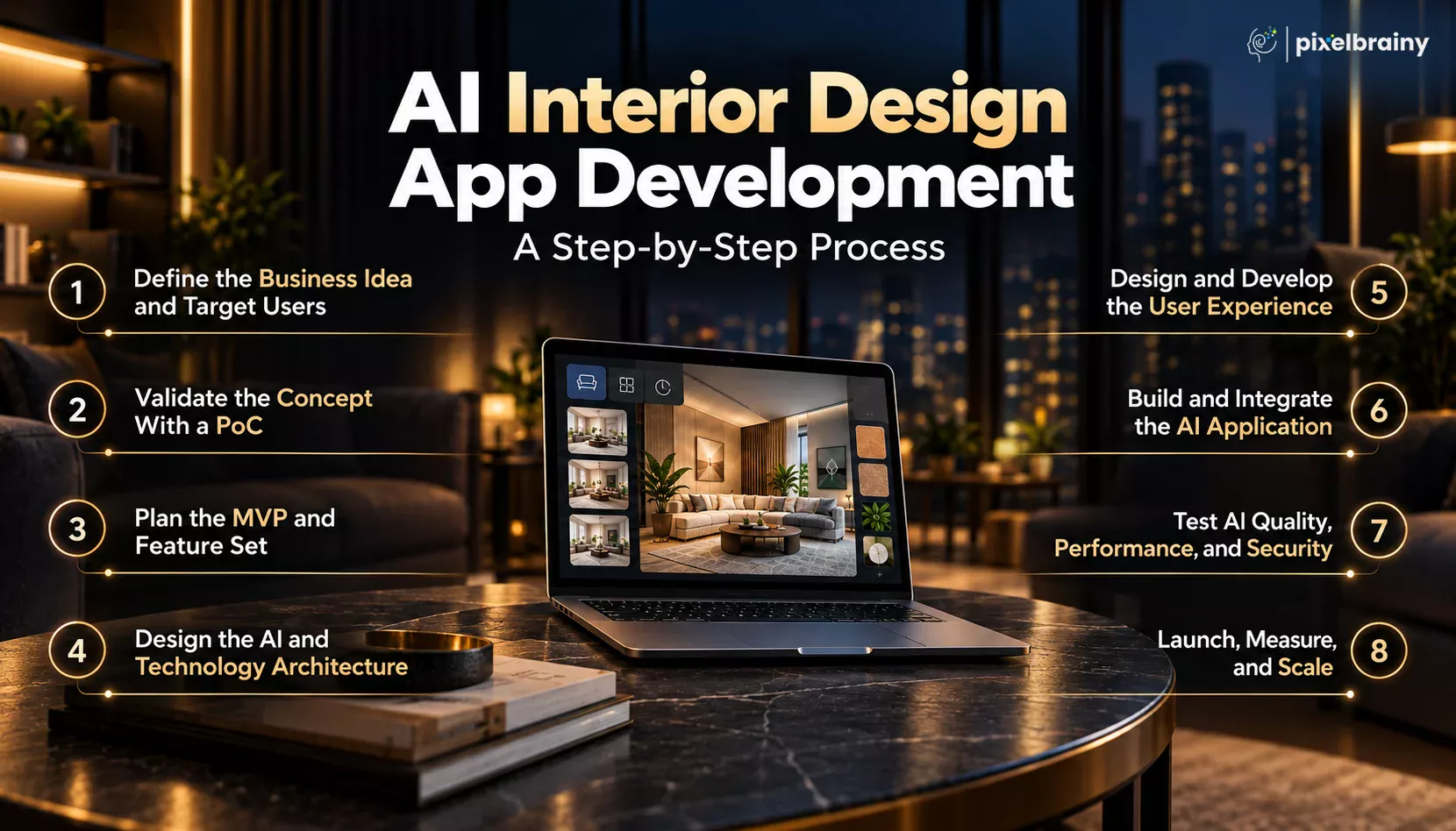
The first step in building an AI interior design app is defining exactly who will use it and what problem it will solve. Start by identifying the target audience, such as homeowners, renters, real estate buyers, furniture shoppers, property developers, or professional designers.
For a luxury property application, requirements may include unit selection, personalized furniture packages, material choices, flooring, kitchen finishes, lighting, and high-resolution visualization.
Define the business model, primary user journey, target platforms, and expected outcomes before technical development begins. At this stage, an AI consultation can help identify suitable AI capabilities, technical requirements, and potential development risks.
The result should be a clear product specification rather than a broad idea.
Also Read: Top 10 AI Consulting Companies in USA
Before investing heavily in AI interior design app development, validate whether the most technically difficult part of the product can actually achieve the required quality.
A PoC development phase can test specific capabilities such as room understanding, furniture replacement, material changes, image generation, spatial consistency, or high-resolution property visualization.
For example, a luxury developer could provide one apartment image and test whether AI can change the flooring, sofa, wall colors, kitchen materials, and furniture while preserving the exact architecture of that unit.
The objective is not to build the entire application. It is to establish whether the proposed AI workflow can deliver acceptable visual quality, processing speed, and consistency before moving into full product development.
After validating the technical concept, define the minimum viable product. MVP development should focus on the features required to prove the product's core value rather than attempting to launch every advanced capability simultaneously.
For a luxury property visualization app, an initial version might include:
Advanced capabilities such as AR, 3D walkthroughs, voice commands, automated renovation estimates, and immersive virtual tours can be introduced later.
A focused MVP makes it easier to measure user engagement and identify which features deserve further investment.
Also Read: Top 10 AI MVP Development Companies in USA
The next step is deciding how the application will process images, understand spaces, generate designs, store projects, and deliver results.
The architecture may include:
Mobile/Web App → API → AI Orchestration → Computer Vision → Generative AI → Quality Processing → Cloud Storage
At this stage, determine whether to use third-party AI APIs, open-source models, custom models, or a hybrid architecture.
The system should also be designed for scalability because image generation can require significant computing resources.
Businesses should evaluate AI model development requirements carefully if they need proprietary visual behavior, highly controlled outputs, product-specific visualization, or specialized room understanding.
Also Read: Top 12+ AI Model Development Companies in the USA
The user experience should make complex AI functionality simple for nontechnical users.
For example, an international property buyer should be able to select a specific apartment, choose a design package, customize materials and furniture, and generate a visualization without understanding how AI works.
Design the main user journey around clear actions:
Select Property → Select Room → Choose Style → Customize → Generate → Review → Save
The interface should also provide progress feedback during AI processing and clearly distinguish between generated concepts and verified product information.
For businesses planning to develop an AI interior design app for iOS and Android, responsive design and platform-specific testing should be considered from the beginning.
Once the architecture and UX are approved, development teams can begin building the application.
This stage connects the mobile or web interface with backend services, databases, authentication, cloud infrastructure, AI models, payment systems, product catalogs, and analytics.
AI integration should be implemented as part of a controlled pipeline rather than simply placing an image-generation API behind the application.
The AI workflow may include:
Image upload → Image preprocessing → Room segmentation → Prompt construction → AI generation → Quality validation → Image enhancement → Final visualization
For specialized furniture or property applications, product databases and approved design assets should also be connected to prevent the AI from inventing products that do not actually exist.
AI applications require testing beyond conventional software testing.
The development team should evaluate whether generated designs preserve the original property's:
The team should also test generation speed, image quality, device compatibility, API reliability, cloud costs, privacy, and security.
For luxury property applications, visual accuracy is especially important because buyers may interpret the visualization as a representation of their future home.
Companies comparing top AI development companies should therefore ask potential partners to demonstrate their AI evaluation methodology rather than judging a vendor only by a polished prototype.
The final stage is launching the application to a controlled group of users and measuring real-world performance.
Track metrics such as:
After launch, improve the product based on actual usage.
If demand increases, infrastructure can be optimized through asynchronous processing, caching, GPU scaling, model routing, image compression, and cloud optimization.
Businesses can also hire AI developers with experience in generative AI, computer vision, cloud infrastructure, and mobile development to continuously improve the product after launch.
For organizations evaluating AI app development companies, the ideal partner should be able to support the complete product lifecycle from strategy and AI architecture through development, deployment, optimization, and ongoing scaling.
Following a structured development process helps businesses turn an interior design concept into a reliable, scalable AI product while controlling technical complexity, visual quality, development costs, and long-term infrastructure requirements.
The cost to develop an AI interior design app typically ranges from $30,000 to $250,000+, depending on the application's features, AI complexity, visualization quality, platforms, integrations, and scalability requirements. A basic application with photo upload and AI room transformation requires a much smaller development budget for an AI interior design app than an enterprise platform with 3D visualization, AR, custom AI models, furniture catalogs, and high-volume image processing.
When calculating the AI interior design app development cost, businesses should also consider ongoing expenses such as AI model usage, cloud infrastructure, GPU processing, maintenance, third-party APIs, and product catalog integrations.
So, if you are asking “What is the development pricing of an AI interior design app?”, a practical 2026 planning range starts around $30,000 for a focused MVP and can exceed $250,000 for a sophisticated enterprise solution.
“I am comparing three development proposals for an AI interior design app and the quotes range from $40,000 to $30,000 for similar core features including photo upload, room transformation, and furniture recommendation. What legitimately drives this price variation in AI interior design app development and what specific questions should I ask each vendor about their image generation model quality, 3D rendering capability, and furniture catalog integration approach to evaluate whether their proposed app delivers photorealistic design visualization or basic filter-style image overlays marketed as AI design?”
The difference between these quotes can come from AI architecture, model quality, engineering depth, rendering infrastructure, integrations, testing, and post-launch support.
| App Type | Estimated Cost | Typical Scope |
|---|---|---|
| Basic AI Interior Design App | $30,000 to $70,000 | Photo upload, AI room transformation, basic style selection, furniture recommendations, user accounts, backend, and admin panel |
| Advanced AI Interior Design App | $70,000 to $150,000 | Advanced AI visualization, multiple design variations, product catalog integration, personalization, HD rendering, subscriptions, and project management |
| Enterprise AI Interior Design App | $150,000 to $250,000+ | Custom AI workflows, 3D/AR, high-resolution visualization, furniture configuration, large catalogs, enterprise integrations, analytics, security, and scalable infrastructure |
| Cost Factor | Estimated Cost | What It Includes |
|---|---|---|
| UI/UX Design | $3,000 to $15,000 | User flows, wireframes, visual design, design system, room editor, onboarding, and responsive interfaces |
| AI Model Integration | $5,000 to $25,000 | Integration of image-generation, computer vision, image-to-image, segmentation, and AI APIs |
| Custom AI Model Development | $20,000 to $80,000+ | Fine-tuning, custom image pipelines, specialized training, model optimization, and proprietary AI capabilities |
| Photorealistic Image Generation | $10,000 to $40,000+ | Room-preserving generation, furniture transformation, image enhancement, masking, and visual-quality optimization |
| 3D Visualization | $15,000 to $50,000+ | 3D room models, furniture models, spatial visualization, interactive environments, and rendering |
| AR Furniture Placement | $15,000 to $50,000+ | AR room scanning, real-world furniture placement, scaling, positioning, and mobile AR functionality |
| Furniture Catalog Integration | $8,000 to $30,000+ | Product APIs, SKUs, product attributes, furniture images, pricing, inventory, and AI product matching |
| AI Recommendation Engine | $7,000 to $25,000 | Personalized furniture, style, color, material, and decor recommendations |
| Mobile App Development | $15,000 to $50,000+ | iOS, Android, cross-platform development, camera functionality, accounts, projects, and notifications |
| Backend Development | $10,000 to $35,000+ | APIs, databases, authentication, project management, image processing, subscriptions, and administration |
| Cloud & GPU Infrastructure | $5,000 to $25,000+ | GPU processing, cloud hosting, image storage, CDN, queues, databases, monitoring, and scaling |
| Admin Dashboard | $4,000 to $15,000 | User management, content management, AI generation monitoring, product management, analytics, and subscriptions |
| Payment Integration | $2,000 to $8,000 | Subscriptions, payment processing, credits, invoices, and transaction management |
| Testing & QA | $5,000 to $20,000 | Functional testing, AI output testing, device testing, performance testing, security testing, and usability testing |
| Security & Privacy | $5,000 to $20,000+ | Encryption, secure image storage, access control, privacy features, data deletion, and security auditing |
| Maintenance & AI Optimization | $10,000 to $30,000+ annually | Bug fixes, model updates, API updates, cloud optimization, performance improvements, and ongoing AI tuning |
These are indicative planning ranges. Costs can overlap because some factors are components of the broader application development budget rather than completely separate expenses.
A $10,000 difference between two proposals does not necessarily mean one vendor is overcharging. The proposals may differ in what is included.
For example, the $30,000 proposal might use an existing image-generation API with basic prompt-based transformations, while the $40,000 proposal could include stronger image controls, room segmentation, post-processing, higher-resolution generation, better QA, or a more robust furniture recommendation system.
Before selecting a vendor, ask:
These questions help determine whether you are comparing genuinely different technical solutions or simply different development estimates.
A reliable AI interior design app cost estimation should account for development, AI quality, visualization technology, integrations, infrastructure, testing, and ongoing AI operating expenses.

An AI interior design app development project needs a technology stack that can handle image processing, computer vision, generative AI, real-time interactions, product recommendations, and scalable cloud infrastructure. The right combination of technologies helps businesses build an AI interior design app that delivers realistic room transformations while maintaining performance and flexibility.
For example, a furniture company may ask: “We want to develop an AI interior design app where customers upload room photos, change furniture and interior styles, generate photorealistic designs, and purchase recommended products. Which technology stack can support AI image generation, product visualization, and scalable mobile development?”
For this type of platform, the AI interior design app tech stack should cover the application layer, AI models, computer vision, databases, cloud infrastructure, and optional 3D or AR capabilities.
| Technology Layer | Recommended Technologies | Purpose |
|---|---|---|
| Mobile Development | Flutter, React Native, Swift, Kotlin | Builds iOS and Android apps for photo uploads, AI design generation, project management, and user interactions |
| Frontend | React.js, Next.js, TypeScript | Supports web-based design interfaces, dashboards, and responsive user experiences |
| Backend | Python, FastAPI, Node.js, NestJS | Manages APIs, users, AI requests, projects, payments, and integrations |
| Generative AI | FLUX, Stable Diffusion, OpenAI image models | Generates room redesigns, style variations, furniture transformations, and visual concepts |
| Computer Vision | OpenCV, PyTorch, TensorFlow, YOLO | Identifies room elements such as furniture, walls, windows, doors, and flooring |
| Image Segmentation | SAM, custom segmentation models | Isolates specific objects and areas for targeted AI modifications |
| Database | PostgreSQL, MongoDB, Redis | Stores users, projects, preferences, product data, and generation information |
| Cloud Infrastructure | AWS, Azure, Google Cloud | Provides scalable computing, storage, networking, and application infrastructure |
| GPU Infrastructure | NVIDIA GPUs, cloud GPU instances | Handles AI inference, image generation, and high-resolution processing |
| Cloud Storage | Amazon S3, Azure Blob, Google Cloud Storage | Stores uploaded room images, generated designs, thumbnails, and project assets |
| 3D and AR | Three.js, Unity, ARKit, ARCore | Supports 3D visualization, virtual furniture placement, and augmented reality experiences |
| Recommendation Engine | Python, vector databases, recommendation algorithms | Matches furniture and decor products with user preferences and generated designs |
| Authentication | Firebase Auth, Auth0, OAuth 2.0 | Provides secure user registration, login, and account management |
| Payments | Stripe, PayPal | Supports subscriptions, credits, premium features, and payments |
| DevOps & Monitoring | Docker, Kubernetes, GitHub Actions, Sentry | Supports deployment, scaling, performance monitoring, and error tracking |
The technology stack should ultimately match the application's AI requirements, visual quality expectations, target platforms, and expected user volume.
A well-structured tech stack gives an AI interior design app the foundation to deliver realistic visualizations, reliable AI processing, scalable performance, and future 3D or AR capabilities.
An AI interior design app can earn revenue in more ways than simply charging users for access. The monetization strategy can connect AI-generated designs with subscriptions, furniture purchases, professional services, real estate workflows, and enterprise solutions.
For example, a furniture brand may ask: “We want to build an AI interior design app where customers can upload a room photo, visualize our products in their space, receive personalized recommendations, and purchase the selected furniture. How can we monetize both the AI experience and the product sales?”
For businesses planning to build an AI interior design app, these six business models can create different revenue opportunities.
A subscription model works well when users regularly need AI-generated designs.
Offer a free plan with limited generations, then introduce paid plans with features such as:
Best for: Homeowners, frequent users, interior designers, and property professionals.
Revenue potential: Monthly or annual recurring revenue.
Not every user wants a monthly subscription. A credit-based model lets users pay only when they need AI design generation.
For example:
10 AI Designs → $9.99
50 AI Designs → $29.99
100 AI Designs → $49.99
Users can spend credits on room transformations, furniture replacement, HD rendering, or advanced AI editing.
This model can also help businesses align revenue with AI inference costs, making it useful for applications where every image generation creates a measurable infrastructure expense.
This model turns the AI interior design app development investment into a shopping experience.
After generating a room design, the app can identify or recommend matching furniture, lighting, rugs, artwork, and decor. Users can then view product details, pricing, availability, and purchase options.
Example revenue flow:
Upload Room → Generate Design → Recommend Products → User Purchases → Platform Earns Commission
Furniture manufacturers can also pay for product placement, sponsored recommendations, or premium catalog visibility.
Best for: Furniture retailers, marketplaces, home decor brands, and ecommerce platforms.
Instead of charging individual homeowners, businesses can pay for access to an AI interior design platform.
Real estate agencies can use AI virtual staging for vacant properties. Interior design firms can generate concepts faster. Property developers can show buyers different furnishing options before construction or purchase.
Pricing can be based on:
This creates a recurring B2B AI app revenue model while positioning the platform as a business tool rather than only a consumer application.
A company can develop an AI interior design app once and license customized versions to multiple businesses.
For example, a furniture manufacturer could launch the technology under its own brand, while a real estate company could use the same underlying platform for virtual property staging.
Revenue can come from:
Initial Setup Fee + Customization Fee + Monthly License + AI Usage Charges + Maintenance
This model is particularly suitable for companies that want AI design capabilities without building and maintaining the entire technology infrastructure internally.
High-value customers can receive advanced capabilities through enterprise plans.
A professional version could include:
“We are a luxury property developer and want an AI interior design app that allows international buyers to personalize apartments with furniture, materials, colors, and design styles before purchasing. Can an enterprise AI design platform support private property catalogs, custom visualization workflows, and multiple sales teams?”
This type of AI product development can generate revenue through annual contracts, implementation fees, enterprise licensing, and usage-based AI charges.
The strongest AI interior design app business models combine recurring software revenue with AI usage, product commerce, and high-value B2B services to create multiple scalable revenue streams.
Developing an AI interior design app involves more than integrating an image-generation model. The application must understand room layouts, preserve architectural elements, generate realistic designs, and deliver consistent results across different images and devices.
For example, a furniture company may ask: “We want to develop an AI interior design app that transforms room photos, keeps walls and windows unchanged, replaces furniture with our actual products, and generates photorealistic results. What challenges should we expect during development?”
For businesses planning to build a scalable AI interior design app, these six challenges require attention from the beginning.
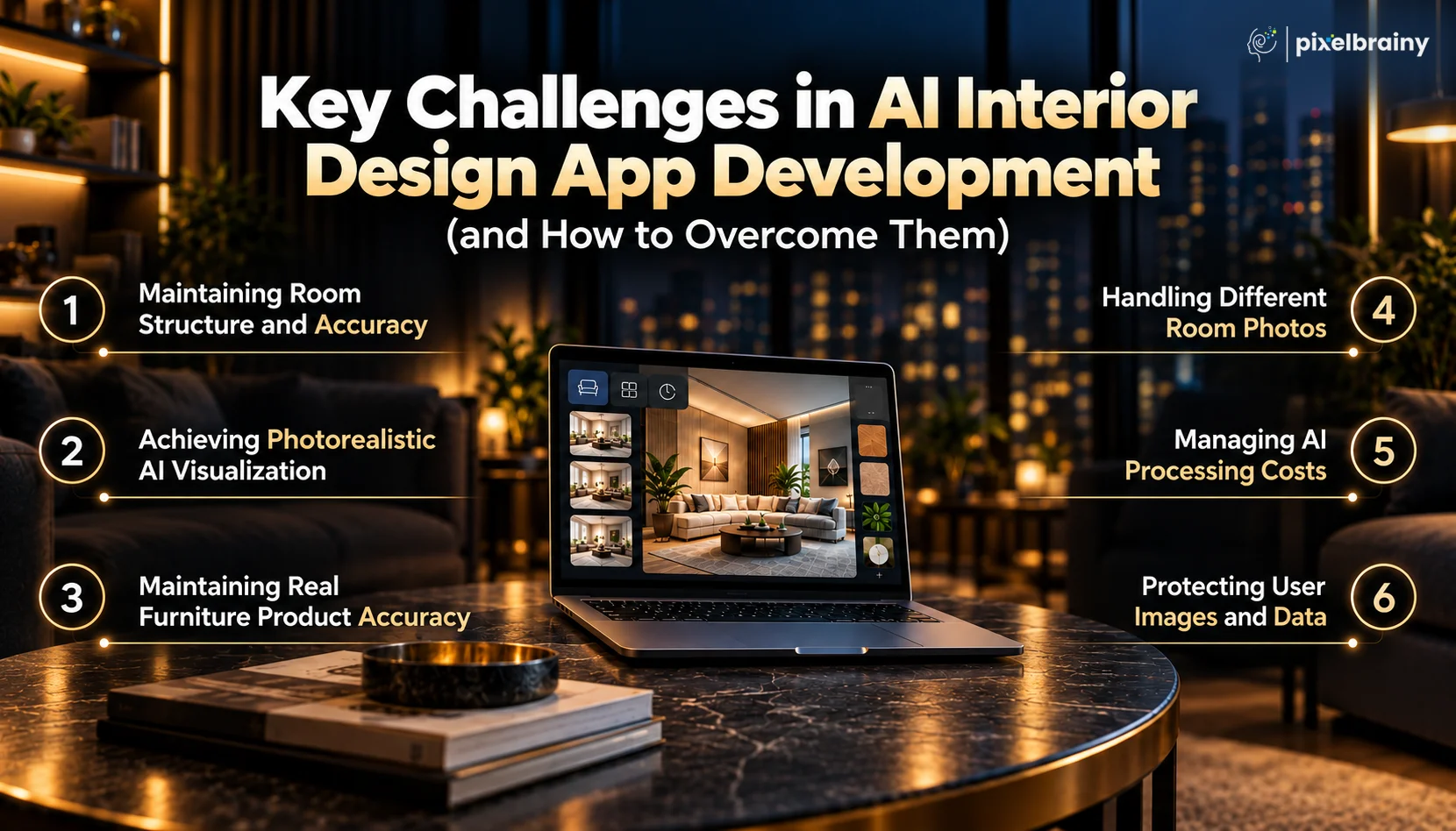
AI-generated designs can sometimes change walls, windows, doors, room proportions, or furniture placement. A visually attractive result may still be inaccurate if the original room structure is not preserved.
How to Overcome It
Use computer vision, depth estimation, semantic segmentation, masking, and controlled image-to-image generation. For applications requiring accurate measurements, combine AI visualization with 2D or 3D spatial data.
Users expect an AI room design app to create realistic interiors rather than simple filters. Lighting, shadows, textures, materials, and furniture proportions must remain visually consistent.
“How can we build an AI interior design app that generates photorealistic room transformations without making furniture look artificial or changing the original lighting and architecture?”
How to Overcome It
Use high-quality generative AI models with image-to-image processing, segmentation, depth information, and post-generation enhancement. Test results across different room sizes, lighting conditions, camera angles, and image qualities.
Generic AI can generate attractive furniture that does not actually exist in a retailer's catalog. This creates a challenge for businesses connecting AI interior design app development with ecommerce.
How to Overcome It
Connect the AI workflow with a structured product catalog containing images, dimensions, materials, colors, SKUs, and product metadata. Recommendation and visual similarity systems can then match real products with generated room designs.
Users may upload photos captured from different devices, angles, lighting conditions, and distances. Poor-quality images, cluttered rooms, mirrors, and unusual layouts can also reduce AI output quality.
How to Overcome It
Add image-quality validation before AI processing. The app can identify low-resolution images, poor lighting, unsuitable angles, or insufficient room visibility and guide users to capture better photos.
High-resolution AI image generation requires significant GPU resources. Generating multiple designs for every user can increase infrastructure and AI interior design app development costs as the platform grows.
How to Overcome It
Use GPU optimization, request queues, caching, image compression, asynchronous processing, and efficient cloud infrastructure. Credit-based pricing can also help align AI usage with operational costs.
Room photos may contain personal belongings, family photographs, addresses, or other private information. Security therefore needs to be part of the AI interior design app development process.
How to Overcome It
Use encrypted data transmission, secure cloud storage, authentication, access controls, defined image-retention policies, and regular security monitoring. Enterprise platforms may also require audit logs and organization-level data controls.
Addressing these challenges early helps an AI interior design app deliver realistic visualizations, reliable AI performance, secure data handling, and scalable growth.
From the above discussion, it is now time to identify the right technology partner who can translate your interior design concept into a reliable AI product. An AI interior design platform needs more than attractive generated images. It requires strong product strategy, AI integration, computer vision, intuitive UX, scalable architecture, and the ability to connect AI outputs with real business workflows.
That is where PixelBrainy as a leading AI app development company can support businesses from early product validation through production and ongoing optimization.
If your goal is to build AI interior design app for homeowners, furniture brands, real estate companies, or professional designers, the development approach should begin with the actual business use case.
PixelBrainy can help define the product scope, validate the concept, identify suitable AI technologies, plan the MVP, design the user experience, and establish an architecture that can scale as the platform grows.
The focus is not simply on adding AI features, but on creating an application where AI contributes directly to visualization, personalization, product discovery, or business growth.
Every interior design platform has different requirements. A virtual staging application may need property image transformation, while a furniture marketplace may require product-aware visualization and recommendation capabilities.
For businesses looking to develop AI interior design app, PixelBrainy can work across generative AI, computer vision, image processing, AI integrations, recommendation systems, and custom application development to create workflows aligned with the intended product.
The architecture can also be planned for future capabilities such as 3D visualization, AR furniture placement, AI floor planning, personalized recommendations, and enterprise integrations.
In one confidential project for a property-focused business, the requirement was to create a digital experience that could help users visualize and personalize premium residential spaces. The project involved customized user journeys, AI-powered functionality, visual content workflows, and an architecture designed for a high-quality property experience.
The client name and confidential implementation details cannot be disclosed. However, the project demonstrates the importance of combining AI capabilities with a carefully designed product experience when visual quality and personalization directly influence customer decisions.
Whether you want to create interior design app for consumers or an enterprise platform for property and furniture businesses, PixelBrainy can support different stages of the product journey, including AI consultation, PoC development, MVP development, UI/UX, AI integration, application development, testing, deployment, and post-launch improvements.
The objective is to create a practical product that can start with essential functionality and expand into more advanced AI capabilities as user demand and business requirements evolve.
PixelBrainy brings together AI expertise and product engineering to help businesses turn complex ideas into usable digital products. Its AI capabilities include generative AI, computer vision, AI model development, AI integrations, and custom AI application development, supported by experience across different business domains.
For an AI interior design product, this means your development partner can work beyond the interface and address the underlying AI workflow, application architecture, integrations, scalability, and future product roadmap.
Have an AI interior design idea in mind? Connect with PixelBrainy and turn your concept into a market-ready AI product.

An AI interior design app can turn room visualization, personalization, furniture discovery, and property presentation into a more intelligent digital experience. However, successful AI interior design app development requires more than integrating a generative AI model. Businesses need the right product strategy, AI architecture, computer vision, visualization capabilities, technology stack, security, and scalable infrastructure.
As discussed throughout this guide, the cost to develop an AI interior design app can range from around $30,000 for a focused MVP to $250,000+ for advanced enterprise platforms with 3D, AR, custom AI workflows, and complex integrations. The final investment depends on features, AI quality, platforms, integrations, and long-term scalability requirements.
Whether your goal is to build AI interior design app for homeowners, furniture brands, real estate companies, or professional designers, starting with a clear use case and scalable development roadmap can reduce technical risks and create stronger opportunities for growth.
Ready to turn your AI interior design idea into a market-ready product? Book an appointment with PixelBrainy today.
The AI interior design app development cost can range from approximately $30,000 to $250,000+. A basic MVP may include room photo upload, AI redesign, style selection, and furniture recommendations, while advanced solutions can include 3D visualization, AR, custom AI models, product catalogs, and enterprise integrations.
The timeline depends on the product scope and AI complexity. A focused MVP can typically take around 3 to 5 months, while a feature-rich platform with custom AI workflows, 3D, AR, ecommerce integrations, and advanced personalization may require 6 to 12 months or longer.
Yes. A furniture-focused application can connect AI visualization with a structured product catalog containing SKUs, images, dimensions, colors, materials, prices, and availability. This allows users to visualize actual products in their rooms instead of seeing only AI-generated furniture concepts.
To create an interior design app with AI capabilities, the technology stack may include generative AI for room transformation, computer vision for identifying room elements, segmentation for targeted editing, image processing for enhancement, recommendation engines for product matching, and cloud GPU infrastructure for AI inference.
Yes, but this requires a controlled AI workflow rather than simple text-to-image generation. Computer vision, depth estimation, segmentation, masking, and image-to-image generation can help preserve important elements such as walls, windows, doors, flooring, and room proportions while modifying selected areas.
Businesses can monetize an AI interior design app through subscriptions, AI generation credits, premium features, furniture commissions, B2B SaaS plans, white-label licensing, and enterprise contracts. The most suitable model depends on whether the application targets consumers, designers, furniture brands, or real estate companies.
Yes. Businesses can develop an AI interior design app for iOS and Android using technologies such as Flutter or React Native for cross-platform development, or use native Swift and Kotlin when platform-specific performance and capabilities are priorities.
Before hiring an AI app development company, ask about its experience with generative AI, image-to-image workflows, computer vision, photorealistic visualization, GPU infrastructure, furniture catalog integration, AI inference costs, security, scalability, and post-launch AI optimization. Requesting relevant project examples can also help evaluate whether the team can handle your specific use case.

About The Author
Sagar Bhatnagar
Sagar Sahay Bhatnagar brings over a decade of IT industry experience to his role as Marketing Head at PixelBrainy. He's known for his knack in devising creative marketing strategies that boost brand visibility and market influence. Sagar's strategic thinking, coupled with his innovative vision and focus on results, sets him apart. His track record of successful campaigns proves his ability to utilize digital platforms effectively for impactful marketing efforts. With a genuine passion for both technology and marketing, Sagar continuously pushes PixelBrainy's marketing initiatives to greater success.

Working with PixelBrainy has been a great experience. They took our vision for an AI-powered platform and turned it into a fully functional product. What impressed me most was their strong understanding of both design and development, and their ability to handle complex requirements with ease. The team was responsive, cooperative, and always open to feedback. They kept things organized, communicated clearly, and delivered quality work on time. I highly recommend PixelBrainy to anyone looking for a skilled and reliable development partner.

Working with the PixelBrainy team has been a highly positive experience. They understand the design requirements and create beautiful UX elements to meet the application needs. The dev team did an excellent job bringing my vision to life. We discussed usability and flow. Sagar worked with his team to design the database and begin coding. Working with Sagar was easy. He has the knowledge to create robust apps, including multi-language support, Google and Apple ID login options, Ad-enabled integrations, Stripe payment processing, and a Web Admin site for maintaining support data. I'm extremely satisfied with the services provided, the quality of the final product, and the professionalism of the entire process. I highly recommend them for Android and iOS Mobile Application Design and Development.

Great experience working with them. Had a lot of feedback and I found that unlike most contractors they were bugging me for updates instead of the other way around. They were extremely time conscience and great at communicating! All work was done extremely high quality and if not on time, early! They were always proactive when it comes to communication and the work is great/above par always. Very flexible and a great team to work with! Goes above and beyond to present us with multiple options and always provides quality. Amazing work per usual with Chitra. If you have UI/UX or branding design needs I recommend you go to them! Will likely work with them in the future as well, definitely recommended!

PixelBrainy is a joy to work with and is a great partner when thinking through branding, logo, and website layout. I appreciate that they spend time going into the "why" behind their decisions to help inform me and others about industry best practices and their expertise.

I hired them to design our software apps. Things I really like about them are excellent communication skills, they answer all project suggestions and collaborate right away, and their input on design and colors is amazing. This project was complex and needed patience and creativity. The team is amazing to do business with. I will be using them long-term. Glad to see there are some good people out there. I was afraid to try and outsource my project to someone but I am glad I met them! I really can't say enough. They went above and beyond on this project. I am very happy with everything they have done to make my business stand out from the competition.

It was great working with PixelBrainy and the team. They were very responsive and really owned the project. We'll definitely work with them again!

I recently worked with the PixelBrainy team on a project and I was blown away by their communication skills. They were prompt, clear, and articulate in all of our interactions. They listened and provided valuable feedback and suggestions to help make the project a success. They also kept me updated throughout the entire process, which made the experience stress-free and enjoyable.

PixelBrainy is very good at what it does. The team also presents themselves very professionally and takes care of their side of things very well. I could fully trust them taking up the design work in a timely and organised manner and their attention to detail saved us lots of effort and time. This particular project was quite intense and the team showed that they function very well under pressure. Very much looking forward to working with her again!

It's always an absolute pleasure working with them. They completed all of my requests quickly and followed every note I had for them to a T, which made our process go smoothly from start to finish. Everything was completed fast and following all of the guidelines. And I would recommend their services to anyone. If you need any design work done in the future, PixelBrainy should be your first call!

They took ownership of our requirements and designed and proposed multiple beautiful variants. The team is self-motivated, requires minimum supervision, committed to see-through designs with quality and delivering them on time. We would definitely love to work with PixelBrainy again when we have any requirements.

PixelBrainy was a big help with our SaaS application. We've been hard at work with a new UI/UX and they provided a lot of help with the designs. If you're looking for assistance with your website, software, or mobile application designs, PixelBrainy and the team is a great recommendation.

PixelBrainy designers are amazing. They are responsive, talented, and always willing to help craft the design until it matches your vision. I would recommend them and plan to continue them for my future projects and more!!!

They were awesome! Did a good job fast, and good communication. Will work with them again. Thank you

Creative, detail-oriented, and talented designers who take direction well and implement changes quickly and accurately. They consistently over-delivered for us.

PixelBrainy team is very talented and creative. Great designers and a pleasure to work with. PixelBrainy is an excellent communicator and I look forward to working with them again.

PixelBrainy has a very talented design team. Their work is excellent and they are very responsive. I enjoy working with them and hope to continue on all of our future projects.


Transform your ideas into reality with us.
Across these industries, each engagement brings unique challenges, from early-stage product development to scaling complex systems, helping us build a practical understanding of real-world product environments.