AI Summary Powered by PixelBrainy
Why are leading hedge funds investing in AI investment research app development when their analysts already have access to premium research platforms like Bloomberg, AlphaSense, and Sentieo?
The answer lies in a challenge that almost every institutional investment firm faces today. Financial markets generate an overwhelming amount of information every day, including 10-K and 10-Q filings, earnings call transcripts, SEC disclosures, analyst reports, macroeconomic updates, and real time market news. Although access to financial data has become easier, extracting meaningful insights quickly remains a time consuming process. As a result, analysts often spend more time reviewing documents than evaluating investment opportunities, limiting their ability to deliver high value research and timely recommendations.
This is why institutional investors, hedge funds, asset management firms, private equity companies, venture capital firms, and fintech startups are increasingly investing in AI investment research app development. By combining artificial intelligence, natural language processing, and machine learning, these platforms automate document analysis, summarize complex financial reports, identify emerging trends, and accelerate research workflows. Consequently, investment research app development with AI has become a strategic priority for organizations seeking faster decision making, improved analyst productivity, and a sustainable competitive advantage.
Consider a real business scenario. A $200 million long short equity hedge fund finds that its analysts spend nearly 60 percent of their workweek reviewing 10-K filings, 10-Q reports, earnings call transcripts, sell side research, and financial news instead of focusing on investment judgment. Before deciding to build an AI investment research app, the firm's leadership wants practical answers. What is the realistic return on investment in analyst hours saved each week? Which proprietary capabilities can a custom platform deliver that subscription solutions like AlphaSense or Sentieo cannot? Which AI development company in the USA has successfully built comparable tools for institutional investment teams with measurable productivity outcomes?
This guide explains how to create an custom AI investment analysis app, covering platform types, essential features, development steps, technology stack, estimated costs, implementation challenges, and the steps to develop an AI investment research app. Whether you are evaluating AI investment research app development or planning investment research app development with AI, this guide will help you make informed technology and business decisions.
An AI investment research app is an intelligent software platform that uses artificial intelligence, machine learning (ML), natural language processing (NLP), and large language models (LLMs) to automate complex and data intensive investment research tasks. It enables analysts, portfolio managers, and financial professionals to process massive volumes of financial information faster, uncover meaningful insights, and make more informed investment decisions. As demand for AI investment research app development continues to rise, firms are increasingly adopting AI powered solutions to improve research efficiency and gain a competitive advantage.
Unlike traditional research platforms that primarily provide access to financial data, investment research app development with AI focuses on transforming raw information into actionable intelligence. These applications can automatically:
The biggest difference between Bloomberg, FactSet, and modern AI investment research software development is the level of intelligence they provide. Traditional research tools act as powerful data repositories, requiring analysts to manually review documents, identify trends, build financial models, and prepare research reports. AI investment research apps automate much of this analytical work by extracting critical insights, comparing historical data, identifying anomalies, and presenting structured recommendations in minutes instead of hours.
These platforms are designed to serve different types of investors, including:
| Factor | Traditional Research Tools | AI Investment Research App |
|---|---|---|
| Earnings call analysis | Manual transcript reading taking hours | AI powered analysis delivered within minutes after the call ends |
| SEC filing review | Manual document search and reading | AI extracts key data points and flags significant changes |
| Financial modeling | Manual spreadsheet creation | AI assisted model generation from structured financial data |
| Sentiment analysis | Manual review of news and commentary | AI powered sentiment scoring across thousands of sources |
| Alternative data | Requires specialist vendors | Integrated alternative data analysis within the research workflow |
| Investment thesis | Manual drafting taking days | AI generates a structured investment thesis draft |
| Research report | Manual report preparation | AI assembles reports from analytical insights |
| Coverage capacity | Limited by analyst bandwidth | AI enables analysts to cover significantly more companies |
Ultimately, the real value of an AI investment research app is not replacing analysts but empowering them to make faster, more confident, and data driven investment decisions with significantly less manual effort.
An AI investment research app follows a structured workflow that transforms large volumes of financial data into actionable investment insights. Instead of requiring analysts to manually gather, read, and interpret information from multiple sources, the platform automates each stage of the research process using artificial intelligence, machine learning, natural language processing (NLP), and large language models (LLMs).
This enables investment teams to spend less time on repetitive tasks and more time making informed investment decisions.
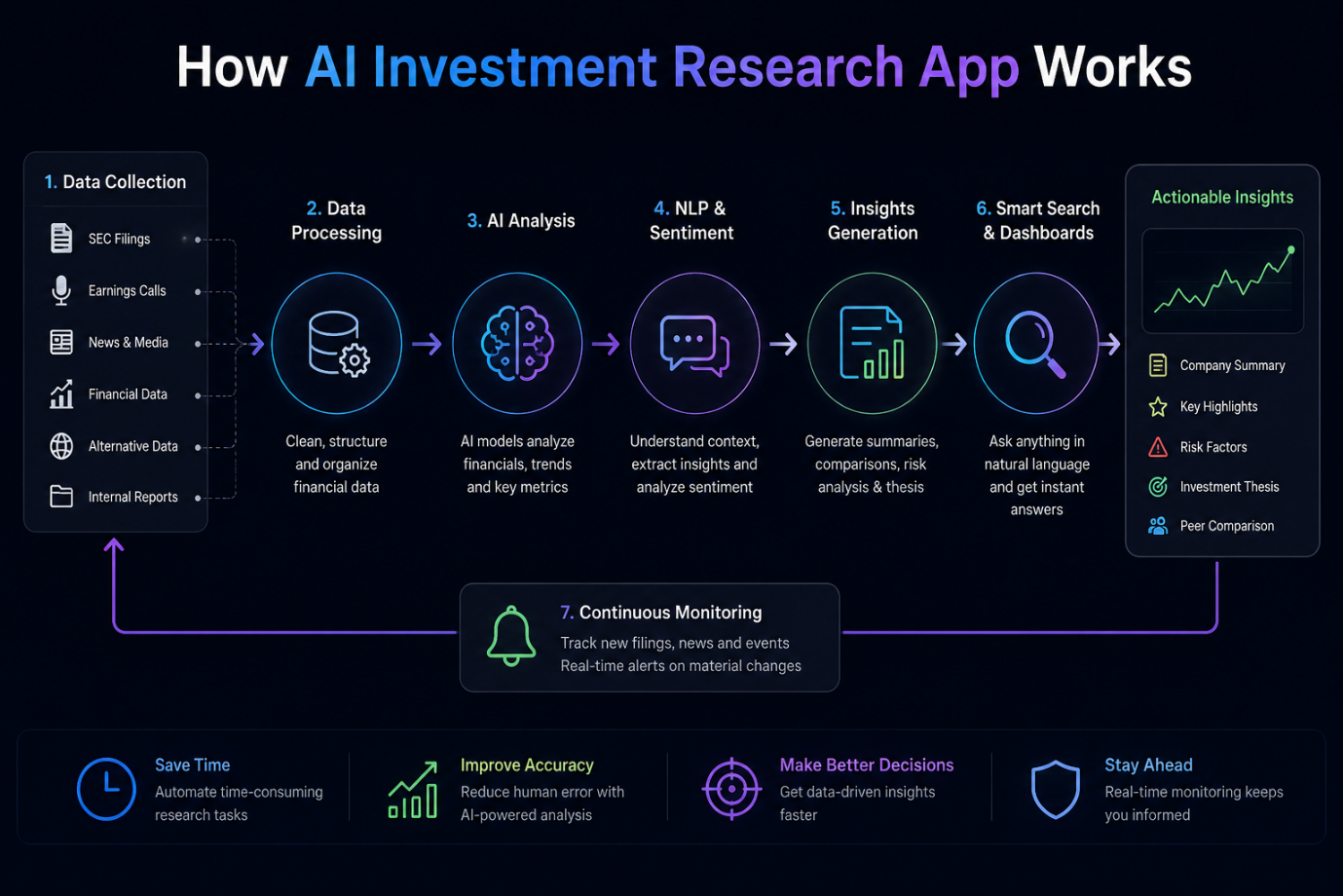
The platform continuously gathers structured and unstructured financial data from trusted sources, including:
This creates a centralized repository of investment-related information.
Once collected, the data is cleaned, standardized, and categorized to ensure consistency. The system removes duplicate records, converts PDFs into searchable text, extracts tables, and organizes information by company, industry, sector, and reporting period.
The AI engine analyzes financial documents to identify meaningful information, such as:
This reduces the need for manual financial statement analysis.
Using NLP, the platform understands the context and meaning behind financial language. It can interpret management commentary, identify changes in business strategy, detect risk disclosures, and summarize lengthy documents into concise, easy-to-understand insights.
The app evaluates sentiment across multiple information sources, including news articles, earnings calls, analyst reports, and social media. It identifies whether market sentiment is positive, negative, or neutral, helping investors understand how public perception may influence stock performance.
After analyzing the available data, the platform automatically generates:
These outputs provide analysts with a strong starting point for deeper evaluation.
Users can search using natural language instead of keywords. For example, they can ask:
The platform delivers accurate, context-aware results within seconds.
The application continuously tracks new filings, earnings releases, regulatory updates, and market news. AI instantly notifies users about material events, significant financial changes, or emerging risks related to their watchlist companies.
| Stage | What the AI Does | Business Benefit |
|---|---|---|
| Data Collection | Aggregates financial data from multiple sources | Eliminates manual data gathering |
| Data Processing | Cleans, structures, and organizes information | Improves data quality and consistency |
| Financial Analysis | Evaluates company performance and financial metrics | Accelerates investment research |
| NLP Analysis | Interprets financial documents and earnings calls | Extracts meaningful insights automatically |
| Sentiment Analysis | Measures market sentiment across multiple channels | Supports informed investment decisions |
| Insight Generation | Creates summaries, risk analysis, and investment thesis | Reduces manual analytical work |
| Smart Search | Answers natural language investment queries | Finds relevant information instantly |
| Real-Time Monitoring | Tracks market events and sends alerts | Keeps investors updated on critical developments |
By combining AI, automation, and advanced analytics into a single workflow, an AI investment research app enables investment professionals to move from data collection to investment decision making faster, more accurately, and at a much larger scale.
The investment research landscape is rapidly evolving as financial institutions face an explosion of structured and unstructured data. Every day, analysts must review SEC filings, earnings call transcripts, company announcements, macroeconomic reports, analyst research, market news, and alternative datasets before making investment decisions. Relying solely on manual research not only slows decision making but also limits the number of companies an analyst can effectively cover.
This growing complexity is driving demand for AI investment research app development. By combining artificial intelligence, machine learning, and natural language processing, these platforms automate repetitive research tasks, generate actionable insights, and help investment professionals make faster and more informed decisions. As a result, investment research app development with AI is becoming a strategic investment for fintech companies looking to improve productivity, reduce operational costs, and deliver institutional grade research capabilities.
Consider another real-world scenario. A rapidly growing wealth management firm serves more than 3,000 high net worth clients, but its research team struggles to deliver personalized investment recommendations because analysts spend hours compiling market updates, monitoring portfolio companies, and preparing research reports. Instead of hiring more analysts, the firm decides to invest in AI investment research software development to automate research workflows, generate client ready insights, and scale advisory services without significantly increasing operational costs.
| Market Insight | Latest Data & Future Outlook |
|---|---|
| AI in Asset Management Market | Estimated at USD 8.6 Billion in 2026 and projected to reach USD 17.0 Billion by 2030, growing at a 24.5% CAGR. |
| AI in Fintech Market | Expected to grow from USD 45.53 Billion in 2026 to USD 241.67 Billion by 2034, at a 23.2% CAGR. |
| Generative AI in Financial Services | Forecast to increase from USD 4.0 Billion in 2026 to USD 25.7 Billion by 2033, reflecting a 30.3% CAGR. |
AI eliminates repetitive tasks such as reviewing SEC filings, earnings transcripts, and financial reports by automatically extracting the most relevant insights.
By automating data collection and analysis, analysts can spend more time evaluating investment opportunities instead of gathering information, allowing each team member to cover more companies.
AI processes financial information in real time, enabling firms to react quickly to earnings announcements, regulatory filings, and market events before competitors.
Automating research workflows lowers the need for extensive manual analysis, helping firms scale research operations without proportionally increasing hiring costs.
Unlike subscription-based research platforms, custom AI applications allow fintech companies to develop proprietary screening models, investment scoring systems, and internal knowledge bases that create a sustainable competitive advantage.
AI applies consistent analytical frameworks across thousands of financial documents, reducing human error and minimizing the risk of missing material information.
Modern AI platforms combine traditional financial data with alternative datasets such as consumer behavior, web traffic, satellite imagery, ESG metrics, and market sentiment to generate deeper investment insights.
AI investment research platforms maintain searchable research histories, source references, audit logs, and version control, making compliance and regulatory reporting more efficient.
AI enables customized dashboards, smart alerts, watchlists, and research recommendations tailored to analysts, advisors, portfolio managers, and client investment preferences.
As financial markets continue generating larger volumes of data, AI provides the scalability needed to support long term business growth without overwhelming research teams.
For fintech businesses, investing in AI investment research app development is no longer just a technology upgrade. It is a strategic move to deliver faster research, smarter investment insights, and a lasting competitive advantage in an increasingly data driven financial market.
There is no one size fits all approach to AI investment research app development. The right solution depends on your target users, investment strategy, available data sources, and business objectives.
While some organizations need AI to automate fundamental research, others focus on quantitative investing, portfolio risk monitoring, ESG analysis, or private market due diligence. Before you build an AI investment research app, it is essential to identify the type of platform that best aligns with your investment workflow and long-term business goals.
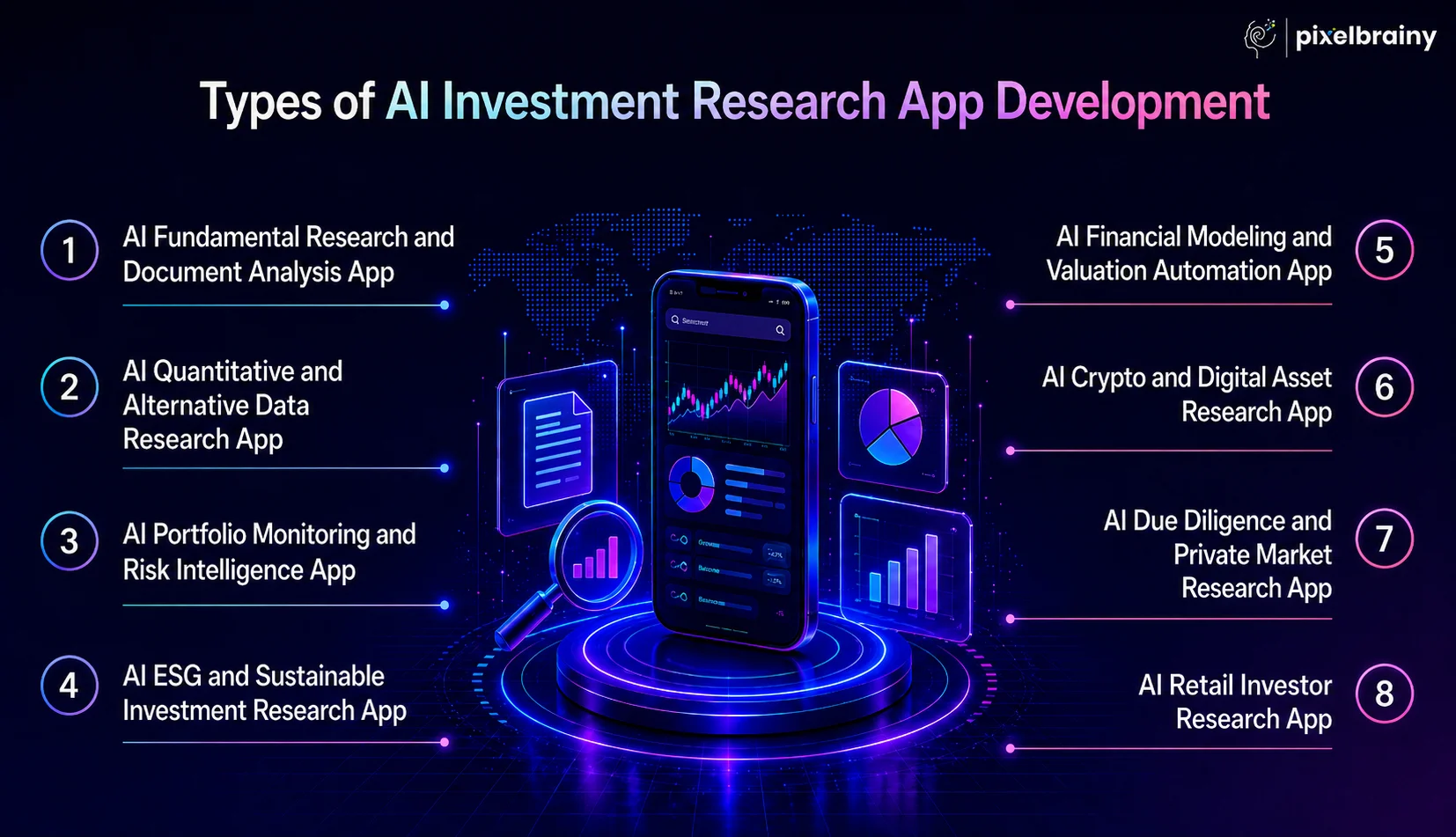
This type of application automates the analysis of financial documents such as SEC filings, earnings call transcripts, annual reports, investor presentations, and analyst research. Using Natural Language Processing (NLP) and Retrieval-Augmented Generation (RAG), users can ask questions in natural language and instantly extract investment insights from thousands of pages of financial content.
Best suited for: Equity research firms, hedge funds, asset managers, and fundamental investors.
Key Product Design Implication: Prioritize enterprise document ingestion, semantic search, RAG architecture, citation-based responses, and secure knowledge management.
Designed for systematic investing, this application combines traditional quantitative models with machine learning to analyze alternative datasets such as satellite imagery, credit card transactions, web traffic, social media sentiment, job postings, and web scraping signals. It identifies statistically significant investment opportunities by uncovering hidden market patterns.
Real-world scenario: A quantitative hedge fund wants to build an AI investment research app that processes alternative data sources to improve alpha generation and enhance factor-based investment strategies.
Best suited for: Quantitative hedge funds, systematic trading firms, and data driven investment teams.
Key Product Design Implication: Build scalable data pipelines, machine learning models, and high-performance data processing infrastructure.
This platform continuously monitors portfolio holdings for changing risk exposures, earnings revisions, news sentiment, regulatory developments, and ESG controversies. AI automatically generates alerts whenever predefined risk thresholds are exceeded, enabling investment teams to respond proactively.
Real-world scenario: A pension fund wants to develop an AI investment research app that provides real time monitoring across its entire investment portfolio to strengthen risk management.
Best suited for: Portfolio managers, chief investment officers, risk teams, and compliance departments.
Key Product Design Implication: Focus on real time data streaming, alert engines, portfolio analytics, and compliance monitoring.
This application specializes in environmental, social, and governance (ESG) research by analyzing sustainability reports, ESG ratings, climate risks, regulatory disclosures, and corporate impact metrics. It helps investors evaluate responsible investment opportunities while supporting regulatory compliance.
Real-world scenario: An investment firm wants to build an AI investment research app focused exclusively on ESG investing and sustainable finance.
Best suited for: ESG fund managers, sustainability analysts, family offices, and impact investors.
Key Product Design Implication: Integrate ESG data providers, sustainability reporting frameworks, and regulatory compliance monitoring.
This platform automates repetitive financial modeling activities, including financial statement extraction, discounted cash flow (DCF) modeling, comparable company analysis, ratio calculations, and scenario planning. AI reduces manual spreadsheet work while improving modeling speed and consistency.
Best suited for: Equity analysts, investment bankers, corporate finance teams, and independent research providers.
Key Product Design Implication: Prioritize financial data extraction, spreadsheet automation, valuation engines, and scenario analysis capabilities.
This type of application focuses on cryptocurrency and digital asset research by analyzing on chain transactions, blockchain activity, protocol metrics, developer contributions, tokenomics, decentralized finance (DeFi) ecosystems, and crypto market sentiment. AI combines multiple data sources to generate comprehensive digital asset research.
Real-world scenario: A digital asset fund plans to develop an AI investment research app capable of simultaneously analyzing blockchain activity, protocol health, and investor sentiment.
Best suited for: Crypto hedge funds, digital asset managers, blockchain investment firms, and advanced crypto investors.
Key Product Design Implication: Integrate blockchain APIs, on chain analytics platforms, wallet monitoring, and real time crypto market feeds.
This application streamlines private market due diligence by automatically analyzing pitch decks, founder profiles, patent filings, customer reviews, competitive landscapes, cap table structures, and market size estimates. AI accelerates investment screening while helping firms identify potential risks and opportunities earlier in the evaluation process.
Real-world scenario: A venture capital firm wants to build an AI investment research app that shortens due diligence cycles and improves startup evaluation accuracy.
Best suited for: Venture capital firms, private equity firms, corporate venture teams, and family offices.
Key Product Design Implication: Focus on document intelligence, web research automation, knowledge graphs, and private company data integration.
This consumer-focused application delivers institutional quality research capabilities in an easy-to-use interface. Features typically include AI powered stock screening, simplified SEC filing summaries, earnings analysis, portfolio insights, watchlists, and personalized research alerts tailored to individual investors.
Best suited for: Retail investors, fintech startups, stock market education platforms, and digital wealth management companies.
Key Product Design Implication: Prioritize intuitive user experience, affordable subscription models, explainable AI, and mobile first design.
The type of AI investment research app you choose will determine your primary data sources, regulatory obligations, AI architecture, development complexity, and monetization strategy, making it one of the most important decisions before starting your AI investment research app development journey.
Building a successful AI investment research platform requires more than integrating artificial intelligence into an application. The platform must provide practical features that streamline research workflows, improve data accessibility, and support faster investment decisions. Whether you are planning AI investment research app development for a hedge fund, asset management firm, wealth management company, or fintech startup, the right feature set determines how effectively users can analyze financial data and generate actionable insights.
The core objective of investment research app development with AI is to reduce manual research while improving the quality, speed, and consistency of investment analysis. Instead of spending hours collecting financial information from multiple sources, analysts should be able to access structured insights, compare companies, monitor market developments, and collaborate with their teams from a single platform.
For example, a registered investment advisory (RIA) firm wants to develop an AI investment research app that allows advisors to quickly analyze stocks, generate client ready research reports, track portfolio companies, and receive real time alerts for material events. To achieve this, the application must include a strong foundation of research, collaboration, search, reporting, and data management capabilities before introducing more advanced AI functionalities.
| Must-Have Feature | Why It Matters |
|---|---|
| Secure User Authentication & Role Management | Every investment research platform should include secure login, multi factor authentication, and role based access control. This ensures sensitive financial data, proprietary research, and client information remain protected while giving different user groups appropriate access permissions. |
| Financial Data Aggregation | The application should collect financial information from multiple trusted sources, including SEC filings, company reports, earnings transcripts, market data providers, and financial news. A centralized data repository eliminates manual data collection and improves research efficiency. |
| Advanced Search & Filtering | Users should quickly search companies, industries, filings, financial metrics, or reports using filters and keyword search. Fast information retrieval significantly improves analyst productivity and reduces time spent navigating large research databases. |
| Company Research Dashboard | A dedicated dashboard should provide a complete overview of each company, including financial performance, valuation metrics, earnings history, recent filings, key announcements, and market updates within a single unified interface. |
| Financial Statement Viewer | Analysts should easily access income statements, balance sheets, and cash flow statements in a structured format. This simplifies financial analysis and removes the need to manually review lengthy annual reports and regulatory filings. |
| Earnings Call Transcript Library | A searchable repository of historical earnings call transcripts enables users to review management commentary, compare quarterly discussions, and identify changes in business strategy or financial guidance over time. |
| News & Market Updates Feed | Real time financial news and company specific updates help analysts stay informed about market developments, mergers, acquisitions, regulatory announcements, and industry events that may influence investment decisions. |
| Watchlists & Portfolio Tracking | Users should create personalized watchlists and monitor companies or investment portfolios from a centralized dashboard. This feature helps investors quickly identify price movements, earnings releases, and significant corporate events. |
| AI Powered Document Summarization | The platform should automatically generate concise summaries of lengthy financial documents, allowing users to understand important highlights without reading hundreds of pages of annual reports or earnings transcripts. |
| Research Notes & Collaboration | Analysts should be able to create notes, highlight important findings, share observations, and collaborate with colleagues. Centralized research management improves teamwork and prevents duplication of analytical efforts. |
| Report Generation | The application should generate structured research reports containing financial metrics, company summaries, market developments, and analyst observations. Automated reporting saves time while maintaining consistency across investment research workflows. |
| Custom Alerts & Notifications | Users should receive notifications for earnings releases, SEC filings, price changes, company announcements, and portfolio events. Timely alerts ensure investment professionals never miss critical market developments. |
| Data Visualization & Interactive Charts | Interactive charts, trend graphs, and financial visualizations simplify the interpretation of historical performance, valuation trends, revenue growth, and other investment metrics, making complex financial information easier to understand. |
| API Integration Support | The platform should support integration with financial data providers, CRM systems, portfolio management software, and internal databases. Flexible integrations improve scalability and allow organizations to extend platform capabilities over time. |
| Audit Logs & Compliance Management | Comprehensive activity logs, research history, and document version tracking help firms maintain transparency, support regulatory compliance, and simplify internal audits while protecting sensitive investment research information. |
These foundational capabilities form the backbone of successful AI investment research app development. They improve usability, strengthen security, streamline research workflows, and prepare the platform for future AI enhancements without increasing operational complexity.
The strongest AI investment research apps are built on a solid foundation of essential features first, making future AI innovation faster, more scalable, and more valuable for every investment team.
As investment firms scale their research operations, essential features alone are no longer enough to create a competitive advantage. Modern AI investment research app development increasingly focuses on advanced capabilities that automate complex analysis, deliver predictive insights, and support faster decision making. These features transform an AI research platform from a productivity tool into a strategic investment intelligence solution.
If your goal is to build an AI investment research app for hedge funds, asset managers, investment banks, or wealth management firms, incorporating advanced AI capabilities can significantly improve research quality and analyst efficiency. While these features require additional development effort and AI expertise, they provide greater long term value by enabling organizations to analyze larger datasets, uncover hidden opportunities, and generate deeper investment insights.
For example, an institutional asset management firm wants to develop an AI investment research platform that not only summarizes financial documents but also answers complex investment questions, predicts emerging risks, detects unusual financial patterns, and automatically generates investment recommendations based on proprietary research models. These advanced capabilities help firms differentiate their platforms from standard market research tools while creating a lasting competitive advantage.
| Advanced Feature | Why It Matters |
|---|---|
| Conversational AI Investment Assistant | An AI powered chatbot enables analysts to ask complex investment questions in natural language and receive contextual answers supported by financial documents, company filings, and historical market data. This significantly improves research efficiency and user experience. |
| Retrieval-Augmented Generation (RAG) | RAG allows the AI to retrieve relevant financial documents before generating responses, ensuring answers remain accurate, source backed, and up to date. This improves trust, transparency, and reliability for institutional investment research workflows. |
| Predictive Market Intelligence | Machine learning models analyze historical financial data, market trends, and economic indicators to forecast earnings performance, revenue growth, potential risks, and industry momentum, helping analysts identify investment opportunities before competitors. |
| AI Powered Company Comparison Engine | The platform automatically compares companies across financial performance, valuation ratios, growth metrics, profitability, competitive positioning, and management commentary, allowing analysts to evaluate investment candidates much faster than manual comparison methods. |
| Intelligent Risk Detection | AI continuously identifies hidden financial risks, governance concerns, regulatory issues, earnings revisions, unusual financial patterns, and operational warning signals before they become material investment problems. This strengthens proactive risk management. |
| Custom AI Screening Models | Users can create personalized investment screening criteria based on financial ratios, qualitative factors, ESG scores, technical indicators, or proprietary investment frameworks, allowing highly customized research aligned with specific investment strategies. |
| Knowledge Graph for Investment Research | Knowledge graphs connect companies, executives, industries, suppliers, competitors, acquisitions, and financial events into an interactive relationship network. This helps analysts uncover business connections and investment insights that traditional research tools often overlook. |
| Explainable AI Recommendations | Instead of generating black box recommendations, the application clearly explains why an investment opportunity, financial risk, or valuation conclusion was reached by referencing supporting financial data and source documents. This increases analyst confidence and regulatory transparency. |
| Workflow Automation with AI Agents | AI agents automate repetitive research tasks such as monitoring filings, preparing daily market summaries, generating research reports, updating watchlists, and tracking company specific developments, significantly reducing manual operational workload. |
| Multilingual Financial Research Support | Advanced language models translate and analyze financial documents, earnings transcripts, and regulatory filings across multiple languages, enabling global investment firms to conduct cross border research more efficiently without language barriers. |
Advanced capabilities help organizations move beyond document analysis and reporting by enabling predictive intelligence, deeper financial analysis, and automated investment workflows. These features are particularly valuable for firms seeking to differentiate their products, improve analyst productivity, and build scalable enterprise grade AI investment research software.
The most successful AI investment research platforms combine a strong foundation of core features with advanced AI capabilities that deliver faster insights, smarter analysis, and a sustainable competitive advantage in modern investment research.
Developing an AI investment research platform requires much more than integrating a large language model into an application. Successful AI investment research app development begins with identifying the right market opportunity, validating the product concept, selecting reliable financial data sources, designing scalable AI architecture, and building a solution that aligns with regulatory and business requirements.
One of the biggest decisions founders face is choosing what type of AI investment research app to build. For example, a first-time fintech entrepreneur may struggle to decide between creating a broad investment research platform covering multiple asset classes or a specialist solution focused exclusively on small cap equity research. Although a niche product may serve a smaller market, it often delivers stronger product market fit, clearer differentiation, and faster customer adoption. Understanding your target users before starting the development process of AI investment research app is essential for long term success.
Below is a proven step by step framework that organizations follow to create an AI investment research app capable of delivering enterprise grade research experiences.
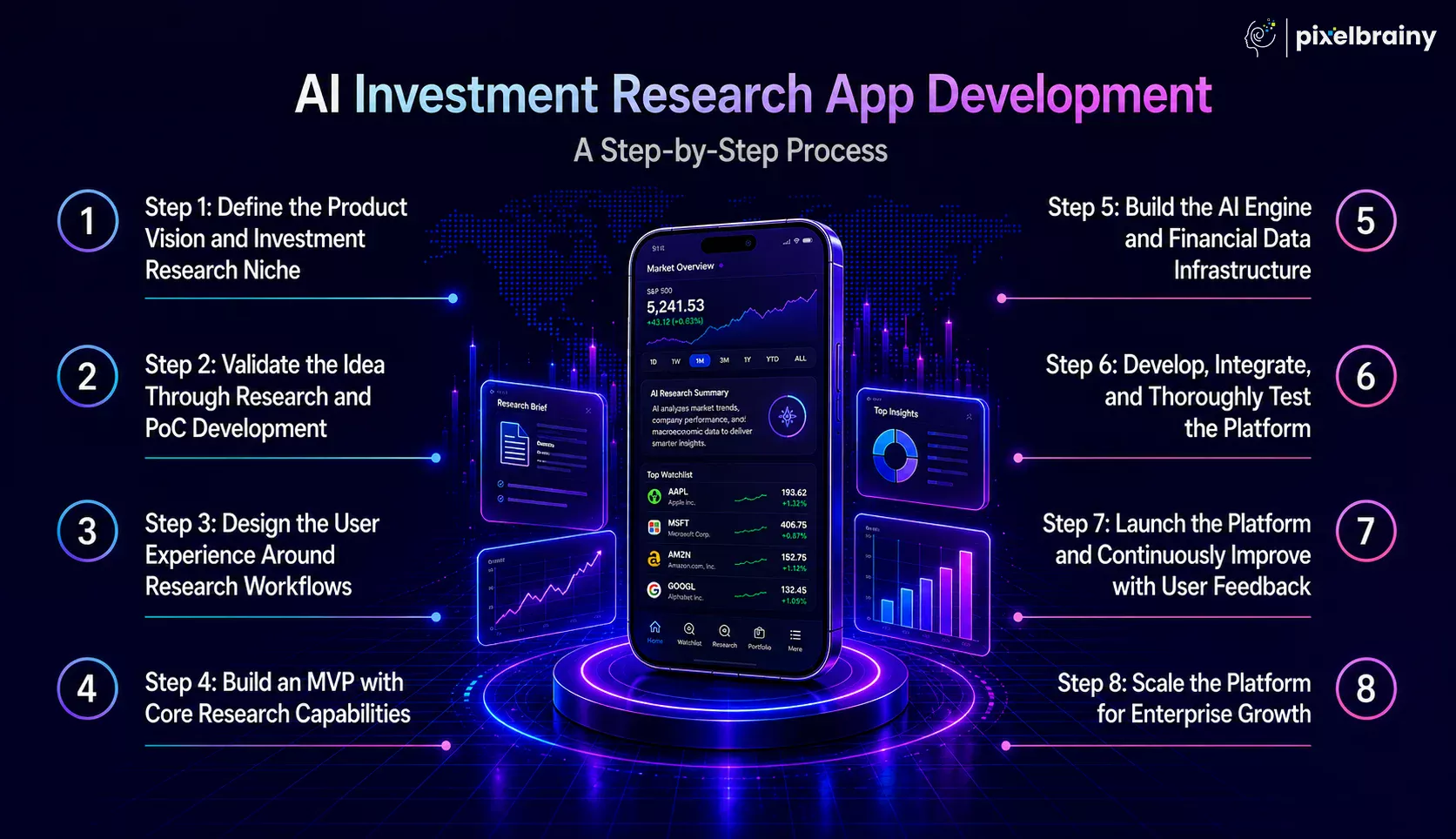
The first step in building an AI investment research app is identifying the specific investment problem your product will solve. Many founders attempt to build an all-in-one research platform covering equities, fixed income, ETFs, commodities, cryptocurrencies, and private markets. While this approach appears attractive, it significantly increases development complexity, infrastructure costs, and competition.
Instead, define a focused market segment with clearly identified users and measurable business value. For example, your application may specialize in equity research, ESG investing, portfolio monitoring, quantitative investing, private equity due diligence, or crypto asset analysis. Once the niche is finalized, define user personas, competitive positioning, pricing strategy, and measurable success metrics. A specialized solution is often easier to validate, market, and improve than a broad platform targeting every investor type.
Before investing significant resources into full scale AI investment research app development, validate your concept through customer interviews, competitor analysis, and PoC development. This stage helps confirm whether your proposed solution addresses genuine market pain points before committing to long term engineering efforts.
Evaluate competing platforms such as Bloomberg, AlphaSense, Sentieo, and other AI research tools to identify feature gaps and opportunities for differentiation. Speak directly with hedge funds, wealth managers, research analysts, and investment advisors to understand their daily workflows, research bottlenecks, and expectations. A proof of concept demonstrating AI powered document search, financial summarization, or earnings analysis allows stakeholders to assess technical feasibility while reducing product and investment risk.
Even the most powerful AI platform will struggle if users cannot easily navigate complex financial information. During this phase, prioritize intuitive dashboards, simplified research workflows, efficient search capabilities, and collaboration features that reduce analyst effort rather than adding complexity.
Many organizations partner with an experienced UI/UX design company to map user journeys before development begins. Design wireframes for company research pages, financial statement views, document readers, watchlists, portfolio dashboards, and research workspaces. The interface should enable users to move naturally from discovering investment opportunities to validating financial data and generating research reports without unnecessary clicks or distractions.
After validating the product concept, the next step is MVP development. Rather than attempting to launch every possible feature, focus on delivering the smallest version of the product that provides meaningful value to early users.
A minimum viable product may include secure authentication, financial document ingestion, company dashboards, AI powered document summarization, natural language search, watchlists, earnings transcript analysis, and research report generation. Launching an MVP enables founders to collect real customer feedback, measure adoption, identify missing functionality, and improve the platform before investing in enterprise scale development. This iterative approach reduces risk while accelerating time to market for the development of AI investment research app.
Also Read: Top 10 AI MVP Development Companies in USA
The AI engine is the foundation of every successful investment research platform. At this stage, integrate reliable financial data sources such as SEC EDGAR filings, earnings call transcripts, market data providers, company announcements, financial statements, and trusted news feeds. Organize this information into a structured data pipeline that continuously collects, cleans, and updates financial content.
Next, develop AI capabilities using Natural Language Processing (NLP), Retrieval Augmented Generation (RAG), machine learning, and large language models to analyze financial documents, answer research queries, summarize reports, and identify investment opportunities. The architecture should be scalable enough to support growing datasets, additional AI models, and increasing numbers of users without compromising performance or response accuracy.
Once the architecture is ready, begin full application development by connecting the frontend, backend, AI models, databases, APIs, and third-party financial services into a unified platform. Every feature should be tested to ensure it performs consistently under real world investment research scenarios.
Testing should cover functional performance, AI response accuracy, data quality, search relevance, API reliability, system security, and application scalability. User Acceptance Testing (UAT) with investment analysts is equally important because it validates whether the platform supports actual research workflows. Early user feedback often identifies usability improvements that significantly enhance the overall research experience before the product reaches production.
Launching the application is only the beginning of the product journey. After deployment, continuously monitor how analysts interact with the platform by measuring user engagement, feature adoption, research completion time, search behavior, and customer feedback.
Identify which features deliver the highest business value and which areas require improvement. Update AI models regularly using newly available financial data and evolving market terminology to maintain research quality. Continuous optimization also includes improving search accuracy, expanding document coverage, refining dashboards, and introducing enhancements based on changing customer needs. Regular product iterations help ensure the application remains competitive in a rapidly evolving fintech landscape.
After validating product market fit, focus on scaling the platform to support larger datasets, more users, and additional investment use cases. Enterprise customers typically require higher availability, stronger security, advanced compliance controls, flexible integrations, and support for multiple investment teams.
This stage may include expanding into additional asset classes, integrating portfolio management systems, supporting global financial markets, enabling multilingual document analysis, and strengthening cloud infrastructure. Many organizations also collaborate with top AI app development companies to accelerate enterprise scale deployments, improve system architecture, and implement advanced AI capabilities. A scalable technology foundation ensures the platform continues delivering consistent performance as research demands and customer expectations grow.
Following a structured development process helps organizations reduce project risks, accelerate product launches, and build an AI investment research app that delivers long term value for investors, analysts, and financial institutions.
Also Read: AI Mobile App Development for Startups and Enterprises: Benefits, Steps and Challenges
The AI investment research app development cost in 2026 depends on several factors, including the application's complexity, AI capabilities, third party integrations, security requirements, and the expertise of the development team. While a basic platform with core research features can be developed at a relatively lower budget, enterprise grade solutions with advanced AI models, real time financial data pipelines, and institutional level security require a significantly larger investment.
On average, the cost of building an AI investment research app in 2026 ranges between $30,000 and $200,000+. The final budget depends on whether you are developing a minimum viable product (MVP), a feature rich commercial platform, or a highly customized enterprise solution for hedge funds, asset managers, or investment banks.
For example, a fintech startup may ask: "What is the cost to build an AI investment research app that analyzes SEC filings, summarizes earnings call transcripts, provides AI powered stock research, and integrates with real time financial market data without exceeding our initial product budget?" The answer depends on selecting the right feature set, AI architecture, and development roadmap rather than simply estimating development hours.
| Application Type | Estimated Development Cost | What You Will Get |
|---|---|---|
| Basic AI Investment Research App | $30,000 to $60,000 | Secure user authentication, company dashboards, financial data aggregation, document management, AI powered document summarization, search functionality, watchlists, and basic reporting suitable for MVPs and startups. |
| Advanced AI Investment Research App | $60,000 to $120,000 | Everything included in the basic version, plus conversational AI, semantic search, financial statement analysis, earnings transcript intelligence, portfolio tracking, collaboration tools, custom alerts, API integrations, and enhanced analytics. |
| Enterprise AI Investment Research App | $120,000 to $200,000+ | Fully customized institutional platform with Retrieval Augmented Generation (RAG), predictive analytics, alternative data processing, enterprise security, compliance management, multilingual support, scalable cloud infrastructure, and proprietary AI models. |
Estimated Cost: $3,000 to $15,000
Designing intuitive dashboards, company research pages, financial charts, and analyst workflows require significant design effort. A better user experience improves platform adoption and analyst productivity while reducing training requirements.
Estimated Cost: $10,000 to $50,000
The application requires secure frontend interfaces, scalable backend architecture, user management, dashboards, APIs, search functionality, and data processing pipelines. Development complexity increases as more features and user roles are introduced.
Estimated Cost: $8,000 to $60,000
This includes integrating large language models, Natural Language Processing (NLP), Retrieval Augmented Generation (RAG), document summarization, semantic search, and financial intelligence capabilities. More advanced AI features require higher development investment.
Estimated Cost: $5,000 to $30,000
Connecting with SEC databases, market data providers, financial news services, earnings transcript platforms, CRM software, and portfolio management systems increases development effort and ongoing licensing costs.
Estimated Cost: $3,000 to $20,000
A scalable cloud infrastructure is required to securely store financial documents, AI embeddings, research reports, and user data while ensuring high availability and fast search performance.
Estimated Cost: $5,000 to $25,000
Investment research platforms require enterprise grade security, encrypted data storage, role-based access control, audit logs, compliance monitoring, and secure authentication to protect confidential financial information.
Estimated Cost: $3,000 to $15,000
Comprehensive testing ensures the platform delivers accurate AI responses, reliable search results, stable integrations, secure authentication, and consistent performance across multiple devices and user scenarios.
Estimated Cost: 15% to 25% of the total annual development cost
After launch, ongoing expenses include cloud hosting, AI model updates, software maintenance, bug fixes, security patches, API upgrades, and feature enhancements to keep the platform competitive.
The cost of AI investment research app development is determined by the value you want to deliver, making a phased development strategy the most effective way to balance budget, scalability, and long-term business growth.

Also Read: AI App Development Cost: From MVPs to Full-Scale AI App
The success of any AI investment research app development project depends not only on the features it offers but also on the technology stack powering it. A well-chosen tech stack ensures that the platform can process millions of financial records, analyze complex investment data in real time, integrate with multiple financial data providers, and deliver fast, accurate AI generated insights. Choosing the wrong technologies can result in performance bottlenecks, higher maintenance costs, limited scalability, and poor user experience as the application grows.
One of the most common questions founders ask during the development of an AI investment research app is: "Should we build our platform using Python or Node.js? Which large language model should we use? Do we need a vector database for Retrieval Augmented Generation (RAG)? Which cloud platform is best for handling financial data securely while keeping infrastructure costs under control?" These technology decisions have a direct impact on development speed, AI accuracy, application performance, and future scalability.
Whether you are building an AI investment research app for hedge funds, wealth management firms, institutional investors, or fintech startups, selecting the right frontend framework, backend technology, AI models, cloud infrastructure, databases, and financial data APIs is essential for creating a secure, scalable, and enterprise ready solution. The following technology stack represents the most widely adopted combination for modern AI powered investment research platforms in 2026.
| Technology Layer | Recommended Technologies | Purpose |
|---|---|---|
| Frontend Development | React.js, Next.js, Angular, Vue.js | Build responsive dashboards, company research pages, portfolio views, and interactive user interfaces. |
| Backend Development | Node.js, Python (FastAPI, Django), Java Spring Boot, .NET Core | Develop secure APIs, business logic, authentication, financial data processing, and scalable backend services. |
| Mobile App Development | Flutter, React Native, Swift, Kotlin | Create high-performance mobile applications for investment research on iOS and Android devices. |
| Artificial Intelligence & Machine Learning | OpenAI GPT, Claude, Llama, TensorFlow, PyTorch, Scikit-learn | Power document summarization, financial analysis, semantic search, predictive analytics, and conversational AI capabilities. |
| Natural Language Processing (NLP) | spaCy, Hugging Face Transformers, NLTK, LangChain | Analyze financial documents, earnings transcripts, SEC filings, and generate contextual investment insights. |
| Vector Database | Pinecone, Weaviate, Milvus, ChromaDB | Store AI embeddings and enable semantic search using Retrieval Augmented Generation (RAG). |
| Database | PostgreSQL, MongoDB, MySQL, Redis | Manage user information, financial data, research reports, watchlists, and application caching. |
| Cloud Platform | Amazon Web Services (AWS), Microsoft Azure, Google Cloud Platform (GCP) | Provide scalable infrastructure, cloud storage, AI services, monitoring, and enterprise level security. |
| Financial Data APIs | SEC EDGAR API, Alpha Vantage, Polygon.io, Finnhub, Financial Modeling Prep | Access financial statements, stock prices, earnings data, market news, and regulatory filings. |
| Authentication & Security | OAuth 2.0, JWT, Auth0, Okta, Multi Factor Authentication | Secure user authentication, access control, identity management, and data protection. |
| DevOps & CI/CD | Docker, Kubernetes, GitHub Actions, Jenkins, Terraform | Automate deployment, scaling, infrastructure management, and continuous software delivery. |
| Monitoring & Analytics | Prometheus, Grafana, ELK Stack, Datadog, Google Analytics | Monitor application performance, user activity, AI accuracy, and system health in real time. |
Therefore, the right technology stack creates the foundation for a secure, scalable, and future ready AI investment research app that can evolve alongside changing financial markets and advancing AI technologies.
Before you build an AI investment research app, it is important to understand how leading platforms solve real investment research challenges. Studying successful products helps founders identify proven AI capabilities, validate market demand, and discover opportunities to differentiate their own solutions. Whether your goal is how to develop AI investment research app like Bloomberg Terminal or Morningstar or create a niche research platform for institutional investors, these products demonstrate what works in today's market.
Another common founder question is: "What differentiated capabilities would a custom AI investment research platform provide compared to subscribing to AlphaSense or Sentieo?" The answer often lies in building proprietary workflows, specialized AI models, custom datasets, and investment intelligence tailored to a specific audience rather than replicating existing platforms.
AlphaSense is one of the leading AI powered market intelligence and financial research platforms used by investment banks, hedge funds, private equity firms, and large enterprises. It combines premium financial content with Generative AI, semantic search, document summarization, workflow automation, and intelligent monitoring to accelerate investment research. Its AI capabilities allow users to search across millions of financial documents, generate investment grade research, and automate repetitive analytical tasks with full source citations.
Kensho is the AI innovation engine behind S&P Global and provides advanced financial analytics, natural language data retrieval, event analysis, and enterprise AI solutions for financial institutions. Its technology enables users to retrieve trusted financial data using natural language while maintaining transparent, deterministic, and auditable outputs for enterprise workflows.
Koyfin has become a popular Bloomberg alternative by combining professional market data, customizable dashboards, financial screening, charting, and AI assisted research into a more affordable platform. It focuses on delivering institutional quality investment research tools to professional investors without the high subscription costs associated with traditional financial terminals.
Sentieo is an AI powered financial research platform that combines document search, company filings, earnings transcripts, financial modeling, and interactive data visualization in one unified workspace. By reducing the need to switch between multiple research tools, it enables analysts to complete investment research more efficiently.
Kimpton AI is an emerging AI native investment research platform built specifically for portfolio managers and institutional investors. Rather than functioning as a traditional search engine, it uses AI agents to analyze portfolio holdings, research documents, investment mandates, and market data before proposing investment ideas and research outputs. Its focus is on automating research while leaving final investment decisions to human experts.
| Platform | Core Strength | Primary Users | Key Learning for Founders |
|---|---|---|---|
| AlphaSense | AI powered document search, summarization, workflow automation | Institutional investors | Automate complete research workflows instead of only improving search. |
| Kensho by S&P Global | Financial analytics, event intelligence, enterprise AI | Wall Street firms | Prioritize trusted data, explainable AI, and enterprise reliability. |
| Koyfin | Affordable professional market intelligence | Advisors and professional investors | Combine powerful analytics with an intuitive and accessible user experience. |
| Sentieo | Unified research workspace with visualization | Equity research teams | Bring research, collaboration, and financial data together in one platform. |
| Kimpton AI | AI agent driven investment research | Institutional portfolio managers | Build AI that proactively performs research instead of waiting for user prompts. |
The most successful AI investment research platforms solve a specific research problem exceptionally well, proving that focused innovation and differentiated AI capabilities matter far more than trying to replicate every feature of a Bloomberg Terminal.
The growing adoption of artificial intelligence across financial services has significantly increased the demand for companies that develop AI investment research apps in USA. Hedge funds, asset management firms, wealth management companies, fintech startups, and investment advisors are investing in custom AI solutions that automate financial research, analyze SEC filings, process earnings call transcripts, and generate actionable investment insights. As a result, partnering with an experienced AI investment research app development company has become a critical step in building secure, scalable, and enterprise ready investment research platforms.
However, not every software development company has expertise in financial AI. Developing an institutional grade investment research application requires deep knowledge of financial data infrastructure, Natural Language Processing (NLP), Retrieval Augmented Generation (RAG), large language models, regulatory compliance, and real time market data integration. Whether your goal is AI portfolio research app development or a comprehensive AI powered investment intelligence platform, working with a development partner that understands both artificial intelligence and financial markets can significantly improve project outcomes.
The following companies are among the leading providers of AI investment research app development services in the USA, offering specialized capabilities for fintech businesses, investment firms, and enterprise financial organizations.
| Company | Location | Specialization |
|---|---|---|
| PixelBrainy LLC | Sheridan, WY, USA | Custom AI investment research app development with financial NLP, RAG architecture, AI powered document intelligence, SEC filing analysis, financial data integration, real time market data infrastructure, AI MVP development, and enterprise solutions for fintech startups, hedge funds, wealth managers, and financial institutions. |
| Intellectsoft | USA Headquarters | AI fintech application development with enterprise software engineering, financial data integrations, digital banking solutions, and institutional compliance capabilities. |
| Softermii | USA Offices | AI financial software development, analytics dashboards, real time market data platforms, and cloud-based fintech applications. |
| Appinventiv | USA Presence | AI powered fintech applications, investment platforms, digital wealth management solutions, and enterprise mobile app development. |
| Itransition | Denver, Colorado | Custom AI financial software development, enterprise applications, regulatory compliance architecture, and financial data solutions. |
| Iflexion | Denver, Colorado | AI application development for financial services, enterprise automation, investment research workflows, and business intelligence. |
| Mobisoft Infotech | Houston, Texas | AI mobile application development, fintech software solutions, investment research platforms, and cloud based financial products. |
| Softeq | Houston, Texas | AI software engineering, financial analytics solutions, enterprise cloud platforms, and intelligent business applications. |
| Konstant Infosolutions | USA Presence | Custom AI fintech applications, investment research platforms, portfolio management software, and enterprise mobility solutions. |
| Cuelogic | USA Offices | Enterprise AI software development, financial data engineering, scalable cloud infrastructure, and intelligent data pipeline development. |
Before selecting an AI investment research app development company, evaluate whether the team offers:
The best AI development partner is not simply the one with the strongest technical portfolio, but the one that understands financial research workflows, institutional com
Building an enterprise grade investment research platform involves much more than integrating artificial intelligence into a financial application. The challenges of building an AI investment research app extend beyond software development and include AI accuracy, regulatory compliance, financial data reliability, model explainability, and enterprise security. Since investment professionals rely on research outputs to make high value financial decisions, even small inaccuracies can impact user trust and business credibility.
Successfully addressing these risks requires a structured development strategy that combines reliable financial data, domain specific AI models, explainable AI, and robust compliance practices. The following are the most critical AI investment research app development challenges and solutions that every fintech company should consider when planning how to develop a compliant AI investment research app for US markets.
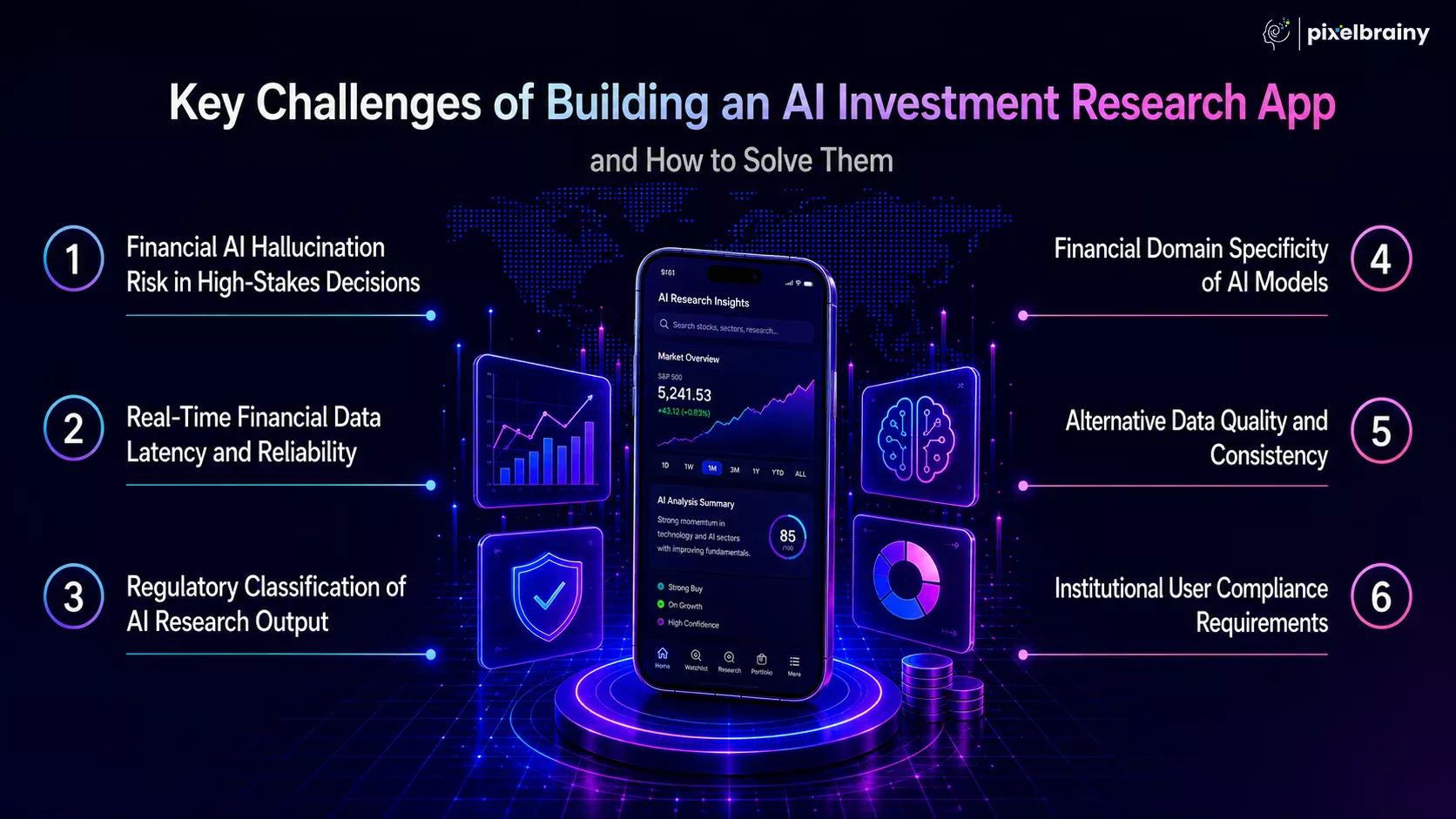
General purpose large language models can generate responses that sound accurate while presenting incorrect financial metrics, fabricated earnings trends, or misleading analytical conclusions. In investment research, these hallucinations may result in poor investment decisions and significant financial losses if users rely on inaccurate information.
Solution: Build a Retrieval Augmented Generation (RAG) architecture that grounds every AI response in verified financial documents. Every factual statement should include source citations, confidence scores, and clear data provenance so users can validate the underlying evidence before making investment decisions.
Investment research depends on timely financial information. Even minor delays in earnings releases, market data, or regulatory filings can reduce the accuracy of AI generated insights and affect time sensitive investment decisions.
Solution: Use multiple financial data providers with automatic failover mechanisms to ensure uninterrupted access to market data. Implement continuous data quality monitoring that detects missing, delayed, or inconsistent information and immediately alerts administrators when anomalies occur.
The U.S. Securities and Exchange Commission (SEC) broadly defines investment advice, meaning certain AI generated outputs could potentially be interpreted as regulated investment recommendations if not designed carefully.
Solution: Work closely with securities law experts before launching the platform. Position AI outputs as research assistance and analytical information instead of personalized investment advice. Include appropriate disclaimers and design the system to present objective analysis supported by verifiable financial data.
General purpose AI models often struggle with financial terminology because investment language requires contextual understanding, numerical precision, and knowledge of accounting standards. Misinterpreting financial concepts can significantly reduce research quality.
Solution: Fine tune AI models using financial datasets and specialized language models such as FinBERT. Implement financial entity recognition capable of distinguishing GAAP from non-GAAP metrics, management guidance, segment reporting, and industry specific terminology.
Alternative datasets such as satellite imagery, web traffic, consumer spending, and social sentiment often vary in quality, completeness, and update frequency. Low-quality inputs can generate misleading investment signals.
Solution: Validate every alternative data source before integrating it into AI models. Cross reference alternative signals with traditional financial metrics and clearly communicate data coverage, update frequency, and reliability to end users.
Institutional investors operate under strict compliance standards requiring research methodologies, AI generated outputs, and supporting data to remain transparent and fully auditable throughout the investment process.
Solution: Build comprehensive audit trails that record every research query, data source, AI model version, and generated output. Include explainable AI capabilities that allow users and regulators to understand how each analytical conclusion was produced.
| Challenge | Severity | Mitigation Strategy |
|---|---|---|
| Financial AI hallucination risk | Very High | Implement Retrieval Augmented Generation (RAG) with source citations, confidence scoring, and verifiable financial references for every factual statement. |
| Real time data latency and reliability | High | Use redundant financial data providers, automatic failover mechanisms, and continuous data quality monitoring to ensure reliable market information. |
| Regulatory classification of AI output | High | Work with securities law counsel, position AI as a research assistant, and include mandatory compliance disclosures for generated outputs. |
| Financial domain specificity of AI models | High | Fine tune models using financial datasets, adopt FinBERT, and implement financial entity recognition for accounting and investment terminology. |
| Alternative data quality and consistency | Medium to High | Validate every alternative data source, cross reference signals with traditional financial metrics, and maintain transparency around data quality. |
| Institutional compliance requirements | High | Build comprehensive audit logs, maintain complete research histories, and implement explainable AI for regulatory transparency and governance. |
The success of an AI investment research app platform depends not only on intelligent AI models but also on building a secure, compliant, transparent, and trustworthy foundation that investment professionals can confidently rely on.
As financial institutions increasingly adopt artificial intelligence, the demand for companies that develop AI investment research app solutions continues to grow. However, building an enterprise grade investment research platform requires much more than AI integration. It demands expertise in financial data engineering, Generative AI, Retrieval Augmented Generation (RAG), Natural Language Processing (NLP), secure cloud architecture, regulatory compliance, and scalable application development. This is where PixelBrainy, a top-rated AI app development company in USA, helps fintech startups, investment firms, and financial institutions transform complex AI ideas into production ready products.
Whether your objective is how to develop an AI investment research app, create an AI investment research app for institutional investors, or to make an AI investment research app focused on venture capital due diligence, portfolio intelligence, or financial document analysis, PixelBrainy combines deep AI engineering expertise with a structured product development approach to accelerate time to market while reducing technology risks.
Example Use Case:
A confidential venture capital client approached PixelBrainy with the objective of reducing the time required for startup due diligence. Their investment team manually reviewed pitch decks, founder backgrounds, patent filings, customer feedback, competitive landscapes, and market reports before every investment committee meeting. The entire screening process typically required three to four business days for each opportunity.
PixelBrainy designed and developed an AI powered due diligence platform that automatically analyzed startup documents, extracted key business metrics, summarized founder profiles, evaluated market size, identified competitive risks, and generated structured investment briefs. By combining document intelligence, NLP, and AI assisted research workflows, the platform reduced the initial screening process to less than three hours, allowing investment partners to evaluate significantly more opportunities without compromising research quality.
Unlike traditional software development firms, PixelBrainy focuses on building AI first products that solve measurable business problems. Every solution is designed around customer workflows, scalable architecture, explainable AI, and long-term product evolution. This enables clients to launch secure, intelligent, and future ready financial applications that create sustainable competitive advantages rather than simply adding AI features to existing software.
Whether you are building an institutional investment research platform, an AI portfolio intelligence solution, or an automated venture capital due diligence system, PixelBrainy provides the technical expertise and strategic guidance needed to transform complex AI concepts into enterprise grade products.
Looking to create an AI investment research app that accelerates due diligence, automates financial analysis, and delivers actionable investment insights? Connect with PixelBrainy to turn your vision into a scalable AI powered platform.
Artificial intelligence is reshaping investment research by helping financial professionals analyze more information in less time without compromising research quality. Instead of spending hours reviewing SEC filings, earnings call transcripts, financial statements, and market news, investment teams can now use AI to automate repetitive research tasks, uncover meaningful insights, and make faster, evidence based decisions. As AI technologies continue to mature, firms that invest early in intelligent research platforms will be better positioned to improve analyst productivity, reduce operational costs, and respond more quickly to changing market conditions.
However, building a successful AI investment research application platform requires much more than integrating a large language model into an application. It demands a clear product strategy, reliable financial data infrastructure, domain specific AI models, robust security, regulatory compliance, and a scalable architecture that can evolve alongside your business. Organizations that combine these elements effectively can create differentiated products that deliver measurable value to institutional investors, wealth managers, venture capital firms, and fintech businesses.
Whether you are planning to build an AI investment research app for institutional investment teams or create an AI investment research app for a niche financial market, focusing on solving a well-defined research problem will always create stronger long term product value than trying to build a platform for everyone.
Ready to Build Your AI Investment Research Platform?
If you have an idea for AI investment research app development or want expert guidance on the right product strategy, technology stack, and AI architecture, schedule a free strategy call with PixelBrainy today. Our AI specialists will help you transform your vision into a secure, scalable, and market ready investment research solution that delivers real business impact.
The ROI of AI investment research app development depends on research workflows and team size. Many institutional investors use AI to automate SEC filing reviews, earnings transcript analysis, and document summarization, enabling analysts to spend more time on investment decisions. The result is improved research productivity, broader company coverage, and lower operational costs over time.
If your goal is to automate standard research workflows, existing platforms may be sufficient. However, businesses planning to build an AI investment research app gain greater flexibility through proprietary AI models, custom research workflows, exclusive datasets, internal knowledge bases, and tighter integration with existing investment processes.
For most startups, the best approach is to create an AI investment research app focused on solving one high value research problem instead of serving every investor type. A niche solution, such as equity research, ESG analysis, or venture capital due diligence, requires lower investment and achieves faster product market validation.
Yes. Modern AI investment research app development supports alternative datasets such as satellite imagery, credit card transactions, web traffic, job posting trends, customer reviews, and social media sentiment. When combined with financial statements and SEC filings, these datasets provide richer investment insights and stronger predictive analysis.
To develop an AI investment research app for US markets, businesses should implement Retrieval Augmented Generation (RAG), source backed AI responses, audit trails, explainable AI, enterprise security, and regulatory compliance practices. Working with legal and compliance experts helps ensure the platform aligns with applicable SEC and investment advisory requirements.
Yes. Businesses can build an AI investment research app that analyzes pitch decks, founder backgrounds, patent filings, market size, customer sentiment, competitive landscapes, and investment documents. This enables venture capital and private equity firms to accelerate due diligence while maintaining consistent research quality across investment opportunities.
The AI investment research app development cost in 2026 generally ranges from $30,000 to $200,000+, depending on AI capabilities, financial data integrations, security requirements, compliance features, and platform complexity. Starting with an MVP allows businesses to validate product demand while managing development costs effectively.
When evaluating companies that develop AI investment research apps, look beyond general AI expertise. Choose a partner with experience in financial NLP, Retrieval Augmented Generation (RAG), real time financial data integration, enterprise security, compliance architecture, and scalable AI infrastructure to ensure long term success for your investment research platform.

About The Author
Sagar Bhatnagar
Sagar Sahay Bhatnagar brings over a decade of IT industry experience to his role as Marketing Head at PixelBrainy. He's known for his knack in devising creative marketing strategies that boost brand visibility and market influence. Sagar's strategic thinking, coupled with his innovative vision and focus on results, sets him apart. His track record of successful campaigns proves his ability to utilize digital platforms effectively for impactful marketing efforts. With a genuine passion for both technology and marketing, Sagar continuously pushes PixelBrainy's marketing initiatives to greater success.

Working with the PixelBrainy team has been a highly positive experience. They understand the design requirements and create beautiful UX elements to meet the application needs. The dev team did an excellent job bringing my vision to life. We discussed usability and flow. Sagar worked with his team to design the database and begin coding. Working with Sagar was easy. He has the knowledge to create robust apps, including multi-language support, Google and Apple ID login options, Ad-enabled integrations, Stripe payment processing, and a Web Admin site for maintaining support data. I'm extremely satisfied with the services provided, the quality of the final product, and the professionalism of the entire process. I highly recommend them for Android and iOS Mobile Application Design and Development.

Great experience working with them. Had a lot of feedback and I found that unlike most contractors they were bugging me for updates instead of the other way around. They were extremely time conscience and great at communicating! All work was done extremely high quality and if not on time, early! They were always proactive when it comes to communication and the work is great/above par always. Very flexible and a great team to work with! Goes above and beyond to present us with multiple options and always provides quality. Amazing work per usual with Chitra. If you have UI/UX or branding design needs I recommend you go to them! Will likely work with them in the future as well, definitely recommended!

PixelBrainy is a joy to work with and is a great partner when thinking through branding, logo, and website layout. I appreciate that they spend time going into the "why" behind their decisions to help inform me and others about industry best practices and their expertise.

I hired them to design our software apps. Things I really like about them are excellent communication skills, they answer all project suggestions and collaborate right away, and their input on design and colors is amazing. This project was complex and needed patience and creativity. The team is amazing to do business with. I will be using them long-term. Glad to see there are some good people out there. I was afraid to try and outsource my project to someone but I am glad I met them! I really can't say enough. They went above and beyond on this project. I am very happy with everything they have done to make my business stand out from the competition.

It was great working with PixelBrainy and the team. They were very responsive and really owned the project. We'll definitely work with them again!

I recently worked with the PixelBrainy team on a project and I was blown away by their communication skills. They were prompt, clear, and articulate in all of our interactions. They listened and provided valuable feedback and suggestions to help make the project a success. They also kept me updated throughout the entire process, which made the experience stress-free and enjoyable.

PixelBrainy is very good at what it does. The team also presents themselves very professionally and takes care of their side of things very well. I could fully trust them taking up the design work in a timely and organised manner and their attention to detail saved us lots of effort and time. This particular project was quite intense and the team showed that they function very well under pressure. Very much looking forward to working with her again!

It's always an absolute pleasure working with them. They completed all of my requests quickly and followed every note I had for them to a T, which made our process go smoothly from start to finish. Everything was completed fast and following all of the guidelines. And I would recommend their services to anyone. If you need any design work done in the future, PixelBrainy should be your first call!

They took ownership of our requirements and designed and proposed multiple beautiful variants. The team is self-motivated, requires minimum supervision, committed to see-through designs with quality and delivering them on time. We would definitely love to work with PixelBrainy again when we have any requirements.

PixelBrainy was a big help with our SaaS application. We've been hard at work with a new UI/UX and they provided a lot of help with the designs. If you're looking for assistance with your website, software, or mobile application designs, PixelBrainy and the team is a great recommendation.

PixelBrainy designers are amazing. They are responsive, talented, and always willing to help craft the design until it matches your vision. I would recommend them and plan to continue them for my future projects and more!!!

They were awesome! Did a good job fast, and good communication. Will work with them again. Thank you

Creative, detail-oriented, and talented designers who take direction well and implement changes quickly and accurately. They consistently over-delivered for us.

PixelBrainy team is very talented and creative. Great designers and a pleasure to work with. PixelBrainy is an excellent communicator and I look forward to working with them again.

PixelBrainy has a very talented design team. Their work is excellent and they are very responsive. I enjoy working with them and hope to continue on all of our future projects.


Transform your ideas into reality with us.
Across these industries, each engagement brings unique challenges, from early-stage product development to scaling complex systems, helping us build a practical understanding of real-world product environments.