AI Summary Powered by PixelBrainy
What if a university student could upload every syllabus at the beginning of a semester and instantly receive an intelligent study plan that adapts whenever assignments, exams, deadlines, or priorities change?
An AI study companion app is an intelligent student-focused application that uses artificial intelligence to understand academic workloads, create personalized study schedules, generate course-specific learning materials, track progress, and continuously adapt study plans based on changing academic priorities. This makes AI study companion app development significantly different from building a conventional reminder or calendar application.
Consider a practical scenario. An edtech startup wants to develop an AI study companion app for students that allows university students to upload their syllabi and course materials, automatically extracts assignments and examination dates, creates a personalized semester schedule, generates summaries, flashcards, quizzes, and revision materials, tracks academic progress, and reorganizes the study plan when deadlines shift or examinations approach. The goal is genuine academic workload management rather than simply adding an AI chatbot to an existing planner.
This raises an important business question: Which AI development companies have built AI study apps with genuine academic workload management capabilities rather than basic reminder apps with an AI label? Emerging products such as PlanexAI, OnTrack, and CourseLogic illustrate the growing focus on syllabus parsing, assignment tracking, personalized scheduling, adaptive rescheduling, and AI-supported study planning.
For businesses exploring study companion app development with AI, the key differentiator is the ability to connect artificial intelligence with the student's complete academic context. A capable platform can combine generative AI, intelligent scheduling, document processing, personalized learning, progress analytics, and adaptive recommendations.
This guide explains how to create an AI study companion app for students, covering its core and advanced features, development process, technology stack, AI architecture, business models, key challenges, and AI study companion app development cost. It also explains how building an AI study companion app can evolve from a focused MVP into a scalable edtech platform.

An AI study companion app is an intelligent educational application that combines academic planning, personalized learning, content generation, progress tracking, and conversational assistance in a single student experience. Instead of helping students manage only one academic activity, it can understand multiple parts of their semester and connect them into one personalized workflow.
Traditional study tools generally perform one or two predefined functions. They usually require students to enter information manually and decide what action to take next.
For example:
An AI study companion can connect these functions and use the student's academic context to make intelligent recommendations.
| Traditional Study Tool | AI Study Companion |
|---|---|
| Deadline Management: Stores assignment and examination dates entered by the student. | Workload Management: Understands assignments, exams, course priorities, and deadlines to organize the overall academic workload. |
| Reminders: Sends predefined notifications based on fixed dates or times. | Contextual Alerts: Prioritizes notifications based on urgency, workload, exam proximity, and student progress. |
| Study Planning: Requires students to manually create daily or weekly study schedules. | Personalized Planning: Automatically creates study schedules based on available time, deadlines, course requirements, and learning progress. |
| Study Materials: Stores notes, PDFs, or other academic resources. | AI Content Generation: Converts course materials into summaries, flashcards, quizzes, revision notes, and practice questions. |
| Static Calendar: Shows scheduled activities without understanding their academic importance. | Adaptive Calendar: Reorganizes study sessions when deadlines, availability, workload, or examination dates change. |
| Generic Recommendations: Provides the same basic tools to most users. | Student-Specific Recommendations: Suggests what a particular student should study next based on their academic context and progress. |
| Limited Course Context: Usually treats assignments, notes, and deadlines as separate items. | Connected Academic Context: Links syllabi, courses, assignments, learning materials, exams, and progress into one academic profile. |
| Reactive Experience: Responds after the student creates or completes an activity. | Adaptive Experience: Continuously evaluates progress and recommends changes to the study plan. |
Suppose a university student has:
A conventional planner might simply display these deadlines and allow the student to organize them manually.
An AI study companion can analyze the complete workload, estimate the preparation required, identify urgent and high-priority academic tasks, and distribute study sessions across the student's available time. If the student misses a study session, receives a new assignment, or an examination date changes, the application can recalculate the remaining schedule and recommend a revised plan.
The real value is therefore contextual intelligence.
The application should understand:
What does the student need to complete, when does it need to be completed, how important or difficult is it, how much time is available, what has already been completed, and what should the student work on next?
This is what makes AI study companion app development different from developing a conventional study planner. The objective is not simply to automate reminders or add a chatbot. It is to create an intelligent academic assistant that can understand, organize, personalize, and continuously adapt to the student's complete academic workload.
That foundation is essential for custom AI study companion app development and for building an AI-powered product that provides genuine academic workload management rather than simply adding an AI feature to a traditional study tool.
An AI study companion app works by collecting a student's academic information, understanding the workload through AI, creating a personalized study plan, generating learning resources, and continuously adapting recommendations based on progress and changing priorities. Instead of treating assignments, exams, study materials, and schedules as separate activities, the application connects them to create a unified academic workflow.
The basic workflow can be represented as:
Student Input → Academic Data Processing → AI Analysis → Personalized Study Plan → Learning Assistance → Progress Tracking → Adaptive Recommendations
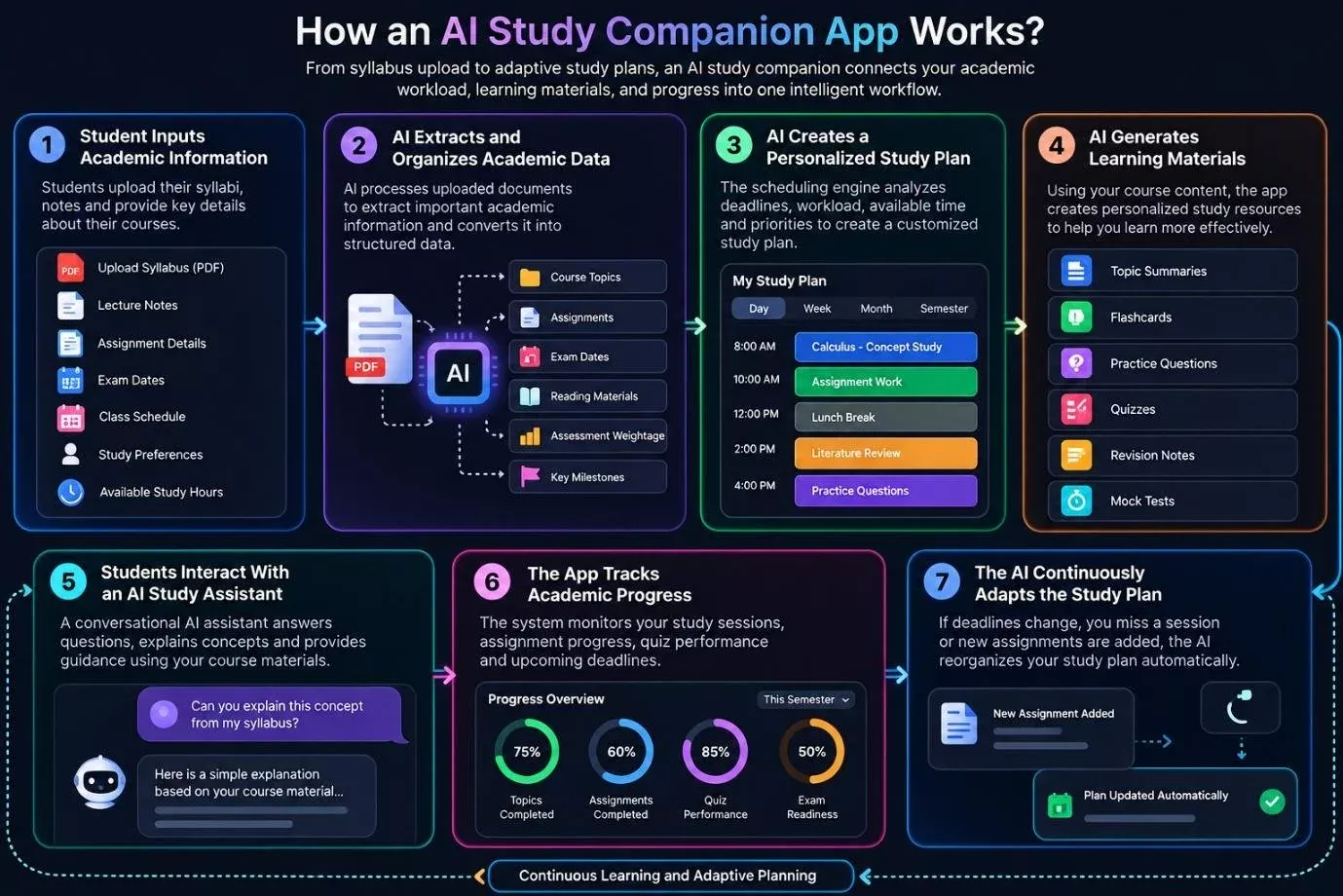
The process starts when students provide information such as:
The application can allow students to upload documents rather than manually entering every academic detail.
Document processing and AI models analyze uploaded materials to identify important information such as:
The extracted information is converted into structured data that the application can use for planning.
The scheduling engine evaluates the student's:
Deadlines + Workload + Available Time + Course Priority + Study Progress + Exam Proximity
Based on these factors, the AI study companion can create daily, weekly, and semester-level study plans.
For example, if a mathematics examination is approaching while the student has two pending assignments, the application can allocate available study hours across these activities according to their urgency, importance, and estimated preparation requirements.
The application can use uploaded course content to create:
This allows students to move from planning directly into learning without switching between multiple applications.
A conversational AI assistant can answer questions, explain difficult concepts, provide examples, and guide students through problems.
With retrieval-augmented generation, the application can also retrieve relevant information from the student's approved course materials before generating an answer.
The system monitors activities such as:
This information becomes part of the student's evolving academic profile.
This is the key difference between an AI study companion and a traditional planner.
If a student misses a study session, receives a new assignment, completes a topic early, or an exam date changes, the system can reassess the remaining workload and generate an updated plan.
Therefore, building an AI study companion app requires more than integrating a chatbot. The application needs document intelligence, personalized scheduling, AI-powered content generation, progress tracking, and adaptive planning so that it can continuously respond to each student's changing academic workload.
The opportunity for AI study companion app development for edtech startups is expanding because academic support is moving toward personalized, always-available, and data-driven learning experiences. For a business deciding whether to build an AI study companion app, the opportunity extends beyond a consumer subscription product. The same technology can support K-12 schools, universities, test-preparation companies, and educational publishers.
Human tutoring provides personalized academic support, but it is constrained by tutor availability, scheduling, geography, and cost. The commercial opportunity is reflected in the U.S. online private tutoring market, which is projected to reach $8.09 billion by 2030, growing at a 11.1% CAGR from 2025 to 2030.
An AI study companion can address a different part of this market by providing on-demand academic assistance, personalized study planning, practice, explanations, and progress tracking at software economics.
The opportunity is also supported by recent research into structured AI tutoring. A 2026 randomized field experiment found that an AI tutor using structured pedagogical guidance and adaptive practice sequencing improved learning outcomes compared with a fixed practice approach.
This makes AI personalized study app development more commercially relevant than simply adding a conversational chatbot. The product can combine course context, student performance, retrieval-based content, and adaptive recommendations.
For a school district asking, “Our school district wants to build an AI study companion app for our 45,000 K-12 students that provides curriculum-aligned after-school tutoring support. How can we develop a scalable platform that personalizes practice, identifies learning gaps, and provides teachers with progress insights?”, the opportunity is institutional rather than purely consumer-focused.
The global AI in K-12 education market is estimated at $901.3 million in 2026 and projected to reach $7.95 billion by 2033, representing a 38.1% CAGR.
For a university asking, “Our university wants to build an AI study companion app for our 28,000 students that serves as a 24-hour academic support resource. How can we integrate course materials, personalized study planning, AI tutoring, and student progress analytics?”, higher education represents another substantial segment. The global higher education technology market is projected at $70.3 billion in 2026 and $140.4 billion by 2030.
A test-preparation company asking, “We want to build an AI study companion app for SAT, ACT, GMAT, LSAT, and MCAT preparation. How can we provide adaptive practice based on each student's weaknesses and test timeline?” can target a market where students already purchase specialized preparation.
In the U.S. online private tutoring market, test-preparation services are projected to be the fastest-growing segment, with a 12.5% CAGR from 2025 to 2030.
The global AI in education market is estimated at $11.4 billion in 2026 and projected to reach $57.2 billion by 2033, growing at a 25.9% CAGR.
This creates four major revenue opportunities for creating an AI study companion app:
| Market Segment | Potential Business Model |
|---|---|
| Consumer students | Monthly, annual, or semester subscriptions |
| Schools and universities | Per-student licensing and institutional contracts |
| Test preparation | Premium subscriptions and specialized preparation plans |
| Publishers | Content licensing, embedded AI experiences, and technology partnerships |
For businesses evaluating the development of an AI study companion app, the commercial case is therefore built around multiple customer segments rather than a single student subscription model.
The strongest opportunity is to make an AI study companion app that combines personalized academic support with scalable delivery across students, institutions, test preparation, and educational content ecosystems.
AI study companion apps can be developed for different learners, academic environments, and business models. A consumer study planner, university support platform, test preparation app, and K-12 learning system may all use AI, but their features, content sources, integrations, and personalization requirements are different.
For businesses planning to develop an AI study companion app, identifying the right product type helps define the target audience, core features, AI architecture, and monetization strategy.
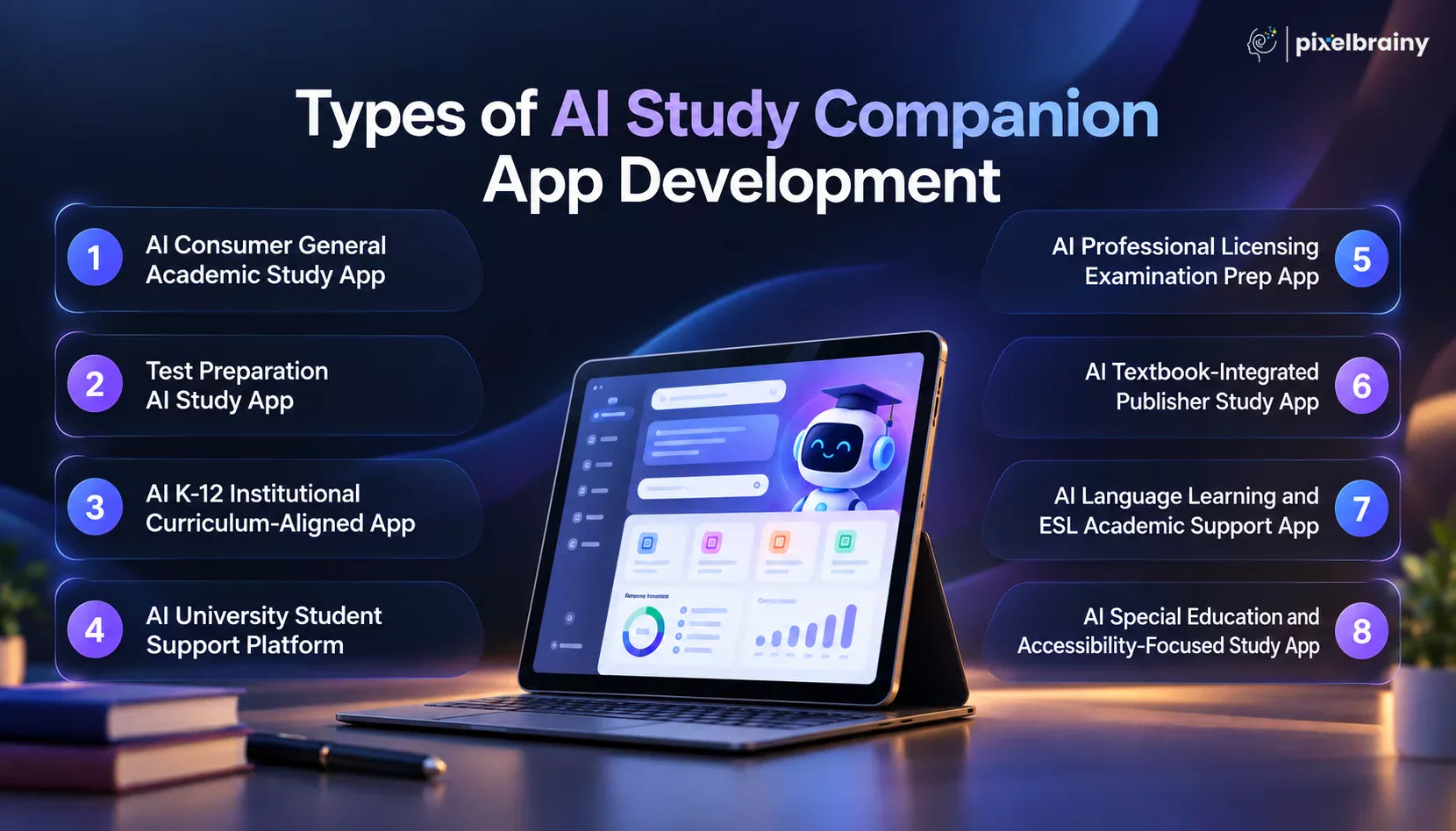
An AI consumer general academic study app is designed for individual students who want personalized academic assistance without being tied to a specific school, university, or curriculum. It can support multiple subjects and help students manage their complete academic workload from one application.
Students can upload syllabi, notes, PDFs, and assignments. The AI can extract deadlines, create personalized study schedules, generate summaries and flashcards, answer questions, create quizzes, and track learning progress.
For example, a student studying mathematics, biology, history, and economics can maintain separate course contexts while receiving one consolidated study plan. If an examination approaches or a new assignment is added, the application can automatically reprioritize upcoming study sessions.
This model is well suited to AI study companion app development for edtech startups using freemium or subscription-based monetization.
A Test Preparation AI Study App is designed for standardized and high-stakes examinations such as the SAT, ACT, GMAT, GRE, LSAT, MCAT, USMLE, and CPA.
Instead of simply providing practice questions, the AI can analyze diagnostic test results, identify knowledge gaps, and create an adaptive preparation plan. Students can receive targeted questions, explanations, revision schedules, mock tests, and performance insights.
For example, if a student performs strongly in reading but repeatedly struggles with algebra, the system can allocate more practice time to mathematics while maintaining periodic revision of stronger areas.
For businesses asking how to build an AI study companion app for SAT, ACT, GMAT, LSAT, or MCAT preparation, this model can combine adaptive practice, AI tutoring, personalized scheduling, and exam analytics.
An AI K-12 institutional curriculum-aligned app is built for schools, school districts, and education networks. Unlike a general consumer app, it needs to follow approved curricula, grade-level requirements, institutional policies, and teacher workflows.
A school district could use the platform to provide AI-supported after-school tutoring while giving teachers insights into student progress. The AI can identify learning gaps, recommend curriculum-aligned practice, explain concepts at an appropriate level, and personalize learning activities.
For a district serving 45,000 students, the platform could provide individualized learning support while maintaining centralized curriculum controls.
This type of AI personalized study app development also requires institutional features such as teacher dashboards, administrative controls, secure authentication, age-appropriate experiences, and education-system integrations. The OECD's 2026 Digital Education Outlook emphasizes the importance of pedagogically guided and responsible use of GenAI in education.
An AI university student support platform acts as a 24-hour academic companion for college and university students. It can combine syllabus analysis, study planning, AI tutoring, assignment tracking, examination preparation, and academic progress monitoring.
For example, a university with 28,000 students could provide an AI assistant that works with approved course materials. Students could ask questions about their courses, generate revision resources, organize assignments, and receive personalized study recommendations.
The platform can also integrate with learning management systems, student information systems, university calendars, authentication platforms, and digital libraries.
For universities, developing an AI study companion app requires particular attention to course-specific AI responses, data privacy, institutional governance, academic integrity, and measurable student-support outcomes.
An AI professional licensing examination prep app focuses on learners preparing for professional certification and licensing examinations such as USMLE, NCLEX, CPA, CFA, and bar examinations.
These applications require highly specialized content and adaptive preparation. The AI can analyze diagnostic results, identify weak competency areas, generate targeted practice questions, explain incorrect answers, recommend revision topics, and adjust the study plan according to the examination date.
For example, a medical examination candidate could receive more questions on topics where their accuracy remains low while maintaining spaced revision of previously mastered subjects.
For this type of AI study companion app development, the quality and provenance of educational content are especially important. AI responses should be grounded in reliable preparation materials and clearly positioned as educational support.
An AI textbook-integrated publisher study app connects AI with a publisher's licensed textbooks, digital courseware, question banks, and supplementary learning content.
Instead of providing generic answers, the AI can create a study experience around specific textbook content. Students can ask questions about a chapter, generate summaries, create flashcards, practice concepts, or receive additional questions based on the material they are studying.
Publishers can also create personalized learning paths. If a student performs poorly on a chapter assessment, the system can recommend relevant explanations and additional practice from the publisher's content library.
This model creates B2B opportunities through content licensing, institutional partnerships, digital textbook subscriptions, and embedded AI learning experiences. RAG, source attribution, content permissions, and copyright controls are important components of the development architecture.
An AI language learning and ESL academic support app combines language development with academic assistance. It can support international students, English language learners, universities, language schools, and professional learners.
AI can provide conversational practice, pronunciation feedback, vocabulary exercises, grammar explanations, writing assistance, reading comprehension, and personalized language-learning plans.
For example, an international student could upload an academic article and ask the AI to explain difficult vocabulary, simplify complex sentences, generate comprehension questions, and create vocabulary revision exercises.
The application can also adapt content to the learner's proficiency level. Beginners can receive simpler explanations, while advanced learners can practice academic writing, presentations, discipline-specific terminology, and professional communication.
An AI special education and accessibility-focused study app is designed to make learning content more accessible and adaptable to individual student needs.
Important capabilities can include:
For example, a student can convert complex course material into simpler language, listen to content through text-to-speech, interact with an AI tutor using voice, or receive information in a more structured format.
Accessibility-focused AI study companion app development should use human-centered design and avoid assuming that students with similar support needs learn identically. UNESCO's guidance emphasizes safe, inclusive, equitable, and human-centered use of generative AI in education.
These eight models give edtech businesses multiple directions for creating an AI study companion app, from direct-to-student learning products to institutional, examination, publishing, language, and accessibility-focused platforms.
For an edtech business, the value of developing an AI study companion app goes beyond adding a chatbot or automating student reminders. A well-designed platform can combine personalized learning, academic workload management, AI tutoring, content generation, progress analytics, and adaptive study planning in one experience.
For startups asking how to make an AI study companion app, the most important question is what measurable value it can create for students and the business. AI can help personalize learning and provide targeted interventions, although current research also shows that educational AI works best when it is used with clear pedagogical guidance rather than as a replacement for learning or teaching.
Here are six key benefits that make AI personalized study app development a significant opportunity for edtech businesses.
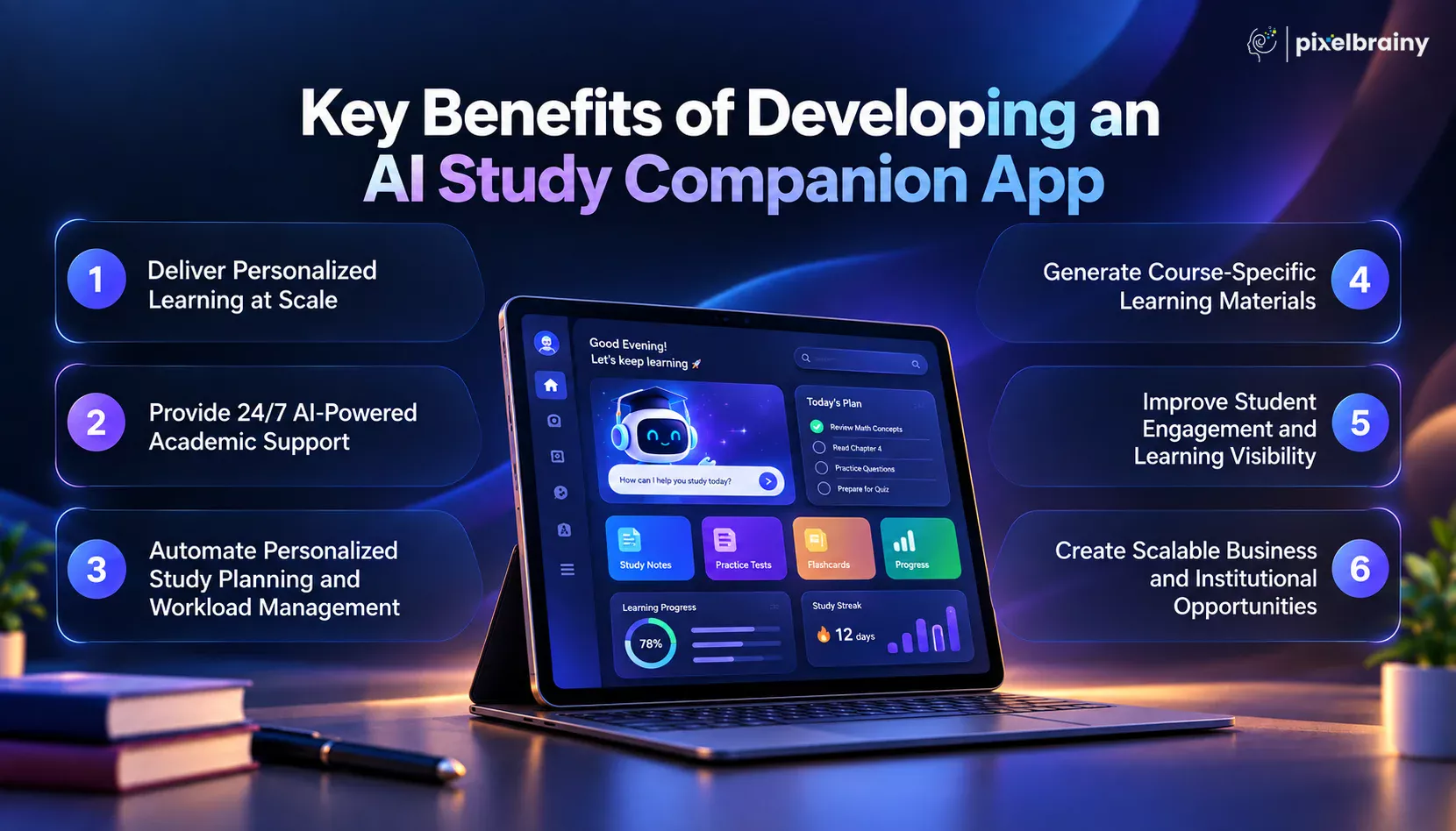
One of the biggest advantages of an AI study companion is its ability to personalize the learning experience for individual students. Traditional educational products often provide the same content, sequence, and recommendations to a large group of learners, while an AI-powered platform can use student-specific information to adjust the learning journey.
The application can consider a student's course schedule, previous performance, learning progress, available study time, difficult topics, and upcoming assessments. Based on this information, it can recommend what to study, which topics need additional practice, and how much time should be allocated to different subjects.
For example, two students preparing for the same mathematics examination may receive completely different study plans because their knowledge gaps and available preparation time are different.
This makes personalization one of the strongest reasons to build an AI study companion app for students. UNESCO's research on AI-powered learning platforms highlights the potential of AI and learning analytics to support personalized education and targeted student interventions.
Students often need academic assistance outside classroom hours. A traditional tutoring model depends on teacher or tutor availability, while an AI study companion can provide immediate support whenever the student needs it.
Students can ask questions, request explanations, review difficult concepts, generate practice questions, or receive guidance while studying. The AI can also use approved course materials through retrieval-augmented generation to provide responses grounded in relevant academic content.
For example, a university student studying late at night could ask the application to explain a difficult economics concept or create practice questions from a specific lecture. The student does not need to wait for the next class or tutoring session.
For businesses considering AI study companion app development for edtech startups, this creates a product that can extend academic support beyond scheduled teaching hours.
The important distinction is that the AI should guide learning rather than simply provide finished answers. The OECD's 2026 Digital Education Outlook notes that educational GenAI can work effectively as a tutor, partner, and assistant when guided by appropriate teaching principles.
Managing multiple courses, assignments, projects, and examinations is a major challenge for students. An AI study companion can turn this complex academic workload into an organized and continuously updated study plan.
The application can analyze:
It can then create daily and weekly study schedules.
The major advantage is adaptability. If a student misses a study session, receives a new assignment, or an examination date changes, the system can recalculate the remaining workload and update the plan.
This makes the development of an AI study companion app particularly valuable for students managing multiple courses simultaneously. Instead of simply reminding students about deadlines, the platform can help them decide how to allocate limited study time across competing academic priorities.
Another major benefit is the ability to turn existing academic content into personalized learning resources.
Students can upload:
The AI can use these materials to generate:
This reduces the time students spend manually preparing revision materials and gives edtech businesses an opportunity to create a more complete learning experience.
For example, a student can upload a 50-page lecture document and request a concise revision summary followed by practice questions and flashcards. The application can then connect those resources to the student's study plan.
This combination of AI content generation and personalized study planning is a major differentiator when businesses develop an AI study companion app rather than building a conventional digital planner.
An AI study companion can provide students with a clearer picture of their academic progress.
Instead of simply showing completed tasks, the platform can organize information such as:
For institutions, these capabilities can also provide aggregated insights into where students may require additional support.
UNESCO's analysis of AI-powered learning platforms identifies learning analytics, student behavior analysis, personalized education, and targeted interventions as important applications of AI in education.
For an edtech business, this creates opportunities to move from a basic productivity product toward a measurable learning-support platform.
However, analytics should be presented carefully. AI-generated indicators should support student and educator decisions rather than be treated as definitive judgments about a learner's ability.
The final major benefit is commercial scalability. A well-designed AI study companion does not have to depend on one customer segment.
The same core AI infrastructure can support multiple products and revenue channels, including:
A startup can initially make an AI study companion app for individual students and later expand into institutional or B2B markets.
The technology can also become a foundation for additional products such as AI tutoring, adaptive assessments, academic analytics, and personalized learning platforms.
For edtech businesses, this makes creating an AI study companion app more than a single-feature product initiative. With the right architecture, it can become a scalable education platform that connects students, academic content, educators, institutions, and learning analytics.
Overall, the strongest value comes from combining personalization, academic planning, AI tutoring, content generation, progress intelligence, and scalable delivery
An AI study companion app needs more than a chatbot, calendar, or digital notebook. The core features should connect personalized learning, AI tutoring, study planning, academic workload management, learning analytics, content generation, progress tracking, and student engagement within one platform. For businesses planning AI study companion app development, the feature set should be designed around one central objective: helping students understand what to learn, how to learn it, and what to do next.
A practical AI study companion app development query could be: “We want to build an AI study companion app for university students that imports course syllabi, creates personalized study plans, generates revision materials, answers course-related questions, tracks progress, and automatically adjusts schedules when deadlines change. What core features should we include?” The following features address that product requirement.
According to the OECD, educational GenAI can support students as a tutor, partner, and assistant when it is designed with clear pedagogical objectives. The organization also highlights personalized learning, intelligent tutoring, learning analytics, adaptive assessment, and responsible AI as important areas in digital education.
| Core Feature | Feature Explanation and Role in AI Study Companion App Development |
|---|---|
| AI-Powered Student Onboarding | An intelligent onboarding system collects courses, academic goals, study preferences, available study hours, learning objectives, and upcoming assessments to create a personalized student profile that powers future recommendations and study plans. |
| Syllabus and Document Import | Students can upload syllabi, PDFs, lecture schedules, assignments, and reading materials. AI extracts subjects, topics, deadlines, examinations, and academic requirements, converting unstructured documents into actionable academic data. |
| Personalized Study Planner | The AI analyzes deadlines, workload, course priorities, available study hours, exam proximity, and previous progress to automatically create daily and weekly study schedules tailored to each student's academic requirements. |
| Adaptive Schedule Management | The application automatically recalculates study schedules when students miss sessions, receive new assignments, complete topics early, change availability, or experience deadline changes, keeping the academic plan continuously updated. |
| AI Study Tutor | An AI tutor provides explanations, examples, hints, guided questions, and interactive learning assistance based on the student's needs. It can adjust explanations according to subject difficulty and learning context. |
| AI Question Answering | Students can ask academic questions using natural language and receive contextual explanations. With retrieval-based systems, answers can also reference approved course materials, lecture notes, textbooks, or uploaded documents. |
| Personalized Content Generation | AI converts academic materials into summaries, flashcards, quizzes, practice questions, revision notes, study guides, and topic explanations, allowing students to select learning formats according to their study objectives. |
| Course Material Integration | The platform can connect textbooks, PDFs, lecture slides, notes, LMS resources, assignments, and course-specific materials so the AI has relevant academic context when generating answers, quizzes, summaries, and recommendations. |
| AI-Powered Search | Natural-language search allows students to find information across their academic resources using conversational queries. Instead of searching individual documents manually, students can ask the application to locate relevant topics, notes, or unanswered study areas. |
| Progress and Performance Tracking | The application tracks completed study sessions, topics covered, assignment progress, quiz results, revision activity, and remaining workload. These insights help students understand their academic progress and guide future recommendations. |
| Learning Gap Detection | AI analyzes quiz responses, incorrect answers, repeated mistakes, and learning activity to identify topics requiring additional attention. The system can then recommend targeted explanations, practice questions, or additional revision sessions. |
| AI Quiz and Assessment Engine | An AI assessment engine generates quizzes and practice tests according to subject, topic, difficulty, and learning objectives. It can adapt future questions according to previous responses and demonstrated areas of weakness. |
| Smart Notifications and Reminders | Instead of sending only fixed calendar alerts, the application can provide contextual reminders based on upcoming deadlines, unfinished tasks, exam proximity, study progress, and current workload, making notifications more academically relevant. |
| AI Motivation and Study Coaching | An AI study coach can support goal setting, reflection, study consistency, progress feedback, and learning routines. The feature should encourage active learning and student thinking rather than simply completing academic tasks for them. |
| Privacy, Safety and AI Controls | The platform should include permission management, data protection, age-appropriate controls, source transparency, AI-use disclosures, moderation, and administrative settings to support trustworthy and responsible use of AI in educational environments. |
These core features create the functional foundation for AI study companion app development, connecting personalized learning, intelligent tutoring, adaptive planning, academic analytics, and responsible AI into one student-focused platform.
Once the core features of an AI study companion app are finalized, businesses can add advanced capabilities that make the product more intelligent and differentiated. Instead of adding another chatbot or quiz generator, the focus should be on features that help the app remember student learning patterns, predict academic needs, support different learning formats, adapt in real time, and provide more personalized guidance.
For example, a business planning to build an AI study companion app may ask: “How can we make our AI study app understand each student's learning behavior and provide support that becomes more personalized over time?” The following non-ordinary features can help address this requirement while creating stronger differentiation from conventional study apps. Current education research also points toward learner memory, adaptive tutoring, multimodal interaction, personalized learning, and AI-supported formative assessment as important areas for educational AI.
| Advanced Feature | How It Can Work in an AI Study Companion App |
|---|---|
| AI Learning Memory | The application can remember important learning context across sessions, including topics a student struggled with, previous questions, completed lessons, common mistakes, and preferred explanation styles. This allows the AI to revisit earlier difficulties instead of treating every conversation as a new interaction. |
| Multimodal Learning Assistant | Students can interact with the application using text, voice, images, documents, diagrams, mathematical problems, and other supported formats. For example, a student could upload a handwritten problem and ask the AI to explain the underlying concept step by step. |
| Socratic Learning Mode | Instead of immediately providing answers, the AI can guide students through a problem using questions, hints, counterexamples, and reasoning prompts. This feature encourages students to think through academic problems and can make the application function as a learning coach rather than an answer-generation tool. |
| Personal AI Learning Profile | The app can maintain a continuously updated profile containing a student's subjects, goals, learning preferences, strengths, weak areas, study habits, progress, and preferred content formats. Future recommendations can use this profile to make the experience increasingly relevant to the individual learner. |
| Predictive Workload Intelligence | AI can analyze upcoming examinations, assignments, estimated preparation requirements, previous progress, and available study time to identify potential workload conflicts before they become urgent. The application can then recommend earlier preparation or changes to the student's study schedule. |
| AI Focus Session Optimizer | With appropriate user permissions, the app can evaluate study-session patterns such as frequent interruptions, inactivity, unfinished sessions, and repeated task switching. It can then recommend shorter study blocks, planned breaks, or changes to the session structure without making unsupported assumptions about the student's mental state. |
| Dynamic Learning Path Generator | Instead of generating isolated summaries or quizzes, AI can create a connected learning pathway from foundational concepts to advanced topics. If a student struggles with a prerequisite concept, the system can redirect them to supporting material before continuing with the next topic. |
| Interactive Learning Simulations | The application can create scenario-based learning experiences in which questions, situations, and challenges change according to student responses. This can support subjects such as science, business, medicine, languages, and professional training where students benefit from practicing decisions rather than only reading information. |
| AI Exam Readiness Analysis | The system can combine revision coverage, practice-test performance, topic-level results, remaining workload, and examination proximity to create a detailed preparation profile. Instead of providing only a generic score, it can identify specific topics that may require additional revision. |
| Explainable AI Recommendations | Whenever the application recommends a study session, topic, quiz, revision activity, or schedule change, it can show the reason behind the recommendation. For example, it could explain that a topic was recommended because the student made repeated mistakes or has an upcoming assessment. Explainability can make AI recommendations easier for students to understand and evaluate. |
These advanced capabilities can help AI study companion app development move beyond standard tutoring and planning features by creating a learning experience that becomes more adaptive, contextual, and personalized as students use the platform.
The steps to develop AI study companion app from idea to launch involve more than designing an app and connecting an AI model. The product needs a clear target audience, validated use case, suitable AI architecture, quality learning content, intuitive UX, testing, and continuous improvement.
Whether you are building an AI study companion app for students as an edtech product, institutional platform, or examination preparation solution, the development process of AI study companion app should move systematically from concept validation to product launch.
For example, a founder may ask: “I am a solo edtech founder building an AI study companion app for the medical and nursing student market where exam preparation complexity is extreme due to the volume of content, the interconnectedness of biological systems knowledge, and the clinical reasoning component of USMLE and NCLEX examinations that requires students to apply knowledge rather than simply recall facts. What does a medical student-specific AI study companion app cost to build and which development companies have experience with clinical reasoning AI tutoring for healthcare professional licensing examination preparation?”
This type of requirement shows why AI study companion app development needs a domain-specific strategy rather than a generic AI chatbot.
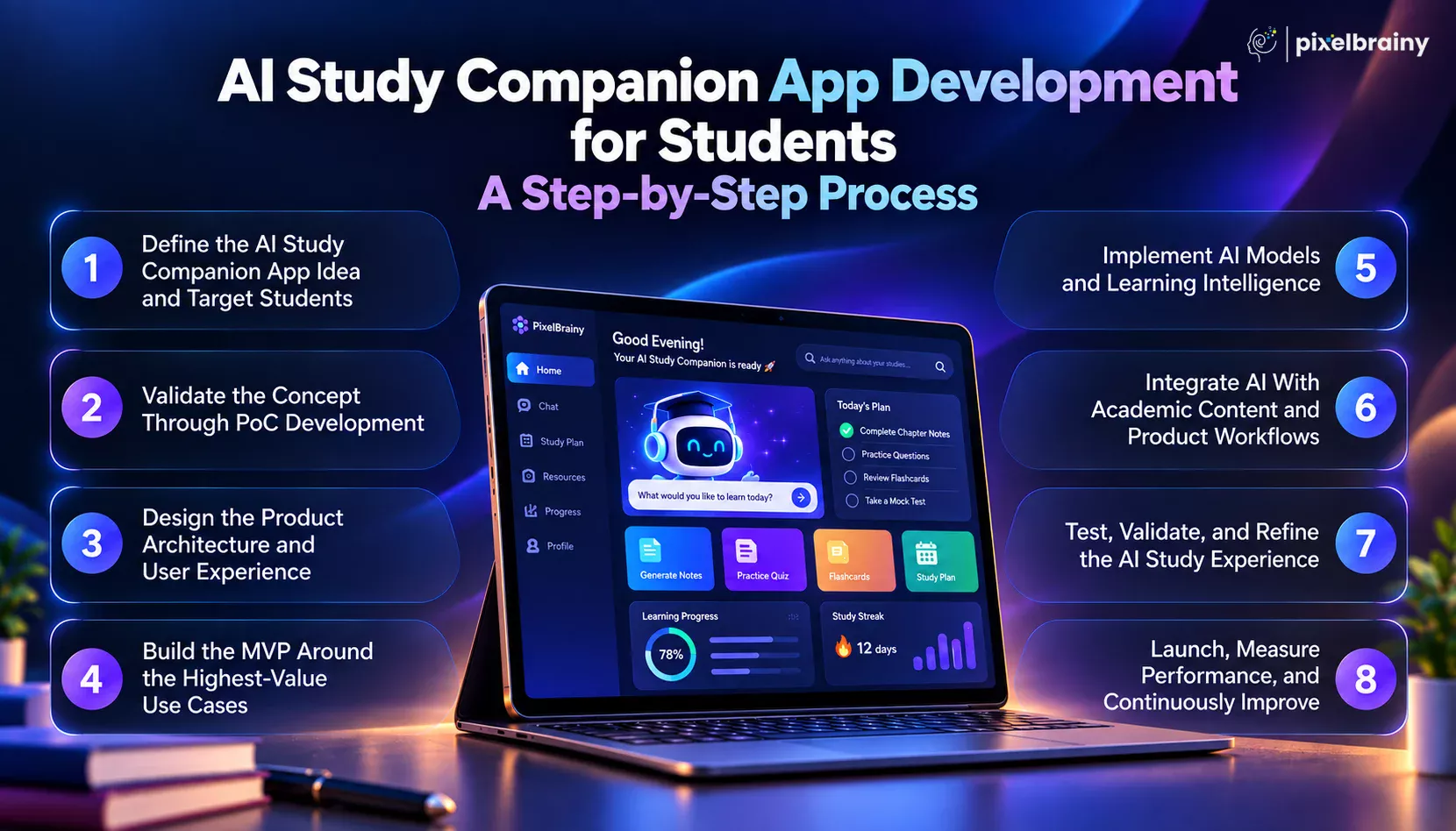
The first step is to clearly define who the application is for, what problem it solves, and what outcome it should deliver. A product for university students will have different requirements from one designed for USMLE, NCLEX, K-12 education, or professional certification.
Define the target users, subjects, academic workflows, learning objectives, competitors, and primary use cases. If you want to develop AI study companion app for edtech business, document the core student problem before selecting technologies.
For a medical education app, the requirements may include factual recall, integrated knowledge, clinical reasoning, case interpretation, practice questions, and examination strategy.
After defining the product concept, validate whether the proposed AI experience is technically and educationally achievable. PoC development can test a narrow capability such as syllabus parsing, personalized question generation, clinical case conversations, adaptive recommendations, or AI-generated explanations.
For a medical study companion, the proof of concept could test whether AI can present a patient case, ask the learner to identify relevant findings, challenge premature conclusions, and provide structured feedback.
This stage helps identify model limitations, data requirements, response-quality issues, and integration challenges before making a larger development investment.
The next stage is to convert the validated concept into a complete product architecture. Map the student journey from onboarding and academic profile creation to study planning, learning sessions, assessments, progress tracking, and recommendations.
Define the mobile and backend architecture, databases, authentication, content management, analytics, AI services, APIs, and administrative dashboards.
If the requirement is to develop AI study companion app for iOS and Android, decide whether native or cross-platform development best fits the product. Also define how academic content will move between the application, AI services, retrieval systems, and student-facing interfaces.
The next stage is MVP development, where the team builds the smallest usable version capable of delivering the core student experience.
Avoid launching every advanced feature simultaneously. An initial product could include student onboarding, course management, AI tutoring, study planning, question generation, progress tracking, and a focused academic content library.
For a USMLE or NCLEX product, the MVP could focus on adaptive case-based practice and reasoning feedback instead of attempting to cover every possible medical learning workflow.
The objective is to launch a functional learning product that can generate meaningful student feedback before expanding the feature set.
Also Read: Top 10 AI MVP Development Companies in USA
Once the product foundation is established, the next stage is AI model development and implementation of the intelligence layer.
Depending on the use case, this can involve large language models, retrieval-augmented generation, recommendation engines, document processing, speech capabilities, adaptive assessment, learner profiles, and specialized evaluation systems.
Medical education requires additional attention to source quality and response verification. USMLE Step 1 focuses on applying foundational science, while Step 2 CK evaluates the application of medical knowledge and clinical science in patient care.
AI integration should connect the intelligence layer with the actual learning experience rather than keeping AI as an isolated chatbot.
The system can retrieve relevant course content, generate questions from approved materials, update learner profiles, identify knowledge gaps, recommend revision activities, and modify study plans based on performance.
For nursing education, clinical judgment should also be reflected in the learning design. The 2026 NCLEX-RN test plan specifically includes clinical judgment, making case-based and reasoning-oriented experiences relevant for products targeting this market.
Testing an AI study application requires more than checking whether screens and buttons work correctly. AI app development companies should evaluate response accuracy, hallucinations, retrieval quality, personalization, latency, accessibility, security, and consistency across different student interactions.
Educational experts should also review generated questions, explanations, feedback, and clinical reasoning scenarios.
For healthcare examination preparation, testing should verify alignment with current examination frameworks and prevent AI-generated information from being presented as authoritative clinical advice. Research on AI-supported clinical reasoning also shows why structured evaluation and instructional design matter.
The final stage is to launch the application, monitor real student behavior, collect feedback, and continuously improve the learning experience.
Important metrics can include activation, study-session completion, question engagement, retention, subscription conversion, content usage, learning-path completion, and AI interaction quality.
AI consultation can help identify opportunities for improving the product after launch. Businesses may hire AI developers for model optimization, integrations, content improvements, performance monitoring, and scaling.
As the product matures, AI product development companies can support expansion from an MVP into a broader education platform.
Following these eight stages creates a structured path for developing an AI study companion app for students, from initial idea and validation through AI implementation, testing, launch, and continuous improvement.
The cost to develop an AI study companion app typically ranges from $40,000 to $300,000+, depending on the product scope, AI capabilities, platforms, integrations, security requirements, and level of personalization. Current 2026 industry estimates place focused AI education products around the lower and middle portions of this range, while advanced platforms with adaptive learning, complex analytics, multiple user roles, and compliance requirements can exceed $200,000.
The development budget of AI study companion app should therefore be planned according to the actual feature set rather than using a fixed price. The cost estimation of AI study companion app development changes considerably when you add features such as AI tutoring, RAG-based academic search, adaptive assessments, multilingual support, real-time collaboration, learning analytics, or institutional dashboards.
For edtech businesses asking “What is the development pricing of AI study companion app?”, a practical starting point is to separate the project into basic, advanced, and enterprise levels. This makes it easier to understand the AI study companion app development cost for edtech businesses and determine which capabilities should be included in the first release.
For example, a university-focused product with Socratic AI tutoring, syllabus processing, adaptive quizzes, essay feedback, research assistance, learning analytics, group study, parent and professor dashboards, FERPA-compliant architecture, multilingual support, and iOS and Android applications will require substantially more investment than a basic AI tutor with quizzes and flashcards.
| AI Study Companion App Type | Estimated Development Cost | Typical Scope |
|---|---|---|
| Basic AI Study Companion App | $40,000 to $80,000 | Student registration, academic profile, AI chatbot/tutor, basic study planner, syllabus upload, summaries, flashcards, quizzes, progress tracking, notifications, basic admin panel, and one or two core AI integrations. |
| Advanced AI Study Companion App | $80,000 to $180,000 | Personalized AI tutoring, RAG-based academic assistance, adaptive study planning, document processing, AI-generated assessments, learning-gap detection, analytics, multilingual support, advanced dashboards, payments, and iOS and Android applications. |
| Enterprise AI Study Companion App | $180,000 to $300,000+ | Advanced adaptive learning, multiple user roles, institutional dashboards, parent and professor portals, group learning, advanced analytics, multilingual infrastructure, extensive integrations, enterprise security, FERPA-related requirements, AI governance, scalability, and complex backend architecture. |
These ranges are planning estimates rather than fixed quotations. Current 2026 education-app benchmarks similarly place mid-range AI education products around $100,000 to $180,000 and enterprise platforms around $200,000 to $300,000+, depending on integrations, compliance, analytics, and AI complexity.
For the stated university product requirement, a $260,000 development budget falls within the enterprise-level planning range, but whether the complete specification can be delivered within that budget depends heavily on the depth of AI tutoring, compliance architecture, dashboards, integrations, multilingual support, mobile scope, and the required 20-week delivery schedule. Current industry estimates also show that enterprise education platforms with advanced AI and compliance features can reach or exceed $200,000.
In short, the right AI study companion app development budget depends on the complexity of its AI intelligence, student experience, integrations, compliance requirements, and scalability rather than simply the number of app screens.
An AI study companion app development technology stack combines mobile and web technologies, AI models, databases, cloud infrastructure, document processing, APIs, analytics, and security tools. Together, these technologies enable the application to provide AI tutoring, personalized study planning, syllabus analysis, content generation, adaptive quizzes, learning analytics, and academic progress tracking.
For example, an edtech business may ask: “What technology stack do we need to build an AI study companion app that understands syllabi and textbooks, provides personalized AI tutoring, generates quizzes and summaries, tracks student progress, and works across iOS, Android, and web?” The answer depends on the required AI capabilities, number of users, academic content, integrations, security requirements, and scalability.
For applications that need AI to answer questions using course-specific materials, a retrieval-augmented generation (RAG) architecture can connect language models with external academic content. Vector search and embeddings can help retrieve relevant information from textbooks, lecture notes, syllabi, and other approved resources before generating responses.
| Technology Layer | Recommended Tools and Technologies | Purpose in AI Study Companion App |
|---|---|---|
| Mobile App Development | Flutter, React Native, Swift, Kotlin | Builds iOS and Android applications with features such as AI tutoring, study planners, quizzes, notifications, dashboards, and progress tracking. |
| Web Application | React.js, Next.js, TypeScript | Supports web-based student portals, professor dashboards, parent dashboards, institutional interfaces, and administrative panels. |
| Backend Development | Node.js, Python, FastAPI, Django | Handles business logic, authentication, APIs, student profiles, schedules, AI workflows, notifications, subscriptions, and application services. |
| AI and LLM Layer | OpenAI, Gemini, Claude, open-source LLMs | Powers conversational tutoring, explanations, summaries, question answering, study content generation, and personalized academic assistance. |
| RAG Architecture | LangChain, LlamaIndex, cloud RAG services | Connects AI models with syllabi, textbooks, lecture notes, PDFs, and other academic resources to provide context-aware responses. (cloud.google.com) |
| Embeddings and Vector Search | pgvector, Pinecone, Weaviate, OpenSearch | Enables semantic search across academic content and retrieves relevant information for AI tutoring, document search, and content generation. |
| Primary Database | PostgreSQL, MySQL, MongoDB | Stores student profiles, courses, schedules, assessments, preferences, subscriptions, learning activity, and application data. |
| Cloud Storage | Amazon S3, Google Cloud Storage, Azure Blob Storage | Stores syllabi, textbooks, PDFs, lecture notes, images, audio, generated study resources, and other uploaded academic content. |
| Document Processing and OCR | AWS Textract, Google Document AI, Azure Document Intelligence | Extracts text and structured information from PDFs, scanned documents, images, syllabi, and other academic materials. |
| API and AI Orchestration | REST, GraphQL, LangChain, LlamaIndex | Connects the application, backend, AI models, retrieval systems, databases, and third-party services into a unified workflow. |
| Authentication and Security | OAuth 2.0, OpenID Connect, JWT, Auth0, Firebase Authentication | Manages secure login, identity verification, sessions, permissions, and role-based access for students, professors, parents, and administrators. |
| Cloud Infrastructure | AWS, Microsoft Azure, Google Cloud | Provides computing, storage, networking, databases, monitoring, backups, AI services, and scalable infrastructure for production deployment. |
| Analytics and Learning Intelligence | Mixpanel, Amplitude, Google Analytics, custom analytics | Measures study activity, engagement, quiz performance, feature usage, retention, and learning behavior to improve the product experience. |
| AI Evaluation and Monitoring | LangSmith, cloud AI evaluation tools, custom evaluation pipelines | Evaluates AI responses for accuracy, relevance, groundedness, safety, consistency, and retrieval quality before and after deployment. |
| DevOps and Deployment | Docker, Kubernetes, GitHub Actions, Terraform | Supports automated testing, continuous integration, deployment, infrastructure management, scaling, and reliable production releases. |
| Payments and Subscriptions | Stripe, RevenueCat, Apple App Store, Google Play Billing | Supports freemium plans, premium subscriptions, recurring payments, upgrades, and in-app purchases. |
| Notifications and Communication | Firebase Cloud Messaging, Apple Push Notification Service, Twilio, SendGrid | Delivers study reminders, assignment alerts, examination notifications, emails, and other student communication. |
| AI Safety and Guardrails | Moderation APIs, validation layers, prompt controls, content filters, human review | Helps reduce unsafe outputs, unsupported academic claims, prompt injection risks, inappropriate content, and other generative AI issues. |
| Testing Frameworks | Jest, PyTest, Cypress, Playwright, Appium | Tests backend services, APIs, AI workflows, web applications, mobile applications, and critical student journeys before production release. |
For a basic AI study companion app, managed AI APIs, PostgreSQL, cloud storage, and a cross-platform mobile framework may be sufficient. A larger institutional platform may require advanced RAG infrastructure, vector databases, analytics pipelines, role-based access, AI evaluation systems, and stronger security controls.
The technology architecture should therefore support the application's current MVP while leaving room for AI personalization, additional learning models, institutional integrations, higher user volumes, and future AI features.
The right technology foundation allows an AI study companion app to deliver personalized learning, reliable AI assistance, scalable performance, and secure management of academic data.
The right AI study companion app business model depends on who pays, what students use most, and how much AI infrastructure the product consumes. A consumer study app may earn through subscriptions, while a university-focused platform may generate revenue through institutional licensing. Some products can also combine free access with paid AI capabilities.
A common edtech query is: “How can we monetize an AI study companion app for university students while keeping basic study tools affordable and generating recurring revenue from premium AI features?” A practical answer is to build the monetization strategy around six major models.
Best suited for: Consumer-focused student apps
Start with a free version that gives students enough value to experience the product. Keep advanced AI capabilities behind a premium plan.
Free access could include:
Premium access could unlock:
This approach can help an AI study companion app attract students before asking them to pay.
Best suited for: Products with frequent student usage
A subscription model charges students regularly for continued access to premium capabilities. This works well when students use the application throughout a semester, academic year, or examination preparation cycle.
For example:
Basic Plan → Core AI tutoring and study planning
Pro Plan → Advanced personalization and unlimited content generation
Exam Plan → Specialized preparation, mock tests, and adaptive revision
Subscription revenue is already a major monetization component of digital education platforms.
The key is to ensure every paid tier provides a clear increase in learning value rather than simply increasing the number of available features.
Best suited for: Universities, colleges, schools, and education networks
Instead of charging every student individually, the AI study companion app business model can sell access directly to educational institutions.
A university could purchase 5,000, 20,000, or institution-wide student licenses.
The institutional package could include:
This creates a B2B revenue channel while allowing students to access the platform through their institution.
Best suited for: AI-intensive applications
Not every student consumes the same amount of AI resources. One student may ask 20 questions a month, while another may upload hundreds of pages and conduct long tutoring sessions.
A usage-based model can therefore charge according to AI consumption.
For example:
Free: 20 AI interactions/month
Student Pro: 500 AI interactions/month
Premium: Higher document and tutoring limits
Additional Credits: Pay when the monthly allowance is exceeded
This model can help an AI study companion app development business better connect revenue with variable AI infrastructure costs.
Best suited for: Edtech companies, publishers, tutoring providers, and education networks
Here, the business sells the platform to an organization that then provides it to students.
For example:
AI Study Companion Platform → Coaching Company → Students
A test-preparation company could bundle an AI study companion with its existing courses. A publisher could provide AI tutoring alongside digital textbooks. A university could include the application within its student technology services.
The organization becomes the paying customer while students remain the primary users.
Best suited for: Education brands that want their own AI learning platform
A white-label model allows an education company to use the underlying AI study companion technology under its own brand.
For example, a medical education company could launch:
“AI Study Companion powered by [Brand]”
The platform could be customized with the company's:
Revenue can come through setup fees, annual licensing, per-student pricing, or a combination of these approaches.
Rather than relying on a single monetization method, many AI study companion app development projects can combine models. For example, a consumer app can use freemium + subscription, while an institutional product can combine university licensing + usage-based AI pricing.
The strongest monetization strategy is one that connects the AI study companion's pricing with student value, frequency of use, AI consumption, and the purchasing structure of its target education market.
Building an AI study companion app involves more than integrating an LLM with a student dashboard. The application has to provide useful academic guidance while dealing with inaccurate AI responses, student data, academic integrity, personalization, content quality, and changing educational requirements.
For businesses planning AI study companion app development, the important question is not only “What features should we build?” but also “How can we make the AI reliable, safe, personalized, and genuinely useful for learning?” A real edtech query could be: “We want to develop an AI study companion app for university students, but how can we prevent hallucinations, protect student data, reduce AI dependency, maintain academic integrity, and still deliver personalized tutoring at scale?”
The following six challenges represent some of the most important areas to address during the development of AI study companion app.
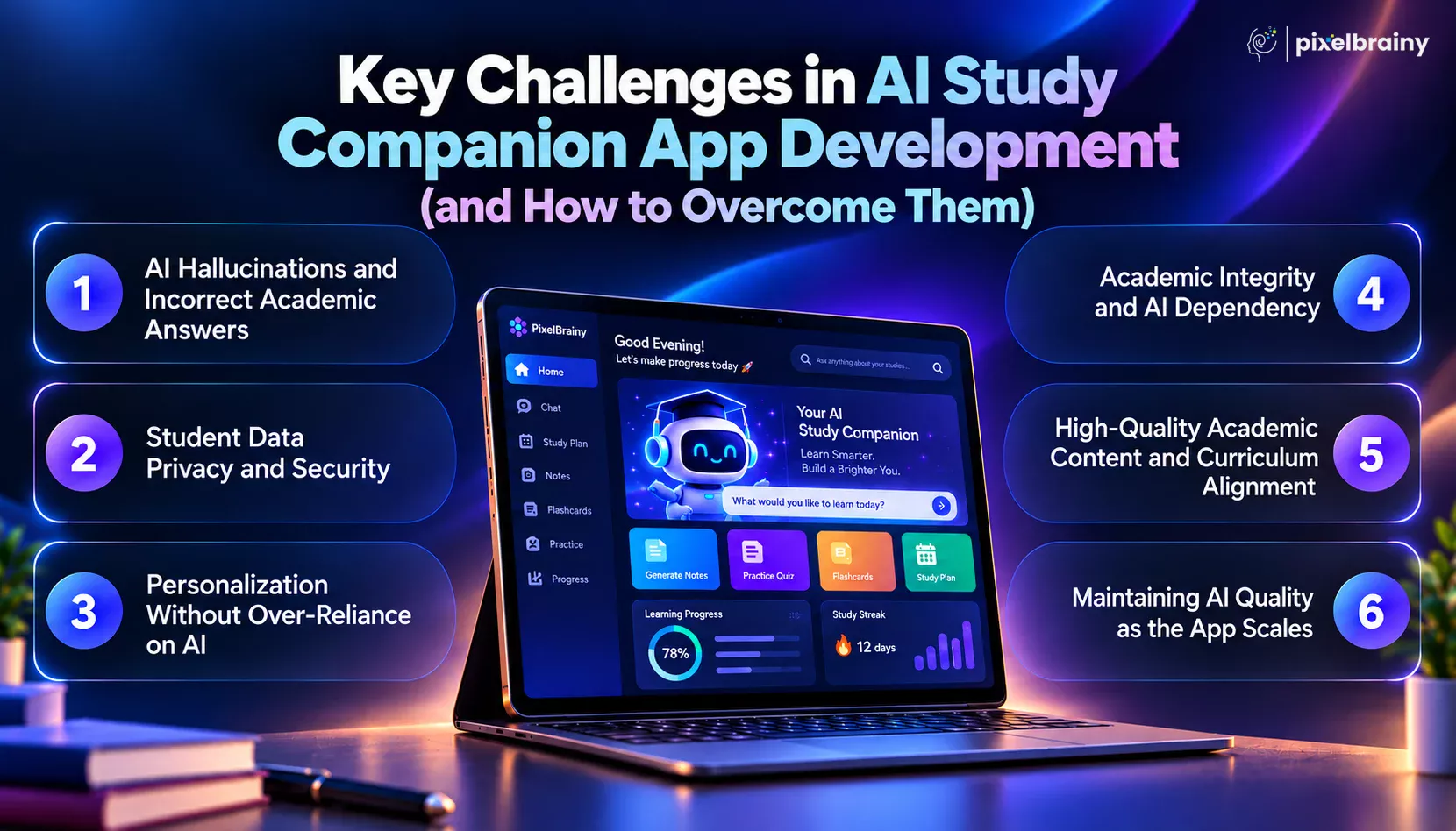
An AI study companion may generate answers that sound convincing but contain incorrect facts, unsupported explanations, or fabricated references. This is particularly important when students use the application for science, medicine, law, mathematics, or examination preparation.
How to overcome it:
Build the AI around trusted academic sources instead of relying entirely on general model knowledge. RAG, source citations, retrieval validation, structured prompts, response evaluation, and human-reviewed content can improve reliability.
The application can also show students where an answer came from and encourage verification for important academic information. OECD research identifies hallucinations and reliability as continuing technical limitations of generative AI.
An AI study companion app can collect highly sensitive information, including student profiles, academic performance, uploaded textbooks, conversations, assignments, learning behavior, and assessment history. Poor data practices can create significant privacy and security risks.
How to overcome it:
Privacy should be incorporated into the architecture from the beginning. Use encryption, secure authentication, role-based permissions, controlled data access, audit logs, secure cloud storage, data-retention policies, and appropriate consent mechanisms.
For products serving schools and universities, the technical architecture should also be reviewed against the privacy requirements applicable to the target market. UNESCO emphasizes data privacy, safety, transparency, equity, and human-centered governance for AI in education.
Personalization is one of the biggest reasons businesses invest in AI personalized study companion app development. However, simply giving every student a different AI response does not create meaningful personalized learning.
The bigger challenge is understanding what the student already knows, where they struggle, what they need to learn next, and when they need additional support.
How to overcome it:
Create a structured learner profile using assessment results, learning history, study preferences, course progress, and demonstrated knowledge gaps. Use this information to adapt explanations, questions, study schedules, and learning pathways.
At the same time, the application should encourage students to think and solve problems rather than complete every cognitive task for them. OECD's 2026 research warns that unrestricted outsourcing of tasks to GenAI can improve task performance without necessarily producing learning gains.
Students may use an AI study companion to generate essays, solve assignments, complete homework, or produce answers without understanding the underlying concepts. This creates a difficult balance between providing useful academic assistance and supporting genuine learning.
How to overcome it:
Design the AI around learning assistance rather than answer replacement. Socratic questioning, hints, step-by-step reasoning, guided practice, citation support, reflection prompts, and explanation-first workflows can encourage active participation.
Academic integrity safeguards can also include AI-use disclosures, assignment-specific restrictions, source attribution, teacher controls, and configurable institutional policies. Educational AI should be designed around clear pedagogical objectives rather than simply maximizing task completion.
A generic AI model may understand broad subjects but still fail to follow a particular university curriculum, examination framework, textbook, grading structure, or institutional teaching methodology.
This becomes even more important when developing an AI study companion app for students preparing for standardized or professional examinations.
How to overcome it:
Create a controlled academic knowledge layer using verified textbooks, institutional resources, curriculum documents, approved question banks, course materials, and examination specifications. RAG can help retrieve relevant information, while content review and evaluation pipelines can check generated explanations and questions.
The system should also make it possible for authorized educators or administrators to update academic content when curricula and examination requirements change.
An AI study companion that works well for 500 students may behave differently when usage grows to thousands or millions of interactions. More users can increase AI costs, response times, infrastructure requirements, monitoring complexity, and the number of unusual interactions that need to be handled.
How to overcome it:
Build scalability into the architecture from the beginning. Use cloud infrastructure, caching, asynchronous processing, model routing, usage limits, monitoring, automated testing, AI evaluation pipelines, and scalable databases.
Track metrics such as AI response quality, latency, token consumption, retrieval accuracy, user retention, study completion, and failed interactions. This allows the development team to identify technical and learning-related problems before they become widespread.
Overcoming these six challenges can help businesses build an AI study companion app that is not only feature-rich, but also reliable, secure, academically responsible, personalized, and scalable.
From the above features, development process, technology stack, cost, and business models, it is now time to identify the right development partner for your product. For an edtech business, the partner needs to understand both AI engineering and the learning experience, because an AI study companion is not simply another mobile application with a chatbot added to it.
This is where PixelBrainy as a leading AI app development company brings a product-focused approach to AI-powered education solutions. Its published capabilities cover AI app development, generative AI, AI consulting, model integration, PoC development, mobile applications, and ongoing optimization.
PixelBrainy's education-focused work includes adaptive learning, automated assessment, behavior analytics, conversational learning, and AI-powered teaching assistants. This provides a foundation for businesses looking to build AI study companion app products around actual student workflows rather than generic conversational AI.
The development approach can cover the complete journey from product strategy and UX to AI integration, backend engineering, mobile development, deployment, and post-launch optimization. This is particularly relevant when an edtech business wants to develop AI study companion app with multiple AI capabilities working together.
An effective study companion needs to understand the learner journey. PixelBrainy's published approach combines product thinking, UX, AI systems, and scalable engineering to create AI products designed for real-world adoption.
This can be important for complex requirements such as:
A typical requirement could be: “We want to create study companion app for university students that combines syllabus-based AI tutoring, personalized study planning, adaptive quizzes, document summarization, progress analytics, and professor dashboards. Can one technology partner handle the AI, mobile application, backend, and product experience?”
PixelBrainy's published capabilities span these broader product-development areas, including AI applications, education platforms, mobile development, AI integration, and scalable digital products.
In one confidential EdTech project, PixelBrainy worked with a mid-sized education platform that wanted to reduce repetitive student-support queries while improving engagement in self-paced STEM courses.
The team developed an AI teaching assistant with course-aware Q&A, NLP capabilities, LMS integration, real-time feedback, progress nudges, and peer-forum summaries. According to PixelBrainy's published case study, the solution achieved an 80% reduction in student support tickets, a 19% increase in course completion, and doubled live-class participation, with an MVP deployed in 10 weeks.
This experience demonstrates how AI can be connected to existing educational workflows instead of operating as an isolated chatbot.
For businesses seeking AI study companion app development services, PixelBrainy offers an end-to-end product approach covering strategy, design, AI engineering, mobile development, integrations, deployment, and optimization. Its published portfolio also includes education platforms and AI-powered digital products.
Ready to turn your AI study companion idea into a scalable EdTech product? Connect with PixelBrainy to discuss your requirements and development roadmap.
An AI study companion app can bring together personalized study planning, AI tutoring, adaptive assessments, academic content generation, progress tracking, and learning analytics to support students throughout their academic journey. For EdTech businesses, this creates an opportunity to develop a focused learning platform that addresses real academic challenges while creating a scalable digital product.
As covered in this guide, successful AI study companion app development requires a clear product vision, well-defined student use cases, the right core and advanced features, a reliable AI and technology stack, a realistic development budget, and a sustainable business model. Equally important are AI accuracy, student data privacy, academic integrity, personalization, and continuous product improvement.
The strongest approach is to start with a validated use case and focused MVP, measure how students interact with it, and gradually expand the platform based on real learning needs and product insights.
Ready to turn your AI study companion idea into a scalable EdTech product? Book an appointment with PixelBrainy and discuss your project with our AI product team.
The cost to develop an AI study companion app generally ranges from $40,000 to $300,000+, depending on the application's features, AI complexity, platforms, integrations, security requirements, and personalization level. A basic product with AI tutoring and quizzes may require a smaller budget, while enterprise platforms with adaptive learning, RAG, analytics, multilingual support, institutional dashboards, and advanced AI capabilities require a larger AI study companion app development cost.
The steps to develop an AI study companion app from idea to launch generally include defining the target students and use case, validating the concept, creating the product architecture, developing the MVP, implementing AI capabilities, integrating academic content, testing AI performance, and launching the application. Post-launch analytics and continuous AI optimization are also important for long-term product growth.
To build an AI study companion app from scratch, an EdTech company should first identify a specific academic problem and target audience. The next stages include defining core features, designing the learner experience, developing the AI architecture, integrating academic content, building mobile and backend systems, testing the AI, and launching an MVP. The product can then expand based on student feedback and usage data.
Businesses looking to develop an AI study companion app for university students can include AI tutoring, syllabus analysis, personalized study planning, document summarization, adaptive quizzes, flashcards, academic search, progress tracking, learning-gap detection, smart notifications, and AI-generated study materials. Advanced applications can additionally support professor dashboards, group learning, research assistance, multilingual interaction, learner memory, and adaptive learning pathways.
Yes, businesses can develop an AI study companion app specifically for USMLE and NCLEX preparation. Such a platform can combine clinical case simulations, adaptive questions, medical content retrieval, clinical reasoning practice, personalized revision plans, performance analytics, and exam-focused learning pathways. Because these are professional healthcare examinations, the application should also include expert-reviewed content, controlled knowledge sources, AI evaluation, and alignment with current examination requirements.
The AI study companion app development technology stack can include Flutter or React Native for mobile development, React or Next.js for web applications, Python or Node.js for backend services, LLM APIs for conversational AI, RAG and vector databases for academic content retrieval, PostgreSQL for structured data, and AWS, Azure, or Google Cloud for infrastructure. Additional tools can support analytics, AI evaluation, security, payments, and notifications.
The time required to build AI study companion app products depends on the scope. A focused MVP may take approximately 10 to 20 weeks, while advanced platforms can require several months. AI tutoring, adaptive learning, document processing, multilingual capabilities, institutional dashboards, LMS integrations, iOS and Android applications, and security requirements can all increase the development timeline.
To create an AI study companion app with meaningful personalization, the platform should maintain a learner profile containing academic goals, courses, study history, assessment results, learning preferences, completed topics, and knowledge gaps. AI can use this information to personalize study plans, explanations, quizzes, revision recommendations, and learning pathways. This creates an experience that adapts to individual students rather than delivering identical learning content to everyone.

About The Author
Sagar Bhatnagar
Sagar Sahay Bhatnagar brings over a decade of IT industry experience to his role as Marketing Head at PixelBrainy. He's known for his knack in devising creative marketing strategies that boost brand visibility and market influence. Sagar's strategic thinking, coupled with his innovative vision and focus on results, sets him apart. His track record of successful campaigns proves his ability to utilize digital platforms effectively for impactful marketing efforts. With a genuine passion for both technology and marketing, Sagar continuously pushes PixelBrainy's marketing initiatives to greater success.

Working with the PixelBrainy team has been a highly positive experience. They understand the design requirements and create beautiful UX elements to meet the application needs. The dev team did an excellent job bringing my vision to life. We discussed usability and flow. Sagar worked with his team to design the database and begin coding. Working with Sagar was easy. He has the knowledge to create robust apps, including multi-language support, Google and Apple ID login options, Ad-enabled integrations, Stripe payment processing, and a Web Admin site for maintaining support data. I'm extremely satisfied with the services provided, the quality of the final product, and the professionalism of the entire process. I highly recommend them for Android and iOS Mobile Application Design and Development.

Great experience working with them. Had a lot of feedback and I found that unlike most contractors they were bugging me for updates instead of the other way around. They were extremely time conscience and great at communicating! All work was done extremely high quality and if not on time, early! They were always proactive when it comes to communication and the work is great/above par always. Very flexible and a great team to work with! Goes above and beyond to present us with multiple options and always provides quality. Amazing work per usual with Chitra. If you have UI/UX or branding design needs I recommend you go to them! Will likely work with them in the future as well, definitely recommended!

PixelBrainy is a joy to work with and is a great partner when thinking through branding, logo, and website layout. I appreciate that they spend time going into the "why" behind their decisions to help inform me and others about industry best practices and their expertise.

I hired them to design our software apps. Things I really like about them are excellent communication skills, they answer all project suggestions and collaborate right away, and their input on design and colors is amazing. This project was complex and needed patience and creativity. The team is amazing to do business with. I will be using them long-term. Glad to see there are some good people out there. I was afraid to try and outsource my project to someone but I am glad I met them! I really can't say enough. They went above and beyond on this project. I am very happy with everything they have done to make my business stand out from the competition.

It was great working with PixelBrainy and the team. They were very responsive and really owned the project. We'll definitely work with them again!

I recently worked with the PixelBrainy team on a project and I was blown away by their communication skills. They were prompt, clear, and articulate in all of our interactions. They listened and provided valuable feedback and suggestions to help make the project a success. They also kept me updated throughout the entire process, which made the experience stress-free and enjoyable.

PixelBrainy is very good at what it does. The team also presents themselves very professionally and takes care of their side of things very well. I could fully trust them taking up the design work in a timely and organised manner and their attention to detail saved us lots of effort and time. This particular project was quite intense and the team showed that they function very well under pressure. Very much looking forward to working with her again!

It's always an absolute pleasure working with them. They completed all of my requests quickly and followed every note I had for them to a T, which made our process go smoothly from start to finish. Everything was completed fast and following all of the guidelines. And I would recommend their services to anyone. If you need any design work done in the future, PixelBrainy should be your first call!

They took ownership of our requirements and designed and proposed multiple beautiful variants. The team is self-motivated, requires minimum supervision, committed to see-through designs with quality and delivering them on time. We would definitely love to work with PixelBrainy again when we have any requirements.

PixelBrainy was a big help with our SaaS application. We've been hard at work with a new UI/UX and they provided a lot of help with the designs. If you're looking for assistance with your website, software, or mobile application designs, PixelBrainy and the team is a great recommendation.

PixelBrainy designers are amazing. They are responsive, talented, and always willing to help craft the design until it matches your vision. I would recommend them and plan to continue them for my future projects and more!!!

They were awesome! Did a good job fast, and good communication. Will work with them again. Thank you

Creative, detail-oriented, and talented designers who take direction well and implement changes quickly and accurately. They consistently over-delivered for us.

PixelBrainy team is very talented and creative. Great designers and a pleasure to work with. PixelBrainy is an excellent communicator and I look forward to working with them again.

PixelBrainy has a very talented design team. Their work is excellent and they are very responsive. I enjoy working with them and hope to continue on all of our future projects.


Transform your ideas into reality with us.
Across these industries, each engagement brings unique challenges, from early-stage product development to scaling complex systems, helping us build a practical understanding of real-world product environments.