AI Summary Powered by PixelBrainy
DeepSeek has become an important reference point in the conversational AI market, particularly for businesses exploring reasoning-focused AI models, open-source LLMs, and lower-cost inference. Since the launch of DeepSeek-R1, its approach to advanced reasoning and open model development has attracted significant attention from AI developers and startups. DeepSeek-R1 was released under the MIT License, with its model weights and technical report made available for broader use, including model distillation and customization.
The adoption of the DeepSeek app also demonstrates the scale of interest in this category. As of October 2026, the official Google Play listing shows 50M+ downloads, while AppCurves recorded approximately 98.96 million lifetime Google Play downloads on October 2026. The latter is a third-party tracking estimate based on public Play Store data, rather than an official combined download figure across all platforms.
For an AI startup founder asking, “How can I build a conversational AI chatbot app like DeepSeek that delivers strong reasoning for complex problem solving without the massive inference cost of GPT and Claude?”, the opportunity goes beyond replicating DeepSeek's interface. A production-grade platform may require an open-source LLM, domain-specific fine-tuning, retrieval-augmented generation, inference optimization, scalable infrastructure, conversational memory, API integrations, security, and continuous model evaluation.
DeepSeek's open-model approach has made this development path more accessible for companies that want greater control over model behavior, deployment, and operating costs. Its reasoning models and open weights also provide a useful foundation for exploring domain-specific AI applications.
So, how much does it cost to build a Conversational AI chatbot app like DeepSeek, and which AI development companies can help deploy a fine-tuned open-source LLM for a specific industry? This guide covers the development process, features, technology stack, cost factors, integrations, monetization strategies, challenges, and business considerations involved in building a DeepSeek-like conversational AI application.

A conversational AI chatbot like DeepSeek is a smart software tool that chats with us and makes us feel like we are having a conversation with the being. Utilizing the power of Artificial Intelligence (AI) and Natural Language Processing (NLP), this tool understands what the user is saying and reverts naturally in a human-like way. This way, it makes the interaction more engaging and personal with the users.
The major factor that put the DeepSeek-style chatbot at the forefront of innovation was its efficiency. It's different from other AI systems as it holds the caliber to deliver exceptional results while utilizing only fewer resources, which makes it more affordable.
| Deepseek Fact #2: Currently the most affordable AI Conversational Chatbot - DeepSeek's AI model harnessed the power of around 2,000 Nvidia H800 chips and is trained on 14.8 trillion tokens, which reveals substantial computational capability. Still, the platform is performing well compared to OpenAI's models. |
If built leveraging robust models, like DeepSeek-V3 and DeepSeek-R1 for improved functionality, a conversational AI chatbot, like DeepSeek, manages complex jobs, like providing suggestions, answering queries, and even assisting with reasoning, all while being easy to operate.
Businesses seeking to improve their customer support, automate jobs, and provide a better user experience can create an app like DeepSeek that is easy to integrate into existing systems, such as websites or customer service tools.
Besides being cost-effective, the DeepSeek-like chatbot is adaptable and can work across diverse industries to back businesses and let them stay competitive.
Simply put, a conversational AI chatbot like DeepSeek is affordable, intelligent, and makes machine conversations feel like talking to a real person.
Of course, DeepSeek and ChatGPT are advanced conversational AI platforms, but what sets them apart are various key differences. Let’s discuss the major ones.
DeepSeek is widespread for its specialized models, namely DeepSeek-R1 (focused on reasoning tasks) and DeepSeek-V3 (general-purpose), that provide exceptional performance at much less cost. The company reaps the rewards of an effective Mixture-of-Experts (MoE) architecture that allows its smart models to activate only a tiny subset of their parameters at a particular time. This results in reduced computational needs which makes DeepSeek more resource-efficient and affordable than ChatGPT.
| DeepSeek is a wake-up call for the US tech industry, said Donald Trump, the U.S. President |
On the contrary, ChatGPT is a more generalized conversational model that sets the industry standard by offering human-like responses across varied domains. Besides offering wide-ranging capabilities and remarkable versatility, it usually demands increased resources and higher computing power for complex tasks. Additionally, ChatGPT is not as cost-effective as DeepSeek, specifically because of API integrations. Thus, businesses are acknowledging DeepSeek as a better option for top-quality AI solutions at low prices. Below, we have created a comparison table that will highlight the key differences between the two conversational AI Chatbots, DeepSeek and ChatGPT.
| Feature | DeepSeek | ChatGPT |
| Founding Year | 2023 | 2022 |
| Primary Models | DeepSeek-V3 (General), DeepSeek-R1 (Reasoning) | ChatGPT-4, ChatGPT-3.5 |
| Performance | Optimized for lower resources, high standards | Adaptable but resource-intensive |
| Pricing | Aggressively low, cost-effective | Higher cost, premium pricing |
| Focus | Cost-effective, reasoning, industry-specific | General-purpose, versatile conversational AI |
| Computational Efficiency | Highly efficient (MoE architecture) | Needs more computing power for complicated tasks |
| Target Audience | Startups, businesses, cost-conscious clients | General users, businesses and developers |
| Learning Approach | Trial and error-based self-improvement | Pre-trained with large datasets |
| Special Features | Reasoning tasks-focused, efficient learning process | Wide-ranging general-purpose conversations |
| Platform Availability | Website, Android and iOS apps | Web-based, no dedicated apps, API integrations |
By scanning this table, you might have got a good overview of the differences between these two chatbots.
| Tip*: ChatGPT or DeepSeek, well, it's a never-ending debate. So developers and businesses can make decisions based on their specific requirements and resource constraints. |
A Conversational AI chatbot app like DeepSeek works by combining a large language model (LLM), natural language processing, context management, reasoning capabilities, knowledge retrieval, and scalable inference infrastructure. Unlike a rule-based chatbot, it can interpret complex prompts, process contextual information, generate responses, and maintain continuity across conversations.
For an AI startup looking to build a Conversational AI chatbot app like DeepSeek, the typical workflow can be summarized as:
User Prompt → Context & Intent Processing → LLM Inference → Reasoning → Knowledge Retrieval/Tool Use → Response Validation → Final Response
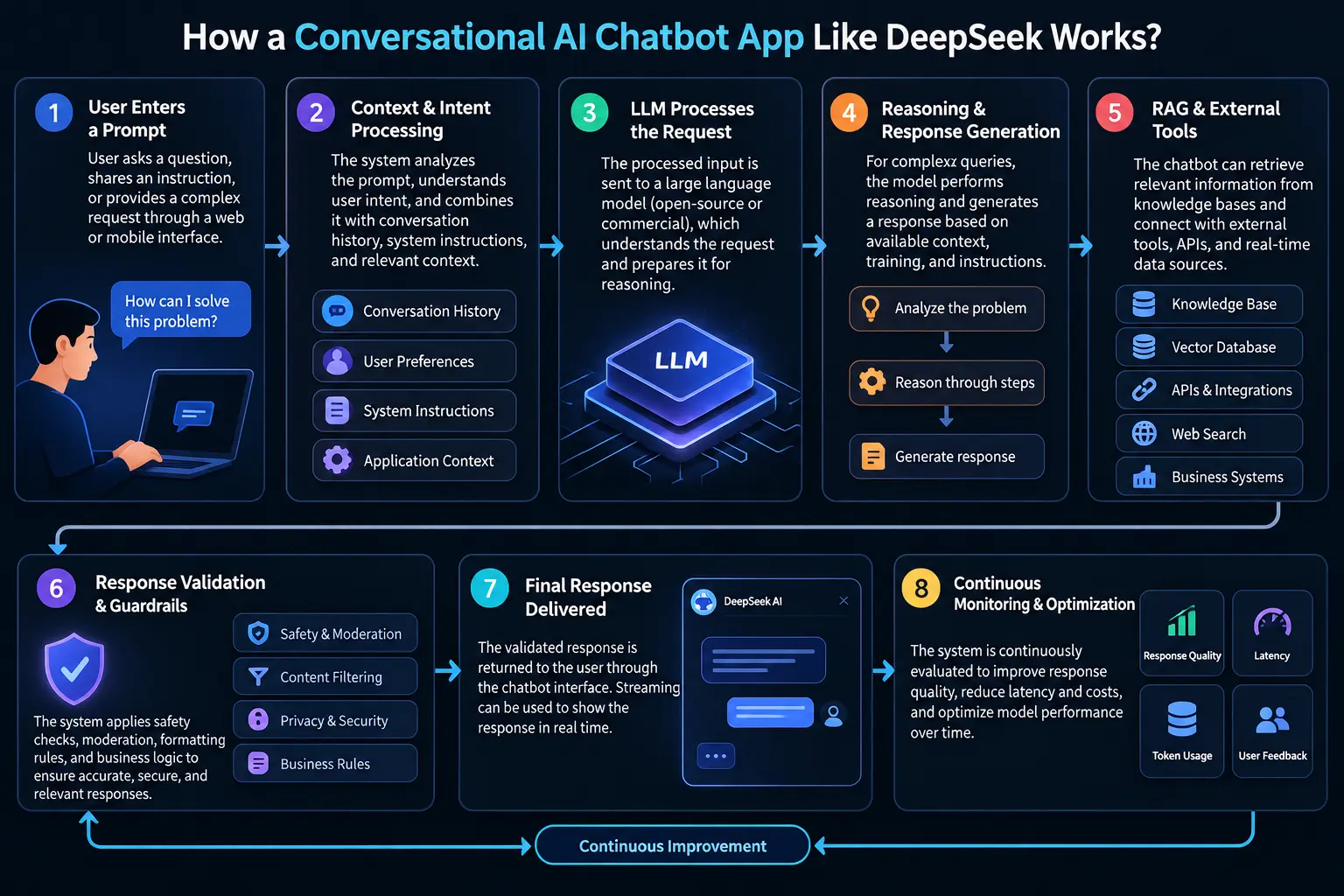
The workflow starts when a user submits a question, instruction, or complex problem through a web or mobile interface. The application sends the request to the backend through an API, where authentication, input validation, and request handling can take place.
The backend prepares the prompt for the AI model by combining the user's current request with relevant conversation history, system instructions, user preferences, and application-specific context. Effective context management allows the chatbot to maintain continuity across multiple interactions.
The processed input is sent to the underlying large language model. A DeepSeek-like application can use an open-source reasoning model, a commercially available LLM, or a customized model depending on the project's requirements.
For domain-specific applications, developers can combine the base model with fine-tuning, instruction tuning, or Retrieval-Augmented Generation (RAG) to improve its ability to work with specialized information.
For complex problem-solving tasks, reasoning-oriented models can use additional computation to work through a request before producing the final answer. The model evaluates the available context and generates a response based on its learned capabilities, instructions, and accessible knowledge.
Importantly, the application does not need to expose the model's private internal reasoning process to users. A production chatbot can provide the resulting answer while applying appropriate safety and response controls.
A production-grade conversational AI chatbot app may need information that is not contained in the model's training data. RAG can retrieve relevant information from company documents, knowledge bases, or vector databases and provide that context to the LLM.
The chatbot can also connect with APIs, databases, search systems, CRM platforms, and other business tools to perform actions or retrieve real-time information.
Before delivering an answer, the application can apply AI guardrails, moderation, security checks, formatting rules, and business logic. These controls help reduce inappropriate responses, protect sensitive information, and keep outputs aligned with the application's intended use.
After processing and validation, the generated response is returned through the chatbot interface. Streaming can also be implemented so users can see the response as it is generated rather than waiting for the complete output.
Building a DeepSeek-like chatbot does not end at deployment. Teams need to monitor response quality, latency, token consumption, inference costs, user feedback, model accuracy, and infrastructure performance.
These insights can guide model optimization, prompt improvements, RAG updates, fine-tuning, and infrastructure changes.
A production-grade AI chatbot like DeepSeek can therefore be viewed as several connected layers:
| Layer | Primary Role |
| Chat Interface | Collects prompts and displays AI responses |
| Application Backend | Handles authentication, sessions, APIs, and business logic |
| LLM Layer | Understands prompts and generates responses |
| Reasoning Layer | Handles complex problem-solving tasks |
| RAG & Knowledge Layer | Provides domain-specific and external information |
| Tool/API Layer | Connects the chatbot with external systems and services |
| Guardrail Layer | Applies safety, privacy, and response controls |
| Inference Infrastructure | Runs models efficiently and manages scalability |
| Monitoring & Evaluation | Tracks quality, latency, usage, and cost |
This architecture is particularly relevant for startups planning to develop a Conversational AI chatbot app like DeepSeek for a specific industry. Instead of simply copying the DeepSeek interface, businesses can combine an appropriate open-source LLM with domain-specific data, RAG, fine-tuning, reasoning capabilities, integrations, and optimized inference infrastructure to create a conversational AI product aligned with their users and business requirements.
Why should an AI startup build a Conversational AI chatbot app like DeepSeek instead of simply integrating an existing commercial LLM? The opportunity lies in creating a specialized AI product with greater control over the model, domain knowledge, inference infrastructure, customization, and operating costs.
For an AI startup founder asking, “How can I build a conversational AI chatbot app like DeepSeek that delivers strong reasoning for complex problem solving without the massive inference cost of GPT and Claude?”, an open-source approach can be particularly relevant. Instead of developing a general-purpose chatbot, the startup can select a suitable open model, adapt it with domain-specific data, add RAG and tool use, and optimize inference around a specific vertical.
DeepSeek-R1 provides a notable reference point for this approach. DeepSeek released R1 under the MIT License, making its model weights and outputs available for commercial use, distillation, and further development. DeepSeek also released smaller distilled models, including 32B and 70B variants, giving developers options beyond deploying the full-scale reasoning model.
This model strategy is important because reasoning quality and infrastructure efficiency involve trade-offs. Research on DeepSeek-R1 has found that reasoning models can achieve strong performance on complex tasks, while also highlighting that additional reasoning can increase token generation and computational requirements.
Below are the key reasons businesses should consider AI conversational app development like DeepSeek.
A DeepSeek-like conversational AI chatbot can provide automated assistance around the clock. Businesses can connect it with their knowledge base, documentation, product information, and support systems to answer common questions without requiring an agent for every interaction.
For global businesses, continuous availability can improve response times while allowing human teams to focus on complex or high-value customer requests.
A major reason to develop an AI chatbot like DeepSeek is to automate repetitive interactions such as answering FAQs, summarizing information, retrieving documents, classifying requests, and supporting routine workflows.
Using an open-source model can also give startups greater control over deployment and customization. However, the total cost still depends on inference infrastructure, model size, optimization, monitoring, engineering, and usage volume.
A domain-specific conversational AI chatbot can combine conversation history, user preferences, business rules, and retrieved knowledge to generate more relevant responses.
For startups building a vertical AI product, fine-tuning can adapt model behavior to specialized tasks, while RAG can provide access to frequently changing business information without requiring the model to be retrained whenever the knowledge base changes.
A production-grade Conversational AI chatbot app like DeepSeek can be deployed on scalable inference infrastructure to serve multiple users concurrently.
Developers can use techniques such as quantization, batching, caching, optimized inference engines, and model selection to manage latency and infrastructure requirements. This allows startups to balance response quality with inference costs as the user base grows.
AI chatbot interactions can provide valuable insights into customer questions, recurring problems, product requirements, and user preferences when collected and analyzed responsibly.
Businesses can use these insights to improve their knowledge bases, refine conversational flows, identify automation opportunities, and determine where additional fine-tuning or model optimization could improve the user experience.
A DeepSeek-style AI chatbot becomes considerably more useful when connected to existing business systems. APIs and tool calling can allow the chatbot to interact with CRM platforms, enterprise databases, knowledge repositories, customer support systems, analytics tools, and internal applications.
For a startup developing a vertical conversational AI product, these integrations can turn the chatbot from a simple question-answering interface into an AI-powered workflow assistant that retrieves information and performs approved actions.
These advantages make Conversational AI chatbot app development like DeepSeek relevant for startups and enterprises that want to build specialized AI products with greater control over their technology stack. The goal should not simply be to copy DeepSeek's interface. A stronger approach is to combine open-source LLMs, domain-specific data, reasoning capabilities, RAG, fine-tuning, optimized inference, integrations, and scalable infrastructure around a clearly defined business use case.
The next step is to identify the key features of a Conversational AI chatbot like DeepSeek and determine which capabilities are essential for a production-ready application.

What features are essential when you want to build a Conversational AI chatbot app like DeepSeek for complex problem-solving, customer support, or a domain-specific AI product? A production-ready chatbot needs more than natural-language responses. It should combine NLP, contextual memory, reasoning capabilities, personalization, multilingual communication, business integrations, security, analytics, and automated workflows to deliver consistent user experiences at scale.
For an AI startup asking, “What features should our DeepSeek-like conversational AI chatbot include if we want to fine-tune an open-source LLM on domain-specific data and deliver reliable AI assistance for our vertical?”, the feature set should be aligned with the application's users, data requirements, business workflows, and deployment model.
The following features can help businesses develop an AI chatbot like DeepSeek that supports intelligent conversations, automation, personalization, scalability, and integration with existing systems.
| Feature | Description |
| Natural Language Processing (NLP) | Allows chatbots to easily understand and interpret human language, permitting natural, conversational exchanges with users. |
| Machine Learning & AI Training | Let the chatbot improve its responses over time by learning from data and improving the accuracy of interactions with every conversation. |
| Context Awareness & Memory | Chatbots can simply remember previous conversations and user preferences, providing personalized, context-aware responses during future interactions. |
| Multilingual Support | The chatbot can smoothly communicate in multiple languages, allowing global reach and delivering seamless support to users across various regions. |
| Voice & Text-based Interaction | Supports both voice and text interactions, offering users flexibility in how they interact with the chatbot, whether by typing or speaking. |
| Sentiment Analysis & Emotion Recognition | Recognizes and interprets users' emotions and sentiments to reply empathetically and suitably, enhancing user experience. |
| Omnichannel Support (Web, Mobile, Messaging Apps) | Ensures that the chatbot can deliver consistent support across numerous platforms like mobile apps, websites, and messaging platforms such as WhatsApp or Facebook Messenger. |
| Customizable AI Responses | Allow tailoring responses based on the brand's voice, tone, and customer requirements, delivering a personalized experience. |
| Integration with CRM, ERP, and Business Tools | Effortlessly integrates with business tools like CRM and ERP systems, simplifying workflows and data management for a more cohesive operation. |
| Speech-to-Text & Text-to-Speech Conversion | Converts voice input into text and vice versa, permitting efficient communication in both spoken and written forms. |
| Automated Workflow Execution | Automates routine tasks and workflows, diminishing the need for human intervention and improving operational efficiency. |
| AI-Powered Recommendations & Personalization | Utilizes the power of AI to deliver personalized product recommendations and tailored content based on user preferences and behavior. |
| Self-Learning & Continuous Improvement | Chatbots learn from every interaction and continually improve their precision, ensuring they deliver better service over time. |
| Secure Data Encryption & Privacy Compliance | Ensures all user data is encrypted and compliant with relevant privacy laws like GDPR, protecting sensitive information. |
| API & SDK Support for Custom Development | Offers APIs and SDKs for developers to create custom features or integrate the chatbot with other software and systems. |
| Live Agent Handoff for Hybrid Support | Permits seamless transitions from the AI chatbot to a human agent when required, providing a hybrid support model that combines automation and human assistance. |
| User Intent Recognition & Adaptive Responses | Identifies user intent accurately and adapts responses, consequently delivering more effective and appropriate interactions. |
| Real-time Analytics & Performance Monitoring | Delivers businesses with insights into chatbot performance, enabling them to identify areas for improvement and measure the effectiveness of interactions. |
| Chatbot Training with Industry-Specific Datasets | Trains the chatbot with datasets tailored to distinct industries, allowing it to handle specialized queries with a more in-depth understanding of the industry’s requirements. |
| Proactive Notifications & Automated Follow-ups | Sends proactive notifications and automated follow-ups to users, keeping them engaged and notified about critical updates or actions. |
A strong conversational AI chatbot like DeepSeek should bring these capabilities together as part of a connected AI architecture rather than treating them as isolated features. During AI conversational app development like DeepSeek, businesses should prioritize the features that directly support their use case, including contextual conversations, industry-specific knowledge, workflow automation, secure integrations, analytics, and human handoff.
For startups developing a domain-specific chatbot, fine-tuned AI models, RAG, API integrations, and continuous evaluation can further improve how the system works with specialized business information and workflows. Working with an experienced AI chatbot app development company can also help translate these requirements into a scalable production architecture.
With the core features defined, the next step is understanding how to develop a conversational AI chatbot app like DeepSeek through a structured development process.
For an enterprise software company asking, “How can we build a proprietary conversational AI chatbot like DeepSeek that clients can deploy on their own infrastructure because sensitive business data cannot be sent to OpenAI or Anthropic APIs?”, the development process needs to address more than conversational capabilities.
Self-hosted deployment, data privacy, model control, enterprise security, inference performance, and integrations should be considered from the beginning.
The development process of an AI conversational AI chatbot app like DeepSeek should move from business requirements and architecture planning to model selection, training, interface development, integrations, testing, deployment, and continuous optimization.

The first step in building an AI conversational AI chatbot app like DeepSeek is to define what the platform needs to accomplish and who will use it.
Requirements may include private document analysis, internal knowledge assistance, reasoning-based problem solving, customer support, or workflow automation.
For an enterprise solution, also define deployment expectations such as on-premise, private cloud, or controlled infrastructure, along with security, compliance, latency, and scalability requirements.
AI consultation can help establish these technical and business requirements before development begins.
Also Read: Top 10 AI Consulting Companies in USA
Model selection directly affects reasoning quality, deployment requirements, latency, and operating costs.
When you create an AI conversational AI chatbot app like DeepSeek, evaluate open-source LLMs based on reasoning performance, model size, licensing, context length, hardware requirements, and domain suitability.
The selected framework and inference infrastructure should also support self-hosted deployment and enterprise workloads.
AI model development may involve selecting a foundation model and adapting it to the organization's specialized requirements.
Also Read: Top 12+ AI Model Development Companies in the USA
Next, determine whether the platform should be developed from scratch, adapted from open-source components, or built using a combination of both approaches.
For enterprises requiring self-hosted conversational AI, the architecture should support private infrastructure, controlled model access, internal authentication, and secure data processing.
A PoC can validate the selected model, infrastructure, and primary use cases before larger investment.
PoC development is useful for comparing reasoning quality, inference performance, security requirements, and deployment feasibility.
Training and customization determine how effectively the chatbot handles industry-specific requirements.
During developing an AI conversational AI chatbot like DeepSeek, prepare high-quality domain datasets and establish appropriate data-processing and evaluation practices.
Depending on the use case, businesses can use RAG, instruction tuning, fine-tuning, or a combination of these approaches.
Evaluation should measure accuracy, reasoning performance, hallucinations, safety, and domain relevance while keeping sensitive enterprise information within the approved infrastructure.
The interface should make sophisticated AI capabilities easy for users to access and understand.
During conversational AI chatbot app development like DeepSeek, design interfaces for web, desktop, mobile, or internal enterprise environments according to deployment requirements.
Important capabilities may include conversation history, document uploads, citations, response streaming, feedback mechanisms, and role-based access.
A specialized UI/UX design company can help create an interface that supports complex workflows while maintaining a clear and responsive user experience.
Also Read: Top 10 AI Consulting Companies in USA
Once the core application is established, integrate the features and systems required for business use.
AI integration can connect the chatbot with enterprise databases, document repositories, CRM platforms, ERP systems, identity providers, internal APIs, and knowledge bases.
For self-hosted deployments, integrations should follow strict authentication, authorization, encryption, and network-security requirements.
Features such as RAG, tool calling, multilingual support, conversation memory, workflow automation, and human handoff can be added according to business requirements.
Before production deployment, evaluate the chatbot across AI quality, security, functionality, and performance.
Test complex prompts, domain-specific questions, adversarial inputs, long conversations, concurrent users, and failure scenarios.
Measure response accuracy, reasoning quality, latency, resource consumption, hallucination rates, and inference performance.
MVP development provides a controlled environment for validating these metrics with real users before expanding the platform.
Also Read: Top 10 AI MVP Development Companies in USA
The final stage is to deploy the chatbot into the target infrastructure and establish continuous monitoring.
For enterprises requiring private AI, deployment may involve on-premise servers, private cloud environments, or other controlled infrastructure instead of external API endpoints.
Organizations can hire AI developers to manage deployment, model serving, infrastructure optimization, security updates, and ongoing performance improvements.
Monitoring should track response quality, latency, resource utilization, inference costs, system availability, and user feedback so the platform can continue improving after launch.
These steps provide a practical framework for how to build an AI conversational AI chatbot app like DeepSeek from scratch, particularly when privacy and self-hosted deployment are core requirements.
From business planning and model selection to integrations, testing, and production deployment, every stage should support the final security and infrastructure objectives.
For organizations evaluating AI app development companies, AI chatbot development companies, or top AI product development companies, experience with open-source LLMs, private deployments, enterprise security, and scalable inference should be key considerations when selecting a development partner.

The cost of building an AI-powered chatbot like DeepSeek differs significantly depending on the AI model selection, development complexity, and the required features.
Partner with a reliable app development company to get the exact cost of developing an AI app like DeepSeek.
On average, a basic AI chatbot may cost approx. $40,000, while a feature-packed, advanced AI-driven chatbot holding the power of deep learning capabilities may exceed $3,00,000.
| Deepseek Fact #5: Sustainable AI Conversational Chatbot Ever - DeepSeek was built at a much lower cost compared to ChatGPT. According to DeepSeek researchers, DeepSeek's V3 model opted for Nvidia H800 chips for training, which cost less than $6 million than what ChatGPT used, leading to reduced AI's environmental impact. |
Below, we will discuss the key factors impacting the overall development cost so that it can avoid unexpected budget rises during the development later on.
It will be cost-effective to use a pre-trained model like GPT-4 or DeepSeek-V3. But, if you decide to train a custom LLM from scratch, it will demand extensive computational data and power.
Estimated Cost: $10,000 - $150,000+
Creating a conversational AI app from scratch increases costs but offers complete customization. Utilize APIs (OpenAI, DeepSeek API) to reduce the cost, but you may have to pay an amount.
Estimated Cost: $20,000 - $100,000
High-quality datasets help with chatbot accuracy. Industry-specific training data may increase expenses with supervised learning costs.
Estimated Cost: $15,000 - $80,000
Advanced features, such as multilingual support, sentimental analysis, AI personalization, and speech-to-text, demand sophisticated development efforts that impact the cost.
Estimated Cost: $25,000 - $120,000
Hosting on cloud platforms like AWS, Azure, or Google Cloud impacts the cost with increased storage, scalability, and computing, especially for high-traffic AI applications.
Estimated Cost: $10,000 - $50,000 (annual)
Interactive, flawless UI for mobile, web, and messaging apps needs investment in development, design, and usability testing that increases the cost.
Estimated Cost: $8,000 - $30,000
Chatbot integration with CRMs, databases, and business tools adds integration costs based on API usage and licensing.
Estimated Cost: $5,000 - $40,000
Ensuring GDPR compliance, data encryption, and secure transactions demands investment in cybersecurity measures.
Estimated Cost: $10,000 - $50,000
AI models need consistent testing for accuracy, performance, and scalability, increasing overall costs.
Estimated Cost: $5,000 - $20,000
Regular updates, feature enhancements, and AI fine-tuning are important for long-term performance.
Estimated Cost: $15,000 - $60,000 (annual)
The cost of developing an AI chatbot like DeepSeek ranges between $40,000 to $300,000+, depending on the AI model, features, data training, and integrations.
While you plan for custom AI conversational app creation, ensure you carefully plan your budget and prioritize key features while considering long-term scalability and maintenance for optimal chatbot performance.
How can an enterprise integrate DeepSeek into existing business workflows while keeping sensitive data secure and maintaining control over how AI processes internal information? For a business asking, “How can we integrate a DeepSeek-like conversational AI into our CRM, ERP, customer support, and internal systems without sending confidential business data to external AI APIs?”, the integration strategy needs to address both AI functionality and enterprise infrastructure.
AI conversational app development like DeepSeek can connect conversational intelligence with existing business applications to automate repetitive processes, retrieve relevant information, and support employees or customers. Depending on the architecture, businesses can use APIs, SDKs, RAG pipelines, internal services, or self-hosted model deployments.
A structured AI integration approach helps businesses determine where the chatbot fits, how it should access business data, and which workflows should remain under human control.
Here are the key steps to integrate DeepSeek into existing business workflows.

First, define how an AI chatbot like DeepSeek can benefit your organization. Decide whether it will manage customer queries, internal support, workflow automation, or lead generation. You should identify the right use cases to ensure your AI chatbot delivers maximum value and efficiency to your business.
DeepSeek arrives with various integration options, including SDKs, APIs, and custom-built solutions; businesses can go for an approach that best fits their technical capabilities, data security, and scalability needs. Additionally, you should know that API-based integration is swifter compared to custom implementation, which, on the contrary, allows greater flexibility. So, choose meticulously per your business requirements.
Flawlessly integrate DeepSeek with enterprise resource planning (ERP) systems, customer relationship management (CRM) software, ticketing platforms, and communication tools. This helps users with real-time data exchange, personalized interactions, and automated responses.
Next, customize DeepSeek’s chatbot so that it can go perfectly with your brand's voice and business operations. For that, train it by utilizing industry-specific datasets and refining its responses depending on past customer interactions to catch up with high precision and relevance.
Before full deployment, evaluate DeepSeek’s performance by performing extensive testing. Analyze its response latency, accuracy, and overall user experience. Ahead, optimize intent recognition, conversation flows, and sentiment analysis to fine-tune AI integrations.
Once you integrate DeepSeek into your existing business workflows, deploy it across the mobile apps, web, messaging platforms, and other support channels. Leverage analytics tools to track engagement metrics, check performance, and accumulate user feedback. Consistently improve the AI chatbot by streamlining responses, upgrading NLP capabilities, and expanding knowledge bases.
A well-planned DeepSeek integration can connect conversational AI with CRM, ERP, customer support, internal knowledge bases, and other business systems while reducing manual work. For enterprises with strict privacy requirements, self-hosted deployment can provide greater control over sensitive data and model infrastructure.
The key is to treat integration as part of the overall AI conversational app development like DeepSeek strategy rather than simply connecting a chatbot to existing software. With the right architecture, testing, access controls, and continuous monitoring, businesses can use conversational AI to support workflows while maintaining security, reliability, and operational control.
How can an AI startup monetize a conversational AI app like DeepSeek while keeping the business model scalable as users, inference workloads, and enterprise requirements grow? For a startup founder asking, “Which monetization model should we use for a DeepSeek-like conversational AI app that offers advanced reasoning to users while also providing domain-specific AI capabilities for businesses?”, the answer depends on the target audience, usage patterns, AI infrastructure costs, and value delivered through premium capabilities.
A conversational AI chatbot app like DeepSeek can generate revenue through recurring subscriptions, API usage, enterprise deployments, custom AI solutions, and premium functionality. A vertical AI product can also create additional revenue by packaging specialized models, private deployment, domain-specific knowledge, workflow automation, or higher usage limits into paid plans.
The following monetization models can help businesses develop an AI chatbot like DeepSeek with multiple revenue streams while matching pricing with actual user and enterprise value.

Usually, AI chatbots follow a Software-as-a-Service (SaaS) model; their users are required to pay monthly or yearly fees as a subscription amount for using premium features like priority support, improved AI capabilities, and higher query limits. You can also choose to provide tiered pricing plans to your AI chatbot users, catering to distinct segments, from individuals to large enterprises.
Businesses integrating DeepSeek’s AI through SDKs or APIs pay depending on the usage. API licensing fees are well-structured as monthly quotas, pay-per-request, or enterprise contracts, which make it a scalable revenue stream. Brands enjoying the benefits of DeepSeek’s AI for virtual assistants, chatbots, or automation tools significantly increase their revenue.
An AI chatbot, like DeepSeek, can provide tailored chatbot training, custom AI models, and dedicated AI solutions for enterprises that need personalized conversational AI systems. Such large-scale contracts produce high revenue, especially for industries, like healthcare, customer support, and finance.
AI chatbots can integrate ads, sponsored responses, or third-party integrations where companies pay for promotional placement within the response of the chatbot. For instance, recommendation-based AI advertising can suggest appropriate products or services based on user queries, producing ad revenue.
Numerous AI platforms follow a freemium model where basic chatbot features and functionalities are available for free. However, advanced ones, like API access, better AI models, or faster response times, demand a paid upgrade. This approach drives more users while converting a percentage into paying customers.
As privacy is a major concern, AI brands can provide anonymized data insights to companies for customer behavior insights, market analysis, and trend predictions. They can subscribe to AI-powered analytics services that assist them optimize marketing strategies and customer interactions.
A successful AI conversational app development like DeepSeek business model should balance customer value with the ongoing costs of model inference, infrastructure, support, security, and AI improvement. Subscription and freemium plans can support user acquisition, while API licensing and enterprise solutions can create higher-value revenue opportunities.
For a domain-specific conversational AI platform, combining recurring subscriptions, usage-based pricing, enterprise contracts, and custom AI services can provide greater flexibility than relying on a single revenue source. The right model should ultimately reflect the application's target market, AI capabilities, deployment requirements, and long-term operating costs.
Building an AI conversational app like DeepSeek involves more than integrating an advanced language model. Businesses need to address model accuracy, training and inference costs, system integrations, ethical AI, security, and compliance before taking the platform to production.
For an enterprise asking, “What are the main challenges in developing a DeepSeek-like conversational AI chatbot that can deliver reliable reasoning while keeping sensitive business data secure and infrastructure costs under control?”, the development strategy needs to address both AI performance and production requirements. Fine-tuning open-source LLMs, optimizing inference, using reliable data pipelines, implementing strong security controls, and continuously evaluating model responses can help create a more dependable platform.
The following challenges highlight the key technical and operational considerations businesses should address when developing an AI chatbot like DeepSeek.
Challenge: Your AI chatbot should accurately interpret user queries embracing complicated sentences, ambiguous phrases, and slang. Poor NLU may result in two incorrect or irrelevant responses, leaving users unsatisfied.
Solution: Choose large-scale datasets and transfer learning from pre-trained models Constantly fine-tune and train the model utilizing real-world interactions and feedback loops to enhance contextual understanding and precision.
Challenge: Training and maintaining an AI model like DeepSeek needs high storage, computational power, and processing resources that can be expensive.
Solution: You can choose to implement Mixture-of-Experts (MoE) architecture to effortlessly optimize resource usage, mitigating computational costs. Maximize cloud-based AI infrastructure and distributed training to manage large-scale datasets effectively while keeping the costs manageable.
Challenge: AI models may create biases depending on the data sets they are trained on, which leads to discriminatory or unethical responses. This can damage credibility.
Solution: Frequently audit training data sets to diminish biased content. Implement human-in-the-loop moderation and impose ethical AI principles by aligning the model with fairness guidelines and responsible AI frameworks.
Challenge: AI chatbots need to integrate with various CRMs, ERPs, customer support tools, and communication platforms, which can lead to compatibility issues. You need to integrate AI chatbots with various ERPs, CRMs, communication platforms, and customer support tools. But this can result in two various compatibility issues.
Solution: Go for standardized APIs, middleware, and SDKs to confirm smooth integration across platforms. You can also adopt microservices architecture to accomplish flexible cross-platform adaptability and scalability.
Challenge: AI applications manage sensitive user data which makes security vulnerabilities a chief concern. Compliance with applicable regulations such as HIPAA, GDPR, or CCPA may lead to legal issues.
Solution: Here you can implement end-to-end encryption, multifactor authentication (MFA), and role-based access controls (RBAC). Update security protocols regularly and confirm compliance with global data protection laws.
It is important to address these challenges when developing an AI conversational chatbot like DeepSeek for business use. Strong model evaluation, efficient AI infrastructure, domain-specific fine-tuning, reliable integrations, responsible AI practices, and robust security measures can help businesses build a scalable and production-ready conversational AI platform.
For enterprises handling confidential information, these considerations are especially important when developing a self-hosted or private conversational AI solution. A capable AI chatbot development company can help plan the model architecture, data strategy, security controls, integrations, and deployment approach needed to move from an AI prototype to a reliable production platform.
Building a powerful AI conversational app like DeepSeek demands expertise in the latest technologies like AI machine learning and large language model (LLM) development. PixelBrainy outshines the competition as a trusted AI development company, providing end-to-end, low-cost AI chatbot development solutions for businesses planning to build a high-performing scalable AI chatbot with rich features.
PixelBrainy has a skilled team of data scientists, AI specialists, and NLP engineers with proficiency in generative AI, deep learning frameworks, and LLMs. Our developers work with DeepSeek, OpenAI, and custom-built AI models to build chatbots for your business that meet industry-leading, applicable performance standards.
Unlike off-the-shelf AI solutions, our experts provide tailored AI chatbot models that are well-optimized for industry-specific requirements. Whether you need advanced contextual memory, multilingual support, or our sentiment analysis, PixelBrainy develops conversational AI chatbot apps that align with your business objectives.
An AI chatbot like DeepSeek development can be costly, but PixelBrainy provides cost-effective AI model development services by utilizing serverless, cloud-based, and edge computing solutions.
PixelBrainy is your trusted AI development partner for creating a futuristic conversational chatbot like DeepSeek. With our scalable architectures, enterprise-grade security, cost-effective solutions, and expert AI engineers, we help worldwide businesses build efficient, intelligent, and highly engaging AI chatbots. Are you ready to build your AI chatbot? Collaborate with us to innovate together!

Why build an AI app like DeepSeek? How AI conversational app development like DeepSeek can help your business maximize its profit.
| DeepSeek Fact#6: Trillion-Dollar Market Quake - The latest AI model of DeepSeek has shaken up the global tech world leading to huge selloff that holds the caliber to wipe out around $1 trillion in market value. This made investors react fast and raise concerns relevant to the impact of this success in the industry. |
The increasing demand for AI conversational app development like DeepSeek has revolutionized how businesses interact with customers, streamline workflows, and improve user experiences.
Before you start your custom conversational AI app development journey to build an AI app like DeepSeek, you should know that some security experts have emerged with data privacy concerns when using DeepSeek, as it is a Chinese company. Time to take advantage of this point and build one that your country's people can trust.
If you are looking to develop an AI chatbot that is scalable, intelligent, and cost-effective, now is the best time to act.
At PixelBrainy, we are the leaders in AI-driven chatbot development, helping businesses globally like yours create high-performance AI applications that boost engagement and efficiency. Whether you need a seamless API integration service, custom AI model, or advanced NLP capabilities, we are ready to give life to your AI app idea.
Let’s build your AI-powered success story together!
Contact PixelBrainy today for a free consultation, and start your venture to transform your business with conversational AI.
The right open-source LLM depends on the chatbot’s reasoning requirements, domain complexity, deployment environment, and inference budget. For a DeepSeek-like conversational AI chatbot, businesses can evaluate reasoning-focused models and fine-tune them with domain-specific datasets to improve performance for their target use cases.
To develop an AI conversational chatbot like DeepSeek for a specific industry, define the target workflows, prepare domain-specific data, fine-tune or adapt an open-source LLM, and connect it with RAG, business systems, and required APIs. Continuous evaluation is also important to ensure the chatbot produces reliable domain-specific responses.
Yes. Businesses can build a self-hosted conversational AI chatbot like DeepSeek using an open-source model and deploy it within private cloud, on-premise, or controlled enterprise infrastructure. This approach can help organizations maintain greater control over sensitive data, model access, infrastructure, and internal AI workflows.
The cost to develop an AI chatbot like DeepSeek varies based on model selection, fine-tuning requirements, infrastructure, UI/UX, integrations, security, testing, and post-launch optimization. A domain-specific enterprise solution with private deployment and advanced reasoning capabilities will generally require a larger development budget than a basic conversational chatbot.
To reduce inference costs in AI conversational app development like DeepSeek, businesses can optimize model size, use efficient inference frameworks, apply quantization or model distillation where appropriate, and design routing strategies that match workloads to suitable models. Infrastructure optimization and monitoring token usage can further improve cost efficiency.
Fine-tuning an open-source LLM for a DeepSeek-like AI chatbot requires relevant and high-quality domain data, a suitable base model, training infrastructure, evaluation datasets, and a defined performance benchmark. Businesses should also combine fine-tuning with techniques such as RAG when frequently changing or proprietary knowledge needs to remain outside the model weights.
For AI integration in a DeepSeek-like conversational chatbot, enterprises can connect CRM, ERP, customer support, knowledge bases, and internal applications through APIs, SDKs, middleware, or custom services. Access controls and permission-aware workflows should ensure the chatbot only retrieves or performs actions that each user is authorized to access.
Businesses looking to build a conversational AI app like DeepSeek should evaluate AI development companies based on their experience with open-source LLMs, AI model development, RAG, fine-tuning, private deployment, enterprise integrations, security, and production-scale AI infrastructure. The right AI chatbot development company should be able to support the complete journey from architecture and PoC to deployment and ongoing model optimization.

About The Author
Sagar Bhatnagar
Sagar Sahay Bhatnagar brings over a decade of IT industry experience to his role as Marketing Head at PixelBrainy. He's known for his knack in devising creative marketing strategies that boost brand visibility and market influence. Sagar's strategic thinking, coupled with his innovative vision and focus on results, sets him apart. His track record of successful campaigns proves his ability to utilize digital platforms effectively for impactful marketing efforts. With a genuine passion for both technology and marketing, Sagar continuously pushes PixelBrainy's marketing initiatives to greater success.

Working with PixelBrainy has been a great experience. They took our vision for an AI-powered platform and turned it into a fully functional product. What impressed me most was their strong understanding of both design and development, and their ability to handle complex requirements with ease. The team was responsive, cooperative, and always open to feedback. They kept things organized, communicated clearly, and delivered quality work on time. I highly recommend PixelBrainy to anyone looking for a skilled and reliable development partner.

Working with the PixelBrainy team has been a highly positive experience. They understand the design requirements and create beautiful UX elements to meet the application needs. The dev team did an excellent job bringing my vision to life. We discussed usability and flow. Sagar worked with his team to design the database and begin coding. Working with Sagar was easy. He has the knowledge to create robust apps, including multi-language support, Google and Apple ID login options, Ad-enabled integrations, Stripe payment processing, and a Web Admin site for maintaining support data. I'm extremely satisfied with the services provided, the quality of the final product, and the professionalism of the entire process. I highly recommend them for Android and iOS Mobile Application Design and Development.

Great experience working with them. Had a lot of feedback and I found that unlike most contractors they were bugging me for updates instead of the other way around. They were extremely time conscience and great at communicating! All work was done extremely high quality and if not on time, early! They were always proactive when it comes to communication and the work is great/above par always. Very flexible and a great team to work with! Goes above and beyond to present us with multiple options and always provides quality. Amazing work per usual with Chitra. If you have UI/UX or branding design needs I recommend you go to them! Will likely work with them in the future as well, definitely recommended!

PixelBrainy is a joy to work with and is a great partner when thinking through branding, logo, and website layout. I appreciate that they spend time going into the "why" behind their decisions to help inform me and others about industry best practices and their expertise.

I hired them to design our software apps. Things I really like about them are excellent communication skills, they answer all project suggestions and collaborate right away, and their input on design and colors is amazing. This project was complex and needed patience and creativity. The team is amazing to do business with. I will be using them long-term. Glad to see there are some good people out there. I was afraid to try and outsource my project to someone but I am glad I met them! I really can't say enough. They went above and beyond on this project. I am very happy with everything they have done to make my business stand out from the competition.

It was great working with PixelBrainy and the team. They were very responsive and really owned the project. We'll definitely work with them again!

I recently worked with the PixelBrainy team on a project and I was blown away by their communication skills. They were prompt, clear, and articulate in all of our interactions. They listened and provided valuable feedback and suggestions to help make the project a success. They also kept me updated throughout the entire process, which made the experience stress-free and enjoyable.

PixelBrainy is very good at what it does. The team also presents themselves very professionally and takes care of their side of things very well. I could fully trust them taking up the design work in a timely and organised manner and their attention to detail saved us lots of effort and time. This particular project was quite intense and the team showed that they function very well under pressure. Very much looking forward to working with her again!

It's always an absolute pleasure working with them. They completed all of my requests quickly and followed every note I had for them to a T, which made our process go smoothly from start to finish. Everything was completed fast and following all of the guidelines. And I would recommend their services to anyone. If you need any design work done in the future, PixelBrainy should be your first call!

They took ownership of our requirements and designed and proposed multiple beautiful variants. The team is self-motivated, requires minimum supervision, committed to see-through designs with quality and delivering them on time. We would definitely love to work with PixelBrainy again when we have any requirements.

PixelBrainy was a big help with our SaaS application. We've been hard at work with a new UI/UX and they provided a lot of help with the designs. If you're looking for assistance with your website, software, or mobile application designs, PixelBrainy and the team is a great recommendation.

PixelBrainy designers are amazing. They are responsive, talented, and always willing to help craft the design until it matches your vision. I would recommend them and plan to continue them for my future projects and more!!!

They were awesome! Did a good job fast, and good communication. Will work with them again. Thank you

Creative, detail-oriented, and talented designers who take direction well and implement changes quickly and accurately. They consistently over-delivered for us.

PixelBrainy team is very talented and creative. Great designers and a pleasure to work with. PixelBrainy is an excellent communicator and I look forward to working with them again.

PixelBrainy has a very talented design team. Their work is excellent and they are very responsive. I enjoy working with them and hope to continue on all of our future projects.


Transform your ideas into reality with us.
Across these industries, each engagement brings unique challenges, from early-stage product development to scaling complex systems, helping us build a practical understanding of real-world product environments.