AI Summary Powered by PixelBrainy
What does it really cost to build an AI face rating app like Umax in 2026, and is it worth the investment for startups and entrepreneurs?
After the success of Umax, founders across the AI industry are asking the same question before launching their own product. The short answer is that the cost to build an AI face rating app typically ranges from $25,000 to $200,000+, depending on the app's complexity, AI capabilities, design quality, and infrastructure. Most startups begin with a Minimum Viable Product that costs between $25,000 and $40,000, while advanced platforms with premium AI features, large scale cloud infrastructure, and subscription systems require a significantly higher investment. If you are looking for the complete product development roadmap, you can explore our detailed AI app development guide for the entire process. This article focuses exclusively on understanding development costs.
Whether you are a startup founder, entrepreneur, digital product owner, investor, AI startup, or established business planning to enter the beauty technology, wellness, or artificial intelligence market, understanding the AI face rating app development cost is the first step toward making informed business decisions.
Every feature you include directly impacts your budget. AI facial analysis, image processing, user authentication, cloud storage, payment integration, personalized recommendations, and ongoing AI model improvements all contribute to the overall face rating app development cost integrating AI.
In this comprehensive guide, you will learn how much does it cost to build an AI app like Umax, the major factors affecting pricing, development phase wise estimates, hidden expenses, and practical ways to optimize your investment. By the end, you will have a realistic understanding of the Umax like AI app development cost and the average cost to create a competitive AI powered face rating application in 2026.
If you are wondering about the cost to develop an AI face rating app, the answer starts long before development begins. Cost planning shapes your AI strategy, feature list, launch timeline, and even your chances of surviving after launch. It is also the biggest reason development estimates for a Umax style app range anywhere from $20,000 to $200,000+. The difference is not the app idea itself. It comes down to AI architecture, feature scope, cloud infrastructure, scalability, and long-term operating expenses.
For founders asking, "I am a non-technical founder validating a looksmaxxing app idea before raising money. What is the minimum realistic investment to launch an MVP with face scoring and recommendations, and which costs can I defer until after traction?" the practical answer is $25,000 to $40,000. This budget is generally enough to build an MVP with user registration, photo upload, AI face scoring, personalized recommendations, and basic subscription functionality. More advanced capabilities can be added once the product gains users and generates revenue.
One of the earliest decisions is whether to use a third-party AI API or develop a custom AI model. This is primarily a budget decision rather than a technical one.
For most startups, integrating existing AI APIs is the fastest and most affordable approach. It reduces the AI face rating app development cost, shortens development time, and helps validate the business idea faster.
Custom AI models require larger investments in training data, machine learning engineers, GPU infrastructure, testing, and continuous optimization. Defining the budget to create an AI face rating app early helps avoid expensive rebuilds and unexpected development costs.
Unlike traditional mobile apps, AI powered platforms generate costs every time users upload photos for analysis.
Every facial scan consumes AI inference, cloud computing, GPU processing, storage, and backend resources. As your user base grows, these operating costs increase with it.
Many startups focus only on the initial face rating app development cost integrating AI while overlooking recurring infrastructure expenses. In reality, poor planning for monthly AI operating costs causes more AI startups to struggle than the initial development budget itself.
Whether you are bootstrapping or preparing for seed funding, investors want more than a rough estimate.
A professional budget should clearly break down UI and UX design, mobile development, backend engineering, AI integration, cloud infrastructure, testing, deployment, maintenance, and future scaling costs.
This level of financial planning demonstrates that you understand both product development and business sustainability, making your startup significantly more attractive to investors.
A clear budget helps separate essential launch features from features that can wait until later.
Your first version should focus on the core user experience, including AI face scoring, appearance recommendations, profile management, secure authentication, and payment integration.
Features such as custom AI models, advanced skin analysis, progress tracking, social communities, gamification, multilingual support, and detailed analytics can be deferred until after you achieve product market fit. This phased approach reduces risk, speeds up development, and keeps the cost to build an AI face rating app under control without sacrificing product quality.
The earlier you define your budget, the easier it becomes to build the right MVP, raise investor confidence, and scale your AI face rating app strategically.
If you are asking how much does it cost to build an AI face rating app in 2026, the short answer is $25,000 to $200,000+. The final investment depends on your AI approach, feature set, supported platforms, and scalability requirements. Most startups begin with a lean MVP to validate demand before investing in advanced AI capabilities and enterprise infrastructure.
For founders with the query, "We are planning to build a face rating app like Umax and I have a budget of around $50,000. Is that enough to launch a working MVP in the US market, and which AI development companies can deliver within that range?", the answer is yes. A budget of around $50,000 is sufficient to build a high-quality MVP with AI face scoring, personalized recommendations, secure authentication, subscriptions, and a scalable backend. Choosing an experienced AI development company that leverages proven AI APIs instead of building custom models from scratch can help you stay within budget while reducing time to market.
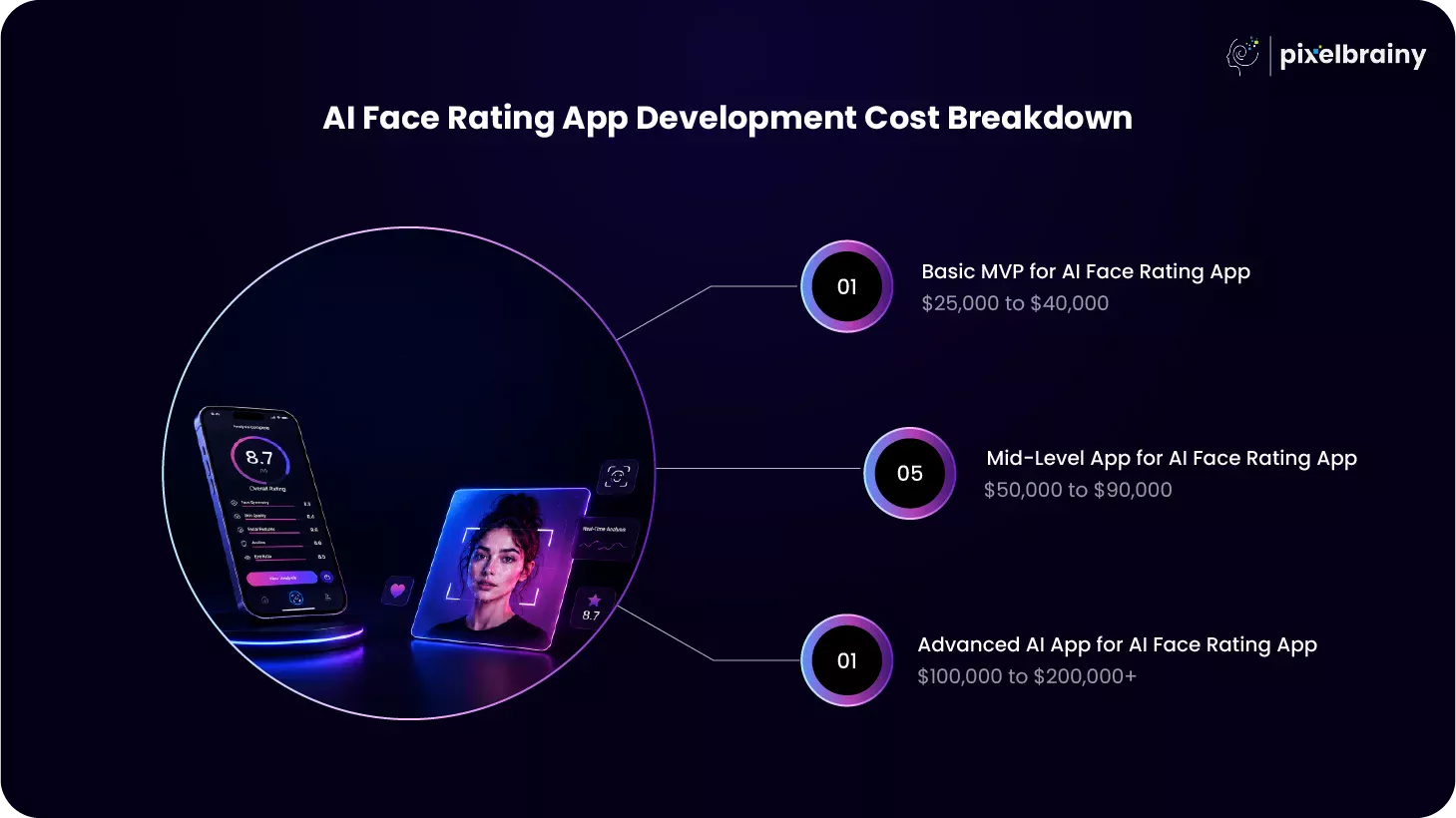
| Development Tier | Estimated Cost | Timeline | Key Features |
| Basic MVP for AI Face Rating App | $25,000 to $40,000 | 6 to 8 Weeks | Single platform (iOS or Android), AI API based face scoring, photo upload, appearance score, personalized recommendations, user authentication, basic dashboard |
| Mid-Level App for AI Face Rating App | $50,000 to $90,000 | 9 to 12 Weeks | Cross platform development, hybrid AI approach, subscription plans, progress tracking, payment gateway, cloud infrastructure, admin panel |
| Advanced AI App for AI Face Rating App | $100,000 to $200,000+ | 14+ Weeks | Custom trained AI scoring model, AI coach, AI image generation, detailed facial analysis, personalized improvement plans, enterprise security, scalable architecture |
The main difference between these pricing tiers is the level of AI capabilities and infrastructure. A Basic MVP keeps the AI face rating app development cost lower by using third party AI APIs and focusing on the core scan, score, and recommendation workflow.
A Mid-Level app adds cross platform support, subscriptions, progress tracking, and a scalable backend. These features improve the user experience and prepare the app for future growth.
An Advanced AI Platform requires a much higher investment because it includes custom AI models, proprietary face scoring algorithms, AI coaching, image generation, enterprise security, and powerful GPU infrastructure.
When estimating the price to build a face rating app, remember that development is only part of the total investment. Cloud hosting, AI inference, maintenance, security updates, and future upgrades also affect the overall development budget of AI face rating app projects.
Ultimately, the cost of developing an AI face rating application depends on your business goals rather than copying every Umax feature. Starting with an MVP costing $25,000 to $50,000 allows you to validate your idea, attract investors, and scale based on real user feedback. This approach offers the most practical AI face rating app development cost breakdown while reducing financial risk.
Also Read: AI App Development Cost: From MVPs to Full-Scale AI App
How do you calculate the cost to build an AI face rating app before development begins? The most accurate approach is to estimate your investment based on project scope, AI complexity, development hours, infrastructure, third party integrations, and long-term maintenance. Instead of relying on rough agency estimates, founders should use a structured cost calculation to understand the actual AI face rating app development cost.
If your question is, "How can I estimate the budget for a Umax like AI face rating app before contacting a development company?", the answer is to break the project into measurable cost components. This approach provides a realistic development budget of AI face rating app projects and helps you prioritize features based on your available funding.
A simple way to estimate the cost of developing an AI face rating application is by using the following formula:
Total AI Face Rating App Cost = (Development Hours × Hourly Rate) + AI Model Cost + Infrastructure Cost + Integration Cost + Maintenance Cost
This formula includes the five major cost drivers of every AI face rating app.
Using this formula makes it easier to calculate the price to build a face rating app and compare different development approaches before investing.
Suppose a startup wants to build an MVP with the following features:
For a realistic MVP, assume the following estimates:
Development Cost = 650 × $50
Development Cost = $32,500
Now apply the complete formula:
Total AI Face Rating App Cost =
$32,500 + $6,000 + $4,000 + $3,500 + $5,000
Estimated Development Cost = $51,000
This example shows how a startup can realistically estimate the AI face rating app development cost before approaching development companies. By adjusting development hours, AI capabilities, infrastructure, or integrations, you can easily calculate different investment scenarios and align the project with your available budget.
Rather than relying on guesswork, using a structured AI face rating app development cost breakdown helps founders make informed technical and financial decisions. It also creates a stronger foundation for investor discussions, project planning, and long- term product scalability.
The AI face rating app development cost is not fixed because every project is built with different technologies, features, and business goals. This is why development quotes for a Umax style app can range from $25,000 to $200,000+.
Understanding the factors affecting AI face rating app development cost helps founders compare proposals more accurately, avoid unnecessary expenses, and build an app that aligns with both their budget and growth strategy.
The table below summarizes the biggest cost drivers and their impact on the overall project budget.
| Cost Factor | Estimated Cost Impact | Impact Level |
| AI Approach | $8,000 to $70,000+ | Very High |
| Feature Depth | $5,000 to $50,000+ | High |
| Platform Strategy | Saves or adds 25% to 40% | High |
| UI/UX Design Complexity | $3,000 to $20,000+ | Medium |
| Development Team & Region | Varies by hourly rates | High |
| Compliance & Security | $3,000 to $20,000+ | Medium to High |
Your AI strategy is the single biggest factor affecting the cost to make AI face rating app.
Using third party AI APIs for face analysis and personalized recommendations is the most cost-effective option for startups. It reduces development time, lowers upfront investment, and allows you to launch an MVP faster. Depending on the AI provider and project scope, API integration typically costs between $8,000 and $20,000.
Building a custom AI model requires a much larger investment. It involves collecting facial datasets, training machine learning models, fine tuning algorithms, setting up GPU infrastructure, and continuously improving model accuracy. As a result, the AI component alone can cost $40,000 to $70,000+, significantly increasing the overall price of developing an AI face rating application.
For most startups, beginning with proven AI APIs is the most practical choice. It helps keep the AI face rating app development budget under control while allowing you to validate your product before investing in proprietary AI technology.
Every new feature increases the face rating app development cost.
A simple MVP with AI face scoring, personalized recommendations, user authentication, and subscriptions usually falls between $25,000 and $40,000.
Adding features such as AI skin analysis, progress tracking, gamification, social sharing, detailed reports, multilingual support, and premium memberships can increase the project budget to $80,000 or even $200,000+.
Launching with essential features first allows startups to validate demand before investing in advanced functionality.
The platforms you support have a direct effect on the AI face rating app development budget.
Building only for iOS or Android requires less time and a smaller investment. Cross platform development using Flutter or React Native allows a single codebase to support both operating systems, reducing development costs by approximately 25% to 40% compared to building two separate native apps.
For startups asking how much does it cost to build an AI app like Umax, a cross- platform MVP is often the most practical and budget friendly approach.
The user experience is another important cost driver.
A clean and functional interface generally costs between $3,000 and $8,000 to design. However, premium interfaces with custom animations, interactive dashboards, AI generated reports, and advanced visual effects can increase UI and UX costs to $15,000 to $20,000+.
Although premium design increases upfront investment, it can improve user engagement, retention, and subscription conversions over time.
The experience and location of your development team significantly influence the Umax like AI face rating app development price.
AI product development agencies in North America typically charge $100 to $200 per hour, while experienced teams in India often charge between $30 and $60 per hour. Because of this difference, the same application may cost $150,000+ with one agency and $50,000 to $80,000 with another, even when the feature list remains largely unchanged.
Choosing an experienced AI development partner is often more valuable than selecting the lowest quote.
Development is only the beginning. AI face rating apps process facial images and biometric information, making privacy, security, and compliance essential investments.
Implementing biometric consent flows, encrypted image storage, secure authentication, and privacy features for regulations such as BIPA can add $3,000 to $20,000 to the initial project.
Many founders also ask, "Every agency quotes me the build cost but nobody explains what it costs to run an AI face rating app month to month. What should I budget for cloud inference, maintenance, and updates in the first year after launch?" As a general benchmark, businesses should reserve 15% to 25% of the initial development cost annually for cloud hosting, AI inference, maintenance, security updates, performance monitoring, and continuous feature improvements.
Understanding these six cost drivers makes it easier to compare development quotes, plan your investment wisely, and build an AI face rating app that fits your business goals and budget.
Understanding the AI face rating app development cost becomes much easier when you break the project into individual development phases. Instead of looking at one large estimate, founders should understand how the budget to create an AI face rating app is distributed from planning to launch.
For businesses asking, "We are a wellness startup and before committing I want the full financial picture for an AI face scanner app: development, launch, and first year operating costs. Can you break down a realistic total investment?", the answer is yes. A complete investment includes product planning, UI and UX design, application development, AI integration, testing, deployment, and annual maintenance. While development generally ranges from $25,000 to $200,000+, businesses should also reserve 15% to 25% of the initial development cost annually for cloud hosting, AI inference, maintenance, security updates, and continuous improvements.
The table below shows how a typical budget to create a face rating app with AI is distributed across each development phase.
| Development Phase | Budget Allocation | Timeline | Estimated Cost (Based on $25,000 to $200,000+) |
| Discovery & Planning | 5% to 10% | 1 to 2 Weeks | $1,250 to $20,000 |
| UI & UX Design | 10% to 15% | 2 to 4 Weeks | $2,500 to $30,000 |
| App Development | 40% to 50% | 8 to 14 Weeks | $10,000 to $100,000 |
| AI Model Integration & Calibration | 20% to 25% | 3 to 6 Weeks | $5,000 to $50,000 |
| Testing & Quality Assurance | 10% to 15% | 2 to 3 Weeks | $2,500 to $30,000 |
| Deployment & Launch | 5% | 1 Week | $1,250 to $10,000 |
This phase lays the foundation for the entire project. It includes market research, competitor analysis, feature prioritization, technical architecture, and project planning.
A well-planned discovery phase reduces development risks and prevents costly changes later. Businesses typically allocate 5% to 10% of the total development pricing of AI face rating app projects to this stage.
Design focuses on creating an intuitive user experience for photo uploads, AI face scoring, recommendations, subscription flows, and dashboards.
Most startups spend 10% to 15% of the total budget on UI and UX design to ensure the application is visually appealing and easy to use.
This is the largest investment in the project and usually accounts for 40% to 50% of the overall custom AI face rating app development cost like Umax.
The phase includes frontend development, backend architecture, user authentication, databases, APIs, payment integration, notifications, and admin panel development.
AI is what differentiates a face rating app from a traditional mobile application.
This phase includes facial analysis integration, recommendation logic, AI model calibration, accuracy testing, image processing, and performance optimization. Depending on whether you use third party AI APIs or custom machine learning models, this stage typically consumes 20% to 25% of the overall project budget.
Also Read: Top 12+ AI Model Development Companies in the USA
Before launch, every feature must be tested across different devices and operating systems.
Quality assurance includes functional testing, AI accuracy validation, security testing, performance optimization, and bug fixing. Businesses generally allocate 10% to 15% of the total budget to ensure a stable and reliable product launch.
The final phase covers production deployment, cloud configuration, application publishing, monitoring, and launch support.
Although this stage represents only about 5% of the total AI face rating app development cost, it ensures your application is ready for public release and prepared to handle real user traffic.
Want to understand the complete development workflow instead of just the costs? Explore our detailed AI Face Rating App Development Guide to learn the step-by-step process from idea validation to post launch scaling.
Breaking your investment into development phases gives you a clearer financial roadmap, making it easier to plan budgets, secure funding, and build your AI face rating app with confidence.

The initial AI face rating app development costing is only part of your total investment. Once your app is live, you will continue paying for cloud infrastructure, AI processing, maintenance, compliance, app store fees, and customer support. These recurring expenses are often overlooked during planning, which is why many startups exceed their expected budget after launch.
One of the most common founder questions is, "Every agency quotes me the build cost but nobody explains what it costs to run an AI face rating app month to month. What should I budget for cloud inference, maintenance, and updates in the first year after launch?" The answer depends on your user growth and AI usage, but most startups should reserve 15% to 25% of the original development cost annually, along with monthly cloud and AI infrastructure expenses.
The following are the major hidden costs every founder should include in their financial planning.
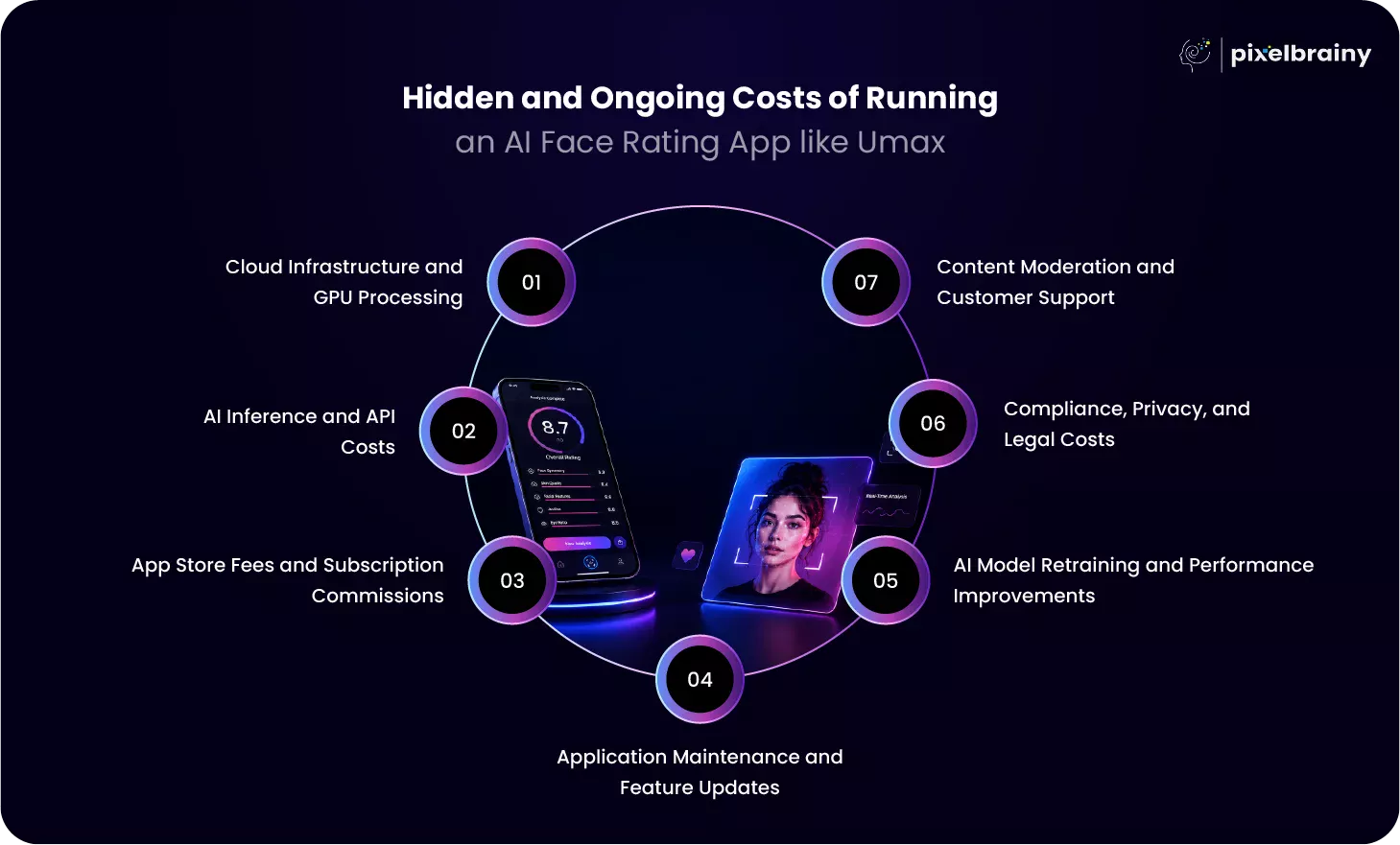
| Ongoing Expense | Estimated Cost |
| Cloud Hosting & GPU Infrastructure | $300 to $5,000+ per month |
| AI Inference & API Usage | $200 to $5,000+ per month |
| App Maintenance & Updates | 15% to 20% of development cost per year |
| AI Model Retraining & Optimization | $5,000 to $30,000 per year |
| Privacy Compliance & Legal Review | $2,000 to $15,000 per year |
| Content Moderation | $300 to $3,000+ per month |
| Customer Support | $500 to $5,000+ per month |
| App Store Developer Fees | Apple: $99/year, Google Play: $25 one time |
Every face scan requires computing power. AI image analysis, facial recognition, databases, cloud storage, and GPU processing all generate recurring costs.
For an MVP with moderate traffic, cloud infrastructure may cost between $300 and $1,000 per month. As your user base grows, GPU usage and cloud resources can easily increase monthly expenses to $5,000 or more.
This is one of the largest recurring expenses after launch and should always be included when estimating the cost of making AI face rating app.
If your application relies on third party AI services, every facial analysis request generates an API charge.
The more users upload photos, the higher your AI inference bill becomes. Depending on the AI provider and monthly usage, businesses typically spend $200 to $5,000+ per month on AI processing alone.
Choosing efficient AI models and optimizing image processing workflows can significantly reduce these ongoing expenses.
Publishing your application also comes with platform fees.
The Apple Developer Program requires an annual membership fee of $99, while the Google Play Developer Account charges a one-time registration fee of $25.
If your business generates revenue through subscriptions, both platforms also charge commission fees, typically ranging from 15% to 30% depending on your subscription model and eligibility.
These costs should be considered when planning your long-term monetization strategy.
Launching your application is only the beginning.
Regular maintenance includes bug fixes, operating system compatibility updates, security patches, performance optimization, and feature enhancements. Most software companies recommend allocating 15% to 20% of the original development cost each year for maintenance.
For example, if your development pricing of AI face rating app is $60,000, your annual maintenance budget should be approximately $9,000 to $12,000.
AI models require continuous improvement to maintain accuracy and deliver better recommendations.
Over time, businesses invest in retraining machine learning models, improving facial analysis accuracy, updating recommendation logic, and testing new AI capabilities.
Depending on project complexity, this can cost between $5,000 and $30,000 annually.
AI face rating apps process facial images and biometric information, making privacy compliance essential.
Businesses may need legal reviews, privacy policy updates, biometric consent management, encryption audits, and compliance with regulations such as BIPA and other regional privacy laws.
Annual compliance expenses typically range from $2,000 to $15,000, depending on the markets you serve.
As your user base grows, managing uploaded images and supporting customers becomes increasingly important.
Content moderation helps detect inappropriate uploads, while customer support handles subscription issues, technical problems, and user feedback.
Combined operational costs generally range between $800 and $8,000+ per month, depending on user volume and support channels.
For most startups launching a Umax style platform, the hidden costs of building an AI face rating app extend well beyond the initial development investment.
A practical estimate for the first-year operating budget is $15,000 to $60,000+, depending on monthly active users, AI processing volume, cloud infrastructure, maintenance requirements, legal compliance, and customer support. For rapidly growing platforms, annual operating expenses can be even higher as AI usage and infrastructure demands increase.
Planning for both development and ongoing operating costs gives you a complete financial picture and helps build a sustainable AI face rating app that can scale successfully after launch.
Reducing the cost to make AI face rating app does not mean compromising on quality. The smartest startups control costs by making better technical and product decisions instead of removing essential functionality. With the right strategy, founders can reduce development expenses by 20% to 50% while still launching a reliable and scalable AI product.
A common founder question is, "How can I reduce the development cost of a Umax style AI face rating app without affecting user experience or AI accuracy?" The answer is to focus on essential features, leverage existing AI technologies, and build in phases instead of trying to launch every feature on day one.
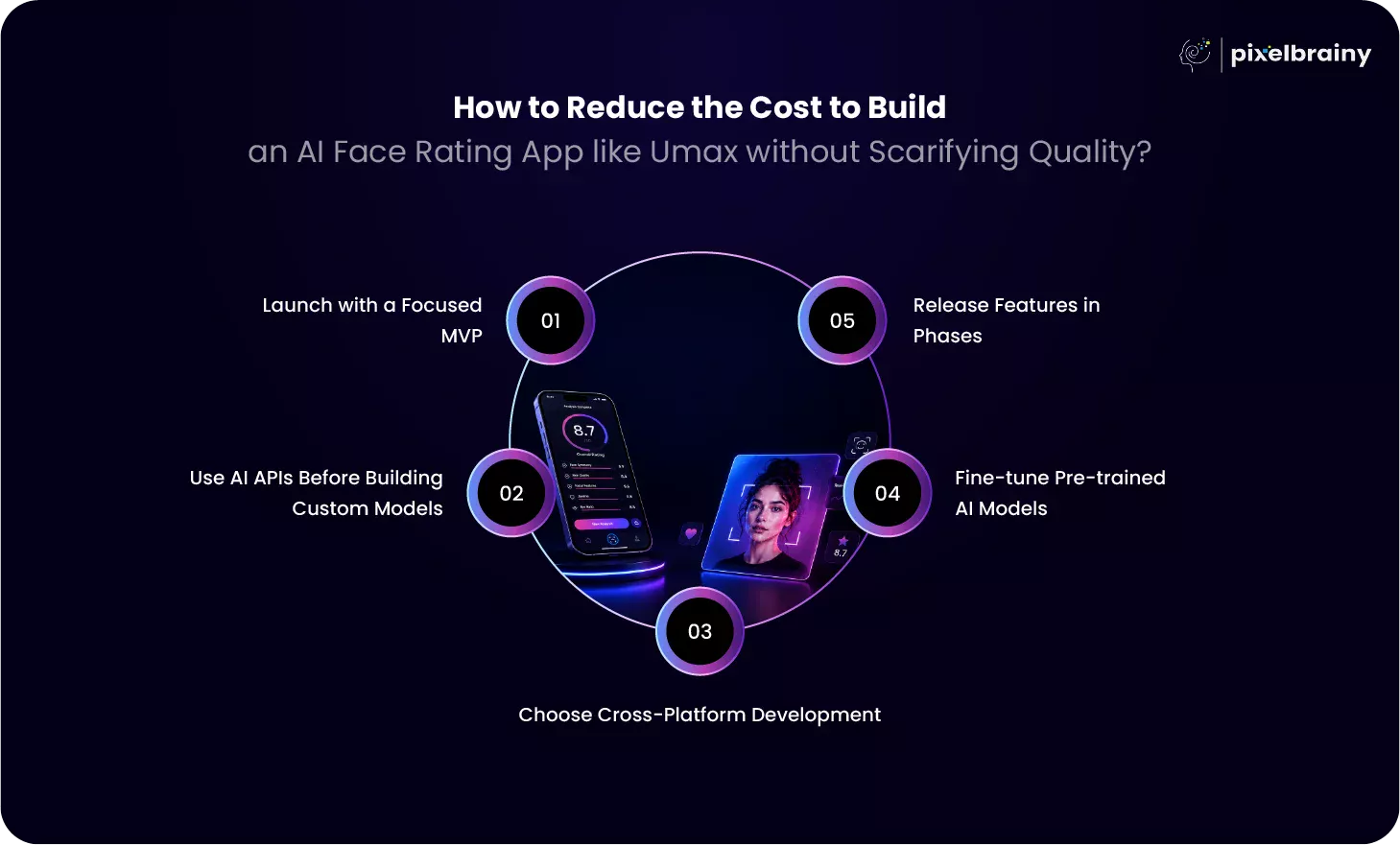
One of the easiest ways to reduce the MVP cost for an AI face rating app is to build only the features users actually need.
Your first release should include user registration, photo upload, AI face scoring, personalized recommendations, and basic subscription functionality. Features such as AI coaching, social communities, gamification, progress tracking, and advanced analytics can be introduced after product validation.
Estimated Savings: 20% to 35% of the total development budget.
Developing a custom facial analysis model requires significant investment in data collection, model training, GPU infrastructure, and continuous optimization.
Instead, most startups begin with trusted AI APIs that provide reliable facial analysis capabilities while dramatically reducing development time. After achieving product market fit, you can gradually migrate to proprietary AI models.
Estimated Savings: 30% to 50% compared to building custom AI from scratch in budget.
Building separate native applications for iOS and Android increases both development time and cost.
Using frameworks such as Flutter or React Native allows developers to maintain a single codebase for both platforms while delivering a consistent user experience.
This approach significantly lowers AI face rating app development pricing and speeds up product launch.
Estimated Savings: 25% to 40% compared to separate native development.
Training machine learning models from the beginning is one of the most expensive parts of AI development.
A more practical approach is to fine tune proven pre trained models for your specific use case. This reduces AI development effort while maintaining high prediction accuracy for face scoring and recommendations.
Estimated Savings: 20% to 40% on AI development costs.
Trying to replicate every Umax feature in the first version quickly increases the budget to build a face rating app using AI.
Instead, launch with a stable MVP, collect user feedback, and introduce advanced capabilities through regular updates. This strategy allows you to invest based on real market demand rather than assumptions.
Estimated Savings: 15% to 30% on initial development costs while reducing business risk.
Many founders compare development proposals based only on price. While a lower quote may seem attractive, choosing the cheapest agency often creates much larger costs later.
Poor quality AI integration, inconsistent face scores, inaccurate recommendations, failed image scans, weak security, and unstable application performance are common problems in low-cost AI products. Fixing these issues after launch usually requires extensive redevelopment, additional testing, and higher infrastructure costs than building the application correctly from the start.
When evaluating the Umax like AI app development cost, focus on technical expertise, AI experience, code quality, and long-term scalability rather than selecting the lowest quote. Paying slightly more for an experienced AI development team often reduces your total ownership cost over the life of the product.
The most successful AI startups do not build the cheapest product. They build the smartest MVP, validate the market quickly, and scale their investment as user demand grows.
PixelBrainy a leading an AI app development company helps businesses optimize AI face rating app development cost by combining strategic MVP planning, scalable AI architecture, transparent cost estimation, and future ready engineering, allowing founders to launch faster without overspending.
One of the most common questions founders ask is, "I am looking for the top AI development companies in the USA to build a face rating app like Umax. What do experienced agencies typically charge for this type of project, and who offers the best value for the money?" While experienced agencies typically charge anywhere from $25,000 to $200,000+, the best value is not always the lowest quote. It comes from choosing a development partner that knows where to invest, where to save, and how to build a scalable product without unnecessary upfront costs.
At PixelBrainy, every project begins with a product discovery and cost planning session. Instead of recommending every possible feature, our team identifies the core functionality required for launch and creates a feature wise roadmap that aligns with your business goals, available budget, and future growth plans. This approach helps optimize the overall AI face rating app development cost while ensuring the application is built on a scalable foundation.
A US based wellness startup approached PixelBrainy with the idea of building an AI powered face rating application. Due to a client confidentiality agreement, we cannot disclose the company name.
The initial product vision included custom AI models, AI coaching, facial skin analysis, progress tracking, community features, and AI generated images. Based on these requirements, the estimated project budget exceeded $110,000.
After a detailed discovery workshop, our team restructured the roadmap into a lean MVP focused on delivering business value quickly. Instead of building custom AI models from the beginning, we integrated enterprise grade face analysis APIs, adopted cross platform development, and prioritized only the features required for market validation.
The first release included AI face scoring, personalized recommendations, secure user authentication, subscription management, and an admin dashboard.
| Metric | Result |
| Original Estimated Budget | $110,000+ |
| Final MVP Investment | Approximately $48,000 |
| Development Cost Saved | Nearly 56% |
| Delivery Timeline | Less than 4 months |
| Scalability | Ready for future custom AI models and advanced features |
The client successfully launched the MVP, validated the product with real users, and planned future enhancements based on actual customer feedback instead of assumptions. This approach reduced unnecessary upfront investment while creating a strong technical foundation for long term growth.
Whether you are building a lean MVP or a large-scale AI platform, our goal is to provide transparent planning, realistic budgeting, and a development strategy that delivers maximum business value from every dollar invested.
Ready to estimate your project? Contact PixelBrainy today for a free custom cost estimation of AI face rating app development and receive a tailored roadmap designed around your business goals and budget.
Building an AI face rating app like Umax is a significant investment, but the right strategy can help you maximize value while keeping costs under control. As discussed throughout this guide, the AI face rating app development cost can range from $25,000 to $200,000+, depending on your AI approach, feature scope, platform choice, and long- term scalability requirements. For most startups, launching with a focused MVP is the smartest way to validate the market before investing in advanced AI capabilities.
Whether you are estimating the cost to develop an AI face rating app, comparing the Umax like AI app development cost, or planning the overall budget to create an AI face rating app, careful planning and phased development are the keys to reducing risk and achieving faster returns on investment. Understanding both development and ongoing operating expenses will help you build a sustainable AI product with confidence.
Ready to estimate the cost of your AI face rating app? Schedule a free consultation with the PixelBrainy team today and receive a personalized development roadmap and transparent project cost estimate tailored to your business goals.
Before requesting proposals, it is recommended to have a preliminary budget of at least $25,000 to $40,000 for an MVP. This helps development companies recommend the right technology stack, feature scope, and AI approach that aligns with your business goals.
The AI engine is usually the most expensive component. Costs increase significantly if you choose custom AI model development instead of integrating pre trained AI APIs. Backend infrastructure and cloud-based AI processing also contribute heavily to the total project budget.
Yes. Launching on either iOS or Android first can significantly reduce your initial investment. Many startups validate their product on a single platform before expanding to additional platforms after gaining traction.
Yes. Every AI face scan consumes cloud computing resources and AI inference services. As user activity increases, your monthly cloud and AI processing costs also increase, making infrastructure planning an important part of your long-term budget.
It depends on your project requirements. A fixed price model works well for clearly defined MVPs, while a dedicated development team offers greater flexibility for products that are expected to evolve with continuous feature updates and AI improvements.
It is a good practice to reserve an additional 10% to 15% of your total development budget for unexpected feature requests, AI enhancements, infrastructure upgrades, or third-party integration changes during development.
Not necessarily. Many businesses improve AI accuracy by fine tuning existing models instead of building custom AI from scratch. This approach can deliver reliable results while keeping development costs under control.
Most successful AI applications release maintenance updates every month and introduce major feature improvements every three to six months. Budgeting for regular updates helps maintain security, improve AI performance, and ensure compatibility with new operating system releases.

About The Author
Sagar Bhatnagar
Sagar Sahay Bhatnagar brings over a decade of IT industry experience to his role as Marketing Head at PixelBrainy. He's known for his knack in devising creative marketing strategies that boost brand visibility and market influence. Sagar's strategic thinking, coupled with his innovative vision and focus on results, sets him apart. His track record of successful campaigns proves his ability to utilize digital platforms effectively for impactful marketing efforts. With a genuine passion for both technology and marketing, Sagar continuously pushes PixelBrainy's marketing initiatives to greater success.

Working with the PixelBrainy team has been a highly positive experience. They understand the design requirements and create beautiful UX elements to meet the application needs. The dev team did an excellent job bringing my vision to life. We discussed usability and flow. Sagar worked with his team to design the database and begin coding. Working with Sagar was easy. He has the knowledge to create robust apps, including multi-language support, Google and Apple ID login options, Ad-enabled integrations, Stripe payment processing, and a Web Admin site for maintaining support data. I'm extremely satisfied with the services provided, the quality of the final product, and the professionalism of the entire process. I highly recommend them for Android and iOS Mobile Application Design and Development.

Great experience working with them. Had a lot of feedback and I found that unlike most contractors they were bugging me for updates instead of the other way around. They were extremely time conscience and great at communicating! All work was done extremely high quality and if not on time, early! They were always proactive when it comes to communication and the work is great/above par always. Very flexible and a great team to work with! Goes above and beyond to present us with multiple options and always provides quality. Amazing work per usual with Chitra. If you have UI/UX or branding design needs I recommend you go to them! Will likely work with them in the future as well, definitely recommended!

PixelBrainy is a joy to work with and is a great partner when thinking through branding, logo, and website layout. I appreciate that they spend time going into the "why" behind their decisions to help inform me and others about industry best practices and their expertise.

I hired them to design our software apps. Things I really like about them are excellent communication skills, they answer all project suggestions and collaborate right away, and their input on design and colors is amazing. This project was complex and needed patience and creativity. The team is amazing to do business with. I will be using them long-term. Glad to see there are some good people out there. I was afraid to try and outsource my project to someone but I am glad I met them! I really can't say enough. They went above and beyond on this project. I am very happy with everything they have done to make my business stand out from the competition.

It was great working with PixelBrainy and the team. They were very responsive and really owned the project. We'll definitely work with them again!

I recently worked with the PixelBrainy team on a project and I was blown away by their communication skills. They were prompt, clear, and articulate in all of our interactions. They listened and provided valuable feedback and suggestions to help make the project a success. They also kept me updated throughout the entire process, which made the experience stress-free and enjoyable.

PixelBrainy is very good at what it does. The team also presents themselves very professionally and takes care of their side of things very well. I could fully trust them taking up the design work in a timely and organised manner and their attention to detail saved us lots of effort and time. This particular project was quite intense and the team showed that they function very well under pressure. Very much looking forward to working with her again!

It's always an absolute pleasure working with them. They completed all of my requests quickly and followed every note I had for them to a T, which made our process go smoothly from start to finish. Everything was completed fast and following all of the guidelines. And I would recommend their services to anyone. If you need any design work done in the future, PixelBrainy should be your first call!

They took ownership of our requirements and designed and proposed multiple beautiful variants. The team is self-motivated, requires minimum supervision, committed to see-through designs with quality and delivering them on time. We would definitely love to work with PixelBrainy again when we have any requirements.

PixelBrainy was a big help with our SaaS application. We've been hard at work with a new UI/UX and they provided a lot of help with the designs. If you're looking for assistance with your website, software, or mobile application designs, PixelBrainy and the team is a great recommendation.

PixelBrainy designers are amazing. They are responsive, talented, and always willing to help craft the design until it matches your vision. I would recommend them and plan to continue them for my future projects and more!!!

They were awesome! Did a good job fast, and good communication. Will work with them again. Thank you

Creative, detail-oriented, and talented designers who take direction well and implement changes quickly and accurately. They consistently over-delivered for us.

PixelBrainy team is very talented and creative. Great designers and a pleasure to work with. PixelBrainy is an excellent communicator and I look forward to working with them again.

PixelBrainy has a very talented design team. Their work is excellent and they are very responsive. I enjoy working with them and hope to continue on all of our future projects.


Transform your ideas into reality with us.
Across these industries, each engagement brings unique challenges, from early-stage product development to scaling complex systems, helping us build a practical understanding of real-world product environments.