AI Summary Powered by PixelBrainy
In a world where continuous learning and personal growth are essential for success, the way we support students and employees must evolve. Traditional coaching and mentoring methods have proven valuable, but they often fall short when it comes to scalability, personalization, and accessibility. As organizations aim to upskill their workforce and educational institutions look for innovative tools to guide learners, technology is stepping in to redefine the coaching experience.
One of the most promising solutions is an AI Coaching Platform like Rocky.ai. These platforms integrate artificial intelligence with modern coaching practices to deliver real-time, customized support tailored to each individual’s goals and progress. They remove barriers such as high costs, scheduling conflicts, and limited availability, making professional growth opportunities accessible to anyone, anywhere.
The rising demand for personalized learning experiences is fueling the development of intelligent coaching platforms that not only guide users but also adapt to their evolving needs. For businesses, they represent a powerful tool to improve performance and engagement. For students, they offer a clear path toward skill development and career readiness.
This guide will walk you through everything you need to know about AI Coaching Platform development. From understanding how these platforms work to learning how to create an AI Coaching Platform step by step, you will explore the key features, technologies, and strategies required for success. Whether your goal is the building of an AI Coaching Platform for employees or students, this is your complete roadmap to turning an idea into an intelligent coaching solution.
An AI Coaching Platform is a digital system that uses artificial intelligence to deliver personalized guidance, feedback, and learning support. It acts as a virtual coach that understands user needs, provides tailored recommendations, and helps individuals achieve their personal or professional goals. Unlike traditional coaching, which relies heavily on scheduled one-on-one sessions, AI coaching platforms operate continuously, making support accessible at any time and from anywhere.
These platforms are built using technologies such as natural language processing, machine learning, and data analytics. Together, these capabilities allow the system to understand user inputs, track progress, analyze behavior, and deliver relevant coaching conversations. Over time, the platform learns from each interaction, becoming more effective in delivering insights, setting goals, and guiding users through their development journey.
The value of an AI coaching platform extends across a variety of users and use cases:
An AI coaching platform ultimately bridges the gap between human coaching and digital learning, delivering a more scalable, adaptive, and impactful development experience for both individuals and organizations.
Artificial intelligence is the foundation that makes a coaching platform truly effective. It does more than automate content delivery. It enables the platform to understand users, personalize their experiences, anticipate their needs, and continuously guide them toward their goals. Without AI, a coaching platform would simply provide generic advice. With AI, it becomes a smart and evolving partner in personal and professional development.
Here are the key ways AI transforms coaching platforms:
AI tailors the coaching journey to each user’s unique needs and goals. By analyzing data such as performance, preferences, and interaction patterns, the platform creates a personalized learning path. This ensures that every piece of advice, exercise, or recommendation is relevant and impactful. As the user progresses, the AI adapts and evolves, refining its suggestions over time.
With natural language processing (NLP), AI enables meaningful two-way communication between the platform and the user. Instead of static prompts or predefined messages, users can engage in conversations that feel natural and context-aware. This interactive experience keeps learners engaged and helps build trust in the digital coach.
AI can identify potential challenges before they occur. By analyzing behavior and learning patterns, it predicts obstacles, skill gaps, or areas needing improvement. The platform can then proactively suggest solutions, resources, or next steps to keep users on track.
AI monitors user performance in real time and provides actionable feedback. It tracks progress, measures improvements, and visualizes achievements, helping users stay motivated and focused on their objectives. This continuous feedback loop is essential for long-term growth.
Unlike traditional coaching, AI coaching platforms can serve thousands of users simultaneously while maintaining a consistent quality of support. This scalability makes them ideal for organizations and educational institutions that need to deliver personalized coaching at scale.
By combining personalization, interactive communication, predictive insights, continuous feedback, and scalability, AI transforms a coaching platform from a simple digital tool into a powerful development ecosystem. It not only guides users but also evolves with them, making learning and growth more effective, engaging, and sustainable.
The demand for intelligent coaching solutions is rising rapidly as organizations recognize the need to continuously develop their workforce. According to a recent report, the global coaching platform market is projected to reach USD 3.8 billion by 2025 and is expected to grow further to USD 11.1 billion by 2035, with a CAGR of 11.2%. This growth highlights how crucial digital coaching tools have become for businesses aiming to stay competitive in a rapidly evolving talent landscape.
Investing in an AI Coaching Platform is more than just adopting new technology. It is a strategic move that directly impacts employee development, organizational performance, and long-term business growth. Here are the key reasons and benefits for businesses to consider:
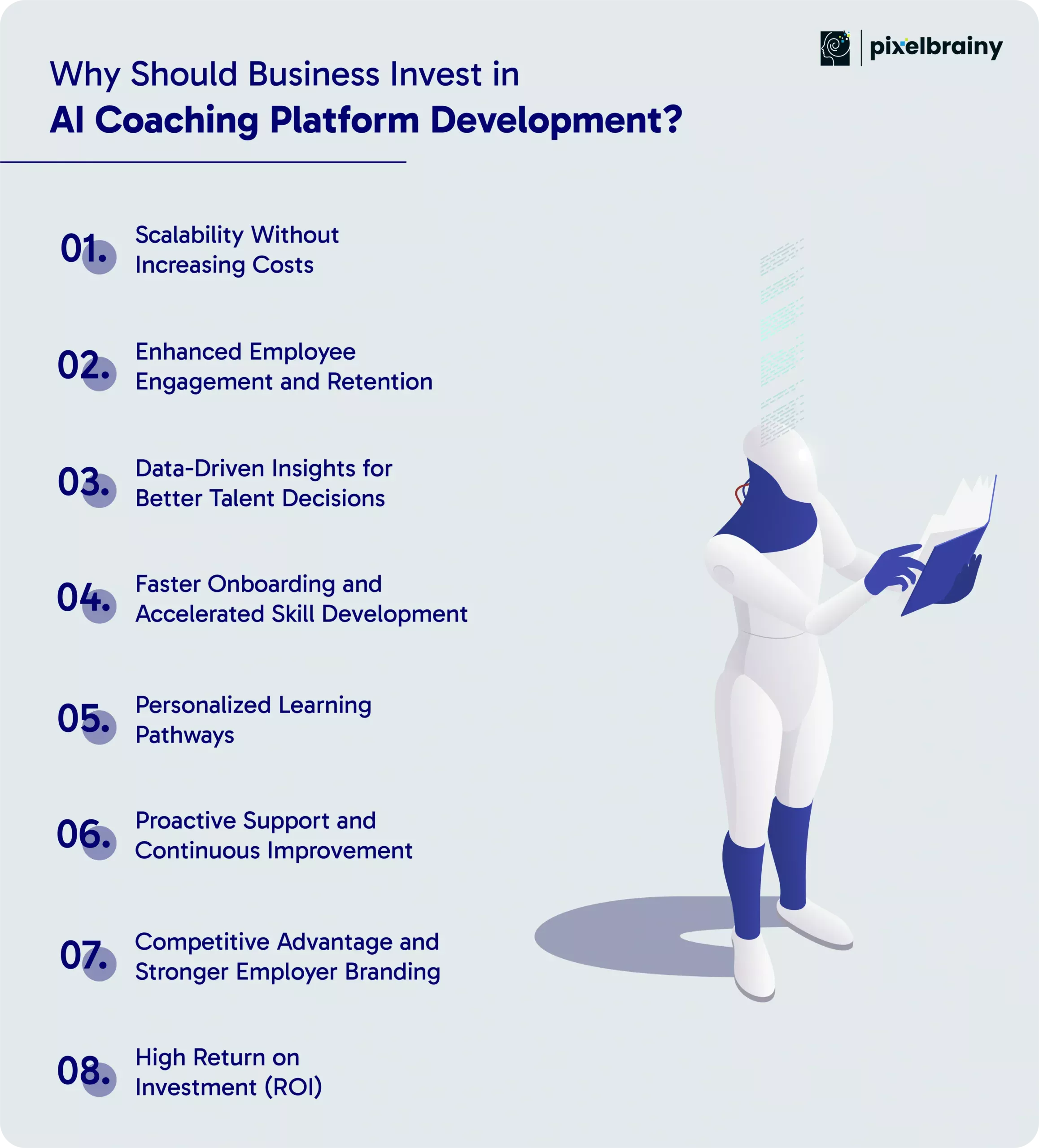
Traditional coaching models require significant financial investment and human resources. AI coaching platforms allow companies to scale personalized coaching to hundreds or even thousands of employees without dramatically increasing costs. This makes learning and development initiatives more sustainable and accessible.
Employees are more likely to stay with an organization that invests in their growth. An AI-powered coaching platform provides continuous, on-demand learning opportunities that are tailored to individual needs. This ongoing support boosts motivation, builds loyalty, and reduces turnover rates.
AI platforms gather valuable data on user behavior, learning progress, skill gaps, and engagement trends. These insights help HR and L&D teams make informed decisions, design targeted training programs, and identify high-potential employees who are ready for leadership roles.
New employees often face challenges in adapting to their roles quickly. An AI coach can guide them through onboarding processes, offer personalized learning resources, and provide real-time feedback. This shortens the time it takes for new hires to become productive and confident contributors.
Every individual has different strengths, weaknesses, and career aspirations. AI coaching platforms create tailored learning experiences that address these differences, ensuring that each employee receives support that aligns with their goals and learning style. Personalized development plans are far more effective than generic training programs.
AI is capable of identifying early signs of skill gaps or disengagement and can recommend timely interventions. Whether it is suggesting new learning materials or adjusting a development plan, this proactive support helps employees stay on track and continuously improve their performance.
Offering cutting-edge learning and coaching solutions enhances a company’s reputation as an innovative and employee-centric organization. This strengthens employer branding and helps attract top talent who value growth opportunities and modern workplace support systems.
Although the initial development cost of an AI coaching platform can be significant, the long-term benefits far outweigh the expenses. Reduced training costs, higher retention rates, improved employee performance, and better alignment between individual growth and business objectives all contribute to a substantial ROI.
From these reasons, it is clear that investing in an AI Coaching Platform is not just about adopting technology but about building a future-ready workforce, strengthening organizational growth, and staying ahead in an increasingly competitive business environment.
Building an effective AI Coaching Platform requires more than just integrating artificial intelligence. It demands a careful selection of features that enhance personalization, engagement, scalability, and learning outcomes. These core functionalities are what transform a basic digital tool into a powerful coaching solution for students, professionals, and organizations.
Below is a breakdown of essential features that should be part of any successful AI coaching platform development project.
| Feature | Description |
| User Profiling and Onboarding | Gathers user information such as career goals, skill levels, preferences, and learning styles during the onboarding process, enabling the platform to deliver highly personalized coaching experiences. |
| AI-Powered Personalization | Leverages artificial intelligence to tailor content, recommendations, and coaching plans based on user behavior, performance data, and evolving learning objectives. |
| Natural Language Processing (NLP) Chat Interface | Facilitates engaging, human-like conversations between the user and the AI coach, making interactions more intuitive, natural, and context-aware. |
| Goal Setting and Progress Tracking | Allows users to set clear learning or career objectives, monitor their progress, and visualize achievements over time, fostering continuous growth and accountability. |
| Real-Time Feedback System | Offers instant feedback on user decisions, tasks, and exercises, helping them adjust their strategies, correct mistakes, and improve performance quickly. |
| Adaptive Learning Paths | Continuously adjusts the user’s learning journey based on performance trends, strengths, weaknesses, and preferences to deliver relevant and impactful content. |
| Data Analytics and Reporting Dashboard | Provides detailed insights into engagement levels, performance metrics, and learning outcomes, enabling educators, managers, or HR teams to make informed decisions. |
| Multi-Device Accessibility | Ensures a seamless coaching experience across web, mobile, and tablet devices, empowering users to learn anytime and anywhere without interruption. |
| Integration with External Tools | Connects seamlessly with learning management systems (LMS), HR software, and productivity platforms to create a unified digital learning ecosystem. |
| Content Recommendation Engine | Suggests curated learning materials, exercises, articles, or videos that match the user’s skill level, career stage, and learning preferences. |
| Performance Gamification | Enhances engagement through interactive elements such as badges, leaderboards, points, and rewards, motivating users to achieve more. |
| Virtual Coaching Sessions | Combines AI-driven guidance with live coaching options, creating a blended learning environment that maximizes the benefits of both human expertise and artificial intelligence. |
| Feedback and Reflection Journals | Encourages users to reflect on their decisions, track their growth journey, and develop greater self-awareness for long-term success. |
| Security and Compliance Controls | Ensures user data is protected through strong encryption and compliance with privacy regulations, building trust and enabling enterprise-level adoption. |
| Scalability and Multi-User Support | Allows organizations to deploy the platform to thousands of users simultaneously while maintaining consistent performance and reliability. |
From these core features, businesses and educational institutions can build a powerful AI coaching platform that delivers personalized experiences, drives engagement, and creates measurable outcomes for users at every stage of their growth journey.
While core functionalities build the foundation of an AI coaching platform, advanced features take the solution to a higher level of intelligence, personalization, and user engagement. These capabilities help differentiate your AI coaching platform from competitors and deliver a richer, more impactful coaching experience for students, professionals, and enterprises.
Predictive analytics enables the platform to anticipate user needs, potential challenges, and future learning requirements based on behavioral patterns and performance data. This helps the system deliver proactive coaching suggestions, skill development plans, and personalized interventions. Organizations benefit from predictive insights that support workforce planning and learning strategy decisions.
Incorporating sentiment analysis allows the platform to interpret the user’s emotional state during interactions, providing responses that are empathetic and context-aware. This feature enhances user trust and engagement by tailoring the coaching approach according to emotional feedback. For students and employees, it creates a more supportive and responsive learning environment.
This feature analyzes user profiles, performance trends, and market data to recommend suitable career paths and skill-building roadmaps. It helps students identify the best academic or professional direction and guides employees toward leadership or specialization roles. By aligning individual aspirations with organizational needs, it drives more meaningful development outcomes.
A voice-based coaching interface improves accessibility and user convenience, especially for those who prefer hands-free interactions. It can deliver feedback, reminders, and coaching sessions through voice commands, making the platform feel more human and engaging. This is particularly useful for busy professionals who want coaching support while multitasking.
Advanced platforms can automatically generate personalized learning materials, exercises, and coaching modules based on user goals and performance data. This reduces the need for manual content creation and ensures that users always have relevant and updated resources. The result is a more scalable and efficient coaching solution that evolves alongside the user’s growth.
By analyzing cognitive patterns and learning behaviors, the platform can adapt coaching techniques to suit different learning styles and thinking processes. This level of personalization ensures more effective skill development and knowledge retention. It also helps organizations better understand how their workforce learns and evolves over time.
Integrating community features and peer-to-peer learning opportunities adds a collaborative dimension to the coaching experience. Users can share insights, participate in group challenges, and learn from others’ experiences. This feature boosts motivation, fosters accountability, and builds a supportive learning ecosystem within the platform.
Microlearning delivers content in small, easily digestible sessions that fit into users’ busy schedules. When enhanced with AI, these modules are dynamically tailored to the learner’s progress and knowledge gaps. This approach keeps users engaged, improves retention, and ensures steady skill advancement over time.
By integrating these advanced features, organizations can build an AI coaching platform that goes beyond basic coaching to deliver predictive insights, emotional intelligence, and deeply personalized development experiences that truly transform how people learn and grow.
The success of any AI Coaching Platform development project depends on following a structured and well-planned process. From early concept validation to full-scale deployment, each stage requires careful attention to technology, design, user experience, and business strategy.
Below is a step-by-step roadmap that explains what is the process of building an AI Coaching Platform and how to ensure it delivers real value to students, employees, and organizations.
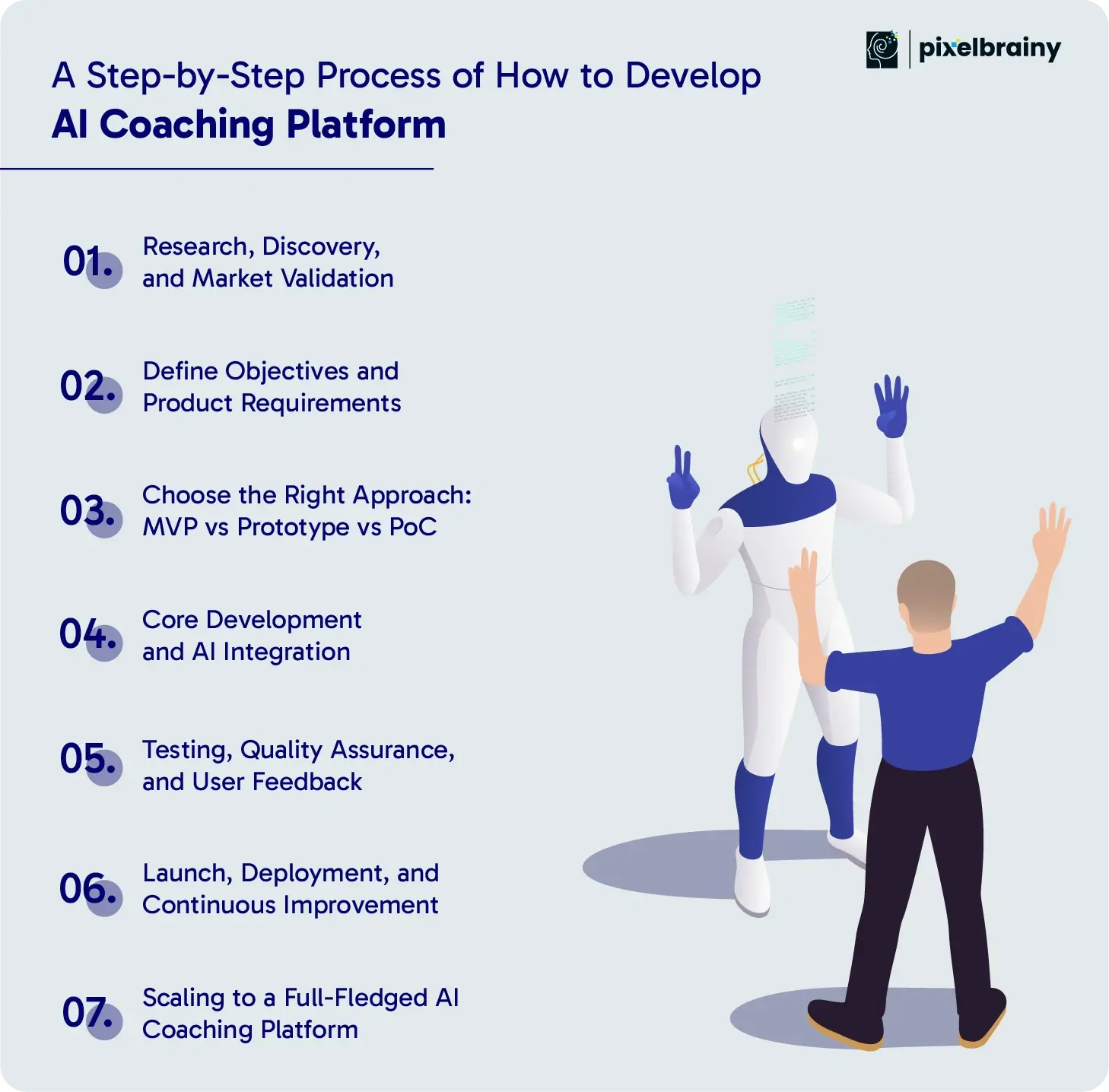
The foundation of successful coaching platform development using AI starts with thorough market research and validation. This phase focuses on understanding your target audience, industry trends, competitive landscape, and existing solutions. Study how students, employees, and organizations currently use coaching platforms, identify their biggest pain points, and explore gaps in the market. This research also includes analyzing pricing models, user behavior, and emerging technologies in AI-powered learning.
Goal: To build a strong business case for your platform and ensure that your idea aligns with real-world needs, user expectations, and market demand.
Key Considerations / Best Practices:
Once the market opportunity is clear, the next step is defining the scope, purpose, and objectives of your platform. This stage involves outlining the platform’s key features, functionality, and user journeys. You should define the type of coaching experience you want to deliver — whether it focuses on career planning, leadership skills, academic success, or workplace performance. The clarity you gain here will shape every technical and strategic decision moving forward.
Goal: To create a clear roadmap for product development that aligns with both user needs and business objectives.
Key Considerations / Best Practices:
Before investing in full-scale development, it’s essential to validate your concept through a staged approach: PoC (Proof of Concept), Prototype, or MVP (Minimum Viable Product). A PoC demonstrates the technical feasibility of your idea. A prototype shows how the product will look and feel. An MVP delivers a functional version with core features that users can test and provide feedback on. Choosing the right approach depends on your timeline, budget, and strategic goals.
Goal: To minimize risk, validate assumptions, and build confidence in your product direction before committing significant resources.
Key Considerations / Best Practices:
This is the heart of coaching platform development using AI. During this stage, your development team builds the backend infrastructure, databases, APIs, and user interfaces. AI components such as chatbots, recommendation systems, adaptive learning engines, and predictive analytics models are integrated to power intelligent coaching capabilities. Collaborating with one of the top AI development companies ensures best practices in scalability, security, and machine learning architecture.
Goal: To create a robust, scalable, and intelligent coaching platform capable of delivering personalized learning experiences at scale.
Key Considerations / Best Practices:
Comprehensive testing ensures that the platform works flawlessly and delivers a positive user experience. This involves functional testing, AI performance evaluation, usability testing, and security checks. User feedback during beta testing is invaluable in identifying gaps, improving AI recommendations, and refining the overall platform performance.
Goal: To deliver a stable, secure, and high-performing product that meets user expectations and business goals.
Key Considerations / Best Practices:
Once the platform passes all quality benchmarks, it’s ready for deployment. The launch phase involves deploying the platform on production servers, onboarding users, and monitoring system performance. Post-launch, continuous improvement is crucial. Gather analytics, user feedback, and performance data to enhance features, update AI models, and deliver new capabilities over time.
Goal: To ensure a successful launch and maintain platform relevance and performance through ongoing iteration and improvement.
Key Considerations / Best Practices:
Also Read: How To Publish An App On Google Play Store In 10+ Easy Steps
After validating the MVP and gathering real-world feedback, the final step is scaling the solution into a comprehensive platform. This involves adding advanced features, expanding AI capabilities, integrating third-party services, and optimizing for enterprise-level performance. At this stage, your platform evolves into a complete coaching ecosystem capable of serving thousands of users.
Goal: To transform your initial product into a powerful, future-ready solution that delivers measurable impact across education and enterprise sectors.
Key Considerations / Best Practices:
From idea validation to large-scale deployment, every stage plays a critical role in creating an AI coaching platform that is impactful, intelligent, and future-ready.
Also Read: A Comprehensive Guide To AI Mobile App Development
One of the most common questions businesses and startups ask is: “What is the cost to develop an AI Coaching Platform?” The answer depends on multiple factors such as platform complexity, features, technology stack, integrations, and scalability requirements. Generally, the AI Coaching Platform development cost ranges from $30,000 to over $200,000. The pricing varies significantly based on whether you are building a basic MVP, a mid-level platform with AI features, or a full-scale enterprise solution with advanced capabilities.
Below is a detailed breakdown of the cost of creating an AI Coaching Platform based on three different development scenarios:
| Platform Type | Description | Estimated Cost |
| Basic AI Coaching Platform | A simple platform with essential features like user onboarding, basic AI chatbot functionality, goal tracking, and standard analytics. Suitable for startups or pilot projects. | $30,000 - $60,000 |
| Medium AI Coaching Platform | Includes advanced AI features like personalized learning paths, NLP-based chat interface, predictive analytics, integrations with third-party tools, and mobile support. Ideal for small to mid-sized businesses and educational institutions. | $60,000 - $120,000 |
| Advanced AI Coaching Platform | A full-fledged enterprise solution with complex AI algorithms, sentiment analysis, career path recommendations, adaptive learning, multi-language support, analytics dashboards, and scalability for thousands of users. | $120,000 - $200,000+ |
The cost to build AI Coaching Platform ultimately depends on your project scope, required features, and business goals. Investing strategically ensures you get a solution that not only meets current needs but also scales effectively as your user base grows.
Also Read: AI App Development Cost: From MVPs to Full-Scale AI App
Selecting the right technology stack is one of the most strategic decisions in AI Coaching Platform development. It determines how scalable, secure, and intelligent your platform will be, and directly impacts user experience, performance, and long-term success. Whether you are planning to create an AI coaching platform for students, employees, or enterprises, choosing the right mix of frontend, backend, AI frameworks, and deployment tools is essential to building a future-ready solution.
Below is a recommended list of tools and technologies widely used by leading development teams to ensure successful coaching platform development using AI.
| Component | Recommended Tools & Frameworks | Explanation |
| Frontend (User Interface) | React, Angular, Vue.js | These JavaScript frameworks offer dynamic, responsive, and user-friendly interfaces. They ensure smooth navigation, quick loading times, and high interactivity for students and employees. |
| Backend (Server-Side Development) | Node.js, Django, Ruby on Rails | These backend frameworks support high-performance, scalable server-side applications. They manage database communication, business logic, and API integrations for the platform. |
| AI & Machine Learning | TensorFlow, PyTorch, OpenAI API | These tools power the intelligence behind the coaching platform. They are used to build, train, and deploy machine learning models for personalization, recommendation systems, and NLP-based coaching features. |
| Natural Language Processing (NLP) | spaCy, NLTK, Hugging Face Transformers | NLP libraries enable the platform to understand and respond to human language, create conversational interfaces, and deliver context-aware coaching sessions. |
| Database Management | PostgreSQL, MongoDB, MySQL | These databases store user profiles, progress data, content, and analytics securely. They are designed for scalability and fast query performance, ensuring smooth platform functionality. |
| Cloud Services & Deployment | AWS, Google Cloud Platform, Microsoft Azure | Cloud platforms provide hosting, scalability, and computing power. They enable the AI coaching platform to handle large volumes of users and data while maintaining uptime and reliability. |
| Authentication & Security | OAuth 2.0, JWT, Firebase Auth | These tools manage secure user authentication, role-based access control, and data protection to ensure compliance with privacy standards. |
| API & Integration Tools | RESTful APIs, GraphQL, Zapier | API solutions allow the platform to integrate with third-party tools like LMS, CRM, or HR software. They enable smooth data exchange and expand platform functionality. |
| Analytics & Monitoring | Google Analytics, Mixpanel, ELK Stack | Analytics tools help track user engagement, learning patterns, and performance metrics. Monitoring solutions ensure platform health, uptime, and performance optimization. |
| DevOps & CI/CD | Docker, Kubernetes, Jenkins | DevOps tools automate deployment, scaling, and updates. They support continuous integration and delivery, which ensures faster release cycles and improved platform reliability. |
With the right tools in place, your platform will adapt easily to future advancements in AI and evolving user expectations.
Building a powerful platform is only the first step. To ensure sustainability and profitability, you need a clear monetization strategy. There are several effective ways to generate revenue from an AI Coaching Platform, whether your target audience is students, professionals, educational institutions, or corporate organizations.
Below are the most proven and profitable monetization models to consider:
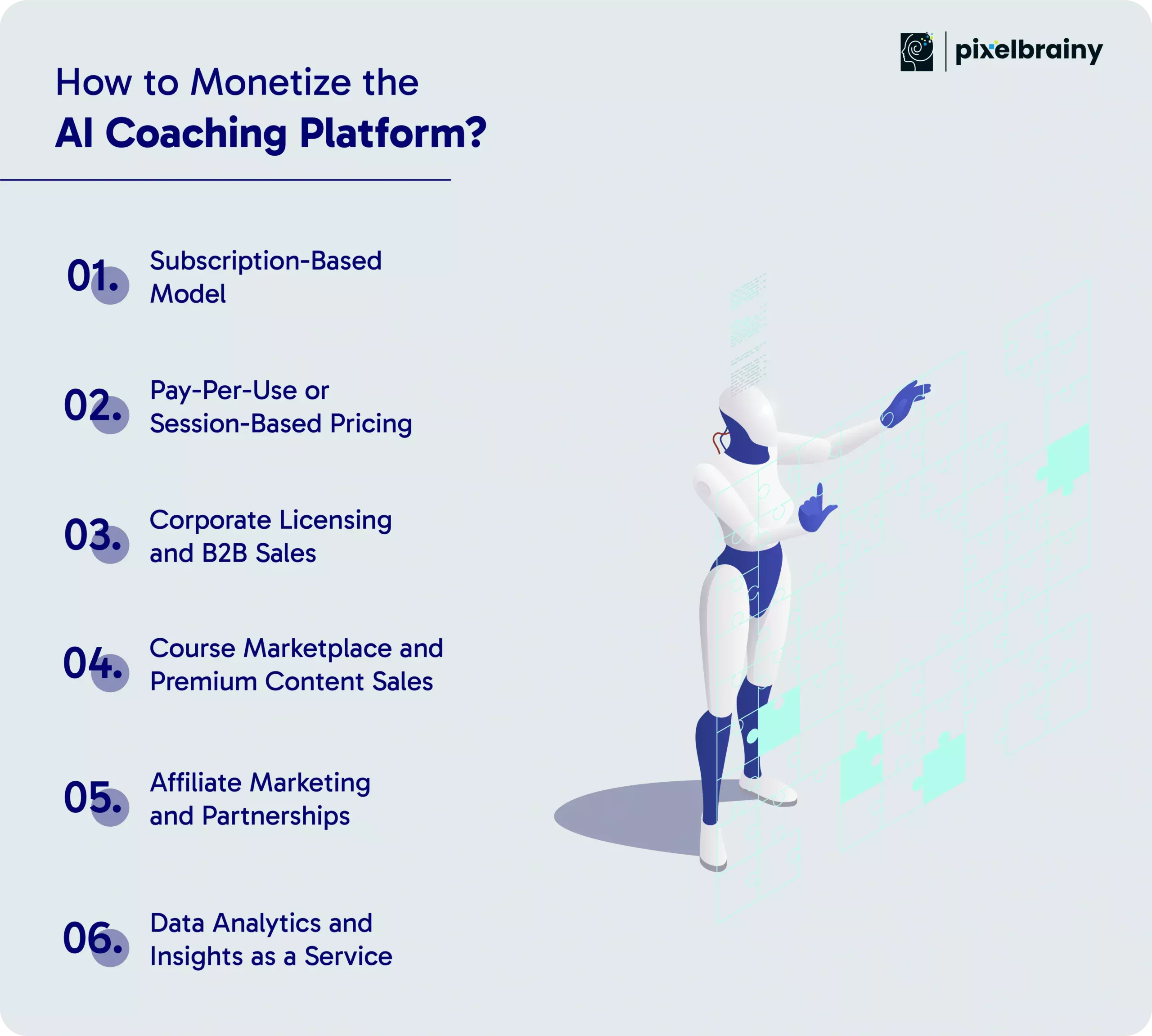
A subscription model is one of the most common and reliable ways to monetize an AI coaching platform. Users pay a recurring fee (monthly, quarterly, or annually) to access premium features, personalized coaching, and continuous learning support. This model ensures predictable revenue and high user retention.
Instead of subscriptions, some users prefer paying only for the services they use. This model allows users to book AI-powered coaching sessions, assessments, or personalized career consultations individually. It works well for users seeking short-term coaching or occasional support.
Many organizations are willing to invest in AI coaching tools to support workforce development and performance management. By offering enterprise licenses or white-label solutions, you can sell your platform directly to companies and institutions at a premium price.
Another profitable approach is to create a marketplace for specialized content such as skill-building modules, career advancement guides, or leadership training programs. Users can purchase premium content separately or as part of their learning journey.
Affiliate programs and strategic partnerships can generate additional revenue streams without directly selling services. The platform can recommend tools, courses, or career services and earn a commission for every conversion.
Aggregated, anonymized data from your platform can provide valuable insights into workforce trends, learning behavior, and skill demands. Selling analytics reports or dashboards to organizations creates an additional high-value revenue stream.
By choosing the right combination of monetization strategies, you can ensure that your AI Coaching Platform not only delivers value but also becomes a sustainable and profitable business.
After planning the features, designing the interface, and defining your strategy, the real test begins with AI coaching platform development. This stage often brings unexpected technical, operational, and strategic challenges.
Understanding these hurdles in advance and preparing effective solutions is crucial to building a reliable, scalable, and impactful platform.
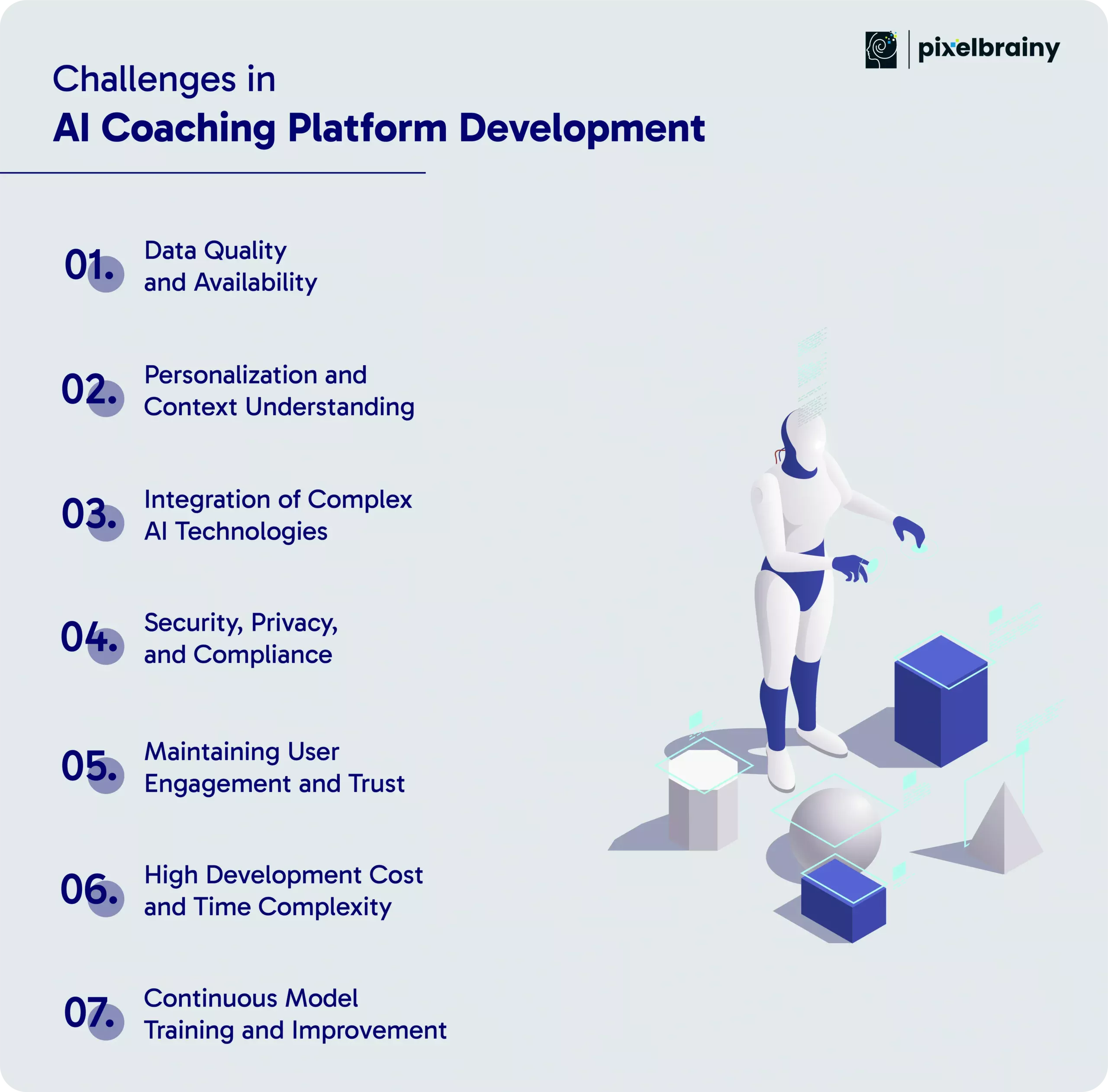
AI systems rely heavily on high-quality, diverse, and well-structured data. However, collecting relevant coaching data such as user goals, behaviors, learning progress, and feedback can be difficult. Inaccurate or biased data can lead to ineffective recommendations, poor user experiences, and unreliable coaching outcomes.
How to Solve It:
Creating a truly personalized coaching experience requires the platform to deeply understand individual goals, preferences, and contexts. Many AI models struggle with accurately interpreting user intent, emotional tone, or long-term learning patterns, which can lead to generic and less impactful coaching sessions.
How to Solve It:
Developing and deploying advanced AI components such as natural language processing, predictive analytics, and recommendation systems require significant technical expertise. Poor integration can lead to scalability issues, performance bottlenecks, or inconsistent results.
How to Solve It:
An AI coaching platform handles sensitive user data, including behavioral insights, performance metrics, and personal goals. Protecting this information is not just a technical requirement but also a legal obligation. Non-compliance with privacy regulations can result in significant penalties and reputational damage.
How to Solve It:
Even with advanced AI features, many platforms struggle to keep users engaged over the long term. If users feel that the recommendations are repetitive, irrelevant, or impersonal, they may abandon the platform. Additionally, over-reliance on automation without a human touch can erode trust.
How to Solve It:
The cost to build an AI coaching platform and the time required for development can be significant, especially when incorporating advanced features and AI models. This can be a major barrier for startups or small businesses with limited budgets.
How to Solve It:
AI systems require ongoing training and updates to remain effective. As user behavior, market trends, and learning needs evolve, the platform must continuously adapt. Failing to update models regularly can make the system outdated and less accurate.
How to Solve It:
By anticipating these challenges and addressing them proactively, you set the foundation for a powerful AI coaching platform that delivers real value and long-term impact.
After you finalized your idea and outlined the core features, now it’s time to bring your vision to life with the right development partner. Choosing an experienced AI development company is one of the most crucial decisions when it comes to developing an AI coaching platform that is intelligent, scalable, and future-ready. At PixelBrainy, we specialize in coaching platform development integrating AI, helping businesses, startups, and institutions transform their concepts into fully functional, impactful products.
Over the years, we have successfully delivered several AI-powered platforms, including a recent confidential project for a global edtech brand. The solution helped them automate personalized coaching, integrate predictive analytics, and scale their services to over 50,000 active users within six months. This proves the power of strategic development and advanced AI integration.
Here’s what makes PixelBrainy the preferred choice to build an AI coaching platform:
Partnering with PixelBrainy means more than just development. It is about building an intelligent coaching ecosystem that delivers measurable results and long-term business value.
From above, it is clear that developing an AI coaching platform is more than just a technological project. It is a strategic investment in the future of learning, growth, and workforce development. Whether your goal is to support students in achieving academic success or to empower employees with continuous skill-building, an AI-powered coaching solution can transform how people learn and perform. With the right planning, technology, and development partner, your platform can deliver personalized guidance, measurable results, and long-term value. As the demand for intelligent coaching continues to rise, now is the perfect time to turn your idea into a powerful digital solution.
Ready to bring your vision to life? Book an appointment with PixelBrainy today and let our experts help you build a next-generation AI coaching platform that makes a real impact.
The timeline typically ranges from 3 to 8 months, depending on the complexity, features, and AI integrations. A basic MVP can be launched within 10–12 weeks, while a full-featured enterprise solution may take longer due to customizations, testing, and scaling requirements.
Yes, most platforms are designed with API support, allowing seamless integration with Learning Management Systems (LMS), HR software, CRMs, and other third-party tools to create a unified learning and development ecosystem.
While having a large dataset improves accuracy and personalization, you can start with smaller, high-quality datasets and expand over time. Pre-trained AI models and third-party data can also be used initially to accelerate development.
AI coaching platforms are versatile and can be applied in education, corporate training, career development, leadership coaching, recruitment, and workforce upskilling. Any sector that values personalized learning and continuous growth can benefit from this technology.
Data protection is crucial. Implement encryption, secure authentication, and compliance with standards like GDPR, CCPA, or FERPA based on your target audience. Regular audits and monitoring also help maintain trust and legal compliance.
Absolutely. With multilingual NLP models and localization support, your AI coaching platform can deliver personalized experiences to global audiences, making it suitable for international businesses and diverse user bases.

About The Author
Sagar Bhatnagar
Sagar Sahay Bhatnagar brings over a decade of IT industry experience to his role as Marketing Head at PixelBrainy. He's known for his knack in devising creative marketing strategies that boost brand visibility and market influence. Sagar's strategic thinking, coupled with his innovative vision and focus on results, sets him apart. His track record of successful campaigns proves his ability to utilize digital platforms effectively for impactful marketing efforts. With a genuine passion for both technology and marketing, Sagar continuously pushes PixelBrainy's marketing initiatives to greater success.

Working with the PixelBrainy team has been a highly positive experience. They understand the design requirements and create beautiful UX elements to meet the application needs. The dev team did an excellent job bringing my vision to life. We discussed usability and flow. Sagar worked with his team to design the database and begin coding. Working with Sagar was easy. He has the knowledge to create robust apps, including multi-language support, Google and Apple ID login options, Ad-enabled integrations, Stripe payment processing, and a Web Admin site for maintaining support data. I'm extremely satisfied with the services provided, the quality of the final product, and the professionalism of the entire process. I highly recommend them for Android and iOS Mobile Application Design and Development.

Great experience working with them. Had a lot of feedback and I found that unlike most contractors they were bugging me for updates instead of the other way around. They were extremely time conscience and great at communicating! All work was done extremely high quality and if not on time, early! They were always proactive when it comes to communication and the work is great/above par always. Very flexible and a great team to work with! Goes above and beyond to present us with multiple options and always provides quality. Amazing work per usual with Chitra. If you have UI/UX or branding design needs I recommend you go to them! Will likely work with them in the future as well, definitely recommended!

PixelBrainy is a joy to work with and is a great partner when thinking through branding, logo, and website layout. I appreciate that they spend time going into the "why" behind their decisions to help inform me and others about industry best practices and their expertise.

I hired them to design our software apps. Things I really like about them are excellent communication skills, they answer all project suggestions and collaborate right away, and their input on design and colors is amazing. This project was complex and needed patience and creativity. The team is amazing to do business with. I will be using them long-term. Glad to see there are some good people out there. I was afraid to try and outsource my project to someone but I am glad I met them! I really can't say enough. They went above and beyond on this project. I am very happy with everything they have done to make my business stand out from the competition.

It was great working with PixelBrainy and the team. They were very responsive and really owned the project. We'll definitely work with them again!

I recently worked with the PixelBrainy team on a project and I was blown away by their communication skills. They were prompt, clear, and articulate in all of our interactions. They listened and provided valuable feedback and suggestions to help make the project a success. They also kept me updated throughout the entire process, which made the experience stress-free and enjoyable.

PixelBrainy is very good at what it does. The team also presents themselves very professionally and takes care of their side of things very well. I could fully trust them taking up the design work in a timely and organised manner and their attention to detail saved us lots of effort and time. This particular project was quite intense and the team showed that they function very well under pressure. Very much looking forward to working with her again!

It's always an absolute pleasure working with them. They completed all of my requests quickly and followed every note I had for them to a T, which made our process go smoothly from start to finish. Everything was completed fast and following all of the guidelines. And I would recommend their services to anyone. If you need any design work done in the future, PixelBrainy should be your first call!

They took ownership of our requirements and designed and proposed multiple beautiful variants. The team is self-motivated, requires minimum supervision, committed to see-through designs with quality and delivering them on time. We would definitely love to work with PixelBrainy again when we have any requirements.

PixelBrainy was a big help with our SaaS application. We've been hard at work with a new UI/UX and they provided a lot of help with the designs. If you're looking for assistance with your website, software, or mobile application designs, PixelBrainy and the team is a great recommendation.

PixelBrainy designers are amazing. They are responsive, talented, and always willing to help craft the design until it matches your vision. I would recommend them and plan to continue them for my future projects and more!!!

They were awesome! Did a good job fast, and good communication. Will work with them again. Thank you

Creative, detail-oriented, and talented designers who take direction well and implement changes quickly and accurately. They consistently over-delivered for us.

PixelBrainy team is very talented and creative. Great designers and a pleasure to work with. PixelBrainy is an excellent communicator and I look forward to working with them again.

PixelBrainy has a very talented design team. Their work is excellent and they are very responsive. I enjoy working with them and hope to continue on all of our future projects.


Transform your ideas into reality with us.
Across these industries, each engagement brings unique challenges, from early-stage product development to scaling complex systems, helping us build a practical understanding of real-world product environments.