
 AI Summary Powered by PixelBrainy
Can cities truly reduce traffic violations, improve road safety, and automate law enforcement without increasing operational costs?
As urban populations expand and the number of vehicles on the road continues to rise, traditional traffic monitoring methods are becoming less effective. Manual surveillance often struggles with delayed responses, human errors, and limited scalability. This challenge has accelerated the adoption of AI powered computer vision systems capable of detecting traffic violations in real time.
From identifying red light jumping and illegal lane changes to recognizing helmet violations and distracted driving, intelligent traffic enforcement solutions are reshaping the future of road safety. Government agencies, smart city planners, transportation authorities, toll operators, and enterprises involved in mobility infrastructure are increasingly investing in these technologies to improve compliance and reduce accidents.
According to Grand View Research, the global Intelligent Transportation System market is expected to reach USD 62.7 billion in 2026 and is projected to grow to USD 128.2 billion by 2033, expanding at a CAGR of 10.8%. This growth highlights the increasing demand for AI driven traffic monitoring and enforcement technologies worldwide.
For organizations planning their investments, understanding the AI traffic violation detection system development cost has become a critical business decision. Whether you want to understand the cost of developing an AI traffic violation detection system, learn how to build AI traffic violation detection system using computer vision in budget, or determine what is the cost to make an AI traffic violation detection system, careful planning is essential.
Typically, an average cost to create AI traffic violation detection system is $50,000 to $300,000+, depending on complexity, deployment scale, and customization requirements.
At last, this blog will show you the complete cost breakdown, budgeting strategies, hidden expenses, cost optimization techniques, and the smartest approach to developing an AI powered traffic violation detection system using computer vision.
Before discussing technology, algorithms, or deployment timelines, smart city authorities need to answer one critical question: How much should we realistically invest in an AI traffic violation detection system that fits our city's unique infrastructure?
Consider this practical situation.
A municipal authority plans to modernize traffic enforcement across several busy intersections. The objective is clear. The system must detect red light jumping, wrong way driving, illegal U turns, and over speeding in real time. It should also generate e challans automatically and integrate with existing transport department databases.
The team has already reviewed multiple vendor demonstrations. On paper, every platform promised advanced capabilities. However, once technical discussions began, the limitations became obvious. Most products were designed as generic solutions with minimal customization options. They failed to account for the city's actual road layouts, varying camera positions, traffic flow patterns, and local enforcement policies.
At this stage, the focus shifts from features to finances.
This is where a well-defined development budget for AI traffic violation detection system becomes essential.
Budget planning allows stakeholders to move beyond broad estimates and understand exactly where their investment will go. Instead of asking, "What is the cheapest option?"
Decision makers begin asking more valuable questions:
The answers directly influence the cost of building AI traffic enforcement software.
For instance, a customized solution designed for a city's specific requirements can typically require an investment of $80,000 to $180,000. If the project expands to cover dozens of intersections, centralized monitoring dashboards, predictive analytics, and large-scale integrations, the investment can easily exceed $300,000. In addition, annual maintenance, software updates, infrastructure management, and model optimization often account for another 15 percent to 25 percent of the original project cost.
This is why custom development budget planning for AI traffic violation detection system initiatives should never be treated as an afterthought. A carefully planned budget creates alignment between technical expectations and financial realities. It minimizes unexpected expenditures, supports phased implementation, and ensures that the final solution is built around the city's operational needs rather than forcing the city to adapt to a standardized product.
In smart city projects, effective budgeting is not simply about controlling costs. It is about creating a reliable foundation for a traffic enforcement system that is accurate, scalable, and capable of delivering measurable public safety outcomes for years to come.
One of the first questions asked by transportation authorities and smart city decision makers is, "What is the realistic cost of developing an AI traffic violation detection system tailored to our road infrastructure?"
This question becomes even more relevant in scenarios where off the shelf vendor solutions fail to address city specific challenges. For example, if your smart city project requires a platform capable of detecting red light jumping, wrong way driving, illegal U turns, and over speeding while automatically generating e challans, a generic product may not deliver the accuracy and flexibility needed for real world deployment.
The truth is that there is no single price tag. The development cost of AI-based traffic enforcement software depends on the scope of deployment, the number of violations being monitored, the level of customization required, integration complexity, and the scalability expectations of the project.
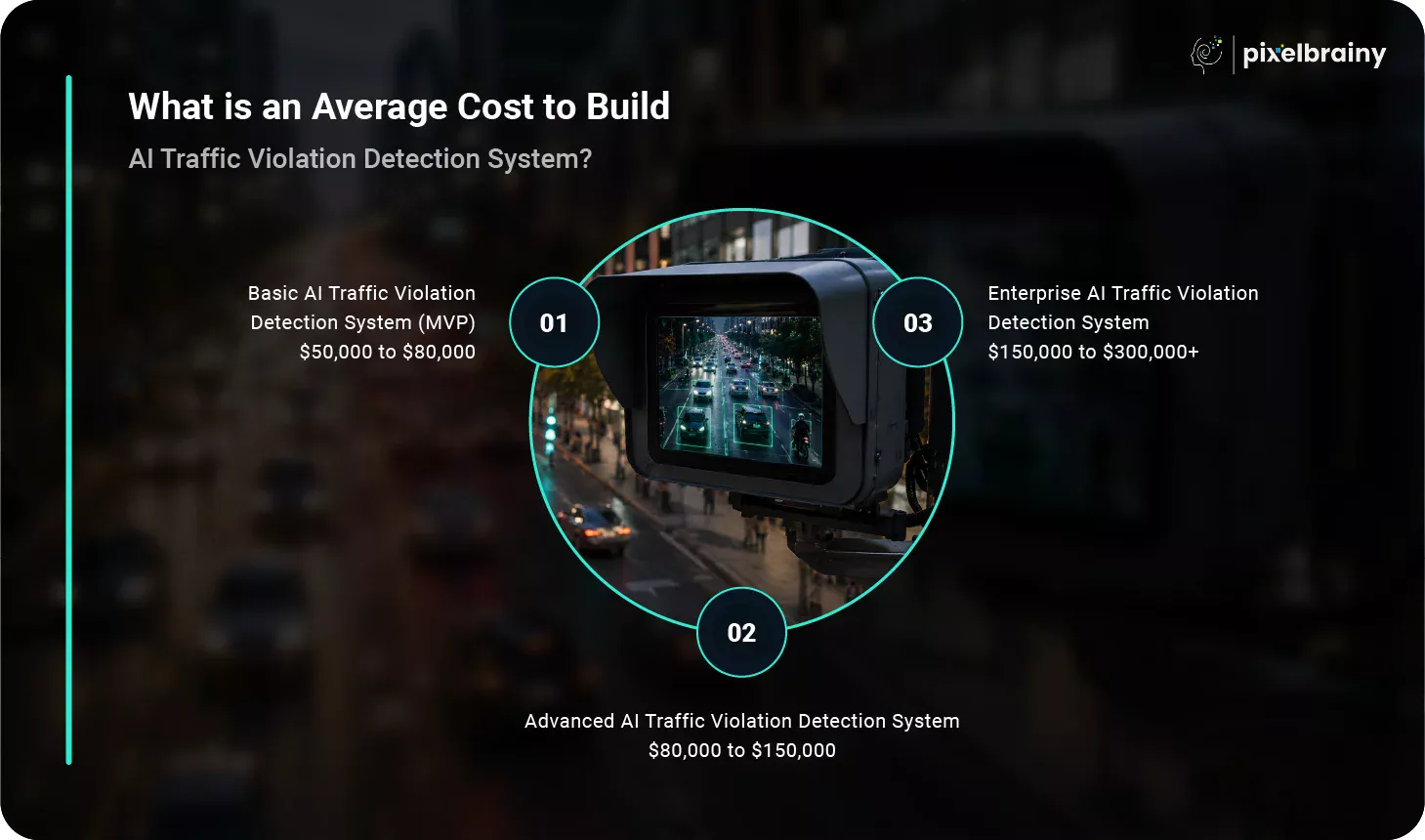
In most cases, the budget required to develop a custom AI traffic violation detection system falls between $50,000 and $300,000+. The final investment can be categorized into three major development tiers.
| Platform Type | Estimated Development Cost | Suitable For | Typical Features |
|---|---|---|---|
| Basic AI Traffic Violation Detection System (MVP) | $50,000 to $80,000 | Pilot projects, proof of concept, small municipalities | Red light violation detection, vehicle detection, basic over speeding alerts, limited dashboard, manual e challan review |
| Advanced AI Traffic Violation Detection System | $80,000 to $150,000 | Mid-sized smart city deployments | Red light jumping detection, wrong way driving detection, illegal U turn identification, over speeding detection, automated e challan generation, reporting dashboard, API integrations |
| Enterprise AI Traffic Violation Detection System | $150,000 to $300,000+ | Large smart city initiatives and nationwide deployments | Multi intersection monitoring, centralized command center, real time analytics, edge AI processing, predictive insights, integration with transport databases, role based access control, high availability architecture |
Organizations that are testing feasibility often start with a Minimum Viable Product. This entry level system focuses on validating the technology before city wide expansion.
A basic deployment typically includes:
Although cost effective, MVP solutions offer limited scalability and are best suited for pilot implementations involving a small number of intersections.
For smart city authorities seeking a production ready platform, this category represents the most practical investment range.
The system is customized to support the city's actual enforcement requirements, including:
This tier often represents the ideal balance between functionality, scalability, and budget.
Large metropolitan areas and national transportation agencies usually require enterprise grade solutions capable of handling massive traffic volumes.
Enterprise deployments may include:
These sophisticated deployments explain why the cost of making an automated computer vision traffic law enforcement platform can exceed $300,000, particularly when extensive customization and infrastructure investments are involved.
Also Read: AI Software Development Cost: A Complete Software Cost Guide
Returning to the common smart city scenario, where authorities require a custom platform capable of identifying red light jumping, wrong way driving, illegal U turns, and over speeding with automatic e challan generation, the realistic development investment generally ranges from $80,000 to $150,000 for a robust city level deployment.
However, ongoing operational expenses should also be considered. Annual maintenance costs, including software updates, AI model retraining, infrastructure monitoring, technical support, and security enhancements, typically account for 15 percent to 25 percent of the original development investment.
Ultimately, understanding the development cost of AI-based traffic enforcement software enables decision makers to allocate resources strategically, avoid underestimating project requirements, and choose the right technology partner capable of delivering a solution built specifically for their transportation ecosystem.
One of the biggest challenges for smart city vendors preparing government proposals is arriving at a realistic budget estimate.
A common concern sounds like this:
"We are submitting a proposal for an AI traffic violation detection system across 50 intersections. We do not know whether the estimate should be based on the number of cameras, violation categories, or AI model complexity. We cannot afford to overbid and lose the contract, nor underbid and compromise project profitability. How can we accurately calculate the development cost before submitting our bid?"
The answer is simple. Do not estimate based on a single factor. The most accurate approach combines all major cost drivers into one structured formula.
Use the following formula to estimate the development pricing of AI traffic violation detection system projects:
AI Traffic Violation Detection Software Development Cost = Base Development Cost + Camera Integration Cost + Violation Detection Cost + AI Model Complexity Cost + Infrastructure Cost + Third Party Integration Cost + Testing and Deployment Cost + Annual Maintenance Cost
This formula helps vendors prepare competitive and realistic bids while accounting for all technical requirements.
Cost Estimation Components:
| Cost Component | What It Covers? | Typical Cost Range |
|---|---|---|
| Base Development Cost | Backend, frontend, dashboard, user management | $20,000 to $40,000 |
| Camera Integration Cost | CCTV and ANPR camera connectivity | $200 to $500 per camera |
| Violation Detection Cost | AI logic for each violation type | $5,000 to $15,000 per violation |
| AI Model Complexity Cost | Training, optimization, validation | $10,000 to $50,000 |
| Infrastructure Cost | Cloud, GPU, storage, networking | $10,000 to $30,000 |
| Third Party Integration Cost | E challan systems and government APIs | $5,000 to $20,000 |
| Testing and Deployment Cost | QA, field testing, rollout | $5,000 to $15,000 |
| Annual Maintenance Cost | Support, updates, retraining | 15% to 25% of development cost |
Suppose you are bidding for a government project with the following requirements:
Example Cost Breakdown:
| Cost Element | Calculation | Estimated Cost |
|---|---|---|
| Base Platform Development | Fixed estimate | $30,000 |
| Camera Integration | 100 × $300 | $30,000 |
| Violation Detection Modules | 4 × $8,000 | $32,000 |
| AI Model Development and Optimization | Fixed estimate | $25,000 |
| Cloud Infrastructure Setup | Fixed estimate | $15,000 |
| E Challan and Government API Integration | Fixed estimate | $10,000 |
| Testing and Deployment | Fixed estimate | $8,000 |
| Total Development Cost | Sum of above | $150,000 |
Once the platform goes live, ongoing support must also be included in the proposal.
The formula is:
Annual Maintenance Cost = Total Development Cost × Maintenance Percentage
If maintenance is estimated at 20 percent:
Annual Maintenance Cost = $150,000 × 20% = $30,000 per year
Final Cost Estimate for Government Proposal:
| Cost Category | Estimated Amount |
|---|---|
| Total Development Cost | $150,000 |
| Annual Maintenance Cost | $30,000 |
| First Year Investment | $180,000 |
The most accurate AI traffic violation detection system costing model should never rely solely on the number of cameras or intersections.
Instead, pricing should be calculated using a combination of:
This approach ensures accurate development pricing of AI traffic violation detection system projects and helps vendors submit competitive proposals with confidence. It also reduces the risk of underestimating the true AI traffic violation detection software development cost, allowing stakeholders to deliver a scalable, high-performance solution that aligns with both government expectations and commercial objectives.
If you are wondering how much does it cost to build an AI traffic violation detection software, the answer depends on several technical and business variables. For startup founders, government agencies, and smart city vendors, understanding these variables is essential before finalizing a budget.
Consider this common scenario:
"I'm a startup founder looking to create a SaaS product for traffic violation detection using AI and CCTV integration for tier 2 cities. We don't have a tech team yet. Can someone help us understand the cost to develop this, the tech stack needed, and recommend companies who specialize in building AI based traffic enforcement systems?"
The realistic answer is that the development cost of AI-based traffic enforcement software can range anywhere from $50,000 to $300,000+, depending on the choices made during planning and development.
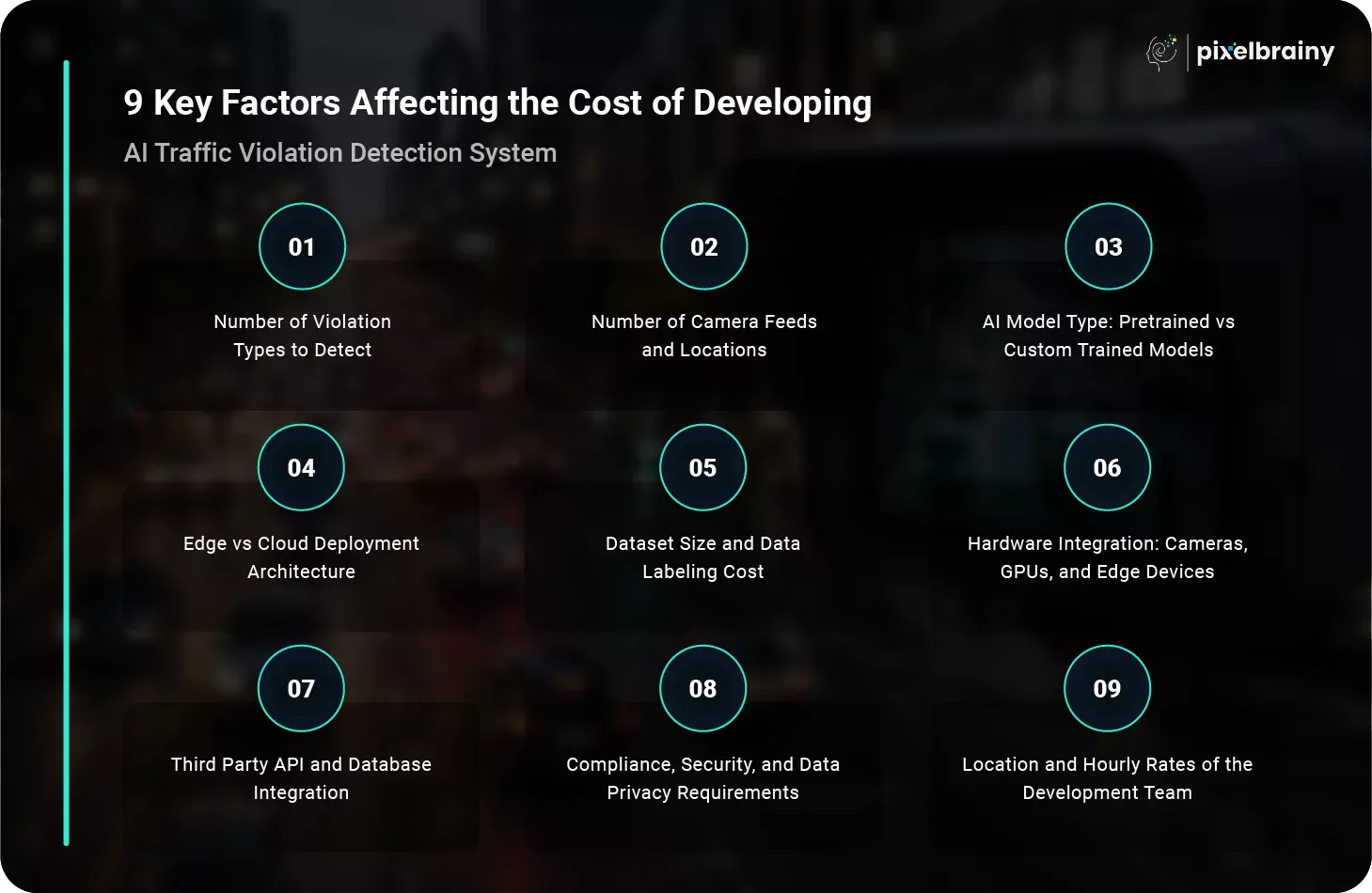
The following are the most important factors affecting AI traffic violation detection system development cost.
| Factor | Cost Influence | Description |
|---|---|---|
| Number of Violation Types | Low to High | More violations require additional AI development |
| Number of Camera Feeds and Locations | Medium to High | Expanding locations increases integration efforts |
| AI Model Type | Medium to High | Custom models cost more than pretrained models |
| Edge vs Cloud Deployment | Medium to High | Infrastructure decisions affect scalability and expenses |
| Dataset Size and Labeling | Medium to High | Larger datasets improve accuracy but increase costs |
| Hardware Integration | Medium to High | Cameras, GPUs, and edge devices add implementation expenses |
| Third Party Integrations | Medium | APIs and database connectivity require additional development |
| Compliance and Security | Medium | Regulatory adherence demands extra investment |
| Development Team Location | Low to High | Regional rates significantly influence project budgets |
The number of traffic offenses your platform must identify directly impacts development complexity.
A system designed to detect only red-light jumping is significantly less expensive than one capable of identifying:
Each violation requires separate detection logic, testing scenarios, and optimization.
Estimated Cost Impact:
One of the biggest contributors to the cost of creating a machine learning traffic violation detection platform is the deployment scale.
Monitoring five intersections differs greatly from handling hundreds of camera streams across multiple cities.
Additional feeds require:
Estimated Cost Impact:
The choice of computer vision architecture significantly influences the budget.
Common frameworks include:
Benefits include:
Organizations with unique road conditions often require specialized training using:
Benefits include:
Estimated Cost Impact:
Deployment architecture determines how traffic footage is processed.
Advantages:
Challenges:
Advantages:
Challenges:
Estimated Cost Impact:
AI systems perform only as well as the data used to train them.
Dataset preparation involves:
Tier 2 cities often require local datasets due to unique traffic conditions.
Estimated Cost Impact:
Hardware compatibility plays a critical role in project success.
Integration may involve:
Legacy infrastructure often increases implementation efforts.
Estimated Cost Impact:
Modern traffic enforcement platforms rarely function in isolation.
They commonly integrate with:
These integrations require secure API development and testing.
Estimated Cost Impact:
Security requirements continue to evolve as governments strengthen regulations around surveillance data.
Areas requiring investment include:
Ignoring compliance can result in operational and legal challenges.
Estimated Cost Impact:
The geographical location of your technology partner has a major impact on overall project expenses.
This is one of the most overlooked AI traffic monitoring software development cost factors.
| Region | Average Hourly Rate |
|---|---|
| India | $25 to $60 |
| Eastern Europe | $40 to $90 |
| Western Europe | $80 to $150 |
| United States | $100 to $200+ |
For startups without an internal engineering team, outsourcing to experienced AI development firms in cost efficient regions can significantly reduce expenses without compromising quality.
For founders evaluating what affects the budget of building a computer vision traffic system, the final investment is rarely determined by a single element.
Understanding these factors affecting AI traffic violation detection system development cost enables organizations to make informed decisions, select the right technology stack, and prioritize investments strategically. By evaluating each component individually, businesses can accurately forecast the cost of creating a machine learning traffic violation detection platform and build a solution that aligns with both market demand and long-term growth objectives.

Many articles discussing the budget for developing an AI traffic surveillance system focus only on the initial development investment. They highlight AI models, dashboards, camera integrations, and deployment costs, but often overlook the expenses that emerge after the system goes live.
This is exactly where many organizations underestimate the true investment required.
Consider this scenario:
"We budgeted $120,000 to build our AI traffic violation detection platform and successfully launched it across multiple intersections. Six months later, we started facing new expenses related to AI model updates, cloud hosting, data labeling, API subscriptions, and hardware maintenance. We realized the original estimate covered development but not the actual cost of operating the system long term. What hidden costs should organizations prepare for before launching an AI traffic enforcement solution?"
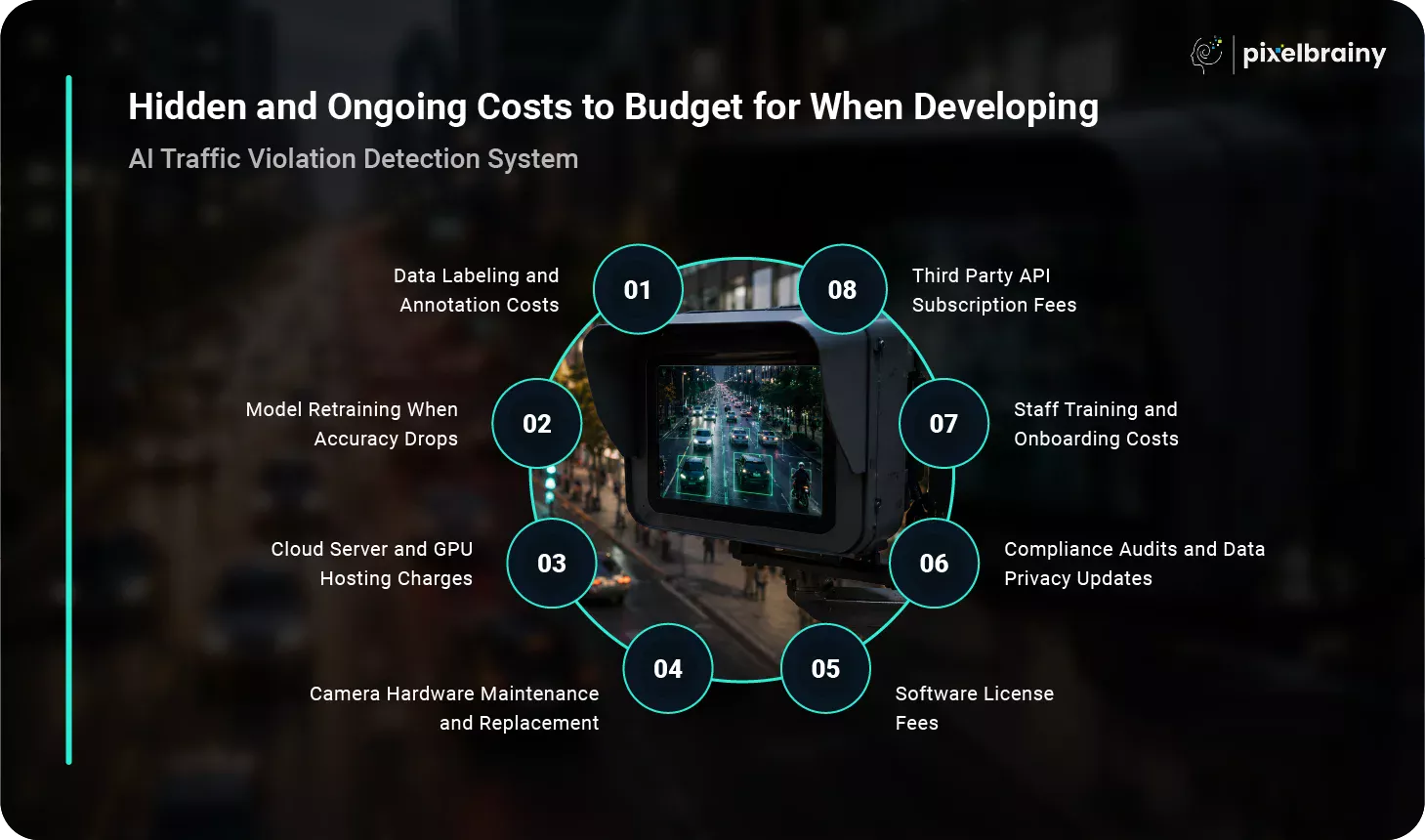
The reality is that the total budget for developing and maintaining AI traffic enforcement system extends well beyond the initial build phase. Ignoring these recurring expenses can strain operational budgets and reduce the long-term effectiveness of the platform.
| Hidden Cost Category | Frequency | Estimated Annual Cost |
|---|---|---|
| Data Labeling and Annotation | Ongoing | $5,000 to $30,000 |
| AI Model Retraining | Quarterly or Annual | $10,000 to $40,000 |
| Cloud Server and GPU Hosting | Monthly | $6,000 to $50,000 |
| Camera Maintenance and Replacement | Annual | $3,000 to $20,000 |
| Software License Fees | Annual | $2,000 to $15,000 |
| Compliance Audits and Privacy Updates | Annual | $5,000 to $20,000 |
| Staff Training and Onboarding | As Needed | $2,000 to $10,000 |
| Third Party API Subscriptions | Monthly or Annual | $1,000 to $12,000 |
Traffic conditions evolve over time. New vehicle types, changing weather conditions, and varying road patterns require fresh training data to maintain detection accuracy.
Ongoing annotation activities include:
These expenses represent one of the most overlooked hidden costs of building AI traffic violation detection system projects.
Even highly accurate models experience performance degradation.
Changes such as:
can reduce detection accuracy.
Regular retraining helps maintain optimal performance and minimizes false positives.
Most AI powered traffic systems rely on cloud infrastructure for:
As the number of intersections and camera feeds grows, hosting expenses increase accordingly.
This becomes a significant component of the ongoing maintenance cost of AI traffic monitoring software.
Cameras operate continuously in challenging outdoor environments.
Routine expenses may include:
Failure to account for these costs can negatively impact system reliability.
Some organizations utilize commercial tools and enterprise software to accelerate development and operations.
These may include:
Annual renewals should be incorporated into long term planning.
Traffic surveillance systems process sensitive information and must comply with evolving regulations.
Organizations may need to invest in:
These requirements are often ignored during the initial estimation process and later emerge as unexpected expenditures.
Technology adoption extends beyond deployment.
Operational teams require training to:
Periodic onboarding becomes necessary as teams expand or responsibilities change.
Modern traffic enforcement platforms frequently rely on external services, including:
Subscription based pricing models can add recurring operational expenses throughout the system lifecycle.
A practical guideline followed by many organizations is:
Annual Maintenance Budget = 15% to 25% of Initial Development Cost
For example:
| Initial Development Cost | Estimated Annual Maintenance Budget |
|---|---|
| $50,000 | $7,500 to $12,500 |
| $100,000 | $15,000 to $25,000 |
| $200,000 | $30,000 to $50,000 |
| $300,000 | $45,000 to $75,000 |
Understanding what are the hidden development budget of AI traffic violation detection software enables businesses, startups, and public sector organizations to avoid budget shortfalls after deployment. A platform that appears affordable during procurement can become financially challenging if recurring expenses are ignored.
When evaluating the total budget for developing and maintaining AI traffic enforcement system, decision makers should look beyond development estimates and adopt a lifecycle perspective. By planning for these ongoing obligations from the beginning, organizations can build a sustainable, high performing solution while accurately forecasting the true ongoing maintenance cost of AI traffic monitoring software over the years ahead.
For many organizations, the biggest challenge is not deciding whether to adopt AI powered traffic enforcement technology. The real challenge is figuring out how to make the investment financially viable without sacrificing system quality, detection accuracy, or future scalability.
Startups entering the intelligent transportation space often operate with limited funding. Smart city authorities face strict procurement budgets. Even established enterprises are expected to justify every technology expense with measurable outcomes. In all these situations, the objective remains the same: maximize value while minimizing unnecessary spending.
A common concern raised by decision makers is:
"How can I reduce the development cost of an AI traffic violation detection system without losing quality?"
The answer lies in making strategic choices during planning, development, and deployment. Rather than cutting corners, organizations should focus on eliminating avoidable expenses and prioritizing investments that directly contribute to performance and business goals.
If the estimated project budget falls between $50,000 and $300,000+, the following approaches can help reduce costs by 20% to 50% while maintaining a high-quality solution.
| Strategy | Typical Savings | How It Helps? |
|---|---|---|
| Start with an MVP | $20,000 to $80,000 | Avoids building unnecessary features |
| Use Open-Source Frameworks | $5,000 to $25,000 annually | Eliminates software licensing costs |
| Fine Tune Pretrained Models | $10,000 to $40,000 | Reduces AI training expenses |
| Begin with Cloud Deployment | $15,000 to $50,000 | Delays expensive hardware purchases |
| Outsource to Cost Efficient Regions | 30% to 60% lower costs | Reduces development expenses |
| Reuse Existing CCTV Infrastructure | $10,000 to $100,000+ | Avoids new hardware investments |
| Use Auto Labeling Tools | $5,000 to $20,000 | Lowers annotation costs |
| Adopt Agile Development | 10% to 25% savings | Minimizes rework and scope creep |
Launching with a Minimum Viable Product allows businesses to validate their idea before committing to enterprise scale investments.
Instead of developing every possible capability, focus initially on high priority features such as:
Advanced analytics and large scale deployment capabilities can be introduced later.
Potential Cost Reduction: An enterprise implementation estimated at $180,000 to $250,000 can often begin as an MVP costing $60,000 to $100,000, resulting in savings of $80,000 to $150,000.
Also Read: Top 10 AI MVP Development Companies in USA
Open-source technologies provide powerful capabilities without expensive licensing fees.
Widely adopted frameworks include:
These technologies support enterprise grade applications while reducing recurring costs.
Potential Cost Reduction: Organizations can save $5,000 to $25,000 annually by avoiding proprietary software licenses.
Building computer vision models from scratch requires substantial investment in data collection, GPU infrastructure, and engineering expertise.
A more efficient alternative is to fine tune pretrained models using project specific datasets.
Benefits include:
Potential Cost Reduction: AI model development costs of $30,000 to $60,000 can often be reduced to $10,000 to $20,000, generating savings of $20,000 to $40,000.
While edge devices offer real time processing benefits, they also involve significant upfront costs.
Cloud deployment enables organizations to scale gradually and pay only for resources they use.
Advantages include:
Potential Cost Reduction: Businesses can postpone hardware expenditures of $20,000 to $60,000, reducing initial spending by approximately $15,000 to $50,000.
Development costs vary considerably across global markets.
| Region | Average Hourly Rate |
|---|---|
| India | $25 to $60 |
| Eastern Europe | $40 to $90 |
| United States | $100 to $200+ |
Collaborating with experienced AI development teams in regions with competitive pricing can significantly improve cost efficiency.
Potential Cost Reduction: Organizations may lower project expenses by 30% to 60%, equivalent to savings of $40,000 to $120,000.
Existing surveillance systems can often support AI based traffic monitoring with minimal upgrades.
Reusing available infrastructure reduces:
Potential Cost Reduction: Savings can range from $10,000 to more than $100,000, depending on the scale of deployment.
Preparing training datasets through manual labeling can consume both time and budget.
Auto labeling tools accelerate this process by generating annotations that human reviewers can verify and refine.
Benefits include:
Potential Cost Reduction: Annotation expenses of $15,000 to $30,000 can often be reduced by $5,000 to $20,000.
Rigid development processes frequently lead to changing requirements and costly revisions.
Agile methodologies help teams:
This approach minimizes investment in low priority functionality.
Potential Cost Reduction: Agile execution can reduce project costs by 10 percent to 25 percent, representing savings of $10,000 to $50,000 on larger implementations.
Build in phases, not all at once, to control your development budget.
Organizations that validate their solution through smaller deployments before expanding city wide often achieve better financial outcomes. A phased strategy reduces risk, improves resource allocation, and enables future investments based on proven results.
Implementing a budget-friendly AI traffic monitoring system development strategy is not about choosing the lowest bidder or compromising on quality. It is about making informed decisions that eliminate unnecessary costs while preserving long term value.
By adopting these practices, businesses can identify the cost-effective way to build computer vision traffic enforcement software, optimize resource utilization, and significantly reduce the how to reduce cost of developing AI traffic violation detection system challenge without affecting performance, reliability, or scalability.

One of the most important decisions organizations face before investing in an AI powered traffic enforcement solution is whether to build a custom platform from scratch or purchase a ready-made system from an existing vendor.
At first glance, off-the shelf solutions appear to be the more affordable option. They promise faster deployment, predefined features, and lower upfront investment. However, many businesses, startups, and smart city authorities eventually discover that generic platforms often struggle to accommodate local traffic conditions, regulatory requirements, and integration needs.
On the other hand, custom development requires a higher initial investment but offers greater flexibility, ownership, and long-term value.
The right choice depends on your business goals, deployment scale, and future growth plans.
| Comparison Factor | Custom Build | Ready-made Solution |
|---|---|---|
| Initial Investment | $50,000 to $300,000+ | $10,000 to $80,000 |
| Deployment Time | 4 to 12 months | 2 to 8 weeks |
| Customization Level | Extensive | Limited |
| Ownership of Source Code | Full ownership | Vendor controlled |
| AI Model Flexibility | High | Restricted |
| Integration Capability | Tailored integrations | Limited compatibility |
| Scalability | Designed for future expansion | Depends on vendor roadmap |
| Recurring Fees | Maintenance only | Subscription and licensing costs |
| Competitive Advantage | Unique solution | Similar to competitors |
| Long Term Cost Efficiency | Higher ROI over time | Can become expensive |
| Data Control | Full control | Shared or vendor dependent |
| Vendor Lock In Risk | Minimal | High |
Ready-made platforms are often suitable for organizations that need a quick implementation and have relatively standard requirements.
These solutions are ideal when:
Most vendors offer pricing models such as:
Although the initial expense is lower, costs can increase over time due to licensing renewals, user-based pricing, and feature upgrades.
Custom development is often the preferred option for smart city authorities, startups building SaaS products, and enterprises seeking long term differentiation.
A custom solution is recommended when:
The investment generally falls into the following categories:
| Custom Development Type | Estimated Cost |
|---|---|
| Basic MVP Solution | $50,000 to $80,000 |
| Advanced Production Platform | $80,000 to $150,000 |
| Enterprise Grade Deployment | $150,000 to $300,000+ |
While the upfront investment is higher, organizations gain complete control over features, architecture, and future enhancements.
Understanding these factors provides a clearer picture of the total investment required over the solution's lifecycle.
For short term projects with standardized requirements, off-the shelf systems can offer a faster route to deployment and lower entry costs.
However, for organizations seeking scalability, flexibility, and competitive advantage, custom development typically delivers stronger long-term returns.
For example, a municipality deploying traffic monitoring at five intersections may benefit from a ready-made platform initially. In contrast, a startup launching a traffic enforcement SaaS product or a smart city authority planning city wide expansion often gains greater value from a custom solution designed around specific operational needs.
There is no universal answer because every organization's priorities differ.
Choose a ready-made AI traffic violation detection system if your goal is rapid deployment with minimal upfront investment and standard functionality.
Choose a custom AI traffic violation detection system if you require specialized features, deeper integrations, ownership of the technology, and the ability to scale without restrictions.
Ultimately, evaluating both immediate expenses and long-term operational implications will help organizations select the option that aligns with their strategic objectives, budget constraints, and future growth ambitions. In many cases, the lowest upfront price does not always translate into the lowest total cost of ownership.
As investments in smart mobility and intelligent transportation continue to grow, businesses need AI solutions that are not only accurate and scalable but also cost efficient. However, many organizations struggle to find technology partners that can balance innovation with budget constraints.
This is where PixelBrainy can make a difference.
PixelBrainy specializes in developing custom AI traffic violation detection systems tailored to specific operational requirements. Instead of offering generic solutions, the team focuses on building computer vision platforms that align with existing infrastructure, business goals, and future scalability plans.
Whether you need to detect parking violations, lane violations, signal jumping, over speeding, or automate e challan generation, PixelBrainy a leading AI development company, helps organizations build intelligent traffic enforcement solutions without unnecessary development expenses.
PixelBrainy helps businesses:
A common question from businesses entering this space is:
"I am a product manager at a proptech company expanding into smart parking and traffic management. We want to develop an AI module for detecting parking violations, lane violations, and signal jumping using edge cameras. What would the cost range be for an MVP and a full production build, and which company can develop it within budget?"
The answer depends on project complexity, but the typical cost ranges are:
| Solution Type | Estimated Cost | Suitable For |
|---|---|---|
| MVP AI Traffic Violation Detection System | $50,000 to $80,000 | Pilot projects and startups |
| Production Ready Platform | $80,000 to $150,000 | City level deployments |
| Enterprise Solution | $150,000 to $300,000+ | Large scale implementations |
PixelBrainy prioritizes core features first, helping businesses launch quickly and validate market demand before expanding.
The team leverages proven frameworks such as YOLO, OpenCV, TensorFlow, and PyTorch to reduce licensing costs while maintaining performance.
Whenever possible, existing CCTV systems and edge cameras are reused to avoid unnecessary hardware investments.
Regular feedback cycles minimize rework, improve transparency, and keep projects within budget.
Solutions are designed to grow from pilot deployments to enterprise scale without requiring complete redevelopment.
By partnering with PixelBrainy, organizations gain:
Building a reliable AI traffic violation detection system does not have to mean overspending. With the right strategy and an experienced development partner, businesses can create a high performing, scalable, and budget conscious traffic enforcement platform that delivers long term value. PixelBrainy helps turn that vision into reality while keeping development costs aligned with business objectives.

Understanding the true AI traffic violation detection system development cost is essential before investing in intelligent traffic enforcement technology. From selecting the right deployment model and AI architecture to accounting for hidden expenses and long-term maintenance, every decision directly impacts the final budget. While the cost of developing an AI traffic violation detection system typically ranges from $50,000 to $300,000+, the actual investment depends on factors such as violation types, camera integrations, infrastructure requirements, customization needs, and scalability goals.
Whether you are a startup building a SaaS platform, a smart city vendor preparing a government proposal, or an enterprise modernizing traffic operation, strategic planning can help you optimize the development cost of AI-based traffic enforcement software without compromising quality. Starting with an MVP, leveraging proven technologies, and partnering with experienced AI specialists can significantly improve return on investment.
Ready to estimate the budget for your AI traffic violation detection project? Book an appointment with PixelBrainy today and get a tailored cost consultation to build a scalable, high-performance solution within your budget.
The AI traffic violation detection system development cost generally ranges from $50,000 to $300,000+, depending on the scope and complexity of the project. A basic MVP with limited violation detection capabilities can cost between $50,000 and $80,000, while a production ready system may require $80,000 to $150,000. Large scale enterprise deployments involving multiple intersections, advanced analytics, edge computing, and government integrations can exceed $300,000.
Several factors determine the final investment required. These include the number of traffic violations the system must detect, the volume of camera feeds and deployment locations, the complexity of the AI models, cloud or edge deployment preferences, dataset collection and annotation requirements, third party integrations, security and compliance needs, and the location of the development team. Understanding these variables helps organizations estimate the budget more accurately and avoid unexpected expenses.
The development timeline depends on the features and deployment scale. A basic MVP typically takes 5 to 8 weeks to complete. An advanced production ready platform may require 9 to 12 weeks, while enterprise grade solutions designed for city wide or multi city deployments can take 13 to 16 weeks or more. Proper planning and agile development practices can help accelerate delivery without compromising quality.
The right approach depends on your business objectives. Ready-made solutions offer faster implementation and lower upfront costs, making them suitable for organizations with standard requirements. However, custom development provides greater flexibility, ownership, scalability, and the ability to tailor the platform to specific road infrastructure and operational workflows. Although the initial investment may be higher, custom solutions often deliver better long-term value and return on investment.
Beyond the initial development budget, organizations should prepare for recurring operational expenses. The ongoing maintenance cost usually accounts for 15% to 25% of the original development cost each year. These expenses may include AI model retraining, cloud and GPU hosting, software updates, security enhancements, technical support, camera maintenance, compliance audits, and subscription fees for third party APIs or government database integrations.
Yes. Most modern AI traffic violation detection systems can be integrated with existing CCTV networks, ANPR cameras, and e challan platforms. Reusing available infrastructure is one of the most effective ways to optimize costs, as it reduces hardware procurement and installation expenses. This approach enables organizations to implement intelligent traffic enforcement capabilities while keeping the overall investment within budget.

About The Author
Sagar Bhatnagar
Sagar Sahay Bhatnagar brings over a decade of IT industry experience to his role as Marketing Head at PixelBrainy. He's known for his knack in devising creative marketing strategies that boost brand visibility and market influence. Sagar's strategic thinking, coupled with his innovative vision and focus on results, sets him apart. His track record of successful campaigns proves his ability to utilize digital platforms effectively for impactful marketing efforts. With a genuine passion for both technology and marketing, Sagar continuously pushes PixelBrainy's marketing initiatives to greater success.


Transform your ideas into reality with us.
Working with the PixelBrainy team has been a highly positive experience. They understand the design requirements and create beautiful UX elements to meet the application needs. The dev team did an excellent job bringing my vision to life. We discussed usability and flow. Sagar worked with his team to design the database and begin coding. Working with Sagar was easy. He has the knowledge to create robust apps, including multi-language support, Google and Apple ID login options, Ad-enabled integrations, Stripe payment processing, and a Web Admin site for maintaining support data. I'm extremely satisfied with the services provided, the quality of the final product, and the professionalism of the entire process. I highly recommend them for Android and iOS Mobile Application Design and Development.

Great experience working with them. Had a lot of feedback and I found that unlike most contractors they were bugging me for updates instead of the other way around. They were extremely time conscience and great at communicating! All work was done extremely high quality and if not on time, early! They were always proactive when it comes to communication and the work is great/above par always. Very flexible and a great team to work with! Goes above and beyond to present us with multiple options and always provides quality. Amazing work per usual with Chitra. If you have UI/UX or branding design needs I recommend you go to them! Will likely work with them in the future as well, definitely recommended!

PixelBrainy is a joy to work with and is a great partner when thinking through branding, logo, and website layout. I appreciate that they spend time going into the "why" behind their decisions to help inform me and others about industry best practices and their expertise.

I hired them to design our software apps. Things I really like about them are excellent communication skills, they answer all project suggestions and collaborate right away, and their input on design and colors is amazing. This project was complex and needed patience and creativity. The team is amazing to do business with. I will be using them long-term. Glad to see there are some good people out there. I was afraid to try and outsource my project to someone but I am glad I met them! I really can't say enough. They went above and beyond on this project. I am very happy with everything they have done to make my business stand out from the competition.

It was great working with PixelBrainy and the team. They were very responsive and really owned the project. We'll definitely work with them again!

I recently worked with the PixelBrainy team on a project and I was blown away by their communication skills. They were prompt, clear, and articulate in all of our interactions. They listened and provided valuable feedback and suggestions to help make the project a success. They also kept me updated throughout the entire process, which made the experience stress-free and enjoyable.

PixelBrainy is very good at what it does. The team also presents themselves very professionally and takes care of their side of things very well. I could fully trust them taking up the design work in a timely and organised manner and their attention to detail saved us lots of effort and time. This particular project was quite intense and the team showed that they function very well under pressure. Very much looking forward to working with her again!

It's always an absolute pleasure working with them. They completed all of my requests quickly and followed every note I had for them to a T, which made our process go smoothly from start to finish. Everything was completed fast and following all of the guidelines. And I would recommend their services to anyone. If you need any design work done in the future, PixelBrainy should be your first call!

They took ownership of our requirements and designed and proposed multiple beautiful variants. The team is self-motivated, requires minimum supervision, committed to see-through designs with quality and delivering them on time. We would definitely love to work with PixelBrainy again when we have any requirements.

PixelBrainy was a big help with our SaaS application. We've been hard at work with a new UI/UX and they provided a lot of help with the designs. If you're looking for assistance with your website, software, or mobile application designs, PixelBrainy and the team is a great recommendation.

PixelBrainy designers are amazing. They are responsive, talented, and always willing to help craft the design until it matches your vision. I would recommend them and plan to continue them for my future projects and more!!!

They were awesome! Did a good job fast, and good communication. Will work with them again. Thank you

Creative, detail-oriented, and talented designers who take direction well and implement changes quickly and accurately. They consistently over-delivered for us.

PixelBrainy team is very talented and creative. Great designers and a pleasure to work with. PixelBrainy is an excellent communicator and I look forward to working with them again.

PixelBrainy has a very talented design team. Their work is excellent and they are very responsive. I enjoy working with them and hope to continue on all of our future projects.


