AI Summary Powered by PixelBrainy
Imagine a world where your digital presence can not only look like you but also think, act, and interact based on your real-world data. This is the promise of AI Digital Twin Avatar Generation Platforms, which are transforming industries by merging the power of digital twins with lifelike AI avatars. Organizations across healthcare, education, customer service, and entertainment are racing to embrace this innovation because it unlocks new ways to connect with users, optimize processes, and create deeply personalized experiences.
In this guide, we explore how to develop an AI Digital Twin Avatar Generator Platform that is both scalable and future-ready. From core concepts to real-world applications, you will learn about the AI Digital Twin Avatar Generation Platform Development process, the technology stack, and the step-by-step roadmap for successful execution.
For businesses, the building of AI Digital Twin Avatar Generator Platform solutions offers a powerful competitive advantage. They allow companies to simulate outcomes, deliver 24/7 personalized engagement, and humanize data through interactive avatars. Whether you want to create a Digital Twin Avatar Generation Platform With AI for customer service, healthcare innovation, or immersive training, this guide will show you the essentials.
Our target audience includes business leaders exploring digital transformation, CTOs and product managers evaluating development strategies, and AI enthusiasts who want to understand the technical and market landscape.
By the end of this guide, you will have a clear understanding of what it takes to build and deploy a robust AI Digital Twin Avatar Generator Platform that drives long-term business value.
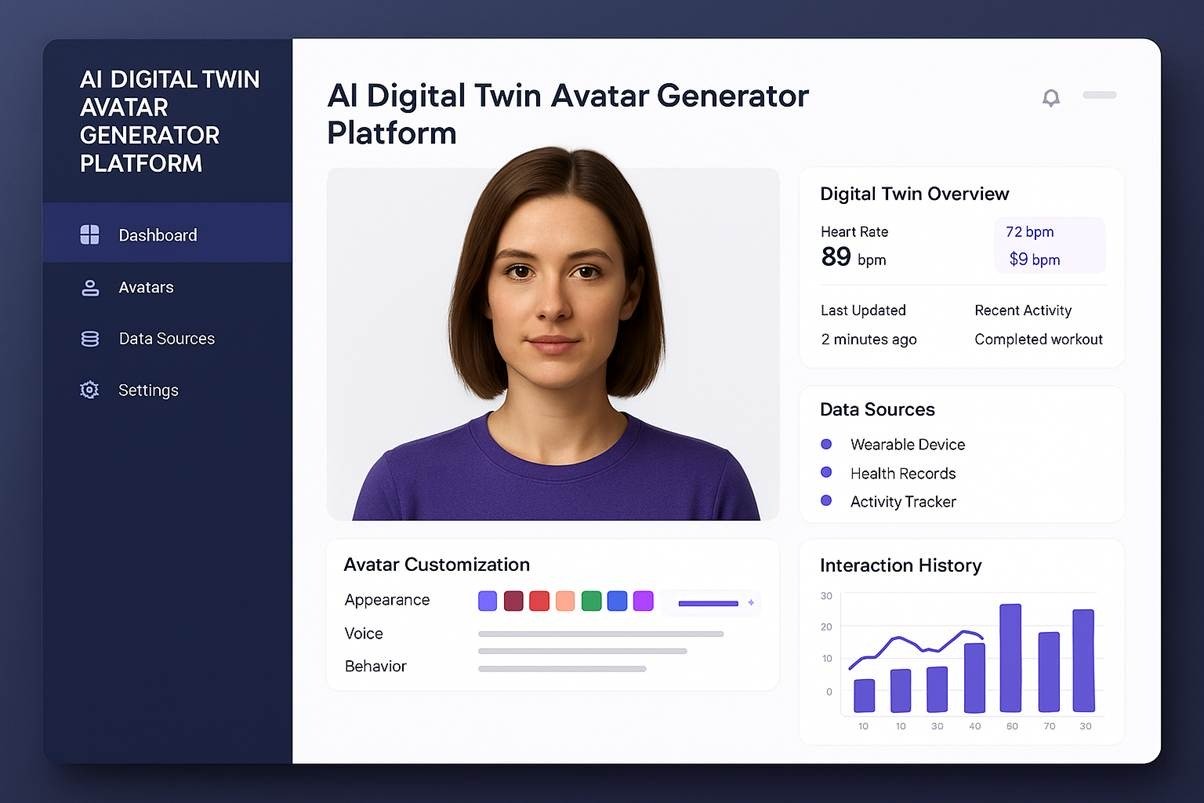
An AI Digital Twin Avatar Generator Platform is a technology framework that brings together three powerful innovations: digital twins, AI, and avatar generation. To understand its value, it is important to break down these components.
A digital twin is a virtual replica of a real-world entity such as a person, a machine, or even an entire process. This twin continuously updates itself using real-time data from sensors, devices, or software systems. For example, in healthcare, a patient’s digital twin might reflect their current heart rate, medical history, and wellness patterns.
An avatar is a digital persona that represents an individual or a brand in an interactive format. Traditional avatars have often been static images or simple animated characters, but with AI, they have evolved into lifelike, expressive, and conversational digital humans.
The AI Digital Twin Avatar Generator Platform merges these two concepts. It allows businesses and individuals to generate avatars that are not only visually realistic but also dynamically connected to live data through digital twins. This means the avatar is no longer a static representation but an intelligent, data-driven companion capable of conversation, prediction, and decision support.
For example, in customer service, an avatar generated on such a platform can access live inventory or user profiles and interact naturally with customers as if it were a real representative. In fitness, an athlete’s digital twin avatar could offer real-time feedback on training performance.
In simple terms, this platform creates an interactive bridge between physical and digital worlds, enabling businesses to deliver personalized, human-like, and data-informed experiences at scale.
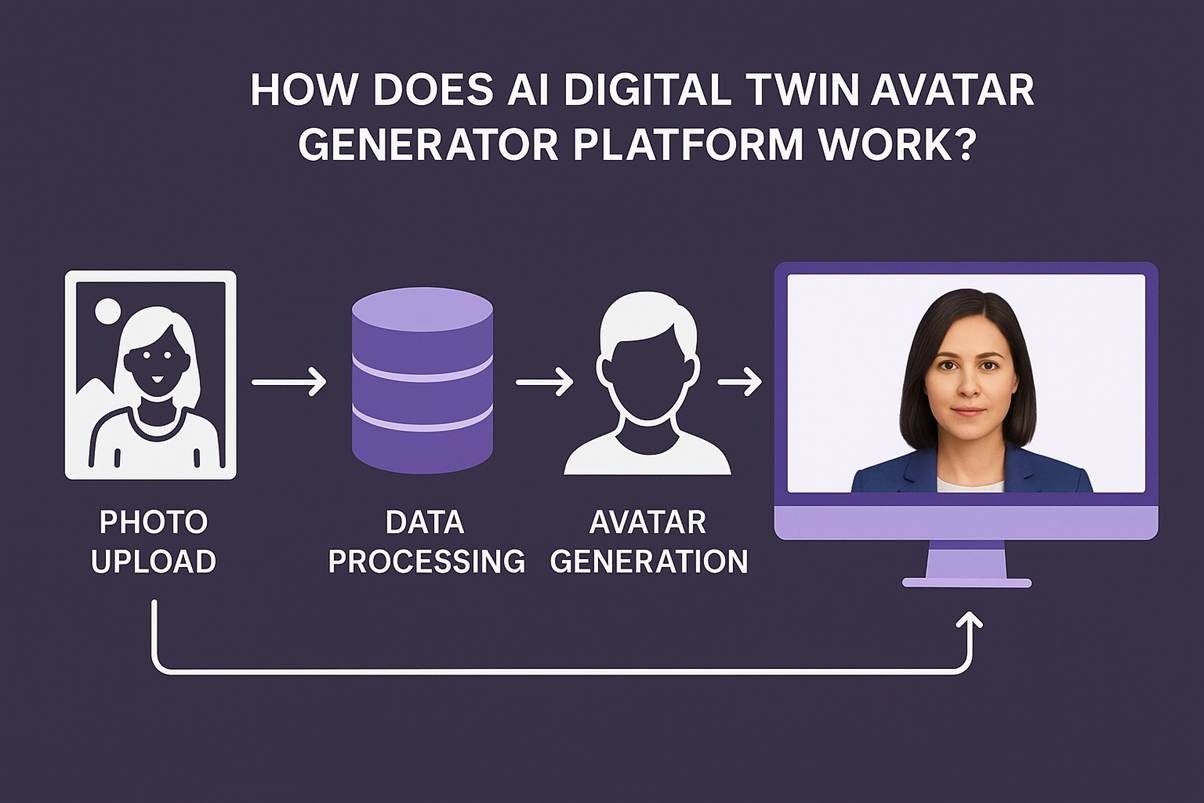
The working of an AI Digital Twin Avatar Generator Platform involves a seamless integration of data, artificial intelligence, and visualization technologies. The process begins by collecting real-world data from various sources such as IoT devices, health trackers, enterprise systems, and user inputs like photos or voice samples. This data is then processed into a digital twin, which acts as a real-time virtual model of the person, object, or system being mirrored.
Next, the platform leverages its AI engine to interpret and enrich this twin with intelligence. Natural Language Processing enables conversational abilities, predictive analytics helps forecast outcomes, and machine learning adapts the avatar’s behavior over time. This ensures that the avatar is not only realistic but also context-aware and capable of meaningful interaction.
Once the AI has processed the data, the avatar generator layer transforms the digital twin into a lifelike, interactive 2D or 3D avatar. This includes visual rendering, voice synthesis, and customizable features such as expressions, appearance, and communication style.
Finally, the user engages with the avatar across multiple platforms including websites, mobile apps, AR/VR headsets, or enterprise systems. The avatar communicates insights, assists with decision-making, and personalizes the interaction based on the underlying digital twin data.
In short, the platform works as a bridge that translates real-world information into engaging, intelligent digital interactions, creating a continuous loop of data, intelligence, and user experience.
Businesses are under pressure to deliver more personalized and efficient digital experiences. An AI Digital Twin Avatar Generator Platform provides exactly that by combining real-world data with lifelike, interactive avatars. It is not just another chatbot but a system that learns, adapts, and builds trust with users through intelligent conversations and real-time insights.
The momentum behind this technology is growing quickly. According to Precedence Research, the global AI avatar market is expected to expand from USD 9.78 billion in 2025 to USD 118.55 billion by 2034, reflecting a CAGR of nearly 32 percent. This trend signals that companies investing in these platforms today are preparing themselves for a future where digital twins and avatars become mainstream.
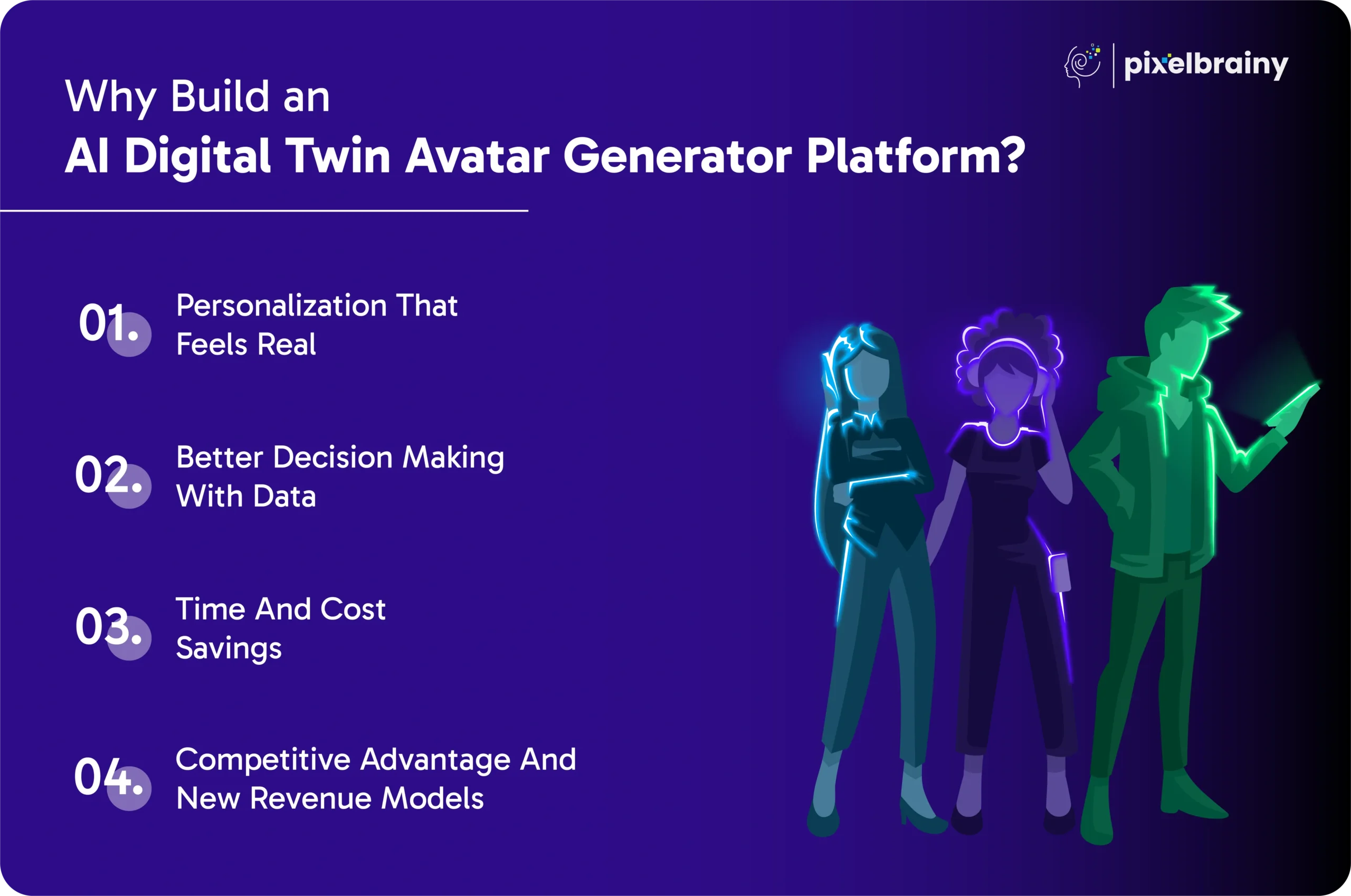
Customers no longer want generic responses. They want experiences that feel authentic and tailored to their individual needs. Imagine a retail platform where the avatar not only recognizes returning customers but also remembers their preferences, past purchases, and browsing patterns. Instead of pushing random products, the avatar makes thoughtful recommendations, guiding the shopper like a real store assistant.
In healthcare, personalization could mean an avatar that communicates a patient’s health progress. Instead of static dashboards filled with confusing charts, patients can interact with an avatar that explains test results, provides reminders, and encourages healthy habits. This brings data to life in a way that people can relate to.
The true power of a digital twin avatar lies in its ability to collect and analyze real-world information. Every interaction feeds the system, making the avatar smarter and more capable over time. For businesses, this becomes a goldmine of insights. You can learn what customers struggle with, what products are most in demand, or which processes need improvement.
For example, in manufacturing, a machine’s digital twin avatar could show operators real-time performance data, predict potential breakdowns, and recommend preventive actions. This shifts the approach from reactive problem-solving to proactive decision-making, saving both time and money.
Customer support is a major expense for most organizations, but it is also critical to customer satisfaction. An AI digital twin avatar can manage high volumes of queries 24/7, providing immediate answers to common questions and escalating complex issues to human agents when needed.
This reduces waiting times for customers while freeing up staff to focus on specialized or high-value tasks. Over time, this combination of automation and efficiency translates to measurable cost savings and happier customers.
Being among the first in your industry to embrace AI-driven avatars can establish your brand as a leader in innovation. While competitors may still rely on static chatbots or conventional customer service, your business could deliver dynamic, human-like interactions that leave a lasting impression.
Beyond customer engagement, there are opportunities to build entirely new revenue streams. For instance, companies could develop premium avatar services tailored to enterprise clients, sell branded avatars for use in marketing campaigns, or even create subscription-based experiences within the metaverse. This flexibility makes the platform not just a cost-saving tool but a revenue-generating engine.
So, these platforms are quickly becoming more than experiments, they are turning into practical tools that help companies stay ahead.
AI Digital Twin Avatar Generator Platforms are starting to move from concept to practice. Many industries are experimenting with them as they look for ways to provide personalized experiences, improve efficiency, and reduce costs.
These platforms blend data, intelligence, and lifelike avatars, making them powerful tools for business transformation. Below are some of the top use cases where the technology is already showing real value.
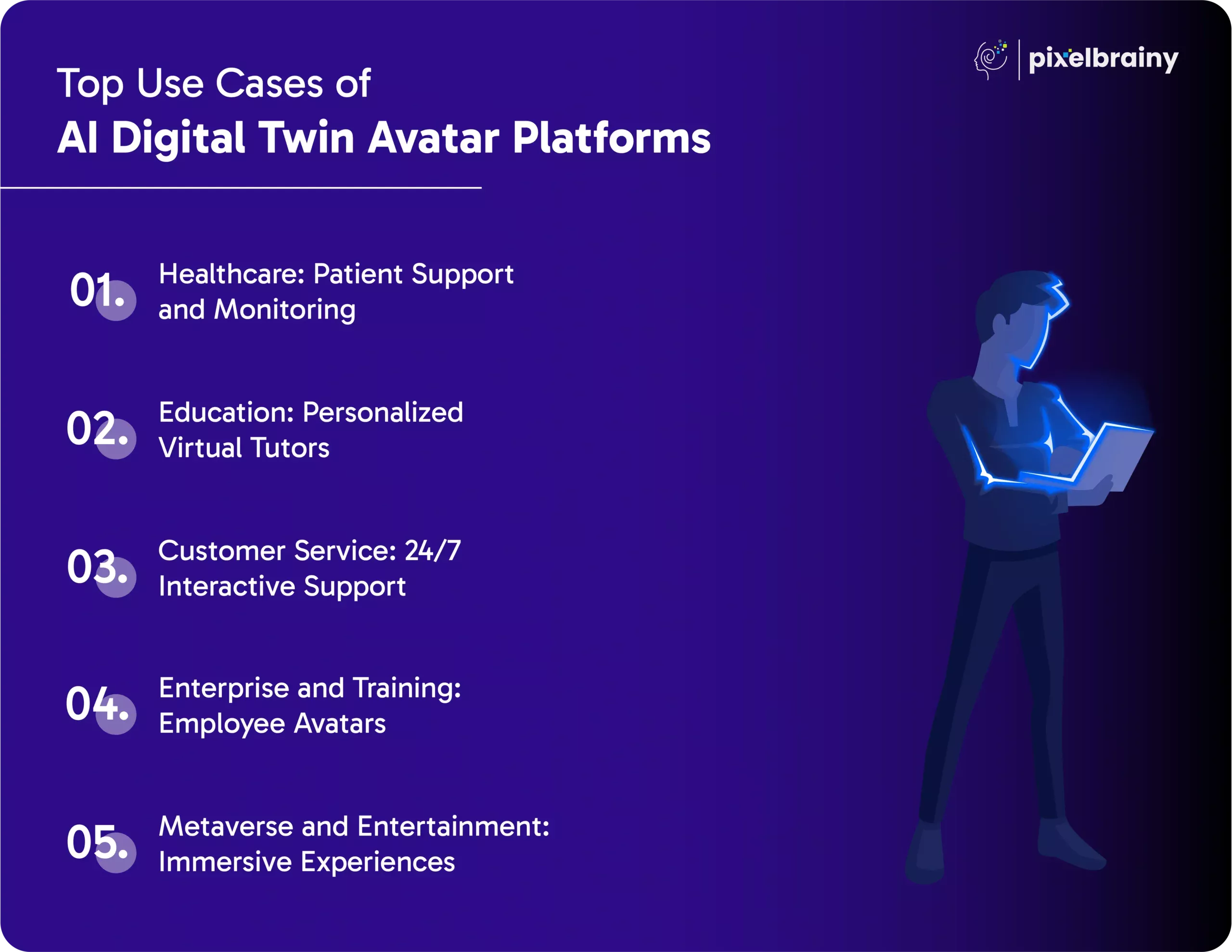
In healthcare, these platforms can turn complex medical data into simple conversations. Instead of forcing patients to interpret charts or technical terms, an avatar can explain test results, give medicine reminders, and even provide lifestyle suggestions. Hospitals and research centers, like Mayo Clinic, are already working with digital twin simulations to improve personalized care, and avatars make that information much easier for patients to understand.
How It Helps
Education is another area where AI Digital Twin Avatar Generator Platforms are proving useful. Imagine a digital tutor that adjusts lessons based on how fast a student learns, where they struggle, and what motivates them. Instead of one-size-fits-all video lectures, avatars can give personalized explanations and encouragement. Adaptive learning tools such as those from Carnegie Learning could become far more engaging when paired with human-like avatars.
How It Helps
Customer service is often the first place people experience AI avatars. Unlike basic chatbots that rely on prewritten answers, an avatar powered by a digital twin can check order history, preferences, and real-time data to deliver a personalized experience. For example, KFC China tested AI avatars to take customer orders and make recommendations, showing how these platforms can create a friendlier and more efficient service.
How It Helps
Inside companies, digital twin avatars are becoming valuable training tools. A new hire can be guided through onboarding by a realistic avatar that knows company policies, systems, and best practices. In high-risk industries like aviation or manufacturing, employees can practice on digital twins of real equipment while guided by avatars, making training safer and more cost-effective.
How It Helps
In the metaverse, avatars are the core of interaction. With digital twin integration, avatars are no longer static characters but living representations of user behavior, achievements, and preferences. In gaming, for instance, an avatar could become stronger or more skilled as the player learns, making the experience more personal. Entertainment companies can also monetize avatars with custom skins, upgrades, and experiences.
How It Helps
So, these use cases prove that AI Digital Twin Avatar Generation Platforms are not just futuristic concepts but practical solutions that are already transforming industries.

The real value of an AI Digital Twin Avatar Generator Platform lies in its features. It is not enough to have an avatar that looks realistic; it needs intelligence, adaptability, and seamless integration with real-world data.
Below are the must-have capabilities that define successful platforms and help businesses deliver personalized, future-ready solutions.
| Feature | Explanation |
| Real-Time Data Integration | A strong platform must connect with IoT devices, enterprise systems, or user data sources in real time. This makes avatars dynamic and ensures they always reflect current states, which is crucial for the creation of AI Digital Twin Avatar Generator Platform that feels alive |
| Advanced 3D Avatar Rendering | Lifelike 2D and 3D models with customizable features allow avatars to feel natural and relatable. Smooth animations, gestures, and expressions create an immersive experience, increasing user trust and engagement |
| Natural Language Processing (NLP) | NLP enables avatars to understand and respond in human-like ways. Beyond answering questions, avatars can adapt tone, context, and even emotions, making conversations feel natural instead of robotic |
| Voice Synthesis and Cloning | Avatars can be equipped with realistic speech that mirrors a person’s voice or brand tone. This enhances user connection and builds stronger identity in interactions. For enterprises, it creates brand consistency |
| Predictive Analytics Engine | A predictive layer makes avatars smarter by analyzing historical data and forecasting outcomes. For example, predicting a customer’s next purchase or suggesting preventive healthcare steps. This is a cornerstone to build AI Digital Twin Avatar Generation Platform that goes beyond surface-level interaction |
| Emotional Intelligence | Avatars with emotional AI can detect mood and adapt responses accordingly. A support avatar could sense frustration in a customer’s tone and respond with empathy, improving satisfaction |
| Multi-Platform Accessibility | Avatars should work seamlessly across mobile, web, AR, and VR environments. This flexibility ensures businesses can meet users wherever they are, without building multiple solutions |
| Security and Compliance | Privacy is critical for Digital Twin Avatar Generation Platform Development Using AI. Features like encrypted communications, consent-based data sharing, and compliance with GDPR or HIPAA help protect sensitive information |
| Continuous Learning | Machine learning allows avatars to improve with every interaction. Over time, they become more accurate in understanding user needs and delivering better responses |
| Integration with Third-Party APIs | A must-have feature to integrate AI Digital Twin Avatar Generator Platform is the ability to connect with CRM, ERP, or external applications. This makes the avatar a true extension of business systems, not just a standalone tool |
These features highlight how AI Digital Twin Avatar Generator Platforms can move beyond simple avatars to become powerful, intelligent companions that add real value to both businesses and users.
Basic features lay the foundation, but advanced capabilities are what set one platform apart from another. To compete in a fast-moving digital landscape, businesses need to go beyond standard avatar creation and data integration. Below are advanced features that can make an AI Digital Twin Avatar Generator Platform truly competitive.
Modern users expect avatars that mirror human detail. Advanced rendering with micro-expressions, skin textures, and natural movement makes avatars more believable. This level of realism builds stronger user trust and engagement, especially in customer-facing industries.
Going beyond basic NLP, context-aware AI can maintain memory of past interactions and adapt its responses accordingly. For example, a customer service avatar can recall a user’s previous complaints and provide continuity in conversations, creating a human-like sense of familiarity.
Integrating generative AI allows avatars to produce new responses, gestures, or even micro-content on the fly. This prevents repetitive conversations and makes interactions feel fresh and unique each time, whether in healthcare consultations or e-learning platforms.
Using computer vision and voice analysis, avatars can recognize emotions like frustration, excitement, or confusion. They can then adapt tone, gestures, or recommendations accordingly. In training scenarios, this helps simulate real-world stress and human reactions.
Advanced platforms can simulate multiple scenarios with digital twins before offering recommendations. For example, in fitness, an avatar could simulate how different diet or workout plans might affect a user’s health, providing predictive guidance rather than reactive advice.
Instead of being limited to one environment, advanced platforms should allow avatars to move seamlessly between web, mobile, AR, VR, and metaverse ecosystems. This ensures a consistent user identity and experience across digital touchpoints.
By using blockchain, avatars can have verifiable digital identities and secure data ownership. This is especially useful in the metaverse, where identity theft and data misuse are concerns. It also allows businesses to build trust by giving users more control over their personal data.
Global businesses need avatars that can communicate across languages and cultural contexts. Advanced AI enables avatars to switch languages smoothly and adapt their communication style to cultural norms, ensuring inclusivity and accessibility for worldwide audiences.
By combining these advanced features, companies can transform AI Digital Twin Avatar Generator Platforms into future-ready solutions that not only meet today’s needs but also anticipate tomorrow’s expectations.
What is the process to build AI Digital Twin Avatar Generator Platform? Many businesses ask this as they explore how to use avatars and digital twins to improve user experiences and efficiency. The answer is a structured approach that moves from idea validation to real-world deployment.
The development of AI Digital Twin Avatar Generator Platform is not just about coding an avatar but creating a living ecosystem where real data, AI, and user interaction all work together. Below is a detailed step-by-step process that outlines how to move from concept to success.
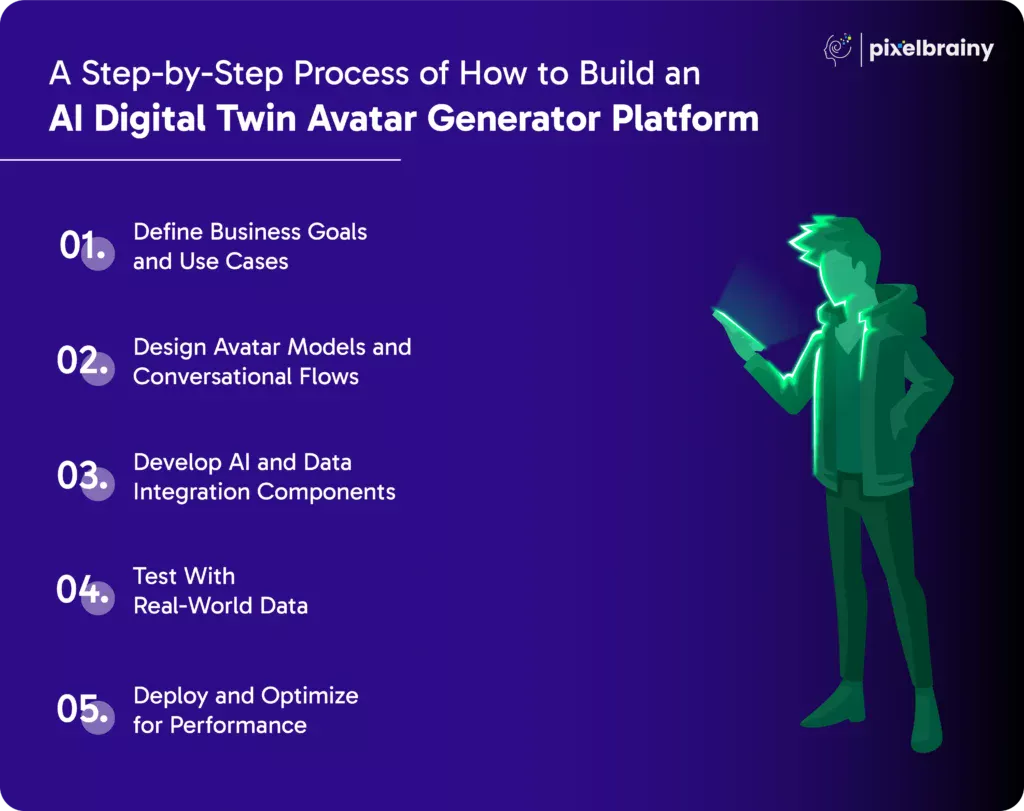
Every project should begin with clarity. The aim of this stage is to identify why the platform is being developed and what problems it is expected to solve. Businesses should outline industry-specific goals such as patient monitoring in healthcare, virtual tutors in education, or immersive customer service in retail.
At this stage, many organizations start with a PoC to test if the concept aligns with real business needs. Defining clear use cases early ensures that the resources, timeline, and investment are aligned with the intended outcomes.
The goal here is to create lifelike avatars that can communicate naturally. This includes designing the visual identity of the avatar, selecting 2D or 3D rendering styles, and planning how conversations will flow. Teams should consider tone, personality, and emotional adaptability so the avatar feels authentic.
An important milestone in this step is building an MVP version of the avatar design and testing it with small user groups. The feedback gathered helps refine both the visual realism and conversational depth before investing heavily in production.
This step focuses on the Digital Twin Avatar Generator Platform Development With AI. The aim is to connect the avatar with real-time data sources, integrate AI engines for natural language processing, and embed predictive analytics for decision support. Security and compliance layers should also be built to protect sensitive data.
At this point, businesses often collaborate with top AI development companies to ensure they are using the right AI frameworks, cloud infrastructure, and data pipelines. A strong technical backbone here ensures that the platform can scale in the future.
The goal of this stage is validation. Testing with real data helps confirm whether the platform can handle live conditions, manage performance loads, and deliver consistent user experiences. Avatars should be tested for accuracy in communication, real-time adaptability, and system reliability.
This stage also allows businesses to evaluate multiple scenarios, such as customer service peaks or healthcare data fluctuations. Robust testing ensures that the platform is reliable and trustworthy once it goes live.
The final step is deployment, where the developing AI Digital Twin Avatar Generator Platform moves from prototype to production. The aim here is to deliver a Full-Fledge Platform that runs smoothly across multiple devices and environments, including web, mobile, AR, VR, or even metaverse applications.
Deployment is not the end. Continuous monitoring and optimization are needed to improve performance, add new features, and refine avatar behavior as user expectations evolve. Businesses should also plan regular updates for security, compliance, and technological improvements.
By following this process, organizations can transform an idea into a fully functional AI Digital Twin Avatar Generator Platform that delivers real value while staying adaptable to future needs.
When businesses start exploring this technology, one of the first questions they ask is what is the cost to make AI Digital Twin Avatar Generator Platform. The answer depends on the scope, features, and complexity of the solution. The AI Digital Twin Avatar Generator Platform Development Cost can vary widely because creating a simple MVP is very different from launching a fully advanced platform with enterprise-grade integrations.
On average, the Cost of Developing an AI Digital Twin Avatar Generation Platform ranges between $30,000 and $300,000+. To give you a clearer idea, here is a breakdown of potential investment levels:
| Type of Platform | Description | Estimated Cost |
| MVP Version | A minimum viable product focused on testing basic use cases like a simple avatar interface, limited conversational flow, and small-scale data integration. Ideal for startups or businesses validating the concept before scaling. | $30,000 – $70,000 |
| Medium Complexity Platform | Includes realistic 3D avatars, NLP-driven conversational abilities, multi-device support (web + mobile), and integration with some third-party APIs. Suitable for mid-size businesses or organizations piloting industry use cases. | $70,000 – $150,000 |
| Advanced Enterprise Platform | A Cost of Building an AI Digital Twin Avatar Generation Software that is fully feature-rich with hyper-realistic avatars, predictive analytics, emotional intelligence, blockchain-backed identity, and scalability across AR/VR and metaverse environments. Designed for enterprises aiming for long-term competitive advantage. | $150,000 – $300,000+ |
While the initial development cost is significant, businesses should also plan for hidden or recurring expenses that ensure long-term performance.
The actual cost depends on the level of customization, industry requirements, and whether development is done in-house or with specialized partners.
Choosing the right technology stack is critical for the success of any platform. The development of AI Digital Twin Avatar Generator Platform depends on a balanced mix of frontend design, backend logic, AI frameworks, and integration tools.
A well-planned stack ensures scalability, security, and high performance. Below is a breakdown of the tools and technologies that are commonly used in Digital Twin Avatar Generator Platform Development With AI.
| Parameter | Tools & Frameworks | Explanation |
| Frontend Development | React, Angular, Unity, Unreal Engine | React and Angular deliver smooth web experiences, while Unity and Unreal are ideal for lifelike 3D avatar rendering. These tools ensure immersive and responsive user interfaces. |
| Backend Development | Node.js, Python (Django, Flask), Java (Spring Boot) | Backend frameworks manage business logic, APIs, and integrations. Python is often used for AI-heavy tasks, while Node.js and Java provide scalability and speed for enterprise applications. |
| AI & Machine Learning | TensorFlow, PyTorch, OpenAI APIs, Hugging Face | These frameworks power natural language processing, emotional intelligence, and predictive analytics. They enable developing AI Digital Twin Avatar Generator Platform with smart and adaptive behavior. |
| 3D Modeling & Rendering | Blender, Maya, Unity, Unreal Engine | Used to design hyper-realistic avatars with accurate facial expressions and body movements. They help create lifelike experiences across AR, VR, and gaming environments. |
| Voice & Speech Technologies | Google Dialogflow, Amazon Polly, Microsoft Azure Speech | These platforms handle speech recognition, text-to-speech, and voice cloning, giving avatars natural and engaging communication abilities. |
| Data Storage & Management | MongoDB, PostgreSQL, Firebase, AWS S3 | Secure databases and cloud storage ensure real-time syncing of digital twin data. This makes it possible to store large volumes of structured and unstructured data safely. |
| Cloud Infrastructure | AWS, Microsoft Azure, Google Cloud | Cloud platforms provide the foundation for AI Digital Twin Avatar Generation Platform Development by offering scalability, security, and flexible deployment options. |
| APIs & Integrations | REST, GraphQL, WebRTC, IoT APIs | APIs connect the avatar system with third-party apps, IoT devices, or enterprise software. They make the avatar ecosystem extensible and versatile. |
| Security Frameworks | OAuth 2.0, SSL/TLS, Blockchain | Advanced security ensures compliance with industry regulations and protects sensitive digital twin data. Blockchain also adds a verifiable identity layer for avatars. |
| Testing & Optimization | Selenium, JMeter, Postman, A/B Testing Tools | Automated testing ensures stability, speed, and reliability of the platform before large-scale deployment. Performance tuning helps optimize for user experience. |
With the right tools and frameworks, businesses can create AI Digital Twin Avatar Generator Platforms that are powerful, secure, and ready to scale.
Building an AI Digital Twin Avatar Generator Platform is exciting but it comes with real challenges. These are not simple systems; they require advanced AI, large amounts of data, secure infrastructures, and seamless user experiences. Below are the main obstacles businesses may face, along with strategies to overcome them.
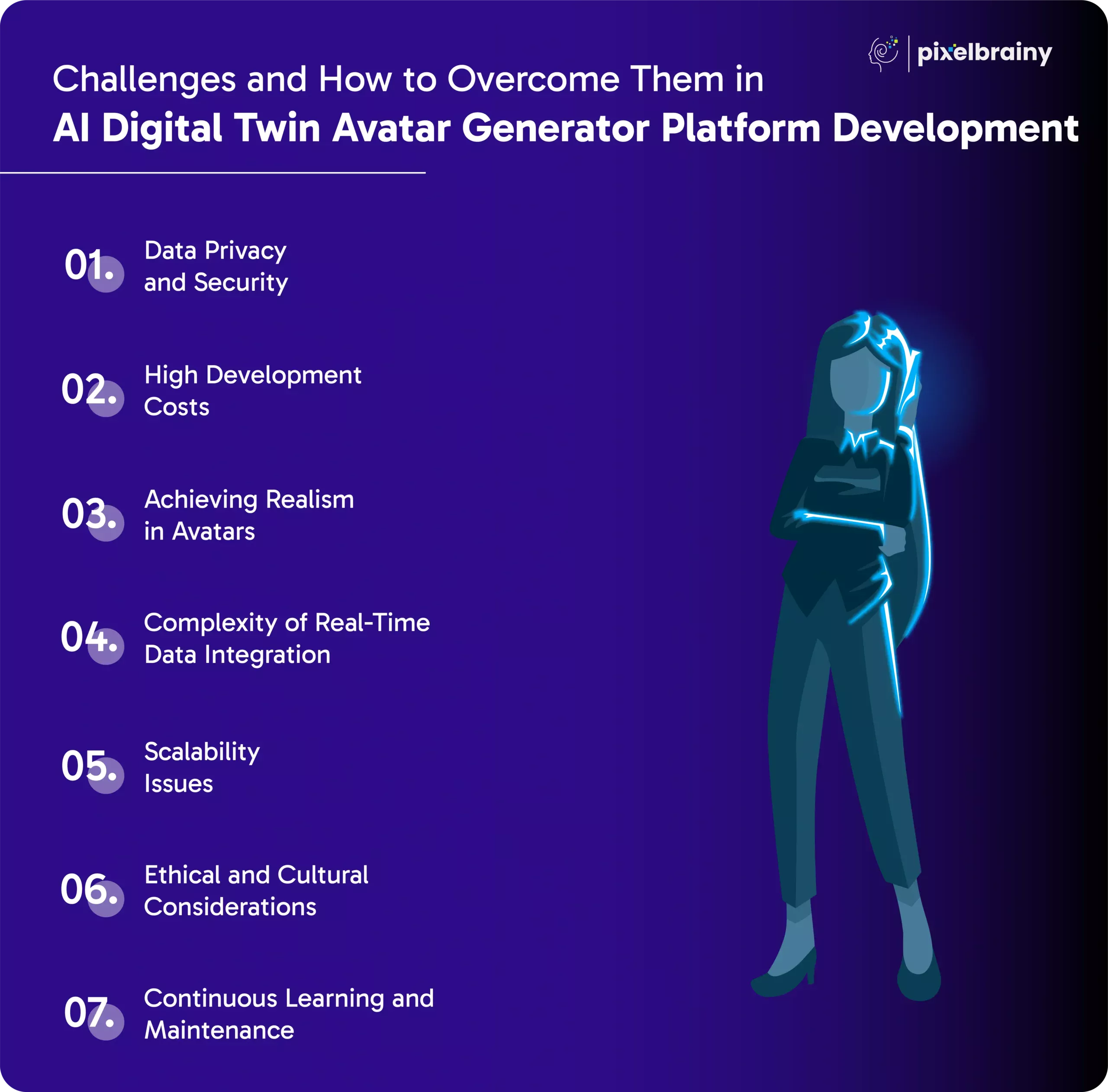
Challenge: Avatars rely heavily on personal information, behavioral data, and sometimes even health records to function effectively. Any breach of this sensitive data can damage user trust and bring serious legal consequences. With growing awareness of digital privacy, users are more concerned than ever about how their information is used.
How to Overcome: Businesses must adopt end-to-end encryption, anonymization techniques, and transparent consent systems. Compliance with global regulations such as GDPR, HIPAA, or CCPA is non-negotiable. Using blockchain-backed identity verification can provide an extra layer of security and give users more control over their personal data.
Challenge: The costs involved in AI Digital Twin Avatar Generator Platform development can be steep. Advanced 3D rendering, machine learning model training, and cloud infrastructure all demand significant investment. This makes it especially difficult for smaller companies to compete with well-funded enterprises.
How to Overcome: A cost-effective way forward is to begin with a minimum viable product (MVP) that focuses on essential features. This allows businesses to validate their idea before scaling further. Partnering with experienced AI development firms also helps optimize budgets, as they bring reusable frameworks, ready-made solutions, and domain expertise that reduce unnecessary expenses.
Challenge: One of the biggest user expectations is realism. If avatars appear too robotic or fall into the “uncanny valley,” users may disengage. Striking the right balance between lifelike features and comfort is a complex task. Poorly designed avatars can make interactions feel artificial and even uncomfortable.
How to Overcome: Developers should invest in advanced 3D modeling tools, motion capture technology, and emotional AI that can mimic subtle human expressions. Testing avatars with real users during different stages of development helps refine appearance and interaction. Regular updates to improve realism over time also ensure avatars stay aligned with evolving user expectations.
Challenge: Digital twin avatars depend on live data streams, whether from IoT devices, enterprise systems, or user behavior. Handling these large and diverse data sources in real time without delays is technically complex. Even minor latency can break the illusion of real-world responsiveness.
How to Overcome: Using scalable cloud-native infrastructure, APIs, and robust data pipelines is essential. Edge computing solutions can further reduce latency by processing data closer to the source. Businesses should also invest in strong monitoring systems to detect and fix integration issues before they impact users.
Challenge: As adoption grows, platforms must handle thousands or even millions of concurrent users. Without proper scaling, this can lead to slow performance, downtime, or inconsistent experiences. Scalability becomes a significant hurdle when businesses expand to global markets.
How to Overcome: The best solution is to design the platform with microservices and Kubernetes-based cloud architecture from the start. This ensures flexibility and horizontal scaling. Businesses should also use load balancing, caching, and performance monitoring tools to maintain a smooth experience under heavy traffic.
Challenge: AI avatars may be used across different regions and cultures. Without careful training, they risk miscommunication, reinforcing stereotypes, or unintentionally offending users. Another concern is the unauthorized use of a person’s likeness, which raises ethical and legal questions.
How to Overcome: Developers should train AI models with diverse datasets and design avatars that can adapt to cultural contexts. Adding options for customization ensures that avatars feel more inclusive and respectful. Clear policies on ethical use and data rights should also be defined to protect both businesses and users.
Challenge: AI models do not stay accurate forever. Without regular retraining, avatars may become outdated, less responsive, or fail to adapt to new scenarios. A stagnant platform quickly loses user trust and becomes irrelevant in fast-changing industries.
How to Overcome: Businesses should implement a feedback loop where every interaction helps improve the AI. Continuous learning pipelines, combined with regular updates and bug fixes, keep avatars accurate and engaging. Investing in ongoing maintenance is just as important as the initial development.
Overcoming these challenges is the key to ensuring that AI Digital Twin Avatar Generator Platforms remain secure, scalable, and capable of delivering meaningful value in the long run.
Starting an AI Digital Twin Avatar Generator Platform Development Journey can feel overwhelming, especially with so many moving parts like AI models, real-time data, and lifelike avatar rendering. That is where PixelBrainy steps in. As a leading AI development company in USA, we help businesses simplify the process and turn bold ideas into working platforms that deliver measurable results.
At PixelBrainy, we do more than simply develop AI Digital Twin Avatar Generation Platform solutions. We collaborate with your team to define clear goals, design avatars that look and feel natural, and integrate AI features that make the platform intelligent and scalable. Whether you are experimenting with an MVP or building AI Digital Twin Avatar Generator Platform at enterprise scale, our proven process ensures smoother execution.
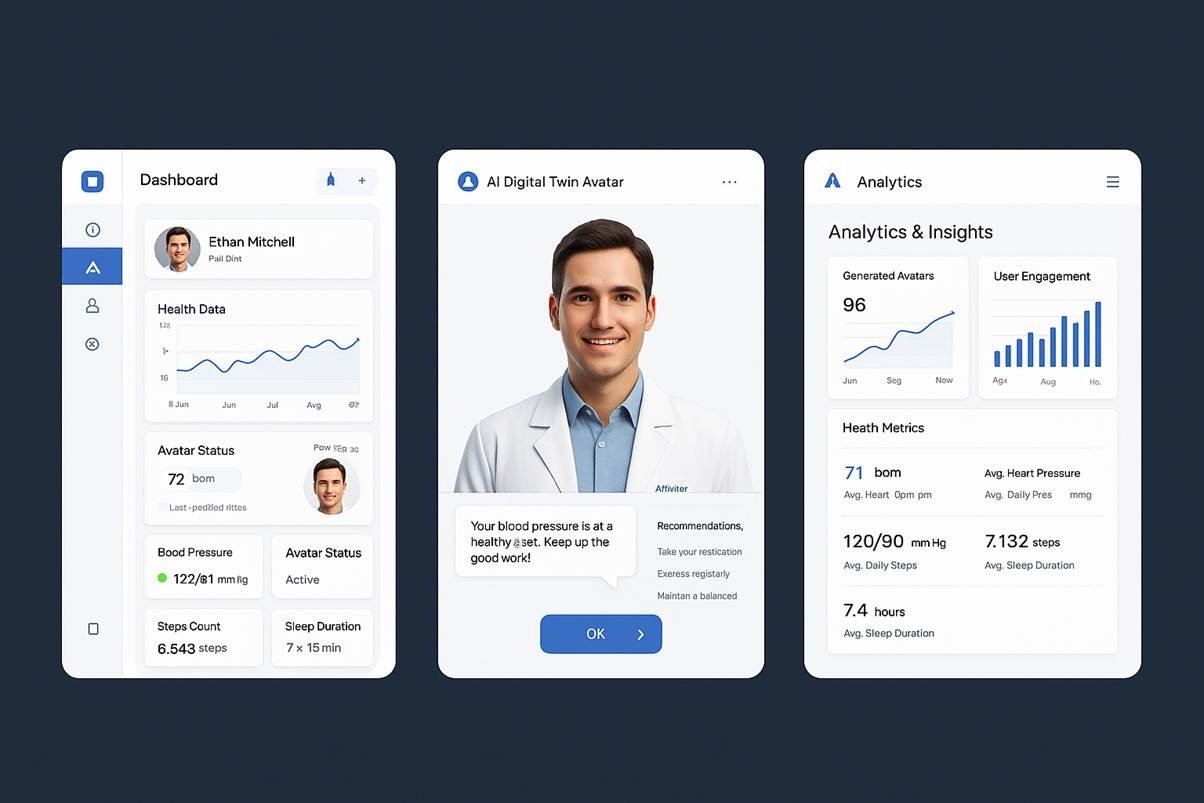
One of our recent projects, completed for a confidential healthcare client, involved creating an AI-driven digital twin avatar capable of interpreting patient health data in real time. The avatar provided personalized insights, medication reminders, and improved doctor-patient engagement. The platform not only improved patient satisfaction but also streamlined the workflow for healthcare providers, showing the real-world impact of this technology.
When you partner with PixelBrainy, you gain a team that combines technical expertise with a practical, business-first mindset.
The journey of creating an AI Digital Twin Avatar Generator Platform is about more than technology. It is about reimagining how businesses and individuals interact, learn, and solve problems in a digital-first world. From healthcare to education and customer service, the possibilities are limitless when avatars become intelligent, lifelike, and adaptive.
By carefully planning use cases, selecting the right technology stack, and overcoming development challenges, organizations can unlock new opportunities for growth and innovation. The future belongs to businesses that embrace digital twin avatars not as tools, but as strategic assets that deliver value, personalization, and competitive advantage.
If you are ready to explore your AI Digital Twin Avatar Generator Platform Development Journey, book an appointment with PixelBrainy today and let us help turn your vision into reality.
The cost can range from $30,000 to $300,000+ depending on complexity. An MVP version is more affordable, while advanced enterprise platforms with predictive analytics, emotional AI, and metaverse integration require larger investments.
AI brings personalization, real-time adaptability, and natural conversations. This makes interactions feel human-like, encouraging users to stay engaged longer and trust the platform more.
Yes, but it requires expertise in AI, 3D rendering, data integration, and cloud infrastructure. Many companies choose to partner with top AI development firms for faster and more reliable outcomes.
Healthcare, education, customer service, retail, enterprise training, and entertainment are leading adopters. Each uses avatars to solve unique challenges like patient care, personalized learning, or immersive brand engagement.
The process includes defining use cases, designing avatars, integrating AI and data systems, testing with real-world conditions, and deploying as a scalable full-fledged solution.
PixelBrainy combines technical expertise with practical business insight, offering end-to-end development services that transform ideas into scalable, competitive platforms.

About The Author
Sagar Bhatnagar
Sagar Sahay Bhatnagar brings over a decade of IT industry experience to his role as Marketing Head at PixelBrainy. He's known for his knack in devising creative marketing strategies that boost brand visibility and market influence. Sagar's strategic thinking, coupled with his innovative vision and focus on results, sets him apart. His track record of successful campaigns proves his ability to utilize digital platforms effectively for impactful marketing efforts. With a genuine passion for both technology and marketing, Sagar continuously pushes PixelBrainy's marketing initiatives to greater success.
Working with the PixelBrainy team has been a highly positive experience. They understand the design requirements and create beautiful UX elements to meet the application needs. The dev team did an excellent job bringing my vision to life. We discussed usability and flow. Sagar worked with his team to design the database and begin coding. Working with Sagar was easy. He has the knowledge to create robust apps, including multi-language support, Google and Apple ID login options, Ad-enabled integrations, Stripe payment processing, and a Web Admin site for maintaining support data. I'm extremely satisfied with the services provided, the quality of the final product, and the professionalism of the entire process. I highly recommend them for Android and iOS Mobile Application Design and Development.

Great experience working with them. Had a lot of feedback and I found that unlike most contractors they were bugging me for updates instead of the other way around. They were extremely time conscience and great at communicating! All work was done extremely high quality and if not on time, early! They were always proactive when it comes to communication and the work is great/above par always. Very flexible and a great team to work with! Goes above and beyond to present us with multiple options and always provides quality. Amazing work per usual with Chitra. If you have UI/UX or branding design needs I recommend you go to them! Will likely work with them in the future as well, definitely recommended!

PixelBrainy is a joy to work with and is a great partner when thinking through branding, logo, and website layout. I appreciate that they spend time going into the "why" behind their decisions to help inform me and others about industry best practices and their expertise.

I hired them to design our software apps. Things I really like about them are excellent communication skills, they answer all project suggestions and collaborate right away, and their input on design and colors is amazing. This project was complex and needed patience and creativity. The team is amazing to do business with. I will be using them long-term. Glad to see there are some good people out there. I was afraid to try and outsource my project to someone but I am glad I met them! I really can't say enough. They went above and beyond on this project. I am very happy with everything they have done to make my business stand out from the competition.

It was great working with PixelBrainy and the team. They were very responsive and really owned the project. We'll definitely work with them again!

I recently worked with the PixelBrainy team on a project and I was blown away by their communication skills. They were prompt, clear, and articulate in all of our interactions. They listened and provided valuable feedback and suggestions to help make the project a success. They also kept me updated throughout the entire process, which made the experience stress-free and enjoyable.

PixelBrainy is very good at what it does. The team also presents themselves very professionally and takes care of their side of things very well. I could fully trust them taking up the design work in a timely and organised manner and their attention to detail saved us lots of effort and time. This particular project was quite intense and the team showed that they function very well under pressure. Very much looking forward to working with her again!

It's always an absolute pleasure working with them. They completed all of my requests quickly and followed every note I had for them to a T, which made our process go smoothly from start to finish. Everything was completed fast and following all of the guidelines. And I would recommend their services to anyone. If you need any design work done in the future, PixelBrainy should be your first call!

They took ownership of our requirements and designed and proposed multiple beautiful variants. The team is self-motivated, requires minimum supervision, committed to see-through designs with quality and delivering them on time. We would definitely love to work with PixelBrainy again when we have any requirements.

PixelBrainy was a big help with our SaaS application. We've been hard at work with a new UI/UX and they provided a lot of help with the designs. If you're looking for assistance with your website, software, or mobile application designs, PixelBrainy and the team is a great recommendation.

PixelBrainy designers are amazing. They are responsive, talented, and always willing to help craft the design until it matches your vision. I would recommend them and plan to continue them for my future projects and more!!!

They were awesome! Did a good job fast, and good communication. Will work with them again. Thank you

Creative, detail-oriented, and talented designers who take direction well and implement changes quickly and accurately. They consistently over-delivered for us.

PixelBrainy team is very talented and creative. Great designers and a pleasure to work with. PixelBrainy is an excellent communicator and I look forward to working with them again.

PixelBrainy has a very talented design team. Their work is excellent and they are very responsive. I enjoy working with them and hope to continue on all of our future projects.


Transform your ideas into reality with us.
Across these industries, each engagement brings unique challenges, from early-stage product development to scaling complex systems, helping us build a practical understanding of real-world product environments.