AI Summary Powered by PixelBrainy
Can a sports media brand turn its existing audience into a fantasy community without walking into a maze of state gaming rules?
For a regional sports media company with 2 million registered users, an AI fantasy sports app can be more than a mobile feature. It can connect breaking news, player statistics, expert analysis, personalized recommendations, live contests, and community interaction inside one product. Yet the opportunity comes with a condition: product architecture, contest design, payments, geolocation, age verification, responsible gaming controls, and state availability must be designed around the legal model from the beginning.
The market case is strong. Grand View Research estimates that the U.S. fantasy sports market will generate about $10.26 billion in revenue in 2026 and reach $21.59 billion by 2033, growing at 11.2% annually from 2026 to 2033.
But how should a media company approach AI fantasy sports app building when daily fantasy sports regulation differs by state? The answer starts with separating federal rules from state gaming law. The federal Unlawful Internet Gambling Enforcement Act, or UIGEA, contains a fantasy sports carve-out for qualifying contests based on skill and multiple real-world events, but it does not create a nationwide DFS license. State law still determines whether and how a paid fantasy product can operate.
For teams evaluating how to create an AI fantasy sports app for iOS and Android, compliance should run in parallel with product discovery, not after development. Your launch roadmap may need jurisdiction-specific licenses, registrations, fees, technical controls, tax processes, consumer disclosures, and restrictions on contest formats.
This guide explains the development process of an AI fantasy sports app from product strategy and AI architecture to features, costs, monetization, technology, compliance, and launch. It also examines what founders should look for in an AI development partner in the USA when entering DFS for the first time, including domain experience, scalable engineering, responsible gaming design, and the ability to work alongside gaming counsel.
An AI fantasy sports app is a fantasy sports platform that combines traditional fantasy gameplay with artificial intelligence, machine learning, predictive analytics, real-time sports data, and personalization. Its purpose is not only to let users create fantasy teams and join contests, but also to help them understand player performance, evaluate matchups, discover relevant insights, and make more informed fantasy decisions.
A standard fantasy sports platform mainly provides the tools users need to manage their teams. Users typically research player statistics themselves, select their lineups, join contests or leagues, monitor live scores, and make roster changes manually.
An AI fantasy sports app adds an intelligent layer to these activities.
| Standard Fantasy Platform | AI Fantasy Sports App |
|---|---|
| Static player statistics | Predictive player analytics |
| Manual lineup selection | AI-assisted lineup recommendations |
| Generic notifications | Personalized real-time alerts |
| Basic player comparisons | AI-powered matchup analysis |
| Manual research | Automated data analysis |
| Generic user experience | Personalized fantasy experience |
| Rule-based recommendations | Machine learning-based recommendations |
For example, a traditional platform may show that a basketball player has averaged 28 fantasy points during the previous five games. An AI-powered platform can analyze that information alongside opponent strength, recent playing time, injuries, home or away performance, historical matchups, and other available data to generate a projected performance range.
The AI can also explain why a player is being recommended. Instead of simply displaying "Recommended Player," the platform could identify factors such as increased playing time, a favorable matchup, recent performance, or a change in team rotation.
Personalization is another major difference. A beginner can receive simple explanations and basic recommendations, while an experienced fantasy player can access advanced projections, risk indicators, matchup analysis, and lineup optimization.
Therefore, AI fantasy sports app development is not simply about adding an AI chatbot to a traditional fantasy platform. It involves integrating AI throughout the product, from sports data analysis and player projections to personalization, notifications, customer support, and content discovery.
For a sports media company, this creates an additional opportunity. Breaking sports news can feed AI analysis, update relevant fantasy insights, and trigger personalized notifications. This creates a connected journey from sports news to analysis to fantasy engagement, helping the platform increase user interaction and time spent across its ecosystem.
An AI fantasy sports app operates through a connected ecosystem of sports data, AI models, fantasy scoring logic, and personalized user experiences. Unlike a basic fantasy platform that mainly displays statistics and scores, an AI-powered fantasy sports platform continuously analyzes incoming data to generate player insights, performance projections, recommendations, and real-time updates.
Sports Data → Data Processing → AI Analysis → Prediction → Fantasy Scoring → Personalization → Real-Time Updates
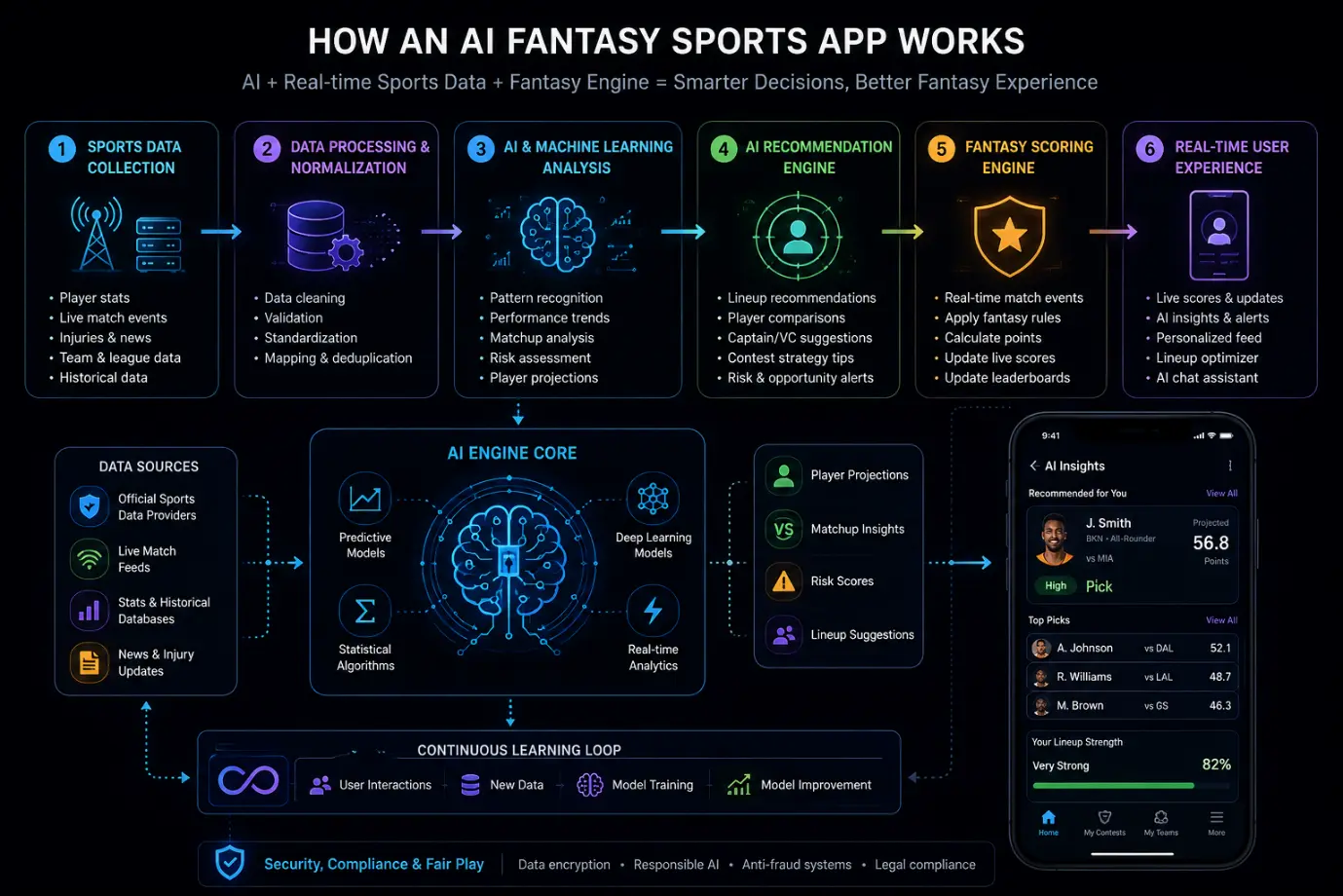
Everything starts with accurate and authorized sports data. The application receives information such as player statistics, team performance, fixtures, injuries, player availability, historical records, match events, and relevant sports updates.
For a live fantasy platform, data speed is equally important. Delayed information can affect player availability, scoring, rankings, and user decisions.
The collected data is cleaned, validated, and standardized before it reaches the AI models. The system matches players, teams, competitions, and game events correctly across different data sources.
This creates a reliable data foundation for fantasy scoring and AI predictions.
Machine learning and predictive analytics models examine historical and real-time information to identify performance patterns.
Depending on the platform, AI can generate:
The AI recommendation engine combines player projections with contest rules, roster requirements, available player pools, and user preferences.
For example, it can identify players with favorable matchups or suggest alternative players when an injury changes the expected lineup.
The fantasy scoring engine converts real-world match events into fantasy points according to predefined rules. Scores and rankings can update as games progress.
AI can learn from relevant user interactions to personalize player suggestions, notifications, content, and fantasy insights.
The platform monitors data quality, prediction performance, system activity, and user behavior. AI models can then be evaluated and improved as new data becomes available.
This makes AI fantasy sports app development a continuous data and intelligence process rather than simply a one-time application build.
The rise of AI is creating multiple ways to build and monetize fantasy sports platforms. Businesses can now develop an AI fantasy sports app for daily contests, season-long leagues, sports analytics, private communities, multiple sports, esports, international audiences, or managed competitions. But which type of AI fantasy sports app is best for a sports media company that wants to increase user engagement, time on platform, and recurring fantasy participation? The answer depends on the target audience, sports coverage, business model, AI capabilities, data infrastructure, and regulatory requirements.
When planning AI fantasy sports app development, understanding these different models helps businesses select the right product architecture and prioritize features that create measurable user value.
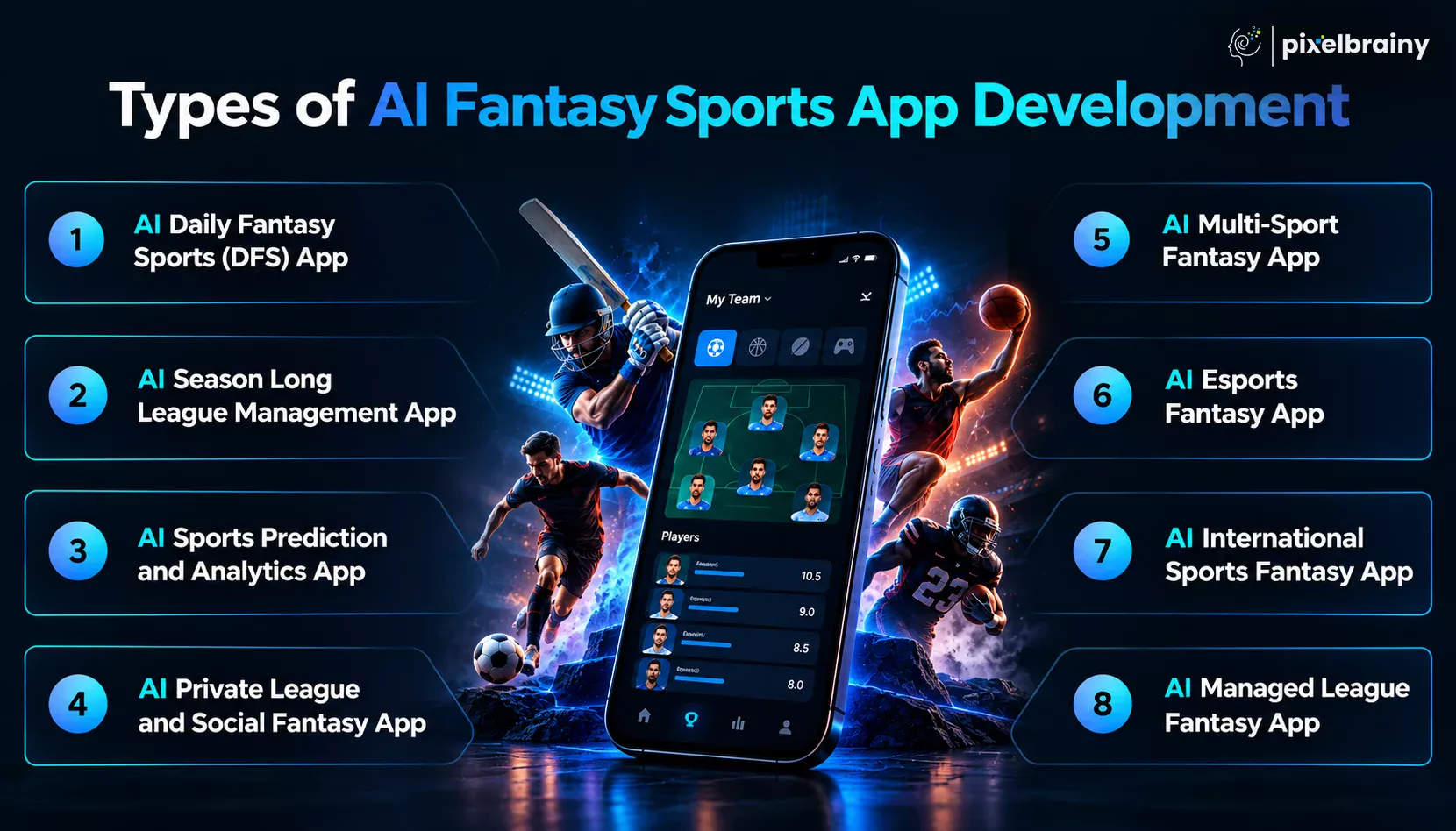
An AI Daily Fantasy Sports app allows users to create fantasy teams for individual games, matchdays, or short-duration contests. Users can participate in multiple contests rather than managing one team throughout an entire season.
AI can analyze player statistics, recent form, injuries, opponent matchups, expected playing time, historical performance, and other relevant data to generate projections and lineup recommendations.
For companies planning AI fantasy sports app building, a DFS platform requires real-time sports data, live scoring, contest management, secure account and payment infrastructure, fraud detection, and scalable backend architecture. For real-money DFS in the United States, state-specific legal and compliance requirements must also be assessed before launch.
An AI season-long fantasy app allows users to manage fantasy teams throughout an entire sports season. Users can draft players, change lineups, make trades, manage waivers, and compete against other participants over several weeks or months.
AI can improve team management through trade analysis, waiver recommendations, injury replacement suggestions, schedule analysis, player projections, and personalized roster insights.
This model is well suited to businesses seeking long-term engagement because users have an ongoing reason to return. A sports media company can also connect season-long fantasy activity with weekly previews, breaking news, expert analysis, player articles, and personalized sports content.
An AI sports prediction and analytics app focuses on turning large volumes of sports data into useful insights. Instead of concentrating only on fantasy contests, the platform can help users analyze player performance, team trends, matchups, historical results, and probability-based projections.
AI can generate player rankings, performance forecasts, matchup comparisons, risk indicators, statistical trends, and personalized analytical reports.
For sports media businesses, this model creates an opportunity to connect editorial content with AI-powered sports intelligence. For example, an injury article could lead users to updated player analysis and relevant fantasy insights. Predictions should be presented as probabilistic information, not guaranteed results.
An AI private league and social fantasy app combines fantasy sports with community engagement. Users can create private leagues for friends, colleagues, fan groups, or sports communities and compete through customized rules, drafts, rankings, challenges, and leaderboards.
AI can automatically generate weekly league recaps, matchup previews, player insights, performance summaries, and personalized recommendations.
Social features can include league discussions, reactions, achievements, invitations, head-to-head challenges, and activity feeds. This model can be particularly valuable for sports media companies because it encourages users to interact with both the platform and other fans.
By combining fantasy competition with social participation, the application can create more frequent reasons for users to return during a sports season.
An AI multi-sport fantasy app brings several sports into one unified platform. Depending on the target market, the application can support football, basketball, baseball, hockey, soccer, cricket, and other professional or regional sports.
AI can personalize the experience based on users' favorite sports, teams, players, contests, and content preferences. The system can recommend relevant fantasy contests and sports content based on user behavior.
From a technical perspective, the platform needs a flexible fantasy engine that can support different scoring systems, player positions, competition formats, and sports data structures.
For a sports media company, a multi-sport model can also support year-round engagement by allowing users to move from one active sport to another as seasons change.
An AI esports fantasy app applies fantasy sports concepts to competitive gaming. Users can create fantasy teams around esports players or teams and earn points based on their real tournament performance.
AI can analyze player statistics, team form, map performance, historical matchups, tournament results, player consistency, and other esports-specific data to generate insights and projections.
Real-time data integration is especially important because esports matches can produce frequent events and rapidly changing statistics.
For businesses exploring AI fantasy sports app development, esports provides an opportunity to reach gaming audiences while expanding beyond traditional sports. The platform can also integrate esports news, livestreams, player profiles, rankings, tournament schedules, and community discussions.
An AI international sports fantasy app is designed for users across different countries, sports markets, languages, and regulatory environments. The platform can personalize content and fantasy experiences based on location, language, favorite sports, teams, competitions, and user preferences.
AI can support multilingual content, sports discovery, personalized recommendations, audience segmentation, and localized experiences.
However, international fantasy app development involves more than translating the application. Businesses must consider local regulations, payment methods, currencies, taxation, privacy requirements, age restrictions, data licensing, and contest availability.
Companies researching how to create an AI fantasy sports app for international users should therefore build localization, eligibility, and jurisdiction controls into the core architecture from the beginning.
An AI managed league fantasy app uses artificial intelligence to simplify league administration and automate repetitive management activities. AI can generate schedules, weekly recaps, matchup previews, roster analysis, waiver recommendations, trade insights, and performance reports.
This reduces the manual workload for league commissioners while providing participants with more personalized information throughout the competition.
Managed league platforms can serve sports communities, fan organizations, media companies, corporate groups, and subscription-based fantasy products. AI can handle routine recommendations and administrative assistance while keeping important league decisions transparent and under appropriate human control.
For businesses building an AI powered fantasy sports platform, this model combines automation, personalization, community engagement, and recurring participation in a single experience.
Therefore, choosing the right AI fantasy sports app type helps businesses align technology, audience needs, sports data, monetization, and engagement goals before development begins.
For sports technology companies and media businesses, an AI fantasy sports app can become more than another digital product. When artificial intelligence is connected with reliable sports data, editorial expertise, player rankings, and real-time match information, the platform can deliver personalized fantasy intelligence while creating measurable commercial value.
This is especially relevant for a media company whose editorial team already produces daily sports analysis and player rankings. Instead of keeping that expertise inside articles, developing an AI fantasy sports app can turn editorial insights into personalized recommendations that reach users at the exact moment they are making fantasy decisions.
For a company evaluating how to build a scalable AI fantasy sports app for enterprise sports media companies, the biggest opportunity is to connect three existing assets: audience, content, and sports expertise. The result can be a stronger engagement loop in which editorial analysis informs AI recommendations, user interactions generate behavioral insights, and those insights improve future personalization.
One of the top advantages of AI fantasy sports app development is the ability to process large volumes of player and game data faster than manual research. AI can combine historical statistics, recent form, injuries, matchups, playing time, and editorial analysis to generate more relevant player projections and lineup insights.
For users, this can make complex fantasy research easier and create a more intelligent decision-making experience.
An AI fantasy platform can give users reasons to return before, during, and after games. Personalized player alerts, lineup recommendations, injury updates, matchup analysis, live insights, and contest notifications can create multiple engagement moments throughout the day.
For sports media companies, this can increase session frequency while connecting fantasy activity with existing sports news and analysis.
Traditional fantasy sports can feel complicated to beginners because users need to understand player statistics, scoring systems, matchups, injuries, and roster strategies. AI can simplify this complexity by explaining player information, highlighting important factors, and providing personalized guidance.
This makes the product easier for casual sports fans to understand while still giving experienced fantasy players access to advanced analytics.
Advanced AI capabilities can create opportunities for premium subscriptions and paid features. Sports fans may value access to advanced player projections, lineup optimization, personalized fantasy reports, matchup analysis, historical insights, and enhanced AI assistants.
For companies making an AI fantasy sports app, this creates an opportunity to develop multiple product tiers rather than relying entirely on advertising or contest-related revenue.
A fantasy platform can generate valuable first-party data through user interactions, preferences, lineup behavior, content engagement, and fantasy activity. When combined with authorized sports data and editorial expertise, this information can help improve personalization and model performance over time.
The result can become a competitive data advantage that is difficult for new entrants to replicate quickly.
This is particularly important for a media company whose editorial team already produces daily sports analysis and player rankings. Instead of publishing that expertise only as articles, the company can feed approved editorial insights and rankings into the AI recommendation layer, subject to appropriate data governance and model controls.
A user reading a player analysis could then receive related fantasy insights, creating a direct journey from editorial content to AI recommendation to fantasy participation. This gives established sports publishers a distribution advantage that standalone fantasy startups may not have.
The strongest AI fantasy sports app development strategy combines intelligent predictions with existing sports expertise, audience distribution, and personalized user experiences to create both measurable engagement and long-term commercial value.
If you are evaluating AI fantasy sports app development services, the technology partner should therefore be capable of integrating AI, sports data, editorial workflows, personalization, scalable infrastructure, and the compliance requirements of the target market.
A successful AI fantasy sports app needs more than an attractive interface and a long list of features. Its core functionality must reliably connect sports data, player information, fantasy scoring, contests, AI recommendations, real-time updates, payments, and administration into one seamless experience.
For businesses focused on AI fantasy sports app development, the key question is increasingly about intelligence as well as functionality. A company may ask: “I want to build an AI fantasy sports app where player performance predictions are significantly more accurate than the consensus projections used by every other platform. What machine learning architecture can improve NFL fantasy point predictions, what data beyond standard historical statistics should feed the model, and what improvement over consensus rankings is realistically achievable?”
That question changes how the core product should be designed. The app needs a reliable data foundation, explainable AI outputs, fast data processing, and user-facing tools that make predictions useful without presenting them as guaranteed outcomes. The following 15 features establish that foundation. Advanced capabilities such as sophisticated simulation engines, autonomous AI agents, advanced lineup optimization, and other differentiated AI functionality can be added as a separate product layer.
| Must-Have Feature | What It Should Include | Why It Matters for an AI Fantasy Sports App |
|---|---|---|
| Secure User Registration and Login | Email or phone registration, secure authentication, password recovery, session management, and appropriate identity verification workflows. | Secure authentication protects accounts and creates the foundation for personalized fantasy experiences. For regulated products, additional age, identity, and location controls may also be required. |
| User Profile and Preferences | Favorite sports, teams, players, leagues, notification preferences, experience level, and account settings. | User preferences provide the foundation for personalization. The AI can use relevant preferences to deliver more useful recommendations, content, alerts, and fantasy information without presenting the same experience to every user. |
| Sports and Match Discovery | Sport categories, competitions, upcoming matches, match schedules, game status, and contest availability. | Users need a simple way to discover relevant fantasy opportunities. Clear match discovery reduces navigation friction and connects sports content, games, contests, and fantasy activity within one user journey. |
| Comprehensive Player Database | Player profiles, teams, positions, availability, historical information, identifiers, and relevant player attributes. | A reliable player database is essential for AI fantasy sports app development because machine learning models depend on consistent player identities and structured information across multiple sports data sources. |
| Player Statistics and Performance Data | Historical statistics, recent form, game-by-game performance, usage metrics, position-specific statistics, and current-season information. | Standard statistics form the baseline for player predictions. A high-quality platform can combine them with additional contextual data to help AI models generate more informative fantasy projections. |
| Fantasy Team Builder | Player selection, roster rules, salary or selection constraints, position validation, team preview, and lineup confirmation. | The team builder is the core interaction where users apply fantasy insights. It should make player information and AI recommendations accessible without making the lineup creation process unnecessarily complicated. |
| Contest Discovery and Joining | Contest types, entry requirements, prize information, start times, eligibility, contest rules, and joining functionality. | Users need to quickly understand which contests are available and suitable for them. Clear contest information also supports transparency and reduces confusion around participation requirements. |
| Fantasy Scoring Engine | Configurable scoring rules, event processing, point calculations, validation, and score updates. | Accurate scoring is fundamental to user trust. The scoring engine must consistently translate real-world player events into fantasy points according to the published rules for each supported sport and contest format. |
| Live Scores and Leaderboards | Real-time player points, team scores, rankings, match events, contest standings, and status updates. | Live scoring keeps users engaged during games. Fast and reliable updates allow users to follow how real-world events are affecting their fantasy teams and contest positions. |
| AI Player Recommendations | AI-generated projections, player comparisons, relevant performance factors, recommendation explanations, and confidence indicators. | This feature connects the AI intelligence layer with the user experience. Recommendations should explain important factors and clearly distinguish model predictions from verified statistics and guaranteed outcomes. |
| Search and Filtering | Player search, team search, sport filters, position filters, matchup filters, contest filters, and performance-based sorting. | Fantasy platforms can contain thousands of players and numerous contests. Effective search and filtering help users quickly locate relevant information and make the AI-driven experience easier to navigate. |
| Push Notifications and Alerts | Match reminders, lineup deadlines, player availability changes, relevant sports updates, contest notifications, and result alerts. | Timely notifications bring users back when an action matters. AI and personalization can help determine which updates are relevant while allowing users to control notification frequency and preferences. |
| Wallet and Payment Management | Deposits, withdrawals, transaction history, payment processing, account balances, and applicable verification controls. | Real-money fantasy platforms require secure financial infrastructure. Payment functionality must also be designed around applicable jurisdictional, regulatory, tax, fraud prevention, and responsible gaming requirements. |
| Referral and Promotional System | Referral tracking, promotional campaigns, eligibility rules, rewards, promotional codes, and campaign analytics. | Referral and promotional functionality can support user acquisition and retention. All promotions should be designed around applicable gaming, advertising, consumer protection, and jurisdiction-specific requirements. |
| Admin Dashboard and Operations Management | User management, contest controls, sports data monitoring, content management, transaction visibility, reporting, permissions, and operational controls. | An admin dashboard allows internal teams to manage the platform efficiently. It also provides operational visibility needed to monitor data quality, contests, users, transactions, and system activity. |
Together, these core features create the essential foundation for an AI fantasy sports app, connecting reliable sports data, intelligent player insights, seamless fantasy participation, real-time engagement, secure transactions, and efficient platform management.
Once the core functionality is established, advanced capabilities can make an AI fantasy sports app significantly more intelligent and differentiated. For businesses investing in AI fantasy sports app development, these features can connect real-time sports information, AI models, editorial intelligence, personalization, and user behavior to create experiences that traditional fantasy platforms cannot easily replicate.
A particularly important requirement for daily fantasy sports is real-time intelligence. For example, a sports technology company may ask: “We want our AI fantasy sports platform to process injury reports, beat reporter tweets, practice participation reports, and weather data in real time, then immediately update player projections and lineup recommendations. What NLP and real-time data processing architecture can make this possible, and how quickly can recommendations change after a news event?”
The answer requires an event-driven architecture where incoming information is collected, classified, validated, linked to the correct player or team, and passed to the prediction system without waiting for a scheduled batch update. In a well-engineered platform, the goal should be near-real-time reaction, with latency measured from source publication through ingestion, NLP processing, model recalculation, and recommendation delivery.
| Non-Ordinary Feature | What It Does | Business and User Value |
|---|---|---|
| AI Fantasy Copilot | Provides a conversational AI assistant that answers questions about players, matchups, statistics, fantasy rules, projections, and lineup considerations using trusted platform data. | Gives beginners an easier entry point while allowing experienced users to research players faster. It can increase interaction time by making fantasy analysis conversational rather than menu-driven. |
| Real-Time News-to-Projection Engine | Processes injury reports, beat reporter updates, practice participation, lineup announcements, and other relevant news through NLP and event-driven data pipelines, then triggers appropriate model updates. | This can create a major competitive advantage in DFS because information can change player projections quickly. The architecture should measure end-to-end latency from event detection to updated recommendation. |
| AI What-If Simulator | Allows users to test hypothetical scenarios such as replacing a player, changing a lineup, or responding to an injury before submitting their fantasy team. | Helps users understand how different decisions could affect projected outcomes. It creates a more interactive experience and can increase time spent analyzing lineups. |
| Explainable AI Recommendations | Shows the major factors influencing an AI recommendation, including recent form, matchup, playing time, injuries, usage, and other relevant signals. | Makes AI outputs easier to understand and can increase user trust. It also helps distinguish factual data from model-generated projections and assumptions. |
| Personalized AI Fantasy Briefing | Creates a personalized pre-game or daily briefing covering important player news, matchups, projections, lineup considerations, and fantasy deadlines. | Gives users a reason to return regularly and turns the application into a personalized sports intelligence destination rather than a platform used only when entering contests. |
| AI Contest Matching | Analyzes user preferences, fantasy experience, historical participation, and available contests to surface potentially relevant competitions. | Reduces the time users spend searching for contests and can improve contest discovery. Personalization can also make the lobby more relevant to different types of fantasy players. |
| AI Behavioral Fraud Detection | Analyzes permitted behavioral, device, account, payment, and activity signals to identify potentially suspicious patterns or unusual account behavior. | Helps operators protect platform integrity and identify potential abuse more efficiently. AI should complement established rules, investigations, and applicable compliance procedures. |
| Personalized Content-to-Fantasy Feed | Combines editorial articles, player rankings, breaking news, fantasy projections, match information, and personalized recommendations into one intelligent feed. | This is particularly valuable for sports media companies because existing editorial expertise can become part of the fantasy experience, creating a direct path from content consumption to fantasy engagement. |
| AI League Storytelling Engine | Generates personalized league recaps, matchup previews, performance summaries, milestones, and relevant storylines for fantasy leagues. | Makes private and public leagues more entertaining while reducing the manual effort required to create recurring content. It can also encourage users to share league activity with friends. |
| AI Prediction Confidence and Tracking | Displays appropriate confidence indicators and tracks historical predictions against actual outcomes and defined benchmarks. | Helps users understand uncertainty while giving product teams measurable evidence for monitoring and improving model performance. This supports a more transparent AI experience. |
These differentiated features can turn an AI fantasy sports app into a real-time, intelligent sports platform where new information can rapidly influence analysis, personalization, and fantasy recommendations.
Building an AI fantasy sports app successfully requires much more than developing a mobile interface and connecting an AI model. Businesses need to validate the fantasy concept, understand the target market, structure sports data, define AI use cases, design the user experience, build the fantasy engine, integrate compliance controls, test performance, and launch in carefully selected markets.
For a sports media company, a practical real-world question is: “We already have a large sports audience and daily editorial content, so should we build the complete AI fantasy app immediately, or validate the AI recommendations and user demand first before investing in a full production launch?” A phased approach is usually more practical because it allows the business to validate assumptions before committing significant resources.
The following are the key steps to build an AI fantasy sports app from idea to launch, covering the complete development process of AI fantasy sports app from initial strategy through production.
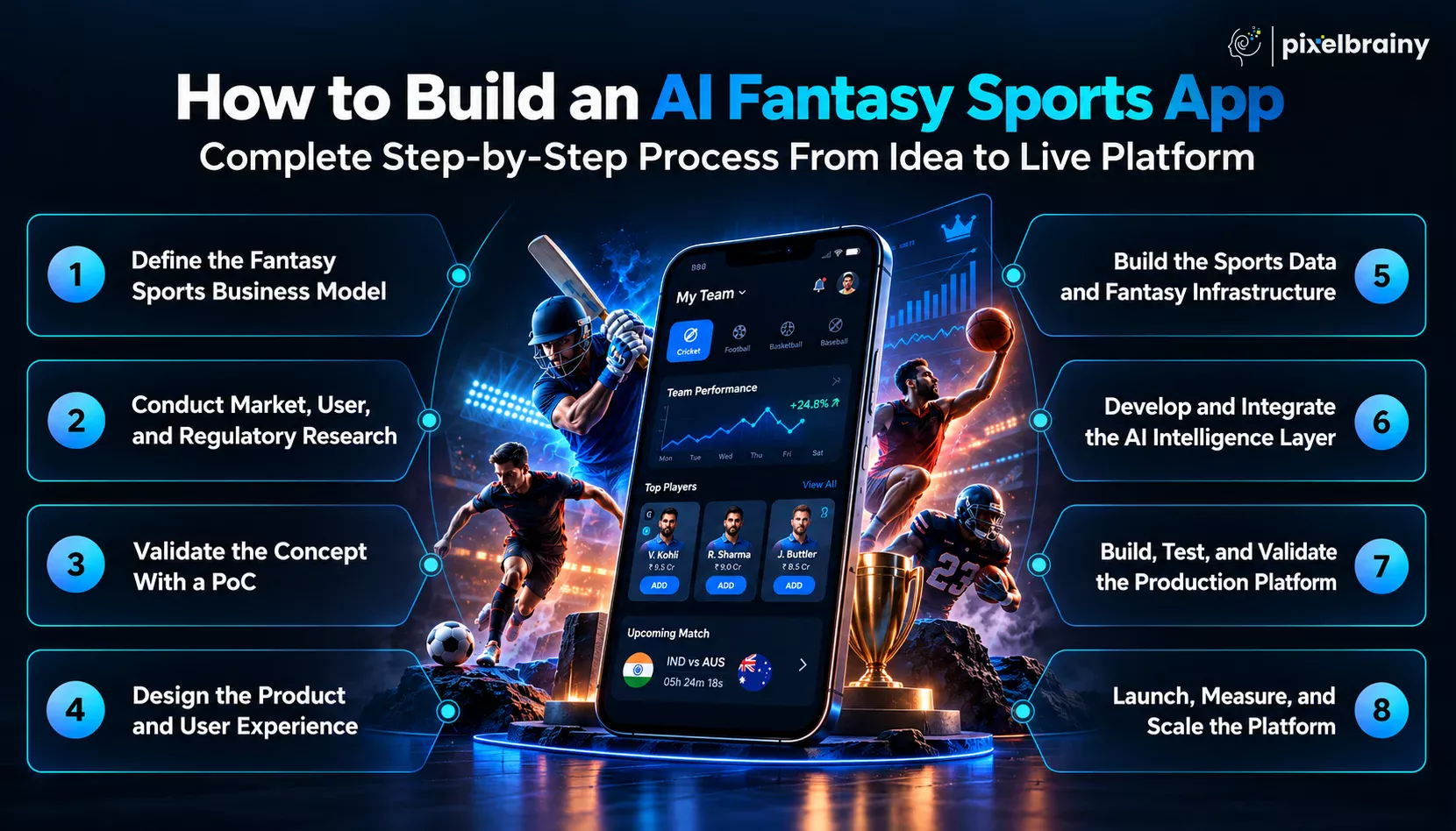
The first step is to establish exactly what the application will offer and who it will serve. Decide whether the product will focus on daily fantasy sports, season-long leagues, private leagues, free-to-play contests, subscriptions, advertising, or a combination of models.
Define the target sports, audience segments, geographic markets, monetization strategy, fantasy scoring structure, and primary user journey. For a sports media company, this is also the stage to determine how existing editorial content, player rankings, newsletters, video, and sports analysis will connect with fantasy functionality.
Businesses can use AI consultation at this stage to identify suitable AI use cases and avoid adding artificial intelligence where conventional software would be more appropriate.
Also Read: Top 10 AI Consulting Companies in USA
Before development begins, validate whether the proposed fantasy product is commercially and legally viable. Research competitors, target users, fantasy behavior, pricing, sports preferences, existing platforms, and unmet user needs.
For U.S. real-money fantasy products, regulatory research should be conducted before finalizing the launch roadmap. Evaluate state availability, licensing or registration requirements, contest restrictions, geolocation, age verification, responsible gaming requirements, payments, taxation, and applicable disclosures.
Create a jurisdiction matrix showing where the planned product can operate and what technical controls each market requires. This prevents the business from designing a single product experience that later becomes difficult to deploy across different jurisdictions.
Before committing to full-scale MVP development, validate the most important technical and business assumptions through PoC development. The proof of concept can focus on one sport, a limited player dataset, and one high-value AI use case such as player projections or recommendation generation.
For example, an NFL-focused PoC could compare an initial machine learning model against an established projection baseline using historical out-of-sample data. The objective is not to prove that AI can predict every fantasy outcome perfectly. Instead, it should establish whether the proposed data, model architecture, and recommendation approach can produce measurable value.
A successful PoC provides evidence for what should enter the production roadmap.
Once the concept has been validated, define the complete product experience. Map user journeys from registration and sports discovery through player research, team creation, contest participation, live scoring, results, and retention.
The interface should make complex fantasy information understandable without overwhelming users. Beginners may need simplified explanations, while experienced users can receive deeper statistics and AI insights.
A specialist UI/UX design company can help translate complex fantasy workflows into intuitive mobile and web experiences. At this stage, establish the information architecture, wireframes, prototypes, design system, accessibility requirements, and interaction patterns for AI-generated recommendations.
The foundation of building an AI fantasy sports app is reliable data and deterministic fantasy logic. Integrate authorized sports data sources and create a normalized data architecture for players, teams, competitions, fixtures, injuries, statistics, and live game events.
Next, develop the fantasy engine that handles roster rules, player eligibility, scoring calculations, contests, rankings, and results.
The architecture should also support real-time processing because live fantasy experiences can generate substantial traffic during major sporting events. Event-driven services, caching, scalable APIs, queues, monitoring, and automated data validation can help the platform handle sudden increases in activity without compromising performance.
The next stage is AI model development based on the validated use cases identified during discovery and the PoC. Depending on the product, models may support player projections, recommendations, personalization, ranking, anomaly detection, natural language interaction, or content intelligence.
AI should connect to structured sports data rather than operate as an isolated chatbot. For example, an injury update can enter the data pipeline, affect the relevant player's status, trigger model recalculation, and update the user's recommendation.
This stage is also where AI integration connects models with the fantasy engine, application APIs, content systems, notifications, and analytics infrastructure. Model monitoring, evaluation, versioning, and fallback mechanisms should be included from the beginning.
Also Read: Top 12+ AI Model Development Companies in the USA
After validating the architecture, move into full AI app development companies supported engineering execution, or use an internal product team with equivalent capabilities. Build the mobile applications, web experience, backend services, AI services, administration tools, payment systems, analytics, and compliance controls.
Testing should cover functionality, security, performance, scalability, data accuracy, AI output quality, payment workflows, and real-time scoring.
AI predictions should also be tested using unseen datasets and appropriate benchmarks. Measure prediction error, ranking performance, calibration, latency, and recommendation quality rather than relying on subjective feedback alone.
For businesses comparing top AI development companies, technical evaluation should include fantasy domain understanding, real-time data engineering, AI expertise, security practices, scalability, and experience working with regulated products.
The final stage is taking the product from development into a controlled production launch. Instead of immediately opening every feature and jurisdiction, begin with a defined market, sport, audience segment, and product scope where the business has completed the required operational and regulatory preparation.
Monitor registration conversion, team creation, contest participation, retention, session frequency, AI recommendation engagement, content interaction, customer support, prediction performance, and infrastructure reliability.
Use these results to prioritize subsequent releases. A successful launch should become a continuous AI product development cycle rather than a one-time project. Feedback, new sports data, model performance, user behavior, and business results should inform future improvements.
For companies evaluating AI app development companies or AI product development companies, the ideal partner should support this complete lifecycle from discovery and architecture through development, launch, optimization, and scale.
A phased development process reduces risk, validates AI performance early, and creates a stronger path from fantasy sports idea to scalable live platform.
The cost to develop an AI fantasy sports app typically starts around $40,000 and can exceed $250,000, depending on the product scope, AI complexity, sports coverage, data requirements, real-time infrastructure, compliance needs, and development team. There is no single fixed AI fantasy sports app development cost because a basic free-to-play product and an enterprise-grade multi-sport platform have very different technical and operational requirements.
For a sports media company with an existing audience, an important planning question is: “If we already have millions of registered sports users and proprietary editorial content, how much should we budget for an AI fantasy sports app that can handle real-time predictions, personalized recommendations, live scoring, and future multi-state expansion?” The answer depends largely on whether the first release is designed as a focused MVP or as a production-ready enterprise platform.
When calculating the development budget of an AI fantasy sports app, businesses should consider both the initial build and recurring expenses such as sports data licensing, cloud infrastructure, AI model operations, maintenance, security, compliance, and third-party services.
| AI Fantasy Sports App Type | Estimated Development Cost | Typical Scope |
|---|---|---|
| Basic AI Fantasy Sports App | $40,000 to $80,000 | One sport, core fantasy team creation, basic player statistics, contests, scoring, user accounts, simple AI recommendations, notifications, admin dashboard, and basic analytics. |
| Advanced AI Fantasy Sports App | $80,000 to $150,000 | Multiple fantasy formats, advanced player analytics, AI projections, personalized recommendations, real-time scoring, social features, payment integration, stronger security, richer admin tools, and scalable backend infrastructure. |
| Enterprise AI Fantasy Sports App | $150,000 to $250,000+ | Multi-sport support, sophisticated AI models, real-time data pipelines, advanced personalization, high-scale infrastructure, complex payment systems, fraud detection, extensive analytics, enterprise security, compliance architecture, and multi-market expansion capabilities. |
These figures are planning estimates rather than fixed development quotes. A highly regulated, high-traffic product with sophisticated proprietary AI models and premium sports data can exceed $250,000.
| Cost Factor | Estimated Cost | What Influences the Cost |
|---|---|---|
| Product Discovery and Strategy | $3,000 to $10,000 | Business requirements, target audience, fantasy format, sports selection, user journeys, technical architecture, and product roadmap. |
| Mobile App UI/UX Design | $5,000 to $20,000 | Number of screens, user flows, responsive design, prototypes, design system, personalization, and complexity of fantasy workflows. |
| Mobile App Development | $15,000 to $60,000+ | Native iOS and Android development, cross-platform approach, number of features, device compatibility, and application complexity. |
| Backend Development | $15,000 to $50,000+ | APIs, user management, fantasy engine, contests, databases, authentication, business logic, and scalability requirements. |
| Sports Data Integration | $5,000 to $30,000+ | Number of sports, data providers, real-time feeds, historical datasets, API complexity, and commercial licensing costs. |
| AI Model Development | $10,000 to $60,000+ | Player prediction models, recommendation systems, personalization, NLP, model training, testing, and data science requirements. |
| Real-Time Infrastructure | $5,000 to $25,000+ | Live scoring, event processing, WebSockets, queues, caching, traffic volume, and real-time data pipelines. |
| Payment and Wallet System | $5,000 to $25,000+ | Deposits, withdrawals, payment providers, wallet functionality, transaction records, verification, and applicable regulatory controls. |
| Security and Fraud Prevention | $5,000 to $25,000+ | Authentication, encryption, fraud detection, penetration testing, account protection, monitoring, and security infrastructure. |
| Compliance Infrastructure | $5,000 to $30,000+ | Geolocation, age verification, identity controls, responsible gaming tools, jurisdiction rules, disclosures, and regulatory integrations. |
| Admin Dashboard | $5,000 to $20,000 | User management, contest controls, content management, analytics, transactions, reporting, and operational tools. |
| Testing and Quality Assurance | $5,000 to $20,000+ | Functional testing, API testing, security testing, performance testing, device testing, AI validation, and real-time scoring verification. |
| Cloud and DevOps Setup | $3,000 to $15,000+ | Cloud architecture, deployment pipelines, monitoring, logging, backups, scalability, disaster recovery, and infrastructure automation. |
| Maintenance and AI Optimization | $1,500 to $10,000+ per month | Bug fixes, infrastructure management, model monitoring, retraining, security updates, API maintenance, and feature improvements. |
The biggest cost difference usually comes from product complexity rather than the number of screens. A basic fantasy platform using straightforward recommendations can remain relatively affordable, while an enterprise platform requiring proprietary player prediction models, real-time news processing, multiple sports, personalized recommendations, high traffic, and sophisticated compliance infrastructure requires significantly more investment.
Sports data can also become a major recurring expense. Premium real-time feeds, historical datasets, player information, and commercial licensing may have costs separate from the software development budget.
For a media company, a practical approach is to start with a focused product around one or two sports, validate user demand and AI performance, and then expand the platform based on measurable engagement and commercial results.
A realistic AI fantasy sports app development budget should account for both the initial $40,000 to $250,000+ build and the recurring costs required to operate, improve, secure, and scale the platform.
Also Read: AI App Development Cost: From MVPs to Full-Scale AI App
Compliance is a critical part of AI fantasy sports app development, particularly for businesses planning a real-money fantasy sports platform in the United States. Understanding AI fantasy sports app legal requirements, UIGEA, state-by-state DFS regulations, licensing obligations, geolocation, age verification, responsible gaming, payments, privacy, and AI governance can directly affect the product architecture, development budget, and launch timeline.
For a sports media company entering DFS for the first time, the important question is not simply whether fantasy sports are legal in the U.S. The practical question is: Which states can our specific fantasy contest operate in, what DFS licensing requirements apply, and which compliance controls must be built into our AI fantasy sports platform before launch?
The answer depends on the contest structure and jurisdiction. Therefore, fantasy sports app compliance should be addressed during product discovery rather than after development.
Important: This section provides general information for product planning and is not legal advice. Businesses planning paid fantasy contests should consult qualified gaming counsel and relevant regulators before launch.
The Unlawful Internet Gambling Enforcement Act of 2006, commonly known as UIGEA, is an important part of the federal framework governing online fantasy sports.
Federal law includes an exclusion for qualifying fantasy or simulation sports contests. Among other conditions, prizes must be established and disclosed in advance, winning outcomes must reflect participants' relative knowledge and skill, and outcomes must depend predominantly on accumulated statistical results from multiple real-world sporting events. The statute also contains restrictions concerning outcomes based solely on a single athlete's performance or a single real-world team's performance.
However, UIGEA does not provide a nationwide DFS license. Meeting the federal fantasy sports exclusion does not remove the need to comply with applicable state laws.
The United States does not have one standardized framework for AI fantasy sports app legal requirements. Individual states can take different approaches to paid fantasy sports, and requirements can vary depending on the contest format.
Before launching a real-money fantasy sports app, businesses should create a state-by-state regulatory matrix covering:
This analysis is essential for media companies whose audiences are concentrated across multiple U.S. states.
DFS licensing requirements should be considered alongside software development because regulatory approvals can become part of the commercial launch critical path.
Indiana, for example, regulates paid fantasy sports through its statutory and regulatory framework. The Indiana Gaming Commission states that applicants for a Paid Fantasy Sports Game Operator License must pay a $50,000 non-refundable application fee, with the initial fee potentially increasing to $75,000 for specified costs. The license is valid for one year and carries a $5,000 annual renewal fee.
This demonstrates why companies should evaluate regulatory costs and timelines before finalizing their AI fantasy sports app development budget.
State-specific AI fantasy sports app compliance should be incorporated into the technical architecture.
A practical eligibility workflow is:
User Verification → Location Verification → Jurisdiction Rules → Contest Eligibility → Payment Controls → Available Features
Instead of creating one unrestricted national product, the platform can determine which contests and features are available based on the user's verified location and applicable regulations.
A configurable jurisdiction engine also makes expansion easier because new state rules can be implemented without rebuilding the entire AI fantasy sports platform.
Depending on the jurisdiction and product structure, operators may need to verify user age, identity, account ownership, or eligibility before allowing participation.
A compliant DFS app development architecture may need to support:
These controls should be incorporated into the onboarding architecture from the beginning.
If paid contests are available only in specific jurisdictions, the platform needs appropriate mechanisms to determine whether a user is physically located in an eligible area.
Depending on applicable requirements, the technology architecture may use permitted signals such as:
For real-money AI fantasy sports app development, geolocation should be treated as a core product capability rather than an optional add-on.
Responsible gaming should be integrated into the product experience wherever applicable.
Depending on the jurisdiction and product, relevant functionality may include:
Responsible gaming features can also support user trust and promote more sustainable participation.
A real-money AI fantasy sports platform requires more than a basic payment gateway.
The product may need to support:
Requirements can vary according to the operator, payment provider, product structure, and jurisdiction. Payment architecture should therefore be reviewed with appropriate gaming and financial compliance specialists.
The legal analysis should focus on the actual mechanics of the fantasy product, not simply its marketing name.
Product teams should evaluate:
These details can affect how the product is treated under applicable U.S. fantasy sports regulations. The exact contest mechanics should therefore be reviewed by qualified counsel before production development is finalized.
College and amateur sports can require additional legal and integrity review.
The NCAA's rules address sports wagering and related conduct involving student-athletes and athletics personnel. Its rules also address fantasy leagues involving entry fees and prizes within its sports wagering framework.
An AI fantasy sports app covering college sports should therefore receive dedicated review covering contest design, eligible users, athlete-related information, data usage, and sports integrity considerations.
AI introduces additional considerations that traditional fantasy platforms may not have.
An AI fantasy platform should establish appropriate controls around:
Users should be able to distinguish between verified sports statistics, editorial analysis, AI-generated predictions, and AI-generated explanations.
AI recommendations should be described as probability-based insights rather than guaranteed winning strategies.
An AI fantasy sports app can process significant amounts of personal and behavioral information, including account details, location information, device signals, preferences, transactions, and fantasy activity.
The platform should evaluate applicable privacy obligations and establish controls covering:
Privacy and security requirements should be incorporated into application architecture and database design from the beginning.
Advertising is another important part of fantasy sports app compliance.
Businesses should review promotions involving:
Marketing should not create misleading impressions about winning probabilities or suggest that AI can guarantee fantasy success.
For businesses researching how to develop an AI fantasy sports app for the U.S. market, compliance should run in parallel with product development.
A practical sequence is:
Legal Feasibility → State Mapping → Contest Design → Licensing Analysis → Compliance Architecture → Development → Testing → Regulatory Readiness → Controlled Launch
This approach reduces the risk of completing the application and later discovering that a target jurisdiction, contest format, payment workflow, or eligibility requirement requires major architectural changes.
The most scalable approach is to make regulatory controls configurable instead of hardcoding them into individual features.
A mature architecture can connect:
Identity → Age → Location → Jurisdiction → Contest Eligibility → Payment → Responsible Gaming → Audit Logs
This structure can help operators manage different requirements across markets while supporting future expansion.
For a sports media company entering DFS for the first time, a phased approach can reduce risk. The business can validate its product and user demand in selected markets, measure AI performance and engagement, and expand only after completing the necessary legal, regulatory, operational, and technical preparation for each additional jurisdiction.
For businesses developing an AI fantasy sports app, building compliance into the product architecture from day one can reduce regulatory risk, avoid costly redevelopment, and create a stronger foundation for scalable U.S. expansion.
A high-performance AI fantasy sports app depends on more than mobile development. The technology stack must support real-time sports data, fantasy scoring, AI predictions, personalized recommendations, secure transactions, live leaderboards, high traffic, and continuous model improvement. For businesses planning AI fantasy sports app development, the right architecture should balance speed, scalability, security, development cost, and future expansion.
A practical question for a sports media company is: “What technology stack can process live sports events and editorial updates, refresh AI player projections quickly, support millions of users during major games, and still allow us to add new sports and AI capabilities without rebuilding the platform?” This requires an event-driven architecture rather than a basic mobile app and conventional backend.
Modern streaming architectures typically separate data sources, ingestion, stream storage, processing, and destinations, which is particularly suitable for real-time fantasy applications
| Technology Layer | Recommended Technologies | Role in AI Fantasy Sports App Development |
|---|---|---|
| Mobile Application | Flutter, React Native, Swift, Kotlin | Builds iOS and Android experiences for team creation, player analysis, contests, notifications, live scores, and user accounts. |
| Web Application | React, Next.js, TypeScript | Supports responsive fantasy dashboards, league management, analytics, editorial content, and administrative interfaces. |
| Backend | Node.js, Python, FastAPI, Java, Go | Handles APIs, authentication, fantasy business logic, contest management, user services, AI communication, and data processing. |
| Fantasy Scoring Engine | Python, Java, Go, Node.js | Converts verified real-world game events into fantasy points using deterministic scoring rules and supports different sports and contest formats. |
| AI and Machine Learning | Python, PyTorch, TensorFlow, scikit-learn | Supports player projections, performance prediction, recommendations, personalization, ranking, classification, and other machine learning workloads. |
| LLM and NLP Layer | LLM APIs, Python, LangChain or equivalent orchestration tools | Processes sports news, editorial content, injury reports, and natural-language questions while connecting AI responses with trusted platform data. |
| Sports Data Integration | Licensed sports APIs, REST APIs, WebSockets | Supplies player statistics, schedules, lineups, injuries, game events, historical data, and real-time sports information. |
| Real-Time Data Streaming | Apache Kafka, Amazon Kinesis, Apache Flink | Ingests and processes high-velocity sports events and other updates with low latency. AWS identifies streaming ingestion, processing, storage, and destinations as core components of modern real-time architectures. |
| Primary Database | PostgreSQL, MySQL | Stores structured information such as users, teams, leagues, contests, rosters, transactions, and fantasy configurations. |
| NoSQL Database | MongoDB, DynamoDB | Supports flexible or high-volume datasets where a relational database may not be the optimal storage pattern. |
| Caching Layer | Redis | Provides fast access to frequently requested data such as player statistics, live scores, rankings, sessions, and temporary application states. |
| Search and Analytics | OpenSearch, Elasticsearch | Enables fast player, team, content, and sports-data search while supporting operational and analytical queries. |
| Cloud Infrastructure | AWS, Google Cloud, Microsoft Azure | Provides scalable compute, storage, networking, security, monitoring, and deployment infrastructure for growing fantasy platforms. |
| AI Model Deployment and MLOps | MLflow, managed ML platforms, Docker, Kubernetes | Supports model versioning, deployment, monitoring, retraining, experimentation, and production AI operations. |
| API and Communication Layer | REST APIs, GraphQL, WebSockets | Connects mobile and web applications with backend services and enables real-time updates for scores, rankings, notifications, and recommendations. |
| Authentication and Security | OAuth 2.0, OpenID Connect, JWT, MFA | Protects user accounts, sessions, APIs, and sensitive application functionality. |
| Payments | PCI-compliant payment providers and wallet services | Supports deposits, withdrawals, transaction management, and payment workflows where permitted by the business model and applicable regulations. |
| DevOps and CI/CD | Docker, Kubernetes, GitHub Actions, GitLab CI/CD | Automates testing, deployment, infrastructure management, application updates, and environment consistency. |
| Monitoring and Observability | Prometheus, Grafana, CloudWatch, OpenTelemetry | Monitors application performance, infrastructure health, API latency, data pipelines, errors, and AI system behavior. |
| Analytics | GA4, Mixpanel, Amplitude, custom data warehouse | Measures user engagement, retention, fantasy participation, content interaction, conversion, and product performance. |
The right AI fantasy sports technology stack creates the foundation for real-time performance, reliable fantasy scoring, scalable AI predictions, secure operations, and future product expansion.
Building an AI fantasy sports app can create several revenue opportunities beyond traditional contest entry fees. The strongest monetization strategy depends on the fantasy format, audience profile, sports coverage, AI capabilities, regulatory environment, and whether the platform is operated by a sports media company, startup, league, or technology provider.
For founders asking, “How can we monetize an AI fantasy sports app without making the product too expensive or frustrating for users, while still generating recurring revenue from our existing sports audience?”, the answer is usually a diversified model rather than dependence on a single revenue stream.
The market opportunity supports this approach. Grand View Research estimates that the global fantasy sports market will reach $31.5 billion in 2026 and $56.4 billion by 2030, with a 15.2% CAGR from 2025 to 2030. Its research also identifies subscriptions, in-app purchases, advertising, and other digital monetization approaches as part of the industry's evolving business model.
For a sports media company, the opportunity is even broader because existing editorial content, audience reach, sponsorship relationships, and first-party engagement data can support multiple monetization channels.
For qualifying real-money DFS products, contest entry fees can become a primary revenue stream. In a peer-to-peer DFS model, users pay entry fees to participate in contests, with prizes distributed according to the published contest structure. Operator revenue can come from the amount retained after prizes and applicable incentives.
However, this model requires careful evaluation of applicable state laws, licensing, contest structures, payments, responsible gaming, taxes, and other compliance requirements before launch.
A premium subscription can give users access to advanced AI-powered functionality that goes beyond the free fantasy experience.
Potential subscription benefits include:
Subscription monetization can create recurring revenue without requiring every user to participate in paid contests.
A freemium AI fantasy sports app can provide basic fantasy functionality for free while charging for advanced intelligence.
For example:
Free: Player statistics, basic contests, standard rankings
Premium: AI projections, personalized recommendations, advanced analytics, premium reports
This approach can help sports media companies use their existing audience to build a large user base before converting highly engaged users into paying customers.
Advertising can be particularly attractive for sports media companies because they may already have relationships with advertisers and sponsors.
Potential inventory includes:
Advertising should be carefully integrated so that monetization does not interrupt important fantasy actions or reduce user trust.
Sports brands can sponsor contests, leagues, AI analysis sections, match centers, player insights, or editorial content.
For example, a company could sponsor an AI Player of the Week feature or a branded fantasy competition.
This model can be particularly effective when the fantasy platform already has a large sports audience because advertisers gain access to users at highly relevant moments around live sports.
Advanced sports intelligence can become a standalone paid product.
A platform could offer premium users:
This creates monetization around the platform's intelligence rather than relying exclusively on fantasy contests.
An AI fantasy sports platform can generate revenue through relevant partnerships where legally and commercially appropriate.
Potential partners may include:
Affiliate relationships should be transparent and comply with applicable advertising, consumer protection, and gaming regulations.
Once the underlying platform becomes mature, the technology itself can become a B2B product.
A sports technology company could license its fantasy infrastructure to:
This creates recurring B2B revenue while allowing the company to monetize its technology beyond its own consumer application.
For a sports media company, AI-generated sports intelligence can become premium sponsorship inventory.
For example:
"AI Match Analysis presented by [Brand]"
or
"Weekly Fantasy Intelligence powered by [Brand]"
The important distinction is that sponsorship should not influence the underlying AI prediction methodology. Editorial and AI integrity should remain separate from commercial placement.
Some fantasy products can monetize individual tools through one-time or recurring purchases.
Examples include:
The appropriate model depends on the audience and platform rules.
A sports media company with proprietary AI capabilities can eventually package its fantasy intelligence as an enterprise product.
Potential offerings include:
AI Player Projections + Sports Data + Recommendation APIs + Editorial Intelligence + Fantasy Infrastructure
Other publishers could integrate these capabilities into their own websites and applications.
This can transform the business from a consumer fantasy application into a broader sports technology platform.
For most sports-tech founders, a hybrid model can provide greater flexibility than depending on one revenue source.
A potential structure could be:
Free Users → Advertising
Engaged Users → Premium AI Subscription
Fantasy Players → Contest Revenue where legally permitted
Brands → Sponsorship Revenue
Businesses → Enterprise Licensing
This approach allows different user segments to generate value according to their engagement level and preferences. Industry research also identifies diversified monetization, including subscriptions, premium features, advertising, and contest-based revenue, as an important trend within fantasy sports.
For a sports media company with an established audience, the strongest opportunity may be to monetize the existing sports content ecosystem rather than treating fantasy as an isolated application.
The user journey can become:
Sports Article → AI Analysis → Fantasy Recommendation → Contest or League → Premium Insight → Subscription
This allows existing editorial traffic to support fantasy acquisition, while fantasy activity creates additional opportunities for subscriptions, advertising, sponsorships, and premium content.
The U.S. fantasy sports market alone is projected to generate approximately $10.26 billion in 2026, according to Grand View Research, highlighting the commercial scale of the category.
The most sustainable AI fantasy sports monetization strategy combines contest economics, premium AI intelligence, advertising, sponsorships, and B2B opportunities while keeping user value and regulatory compliance at the center of the product.
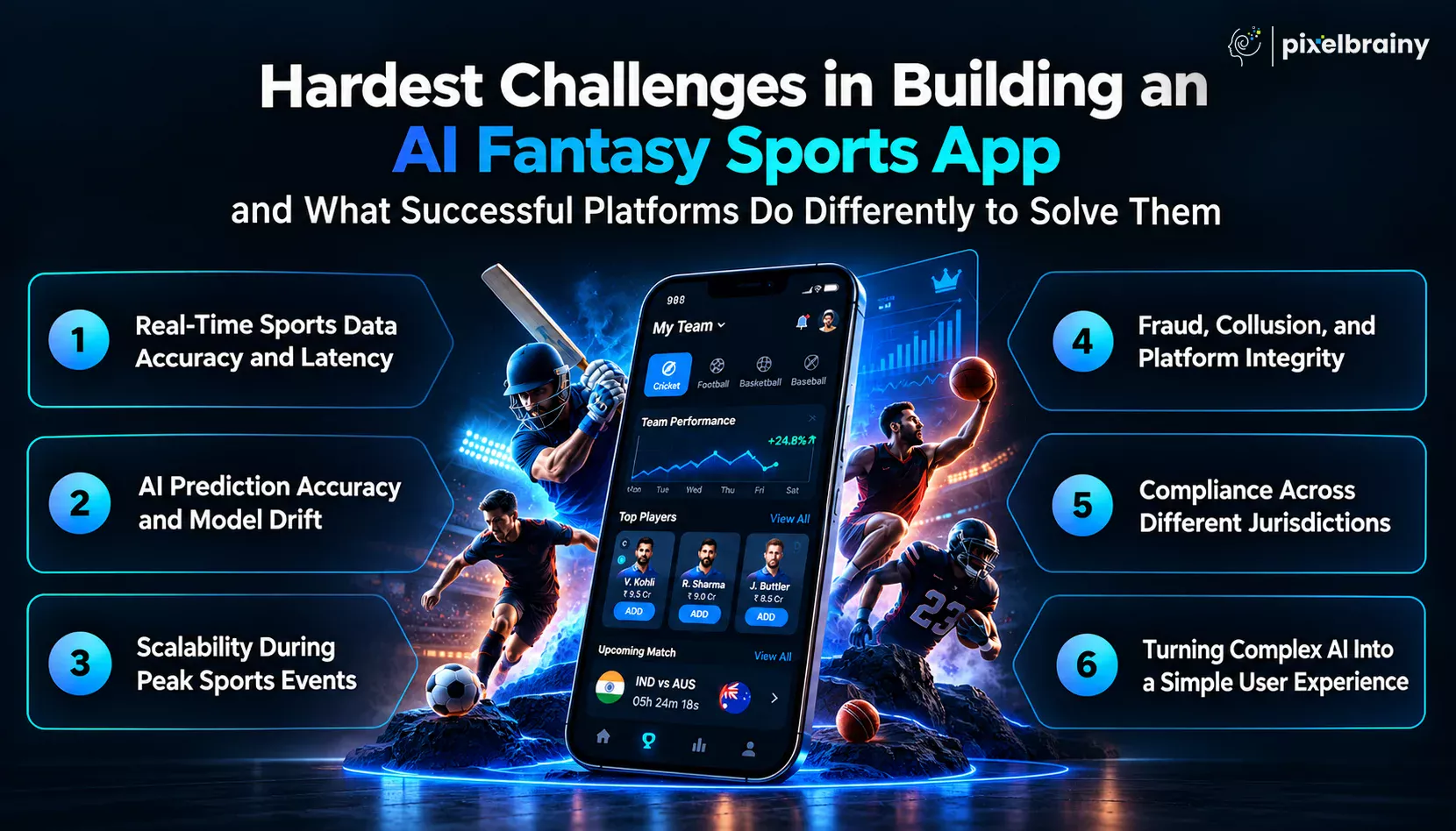
Before you develop an AI fantasy sports app, it is important to understand that the hardest problems are rarely the visible features such as team creation, player profiles, contests, or leaderboards. The real complexity lies behind the interface: real-time sports data, prediction accuracy, model reliability, peak traffic, fraud prevention, regulatory controls, and the ability to turn complex AI insights into a simple user experience.
For businesses investing in AI fantasy sports app development, a critical question is: “How can we build a fantasy platform that reacts to breaking player news within minutes, maintains accurate scoring during peak game traffic, produces genuinely useful predictions, and remains reliable as our existing sports audience grows?”
This question is particularly important for sports media companies that already have large audiences and proprietary editorial analysis. Developing an AI fantasy sports app requires connecting those assets to a scalable technical architecture without compromising speed, accuracy, security, or user trust.
The following six challenges represent some of the most important areas that sports-tech founders and product teams need to solve before taking an AI fantasy platform from concept to large-scale operation.
The challenge:
Fantasy users expect player statistics, injuries, lineups, scores, and rankings to update quickly. Delayed, incomplete, duplicated, or inconsistent data can produce inaccurate predictions and scoring disputes.
How successful platforms solve it:
They use reliable authorized sports data providers, normalized data structures, event-driven pipelines, validation rules, caching, and fallback mechanisms. Critical game events can flow through real-time processing systems before reaching the fantasy scoring engine and user interface. Data corrections should also remain auditable.
The challenge:
Adding machine learning does not automatically make fantasy predictions more accurate. Player performance can change because of injuries, team changes, coaching decisions, opponent strength, usage patterns, weather, and other contextual factors.
How successful platforms solve it:
They continuously evaluate models using unseen data and benchmark predictions against defined baselines. Different architectures can be tested to determine which produces the strongest results for the specific sport and prediction target. Model monitoring, versioning, retraining, and drift detection help maintain performance as conditions change.
The challenge:
Fantasy traffic can increase dramatically before major games, tournaments, playoffs, and lineup deadlines. The platform may suddenly need to process large numbers of API requests, live events, leaderboard calculations, notifications, and user actions.
How successful platforms solve it:
They design infrastructure around peak demand rather than average traffic. Cloud auto-scaling, load balancing, distributed caching, optimized databases, event queues, and real-time communication systems can help the platform remain responsive during traffic spikes. Stress testing should replicate realistic game-day conditions before launch.
The challenge:
Real-money fantasy platforms can face multi-accounting, automated activity, payment abuse, suspicious account relationships, and potential collusion. These problems can affect both platform economics and user confidence.
How successful platforms solve it:
They combine deterministic rules with behavioral analytics, device intelligence, transaction monitoring, velocity controls, anomaly detection, and appropriate human investigation. A strong audit trail also helps operators investigate disputes and understand suspicious activity.
The challenge:
U.S. real-money DFS regulation is not uniform across every jurisdiction. Contest formats, licensing, registration, geolocation, age verification, responsible gaming, payments, and other requirements can differ.
How successful platforms solve it:
They incorporate compliance into the core product architecture through configurable jurisdiction rules. A verified user's location can determine contest eligibility, available features, payment functionality, and applicable controls. This makes it easier to expand into new markets without rebuilding the entire application.
The challenge:
Even an advanced prediction model can fail commercially if users cannot understand or apply its recommendations. Too many statistics, projections, alerts, and confidence indicators can overwhelm casual users.
How successful platforms solve it:
They create layered experiences. Beginners receive simple explanations and actionable insights, while advanced users can access deeper statistics, projections, comparisons, and analytical details. Explainable AI can communicate the key factors behind a recommendation without exposing unnecessary technical complexity.
Successful AI fantasy sports platforms overcome these challenges by combining reliable data, validated AI, scalable infrastructure, strong integrity controls, regulatory readiness, and a simple user experience.
From the challenges, technology requirements, compliance considerations, and development process discussed above, it is now time to identify the right technology partner. For a sports media company entering the fantasy sports market, the right partner should not simply deliver a long feature list. The partner should understand sports data, AI model performance, real-time processing, personalization, scalable architecture, and the commercial objectives behind the product.
As an AI fantasy sports app development company, PixelBrainy approaches fantasy platforms as intelligent sports products rather than conventional mobile applications. The focus is on creating an AI layer that can turn sports data, editorial intelligence, player information, and user behavior into useful, measurable experiences.
A fantasy application can have dozens of features and still fail to create meaningful differentiation if its underlying recommendations are weak. PixelBrainy focuses on the intelligence behind the experience, including data pipelines, prediction models, recommendation logic, personalization, model evaluation, and continuous optimization.
The objective is to build AI fantasy sports app experiences where AI provides genuine decision-support value rather than appearing as a marketing layer added to traditional fantasy functionality.
Sports media companies often already possess valuable assets such as editorial content, player rankings, audience data, sports journalism, newsletters, video content, and established distribution channels.
PixelBrainy can design the fantasy architecture around these assets so that approved editorial intelligence can complement structured sports data and AI recommendations. This creates a connected user journey from sports content to player analysis, fantasy research, and participation.
For a company asking, " Our company wants to build an AI fantasy sports app that operates a season long fantasy football league as a managed product where users join leagues run by our platform rather than self-managing their own leagues. Our AI commissioner handles all league management decisions including waivers, scheduling, and rule enforcement, our AI provides weekly coaching reports to each team manager, and our platform creates a premium end to end experience where users focus entirely on the strategic and social aspects of fantasy football without any administrative overhead. Which AI development companies in the USA have experience building managed league fantasy sports products where the platform takes on commissioner responsibilities through AI automation?", the answer begins with integrating those assets into the product architecture from the start.
Fantasy decisions can change rapidly when an injury, lineup announcement, practice update, weather change, or other relevant event occurs. PixelBrainy's approach considers the complete pipeline from data ingestion to AI processing and recommendation delivery.
The architecture can support real-time event processing, structured data updates, model triggers, recommendation refreshes, and user notifications. The objective is to minimize unnecessary latency while maintaining appropriate data validation before new information influences the user experience.
PixelBrainy does not treat AI predictions as guaranteed outcomes. Instead, models should be evaluated using appropriate historical and out-of-sample datasets, relevant accuracy metrics, calibration, ranking performance, and clearly defined benchmarks.
This approach is particularly important for sports media companies that want to claim differentiated prediction quality. Before promoting an AI recommendation engine, teams should establish how performance will be measured and whether the model produces measurable incremental value over an appropriate baseline.
A U.S.-focused sports media business approached PixelBrainy with the objective of extending its existing sports audience into an AI-powered fantasy experience. The client already had a substantial sports content ecosystem but needed a product architecture capable of connecting editorial insights, sports data, fantasy functionality, and AI recommendations.
Because the client information is confidential, specific company and commercial details cannot be disclosed.
The project approach included:
The primary objective was not simply to create more features. It was to establish an intelligent foundation where data quality, AI recommendations, user experience, and scalability work together.
PixelBrainy focuses on the intersection of AI, sports technology, data engineering, and product development. This enables the team to approach fantasy products from both the technical and business perspectives.
The engagement can cover strategy, architecture, UX, data engineering, machine learning, application development, integrations, testing, deployment, and post-launch optimization.
For companies looking to develop AI fantasy sports app products, the focus remains on creating a platform that can evolve as sports coverage, user expectations, AI capabilities, and business requirements change.
The strongest fantasy platform is not necessarily the one with the longest feature list. It is the one where every important feature contributes to a faster, smarter, more personalized, and more trustworthy user experience.
PixelBrainy approaches AI fantasy sports app development integrating AI around that principle, with emphasis on prediction quality, real-time intelligence, data architecture, personalization, scalability, and measurable product outcomes.
Ready to turn your sports audience and data into an intelligent fantasy experience? Connect with PixelBrainy to discuss your AI fantasy sports product.
The opportunity to develop an AI fantasy sports app goes far beyond adding AI recommendations to a traditional fantasy platform. A successful product brings together accurate sports data, intelligent player predictions, real-time updates, personalized experiences, engaging fantasy mechanics, secure infrastructure, and the compliance framework required for its target markets.
As this guide explains, AI fantasy sports app development requires a clear strategy from the beginning. Businesses need to select the right fantasy model, validate the AI use case, build a reliable data foundation, develop the core platform, integrate machine learning, prepare for peak traffic, address legal requirements, and establish monetization strategies that support sustainable growth.
For sports media companies, the opportunity is even stronger. Existing audiences, editorial expertise, player rankings, and sports content can become valuable inputs for a differentiated AI fantasy sports app, creating a connected journey from news and analysis to personalized fantasy engagement.
The goal is not to build the platform with the most features. It is to build one that delivers better intelligence, stronger engagement, and measurable user value.
Ready to turn your fantasy sports vision into an AI-powered platform? Book an appointment with PixelBrainy today.
The cost to develop an AI fantasy sports app typically ranges from $40,000 to $250,000+. A basic single-sport product may cost less, while an enterprise AI fantasy sports app development project with real-time sports data, advanced AI predictions, multiple sports, payment infrastructure, compliance controls, and high scalability can require a significantly larger investment.
To build an AI fantasy sports app, businesses can use machine learning for player projections, recommendation systems, personalization, rankings, anomaly detection, and predictive analytics. Depending on the product, NLP can process injury reports, editorial content, practice updates, and breaking sports information. Python, ML frameworks, real-time data pipelines, cloud infrastructure, and scalable APIs are commonly used for fantasy sports app development using AI.
An AI fantasy sports app can potentially deliver measurable improvements over existing projections, but no AI model can guarantee superior predictions. Accuracy depends on data quality, model architecture, feature engineering, prediction horizon, and the consensus benchmark. During AI fantasy sports app development, models should be evaluated using unseen data and metrics such as MAE, RMSE, calibration, and ranking performance.
A properly engineered AI fantasy sports app can process relevant updates within seconds or minutes, depending on the data source and processing architecture. Injury reports, lineup announcements, practice participation, weather changes, and other signals can trigger data validation, model updates, and refreshed recommendations. For DFS products, low-latency AI fantasy sports app development is especially important because player information can change close to contest deadlines.
Not automatically. UIGEA does not provide a nationwide DFS operating license, and AI fantasy sports app legal requirements can vary by state and contest format. Businesses should conduct state-by-state research covering DFS licensing requirements, contest eligibility, geolocation, age verification, payments, responsible gaming, taxation, and other applicable obligations before launching a real-money fantasy sports app.
Beyond standard historical statistics, an AI fantasy sports app can analyze player usage, snap rates, target share, injuries, opponent tendencies, weather, expected playing time, depth charts, team changes, coaching tendencies, and other contextual information. The appropriate data depends on the sport and prediction objective. Reliable, properly licensed sports data is essential for AI model development and accurate fantasy recommendations.
The timeline for AI fantasy sports app development depends on product scope, sports coverage, AI complexity, integrations, compliance requirements, and platform requirements. A focused MVP can generally be delivered faster than an enterprise multi-sport platform. The development process of AI fantasy sports app typically includes discovery, proof of concept, UX design, core development, AI integration, testing, compliance preparation, deployment, and post-launch optimization.
A sports media company can monetize an AI fantasy sports app through premium AI subscriptions, advertising, sponsorships, paid fantasy contests where legally permitted, premium analytics, referrals, and B2B or white-label licensing. Existing editorial content and audience distribution can create an additional advantage by connecting sports news, AI analysis, fantasy engagement, and premium products within one digital ecosystem.

About The Author
Sagar Bhatnagar
Sagar Sahay Bhatnagar brings over a decade of IT industry experience to his role as Marketing Head at PixelBrainy. He's known for his knack in devising creative marketing strategies that boost brand visibility and market influence. Sagar's strategic thinking, coupled with his innovative vision and focus on results, sets him apart. His track record of successful campaigns proves his ability to utilize digital platforms effectively for impactful marketing efforts. With a genuine passion for both technology and marketing, Sagar continuously pushes PixelBrainy's marketing initiatives to greater success.

Working with the PixelBrainy team has been a highly positive experience. They understand the design requirements and create beautiful UX elements to meet the application needs. The dev team did an excellent job bringing my vision to life. We discussed usability and flow. Sagar worked with his team to design the database and begin coding. Working with Sagar was easy. He has the knowledge to create robust apps, including multi-language support, Google and Apple ID login options, Ad-enabled integrations, Stripe payment processing, and a Web Admin site for maintaining support data. I'm extremely satisfied with the services provided, the quality of the final product, and the professionalism of the entire process. I highly recommend them for Android and iOS Mobile Application Design and Development.

Great experience working with them. Had a lot of feedback and I found that unlike most contractors they were bugging me for updates instead of the other way around. They were extremely time conscience and great at communicating! All work was done extremely high quality and if not on time, early! They were always proactive when it comes to communication and the work is great/above par always. Very flexible and a great team to work with! Goes above and beyond to present us with multiple options and always provides quality. Amazing work per usual with Chitra. If you have UI/UX or branding design needs I recommend you go to them! Will likely work with them in the future as well, definitely recommended!

PixelBrainy is a joy to work with and is a great partner when thinking through branding, logo, and website layout. I appreciate that they spend time going into the "why" behind their decisions to help inform me and others about industry best practices and their expertise.

I hired them to design our software apps. Things I really like about them are excellent communication skills, they answer all project suggestions and collaborate right away, and their input on design and colors is amazing. This project was complex and needed patience and creativity. The team is amazing to do business with. I will be using them long-term. Glad to see there are some good people out there. I was afraid to try and outsource my project to someone but I am glad I met them! I really can't say enough. They went above and beyond on this project. I am very happy with everything they have done to make my business stand out from the competition.

It was great working with PixelBrainy and the team. They were very responsive and really owned the project. We'll definitely work with them again!

I recently worked with the PixelBrainy team on a project and I was blown away by their communication skills. They were prompt, clear, and articulate in all of our interactions. They listened and provided valuable feedback and suggestions to help make the project a success. They also kept me updated throughout the entire process, which made the experience stress-free and enjoyable.

PixelBrainy is very good at what it does. The team also presents themselves very professionally and takes care of their side of things very well. I could fully trust them taking up the design work in a timely and organised manner and their attention to detail saved us lots of effort and time. This particular project was quite intense and the team showed that they function very well under pressure. Very much looking forward to working with her again!

It's always an absolute pleasure working with them. They completed all of my requests quickly and followed every note I had for them to a T, which made our process go smoothly from start to finish. Everything was completed fast and following all of the guidelines. And I would recommend their services to anyone. If you need any design work done in the future, PixelBrainy should be your first call!

They took ownership of our requirements and designed and proposed multiple beautiful variants. The team is self-motivated, requires minimum supervision, committed to see-through designs with quality and delivering them on time. We would definitely love to work with PixelBrainy again when we have any requirements.

PixelBrainy was a big help with our SaaS application. We've been hard at work with a new UI/UX and they provided a lot of help with the designs. If you're looking for assistance with your website, software, or mobile application designs, PixelBrainy and the team is a great recommendation.

PixelBrainy designers are amazing. They are responsive, talented, and always willing to help craft the design until it matches your vision. I would recommend them and plan to continue them for my future projects and more!!!

They were awesome! Did a good job fast, and good communication. Will work with them again. Thank you

Creative, detail-oriented, and talented designers who take direction well and implement changes quickly and accurately. They consistently over-delivered for us.

PixelBrainy team is very talented and creative. Great designers and a pleasure to work with. PixelBrainy is an excellent communicator and I look forward to working with them again.

PixelBrainy has a very talented design team. Their work is excellent and they are very responsive. I enjoy working with them and hope to continue on all of our future projects.


Transform your ideas into reality with us.
Across these industries, each engagement brings unique challenges, from early-stage product development to scaling complex systems, helping us build a practical understanding of real-world product environments.