AI Summary Powered by PixelBrainy
Why do some food delivery platforms scale faster, deliver better customer experiences, and achieve higher profitability while others struggle with inefficient logistics, delayed deliveries, and declining customer retention despite offering the same core service?
The answer lies in artificial intelligence. AI food delivery app development is transforming how modern food delivery businesses manage operations, optimize logistics, personalize customer experiences, and drive sustainable growth. An AI-powered food delivery app goes beyond online ordering by leveraging technologies such as machine learning, predictive analytics, recommendation engines, real-time GPS tracking, and intelligent automation to make faster, smarter, and data-driven decisions across the entire delivery ecosystem. As competition intensifies and customer expectations continue to rise, businesses that integrate AI are better equipped to improve operational efficiency, reduce costs, and increase customer loyalty.
Traditional food delivery applications rely on static routing, manual dispatch systems, fixed workflows, and one-size-fits-all recommendations. While these approaches support basic delivery operations, they often struggle to adapt to changing traffic conditions, fluctuating demand, restaurant preparation times, delivery partner availability, and evolving customer preferences. Developing an AI food delivery app addresses these limitations by introducing intelligent dispatch, dynamic route optimization, AI-powered personalization, demand forecasting, fraud detection, automated customer support, and smart restaurant integrations. These capabilities help businesses shorten delivery times, maximize driver utilization, increase repeat orders, and create highly personalized ordering experiences that drive long-term revenue growth.
If your goal is, "We are looking to develop an AI food delivery app and we need a development partner that understands both AI feature development and the operational complexity of food delivery platforms. We are not looking for a generic app agency that will treat our food delivery app like a standard e-commerce project. We want a team that understands real time dispatch systems, GPS tracking at scale, restaurant integration complexity, and AI-powered personalization all at the same time," then you're asking the right questions. Building an intelligent food delivery platform requires expertise in AI development, scalable cloud infrastructure, real-time dispatch systems, location intelligence, and food delivery operations.
In this guide, you'll learn everything about food delivery app development integrating AI, including what an AI food delivery app is, why it matters, who it is built for, its types, key benefits, essential and advanced features, the complete development process of AI food delivery app, development costs, monetization strategies, implementation challenges, and how to choose the right technology partner. By the end, you'll have a clear roadmap to build an AI food delivery app that delivers exceptional customer experiences, streamlines operations, and creates a lasting competitive advantage.
An AI food delivery app is a smart food ordering and delivery platform that uses artificial intelligence to automate operations, personalize customer experiences, optimize logistics, and improve business decisions using real-time and historical data. Unlike traditional delivery apps that follow predefined rules, AI-powered platforms continuously learn from customer behavior, restaurant performance, delivery patterns, traffic conditions, and demand trends. This is why AI food delivery app development is becoming a strategic investment for startups, restaurant chains, cloud kitchens, and enterprise food delivery businesses.
The primary difference between a standard food delivery app and an AI-powered one is intelligence. A conventional platform connects customers, restaurants, and delivery partners through fixed workflows such as manual dispatch, static routing, and generic recommendations. In contrast, food delivery app development with AI enables the platform to analyze data continuously and make smarter decisions that improve efficiency and user experience.
Some of the core capabilities of an AI-powered food delivery app include:
Artificial intelligence benefits every participant in the food delivery ecosystem. Customers receive personalized recommendations, accurate delivery estimates, and faster support. Restaurants gain valuable insights into demand trends, menu performance, and customer preferences to improve sales and reduce food waste. Delivery partners benefit from smarter order allocation, optimized delivery routes, and balanced workloads that improve productivity and earnings.
These AI powered food delivery app features create a self-learning platform that becomes smarter with every order. Instead of simply connecting customers, restaurants, and drivers, an AI-powered food delivery app continuously optimizes the entire ecosystem, making it faster, more efficient, and more profitable than a standard delivery application.
| Factor | Standard Food Delivery App | AI Food Delivery App |
| Food Recommendations | Static popular items list | Personalized based on order history and customer behavior |
| Driver Dispatch | Rule-based nearest driver assignment | AI-optimized matching using traffic, workload, and restaurant preparation time |
| Route Optimization | Fixed GPS directions | Dynamic real-time route optimization |
| Delivery Time Estimate | Distance-based estimation | AI prediction using multiple real-time variables |
| Demand Forecasting | Manual planning | AI predicts demand based on location, time, weather, and historical trends |
| Dynamic Pricing | Fixed delivery fees | AI-adjusted pricing based on demand and supply |
| Customer Retention | Generic promotions | AI-personalized offers based on customer behavior |
| Restaurant Insights | Basic sales reports | AI-powered menu performance, demand forecasting, and customer analytics |
A standard food delivery app processes orders, while an AI-powered food delivery app learns from every interaction to deliver personalized experiences, optimize operations, and help food delivery businesses scale more efficiently.
An AI food delivery app works by using artificial intelligence, machine learning, predictive analytics, and real-time data to automate and optimize every stage of the food delivery process. Instead of relying on fixed rules, the platform continuously analyzes customer behavior, restaurant operations, driver availability, traffic conditions, and historical order data to make faster, smarter, and more accurate decisions. This intelligent approach helps businesses reduce delivery delays, improve operational efficiency, and deliver a highly personalized customer experience.
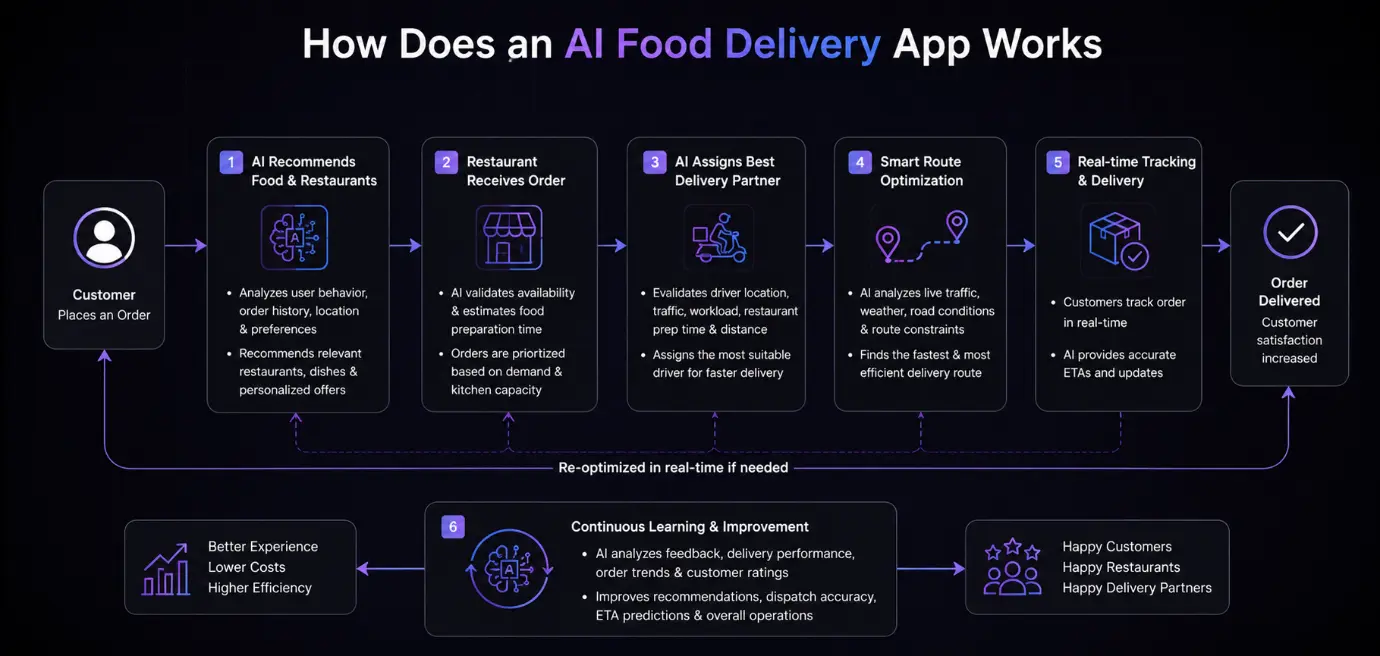
AI analyzes the customer's order history, browsing behavior, location, and preferences to recommend relevant restaurants, dishes, and personalized offers. This improves user engagement and increases the likelihood of repeat orders.
The platform estimates food preparation time, checks restaurant availability, and prioritizes orders based on kitchen capacity and real-time demand, helping restaurants manage operations more efficiently.
Instead of selecting the nearest driver, AI evaluates multiple factors such as driver location, traffic conditions, workload, restaurant preparation time, and delivery distance to assign the most suitable delivery partner.
AI continuously monitors GPS data, live traffic, weather conditions, and road closures to identify the fastest delivery route while providing customers with accurate delivery time estimates and real-time order tracking.
After every completed order, AI analyzes customer feedback, delivery performance, demand patterns, and restaurant data to improve future recommendations, dispatch accuracy, delivery predictions, and overall platform performance.
Customer Places Order → AI Personalizes Recommendations → Restaurant Accepts Order → AI Assigns the Best Driver → Smart Route Optimization → Real-Time Order Tracking → Delivery Completed → AI Learns and Improves
Rather than simply processing food orders, AI food delivery app development creates a self-learning ecosystem where every interaction makes the platform smarter. This is why businesses investing in food delivery app development with AI can deliver faster services, optimize logistics, improve customer satisfaction, and scale their operations more efficiently.
Building an AI food delivery platform is fundamentally different from building a traditional consumer app. Instead of serving a single audience, an AI-powered delivery platform must simultaneously create value for multiple stakeholders whose success depends on one another. Customers expect speed and personalization, restaurants want operational efficiency and higher revenue, delivery partners need smarter route planning, while enterprise businesses require complete visibility and control over their delivery ecosystem. This is why AI food delivery app development requires a marketplace-first architecture where every AI capability benefits the entire network rather than just one user group.
Before you build an AI food delivery app, it's important to understand the needs of each audience your platform will serve.
Customers are the primary drivers of every food delivery platform. They expect an effortless ordering experience with personalized restaurant recommendations, accurate delivery estimates, secure payments, real-time order tracking, and responsive customer support. Every interaction should feel fast, intuitive, and tailored to their individual preferences.
Artificial intelligence improves this experience by learning from browsing history, previous orders, dietary preferences, location, budget, and ordering habits. Over time, the platform becomes better at recommending meals, predicting ordering behavior, sending personalized offers, and providing highly accurate delivery time estimates. When AI works effectively, customers spend less time searching and more time ordering, leading to higher engagement, increased repeat purchases, and stronger customer loyalty.
Restaurants view a food delivery platform as much more than an order management system. They want consistent order volume, predictable demand, better kitchen planning, and insights that help improve profitability. Managing peak-hour demand, reducing food waste, and understanding customer preferences are equally important for long-term success.
When you develop AI powered food delivery app solutions, artificial intelligence helps restaurants forecast demand, identify their best-selling menu items, optimize inventory planning, prioritize incoming orders, and recommend promotional campaigns based on customer purchasing behavior. Rather than relying solely on historical sales reports, restaurants receive actionable insights that help improve kitchen efficiency, maximize revenue, and deliver a better customer experience.
Delivery partners play a critical role in maintaining service quality and customer satisfaction. They expect fair order allocation, optimized delivery routes, transparent earnings, minimal idle time, and clear communication throughout every delivery.
AI makes driver operations significantly more efficient by evaluating multiple real-time variables such as traffic conditions, delivery distance, restaurant preparation time, driver availability, and current workload before assigning an order. Intelligent route optimization also reduces unnecessary travel while increasing the number of successful deliveries per shift. A platform that prioritizes driver experience alongside delivery speed is more likely to retain reliable delivery partners and maintain consistent service levels during peak demand.
Cloud kitchens operate multiple restaurant brands without a traditional dine-in experience, making operational efficiency their highest priority. These businesses often manage dozens of virtual brands from one or more centralized kitchens and depend entirely on digital ordering platforms for growth.
Many founders say, "Our company is planning to build an AI food delivery app that also serves as a cloud kitchen management platform." To support this business model, the platform should provide AI-powered demand forecasting, multi-brand order management, centralized kitchen monitoring, inventory optimization, menu performance analytics, and seamless integration between kitchen operations and delivery logistics. A unified dashboard enables operators to manage every brand from one place while using AI insights to improve production planning and profitability.
Large restaurant chains, franchise networks, and grocery retailers increasingly want to own their digital ordering ecosystem instead of relying entirely on third-party marketplaces. They need complete ownership of customer relationships, delivery operations, pricing strategies, and business data while maintaining a consistent brand experience across multiple locations.
This requirement is reflected in real-world business needs. Many enterprise founders approach development teams with requests such as, "We are an existing restaurant group with 25 locations across the US and we want to develop an AI food delivery app that we own and operate directly." Others are planning to build an AI food delivery app for grocery delivery, saying, "We are a grocery retail chain looking to develop an AI food and grocery delivery app that uses AI to optimize picking routes in our stores." These businesses require far more than a consumer-facing application. They need a scalable enterprise platform with white-label deployment, centralized administration, AI-powered analytics, POS and ERP integrations, multi-location management, inventory intelligence, and complete ownership of customer data.
Whether you prioritize consumers, restaurants, cloud kitchens, or enterprise businesses, identifying your primary user group first lays the foundation for successful AI food delivery app development.
Not all food delivery apps are built for the same business model. The type of platform you choose determines your target audience, revenue model, AI capabilities, integrations, and overall development scope. Before investing in AI food ordering app development, founders should clearly identify who they want to serve and how their platform will create value. Whether you're targeting consumers, restaurant chains, cloud kitchens, grocery retailers, or enterprises, selecting the right model early helps reduce development complexity and build a product that can scale with your business.
For example, many founders approach development teams with requirements like, "Our startup is building an AI food delivery app targeting health-conscious consumers in major US cities who want AI powered meal recommendations based on their dietary preferences." In this scenario, AI-powered meal recommendations, nutrition analysis, and personalized user experiences become the platform's core differentiators rather than optional features.
Understanding your business model before you develop AI food delivery app solutions ensures your product roadmap, AI features, and monetization strategy align with your long-term vision.
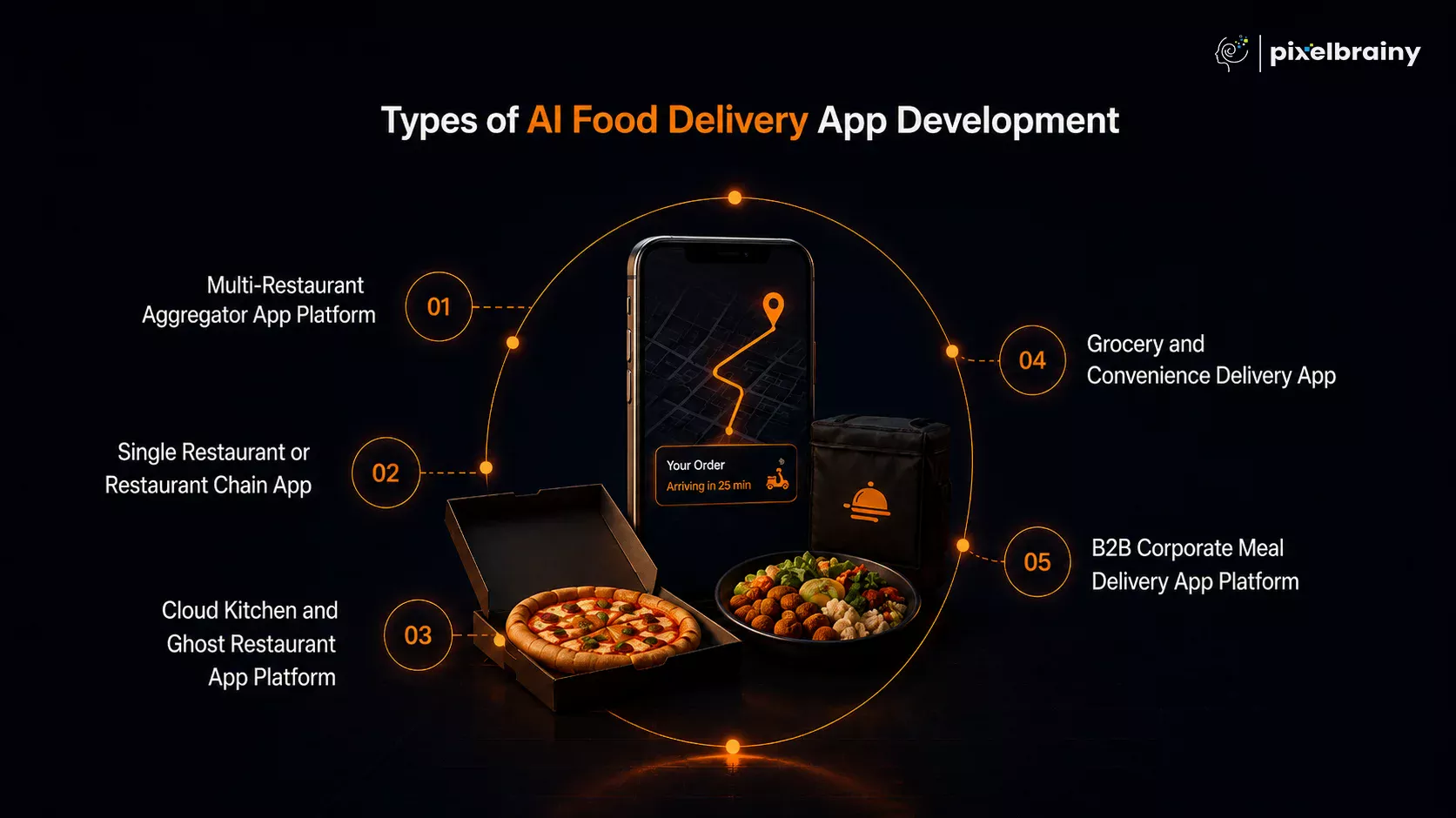
A multi-restaurant app aggregator connects customers with multiple independent restaurants through a single marketplace. Users can browse different cuisines, compare restaurants, place orders, and track deliveries from one app.
Real Examples: Uber Eats, DoorDash, Grubhub, Deliveroo.
Artificial intelligence powers personalized restaurant and dish recommendations, predicts customer preferences, optimizes driver dispatch across multiple restaurants, and forecasts demand by location and time. These capabilities improve delivery efficiency while helping restaurants reach more customers.
Best For: Well-funded startups looking to build a marketplace in underserved cities or regional markets.
This model is designed exclusively for one restaurant brand or restaurant chain, allowing businesses to accept direct online orders without relying on third-party aggregators or paying high commission fees.
Real Examples: Domino's, Pizza Hut, Chick-fil-A, Starbucks.
AI helps personalize upsell recommendations, analyze customer purchasing behavior, automate loyalty programs, optimize delivery routes for an owned driver fleet, and improve repeat order rates. Businesses also gain complete ownership of customer data and brand experience.
Best For: Restaurant chains and franchises with consistent order volumes and an established customer base.
Cloud kitchen platforms are built for delivery-only restaurants that operate multiple virtual brands from centralized kitchens. Since these businesses depend entirely on online orders, operational efficiency is critical.
Real Examples: Rebel Foods (Faasos, Behrouz Biryani), Kitopi, CloudKitchens.
Through AI restaurant delivery app development, operators can forecast demand by cuisine and location, optimize menu performance, manage multiple brands from one dashboard, predict inventory requirements, and improve kitchen productivity using AI-driven insights.
Best For: Cloud kitchen operators and startups building technology platforms for delivery-first restaurant businesses.
This model extends on demand food delivery app development with AI beyond restaurant meals to groceries, convenience products, beverages, pharmacy items, and meal kits. These platforms require intelligent inventory management and fast order fulfillment.
Real Examples: Instacart, Gopuff, Blinkit, Zepto.
AI improves product discovery through basket recommendation engines, predicts subscription purchases, suggests complementary products, optimizes in-store picking routes, and manages inventory more efficiently.
Best For: Grocery retailers, quick commerce startups, supermarkets, and meal kit subscription businesses.
Corporate meal delivery platforms help organizations manage employee meals, business meetings, training sessions, and corporate events through centralized ordering and billing.
Real Examples: ezCater, Sharebite, EAT Club (now part of Fooda).
Artificial intelligence aggregates employee meal preferences, automates recurring meal planning, recommends restaurants based on company budgets and dietary requirements, and generates analytics for HR and workplace administrators.
Best For: Founders targeting corporate catering, employee wellness programs, workplace food benefits, and enterprise meal management.
| Type | Target User | Core AI Application | Best Revenue Model |
| Multi-Restaurant Aggregator | General consumers | Personalized recommendations and intelligent dispatch optimization | Commission + Delivery Fee |
| Single Restaurant Chain App | Brand-loyal customers | AI-powered upsell recommendations and customer retention | Direct Order Margin Improvement |
| Cloud Kitchen Platform | Delivery-only operators | Demand forecasting and menu optimization | SaaS Subscription + Commission |
| Grocery & Convenience Delivery | On-demand shoppers | Basket recommendation engine and subscription prediction | Delivery Fee + Subscription |
| B2B Corporate Meal Delivery | Enterprise businesses and employees | Group preference aggregation and recurring meal planning | Corporate Account Subscription |
The type of platform you build influences every major decision, from AI capabilities and technology architecture to monetization and future scalability. Identifying the right business model before starting AI food ordering app development helps you build a solution that aligns with your target market, supports long-term growth, and delivers lasting value for every stakeholder.
AI food delivery app development delivers measurable business value by combining machine learning, predictive analytics, intelligent dispatch, recommendation engines, demand forecasting, and real-time route optimization into one connected platform. Rather than simply digitizing food ordering, AI continuously analyzes customer behavior, restaurant operations, driver availability, and delivery data to make smarter decisions that improve efficiency, reduce costs, and increase revenue.
For founders planning to build AI food delivery app solutions, these capabilities create long-term competitive advantages that traditional delivery platforms cannot easily replicate.
Personalization is one of the most valuable AI capabilities in a food delivery platform. AI recommendation engines analyze browsing history, previous orders, dietary preferences, location, and purchasing behavior to recommend meals that are most relevant to each customer.
For users, this creates a faster and more engaging ordering experience. For businesses, it increases repeat purchases, average order value, and customer lifetime value while lowering customer acquisition costs through improved retention.
Efficient delivery operations are essential for maintaining healthy profit margins. An AI route optimization food delivery app continuously evaluates live traffic, weather conditions, driver availability, delivery priorities, and GPS data to identify the fastest delivery routes.
AI also enables intelligent multi-order batching, allowing delivery partners to complete more deliveries in less time. Customers receive faster deliveries, while businesses reduce fuel costs, delivery expenses, and improve unit economics at every order volume.
Predictive analytics enables restaurants to anticipate demand before peak hours begin. By analyzing historical orders, seasonal trends, weather patterns, local events, and customer behavior, AI forecasts future order volumes with greater accuracy.
Restaurants can prepare inventory, optimize staffing, and manage kitchen operations more efficiently. As a result, customers experience shorter wait times, businesses receive higher ratings, and restaurants improve operational performance.
Unlike traditional dispatch systems that assign the nearest available driver, machine learning food delivery app development uses AI to evaluate delivery distance, traffic conditions, driver workload, restaurant preparation time, and delivery priority before assigning each order.
Drivers spend less time waiting between deliveries and complete more orders per shift, improving earnings and satisfaction. For founders, this means lower driver costs per order, better fleet utilization, and a more scalable delivery operation.
Artificial intelligence helps businesses increase revenue without depending solely on higher order volumes. Dynamic pricing adjusts delivery fees based on demand and supply, while AI-powered recommendation engines suggest complementary items such as beverages, desserts, or meal upgrades during checkout.
Customers receive relevant recommendations instead of generic promotions, while businesses increase average order value and maximize revenue from every transaction.
Every completed order generates valuable data that strengthens AI models over time. Customer interactions, delivery performance, restaurant operations, and driver behavior continuously improve recommendation engines, ETA predictions, demand forecasting, and intelligent dispatch.
As you develop AI powered food delivery app solutions, the platform becomes more accurate, efficient, and personalized with every transaction. This continuous learning creates a data-driven competitive advantage that grows stronger as your customer base expands, making it increasingly difficult for competitors to replicate your operational intelligence.
| Benefit | AI Capability Behind It | Business Impact |
| Higher Customer Retention | AI recommendation engine and personalization | Higher customer lifetime value and lower churn |
| Lower Delivery Costs | Real-time route optimization and fleet optimization | Better unit economics and reduced operational costs |
| Reduced Order Wait Times | Predictive analytics and AI demand forecasting | Faster deliveries, improved ratings, and higher customer satisfaction |
| Smarter Driver Utilization | Intelligent dispatch and machine learning | Lower driver cost per order and improved fleet productivity |
| Higher Revenue Per Order | Dynamic pricing and AI-powered upselling | Increased average order value without additional marketing spend |
| Long-Term Competitive Advantage | Continuous AI model learning | A self-improving platform and sustainable data advantage |
The real strength of AI food delivery app development lies in how multiple AI capabilities work together. Personalization increases retention, route optimization reduces costs, demand forecasting improves restaurant efficiency, intelligent dispatch boosts driver productivity, and continuous learning makes the platform smarter over time.
Together, these above benefits create a scalable, data-driven ecosystem that helps businesses grow faster, operate more efficiently, and maintain a lasting competitive advantage.
When founders ask, "What features should I include in my AI food delivery app?", the answer extends far beyond online ordering, payment integration, and live GPS tracking. A modern AI-powered food delivery platform combines artificial intelligence, machine learning, predictive analytics, and real-time data processing to automate decisions, personalize customer experiences, optimize restaurant operations, and improve delivery efficiency. These intelligent capabilities help businesses reduce operational costs, increase customer retention, and create a platform that becomes smarter with every order.
Unlike a conventional food delivery application, an AI-powered platform serves three different user groups through dedicated interfaces: the Customer App, the Restaurant Dashboard, and the Driver App. Each interface addresses unique challenges while sharing a common AI engine that powers recommendations, demand forecasting, intelligent dispatch, and route optimization. During AI food recommendation engine development, founders should focus on features that deliver immediate business value in Version 1, while reserving advanced innovations for future product releases as the platform grows.
| Feature | How AI Works | Business & User Value |
| AI Personalized Food Recommendation Engine | AI learns from order history, browsing behavior, dietary preferences, location, spending habits, and meal timings to recommend restaurants and dishes tailored to each user. The recommendation engine continuously improves as more customer data becomes available. | Creates a highly personalized ordering experience, increases repeat purchases, improves customer retention, and boosts average order value. |
| Real-Time Order Tracking with AI Delivery Time Prediction | Combines live GPS tracking with AI models that analyze restaurant preparation time, driver pickup status, traffic conditions, weather, and delivery distance to generate accurate ETAs. Customers also receive proactive notifications when delays are predicted. | Builds customer trust, reduces uncertainty, minimizes support requests, and improves delivery satisfaction. |
| AI Chatbot for Order Support | Natural Language Processing (NLP) enables the chatbot to answer questions about order status, refunds, menu items, allergies, payments, and delivery updates. Complex issues are automatically escalated to human support. | Delivers 24/7 customer assistance, reduces support costs, and provides faster issue resolution. |
| Smart Reorder & AI Favorites | AI identifies frequently ordered meals, favorite restaurants, and ordering patterns to enable one-tap reordering. It can also recommend reorders when a user's typical meal time approaches. | Simplifies repeat purchases, shortens checkout time, and encourages customer loyalty. |
| AI-Personalized Promotions & Loyalty | AI creates personalized discounts, reward triggers, and loyalty campaigns based on each customer's purchasing behavior instead of offering generic promotions to all users. | Increases repeat orders, improves customer lifetime value, and maximizes marketing efficiency. |
| Feature | How AI Works | Business Value |
| AI Demand Forecasting | Predictive analytics analyzes historical orders, weather conditions, holidays, local events, and seasonal demand to forecast future order volumes with greater accuracy. | Helps restaurants schedule staff, prepare inventory, reduce food waste, and shorten preparation times. |
| Menu Performance Analytics | AI evaluates menu popularity, customer ratings, reorder frequency, preparation time, and profit margins to identify best-performing and underperforming dishes. | Supports data-driven pricing decisions, menu optimization, and higher restaurant profitability. |
| Automated Order Management | Incoming orders are intelligently prioritized based on kitchen workload, preparation time, and delivery schedules while integrating seamlessly with Kitchen Display Systems (KDS). | Improves kitchen efficiency, streamlines operations, and reduces order preparation delays. |
| Feature | How AI Works | Business & Driver Value |
| AI Route Optimization & Navigation | AI continuously evaluates GPS data, live traffic, weather conditions, road closures, and multiple delivery stops to recommend the fastest and most efficient delivery route. | Reduces fuel costs, shortens delivery times, and enables drivers to complete more deliveries per shift. |
| AI-Powered Dispatch & Job Matching | Instead of assigning the nearest driver, AI evaluates driver location, current workload, vehicle type, restaurant preparation time, delivery priority, and historical performance to identify the best delivery partner for each order. | Improves driver utilization, reduces idle time, balances workloads, and increases overall delivery efficiency. |
| Earnings Transparency & AI Incentive Alerts | AI tracks earnings in real time while predicting future demand hotspots. Drivers receive proactive notifications about surge pricing opportunities and high-demand delivery zones before order volumes increase. | Improves driver earnings, strengthens driver retention, and ensures better delivery coverage during peak hours |
| Feature | Must Have in Version 1 | Version 2 |
| AI Personalized Food Recommendation Engine | ✅ | |
| Real-Time Order Tracking with AI ETA Prediction | ✅ | |
| AI Driver Dispatch & Job Matching | ✅ | |
| AI Route Optimization | ✅ | |
| AI Demand Forecasting | ✅ | |
| AI Chatbot for Customer Support | ✅ | |
| Dynamic Pricing Engine | ✅ | |
| Menu Performance Analytics | ✅ | |
| Smart Reorder & One-Tap Favorites | ✅ | |
| AI-Personalized Loyalty & Promotions | ✅ | |
| Voice Ordering | ✅ | |
| AI Subscription Meal Planning | ✅ | |
| AR Food Preview | ✅ | |
| Ghost Kitchen Management Tools | ✅ | |
| AI Group Ordering with Smart Bill Split Suggestions | ✅ |
That’s why prioritizing these core AI powered food delivery app features in Version 1 establishes a strong foundation for customer engagement, restaurant efficiency, and delivery optimization.
As your platform grows and AI models learn from increasing volumes of data, advanced capabilities can be introduced to further strengthen personalization, automation, and long-term scalability. This phased approach helps founders launch faster while building an AI platform that continuously evolves with their business and users.
Building an AI-powered food delivery platform requires much more than developing a mobile application. It involves creating an intelligent marketplace that connects customers, restaurants, and delivery partners while using artificial intelligence to automate recommendations, dispatch, route optimization, demand forecasting, and operational decision-making. For founders wondering how to build AI food delivery app from scratch in 2026, the development journey should follow a structured roadmap that minimizes risk, accelerates time to market, and creates a scalable foundation for future growth.
The development process of AI food delivery app projects is typically divided into multiple phases, with several activities running in parallel to reduce overall development time. The roadmap below outlines the steps to build AI food delivery app from idea to launch in 2026, including what happens during each phase, who participates, the expected deliverables, and an estimated timeline. This approach is widely followed by startups planning to develop AI food delivery app for iOS and Android in 2026 while maintaining quality and scalability.
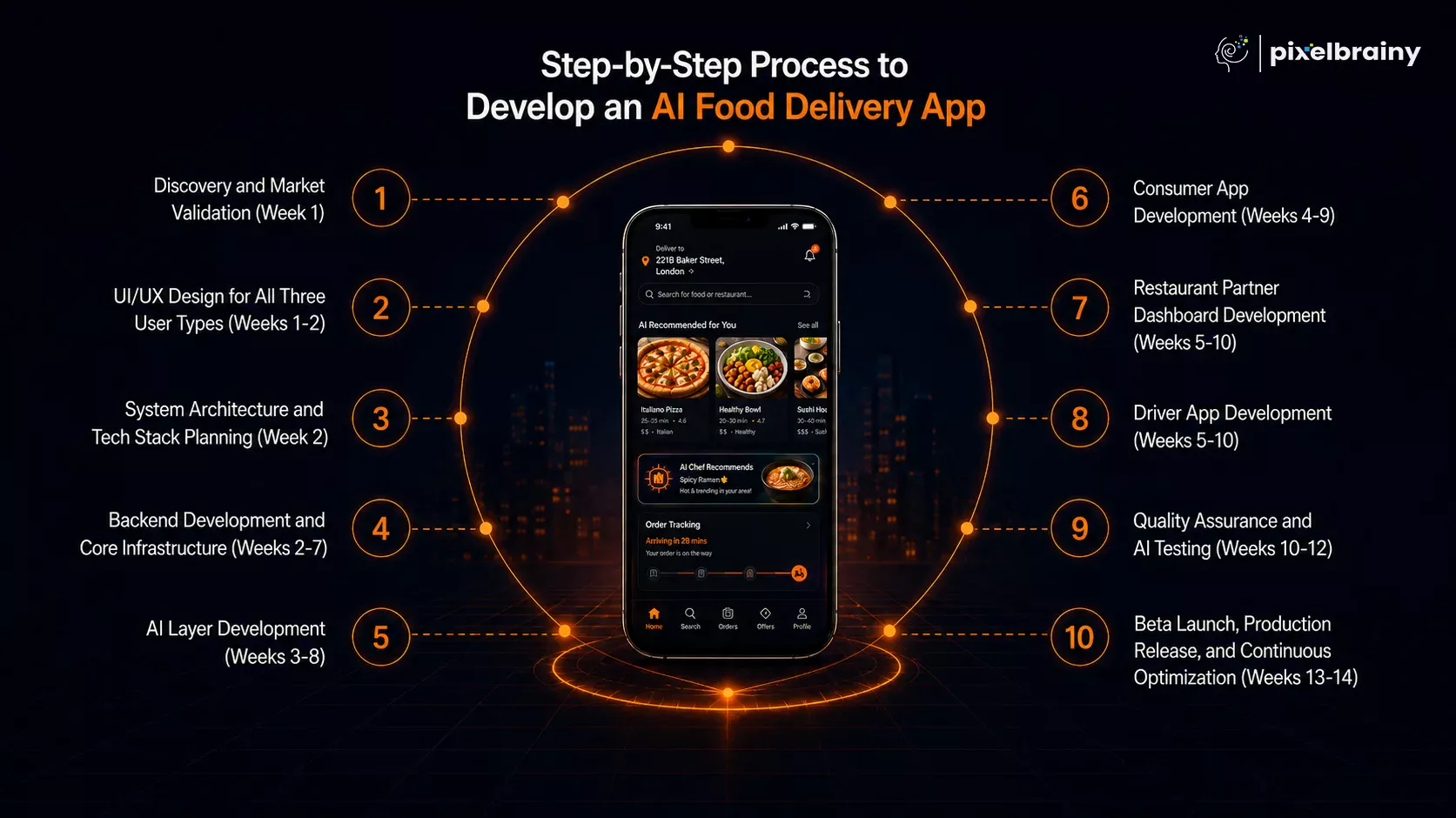
Every great product begins with validating the business before investing in development. During this phase, founders identify the target audience, analyze competitors, define the marketplace model, and determine how the platform will generate revenue. Decisions made here influence every technical and business choice throughout the project.
The team also outlines the restaurant acquisition strategy, driver onboarding plan, and launch city selection while researching local regulations, payment compliance, and operational requirements. Many startups begin with AI consulting services followed by PoC development to validate technical feasibility before committing to full-scale development.
| Activity | Details |
| What Happens | Market research, competitor analysis, monetization planning, launch strategy |
| Who Is Involved | Founders, Product Manager, Business Analyst, AI Consultant |
| Deliverables | Product Requirements Document (PRD), Business Model Canvas, City Launch Strategy |
| Timeline | Week 1 |
Unlike traditional mobile apps, an AI food delivery platform requires three independent user experiences: the customer app, the restaurant dashboard, and the driver application. Each interface has different workflows, goals, and usability requirements while remaining visually consistent across the platform.
Designers create user journeys, high-fidelity screens, clickable prototypes, and a reusable design system. User testing with representatives from each audience helps validate navigation, usability, and ordering flows before development begins. Many startups collaborate with a specialized mobile app UI/UX design company during this stage to create intuitive interfaces.
| Activity | Details |
| What Happens | UX research, wireframes, prototypes, design system creation |
| Who Is Involved | UI/UX Designers, Product Manager, Founders |
| Deliverables | High-fidelity designs, Interactive Prototype, Design System |
| Timeline | Weeks 1-2 |
Once the product design is approved, the engineering team defines the technical architecture. This includes selecting the technology stack, designing marketplace workflows, planning cloud infrastructure, and choosing third-party services such as payment gateways, mapping APIs, SMS providers, and push notification platforms.
The AI architecture is also planned during this stage, identifying how recommendation engines, ETA prediction, demand forecasting, and intelligent dispatch will communicate with the backend through scalable AI integration solutions.
| Activity | Details |
| What Happens | Architecture planning, API selection, cloud infrastructure design |
| Who Is Involved | Solution Architect, Technical Lead, AI Engineer |
| Deliverables | Technical Architecture Document, API Selection, Infrastructure Plan |
| Timeline | Week 2 |
The backend forms the operational foundation of the platform. Developers build APIs for user authentication, restaurant management, menu management, order processing, payment integration, driver management, and real-time notifications. The database architecture is also designed to support thousands of simultaneous transactions.
This phase is often more complex than founders initially expect. One common concern is:
I am developing a food delivery app and one of the steps I keep underestimating is the restaurant onboarding and menu management side of the platform. We are looking to develop a restaurant-facing dashboard that makes it easy for restaurant partners to manage their menus, set availability, track incoming orders, and view performance analytics. We want to understand how complex this restaurant management layer is to build and how much it adds to our total development scope.
In practice, the restaurant management layer is a core component of the platform rather than an optional feature. It requires secure onboarding workflows, menu management tools, availability controls, order dashboards, analytics, and seamless synchronization with customer-facing applications.
| Activity | Details |
| What Happens | API development, database design, payments, notifications, restaurant & driver management |
| Who Is Involved | Backend Developers, Database Engineers, DevOps Engineers |
| Deliverables | Backend APIs, Database Architecture, Payment & Notification Infrastructure |
| Timeline | Weeks 2-7 |
With the core infrastructure in place, developers begin building the intelligence behind the platform. This includes recommendation engines, AI-powered dispatch, delivery route optimization, ETA prediction, demand forecasting, fraud detection, and customer review sentiment analysis.
The team also focuses on AI model development, training and evaluating models using historical datasets before exposing them through secure APIs that integrate seamlessly with the application.
| Activity | Details |
| What Happens | AI model training, recommendation engine, forecasting, dispatch, fraud detection |
| Who Is Involved | AI Engineers, Machine Learning Engineers, Data Scientists |
| Deliverables | Trained AI Models, AI APIs, Performance Benchmarks |
| Timeline | Weeks 3-8 |
Frontend developers build the customer application by integrating the backend services and AI capabilities into an intuitive mobile experience. Core features include AI-powered recommendations, restaurant discovery, menu browsing, cart management, checkout, order tracking, push notifications, loyalty rewards, and secure payments.
The goal is to create a responsive application that delivers personalized experiences while maintaining fast performance across both Android and iOS devices.
| Activity | Details |
| What Happens | Customer app development and API integration |
| Who Is Involved | Mobile Developers, Frontend Engineers |
| Deliverables | Consumer App for iOS and Android |
| Timeline | Weeks 4-9 |
The restaurant dashboard enables merchants to manage their business without depending on manual support. Restaurant owners can update menus, control item availability, receive incoming orders, monitor kitchen performance, create promotions, and access AI-powered analytics through a centralized interface.
For many businesses, this dashboard becomes the operational control center that enables efficient restaurant management while supporting long-term platform scalability.
| Activity | Details |
| What Happens | Restaurant portal development, analytics, menu & order management |
| Who Is Involved | Frontend Developers, Backend Developers |
| Deliverables | Restaurant Web & Mobile Dashboard |
| Timeline | Weeks 5-10 |
The driver application focuses on operational efficiency. It includes AI-powered dispatch, navigation, multi-order delivery management, earnings tracking, customer communication, and real-time notifications that help drivers complete deliveries faster.
The application continuously exchanges live data with the backend, allowing AI to optimize delivery routes and improve driver utilization throughout the day.
| What Happens | Driver app development, navigation, dispatch integration |
| Who Is Involved | Mobile Developers, Backend Engineers |
| Deliverables | Driver App for iOS and Android |
| Timeline | Weeks 5-10 |
Before launch, the platform undergoes extensive testing across all three interfaces. QA engineers verify functionality, performance, security, payment workflows, and API reliability while AI specialists evaluate recommendation quality, ETA prediction accuracy, fraud detection performance, and dispatch optimization.
Testing ensures the platform performs reliably under real-world traffic before users begin placing live orders.
| Activity | Details |
| What Happens | Functional testing, AI evaluation, security and performance testing |
| Who Is Involved | QA Engineers, AI Engineers, Security Specialists |
| Deliverables | QA Report, AI Accuracy Benchmarks, Security Audit |
| Timeline | Weeks 10-12 |
The final phase begins with a controlled beta launch involving selected restaurants, delivery partners, and early customers. Real-world feedback helps identify usability improvements, operational bottlenecks, and opportunities to refine AI models before expanding to a larger audience.
After successful validation, the team publishes the application on the App Store and Google Play, scales restaurant onboarding, launches marketing campaigns, and establishes a continuous AI optimization pipeline. If you're evaluating top AI product development companies in USA, this is also the stage where experienced partners differentiate themselves by providing long-term product support, analytics, and AI model improvements beyond the initial release.
| Activity | Details |
| What Happens | Beta testing, production launch, AI optimization, growth planning |
| Who Is Involved | Product Team, Marketing Team, DevOps, Customer Success |
| Deliverables | Live Application, Launch Report, AI Optimization Pipeline |
| Timeline | Weeks 13-14 |
By following this roadmap, startups can create an AI food delivery application that launches faster, scales efficiently, and delivers long-term value for customers, restaurant partners, and delivery drivers alike.
Also Read: Restaurant Reservation App Development: Types, Features and Cost
The cost to build an AI food delivery app typically ranges from $30,000 to $200,000+, depending on the platform's complexity, AI capabilities, number of user interfaces, third-party integrations, and the development team's location and expertise. A basic MVP with essential AI features requires a significantly lower investment than an enterprise-grade platform with advanced automation, predictive analytics, and custom machine learning models.
Founders often ask, "How much does it cost to develop an AI food delivery app?" The answer depends on the scope of your product. A platform with separate customer, restaurant, and driver applications, combined with AI-powered recommendations, intelligent dispatch, route optimization, demand forecasting, and real-time analytics, naturally requires more development effort than a standard food delivery app.
| Project Scope | Estimated Cost | Typical Features |
| MVP AI Food Delivery App | $30,000 to $60,000 | Customer app, restaurant dashboard, driver app, user authentication, payments, AI recommendations, real-time tracking |
| Mid-Scale AI Platform | $60,000 to $120,000 | Intelligent dispatch, route optimization, demand forecasting, AI chatbot, loyalty system, analytics dashboard |
| Enterprise AI Food Delivery Platform | $120,000 to $200,000+ | Custom AI models, dynamic pricing, fraud detection, advanced analytics, cloud scalability, enterprise integrations |
The total investment depends on the business goals and feature roadmap rather than a fixed price. Many AI food delivery app development for startups projects begin with an MVP that includes essential AI capabilities and then expand through additional releases as the platform gains users and operational data. If you're planning to create an AI food delivery application, starting with a scalable architecture allows you to control development costs while supporting long-term growth.
Note: This is a high-level cost overview. In our dedicated guide, we'll break down AI food delivery app development costs by feature, development phase, technology stack, AI model complexity, team structure, and ongoing maintenance expenses.
Also Read: AI App Development Cost: From MVPs to Full-Scale AI App
Before you build AI food delivery app solutions, it's worth studying the platforms that have already proven the business model at scale. These companies use artificial intelligence not as a standalone feature but as the foundation for improving customer experiences, optimizing logistics, and increasing operational efficiency. For founders researching how to develop AI food delivery app like DoorDash or Uber Eats, the biggest opportunity is not to copy existing platforms but to understand why their AI strategies work and where your product can differentiate.
DoorDash has built one of the world's most efficient food delivery networks by using AI to optimize dispatch decisions, predict customer demand, and improve delivery logistics. Its machine learning models continuously evaluate driver availability, restaurant preparation times, traffic conditions, and delivery distances to assign orders more efficiently. The platform also uses predictive analytics to improve customer retention through its DashPass subscription program.
Key AI capabilities
Founder lesson
If your goal is "We want to build an AI food delivery app similar to DoorDash or Uber Eats but with a more advanced AI layer," focus on operational intelligence rather than adding isolated AI features. Dispatch optimization often delivers greater business value than simply improving the user interface.
Uber Eats combines recommendation engines, dynamic pricing, and real-time route optimization to operate across hundreds of cities worldwide. AI analyzes customer ordering behavior to personalize restaurant recommendations while continuously optimizing delivery routes based on traffic, courier availability, and demand patterns. The platform also adjusts pricing dynamically during peak demand to balance supply and profitability.
Key AI capabilities
Founder lesson
Instead of copying every feature, identify where AI can solve problems unique to your target market, whether that is healthier meal recommendations, faster last-mile delivery, or lower delivery costs.
Although primarily a grocery delivery platform, Instacart demonstrates how AI can improve marketplace efficiency beyond food delivery. Its recommendation engine personalizes product suggestions, while AI helps shoppers optimize picking routes inside stores, reducing fulfillment time and improving delivery accuracy.
Key AI capabilities
Founder lesson
AI should optimize both digital experiences and real-world operations. Improving operational efficiency behind the scenes can have as much impact as enhancing customer-facing features.
Deliveroo differentiates itself through strong restaurant partner tools. Alongside customer ordering, it provides restaurants with AI-powered demand forecasting, sales analytics, and operational insights that help improve staffing, inventory planning, and menu performance.
This approach is particularly relevant for founders who say:
"We are an existing restaurant group and we want to develop an AI food delivery app that we own and operate directly rather than paying commission to third party platforms like DoorDash or Uber Eats."
Building a robust restaurant management layer can create significant long-term value while giving restaurants greater control over customer relationships.
Key AI capabilities
Founder lesson
Treat restaurant partners as primary platform users, not simply suppliers. Better operational tools increase partner retention and platform growth.
Waayu is an emerging food delivery platform that is attracting attention for its restaurant-first approach. The company has introduced AI-powered restaurant onboarding, a next-generation POS ecosystem, analytics, and operational automation to help restaurants join and manage the platform more efficiently.
This strategy aligns with entrepreneurs who say:
I am a restaurant tech entrepreneur and I want to build an AI food delivery app that gives independent restaurant owners a competitive alternative to DoorDash and Uber Eats.
Key AI capabilities
Founder lesson
Emerging platforms show that differentiation does not always come from serving more customers. Building better AI tools for restaurant partners can become a powerful competitive advantage, particularly in markets where businesses want alternatives to high-commission marketplaces.
The most successful examples of AI food delivery app development share one common principle: artificial intelligence improves every stage of the marketplace, from customer recommendations and delivery logistics to restaurant operations and business analytics.
Rather than replicating existing platforms, founders should identify the AI capabilities that solve the biggest challenges in their target market and use those insights to develop AI food delivery app solutions with a clear competitive advantage.
Once you've decided what your AI food delivery app should do, the next question is usually, "Which technologies should we use to build it?" The answer isn't about picking the most popular programming language or framework. It's about selecting technologies that can handle real-time orders, AI recommendations, live driver tracking, secure payments, and thousands of simultaneous users without compromising performance.
The following food delivery app tech stack 2026 is a practical combination of frontend frameworks, backend technologies, AI tools, databases, and cloud services that many businesses use to develop AI food delivery software that's built to scale.
| Layer | Recommended Technology | Why It Is Recommended |
| Customer App (iOS & Android) | React Native | Single codebase enables faster development and consistent user experience across both platforms. |
| Restaurant Dashboard | React.js | Ideal for building feature-rich web dashboards with real-time order management and analytics. |
| Driver App | React Native with Background Location | Supports reliable GPS tracking, background location updates, and cross-platform deployment. |
| Backend | Node.js with Microservices | Handles real-time order processing, authentication, dispatch, and API communication at scale. |
| Real-Time Communication | Socket.io (WebSockets) | Enables low-latency order tracking, driver location updates, and live notifications. |
| AI Recommendation Engine | Python, TensorFlow, Collaborative Filtering | Delivers personalized restaurant and food recommendations based on customer behavior. |
| Dispatch & Route Optimization | Python with Google OR-Tools or Custom Machine Learning Models | Optimizes driver assignment, delivery sequencing, and route planning. |
| Delivery Time Prediction | Python with XGBoost or LightGBM | Improves ETA accuracy using traffic, distance, weather, and restaurant preparation data. |
| Demand Forecasting | Python Time Series Models | Predicts restaurant and delivery demand to improve staffing and inventory planning. |
| Maps & Navigation | Google Maps Platform or Mapbox | Supports live tracking, driver navigation, route optimization, and geofencing. |
| Database | PostgreSQL + Redis | Combines reliable transactional storage with high-speed caching for real-time performance. |
| Message Queue | Apache Kafka | Processes large volumes of real-time order events and background tasks efficiently. |
| Push Notifications | Firebase Cloud Messaging (FCM) | Sends order updates, delivery alerts, and promotional notifications across devices. |
| Payment Gateway | Stripe Connect | Simplifies multi-party payments, restaurant settlements, and driver payouts. |
| Cloud Hosting | AWS or Google Cloud | Provides scalable infrastructure with auto-scaling, security, and high availability. |
| Analytics | Mixpanel + Custom BI Dashboard | Tracks user behavior, operational KPIs, and AI model performance for continuous optimization. |
There is no single technology stack that fits every business, but selecting scalable frameworks, cloud-native infrastructure, and AI-ready tools creates a strong foundation for long-term growth.
By combining React Native, Node.js, Python-based machine learning frameworks, PostgreSQL, Kafka, and cloud platforms like AWS or Google Cloud, businesses can build an AI-powered food delivery platform that is secure, scalable, and ready to support future AI innovations.
Launching a food delivery platform is only half the equation. Long-term success depends on choosing a food delivery app monetization model that generates sustainable revenue while delivering value to customers, restaurant partners, and delivery drivers. The advantage of on demand food delivery app development with AI is that artificial intelligence creates additional revenue opportunities through personalized recommendations, intelligent advertising, dynamic pricing, and data-driven business insights that are difficult for traditional platforms to offer.
Rather than relying on a single income source, most successful food delivery businesses combine multiple monetization models. This diversified approach helps increase revenue, reduce dependency on order commissions, and create predictable recurring income. It also plays a significant role in recovering your AI food delivery platform development cost over time.
| Monetization Model | Revenue Type | How It Works | Revenue Potential |
| Restaurant Commission | Per-order percentage | The platform earns a percentage of every completed order placed through partner restaurants. | 15% to 30% of each order value |
| Customer Delivery Fee | Per-order flat fee | Customers pay a delivery fee based on distance, delivery speed, or service area. | $1 to $5 per delivery |
| Premium Restaurant Placement | Monthly subscription | Restaurants pay to appear in featured listings and AI-personalized recommendations for greater visibility. | $200 to $2,000 per restaurant per month |
| Customer Subscription Plan | Recurring monthly revenue | Subscribers receive benefits such as free delivery, exclusive discounts, and priority customer support. | $5 to $15 per customer per month |
| AI-Powered Restaurant Advertising | CPC or CPM | Restaurants bid for sponsored placements within AI-generated search results and personalized recommendation feeds. | Depends on platform traffic and advertiser demand |
| SaaS for Cloud Kitchens | Monthly software license | Cloud kitchens subscribe to AI tools for demand forecasting, menu optimization, sales analytics, and operational reporting. | $500 to $5,000 per kitchen per month |
A profitable AI food delivery business rarely depends on commissions alone. Combining transaction-based revenue with subscriptions, advertising, and AI-powered software services creates a more resilient business model while increasing customer lifetime value and restaurant partner retention.
As your platform grows, these diversified revenue streams can significantly improve profitability and accelerate the return on your development investment.
Building an AI-powered food delivery platform involves much more than developing mobile applications. Unlike a traditional food delivery app, an AI-driven platform must coordinate customers, restaurants, and delivery partners while processing real-time data to deliver personalized recommendations, optimize delivery routes, predict demand, and automate operational decisions. These capabilities create a better user experience, but they also introduce technical and operational complexities that founders should understand before starting the project.
One of the most common questions we hear is:
"We want to build an AI food delivery app, but we're concerned about the technical challenges involved. How difficult is it to develop AI features like personalized recommendations, intelligent driver dispatch, and demand forecasting without making the platform overly complex?"
The reality is that every business planning to build AI food delivery app solutions faces similar challenges. Understanding them early helps reduce development risks, improve planning, and build a platform that can scale as users, restaurants, and delivery volumes grow.
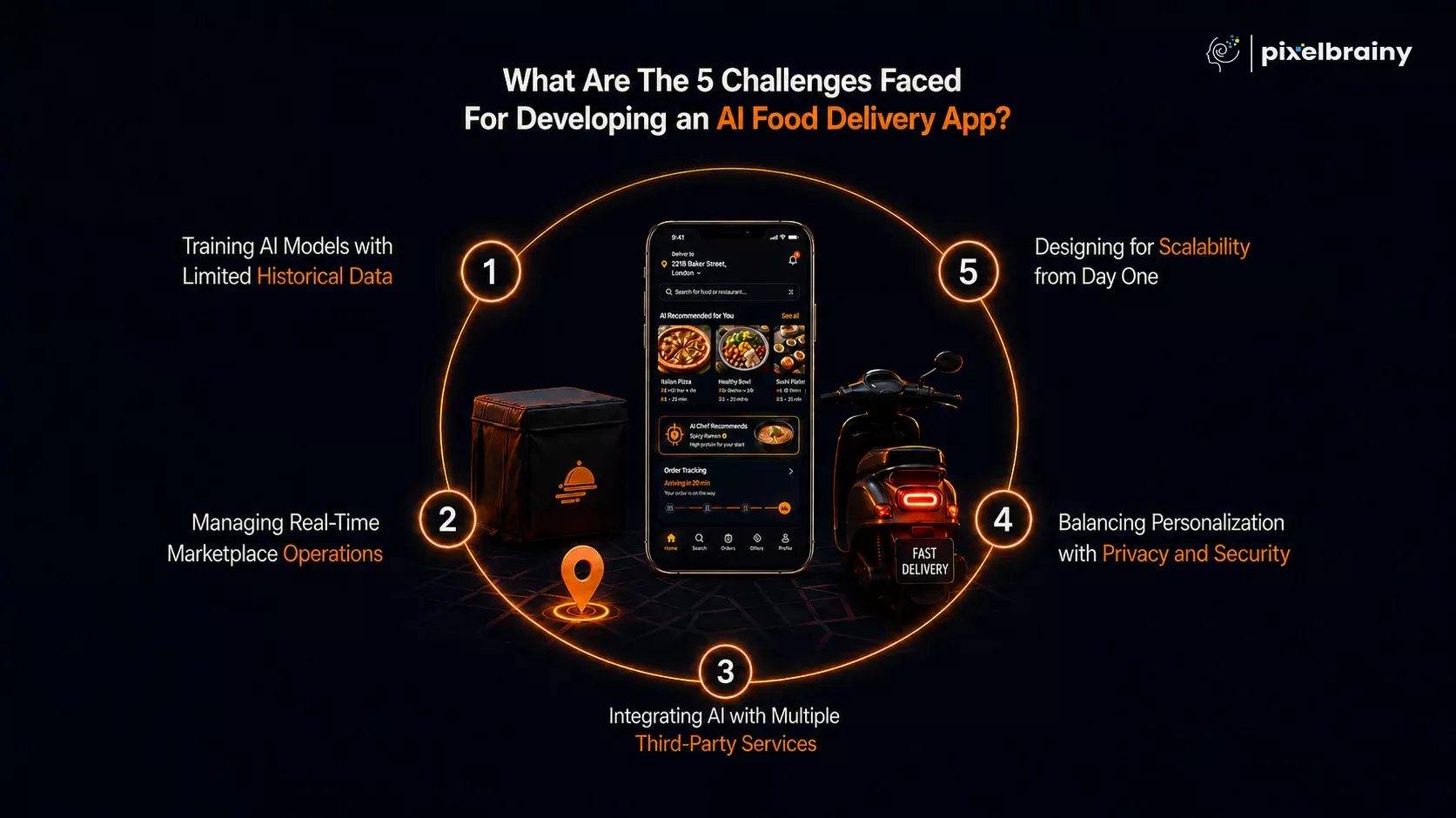
Artificial intelligence relies on quality data to make accurate predictions. However, most startups beginning AI food delivery app development have little historical customer behavior, delivery performance, or restaurant data available for training machine learning models.
Without sufficient data, AI features such as food recommendations, ETA prediction, demand forecasting, and intelligent dispatch may not perform as accurately during the initial launch. A practical approach is to launch with core AI capabilities, collect real user data, and continuously improve model accuracy over time.
Challenge: Limited data makes it difficult to deliver highly accurate AI predictions during the early stages of the platform.
An AI food delivery platform operates three interconnected systems simultaneously: the customer app, the restaurant dashboard, and the driver app. Every order generates multiple real-time events, including order confirmation, kitchen preparation, driver assignment, payment processing, live tracking, and delivery completion.
Many founders ask:
"We are planning to develop an AI food delivery app across multiple cities. How do platforms like DoorDash and Uber Eats handle thousands of simultaneous orders without performance issues?"
The answer lies in scalable backend architecture, event-driven processing, and real-time communication that keep every participant synchronized without delays.
Challenge: Supporting thousands of concurrent orders while maintaining fast, reliable, and real-time platform performance.
Modern AI food delivery software development depends on a wide range of third-party services, including payment gateways, mapping APIs, SMS providers, push notifications, identity verification, and cloud infrastructure. At the same time, AI models must continuously exchange data with these services to generate recommendations, optimize routes, and predict delivery times.
Each additional integration increases development complexity, ongoing maintenance, and testing requirements.
Challenge: Ensuring seamless communication between AI systems and multiple external services without affecting application stability.
One of AI's greatest strengths is personalization, but it depends on collecting customer information such as ordering history, dietary preferences, browsing behavior, and location data. Businesses must balance personalized experiences with strong security practices and compliance with privacy regulations.
Secure authentication, encrypted databases, permission management, and responsible AI practices should be incorporated into the platform from the beginning rather than treated as post-launch improvements.
Challenge: Delivering personalized experiences while protecting customer data and maintaining regulatory compliance.
Infrastructure that performs well for one city may struggle when expanding to multiple regions. As more restaurants, drivers, and customers join the platform, API traffic, database transactions, AI workloads, and cloud infrastructure requirements increase significantly.
Enterprise founders often ask:
Our goal is to build an AI food delivery app that can scale nationally. Should we design the architecture for one launch city or prepare for long-term expansion from the beginning?
The recommended approach is to build a scalable architecture from the start, even if the first release targets a single market. This reduces future redevelopment costs and supports continuous growth as the platform evolves.
Challenge: Scaling infrastructure, AI models, and operational workflows without compromising application performance or user experience.
| Challenge | Why It Matters | Recommended Solution |
| Training AI Models | Limited launch data affects recommendation quality and prediction accuracy. | Continuously train AI models using real customer and operational data. |
| Real-Time Marketplace Management | Thousands of live events must stay synchronized across customers, restaurants, and drivers. | Build scalable backend architecture with real-time communication and event-driven processing. |
| Third-Party Integrations | Payments, maps, notifications, and AI services increase system complexity. | Use reliable APIs, modular architecture, and thorough integration testing. |
| Privacy & Security | AI depends on sensitive customer and operational data. | Implement encryption, secure authentication, and privacy-first development practices. |
| Platform Scalability | Business growth increases infrastructure, AI processing, and operational demands. | Adopt cloud-native architecture and continuously optimize AI models and backend systems. |
Every business planning to develop AI food delivery app solutions will face technical, operational, and scalability challenges throughout the development journey. The most successful platforms overcome these obstacles by investing in scalable architecture, high-quality data pipelines, secure infrastructure, and continuously improving AI models after launch.
Addressing these AI food delivery app development challenges early helps reduce project risks, accelerate growth, and create an intelligent platform that delivers long-term value to customers, restaurant partners, and delivery drivers.
By this point in the guide, you've explored what an AI food delivery app is, how it works, the features it should include, the technology stack behind it, the development process, monetization strategies, estimated costs, and the challenges involved. The next step is finding an experienced AI app development company that can transform your idea into a scalable, production-ready platform.
Many founders reach out with questions like:
"Can you suggest the best AI development companies in the USA who can build this kind of app from scratch in 2026?"
or
"Looking for an experienced AI development partner in the USA who can build this for us."
If you're evaluating top AI app development companies USA, it's important to choose a team that understands both artificial intelligence and the operational complexity of food delivery marketplaces, not just mobile app development.
At PixelBrainy, we provide end-to-end AI food delivery app development services for startups, restaurant groups, cloud kitchens, and enterprise businesses looking to launch intelligent food delivery platforms. Our team combines AI engineering, scalable backend development, and cross-platform mobile expertise to build applications that are designed for long-term growth.
Our experience includes building AI-powered marketplace and on-demand logistics platforms using technologies such as LangChain, LangGraph, GPT-4, Claude, FastAPI, Apache Kafka, and AWS. These technologies enable us to develop intelligent recommendation systems, conversational AI, real-time event processing, scalable APIs, and cloud-native architectures capable of supporting high-volume marketplace operations.
We also have deep expertise in multi-sided marketplace architecture, real-time GPS tracking, delivery logistics, machine learning recommendation engines, demand forecasting, ETA prediction, and intelligent dispatch systems. Whether your goal is to build AI food delivery app solutions for a single city or expand into multiple markets, we design platforms that can evolve alongside your business.
On the frontend, our team develops high-performance iOS and Android applications using React Native while also building modern web portals for restaurant partners and operational dashboards. This ensures customers, restaurants, delivery drivers, and administrators all have seamless experiences across every touchpoint.
Beyond technology, we understand the operational and regulatory requirements of launching a three-sided food delivery marketplace in the US, including payment workflows, restaurant onboarding, driver management, location services, and platform scalability.
Every successful AI food delivery platform development project begins with a clear strategy. That's why we recommend starting with a paid Discovery and Architecture Workshop before writing production code.
During this session, our team works closely with you to define:
At the end of the workshop, you'll receive a complete product strategy, technical architecture, implementation roadmap, and realistic budget estimate that can guide development with confidence.
Whether you're an early-stage founder launching in a single city, a restaurant group planning to develop AI food delivery app solutions without relying on third-party marketplaces, a cloud kitchen operator expanding your digital presence, or a funded startup preparing for multi-city growth, we tailor our engagement model to match your business goals, timeline, and budget.
If you're looking to build a scalable AI-powered food delivery platform, PixelBrainy is ready to help. Let’s connect with our team to discuss your vision, validate your product strategy, and start building an intelligent food delivery solution that is designed to grow with your business.
The future of food delivery belongs to platforms that combine artificial intelligence with seamless customer experiences and efficient operations. Whether you're building a startup, launching a direct ordering platform for your restaurant brand, or creating a next-generation marketplace, the decisions you make today will shape how your platform scales tomorrow.
Throughout this guide, we've covered everything from AI-powered features and technology stack selection to development, monetization, costs, and real-world challenges. The next step is turning that strategy into a scalable product built with the right architecture, AI capabilities, and long-term vision.
At PixelBrainy, we help founders and businesses transform ambitious ideas into intelligent, market-ready food delivery platforms. Our team specializes in AI-powered marketplace development, scalable mobile applications, and real-time logistics solutions designed for long-term growth.
Ready to bring your idea to life? Schedule a discovery call with PixelBrainy today and let's build an AI-powered food delivery platform that gives your business a lasting competitive advantage.
Yes. Many startups begin AI food delivery app development with an MVP that includes essential features such as customer ordering, restaurant management, driver dispatch, AI-powered recommendations, and real-time order tracking. Once the platform gains users and revenue, additional AI capabilities can be introduced through future development phases, making it a practical approach for budget-conscious founders.
When looking to build AI food delivery app solutions, choose an experienced AI app development company USA like PixelBrainy with expertise in marketplace platforms, AI integration, mobile development, and real-time logistics. A strong development partner should understand customer experiences, restaurant operations, driver management, and scalable cloud architecture rather than focusing only on app development.
Yes. PixelBrainy offers structured AI food delivery app development services that begin with a paid discovery and architecture workshop. This process defines project scope, prioritizes features, estimates costs, and creates a realistic development roadmap, helping founders launch within an agreed budget and timeline while minimizing unexpected scope changes.
PixelBrainy specializes in AI food delivery app platform development, combining AI engineering, marketplace architecture, and on-demand logistics expertise. Our team builds scalable customer apps, restaurant dashboards, and driver applications powered by intelligent recommendations, real-time dispatch, demand forecasting, and cloud-native infrastructure designed for long-term growth.
To develop AI food delivery app solutions like Uber Eats, start with a clear business model and MVP roadmap. Build dedicated applications for customers, restaurants, and delivery partners, then integrate AI features such as personalized recommendations, intelligent dispatch, route optimization, ETA prediction, and demand forecasting to improve operational efficiency and customer satisfaction.
The timeline for AI food delivery app development depends on the project's scope and AI complexity. An MVP with essential AI capabilities can typically be developed within 12 to 14 weeks, while enterprise-grade platforms with advanced AI models, custom integrations, and multi-city support generally require additional development and testing.
When you build AI food delivery app solutions, prioritize features that deliver immediate business value, including AI-powered food recommendations, intelligent driver dispatch, real-time ETA prediction, route optimization, demand forecasting, and AI chatbot support. These features improve customer retention, operational efficiency, and long-term platform scalability.
Yes. Businesses can develop AI food delivery software by integrating AI capabilities into their existing platforms without rebuilding the entire application. Features such as recommendation engines, demand forecasting, customer analytics, AI-powered loyalty programs, and delivery optimization can be implemented gradually based on business goals and available data.
The cost of AI food delivery app development generally ranges from $30,000 to $200,000+, depending on the number of applications, AI features, third-party integrations, and platform complexity. Most startups begin with an MVP and expand functionality over time to manage investment while supporting long-term growth.
Yes. Most businesses develop AI food delivery app solutions for both iOS and Android using cross-platform frameworks such as React Native. This approach reduces development time, lowers costs, maintains a consistent user experience across devices, and simplifies future updates and feature releases.

About The Author
Sagar Bhatnagar
Sagar Sahay Bhatnagar brings over a decade of IT industry experience to his role as Marketing Head at PixelBrainy. He's known for his knack in devising creative marketing strategies that boost brand visibility and market influence. Sagar's strategic thinking, coupled with his innovative vision and focus on results, sets him apart. His track record of successful campaigns proves his ability to utilize digital platforms effectively for impactful marketing efforts. With a genuine passion for both technology and marketing, Sagar continuously pushes PixelBrainy's marketing initiatives to greater success.

Working with the PixelBrainy team has been a highly positive experience. They understand the design requirements and create beautiful UX elements to meet the application needs. The dev team did an excellent job bringing my vision to life. We discussed usability and flow. Sagar worked with his team to design the database and begin coding. Working with Sagar was easy. He has the knowledge to create robust apps, including multi-language support, Google and Apple ID login options, Ad-enabled integrations, Stripe payment processing, and a Web Admin site for maintaining support data. I'm extremely satisfied with the services provided, the quality of the final product, and the professionalism of the entire process. I highly recommend them for Android and iOS Mobile Application Design and Development.

Great experience working with them. Had a lot of feedback and I found that unlike most contractors they were bugging me for updates instead of the other way around. They were extremely time conscience and great at communicating! All work was done extremely high quality and if not on time, early! They were always proactive when it comes to communication and the work is great/above par always. Very flexible and a great team to work with! Goes above and beyond to present us with multiple options and always provides quality. Amazing work per usual with Chitra. If you have UI/UX or branding design needs I recommend you go to them! Will likely work with them in the future as well, definitely recommended!

PixelBrainy is a joy to work with and is a great partner when thinking through branding, logo, and website layout. I appreciate that they spend time going into the "why" behind their decisions to help inform me and others about industry best practices and their expertise.

I hired them to design our software apps. Things I really like about them are excellent communication skills, they answer all project suggestions and collaborate right away, and their input on design and colors is amazing. This project was complex and needed patience and creativity. The team is amazing to do business with. I will be using them long-term. Glad to see there are some good people out there. I was afraid to try and outsource my project to someone but I am glad I met them! I really can't say enough. They went above and beyond on this project. I am very happy with everything they have done to make my business stand out from the competition.

It was great working with PixelBrainy and the team. They were very responsive and really owned the project. We'll definitely work with them again!

I recently worked with the PixelBrainy team on a project and I was blown away by their communication skills. They were prompt, clear, and articulate in all of our interactions. They listened and provided valuable feedback and suggestions to help make the project a success. They also kept me updated throughout the entire process, which made the experience stress-free and enjoyable.

PixelBrainy is very good at what it does. The team also presents themselves very professionally and takes care of their side of things very well. I could fully trust them taking up the design work in a timely and organised manner and their attention to detail saved us lots of effort and time. This particular project was quite intense and the team showed that they function very well under pressure. Very much looking forward to working with her again!

It's always an absolute pleasure working with them. They completed all of my requests quickly and followed every note I had for them to a T, which made our process go smoothly from start to finish. Everything was completed fast and following all of the guidelines. And I would recommend their services to anyone. If you need any design work done in the future, PixelBrainy should be your first call!

They took ownership of our requirements and designed and proposed multiple beautiful variants. The team is self-motivated, requires minimum supervision, committed to see-through designs with quality and delivering them on time. We would definitely love to work with PixelBrainy again when we have any requirements.

PixelBrainy was a big help with our SaaS application. We've been hard at work with a new UI/UX and they provided a lot of help with the designs. If you're looking for assistance with your website, software, or mobile application designs, PixelBrainy and the team is a great recommendation.

PixelBrainy designers are amazing. They are responsive, talented, and always willing to help craft the design until it matches your vision. I would recommend them and plan to continue them for my future projects and more!!!

They were awesome! Did a good job fast, and good communication. Will work with them again. Thank you

Creative, detail-oriented, and talented designers who take direction well and implement changes quickly and accurately. They consistently over-delivered for us.

PixelBrainy team is very talented and creative. Great designers and a pleasure to work with. PixelBrainy is an excellent communicator and I look forward to working with them again.

PixelBrainy has a very talented design team. Their work is excellent and they are very responsive. I enjoy working with them and hope to continue on all of our future projects.


Transform your ideas into reality with us.
Across these industries, each engagement brings unique challenges, from early-stage product development to scaling complex systems, helping us build a practical understanding of real-world product environments.