AI Summary Powered by PixelBrainy
What if a bettor could ask, “Where is the value on Sunday’s NFL slate?” and receive a data-backed answer in seconds, with current odds, injury context, market movement, and transparent reasoning?
That is the core opportunity behind AI sports betting assistant development. Modern wagering platforms are moving beyond static odds pages and basic rule-based chatbots toward conversational products that can understand natural-language questions, retrieve live sports data, compare markets, explain betting scenarios, and help users make informed decisions.
If you want to build an AI sports betting assistant, the challenge is not simply connecting a large language model to a sportsbook database. A production-grade assistant needs a real-time data architecture, odds normalization, retrieval systems, analytics models, conversational memory, sportsbook APIs, responsible-gaming controls, jurisdiction-aware logic, security, and strong safeguards against unsupported or fabricated recommendations.
The commercial opportunity is substantial. According to the American Gaming Association’s 2026 State of the States report, U.S. commercial sports betting generated $16.89 billion in revenue during 2025, up 22.6% year over year. More recent AGA data shows Q2 2026 sports betting revenue at approximately $3.9 billion.
For operators, this creates an opportunity to make research itself part of the sportsbook experience.
This guide explains how to create an AI sports betting assistant with real-time odds analysis and pick recommendation features, including its architecture, data sources, core and advanced features, technology stack, development process, estimated cost, monetization models, and key challenges. It also examines documented 2026 examples such as FanDuel's AceAI and Fanatics Betting and Gaming's AI systems to understand what production-grade conversational betting technology looks like.
If you are evaluating AI sports betting assistant development services, the following framework can help you assess developers, architecture proposals, budgets, and product roadmaps before development begins.
An AI sports betting assistant is a specialized conversational AI solution designed specifically for sports wagering. It combines natural language understanding with sports data, real-time odds, statistical analysis, market information, and sportsbook functionality to help users research betting opportunities and understand available markets.
Unlike a general-purpose AI tool, an AI sports betting assistant is connected to the data and systems that power a wagering platform. It can understand questions such as “Which side has value in tonight's NBA game?”, “Compare these two player props,” or “Why did this NFL spread move?” and provide responses based on current, verified information.
A real-world example is FanDuel's AceAI, which combines sports research, analysis and betting tools within its sportsbook experience. FanDuel reported that AceAI had processed more than 268,000 customer queries by July 2026.
An AI sports betting chatbot primarily focuses on conversational interaction. It may answer questions about teams, leagues, betting terminology, or basic sportsbook functionality. Its primary purpose is communication.
An AI sports betting assistant goes further by connecting conversation with specialized sports and wagering capabilities.
| Capability | AI Sports Betting Chatbot | AI Sports Betting Assistant |
|---|---|---|
| Natural language conversation | Yes | Yes |
| Sports information | Basic to moderate | Advanced |
| Real-time odds | Limited or optional | Core capability |
| Market comparison | Limited | Yes |
| Player and team analysis | Basic | Advanced |
| Betting research | Basic | Advanced |
| Personalized context | Limited | Yes |
| Bet slip integration | Usually limited | Can be integrated |
| Recommendation explanations | Basic | Data-driven |
| Responsible gaming controls | May be limited | Essential |
| Sportsbook integration | Optional | Core capability |
In simple terms, a chatbot talks about betting, while an assistant helps users research and navigate betting decisions using connected data and tools.
An AI sports betting intelligence platform is broader than a conversational assistant. It represents the underlying analytical ecosystem that processes sports and betting information.
It can include:
The AI assistant can act as the conversational interface on top of this intelligence platform.
Therefore, the relationship can be understood as:
AI Sports Betting Intelligence Platform = Data + Models + Analytics
AI Sports Betting Assistant = Conversational Interface + Intelligence + Sportsbook Tools
AI Sports Betting Chatbot = Conversational Interaction
This distinction is important when planning an AI sports betting assistant development project. A chatbot can be relatively simple, while a production-grade assistant requires deeper integration with live sports data, sportsbook infrastructure, analytics systems, and responsible gaming controls. Modern betting products are increasingly moving toward this integrated conversational model rather than treating chat as a standalone support feature.
For operators, the goal should not simply be to create an AI that generates betting answers. The goal is to build a trusted conversational intelligence layer for the sportsbook, capable of turning complex sports and market information into clear, timely, and useful insights.
An AI sports betting assistant works by connecting conversational AI with real-time sports data, live odds, betting analytics, sportsbook APIs, user context, and responsible gaming controls. When a bettor asks a natural-language question, the system identifies the intent, retrieves relevant and current information, analyzes the available betting market, validates the response, and presents the result in a conversational format.
The important point is that the AI assistant should not rely on the language model alone. A production-grade system uses the LLM as an intelligent interaction and orchestration layer while specialized services provide current sports facts, odds, calculations, recommendations, and compliance decisions. FanDuel's AceAI follows this integrated approach by combining conversational research, sports statistics, betting markets, and bet-slip functionality within its sportsbook experience.
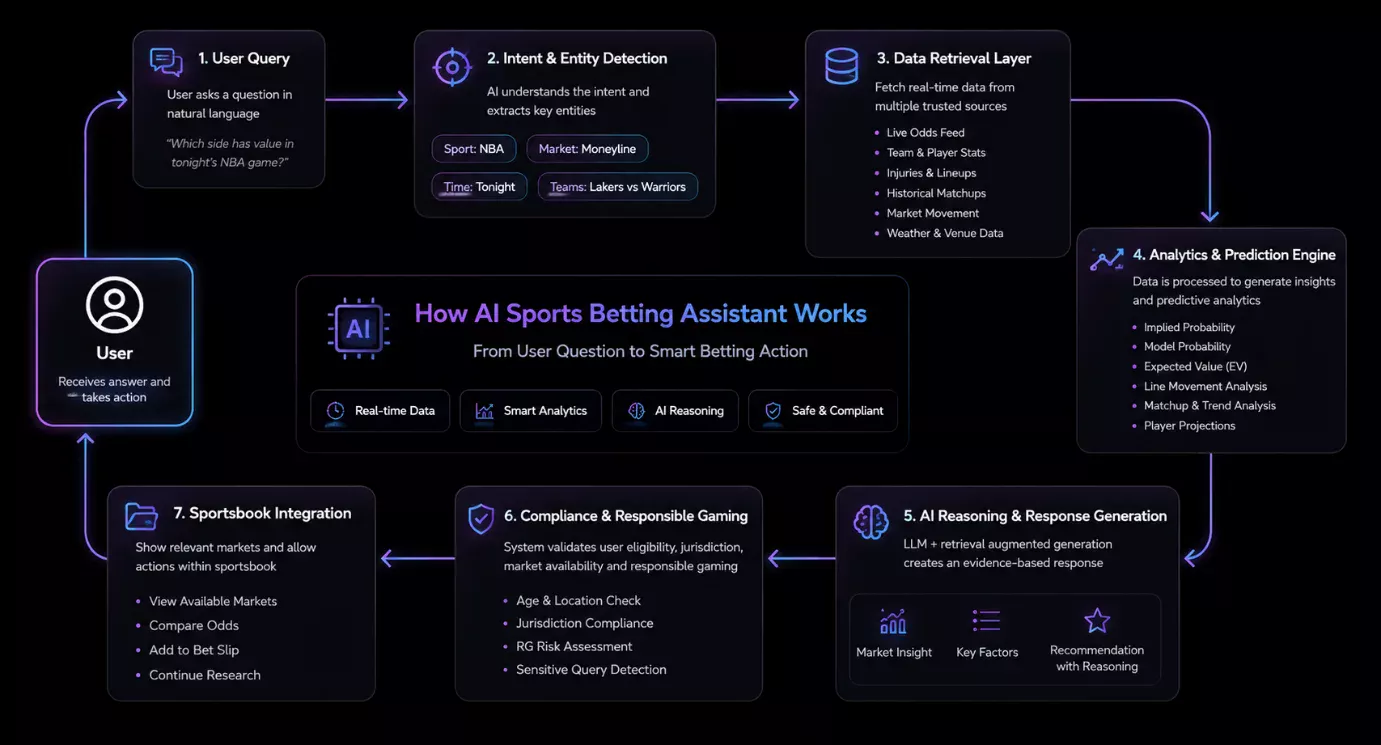
The workflow begins when a user enters a question such as:
“Which side has the value in tonight's NBA game?”
The AI identifies important entities and intent, including the sport, event, market, timeframe, and type of analysis requested.
The assistant then identifies the data needed to answer the question accurately. Depending on the query, this may include:
This approach allows the assistant to provide a context-specific answer instead of a generic sports response.
The platform connects with licensed sports data providers, odds feeds, sportsbook APIs, and internal databases. Incoming information is normalized so different leagues, events, teams, players, markets, and betting selections can be processed consistently.
For live betting, the architecture needs low-latency data pipelines because odds and event conditions can change rapidly. Event streaming, caching, and real-time distribution can help keep the information presented to users synchronized with the underlying sportsbook market.
The analytics layer evaluates the relevant information using deterministic calculations and predictive models. Depending on the product, this layer can calculate:
The results are then supplied to the AI orchestration layer.
The language model converts the structured data and analytical results into a natural conversational answer.
For example, instead of simply stating:
“Team A is the better pick.”
A well-designed assistant can explain the current price, relevant statistical factors, model probability, market movement, and important risks or assumptions.
This separation between the LLM and trusted data sources is critical because the language model should not invent live odds, player statistics, injuries, or betting markets. FanDuel specifically states that AceAI uses trusted data sources for current player and team statistics and combines multiple LLMs with sportsbook infrastructure.
After providing its analysis, the assistant can connect the user with the corresponding sportsbook market. Depending on the platform design, users may be able to explore available selections or add a researched selection to their bet slip.
The AI should not automatically place a wager simply because it generated a recommendation. FanDuel's AceAI, for example, keeps the customer in control of adding selections to the bet slip.
A regulated sports wagering platform also needs a compliance layer that can evaluate jurisdiction, eligibility, responsible gaming signals, market availability, and escalation requirements.
A modern architecture can use dedicated classification and guardrail services rather than asking the LLM to make every compliance decision. Fanatics Betting and Gaming's 2026 multi-agent architecture demonstrates this approach by placing responsible gaming classification and guardrails before and alongside specialized AI agents.
User Query → Intent Detection → Data Retrieval → Odds Normalization → Betting Analytics → AI Orchestration → Compliance Validation → Conversational Response → Sportsbook Market or Bet Slip
This architecture makes the AI sports betting assistant more than a chatbot. It becomes a real-time intelligence layer connecting users, sports data, betting analytics, and sportsbook functionality in one conversational experience.
Why are sportsbook operators increasingly looking beyond traditional odds, promotions, and betting interfaces to create their next competitive advantage? The answer is the growing need for faster research, better market discovery, personalized experiences, and intelligent interaction within an increasingly complex sports wagering ecosystem.
An AI sports betting assistant can transform a sportsbook from a platform where customers simply browse markets into a conversational sports intelligence environment. Instead of searching across statistics websites, injury reports, betting analysis platforms, and sportsbook pages, users can ask questions in natural language and receive contextually relevant information within the wagering platform.
The underlying sports betting market continues to expand, creating a larger addressable market for AI-powered products and services.
The American Gaming Association estimated that Americans would legally wager $3.3 billion on the 2026 NCAA Division I men's and women's basketball tournaments,
For sportsbook operators, larger betting audiences mean more opportunities to use AI sports betting assistant development to improve how customers discover, research, and understand available markets.
Sportsbooks now offer far more than traditional moneyline, spread, and totals markets. Users can encounter player props, alternate lines, same-game parlays, live markets, multi-leg combinations, and other specialized options.
This creates an information problem.
A bettor might ask:
“Which NBA player props are most interesting tonight based on recent usage and the current line?”
Instead of manually reviewing dozens of player pages, an AI betting assistant can help organize the relevant information into a conversational response.
This makes making an AI sports betting assistant commercially attractive because the product can reduce information friction without requiring users to leave the sportsbook.
The commercial case becomes stronger when AI is connected to an existing customer behavior rather than attempting to create an entirely new habit.
FanDuel currently reports that 93% of its bettors conduct some form of pre-bet research, such as checking statistics, injury reports, or comparing odds.
This makes research a natural use case for an AI sports betting assistant.
Instead of asking:
“Will users use AI for betting research?”
The more commercially relevant question becomes:
“How can a sportsbook bring the research customers are already doing into its own product experience?”
Traditional betting research often requires users to move between multiple sources.
For example:
Sports News → Injury Report → Statistics Website → Odds Comparison → Sportsbook → Bet Slip
An AI assistant can compress this journey into:
Question → Research → Analysis → Relevant Market
FanDuel's 2026 AceAI deployment provides a real market example. The company says users can research statistics, explore available markets, ask follow-up questions, and add selections to their bet slip without leaving the sportsbook application. FanDuel also reports that AceAI had processed more than 268,000 customer queries since launch by July 2026.
This demonstrates why AI sports betting assistant development services can be valuable for operators seeking to integrate research and market discovery into one experience.
A sportsbook can contain thousands of markets, but users rarely need all of them.
An AI assistant can potentially help users navigate this complexity based on permitted preferences and conversational context.
For example:
“Show me tonight's NBA games involving teams I follow.”
Or:
“Compare the player props we were discussing earlier.”
Conversational memory and personalization can reduce repetitive searching while making the sportsbook feel more relevant to individual users.
The key is to use personalization to improve information discovery and user control, while maintaining responsible gaming safeguards and applicable regulatory requirements.
Sports wagering is highly dynamic. Odds can change after injuries, lineup announcements, scoring events, weather developments, or significant market activity.
This creates opportunities for AI systems connected to real-time sports and odds data.
A user could ask:
“Why did this NFL spread move from -3 to -4?”
A properly designed assistant can retrieve the relevant market history and sports information, then explain potential factors behind the movement.
This is particularly valuable for live and in-play betting environments where users need information quickly and market conditions can change within seconds.
Player props create another significant use case because they require users to analyze individual performance rather than only team outcomes.
FanDuel reported that its home run betting handle increased 37% between the 2024 and 2025 MLB seasons, while home run wagers were its most popular MLB bet type by volume in 2025. For 2026, FanDuel added performance data and game logs directly into the sportsbook to support prop research.
FanDuel: The Rise of Home Run Betting and 2026 Product Features
This illustrates a broader opportunity for AI betting assistant development. AI can help users interpret player statistics, recent performance, matchup information, and available prop markets without requiring extensive manual research.
Odds remain fundamental, but operators increasingly need additional ways to differentiate the customer experience.
An AI assistant can create differentiation through:
Industry commentary in 2026 also highlights differentiation as an increasingly important priority as the U.S. sports betting market becomes more competitive.
This means the commercial value of AI is not limited to generating picks. It can become part of the sportsbook's overall product experience.
Operators can also use AI to develop premium sports intelligence products rather than limiting AI to a free chatbot.
Potential offerings include:
This creates potential subscription, SaaS, API, and B2B monetization opportunities for companies developing AI-powered sports wagering technology.
Sports betting AI must be developed differently from a general recommendation engine because the technology operates within a regulated wagering environment.
The American Gaming Association's 2026 research found that only 28% of sports event contract bettors said responsible gaming tools were easy to find, compared with 58% of sportsbook users.
This highlights an important product opportunity: responsible gaming should be integrated into the AI architecture rather than added as a disclaimer after the assistant has been built.
The assistant can incorporate safeguards for sensitive queries, self-exclusion, betting limits, loss-chasing behavior, age and jurisdiction requirements, and escalation to appropriate support resources.
One of the strongest reasons to consider AI sports betting assistant development is that major operators are already putting conversational AI into real customer-facing products.
FanDuel's AceAI has moved beyond an experimental chatbot into a broader research and betting interface, supporting multiple major sports and processing more than 268,000 customer queries since launch.
That creates an important signal for operators and technology companies: conversational AI is becoming part of the competitive sportsbook product landscape rather than remaining purely a future concept.
For businesses evaluating how to create an AI sports betting assistant, the opportunity is therefore broader than building an AI that produces betting picks. The stronger commercial strategy is to develop a conversational intelligence layer that connects real-time sports data, betting analytics, market discovery, personalization, sportsbook functionality, and responsible gaming within one user experience.
As sports betting becomes more data-intensive and competitive, AI sports betting assistants can give operators a new way to turn complex wagering information into a more intelligent, conversational, and differentiated sportsbook experience.
The right type of AI sports betting assistant depends on who will use it, where it will be deployed, what data it can access, and how the business plans to monetize it. A consumer-facing product may prioritize conversational research and personalized insights, while a sportsbook-focused solution may emphasize real-time odds, market discovery, bet-slip integration, and responsible gaming controls.
For example, a user may ask:
“Can you compare tonight's NBA games, explain where the value appears to be, and show me the relevant markets?”
The answer to this type of query requires more than a conventional sports chatbot. It requires an assistant connected to sports data, betting markets, analytics, and potentially sportsbook infrastructure.
When building an AI sports betting assistant, businesses can choose from several product models. Some are designed for consumers, while others are created for sportsbooks, media companies, professional bettors, affiliates, or fantasy sports users. The following eight types cover the major opportunities for businesses looking to develop an AI powered sports betting assistant or build a scalable AI sports betting assistant for sports betting platforms.
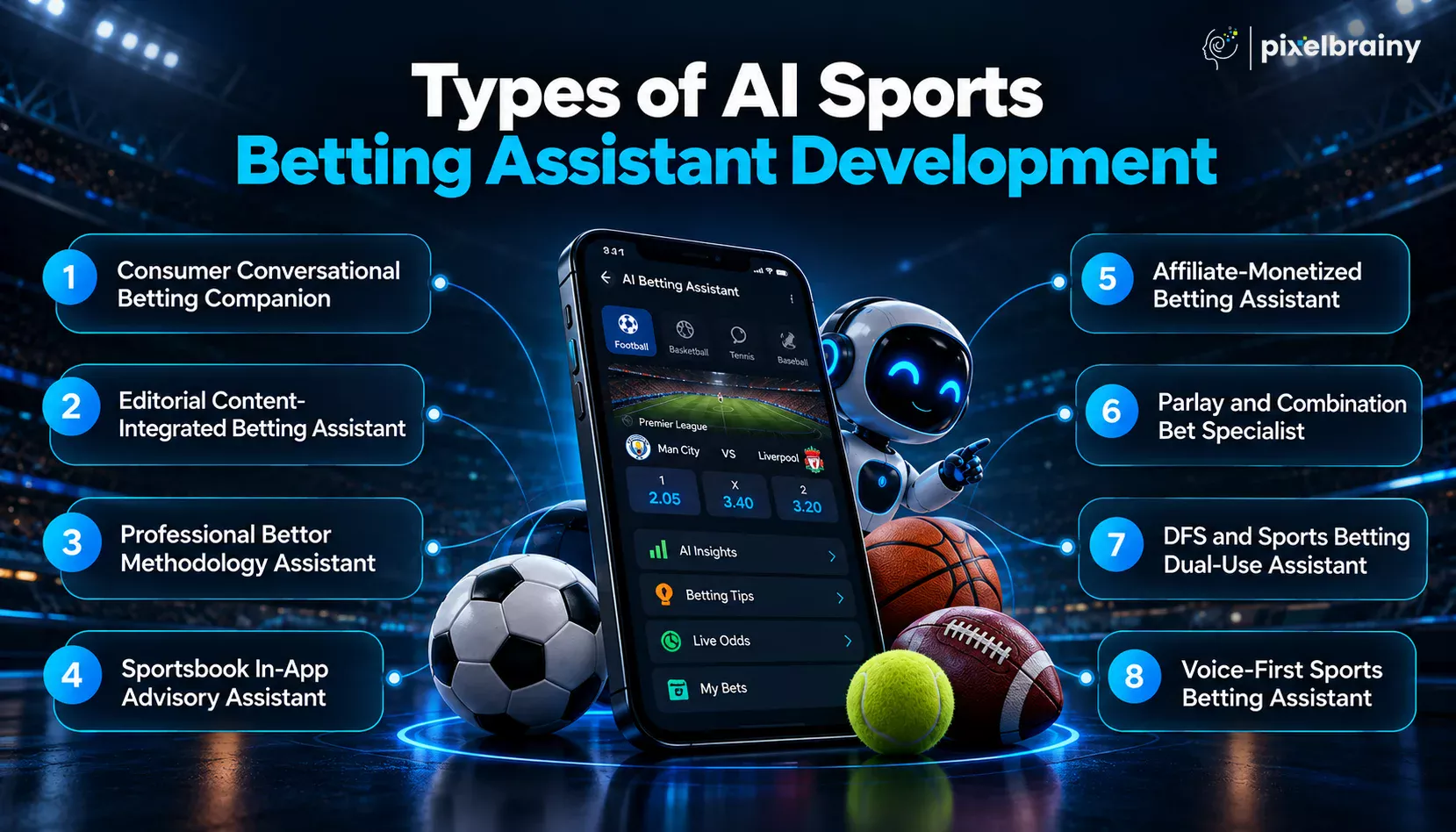
A Consumer Conversational Betting Companion is designed for everyday sports bettors who want an interactive way to research games and betting markets. Users can ask natural-language questions about teams, players, odds, injuries, trends, and upcoming games without navigating multiple data screens.
The assistant can provide explanations, compare markets, answer follow-up questions, and maintain conversational context. For example, a user can ask about an NFL matchup and then follow up with a question about the total without repeating the game details.
This model works particularly well for businesses planning to create an AI sports betting assistant for iOS and Android, where conversational interaction can simplify mobile betting research and improve user engagement.
An Editorial Content-Integrated Betting Assistant combines AI conversation with sports journalism, betting articles, previews, analysis, and other editorial content. Instead of treating editorial content and betting markets as separate experiences, the assistant allows users to interact directly with published information.
For example, after reading an NFL game preview, a user could ask:
“What does this injury mean for the spread?”
The assistant can retrieve relevant editorial content, combine it with current sports data, and provide a contextual response.
This model is particularly suitable for sports publishers, media companies, and betting content platforms. Making an AI sports betting assistant part of an existing content ecosystem can also increase content discovery and create additional opportunities for subscriptions, advertising, affiliate partnerships, or premium research products.
A Professional Bettor Methodology Assistant is built for experienced users who want deeper analytical support rather than basic betting information. It can help organize research around probability, pricing, historical performance, market movement, projections, and betting methodology.
Instead of simply answering which team is favored, the assistant can help users evaluate the assumptions behind a potential wager. It may compare model probability with market-implied probability, examine line movement, identify relevant statistical factors, and explain potential weaknesses in an analytical thesis.
This type is appropriate for businesses targeting advanced bettors and sports analytics users. AI bet recommendation assistant development for sports betting at this level requires sophisticated data pipelines, analytical models, historical datasets, and transparent explanations rather than relying solely on an LLM.
A Sportsbook In-App Advisory Assistant is embedded directly inside a sportsbook application or wagering platform. Its purpose is to help users navigate the operator's own markets, odds, statistics, promotions, and betting interface.
A user could ask:
“What NBA markets are available tonight?”
Or:
“Explain the difference between this spread and moneyline.”
The assistant can retrieve current sportsbook information and direct users toward relevant markets or their bet slip. This creates a tighter connection between conversational research and sportsbook functionality.
This model is particularly valuable when businesses want to build a scalable AI sports betting assistant for sports betting platforms. It can integrate with authentication, market APIs, odds services, bet slips, account systems, and responsible gaming infrastructure.
An Affiliate-Monetized Betting Assistant is designed around sportsbook discovery and affiliate conversion rather than being owned entirely by a sportsbook operator. The assistant can compare legally available betting options, explain differences between operators, and direct users toward relevant licensed platforms.
For example, a user might ask:
“Which sportsbook offers this market in my location?”
The system can identify eligible options based on jurisdiction, market availability, odds, and other permitted criteria.
The business can generate revenue through affiliate commissions, qualified referrals, or partnerships with sportsbooks. However, operators need to carefully manage advertising disclosures, jurisdiction restrictions, responsible gaming requirements, and the accuracy of displayed odds or offers when developing an AI powered sports betting assistant for affiliate use.
A Parlay and Combination Bet Specialist focuses specifically on multi-selection betting experiences. It can help users understand how individual selections interact, compare available combinations, and explain the characteristics and risks of different parlay structures.
For example, a user could ask:
“Can you explain how these three NBA selections would work together?”
The assistant can identify the relevant markets, retrieve current prices, calculate potential payout scenarios, and explain correlation considerations where appropriate.
A sophisticated implementation should not simply encourage users to create increasingly complex wagers. It should provide transparent information about probability, pricing, and risk. For businesses pursuing AI bet recommendation assistant development for sports betting, this type requires careful integration between the conversational layer, odds engine, market data, bet-slip system, and responsible gaming controls.
A DFS and Sports Betting Dual-Use Assistant serves users who participate in both daily fantasy sports and traditional sports betting. The assistant can provide player statistics, projections, matchup analysis, injury information, and performance trends that are relevant across both experiences.
For example, a user could ask:
“Which NFL players have the strongest matchup projections this week?”
The assistant could present information applicable to both DFS roster construction and player prop research, depending on the platform's supported products.
This model can help businesses create a broader sports analytics ecosystem instead of developing separate AI experiences for each product. It is particularly useful for operators offering multiple sports products and companies building AI sports betting assistants that need to serve several user segments from one intelligence layer.
A Voice-First Sports Betting Assistant allows users to interact with sports and betting information primarily through spoken commands. This approach can be particularly useful on mobile devices, smart speakers, connected vehicles, and other hands-free environments where typing is inconvenient.
Users could ask:
“What are the biggest NBA line movements tonight?”
The assistant can interpret the spoken request, retrieve relevant real-time information, and provide a concise response through voice while optionally displaying supporting information on a connected screen.
A voice-first architecture requires strong speech recognition, natural-language understanding, low-latency data retrieval, conversational memory, and clear response generation. For companies planning to create an AI sports betting assistant for iOS and Android, voice can become an additional interface rather than a separate product.
Therefore selecting the right assistant model at the beginning helps businesses control development complexity while creating an AI betting experience that can scale across users, sports, markets, and platforms.
A successful AI sports betting assistant needs a strong set of core features that make sports research, odds discovery, market exploration, and sportsbook interaction simple for users. These capabilities form the foundation of a reliable conversational betting product before introducing advanced AI capabilities.
For example, a bettor may ask:
“What are the best betting options for tonight's NBA games, and what statistics support each option?”
To answer this type of query effectively, the assistant needs accurate sports information, current market data, conversational understanding, and transparent explanations.
If you are building an AI sports betting assistant for a sportsbook, mobile application, or sports wagering platform, these 15 core features should be considered during product planning.
| Feature | Explanation |
|---|---|
| Natural Language Conversation | Natural language conversation allows users to ask sports and betting questions using everyday language. The assistant can understand questions about teams, players, games, odds, markets, statistics, and betting terminology without requiring users to navigate complex sportsbook menus. |
| Real-Time Odds Display | Real-time odds display provides current prices for available betting markets through connected odds providers or sportsbook APIs. The feature should refresh market information continuously and show appropriate timestamps or freshness indicators so users can understand how current the displayed odds are. |
| Sports and Event Search | Sports and event search allows users to quickly locate leagues, games, teams, players, and upcoming events through conversational queries. Instead of manually browsing sportsbook categories, users can ask for specific games, competitions, or teams and receive relevant results. |
| Betting Market Exploration | Betting market exploration helps users discover and understand available wagering options, including moneyline, spread, totals, and player props. The assistant can explain how different markets work and present relevant options without forcing users to search through numerous sportsbook pages. |
| Team and Player Statistics | Team and player statistics provide factual performance information that supports sports research. Users can ask about recent form, scoring averages, defensive performance, player usage, matchup statistics, or season records and receive information retrieved from connected sports data sources. |
| Injury and Availability Information | Injury and availability information helps users understand current player statuses that may affect a game or betting market. The assistant can surface available injury reports, lineup updates, suspensions, and participation information while identifying information that remains subject to change. |
| Odds Comparison | Odds comparison helps users evaluate different available prices for supported betting markets. The assistant can organize prices from connected sportsbooks or markets, making it easier to identify differences while ensuring that displayed information is based on current and properly licensed data. |
| Implied Probability Calculation | Implied probability calculation converts betting odds into a probability representation that users can understand more easily. The assistant can explain what the market price implies while making clear that implied probability is not a guarantee or prediction of the actual outcome. |
| Betting Trend Analysis | Betting trend analysis organizes relevant historical and recent statistical patterns around teams, players, games, and markets. Users can ask about trends such as recent performance, home and away results, matchup history, or other supported statistical indicators during their research. |
| Line Movement Tracking | Line movement tracking allows users to see how odds or betting lines have changed from opening prices to current values. A bettor could ask, “How has this NFL spread moved today?” and receive a chronological explanation of available market movement data. |
| Personalized Recommendations | Personalized recommendations use permitted user preferences and conversational context to make sports research more relevant. The assistant can prioritize preferred sports, teams, or markets while presenting recommendations transparently and avoiding claims that any selection is guaranteed to win. |
| Conversational Context | Conversational context allows the assistant to understand follow-up questions without requiring users to repeat previous information. For example, after discussing an NBA matchup, a user can ask, “What about the total?” and the assistant can connect the question with the existing conversation. |
| Bet Slip Integration | Bet slip integration connects the conversational research experience with available sportsbook selections. After users review a market, the assistant can direct them to the relevant selection or add an eligible selection to the bet slip while keeping the final wagering decision under user control. |
| Notifications and Alerts | Notifications and alerts keep users informed about selected games, market changes, injury updates, scheduled events, or other permitted information. Users should be able to select which alerts they want, manage notification frequency, and control the sports or markets they follow. |
| Responsible Gaming Controls | Responsible gaming controls help ensure that the AI betting experience operates within applicable regulatory and user-safety requirements. The assistant can support age and jurisdiction checks, self-exclusion requirements, wagering limits, responsible gaming interventions, and appropriate escalation to support resources. |
These core capabilities provide the foundation for AI sports betting assistant development across sportsbook websites, mobile applications, and wagering platforms. They also support businesses looking to develop an AI powered sports betting assistant, create an AI sports betting assistant for iOS and Android, or build a conversational betting product that connects sports intelligence with sportsbook functionality.
The right combination of conversational AI, real-time data, betting information, personalization, and responsible controls creates the foundation for a reliable AI sports betting experience.
Once the core capabilities of an AI sports betting assistant are established, advanced features can make the platform more intelligent, responsive, personalized, and competitive. These capabilities are particularly useful for operators planning to build a scalable AI sports betting assistant for sports betting platforms with sophisticated analytics, real-time decision support, and multi-channel user experiences.
Advanced functionality can also help an AI assistant move beyond basic sports questions and provide deeper market analysis, scenario evaluation, predictive insights, and automated information workflows. However, these features should be introduced only after the underlying sports data, odds infrastructure, AI responses, and responsible gaming controls are reliable.
| Advanced Feature | Explanation |
|---|---|
| AI-Powered Predictive Modeling | AI-powered predictive modeling can evaluate historical statistics, team performance, player data, matchup characteristics, and other relevant variables to estimate potential game or player outcomes. The resulting probabilities can support betting analysis while clearly communicating uncertainty and avoiding claims of guaranteed results. |
| Real-Time Market Opportunity Scanner | A real-time market opportunity scanner continuously evaluates supported betting markets for changes in prices, lines, probabilities, or other predefined analytical conditions. When a potentially relevant situation is detected, the assistant can explain the underlying data and direct users toward the applicable market. |
| Multi-Agent AI Architecture | A multi-agent architecture assigns specialized tasks to different AI agents, such as sports research, odds analysis, player statistics, injury intelligence, recommendation generation, and compliance. An orchestration layer coordinates these agents to produce a more comprehensive response while keeping specialized responsibilities separated. |
| Scenario and What-If Analysis | Scenario analysis allows users to explore how changes in important variables could affect an analytical assessment. For example, users could ask how a quarterback's absence, lineup change, weather condition, or significant line movement might influence a team's projected probability. |
| AI-Powered Line Movement Intelligence | Advanced line movement intelligence combines historical prices, current odds, timing, game information, and market changes to explain why a betting line may have moved. Instead of simply displaying movement, the assistant can provide relevant context surrounding significant changes. |
| Personalized Betting Intelligence | Personalized betting intelligence can use permitted preferences, previous research interactions, favorite sports, and selected markets to create a more relevant information experience. The system should apply appropriate privacy and responsible gaming controls while avoiding personalization that could encourage excessive or harmful wagering. |
| Voice-Based AI Betting Assistant | Voice-based interaction enables users to ask sports and betting questions without typing. Speech recognition converts spoken requests into structured queries, while the AI retrieves relevant sports information and generates concise responses. This feature can extend an AI betting assistant across mobile and connected-device experiences. |
| AI-Powered Bet Slip Analysis | AI-powered bet slip analysis can evaluate selections already added to a user's bet slip and explain factors such as individual market characteristics, potential correlations, pricing, and overall risk. The feature should provide transparent information rather than presenting a combination as guaranteed or risk-free. |
| Predictive Injury and Lineup Intelligence | Predictive injury and lineup intelligence combines available injury information, player participation history, roster changes, and statistical data to help assess how potential lineup changes could affect a matchup. The assistant can update its analysis when verified status information changes. |
| Explainable AI Recommendation Engine | An explainable recommendation engine shows users the evidence and assumptions behind an AI-generated analytical view. Instead of presenting an unexplained selection, the assistant can display relevant statistics, market price, model probability, key factors, data freshness, and uncertainty so users can better understand the analysis. |
These advanced capabilities can significantly expand the functionality of AI sports betting assistant development, particularly for enterprise sportsbooks, betting technology providers, sports media companies, and advanced analytics platforms. They can also support businesses looking to develop AI powered sports betting assistants that deliver deeper real-time intelligence rather than basic conversational responses.
Advanced AI features can turn a conventional betting assistant into a sophisticated sports intelligence layer capable of analyzing markets, scenarios, and user queries with greater depth and context.
What does it take to turn an AI sports betting assistant idea into a reliable, market-ready product? Building the product requires more than selecting an LLM and connecting it to a sportsbook API. A successful AI sports betting assistant development project needs structured product planning, sports data architecture, AI engineering, user experience design, model validation, sportsbook integration, compliance, testing, and continuous optimization.
If you are researching how to build an AI sports betting assistant from scratch, the development process should move from a clearly defined use case to a validated product and then to a scalable production platform. The following eight steps explain the steps to build AI sports betting assistant from idea to launch while keeping technical complexity aligned with business objectives.
A useful real-world query at the planning stage is:
“How can I launch an AI betting assistant that analyzes live NFL odds, explains its recommendations, and works across my sportsbook website and mobile apps?”
This type of requirement illustrates why sports betting assistant development using AI needs coordinated work across product, data, AI, backend, frontend, infrastructure, and compliance teams.
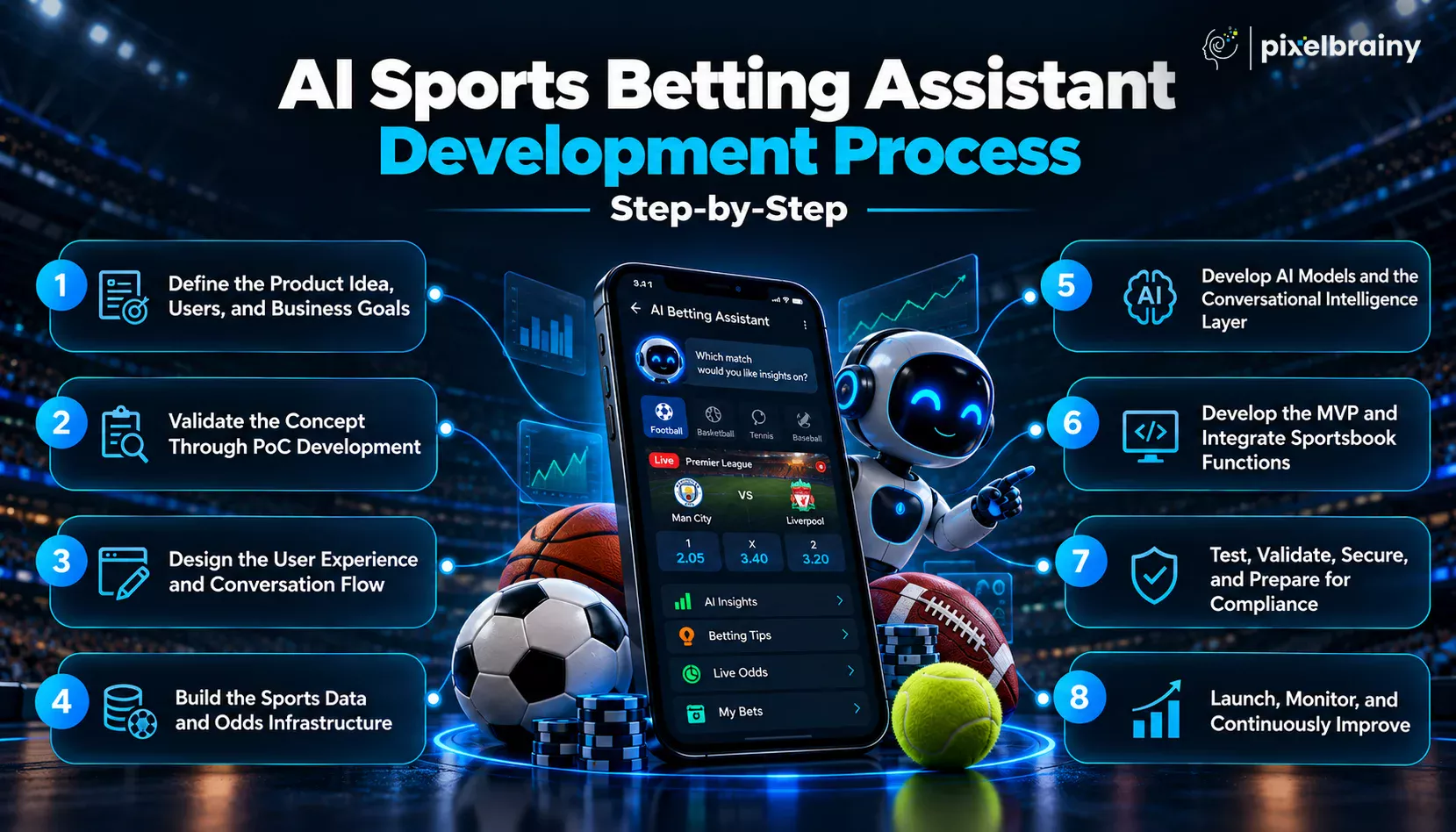
The first step is to define exactly what the AI sports betting assistant will do and who it will serve. Start by identifying the primary users, supported sports, betting markets, target jurisdictions, business model, and intended user journey. Determine whether the product will focus on sports research, market discovery, betting analysis, sportsbook assistance, or a combination of these functions.
During this stage, teams should document the questions the assistant must answer and the actions it should support. AI consultation can help establish the product scope, technical feasibility, data requirements, and potential risks before engineering begins. Clear objectives prevent unnecessary features from increasing development cost and timeline.
Also Read: Top 10 AI Consulting Companies in USA
Before committing to full-scale AI product development, validate whether the proposed assistant can technically deliver useful responses. A PoC development phase can connect a limited sports data source, odds API, AI model, and basic conversational interface to test specific use cases.
For example, the PoC could determine whether the system can correctly answer questions about current NFL odds, retrieve relevant player statistics, explain line movement, and maintain conversation context. Teams can measure response accuracy, data freshness, latency, and AI hallucination rates. A successful PoC provides evidence that the proposed architecture can support the broader product before significant resources are committed.
Also Read: Top 10 AI Product Development Companies in USA
The next stage focuses on how users will interact with the assistant. The conversation should feel simple even when the underlying sports analytics are complex. Define important user journeys such as asking about a game, comparing odds, exploring player props, understanding market movement, and reviewing available selections.
A specialized UI/UX design company can help translate these workflows into intuitive interfaces for web and mobile platforms. Design should also account for data timestamps, probability explanations, source visibility, error states, unavailable markets, and responsible gaming messaging. The objective is to make complex betting intelligence understandable without overwhelming the user.
Reliable sports data is the foundation of the development process of AI sports betting assistant. At this stage, developers integrate authorized sports data providers, odds feeds, injury information, player statistics, historical datasets, and sportsbook APIs.
The backend should normalize incoming information into a consistent data structure covering leagues, events, teams, players, markets, selections, and prices. Real-time applications may require streaming infrastructure, caching, event processing, and WebSocket communication. Data validation is equally important because incorrect or stale odds can undermine user trust. The architecture should also record timestamps and source information so the assistant can determine whether retrieved information is sufficiently current.
Once the data foundation is available, developers can build the AI capabilities required for the assistant. AI model development may include selecting appropriate language models, designing prompts, implementing retrieval-augmented generation, creating tool-calling workflows, developing classification systems, and establishing response guardrails.
The LLM should not independently generate live betting facts. Instead, it should call trusted data and analytics services, receive structured results, and convert those results into natural-language responses. This architecture improves factual reliability and allows the development team to update sports data or analytical models without retraining the entire conversational system.
Also Read: Top 12+ AI Model Development Companies in the USA
The next step is MVP development, where the validated concept becomes a usable product. The initial version should focus on the highest-value features rather than attempting to support every sport, market, and AI capability immediately.
An MVP might include conversational sports research, real-time odds, player and team statistics, basic betting analysis, market search, conversation history, and bet-slip integration. The AI integration should connect the language model with the backend, sports data services, analytics engine, user account system, and sportsbook APIs. User authentication, permissions, API security, logging, and error handling should also be incorporated before production testing.
Before launch, the assistant needs extensive functional, AI, security, performance, and compliance testing. Create a test dataset containing real-world betting questions, ambiguous requests, outdated information scenarios, unavailable markets, rapidly changing odds, incorrect assumptions, and multi-turn conversations.
Evaluate whether the assistant retrieves the right data, produces accurate calculations, identifies uncertainty, and avoids unsupported claims. Security testing should cover APIs, authentication, data access, rate limits, and infrastructure. Responsible gaming and jurisdiction controls should also be validated for the markets where the product will operate. These checks help transform a promising prototype into a production-ready wagering technology product.
The final step is launching the assistant in a controlled production environment and continuously measuring its performance. Start with selected users, sports, markets, or jurisdictions before expanding the platform. Monitor metrics such as query success rate, response latency, data freshness, user engagement, recommendation interaction, error frequency, and support escalations.
After launch, user conversations can reveal unanswered questions, confusing responses, missing data, and new product opportunities. Teams can use these insights to improve prompts, retrieval workflows, models, interfaces, and data sources. Companies evaluating top AI sports betting software development companies should also assess their post-launch monitoring, optimization, security, and maintenance capabilities rather than focusing only on initial development.
The AI sports betting assistant development journey does not end when the first version reaches production. Continuous AI product development companies can help evolve the platform through better models, additional sports, new data sources, improved personalization, expanded sportsbook integrations, and stronger evaluation systems.
Following a structured roadmap makes it easier to create an AI sports betting assistant that can move from a validated idea to an MVP and ultimately into a scalable sports wagering product without compromising reliability or user experience.
A disciplined development process turns an AI betting concept into a scalable product by connecting validated use cases, trusted sports data, AI intelligence, sportsbook infrastructure, and continuous optimization.
How much does it cost to cretate an AI sports betting assistant in 2026, and what should a realistic development budget include? For a focused AI betting assistant, businesses can typically plan for $30,000 to $200,000+, depending on the AI capabilities, sports data integrations, number of platforms, real-time requirements, sportsbook connectivity, personalization, security, and scalability.
For businesses estimating the AI sports betting assistant development cost, there is no single fixed price. A basic conversational assistant connected to sports data can fit toward the lower end, while an enterprise solution with real-time odds, custom AI models, multiple sports, mobile apps, sportsbook APIs, advanced analytics, and high-volume infrastructure can move substantially higher. Current 2026 industry estimates similarly place AI sports betting and recommendation solutions across broad ranges depending on complexity.
A useful real-world query for planning is:
“I have a $100,000 budget. Can I build an AI sports betting assistant with live odds, personalized recommendations, and sportsbook integration, or should I start with an MVP?”
The answer depends on the scope. A phased approach can allow a business to launch essential capabilities first and invest in advanced functionality after validating the product.
| AI Sports Betting Assistant Type | Estimated Development Cost | Typical Scope |
|---|---|---|
| Basic AI Sports Betting Assistant | $30,000 to $60,000 | Conversational AI, limited sports coverage, sports data API, basic odds retrieval, team and player statistics, natural-language search, basic recommendation logic, responsive web interface, essential security and testing. |
| Advanced AI Sports Betting Assistant | $60,000 to $120,000 | Real-time odds, multiple sports, personalized recommendations, betting analytics, line movement, injury information, sportsbook integration, conversational memory, mobile support, advanced backend architecture, analytics dashboard, and stronger compliance controls. |
| Enterprise AI Sports Betting Assistant | $120,000 to $200,000+ | Multi-sport and multi-market support, custom AI models, real-time streaming infrastructure, multi-platform applications, advanced personalization, multi-agent architecture, enterprise sportsbook integrations, high scalability, security, monitoring, compliance, and extensive analytics. |
These ranges represent software development estimates for the AI sports betting assistant layer, not the complete cost of launching a regulated sportsbook. Licensing, sportsbook operations, premium sports data rights, payment infrastructure, legal services, and jurisdiction-specific regulatory costs can be additional. Full sportsbook builds can reach substantially higher budgets because of trading, wallet, KYC, geolocation, compliance, and licensing requirements.
The AI layer is one of the biggest variables in the cost estimation of an AI sports betting assistant. A basic LLM integration costs less than a system using custom recommendation models, predictive analytics, retrieval pipelines, model evaluation, personalization, and multiple AI agents. AI bet recommendation systems alone are commonly estimated in the $30,000 to $200,000+ range depending on complexity.
Integrating sports statistics, schedules, player information, injury feeds, odds, and market data requires backend engineering, normalization, validation, and ongoing provider management. Premium real-time data licensing is usually a separate recurring expense and can become one of the largest operational costs as coverage and geographic rights expand.
Pre-match research requires less infrastructure than live betting. Real-time applications may require streaming pipelines, WebSockets, event processing, caching, low-latency databases, and automated data synchronization. More sports, markets, users, and higher event volumes increase infrastructure requirements.
If the product uses proprietary predictive models instead of relying entirely on third-party AI models, the budget increases. Costs can include historical data preparation, feature engineering, model training, validation, probability calibration, deployment, and ongoing model monitoring.
A web-only conversational assistant can cost less than a product supporting responsive web, iOS, and Android applications. Mobile development also requires platform-specific testing, notifications, authentication, app-store preparation, and device optimization.
Connecting the assistant with sportsbook systems can involve market availability, odds retrieval, user accounts, bet-slip functionality, authentication, and other operator APIs. The complexity increases when the assistant must interact with multiple sportsbook environments.
Personalization requires systems for managing permitted preferences, conversation history, user context, recommendation logic, and data privacy. More sophisticated personalization increases both development complexity and infrastructure requirements.
Security requirements can include authentication, encryption, access controls, API security, audit logs, rate limiting, and monitoring. Responsible gaming functionality may require jurisdiction checks, self-exclusion handling, wagering controls, intervention workflows, and support escalation.
The user interface affects how easily bettors can interact with complex sports information. Costs increase when the product requires sophisticated conversational screens, odds displays, market comparison interfaces, bet-slip workflows, dashboards, mobile experiences, and accessibility support.
Cloud architecture, deployment automation, databases, monitoring, logging, CI/CD pipelines, load balancing, backups, and security infrastructure contribute to the development budget. Live sports events can create major traffic spikes, making scalability particularly important.
AI betting assistants require more than conventional application testing. Teams need to test data accuracy, odds freshness, API failures, hallucinations, calculations, ambiguous questions, multi-turn conversations, recommendation logic, security, and high-traffic conditions.
The initial AI sports betting assistant development cost is only part of the total investment. Businesses should budget for cloud infrastructure, AI inference, sports data subscriptions, API usage, model monitoring, security updates, bug fixes, new sports coverage, third-party services, and continuous product improvements.
A useful way to estimate the development budget of an AI sports betting assistant is to consider the product in three stages:
$30,000 to $60,000: Best suited to an MVP with conversational AI, one or two sports, basic odds and statistics, and limited integrations.
$60,000 to $120,000: Appropriate for a production-ready assistant with multiple sports, real-time data, personalized analysis, sportsbook integration, mobile support, and stronger analytics.
$120,000 to $200,000+: Appropriate for enterprise requirements involving custom AI models, extensive sports coverage, real-time infrastructure, multiple platforms, advanced personalization, high-volume traffic, and complex integrations.
For comparison, 2026 estimates for complete AI sports betting applications can extend well beyond $200,000 when the scope includes a full sportsbook, payments, KYC, compliance, risk management, and other operator infrastructure.
Therefore, when asking “what is the development pricing of an AI sports betting assistant?”, businesses should first define whether they are building an AI assistant that connects to an existing sportsbook or attempting to build the entire wagering platform.
A phased $30,000 to $200,000+ investment allows businesses to match the AI sports betting assistant development budget with product complexity, launch goals, data requirements, and long-term scalability.
What powers a reliable AI sports betting assistant behind the scenes? The user may see a simple chat window, but the technology supporting it can involve real-time sports feeds, odds APIs, AI models, analytics engines, databases, cloud infrastructure, and sportsbook integrations working together.
For businesses planning AI sports betting assistant development, the technology stack should be designed around one core requirement: the AI needs access to accurate, timely, and structured sports information before it responds to a betting-related question. A language model alone cannot reliably provide live odds, current injuries, market movement, or sportsbook availability.
For example, a business may ask:
“What technology do I need to build an AI sports betting assistant that can analyze live NFL and NBA odds, answer natural-language questions, and connect users with sportsbook markets?”
That requirement calls for a modular architecture where each technology has a defined responsibility. The AI handles conversation and reasoning, sports APIs supply current information, analytics services process betting data, backend systems coordinate requests, and cloud infrastructure keeps the platform available as traffic grows.
The right stack also depends on whether the goal is an MVP, mobile betting application, sportsbook integration, or enterprise-grade platform. A smaller product can begin with managed AI services and third-party sports APIs, while a high-volume platform may require custom models, streaming infrastructure, distributed databases, and dedicated data pipelines.
The table below outlines a practical tech stack for AI sports betting assistant development, along with the role each technology can play in building a secure, responsive, and scalable product.
| Technology Layer | Recommended Technologies | Purpose in AI Sports Betting Assistant Development |
|---|---|---|
| AI and LLM Layer | OpenAI GPT models, Anthropic Claude, Google Gemini | Handles natural-language understanding, conversational responses, query interpretation, tool calling, summarization, and contextual sports research. Multiple models can be evaluated based on accuracy, latency, cost, and supported capabilities. |
| AI Orchestration | LangChain, LangGraph, LlamaIndex | Connects language models with sports APIs, databases, analytics engines, retrieval systems, and external tools. This layer can route different user requests to appropriate data and analytical services. |
| Backend Development | Python, FastAPI, Node.js, NestJS | Manages business logic, API requests, AI workflows, authentication, sportsbook integrations, data processing, and communication between the frontend and intelligence services. Python is particularly useful for AI and analytical workloads. |
| AI and Data Science | Python, PyTorch, TensorFlow, scikit-learn, Pandas | Supports predictive modeling, statistical analysis, feature engineering, probability calculations, recommendation systems, and custom sports analytics models. |
| Sports Data APIs | Sportradar, SportsDataIO, The Odds API, Genius Sports | Provides sports schedules, scores, player statistics, team information, injuries, events, and betting market information. Commercial data licensing and permitted usage should be evaluated for the target market. |
| Odds and Sportsbook APIs | Licensed sportsbook APIs, odds aggregation APIs, operator APIs | Provides current betting markets, prices, selections, market status, and sportsbook-specific information that the conversational assistant can retrieve when answering user queries. |
| Real-Time Data Processing | Apache Kafka, Redis Streams, WebSockets | Handles rapidly changing scores, odds, market events, player updates, and other real-time information. Streaming architecture becomes particularly important when supporting live and in-play betting. |
| Primary Database | PostgreSQL, MySQL | Stores users, application configuration, sports entities, market metadata, preferences, transactions, permissions, and other structured application data. PostgreSQL is particularly suitable for complex relational sports data. |
| Caching Layer | Redis | Stores frequently requested sports data, sessions, API responses, temporary calculations, and other high-demand information to reduce latency and database load. |
| Vector Database | Pinecone, Weaviate, Qdrant, pgvector | Supports semantic retrieval of sports articles, historical research, documentation, analytical information, and other unstructured content when retrieval-augmented generation is required. |
| Frontend Web | React.js, Next.js, TypeScript | Builds responsive sportsbook interfaces, conversational dashboards, odds displays, research panels, market pages, and interactive AI experiences for web users. |
| Mobile Applications | React Native, Flutter, Swift, Kotlin | Enables businesses to create an AI sports betting assistant for iOS and Android while sharing portions of the application codebase where appropriate. Native development can be considered when platform-specific performance or functionality is critical. |
| Cloud Infrastructure | AWS, Microsoft Azure, Google Cloud | Provides scalable compute, databases, storage, networking, AI infrastructure, monitoring, security services, and deployment environments for production applications. |
| Containerization and DevOps | Docker, Kubernetes, GitHub Actions, Terraform | Supports reproducible deployments, automated CI/CD, container orchestration, infrastructure management, and horizontal scaling as the number of users and sports events increases. |
| Authentication and Security | OAuth 2.0, OpenID Connect, JWT, AWS Cognito, Auth0 | Protects user accounts, APIs, administrative interfaces, and application resources through authentication, authorization, token management, and access-control mechanisms. |
| Monitoring and Analytics | Datadog, Grafana, Prometheus, OpenTelemetry | Tracks application performance, API latency, AI response quality, infrastructure health, errors, data pipeline performance, and system availability. |
| AI Evaluation and Testing | LangSmith, custom evaluation frameworks, automated test suites | Measures AI response accuracy, hallucination rates, retrieval quality, tool-calling performance, response consistency, and adherence to defined safety and business rules. |
| API Gateway | AWS API Gateway, Kong, NGINX | Controls API traffic, authentication, routing, rate limiting, and communication between frontend applications, AI services, sportsbook APIs, and backend systems. |
The right tech stack gives an AI sports betting assistant the foundation to process real-time data, deliver reliable AI responses, and scale smoothly as users, sports, and betting markets grow.
How can an AI sports betting assistant generate revenue without compromising the user experience or responsible gaming principles? The monetization model should match the product's audience, platform ownership, regulatory environment, and the value the assistant provides. A consumer assistant can generate revenue through subscriptions, while a sportsbook operator can use AI to strengthen customer engagement and create premium experiences.
For businesses planning AI sports betting assistant development, monetization should be considered during product planning rather than added after launch. A useful business query is:
“How can I monetize an AI sports betting assistant that provides real-time odds analysis, personalized betting research, and sportsbook recommendations?”
The strongest approach is often a combination of revenue streams. The following six strategies can help businesses build a sustainable commercial model around an AI-powered sports wagering product.
A subscription model allows users to pay for access to advanced sports research and AI-powered analytical capabilities. The free tier can provide basic sports information, while premium plans can unlock features such as deeper statistical analysis, expanded sports coverage, personalized research, historical market analysis, and higher usage limits.
Businesses can offer monthly, quarterly, or annual plans based on usage and functionality. For example, a basic plan could target casual sports fans, while a professional plan could provide advanced analytics for experienced bettors.
This model creates recurring revenue and makes the AI sports betting assistant a standalone sports intelligence product rather than relying entirely on sportsbook commissions.
An affiliate model can generate revenue by referring eligible users to licensed sportsbook operators. The assistant can help users discover relevant sportsbooks, compare permitted information, and access operator offers based on their location and eligibility.
Revenue may come from qualified registrations, deposits, revenue-sharing arrangements, or other agreed affiliate structures.
For businesses building an independent AI sports betting assistant, affiliate monetization can be particularly attractive because it does not require operating the sportsbook itself. However, affiliate disclosures, advertising requirements, jurisdiction restrictions, and responsible gaming obligations need to be incorporated into the product architecture.
Instead of monetizing individual bettors, businesses can license the AI assistant technology to sportsbooks, sports media companies, affiliates, and betting technology providers.
A B2B model can provide a white-label conversational AI system that companies customize with their branding, sports data, betting markets, and customer workflows.
Revenue can be structured through setup fees, monthly platform fees, API usage, per-user pricing, or enterprise contracts. This approach can make AI sports betting assistant development commercially attractive for technology companies that want to serve multiple operators from one scalable AI infrastructure.
Advanced analytics can become a separate paid product for users seeking deeper sports intelligence. Instead of charging users simply for access to a chatbot, businesses can package specialized capabilities into premium research products.
Potential offerings include:
This strategy works particularly well when the platform has differentiated data or proprietary analytical models. The value proposition becomes access to a sophisticated sports research environment rather than simply receiving AI-generated answers.
Advertising can provide another revenue stream, particularly for free consumer-facing assistants with significant traffic. Sports brands, media companies, licensed operators, and other relevant businesses may sponsor appropriate content or placements.
For example, a sports information platform could display clearly identified sponsored content alongside game previews, sports news, or educational betting information.
Advertising should remain clearly separated from AI-generated analysis. The assistant should not present paid placements as independent recommendations, and businesses should comply with applicable advertising, disclosure, age, jurisdiction, and responsible gaming requirements.
Businesses can package the assistant's AI capabilities as APIs that other companies integrate into their own products. A sports media application, sportsbook, affiliate website, or analytics platform could use the API to provide conversational sports research without developing its own AI infrastructure.
Pricing can be based on API calls, conversations, active users, token consumption, feature tiers, or enterprise agreements.
This model is particularly useful for companies developing an AI sports betting assistant as an underlying technology platform. Instead of monetizing only direct consumers, the business can create a broader B2B ecosystem around conversational sports intelligence.
The appropriate strategy depends on the business model and target audience:
| Business Model | Suitable Monetization |
|---|---|
| Consumer AI betting app | Subscription + premium analytics |
| Sports media platform | Advertising + subscriptions |
| Betting affiliate platform | Affiliate commissions + premium content |
| Sportsbook operator | Customer engagement + premium features |
| AI technology provider | API licensing + white-label solutions |
| Enterprise sports analytics platform | SaaS licensing + usage-based pricing |
For example, a company launching a consumer application could offer free conversational sports research while placing advanced analytics, personalized tools, and higher usage limits behind a subscription. A B2B provider could instead license the same underlying AI infrastructure to multiple sportsbooks.
The key is to ensure that monetization supports the product's value rather than encouraging excessive wagering. Responsible gaming controls, transparent disclosures, user privacy, and applicable gambling regulations should remain part of the monetization architecture from the beginning.
A diversified monetization strategy can turn an AI sports betting assistant into a recurring-revenue product while creating value for users, sportsbook operators, affiliates, and sports technology businesses.
What could prevent an AI sports betting assistant from delivering accurate, real-time, and trustworthy betting intelligence in a production environment? The biggest challenges are rarely limited to the AI model itself. Sports data changes continuously, betting markets can move within seconds, regulations vary by jurisdiction, and users expect conversational answers to be both fast and reliable.
For businesses planning AI sports betting assistant development, identifying these challenges before development begins can reduce technical risk, improve development efficiency, and create a stronger foundation for scaling the product across sports, markets, users, and platforms.
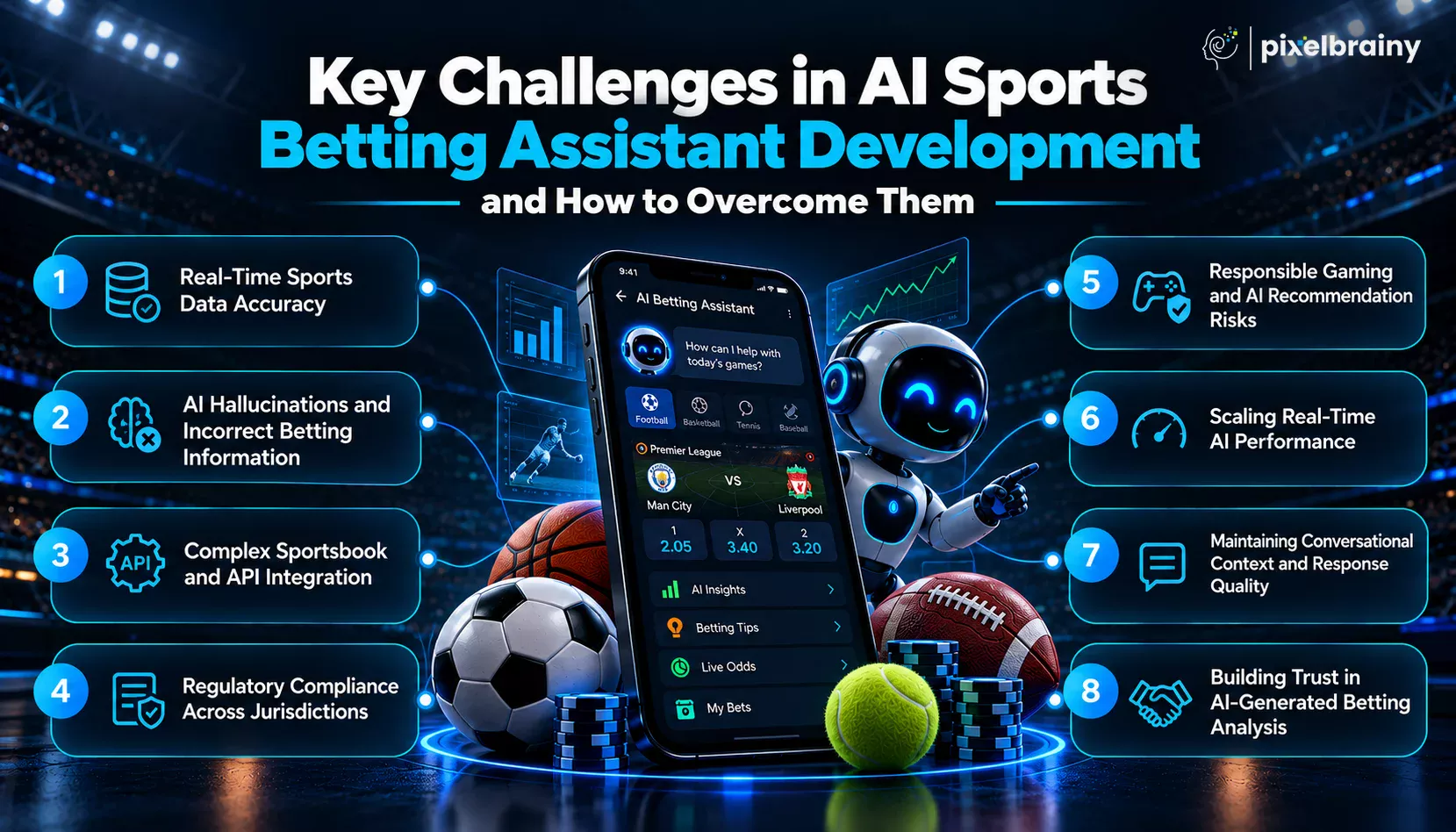
An AI sports betting assistant depends heavily on current information. Odds, scores, player availability, lineups, game status, and betting markets can change rapidly. If the assistant responds using stale information, even an otherwise well-written answer can become misleading.
Challenge: Sports data may arrive from multiple providers with different formats, update intervals, identifiers, and levels of coverage. Delays or inconsistencies can result in incorrect odds, outdated injury information, or unavailable markets being presented to users.
Solution: Integrate reliable and properly licensed sports data and odds providers through a dedicated data layer. Normalize information into standardized formats, attach timestamps to dynamic data, validate incoming updates, and use real-time streaming technologies for markets that require low-latency updates.
Large language models can generate confident-sounding information that is factually incorrect. This is especially important when users ask about current odds, player statistics, injuries, betting markets, or game developments.
Challenge: An LLM's pretrained knowledge is not a reliable source for continuously changing sports information. Asking the model to answer live betting questions without external data can result in fabricated statistics, outdated odds, or nonexistent markets.
Solution: Build the assistant around retrieval and tool-based workflows. The AI should retrieve current information from trusted APIs and databases before generating an answer. Deterministic services should handle calculations such as implied probability, while response validation should check whether the generated answer is supported by retrieved data.
A commercially useful assistant may need to connect with sportsbook markets, odds systems, user accounts, bet slips, sports data providers, analytics engines, and notification services.
Challenge: These systems can use different APIs, authentication methods, data structures, and availability rules. Poor integration architecture can create slow responses, inconsistent information, failed requests, or security vulnerabilities.
Solution: Use a modular backend with dedicated integration services and API gateways. Keep sportsbook transactions and account operations outside the LLM, using deterministic backend services for authentication, authorization, market validation, and bet-slip actions. This creates clearer security boundaries and makes future integrations easier.
Sports betting is highly regulated, and requirements can differ between states, countries, and jurisdictions. An AI assistant may also introduce additional considerations because it generates personalized conversational content.
Challenge: A feature permitted in one jurisdiction may not be available in another. User eligibility, market availability, advertising, responsible gaming, data protection, and AI-generated recommendations can all require different controls.
Solution: Implement compliance as part of the initial architecture. Use jurisdiction-aware services to determine which features and markets are available to each user. Maintain audit logs, access controls, responsible gaming workflows, and configurable policies so regulatory changes can be incorporated without rebuilding the entire application.
An AI betting assistant can make sports information easier to access and personalize. Without appropriate safeguards, however, personalization or recommendation functionality could encourage excessive wagering.
Challenge: Users may interpret AI-generated recommendations as predictions with a high degree of certainty. An assistant that optimizes solely for engagement or wagering activity can also create inappropriate user experiences.
Solution: Design responsible gaming controls directly into the AI workflow. Recommendations should communicate uncertainty and supporting information rather than guarantee outcomes. The platform should also incorporate applicable wagering limits, self-exclusion mechanisms, age and jurisdiction controls, intervention workflows, and access to responsible gaming resources.
A sports betting platform may experience significant traffic spikes during major games, playoffs, championships, and other high-interest events. At the same time, real-time odds and sports feeds can generate large volumes of changing information.
Challenge: A system that performs well during normal traffic may become slow or unstable during peak events. AI inference costs, API requests, database queries, and real-time processing can increase rapidly as the user base grows.
Solution: Build for scalability from the beginning using cloud infrastructure, caching, asynchronous processing, load balancing, autoscaling, and event-driven architecture. Frequently requested data can be cached, while rapidly changing information can be distributed through streaming systems. AI requests should also be optimized through model routing and appropriate response limits.
Users rarely ask only one question. A betting conversation can move from a game overview to spread analysis, player props, totals, and line movement within the same session.
Challenge: Without effective context management, the assistant may forget the game being discussed, confuse players or teams, use outdated information, or provide answers unrelated to the user's previous question.
Solution: Implement conversation-state management, entity tracking, session memory, and context-aware retrieval. The system should identify which team, player, game, or market the user is referring to while refreshing dynamic information when market conditions change. Continuous AI evaluation can then measure response accuracy, relevance, and consistency.
Even technically accurate AI responses can lose credibility if users cannot understand where the information came from or why the assistant reached a particular analytical conclusion.
Challenge: A black-box recommendation such as “This is the best bet” provides little context and can make users question the reliability of the platform.
Solution: Develop explainable AI responses that identify relevant statistics, current market prices, model assumptions, data freshness, and important factors influencing the analysis. The assistant should distinguish between factual information, statistical analysis, and uncertainty. This creates a more transparent experience and helps users make their own informed decisions.
Addressing these challenges at the architecture stage can turn potential weaknesses into competitive advantages, creating an AI sports betting assistant that users can trust and businesses can scale.
From the market opportunity, core features, technology stack, development process, cost, and challenges discussed above, it is now time to identify the right development partner for turning the concept into a production-ready product. PixelBrainy brings together AI engineering, sports technology, data integration, product design, and scalable software development to help businesses create intelligent sports wagering experiences.
As a PixelBrainy as AI sports betting software development company, our approach focuses on developing solutions around real business requirements rather than delivering a generic chatbot with an LLM attached. Our team can help businesses define the product architecture, select appropriate sports data sources, integrate AI capabilities, develop conversational workflows, and connect the assistant with existing sportsbook infrastructure.
Businesses exploring AI sports betting assistant development services can work with PixelBrainy across the complete product lifecycle, from initial product discovery and proof of concept through MVP creation, testing, deployment, and ongoing optimization.
In one confidential sports technology engagement, PixelBrainy worked on an AI-powered sports analytics solution designed to process sports data, generate contextual insights, and present information through a conversational experience. The project involved data/API integration, AI workflow design, backend engineering, analytics processing, and an interactive user interface.
The experience demonstrates our capability in sports betting assistant development integrating AI, particularly where conversational intelligence needs to work with structured sports data and scalable backend infrastructure.
A business evaluating “who can develop an AI sports betting assistant with real-time odds, conversational analytics, and sportsbook integration?” needs a partner that understands both AI and the underlying sports technology ecosystem.
Ready to Build Your AI Sports Betting Product?
Connect with PixelBrainy to discuss your sports betting AI idea and turn it into a scalable product.

The sports betting experience is moving toward more personalized, data-driven, and conversational interactions, creating a strong opportunity for businesses investing in AI sports betting assistant development. A well-designed assistant can bring natural-language conversations, real-time odds analysis, sports statistics, market research, personalized insights, sportsbook integration, and responsible gaming capabilities into a single user experience.
However, successful building AI sports betting assistant projects require more than integrating an AI model. Reliable sports data, scalable architecture, accurate analytics, secure APIs, regulatory considerations, intuitive UX, and continuous AI optimization all contribute to a production-ready solution.
Businesses looking to develop AI sports betting assistant solutions can start with a focused MVP, validate the most valuable use cases, and gradually expand into advanced analytics, mobile applications, real-time intelligence, and enterprise integrations. With the right technology strategy and development partner, an AI betting concept can evolve into a scalable sports wagering product designed for changing user expectations and market opportunities.
Book an appointment with PixelBrainy today to discuss your AI sports betting assistant idea and development roadmap.
The AI sports betting assistant development cost can range from approximately $30,000 to $200,000+, depending on features, sports data integrations, AI complexity, sportsbook APIs, platforms, personalization, and scalability requirements. A basic MVP generally costs less than an enterprise-grade assistant with real-time analytics and multiple sportsbook integrations.
To build an AI sports betting assistant with real-time insights, you need an LLM connected to licensed sports data APIs, live odds feeds, statistical databases, an analytics engine, and a backend orchestration layer. The assistant retrieves current information before generating responses, allowing it to answer questions about odds, games, players, markets, and statistical trends.
To develop an AI sports betting assistant, a typical technology stack can include an LLM such as GPT, Claude, or Gemini, Python or Node.js for backend development, React or Next.js for web applications, PostgreSQL and Redis for data management, sports and odds APIs, cloud infrastructure, and real-time technologies such as WebSockets or Kafka.
Yes. Businesses can create an AI sports betting assistant for iOS and Android using React Native, Flutter, Swift, or Kotlin. A centralized backend can manage AI conversations, sports data, odds analysis, authentication, personalization, and sportsbook integrations while delivering the experience across both mobile platforms.
AI sports betting assistant development can add a conversational intelligence layer to a sportsbook by helping users discover markets, understand odds, research teams and players, analyze statistics, and navigate betting information through natural-language questions. It can also improve product engagement by making complex sportsbook information easier to access.
Yes, an AI bet recommendation assistant development project can incorporate user preferences, sports statistics, current odds, historical information, and analytical models to generate personalized insights. Recommendations should explain the supporting data and uncertainty rather than presenting any wager as guaranteed or risk-free.
The timeline for AI sports betting assistant development depends on the product scope. A focused MVP may require several months, while a complex enterprise solution with multiple sports, live odds, custom AI models, mobile applications, sportsbook integrations, and compliance requirements can take significantly longer. A PoC can help validate functionality before full-scale development.

About The Author
Sagar Bhatnagar
Sagar Sahay Bhatnagar brings over a decade of IT industry experience to his role as Marketing Head at PixelBrainy. He's known for his knack in devising creative marketing strategies that boost brand visibility and market influence. Sagar's strategic thinking, coupled with his innovative vision and focus on results, sets him apart. His track record of successful campaigns proves his ability to utilize digital platforms effectively for impactful marketing efforts. With a genuine passion for both technology and marketing, Sagar continuously pushes PixelBrainy's marketing initiatives to greater success.

Working with the PixelBrainy team has been a highly positive experience. They understand the design requirements and create beautiful UX elements to meet the application needs. The dev team did an excellent job bringing my vision to life. We discussed usability and flow. Sagar worked with his team to design the database and begin coding. Working with Sagar was easy. He has the knowledge to create robust apps, including multi-language support, Google and Apple ID login options, Ad-enabled integrations, Stripe payment processing, and a Web Admin site for maintaining support data. I'm extremely satisfied with the services provided, the quality of the final product, and the professionalism of the entire process. I highly recommend them for Android and iOS Mobile Application Design and Development.

Great experience working with them. Had a lot of feedback and I found that unlike most contractors they were bugging me for updates instead of the other way around. They were extremely time conscience and great at communicating! All work was done extremely high quality and if not on time, early! They were always proactive when it comes to communication and the work is great/above par always. Very flexible and a great team to work with! Goes above and beyond to present us with multiple options and always provides quality. Amazing work per usual with Chitra. If you have UI/UX or branding design needs I recommend you go to them! Will likely work with them in the future as well, definitely recommended!

PixelBrainy is a joy to work with and is a great partner when thinking through branding, logo, and website layout. I appreciate that they spend time going into the "why" behind their decisions to help inform me and others about industry best practices and their expertise.

I hired them to design our software apps. Things I really like about them are excellent communication skills, they answer all project suggestions and collaborate right away, and their input on design and colors is amazing. This project was complex and needed patience and creativity. The team is amazing to do business with. I will be using them long-term. Glad to see there are some good people out there. I was afraid to try and outsource my project to someone but I am glad I met them! I really can't say enough. They went above and beyond on this project. I am very happy with everything they have done to make my business stand out from the competition.

It was great working with PixelBrainy and the team. They were very responsive and really owned the project. We'll definitely work with them again!

I recently worked with the PixelBrainy team on a project and I was blown away by their communication skills. They were prompt, clear, and articulate in all of our interactions. They listened and provided valuable feedback and suggestions to help make the project a success. They also kept me updated throughout the entire process, which made the experience stress-free and enjoyable.

PixelBrainy is very good at what it does. The team also presents themselves very professionally and takes care of their side of things very well. I could fully trust them taking up the design work in a timely and organised manner and their attention to detail saved us lots of effort and time. This particular project was quite intense and the team showed that they function very well under pressure. Very much looking forward to working with her again!

It's always an absolute pleasure working with them. They completed all of my requests quickly and followed every note I had for them to a T, which made our process go smoothly from start to finish. Everything was completed fast and following all of the guidelines. And I would recommend their services to anyone. If you need any design work done in the future, PixelBrainy should be your first call!

They took ownership of our requirements and designed and proposed multiple beautiful variants. The team is self-motivated, requires minimum supervision, committed to see-through designs with quality and delivering them on time. We would definitely love to work with PixelBrainy again when we have any requirements.

PixelBrainy was a big help with our SaaS application. We've been hard at work with a new UI/UX and they provided a lot of help with the designs. If you're looking for assistance with your website, software, or mobile application designs, PixelBrainy and the team is a great recommendation.

PixelBrainy designers are amazing. They are responsive, talented, and always willing to help craft the design until it matches your vision. I would recommend them and plan to continue them for my future projects and more!!!

They were awesome! Did a good job fast, and good communication. Will work with them again. Thank you

Creative, detail-oriented, and talented designers who take direction well and implement changes quickly and accurately. They consistently over-delivered for us.

PixelBrainy team is very talented and creative. Great designers and a pleasure to work with. PixelBrainy is an excellent communicator and I look forward to working with them again.

PixelBrainy has a very talented design team. Their work is excellent and they are very responsive. I enjoy working with them and hope to continue on all of our future projects.


Transform your ideas into reality with us.
Across these industries, each engagement brings unique challenges, from early-stage product development to scaling complex systems, helping us build a practical understanding of real-world product environments.