AI Summary Powered by PixelBrainy
Why do so many IoT projects fail to deliver business value even after companies invest heavily in connected devices and smart sensors?
The answer is simple. Most businesses invest in IoT hardware before investing in the software infrastructure that transforms device data into business intelligence. Manufacturers, healthcare providers, logistics companies, retailers, and energy companies deploy thousands of connected sensors, gateways, and edge devices, but without robust IoT software development, those devices generate data instead of measurable outcomes. The software layer is responsible for secure device connectivity, data ingestion, real time processing, analytics, automation, and integration with enterprise systems, making it the foundation of every successful IoT initiative.
By 2026, billions of connected devices are generating unprecedented volumes of real time operational data worldwide. However, collecting data is no longer the challenge. The real challenge is building software capable of converting continuous data streams into predictive maintenance, operational efficiency, automated workflows, and faster business decisions. This is why custom IoT software development has become a strategic investment rather than simply a technology project.
Many organisations understand what IoT can achieve, but few understand how to develop IoT software from scratch or what a production ready IoT platform actually requires beyond a dashboard displaying sensor readings. A complete connected device software development project includes device management, secure communication, cloud infrastructure, real time analytics, API development, firmware updates, user applications, and integration with ERP, CRM, and other enterprise systems.
Consider this common enterprise scenario: I am a CTO at a mid-size enterprise, and our board has approved budget for an IoT initiative. I need a credible development roadmap that explains the complete software scope, including device management, data ingestion, real time processing, analytics dashboards, and ERP integration before selecting a technology partner.
This guide explains everything you need to build an IoT software solution, including high ROI industry use cases, the complete development process, technology stack, cost breakdown, implementation challenges, and how to choose an experienced IoT software development company. Businesses that invest in the right IoT software platform gain long term competitive advantages through predictive maintenance, operational visibility, automation, and real time decision making that competitors without mature IoT infrastructure cannot easily replicate.
IoT software development is the process of building software that connects physical devices, sensors, machines, and equipment with digital systems to enable real time data collection, communication, analytics, automation, and business decision making. Unlike traditional applications that rely on user interactions, IoT application development enables connected devices to continuously exchange data with cloud platforms and enterprise systems without constant human intervention.
The primary goal of custom IoT software development is to transform raw sensor data into actionable business intelligence. This includes securely collecting device data, processing it in real time, applying analytics or AI models, and integrating insights with enterprise systems such as ERP, CRM, and warehouse management platforms. As a result, businesses can automate operations, improve asset visibility, reduce downtime, and make faster, data driven decisions.
What makes IoT software different from standard software development is its ability to connect the physical and digital worlds. Traditional web and mobile applications mainly manage users, databases, and business logic. In contrast, IoT software must also handle hardware limitations, multiple communication protocols, intermittent connectivity, continuous data streams, low latency processing, and end to end security across devices, networks, and cloud infrastructure.
A production ready IoT platform consists of five essential software layers:
| Factor | Standard Software Development | IoT Software Development |
| Primary Interface | User input via keyboard, touch, or voice | Sensor data and device actuators |
| Data Volume | User generated events | Continuous device telemetry |
| Real Time Requirements | Moderate response time | Millisecond to second latency |
| Security Surface | Application and network layer | Device, firmware, communication, cloud, and application layer |
| Connectivity | Reliable internet assumed | Handles intermittent connectivity |
| Hardware Constraints | Minimal | Limited memory, power, and processing resources |
| Update Mechanism | Standard software deployment | Over the air firmware updates |
| Scale Complexity | User scaling | Millions of connected devices |
Understanding these five software layers is what separates a production grade IoT platform from a basic sensor dashboard. A well planned IoT software development strategy enables businesses to build secure, scalable, and intelligent IoT solutions that deliver measurable operational value.
An IoT software solution works by creating a continuous flow of information between connected devices, cloud infrastructure, and business applications. Every sensor reading, machine status update, or environmental measurement follows a structured software pipeline that captures data, processes it in real time, and converts it into actionable business insights. This is the foundation of modern IoT software development, enabling organisations to monitor operations, automate workflows, and make faster data driven decisions.
Although industries use different devices and technologies, nearly every enterprise IoT system follows the same five stage workflow.
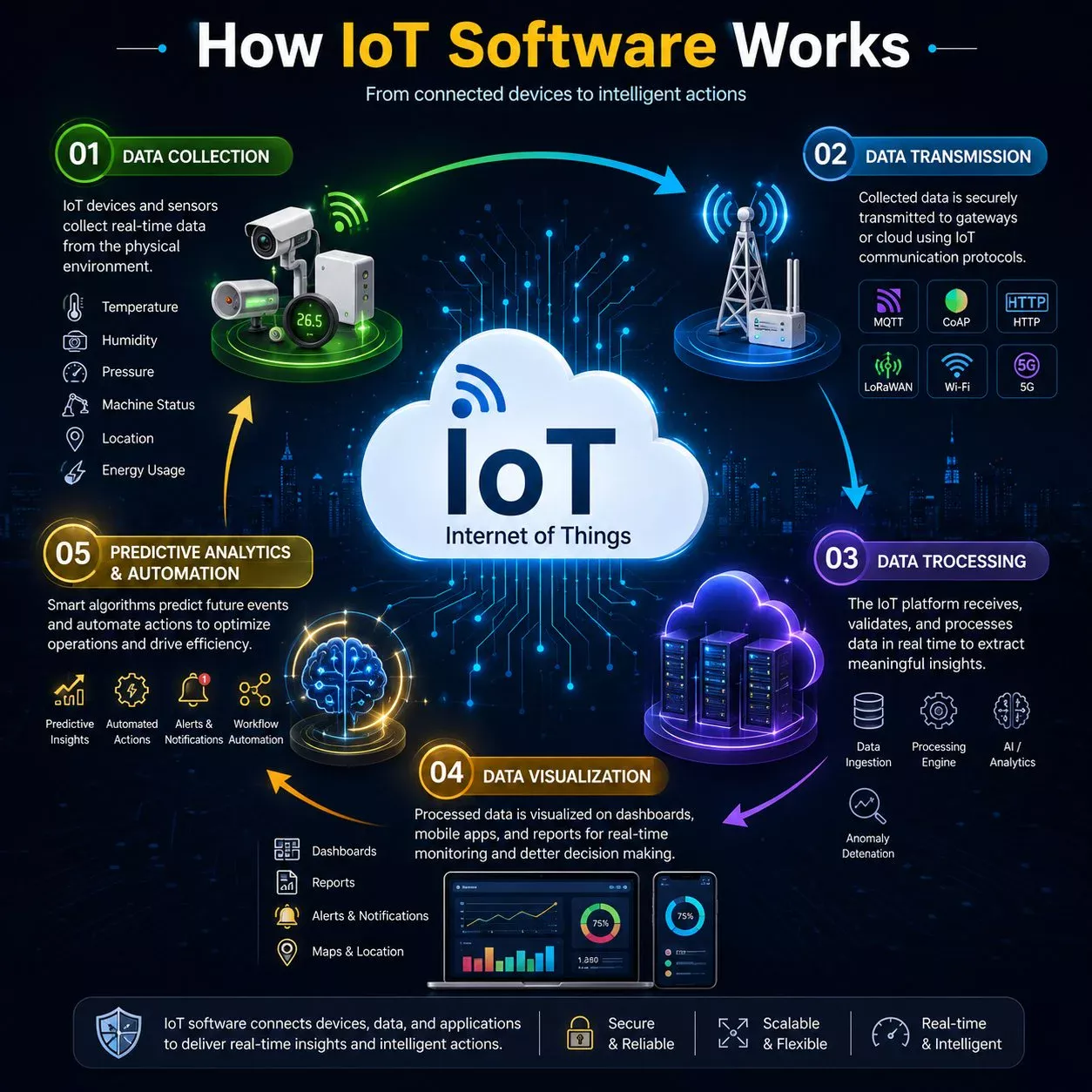
The process begins with connected devices such as sensors, industrial machines, GPS trackers, wearables, smart meters, or cameras. These devices continuously collect operational data, including temperature, pressure, vibration, humidity, location, equipment performance, or energy consumption. Instead of relying on manual reporting, the software receives a constant stream of real time information directly from physical assets.
After data is collected, it is securely transmitted to an IoT gateway or cloud platform through communication protocols such as MQTT, CoAP, HTTP, Bluetooth Low Energy, LoRaWAN, Wi-Fi, or 5G. During this stage, encryption, authentication, and device verification protect the data while ensuring reliable communication, even when network connectivity is unstable.
Once the data reaches the platform, the IoT software validates, filters, and processes millions of incoming events. Business rules, analytics engines, and AI models analyse the data to identify anomalies, calculate performance metrics, detect equipment failures, or trigger automated workflows. Rather than storing raw sensor readings, the platform converts them into meaningful operational information.
The processed information is displayed through dashboards, mobile applications, reports, and alerts. Decision makers can monitor equipment health, production performance, fleet movements, inventory levels, or energy usage from a single interface. Real time visualisation allows teams to identify issues immediately instead of waiting for periodic reports.
The final stage transforms insights into action. By combining historical and real time data, the platform predicts future events, recommends corrective actions, and automates business processes. For example, the system can schedule maintenance before equipment fails, optimise production schedules, send instant notifications, or automatically update ERP and inventory systems without manual intervention.
| Stage | What Happens | Business Value |
| Data Collection | Connected devices capture operational data | Continuous visibility into assets and operations |
| Data Transmission | Device data is securely transferred to gateways or the cloud | Reliable and secure communication |
| Data Processing | Data is filtered, analysed, and enriched using business rules and AI | Real time insights and faster decision making |
| Data Visualisation | Dashboards, reports, and alerts present actionable information | Improved monitoring and operational control |
| Predictive Analytics & Automation | The system predicts events and automates responses | Reduced downtime, lower costs, and greater efficiency |
A successful IoT platform is not defined by the number of connected devices but by how effectively its software transforms continuous device data into intelligent actions. When every stage of the IoT workflow works together, businesses gain real time visibility, predictive insights, and automation that drive measurable operational and financial outcomes.
Businesses are investing in IoT software development because connected devices alone do not create business value. The real advantage comes from software that collects, processes, analyses, and transforms real time device data into intelligent business decisions. Modern IoT software solutions enable organisations to monitor assets continuously, automate operations, predict equipment failures, optimise resources, and integrate connected devices with enterprise systems such as ERP, CRM, and business intelligence platforms. As a result, custom IoT software development has become a strategic investment for organisations pursuing digital transformation, operational excellence, and long-term competitive advantage.
The market reflects this rapid adoption. According to Statista, the global Internet of Things market is projected to generate US$1.18 trillion in revenue by 2026, while the number of connected IoT devices worldwide is forecast to grow from 19.8 billion in 2025 to more than 40.6 billion by 2034.
At the same time, Fortune Business Insights estimates that the IoT analytics market will reach US$50.43 billion in 2026 and expand to US$201.77 billion by 2034, driven by increasing demand for AI powered analytics, predictive maintenance, and real time decision making. These trends clearly show that enterprise investment is shifting from connected hardware to intelligent IoT software platforms capable of extracting business value from massive volumes of data.
IoT software continuously collects and analyses data from connected devices, allowing businesses to monitor equipment, production lines, vehicles, and facilities in real time. This visibility helps identify operational bottlenecks, improve asset utilisation, and eliminate manual monitoring processes.
Instead of waiting for equipment to fail, IoT application development enables predictive maintenance by analysing historical and live sensor data. Businesses can detect abnormal machine behaviour early, schedule maintenance proactively, minimise unplanned downtime, and extend the lifespan of critical assets.
Enterprise IoT platforms deliver real time dashboards, alerts, and performance reports that help decision makers respond immediately to changing business conditions. Whether managing manufacturing equipment, delivery fleets, healthcare devices, or energy infrastructure, organisations can make faster and more informed decisions using live operational data.
One of the biggest advantages of custom IoT software development is business process automation. IoT platforms can automatically generate maintenance requests, optimise production schedules, trigger inventory replenishment, adjust machine settings, or send alerts when predefined conditions are met, reducing manual effort and improving operational accuracy.
Continuous monitoring enables businesses to optimise energy consumption, improve workforce productivity, reduce equipment failures, and minimise resource wastage. Over time, these improvements translate into lower operating costs and a higher return on investment from connected infrastructure.
Connected products enable businesses to move from reactive support to proactive service. IoT software allows organisations to remotely monitor products, deploy software updates, diagnose issues before customers report them, and deliver personalised services that improve customer satisfaction and long term retention.
IoT serves as a foundation for Industry 4.0 initiatives by connecting devices, cloud platforms, AI, edge computing, and enterprise applications into a single intelligent ecosystem. This enables organisations to build scalable digital operations, improve supply chain visibility, support digital twins, and unlock new data driven business models.
| Traditional Operations | IoT Powered Operations |
| Manual equipment inspections | Continuous real time monitoring |
| Reactive maintenance | AI driven predictive maintenance |
| Historical reporting | Live dashboards and instant alerts |
| Manual inventory tracking | Automated inventory management |
| Periodic machine checks | 24/7 remote asset monitoring |
| Limited operational visibility | End to end business intelligence |
As enterprise IoT continues to evolve with AI, edge computing, and predictive analytics, the greatest competitive advantage will belong to businesses that invest in intelligent IoT software platforms capable of transforming connected device data into automated actions and measurable business outcomes.
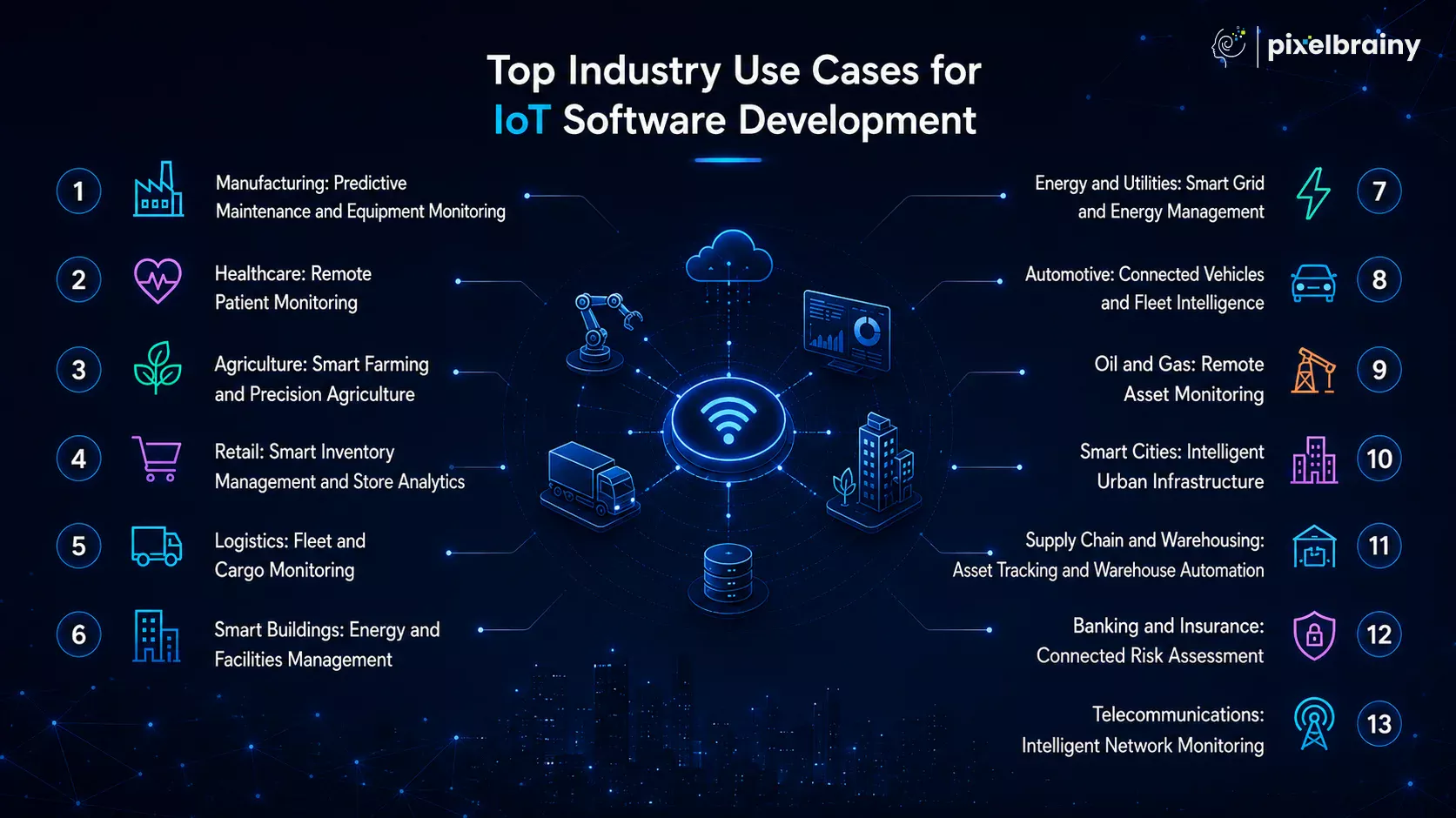
As enterprises accelerate digital transformation, IoT software development is becoming a core technology investment across industries. Connected devices are no longer deployed simply to collect sensor data. Instead, organisations are building intelligent IoT platforms that combine real time monitoring, AI driven analytics, automation, and enterprise integrations to solve specific operational challenges and improve business performance.
From predictive maintenance in manufacturing to remote patient monitoring in healthcare and precision farming in agriculture, IoT software development use cases by industry continue to expand as businesses seek greater operational visibility, cost optimisation, and data driven decision making. The common objective across every industry is the same: transform continuous device data into measurable business outcomes.
The following examples highlight some of the highest ROI applications of industrial IoT software development and enterprise IoT platforms, including the business problem they solve, how the software works, the measurable benefits it delivers, and the architectural considerations required for a production ready deployment.
Manufacturing facilities lose billions every year due to unexpected equipment failures. Traditional preventive maintenance often replaces components that are still functioning correctly while failing to detect breakdowns that occur between scheduled inspections.
IoT software solution
Industrial sensors continuously monitor machine vibration, temperature, motor current, pressure, humidity, and acoustic signals. The IoT platform analyses these data streams using machine learning algorithms to predict equipment failures before they occur and automatically notify maintenance teams.
Business outcomes
Architecture consideration
Industrial IoT software development typically combines edge computing for millisecond anomaly detection with cloud-based analytics for predictive model training, historical reporting, and enterprise integration.
Hospitals and healthcare providers cannot continuously monitor every patient manually. Changes in vital signs may go unnoticed until they become medical emergencies, increasing clinical risks and operational pressure.
IoT software solution
Wearable devices, bedside monitors, smart medical sensors, and connected healthcare equipment continuously capture patient vitals including heart rate, oxygen saturation, blood pressure, temperature, glucose levels, and ECG readings. The platform generates intelligent alerts whenever patient specific thresholds are exceeded.
Business outcomes
Architecture consideration
IoT software development for healthcare industry requires HIPAA compliant data pipelines, encrypted communication, real time alert processing, and seamless integration with Hospital Information Systems (HIS) and Electronic Health Records (EHR).
Traditional farming relies heavily on manual observation and fixed irrigation schedules, often leading to excessive water usage, uneven fertilisation, and lower crop productivity.
IoT software solution
Soil moisture sensors, weather stations, GPS enabled tractors, drone imagery, and environmental sensors continuously collect field data. An agricultural IoT platform analyses these inputs to automate irrigation, optimise fertiliser usage, detect crop stress, and improve harvest planning.
Business outcomes
Architecture consideration
Smart farming platforms commonly use LoRaWAN, NB-IoT, or satellite connectivity for remote locations, while edge computing supports local decision making where internet connectivity is limited.
Retailers frequently lose revenue because products become unavailable before staff identify inventory shortages. Manual stock counting is also time consuming and prone to human error.
IoT software solution
RFID tags, smart shelves, computer vision cameras, barcode scanners, and weight sensors continuously monitor inventory levels. The software automatically triggers replenishment orders, tracks product movement, and analyses customer behaviour to optimise store layouts.
Business outcomes
Architecture consideration
Enterprise retail platforms require real time integration with ERP systems, warehouse management software, POS systems, and inventory management platforms.
Without real time visibility, logistics companies struggle to optimise delivery routes, monitor cargo conditions, and reduce transportation costs. Cold chain shipments are especially vulnerable to temperature fluctuations during transit.
IoT software solution
GPS trackers, telematics devices, fuel sensors, driver behaviour monitors, and temperature sensors continuously transmit vehicle location, cargo conditions, and fleet performance to a central logistics platform. AI algorithms optimise routes and automatically notify operators about delivery risks.
Business outcomes
Architecture consideration
Fleet management systems rely on cellular connectivity, geofencing, real time dashboards, route optimisation engines, and integration with dispatch management and customer notification systems.
Commercial buildings often operate disconnected HVAC, lighting, security, elevators, and energy systems, making it difficult to optimise energy usage and respond quickly to maintenance issues.
IoT software solution
Connected sensors continuously monitor occupancy, indoor air quality, lighting, temperature, humidity, and energy consumption. The IoT platform automatically adjusts HVAC systems, detects equipment faults, schedules maintenance, and optimises overall building performance.
Business outcomes
Architecture consideration
Smart building platforms require multi-protocol integration supporting BACnet, Modbus, Zigbee, KNX, Bluetooth Low Energy, and other building automation standards while integrating with Building Management Systems (BMS).
Power generation companies and utility providers manage vast networks of transmission lines, substations, transformers, and smart meters. Traditional monitoring methods often make it difficult to detect outages, equipment failures, or energy losses in real time, leading to higher operational costs and slower response times.
IoT Software Solution
IoT sensors, smart meters, transformers, and grid monitoring devices continuously collect data on voltage, current, power consumption, and equipment health. The platform analyses this data to detect faults, balance energy demand, optimise grid performance, and automate outage notifications.
Business Outcomes
Architecture Consideration
Energy IoT platforms require high availability, secure edge devices, SCADA integration, real time event processing, and cloud analytics capable of handling millions of connected smart meters simultaneously.
Modern vehicles generate thousands of data points every minute, yet many organisations struggle to convert this information into actionable operational insights.
IoT Software Solution
Connected vehicle platforms collect GPS location, engine diagnostics, battery performance, fuel consumption, tyre pressure, and driver behaviour. AI powered analytics identify maintenance requirements, optimise routes, monitor driver safety, and improve fleet utilisation.
Business Outcomes
Architecture Consideration
Automotive IoT solutions require reliable cellular connectivity, edge processing for onboard decisions, secure OTA firmware updates, and integration with transportation management systems.
Oil fields, pipelines, offshore platforms, and refineries often operate in remote or hazardous environments where manual inspections are expensive, time consuming, and risky.
IoT Software Solution
Connected pressure sensors, flow meters, vibration sensors, gas detectors, and environmental monitoring devices continuously monitor equipment performance and pipeline conditions. The platform automatically detects leaks, abnormal pressure changes, and equipment degradation before major failures occur.
Business Outcomes
Architecture Consideration
Industrial IoT software development for oil and gas requires rugged edge gateways, satellite or LPWAN connectivity, real time alarm systems, and highly secure communication across remote assets.
Rapid urbanisation is increasing pressure on transportation systems, utilities, waste management, and public safety services. City administrators require real time visibility to manage infrastructure efficiently.
IoT Software Solution
Connected traffic signals, smart parking sensors, surveillance systems, environmental sensors, waste bins, and street lighting systems continuously share operational data with a central city management platform.
Business Outcomes
Architecture Consideration
Smart city platforms require highly scalable cloud infrastructure, multi-protocol device communication, AI powered analytics, GIS integration, and secure management of millions of connected devices.
Supply chains often suffer from inventory inaccuracies, misplaced assets, shipment delays, and limited visibility across warehouse operations.
IoT Software Solution
RFID tags, barcode scanners, autonomous robots, environmental sensors, and asset trackers continuously monitor inventory movement, storage conditions, and warehouse activity. IoT software provides live inventory visibility while automating stock replenishment and warehouse workflows.
Business Outcomes
Architecture Consideration
Warehouse IoT platforms require seamless integration with Warehouse Management Systems (WMS), ERP software, robotics platforms, and AI driven inventory optimisation engines.
Financial institutions increasingly rely on IoT data to assess customer risk more accurately and deliver personalised insurance products.
IoT Software Solution
Telematics devices, wearable health trackers, connected home sensors, and smart security systems provide continuous behavioural and environmental data that supports usage-based insurance and proactive risk management.
Business Outcomes
Architecture Consideration
Financial IoT platforms require strong encryption, regulatory compliance, secure APIs, identity management, and privacy focused data governance.
Telecommunication providers operate thousands of network towers, routers, switches, and data centres that require continuous monitoring to maintain service quality.
IoT Software Solution
Connected infrastructure sensors monitor network equipment, environmental conditions, energy usage, and hardware performance. AI powered analytics detect service degradation, predict equipment failures, and optimise network capacity.
Business Outcomes
Architecture Consideration
Telecom IoT platforms require distributed edge computing, real time network analytics, automated incident management, and integration with Network Operations Centres (NOC).
| Industry | Primary Use Case | Key Business Outcome | Critical Architecture Consideration |
| Manufacturing | Predictive maintenance | Reduced downtime and maintenance costs | Edge computing for real time anomaly detection |
| Healthcare | Remote patient monitoring | Earlier diagnosis and improved clinical efficiency | HIPAA compliant architecture with HIS integration |
| Agriculture | Precision farming | Lower water consumption and higher crop yields | LoRaWAN and edge processing for remote farms |
| Retail | Smart inventory management | Reduced stock outs and automated replenishment | ERP and POS integration with live inventory |
| Logistics | Fleet and cargo monitoring | Fuel savings and improved delivery visibility | Cellular connectivity with geofencing alerts |
| Smart Buildings | Energy and facility management | Lower energy costs and predictive maintenance | Multi protocol building system integration |
| Energy & Utilities | Smart grid monitoring | Improved grid reliability and energy optimisation | SCADA integration and high availability cloud |
| Automotive | Connected fleet intelligence | Better fleet performance and predictive servicing | OTA updates and telematics integration |
| Oil & Gas | Remote asset monitoring | Improved safety and reduced operational risks | Secure edge gateways with satellite connectivity |
| Smart Cities | Intelligent infrastructure | Better public services and resource optimisation | Massive device scalability and GIS integration |
| Supply Chain | Asset tracking and warehouse automation | Greater inventory accuracy and operational efficiency | WMS and ERP integration |
| Banking & Insurance | Connected risk monitoring | Smarter underwriting and fraud prevention | Secure APIs and regulatory compliance |
| Telecommunications | Intelligent network monitoring | Higher network reliability and lower operational costs | Edge analytics and NOC integration |
The most successful IoT software development use cases by industry share a common objective: transforming real time data from connected devices into intelligent business decisions.
Whether through industrial IoT software development, IoT software development for healthcare industry, smart cities, logistics, or energy management, organisations that build scalable, secure, and AI enabled IoT platforms gain measurable advantages in operational efficiency, automation, predictive analytics, and long-term business growth.
A production ready IoT software platform is much more than a system that connects sensors and displays data on a dashboard. It serves as the central intelligence layer that manages connected devices, processes real time data, automates business workflows, secures communication, and integrates seamlessly with enterprise applications. Whether an organisation is investing in custom IoT software development, expanding an Industrial IoT ecosystem, or modernising existing infrastructure, the platform must include capabilities that support scalability, reliability, security, and long-term business growth.
A common question among business leaders is: "We are building an enterprise IoT solution, but what features are essential to ensure it can securely manage connected devices, process millions of real time events, integrate with ERP systems, and continue scaling as our business grows?" The answer lies in implementing a comprehensive set of enterprise grade features that go beyond basic device connectivity and enable intelligent, data driven operations.
The following features represent the foundation of every successful IoT software development project and are essential for building secure, scalable, and future ready IoT ecosystems across manufacturing, healthcare, logistics, retail, energy, agriculture, and smart infrastructure.
| Feature | Why It Is Essential for a Production IoT Platform |
| Device Management | A centralised device management system enables organisations to onboard, configure, monitor, group, and remotely manage thousands of connected devices throughout their lifecycle. This improves operational visibility, simplifies maintenance, and supports large scale IoT software development without increasing administrative complexity. |
| Secure Device Authentication | Every connected device should be authenticated using digital certificates, encryption, and identity management before communicating with the platform. Strong authentication prevents unauthorised access, protects sensitive business information, and strengthens enterprise IoT security across the entire connected ecosystem. |
| Real Time Data Processing | A production IoT software platform must process continuous streams of sensor data with minimal latency. Real time processing enables immediate anomaly detection, intelligent automation, predictive maintenance, and faster business decisions based on live operational information. |
| Edge Computing Support | Edge computing processes data closer to connected devices instead of relying entirely on cloud infrastructure. This reduces latency, minimises bandwidth usage, improves response times, and allows critical operations to continue even when network connectivity is limited. |
| Cloud Integration | Cloud integration provides scalable storage, computing resources, disaster recovery, and seamless connectivity with enterprise applications. It also enables organisations to combine IoT data with AI, analytics, ERP, CRM, and business intelligence platforms for greater operational value. |
| Predictive Analytics | AI powered predictive analytics identifies trends, forecasts equipment failures, detects anomalies, and recommends preventive actions before operational issues occur. This helps businesses reduce downtime, optimise maintenance schedules, and improve overall asset performance. |
| Remote Device Monitoring | Continuous monitoring gives administrators complete visibility into device health, connectivity, battery status, firmware versions, and operational performance. Remote monitoring improves troubleshooting, reduces field service visits, and increases overall system reliability. |
| Over the Air Firmware Updates | OTA firmware updates allow organisations to remotely deploy software improvements, bug fixes, and security patches to connected devices without physical intervention. This keeps IoT infrastructure secure, compliant, and operating with the latest features. |
| Workflow Automation | Workflow automation enables IoT platforms to trigger maintenance requests, adjust machine settings, send notifications, update enterprise applications, or execute predefined business processes automatically whenever specific sensor conditions are detected. |
| Interactive Dashboards | Interactive dashboards convert complex IoT data into intuitive charts, reports, maps, KPIs, and visual analytics. Decision makers gain complete operational visibility, allowing them to monitor assets, identify trends, and respond quickly to business events. |
| API and Enterprise Integration | Enterprise IoT platforms should integrate securely with ERP, CRM, MES, warehouse management, SCADA, and third-party applications through APIs. Connected business systems eliminate data silos and automate information flow across the organisation. |
| Scalability | As businesses deploy additional sensors and connected assets, the platform should seamlessly scale from hundreds to millions of devices without affecting performance. Scalable architecture ensures consistent reliability, availability, and future business expansion. |
| Enterprise Grade Cybersecurity | Comprehensive cybersecurity protects every layer of the IoT ecosystem, including connected devices, firmware, communication protocols, cloud infrastructure, APIs, and applications. Strong security controls minimise cyber threats while maintaining compliance with industry regulations. |
| Alert and Notification Management | Intelligent alert management automatically notifies users about equipment failures, abnormal sensor readings, security incidents, or operational exceptions in real time. Faster notifications enable quicker responses, minimise downtime, and reduce operational risks. |
| Reporting and Business Intelligence | Advanced reporting transforms raw IoT data into actionable business intelligence through KPI dashboards, performance reports, trend analysis, and executive insights. These capabilities support strategic planning, continuous optimisation, and better long-term decision making. |
The true value of an enterprise IoT platform lies not in the number of connected devices it supports, but in the intelligent features that transform real time device data into secure, scalable, and measurable business outcomes.
Building an enterprise IoT solution is not the same as developing a web or mobile application. A production ready IoT software platform consists of multiple software layers that work together to securely connect devices, process millions of real time events, automate business operations, and integrate with existing enterprise systems. From embedded firmware and communication protocols to cloud infrastructure, analytics engines, APIs, and user dashboards, every layer must be designed as part of one connected software ecosystem.
Many businesses beginning custom IoT software development ask the same question:
"We are a startup that has built a hardware product and are now planning the software layer that will make it valuable for enterprise customers. We understand IoT software involves much more than a mobile app, but what does the complete software architecture actually look like? We need a clear roadmap covering firmware, communication protocols, cloud backend, data processing, and customer dashboards before we start development."
The answer is to follow a structured IoT software development process where each software component is planned, developed, tested, secured, and integrated systematically. Whether your objective is industrial IoT software development, building a connected healthcare platform, or launching enterprise IoT development services, the following roadmap provides a proven framework to build an IoT software solution that is scalable, secure, and future ready.
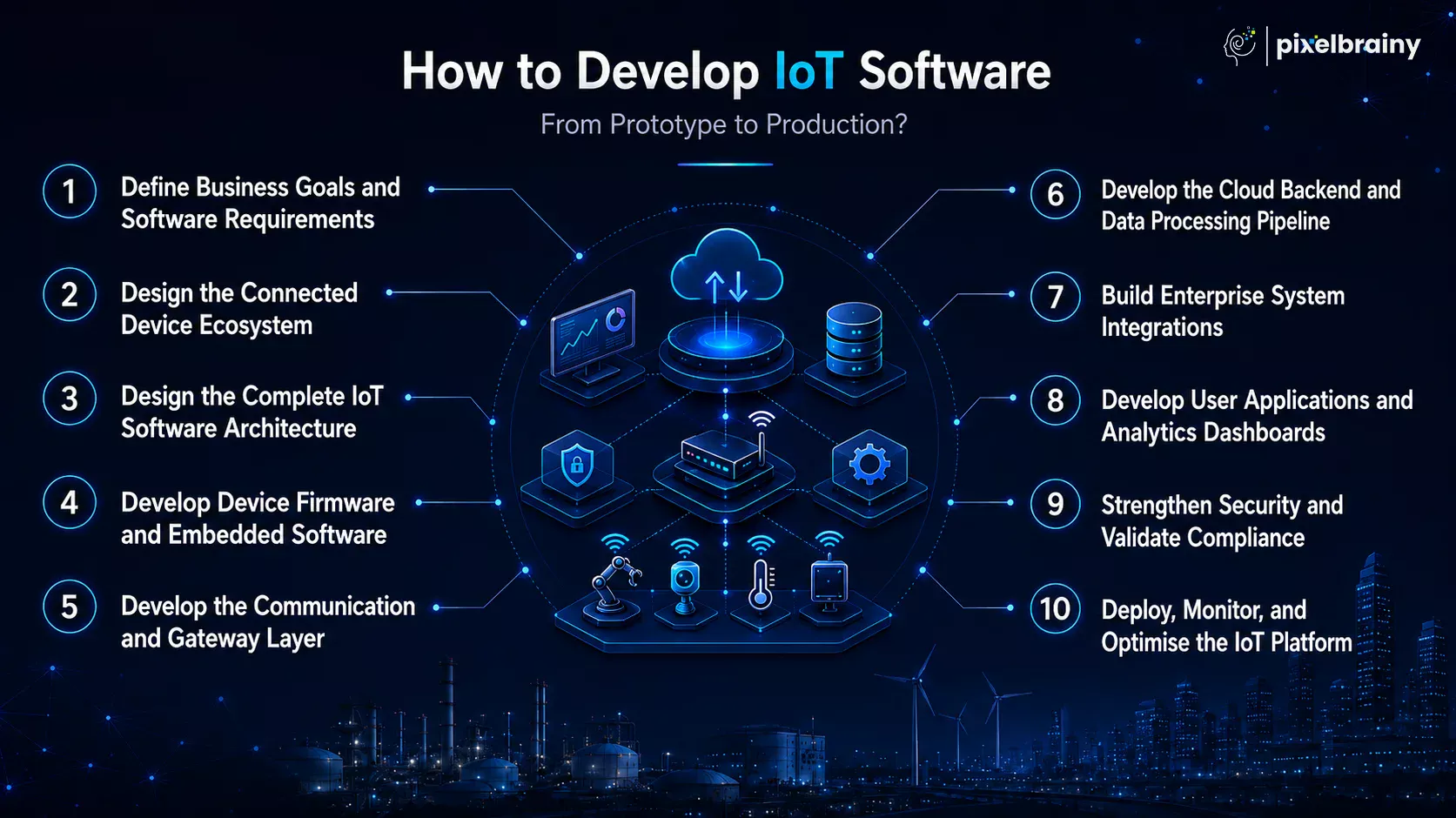
Purpose
Every successful IoT platform begins with understanding the business problem before writing a single line of code. This phase establishes the foundation for the entire software architecture.
Software Components Planned
Key Development Activities
Identify the operational challenges the software will solve, define the sensors and devices involved, determine what data each device should collect, and document how business users will interact with dashboards, reports, and alerts. Many organisations validate technical feasibility through PoC development before committing to full scale engineering.
Expected Outcome
A clearly documented software blueprint that aligns technical development with measurable business objectives while reducing future redesign costs.
Purpose
A production IoT platform must support different hardware manufacturers, communication standards, and deployment environments without compromising reliability.
Software Components Planned
Key Development Activities
Document every device that will communicate with the platform, including sensors, gateways, PLCs, controllers, wearables, GPS trackers, and industrial machines. Identify supported protocols such as MQTT, CoAP, HTTP, Bluetooth Low Energy, LoRaWAN, Zigbee, Wi-Fi, or 5G and define how the software will manage communication between heterogeneous devices.
Expected Outcome
A scalable device communication architecture capable of supporting future hardware expansion without major software modifications.
Purpose
This stage transforms business requirements into a technical software architecture that defines how every software layer communicates throughout the platform.
Software Components Designed
Key Development Activities
Design the five core software layers including firmware, communication services, IoT gateways, cloud infrastructure, analytics, and user applications. Decide whether edge computing or cloud first processing best supports latency, bandwidth, and operational requirements. If user experience is a priority, collaborating with an experienced UI/UX design company at this stage helps create intuitive dashboards for operators, administrators, and enterprise decision makers.
Expected Outcome
A scalable software architecture that supports security, performance, maintainability, and long-term platform growth.
Purpose
Firmware is the first software layer inside every connected device. It controls how sensors operate, collect data, and communicate with the IoT platform.
Software Components Developed
Key Development Activities
Develop firmware that controls sensor behaviour, defines data collection frequency, manages device communication, and optimises battery consumption where applicable. Implement encrypted communication and Over the Air update capability from the beginning so devices can receive software improvements without requiring physical maintenance.
Expected Outcome
Reliable firmware capable of securely transmitting accurate sensor data under real world operating conditions.
Purpose
The communication layer acts as the bridge between connected devices and cloud software, ensuring secure, reliable, and uninterrupted data exchange.
Software Components Developed
Key Development Activities
Develop gateway software that aggregates device telemetry, translates multiple communication protocols, encrypts data transmissions, authenticates devices, and temporarily stores information during network interruptions. This layer also performs local filtering and edge analytics before forwarding processed data to cloud services.
Expected Outcome
A resilient communication platform that guarantees secure device connectivity and reliable data transmission even in environments with unstable network conditions.
Purpose
The cloud backend serves as the central software layer that receives, processes, stores, and analyses data generated by connected devices. It transforms continuous device telemetry into actionable insights, automation workflows, and enterprise intelligence.
Software Components Developed
Key Development Activities
Develop the cloud infrastructure that receives millions of incoming device messages through secure communication channels. Build a real time data processing pipeline capable of validating sensor data, detecting anomalies, generating alerts, applying business rules, and storing historical data for reporting and AI driven analytics. This stage also includes developing a central device management service that remotely monitors device health, manages firmware updates, tracks connectivity, and supports large scale device lifecycle management.
Expected Outcome
A highly scalable IoT platform development environment that securely processes high volume device data while delivering reliable analytics, automation, and enterprise grade performance.
Purpose
An enterprise IoT platform becomes significantly more valuable when it shares information with existing business systems instead of operating independently.
Software Components Developed
Key Development Activities
Develop secure APIs and middleware that synchronise IoT data with ERP, CRM, SCADA, MES, warehouse management, and maintenance management systems. The integration layer should allow enterprise applications to receive real time alerts, retrieve operational data, trigger device actions, and automate business workflows. At this stage, many organisations also prioritise MVP development to release a functional enterprise solution quickly while validating user adoption before expanding advanced capabilities.
Expected Outcome
A connected software ecosystem where IoT insights automatically improve operational efficiency across existing enterprise applications.
Purpose
Business users require intuitive applications that transform complex IoT data into meaningful operational insights and simple day to day actions.
Software Components Developed
Key Development Activities
Develop responsive web dashboards for administrators, operators, and business executives to monitor connected devices in real time. Build mobile applications for technicians who require remote access to alerts, maintenance records, and equipment status while working in the field. Implement notification services capable of delivering alerts through email, SMS, push notifications, and enterprise collaboration platforms. Dashboards should provide KPI tracking, historical reports, device health monitoring, and predictive maintenance insights.
Expected Outcome
User friendly software applications that convert complex IoT data into clear visual information, enabling faster decisions and improved operational visibility.
Purpose
Enterprise IoT platforms manage sensitive operational and business information, making cybersecurity an essential part of the software development lifecycle rather than a final testing activity.
Software Components Developed
Key Development Activities
Perform comprehensive security testing across devices, firmware, communication protocols, cloud infrastructure, APIs, databases, and user applications. Implement certificate-based authentication, role-based access control, encrypted communication, secure API gateways, and continuous threat monitoring. Validate compliance with industry standards such as HIPAA for healthcare, IEC 62443 for industrial environments, GDPR for data protection, or other regulatory requirements applicable to the deployment.
Expected Outcome
A secure enterprise IoT software platform that protects connected devices, business data, and customer information while satisfying industry compliance requirements.
Purpose
The final stage focuses on safely deploying the software into production while continuously monitoring performance, reliability, and business outcomes.
Software Components Deployed
Key Development Activities
Begin deployment with a limited group of devices or a single operational location before expanding organisation wide. Continuously monitor system availability, communication reliability, dashboard performance, API response times, and device connectivity. Use operational data to optimise alert thresholds, improve analytics accuracy, enhance software performance, and resolve integration issues before scaling the deployment to the complete device fleet.
Expected Outcome
A stable, production ready IoT platform that supports continuous monitoring, proactive optimisation, and future expansion without disrupting business operations.
| Development Phase | Software Deliverables | Estimated Duration |
| Business Analysis and Software Architecture | Use cases, requirements, software architecture, device ecosystem planning | 2 Weeks |
| Firmware and Embedded Software Development | Device firmware, sensor logic, OTA update capability | 3 Weeks |
| Communication and Gateway Development | Gateway software, protocol translation, edge analytics, secure communication | 2 Weeks |
| Cloud Backend and Data Processing | Message broker, APIs, stream processing, analytics engine, device management | 4 Weeks |
| Enterprise System Integration | ERP, CRM, SCADA, MES, API integration and testing | 2 Weeks |
| Dashboard and Mobile Application Development | Web dashboard, mobile application, reporting, notification system | 2 Weeks |
| Security Hardening and Compliance Validation | Authentication, encryption, compliance testing, penetration testing | 1 Week |
| Pilot Deployment, Monitoring, and Optimisation | Pilot rollout, performance monitoring, production tuning | 2 Weeks |
| Total Estimated Development Timeline | Complete Enterprise IoT Software Development Lifecycle | Approximately 18 Weeks |
Developing an enterprise IoT software platform is a structured software engineering process that extends far beyond connecting devices to the internet. Organisations that invest in every software layer, from firmware and secure communication to cloud analytics, enterprise integrations, and continuous monitoring, are better positioned to build scalable, secure, and intelligent IoT solutions that deliver measurable business value and long-term competitive advantage.
The average IoT software development cost typically ranges from $50,000 to $400,000+, depending on the complexity of the software, the number of connected devices, deployment scale, security requirements, and enterprise integrations. A basic IoT platform designed for monitoring a limited number of devices requires a much lower investment than a custom enterprise solution that includes edge computing, AI powered analytics, real time data processing, ERP integration, and multi-location device management.
A common question business owners and CTOs ask is: "How much should we budget to build an IoT software solution, and what features can we realistically expect at different investment levels?" There is no one size fits all answer because every custom IoT software development project has different technical requirements. The total cost depends on several factors, including device firmware development, communication protocols, cloud backend architecture, dashboards, mobile applications, API integrations, cybersecurity, compliance, and the overall complexity of the IoT platform development process.
Instead of focusing only on the initial development cost, businesses should evaluate the long-term value the software delivers through automation, predictive maintenance, operational efficiency, and real time decision making. Understanding what is included at each pricing tier helps organisations choose the right IoT development services while avoiding unnecessary features or unexpected development costs.
| Solution Type | Estimated Development Cost | What You Get |
| Basic IoT Software | $50,000 to $100,000 | Suitable for startups and small businesses. Includes device connectivity, secure communication, basic cloud backend, real time monitoring dashboard, user authentication, simple reporting, and essential device management for a limited number of connected devices. |
| Advanced IoT Software | $100,000 to $250,000 | Designed for growing businesses that require a scalable IoT software solution. Includes multi device management, real time data processing, analytics dashboards, mobile application, OTA firmware updates, API integrations, workflow automation, alerts, and cloud scalability. |
| Enterprise IoT Software | $250,000 to $400,000+ | Built for large enterprises with complex operational requirements. Includes custom architecture, edge computing, AI powered predictive analytics, digital twin capabilities, enterprise security, ERP, CRM, MES and SCADA integrations, multi-location deployment, compliance support, and high availability cloud infrastructure capable of managing millions of connected devices. |
For a detailed breakdown of pricing factors, hidden costs, development timelines, and practical budgeting strategies, explore our complete guide on IoT Software Development Cost.
Building a successful IoT software solution requires much more than selecting a programming language or cloud provider. A production ready platform combines multiple technologies that work together to connect devices, process real time data, secure communication, manage cloud infrastructure, and deliver actionable business insights. The right technology stack directly impacts the scalability, security, performance, and long-term maintainability of your IoT software development project.
A common question business ask is: "What tools and technologies are required to build an enterprise IoT software platform that can securely connect devices, process real time data, integrate with existing business systems, and support future growth?" The answer depends on your business objectives, device ecosystem, deployment environment, and software architecture. However, most custom IoT software development projects rely on a proven set of technologies across firmware, communication, cloud computing, databases, analytics, APIs, and application development.
The following technology stack represents the core components commonly used by leading IoT development services companies to build secure, scalable, and enterprise grade IoT platforms.
| Technology Layer | Popular Tools & Technologies | Purpose in IoT Software Development |
| Programming Languages | C, C++, Python, Java, JavaScript, TypeScript, Go, Rust | Used to develop embedded firmware, backend services, APIs, automation logic, analytics, and web applications across the complete IoT ecosystem. |
| Embedded Platforms | Arduino, ESP32, STM32, Raspberry Pi, Nordic nRF | Power IoT devices by controlling sensors, actuators, embedded firmware, and local device communication. |
| Communication Protocols | MQTT, CoAP, HTTP, WebSockets, AMQP | Enable secure and efficient communication between connected devices, gateways, cloud platforms, and enterprise applications. |
| Connectivity Technologies | Wi-Fi, Bluetooth Low Energy, Zigbee, LoRaWAN, NB-IoT, LTE, 5G | Connect devices based on deployment environment, communication range, bandwidth requirements, and power consumption. |
| Cloud IoT Platforms | AWS IoT Core, Microsoft Azure IoT, Google Cloud IoT, ThingsBoard | Provide scalable cloud infrastructure for device management, messaging, analytics, monitoring, and enterprise integrations. |
| Backend Frameworks | Node.js, Spring Boot, .NET, Django, FastAPI | Build APIs, business logic, authentication services, device management modules, and backend microservices. |
| Databases | PostgreSQL, MySQL, MongoDB, InfluxDB, TimescaleDB, Redis | Store user data, configuration settings, and high volume time series sensor data for reporting and analytics. |
| Message Brokers | Apache Kafka, RabbitMQ, MQTT Broker, EMQX, Mosquitto | Handle continuous device telemetry, asynchronous messaging, event streaming, and reliable communication across distributed IoT systems. |
| Data Processing & Analytics | Apache Spark, Apache Flink, TensorFlow, Apache NiFi | Process real time data streams, detect anomalies, build predictive analytics, and generate operational insights using AI and machine learning. |
| API Development | REST APIs, GraphQL, gRPC | Enable secure integration between IoT platforms, mobile applications, ERP, CRM, SCADA, and third party enterprise systems. |
| Frontend Technologies | React, Angular, Vue.js, Flutter | Develop responsive dashboards, operator portals, administrative panels, and cross platform mobile applications for IoT users. |
| DevOps & Containerisation | Docker, Kubernetes, GitHub Actions, Jenkins | Automate software deployment, scaling, monitoring, continuous integration, and continuous delivery for enterprise IoT platforms. |
| Monitoring & Observability | Grafana, Prometheus, ELK Stack, OpenTelemetry | Monitor infrastructure health, application performance, device connectivity, system logs, and operational metrics in real time. |
| Cybersecurity Tools | TLS/SSL, OAuth 2.0, JWT, X.509 Certificates, AWS IAM, Azure Active Directory | Protect connected devices, APIs, cloud services, and enterprise applications through authentication, encryption, identity management, and secure access control. |
| Testing & Simulation | Postman, JMeter, Wireshark, MQTT Explorer, Device Simulators | Validate APIs, communication protocols, device behaviour, network traffic, scalability, and overall software reliability before production deployment. |
The success of an enterprise IoT software platform depends not only on the technologies you choose but also on how effectively they work together to deliver secure connectivity, scalable architecture, real time intelligence, and long-term business value.
One of the most important decisions during an IoT initiative is whether to invest in custom IoT software development or adopt a ready-made IoT platform. Both approaches enable businesses to connect devices, collect real time data, and monitor operations, but they differ significantly in terms of flexibility, scalability, ownership, integration capabilities, security, and long-term return on investment. The right choice depends on your business objectives, operational complexity, compliance requirements, and future growth plans.
Businesses planning an IoT initiative often need to decide whether a custom built IoT platform or a readymade solution will better support their operational goals, enterprise integrations, and long-term digital transformation strategy. While readymade platforms help organisations launch projects quickly with lower upfront investment, enterprises that require advanced automation, complex workflows, or industry specific capabilities often achieve greater value through custom IoT software development. Understanding the strengths and limitations of both approaches helps businesses choose a solution that aligns with their technical requirements and future scalability.
| Comparison Factor | Custom IoT Software Development | Ready Made IoT Platform |
| Business Fit | Designed specifically around your business processes, operational workflows, and industry requirements. | Built for common business scenarios with limited industry specific customisation. |
| Customisation | Complete flexibility to develop unique features, dashboards, automation workflows, and user experiences. | Customisation is limited to the features and configurations supported by the platform vendor. |
| Scalability | Easily scales from hundreds to millions of connected devices as business operations grow. | Scalability depends on vendor architecture, subscription plans, and platform limitations. |
| Enterprise Integration | Integrates seamlessly with ERP, CRM, MES, SCADA, CMMS, warehouse management systems, and other enterprise applications. | Standard integrations are available, but advanced integrations may require additional development or third-party connectors. |
| Ownership | Full ownership of the software, source code, architecture, and intellectual property remains with the business. | The platform provider owns the core software, and businesses operate within the vendor ecosystem. |
| Security & Compliance | Security architecture and compliance controls can be customised to meet industry specific standards such as HIPAA, GDPR, or IEC 62443. | Security capabilities depend on the provider and may not satisfy every regulatory or enterprise requirement. |
| Deployment Time | Longer implementation because the software is designed and developed from scratch. | Faster deployment using pre built modules, templates, and standard workflows. |
| Initial Investment | Higher upfront investment with greater long-term flexibility and ownership. | Lower initial cost but ongoing subscription, licensing, and scaling costs may increase over time. |
| Performance Optimisation | Optimised specifically for your devices, communication protocols, workloads, and business operations. | Designed as a general-purpose platform that may include unnecessary features or performance limitations. |
| Future Expansion | New features, AI capabilities, integrations, and automation workflows can be added without vendor restrictions. | Future enhancements depend on the vendor's product roadmap, supported features, and licensing model. |
| Best Suited For | Medium and large enterprises, Industrial IoT, healthcare, logistics, manufacturing, utilities, and regulated industries. | Startups, proof of concept projects, pilot deployments, and businesses with standard monitoring requirements. |
Custom development is the ideal approach if your organisation:
A ready-made platform is a practical option if your organisation:
Ready-made IoT platforms are well suited for pilot projects, prototypes, and businesses with straightforward monitoring requirements. However, as organisations grow, they often encounter limitations related to scalability, integration, vendor dependency, and recurring licensing costs.
In contrast, custom IoT software development provides complete control over software architecture, security, user experience, enterprise integrations, and future innovation. Although it requires a higher initial investment, it offers greater flexibility, long term cost efficiency, and the ability to build a scalable IoT platform that evolves alongside changing business needs.
For businesses focused on long term scalability, enterprise integration, and competitive advantage, custom IoT software development is the most strategic investment for building a secure, future ready IoT ecosystem.
Launching a successful IoT software development project requires much more than selecting hardware, sensors, or a cloud platform. The long-term success of an IoT solution depends on careful planning across software architecture, device connectivity, cybersecurity, scalability, compliance, and enterprise integration. Addressing these factors early helps businesses avoid costly redesigns, security vulnerabilities, and performance issues after deployment.
Many organisations begin development by focusing on connected devices, only to realise later that the software ecosystem is far more complex. A well planned custom IoT software development strategy should support current business requirements while remaining flexible enough to accommodate future devices, users, integrations, and data volumes. Before you build an IoT software solution, consider the following technical and business factors.
| Consideration | Why It Matters |
| Define Clear Business Objectives | Identify the business problem your IoT software will solve and establish measurable success metrics such as reduced downtime, improved efficiency, cost savings, or better customer experience before development begins. |
| Choose the Right Device Ecosystem | Ensure your software supports the required sensors, gateways, controllers, and connected devices while allowing future hardware expansion without major architectural changes. |
| Select Appropriate Communication Protocols | Choose protocols such as MQTT, CoAP, HTTP, LoRaWAN, Bluetooth Low Energy, or 5G based on connectivity range, bandwidth requirements, power consumption, and deployment environment. |
| Design a Scalable Software Architecture | Build an architecture capable of supporting increasing numbers of connected devices, users, and data streams without affecting application performance or reliability. |
| Prioritise Cybersecurity | Protect every layer of the IoT ecosystem through encryption, secure authentication, role-based access control, device identity management, and continuous security monitoring. |
| Plan Cloud and Edge Computing Strategy | Decide whether data should be processed at the edge, in the cloud, or through a hybrid architecture based on latency, bandwidth, and operational requirements. |
| Ensure Enterprise System Integration | Plan seamless integration with ERP, CRM, MES, SCADA, warehouse management, and business intelligence platforms to maximise the value of IoT data across the organisation. |
| Consider Regulatory Compliance | Identify industry specific compliance requirements such as HIPAA, GDPR, IEC 62443, or ISO standards early to avoid expensive redevelopment and deployment delays. |
| Implement Remote Device Management | Include capabilities for device provisioning, monitoring, diagnostics, firmware updates, and lifecycle management to simplify large scale IoT operations. |
| Focus on User Experience | Develop intuitive dashboards, reports, alerts, and mobile applications that enable business users to understand and act on IoT data quickly and efficiently. |
| Plan for Data Storage and Analytics | Determine how real time and historical device data will be stored, processed, analysed, and transformed into actionable business intelligence using AI and advanced analytics. |
| Choose an Experienced IoT Development Partner | Partnering with a team experienced in IoT platform development reduces technical risks, accelerates delivery, and ensures the software is designed using proven enterprise best practices. |
Careful planning before development lays the foundation for a secure, scalable, and future ready IoT software platform that delivers measurable business value from day one.
Building an enterprise IoT platform is far more challenging than developing a traditional web or mobile application. Unlike conventional software, IoT software development must manage thousands of connected devices, multiple communication protocols, continuous data streams, real time processing, enterprise integrations, and cybersecurity across both physical and digital environments. As organisations move from pilot projects to large scale deployments, these technical and operational challenges become even more complex.
A question many CTOs and technology leaders ask is: "What are the biggest challenges of IoT software development, and how can we overcome them before they impact security, scalability, or long-term platform performance?" The answer lies in understanding these challenges early and designing the software architecture to address them from the beginning rather than treating them as post deployment issues.
The following are the most common challenges of IoT software development and how to solve them, along with practical strategies used in successful enterprise IoT implementations.
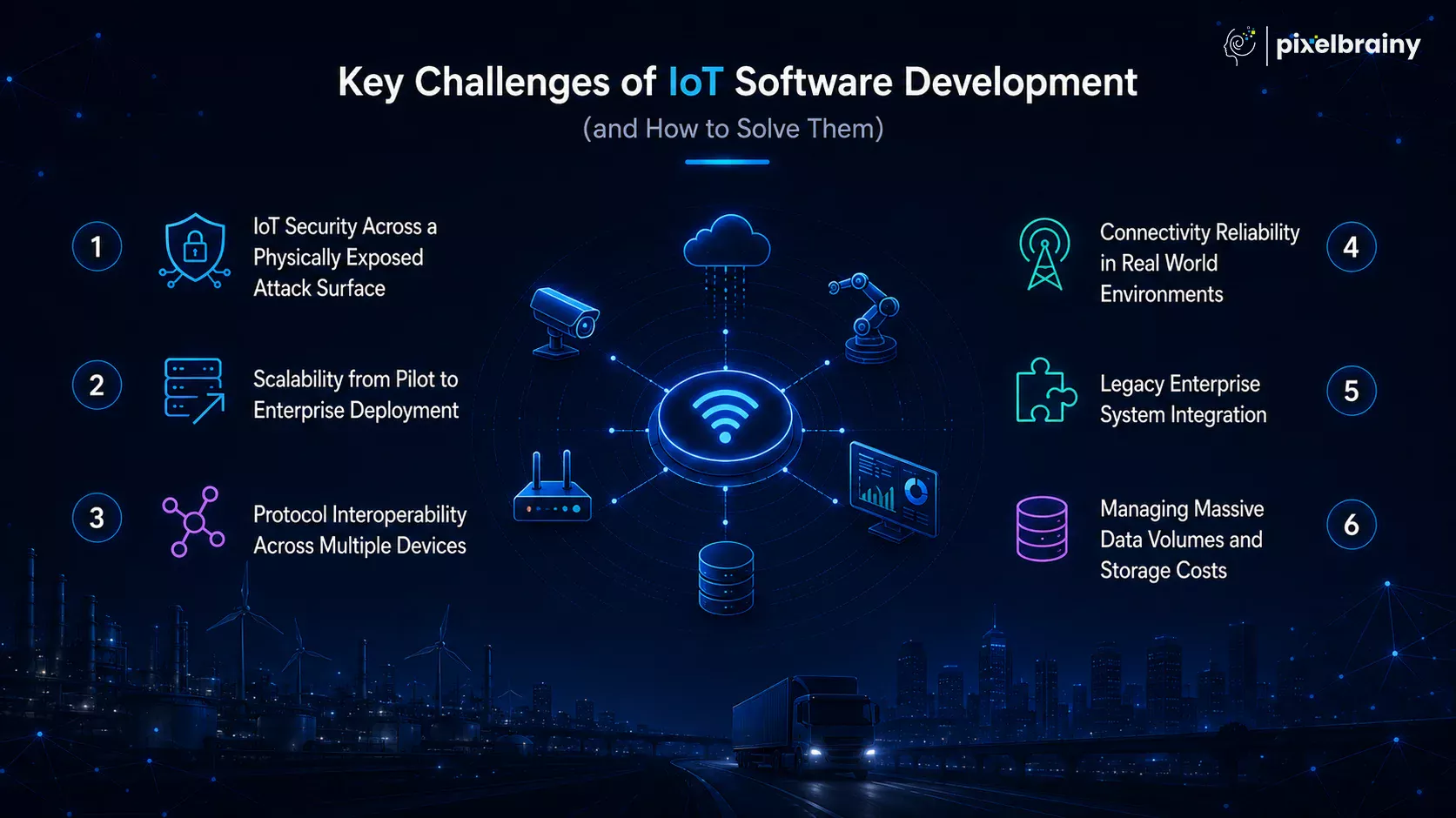
Unlike traditional applications that run within secured environments, IoT devices are often deployed in factories, hospitals, warehouses, farms, vehicles, and public infrastructure where they are physically accessible. These devices can be tampered with, communication can be intercepted, and compromised devices may become entry points into enterprise networks. Security becomes even more challenging because many embedded devices operate with limited processing power and memory.
How to solve it
Implement certificate-based device authentication from the beginning, encrypt communication across every software layer, isolate IoT devices from enterprise IT networks through network segmentation, enable secure boot within device firmware, and include remote device lock, wipe, and firmware update capabilities to minimise security risks.
Many IoT platforms perform well with a few hundred connected devices but struggle when expanded to thousands or millions of devices. Increased telemetry, concurrent connections, and continuous processing often expose architectural limitations that were not visible during pilot deployments. This is one of the most common IoT software development challenges in security and scalability.
How to solve it
Design cloud infrastructure for horizontal scalability from the beginning, implement high throughput message brokers such as Apache Kafka or MQTT brokers, optimise time series databases, and perform load testing using projected production scale before enterprise rollout.
Enterprise IoT ecosystems rarely consist of devices from a single manufacturer. Different sensors and equipment often use different communication protocols and data formats, making unified software development significantly more complex.
How to solve it
Develop a protocol translation layer within the IoT gateway that converts different protocols into a common internal data format before processing. Selecting an IoT platform with native support for multiple communication standards also simplifies future hardware expansion.
IoT deployments frequently operate in remote factories, agricultural fields, offshore locations, or moving vehicles where internet connectivity is inconsistent. Software designed for continuous connectivity can experience data loss, delayed alerts, and unreliable device management.
How to solve it
Implement local data buffering on devices and gateways, synchronise stored data automatically after connectivity is restored, design cloud services to process delayed or out of order messages correctly, and use edge computing for time critical decisions that cannot depend on cloud availability.
Most organisations already use ERP, CRM, MES, SCADA, and maintenance management systems that were never designed to process continuous IoT data. Integrating modern IoT platforms with legacy business software often becomes one of the most time-consuming development tasks.
How to solve it
Build a dedicated middleware layer that translates IoT data into formats understood by existing enterprise systems. Secure APIs, industrial connectors, and OPC UA bridges help connect IoT platforms with legacy applications while keeping both systems loosely coupled for future upgrades.
Large enterprise deployments generate billions of sensor readings every month. Storing every data point indefinitely increases infrastructure costs while reducing query performance and slowing analytics.
How to solve it
Implement tiered storage architecture using time series databases for recent telemetry, cost effective object storage for historical data, and intelligent retention policies that archive or aggregate older information while preserving the data needed for analytics, reporting, and compliance.
| Challenge | Severity | Root Cause | Recommended Solution |
| Security Across Physical Devices | Very High | Devices operate in physically accessible environments with limited computing resources. | Certificate based authentication, encrypted communication, secure boot, network segmentation, remote device management. |
| Scalability from Pilot to Enterprise | High | Software architecture is designed for small deployments instead of enterprise scale. | Horizontal cloud architecture, Apache Kafka or MQTT brokers, scalable databases, production load testing. |
| Protocol Interoperability | High | Devices from multiple manufacturers use different communication standards and data formats. | Gateway based protocol translation and standardised internal data models. |
| Connectivity Reliability | High | Remote deployments experience unstable or intermittent network connectivity. | Local data buffering, edge computing, automatic synchronisation, resilient message processing. |
| Legacy System Integration | Medium to High | Existing ERP, SCADA, MES, and CRM systems lack native IoT capabilities. | Integration middleware, secure APIs, OPC UA connectors, enterprise integration services. |
| Data Volume and Storage Costs | Medium | Continuous high frequency telemetry generates massive amounts of operational data. | Time series databases, tiered storage, intelligent retention policies, data aggregation strategies. |
Addressing these challenges during the planning and architecture stages is the most effective way to develop secure IoT software for enterprise environments that remains scalable, reliable, and future ready as connected ecosystems continue to grow.
Building an enterprise IoT platform requires expertise far beyond traditional software development. While many agencies can build dashboards, mobile applications, or cloud APIs, very few can engineer the complete software ecosystem that powers a production ready IoT platform. From embedded firmware and communication protocols to real time analytics, enterprise integrations, and AI driven automation, every software layer must work together reliably at scale.
If you are evaluating how to choose an IoT software development company, the first question should not be "Who can build the application?" It should be "Who has the technical expertise to build the complete IoT software architecture that will support our business for the next five to ten years?" That is where PixelBrainy stands apart.
As a leading IoT software development company, PixelBrainy develops the entire IoT software stack rather than focusing only on the visible dashboard layer. Our engineers design secure firmware, build gateway software, develop cloud native data processing pipelines, integrate enterprise systems, and create intelligent analytics platforms that transform connected device data into measurable business outcomes.
Unlike conventional software agencies, our engineering approach is built around enterprise IoT architecture.
| Evaluation Factor | Generic Software Development Agency | PixelBrainy |
| IoT Engineering Expertise | Primarily web and mobile application development | End to end IoT software engineering from firmware to cloud analytics |
| Firmware & Embedded Software | Usually outsourced or unavailable | Native embedded software and firmware development for connected devices |
| Communication & Gateway Layer | Limited experience with IoT protocols | MQTT, CoAP, LoRaWAN, BLE, OPC UA, Modbus, and multi protocol gateway development |
| Cloud & Stream Processing | Standard backend applications | Apache Kafka, Apache Flink, event streaming, time series processing, and cloud native IoT platforms |
| Enterprise Device Management | Basic connectivity features | Device provisioning, OTA firmware updates, fleet health monitoring, remote diagnostics, and lifecycle management |
| Enterprise Integrations | REST API integration only | ERP, CRM, SCADA, MES, CMMS, industrial automation systems, and legacy platform integration |
| AIoT & Predictive Intelligence | General AI implementation | Predictive maintenance, anomaly detection, equipment health scoring, and IoT specific machine learning models |
| Security Architecture | Application security only | Device identity management, X.509 certificates, secure boot, encrypted communication, zero trust architecture, and enterprise IoT security |
| Edge Computing | Rarely supported | AWS IoT Greengrass, Azure IoT Edge, hybrid edge cloud deployments, and offline processing |
| Commercial Transparency | High level quotations | Detailed effort estimation, milestone-based delivery, infrastructure planning, and operational cost forecasting |
Many vendors specialise in building dashboards while expecting clients to handle firmware, gateways, cloud infrastructure, or enterprise integrations separately.
PixelBrainy follows a different engineering philosophy.
We develop all five software layers of an enterprise IoT platform:
This unified development approach reduces technical complexity, accelerates delivery, improves software quality, and provides a single point of accountability throughout the project lifecycle.
Successful IoT projects require accurate financial planning as much as technical planning.
Instead of providing broad estimates, PixelBrainy delivers itemised project proposals that clearly separate:
This gives business stakeholders complete visibility into the total cost of ownership before development begins.
Our engineers have experience delivering custom IoT software development for organisations across multiple sectors, including:
Client Success Snapshot:
A manufacturing organisation approached PixelBrainy after experiencing repeated production interruptions caused by unexpected equipment failures across multiple facilities.
Our team developed an enterprise IoT platform that included firmware optimisation, MQTT based communication, edge gateway software, a cloud native event processing pipeline, predictive maintenance models, and ERP integration.
Within six months of deployment, the client achieved:
Client details remain confidential under a non-disclosure agreement.
Whether you are building your first connected product or scaling an enterprise IoT ecosystem, PixelBrainy combines deep technical expertise with practical business understanding to deliver secure, scalable, and future ready IoT software solutions.
Let's build an IoT platform that creates measurable business value. Connect with PixelBrainy today.
Successful IoT software development is not defined by the number of connected devices but by the quality of the software that powers them. Throughout this guide, we explored what it takes to build an IoT software solution, from understanding enterprise use cases and designing scalable architectures to selecting the right technology stack, managing development costs, overcoming technical challenges, and choosing between custom- and ready-made platforms. Each of these decisions directly impacts the security, scalability, and long-term success of your IoT initiative.
Whether you are planning custom IoT software development for a new connected product or modernising existing enterprise operations, building the right software foundation is essential for unlocking the full value of IoT. A well-engineered IoT software platform enables real time monitoring, predictive analytics, intelligent automation, and seamless integration with business systems, helping organisations improve operational efficiency and make faster, data driven decisions.
If you are looking for an experienced IoT software development company to transform your idea into a secure, scalable, and production ready solution, schedule a call with the PixelBrainy team. We would be happy to discuss your requirements, recommend the right development approach, and help you build an IoT platform that delivers measurable business results.
IoT software development is the process of building software that connects physical devices, sensors, and machines with cloud platforms and enterprise applications. It enables businesses to collect, process, analyse, and act on real time data, helping improve operational efficiency, automate workflows, reduce downtime, and make faster data driven decisions across multiple industries.
The development timeline depends on the project's complexity, integrations, and business requirements. A basic IoT platform can take around 8 to 12 weeks, while a production ready custom IoT software development project with firmware, cloud backend, dashboards, and enterprise integrations typically takes 16 to 20 weeks or longer for highly complex deployments.
A modern IoT software solution combines embedded programming languages such as C and C++, backend technologies like Java, Python, or Node.js, communication protocols including MQTT and CoAP, cloud platforms such as AWS IoT Core or Azure IoT, time series databases, AI frameworks, APIs, and real time analytics tools.
The biggest challenge is building a secure and scalable platform that can reliably manage thousands of connected devices while processing continuous streams of real time data. Successful IoT software development also requires strong cybersecurity, protocol interoperability, cloud scalability, enterprise integrations, and efficient device lifecycle management from the beginning.
A ready-made platform is suitable for pilot projects and basic monitoring applications. However, businesses requiring advanced automation, predictive analytics, enterprise integrations, or industry specific workflows benefit more from custom IoT software development, as it offers greater flexibility, scalability, ownership, and long-term business value.
The cost of IoT software development generally ranges from $50,000 to $400,000+, depending on software complexity, connected devices, cloud infrastructure, integrations, security, and advanced features such as AI, edge computing, and predictive analytics. Enterprise projects typically require higher investment due to their larger scale and custom requirements.
When evaluating an IoT software development company, look beyond dashboard development. Choose a partner with expertise in embedded firmware, communication protocols, cloud architecture, real time data processing, enterprise integrations, cybersecurity, and long-term platform support. Proven industry experience and transparent development processes are equally important for a successful IoT implementation.

About The Author
Sagar Bhatnagar
Sagar Sahay Bhatnagar brings over a decade of IT industry experience to his role as Marketing Head at PixelBrainy. He's known for his knack in devising creative marketing strategies that boost brand visibility and market influence. Sagar's strategic thinking, coupled with his innovative vision and focus on results, sets him apart. His track record of successful campaigns proves his ability to utilize digital platforms effectively for impactful marketing efforts. With a genuine passion for both technology and marketing, Sagar continuously pushes PixelBrainy's marketing initiatives to greater success.

Working with the PixelBrainy team has been a highly positive experience. They understand the design requirements and create beautiful UX elements to meet the application needs. The dev team did an excellent job bringing my vision to life. We discussed usability and flow. Sagar worked with his team to design the database and begin coding. Working with Sagar was easy. He has the knowledge to create robust apps, including multi-language support, Google and Apple ID login options, Ad-enabled integrations, Stripe payment processing, and a Web Admin site for maintaining support data. I'm extremely satisfied with the services provided, the quality of the final product, and the professionalism of the entire process. I highly recommend them for Android and iOS Mobile Application Design and Development.

Great experience working with them. Had a lot of feedback and I found that unlike most contractors they were bugging me for updates instead of the other way around. They were extremely time conscience and great at communicating! All work was done extremely high quality and if not on time, early! They were always proactive when it comes to communication and the work is great/above par always. Very flexible and a great team to work with! Goes above and beyond to present us with multiple options and always provides quality. Amazing work per usual with Chitra. If you have UI/UX or branding design needs I recommend you go to them! Will likely work with them in the future as well, definitely recommended!

PixelBrainy is a joy to work with and is a great partner when thinking through branding, logo, and website layout. I appreciate that they spend time going into the "why" behind their decisions to help inform me and others about industry best practices and their expertise.

I hired them to design our software apps. Things I really like about them are excellent communication skills, they answer all project suggestions and collaborate right away, and their input on design and colors is amazing. This project was complex and needed patience and creativity. The team is amazing to do business with. I will be using them long-term. Glad to see there are some good people out there. I was afraid to try and outsource my project to someone but I am glad I met them! I really can't say enough. They went above and beyond on this project. I am very happy with everything they have done to make my business stand out from the competition.

It was great working with PixelBrainy and the team. They were very responsive and really owned the project. We'll definitely work with them again!

I recently worked with the PixelBrainy team on a project and I was blown away by their communication skills. They were prompt, clear, and articulate in all of our interactions. They listened and provided valuable feedback and suggestions to help make the project a success. They also kept me updated throughout the entire process, which made the experience stress-free and enjoyable.

PixelBrainy is very good at what it does. The team also presents themselves very professionally and takes care of their side of things very well. I could fully trust them taking up the design work in a timely and organised manner and their attention to detail saved us lots of effort and time. This particular project was quite intense and the team showed that they function very well under pressure. Very much looking forward to working with her again!

It's always an absolute pleasure working with them. They completed all of my requests quickly and followed every note I had for them to a T, which made our process go smoothly from start to finish. Everything was completed fast and following all of the guidelines. And I would recommend their services to anyone. If you need any design work done in the future, PixelBrainy should be your first call!

They took ownership of our requirements and designed and proposed multiple beautiful variants. The team is self-motivated, requires minimum supervision, committed to see-through designs with quality and delivering them on time. We would definitely love to work with PixelBrainy again when we have any requirements.

PixelBrainy was a big help with our SaaS application. We've been hard at work with a new UI/UX and they provided a lot of help with the designs. If you're looking for assistance with your website, software, or mobile application designs, PixelBrainy and the team is a great recommendation.

PixelBrainy designers are amazing. They are responsive, talented, and always willing to help craft the design until it matches your vision. I would recommend them and plan to continue them for my future projects and more!!!

They were awesome! Did a good job fast, and good communication. Will work with them again. Thank you

Creative, detail-oriented, and talented designers who take direction well and implement changes quickly and accurately. They consistently over-delivered for us.

PixelBrainy team is very talented and creative. Great designers and a pleasure to work with. PixelBrainy is an excellent communicator and I look forward to working with them again.

PixelBrainy has a very talented design team. Their work is excellent and they are very responsive. I enjoy working with them and hope to continue on all of our future projects.


Transform your ideas into reality with us.
Across these industries, each engagement brings unique challenges, from early-stage product development to scaling complex systems, helping us build a practical understanding of real-world product environments.