AI Summary Powered by PixelBrainy
What if your golf club could bring tee-time booking, GPS course navigation, handicap tracking, pro shop access, and member communication into one seamless mobile experience?
For private golf clubs, member expectations are evolving beyond traditional websites, phone-based bookings, and email newsletters. Golfers increasingly value digital convenience that helps them manage every part of their club experience from their smartphones. This makes golf app development a practical opportunity for clubs looking to improve member engagement, simplify operations, and deliver more personalized services.
Consider a private golf club with around 450 members and limited digital infrastructure. Members may want to book tee times without calling the club, check their handicap and playing history, navigate the course using GPS, browse pro shop inventory, receive club updates, and connect with fellow golfers through a single platform. At this stage, the club faces an important decision: should it purchase a white-label golf club management app, or invest in a custom golf application built around its specific requirements?
A custom solution can provide greater control over branding, workflows, integrations, member experiences, and future functionality. It can also incorporate advanced capabilities such as AI-powered recommendations, personalized golf insights, intelligent member support, and automated engagement features as the platform evolves.
For businesses exploring custom golf app development, understanding the difference between ready-made platforms and purpose-built applications is essential before making a long-term investment. The right development approach depends on factors such as membership size, required features, existing systems, budget, scalability, and the level of personalization expected.
This guide explores the key aspects of golf mobile app development, including app types, essential features, development steps, technology stack, advanced technologies, costs, monetization opportunities, challenges, and team requirements. It also provides insights for clubs considering experienced golf app development companies in the USA for a custom solution.
Golf mobile app development refers to the process of designing and building mobile applications that connect golfers, golf clubs, course operators, and related services through a centralized digital platform. These apps can support everyday golfing activities while helping clubs streamline member services and improve engagement.
Depending on the business model and target users, a golf application can include features such as tee-time booking, GPS-based course navigation, digital scorecards, handicap tracking, tournament management, push notifications, member communication, and pro shop integration.
For private golf clubs, a custom golf club management app can also bring operational and member-facing services together in one platform. Club administrators can manage bookings, events, member profiles, communications, and other services, while golfers can access relevant information directly from their smartphones.
More advanced solutions can incorporate AI-powered golf app features, such as personalized training recommendations, performance insights, swing analysis, intelligent virtual assistance, and behavior-based member engagement.
The development approach can range from a relatively focused mobile application to a comprehensive digital ecosystem connected with club management software, payment systems, GPS services, wearables, and other third-party platforms.
Ultimately, custom golf app development enables golf businesses to create a digital experience around their specific members, workflows, branding, and long-term growth objectives.
Fantasy golf apps create a digital layer around the sport by allowing users to build teams, follow player performance, participate in leagues, compete with friends, and receive real-time updates from a single mobile platform. For businesses exploring fantasy golf app development, the opportunity extends beyond basic gameplay. Features such as live scoring, player statistics, personalized recommendations, push notifications, social challenges, and in-app communication can create recurring engagement throughout tournaments and across the golf season.
A real question for a business considering golf mobile app development is: “Can a fantasy golf app generate enough engagement and recurring revenue to justify the investment, and what features will make users return throughout the season?”
Current market indicators point to continued momentum. The global fantasy sports market is estimated at $42.37 billion in 2026 and is projected to reach $80.31 billion by 2031, representing a 13.66% CAGR. Mordor Intelligence also identifies mobile-first adoption and increasingly detailed sports analytics as important market drivers.
Golf itself is experiencing strong participation. The National Golf Foundation reports that 48.1 million Americans participated in golf on-course or off-course in 2025, while more than 500 million rounds have been played at U.S. courses annually during each of the past six years.
For a fantasy golf platform, this creates opportunities to combine live golf data with social engagement, personalized experiences, and intelligent features such as AI-powered player insights or recommendations.
A successful fantasy golf app combines engaging gameplay, reliable live data, intuitive UX, personalization, and a sustainable monetization strategy to create lasting value for both users and the business.
Golf is becoming increasingly connected through mobile technology, giving golf clubs, courses, and players new ways to manage activities, improve performance, and stay engaged. Golf app development can bring bookings, course information, performance data, communication, payments, and member services into a single digital experience.
A practical question for a golf business is: “What measurable benefits can a custom golf app deliver beyond the basic booking and score-tracking features available in existing platforms?”
The answer depends on the app’s target audience and feature set, but a well-designed golf mobile app can create value on both sides of the platform. Golf clubs can streamline operations and strengthen member relationships, while golfers can access personalized tools and course information whenever they need them.
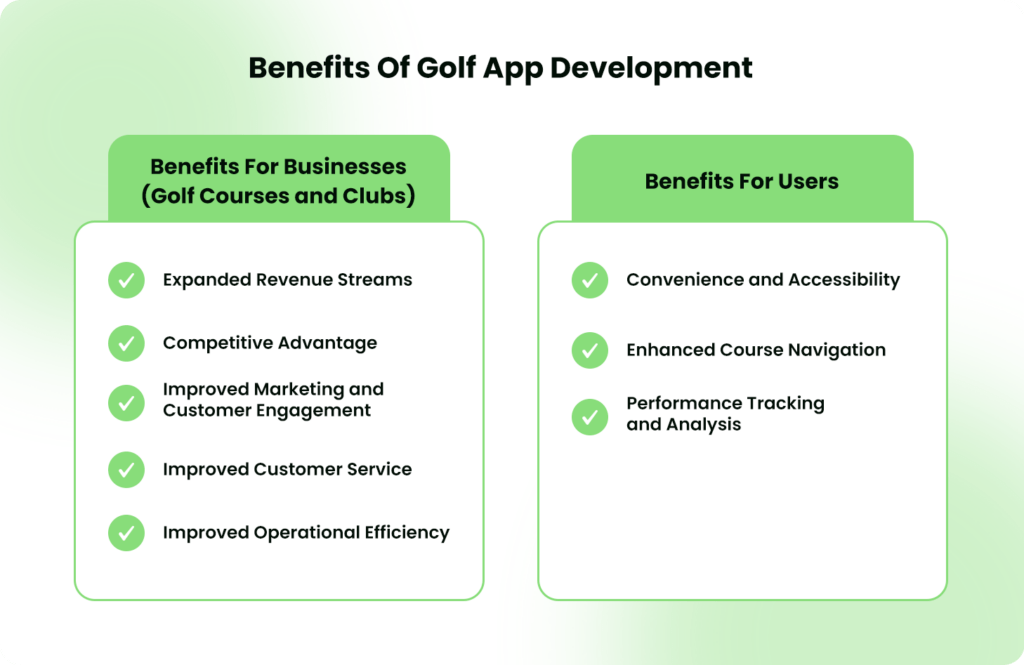
A golf mobile app can create additional opportunities to generate revenue through premium memberships, paid services, in-app purchases, event registrations, pro shop integrations, and other club-specific offerings. Businesses can also use personalized promotions to present relevant services to members and visitors.
A professionally developed golf club management app can differentiate a golf course or private club by offering convenient digital services in one place. Features such as mobile tee-time booking, GPS navigation, digital scorecards, personalized recommendations, and member communication can create a more modern club experience.
Push notifications and in-app communication allow clubs to promote tournaments, events, offers, memberships, and club announcements directly to users. Personalized content can further improve engagement by delivering information based on member interests, activity, and preferences.
A golf application can provide members and players with a direct communication channel for bookings, questions, notifications, and support. AI-powered assistants can also help answer common queries, provide relevant information, and reduce the workload associated with repetitive customer service requests.
A centralized app can simplify tee-time management, event registration, member communication, payments, and other recurring administrative activities. Integrating the app with existing club management systems can further reduce manual processes and give staff better visibility into daily operations.
Golfers can manage their golfing activities directly from their smartphones. They can book or modify tee times, check course information, receive club updates, manage reservations, and access relevant services without relying on separate communication channels.
Modern golf app development can incorporate digital scorecards, performance dashboards, statistics, and AI-powered insights. These capabilities help golfers monitor their progress, identify areas that need improvement, and make training more data-driven over time.
GPS-enabled golf apps can provide interactive course maps, hole layouts, distances, and relevant course information during a round. When combined with accurate location services and user-friendly interfaces, these capabilities can help golfers navigate the course and make more informed club and shot decisions.
A well-planned golf app can connect business efficiency with a more convenient, personalized, and data-driven experience for golfers, creating value for both clubs and their members.

Golf businesses and entrepreneurs can build mobile solutions for very different user needs, from course navigation and score tracking to training, social engagement, gaming, and club management. The right golf mobile app development approach depends on the target audience, business model, core problem, required integrations, and opportunities for future expansion.
A common question for businesses entering this space is: “Which type of golf app should we develop to address a specific golfer need while creating a scalable and commercially viable product?”
For example, a private golf club may prioritize tee-time management and member engagement, while a golf technology startup may focus on GPS tracking, AI-powered coaching, or performance analytics. Understanding these app categories helps define the right feature set, technology requirements, development scope, and user experience before development begins.
Below are 10 golf mobile app ideas and development types, along with their core functionalities and benefits, to help identify opportunities across the modern golfing ecosystem.
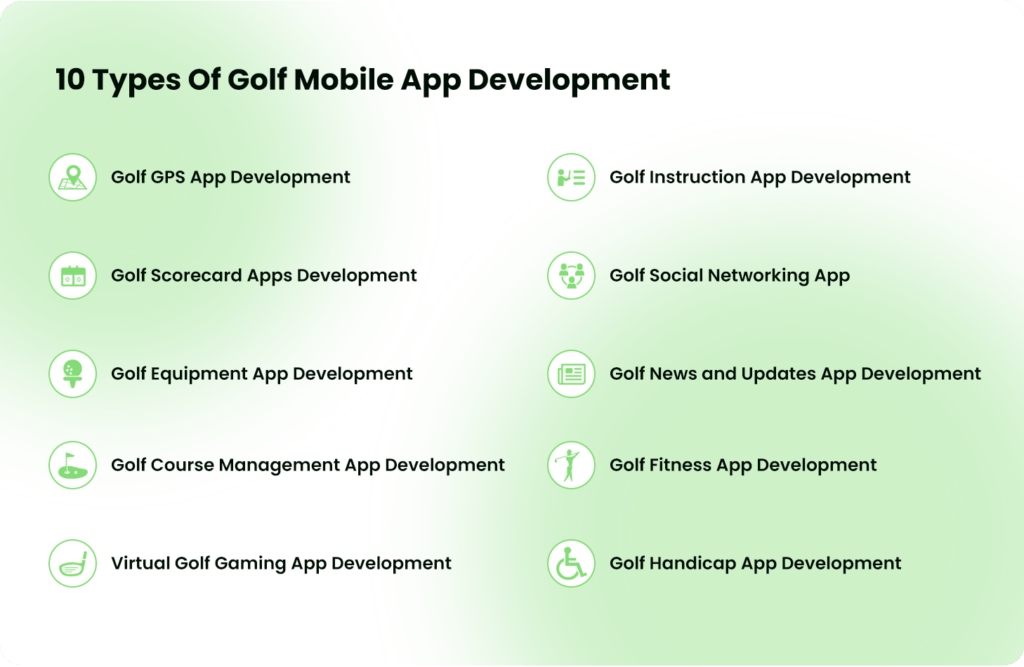
Leveraging the power of GPS technology, the golf GPS app offers hole layouts with hazard markers, real-time yardages to the green, and shot-tracking abilities for analyzing accuracy and distances.
Features:
Benefits:
Are you looking to build a golf GPS app? Contact us today!
The app offers personalized swing analysis and coaching tips via video tutorials, access to advice from golf experts, and practice drills crafted to aim at specific weaknesses.
Features:
Benefits:
Seeking to hire an app development company for golf institution app development? Hire PixelBrainy now!
By providing a digital platform, golf scorecard apps calculate handicaps in real-time, view team and individual statistics, and track scores eliminating the need for paper scorecards.
Features:
Benefits:
You can also develop a golf scorecard app by partnering with PixelBrainy, a leading mobile app development company.
This app seamlessly connects golfers with social networking sites to organize tournaments and matches, find playing partners, create a community around the sport, and share achievements and scores.
Features:
Benefits:
Interested in developing a golf social networking app that can foster a social golfing experience? Let's connect!
The app offers a one-stop shop for everything relevant to golf equipment. Using this app, users can look for detailed product reviews, find recommendations depending on their swing type and skill level, and compare costs from varied retailers. Some applications can integrate with online stores for easy purchasing.
Features:
Benefits:
Want to create a golf equipment app to make effortless choices for equipment? Contact us Now!
The app delivers information about the latest happenings in the golf world to the users' phones. Now, you can stay informed on matches, get insightful golfer interviews, and follow leaderboards and live scoring for your favorite events.
Features:
Benefits:
Build a golf news and updates app, and keep golf fans engaged and updated. Chat with us today!
The app is for golf course management, improving customer engagement, and streamlining operations. It provides features for tee time booking, GPS-based in-course navigation, and course information management.
Features:
Benefits:
If you are looking to build a golf course management app, connect with a mobile app development company now!
The app offers customized workouts crafted to enhance a golfer's flexibility, strength, and power, promoting injury prevention.
Features:
Benefits:
Looking to develop a golf fitness app? Chat with us now!
The virtual golf gaming app simulates the golfing experience on a virtual course, permitting players to practice or compete online in a realistic digital ambiance.
Features:
Benefits:
Need to build a virtual golf gaming app? Hire mobile app developers and empower golfers with instructions from professionals.
Such apps use the USGA Golf Handicap Index system to evaluate and track a golfer's handicap, a measurement of their potential ability. Users input their scores, and the application calculates their handicap depending on a designated formula.
Features:
Benefits:
Are you looking to build a golf handicap app? Connect with us today!
These golf app development types cover a broad range of opportunities, helping businesses build focused digital experiences around golfers, clubs, courses, training, performance, and engagement.
A successful golf app development project needs more than a clean interface and basic score tracking. The feature set should address the needs of golfers, club administrators, course operators, and other stakeholders while creating a smooth digital experience across booking, gameplay, communication, payments, and management.
A practical question for businesses planning golf mobile app development is: “Which features should a golf app include to deliver real value to golfers while also helping clubs streamline operations and increase engagement?”
The answer depends on the app type and target audience, but core capabilities such as GPS course mapping, scorecards, tee-time reservations, handicap tracking, leaderboards, messaging, analytics, booking management, and secure payments can form a strong foundation. More advanced capabilities, including AI-powered swing analysis and personalized recommendations, can be added based on the product's goals and target users.
Below is a stakeholder-focused breakdown of the essential golf app features that can make a mobile golf platform useful, engaging, and operationally effective.
| Feature | Description |
| Scorecard Tracking | Seamlessly record and track your strokes and earned scores, and display stats for every hole. |
| GPS Course Mapping | Check interactive course layouts with hole-by-hole yardages, green layouts, and hazards. |
| Tee Time Reservations | Search for and schedule tee times at their favored courses directly using the app. |
| Leaderboards | Compete with fellow golfers and friends on virtual leaderboards for respective rounds or tournaments. |
| Handicap Tracking | Automatically compute and maintain their official golf handicap depending on their recent scores. |
| Swing Analysis | Upload videos of their swing and get feedback or instruction from AI-enabled tools or professional coaches (potentially a premium feature). |
| Social Sharing | Share the user’s golfing accomplishments ( round highlights, scorecards, and connect with friends on social media. |
| In-App Messaging | Chat with their friends and fellow golfers directly using the app. |
| Equipment Reviews | Read reviews and compare golf equipment options (balls, clubs, apparel) before purchasing. |
| Training Videos | Access instructional/training videos from famed coaches to learn the latest techniques and improve their game. |
| Tournament Registration | Register for upcoming tournaments directly using the app and easily manage their participation details (tee times, team formation, scoring). |
| Weather Forecasts | View real-time weather forecasts and updates specifically for their golfing location. |
| Feature | Description |
| User Management | Easily add, edit, and manage user accounts, including access levels, profile details, and potential moderation functions. |
| Course Management | Add, edit, and seamlessly manage golf course details. This includes location, hole-by-hole yardages, layout, photos, and amenities. |
| Content Management | Create, edit, and publish many types of content within the application, like golf tips, news articles, or tournament announcements. |
| Analytics Dashboard | Track and analyze key application metrics, such as feature usage, user engagement, and booking trends. |
| Push Notifications | Send targeted push notifications to users with promotions, updates, or reminders (e.g., tournament registrations and upcoming tee times). |
| Booking Management | View, manage, and approve tee-time schedules made by users using the app. |
| Payment Gateway Integration | Seamlessly integrate secure payment gateways to ease online transactions using the app (e.g., tee time bookings, tournament fees, equipment purchases). |
| Ad Management (Optional) | Managed in-app advertising campaigns, permitting businesses or brands to target golfers with related ads. |
| Customer Support | Identify user inquiries and troubleshoot the issues reported via the app through a live chat functionality or ticketing system. |
| Reporting Tools | Generate complete reports on varied aspects of the app, like booking statistics, user activity, and revenue metrics. |
| Event Management | Create, handle, and promote golf tournaments or other events using the app, permitting users to register and participate. |
| Security and Access Control | Smoothly implement robust security measures to safeguard financial information, user data, and comprehensive app functionality. Impose access controls to limit unauthorized access to sensitive details and maintain a secure platform. |
Combining golfer-focused functionality with powerful admin capabilities can turn a golf mobile app into a comprehensive platform for improving user engagement, simplifying club operations, and creating scalable digital services.
Advanced technology can take a golf app development project beyond basic scorekeeping, bookings, and course information by creating more interactive, personalized, and data-driven experiences. For businesses planning a feature-rich golf mobile app, the key question is: “Which advanced features can genuinely improve golfer engagement and performance while creating opportunities for differentiation and long-term growth?”
The answer depends on the target audience, business model, technical infrastructure, and development budget. A private club may prioritize AI-powered coaching and smart equipment integration, while a golf technology or gaming platform may benefit more from AR, VR, live streaming, and gamification.
Advanced capabilities can also be introduced progressively rather than being included in the initial MVP. This allows businesses to validate core functionality first and then expand the platform with technologies that provide measurable value.
Below is a breakdown of advanced golf app features that can enhance user experiences and create additional opportunities for innovation.
| Features | Description |
| Augmented Reality (AR) for Course Exploration | Use AR overlays on your smartphone camera to visualize distances, course layouts, and hazards in real-time. |
| Virtual Reality (VR) for Swing Analysis | Scan your swing technique in a VR environment, permitting a more detailed segregation of mechanics and potential issues. |
| AI-powered Coaching Tips | Utilize AI algorithms to analyze your swing data (possibly using video uploads) and offer personalized coaching tips for enhancement. |
| Drone Footage Integration | Include drone footage to provide interactive 360-degree views of golf courses, displaying hole layouts and nearby landscapes. |
| Live Streaming of Tournaments | Stream live amateur or professional tournaments within the app, permitting users to follow the action from anywhere. |
| Personalized Training Plans | Build customized training plans depending on individual goals, skill levels, and performance data accumulated through the app. |
| Gamification Elements | Integrate game mechanics, such as badges, points, and leaderboards, to promote healthy competition, motivate users, and make practicing more engaging. |
| Customizable Player Profiles | Permit users to personalize their profiles with statistics, avatars, and achievements, instilling a sense of identity within the app. |
| Blockchain for Secure Transactions | Use blockchain technology to ensure transparent and secure online transactions within the app (e.g., in-app purchases and payments). |
| Predictive Analytics for Game Improvement | Use advanced analytics to anticipate potential outcomes and recommend strategic adjustments depending on user data and course details. |
| Subscription-Based Premium Content | Provide exclusive features or content (e.g., pro coaching sessions, in-depth training videos) utilizing a subscription model. |
| Integration with Smart Golf Equipment | Connect with smart golf equipment (clubs, balls) to analyze performance data, track detailed swing metrics, and personalize practice sessions. |
These advanced golf app features can help transform a standard mobile application into a more immersive, intelligent, and personalized golfing platform while supporting stronger engagement and future scalability.
How can a golf business build a mobile app that combines GPS course mapping, shot tracking, tee-time booking, performance insights, and a smooth user experience without creating unnecessary development complexity? A successful golf app development process starts with defining the right product scope and continues through research, design, development, testing, launch, and ongoing optimization.
Whether you are building a golf app for a private club, creating a golf game improvement app, or planning a consumer platform with advanced features, each stage should connect directly to user needs and business objectives. The development approach may also differ depending on whether you want to create a golf app for iOS and Android, integrate AI capabilities, connect wearables, or develop a platform that supports betting and friendly wager features for golfers where legally permitted.
For businesses investing in the development of golf mobile application, the objective should be to create a scalable foundation that can accommodate future features without requiring major architectural changes. An MVP can help validate the core concept first, while advanced capabilities can be introduced as adoption grows.
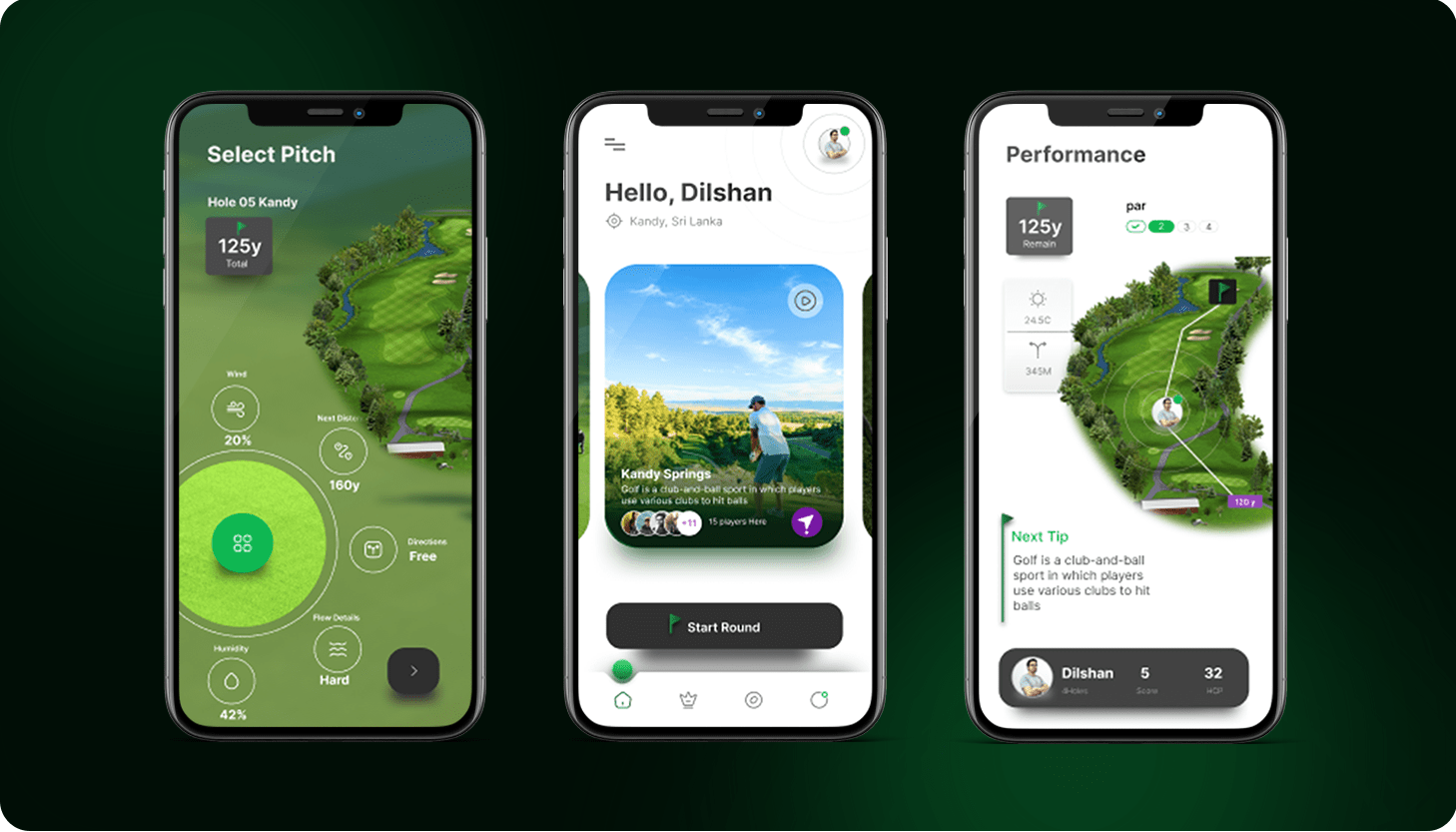
Start with detailed market and user research to identify your target golfers, business requirements, competitors, and opportunities for differentiation. Analyze existing golf applications to identify useful features, user pain points, and areas where your product can deliver greater value.
This planning stage creates a clear foundation for golf mobile app development and helps prevent unnecessary scope expansion later.
The design stage converts your product requirements into intuitive user journeys, wireframes, prototypes, and final interfaces. Golfers often use apps while moving around a course, so navigation, readability, responsiveness, and accessibility should receive particular attention.
Working with a specialized UI/UX design company can help create an interface that balances visual appeal with practical on-course usability.
This stage transforms the approved designs and technical specifications into a functional golf application. The development team establishes the front-end experience, backend architecture, APIs, databases, authentication, and integrations required for the platform.
For products that require intelligent capabilities, AI integration can be introduced for features such as swing analysis, personalized training recommendations, performance insights, or intelligent golf assistance.
If the product needs early market validation, MVP development can help launch the core experience before expanding into more advanced functionality.
Also Read: Top 10 AI MVP Development Companies in USA
Thorough testing is essential before releasing the application to golfers. Testing should cover both technical functionality and real-world usability across supported devices, operating systems, network conditions, and locations.
Testing helps ensure that the development of golf mobile application results in a dependable experience that users can rely on during actual rounds.
Once testing is complete, prepare the application for deployment and build awareness among your target audience. App-store optimization, launch campaigns, partnerships, and community engagement can all contribute to early adoption.
For larger products, collaborating with top product development companies can help coordinate product strategy, engineering, launch preparation, and ongoing optimization.
Golf app development continues after the initial launch. Regular maintenance keeps the platform secure, compatible, and responsive while allowing the product to evolve with user expectations and market opportunities.
A structured maintenance strategy is particularly important when developing a scalable golf app, as growing users, integrations, and data requirements can increase infrastructure and operational complexity.
Following these golf app development steps provides a structured path from product concept to launch, helping businesses build a scalable, user-focused golf application that can evolve with golfer needs and future technology.

Investing in golf mobile app development can create new opportunities for golf clubs, course operators, startups, and technology businesses, but it also comes with financial, technical, and operational considerations. A well-planned app can simplify golfer services, strengthen engagement, and introduce new revenue channels, while factors such as development costs, competition, maintenance, and data security can affect long-term success.
A practical question for businesses is: “Will building a custom golf app deliver enough value to justify the development and ongoing maintenance investment compared with using an existing golf platform?”
The answer depends on the target audience, product scope, business objectives, available resources, and level of differentiation required. Reviewing the advantages and potential challenges before development can help establish realistic expectations, prioritize resources, and build a sustainable product strategy.
Apps ease golfers by streamlining tee time booking, tracking scores, and accessing course details on the go, everything from their smartphones. This frees them from website navigation or phone calls.
The golf fantasy apps provide real-time updates to users keeping them informed with tournament schedules, live leaderboards, and course information. This builds a robust connection with the huge golfing world.
Using the apps, golfers can access useful features, such as practice session logs, swing analysis tools, and personalized enhancement tips that lead to improved golfing experiences.
Providing access to premium features, targeted advertising, and online merchandise sales through in-app purchases, golf mobile applications emerge as a financially viable factor.
Social features, such as organizing tournaments, connecting with friends, and sharing scores can instill a sense of community and make users engaged with the app.
Now, move on to the disadvantages of golf app development.
Developing and maintaining a best-quality app demands notable investment in design, development, and consistent updates.
This may surface as a blockage for entry, specifically startups and small businesses.
Apps seek regular updates to identify errors, incorporate new features, and maintain compatibility with the operating systems and latest devices. This needs resources and ongoing technical proficiency.
The golf apps have already stepped into the market, thus a new app should offer a robust value proposition, unique features, and effective promotion to stay ahead of the curve.
User data security is the priority and for that robust measures should be considered to safeguard user information, like location data, scores, and payment details, from misuse or breaches.
Even your best app can be hit by negative feedback. The team of developers must be all set to locate user concerns, fix glitches promptly, and constantly enhance the app per the user input.
Weighing these advantages and challenges before starting golf app development can help businesses determine whether a custom solution aligns with their goals, resources, and long-term growth strategy.
The cost of golf mobile app development would be challenging to reveal as it demands the complete project details you want to build, like the features you want to embrace, the app’s complexity, the developers’ location you hire, and a lot more.
The average cost to build a golf app starts can range from $30,000 to $300,000 or more, depending on various factors affecting the price.
Factors affecting the app development cost:
As the app's complexity increases the cost also elevates. You can start with a simple app development to stick to your budget.
The increasing number of features will boost the cost. Beginning with a smaller number of features will cost you less. Further, with the app's growth, you can add more.
The cost of building a golf app for Android and iOS may be higher. Choose to develop for one platform, later you can build for another also.
Custom app design and the number of screens will decide the app development cost. So, choose accordingly aiming for your budget.
So, while you plan to make a golf app for your business consider these factors to avoid going out of your budget later.
Below is the table showcasing the latest tools and tech stack you need to develop a golf mobile app. You can refer to this table based on your project details.
| Development Stage | Tools & Technologies |
| App Planning & Design | Figma, Adobe XD, Sketch |
| Front-End Development | React Native, Flutter |
| Front-End Development | Kotlin (Android), Swift (iOS) |
| Back-End Development | Node.js, Java, Python |
| Database | MySQL, MongoDB |
| GPS Integration | Apple Core Location, Google Maps Platform, |
| Maps & Navigation | Google Maps, Mapbox |
| Analytics | Google Analytics, Firebase Analytics |
| Push Notifications | Firebase Cloud Messaging (FCM), Apple Push Notification service (APNS) |
The table we created here offers a general overview displaying the specific tools and technologies used that may vary depending on the app's features, targeted platforms, and complexity.
Advanced technologies can turn a conventional golf application into a more intelligent, immersive, and connected digital experience. For businesses investing in golf mobile app development, technologies such as AI, AR, VR, and IoT can support personalized coaching, interactive course experiences, automated performance tracking, and real-time insights.
A practical question to consider is: “Which advanced technologies can add meaningful value to a golf app without unnecessarily increasing development complexity and cost?” The answer depends on the target users, app type, available data, infrastructure, and long-term product roadmap. Businesses can introduce these capabilities in phases, beginning with the technologies that directly support their core user needs.
VR integration can craft immersive practice environments, permitting golfers to visualize hole layouts, practice their swing mechanics, and virtually walk courses in a realistic setting. Golfers lacking access to physical courses or looking to practice specific scenarios will find this app useful.
In a golf mobile app, AR can exhibit yardages, shot overlays, and hazard markers, directly onto the golfer's view of the course, offering strategic insights and real-time data during gameplay.
AI can support personalized golf experiences by analyzing swing videos, performance statistics, playing patterns, and other available data. AI development can enable features such as automated swing analysis, personalized training recommendations, performance insights, and adaptive practice programs.
Think of smart golf clubs or wearables holding the caliber to track swing data and offer insights directly within the app. IoT integration in golf apps can provide for real-time swing analysis, monitor club performance, and automate shot tracking, easing golfers to improve their game.
Tip*: If you have a limited budget, you can skip integrating these features initially, later with your evolving app, you can do this and be a leader in the landscape of golf app development.
Therefore, integrating these technologies selectively and in phases can help businesses create a more innovative golf application while keeping development aligned with user value, technical feasibility, and long-term product goals.
Building a successful golf mobile app requires a multidisciplinary team that can handle product planning, design, engineering, data, and quality assurance throughout the development lifecycle. The team structure may vary based on the app’s complexity, platform requirements, integrations, and advanced capabilities such as GPS, AI, wearables, or real-time data.
A practical question for businesses is: “What development team do we need to build, launch, and maintain a scalable golf app without creating unnecessary hiring or operational costs?”
For a basic golf application, a lean team may be sufficient, while feature-rich platforms involving course management, GPS tracking, AI-powered coaching, payments, and third-party integrations may require additional specialists. Defining responsibilities clearly also helps maintain development quality, communication, timelines, and budget control.
Below is a core team structure that can support the development of a golf mobile application:
The team member leads the comprehensive app development process and ensures the tasks are on the expected track, communication goes flawlessly, and the project stays within the timeline and budget.
The creative push of an app is the look and feel. The designers craft a user-friendly and intuitive app interface that's visually aesthetic and easy to navigate for golfers.
The members give life to the app design by translating the UI mockups into suitable functional code, creating the user-facing parameters of the app with which golfers interact using their phones.
This is the wizard behind the scenes. The team members build the app's server-side logic, managing data storage, processing the app, and ensuring seamless communication between the application and external services.
They are like the app's watchdog. They dive deeper to test every app's feature and functionality to locate and fix bugs (if any) before rolling out the app for golfers and aim to provide an error-free and smooth experience.
An optional team member and database admin manages the app's database and leads to efficient data storage, security, and retrieval. You can hire them to handle huge data volumes or complex data interactions.
A well-balanced golf app development team brings together the right combination of product, design, engineering, and quality expertise to deliver a reliable application while keeping development aligned with the project’s scope and business goals.
Building a golf mobile application involves more than developing attractive features. Businesses must also account for data reliability, usability, technical performance, integrations, and user privacy throughout the development lifecycle. These factors can directly influence how golfers perceive the app and whether they continue using it after the initial download.
A practical question for businesses planning golf app development is: “What challenges could affect the reliability, performance, and adoption of our golf app, and how can we address them before they become costly problems?”
Identifying these challenges early allows product teams to establish the right technical architecture, testing strategy, security controls, and user experience standards before launch. This becomes especially important for apps that depend on real-time GPS data, third-party APIs, course information, location services, or large numbers of concurrent users.
Let’s explore the key challenges involved in building a golf app and practical solutions for addressing them.
Challenge: Ensuring real-time updates, accurate course data, and flawless integration with 3rd-party APIs (weather services or GPS) is important. Inaccurate data may annoy users and hamper the app’s functionality.
Solution: Connect with a reliable golf course owner and data provider to maintain accurate course details. Implement a strong testing process to ensure smooth API integration and data accuracy across every feature.
Challenge: Crafting a user-friendly and intuitive interface that can offer golfers every skill level is essential. A simple design can make the app abundant and satisfy users.
Solution: Research deeply to know your users and perform usability testing throughout the app design process. Prioritize clear navigation, a clean interface, and features that can make the app easy to use and understand.
Challenge: The app should handle different user loads and function smoothly specifically during peak times or for users using older versions. An unresponsive or slow app can affect user experience.
Solution: Opt for an apt tech stack holding the caliber to handle the expected user volume. Implement app performance optimization techniques and perform testing to ensure effective app scalability.
Challenge: App owners should be paramount in safeguarding user data, like location details, scores, and more. Security breaches can spoil user trust and result in legal fallout.
Solution: Implement security measures, such as user authentication and encryption. Clearly convey your privacy policy and stick to data security rules and regulations. Update your app regularly to locate security vulnerabilities, if any.
Addressing these challenges early can help businesses build a golf app that delivers reliable data, smooth performance, intuitive usability, and stronger security while remaining prepared for future growth.
Launching a golf mobile app is only the beginning. To turn the product into a sustainable business, the monetization strategy should complement the app’s audience, feature set, and overall user experience. Whether the application targets individual golfers, private clubs, golf courses, or a broader golf community, the right revenue model can create recurring income while continuing to deliver meaningful value to users.
A practical question for businesses is: “Which monetization model can generate sustainable revenue from a golf app without creating friction for golfers or reducing long-term user engagement?”
The answer may involve one revenue stream or a combination of several models. A golf application can monetize premium functionality, subscriptions, digital content, advertising, partnerships, transactions, and other relevant services. The most suitable approach depends on factors such as user demographics, app category, engagement levels, purchasing behavior, and the services offered through the platform.
Below are the key strategies businesses can consider to monetize their golf mobile app development investment:
Choose to offer users a free, basic app version incorporating core functionalities, such as course details and score tracking information.
Later, you can provide some premium features, like personalized gaming tips, stat tracking, or special course discounts through in-app purchases.
So forth, users can try your app at least once.
You can choose to offer subscription plans with varied benefits. A basic plan can give users access to premium features, while a pro may hold exclusive video lessons or live tournament tracking. This model leads to recurring revenues and increasing user loyalty.
Hire mobile app developers with a track record of serving golf-relevant brands or services to showcase targeted ads within the mobile app. This can be a better way to unlock revenue streams, but ensure the advertisements suit your user base best and don’t hit their experience.
Sell easily downloadable content, such as customized scorecard templates, virtual golf equipment, or instructional video stack for a personalized avatar within the golf mobile app.
This can be useful for golfers seeking a more customized experience and extra ways to enhance their game.
Collaborate with golf equipment companies, course, and apparel brands for exclusive in-app deals or sponsored content. This can offer users valuable promotions or discounts generating increased revenue.
Partner with companies that align with your target audience for a mutually profitable bond.
If applicable, you can change an amount from users for each successful transaction if your app facilitates reserving lessons, buying merchandise, or booking tee times.
This can be a better option if your app links users with any golf-relevant services.
A well-planned golf app monetization strategy should balance revenue generation with user value, making premium services and commercial opportunities feel relevant rather than disruptive to the golfing experience.
From the above considerations, it is now important to identify a development partner that can translate your golf product idea into a scalable digital solution. PixelBrainy is a leading golf app development company helping businesses create intelligent, user-focused golf applications with modern technologies, including AI.
A real-world question businesses often ask is: “Which development partner can help us build a golf app that combines core golfing features with AI capabilities while remaining scalable, secure, and aligned with our business goals?”
PixelBrainy approaches each project around the product’s target users, business objectives, technical requirements, and future roadmap. Our team can build golf app solutions ranging from GPS and score tracking platforms to golf club management, training, social, and performance-focused applications.
For a confidential client, PixelBrainy developed a golf-focused digital solution incorporating AI-powered personalization and performance insights. The platform was designed to analyze user activity and provide relevant recommendations while supporting a smooth mobile experience. Due to client confidentiality, specific business and product details cannot be disclosed.
This project reflects our approach to golf app development integrating AI, where intelligent capabilities are introduced around genuine user needs rather than added simply as standalone features.
With our golf app development services, businesses can move from an initial concept to a production-ready product supported by a team experienced in AI, mobile technologies, integrations, and scalable product architecture.
Ready to discuss your golf app idea? Connect with PixelBrainy today.
The golf industry is embracing digital experiences that make it easier for players to engage with the sport, improve their performance, connect with other golfers, and access services from anywhere. A thoughtfully planned golf mobile app can bring these experiences together through features such as GPS navigation, score tracking, tee-time booking, social interaction, training tools, and personalized insights.
For businesses, golf app development can also create opportunities to strengthen customer engagement, streamline operations, introduce new revenue channels, and build a differentiated digital presence. The right technology, feature strategy, user experience, and scalable architecture are essential to achieving these outcomes.
At PixelBrainy, we help businesses turn golf app concepts into feature-rich, scalable, and user-focused digital products. From product planning and UI/UX design to development, AI integration, testing, deployment, and ongoing support, our team can support the complete product journey.
Ready to turn your golf app idea into a market-ready product? Book an appointment with PixelBrainy today.
The cost to develop a golf app typically ranges from $30,000 to $300,000. The exact price depends on factors such as app complexity, features, and developer rates. Advanced features or customization can push the cost beyond this range.
Building a golf app typically takes 20-24 weeks. The timeline depends on factors such as app complexity, features, and development team size. Custom features or extensive testing may extend this duration.
Compatibility relies on the app and the specific wearables. Various apps integrate with wearables leveraging the power of IoT technology, and providing features, such as automatic shot tracking or swing data tracking.
Such apps use GPS technology and mapping APIs to bestow users with real-time location data, interactive course layouts, and yardages. They usually include a fusion of front-end development for the UI, back-end development for data processing, and seamless integration with GPS services. You can connect with PixelBrainy and start your golf GPS app development project now!
Contact PixelBrainy to discuss your vision today! Our team of experts will access your requirements and offer a customized plan for building your golf mobile app.

About The Author
Sagar Bhatnagar
Sagar Sahay Bhatnagar brings over a decade of IT industry experience to his role as Marketing Head at PixelBrainy. He's known for his knack in devising creative marketing strategies that boost brand visibility and market influence. Sagar's strategic thinking, coupled with his innovative vision and focus on results, sets him apart. His track record of successful campaigns proves his ability to utilize digital platforms effectively for impactful marketing efforts. With a genuine passion for both technology and marketing, Sagar continuously pushes PixelBrainy's marketing initiatives to greater success.

Working with the PixelBrainy team has been a highly positive experience. They understand the design requirements and create beautiful UX elements to meet the application needs. The dev team did an excellent job bringing my vision to life. We discussed usability and flow. Sagar worked with his team to design the database and begin coding. Working with Sagar was easy. He has the knowledge to create robust apps, including multi-language support, Google and Apple ID login options, Ad-enabled integrations, Stripe payment processing, and a Web Admin site for maintaining support data. I'm extremely satisfied with the services provided, the quality of the final product, and the professionalism of the entire process. I highly recommend them for Android and iOS Mobile Application Design and Development.

Great experience working with them. Had a lot of feedback and I found that unlike most contractors they were bugging me for updates instead of the other way around. They were extremely time conscience and great at communicating! All work was done extremely high quality and if not on time, early! They were always proactive when it comes to communication and the work is great/above par always. Very flexible and a great team to work with! Goes above and beyond to present us with multiple options and always provides quality. Amazing work per usual with Chitra. If you have UI/UX or branding design needs I recommend you go to them! Will likely work with them in the future as well, definitely recommended!

PixelBrainy is a joy to work with and is a great partner when thinking through branding, logo, and website layout. I appreciate that they spend time going into the "why" behind their decisions to help inform me and others about industry best practices and their expertise.

I hired them to design our software apps. Things I really like about them are excellent communication skills, they answer all project suggestions and collaborate right away, and their input on design and colors is amazing. This project was complex and needed patience and creativity. The team is amazing to do business with. I will be using them long-term. Glad to see there are some good people out there. I was afraid to try and outsource my project to someone but I am glad I met them! I really can't say enough. They went above and beyond on this project. I am very happy with everything they have done to make my business stand out from the competition.

It was great working with PixelBrainy and the team. They were very responsive and really owned the project. We'll definitely work with them again!

I recently worked with the PixelBrainy team on a project and I was blown away by their communication skills. They were prompt, clear, and articulate in all of our interactions. They listened and provided valuable feedback and suggestions to help make the project a success. They also kept me updated throughout the entire process, which made the experience stress-free and enjoyable.

PixelBrainy is very good at what it does. The team also presents themselves very professionally and takes care of their side of things very well. I could fully trust them taking up the design work in a timely and organised manner and their attention to detail saved us lots of effort and time. This particular project was quite intense and the team showed that they function very well under pressure. Very much looking forward to working with her again!

It's always an absolute pleasure working with them. They completed all of my requests quickly and followed every note I had for them to a T, which made our process go smoothly from start to finish. Everything was completed fast and following all of the guidelines. And I would recommend their services to anyone. If you need any design work done in the future, PixelBrainy should be your first call!

They took ownership of our requirements and designed and proposed multiple beautiful variants. The team is self-motivated, requires minimum supervision, committed to see-through designs with quality and delivering them on time. We would definitely love to work with PixelBrainy again when we have any requirements.

PixelBrainy was a big help with our SaaS application. We've been hard at work with a new UI/UX and they provided a lot of help with the designs. If you're looking for assistance with your website, software, or mobile application designs, PixelBrainy and the team is a great recommendation.

PixelBrainy designers are amazing. They are responsive, talented, and always willing to help craft the design until it matches your vision. I would recommend them and plan to continue them for my future projects and more!!!

They were awesome! Did a good job fast, and good communication. Will work with them again. Thank you

Creative, detail-oriented, and talented designers who take direction well and implement changes quickly and accurately. They consistently over-delivered for us.

PixelBrainy team is very talented and creative. Great designers and a pleasure to work with. PixelBrainy is an excellent communicator and I look forward to working with them again.

PixelBrainy has a very talented design team. Their work is excellent and they are very responsive. I enjoy working with them and hope to continue on all of our future projects.


Transform your ideas into reality with us.
Across these industries, each engagement brings unique challenges, from early-stage product development to scaling complex systems, helping us build a practical understanding of real-world product environments.