AI Summary Powered by PixelBrainy
Why does one IoT software development company estimate your project at $50,000 while another quotes more than $400,000 for what appears to be the same solution?
If you've been researching the IoT software development cost, you've probably discovered that there is no shortage of conflicting estimates. One vendor promises to deliver your platform for under $75,000, while another insists the same project requires a budget exceeding $400,000. For business leaders planning their first connected product or enterprise IoT platform, these inconsistent estimates make it difficult to determine what a realistic investment actually looks like.
This uncertainty is especially common among manufacturers, healthcare providers, logistics companies, and enterprises adopting connected technologies for the first time. Consider this real-world scenario:
"We are a manufacturing company planning our first IoT software initiative and we have been trying to get a realistic cost estimate for six weeks. Every agency we speak to either gives us a vague range or a quote so high it seems designed for a Fortune 500 company rather than a mid-size manufacturer. We are looking for a transparent breakdown of what IoT software development actually costs so we can build a credible business case before our board meeting next month."
The reality is that how much does IoT software development cost depends on six major variables, and the difference between a $50,000 pilot and a $400,000+ enterprise platform is completely justified when those variables are understood. Unlike traditional business applications, the cost to build IoT software solution includes five interconnected technical layers, including device firmware, communication protocols, edge computing, cloud infrastructure, analytics, and user applications. Each layer contributes to both the initial development investment and the long-term operational cost.
In this guide, we'll provide a transparent IoT software development cost breakdown, explain the custom IoT software development cost for different project sizes, and reveal an average cost to make an IoT software based on real engineering requirements rather than generic pricing ranges. By the end of this guide, you'll know exactly where your project fits within the $50K to $400K+ investment range and, more importantly, understand why it belongs there.
Building an IoT software platform involves far more than connecting devices to the cloud. A production ready IoT solution combines device firmware, communication protocols, edge computing, cloud infrastructure, real time analytics, AI powered automation, enterprise integrations, and ongoing device management. Each of these technical layers contributes to the overall IoT software development cost, making budgeting one of the most important decisions before development begins.
Many businesses underestimate the financial planning required because they initially focus only on software development. However, the cost to build IoT software solution depends on multiple technical and operational components that continue long after the platform goes live. Creating a realistic budget early helps businesses prioritise investments, minimise project risks, and avoid unexpected expenses during development.
A common business question at this stage is:
"Our leadership team has approved an initial IoT budget, but every department keeps requesting additional features. Operations want predictive maintenance, IT wants enterprise integrations, finance wants real time reporting, and management wants AI dashboards. How do we determine which features belong in Phase 1 without exceeding our budget or delaying the launch?"
This is exactly why budgeting should begin before architecture decisions, feature planning, and development activities start. A structured financial plan allows organisations to estimate how much does IoT software development cost, define realistic project milestones, and build a scalable platform without unnecessary financial surprises.
Not every feature needs to be included in the first release of your IoT platform. Successful organisations focus on launching a Minimum Viable Product (MVP) that delivers immediate business value before expanding into more advanced capabilities.
A typical IoT MVP usually includes:
Once the platform has been validated, additional capabilities can be introduced, including predictive maintenance, digital twins, edge analytics, OTA firmware updates, AI powered automation, and enterprise system integrations.
Prioritising features in phases helps reduce the cost to build IoT software solution while allowing businesses to achieve faster deployment and quicker returns on investment.
Whether presenting to executives, investors, or board members, a detailed financial plan demonstrates that the project has been carefully evaluated rather than estimated with broad assumptions.
Instead of presenting one overall figure, organisations should clearly explain the budget allocated to:
A transparent IoT software development cost breakdown builds confidence among decision makers and makes funding discussions significantly more productive.
One of the biggest reasons IoT projects exceed their planned budgets is uncontrolled feature growth. Many projects begin with simple device monitoring but gradually expand to include AI driven analytics, predictive maintenance, digital twins, mobile applications, remote firmware management, and enterprise integrations.
While these features provide substantial business value, they also increase the overall custom IoT software development cost.
Establishing a defined budget from the beginning allows stakeholders to evaluate every additional feature based on business value, technical complexity, and expected return on investment before expanding the project scope.
Technology selection has a direct impact on both development expenses and future operating costs. Making architectural decisions early helps organisations avoid expensive redesigns later in the project lifecycle.
Key technology decisions typically include:
Making these decisions during the planning stage leads to a more accurate estimate of the IoT software development cost while ensuring the platform remains scalable as connected device numbers grow.
The most successful IoT platforms are developed in multiple stages instead of attempting to launch every advanced capability at once. A phased roadmap enables organisations to validate business outcomes while controlling costs and reducing implementation risks.
A practical roadmap may include:
Phase 1
Phase 2
Phase 3
This phased strategy provides a practical IoT software development cost breakdown, helps businesses estimate an average cost to make an IoT software, and ensures investments are aligned with measurable business objectives instead of unnecessary feature expansion.
That’s why budgeting before development provides a clear financial roadmap, improves decision making, reduces project risks, and helps organisations understand the true IoT software development cost before writing a single line of code. More importantly, it enables businesses to invest strategically, launch faster, and scale their IoT ecosystem with confidence as operational needs evolve.
If you're wondering how much does IoT software development cost in 2026, the short answer is $50,000 to $400,000+. However, there is no fixed price because every IoT project differs in architecture, device complexity, communication protocols, cloud infrastructure, security requirements, AI capabilities, and enterprise integrations. Whether you're building a basic monitoring platform or a large scale Industrial IoT ecosystem, the final IoT software development cost depends on the scope of your project and the business outcomes you want to achieve.
Unlike traditional software, the cost to build IoT software solution includes multiple engineering layers such as embedded firmware, device connectivity, edge computing, cloud processing, analytics, dashboards, and long-term device management. As additional capabilities are introduced, the development effort, infrastructure requirements, and operational costs increase accordingly.
A common business question at this stage is:
"We're planning to connect nearly 500 production machines across three manufacturing facilities. Initially, we only needed live equipment monitoring and maintenance alerts, but now we're considering predictive maintenance, digital twins, mobile applications, ERP integration, and AI powered production analytics. Our budget is around $150,000. Can we build a production ready IoT platform within this budget, and which features should we prioritise first?"
The answer depends on your priorities. A budget between $120,000 and $180,000 is generally sufficient for developing a scalable mid-level IoT platform that includes secure device connectivity, cloud infrastructure, dashboards, analytics, mobile access, and selected AI powered capabilities. Businesses can further optimise the custom IoT software development cost by adopting an MVP first strategy, leveraging managed cloud services, and integrating with proven IoT platforms instead of building every component from scratch.
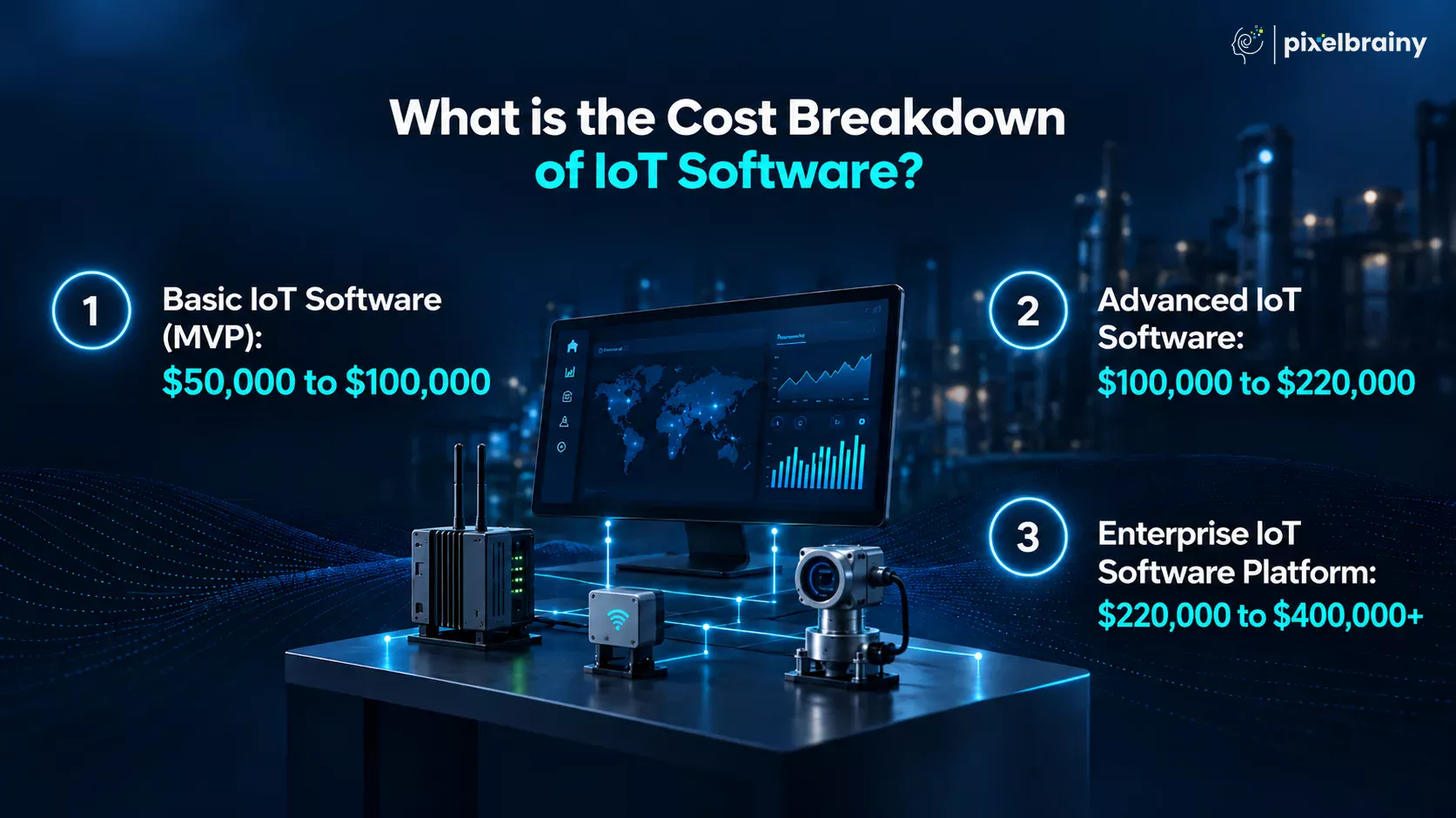
| Development Tier | Estimated Cost | Timeline | What's Included |
| Basic IoT Software (MVP) | $50,000 to $100,000 | 8 to 10 Weeks | Device registration, MQTT based connectivity, sensor monitoring, cloud dashboard, user authentication, basic alerts, reporting, admin panel, and essential security features. |
| Advanced IoT Software | $100,000 to $220,000 | 10 to 14 Weeks | Everything in the MVP plus edge computing, OTA firmware updates, mobile applications, predictive alerts, role-based access, ERP or CRM integration, advanced analytics, scalable cloud architecture, and API integrations. |
| Enterprise IoT Software Platform | $220,000 to $400,000+ | 14 to 18 Weeks | AI powered predictive maintenance, digital twins, multi-site management, enterprise security, real time analytics, edge AI, high availability infrastructure, device fleet management, industrial protocol integration, compliance, and custom enterprise workflows. |
A Basic IoT Software platform focuses on validating your business idea with the minimum functionality required to monitor connected devices and collect operational data. This option is ideal for startups, proof of concept initiatives, pilot projects, and businesses beginning their IoT journey without committing to a large enterprise investment.
Typical capabilities include:
This approach keeps the IoT software development cost manageable while allowing organisations to validate technical feasibility and business value before expanding the platform.
An Advanced IoT Software platform introduces greater automation, scalability, and operational intelligence. It is well suited for growing businesses that need more than simple monitoring and want connected systems that actively support business operations.
Additional capabilities often include:
This development tier offers the best balance between functionality and investment for organisations looking to optimise the cost to build IoT software solution while preparing for future growth.
Enterprise IoT platforms are designed for organisations operating thousands of connected devices across multiple locations. These systems require advanced security, high availability, industrial integrations, AI driven decision making, and enterprise grade scalability.
Common enterprise capabilities include:
Although this tier represents the highest custom IoT software development cost, it delivers the greatest long term operational value for enterprises managing large connected ecosystems.
The primary difference between these pricing tiers is not simply the number of features. It is the complexity of the underlying engineering required to support secure, reliable, and scalable IoT operations.
Several factors contribute to the increasing IoT software development cost breakdown, including:
As these technical requirements become more sophisticated, development effort, testing, infrastructure, and long-term operational costs naturally increase.
Many businesses focus only on development expenses while overlooking the long-term cost of operating an IoT ecosystem. After deployment, organisations should also budget for:
These recurring expenses form an important part of the overall IoT software development cost breakdown and should be included when calculating total ownership costs.
Ultimately, an average cost to make an IoT software should be determined by your business objectives rather than by attempting to replicate every capability of large enterprise platforms from the beginning. Starting with a Basic IoT Software MVP allows organisations to validate their concept, demonstrate ROI, secure stakeholder confidence, and expand strategically over time. This phased development approach reduces financial risk, optimises the IoT software development cost, and creates a strong foundation for building a scalable, future ready connected ecosystem.
One of the biggest challenges businesses faces is estimating the IoT software development cost before approaching development companies. While many vendors provide a broad estimate between $50,000 and $400,000+, the actual investment depends on your device ecosystem, communication protocols, cloud infrastructure, AI capabilities, enterprise integrations, security requirements, and the overall complexity of your solution.
For example, a manufacturing company building a basic IoT monitoring platform for 100 connected machines will require a significantly smaller investment than an enterprise deploying predictive maintenance, digital twins, edge computing, multi-location monitoring, and ERP integrations across several facilities.
A common buyer question is:
"We're planning to connect nearly 200 industrial machines across two production plants. Before requesting proposals from IoT software development companies, we'd like to estimate our project budget ourselves. Is there a practical way to calculate how much our IoT software will cost based on our actual requirements instead of relying on broad pricing estimates?"
The answer is yes. Rather than relying on generic estimates, you can break your project into individual cost components. This approach provides a realistic IoT software development cost breakdown, helping you understand exactly where your investment will be allocated and making it easier to plan budgets before speaking with development partners.
A practical way to estimate your project investment is:
Total IoT Software Development Cost = Core Software Development + Device & Firmware Integration + Cloud Infrastructure + AI & Analytics + Third Party Integrations + Testing & Deployment + First Year Maintenance
Each component contributes directly to the overall cost to build IoT software solution.
| Cost Component | What It Covers |
| Core Software Development | UI/UX design, frontend, backend, APIs, database, admin dashboard, authentication, and reporting |
| Device & Firmware Integration | Sensor connectivity, embedded software integration, MQTT, OPC UA, Modbus, LoRaWAN, BLE, device provisioning, and communication protocols |
| Cloud Infrastructure | Cloud hosting, IoT platform, time series database, message broker, storage, monitoring, and auto scaling infrastructure |
| AI & Analytics | Predictive maintenance, anomaly detection, digital twins, machine learning models, dashboards, and reporting |
| Third Party Integrations | ERP, CRM, SCADA, MES, payment services, notification platforms, authentication, APIs, and enterprise systems |
| Testing & Deployment | Functional testing, performance testing, cybersecurity validation, device testing, deployment, and production environment setup |
| First Year Maintenance | Platform updates, cloud optimisation, OTA firmware support, bug fixes, security patches, and technical support |
Suppose your business wants to develop an MVP with:
Your estimated investment could look like this:
| Expense | Estimated Cost |
| Core Software Development | $35,000 |
| Device & Firmware Integration | $18,000 |
| Cloud Infrastructure | $10,000 |
| AI & Basic Analytics | $8,000 |
| Third Party Integrations | $6,000 |
| Testing & Deployment | $7,000 |
| First Year Maintenance | $12,000 |
| Estimated Total Cost | $96,000 |
This example demonstrates that the custom IoT software development cost extends far beyond application development alone. Device integration, cloud infrastructure, communication protocols, AI capabilities, and ongoing maintenance all contribute significantly to the total project investment.
A structured cost calculator helps businesses:
Instead of relying on generic estimates between $50,000 and $400,000+, calculating your investment using individual development components provides a far more accurate picture of how much does IoT software development cost. More importantly, it enables businesses to allocate budgets strategically, minimise financial risk, and build scalable IoT platforms that support long term growth.
The IoT software development cost varies significantly from one project to another because every business has different device ecosystems, operational goals, communication protocols, AI requirements, security standards, and scalability expectations. This is why the cost to build IoT software solution can range from $50,000 to $400,000+, even when two organisations appear to require similar functionality.
A common business question is:
"We're planning to develop an IoT platform for monitoring production equipment across multiple factories. Before presenting the proposal to our board, we need a realistic estimate covering device connectivity, cloud infrastructure, AI powered predictive maintenance, ERP integration, and long-term maintenance. What are the major factors that determine how much IoT software development will actually cost?"
The answer lies in understanding the major cost drivers behind every IoT project. Each technical decision directly affects the custom IoT software development cost, making it easier to estimate how much does IoT software development cost and allocate budgets more effectively.
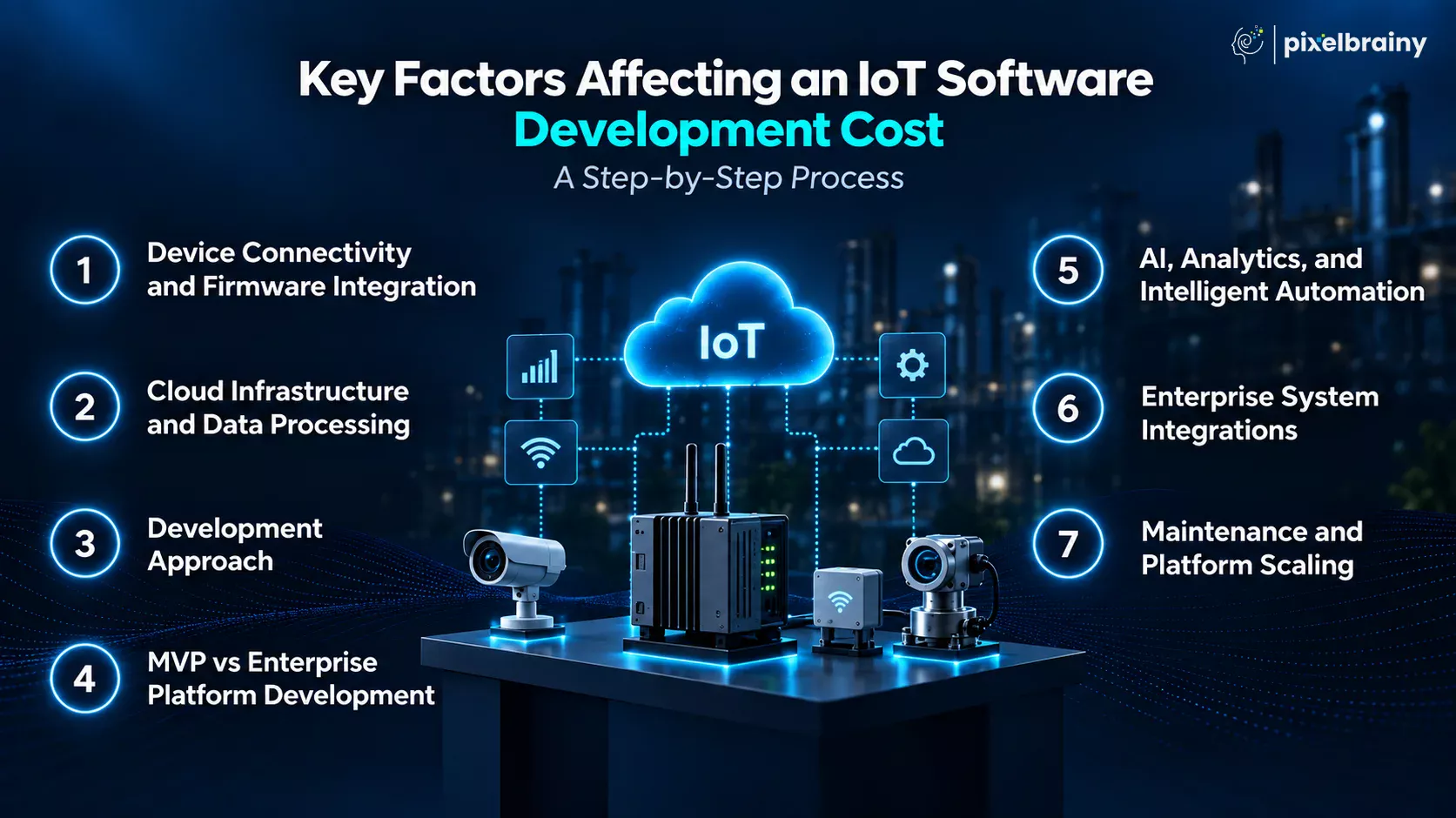
| Cost Factor | Estimated Cost Impact | Impact Level |
| Device Connectivity & Firmware Integration | $10,000 to $70,000+ | Very High |
| Cloud Infrastructure & Data Processing | $10,000 to $60,000+ | Very High |
| Development Approach | Can save or add 20% to 45% | High |
| MVP vs Enterprise Platform | $50,000 to $400,000+ | Very High |
| AI, Analytics & Intelligent Automation | $15,000 to $80,000+ | High |
| Enterprise Integrations | $8,000 to $40,000+ | Medium to High |
| Maintenance & Platform Scaling | 15% to 25% annually | Medium to High |
Estimated Cost: $10,000 to $70,000+
Connecting devices is one of the largest contributors to the overall IoT software development cost. The investment depends on the number of connected devices, firmware complexity, communication protocols, gateway development, and hardware compatibility.
For example, integrating standard MQTT enabled sensors generally costs less than connecting industrial PLCs using OPC UA, Modbus, BACnet, PROFIBUS, or developing custom embedded firmware. Projects involving multiple hardware vendors, legacy equipment, or edge gateways require additional engineering, testing, and validation, increasing the custom IoT software development cost.
Estimated Cost: $10,000 to $60,000+
Cloud infrastructure manages device communication, data storage, analytics, dashboards, alerts, and platform scalability. It represents another major component of the IoT software development cost breakdown.
A basic cloud platform supporting hundreds of connected devices typically falls between $10,000 and $20,000. However, enterprise environments requiring millions of daily sensor events, high availability, disaster recovery, auto scaling, real time analytics, and multi region deployment can increase infrastructure development costs to $40,000 to $60,000+.
Selecting the right cloud architecture early helps optimise both development costs and future operating expenses.
Cost Impact: Can Reduce or Increase Total Cost by 20% to 45%
The development model you choose has a significant influence on how much does IoT software development cost.
Building an in-house engineering team often requires embedded developers, firmware engineers, cloud architects, DevOps specialists, QA engineers, cybersecurity experts, and project managers. Annual staffing costs can easily exceed $500,000 before product development even begins.
Partnering with experienced IoT software development companies generally keeps projects within the $50,000 to $400,000+ range while reducing hiring costs, accelerating delivery, and providing access to specialised IoT expertise. Many organisations achieve the best balance by combining an internal product team with an external IoT development partner.
Estimated Cost: $50,000 to $400,000+
Project scope is one of the biggest factors affecting the cost to build IoT software solution.
A production ready MVP with secure device connectivity, cloud dashboards, user authentication, reporting, and alerts generally costs between $50,000 and $100,000.
An advanced IoT platform with edge computing, OTA firmware updates, ERP integration, AI powered insights, and predictive maintenance typically ranges from $100,000 to $220,000.
A fully featured enterprise platform supporting digital twins, multi-site management, industrial automation, advanced cybersecurity, and large-scale device fleets usually requires an investment of $220,000 to $400,000+.
Starting with an MVP remains the most cost-effective strategy for validating business value before scaling.
Also Read: Top 10 AI MVP Development Companies in USA
Estimated Cost: $15,000 to $80,000+
Artificial intelligence is increasingly becoming the primary value driver for enterprise IoT projects. However, advanced AI capabilities also increase the overall IoT software development cost.
Basic anomaly detection and automated alerts generally require an additional investment of $15,000 to $30,000.
More sophisticated capabilities such as predictive maintenance, computer vision, digital twins, production forecasting, energy optimisation, and machine learning based decision support can increase costs by $40,000 to $80,000+, depending on data complexity and model development requirements.
Although AI raises development costs, it often delivers the highest long term operational ROI.
Estimated Cost: $8,000 to $40,000+
Enterprise IoT platforms rarely operate independently. Most businesses require integration with existing software to automate workflows and improve operational visibility.
Common integrations include:
Simple API integrations generally begin around $8,000, while complex enterprise integrations across multiple business systems can exceed $40,000, depending on architecture complexity and data synchronisation requirements.
Estimated Cost: 15% to 25% of the Initial Development Cost Per Year
Many businesses underestimate the long-term cost of operating an IoT platform after launch.
As a general benchmark, annual maintenance typically represents 15% to 25% of the original IoT software development cost.
For example:
This budget usually covers:
Planning these recurring expenses early provides a far more realistic IoT software development cost breakdown and prevents unexpected operational costs after deployment.
There is no universal answer to how much does IoT software development cost because every project differs in connected devices, AI capabilities, infrastructure, enterprise integrations, and scalability requirements. Instead of treating an average cost to make an IoT software as a fixed number, businesses should evaluate each cost factor individually and align their investment with long term objectives. Starting with a focused MVP and expanding strategically enables organisations to optimise the IoT software development cost, reduce financial risk, and build a scalable IoT ecosystem that delivers measurable business value.
The team you choose has a direct impact on your IoT software development cost, project delivery timeline, engineering quality, communication efficiency, and long-term platform scalability. While two vendors may deliver similar IoT solutions, the cost to build IoT software solution can vary significantly depending on the team's location, development model, and expertise in embedded systems, firmware development, cloud platforms, AI, cybersecurity, and enterprise integrations.
Businesses evaluating how much does IoT software development cost often overlook the fact that the hourly rate alone does not determine the overall project investment. An experienced IoT engineering team may charge higher rates but deliver faster, reduce technical debt, and minimise costly rework throughout the project lifecycle.
A common buyer question is:
"We're evaluating whether to hire an in house IoT engineering team or partner with an external IoT development company. Which approach provides the best balance between cost, technical expertise, and long-term scalability for an enterprise IoT platform?"
Another frequently asked question is:
"We're comparing IoT software development companies across the USA, Eastern Europe, and South Asia. Which option offers the best value without compromising engineering quality, communication, or security?"
The comparison below provides a realistic estimate of the custom IoT software development cost across different team models.
| Team Type | Hourly Rate | Estimated Project Cost* | Best For |
| In House IoT Development Team (USA) | $120 to $220/hour | $300,000 to $700,000+ | Large enterprises building long term IoT products that require complete engineering control, internal R&D, and dedicated firmware, cloud, AI, and DevOps teams. |
| US Based IoT Development Agency | $90 to $180/hour | $120,000 to $350,000+ | Businesses looking for experienced IoT architects, structured project management, enterprise security, faster delivery, and ongoing support. |
| Freelancers (Mixed Locations) | $30 to $100/hour | $50,000 to $120,000+ | Proof of concepts, simple IoT MVPs, or small projects where budget is the primary concern and technical complexity remains limited. |
| Offshore Development Team (Eastern Europe) | $45 to $90/hour | $90,000 to $220,000+ | Companies seeking experienced IoT engineers, firmware specialists, cloud expertise, and competitive pricing for mid-sized connected product development. |
| Offshore Development Team (South Asia) | $25 to $60/hour | $50,000 to $180,000+ | Startups and growing businesses looking for affordable IoT software development cost while maintaining access to experienced embedded engineers, cloud developers, AI specialists, and full stack IoT teams. |
Estimated project cost assumes a medium complexity IoT platform with secure device connectivity, cloud infrastructure, dashboards, analytics, mobile access, API integrations, testing, and production deployment. Final pricing varies depending on device count, communication protocols, AI capabilities, security requirements, enterprise integrations, and project scope.
If your organisation plans to build multiple connected products over several years, maintaining an internal IoT engineering team offers the highest level of product ownership and technical control.
However, this is also the most expensive option. Recruitment, salaries, employee benefits, engineering tools, infrastructure, software licences, training, and operational overhead significantly increase the overall IoT software development cost, often exceeding the cost of outsourcing by a considerable margin.
For many mid-market and enterprise organisations, partnering with an experienced US based IoT development agency provides the ideal balance between quality, accountability, and delivery speed.
Businesses gain immediate access to firmware engineers, embedded developers, cloud architects, AI specialists, cybersecurity experts, UI designers, QA engineers, and project managers without the long recruitment cycle required to build an internal team. This model also helps optimise the cost to build IoT software solution while maintaining strong collaboration and governance.
Freelancers can be a practical option for validating ideas, building prototypes, or creating small proof of concept applications.
However, enterprise IoT projects rarely depend on a single skill set. Coordinating independent firmware developers, cloud engineers, mobile developers, AI specialists, and security experts often introduces communication challenges, inconsistent code quality, and increased delivery risk. As project complexity grows, the initial savings may quickly disappear through rework and delayed releases.
Eastern Europe has become a popular destination for businesses seeking experienced IoT engineering talent with strong technical capabilities and competitive pricing.
These teams often provide expertise across firmware development, cloud engineering, industrial protocols, AI integration, and enterprise software while maintaining effective communication and structured delivery processes. For many organisations, this option offers an attractive balance between engineering quality and custom IoT software development cost.
Ultimately, there is no single team model that fits every organisation. The right choice depends on your business objectives, available budget, technical complexity, and long-term product strategy.
If your goal is to optimise an average cost to make an IoT software while maintaining engineering quality, many businesses achieve the best results by partnering with an experienced IoT development company that combines specialised expertise, structured delivery, and long-term support without the operational overhead of building an in-house team.
The IoT software development cost is not incurred all at once. Instead, it is distributed across multiple development phases, each serving a specific purpose in transforming an idea into a secure, scalable, and production ready IoT platform. Understanding how your budget is allocated throughout the project lifecycle helps businesses estimate how much does IoT software development cost, plan investments more effectively, and avoid unexpected financial surprises during development.
A common misconception is that coding accounts for most of the project budget. In reality, activities such as business analysis, UI/UX design, firmware integration, testing, cloud infrastructure, deployment, and post launch optimisation all contribute significantly to the overall cost to build IoT software solution.
A common business owner query is:
"We're budgeting for an enterprise IoT platform, but our finance team wants to know exactly where the development budget will be spent. How much should we allocate for planning, firmware integration, cloud development, testing, deployment, and post launch support before approving the project?"
The answer depends on the project's complexity, but breaking the investment into development phases provides one of the most accurate ways to estimate the custom IoT software development cost.
| Development Phase | Estimated Cost | Percentage of Total Budget | What It Covers |
| Discovery & Project Planning | $5,000 to $20,000 | 8% to 12% | Business analysis, technical consulting, architecture planning, requirement gathering, project roadmap, technology selection, and feasibility assessment. |
| UI/UX Design & Prototyping | $8,000 to $25,000 | 10% to 15% | User experience design, dashboards, mobile screens, wireframes, clickable prototypes, and user journey optimisation. |
| Core IoT Software Development | $25,000 to $120,000+ | 35% to 45% | Frontend, backend, APIs, cloud platform, database, dashboards, authentication, admin panel, and business logic development. |
| Device & Firmware Integration | $15,000 to $70,000+ | 15% to 20% | Sensor integration, embedded software, gateways, MQTT, OPC UA, Modbus, LoRaWAN, BLE, and device communication. |
| Testing, Security & Deployment | $8,000 to $35,000 | 10% to 15% | Functional testing, performance testing, penetration testing, bug fixing, production deployment, cloud configuration, and security validation. |
| Post Launch Maintenance & Optimisation | 15% to 25% annually | Ongoing | OTA firmware updates, cloud optimisation, feature enhancements, security patches, AI model improvements, monitoring, and technical support. |
Estimated Cost: $5,000 to $20,000
Every successful IoT project begins with a detailed discovery phase. This stage defines business objectives, technical architecture, communication protocols, device requirements, cloud infrastructure, security expectations, and implementation strategy.
Although many businesses try to minimise planning costs, this phase often prevents expensive redesigns later and provides a more accurate IoT software development cost breakdown before development begins.
Estimated Cost: $8,000 to $25,000
IoT platforms are only valuable if operational teams can easily understand and act on connected data.
This phase focuses on creating intuitive dashboards, mobile interfaces, administrative portals, real time monitoring screens, reporting layouts, and interactive prototypes. Well-designed user experiences improve adoption while reducing operator training and long-term usability issues.
Estimated Cost: $25,000 to $120,000+
This phase represents the largest portion of the overall IoT software development cost because it includes building the cloud platform, backend services, APIs, user authentication, dashboards, databases, business logic, and administrative systems.
The investment varies depending on application complexity, supported platforms, scalability requirements, multi tenancy, user roles, and enterprise functionality. As additional AI capabilities and integrations are introduced, development costs naturally increase.
Estimated Cost: $15,000 to $70,000+
Connecting physical devices to software requires specialised engineering that extends beyond conventional application development.
This phase includes firmware integration, device provisioning, sensor communication, gateway configuration, industrial protocol implementation, and connectivity testing. Projects involving custom hardware, legacy PLCs, or multiple communication standards generally require additional engineering effort, increasing the overall custom IoT software development cost.
Estimated Cost: $8,000 to $35,000
Enterprise IoT systems require extensive validation before production deployment.
This stage includes functional testing, device compatibility testing, load testing, cybersecurity assessments, penetration testing, bug fixing, production deployment, and infrastructure configuration. Investing adequately in testing significantly reduces operational risks and improves long term platform reliability.
Estimated Cost: 15% to 25% of the Initial Development Cost Per Year
Launching an IoT platform is only the beginning. Long term success depends on continuous maintenance, platform optimisation, and security improvements.
Annual maintenance typically covers:
For example:
Therefore, the cost to build IoT software solution should never be viewed as a single development expense. Instead, it is a structured investment distributed across planning, design, engineering, device integration, testing, deployment, and ongoing optimisation.
Understanding this phased IoT software development cost breakdown enables businesses to budget more accurately, prioritise investments, and estimate an average cost to make an IoT software based on their actual technical and operational requirements rather than relying on broad pricing estimates alone.
The biggest contributor to the IoT software development cost is not the number of screens or the size of your dashboard. It is the combination of features your platform supports. Every additional capability requires more engineering effort across firmware, device communication, cloud infrastructure, APIs, cybersecurity, AI, testing, and ongoing maintenance. This is why the cost to build IoT software solution can vary from $50,000 for a basic monitoring platform to more than $400,000 for a fully featured enterprise IoT ecosystem.
A common business query is:
"We only need real time equipment monitoring today, but our leadership team is already discussing predictive maintenance, digital twins, remote firmware updates, ERP integration, and AI powered analytics in the future. Which features contribute the most to the IoT software development cost, and how much should we budget for each one?"
The answer depends on the functionality you choose. Breaking the platform into individual feature costs provides one of the most accurate ways to estimate how much does IoT software development cost and helps organisations prioritise features based on business value instead of assumptions.
| Feature | Estimated Development Cost | Complexity |
| Device Registration & Authentication | $3,000 to $8,000 | Low |
| Device Connectivity & Communication Protocols | $8,000 to $30,000 | Medium to High |
| Real Time Monitoring Dashboard | $8,000 to $20,000 | Medium |
| Alerts & Notifications | $4,000 to $10,000 | Low to Medium |
| Cloud Infrastructure & Data Storage | $10,000 to $40,000 | High |
| OTA Firmware Updates | $12,000 to $35,000 | High |
| Mobile Application | $15,000 to $40,000 | High |
| AI Powered Predictive Maintenance | $20,000 to $80,000+ | Very High |
| Digital Twin Development | $25,000 to $90,000+ | Very High |
| Enterprise System Integrations | $10,000 to $40,000+ | High |
| Advanced Analytics & Reporting | $8,000 to $25,000 | Medium |
| Security & Compliance | $8,000 to $30,000 | High |
Estimated Cost: $3,000 to $8,000
Every IoT platform begins with secure device onboarding. This feature manages device registration, user authentication, role-based access control, and secure provisioning before devices begin transmitting data.
Although relatively inexpensive, secure authentication is essential for building a reliable IoT ecosystem and forms the foundation of the overall IoT software development cost breakdown.
Estimated Cost: $8,000 to $30,000
Connecting devices to the platform represents one of the most important engineering tasks.
Development costs increase depending on the communication standards your business requires, including:
Projects supporting multiple industrial protocols, gateways, and legacy equipment generally require additional engineering, increasing the custom IoT software development cost.
Estimated Cost: $8,000 to $20,000
Operational dashboards allow users to visualise sensor data, monitor connected assets, analyse trends, and respond to events in real time.
Dashboard complexity depends on the number of connected devices, user roles, reporting requirements, interactive charts, maps, and custom KPIs.
Estimated Cost: $4,000 to $10,000
Automated notifications improve operational response by alerting users whenever equipment exceeds predefined thresholds or abnormal behaviour is detected.
Typical notification channels include:
This feature offers excellent business value while having a relatively modest impact on the IoT software development cost.
Estimated Cost: $10,000 to $40,000
Cloud infrastructure manages device communication, message processing, databases, analytics, APIs, storage, and platform scalability.
Basic deployments supporting hundreds of devices require significantly less investment than enterprise platforms processing millions of sensor events each day across multiple regions.
Estimated Cost: $12,000 to $35,000
Remote firmware management enables organisations to update connected devices without manual intervention.
A robust OTA solution includes:
Although this increases the cost to build IoT software solution, it significantly reduces long term maintenance costs.
Estimated Cost: $15,000 to $40,000
Many businesses require mobile access for field engineers, maintenance teams, supervisors, and executives.
Typical mobile capabilities include:
Supporting both Android and iOS naturally increases development effort.
Estimated Cost: $20,000 to $80,000+
Artificial intelligence is one of the largest contributors to the IoT software development cost because it requires data engineering, machine learning models, historical training datasets, and ongoing optimisation.
Typical AI capabilities include:
Although AI increases development costs, it often delivers the highest long-term return on investment.
Estimated Cost: $25,000 to $90,000+
Digital twins create virtual representations of physical assets using real time sensor data.
These models support:
Digital twin implementation requires advanced engineering, making it one of the highest cost features in enterprise IoT development.
Estimated Cost: $10,000 to $40,000+
Enterprise IoT platforms rarely operate independently. Most businesses require seamless integration with existing software.
Common integrations include:
Integration complexity depends on the number of systems, API availability, authentication methods, and data synchronisation requirements.
Estimated Cost: $8,000 to $25,000
Business intelligence dashboards help organisations convert sensor data into actionable insights.
Typical reporting features include:
The more custom reporting required, the greater the investment.
Estimated Cost: $8,000 to $30,000
Security should never be treated as an optional feature. Enterprise IoT platforms require strong protection across every layer of the connected ecosystem.
Typical security capabilities include:
Although security increases the IoT software development cost, it protects businesses from significantly greater financial and operational risks in the future.
Rather than attempting to build every advanced capability from the beginning, businesses should prioritise the features that deliver the highest immediate value.
This phased approach provides a more accurate IoT software development cost breakdown, helps estimate an average cost to make an IoT software, reduces financial risk, and enables organisations to expand their platform strategically as operational requirements evolve.

Many businesses estimate the obvious expenses such as application development, cloud infrastructure, device integration, and dashboards when calculating the IoT software development cost. However, several important expenses are frequently overlooked during the planning stage. While each cost may appear relatively small individually, together they can increase the cost to build IoT software solution by tens of thousands of dollars if they are not included in the initial budget.
This is one of the reasons decision makers often ask:
"We've already budgeted approximately $180,000 for developing our IoT software platform, but our CFO wants to know whether there are any hidden costs we haven't considered. Beyond development, what additional expenses should we include to avoid budget overruns during deployment and long-term operations?"
Planning for these hidden expenses early provides a more accurate IoT software development cost breakdown, helps businesses estimate how much does IoT software development cost, and prevents unexpected financial surprises after development begins.
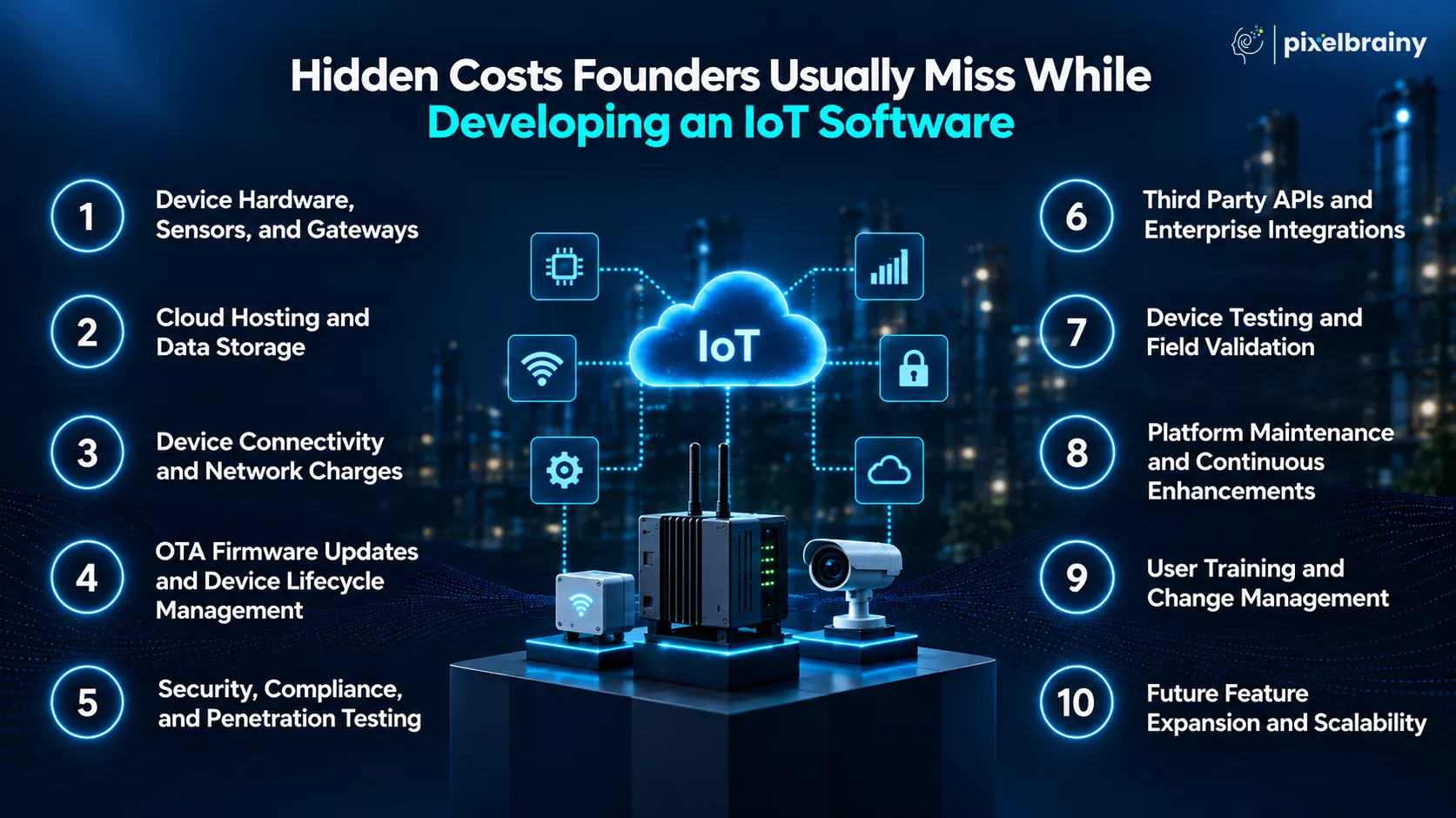
Estimated Cost: $5,000 to $100,000+
Many businesses focus exclusively on software while overlooking the physical infrastructure required to collect and transmit data.
Additional investments may include:
The final cost depends on the number of connected assets and the hardware selected. Large Industrial IoT deployments often spend more on hardware than software during the initial rollout.
Estimated Cost: $500 to $8,000+ per Month
Most organisations budget for cloud development but underestimate the recurring cost of operating an IoT platform.
Ongoing expenses typically include:
As connected devices and sensor traffic increase, monthly infrastructure costs naturally grow.
Estimated Cost: $1,000 to $30,000+ per Year
Every connected device requires reliable communication.
Recurring connectivity expenses may include:
Businesses deploying thousands of remote devices should include connectivity costs as part of the overall IoT software development cost breakdown.
Estimated Cost: $5,000 to $30,000+
Remote firmware management is often forgotten during budgeting because businesses focus primarily on initial deployment.
A complete OTA management solution includes:
Without proper lifecycle management, maintaining large IoT deployments becomes increasingly expensive over time.
Estimated Cost: $8,000 to $40,000+
IoT platforms process operational data, enterprise information, and sometimes sensitive customer information, making cybersecurity a critical investment rather than an optional feature.
Additional costs may include:
Highly regulated industries such as healthcare, manufacturing, and energy generally require larger security budgets.
Estimated Cost: $5,000 to $25,000+
Most enterprise IoT platforms integrate with existing business systems rather than operating independently.
Common integration costs include:
Subscription fees for external platforms should also be included in long term budgeting.
Estimated Cost: $5,000 to $20,000+
Testing IoT software goes far beyond validating application functionality.
Comprehensive testing usually includes:
Investing in testing significantly reduces operational failures after deployment.
Estimated Cost: 15% to 25% of the Initial Development Cost Per Year
Many organisations assume development ends once the platform goes live.
In reality, ongoing investment is required for:
For example, if your initial custom IoT software development cost is $200,000, annual maintenance may range between $30,000 and $50,000.
Estimated Cost: $3,000 to $20,000+
Even the most advanced IoT platform will struggle to deliver ROI if employees are not properly trained.
Businesses often overlook costs associated with:
Proper adoption ensures teams can fully utilise new IoT capabilities from day one.
Estimated Cost: $10,000 to $80,000+
Most organisations begin with an MVP but later expand the platform as business requirements evolve.
Future investments commonly include:
Planning these future enhancements during the initial budgeting phase provides a more realistic estimate of an average cost to make an IoT software and avoids repeated architectural redesigns later.
Ignoring these hidden expenses is one of the biggest reasons IoT projects exceed their original budgets. By accounting for hardware, connectivity, cloud operations, cybersecurity, device management, enterprise integrations, maintenance, and future scalability from the beginning, businesses gain a far more accurate view of the IoT software development cost.
A comprehensive budget not only reduces financial risk but also ensures your IoT platform can be deployed, maintained, and scaled successfully as business requirements continue to evolve.
Every business wants to build a secure, scalable, and future ready IoT platform, but every business also has a budget to manage. The good news is that reducing the IoT software development cost does not mean compromising performance, security, scalability, or long-term reliability. The key lies in making the right architectural, technology, and product decisions from the very beginning.
By following the strategies below, businesses can significantly optimise the cost to build IoT software solution while ensuring the platform remains production ready and capable of supporting future growth.
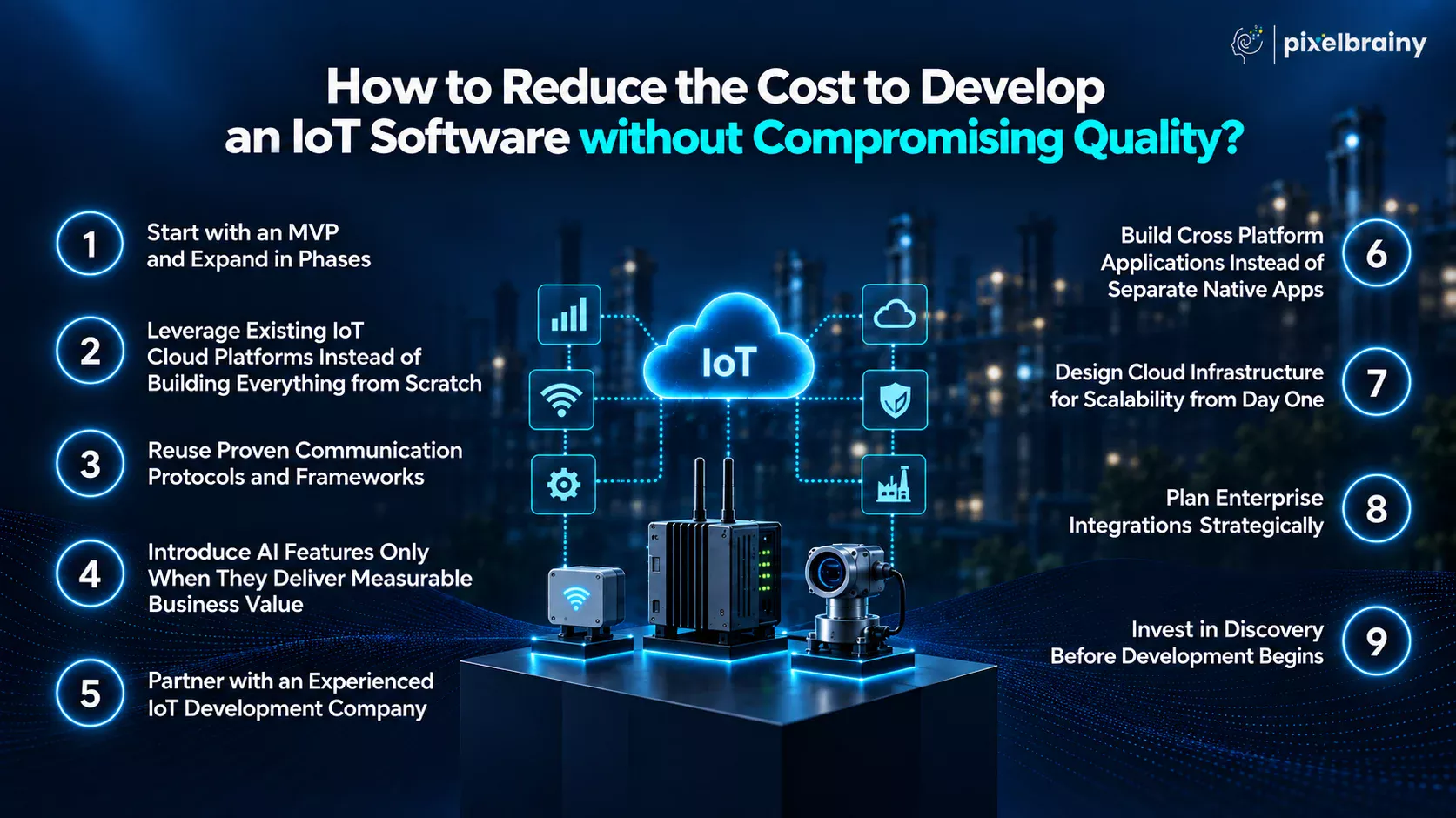
One of the smartest ways to reduce the IoT software development cost is to build only the features your business needs immediately.
A common business question is:
"We eventually want AI powered predictive maintenance, digital twins, mobile apps, and ERP integration, but our current budget is around $100,000. What should we build first so we can launch faster without exceeding our budget?"
Instead of building every enterprise feature in the first release, focus on an MVP that includes:
Advanced capabilities such as AI powered analytics, OTA firmware updates, digital twins, edge computing, and enterprise integrations can be introduced after validating business outcomes.
Estimated Savings: 20% to 35%, or approximately $20,000 to $80,000.
Developing every infrastructure component internally significantly increases the custom IoT software development cost.
Instead, businesses can utilise proven cloud platforms such as:
These platforms already provide secure device connectivity, messaging, authentication, monitoring, and scalability.
This approach accelerates development while reducing engineering complexity.
Estimated Savings: 15% to 30%, or approximately $15,000 to $50,000.
Many organisations unnecessarily invest in building proprietary communication layers.
Instead, adopting industry proven standards such as:
reduces engineering effort, improves interoperability, and simplifies future integrations.
Using established frameworks also reduces long term maintenance costs while improving platform reliability.
Estimated Savings: 10% to 25%, or approximately $10,000 to $35,000.
Artificial intelligence is one of the largest contributors to the IoT software development cost breakdown, but not every project requires advanced AI from day one.
Begin with:
Then gradually introduce:
This phased strategy ensures AI investment is backed by measurable operational value.
Estimated Savings: 15% to 30%, or approximately $15,000 to $60,000.
Many businesses ask:
"Should we hire an in-house engineering team or outsource our IoT project to reduce development costs while maintaining quality?"
Building an internal IoT team requires recruiting firmware engineers, embedded developers, cloud architects, AI specialists, DevOps engineers, cybersecurity experts, QA professionals, and project managers.
Partnering with an experienced IoT development company provides immediate access to specialised expertise without recruitment costs, employee overhead, or lengthy hiring cycles.
Estimated Savings: 30% to 50%, or approximately $60,000 to $200,000, compared to building an equivalent in house engineering team.
If your IoT platform requires mobile access, building separate native applications for Android and iOS increases both development time and maintenance costs.
Using cross platform technologies such as Flutter or React Native allows businesses to maintain a single codebase while delivering a consistent user experience across multiple devices.
Native applications can always be developed later if business requirements justify the additional investment.
Estimated Savings: 20% to 35%, or approximately $15,000 to $40,000.
Many businesses overinvest in infrastructure before understanding actual usage patterns.
Using cloud native architecture with:
ensures you only pay for computing resources when demand increases.
This significantly reduces long term operating expenses while supporting future business growth.
Estimated Savings: 30% to 60% on ongoing cloud infrastructure costs.
Integrating ERP, CRM, SCADA, MES, CMMS, and other enterprise platforms all at once can substantially increase the cost to build IoT software solution.
Instead, prioritise integrations that deliver immediate operational value and schedule additional integrations in later development phases.
This staged approach reduces both development complexity and implementation risks.
Estimated Savings: 10% to 25%, or approximately $10,000 to $30,000.
Many organisations attempt to reduce upfront costs by skipping discovery workshops and technical planning.
However, inadequate planning often leads to architecture changes, feature rework, delayed releases, and higher overall project costs.
A structured discovery phase helps define technical requirements, communication protocols, cloud architecture, security strategy, and project scope before development starts.
Estimated Savings: 15% to 30% by avoiding costly rework during later development stages.
So, reducing the IoT software development cost is not about cutting corners or compromising quality. It is about making smarter product, technology, and architecture decisions from the start.
By adopting an MVP first approach, leveraging proven IoT platforms, and scaling features strategically, businesses can optimise development costs while building a secure, scalable, and future ready IoT solution.
As an experienced IoT development company, PixelBrainy helps startups, manufacturers, healthcare providers, logistics companies, smart building operators, and enterprises optimize their IoT software development cost without compromising quality, security, scalability, or long-term business value. We combine product strategy, embedded engineering, cloud architecture, AI powered analytics, and full stack IoT development to help businesses launch faster while maximising every development dollar. Rather than recommending unnecessary features or overengineering the platform, our team focuses on building an IoT solution that delivers measurable ROI from the very first deployment.
A common business question is:
"We're comparing IoT software development costs across the USA, Eastern Europe, and South Asia. Can PixelBrainy help us understand the cost differences and recommend the most cost-effective development approach without compromising engineering quality, communication, security, or long-term scalability?"
The answer is yes. While development costs vary across regions, the best value rarely comes from selecting the lowest proposal. It comes from partnering with an experienced IoT development company that understands how to optimise architecture, prioritise high impact features, eliminate unnecessary development effort, and build scalable solutions that support future business growth.
At PixelBrainy, every IoT project starts with a structured discovery and cost planning workshop before development begins.
During this phase, our IoT experts evaluate:
Instead of recommending every advanced IoT capability from day one, we identify the features that generate the highest business impact for your initial release. This approach helps optimise the cost to build IoT software solution, reduces unnecessary development expenses, and creates a scalable roadmap for future expansion.
A US based manufacturing company approached PixelBrainy to build an Industrial IoT platform for monitoring production equipment across multiple facilities. The original project scope included predictive maintenance, digital twins, AI powered analytics, ERP integration, mobile applications, multi-site management, remote firmware updates, and advanced reporting.
Due to a confidentiality agreement, we cannot disclose the client's identity.
Based on the initial requirements, the estimated project investment exceeded $320,000.
Following a detailed product discovery workshop, our team restructured the roadmap into a scalable MVP. Instead of developing every enterprise capability in the first phase, we prioritised secure device connectivity, cloud dashboards, real time monitoring, essential reporting, and scalable cloud infrastructure. Advanced AI capabilities, ERP integrations, digital twins, and predictive maintenance were scheduled for later releases.
The First Release Included:
Project Outcome:
| Metric | Result |
| Original Estimated Budget | $320,000+ |
| Final MVP Investment | Approximately $165,000 |
| Development Cost Saved | Nearly 48% |
| Delivery Timeline | Less than 16 Weeks |
| Future Readiness | Prepared for AI powered predictive maintenance, digital twins, ERP integration, OTA firmware updates, and multi-site expansion |
By focusing on validated business requirements instead of assumptions, the client launched the platform sooner, demonstrated operational value to stakeholders, and planned future enhancements based on measurable business outcomes. This phased strategy significantly reduced the IoT software development cost while creating a robust technical foundation for long term growth.
PixelBrainy delivers much more than software development. We provide complete IoT product strategy focused on reducing costs, accelerating delivery, and maximising long term return on investment.
Our expertise includes:
Whether you're planning a proof of concept, an MVP, or a large-scale enterprise deployment, PixelBrainy helps businesses optimise the custom IoT software development cost while delivering secure, scalable, and production ready IoT solutions designed for long term success.
Connect with PixelBrainy for a free consultation and personalised project estimation. Our IoT specialists will help you understand how much does IoT software development cost, provide a transparent IoT software development cost breakdown, and recommend the most cost-effective development strategy based on your business goals, technical requirements, timeline, and budget.
Estimating the IoT software development cost is not about finding a single fixed price. It is about understanding the technical, operational, and business factors that shape your investment. As this guide has shown, the cost to build IoT software solution can range from $50,000 to $400,000+, depending on project scope, device ecosystem, AI capabilities, cloud infrastructure, enterprise integrations, and long-term scalability requirements.
Understanding the IoT software development cost breakdown helps businesses make smarter budgeting decisions before development begins. By prioritising an MVP, selecting the right development approach, choosing scalable technologies, and planning for ongoing maintenance, organisations can optimise costs without compromising quality or future growth.
If you've been searching for "IoT Software Development Cost: How Much Does It Cost to Build an IoT Solution? ($50K–$400K+)", the answer ultimately depends on your business objectives, feature requirements, connected device ecosystem, and deployment strategy. A tailored cost estimate will always be more accurate than relying on industry averages alone.
Whether you're evaluating the custom IoT software development cost for a pilot project or estimating how much does IoT software development cost for an enterprise deployment, the right strategy and development partner can significantly improve your return on investment while reducing implementation risks. A well planned IoT platform not only meets today's operational needs but also provides a strong foundation for future innovation and business expansion.
Ready to turn your IoT idea into a scalable solution? Book an appointment with our IoT experts and get a personalised cost estimate and development roadmap for your project.
The IoT software development cost in 2026 typically ranges from $50,000 to $400,000+, depending on project complexity, connected devices, communication protocols, cloud infrastructure, AI capabilities, security, and enterprise integrations. A basic MVP costs significantly less than a fully featured enterprise IoT platform supporting thousands of connected devices.
A production ready MVP generally requires a budget of $50,000 to $100,000. This typically covers secure device connectivity, cloud infrastructure, user authentication, dashboards, reporting, and basic notifications. The final cost to build a basic IoT software platform depends on device count, supported protocols, and integration requirements.
The most expensive part of the IoT software development cost breakdown is usually cloud platform engineering, firmware integration, AI powered analytics, and enterprise system integrations. These components require specialised engineering expertise and significantly influence the overall custom IoT software development cost for production ready platforms.
Firmware development generally adds $10,000 to $70,000+ to the overall IoT software development cost, depending on hardware complexity, communication protocols, power optimisation, OTA update support, and embedded software requirements. Projects involving custom hardware or industrial devices typically require larger firmware development budgets.
Real time processing typically increases the IoT software development cost by 15% to 35% because it requires event driven architecture, continuous data processing, low latency infrastructure, message brokers, and scalable cloud services. Batch processing is generally more affordable but unsuitable for time sensitive industrial applications.
Monthly operating costs usually include cloud hosting, device connectivity, data storage, security monitoring, API subscriptions, platform maintenance, and technical support. Depending on deployment size, ongoing expenses can range from $500 to $8,000+ per month, with larger enterprise deployments requiring higher operational budgets.
Healthcare IoT platforms typically require $180,000 to $400,000+ because they must support HIPAA compliant data security, encrypted communication, secure authentication, audit logging, regulatory documentation, and healthcare system integrations. Additional compliance requirements increase both development effort and long-term maintenance costs.
Yes. Offshore development teams generally offer lower hourly rates than US based teams, making them a cost-effective option. However, the best value comes from choosing an experienced IoT software development company with proven expertise, transparent communication, and successful enterprise IoT delivery rather than selecting the lowest price alone.
As connected devices increase, additional investment is required for cloud infrastructure, device management, data processing, security, monitoring, and scalability. Businesses should expect the IoT software development cost to increase progressively as the platform expands from pilot deployments to enterprise scale operations supporting thousands of connected devices.
Yes. A functional MVP can usually be developed within a budget of $50,000 to $100,000. This typically includes device connectivity, cloud dashboards, user authentication, reporting, and basic alerts. Starting with an MVP is one of the most effective ways to optimise the custom IoT software development cost.
PixelBrainy focuses on building scalable IoT solutions while optimising development costs through structured discovery, MVP first delivery, reusable architectures, and phased implementation. Our expertise spans firmware development, cloud platforms, AI powered analytics, Industrial IoT, enterprise integrations, and long-term product scalability, helping businesses maximise ROI from their IoT investments.
The most accurate IoT software development cost estimate starts with a discovery workshop that evaluates your business objectives, device ecosystem, communication protocols, required features, cloud infrastructure, AI capabilities, integrations, security needs, and deployment scale. This produces a transparent, feature wise cost breakdown instead of a generic pricing range.

About The Author
Sagar Bhatnagar
Sagar Sahay Bhatnagar brings over a decade of IT industry experience to his role as Marketing Head at PixelBrainy. He's known for his knack in devising creative marketing strategies that boost brand visibility and market influence. Sagar's strategic thinking, coupled with his innovative vision and focus on results, sets him apart. His track record of successful campaigns proves his ability to utilize digital platforms effectively for impactful marketing efforts. With a genuine passion for both technology and marketing, Sagar continuously pushes PixelBrainy's marketing initiatives to greater success.

Working with the PixelBrainy team has been a highly positive experience. They understand the design requirements and create beautiful UX elements to meet the application needs. The dev team did an excellent job bringing my vision to life. We discussed usability and flow. Sagar worked with his team to design the database and begin coding. Working with Sagar was easy. He has the knowledge to create robust apps, including multi-language support, Google and Apple ID login options, Ad-enabled integrations, Stripe payment processing, and a Web Admin site for maintaining support data. I'm extremely satisfied with the services provided, the quality of the final product, and the professionalism of the entire process. I highly recommend them for Android and iOS Mobile Application Design and Development.

Great experience working with them. Had a lot of feedback and I found that unlike most contractors they were bugging me for updates instead of the other way around. They were extremely time conscience and great at communicating! All work was done extremely high quality and if not on time, early! They were always proactive when it comes to communication and the work is great/above par always. Very flexible and a great team to work with! Goes above and beyond to present us with multiple options and always provides quality. Amazing work per usual with Chitra. If you have UI/UX or branding design needs I recommend you go to them! Will likely work with them in the future as well, definitely recommended!

PixelBrainy is a joy to work with and is a great partner when thinking through branding, logo, and website layout. I appreciate that they spend time going into the "why" behind their decisions to help inform me and others about industry best practices and their expertise.

I hired them to design our software apps. Things I really like about them are excellent communication skills, they answer all project suggestions and collaborate right away, and their input on design and colors is amazing. This project was complex and needed patience and creativity. The team is amazing to do business with. I will be using them long-term. Glad to see there are some good people out there. I was afraid to try and outsource my project to someone but I am glad I met them! I really can't say enough. They went above and beyond on this project. I am very happy with everything they have done to make my business stand out from the competition.

It was great working with PixelBrainy and the team. They were very responsive and really owned the project. We'll definitely work with them again!

I recently worked with the PixelBrainy team on a project and I was blown away by their communication skills. They were prompt, clear, and articulate in all of our interactions. They listened and provided valuable feedback and suggestions to help make the project a success. They also kept me updated throughout the entire process, which made the experience stress-free and enjoyable.

PixelBrainy is very good at what it does. The team also presents themselves very professionally and takes care of their side of things very well. I could fully trust them taking up the design work in a timely and organised manner and their attention to detail saved us lots of effort and time. This particular project was quite intense and the team showed that they function very well under pressure. Very much looking forward to working with her again!

It's always an absolute pleasure working with them. They completed all of my requests quickly and followed every note I had for them to a T, which made our process go smoothly from start to finish. Everything was completed fast and following all of the guidelines. And I would recommend their services to anyone. If you need any design work done in the future, PixelBrainy should be your first call!

They took ownership of our requirements and designed and proposed multiple beautiful variants. The team is self-motivated, requires minimum supervision, committed to see-through designs with quality and delivering them on time. We would definitely love to work with PixelBrainy again when we have any requirements.

PixelBrainy was a big help with our SaaS application. We've been hard at work with a new UI/UX and they provided a lot of help with the designs. If you're looking for assistance with your website, software, or mobile application designs, PixelBrainy and the team is a great recommendation.

PixelBrainy designers are amazing. They are responsive, talented, and always willing to help craft the design until it matches your vision. I would recommend them and plan to continue them for my future projects and more!!!

They were awesome! Did a good job fast, and good communication. Will work with them again. Thank you

Creative, detail-oriented, and talented designers who take direction well and implement changes quickly and accurately. They consistently over-delivered for us.

PixelBrainy team is very talented and creative. Great designers and a pleasure to work with. PixelBrainy is an excellent communicator and I look forward to working with them again.

PixelBrainy has a very talented design team. Their work is excellent and they are very responsive. I enjoy working with them and hope to continue on all of our future projects.


Transform your ideas into reality with us.
Across these industries, each engagement brings unique challenges, from early-stage product development to scaling complex systems, helping us build a practical understanding of real-world product environments.