
 AI Summary Powered by PixelBrainy
Why do so many businesses invest heavily in AI initiatives only to end up with missed deadlines, inflated invoices, and software that never delivers measurable business value?
The answer often has less to do with AI itself and more to do with choosing the wrong development partner. As artificial intelligence adoption accelerates across industries, businesses are under pressure to modernize operations, automate workflows, improve customer experiences, and gain a competitive edge. However, selecting an AI software development company in USA requires a far more strategic evaluation process than hiring a traditional software vendor.
Many organizations searching for guidance on how to choose an AI software development company quickly discover that the market is crowded with AI vendors who overpromise, unrealistic timelines, and flashy demos that fail in production environments. The result is a wasted AI development budget, stalled implementation cycles, and growing skepticism toward future innovation initiatives.
A growing number of companies are now investing in failed AI project recovery after learning expensive lessons from poor execution, weak data strategies, and unclear business alignment. In fact, several studies continue to highlight recurring AI project failure reasons such as unrealistic expectations, poor governance, lack of domain expertise, and inadequate deployment planning.
According to Gartner Research, worldwide AI spending is forecast to reach $2.52 trillion in 2026, reflecting a 44% year-over-year increase. This rapid growth signals enormous opportunity - but also increased risk for businesses selecting the wrong provider for AI software development services.
Many decision-makers openly admit: “We are looking to hire an AI software development company for our business but we have been burned before by vendors who overpromised and underdelivered.” That concern is now shared by startups, mid-sized enterprises, and Fortune 500 companies alike seeking a reliable AI development partner USA capable of delivering measurable outcomes instead of empty promises.
This guide is designed for business owners, CTOs, innovation leaders, operations executives, digital transformation teams, and enterprise buyers who want to make smarter AI investment decisions with confidence.
Businesses often evaluate AI providers the same way they evaluate traditional software agencies. That approach creates serious risks because artificial intelligence projects involve a completely different level of complexity, experimentation, and long-term management.
Understanding the difference between an AI development company vs software development company is the first step toward making a smarter investment decision.
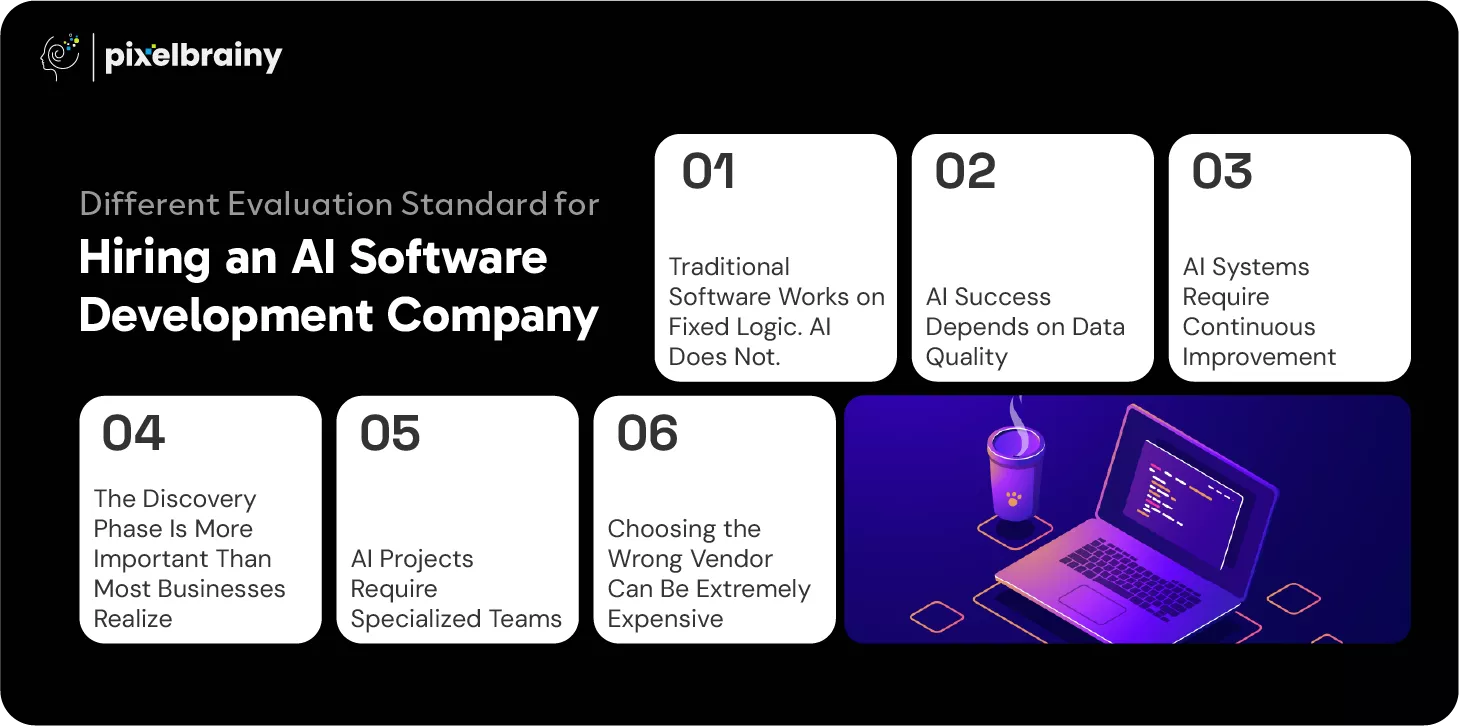
Conventional software applications operate through predefined rules and predictable workflows. Once developed and tested, the system usually performs the same function repeatedly with minimal variation.
AI systems behave differently because they learn from data patterns and improve over time. Their outputs are influenced by changing datasets, user behavior, operational conditions, and algorithm performance. This makes AI projects far less predictable than standard application development.
A normal software agency may build websites, mobile apps, or enterprise dashboards effectively. However, a specialized machine learning development company must understand data science, predictive modeling, algorithm optimization, and large-scale AI infrastructure management.
One of the biggest differences in AI projects is the role of data.
An AI solution is only as strong as the information feeding the system. Poorly structured or incomplete datasets can lead to inaccurate predictions, automation failures, and unreliable outputs.
This is why experienced AI providers spend significant time evaluating:
Without this foundation, even advanced AI systems struggle in production environments.
Traditional software can remain relatively stable after launch. AI systems cannot.
Successful AI implementation requires ongoing AI model training and deployment processes that continuously improve system accuracy. As market conditions, operational patterns, or customer behavior evolve, AI performance can decline over time.
This issue is commonly addressed through:
Without proper maintenance, AI systems become outdated and unreliable.
Experienced AI firms do not jump directly into coding.
A proper AI project discovery phase involves analyzing business operations, identifying technical limitations, understanding workflow inefficiencies, assessing infrastructure readiness, and defining measurable business outcomes.
This stage helps determine:
Vendors who skip this process often overpromise results that cannot be delivered in real-world conditions.
AI development requires far more than software engineers alone.
A strong AI software development team often includes:
These specialists work together to manage infrastructure, automation pipelines, deployment environments, monitoring systems, and production reliability.
Businesses should always verify whether these capabilities exist internally or are being outsourced.
The wrong AI vendor consequences extend far beyond delayed timelines.
Businesses may face:
Many organizations spend months or years recovering from failed implementations that were poorly planned from the beginning.
One common concern businesses express is:
“We have never worked with an AI software development company before... We want to use AI to predict machine failures before they happen...”
Predictive maintenance systems require deep expertise in industrial data processing, machine learning models, infrastructure scalability, and real-time operational monitoring. This is why vendor evaluation must go far beyond surface-level marketing claims.
Hiring an AI partner is not simply about finding developers who can build software.
It is about choosing a strategic technology partner capable of delivering measurable business outcomes, operational stability, scalable infrastructure, and long-term AI software development ROI.
Many businesses invest in AI with strong expectations but very limited understanding of how to properly evaluate vendors. This often leads to poor decision-making, weak implementation strategies, and expensive operational setbacks later in the project lifecycle.
Most AI project failure reasons begin long before development starts. They usually begin during vendor selection.
Below are the most common mistakes businesses make when hiring an AI partner.
Many companies focus heavily on cost reduction during vendor selection and ignore technical expertise, infrastructure planning, and scalability capabilities. This often results in a wasted AI development budget because low-cost vendors may lack experienced engineers, deployment specialists, and long-term support processes required for successful AI implementation.
Many AI vendors who overpromise create impressive presentations, polished demonstrations, and unrealistic timelines that fail under real-world operational conditions. Businesses that skip technical validation frequently experience unstable systems, weak prediction accuracy, integration failures, and unrealistic expectations that negatively affect long-term project success and operational performance.
A vendor may successfully build AI solutions for one industry while struggling with completely different operational requirements in another sector. Hiring an AI software development agency without relevant industry knowledge often creates compliance issues, workflow inefficiencies, inaccurate outputs, and implementation problems that slow project progress significantly.
Some vendors market themselves as complete AI providers while outsourcing critical development work to external contractors or temporary freelancers. This creates communication gaps, inconsistent quality standards, delayed issue resolution, and project instability that can negatively impact delivery timelines, software performance, and overall business confidence.
Businesses often launch AI initiatives without defining measurable KPIs, operational benchmarks, or expected business outcomes before development begins. Without clear metrics, organizations struggle to evaluate actual performance improvements, operational efficiency gains, automation impact, revenue growth, and long-term return on investment after deployment.
AI systems depend heavily on accurate, structured, and high-quality datasets for reliable performance and meaningful outputs. Businesses that ignore early data assessments often experience incomplete information, inconsistent records, weak model accuracy, integration limitations, and performance instability that damage long-term project effectiveness and operational reliability.
Many businesses assume AI systems will continue operating efficiently after deployment without ongoing monitoring or optimization support. One common concern companies share is: “We built an AI recommendation system 8 months ago with a vendor who has now gone completely silent. The model accuracy has dropped and nobody is maintaining it”
This situation reflects common AI vendor broken promises that eventually lead to AI software project delays, declining prediction accuracy, infrastructure instability, operational downtime, and expensive redevelopment costs that businesses were never prepared to handle after deployment.
Businesses frequently ignore important AI software development company red flags during early conversations because they focus too heavily on pricing, timelines, or marketing presentations. Common warning signs include vague contracts, unrealistic promises, unclear maintenance plans, poor communication practices, and limited technical transparency during evaluation discussions.
Some AI vendors successfully deliver small pilot projects but struggle when systems scale into real production environments with larger workloads and operational complexity. Poor scalability planning often creates infrastructure bottlenecks, unstable performance, system slowdowns, and expensive redevelopment efforts that increase overall AI development budget overrun risks significantly.
Many organizations choose vendors emotionally instead of following a structured evaluation process based on technical expertise, operational capability, scalability, communication quality, and support readiness. Building an internal AI software development company red flags checklist helps businesses identify hidden risks early and avoid costly vendor selection mistakes later.
Long-term AI success depends heavily on vendor expertise, operational transparency, technical reliability, and continuous support capabilities. Businesses that perform deeper evaluation early are far more likely to avoid costly implementation failures later.
Also Read: Top 10 AI Development Companies in Sheridan
Many businesses rush into AI implementation before clearly understanding their internal goals, operational challenges, and technical readiness. This often creates confusion during development and leads to unrealistic expectations, budget inefficiencies, and poor long-term outcomes.
Before evaluating vendors or comparing proposals, companies must first define several foundational elements internally. This preparation stage helps businesses better understand what to look for in an AI development company while also reducing project risks later.
Below are the five most important areas every business should define before starting any AI initiative.
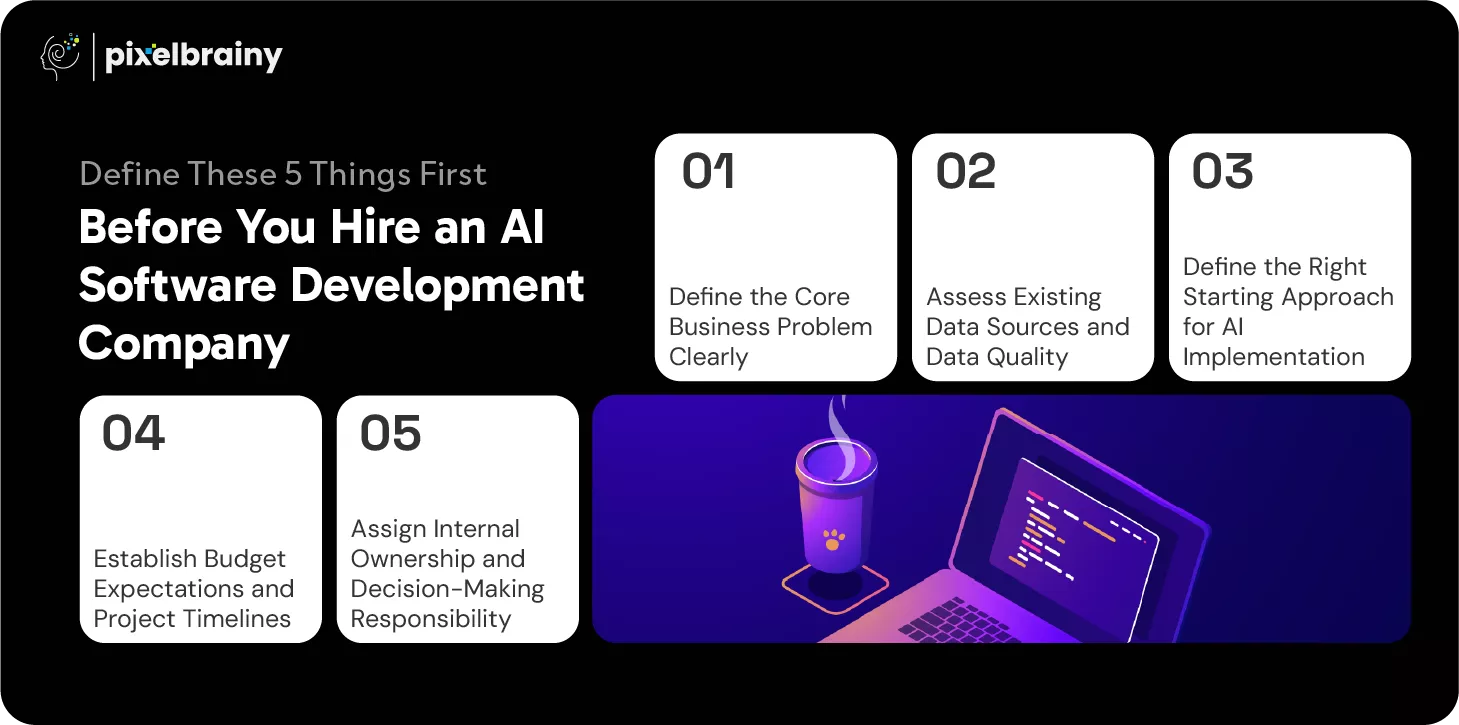
Businesses should never begin with the statement:
“We need AI.”
Instead, the focus should be on identifying the actual operational problem that needs improvement.
Important questions to answer include:
For example, some businesses may require natural language processing development for customer support automation, while others may need predictive analytics for inventory management or fraud detection.
The clearer the business objective, the easier it becomes to align technology decisions with measurable outcomes.
AI systems rely heavily on structured and reliable data. Before starting development, businesses should evaluate what information is currently available internally.
This assessment should include:
Many organizations often ask:
“We are a retail business with about 3 years of customer purchase data stored in spreadsheets... We are not sure if our data is good enough to get started...”
In many cases, businesses already possess valuable datasets but require proper data preprocessing for AI before models can be trained effectively. A reliable vendor should help assess data quality, consistency, completeness, and scalability before development begins.
Not every business needs a large-scale AI platform immediately. Many successful projects begin with smaller validation phases before full deployment.
Businesses should determine whether they need:
For example, a company exploring recommendation systems may first launch a limited MVP to test user behavior before expanding into enterprise-level deployment.
Organizations exploring generative AI development services should also determine whether they require customer-facing applications, internal productivity tools, or automated content workflows before selecting technologies or vendors.
AI projects vary significantly in cost depending on infrastructure, customization requirements, integrations, data complexity, and compliance needs.
Businesses should define:
It is equally important to establish a realistic AI software development project timeline based on:
Companies exploring AI consulting services USA or enterprise-level AI development services USA should understand that meaningful AI implementation usually requires phased execution rather than rushed deployment expectations.
Many AI initiatives fail because no internal stakeholder fully owns the implementation process.
Businesses should identify:
Strong internal ownership improves communication, accelerates approvals, reduces implementation delays, and helps align AI outcomes with operational priorities.
For example, businesses working with a computer vision development company for warehouse automation or manufacturing inspection systems often require collaboration between operations teams, IT departments, and executive leadership throughout the project lifecycle.
Businesses that define goals, data readiness, budgets, and internal responsibilities early create a far stronger foundation for AI success. Better preparation not only improves vendor evaluation but also increases the likelihood of achieving measurable business outcomes from future AI investments.

Businesses investing in AI often struggle to identify which vendors are genuinely capable and which ones rely mostly on marketing claims, unrealistic promises, or limited technical depth. Understanding how to evaluate an AI software development company requires businesses to look far beyond pricing proposals, sales presentations, or polished demonstrations.
Many organizations ask:
“We have a budget of around $80,000 to $120,000 for AI development... How do I find a reliable AI software development company in the USA that is transparent about pricing?”
The answer lies in following a structured AI vendor evaluation framework that focuses equally on technical expertise, operational maturity, compliance readiness, scalability planning, communication quality, and long-term support capabilities.
Below are the ten most important evaluation criteria every business should carefully assess before hiring an AI partner.
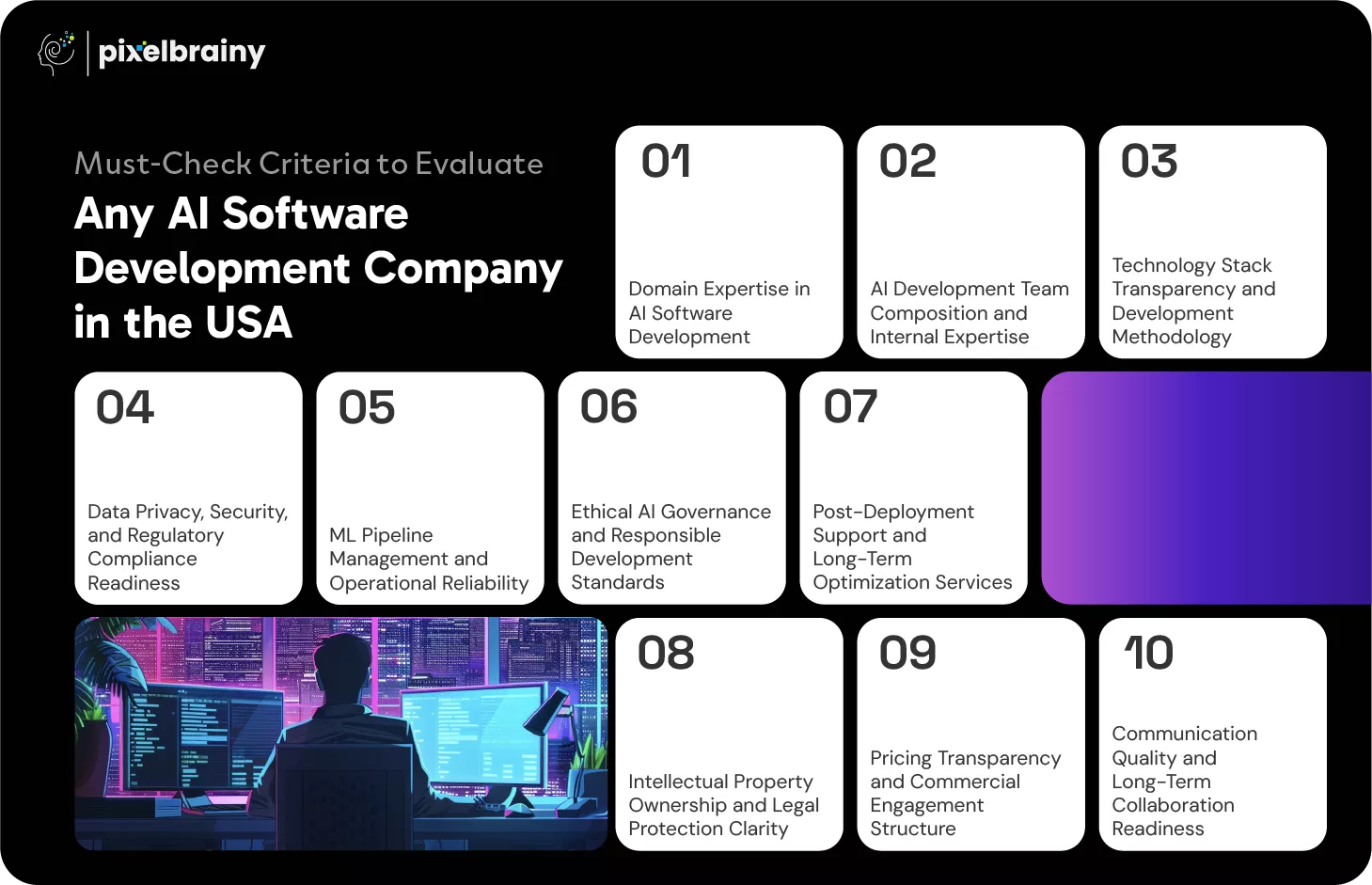
Industry experience plays a major role in determining whether an AI project succeeds or fails in real operational environments. A vendor may have strong engineering capabilities but still struggle if they do not fully understand the workflows, compliance requirements, customer behaviors, and operational challenges within your industry.
Businesses should always ask whether the company has delivered successful AI implementations for organizations operating in similar sectors. AI requirements vary significantly between industries such as healthcare, manufacturing, finance, logistics, retail, insurance, and ecommerce. A vendor experienced in customer recommendation systems may not understand medical compliance workflows or industrial automation environments.
The best AI software development company in USA will usually provide industry-specific case studies, measurable business outcomes, operational insights, and production-level deployment experience that directly aligns with your business needs and long-term objectives.
Many vendors present themselves as advanced AI providers while relying heavily on outsourced contractors or small generalized engineering teams. Businesses should carefully evaluate who is actually responsible for designing, training, deploying, monitoring, and maintaining the AI system throughout the project lifecycle.
A reliable AI development company with data scientists on staff typically includes machine learning engineers, AI architects, data scientists, data engineers, cloud specialists, MLOps professionals, quality assurance teams, and business analysts working together internally.
Each specialist contributes to different stages of AI implementation including data preparation, algorithm optimization, infrastructure management, deployment automation, system monitoring, and performance improvement. Strong internal collaboration usually leads to more stable delivery processes, faster problem resolution, and higher implementation quality over time.
Businesses should clearly understand which technologies, infrastructure platforms, frameworks, and deployment environments the vendor plans to use before development begins. Lack of technical transparency often creates long-term operational limitations, vendor dependency, and future migration difficulties.
Some vendors rely heavily on proprietary systems that restrict flexibility and increase long-term operational costs. Others use scalable open-source technologies that offer greater customization, portability, and infrastructure independence for businesses planning long-term AI growth.
Organizations should ask detailed questions regarding cloud architecture, hosting platforms, integration frameworks, model deployment systems, scalability planning, security layers, infrastructure monitoring, and maintenance procedures before approving any development roadmap or technical implementation strategy.
Compliance readiness should be considered a mandatory evaluation factor for businesses handling customer information, healthcare records, financial data, or regulated operational systems. Vendors lacking strong security governance often create serious operational and legal risks later in the project lifecycle.
Businesses should verify whether the vendor supports:
A trustworthy provider should explain how they manage encryption practices, data access permissions, infrastructure security, audit logging, user authentication, monitoring systems, cloud governance, and operational risk management throughout development and deployment environments.
Strong compliance readiness demonstrates operational maturity and significantly reduces future security, legal, and reputational risks for businesses implementing enterprise AI solutions.
Reliable AI systems require much more than model creation. Businesses should carefully evaluate how vendors manage operational workflows, deployment automation, monitoring systems, testing environments, and long-term maintenance procedures behind the scenes.
Strong vendors usually implement structured ML pipeline development practices that improve scalability, reproducibility, deployment consistency, rollback management, testing reliability, and long-term operational stability.
Organizations should also ask how vendors manage:
Without strong operational infrastructure, AI projects become difficult to maintain, optimize, or scale effectively once production environments grow more complex over time.
Businesses should evaluate whether the vendor follows structured ethical governance processes during model training, deployment, and operational monitoring. Poor governance can create biased outcomes, unfair predictions, compliance risks, and reputational damage for businesses relying heavily on AI systems.
An ethical AI software development company should proactively address:
This becomes especially important in industries where AI influences financial approvals, healthcare decisions, hiring processes, insurance evaluations, or customer profiling systems that directly impact individuals and operational outcomes.
Vendors unwilling to discuss governance practices openly should always be treated as a potential long-term business risk.
Many businesses underestimate how much maintenance AI systems require after deployment. Unlike traditional software applications, AI models continuously evolve and require regular optimization, monitoring, retraining, and infrastructure support to maintain stable operational performance.
A reliable AI software development company with post deployment support should clearly explain:
Businesses often encounter serious operational disruptions when vendors disappear after deployment or fail to provide long-term maintenance services. Strong post-launch support capabilities usually indicate greater operational maturity and stronger long-term partnership reliability.
Organizations should always clarify maintenance expectations before approving final contracts or deployment schedules.
Many businesses fail to properly define ownership rights before AI development begins, creating future disputes related to models, datasets, source code, infrastructure access, licensing restrictions, and operational scalability rights after deployment is completed.
Organizations should clearly document:
Transparent contracts help businesses maintain operational independence while reducing future legal complications, vendor dependency risks, infrastructure limitations, and scalability restrictions associated with poorly defined ownership agreements.
Reliable vendors openly discuss intellectual property structures early in the negotiation process instead of avoiding detailed legal clarification conversations.
AI pricing structures can become extremely confusing when vendors provide vague estimates, hidden cloud expenses, unclear maintenance costs, or unrealistic implementation assumptions during the early proposal stages.
Businesses should fully understand available AI development pricing models before approving contracts, budgets, or deployment commitments.
Common pricing structures include:
Transparent vendors explain infrastructure costs, API usage expenses, cloud hosting fees, optimization pricing, support billing, maintenance charges, and scalability expenses clearly before implementation begins.
Clear commercial discussions early in the process significantly reduce financial confusion, contract disputes, and unexpected operational costs later in the project lifecycle.
Technical expertise alone does not guarantee successful AI implementation. Communication quality, operational collaboration, reporting consistency, and organizational alignment often determine whether projects remain stable throughout long-term development and optimization cycles.
Businesses should carefully evaluate:
Strong communication structures improve decision-making speed, issue resolution efficiency, operational transparency, stakeholder alignment, and long-term partnership stability between internal business teams and external AI development partners.
Cultural compatibility also matters significantly because most enterprise AI initiatives require ongoing collaboration, continuous optimization, and long-term strategic planning long after initial deployment phases are completed.
Strong vendor evaluation processes reduce project risk, improve operational stability, and increase the likelihood of achieving measurable AI business outcomes. Businesses that prioritize transparency, technical depth, governance readiness, and long-term collaboration usually build far more successful AI partnerships over time.
Also Read: Top AI Computer Vision Software Development Companies in USA
Many businesses spend too much time focusing on warning signs and not enough time identifying the positive indicators that separate experienced AI partners from unreliable vendors. While technical expertise is important, long-term AI success often depends on transparency, operational maturity, communication quality, and realistic execution planning.
Businesses frequently say:
“We have shortlisted 3 AI software development companies in the USA and all of them have sent us proposals. The pricing, timelines and approaches are completely different from each other..so what should I do now…”
This situation is extremely common because every vendor positions themselves differently. The key is not simply comparing pricing or timelines. The real goal is identifying which company demonstrates the strongest operational discipline, business understanding, technical honesty, and long-term partnership capability.
Below are some of the most important AI software development company green flags businesses should look for before making a final decision.
One of the strongest indicators of a reliable vendor is the quality of questions they ask during early discussions.
Inexperienced vendors often spend most of the first meeting talking about their services, technology stack, awards, or previous projects without fully understanding your business environment. Strong AI partners behave differently. They focus heavily on learning before proposing solutions.
A trustworthy AI development partner USA will usually ask detailed questions regarding:
They may also ask about internal team structure, reporting processes, customer behavior patterns, and operational inefficiencies before discussing technologies or pricing.
This discovery-focused mindset demonstrates that the vendor is prioritizing business alignment instead of rushing directly into sales conversations. Companies offering mature AI consulting services USA understand that successful AI implementation begins with business understanding, not coding.
The best AI development partner for enterprise USA typically spends more time diagnosing operational challenges than aggressively promoting technical solutions during the early evaluation stages.
Many businesses mistakenly assume that fast delivery promises indicate strong technical capability. In reality, experienced AI companies often challenge unrealistic expectations rather than blindly agreeing with them.
Reliable vendors understand that AI implementation involves:
When vendors immediately promise enterprise-level deployment within extremely short timelines without reviewing your data, infrastructure, or business workflows, it usually signals poor execution discipline.
Experienced providers are also honest about data limitations. If your datasets are incomplete, inconsistent, outdated, or poorly structured, strong vendors will explain the risks openly instead of pretending everything is ready for production deployment.
This level of honesty may initially feel slower or more cautious, but it usually reflects stronger long-term delivery capability.
Vendors experienced in custom AI software development understand that realistic planning protects both operational stability and business outcomes over time.
Many vendors present polished case studies with high-level summaries but avoid discussing the actual experimentation process behind AI implementation.
Trustworthy companies are usually comfortable sharing operational details regarding:
One particularly important green flag is whether the company demonstrates structured AI experiment tracking processes from previous implementations.
This shows the vendor understands how to:
Businesses evaluating vendors should ask whether teams maintain formal experimentation workflows or if projects are managed informally without structured operational controls.
Strong experiment management usually reflects greater technical maturity, better scalability planning, and more reliable deployment practices.
Many weak vendors only discuss successful projects while avoiding conversations about implementation failures, technical setbacks, or operational challenges.
Experienced AI companies understand that not every experiment succeeds immediately.
They are usually comfortable discussing:
More importantly, trustworthy vendors explain how those problems were identified, managed, corrected, and improved over time.
This level of transparency demonstrates:
Businesses should pay close attention to how openly vendors discuss project difficulties during evaluation meetings. Companies that refuse to acknowledge challenges often lack the experience required for large-scale enterprise AI implementation.
An effective AI vendor evaluation framework should always assess transparency alongside technical expertise.
One of the clearest signs of a mature AI provider is the willingness to conduct a structured AI project discovery phase before providing final pricing, timelines, or deployment commitments.
Inexperienced vendors often provide fixed proposals immediately after a short introductory call without reviewing:
Strong vendors approach projects differently.
A structured discovery phase usually includes:
This process allows vendors to provide more accurate recommendations regarding timelines, budgets, deployment strategies, and expected business outcomes.
Businesses should view discovery-focused planning as a positive indicator of operational discipline rather than unnecessary delay. Vendors who invest time in proper assessment typically deliver more stable and scalable AI systems later.
Trustworthy AI companies consistently demonstrate transparency, realistic planning, operational maturity, and long-term business alignment throughout the evaluation process. Businesses that focus on these positive indicators are far more likely to build stable, scalable, and successful AI partnerships over time.
Also Read: AI Software Development Cost: A Complete Software Cost Guide
Businesses evaluating AI vendors in the United States must consider much more than pricing, technical expertise, or project timelines. Regulatory requirements, operational governance, communication expectations, and data protection laws play a major role in determining whether an AI initiative remains secure, compliant, and scalable over time.
Many executives face questions like:
“I am the CEO of a fintech company and we are evaluating whether to hire a domestic USA-based AI software development company or go with an offshore team to save costs. We handle sensitive financial data and need full CCPA and SOC 2 compliance...”
This concern highlights why choosing an AI software development company in USA often involves deeper legal, operational, and security considerations compared to standard outsourcing decisions.
Below are the most important USA-specific factors businesses should carefully evaluate before selecting an AI partner.
Regulatory compliance has become one of the most important evaluation criteria for businesses implementing AI systems in the United States. Organizations handling healthcare data, financial records, customer information, or sensitive operational systems must ensure their vendors follow strict governance and security standards throughout the AI lifecycle.
A reliable AI development company USA should demonstrate strong experience with:
These frameworks help businesses manage risk, maintain transparency, protect consumer data, and strengthen operational accountability during model development and deployment.
Strong vendors also implement structured processes for encryption, audit logging, user access management, infrastructure monitoring, and operational governance. Businesses should carefully evaluate how vendors approach data privacy in AI development USA because weak governance can create major legal, financial, and reputational risks later in production environments.
AI implementation projects require continuous collaboration between technical teams, business stakeholders, operations managers, and executive leadership. Time zone alignment often becomes a major factor influencing communication quality, project coordination, issue resolution speed, and operational efficiency throughout the development lifecycle.
US-based vendors usually offer easier scheduling, faster escalation processes, stronger cultural alignment, and more predictable communication practices compared to offshore teams operating in distant regions.
Businesses working with domestic teams often experience:
Communication expectations also tend to be more structured when working with experienced US AI vendors. This includes regular reporting, escalation protocols, technical documentation, roadmap reviews, and executive-level progress updates.
For enterprise AI initiatives requiring long-term collaboration, communication consistency can significantly influence overall implementation success and operational stability.
Many businesses compare domestic and nearshore outsourcing models while evaluating AI implementation strategies. Understanding the differences between nearshore vs domestic AI development USA approaches is essential before making long-term vendor decisions.
Domestic vendors often provide:
However, domestic pricing is usually higher due to labor costs and operational overhead.
Nearshore teams may offer lower development costs and extended engineering capacity while still operating within relatively compatible time zones. However, businesses should carefully assess security standards, communication maturity, legal protections, and compliance readiness before outsourcing sensitive AI systems internationally.
When comparing a nearshore vs domestic AI development company USA, businesses should prioritize long-term operational reliability, governance maturity, scalability, and security readiness instead of focusing only on short-term cost savings.
Location becomes especially important when businesses operate in highly regulated industries such as healthcare, finance, insurance, legal services, or government contracting. These sectors often require strict operational governance, regulatory documentation, infrastructure security, and audit readiness throughout the entire AI lifecycle.
Vendors supporting AI regulatory compliance USA requirements must understand:
Businesses should also evaluate whether vendors follow secure AI software development practices and established AI data security standards USA throughout model training, deployment, monitoring, and maintenance processes.
A structured USA AI development company compliance checklist helps businesses verify whether vendors can properly support regulatory obligations, operational governance, long-term security management, and enterprise-level compliance expectations before implementation begins.
Regulatory readiness, operational security, communication quality, and governance maturity play a major role in long-term AI success within the United States. Businesses that prioritize compliance alignment and infrastructure security early are far more likely to build stable, scalable, and legally protected AI systems over time.
Many businesses focus heavily on technical presentations, pricing proposals, and delivery timelines during vendor selection but fail to ask the deeper operational questions that reveal how reliable a company actually is. The quality of questions asked before signing a contract often determines whether an AI partnership becomes successful or turns into an expensive recovery project later.
Many organizations say:
“We are looking for a new AI development company in the USA that offers proper post-deployment support and retraining. What should our contract include this time?”
This concern is extremely common among businesses that have previously experienced poor communication, disappearing vendors, declining model performance, or unclear support responsibilities after deployment.
The following questions should become part of every company’s internal AI software development company checklist before signing any agreement.
One of the most effective ways to evaluate vendor maturity is by asking them to discuss projects that did not go exactly as planned. Most inexperienced vendors only talk about successful implementations while avoiding conversations about operational failures, technical setbacks, or delivery challenges.
A reliable AI development partner USA should feel comfortable explaining:
This conversation reveals far more about operational maturity than polished sales presentations ever will.
Businesses should pay close attention to whether the vendor takes accountability or shifts blame entirely onto clients, datasets, or external conditions. Companies that openly discuss problem-solving processes usually demonstrate stronger transparency, technical discipline, and long-term operational reliability compared to vendors focused only on perfect marketing narratives.
Many businesses fail to clarify ownership rights before development begins, creating major operational and legal disputes later. Questions regarding AI development company IP ownership should always be discussed clearly before signing contracts or approving deployment roadmaps.
Organizations should specifically clarify:
Businesses should also confirm all AI model ownership and IP rights in writing rather than relying on verbal explanations during meetings.
Some vendors retain partial ownership of trained models, proprietary frameworks, or deployment infrastructure, which may limit future portability or increase vendor dependency. Clear ownership structures protect long-term operational flexibility and reduce future legal complications related to infrastructure migration, optimization, scaling, or platform independence after project completion.
AI systems require ongoing monitoring and optimization after deployment because operational conditions, customer behavior, and business data constantly evolve over time. Businesses should clearly understand how retraining decisions are handled before entering long-term vendor relationships.
Strong vendors should explain:
This question also helps businesses identify whether vendors offer structured long-term support or simply focus on initial deployment delivery.
Many companies experience serious AI vendor broken promises when vendors disappear after launch or refuse responsibility for declining model performance later. Clear retraining policies help businesses avoid future operational confusion, escalating costs, and infrastructure instability caused by undefined maintenance responsibilities after deployment environments become more complex over time.
AI implementation projects frequently evolve during development as businesses refine objectives, discover data limitations, or identify additional operational opportunities. Vendors must demonstrate structured processes for managing changing requirements without creating unnecessary delays, confusion, or cost escalation.
Businesses should ask:
Reliable vendors typically follow formal project governance processes that improve transparency and operational stability during changing project conditions.
This discussion also reveals how mature the vendor’s internal communication systems, planning processes, and escalation structures actually are. Vendors lacking structured change management often struggle with coordination, delivery consistency, stakeholder communication, and operational accountability during complex AI implementation projects.
Many businesses focus heavily on development timelines but fail to review post-launch support responsibilities in sufficient detail before signing contracts. This often creates major operational problems once systems move into production environments.
Organizations should carefully review whether the vendor functions as an AI software development company with post deployment support or simply delivers code without long-term operational accountability.
The SLA should clearly define:
Written documentation is extremely important because verbal promises frequently become difficult to enforce later.
Businesses should also confirm whether support coverage includes weekends, emergencies, infrastructure outages, model degradation, and cloud platform failures before finalizing long-term service agreements or deployment commitments.
Businesses operating in regulated industries must verify whether vendors understand compliance expectations related to security, governance, operational auditing, and data protection within the United States.
Vendors supporting secure AI software development should explain their experience working with:
This discussion helps businesses evaluate whether the vendor can properly support enterprise-level operational governance and regulatory obligations throughout the project lifecycle.
Companies lacking compliance experience may unintentionally create security vulnerabilities, operational risks, infrastructure gaps, or legal complications that become extremely expensive to correct later. Strong compliance understanding is especially important for businesses handling healthcare records, financial information, insurance data, legal documentation, or enterprise customer systems.
Strong vendor evaluation depends heavily on asking operationally focused questions before contracts are finalized. Businesses that prioritize transparency, governance clarity, ownership protection, and long-term support readiness are far more likely to build stable and successful AI partnerships over time.
Many businesses struggle during the final vendor selection stage because every proposal appears attractive in different ways. One company may offer lower pricing, another may promise faster deployment, while another focuses heavily on technical sophistication and enterprise scalability. Without a structured evaluation process, businesses often make decisions based on assumptions instead of measurable comparison criteria.
A common concern decision-makers share is:
“We have shortlisted 3 AI software development companies in the USA and all of them have sent us proposals. The pricing, timelines and approaches are completely different from each other and we are confused about how to compare them fairly...”
This situation highlights the importance of building a structured AI vendor scoring framework that allows businesses to compare vendors objectively instead of relying purely on sales presentations or proposal formatting.
Below are the most important evaluation categories businesses should compare before making a final vendor decision.
The first area businesses should evaluate is the vendor’s actual technical capability and production-level AI experience. Many vendors showcase polished presentations but lack the operational maturity required to build stable, scalable, and maintainable AI systems in real business environments.
Businesses should review:
Companies handling enterprise AI software development usually require stronger governance structures, scalability planning, and infrastructure reliability than smaller pilot projects or experimental deployments.
Organizations should also evaluate whether the vendor demonstrates practical business understanding alongside technical expertise. Strong AI implementation depends not only on coding capability but also on operational problem-solving, strategic thinking, and long-term scalability readiness throughout the project lifecycle.
Industry-specific experience often determines whether an AI project succeeds under real operational conditions. A technically capable vendor may still struggle if they do not understand the workflows, compliance expectations, customer behavior patterns, or operational challenges within your industry.
Businesses should evaluate whether vendors have previously worked with organizations facing similar operational requirements or regulatory obligations.
An AI development company for startups may focus heavily on speed, experimentation, and rapid MVP deployment, while larger enterprise projects usually require more governance, documentation, infrastructure planning, and compliance management.
Strong vendors typically ask detailed questions regarding operational bottlenecks, workflow inefficiencies, customer interactions, and scalability goals before proposing technical solutions. This demonstrates deeper business understanding and stronger implementation maturity beyond standard development capabilities.
Communication quality plays a major role in long-term AI project success, especially for projects involving multiple stakeholders, evolving requirements, and continuous optimization cycles.
Businesses should carefully evaluate:
Strong vendors usually communicate operational risks, infrastructure limitations, scalability concerns, and implementation dependencies openly instead of oversimplifying project complexity during sales conversations.
This area becomes especially important when businesses are trying to understand how to compare AI software development companies fairly beyond pricing or technical marketing language.
Transparent communication often reflects stronger operational maturity, better governance practices, and healthier long-term collaboration potential between internal business teams and external AI development partners throughout the project lifecycle.
AI systems require continuous optimization, monitoring, retraining, and infrastructure management after deployment. Businesses should evaluate whether vendors demonstrate strong long-term operational planning instead of focusing only on initial project delivery.
Organizations should assess:
Some vendors build successful prototypes but struggle when systems scale into larger production environments with growing workloads and operational complexity.
The best AI software development company in USA usually demonstrates strong long-term planning, governance readiness, support maturity, and operational accountability rather than simply emphasizing rapid deployment speed or aggressive delivery timelines during proposal discussions.
Businesses should prioritize vendors capable of supporting long-term growth, optimization, and operational stability as business requirements evolve over time.
Pricing comparisons should focus on long-term operational value rather than initial proposal cost alone. Many businesses unknowingly select vendors with lower upfront pricing only to face hidden infrastructure costs, support limitations, retraining expenses, and scalability issues later.
Businesses should evaluate:
This process helps organizations build a more practical AI vendor evaluation framework based on long-term operational sustainability instead of short-term budget assumptions.
Companies should also maintain an internal AI software development vendor red flags checklist to identify unrealistic pricing structures, vague cost estimates, unclear maintenance obligations, or unusually aggressive delivery commitments that may create future operational instability or financial risk later.
| Evaluation Criteria | Weight (%) | Vendor A | Vendor B | Vendor C |
| Technical AI Expertise | 20 | 8 | 9 | 7 |
| Industry Experience | 15 | 9 | 7 | 8 |
| Communication Transparency | 15 | 8 | 7 | 9 |
| Scalability & Support Readiness | 20 | 9 | 6 | 7 |
| Compliance & Security Capability | 10 | 8 | 7 | 8 |
| Pricing Transparency | 10 | 7 | 9 | 8 |
| Cultural & Team Alignment | 10 | 9 | 7 | 8 |
Structured vendor comparisons help businesses reduce emotional decision-making and improve long-term AI investment outcomes. Organizations that evaluate vendors across technical, operational, communication, and governance categories are far more likely to build stable and scalable AI partnerships successfully.
Also Read: Top 10 AI MVP Development Companies in USA
Many businesses enter AI implementation without understanding what realistic project progress should actually look like over time. This creates confusion around delivery expectations, pricing assumptions, deployment timelines, and operational milestones during the development lifecycle.
A common concern organizations express is:
“We have never worked with an AI software development company before... I don't know what questions to ask, what a fair price looks like or how long it should take...”
The reality is that successful AI implementation happens in structured phases. Businesses should not expect enterprise-grade AI systems to be fully operational within only a few weeks. Strong AI partnerships follow clear execution stages that focus on discovery, testing, deployment, monitoring, and optimization.
Understanding these AI development partnership milestones helps businesses evaluate whether projects are progressing realistically and whether vendors are following mature operational practices.
The first 30 days of an AI engagement should focus heavily on planning, operational assessment, and technical validation rather than rushing directly into deployment. During this phase, businesses and vendors work together to understand workflows, define objectives, assess infrastructure readiness, and identify data quality limitations before model development begins.
This stage usually includes:
Most vendors also begin AI proof of concept development planning during this period to validate whether the proposed solution is realistic before larger investments are made.
Businesses asking how long does AI software development take should understand that discovery and validation are critical early phases that significantly reduce future deployment risks, operational instability, and scalability issues later in the project lifecycle.
By the 90-day stage, businesses should usually expect to see the first working AI model operating within a staging or controlled testing environment. This period focuses heavily on iterative development, validation testing, optimization, and operational refinement before full production deployment occurs.
Typical activities during this phase include:
This is also the period when vendors typically begin AI model training and deployment activities in controlled environments to evaluate prediction accuracy, system stability, and operational performance against predefined business objectives.
The AI software development project timeline during this stage should remain highly collaborative because business feedback often influences optimization priorities, deployment readiness, and future scalability planning decisions significantly.
At approximately six months, businesses should expect the AI system to be operating within a live production environment with active monitoring, operational governance, and performance optimization processes already in place.
This stage often includes:
Most mature vendors also begin the first AI model retraining cycle during this period because production data often reveals new behavioral patterns, prediction gaps, or operational adjustments that improve long-term accuracy.
Organizations investing in custom AI software development should also begin evaluating measurable business improvements such as operational efficiency, cost reduction, automation gains, forecasting accuracy, or customer experience improvements during this phase.
This is typically when businesses begin measuring early AI software development ROI based on real operational outcomes instead of projected estimates discussed during the planning stage.
Successful AI implementation depends on realistic expectations, structured execution phases, and continuous operational collaboration over time. Businesses that understand normal project progression are far more likely to build stable, scalable, and measurable AI systems successfully.
When you decided to move forward with an AI vendor, the final contract stage becomes one of the most critical parts of the entire project. Many businesses focus heavily on demos, pricing, and timelines but overlook important legal, operational, and security responsibilities before signing.
A structured AI software development company checklist helps businesses avoid ownership disputes, hidden pricing issues, support confusion, and governance gaps later. Companies researching how to hire AI developers in USA should carefully evaluate compliance readiness, communication quality, operational transparency, and long-term support capabilities before making a final decision.
Many organizations also prefer working with established providers such as PixelBrainy LLC, recognized among leading AI product development companies in USA for delivering scalable enterprise AI solutions and modern software products.
Businesses should carefully review contracts, confidentiality clauses, licensing terms, and deployment rights before development starts. Questions related to AI development company IP ownership should always be documented clearly to avoid future ownership conflicts, operational dependency risks, or infrastructure migration limitations.
Organizations should verify encryption standards, access controls, audit logging systems, and governance procedures before granting vendors access to operational systems. Businesses handling regulated information must also evaluate data privacy in AI development USA requirements and secure AI software development practices carefully.
Businesses should clearly document support responsibilities, retraining procedures, escalation processes, monitoring obligations, and response timelines before deployment begins. A reliable AI software development agency should always provide written SLA commitments instead of relying only on verbal support discussions during negotiations.
Businesses should carefully review discovery costs, infrastructure pricing, maintenance charges, retraining fees, and scalability expenses before approving proposals. Understanding different AI development pricing models helps organizations compare vendors properly and avoid hidden operational costs or future billing disputes later.
AI implementation requires clear coordination between internal teams and external vendors throughout the project lifecycle. Businesses researching how to hire AI developers in USA should assign operational owners, technical leads, compliance reviewers, and communication managers before development activities officially begin.
The right preparation today can prevent expensive AI failures tomorrow. If you are planning your next AI initiative, partner with an experienced team like PixelBrainy to build secure, scalable, and business-focused AI solutions with confidence
AI implementation can create major business advantages when the right development partner, strategy, and execution process are aligned from the beginning. Businesses investing in artificial intelligence are aiming to improve operational efficiency, automate workflows, strengthen customer experiences, reduce manual effort, and build long-term competitive advantages within their industries.
Successful AI projects depend heavily on vendor expertise, data readiness, communication transparency, compliance management, and post-deployment support capabilities. Companies that carefully evaluate technical maturity, governance standards, scalability planning, and operational reliability are far more likely to achieve measurable outcomes and sustainable growth from their AI investments.
From project discovery and deployment planning to security reviews, ownership agreements, retraining processes, and long-term optimization, every stage plays an important role in overall implementation success.
If your business is planning to invest in AI and you want expert guidance before moving forward, book an appointment with our AI strategy team to discuss your goals, operational challenges, and development roadmap in detail.
The cost of hiring an AI software development company in the USA depends on project complexity, data readiness, infrastructure requirements, integrations, and long-term support needs. Small AI proof of concepts may start between $20,000 and $50,000, while enterprise-level AI platforms can range from $100,000 to several hundred thousand dollars. Pricing also varies based on custom model development, compliance requirements, cloud infrastructure usage, and post-deployment support services.
AI development timelines vary based on project scope, data quality, model complexity, integrations, and testing requirements. Most projects begin with a discovery and planning phase that takes several weeks. MVP-level AI systems may take 2 to 4 months, while enterprise-grade implementations often require 6 months or longer. Timelines also depend heavily on data preparation, testing cycles, deployment validation, and ongoing optimization requirements.
An AI consultant typically focuses on strategy, feasibility analysis, workflow recommendations, and implementation planning. An AI software development company handles end-to-end execution, including data engineering, model development, infrastructure setup, deployment, testing, monitoring, and post-launch support. Many businesses begin with consulting to validate opportunities before moving into full development and deployment phases with an engineering-focused AI partner.
The right choice depends on your budget, compliance requirements, communication expectations, and operational complexity. USA-based vendors usually offer stronger regulatory familiarity, better communication alignment, and easier collaboration for enterprise projects. Offshore or nearshore teams may reduce upfront development costs but can introduce challenges related to compliance governance, time zone differences, infrastructure security, and long-term support coordination for sensitive business systems.
Yes. Many businesses begin AI projects before their data is fully structured or optimized. A reliable AI vendor should first conduct a data readiness assessment to identify gaps, inconsistencies, missing records, and preprocessing requirements. In many cases, historical spreadsheets, CRM exports, transaction records, and operational documents can still provide valuable starting points for AI proof of concept development or early-stage experimentation.
Businesses should request measurable case studies, deployment examples, client references, and operational outcome data instead of relying only on marketing presentations. Ask vendors to explain project challenges, optimization processes, deployment metrics, and long-term support outcomes. Reliable companies are usually comfortable discussing implementation details, testing methodologies, infrastructure decisions, and measurable business improvements from previous AI deployments.
No. Many companies begin AI initiatives without internal AI specialists. However, businesses should still assign internal stakeholders responsible for operations, decision-making, compliance reviews, and communication management during implementation. A strong AI development partner should guide your organization through discovery, planning, deployment, training, and optimization even if your internal team has limited AI experience initially.
Yes. Many successful AI implementations begin with small proof of concepts, pilot programs, or MVP deployments before expanding into larger enterprise systems. This phased approach helps businesses validate ROI, test operational feasibility, reduce financial risk, and improve internal adoption gradually. Once initial models demonstrate measurable business value, organizations can scale infrastructure, automation capabilities, integrations, and advanced AI functionality over time.

About The Author
Sagar Bhatnagar
Sagar Sahay Bhatnagar brings over a decade of IT industry experience to his role as Marketing Head at PixelBrainy. He's known for his knack in devising creative marketing strategies that boost brand visibility and market influence. Sagar's strategic thinking, coupled with his innovative vision and focus on results, sets him apart. His track record of successful campaigns proves his ability to utilize digital platforms effectively for impactful marketing efforts. With a genuine passion for both technology and marketing, Sagar continuously pushes PixelBrainy's marketing initiatives to greater success.


Transform your ideas into reality with us.
Working with the PixelBrainy team has been a highly positive experience. They understand the design requirements and create beautiful UX elements to meet the application needs. The dev team did an excellent job bringing my vision to life. We discussed usability and flow. Sagar worked with his team to design the database and begin coding. Working with Sagar was easy. He has the knowledge to create robust apps, including multi-language support, Google and Apple ID login options, Ad-enabled integrations, Stripe payment processing, and a Web Admin site for maintaining support data. I'm extremely satisfied with the services provided, the quality of the final product, and the professionalism of the entire process. I highly recommend them for Android and iOS Mobile Application Design and Development.

Great experience working with them. Had a lot of feedback and I found that unlike most contractors they were bugging me for updates instead of the other way around. They were extremely time conscience and great at communicating! All work was done extremely high quality and if not on time, early! They were always proactive when it comes to communication and the work is great/above par always. Very flexible and a great team to work with! Goes above and beyond to present us with multiple options and always provides quality. Amazing work per usual with Chitra. If you have UI/UX or branding design needs I recommend you go to them! Will likely work with them in the future as well, definitely recommended!

PixelBrainy is a joy to work with and is a great partner when thinking through branding, logo, and website layout. I appreciate that they spend time going into the "why" behind their decisions to help inform me and others about industry best practices and their expertise.

I hired them to design our software apps. Things I really like about them are excellent communication skills, they answer all project suggestions and collaborate right away, and their input on design and colors is amazing. This project was complex and needed patience and creativity. The team is amazing to do business with. I will be using them long-term. Glad to see there are some good people out there. I was afraid to try and outsource my project to someone but I am glad I met them! I really can't say enough. They went above and beyond on this project. I am very happy with everything they have done to make my business stand out from the competition.

It was great working with PixelBrainy and the team. They were very responsive and really owned the project. We'll definitely work with them again!

I recently worked with the PixelBrainy team on a project and I was blown away by their communication skills. They were prompt, clear, and articulate in all of our interactions. They listened and provided valuable feedback and suggestions to help make the project a success. They also kept me updated throughout the entire process, which made the experience stress-free and enjoyable.

PixelBrainy is very good at what it does. The team also presents themselves very professionally and takes care of their side of things very well. I could fully trust them taking up the design work in a timely and organised manner and their attention to detail saved us lots of effort and time. This particular project was quite intense and the team showed that they function very well under pressure. Very much looking forward to working with her again!

It's always an absolute pleasure working with them. They completed all of my requests quickly and followed every note I had for them to a T, which made our process go smoothly from start to finish. Everything was completed fast and following all of the guidelines. And I would recommend their services to anyone. If you need any design work done in the future, PixelBrainy should be your first call!

They took ownership of our requirements and designed and proposed multiple beautiful variants. The team is self-motivated, requires minimum supervision, committed to see-through designs with quality and delivering them on time. We would definitely love to work with PixelBrainy again when we have any requirements.

PixelBrainy was a big help with our SaaS application. We've been hard at work with a new UI/UX and they provided a lot of help with the designs. If you're looking for assistance with your website, software, or mobile application designs, PixelBrainy and the team is a great recommendation.

PixelBrainy designers are amazing. They are responsive, talented, and always willing to help craft the design until it matches your vision. I would recommend them and plan to continue them for my future projects and more!!!

They were awesome! Did a good job fast, and good communication. Will work with them again. Thank you

Creative, detail-oriented, and talented designers who take direction well and implement changes quickly and accurately. They consistently over-delivered for us.

PixelBrainy team is very talented and creative. Great designers and a pleasure to work with. PixelBrainy is an excellent communicator and I look forward to working with them again.

PixelBrainy has a very talented design team. Their work is excellent and they are very responsive. I enjoy working with them and hope to continue on all of our future projects.


