
 AI Summary Powered by PixelBrainy
What if the fastest way to improve profit margins in 2026 isn't increasing revenue, but eliminating operational waste that's silently draining your budget every day?
For many USA businesses, operating costs have become one of the biggest threats to sustainable growth. Labor expenses continue to rise, supply chains remain unpredictable, compliance requirements are becoming more complex, and customer expectations have never been higher. The post-pandemic business environment has created a reality where companies are expected to accomplish more with fewer resources while maintaining exceptional service levels.
This challenge is particularly difficult for mid-sized businesses that often lack the scale advantages of large enterprises while facing the same market pressures. Hiring additional staff is expensive, manual processes slow down operations, and inefficiencies hidden across departments can cost organizations millions annually.
This is precisely why AI has moved from an experimental technology to a business necessity. According to NVIDIA's 2026 State of AI report, 64% of organizations are now actively using AI in their operations, demonstrating how rapidly AI has become embedded in day-to-day business functions.
The conversation around AI in business operations 2026 is no longer about future possibilities. It is about measurable financial outcomes. Business leaders are increasingly focused on how to reduce operating costs with AI, improve workforce productivity, and create scalable processes without significantly increasing headcount.
In this guide, you'll discover where AI generates the fastest and most measurable cost savings, the ROI benchmarks USA businesses are achieving in 2026, and a practical framework for identifying the highest-impact starting points. Whether you're a mid-sized company looking to improve margins or an enterprise seeking operational transformation, understanding AI operational efficiency strategies can help unlock significant cost reductions while positioning your business for long-term growth.
AI cost reduction for businesses is the practice of using artificial intelligence to lower operating expenses while maintaining or improving business performance. Rather than relying solely on budget cuts or workforce reductions, businesses use AI to streamline workflows, reduce inefficiencies, and improve decision-making across departments. The objective is simple: accomplish the same or greater amount of work with fewer resources, less manual effort, and lower overall costs.
Businesses typically achieve cost savings through three key areas:
Automation removes repetitive, rule-based tasks that consume employee time. Through AI workflow automation, organizations can automate activities such as invoice processing, customer support inquiries, appointment scheduling, data entry, document management, and reporting. This reduces labor costs while allowing employees to focus on higher-value work.
Optimization improves how existing processes operate. AI systems analyze workflows, identify bottlenecks, and recommend more efficient ways to allocate resources, manage inventory, schedule staff, or handle operational tasks. This approach forms the foundation of many enterprise AI cost optimization initiatives because it reduces waste without disrupting core business operations.
Intelligence focuses on making faster and more informed decisions. AI can predict demand fluctuations, detect operational risks, forecast maintenance needs, and uncover patterns hidden within large datasets. Better decisions lead to fewer costly mistakes and more efficient use of business resources.
It is also important to understand the difference between three cost-related outcomes:
This distinction answers a common question: AI automation and AI cost reduction are not the same thing. Automation is one method, while cost reduction is the broader business result. The most successful organizations use AI strategically to reduce expenses, improve productivity, and create sustainable operational efficiency across the enterprise.
For many business leaders, the question is not whether AI can reduce costs, but where it delivers the fastest and most measurable financial impact. Consider a common scenario: "We are a mid-sized e-commerce company in the US and our operational costs have gone up by almost 40% over the last two years. We are spending too much on customer support, manual data entry, and inventory management. How can AI help us reduce these costs and where should we start?"
The answer is to focus on business functions where repetitive work, high transaction volumes, and operational inefficiencies create significant cost burdens. Based on 2026 enterprise benchmarks, the following six areas consistently deliver the strongest ROI.
Customer support costs often increase faster than revenue growth. As ticket volumes rise, businesses typically respond by hiring more agents, which creates a cycle of escalating labor expenses. For many organizations, support headcount costs can double within three years.
AI customer service automation helps break this cycle by deploying AI-powered support agents that autonomously handle tier-1 customer inquiries, including order tracking, account updates, password resets, product questions, and basic troubleshooting. These systems operate around the clock and can manage thousands of customer interactions simultaneously.
The financial impact is significant. Industry benchmarks show the average cost per support ticket can drop from approximately $4.18 when handled by a human agent to just $0.46 when resolved by an AI agent. Businesses also report an average 35% reduction in support team workload, enabling human agents to focus on higher-value customer interactions.
Finance and accounting departments spend thousands of hours annually on invoice processing, reconciliation, compliance reporting, expense auditing, and documentation management. These activities are essential but highly repetitive.
AI automates much of this work through intelligent document processing, automated reconciliation, financial data extraction, and AI-generated reporting. Instead of manually reviewing transactions and paperwork, teams can focus on financial analysis and strategic decision-making.
According to operational AI studies, finance and accounting functions are among the strongest candidates for automation because of their structured workflows and high transaction volumes. Organizations deploying AI in these functions commonly report around 30% cost savings through reduced manual effort, improved accuracy, and faster reporting cycles.
For SaaS companies and digitally driven enterprises, cloud spending has become one of the fastest-growing operational expenses. Idle resources, oversized instances, and inefficient provisioning frequently result in unnecessary spending.
AI-powered cloud optimization platforms continuously analyze infrastructure usage patterns, predict resource demand, identify waste, and automate scaling decisions. These systems can detect underutilized resources and recommend or execute corrective actions automatically.
Enterprises implementing AI-driven cloud governance frequently report significant reductions in infrastructure waste, with many organizations achieving double-digit percentage savings on cloud spending while improving performance and reliability.
Inventory inefficiencies quietly drain profits across retail, manufacturing, distribution, and e-commerce businesses. Overstocking increases storage costs and ties up working capital, while stockouts result in lost revenue and dissatisfied customers.
AI improves supply chain performance through predictive demand forecasting, supplier analytics, automated replenishment, procurement optimization, and inventory planning. Instead of relying solely on historical trends, AI continuously evaluates real-time signals and market conditions.
Organizations implementing AI-driven supply chain optimization frequently report some of the highest operational savings among all business functions. Research shows supply chain and procurement operations can achieve cost reductions approaching 30% through improved forecasting accuracy and reduced waste.
Human resources teams often spend significant time screening resumes, coordinating interviews, onboarding new employees, answering policy questions, and managing administrative requests.
AI reduces this burden through automated candidate screening, intelligent talent matching, onboarding workflows, employee self-service assistants, and workforce analytics. These systems improve hiring efficiency while reducing administrative workloads.
Studies show that people operations and HR functions are particularly well-suited for automation because many tasks follow repeatable workflows. Organizations commonly report significant reductions in administrative effort and improved productivity across HR operations.
Many sales professionals spend more time qualifying leads, updating CRM systems, preparing outreach messages, and managing follow-ups than actively selling.
AI addresses these inefficiencies through lead scoring, automated outreach sequences, customer segmentation, predictive sales forecasting, and AI-assisted content generation. This enables sales and marketing teams to increase output without increasing headcount.
Research indicates that AI-powered marketing and revenue operations can deliver major productivity improvements by reducing manual work and accelerating campaign execution. Organizations using AI agents in customer-facing functions report significant efficiency gains and faster lead conversion rates.
Healthcare organizations face enormous administrative costs associated with patient scheduling, medical documentation, insurance verification, claims processing, and revenue cycle management.
AI automates many of these processes, reducing paperwork, accelerating reimbursements, improving scheduling efficiency, and lowering administrative overhead. As healthcare providers face increasing staffing shortages and rising operational costs, AI is becoming a critical efficiency tool.
Industry research suggests healthcare administration represents one of the largest untapped opportunities for operational cost reduction through AI-driven automation.
Insurance providers process large volumes of claims, underwriting assessments, policy documentation, and fraud investigations. These workflows are highly document-intensive and often require substantial manual review.
AI streamlines claims processing, automates document analysis, supports underwriting decisions, and improves fraud detection. This reduces processing costs while accelerating customer response times and improving accuracy.
Many insurers are deploying AI specifically to lower cost-to-serve and improve operational efficiency across claims and policy administration workflows.
For most mid-sized businesses looking to reduce operating costs quickly, the highest-priority opportunities are:
These three functions consistently deliver the fastest returns and often create measurable savings within the first 6 to 12 months of AI adoption, making them the ideal starting point for enterprise-wide cost optimization initiatives.
One of the most common questions business leaders ask before investing in AI is: "What is the ROI of AI automation in business operations?" While outcomes vary by industry and implementation approach, 2026 benchmark data provides a much clearer picture than ever before. The evidence shows that businesses are moving beyond experimentation and generating measurable financial returns from production-scale AI deployments.
For a financial services firm, retail company, healthcare provider, or mid-sized enterprise planning AI implementation this year, the following benchmarks provide realistic expectations for cost savings, payback periods, and business impact.
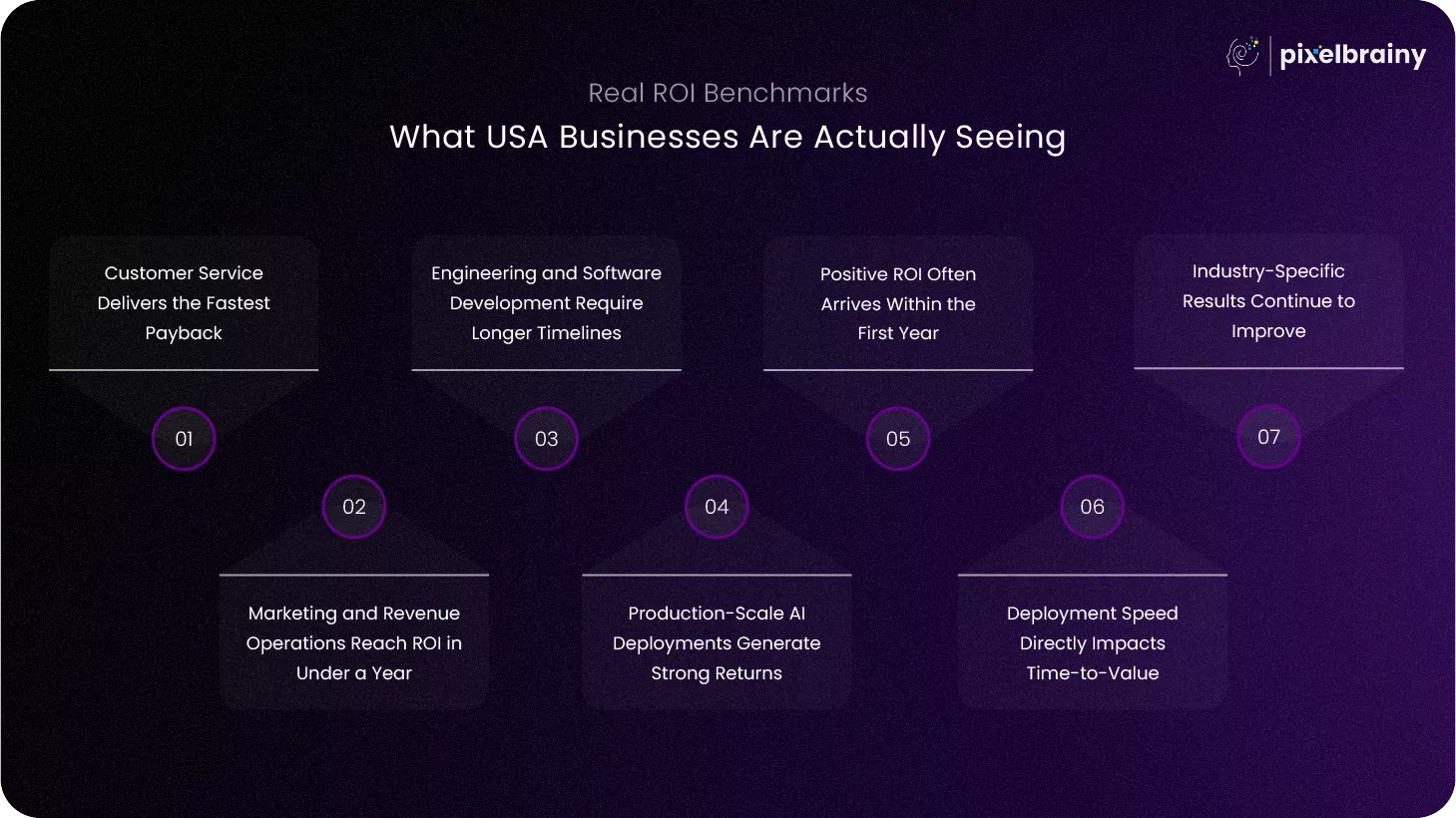
Customer support remains one of the quickest areas to generate returns. Organizations implementing AI-powered customer service agents report an average payback period of approximately 4.1 months, making it one of the fastest-returning AI investments available.
AI-powered lead management, campaign optimization, and content automation initiatives achieve an average payback period of 6.7 months. Many organizations see productivity gains before full financial ROI is realized.
AI initiatives focused on software engineering, code generation, testing automation, and development operations typically achieve payback within 9.3 months, reflecting the greater complexity of implementation.
Organizations that move beyond pilot programs and deploy AI across core business functions report an average ROI multiple of approximately 1.7x, meaning every dollar invested generates $1.70 in measurable business value.
According to a widely cited Microsoft and IDC study, organizations realize an average return of $3.70 for every $1 invested in AI, demonstrating why AI remains a top strategic investment priority across industries.
Approximately 41% of AI deployments achieve positive ROI within 12 months, particularly when focused on operational efficiency, customer service automation, and workflow optimization.
Businesses implementing vendor-deployed AI agents typically reach production in around 38 days, while custom-built AI systems require approximately 94 days before delivering measurable operational value.
In retail, approximately 94% of organizations report lower operational costs after implementing AI-driven automation and analytics initiatives. Contact centers report average cost reductions of around 30% through AI-assisted customer service operations.
Although the average AI ROI for businesses continues to improve, not every organization achieves identical results. Three factors have the greatest influence on outcomes.
The first is data readiness. Companies with clean, accessible, and well-structured data typically see faster implementation and stronger results. The second is integration depth. AI solutions connected to core systems such as CRM, ERP, customer support, and finance platforms generate more value than isolated tools. The third is use case selection. Organizations that focus on high-volume, repetitive processes usually achieve faster returns than those pursuing broad transformation projects from day one.
For businesses asking about the average ROI of AI implementation for enterprises, the evidence from 2026 is clear: organizations that start with operational cost reduction use cases and scale strategically are seeing the fastest path to measurable value.
Reducing operational costs with AI is not simply about adopting the latest technology. The real challenge is choosing the right implementation approach. For most businesses, the decision comes down to two options: purchasing an existing AI solution or investing in custom AI development. Both approaches can generate significant savings, but the ROI profile differs depending on business size, operational complexity, and long-term objectives.
Pre-built AI platforms are often the fastest path to operational improvements. They are designed for businesses that need rapid deployment, standardized functionality, and predictable costs.
Off-the-shelf solutions typically work best when:
Popular examples include Microsoft Copilot, Salesforce Einstein, and HubSpot AI. These platforms can quickly automate content creation, customer support tasks, CRM management, reporting, and workflow assistance.
For companies looking at how to use AI to reduce business costs quickly, these solutions often provide measurable benefits within weeks. They require minimal development effort and can be deployed across departments with relatively low risk.
As organizations grow, operational complexity increases. Unique workflows, multiple software systems, proprietary data, and industry-specific requirements often limit the effectiveness of generic AI tools.
Custom AI development generally delivers stronger long-term ROI when:
While vendor-based AI agents often reach production and begin delivering value in approximately 38 days, custom AI solutions typically require longer implementation cycles. However, once the first optimization phase is completed, custom systems frequently outperform off-the-shelf tools because they are designed around the organization's specific cost drivers and operational challenges.
For businesses focused on enterprise AI cost optimization, custom AI often creates deeper automation, better system integration, and larger cumulative savings over time.
Before choosing between a pre-built platform and a custom AI solution, business leaders should answer three questions:
If the answers point toward speed, simplicity, and limited customization, off-the-shelf AI tools are often the right choice. If the answers point toward complex operations, large-scale automation, and sustainable cost reduction, custom AI development will usually generate stronger long-term ROI and greater operational impact.
Many businesses understand that AI can reduce costs, but far fewer know how to implement it successfully. The biggest mistake organizations make is starting with technology instead of starting with a business problem. Whether your goal is to cut overhead by 30%, improve productivity, or achieve measurable operational savings within 90 days, a structured approach is critical.
The following framework provides a practical roadmap that CFOs, operations leaders, and business owners can use to implement AI for measurable cost reduction.
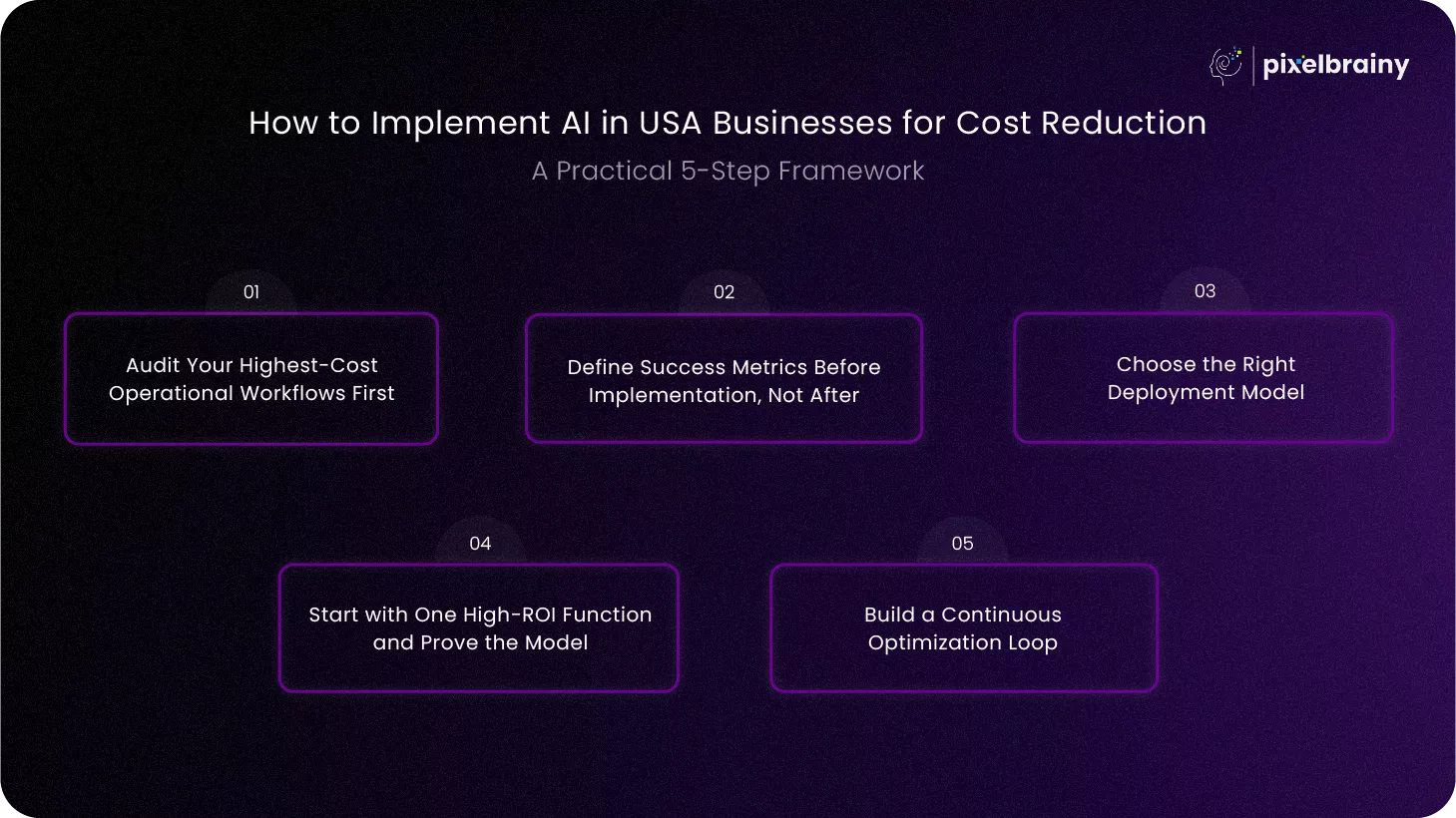
Before evaluating AI platforms or vendors, create a clear operational cost map.
Identify the three to five business functions consuming the most time, labor, and resources while delivering relatively low strategic value. Common examples include customer support ticket handling, invoice processing, data entry, inventory management, scheduling, and reporting.
The objective is not to find where AI can be applied. The objective is to find where costs are highest and inefficiencies are most visible. These workflows become your first opportunities for AI for workflow automation and operational improvement.
Organizations that begin with a cost-focused assessment typically achieve faster ROI than those pursuing broad AI initiatives without a clear business case.
One of the primary reasons AI projects fail is the absence of measurable success criteria.
Every AI deployment should be linked to specific business outcomes before implementation begins.
Examples include:
Without baseline metrics, proving ROI becomes nearly impossible. Establishing these benchmarks upfront creates accountability and provides a clear way to evaluate success.
If your goal is to learn how to use AI to reduce business costs, measurement must be part of the strategy from day one.
The next step is selecting the most appropriate implementation approach.
Vendor-based solutions often work best when processes are standardized and rapid deployment is the priority. Businesses can quickly implement tools for customer support, content generation, reporting, and workflow management.
However, if the target process involves proprietary data, multiple software systems, or highly specialized workflows, custom AI development usually delivers stronger long-term value and deeper automation opportunities.
The right choice depends less on company size and more on workflow complexity and integration requirements.
Rather than launching multiple AI projects simultaneously, focus on one area where measurable savings can be achieved quickly.
Customer support automation and back-office process automation consistently produce some of the fastest returns. These functions typically involve repetitive tasks, structured workflows, and high labor costs, making them ideal candidates for early implementation.
For businesses asking, "What is the quickest AI implementation that can show real savings within 90 days?", customer service automation is often the strongest starting point.
Once ROI is proven internally, organizations can expand AI into finance, HR, supply chain, marketing, and other operational functions.
AI implementation is not a one-time project. Long-term success depends on continuous improvement.
Business processes evolve, customer behavior changes, and operational requirements shift over time. AI systems that are not monitored, refined, and updated can gradually lose effectiveness.
A successful AI strategy should include:
This ensures sustained AI operational efficiency and helps maximize the long-term value of the investment.
Knowing that AI can reduce operating costs is one thing. Successfully implementing it is another.
Many businesses reach a point where they understand the potential of AI but struggle with a more practical question: Which development partner can actually deliver measurable cost savings? Choosing the wrong partner often leads to lengthy implementation cycles, disconnected tools, poor user adoption, and AI solutions that fail to integrate with existing business systems. The result is delayed ROI and increased project costs instead of operational efficiency.
This is where PixelBrainy as an AI development company takes a different approach.
As Biz4Group's specialist AI development and digital product design brand, PixelBrainy operates at the intersection of intelligent automation, user-centered design, and business performance. The focus is not simply building AI features. The focus is building AI solutions that employees use, customers embrace, and organizations can directly connect to measurable business outcomes.
One of the biggest reasons AI projects underperform is poor adoption. Even the most advanced system creates little value if employees avoid using it. PixelBrainy combines deep technical AI expertise with strong UI/UX design principles to ensure solutions are intuitive, practical, and integrated into daily workflows from day one.
Key capabilities include:
Whether the goal is implementing AI tools to cut operational expenses, modernizing internal workflows, or investing in custom AI development for business, execution quality often determines whether a project delivers measurable cost savings or becomes another underutilized technology investment.
Ready to turn AI cost-reduction strategies into measurable business outcomes? Let's connect with the PixelBrainy experts and explore how a tailored AI solution can help improve operational efficiency, reduce overhead, and accelerate ROI.

The pressure on businesses to control costs while maintaining growth has never been greater. Rising labor expenses, operational complexity, and increasing customer expectations are forcing organizations to find smarter ways to operate. As the examples and benchmarks throughout this guide demonstrate, AI is no longer a future initiative. It is a practical business tool delivering measurable savings across customer service, finance, supply chain, HR, IT, and other operational functions.
The most successful organizations are not adopting AI everywhere at once. They are identifying high-cost workflows, defining clear success metrics, implementing targeted solutions, and scaling proven results across the business. Whether you choose off-the-shelf tools or invest in custom AI development, the key is aligning technology with measurable business outcomes.
Businesses that start today will be better positioned to improve efficiency, reduce overhead, increase productivity, and create sustainable competitive advantages throughout 2026 and beyond.
Ready to identify your highest-impact AI cost reduction opportunities? Book an appointment with the PixelBrainy team and discover how custom AI solutions can help your business reduce operational expenses and accelerate growth.
Most businesses using AI report operational cost savings of 5 to 20% in the first year. Enterprises running AI at production scale across multiple functions report savings of 26 to 31%, with leading adopters exceeding 30% in customer service, supply chain, and finance.
Customer support, finance and back-office operations, cloud infrastructure, and supply chain management consistently deliver the fastest and highest cost savings. Customer service AI delivers median ROI in 4.1 months, the fastest of any business function.
The average ROI for enterprises moving AI from pilot to production is 1.7x, with advanced adopters generating $3.70 for every $1 invested. Payback periods range from 4 to 9 months depending on the function and deployment model.
Vendor-deployed AI tools typically deliver first value within 38 days. Custom-built AI solutions average 94 days to initial deployment but tend to outperform off-the-shelf tools after the first optimisation cycle.
Yes. Small businesses with under 50 employees can see meaningful cost savings from AI in customer support, scheduling, and back-office automation. Entry-level AI tools require minimal upfront investment, and ROI is achievable within the first quarter for high-volume repetitive tasks.
Starting without pre-defined success metrics. Businesses that deploy AI without tying it to a measurable outcome such as cost per ticket or processing time cannot prove ROI, which leads to premature project cancellation before benefits materialise.
Look for a partner with demonstrated experience in your specific business function, not just general AI capability. Ask for case studies showing measurable cost outcomes. Prioritise vendors who include UI/UX planning, change management support, and post-deployment monitoring as part of their engagement model.

About The Author
Sagar Bhatnagar
Sagar Sahay Bhatnagar brings over a decade of IT industry experience to his role as Marketing Head at PixelBrainy. He's known for his knack in devising creative marketing strategies that boost brand visibility and market influence. Sagar's strategic thinking, coupled with his innovative vision and focus on results, sets him apart. His track record of successful campaigns proves his ability to utilize digital platforms effectively for impactful marketing efforts. With a genuine passion for both technology and marketing, Sagar continuously pushes PixelBrainy's marketing initiatives to greater success.


Transform your ideas into reality with us.
Working with the PixelBrainy team has been a highly positive experience. They understand the design requirements and create beautiful UX elements to meet the application needs. The dev team did an excellent job bringing my vision to life. We discussed usability and flow. Sagar worked with his team to design the database and begin coding. Working with Sagar was easy. He has the knowledge to create robust apps, including multi-language support, Google and Apple ID login options, Ad-enabled integrations, Stripe payment processing, and a Web Admin site for maintaining support data. I'm extremely satisfied with the services provided, the quality of the final product, and the professionalism of the entire process. I highly recommend them for Android and iOS Mobile Application Design and Development.

Great experience working with them. Had a lot of feedback and I found that unlike most contractors they were bugging me for updates instead of the other way around. They were extremely time conscience and great at communicating! All work was done extremely high quality and if not on time, early! They were always proactive when it comes to communication and the work is great/above par always. Very flexible and a great team to work with! Goes above and beyond to present us with multiple options and always provides quality. Amazing work per usual with Chitra. If you have UI/UX or branding design needs I recommend you go to them! Will likely work with them in the future as well, definitely recommended!

PixelBrainy is a joy to work with and is a great partner when thinking through branding, logo, and website layout. I appreciate that they spend time going into the "why" behind their decisions to help inform me and others about industry best practices and their expertise.

I hired them to design our software apps. Things I really like about them are excellent communication skills, they answer all project suggestions and collaborate right away, and their input on design and colors is amazing. This project was complex and needed patience and creativity. The team is amazing to do business with. I will be using them long-term. Glad to see there are some good people out there. I was afraid to try and outsource my project to someone but I am glad I met them! I really can't say enough. They went above and beyond on this project. I am very happy with everything they have done to make my business stand out from the competition.

It was great working with PixelBrainy and the team. They were very responsive and really owned the project. We'll definitely work with them again!

I recently worked with the PixelBrainy team on a project and I was blown away by their communication skills. They were prompt, clear, and articulate in all of our interactions. They listened and provided valuable feedback and suggestions to help make the project a success. They also kept me updated throughout the entire process, which made the experience stress-free and enjoyable.

PixelBrainy is very good at what it does. The team also presents themselves very professionally and takes care of their side of things very well. I could fully trust them taking up the design work in a timely and organised manner and their attention to detail saved us lots of effort and time. This particular project was quite intense and the team showed that they function very well under pressure. Very much looking forward to working with her again!

It's always an absolute pleasure working with them. They completed all of my requests quickly and followed every note I had for them to a T, which made our process go smoothly from start to finish. Everything was completed fast and following all of the guidelines. And I would recommend their services to anyone. If you need any design work done in the future, PixelBrainy should be your first call!

They took ownership of our requirements and designed and proposed multiple beautiful variants. The team is self-motivated, requires minimum supervision, committed to see-through designs with quality and delivering them on time. We would definitely love to work with PixelBrainy again when we have any requirements.

PixelBrainy was a big help with our SaaS application. We've been hard at work with a new UI/UX and they provided a lot of help with the designs. If you're looking for assistance with your website, software, or mobile application designs, PixelBrainy and the team is a great recommendation.

PixelBrainy designers are amazing. They are responsive, talented, and always willing to help craft the design until it matches your vision. I would recommend them and plan to continue them for my future projects and more!!!

They were awesome! Did a good job fast, and good communication. Will work with them again. Thank you

Creative, detail-oriented, and talented designers who take direction well and implement changes quickly and accurately. They consistently over-delivered for us.

PixelBrainy team is very talented and creative. Great designers and a pleasure to work with. PixelBrainy is an excellent communicator and I look forward to working with them again.

PixelBrainy has a very talented design team. Their work is excellent and they are very responsive. I enjoy working with them and hope to continue on all of our future projects.


