AI Summary Powered by PixelBrainy
Should your business build an in-house AI engineering team from scratch, or outsource AI software development to a specialized partner to launch faster without committing to years of hiring costs?
For a CTO at a Series B startup, this decision is more than a question of engineering resources. It is a strategic investment that affects product velocity, cash flow, technical ownership, and the company's ability to deliver measurable business results before competitors catch up. When your board expects AI capabilities to reach production quickly, choosing the wrong development model can cost your business months of execution time and hundreds of thousands of dollars in avoidable expenses.
The decision around in-house vs outsourced AI software development becomes particularly important when your existing engineering team lacks specialized expertise in machine learning, large language models (LLMs), retrieval-augmented generation (RAG), AI agents, model evaluation, and production-grade AI infrastructure. Hiring three to four senior AI engineers may appear to be the safest long-term investment, but salaries represent only one part of the actual cost. Benefits, equity, recruitment fees, onboarding, infrastructure, management overhead, and the time required to build a fully operational team can significantly increase the total investment.
Alternatively, AI development outsourcing for businesses provides access to experienced specialists, established engineering processes, and cross-functional expertise without requiring a company to recruit every skill internally. However, outsourcing also introduces important considerations, including vendor dependency, intellectual property protection, communication overhead, and the long-term cost of maintaining the delivered software.
The market makes this decision increasingly urgent. According to Gartner's September 2026 forecast, worldwide AI spending is projected to reach $2.7 trillion in 2026, representing 49.5% year-over-year growth. Gartner also forecasts worldwide AI software spending to reach approximately $461.6 billion in 2026 and $656.4 billion in 2027. These figures demonstrate the scale of investment in AI, although they do not guarantee that every AI project will generate a positive return.
For decision-makers evaluating in-house AI development vs outsourcing, the right answer depends on the capabilities they need, their delivery deadlines, the sensitivity of their data, and their long-term product strategy. This guide compares the full costs, benefits, risks, and operational trade-offs of both approaches, including realistic 2027 budget scenarios, to help you decide whether to build an AI team in-house or outsource and present a defensible recommendation to your board.

Should your business invest in building a dedicated AI engineering team or partner with an external AI development company to deliver AI capabilities faster and more cost-effectively? For CTOs and business leaders in 2027, the answer depends on more than salaries and agency fees. It requires evaluating technical expertise, recruitment timelines, infrastructure costs, delivery speed, and long-term product ownership.
Unlike standard software development, AI engineering spans several specialized disciplines, including machine learning, large language models (LLMs), data engineering, model evaluation, MLOps, and AI security. Experienced AI professionals are in high demand, making recruitment competitive, expensive, and time-consuming. AI projects also require additional investment in computing infrastructure, model APIs, data pipelines, and ongoing performance monitoring.
In-house AI development means hiring full-time AI engineers, machine learning engineers, data scientists, and AI product managers who work as employees on your company's AI initiatives. This approach provides direct control over technical decisions, intellectual property, product priorities, and long-term knowledge retention.
Outsourced AI development involves engaging an external AI development company to deliver specific AI capabilities through a defined project or ongoing engagement. The contract establishes the scope, timeline, deliverables, pricing, and responsibilities, allowing businesses to access specialized expertise without recruiting every role internally.
A third option is the hybrid AI development model, which combines a core internal team with outsourced specialists. For example, your CTO and existing engineers can retain product ownership and architectural control while an external team develops AI integrations, retrieval-augmented generation (RAG) pipelines, or model evaluation systems.
| Model | Who Does the Work | Cost Structure | Control Level | Speed to Start |
|---|---|---|---|---|
| Fully in-house | Your own employees | Salaries, benefits, equity, and overhead | Highest | Slowest, often 3 to 6 months to assemble a team |
| Fully outsourced | External AI development company | Project fee or ongoing retainer | Medium | Often fastest, potentially within weeks |
| Hybrid model | Internal core team plus external specialists | Combined salaries and agency fees | High | Medium, depending on internal readiness |
Timelines are illustrative estimates and depend on hiring conditions, project complexity, and provider availability.
Ultimately, the in-house AI development vs outsourcing decision comes down to how quickly your business needs AI capabilities, how much internal expertise it can support, and which capabilities must remain under direct company control. The right model balances delivery speed, cost efficiency, and long-term technical ownership.
Building an in-house AI development team gives businesses greater control over their technology, intellectual property, product roadmap, and long-term engineering capabilities. However, the financial commitment extends well beyond employee salaries. Companies must account for benefits, equity compensation, recruitment fees, onboarding, infrastructure, software licenses, and the productivity lost while new hires learn the codebase and business requirements.
These expenses are particularly important for Series B startups facing pressure to launch AI-powered features quickly while managing their cash runway. Recruiting experienced AI professionals can take months, and assembling a complete team requires multiple complementary skill sets, including machine learning, data engineering, AI application development, and production infrastructure.
For CTOs evaluating their next investment, how much does it cost to build an in-house AI team in 2027? The answer depends on team composition, location, seniority, and infrastructure requirements. For US-based businesses, the following breakdown provides an illustrative budgeting framework for understanding the full in-house AI development cost in 2027.
Senior AI engineers and machine learning engineers in major US technology markets may command annual base salaries of approximately $180,000 to $280,000 and $160,000 to $250,000, respectively. Data scientists may earn $140,000 to $220,000, while AI product managers may earn $150,000 to $220,000.
These figures are illustrative planning ranges rather than verified national salary averages. Actual compensation varies by location, experience, specialization, and company stage. Equity and other incentives may increase total compensation by 20% to 40% above base salary, although equity should be tracked separately from cash expenditure.
Employer payroll taxes, health insurance, retirement contributions, and other employee benefits can add approximately 25% to 35% to base salary.
For example, an AI engineer earning $200,000 annually could cost $250,000 to $270,000 per year in salary and employment-related expenses alone. This excludes recruiting, equipment, infrastructure, and management overhead.
Specialist recruitment fees can reach 20% to 30% of an AI engineer's first-year base salary. Hiring four engineers earning an average of $200,000 could therefore generate $160,000 to $240,000 in recruiting fees when external recruiters are used for every position.
Senior AI hiring may take three to six months in competitive markets. Failed hires can create additional recruitment expenses, onboarding costs, and delivery delays.
New AI engineers typically need two to four months to become fully productive in an unfamiliar codebase, data environment, and business domain. During this period, the company pays full compensation while employees learn internal systems and require guidance from existing engineers and technical leaders.
The resulting productivity gap can delay AI product delivery, although its financial impact depends on the project and the employee's contribution during onboarding.
AI development requires infrastructure and tools beyond those typically needed for conventional application development. Expenses may include GPU compute, cloud hosting, model API usage, data storage, experiment tracking, evaluation platforms, and MLOps tools.
For a small AI team, an illustrative annual infrastructure and tooling budget is $30,000 to $100,000 or more, depending on model usage, data volumes, and training requirements.
The following table estimates annual employment and recruiting costs for individual roles, alongside the infrastructure budget required to support the team.
| Role | Base Salary Range | Total Employment Cost | Recruiting Cost |
|---|---|---|---|
| Senior AI engineer | $180,000 to $280,000 | $225,000 to $378,000 | $36,000 to $84,000 |
| ML engineer | $160,000 to $250,000 | $200,000 to $338,000 | $32,000 to $75,000 |
| Data scientist | $140,000 to $220,000 | $175,000 to $297,000 | $28,000 to $66,000 |
| AI product manager | $150,000 to $220,000 | $188,000 to $297,000 | $30,000 to $66,000 |
| Infrastructure and tooling | Not applicable | $30,000 to $100,000 annually | None |
| Minimum three-person team: AI engineer, ML engineer, and data scientist | $480,000 to $750,000 | $600,000 to $1,013,000 | $96,000 to $225,000 |
For a four-person team that also includes an AI product manager, annual employment costs could reach approximately $788,000 to $1.31 million before recruitment, infrastructure, and other overhead. The actual total will depend on the compensation packages and operating requirements of the team.
Ultimately, the true in-house AI development cost in 2027 is significantly higher than base salaries alone suggest. Before committing to permanent hiring, businesses should calculate the full cost of recruitment, employment, infrastructure, and ramp-up time, then compare that investment against the cost of outsourcing an equivalent AI
Outsourcing AI software development allows businesses to access specialized engineering expertise without committing to the salaries, benefits, and long-term employment costs associated with building an internal team. Unlike in-house hiring, outsourced engagements typically define fees through project-based pricing, hourly rates, or monthly retainers, making the initial investment easier to forecast. However, the agency fee alone does not represent the total cost of delivering and maintaining an AI solution.
For CTOs and business leaders planning their 2027 AI budgets, the main considerations include the provider's location, team composition, project complexity, internal coordination, and ongoing maintenance. Understanding these factors is essential when evaluating the AI software development outsourcing cost and comparing providers across different markets.
AI development rates vary significantly by geography, specialization, seniority, and engagement structure. The following figures are illustrative budgeting ranges for 2027, not verified market averages or guaranteed provider quotations.
For businesses evaluating the outsourcing AI development to India vs Eastern Europe cost comparison, India may offer lower hourly rates, while Eastern European providers may suit projects requiring particular technical specializations or greater working-hour overlap with European clients. Neither geography guarantees superior quality. Evaluate production experience, engineering standards, communication, security, and delivery outcomes before making a decision.
Outsourcing reduces direct recruitment responsibilities, but your internal team must still define requirements, review deliverables, coordinate stakeholders, and approve releases.
As a preliminary budgeting assumption, allocate an additional 15% to 25% of the agency engagement cost for internal management and coordination time. The actual amount depends on project complexity, organizational readiness, and the level of oversight required.
When an outsourced engagement ends, internal engineers need sufficient documentation and technical knowledge to maintain the delivered system. Budget for handover sessions, architecture documentation, deployment procedures, repository access, and operational training.
Including these deliverables in the original contract can reduce transition costs and prevent vendor dependency.
The following comparison assumes a consistent workload of 160 billable hours per month for six months or 12 months. Project estimates exclude internal management, infrastructure, model usage, and transition expenses.
| Location | Hourly Rate | Six-Month Project Cost | Annual Retainer Cost |
|---|---|---|---|
| United States | $150 to $250 | $144,000 to $240,000 | $288,000 to $480,000 |
| Western Europe | $100 to $150 | $96,000 to $144,000 | $192,000 to $288,000 |
| Eastern Europe | $50 to $100 | $48,000 to $96,000 | $96,000 to $192,000 |
| India and South Asia | $25 to $60 | $24,000 to $57,600 | $48,000 to $115,200 |
| PixelBrainy | Custom quotation | Custom project estimate | Custom retainer quotation |
PixelBrainy's pricing is not independently verified here. Contact the company for current rates and a project-specific estimate. The table represents one full-time equivalent at 160 hours per month, not the total cost of a multi-person AI development team.
A realistic budget should combine agency fees with internal coordination, infrastructure, third-party model charges, security reviews, and knowledge transfer. Comparing these expenses over the same period and against equivalent deliverables produces a more reliable in-house vs outsourced AI development cost comparison.
Ultimately, outsourcing can reduce the initial financial commitment and accelerate access to specialized AI expertise, but the best-value partner is the one that delivers reliable results, transparent costs, and sustainable technical ownership.
The in-house AI team vs AI development agency comparison involves more than comparing salaries with agency fees. Businesses must evaluate delivery speed, total cost of ownership, access to specialized expertise, intellectual property (IP) protection, scalability, and long-term knowledge retention. For startups and enterprise businesses, the right approach depends on whether AI is a core, long-term competitive advantage or a specific capability that needs to be delivered quickly.
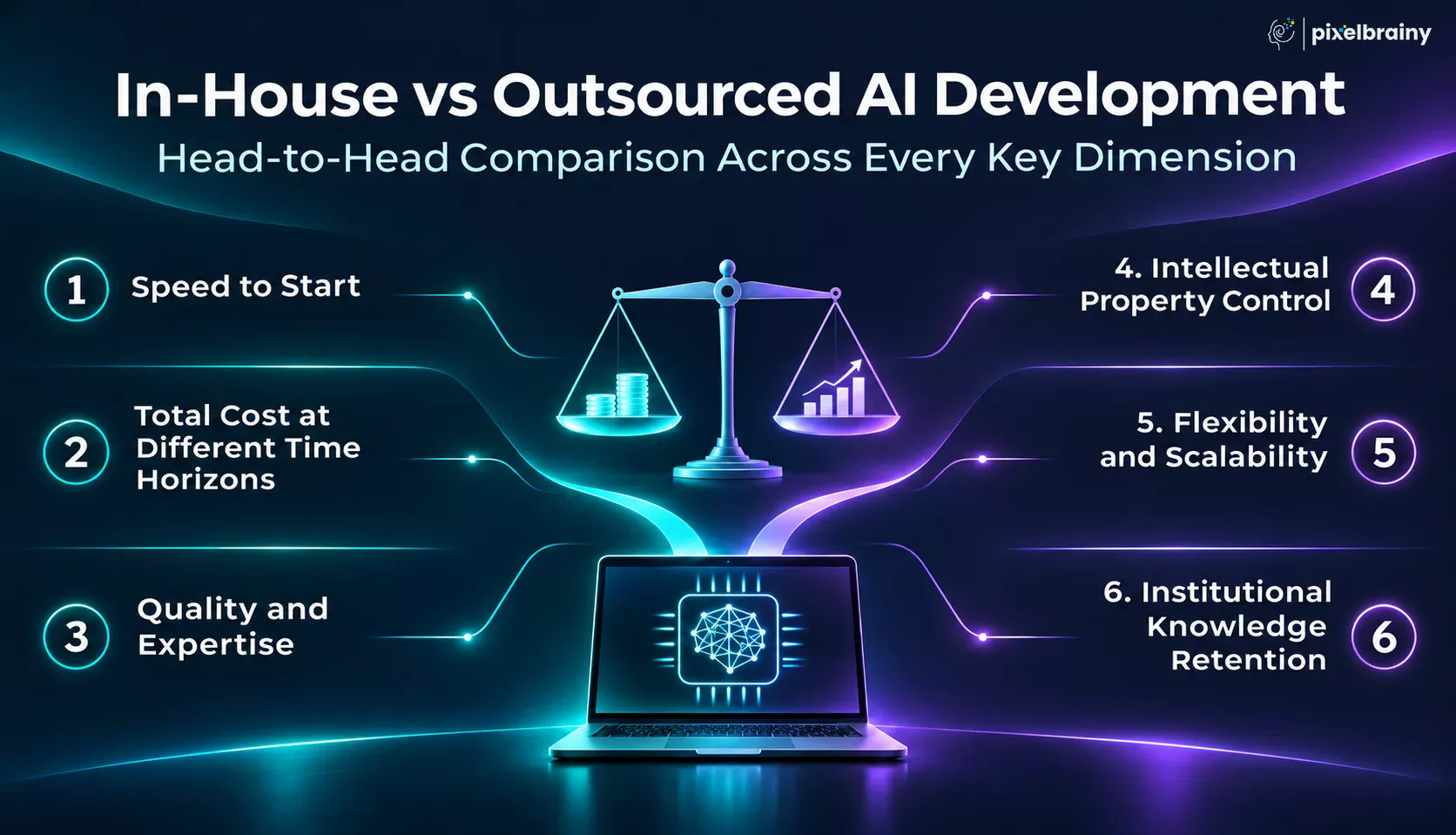
In-house development: Recruiting senior AI engineers involves interviews, offer negotiations, notice periods, and onboarding. Building a productive team can take three to six months or longer.
Outsourced development: An established AI development agency may begin work within two to four weeks of signing, provided the team is available and the scope is defined.
Winner: Outsourced development for urgent delivery requirements.
Year one: Outsourcing can be less expensive for a defined project because businesses avoid permanent hiring commitments, recruitment fees, and much of the initial ramp-up expenditure.
Years two to three: The cost gap may narrow as an internal team becomes productive, although salaries, benefits, infrastructure, and retention costs continue.
Year four and beyond: In-house development can become more cost-effective when a retained team consistently supports a substantial AI roadmap. Outsourcing may remain more economical when demand fluctuates or specialist capacity is needed only for specific projects.
Winner: Depends on workload and utilization. Compare both models over equivalent time periods and deliverables rather than assuming either is always cheaper.
In-house quality depends on hiring success, technical leadership, and ongoing training. Internal engineers can develop deep knowledge of the company's product and customers.
Outsourcing provides access to an existing team of specialists, potentially including AI architects, ML engineers, data engineers, and MLOps experts. However, delivery quality depends on the actual professionals assigned to your project and their relevant experience.
Winner: Outsourced development for rapid access to specialized expertise, provided the agency has verified capabilities.
An internal team makes IP governance more straightforward because development occurs within the company's established environment. Employment agreements, third-party licenses, and security controls are still necessary.
Outsourcing requires clear IP assignment clauses, confidentiality agreements, data-processing terms, and explicit ownership of custom deliverables. Pre-existing vendor tools and third-party components must also be addressed.
Winner: In-house development for simpler IP governance. Carefully structured outsourcing contracts can also provide strong protection.
Expanding an internal team requires recruitment, onboarding, and additional employment expenditure. Reducing headcount can involve restructuring costs and employee impacts.
Outsourcing allows businesses to adjust contracted capacity according to project requirements, subject to availability, notice periods, and contractual terms.
Winner: Outsourced development for variable workloads and flexible access to specialists.
Internal employees accumulate knowledge about product architecture, business processes, customer behavior, and AI performance. This knowledge remains accessible while employees stay and documentation is maintained.
Outsourced engagements introduce knowledge-transfer risks when contracts end. Businesses can reduce these risks through documentation requirements, code reviews, recorded architectural decisions, and structured handovers.
Winner: In-house development for ongoing internal knowledge retention.
| Dimension | In-House Development | Outsourced Development | Advantage |
|---|---|---|---|
| Speed to start | Often 3 to 6 months to build a team | Potentially 2 to 4 weeks | Outsourced |
| Total cost over time | Can be cost-effective with sustained utilization | Can reduce initial and project-specific costs | Depends on workload |
| Quality and AI expertise | Depends on recruitment, training, and retention | Access to specialists depends on vendor quality | Outsourced for rapid specialist access |
| Intellectual property control | Direct internal governance | Requires clear contractual protections | In-house for simpler governance |
| Flexibility and scalability | Hiring and restructuring required | Capacity adjusted contractually | Outsourced |
| Institutional knowledge retention | Accumulates internally | Requires deliberate knowledge transfer | In-house |
The comparison reflects typical trade-offs. Actual outcomes depend on project complexity, team utilization, vendor quality, and contractual arrangements.
Ultimately, outsourcing generally offers advantages in delivery speed, specialist access, and flexible capacity, while in-house development provides greater continuity and simpler internal knowledge retention. For many businesses, a hybrid model can balance both by retaining strategic ownership internally while outsourcing specialized implementation work.
Building an in-house AI team is the right choice when your business needs long-term technical ownership, continuous AI development, and direct control over proprietary technology or sensitive data. Although internal hiring requires a higher initial investment, it can deliver strategic value when AI capabilities are central to your competitive advantage and require ongoing improvement.
For CTOs evaluating how to decide between in-house and outsourced AI development, the key question is whether AI expertise is a temporary project requirement or a permanent business capability. The following scenarios help determine when investing in an internal team makes sense.
If AI is your primary product differentiator, keeping critical development in-house can protect proprietary technology and preserve specialized knowledge. This is particularly relevant to AI-first companies building proprietary models, businesses with valuable training datasets, or organizations developing unique algorithms that competitors cannot easily replicate.
Internal teams can continuously improve these capabilities using customer feedback, proprietary data, and accumulated product knowledge without depending entirely on an external provider.
Businesses with a sustained pipeline of AI projects may benefit from the economics of permanent employees rather than repeatedly paying agency rates.
For example, a SaaS company developing AI recommendations, automated workflows, intelligent search, and predictive analytics may need dedicated AI engineers throughout the year.
The break-even point between in-house and outsourced development can fall within 12 to 24 months under certain assumptions, but this is not a universal benchmark. It depends on hiring costs, salaries, agency rates, team utilization, and the volume of work.
Healthcare, financial services, defense, and other regulated sectors may face restrictions on third-party access to sensitive data, systems, or source code.
An internal team can simplify access governance and reduce external exposure. However, in-house development does not automatically ensure compliance. The organization must still implement appropriate security controls, audits, and regulatory safeguards.
Building an internal AI team works best when an experienced CTO, VP of AI, or engineering leader can recruit, mentor, and retain specialized talent.
Without strong technical leadership, businesses risk hiring the wrong profiles, building unnecessary infrastructure, and struggling to move AI prototypes into production.
| Signal | Why It Favors In-House |
|---|---|
| AI is a core competitive differentiator | Protects proprietary expertise and supports continuous innovation |
| Continuous, high-volume AI development | Can improve long-term economics through sustained team utilization |
| Sensitive data requires strict access controls | Enables direct governance over employee and system access |
| Strong technical leadership is available | Improves hiring, architecture, and team retention |
| Long-term product development is planned | Builds institutional knowledge and technical continuity |
Therefore, in-house AI development is most suitable when your company must own its AI expertise for the long term, has sufficient ongoing work to justify a permanent team, and can support the investment with strong technical leadership. For startups, the decision should be driven by strategic importance and sustained demand, not simply the desire to keep all development under one roof.
Outsourcing AI software development is often the right choice when a business needs specialized expertise quickly, has a defined project scope, or cannot justify the cost and time required to build a permanent AI engineering team. It allows companies to access experienced AI developers without committing immediately to full-time salaries, benefits, recruitment expenses, and long-term employment overhead.
For CTOs and startup founders evaluating when to outsource AI software development, the decision often comes down to delivery deadlines, hiring constraints, budget availability, and uncertainty about future demand. Outsourcing can be particularly valuable for startups that need to validate an AI product, demonstrate results to investors, or launch a new capability before competitors.
When speed to market is a competitive requirement, outsourcing can provide access to an established AI development team without waiting several months to recruit and onboard specialists.
This is especially relevant for startups racing to validate a product concept, meet board commitments, or deliver an AI feature before their funding runway becomes a constraint. However, faster delivery depends on the agency's availability, technical experience, and understanding of your requirements.
Not every business needs permanent AI engineers. If your requirements involve a defined initiative, such as developing an AI chatbot, integrating an LLM, building a RAG pipeline, or creating a proof of concept, outsourcing can align expenditure with the work required.
Instead of maintaining a full-time team between projects, you can engage specialists for the relevant development phases and adjust capacity as priorities change.
Businesses outside major technology hubs may struggle to recruit senior AI engineers because of compensation constraints, limited local talent, or competition from large technology companies.
Outsourcing expands access to specialist teams across different regions without requiring your company to establish a local recruitment pipeline for every AI discipline.
Outsourcing an initial AI project allows your business to test technical feasibility, customer demand, and potential return on investment before committing to permanent hiring.
For early-stage startups, this approach can reduce the financial risk of building a large team around an unvalidated idea. It also helps identify the capabilities that should eventually become internal responsibilities.
| Signal | Why It Favors Outsourcing |
|---|---|
| Immediate development start required | Can avoid the time needed to recruit and onboard an internal team |
| Project-based rather than continuous needs | Aligns costs with project requirements without permanent team overhead |
| Difficulty attracting AI talent | Provides access to specialist expertise beyond the local hiring market |
| Product-market fit validation needed | Limits initial commitment before a larger investment |
| Early-stage budget constraints | Can reduce initial cash requirements compared with building an equivalent internal team |
Outsourcing does not eliminate project management, infrastructure, or maintenance costs, so businesses should evaluate the complete cost of delivery rather than the agency fee alone.
Therefore, outsourcing AI software development is particularly suitable when speed, flexible access to expertise, and controlled initial investment matter more than maintaining every capability internally. For startups, it can provide a practical path to validate AI opportunities and build momentum before committing to a permanent engineering team.
A hybrid AI development model combines the strengths of internal engineering teams and external AI specialists, helping businesses accelerate development while maintaining control over their technology, data, and product strategy.
For a Series B startup, this approach can be particularly effective. Instead of waiting months to hire three to four senior AI engineers or outsourcing the entire product, the company can retain core technical ownership internally and bring in external specialists to accelerate delivery.
The hybrid model divides responsibilities according to business priorities, technical expertise, and long-term ownership requirements.
The in-house team owns:
The outsourced AI development team handles:
For example, a SaaS company can retain its CTO, product manager, and backend engineers internally while engaging an AI development agency to build an LLM-powered assistant. The internal team maintains control of customer data access, application architecture, and product decisions, while the external team accelerates AI implementation.
A hybrid approach is particularly valuable when your business needs AI capabilities quickly but expects to maintain and expand them over several years.
Use the following framework to decide which responsibilities should remain internal and which should be outsourced.
| Business Requirement | Recommended Approach | Reason |
|---|---|---|
| AI is a core competitive advantage | In-house ownership | Protects strategic expertise and product knowledge |
| Immediate access to specialist AI skills | Outsourced specialists | Accelerates implementation without waiting for recruitment |
| Continuous AI development with urgent deadlines | Hybrid model | Combines internal continuity with additional delivery capacity |
| AI product concept still needs validation | Outsourced pilot, followed by reassessment | Limits initial hiring commitments |
| Long-term maintenance and frequent improvements | Internal ownership with external support as needed | Builds sustainable technical knowledge |
Businesses can move gradually from external delivery to internal ownership rather than making a costly transition all at once.
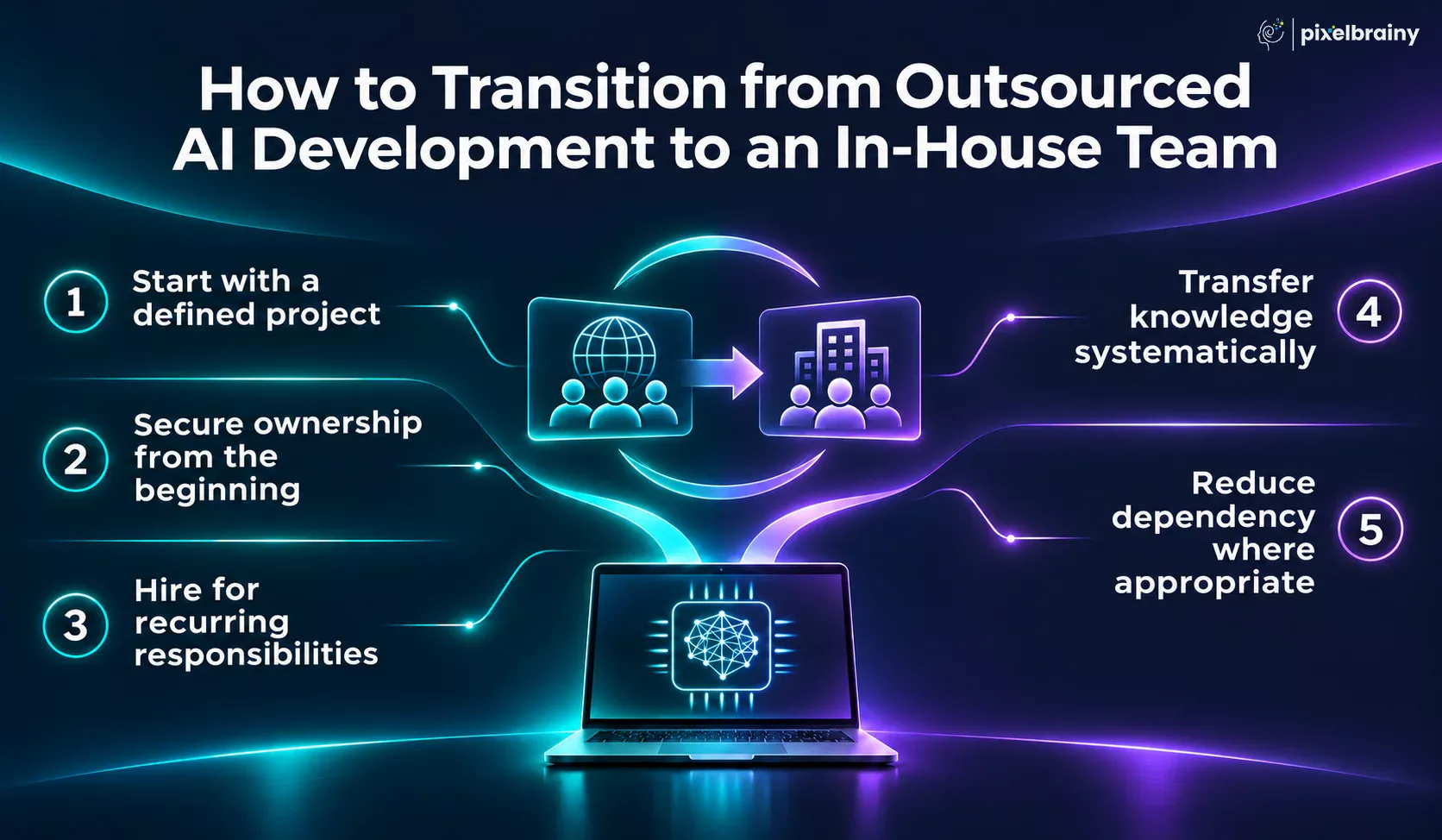
Step 1: Start with a defined project: Establish measurable objectives, delivery milestones, acceptance criteria, and budget limits.
Step 2: Secure ownership from the beginning: Maintain company-controlled code repositories, clarify IP rights, and require architecture documentation and deployment instructions.
Step 3: Hire for recurring responsibilities: As demand grows, recruit internal engineers for ongoing work such as AI architecture, data pipelines, evaluation, and production monitoring.
Step 4: Transfer knowledge systematically: Require code walkthroughs, technical documentation, automated tests, and practical training for internal engineers.
Step 5: Reduce dependency where appropriate: Move routine maintenance and core development internally while retaining external specialists for niche skills, temporary capacity, or complex projects.
The key is to plan knowledge transfer and operational ownership at the beginning of the engagement, rather than waiting until the outsourcing contract ends.
So, a hybrid AI development model offers businesses a practical balance between rapid implementation and long-term technical control. By keeping strategic capabilities internal and outsourcing specialized work selectively, companies can accelerate AI delivery while developing the expertise needed to sustain growth.
Protecting intellectual property (IP) and sensitive data is essential when outsourcing AI software development. Businesses must ensure that external developers cannot misuse proprietary code, expose confidential training data, or retain unauthorized access to critical AI systems after an engagement ends. The risks of outsourcing AI software development to a third party can be reduced through clear contractual protections, controlled development environments, and enforceable data-handling procedures.
For CTOs evaluating what to look for when outsourcing AI software development, a key question is: How can you protect your company's intellectual property, proprietary AI models, and customer data while giving an external development team the access it needs to deliver the project? The answer involves combining legally sound contracts with practical security controls that protect sensitive assets throughout development and after the engagement concludes.
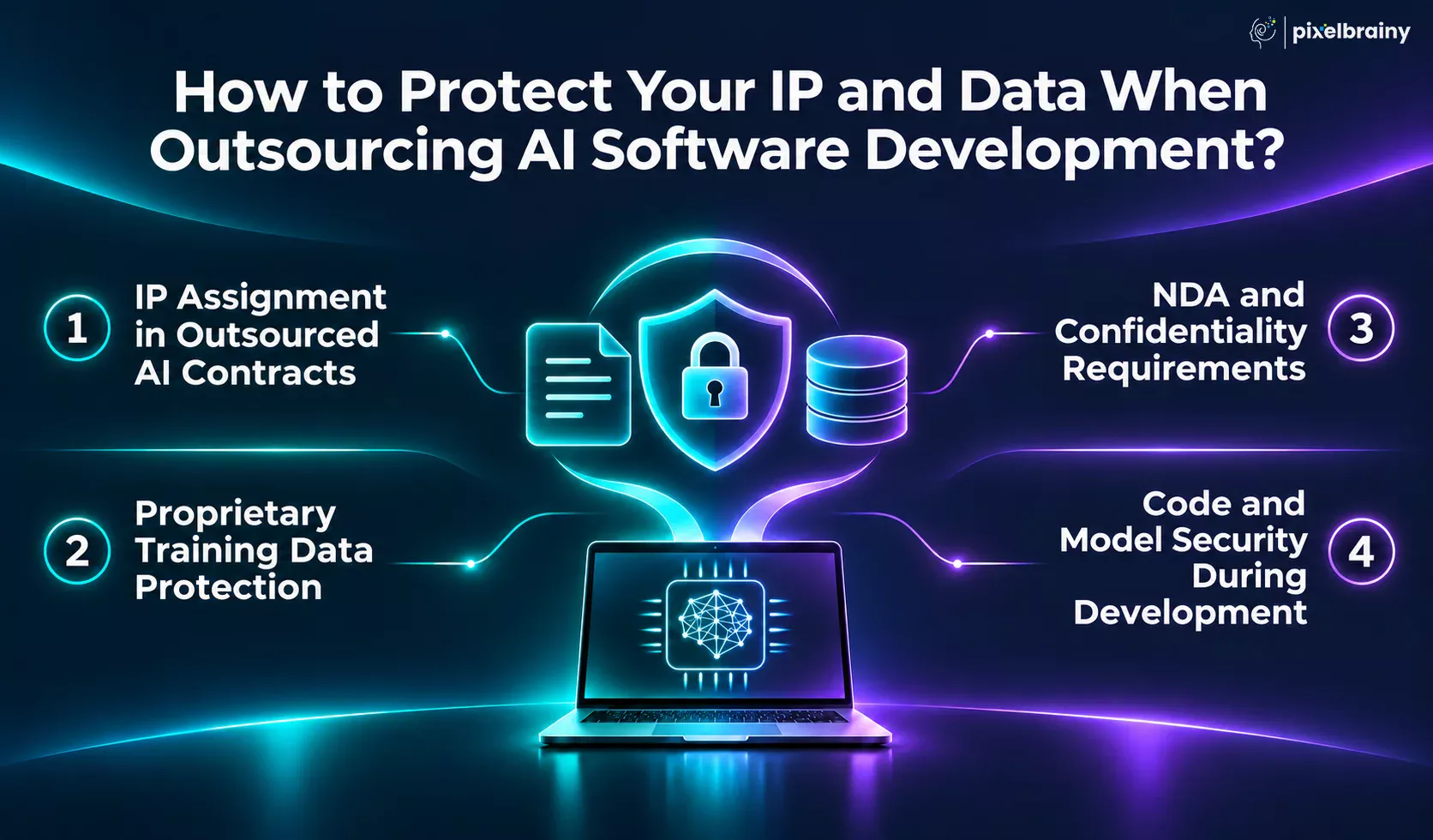
Your outsourcing agreement should explicitly establish ownership of project deliverables, including custom source code, AI models, model weights where applicable, and technical documentation. It should distinguish newly developed IP from the agency's pre-existing tools and third-party components.
Do not assume generic work-for-hire language automatically transfers every relevant right. Define IP assignment, licensing obligations, permitted reuse, and ownership transfer conditions with qualified legal counsel.
Training data and proprietary business information should be accessible only to authorized personnel who need them for the project. Contracts should prohibit unauthorized reuse of client data, including using it to train models for other clients.
Where practical, use anonymized, minimized, or synthetic datasets to reduce exposure. Establish retention periods, deletion requirements, and procedures for verifying data removal when the engagement ends.
Require appropriate nondisclosure agreements (NDAs) before sharing confidential project information. Ensure confidentiality obligations cover the agency, relevant personnel, and approved subcontractors.
Specify protection for AI architecture, training datasets, model performance metrics, business logic, customer information, and unreleased product plans.
Whenever feasible, use your own cloud environment or a dedicated environment under your control. Apply least-privilege access, multifactor authentication, secure credential management, and repository permissions limited to authorized team members.
Review access regularly, revoke permissions when engineers leave the project, and maintain audit logs. Ensure code, model artifacts, and deployment configurations remain accessible to your organization.
IP and Data Security Checklist for AI Outsourcing Contracts:
| Protection Element | Required Contract Term or Control | Risk if Missing |
|---|---|---|
| IP assignment | Clear ownership and assignment of custom deliverables | Ownership disputes or restricted reuse |
| Training data restrictions | Prohibit unauthorized access, reuse, and model training | Exposure of proprietary data |
| NDA coverage | Protect architecture, datasets, performance metrics, and business information | Confidential information disclosure |
| Data deletion | Define deletion deadlines and verification procedures | Unnecessary retention of sensitive data |
| Development environment control | Use controlled infrastructure, repository permissions, and access logs | Unauthorized access to code and models |
Ultimately, protecting AI intellectual property requires both enforceable contracts and practical technical controls. Establish ownership, restrict data access, and plan for secure knowledge transfer before development begins to reduce vendor dependency and protect your long-term AI investment.
Evaluating an AI development vendor requires more than reviewing its website, pricing, or technology stack. The right partner should demonstrate genuine AI engineering expertise, proven production experience, qualified engineers, and clear intellectual property protections. Understanding how to evaluate an AI software development outsourcing partner helps businesses separate experienced AI teams from vendors that mainly connect existing AI APIs to standard applications.
When comparing AI software development outsourcing vs hiring, assess whether an external team can meet your technical requirements, maintain delivery quality, and preserve knowledge throughout the project. Use these evaluation criteria before signing a contract.
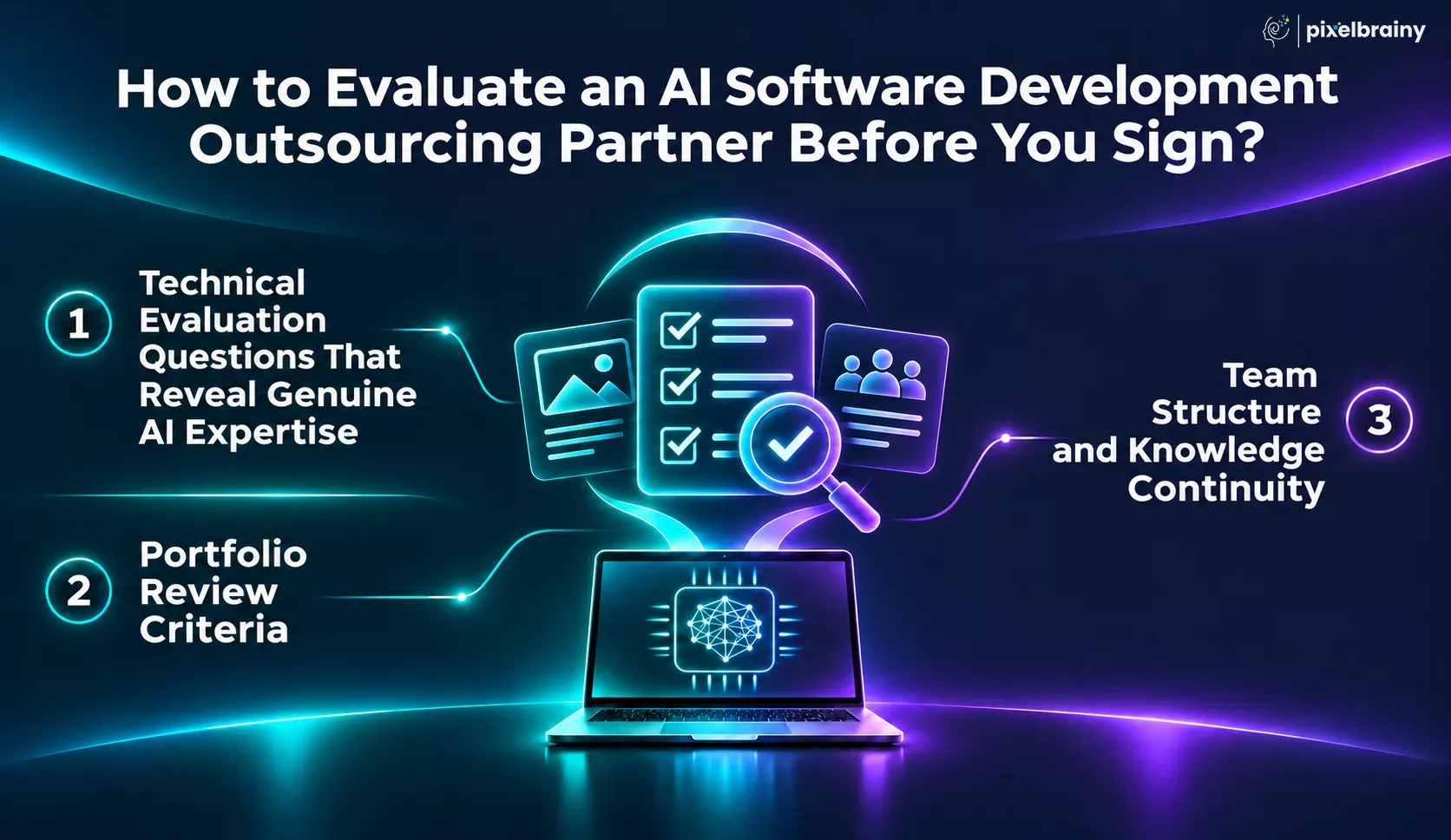
Ask targeted questions to understand the vendor's technical depth:
Strong candidates explain trade-offs, limitations, and measurable evaluation methods. Vague claims about using popular AI tools without discussing architecture or performance testing deserve further scrutiny.
Review the vendor's actual project outcomes rather than relying on broad claims about AI expertise.
Relevant metrics may include response accuracy, latency, operating costs, user adoption, and task completion rates.
The team delivering your project matters as much as the vendor's company-wide capabilities.
| Evaluation area | Strong signal | Weak signal |
|---|---|---|
| AI technical depth | Specific answers on RAG, fine-tuning, and hallucination prevention | Vague claims about AI expertise |
| Production portfolio | Case studies with real deployment metrics | Demos presented as proven production experience |
| Team quality | Named engineers with verifiable experience | Generic profiles without individual credentials |
| IP protection | Clear contractual ownership terms | Verbal assurances without specific commitments |
| Knowledge transfer | Documented handover process and client references | Promises without an established process |
Therefore, evaluating an AI software development partner through technical expertise, proven results, team reliability, and IP protection helps businesses reduce outsourcing risks. The right partner should offer measurable value, transparent collaboration, and the technical capabilities needed to support long-term AI growth.
Businesses investing in AI need a development partner that can turn complex requirements into practical software while maintaining transparency, technical quality, and long-term product ownership. PixelBrainy is an AI development company that helps businesses build AI-powered solutions through specialized engineering, flexible outsourcing, and business-focused product development.
For founders and companies without an established AI team, outsourcing can provide access to technical expertise without the immediate expense of hiring permanent specialists. When considering outsourcing AI development to a company, businesses should look for a partner that understands their market, communicates technical decisions clearly, protects intellectual property, and delivers software designed for real users.
PixelBrainy's value proposition centers on helping businesses move from product requirements to AI implementation with a structured, collaborative approach.
PixelBrainy delivered an AI-powered real estate listing platform for the US market after being engaged by a real estate agency as its outsourced development team. The project illustrates how businesses can work with an external technology partner to build a specialized digital platform without assembling every development role internally.
The engagement can be understood through three core areas:
The project demonstrates the value of engaging an outsourced AI development team when a business needs specialized implementation without building a complete internal engineering department. Verified details about individual features, technologies, deployment results, and performance metrics can further strengthen the case study while preserving the client's confidentiality.
For companies evaluating AI development outsourcing for businesses, the right partner should combine technical capability, clear communication, and a delivery process that supports long-term product ownership. Businesses researching the best AI development company in USA should evaluate relevant project experience, engineering depth, IP protections, and post-launch support before making a decision.
Have an AI product idea or an existing project to scale? Connect with PixelBrainy to discuss your requirements and explore outsourcing your AI development project.
The decision between in-house and outsourced AI development ultimately depends on your budget, technical capabilities, product complexity, and long-term business goals. Building an in-house team offers greater direct control and internal knowledge, while outsourcing AI development provides access to specialized expertise, flexible resources, and potentially faster execution without the immediate commitment of permanent hiring. For many businesses, a hybrid model offers a practical balance between both approaches.
When evaluating AI software development outsourcing vs hiring, consider more than initial costs. Assess technical expertise, intellectual property protection, team continuity, scalability, and knowledge transfer. The best approach for AI software development in 2027 is the one that aligns with your business strategy and supports sustainable product growth.
Whether you are a startup validating an AI idea or an established company expanding its capabilities, PixelBrainy can help you explore an approach suited to your requirements.
Ready to move forward with your AI project? Book an appointment with PixelBrainy to discuss your goals and development needs.
Outsourcing AI development often costs less initially because businesses avoid permanent salaries, recruitment, and employee benefits. In-house teams may offer better long-term value for continuous development. The more cost-effective option depends on project duration, workload, infrastructure, and the specialized AI expertise required.
Outsourcing AI development makes financial sense when you need specialized expertise, faster delivery, or temporary project capacity without long-term employment costs. It suits startups validating AI products and businesses with fluctuating workloads. Compare total project costs against recruitment, salaries, infrastructure, and ongoing team management.
Protect intellectual property when outsourcing AI software development through clear ownership clauses, confidentiality agreements, controlled repository access, and secure data-handling procedures. Specify ownership of custom code, AI models, documentation, and deliverables. Define subcontractor restrictions, data deletion requirements, and access revocation before signing the development contract.
The hybrid AI development model combines internal employees with outsourced specialists. Your in-house team retains product strategy, sensitive data governance, and architectural decisions, while external developers provide specialized skills or additional capacity. This approach works well when businesses need flexibility without sacrificing long-term technical control.
Evaluate an AI development agency by asking about RAG architecture, model fine-tuning, hallucination prevention, model evaluation, and production monitoring. Request case studies with measurable outcomes, verify individual engineer experience, and examine deployed systems. Genuine AI specialists explain technical trade-offs rather than relying on generic expertise claims.
Essential AI software development outsourcing contract terms include IP ownership, confidentiality, data protection, deliverable acceptance criteria, payment milestones, and termination rights. Also define security responsibilities, subcontractor access, warranties where applicable, and knowledge transfer. Clear provisions reduce disputes and protect your business throughout and after the engagement.
Building an in-house AI development team typically takes several months, depending on role availability, recruitment complexity, compensation, and technical requirements. Hiring multiple AI engineers, data specialists, and technical leaders can extend timelines. Businesses should also account for onboarding, infrastructure setup, and the time required to establish workflows.
Yes, outsourcing AI development does not mean surrendering architectural control. Define technical ownership, approve major design decisions, maintain access to repositories and infrastructure, and establish documentation requirements. Regular architecture reviews and demonstrations help your internal stakeholders understand implementation choices while the outsourced team handles engineering execution.
The break-even point between in-house and outsourced AI development costs occurs when cumulative outsourcing expenses equal the total cost of maintaining an internal team over the same period. Include salaries, benefits, recruitment, infrastructure, and management. Calculate both options using your expected workload, project duration, and maintenance needs.
Transition from outsourced to in-house AI development by recruiting internal technical leadership, documenting architecture, transferring repository and infrastructure access, and establishing knowledge-sharing sessions. Gradually move maintenance and core development responsibilities internally while retaining external specialists for niche requirements. A phased transition reduces disruption and knowledge loss.
No AI development category is universally unsuitable for outsourcing. However, businesses should retain strong internal oversight of strategic algorithms, sensitive data governance, critical architecture, and regulated decision-making. Outsourcing these activities may still be appropriate with qualified partners, strict access controls, clear contracts, and accountable internal ownership.
PixelBrainy's positioning emphasizes tailored AI engineering, transparent collaboration, IP-conscious delivery, and structured knowledge transfer. Businesses considering PixelBrainy should assess its relevant project experience, technical capabilities, delivery process, and post-launch support. These factors help determine whether the company fits their AI development requirements and long-term goals.

About The Author
Sagar Bhatnagar
Sagar Sahay Bhatnagar brings over a decade of IT industry experience to his role as Marketing Head at PixelBrainy. He's known for his knack in devising creative marketing strategies that boost brand visibility and market influence. Sagar's strategic thinking, coupled with his innovative vision and focus on results, sets him apart. His track record of successful campaigns proves his ability to utilize digital platforms effectively for impactful marketing efforts. With a genuine passion for both technology and marketing, Sagar continuously pushes PixelBrainy's marketing initiatives to greater success.

Working with PixelBrainy has been a great experience. They took our vision for an AI-powered platform and turned it into a fully functional product. What impressed me most was their strong understanding of both design and development, and their ability to handle complex requirements with ease. The team was responsive, cooperative, and always open to feedback. They kept things organized, communicated clearly, and delivered quality work on time. I highly recommend PixelBrainy to anyone looking for a skilled and reliable development partner.

Working with the PixelBrainy team has been a highly positive experience. They understand the design requirements and create beautiful UX elements to meet the application needs. The dev team did an excellent job bringing my vision to life. We discussed usability and flow. Sagar worked with his team to design the database and begin coding. Working with Sagar was easy. He has the knowledge to create robust apps, including multi-language support, Google and Apple ID login options, Ad-enabled integrations, Stripe payment processing, and a Web Admin site for maintaining support data. I'm extremely satisfied with the services provided, the quality of the final product, and the professionalism of the entire process. I highly recommend them for Android and iOS Mobile Application Design and Development.

Great experience working with them. Had a lot of feedback and I found that unlike most contractors they were bugging me for updates instead of the other way around. They were extremely time conscience and great at communicating! All work was done extremely high quality and if not on time, early! They were always proactive when it comes to communication and the work is great/above par always. Very flexible and a great team to work with! Goes above and beyond to present us with multiple options and always provides quality. Amazing work per usual with Chitra. If you have UI/UX or branding design needs I recommend you go to them! Will likely work with them in the future as well, definitely recommended!

PixelBrainy is a joy to work with and is a great partner when thinking through branding, logo, and website layout. I appreciate that they spend time going into the "why" behind their decisions to help inform me and others about industry best practices and their expertise.

I hired them to design our software apps. Things I really like about them are excellent communication skills, they answer all project suggestions and collaborate right away, and their input on design and colors is amazing. This project was complex and needed patience and creativity. The team is amazing to do business with. I will be using them long-term. Glad to see there are some good people out there. I was afraid to try and outsource my project to someone but I am glad I met them! I really can't say enough. They went above and beyond on this project. I am very happy with everything they have done to make my business stand out from the competition.

It was great working with PixelBrainy and the team. They were very responsive and really owned the project. We'll definitely work with them again!

I recently worked with the PixelBrainy team on a project and I was blown away by their communication skills. They were prompt, clear, and articulate in all of our interactions. They listened and provided valuable feedback and suggestions to help make the project a success. They also kept me updated throughout the entire process, which made the experience stress-free and enjoyable.

PixelBrainy is very good at what it does. The team also presents themselves very professionally and takes care of their side of things very well. I could fully trust them taking up the design work in a timely and organised manner and their attention to detail saved us lots of effort and time. This particular project was quite intense and the team showed that they function very well under pressure. Very much looking forward to working with her again!

It's always an absolute pleasure working with them. They completed all of my requests quickly and followed every note I had for them to a T, which made our process go smoothly from start to finish. Everything was completed fast and following all of the guidelines. And I would recommend their services to anyone. If you need any design work done in the future, PixelBrainy should be your first call!

They took ownership of our requirements and designed and proposed multiple beautiful variants. The team is self-motivated, requires minimum supervision, committed to see-through designs with quality and delivering them on time. We would definitely love to work with PixelBrainy again when we have any requirements.

PixelBrainy was a big help with our SaaS application. We've been hard at work with a new UI/UX and they provided a lot of help with the designs. If you're looking for assistance with your website, software, or mobile application designs, PixelBrainy and the team is a great recommendation.

PixelBrainy designers are amazing. They are responsive, talented, and always willing to help craft the design until it matches your vision. I would recommend them and plan to continue them for my future projects and more!!!

They were awesome! Did a good job fast, and good communication. Will work with them again. Thank you

Creative, detail-oriented, and talented designers who take direction well and implement changes quickly and accurately. They consistently over-delivered for us.

PixelBrainy team is very talented and creative. Great designers and a pleasure to work with. PixelBrainy is an excellent communicator and I look forward to working with them again.

PixelBrainy has a very talented design team. Their work is excellent and they are very responsive. I enjoy working with them and hope to continue on all of our future projects.


Transform your ideas into reality with us.
Across these industries, each engagement brings unique challenges, from early-stage product development to scaling complex systems, helping us build a practical understanding of real-world product environments.