AI Summary Powered by PixelBrainy
Imagine you are a licensed Realtor with 12 years of experience, strong local market knowledge, and an established client base. You want to build a personal AI real estate app that does more than display property listings. The goal is to create a digital advantage that helps you respond to leads faster, understand buyer preferences, automate repetitive work, and make better decisions throughout the sales process.
Before investing in AI real estate app development, however, several practical questions need clear answers. Which AI features can deliver measurable productivity improvements for an individual agent? Can AI personalize property recommendations, qualify leads, generate listing content, assist with client communication, or support property valuation? How much does it cost to build an AI real estate app when the product is commissioned by a solo high-producing Realtor rather than a large brokerage? And which AI real estate app development companies in the USA have experience creating solutions for individual real estate professionals?
These questions matter because developing AI for real estate is not simply about adding a chatbot or recommendation engine. The application needs to connect real estate data, machine learning, predictive analytics, automation, personalization, property search, lead management, and customer engagement in a way that supports measurable business outcomes.
This guide explores the development process of an AI real estate app, including essential AI features, technology considerations, development costs, team requirements, and implementation steps. You will also learn how to build an AI real estate app that is designed around an individual Realtor's workflow, client relationships, and competitive positioning rather than the requirements of a large brokerage.
For agents looking to build AI real estate apps that deliver practical productivity gains, understanding these decisions is the first step toward creating a smarter proptech solution.

Traditional real estate apps primarily help users search, filter, compare, and view properties. They make listing information accessible through features such as location maps, property photos, price filters, size, and basic search criteria. However, the experience largely depends on users knowing what they want and manually exploring available options. For agents, tasks such as lead qualification, follow-ups, property matching, and market analysis may still require significant manual effort.
AI real estate apps add intelligence to these workflows by using machine learning, predictive analytics, natural language processing, automation, and behavioral data. Instead of simply displaying information, an AI-powered platform can interpret user preferences, identify patterns, recommend relevant properties, prioritize leads, and support faster decision-making.
For a high-producing Realtor considering AI real estate app development, this distinction is especially important. A personal app should not simply replicate the functionality of a traditional property portal. It should help the agent save time, understand clients more effectively, automate repetitive activities, and create a differentiated experience that can support measurable productivity gains.
| Aspect | Traditional Real Estate Apps | AI Real Estate Apps |
| Property Search | Users manually apply filters such as price, location, property type, number of bedrooms, and size to find listings. | AI analyzes stated preferences, search behavior, interaction history, and relevant property data to provide more personalized property recommendations. |
| Lead Management | Agents typically review inquiries manually, decide which prospects need attention, and manage follow-ups through basic CRM workflows. | AI can score leads based on engagement and available behavioral signals, prioritize prospects, trigger follow-ups, and help agents focus on higher-value opportunities. |
| Property Valuation & Pricing | Property estimates often rely on predefined rules, comparable listings, historical information, or manually reviewed market data. | AI models can analyze multiple data points, including comparable properties, historical trends, location-related factors, and market signals to support more dynamic valuation insights. |
| User Experience | Most users receive a similar browsing experience, with personalization mainly based on filters and saved searches. | AI can adapt recommendations, content, notifications, and search experiences according to individual preferences, behavior, and interaction patterns. |
| Customer Support | Support generally depends on agents, customer service teams, FAQs, or standard communication channels. | AI assistants can answer common questions, summarize property information, support natural-language searches, and provide immediate assistance while handing complex matters to human agents. |
| Market Insights | Agents and buyers review dashboards, reports, historical data, and market information to interpret current conditions. | Predictive analytics can identify patterns, highlight relevant market signals, support forecasting, and surface insights that may help agents make more informed decisions. |
| Agent Productivity | Agents spend considerable time on repetitive activities such as responding to inquiries, organizing information, preparing content, and following up with prospects. | AI automation can reduce repetitive workload by assisting with lead qualification, communication, summaries, recommendations, listing content, and other routine tasks. |
| Client Personalization | Recommendations are primarily based on manually selected preferences and search filters. | AI can continuously refine recommendations using client interactions, preferences, search patterns, and feedback to create a more individualized property discovery experience. |
| Communication | Agents manually handle most buyer and seller communication, reminders, and follow-ups. | AI can assist with response generation, conversation summaries, follow-up reminders, and personalized communication while keeping the agent involved in important client interactions. |
| Scalability | Increasing the number of clients and inquiries can increase the agent's manual workload significantly. | Automation and intelligent workflows can help an individual Realtor manage more interactions and information without increasing every task proportionally. |
The key distinction is that traditional apps present real estate information, while AI-powered apps can interpret data, personalize experiences, automate workflows, and support agent decisions. For an individual Realtor, the strongest value comes from applying AI where it produces measurable gains in productivity, response time, client engagement, and lead management.
For a high-producing Realtor, investing in AI real estate app development makes sense when the technology improves measurable parts of the daily workflow, such as lead qualification, property matching, client communication, listing preparation, and market analysis. A personal AI-powered app can give an individual agent capabilities that are difficult to replicate through standard listing or CRM software, creating a more efficient and personalized client experience.
The opportunity is also supported by strong market growth. According to The Business Research Company’s 2026 report, the global AI in real estate market is projected to grow from $404.9 billion in 2026 to $1.303 trillion by 2030, representing a 33.9% CAGR. North America was the largest regional market in 2025.
Market expansion creates room for specialized AI tools designed around individual agents rather than only large brokerages. A Realtor can commission a custom application around a specific market, client profile, sales workflow, and personal service model.
For an agent asking whether building AI real estate app investment can create a competitive advantage, the stronger case is workflow ownership. The application can combine client information, property preferences, follow-up activity, and market data into one experience tailored to the agent's way of working.
AI can help agents identify which prospects are more engaged, prioritize follow-ups, summarize conversations, and automate routine responses. Instead of manually reviewing every inquiry, an AI-powered real estate app can organize prospects according to relevant behavioral and interaction signals.
This creates a direct productivity opportunity for a solo Realtor who manages a large pipeline. Time saved on repetitive qualification and communication can be redirected toward negotiations, showings, client relationships, and revenue-generating activities.
An AI real estate app can move beyond basic searches based only on price, bedrooms, or location. Machine learning can analyze client preferences, saved properties, search behavior, interactions, and feedback to help surface more relevant listings.
For a Realtor building a personal technology advantage, this creates an opportunity to deliver a highly tailored property discovery experience. Personalized recommendations can also help agents understand changing client preferences and refine conversations around the properties most likely to match their needs.
AI can process property records, comparable information, historical trends, neighborhood signals, and other available datasets to support valuation and market analysis. The Business Research Company identifies AI-based property valuation and predictive market analysis among the major growth trends in the sector.
For an individual agent, these capabilities can reduce the time required to gather and interpret information. The purpose is not to replace professional judgment, but to provide faster analytical support that can strengthen pricing conversations and market recommendations.
The development of AI real estate apps can automate repetitive activities that consume an agent's working hours. Examples include lead routing, appointment reminders, client notifications, conversation summaries, listing drafts, data organization, and routine administrative workflows.
For a solo agent, productivity improvement is particularly valuable because there are fewer employees to distribute operational tasks across. A thoughtfully designed application can act as a digital assistant around the agent's existing workflow, helping increase capacity without requiring every additional client interaction to create another manual task.
Many real estate platforms provide similar listing discovery and search functionality. A personal AI application can differentiate an agent through faster responses, customized recommendations, intelligent client support, and a more consistent digital experience.
This is especially relevant to the real-world query behind this guide: a licensed Realtor with 12 years of experience wants a custom app that provides a genuine competitive advantage over other agents in the same market. For that type of buyer, the strongest investment case is not simply owning an AI app. It is owning a workflow that helps the agent deliver a service competitors cannot easily reproduce.
A well-planned AI real estate app development strategy can create value beyond immediate productivity. The application can evolve as client behavior, market conditions, and business requirements change. New workflows can be added, integrations expanded, and AI capabilities refined according to actual usage.
The broader market outlook reinforces this opportunity. The Business Research Company expects AI in real estate to reach more than $1.3 trillion by 2030, with predictive pricing, automated customer engagement, and data-driven investment insights among the forecast-period trends.
For a Realtor considering how to develop an AI real estate app, the strongest investment case is measurable productivity, differentiated client service, and a technology foundation that can grow with the agent's business.
The real estate industry offers multiple opportunities for AI real estate app development, but the best app type depends on the specific problem, audience, and business model. A buyer-focused platform may use AI to improve property discovery, while an investor solution may prioritize market forecasting, valuation, and portfolio analysis. Similarly, agencies can use AI for lead management, communication, documentation, and property operations.
Consider a real estate startup planning a platform for investors who compare properties across several markets. Instead of manually reviewing rental data, neighborhood indicators, property prices, and investment risks, the startup can use AI to organize these signals and provide faster, data-driven insights. This kind of application demonstrates how AI can address a focused real estate problem while creating a differentiated product opportunity.
When you build an AI real estate app, the objective should therefore be more specific than simply adding artificial intelligence. The chosen app category should have a clear user need, a practical AI use case, reliable data sources, and a business model capable of supporting long-term growth.
Below are 12 AI-powered real estate app types covering property search, valuation, lead management, financing, investment analysis, virtual tours, document automation, fraud prevention, smart homes, market intelligence, and property management. These categories can also be combined to create a broader AI-powered real estate solution based on the intended audience and product strategy.
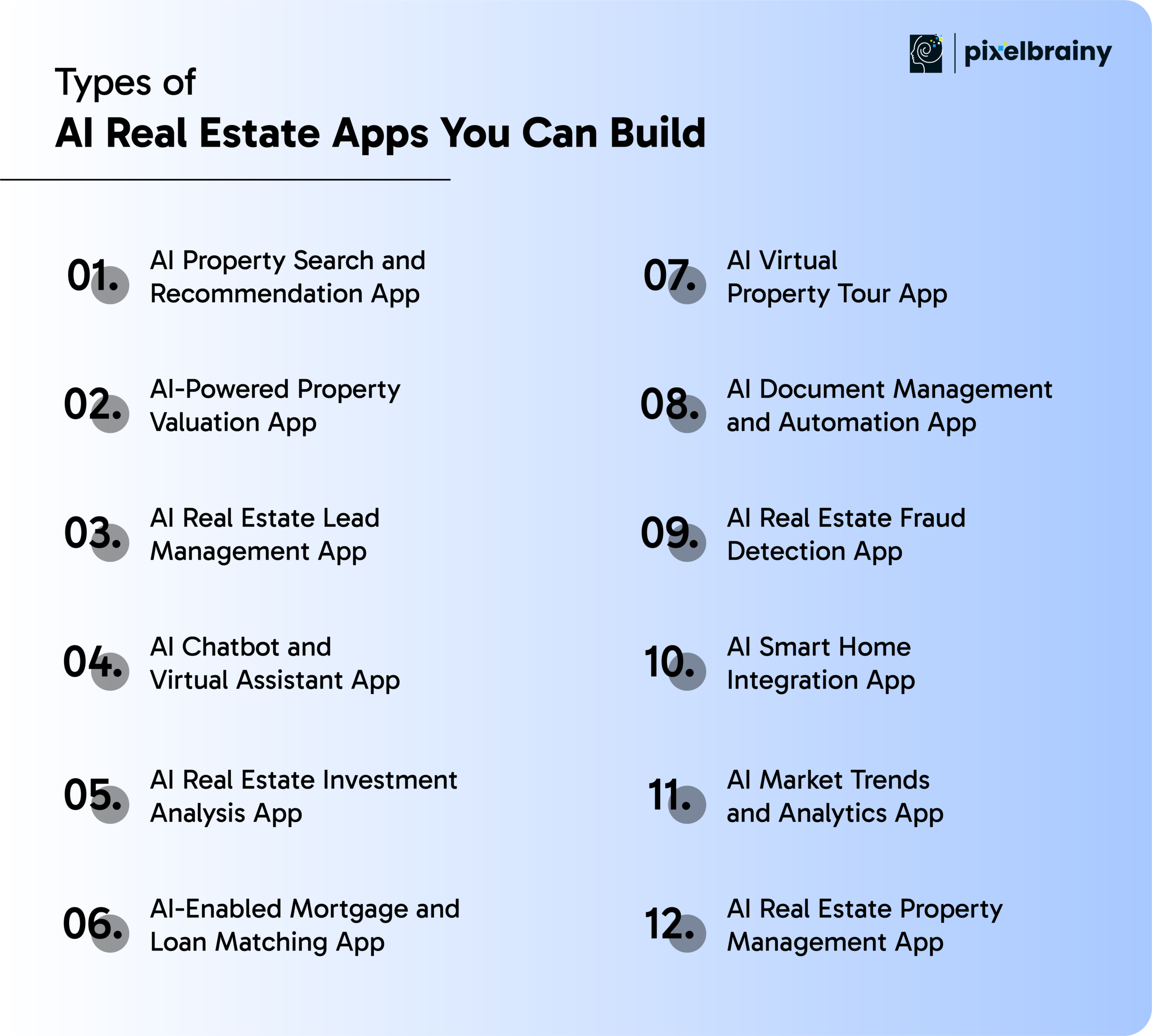
An AI-powered property search app transforms the way buyers discover properties. Instead of relying only on manual filters like price or location, the app uses machine learning algorithms to study user behavior, browsing history, and preferences to suggest the most relevant listings.
Key Features:
Real Example: Zillow and Redfin both use AI algorithms to recommend properties that match user intent, improving buyer satisfaction and engagement.
This approach makes developing an AI real estate app far more impactful, as it saves users time and delivers properties aligned with their needs.
Valuing a property accurately is one of the biggest challenges in real estate. An AI valuation app can process vast datasets including recent sales, neighborhood growth, amenities, and even economic indicators to generate real-time, precise valuations.
Key Features:
Real Example: Zillow’s Zestimate is a well-known AI valuation model that evaluates millions of homes, providing users with near-instant property value estimates.
For realtors and startups, building an AI real estate app with valuation tools ensures trust and transparency with clients.
Managing and converting leads is critical in real estate. Traditional CRMs require manual input and follow-ups, but an AI real estate app for lead management can automate the process and help agents focus on high-potential clients.
Key Features:
Real Example: HubSpot and Salesforce CRM integrate AI to qualify and prioritize leads, helping real estate teams close deals faster.
When developing an AI real estate app, lead management features can be a core differentiator for agencies and startups.
AI chatbots have revolutionized customer interaction. A virtual assistant app can answer buyer queries instantly, schedule property tours, and even provide mortgage details—all without human intervention.
Key Features:
Real Example: Trulia uses AI-powered chatbots to enhance customer interactions, reducing wait times and improving client satisfaction.
If you are planning to build an AI real estate app, chatbot integration adds immediate value by improving user experience and reducing operational costs.
Investors need data-driven insights to make profitable decisions. An AI app designed for investment analysis can forecast rental yields, property appreciation, and market risks by processing historical and real-time data.
Key Features:
Real Example: Roofstock uses AI to help investors analyze single-family rental opportunities, offering insights into property performance.
Startups developing AI real estate apps in this segment can attract investors seeking smarter, data-backed investment tools.
Financing is often a complex part of real estate. An AI mortgage app simplifies this by comparing banks, lenders, and loan products to suggest the best fit for a buyer’s financial profile.
Key Features:
Real Example: Rocket Mortgage uses AI to match applicants with the right loan packages quickly and efficiently.
This makes AI real estate app development valuable not only for buyers but also for financial institutions looking to streamline loan approvals.
Virtual tours combined with AI allow users to experience properties remotely with a higher level of personalization. The AI can highlight specific rooms or features that align with a buyer’s preferences.
Key Features:
Real Example: Matterport provides AI-powered 3D tours that help buyers explore properties online in detail.
For startups, building AI real estate apps with VR integration can significantly improve user engagement.
Paperwork is one of the most time-consuming tasks in real estate. AI can automate contract drafting, compliance checks, and secure storage of documents.
Key Features:
Real Example: DocuSign leverages AI for contract verification and fraud detection in real estate transactions.
Adding this to your AI real estate app development plan reduces errors and speeds up deal closures.
Fraudulent property listings and scams are common. An AI app for fraud detection analyzes user behavior, financial patterns, and listing authenticity to flag suspicious activities.
Key Features:
Real Example: CoreLogic uses AI-based fraud detection tools to protect real estate transactions from scams.
When you develop an AI real estate app with fraud prevention, you build trust and reliability in your platform.
The rise of smart homes has created opportunities to merge IoT with real estate. An AI app can showcase properties with smart features and even simulate energy savings or security benefits.
Key Features:
Real Example: Google Nest integrates with real estate apps to display smart home features that appeal to tech-savvy buyers.
This type of AI real estate app development appeals strongly to modern homebuyers seeking advanced living solutions.
AI can process massive amounts of property and economic data to forecast real estate market movements. Realtors and investors gain a clear advantage by knowing where the market is heading.
Key Features:
Real Example: HouseCanary uses AI analytics to deliver accurate market forecasting for investors and agents.
For startups building AI real estate apps, this type of solution creates high demand among investors and brokers.
Managing multiple properties can be overwhelming. An AI-powered property management app automates rent collection, tenant screening, and maintenance requests.
Key Features:
Real Example: AppFolio uses AI tools to streamline property management for landlords and agencies.
For entrepreneurs developing AI real estate apps, property management solutions are one of the most profitable categories.
These 12 categories demonstrate how AI in real estate can support different users and workflows, from property discovery and investment analysis to transaction management and property operations. The right category should be selected according to the problem your product can solve most effectively and the AI capabilities that can deliver measurable value.
The value of AI real estate application development becomes clearer when the technology is tied to specific business outcomes rather than treated as a simple upgrade to traditional property software. Consider a real estate agency handling hundreds of inquiries each month while agents manually sort leads, respond to recurring questions, compare properties, and prepare client recommendations. An AI-powered application can reduce this workload by turning property and customer data into actionable recommendations, automated workflows, and faster decision support.
For businesses evaluating whether to develop an AI real estate app, the strongest benefits come from measurable improvements in search efficiency, lead handling, pricing support, automation, customer experience, and market intelligence. These capabilities can help agencies operate more efficiently while giving clients a more responsive and personalized digital experience.
The following benefits explain where AI in real estate app development can create practical business value and why AI-powered functionality is becoming an important consideration for modern proptech products.
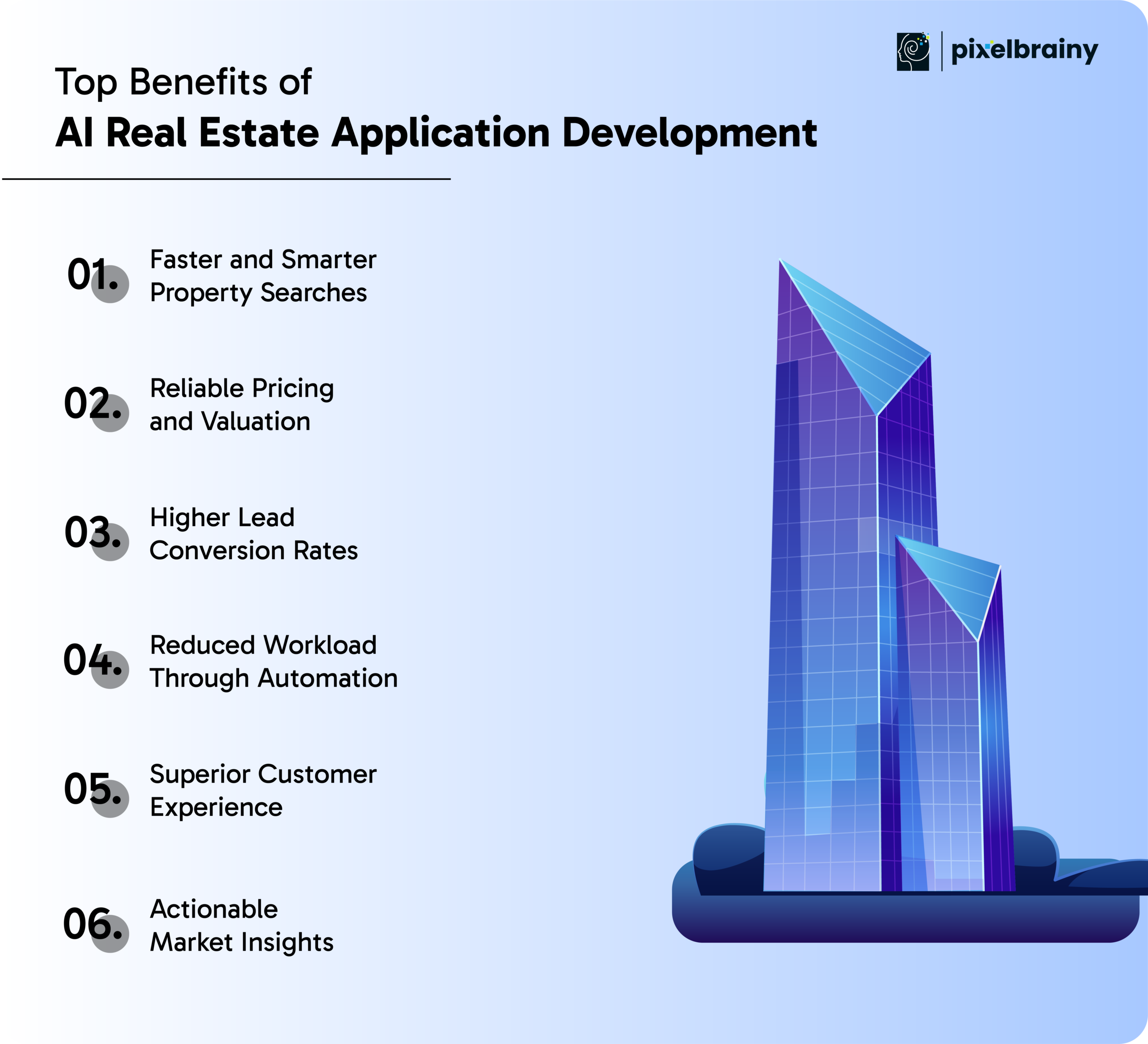
Property search is often the most time-consuming part of real estate transactions. Clients may spend weeks browsing through hundreds of listings before finding something suitable. By introducing AI into search functionality, real estate apps can deliver personalized property recommendations that match client budgets, preferences, and lifestyle needs.
This improvement saves buyers valuable time while also making realtors more effective in presenting the right options. For startups, it means higher user retention because clients are more likely to continue using an app that understands their needs. Smarter searches create smoother journeys, which ultimately lead to higher satisfaction and faster closings.
Pricing is one of the biggest pain points in real estate. Traditional valuation methods often leave buyers questioning whether they are overpaying or sellers wondering if they have undervalued their property. AI real estate app development solves this by analyzing historical data, local market trends, and comparable sales to deliver real-time, trustworthy valuations.
Accurate pricing helps build credibility for realtors and platforms. Clients gain confidence in their decisions, negotiations become smoother, and the risk of deals falling through decreases. For businesses, offering reliable valuations strengthens trust, leading to long-term client loyalty and repeat business.
One of the top benefits of building an AI real estate app is its ability to turn raw leads into actual clients. Realtors often spend excessive time chasing unqualified leads, which drains resources and reduces efficiency. With AI, apps can identify the most promising prospects, evaluate their likelihood to buy or rent, and provide insights that help agents focus on the right people.
This not only improves sales efficiency but also boosts revenue. Startups benefit from improved customer acquisition strategies, while established agencies enjoy faster deal closures. Over time, higher conversion rates translate into stronger market presence and sustainable growth.
The real estate industry involves numerous repetitive tasks such as answering basic client queries, scheduling property tours, and managing paperwork. When you decide to create an AI real estate app, automation takes over these time-consuming processes.
For realtors, this means less time spent on administrative work and more time building meaningful relationships with clients. Startups benefit by running leaner operations without needing large support teams. Clients also enjoy quicker responses and smoother processes, which enhances their overall experience. Automation not only improves efficiency but also reduces operational costs, creating long-term business value.
Customer expectations have evolved. They no longer want generic results or delayed responses. Instead, they look for apps that provide personalized suggestions, immediate support, and immersive experiences. With AI real estate mobile app development, businesses can deliver this level of service by integrating AI-driven personalization, chatbots, and virtual tours.
For clients, this creates an engaging and stress-free journey from search to final transaction. For realtors and startups, it strengthens brand image and builds a reputation for reliability. A superior customer experience increases loyalty, referrals, and positive reviews, all of which contribute to long-term growth.
Real estate success depends on anticipating market movements. AI systems can process massive datasets to identify future trends, rental yield opportunities, and emerging hotspots. By embedding these capabilities into an app, businesses provide clients with insights that help them make smarter decisions.
For realtors, these insights offer a competitive edge in advising clients. For startups, they create unique selling points that differentiate them from traditional platforms. For investors, predictive analytics ensure better returns. The ability to provide actionable market intelligence transforms a real estate app from a simple listing platform into a trusted decision-making tool.
The benefits of an AI-powered real estate app extend from everyday productivity improvements to stronger customer relationships and smarter business decisions. When each AI capability is connected to a clear workflow and measurable outcome, the technology can become a practical growth tool rather than an additional software layer.

A successful AI real estate app development project starts with dependable core functionality before advanced intelligence is added. Consider a real estate brokerage that wants one application for managing property inventory, capturing buyer inquiries, scheduling visits, and keeping clients updated. The platform first needs reliable listing, search, communication, account, scheduling, and administration capabilities so users can complete everyday tasks without friction.
For businesses planning to develop an AI real estate app, these foundational features also create the data and workflow structure that future AI capabilities can work with effectively. Property information, saved searches, inquiries, user preferences, communications, and activity records can later support personalization, predictive analytics, intelligent recommendations, and automation.
Below are 15 essential features to consider when you build an AI real estate app, particularly when the goal is to create a scalable product that serves buyers, sellers, and real estate professionals.
| Core Feature | Explanation |
| User Registration & Profiles | Allows buyers, sellers, and agents to create accounts, personalize their experience, and save preferences for future use |
| Property Listings | Displays detailed property information such as price, size, photos, and descriptions in a structured format |
| Advanced Search Filters | Enables users to refine searches by location, budget, property type, and other essential filters |
| Map Integration | Offers location-based search with maps showing nearby schools, amenities, and transport links |
| Saved Searches & Favorites | Lets users bookmark properties or save searches, improving convenience and engagement |
| Contact & Inquiry Forms | Provides a direct way for buyers to reach realtors or property owners instantly |
| Push Notifications | Sends alerts for new listings, price drops, or saved property updates to keep users engaged |
| Image & Video Galleries | Enhances listings with multiple photos or video tours for better property visualization |
| Scheduling Property Visits | Allows buyers to book property tours directly within the app, simplifying the viewing process |
| Mortgage Calculator | Helps buyers estimate monthly payments and affordability before making inquiries |
| In-App Chat & Messaging | Facilitates direct communication between buyers, agents, and sellers without leaving the app |
| Reviews & Ratings | Builds credibility by allowing users to share experiences with properties, agents, or agencies |
| Multi-Language Support | Makes the app accessible to diverse audiences by supporting multiple languages |
| Secure Payment Integration | Supports safe transactions for booking fees, deposits, or premium features |
| Admin Dashboard | Gives property owners and realtors control to manage listings, users, and inquiries efficiently |
These foundational capabilities provide the structure required for a dependable AI-powered real estate application. Once the core workflows and data foundation are established, advanced AI features can be layered onto the platform to support smarter recommendations, automation, prediction, and decision-making.
Once the core property search, listings, communication, scheduling, and account workflows are established, advanced intelligence can help an AI real estate app deliver greater business value. Consider a real estate agency managing a large volume of listings and buyer inquiries across several neighborhoods. Its agents may spend significant time identifying suitable properties, prioritizing prospects, reviewing documents, and responding to recurring questions. Advanced AI capabilities can assist with these activities by analyzing data, recognizing patterns, automating routine work, and delivering context-aware support.
The right approach to AI real estate app development is not to include every available AI capability. Each feature should address a defined user or operational requirement and have a measurable purpose. For businesses planning to develop an AI real estate app, these capabilities can help transform a standard property platform into a more intelligent system for recommendations, lead management, market analysis, fraud prevention, property visualization, and workflow automation.
| Advanced Feature | Explanation |
| AI-Powered Property Recommendations | Uses machine learning to analyze buyer behavior and preferences, delivering highly personalized property suggestions |
| Predictive Market Analytics | Provides insights into future market trends, rental yields, and property appreciation, helping agents and investors make smarter decisions |
| AI Virtual Assistants & AI Chatbots | Offers 24/7 support for queries, appointment scheduling, and guiding clients through the property journey |
| Smart Fraud Detection | Identifies suspicious listings, fake documents, and risky transactions using AI algorithms to ensure safer dealings |
| AI Image Recognition | Automatically tags and classifies property photos, highlights features, and verifies image authenticity |
| AR/VR Virtual Property Tours | Allows immersive 3D property walkthroughs with AI enhancements that highlight key areas for buyers |
| Voice Search & Commands | Lets users search for properties or schedule viewings using voice commands for a faster and more natural experience |
| AI-Powered Lead Scoring | Evaluates leads based on buying intent and engagement, allowing agents to focus on the most promising prospects |
| Document Automation with AI | Simplifies contracts, compliance checks, and paperwork using natural language processing for faster deal closure |
| Smart Home Integration | Connects listings with IoT features such as energy efficiency data, security systems, and smart device compatibility |
These advanced capabilities can give AI-powered real estate apps greater intelligence across property discovery, lead conversion, analytics, client support, and transaction workflows. The strongest results come from selecting features that align with the platform's users, data, business model, and measurable objectives rather than adding AI functionality without a clear purpose.
Turning an AI real estate concept into a production-ready application requires more than selecting AI models and starting development. The process needs to connect the business model, real estate data, user workflows, application architecture, AI use cases, and scalability requirements from the beginning. This is especially relevant for a real estate technology startup planning to serve multiple markets, where poor data quality or an untested AI workflow can become expensive to fix after launch.
If you are evaluating what is the process to build AI real estate app, a structured approach helps determine which capabilities should be validated first, what data the AI requires, and when to move from experimentation to production. A phased AI real estate app development process also helps control investment while gathering evidence about user demand, technical feasibility, model performance, and scalability.
The steps below explain how to move from initial strategy through PoC, MVP, AI expansion, security testing, and full product growth.
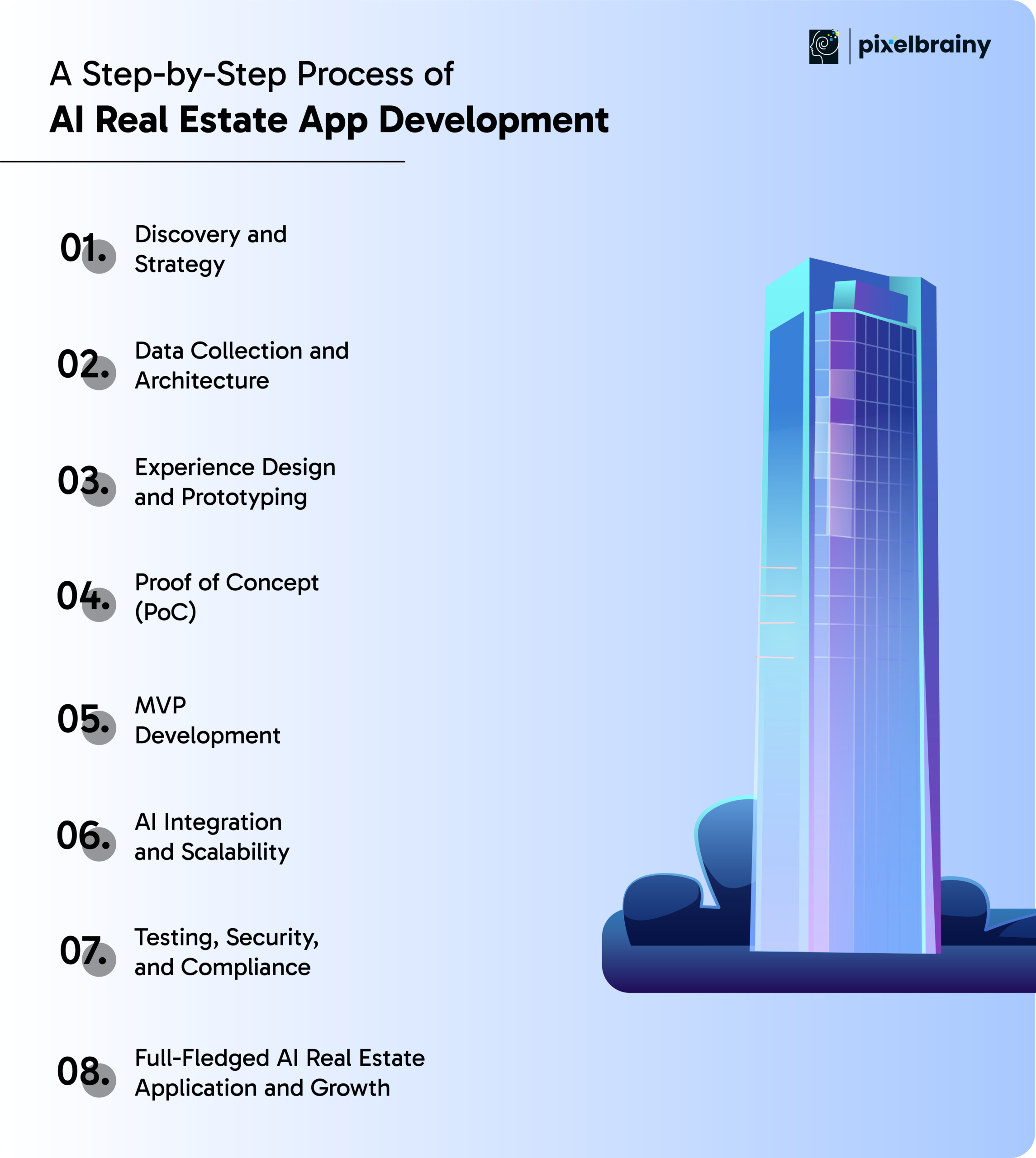
The first step in developing AI real estate app is to define the business vision clearly. This involves identifying the target audience, whether they are buyers, sellers, investors, or agents, and outlining their pain points. You also need to analyze competitors and study the gaps in their offerings. This research helps you position your app with unique value.
At this stage, it is also important to map out the revenue model. Will the app generate income through commissions, premium listings, or subscription plans? Benchmarking against Top AI Development Companies in USA can guide you in setting technology standards and help you adopt best practices from industry leaders. This step ensures that the app has a strong strategic foundation before development begins.
The success of any AI product depends heavily on the quality of data. For a real estate app, data sources include MLS feeds, property photos, market histories, demographics, and user interactions. This data must be cleaned, structured, and secured in a way that makes it usable for AI models.
Building a proper architecture ensures scalability as your platform grows. Cloud infrastructure, storage solutions, and APIs are designed to handle millions of listings and user queries. Since the development of AI real estate application relies on predictive analytics and personalization, a strong data pipeline ensures accurate outputs for features such as property valuations and recommendations.
Once the data and strategy are clear, the next step is to translate the vision into a user-friendly interface. Collaborating with a UI/UX Design Company ensures the app has an intuitive design that guides users effortlessly through registration, property search, and communication. Wireframes and clickable prototypes allow you to test concepts early with potential users.
Prototyping at this stage helps identify usability challenges before heavy development costs are incurred. A smooth user experience is essential in the crowded real estate market, and apps that are easier to use tend to see higher adoption rates.
The Proof of Concept is where you test your critical AI ideas on a small scale. Instead of building the entire app, you validate a single use case such as automated property valuation or AI-powered search recommendations. This allows you to test feasibility, performance, and cost efficiency.
Running a PoC reduces risk by confirming that your chosen AI technology can solve real-world problems effectively. This stage is critical in real estate app development with AI, as it helps you decide which models are worth scaling and which need rethinking before investing further.
The stage of MVP Development for AI Real Estate App focuses on delivering a functional version of the app with essential features. This includes property listings, search filters, maps, and one or two AI-driven features that solve the most pressing user problems. The purpose of an MVP is to validate the product in real-world conditions while keeping costs under control.
By launching early, you can gather feedback directly from users, identify improvements, and refine the product. This approach helps startups and realtors avoid wasting resources on features that do not add value. An MVP also demonstrates early traction to potential investors.
Also Read: Top 10 AI MVP Development Companies in USA
Once the MVP has proven its value, the next step is to expand with deeper AI integration. This involves adding advanced capabilities like predictive analytics, AI chatbots, fraud detection, and intelligent lead scoring. Setting up MLOps ensures models are monitored, retrained, and updated as market conditions change.
Partnering with experts in AI solutions for real estate app can help speed up this process and ensure that your models are not just accurate but also production-ready. Scalability is critical at this stage so the app can support a growing number of users without compromising on performance.
Quality assurance is not just about fixing bugs. It also includes testing AI models for accuracy, fairness, and reliability of AI real estate applications. Performance tests check if the app can handle thousands of simultaneous users, while penetration tests ensure that sensitive data remains secure.
For compliance, features such as consent management, audit logs, and encryption are implemented. Regulations like GDPR and CCPA must be respected to protect user data and avoid legal issues. This step ensures that the app is trustworthy and ready for real-world adoption.
The final stage transforms your MVP into a comprehensive product. At this point, you can integrate third-party services such as mortgage calculators, insurance partners, and property management tools. Marketing strategies are launched to attract users, while continuous updates add new features based on customer demand.
For startups and realtors, this stage answers the long-term question of how to create AI real estate app that scales, attracts consistent revenue, and builds a loyal user base. Growth at this stage comes from ongoing improvements, partnerships, and customer engagement strategies.
Following a phased development process of AI real estate application helps reduce technical and commercial risk while giving teams clear checkpoints for validating data, AI functionality, usability, security, and scalability before expanding the product.
The cost to develop an AI real estate app typically ranges from $30,000 to $200,000+, depending on the product scope, number of platforms, UI/UX complexity, AI capabilities, integrations, data requirements, and development team. A basic MVP with essential property search and one or two AI functions will generally require less investment than a full-scale platform with predictive analytics, intelligent recommendations, automated lead management, AI assistants, and real-time data processing.
For businesses planning AI real estate app development, the initial development budget is only part of the total investment. Expenses for cloud infrastructure, AI APIs or model usage, real estate data sources, third-party integrations, security, testing, maintenance, and future AI model improvements can affect the overall cost of ownership.
For an individual Realtor commissioning a personal application, the budget will also depend on whether the product is built as a focused productivity platform or expanded into a broader client-facing real estate solution. Defining the core use cases early can help control scope and make the AI real estate app development cost more predictable.
For a detailed breakdown of cost factors, estimates, and development considerations, explore our dedicated guide on AI Real Estate App Development Cost.
An AI-powered real estate application needs a technology foundation capable of handling property data, user interactions, AI workloads, third-party services, and growing traffic without compromising performance. Consider a proptech startup developing an investment platform that analyzes properties across multiple markets. The application may need to process large property datasets, deliver responsive search, support predictive analytics, connect location and property APIs, and maintain secure user accounts. These requirements directly influence the technology architecture behind the product.
For teams planning AI real estate app development, the technology stack should reflect the application's use cases, data volume, target platforms, AI requirements, and expected scale. The frontend manages the user experience, backend services handle application logic, databases organize property and user data, while AI and cloud technologies support capabilities such as recommendations, valuation, image analysis, and predictive insights.
| Category | Technologies/Tools | Explanation |
| Frontend | React Native, Flutter, Angular | Frameworks like React Native and Flutter ensure cross-platform mobile apps, while Angular supports responsive web apps. These tools deliver fast, smooth, and user-friendly interfaces |
| Backend | Node.js, Django, Ruby on Rails | Backend frameworks power server-side logic. Node.js is ideal for real-time apps, Django supports high security, and Rails is known for rapid development cycles |
| Databases | PostgreSQL, MongoDB, Firebase | PostgreSQL offers structured relational storage, MongoDB is flexible for unstructured property data, and Firebase supports real-time syncing |
| AI & ML Frameworks | TensorFlow, PyTorch, Scikit-learn | TensorFlow and PyTorch are widely used for building and training property valuation or recommendation models, while Scikit-learn is effective for predictive analytics |
| Cloud Platforms | AWS, Google Cloud, Microsoft Azure | These platforms provide scalable hosting, storage, and AI services like image recognition and natural language processing for real estate apps |
| APIs & Integrations | Google Maps API, Zillow API, Payment Gateways | APIs enhance functionality. Google Maps helps with location intelligence, Zillow API supports property data, and secure gateways enable payments |
| DevOps & CI/CD | Docker, Kubernetes, Jenkins | Tools like Docker and Kubernetes simplify containerization and scaling, while Jenkins supports automated testing and deployment pipelines |
| Authentication & Security | OAuth, JWT, SSL Encryption | OAuth and JWT secure user authentication, while SSL ensures encrypted transactions and safe property data exchanges |
| Analytics Tools | Google Analytics, Mixpanel, Tableau | These tools help track user behavior, engagement, and market trends, offering insights to continuously improve the app |
| Collaboration & Project Management | Jira, Trello, Slack | Agile-friendly tools such as Jira and Trello support task tracking, while Slack ensures effective communication during development |
A technology stack aligned with the application's data, AI workloads, integrations, and growth expectations provides a stronger foundation for building an AI real estate app that can evolve as user and business requirements expand.

A strong AI real estate app development strategy needs a revenue model that fits the target users and the value the platform creates. Consider a proptech startup building a platform for real estate professionals who want AI-assisted lead management, property intelligence, and client engagement in one place. The monetization approach could differ significantly depending on whether the platform serves solo agents, brokerages, property owners, investors, or consumers.
For startups planning to build an AI real estate app, monetization should be considered alongside product architecture and feature planning. Subscription access may work well for professional users, while transaction fees, premium visibility, or partnerships can create additional revenue opportunities. AI can also make these models more targeted by matching services, recommendations, and promotional opportunities with relevant user intent.
Below are four practical monetization strategies that can help turn an AI-powered real estate platform into a sustainable business while keeping the revenue model aligned with user value.
One of the most common approaches is offering subscription-based access to realtors and agencies. Instead of charging per listing, the app provides tiered monthly or yearly plans that unlock access to features such as premium analytics, AI-powered lead scoring, and unlimited listings.
For agents, this ensures predictable costs while giving them the tools to close deals more efficiently. For app owners, it creates recurring revenue and higher customer lifetime value. Startups can further segment plans by agency size, adding flexibility for both solo agents and large firms.
Real estate is a competitive industry, and visibility matters. Offering premium listing placements allows sellers and agents to pay for higher ranking in search results, highlighted property cards, or featured spots on the homepage.
This model generates additional income while giving property owners a direct way to attract more qualified buyers. AI can further optimize placement by matching premium listings with buyers most likely to convert, ensuring better ROI for advertisers.
Another profitable model is earning a percentage from successful transactions completed through the platform. Each time a property is rented, purchased, or financed via the app, the business receives a commission.
This approach ties platform success directly to user success, aligning incentives for all parties. While commissions may vary, this strategy works well in markets where digital transactions are increasingly common and trusted. Over time, integrating smart contracts or escrow services can make commission-based models even more seamless.
Real estate transactions often require multiple services such as mortgages, insurance, and legal documentation. Partnering with these service providers allows the app to earn through referrals, lead generation, or direct advertising.
For example, a buyer searching for a property can be offered pre-approved mortgage options from partnered banks, or sellers may be connected with legal experts for contract assistance. This not only diversifies revenue streams but also enhances the app’s value by becoming a one-stop solution for the entire real estate journey.
A sustainable AI real estate app business model should connect revenue directly to the value users receive, while allowing the platform to expand its earning potential as adoption, transactions, and professional usage increase.
An AI real estate app development project can deliver strong value, but its success depends on how well the technical, regulatory, data, and user-experience challenges are handled. Consider a proptech startup preparing to launch an AI platform that uses property data to recommend listings, assess leads, and support valuation decisions. The application must work with reliable datasets, protect sensitive information, control AI infrastructure costs, and provide useful results that users can trust.
For businesses planning to create an AI real estate app, these challenges should be addressed during architecture and product planning rather than after launch. Data quality affects model performance, privacy requirements influence how information is collected and stored, and poorly controlled AI workloads can increase operating costs. At the same time, real estate decisions often involve significant financial and emotional considerations, making human oversight an important part of the product experience.
Below are the most common challenges in AI real estate app development and practical approaches businesses can use to manage them effectively.
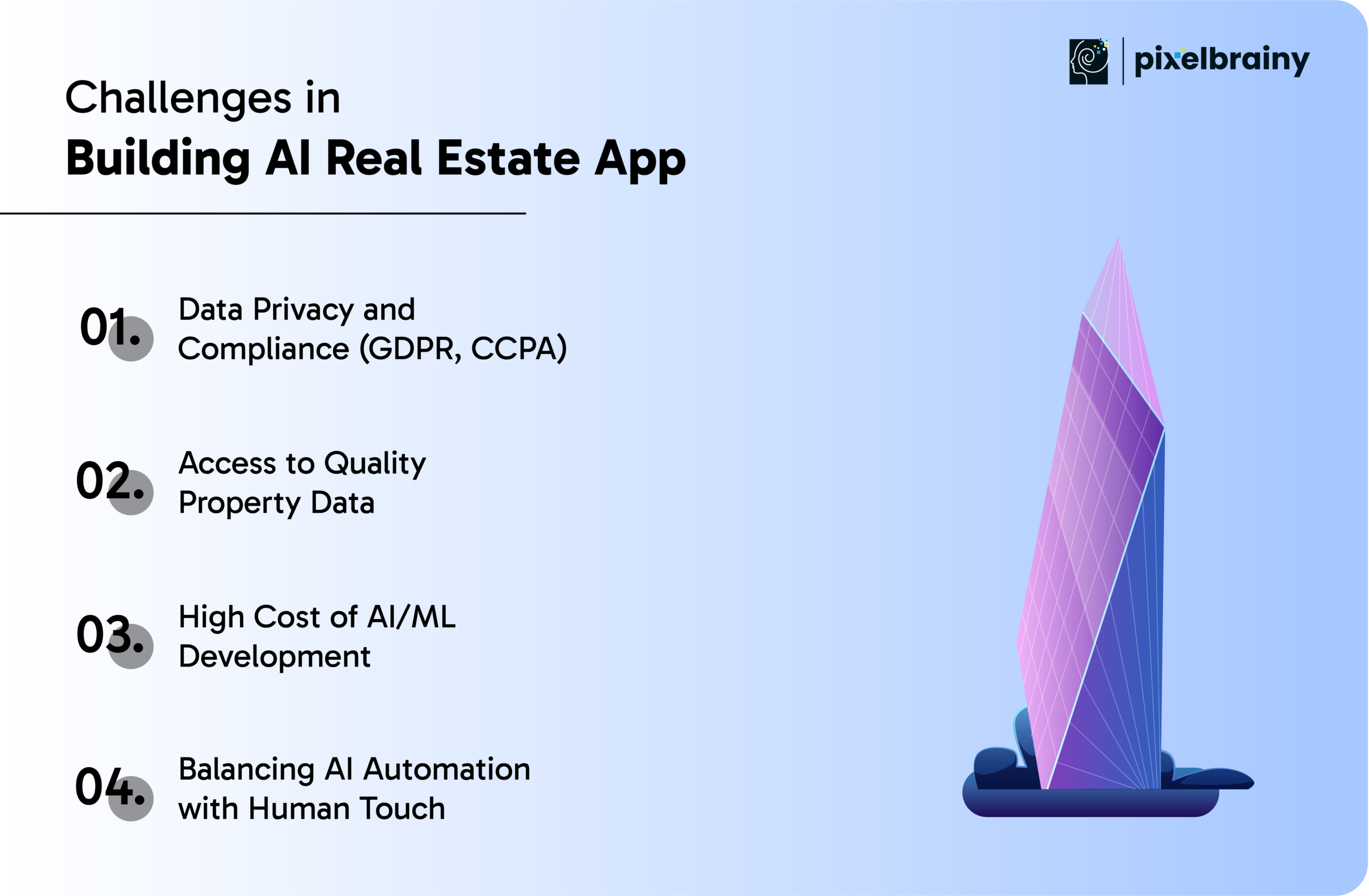
Challenge: Real estate apps handle sensitive data such as buyer information, financial details, and property ownership records. Mishandling this data or failing to comply with regulations like GDPR (General Data Protection Regulation) and CCPA (California Consumer Privacy Act) can lead to legal risks and loss of user trust.
Solution: Build privacy-first architecture by implementing data encryption, anonymization, and strict consent management. Regular compliance audits and transparent privacy policies are critical. Partnering with legal experts during the development of AI real estate application ensures adherence to evolving global data standards.
Challenge: AI models depend on large volumes of clean and reliable data. However, accessing high-quality property listings, transaction histories, and market trends can be difficult, fragmented, or expensive. Inconsistent or biased datasets lead to poor recommendations and inaccurate valuations.
Solution: Establish partnerships with MLS providers, property portals, and government agencies to gain verified datasets. Invest in data cleaning and enrichment techniques to improve quality. Using APIs from trusted providers ensures real-time updates. A robust data pipeline is the backbone of developing AI real estate app that delivers accurate insights.
Challenge: Advanced AI models for property recommendations, valuations, or fraud detection require skilled developers, expensive infrastructure, and ongoing training. The costs of cloud hosting, GPU resources, and continuous model improvement can strain startup budgets.
Solution: Begin with MVP development to test core AI use cases before scaling. Leverage pre-trained models and cloud-based AI services from providers like AWS, Google Cloud, or Azure to reduce costs. Outsourcing specific AI tasks to specialized vendors can also make early stages more affordable. Over time, optimizing infrastructure with MLOps will lower recurring expenses.
Challenge: While AI improves efficiency, real estate is still a people-centric business where personal trust and relationships matter. Over-automation can make apps feel impersonal, reducing client satisfaction and trust in big financial decisions like property purchases.
Solution: Use AI to handle repetitive tasks such as valuations, scheduling, and initial queries, but keep agents involved in decision-critical interactions. Hybrid models that combine chatbots with live agent escalation offer the best balance. By designing AI tools to complement rather than replace human expertise, AI real estate app development creates value without losing the human connection.
Therefore, addressing data privacy, property data quality, AI development costs, and human oversight early can make AI real estate app development more secure, reliable, and practical for real-world users.
The next phase of AI real estate app development will focus on making property platforms more predictive, personalized, automated, and connected. Consider a real estate technology company serving buyers, agents, and investors across multiple markets. Its future application may need to understand complex user intent, streamline transaction workflows, connect with smart property environments, and deliver recommendations based on more than basic search filters.
For businesses planning to develop an AI real estate app, keeping track of emerging technologies can help shape a stronger product roadmap. However, every trend should be evaluated according to its practical use case, available data, regulatory requirements, implementation cost, and expected user value. Technologies such as generative AI, blockchain, hyper-personalization, and IoT can create meaningful opportunities when they solve specific problems within the real estate journey.
The following trends highlight the areas most likely to influence the next generation of AI-powered real estate applications.
Trend: Drafting property contracts and legal agreements is time-consuming, error-prone, and often requires professional assistance. Generative AI is changing this by creating legally compliant contract drafts based on predefined templates, deal terms, and local regulations.
Impact: Realtors and buyers can save hours of paperwork and reduce legal bottlenecks. AI-generated contracts also minimize human error and standardize processes. While legal review will still be necessary, generative AI dramatically shortens turnaround times, making property transactions smoother.
Trend: Real estate transactions involve sensitive financial and ownership data. By combining blockchain’s immutability with AI’s fraud detection and validation capabilities, apps can provide secure, transparent, and tamper-proof digital transactions.
Impact: Buyers and sellers gain confidence in the authenticity of property records. Realtors benefit from faster, verifiable transactions with reduced fraud risk. Smart contracts powered by blockchain and AI can automatically execute payments, escrow releases, and ownership transfers, creating end-to-end trust in the ecosystem.
Trend: Traditional property searches often overwhelm users with irrelevant options. Future AI real estate apps will focus on hyper-personalization, where recommendations go beyond price and location to include lifestyle preferences, commuting patterns, financial goals, and even long-term investment potential.
Impact: Buyers will receive fewer but highly relevant property suggestions, making their journey faster and more enjoyable. Realtors and startups benefit from higher conversion rates as clients are matched with homes that truly align with their needs. This personalization becomes a powerful differentiator in a crowded market.
Trend: As IoT adoption grows, AI real estate apps will increasingly connect with smart home ecosystems. Buyers will be able to see property listings that highlight energy efficiency, connected devices, and automation features integrated into homes.
Impact: For modern buyers, smart home compatibility adds strong appeal. Realtors gain a new selling point by showcasing homes with IoT features, while startups can create new revenue opportunities by partnering with smart home device providers. Over time, apps may even allow buyers to simulate energy savings or security features before making purchase decisions.
Therefore, the future of AI real estate app development will favor platforms that combine intelligent automation with personalization, security, and connected property experiences while keeping every technology tied to a clear user or business outcome.
From strategy and product planning to AI implementation, deployment, and scaling, PixelBrainy helps businesses turn real estate technology ideas into intelligent, practical solutions. As a real estate AI software development company, we combine AI expertise, software engineering, and an understanding of real estate workflows to create applications designed around specific business objectives.
Our expertise spans AI-powered property recommendations, intelligent property valuation, predictive analytics, lead scoring, personalized search, virtual assistants, and automated real estate workflows. Rather than adding AI as an isolated feature, we focus on connecting AI capabilities with the application's data, users, and operational processes.
A leading U.S. real estate agency approached PixelBrainy with a common challenge: buyers were overwhelmed by irrelevant property options, while agents were spending substantial time handling unqualified leads.
PixelBrainy developed an AI-powered solution that analyzed buyer preferences, behavior, and relevant market data to generate more personalized property recommendations. The platform also used AI-driven lead scoring to help agents identify and prioritize prospects with stronger conversion potential.
The project delivered measurable results:
This engagement reflects PixelBrainy's approach to real estate AI app development, where technology is connected to measurable business outcomes rather than implemented simply for innovation.
Whether you are a startup launching a proptech product, an agency modernizing its technology stack, or an individual real estate professional exploring AI capabilities, PixelBrainy can support the journey from concept to production-ready application.
Connect with PixelBrainy to discuss your real estate AI app idea.
AI is creating practical opportunities across property discovery, lead management, valuation, client communication, market analysis, and real estate operations. The value of AI real estate app development comes from connecting these capabilities to specific workflows and measurable outcomes, helping realtors, agencies, and proptech businesses deliver faster, more personalized, and data-informed experiences.
A successful application starts with a clearly defined use case, reliable real estate data, the right technology architecture, and a development roadmap that supports both immediate requirements and future growth. Whether the objective is to launch an MVP, create a specialized solution for real estate professionals, or expand an established platform with AI capabilities, these foundations help turn an idea into a practical product.
For businesses ready to develop an AI real estate app, working with a partner that understands both AI and real estate can simplify the journey from strategy and design to development, deployment, and scaling.
Book an appointment with PixelBrainy to discuss your AI real estate app idea and development goals.
The most valuable features depend on the application's target users and business goals. AI real estate app development can include intelligent property recommendations, AI-powered lead scoring, predictive market analytics, virtual assistants, automated document processing, smart search, and property valuation. The right combination should be based on measurable user and business requirements.
Yes. You can develop an AI real estate app specifically around an individual Realtor's workflow, client base, and local market. The application can combine lead management, personalized property recommendations, client communication, appointment scheduling, market insights, and automation to help the agent manage daily activities more efficiently.
An AI-powered real estate app can analyze user preferences, search activity, saved properties, viewing behavior, budget, location preferences, and interaction history. Machine learning models can use these signals to identify relevant listings and continuously improve recommendations as the user's behavior and requirements change.
The required data depends on the AI functionality being implemented. Real estate AI app development may require property listings, historical transaction data, location information, market trends, property images, user preferences, search activity, and engagement data. Businesses should also evaluate data quality, licensing, privacy, availability, and update frequency before using these datasets.
The cost to build an AI real estate app varies according to application scope, AI complexity, platforms, integrations, data sources, UI/UX requirements, security, and development resources. A focused MVP with selected AI capabilities will generally require a smaller investment than a large platform combining valuation, predictive analytics, AI assistants, personalization, and multiple external integrations.
AI can analyze available engagement and interaction signals to help prioritize leads, identify follow-up opportunities, summarize conversations, and automate routine communication. When you build an AI real estate app with lead intelligence, Realtors can spend more time on high-value client interactions while reducing repetitive administrative work.
An AI chatbot can be useful for answering common property questions, assisting with searches, scheduling appointments, providing application guidance, and handling routine client requests. During AI real estate app development, the chatbot should be connected to reliable application and property data and provide human escalation for complex or sensitive situations.
Look for a company with relevant experience in AI real estate app development, machine learning, property data, application integrations, security, and scalable architecture. Review relevant case studies, technical expertise, development methodology, estimated costs, timelines, and post-launch support. A capable partner should understand both the real estate workflow and the AI requirements behind the product.
The AI real estate app development timeline depends on the product scope, number of platforms, AI capabilities, integrations, data requirements, testing, and team size. A focused MVP with core property features and limited AI functionality may take a few months, while a full-scale application with predictive analytics, intelligent recommendations, AI assistants, and multiple integrations can require significantly more time.
The cost of AI real estate app development can range from $30,000 to $200,000+, depending on the app's complexity, number of features, AI capabilities, platforms, integrations, data requirements, security, and development team. A focused MVP with essential property features and limited AI functionality will generally cost less than a full-scale solution with predictive analytics, intelligent recommendations, AI assistants, valuation models, and multiple third-party integrations.

About The Author
Sagar Bhatnagar
Sagar Sahay Bhatnagar brings over a decade of IT industry experience to his role as Marketing Head at PixelBrainy. He's known for his knack in devising creative marketing strategies that boost brand visibility and market influence. Sagar's strategic thinking, coupled with his innovative vision and focus on results, sets him apart. His track record of successful campaigns proves his ability to utilize digital platforms effectively for impactful marketing efforts. With a genuine passion for both technology and marketing, Sagar continuously pushes PixelBrainy's marketing initiatives to greater success.

Working with PixelBrainy has been a great experience. They took our vision for an AI-powered platform and turned it into a fully functional product. What impressed me most was their strong understanding of both design and development, and their ability to handle complex requirements with ease. The team was responsive, cooperative, and always open to feedback. They kept things organized, communicated clearly, and delivered quality work on time. I highly recommend PixelBrainy to anyone looking for a skilled and reliable development partner.

Working with the PixelBrainy team has been a highly positive experience. They understand the design requirements and create beautiful UX elements to meet the application needs. The dev team did an excellent job bringing my vision to life. We discussed usability and flow. Sagar worked with his team to design the database and begin coding. Working with Sagar was easy. He has the knowledge to create robust apps, including multi-language support, Google and Apple ID login options, Ad-enabled integrations, Stripe payment processing, and a Web Admin site for maintaining support data. I'm extremely satisfied with the services provided, the quality of the final product, and the professionalism of the entire process. I highly recommend them for Android and iOS Mobile Application Design and Development.

Great experience working with them. Had a lot of feedback and I found that unlike most contractors they were bugging me for updates instead of the other way around. They were extremely time conscience and great at communicating! All work was done extremely high quality and if not on time, early! They were always proactive when it comes to communication and the work is great/above par always. Very flexible and a great team to work with! Goes above and beyond to present us with multiple options and always provides quality. Amazing work per usual with Chitra. If you have UI/UX or branding design needs I recommend you go to them! Will likely work with them in the future as well, definitely recommended!

PixelBrainy is a joy to work with and is a great partner when thinking through branding, logo, and website layout. I appreciate that they spend time going into the "why" behind their decisions to help inform me and others about industry best practices and their expertise.

I hired them to design our software apps. Things I really like about them are excellent communication skills, they answer all project suggestions and collaborate right away, and their input on design and colors is amazing. This project was complex and needed patience and creativity. The team is amazing to do business with. I will be using them long-term. Glad to see there are some good people out there. I was afraid to try and outsource my project to someone but I am glad I met them! I really can't say enough. They went above and beyond on this project. I am very happy with everything they have done to make my business stand out from the competition.

It was great working with PixelBrainy and the team. They were very responsive and really owned the project. We'll definitely work with them again!

I recently worked with the PixelBrainy team on a project and I was blown away by their communication skills. They were prompt, clear, and articulate in all of our interactions. They listened and provided valuable feedback and suggestions to help make the project a success. They also kept me updated throughout the entire process, which made the experience stress-free and enjoyable.

PixelBrainy is very good at what it does. The team also presents themselves very professionally and takes care of their side of things very well. I could fully trust them taking up the design work in a timely and organised manner and their attention to detail saved us lots of effort and time. This particular project was quite intense and the team showed that they function very well under pressure. Very much looking forward to working with her again!

It's always an absolute pleasure working with them. They completed all of my requests quickly and followed every note I had for them to a T, which made our process go smoothly from start to finish. Everything was completed fast and following all of the guidelines. And I would recommend their services to anyone. If you need any design work done in the future, PixelBrainy should be your first call!

They took ownership of our requirements and designed and proposed multiple beautiful variants. The team is self-motivated, requires minimum supervision, committed to see-through designs with quality and delivering them on time. We would definitely love to work with PixelBrainy again when we have any requirements.

PixelBrainy was a big help with our SaaS application. We've been hard at work with a new UI/UX and they provided a lot of help with the designs. If you're looking for assistance with your website, software, or mobile application designs, PixelBrainy and the team is a great recommendation.

PixelBrainy designers are amazing. They are responsive, talented, and always willing to help craft the design until it matches your vision. I would recommend them and plan to continue them for my future projects and more!!!

They were awesome! Did a good job fast, and good communication. Will work with them again. Thank you

Creative, detail-oriented, and talented designers who take direction well and implement changes quickly and accurately. They consistently over-delivered for us.

PixelBrainy team is very talented and creative. Great designers and a pleasure to work with. PixelBrainy is an excellent communicator and I look forward to working with them again.

PixelBrainy has a very talented design team. Their work is excellent and they are very responsive. I enjoy working with them and hope to continue on all of our future projects.


Transform your ideas into reality with us.
Across these industries, each engagement brings unique challenges, from early-stage product development to scaling complex systems, helping us build a practical understanding of real-world product environments.