AI Summary Powered by PixelBrainy
Why are so many enterprise AI projects delayed before development even begins? The answer is surprisingly simple. Business leaders, CTOs, and technology vendors often use RAG, AI agents, and agentic AI as if they mean the same thing, even though they represent very different AI architectures with distinct capabilities, costs, and implementation strategies.
Consider a practical scenario. A mid size enterprise is evaluating AI investment options for 2026. During a strategy meeting, the CTO recommends Retrieval Augmented Generation (RAG) to improve knowledge management, while the operations team advocates AI agents to automate customer support and internal workflows. At the same time, another vendor proposes agentic AI as a fully autonomous business solution. With each stakeholder defining AI differently, making the right investment decision becomes difficult.
The market urgency is clear. According to Gartner, worldwide AI spending is forecast to reach USD 2.59 trillion in 2026, a 47% year over year increase, with enterprise adoption rapidly shifting towards AI agents and agentic workflows that deliver measurable business outcomes.
This growing investment has also increased searches for RAG vs AI agents vs agentic AI, what is the difference between RAG AI agents and agentic AI, and RAG vs AI agents vs agentic AI explained for founders. These are not purely technical questions. They directly influence architecture decisions, implementation costs, governance, scalability, and return on investment.
In this guide, you will understand RAG vs AI agents vs agentic AI which should I build for my business, compare RAG vs AI agents for customer support which is better, and learn how to build a system that combines RAG with AI agents. By the end, you will have a practical framework to select the right AI architecture based on your business objectives rather than vendor marketing claims.
Before comparing architectures, decision makers need a common vocabulary. Many failed AI initiatives begin because stakeholders use RAG, AI agents, and agentic AI interchangeably. In reality, they solve different business problems and offer different levels of automation.
Understanding what is the difference between RAG AI agents and agentic AI is the first step towards choosing the right architecture for your organisation.
RAG (Retrieval Augmented Generation) is an AI architecture that retrieves relevant information from your enterprise knowledge base at query time and uses that information to generate accurate, grounded responses.
Its primary purpose is to answer questions using trusted business content such as policy documents, product manuals, contracts, technical documentation, or internal knowledge bases.
Think of RAG as a highly intelligent enterprise search engine that reads multiple documents and delivers a precise answer instead of a list of links.
Business takeaway: If your use case is primarily about answering questions accurately, RAG is where you should start.
An AI agent is a large language model powered system that uses software tools to perform business actions instead of only generating text.
Unlike RAG, an AI agent can interact with enterprise applications and complete predefined tasks across different systems.
Think of an AI agent as a smart digital assistant that not only answers your question but also completes the task on your behalf.
Business takeaway: If your use case requires taking actions instead of simply providing answers, an AI agent is the better choice.
Also Read: AI Agent Development Cost ($10K-$100K)
Agentic AI refers to autonomous AI systems that can plan, decide, adapt, and execute multiple interconnected tasks to achieve complex business objectives with minimal human direction.
Rather than following a fixed workflow, agentic AI continuously evaluates progress and adjusts its strategy as conditions change.
Think of agentic AI as a self-directed team member who receives a business objective on Monday and independently figures out how to deliver results by Friday.
Business takeaway: If your use case involves complex, multi-step goals that require continuous planning and dynamic decision making, agentic AI is the right architecture.
Also Read: How to Develop Agentic AI System
| Concept | One-Line Definition | Primary Action | What It Cannot Do |
| RAG | Retrieves information from enterprise knowledge to generate accurate answers. | Generates grounded responses. | Cannot execute tasks or interact with business systems. |
| AI Agent | Uses enterprise tools to complete predefined business tasks. | Executes actions across applications and APIs. | Cannot autonomously redesign complex strategies. |
| Agentic AI | Plans, reasons, adapts, and executes towards business goals. | Coordinates multi-step decisions and workflows. | Cannot operate safely without governance and human oversight. |
In short, RAG retrieves knowledge, AI agents execute tasks, and agentic AI autonomously plans and achieves business goals, making each architecture suitable for a different stage of enterprise AI maturity.
Although all three architectures are powered by large language models (LLMs), they process requests very differently. The difference between RAG and AI agents is not the language model itself but how it retrieves information, interacts with external systems, and makes decisions. Likewise, agentic AI vs retrieval augmented generation is a comparison between answering questions and autonomously pursuing business objectives.
The easiest way to understand these differences is to see what happens behind the scenes when each architecture receives a request.
A RAG system is designed to retrieve the most relevant business information before generating a response. Every answer is grounded in trusted enterprise data instead of relying only on the LLM's training knowledge.
Here's how it works:
Example
A procurement manager asks:
"What is our refund policy for enterprise contracts?"
Instead of generating a generic response, the RAG system retrieves the relevant contract clause, generates an accurate answer, and cites the policy document used as its source.
Key characteristic: Retrieve first, then generate.
Unlike RAG, an AI agent is designed to complete tasks rather than simply answer questions. It continuously reasons about the next best action by interacting with enterprise tools and applications.
Here's how it works:
Example
A finance manager asks:
"Check whether our top ten clients have unpaid invoices and send reminders to overdue accounts."
The AI agent queries the CRM, verifies payment status, identifies overdue invoices, generates reminder emails, and sends them automatically without requiring additional user input.
Key characteristic: Reason, act, observe, and repeat until the goal is achieved.
Agentic AI extends the capabilities of AI agents by introducing autonomous planning and continuous adaptation. Instead of following predefined workflows, it dynamically creates and adjusts execution plans based on changing conditions.
Here's how it works:
Example
A product leader asks:
"Research our top three competitors, analyse their pricing and feature sets, identify product gaps, and deliver a strategic response document by Friday."
The agentic AI searches the web, retrieves internal documents, analyses competitor data, writes scripts to process findings, drafts the report, revises it based on new information, and delivers the final document with minimal human involvement.
Key characteristic: Plan, orchestrate, adapt, and execute towards a business objective.
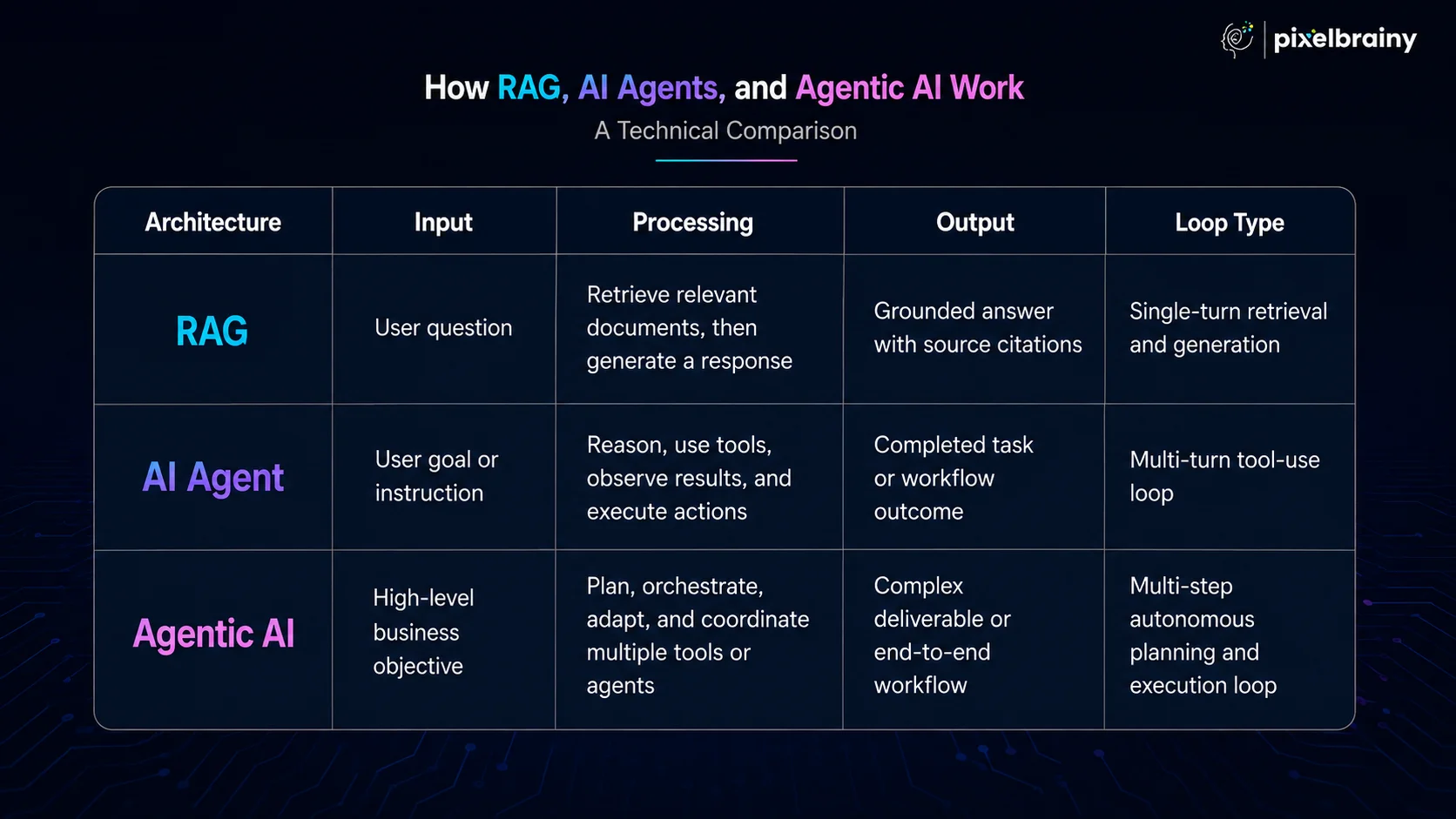
| Architecture | Input | Processing | Output | Loop Type |
| RAG | User question | Retrieve relevant documents, then generate a response | Grounded answer with source citations | Single-turn retrieval and generation |
| AI Agent | User goal or instruction | Reason, use tools, observe results, and execute actions | Completed task or workflow outcome | Multi-turn tool-use loop |
| Agentic AI | High-level business objective | Plan, orchestrate, adapt, and coordinate multiple tools or agents | Complex deliverable or end-to-end workflow | Multi-step autonomous planning and execution loop |
RAG retrieves trusted knowledge, AI agents transform that knowledge into actions, and agentic AI combines planning, reasoning, and execution to autonomously achieve complex business goals. This architectural distinction is what determines the right technology for your enterprise use case and explains many RAG and AI agents combined use cases seen in modern production systems.
Although RAG, AI agents, and agentic AI all leverage large language models, they are built to solve fundamentally different business problems. Looking only at their technical capabilities often leads to unnecessary complexity, higher implementation costs, or AI solutions that fail to deliver measurable business outcomes. For enterprise leaders, the real question is not which technology is more advanced, but which architecture aligns with the problem they are trying to solve.
A question we frequently hear from CTOs and digital transformation leaders is: "We want to automate customer support, internal operations, and business workflows. Should we start with RAG, AI agents, or invest directly in agentic AI?" The answer depends on several practical factors that influence implementation success, scalability, governance, and long-term ROI. Understanding when to use RAG vs AI agents becomes much easier when you compare them across the following decision dimensions.
Every architecture is designed for a different level of business capability.
Business implication: If your use case revolves around enterprise knowledge search, policy assistance, or document-based customer support, RAG is usually the best starting point. If your AI needs to update CRM records, process invoices, or automate workflows, AI agents are a better fit. For strategic initiatives involving autonomous planning across multiple systems, agentic AI becomes the appropriate choice.
As AI systems become more autonomous, maintaining consistent and predictable behaviour becomes increasingly challenging.
Business implication: For industries such as healthcare, financial services, insurance, or legal, RAG or tightly controlled AI agents provide a more reliable foundation before introducing highly autonomous agentic systems.
The engineering effort required increases significantly with each level of autonomy.
Business implication: Begin with the simplest architecture that solves the business problem. Additional autonomy should only be introduced when there is clear evidence that a simpler approach cannot meet operational requirements.
Cost Profile
The total cost of ownership increases alongside system autonomy.
Business implication: When evaluating RAG vs agentic AI which is better, focus on business value rather than technical sophistication. If RAG delivers the desired outcome, adopting a more autonomous architecture is unlikely to produce a proportional return on investment.
| Decision Dimension | RAG | AI Agent | Agentic AI |
| Best task type | Question answering from enterprise documents | Defined task execution using enterprise tools | Complex business goal achievement requiring planning |
| Output type | Grounded answer with source citations | Completed action or task result | Completed multi-step workflow or strategic deliverable |
| Reliability | High, predictable, and traceable | Medium, as tool failures introduce variability | Lower, as uncertainty compounds across multiple planning steps |
| Development complexity | Low to medium, typically weeks to production | Medium to high, typically months to production | High, often requiring three or more months |
| Cost per interaction | Low per query | Medium per task | High per business objective |
| Human oversight | Minimal answer review | Moderate approval for sensitive actions | Significant governance, especially during early deployment |
The most effective enterprise AI strategy is not about deploying the most autonomous system first, but about implementing the architecture that best fits the business problem today while providing a clear path to evolve from RAG to AI agents and eventually to agentic AI as organisational needs mature.
Understanding the technology is only half the decision. The real value comes from knowing where each architecture delivers measurable business outcomes. Many enterprise AI projects struggle because organisations deploy autonomous AI for simple knowledge retrieval or use a basic chatbot where workflow automation is actually needed.
The following examples highlight the most common RAG vs AI agents use cases and demonstrate where each architecture creates the greatest business value.
RAG delivers the highest value when organisations need accurate, traceable answers from trusted enterprise knowledge. It is ideal for scenarios where factual accuracy matters more than automation and where autonomous actions could introduce unnecessary risk.
| Industry | Use Case | Why RAG Fits |
| Healthcare | Clinical staff querying treatment guidelines and drug interaction databases | Responses are grounded in validated medical sources with traceable citations. |
| Legal | Attorneys searching case law, contracts, and legal memoranda | Legal decisions require precise answers backed by source documents. |
| Enterprise | Employees accessing HR policies, SOPs, compliance documents, and internal knowledge bases | Enables fast, accurate knowledge retrieval without changing business systems. |
| E-commerce | Customer support chatbot answering product, shipping, warranty, and return policy questions | Ensures responses always reflect the latest business policies. |
| Finance | Analysts querying research reports, regulatory filings, and compliance documentation | Protects proprietary information while providing source-backed responses. |
Business insight: If your objective is to improve knowledge discovery, compliance, or self-service support, RAG offers the fastest and lowest-risk path to production. For organisations evaluating RAG chatbot vs AI agent which is right for my customer support, RAG is the preferred choice when support primarily involves answering policy or product-related questions.
AI agents become valuable when work extends beyond answering questions and requires interaction with enterprise applications. They combine reasoning with action, allowing organisations to automate structured business processes.
| Industry | Use Case | Why AI Agent Fits |
| Customer Support | Processing refunds, checking account status, updating tickets, and sending confirmations | Combines knowledge retrieval with workflow execution across multiple systems. |
| Sales | Qualifying leads, updating CRM records, scheduling meetings, and sending follow-up emails | Automates repetitive sales activities using predefined business workflows. |
| Software Development | Writing, testing, debugging, and validating code within assigned tasks | Executes code and iteratively improves results using developer tools. |
| HR & Operations | Employee onboarding, account provisioning, orientation scheduling, and document distribution | Coordinates multiple enterprise systems within a defined workflow. |
| Marketing | Collecting competitive intelligence and generating structured market briefings | Uses multiple tools to gather, analyse, and summarise information efficiently. |
Business insight: AI agents are best suited for predictable workflows where the system must complete tasks across business applications rather than simply provide information.
Also Read: Top 15+ AI Agent Development Companies In USA
Agentic AI is designed for organisations pursuing complex business objectives that require planning, adaptation, and autonomous execution over multiple stages. These are among the fastest-growing agentic AI use cases for business automation in 2026.
| Industry | Use Case | Why Agentic AI Fits |
| Software Development | Planning features, writing code, running tests, fixing bugs, and delivering production-ready software | Requires continuous planning, execution, and iteration. |
| Research & Strategy | Analysing competitors, identifying market gaps, testing hypotheses, and producing strategic recommendations | Adapts its research strategy as new information emerges. |
| Finance | Performing investment research, analysing financial statements, modelling scenarios, and generating investment memos | Coordinates multiple analytical steps with dynamic decision making. |
| Legal | Reviewing contracts, identifying risks, drafting responses, routing approvals, and updating records | Manages conditional workflows across multiple legal systems. |
| Enterprise Automation | End-to-end lead qualification, outreach, meeting scheduling, CRM updates, and follow-up management | Continuously adapts workflow execution based on changing business conditions. |
Business insight: Agentic AI is the right choice when the objective is not a single task but an end-to-end business outcome that requires autonomous planning and continuous adaptation.
| Architecture | Best Industry Fit | Core Use Case Pattern | When It Is the Wrong Choice |
| RAG | Healthcare, Legal, Enterprise, Finance | Accurate question answering from trusted knowledge | When the use case requires executing actions or business workflows |
| AI Agent | Customer Support, Sales, HR, Marketing | Defined task execution across enterprise systems | When objectives are too open-ended for predefined workflows |
| Agentic AI | Software Development, Research, Finance, Legal Automation | Complex goal achievement through autonomous planning | When regulatory, governance, or reliability requirements demand strict human control |
The most successful enterprise AI implementations start by matching the architecture to the business problem, using RAG for trusted knowledge retrieval, AI agents for workflow automation, and agentic AI only when autonomous planning delivers measurable business value.
Most enterprise AI platforms do not rely on a single architecture. Instead, production-ready systems combine multiple AI capabilities to balance accuracy, automation, and autonomy. Rather than viewing them as competing technologies, organisations should understand can RAG and AI agents be combined in the same system as a design question.
In practice, the most successful enterprise solutions layer RAG, AI agents, and agentic AI together based on business requirements, system maturity, and operational complexity.
Modern AI systems typically evolve into a layered architecture, where each technology performs a distinct role.
The easiest way to remember the relationship is:
RAG knows things. AI agents do things. Agentic AI decides, coordinates, and adapts.
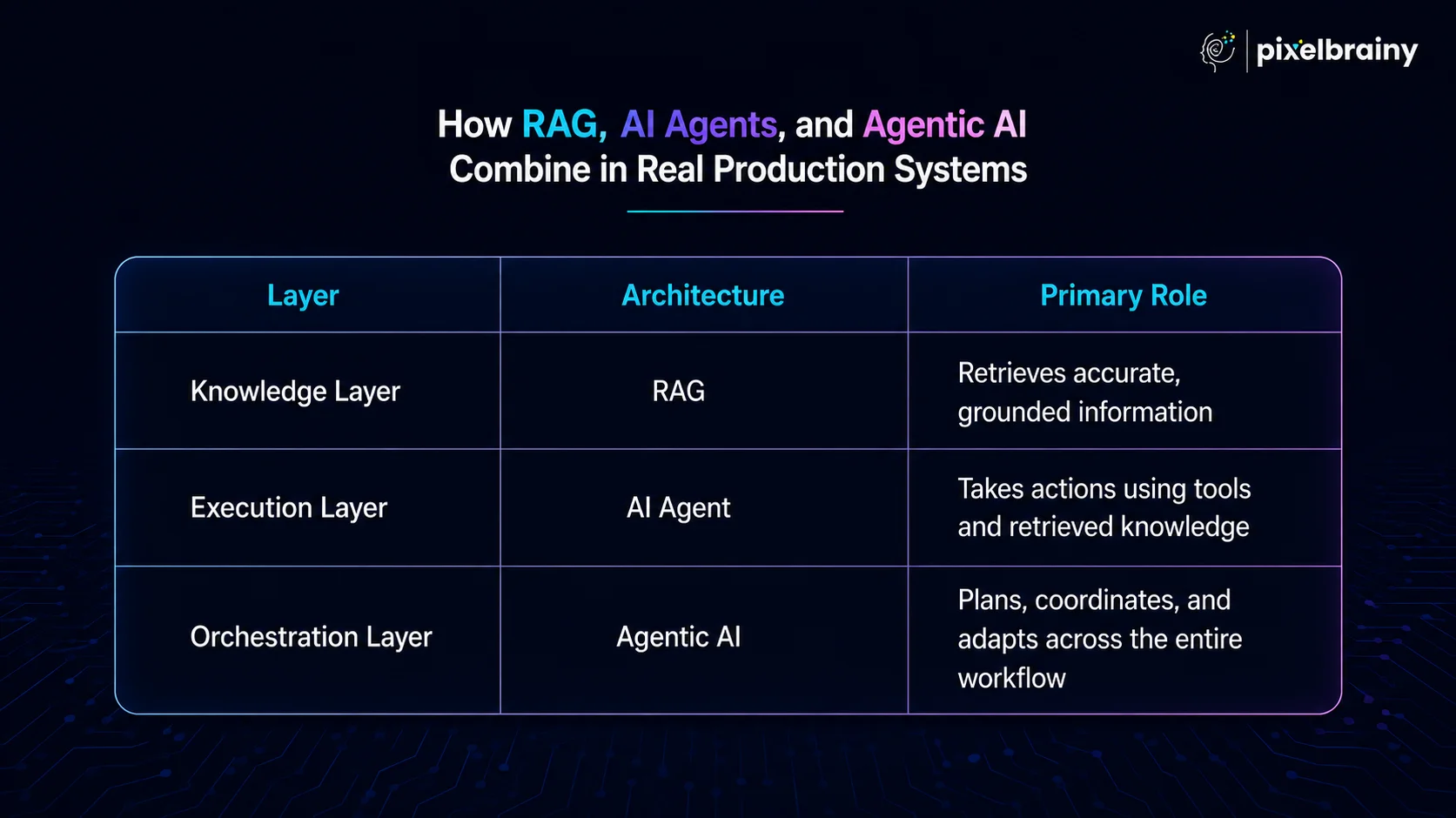
| Layer | Architecture | Primary Role |
| Knowledge Layer | RAG | Retrieves accurate, grounded information |
| Execution Layer | AI Agent | Takes actions using tools and retrieved knowledge |
| Orchestration Layer | Agentic AI | Plans, coordinates, and adapts across the entire workflow |
A modern customer support platform combines all three architectures to deliver both accuracy and automation.
Summary: RAG answers accurately, AI agents execute customer actions, and agentic AI manages the complete support experience.
Legal operations require both trusted information and structured workflow execution.
Summary: RAG provides legal knowledge, AI agents execute document workflows, and agentic AI manages the matter from start to finish.
Enterprise research teams increasingly combine internal and external intelligence.
Summary: RAG delivers trusted internal knowledge, AI agents collect and process external information, and agentic AI drives the end-to-end research strategy.
AI maturity should evolve incrementally rather than introducing unnecessary complexity from day one.
| Start With | Add When | Add Next When |
| RAG only | Users need accurate answers from enterprise documents | Business processes require actions beyond answering questions |
| RAG + AI Agent | Task execution is needed alongside knowledge retrieval | Workflows become too dynamic for predefined agent loops |
| RAG + AI Agent + Agentic AI | Autonomous, multi-step business goals become a priority | RAG and AI agent layers have already demonstrated reliable production performance |
The most scalable enterprise AI systems are not built by replacing one architecture with another, but by layering RAG, AI agents, and agentic AI to deliver the right balance of knowledge, action, and autonomous decision-making.
After understanding the capabilities, use cases, and trade-offs of each architecture, the next challenge is determining which one best fits your business. There is no universal answer because every organisation has different objectives, risk tolerance, budgets, and operational complexity. Instead of asking "RAG vs AI agents vs agentic AI which should I build for my business?", decision makers should evaluate their use case through a series of practical questions.
This framework helps founders, CTOs, and product teams make informed decisions when choosing AI architecture for business: RAG, agents, or agentic AI.
The first decision is understanding whether your AI system needs to provide information or perform work.
Recommendation: Build only the capabilities your use case genuinely requires.
Next, evaluate how predictable the workflow is.
Recommendation: Greater autonomy is only valuable when the business problem demands continuous decision-making.
Every AI implementation should be aligned with the level of risk your organisation can tolerate.
Recommendation: As business risk increases, human oversight should increase accordingly.
Project constraints often influence architecture decisions as much as technical requirements.
Recommendation: Scale your AI architecture alongside your engineering maturity rather than your ambition.
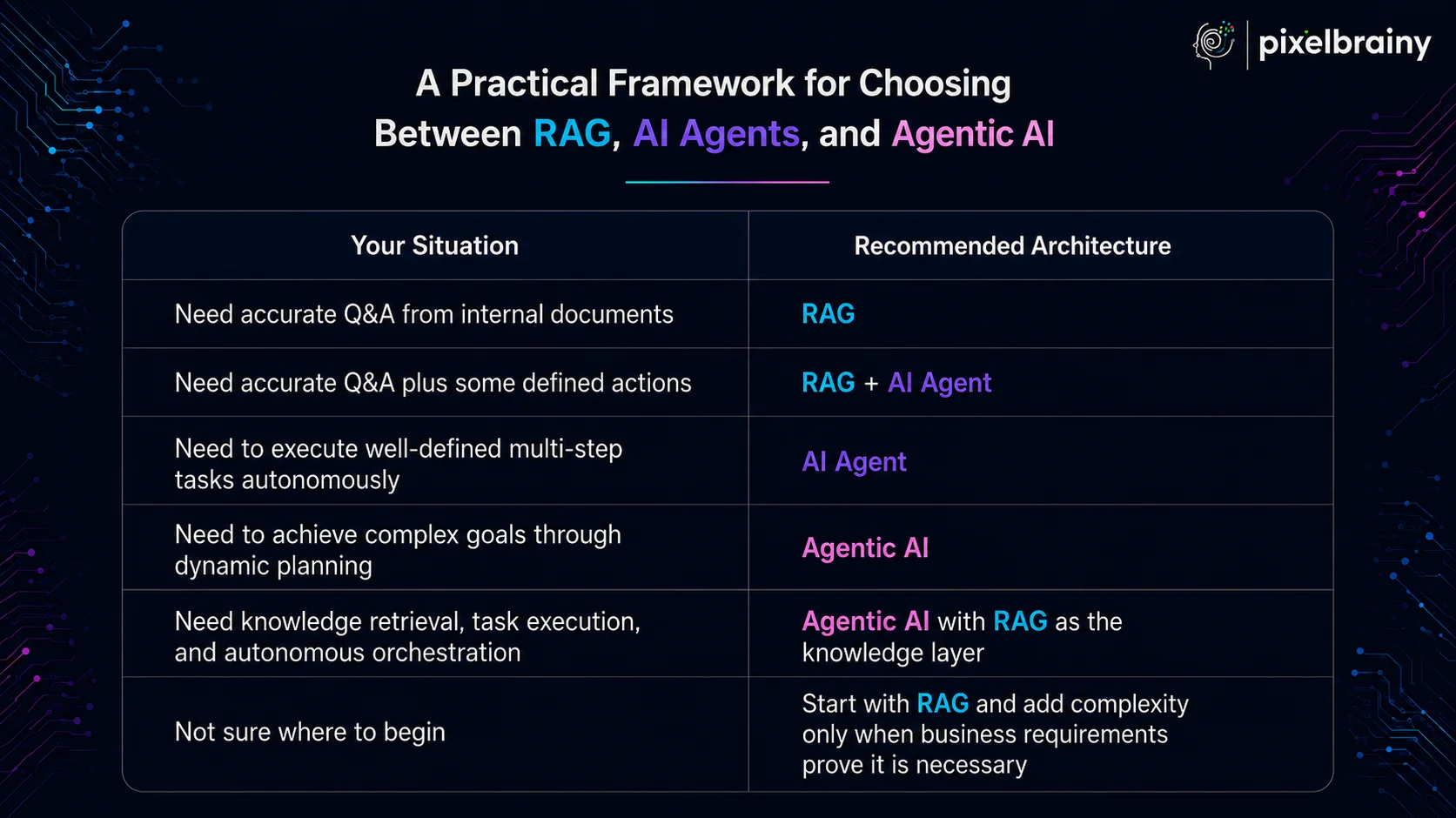
| Your Situation | Recommended Architecture |
| Need accurate Q&A from internal documents | RAG |
| Need accurate Q&A plus some defined actions | RAG + AI Agent |
| Need to execute well-defined multi-step tasks autonomously | AI Agent |
| Need to achieve complex goals through dynamic planning | Agentic AI |
| Need knowledge retrieval, task execution, and autonomous orchestration | Agentic AI with RAG as the knowledge layer |
| Not sure where to begin | Start with RAG and add complexity only when business requirements prove it is necessary |
The most effective enterprise AI strategy begins with the simplest architecture that solves today's business problem and evolves incrementally as automation requirements, organisational maturity, and business value continue to grow.
For most enterprises, the biggest barrier to AI adoption is not capability but trust. Before expanding from knowledge retrieval to autonomous decision-making, technology leaders need confidence that AI systems will behave predictably, remain auditable, and operate within clearly defined governance boundaries. Questions such as "AI agents vs RAG which has lower hallucination risk?" or "RAG vs agentic AI for financial services automation" are increasingly shaping enterprise AI strategies. The answer lies in understanding the unique risk profile of each architecture and implementing the right control mechanisms from the outset.
Among the three architectures, RAG offers the highest level of reliability because responses are grounded in trusted enterprise documents rather than relying solely on an LLM's internal knowledge.
However, RAG is not risk-free.
Primary risk
Secondary risk
How to mitigate these risks
Business insight: RAG is the preferred architecture whenever answer accuracy, traceability, and compliance outweigh the need for workflow automation.
AI agents introduce additional operational risk because they interact directly with enterprise applications rather than simply generating responses.
Primary risk
Secondary risk
How to mitigate these risks
Business insight: AI agents provide significant productivity gains when combined with governance controls that keep automation within predefined operational boundaries.
Agentic AI delivers the highest level of autonomy, but it also carries the greatest governance responsibility. This is particularly important when evaluating when does agentic AI outperform RAG for complex business tasks, as increased capability comes with increased operational risk.
Primary risk
Secondary risk
How to mitigate these risks
Business insight: For regulated environments such as banking, insurance, and healthcare, agentic AI should be introduced progressively, with governance evolving alongside system autonomy.
| Architecture | Primary Risk | Impact Severity | Key Mitigation |
| RAG | Retrieval failure and outdated knowledge | Low to medium, typically incorrect responses | Hybrid retrieval, confidence scoring, and continuous knowledge base monitoring |
| AI Agent | Unintended tool execution | Medium to high, potentially affecting business systems | Human approval gates, audit trails, sandbox testing, and reversible workflows |
| Agentic AI | Compounding autonomous decisions across multiple steps | High, with potential business-wide impact | Staged autonomy, hard action limits, continuous monitoring, and governance controls |
Enterprise AI reliability is determined less by the architecture itself and more by the governance surrounding it. Organisations that introduce autonomy gradually, validate every layer, and implement strong control mechanisms can safely evolve from RAG to AI agents and eventually to agentic AI without compromising trust, compliance, or operational stability.
Cost is often the deciding factor when evaluating enterprise AI initiatives. While the capabilities of RAG, AI agents, and agentic AI continue to evolve, their implementation and operational costs vary significantly. For founders and CTOs, understanding the RAG vs AI agents vs agentic AI cost comparison for enterprise is essential before committing engineering resources or selecting a technology roadmap. The total investment extends beyond initial development and includes infrastructure, model inference, maintenance, monitoring, and ongoing optimisation.
One of the biggest misconceptions is that every AI architecture requires a similar investment. In reality, costs increase with the level of autonomy. RAG focuses primarily on knowledge retrieval, AI agents add workflow execution and system integrations, while agentic AI introduces orchestration, long-running reasoning, memory, and multi-agent coordination, all of which increase engineering effort and operational expenses.
| Architecture | Development Cost Range | Key Cost Driver | Time to Production |
| RAG | $20,000 to $100,000 | Document ingestion pipeline, embeddings, and vector database setup | 4 to 12 weeks |
| AI Agent | $40,000 to $150,000 | Tool integrations, workflow orchestration, and agent reliability engineering | 8 to 20 weeks |
| Agentic AI | $100,000 to $400,000+ | Orchestration layer, multi-agent coordination, memory architecture, and planning logic | 16 to 40 weeks |
| RAG + AI Agent | $60,000 to $200,000 | Combined knowledge retrieval, execution layer, and integration engineering | 12 to 24 weeks |
Business insight: For organisations evaluating the cost of developing a RAG chatbot for enterprise, RAG typically offers the fastest route to production with the lowest engineering complexity and investment.
Operational costs increase as AI systems perform more reasoning cycles, tool calls, and autonomous decision-making.
| Architecture | Cost Per Interaction | Monthly Cost at 10K Interactions | Monthly Cost at 100K Interactions |
| RAG | $0.01 to $0.10 | $100 to $1,000 | $1,000 to $10,000 |
| AI Agent | $0.10 to $1.00 | $1,000 to $10,000 | $10,000 to $100,000 |
| Agentic AI | $1.00 to $10.00+ | $10,000 to $100,000 | $100,000+ |
These factors make agentic AI significantly more expensive than architectures designed for single-turn retrieval or predefined task execution.
Looking beyond development costs provides a more realistic estimate of long-term investment.
| Architecture | Year 1 Development | Year 1 Operations | Total Year 1 Cost |
| RAG | $20,000 to $100,000 | $5,000 to $50,000 | $25,000 to $150,000 |
| AI Agent | $40,000 to $150,000 | $20,000 to $200,000 | $60,000 to $350,000 |
| Agentic AI | $100,000 to $400,000 | $100,000 to $500,000+ | $200,000 to $900,000+ |
Business insight: When considering how to decide between RAG, AI agents, and agentic AI for my startup, focus on the total cost of ownership rather than the initial development budget. Many startups and mid-sized enterprises achieve faster ROI by launching with RAG or a RAG + AI agent architecture before investing in the higher cost and complexity of fully autonomous agentic AI.
The most cost-effective AI strategy is to invest only in the level of autonomy your business can justify today, then scale your architecture as measurable business value and operational maturity grow.
Building enterprise AI successfully is not about adopting the latest trend. It is about implementing the right architecture for the right business problem. PixelBrainy, a leading RAG development company, takes an architecture-first approach to help businesses identify, design, and deploy AI solutions that deliver measurable business outcomes.
Whether you're looking for RAG solutions, AI agent development, or Agentic AI solutions, our focus remains the same: building scalable, secure, and production-ready AI systems that align with your business goals.
We help organisations build AI solutions across every stage of enterprise AI maturity.
Unlike many companies that develop RAG chatbots for enterprise startups, we don't begin with a technology. We begin with your business objective.
Every engagement starts with an AI Architecture Assessment, where we help you understand:
This ensures you receive an honest recommendation instead of being pushed toward whichever AI approach is currently trending.
PixelBrainy partners with:
Whether you're building your first AI product or scaling enterprise automation, our engineers help you move from strategy to production with the right technology foundation.
✔ Architecture-first consulting, not trend-first recommendations
✔ End-to-end expertise across RAG solutions, AI agent development, and Agentic AI solutions
✔ Transparent guidance on cost, complexity, and ROI before development begins
✔ Production-ready engineering with security, scalability, and governance built in
✔ Long-term partnership from AI strategy through deployment and optimisation
Connect with PixelBrainy today for a personalised AI architecture consultation and discover whether RAG, AI agents, Agentic AI, or a combination of all three is the right fit for your business.
The debate around RAG vs AI agents vs agentic AI is not about identifying a single winner. Each architecture is designed to solve a different category of business problems. RAG delivers accurate, source-grounded answers from trusted knowledge, AI agents automate defined tasks across enterprise systems, and agentic AI orchestrates complex, multi-step objectives with greater autonomy. The right choice depends on your specific use case, reliability requirements, implementation timeline, budget, and long-term automation goals.
A successful enterprise AI strategy rarely begins with the most advanced architecture. Instead, it starts with the simplest solution that delivers measurable business value. As business needs evolve, organisations can progressively expand from RAG to AI agents and eventually to agentic AI without introducing unnecessary complexity or cost.
If you're still evaluating RAG vs AI agents vs agentic AI or wondering which architecture best fits your organisation, PixelBrainy can help. Our team provides architecture-first consulting to assess your business objectives, technical requirements, operational workflows, and expected ROI before recommending the right solution. Whether you need enterprise-grade RAG solutions, AI agent development, or Agentic AI solutions, we help you build an AI architecture that is scalable, reliable, and aligned with your business goals.
Ready to Build the Right AI Architecture?
Book a free AI architecture consultation with PixelBrainy today and discover the smartest path to building an enterprise-ready AI solution tailored to your business.
RAG retrieves information from trusted documents to answer questions accurately. AI agents go one step further by taking actions such as updating records or sending emails. Agentic AI adds autonomous planning, allowing the system to make decisions, coordinate multiple tasks, and achieve complex business goals with minimal human intervention.
An AI agent executes predefined tasks using tools, APIs, and business systems within a structured workflow. Agentic AI builds on those capabilities by planning, adapting, and coordinating multiple tasks autonomously. In short, AI agents focus on execution, while agentic AI focuses on achieving broader business objectives through intelligent orchestration.
Choose RAG when your primary requirement is accurate question answering from enterprise documents, knowledge bases, or policies. If users only need trusted information without interacting with external systems or triggering workflows, RAG provides the simplest, most reliable, and cost-effective solution.
Yes. In fact, many production AI systems combine both architectures. RAG retrieves accurate business knowledge, while AI agents use that information to execute actions such as processing requests, updating databases, or automating workflows. This layered approach improves both accuracy and operational efficiency.
RAG generally has the lowest hallucination risk because every response is grounded in trusted enterprise documents. When implemented with high-quality retrieval and source citations, RAG provides more reliable and auditable responses than AI agents or highly autonomous agentic AI systems.
Agentic AI can cost significantly more because each objective often requires multiple reasoning cycles, planning steps, tool calls, and long-running workflows. Depending on complexity, operational costs may be ten to one hundred times higher than a typical RAG query, making business justification essential.
Yes, but only with appropriate governance. High-risk industries should implement human approval checkpoints, audit trails, monitoring, and strict access controls. Many organisations begin with RAG or tightly governed AI agents before gradually introducing agentic AI into lower-risk business processes.
A production-ready RAG solution can often be delivered within four to twelve weeks. AI agent development generally takes eight to twenty weeks because it involves workflow orchestration, tool integration, security controls, testing, and reliability engineering across multiple enterprise systems.
It depends on your requirements. A RAG chatbot is ideal for answering product, policy, or documentation questions. If support workflows involve refunds, ticket creation, order updates, or CRM actions, combining RAG with AI agents delivers a more complete customer support solution.
Start by asking three questions. Does the system only answer questions, does it need to take actions, or must it autonomously achieve complex business goals? Your answers will determine whether RAG, AI agents, or agentic AI is the most appropriate architecture for your organisation.
PixelBrainy follows an architecture-first approach rather than promoting the latest AI trend. We evaluate your business objectives, technical requirements, budget, and implementation timeline before recommending the most suitable RAG solution, AI agent, or agentic AI architecture for long-term success.
Absolutely. Every engagement begins with an AI architecture assessment that evaluates your use case, technical landscape, business goals, expected ROI, and operational constraints. This ensures you invest in the right solution before committing time, budget, or engineering resources to development.

About The Author
Sagar Bhatnagar
Sagar Sahay Bhatnagar brings over a decade of IT industry experience to his role as Marketing Head at PixelBrainy. He's known for his knack in devising creative marketing strategies that boost brand visibility and market influence. Sagar's strategic thinking, coupled with his innovative vision and focus on results, sets him apart. His track record of successful campaigns proves his ability to utilize digital platforms effectively for impactful marketing efforts. With a genuine passion for both technology and marketing, Sagar continuously pushes PixelBrainy's marketing initiatives to greater success.

Working with the PixelBrainy team has been a highly positive experience. They understand the design requirements and create beautiful UX elements to meet the application needs. The dev team did an excellent job bringing my vision to life. We discussed usability and flow. Sagar worked with his team to design the database and begin coding. Working with Sagar was easy. He has the knowledge to create robust apps, including multi-language support, Google and Apple ID login options, Ad-enabled integrations, Stripe payment processing, and a Web Admin site for maintaining support data. I'm extremely satisfied with the services provided, the quality of the final product, and the professionalism of the entire process. I highly recommend them for Android and iOS Mobile Application Design and Development.

Great experience working with them. Had a lot of feedback and I found that unlike most contractors they were bugging me for updates instead of the other way around. They were extremely time conscience and great at communicating! All work was done extremely high quality and if not on time, early! They were always proactive when it comes to communication and the work is great/above par always. Very flexible and a great team to work with! Goes above and beyond to present us with multiple options and always provides quality. Amazing work per usual with Chitra. If you have UI/UX or branding design needs I recommend you go to them! Will likely work with them in the future as well, definitely recommended!

PixelBrainy is a joy to work with and is a great partner when thinking through branding, logo, and website layout. I appreciate that they spend time going into the "why" behind their decisions to help inform me and others about industry best practices and their expertise.

I hired them to design our software apps. Things I really like about them are excellent communication skills, they answer all project suggestions and collaborate right away, and their input on design and colors is amazing. This project was complex and needed patience and creativity. The team is amazing to do business with. I will be using them long-term. Glad to see there are some good people out there. I was afraid to try and outsource my project to someone but I am glad I met them! I really can't say enough. They went above and beyond on this project. I am very happy with everything they have done to make my business stand out from the competition.

It was great working with PixelBrainy and the team. They were very responsive and really owned the project. We'll definitely work with them again!

I recently worked with the PixelBrainy team on a project and I was blown away by their communication skills. They were prompt, clear, and articulate in all of our interactions. They listened and provided valuable feedback and suggestions to help make the project a success. They also kept me updated throughout the entire process, which made the experience stress-free and enjoyable.

PixelBrainy is very good at what it does. The team also presents themselves very professionally and takes care of their side of things very well. I could fully trust them taking up the design work in a timely and organised manner and their attention to detail saved us lots of effort and time. This particular project was quite intense and the team showed that they function very well under pressure. Very much looking forward to working with her again!

It's always an absolute pleasure working with them. They completed all of my requests quickly and followed every note I had for them to a T, which made our process go smoothly from start to finish. Everything was completed fast and following all of the guidelines. And I would recommend their services to anyone. If you need any design work done in the future, PixelBrainy should be your first call!

They took ownership of our requirements and designed and proposed multiple beautiful variants. The team is self-motivated, requires minimum supervision, committed to see-through designs with quality and delivering them on time. We would definitely love to work with PixelBrainy again when we have any requirements.

PixelBrainy was a big help with our SaaS application. We've been hard at work with a new UI/UX and they provided a lot of help with the designs. If you're looking for assistance with your website, software, or mobile application designs, PixelBrainy and the team is a great recommendation.

PixelBrainy designers are amazing. They are responsive, talented, and always willing to help craft the design until it matches your vision. I would recommend them and plan to continue them for my future projects and more!!!

They were awesome! Did a good job fast, and good communication. Will work with them again. Thank you

Creative, detail-oriented, and talented designers who take direction well and implement changes quickly and accurately. They consistently over-delivered for us.

PixelBrainy team is very talented and creative. Great designers and a pleasure to work with. PixelBrainy is an excellent communicator and I look forward to working with them again.

PixelBrainy has a very talented design team. Their work is excellent and they are very responsive. I enjoy working with them and hope to continue on all of our future projects.

Transform your ideas into reality with us.
Across these industries, each engagement brings unique challenges, from early-stage product development to scaling complex systems, helping us build a practical understanding of real-world product environments.