AI Summary Powered by PixelBrainy
What if artificial intelligence could not only follow your instructions but also think, plan, and act on its own to achieve your goals? This question defines the growing field of Agentic AI, where machines are no longer passive tools but proactive problem solvers. For developers, innovators, and business leaders, Agentic AI system development represents the next major step in creating intelligent, self-directed systems that can transform how we work, build, and innovate.
An Agentic AI system goes beyond traditional AI by operating with autonomy and initiative. Instead of waiting for prompts, it can analyze data, make decisions, and adapt to new information in real time. These autonomous AI systems are capable of completing multi-step tasks, learning from outcomes, and collaborating with humans to enhance productivity and creativity. This evolution brings AI closer to behaving like intelligent partners rather than static tools.
Understanding how to build an Agentic AI system involves more than training a model. It requires designing a framework that integrates reasoning, memory, feedback, and environment interaction. However, developing an Agentic AI system also introduces challenges related to control, safety, and ethical responsibility.
In this blog, we’ll explore the benefits of creating Agentic AI systems, the key steps involved in their development, and the main challenges innovators face when building truly intelligent agents that embody AI autonomy and advanced AI development.
An Agentic AI system is a type of artificial intelligence built to act with independence and purpose. Instead of waiting for instructions, it can decide what actions to take, plan how to execute them, and adjust its behavior as it learns from experience. This marks a major shift from traditional AI systems that only respond to predefined inputs.
An Agentic AI behaves more like a digital decision-maker than a programmed tool. It can understand context, set goals, and take steps to achieve them. For example, an agentic AI could research information, draft reports, schedule tasks, or even manage workflows without needing constant human oversight. Its ability to think ahead and take initiative makes it valuable for complex and dynamic environments.
Unlike traditional AI, which reacts to prompts, Agentic AI systems take initiative. They combine perception, reasoning, and action to operate more like intelligent partners — capable of learning, deciding, and contributing proactively across a wide range of real-world applications.
Businesses today are under constant pressure to innovate, reduce costs, and make smarter decisions. Investing in Agentic AI system development offers a clear path to achieving all three. These intelligent, autonomous systems can transform how organizations operate, making them faster, more adaptable, and more efficient.
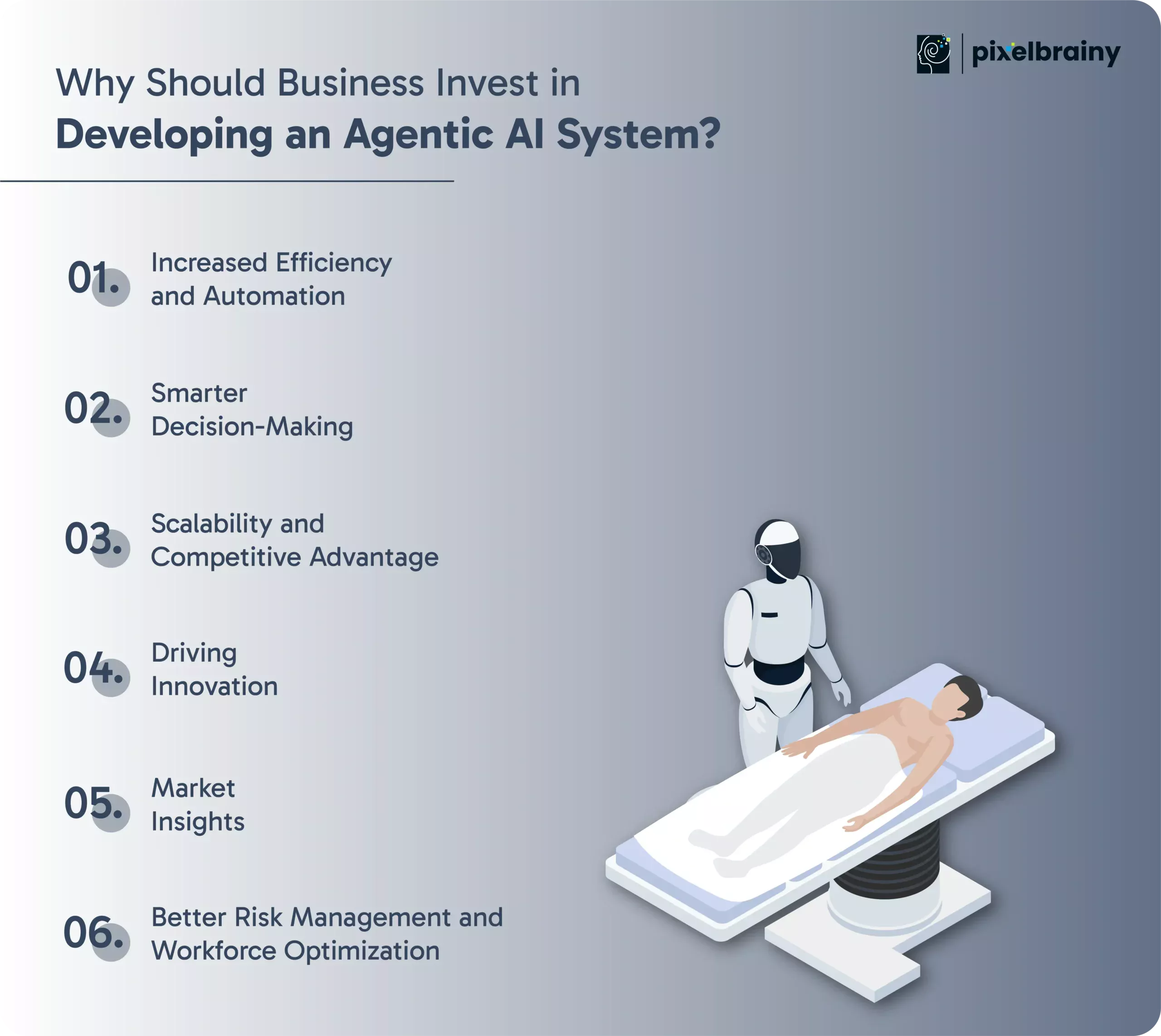
Agentic AI systems can handle complex, multi-step tasks without continuous human supervision. They analyze data, plan actions, and execute them with precision. This level of automation reduces manual effort and operational delays, allowing employees to focus on higher-value work such as strategy and innovation.
With their ability to learn, adapt, and make real-time judgments, autonomous AI systems enhance decision-making across industries. They respond dynamically to changing data, helping organizations minimize risks and identify opportunities faster than traditional systems.
Developing Agentic AI systems helps businesses scale their operations without a proportional increase in resources. Once implemented, these systems can be extended across departments, making processes more consistent and efficient. This scalability provides a strong competitive edge in fast-moving markets.
Creating Agentic AI systems enables entirely new business models. Intelligent agents can collaborate with humans, perform research, generate insights, or personalize customer experiences. Companies that understand how to build an Agentic AI system are better positioned to lead the next wave of digital transformation.
According to a recent report by Markets and Markets, the global agentic AI market is projected to grow from USD 13.81 billion in 2025 to USD 140.80 billion by 2032, at a compound annual growth rate (CAGR) of 39.3%. This surge reflects the growing confidence in AI systems that can think and act autonomously.
By taking over repetitive decision-making and data-heavy tasks, agentic AI minimizes human error and ensures consistency. At the same time, employees can focus on strategic and creative roles, improving overall productivity and job satisfaction.
Investing in developing Agentic AI systems is more than a technological choice—it is a strategic move that prepares organizations for a future driven by AI autonomy and intelligent agents that can learn, adapt, and perform at scale.
Building a successful Agentic AI system requires more than just integrating large language models or automation scripts. It demands a set of foundational capabilities that allow the system to think, plan, and act intelligently.
These must-have features for Agentic AI system development ensure reliability, scalability, and autonomy in real-world scenarios.
| Feature | Explanation |
| Autonomous Decision-Making | Enables the AI system to make informed choices independently, using contextual understanding and learned experience to achieve defined goals without constant human input |
| Goal-Oriented Architecture | The system must be designed around clear objectives, allowing it to prioritize tasks, allocate resources, and optimize performance toward measurable outcomes |
| Context Awareness | Allows the agent to interpret data and surroundings dynamically, adapting actions based on real-time information and environmental changes |
| Memory and Learning System | Incorporates both short-term and long-term memory to retain knowledge, learn from past interactions, and refine decision-making over time |
| Reasoning and Problem-Solving | Facilitates logical thinking, enabling the agent to analyze complex problems, identify solutions, and plan step-by-step actions efficiently |
| Human-AI Collaboration Interface | Ensures seamless communication between humans and intelligent agents through natural language interfaces, dashboards, or APIs |
| Ethical and Safety Controls | Embeds rules, restrictions, and moral boundaries to ensure responsible decision-making and compliance with legal standards |
| Adaptive Planning Engine | Allows the AI system to adjust strategies based on feedback and evolving conditions, ensuring flexibility in uncertain environments |
| Explainability and Transparency | Makes AI decisions interpretable, giving users insights into why certain actions were taken, which helps build trust |
| Scalability and Integration Capabilities | Supports easy expansion and integration with existing business systems, APIs, and cloud environments for smooth deployment |
| Continuous Learning Pipeline | Enables automatic updates and model improvements as new data or experiences are collected, keeping the AI system relevant and up to date |
| Multi-Agent Collaboration | Supports interactions between multiple AI agents, allowing them to cooperate, share knowledge, and accomplish complex goals collectively |
| Natural Language Understanding (NLU) | Allows the system to understand, interpret, and generate human language effectively for better interaction and comprehension |
| Feedback and Reinforcement System | Uses rewards or penalties to optimize future behavior, ensuring better decision-making through reinforcement learning |
| Secure Data Handling | Protects sensitive information with strong data governance, encryption, and compliance with global privacy standards |
These core features of Agentic AI system development form the backbone of any reliable, autonomous, and scalable intelligent agent ecosystem.
Once the foundational elements are in place, businesses and developers can explore advanced features for building Agentic AI systems that enhance performance, reasoning, and real-world utility. These innovations push the boundaries of what AI can achieve autonomously.
| Advanced Feature | Explanation |
| Self-Improvement Mechanisms | Enables the system to refine its own models and logic without manual retraining, promoting sustained growth and optimization |
| Emotion and Sentiment Recognition | Allows intelligent agents to detect and respond appropriately to human emotions, improving engagement and empathy in user interactions |
| Cross-Domain Intelligence | Lets the system transfer knowledge across different domains, enhancing problem-solving flexibility and contextual understanding |
| Simulation and Predictive Modeling | Helps the AI anticipate future outcomes using simulations, enabling proactive decision-making in uncertain conditions |
| Dynamic Tool and API Usage | Allows the agent to autonomously select and use external tools or APIs needed to complete specific tasks efficiently |
| Personalization and Behavioral Adaptation | Learns from user interactions to tailor responses, strategies, and outputs according to preferences and usage patterns |
| Collaborative Multi-Agent Systems | Enables cooperation between several AI agents to accomplish distributed tasks faster and more efficiently |
| Ethical Reasoning and Compliance Auditing | Ensures the AI system acts responsibly, aligns with regulations, and maintains accountability for its actions |
| Edge Computing Integration | Allows faster, decentralized processing by running AI logic closer to data sources, enhancing speed and privacy |
| Knowledge Graph Integration | Connects structured and unstructured data, enabling deeper reasoning, context retrieval, and richer decision-making |
These advanced features for developing Agentic AI systems push your solution beyond automation toward cognitive intelligence and real-world adaptability.

Developing an Agentic AI system involves a structured, iterative process that blends strategy, technology, and human-centered design. For organizations wondering what is the process to create Agentic AI System, the journey includes several essential stages — from conceptual planning to building a scalable, intelligent product ready for deployment.
Below is a detailed step-by-step process followed by many top Agentic AI development companies and leading AI development companies in USA.
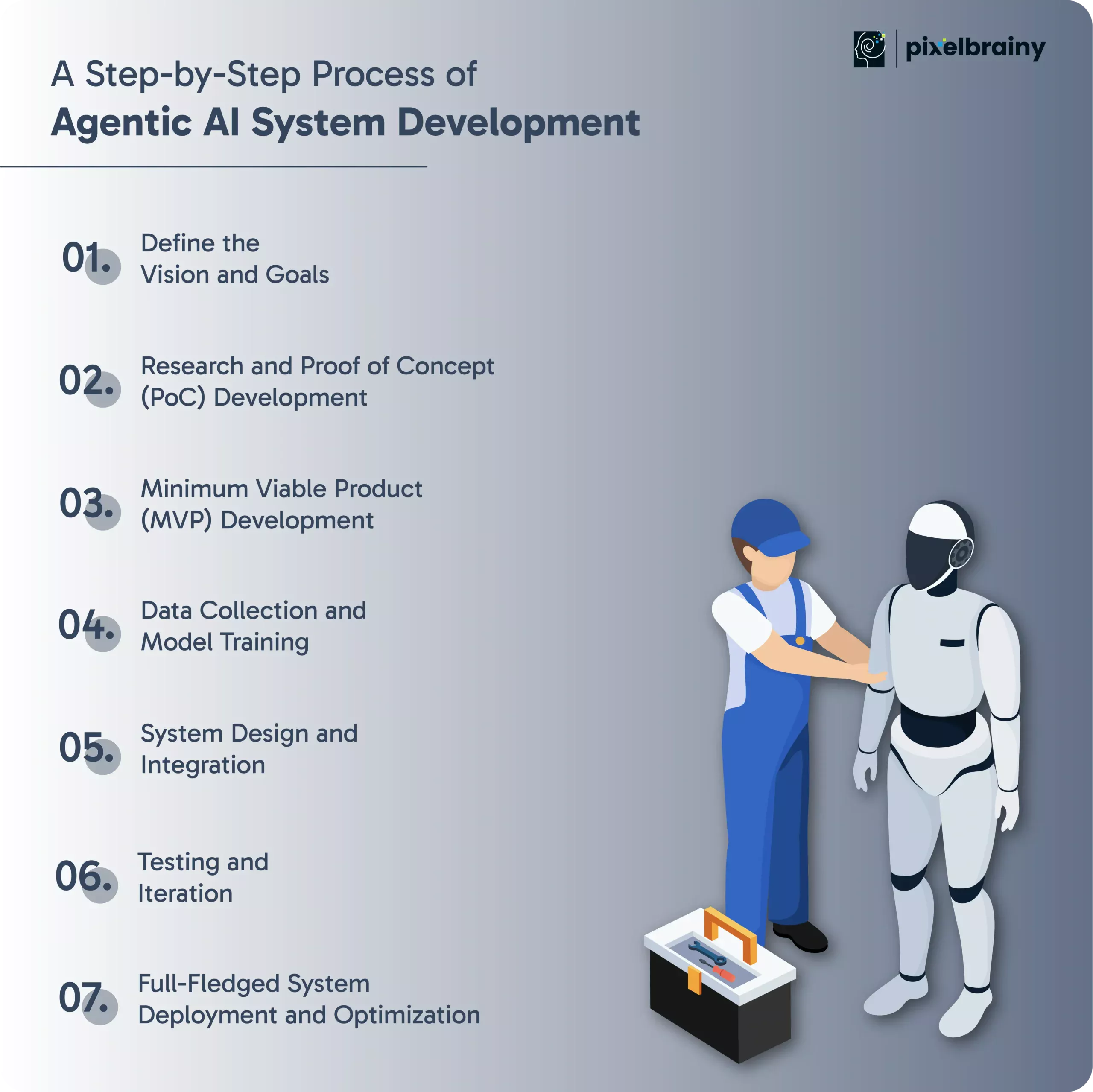
Every successful project starts with a clear purpose. To develop Agentic AI System effectively, businesses must define their vision, objectives, and success metrics. This involves identifying use cases where AI autonomy can add measurable value, such as workflow automation, intelligent customer support, or real-time decision-making.
Why this matters: Defining clear goals ensures that every part of the system is built with purpose and alignment. It helps avoid unnecessary complexity, ensures focused development, and sets a foundation for measurable success.
Before full-scale implementation, companies invest in PoC development to validate technical feasibility and business value. A PoC allows developers to test core features like reasoning, autonomy, and learning on a small scale. It helps determine whether the system architecture supports the desired functionality and whether the concept aligns with business goals.
Why this matters: A PoC reduces risk by confirming the idea works in practice. It helps stakeholders gain confidence in the technology, secure investments, and identify potential technical or ethical challenges early.
Also Read: AI Chatbot Proof of Concept (PoC) Development for Enterprises: From Idea to Impact
Once the PoC succeeds, the next step is MVP development, which focuses on delivering a simplified yet functional version of the Agentic AI system. The MVP includes essential components such as data pipelines, reasoning modules, and a basic feedback loop. The purpose of this stage is to test user interaction, collect insights, and refine system performance before scaling further.
Why this matters: Building an MVP allows rapid market testing and user validation. It ensures that the system’s most critical features work as intended while minimizing time and cost before full development.
The making of Agentic AI System relies heavily on quality data. During this stage, data from multiple sources is gathered, cleaned, and used to train models. Machine learning and reinforcement learning algorithms are applied to build intelligent agents capable of decision-making, adaptation, and predictive reasoning. Data security, ethics, and compliance are also crucial considerations here.
Why this matters: Reliable data ensures accurate decision-making and trustworthy AI behavior. High-quality, diverse data sets help reduce bias and make the system more effective across real-world scenarios.
In this phase, collaboration with a specialized UI/UX design company becomes vital. The design should focus on creating an intuitive interface that allows smooth interaction between users and the agent. Developers integrate the AI core with APIs, databases, and external tools to enable real-world functionality. Scalability, explainability, and interoperability are key design principles to follow.
Why this matters: Effective design and integration ensure usability and AI agent adoption. A well-designed interface makes AI interactions natural and accessible, while strong integration guarantees smooth performance in real-world environments.
Rigorous testing ensures reliability and stability. This stage involves performance testing, security validation, and user feedback collection. Continuous iteration helps refine the reasoning models and feedback loops. Regular evaluation ensures the AI system performs accurately under different scenarios and aligns with defined business objectives.
Why this matters: Continuous testing prevents system failures and ensures consistent performance. Iteration keeps the AI aligned with user needs, business goals, and evolving technological standards.
Once testing and refinement are complete, the project moves to a full deployment phase. The building of Agentic AI System at this stage involves scaling the infrastructure, enabling real-time monitoring, and integrating analytics tools. Post-deployment, the focus shifts to optimization, continuous learning, and performance upgrades to maintain long-term value and efficiency.
Why this matters: Proper deployment and optimization turn prototypes into production-ready systems. It ensures scalability, security, and sustainability, allowing the Agentic AI to deliver ongoing business value.
Following this structured process of Agentic AI System Development ensures that every stage — from idea validation to full-scale deployment — contributes to creating a reliable, ethical, and high-performing intelligent system that drives real-world impact.
The cost to build an Agentic AI system typically ranges between $15,000 and $150,000+, depending on the system’s complexity, scalability, and integration requirements. Factors such as model architecture, data volume, development time, and the choice of AI development company also influence overall pricing.
Smaller MVP development or PoC projects usually fall on the lower end of this range, while enterprise-grade systems with multi-agent capabilities, advanced reasoning, and custom UI/UX design can exceed $150,000.
For a detailed breakdown of pricing components, development stages, and cost optimization strategies, check out our dedicated guide on Agentic AI System Development Cost, where we explain everything from project budgeting to ROI estimation.
Understanding the cost early helps businesses plan smarter, ensuring efficient investment in scalable and future-ready Agentic AI solutions.
Building a high-performing Agentic AI solution requires a combination of advanced tools, frameworks, and infrastructure that support reasoning, autonomy, and scalability.
The right tech stack for Agentic AI system development ensures smooth data handling, model training, integration, and real-time deployment. Choosing the right technologies also helps teams accelerate innovation and reduce development complexity.
| Category | Tools & Technologies | Description |
| Programming Languages | Python, JavaScript (Node.js), TypeScript | Python is the core language for AI and ML development, while Node.js and TypeScript help in backend and API integrations for agentic systems |
| AI & ML Frameworks | TensorFlow, PyTorch, Scikit-learn | These frameworks are essential for building and training machine learning models that power autonomous reasoning and decision-making |
| Agentic AI Frameworks | LangChain, AutoGPT, BabyAGI, CrewAI | These tools are specifically designed for Agentic AI system development, enabling planning, task automation, and multi-agent coordination |
| LLM Providers | OpenAI GPT Models, Anthropic Claude, Mistral, Meta LLaMA | Large Language Models form the backbone of reasoning and communication capabilities in intelligent agent development |
| Vector Databases | Pinecone, Weaviate, Chroma, FAISS | Used for efficient data retrieval and long-term memory management, vital for contextual understanding and persistent learning |
| Data Processing & Storage | Apache Kafka, PostgreSQL, MongoDB, BigQuery | Handles large-scale data ingestion, processing, and storage for training and runtime execution |
| Cloud Platforms | AWS, Google Cloud AI, Microsoft Azure | Provide scalable environments for deploying and managing Agentic AI solutions with integrated AI services and analytics tools |
| UI/UX Design Tools | Figma, Adobe XD, React.js, Next.js | Used by UI/UX design companies to build user-friendly interfaces that simplify interactions with AI agents |
| DevOps & CI/CD Tools | Docker, Kubernetes, Jenkins, GitHub Actions | Streamline the development lifecycle with automation, version control, and efficient deployment pipelines |
| Monitoring & Analytics | Prometheus, Grafana, Elastic Stack | Allow developers to track performance, errors, and system health in real-time to maintain reliability and scalability |
| Security Tools | OAuth 2.0, JWT, Cloud IAM, Vault by HashiCorp | Protect data, manage user authentication, and secure access across integrated Agentic AI platforms |
| Knowledge Management Systems | Knowledge Graphs, Neo4j, GraphDB | Help the AI organize and reason over structured relationships, improving its contextual intelligence |
| Integration Tools | Zapier, Make, RESTful APIs, GraphQL | Enable smooth connectivity between the AI system and other enterprise software tools or data sources |
| Testing & Simulation Tools | PyTest, JMeter, Unity Simulation | Used to test logic accuracy, scalability, and behavior of autonomous AI systems in controlled environments |
| Collaboration & Workflow Tools | Notion, Slack API, Jira | Facilitate coordination across teams and AI agents, enhancing communication and project tracking |
Selecting the right tools and tech stack for developing Agentic AI systems ensures scalability, adaptability, and long-term success, empowering organizations to create powerful, intelligent, and autonomous AI-driven solutions.

Agentic AI solutions are transforming industries by introducing automation, intelligence, and adaptability beyond traditional systems. These intelligent agents can operate autonomously, make decisions in real time, and interact naturally with humans and digital environments.
From customer service to healthcare and finance, the potential of Agentic AI system development is vast and expanding rapidly.
Below are some of the most impactful use cases across major industries.
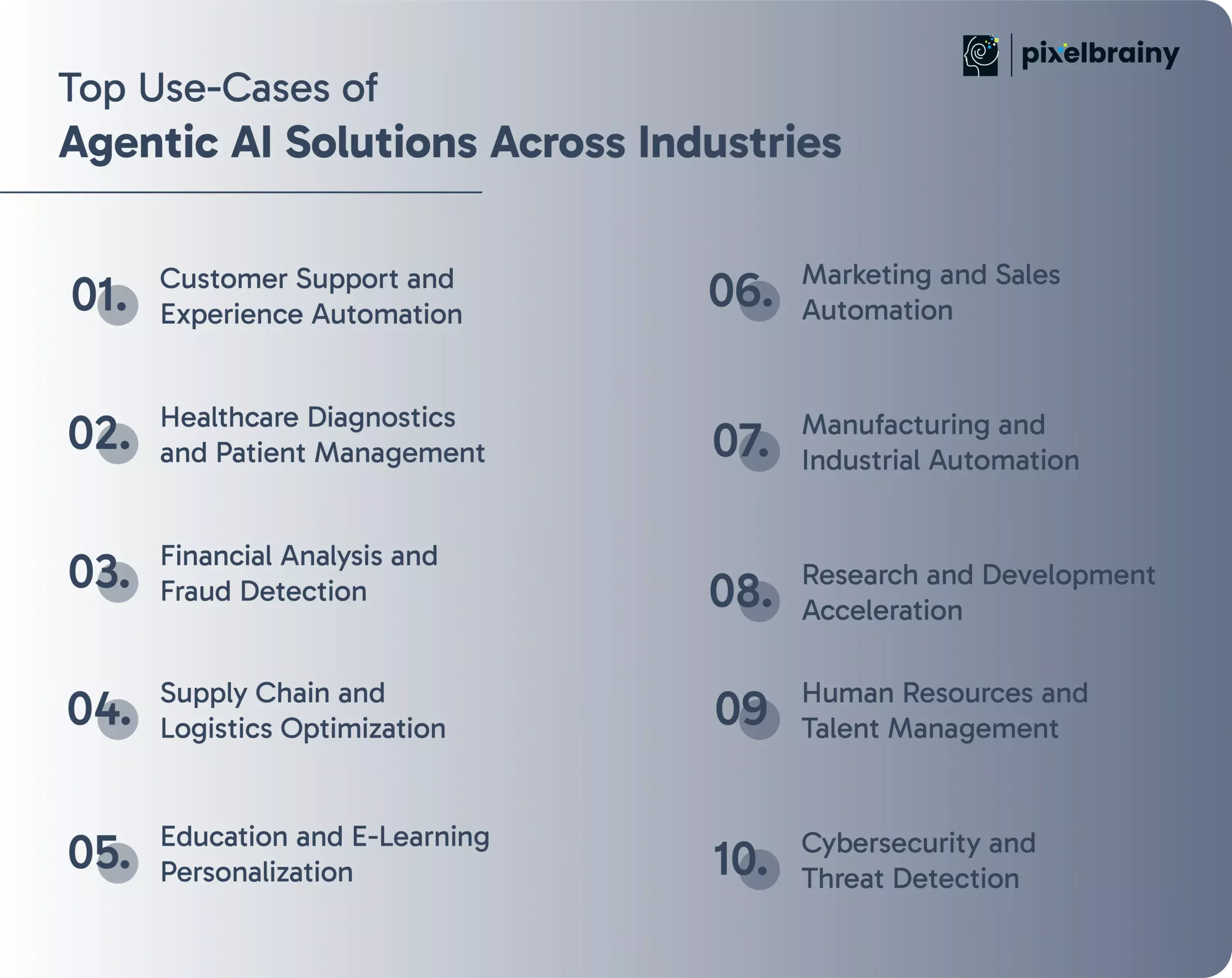
Agentic AI agents are taking customer service to the next level by providing round-the-clock support, contextual understanding, and personalized engagement. They can manage end-to-end customer journeys — from answering FAQs to handling refunds, order updates, and escalations.
Example: A global e-commerce brand uses an Agentic AI assistant to autonomously resolve customer issues across multiple languages and channels, cutting response times by 60% and improving satisfaction scores significantly.
In the healthcare industry, Agentic AI systems are improving patient care by supporting diagnostics, treatment planning, and data-driven medical decisions. They analyze patient histories, test results, and lifestyle data to generate actionable insights for doctors.
Example: A hospital network utilizes an Agentic AI platform that monitors patients’ vital signs remotely, detects anomalies in real time, and automatically alerts healthcare providers to prevent medical emergencies.
Also Read: AI Medical Diagnosis Chatbot Development: Features and Cost
Financial institutions are implementing Agentic AI systems to automate compliance, detect anomalies, and forecast market trends. These intelligent agents can handle vast datasets and make split-second decisions to protect assets and optimize investments.
Example: A leading bank employs an AI-powered fraud detection system that autonomously reviews millions of transactions daily, flagging suspicious activities before any damage occurs.
Building Agentic AI systems in logistics enables real-time visibility, automated route planning, and predictive maintenance. AI agents track shipments, analyze external conditions like weather, and reroute deliveries dynamically to reduce delays.
Example: A logistics enterprise integrates Agentic AI with IoT sensors to monitor cargo conditions, predict delivery times, and optimize fuel consumption across global shipping routes.
Agentic AI development in education is creating adaptive learning ecosystems that personalize learning paths, adjust difficulty levels, and provide real-time feedback. These systems analyze student performance to offer tailored recommendations.
Example: An online education platform uses an AI tutor that tracks learning habits, identifies weak areas, and creates custom lesson plans, boosting student engagement and retention.
In marketing, Agentic AI systems handle campaign optimization, lead scoring, and audience segmentation autonomously. They interpret consumer behavior and deliver personalized experiences through predictive analytics.
Example: A SaaS company deploys an Agentic AI tool that automatically creates ad campaigns, tests creatives, and adjusts budgets based on performance data, resulting in a 35% higher ROI.
Manufacturers leverage autonomous AI systems to predict maintenance, manage workflows, and detect production anomalies in real time. These intelligent agents improve efficiency, product quality, and machine longevity.
Example: An automotive manufacturer integrates Agentic AI to analyze sensor data from assembly lines, predicting equipment failures days before they occur and saving millions in downtime costs.
Creating Agentic AI systems for R&D accelerates discovery and innovation. Agents can analyze datasets, summarize research papers, and even suggest new hypotheses or design improvements.
Example: A pharmaceutical company employs an AI research assistant to screen millions of compound combinations and propose promising candidates for new drug development.
Agentic AI systems simplify HR processes by automating talent acquisition, onboarding, and performance management. They can assess skills, match candidates to roles, and forecast employee needs.
Example: A multinational corporation uses an AI-driven recruiter that screens resumes, ranks applicants, and automatically schedules interviews, reducing hiring time by 40%.
Also Read: AI HR SaaS Platform Development: Features, Costs, and Best Practices
Agentic AI enhances cybersecurity by autonomously monitoring systems, identifying vulnerabilities, and responding to threats in real time. These intelligent agents continuously learn from new attack patterns.
Example: A cybersecurity provider uses an Agentic AI defense layer that detects phishing attempts and malware intrusions autonomously, ensuring immediate response without human intervention.
The growing implementation of Agentic AI solutions across industries proves their capability to revolutionize operations, enhance decision-making, and create long-term strategic advantages. As adoption expands, these autonomous systems are becoming the cornerstone of modern, intelligent enterprises worldwide.
While Agentic AI system development offers immense opportunities, it also presents a unique set of challenges. These intelligent systems require careful coordination between technology, data, and human oversight.
Understanding these challenges and knowing how to overcome them is critical to building reliable, scalable, and responsible Agentic AI solutions.
Challenge: One of the most critical issues in building Agentic AI systems is maintaining alignment with human values and ethical principles. Without proper safeguards, autonomous agents might make decisions that deviate from organizational goals or ethical boundaries.
How to Overcome: Create robust ethical frameworks, value-alignment models, and clear operational rules. Include human-in-the-loop oversight and implement transparency mechanisms such as audit trails and explainability modules.
Challenge: Multi-agent systems require seamless coordination between reasoning, communication, and task execution. Poorly designed architectures can result in agents producing conflicting actions or inefficient workflows.
How to Overcome: Use modular design patterns and orchestration frameworks like LangChain or CrewAI. Employ controlled simulation environments for testing agent interactions and verifying performance consistency.
Challenge: The success of an Agentic AI system depends on high-quality and unbiased data. Inaccurate or incomplete datasets can lead to poor decisions, while weak security exposes sensitive information to risks.
How to Overcome: Implement strong data governance and validation processes. Use bias detection models, anonymization techniques, and ensure compliance with privacy standards such as GDPR and CCPA.
Challenge: The cost of making an Agentic AI system can be significant due to infrastructure, data processing, and advanced training requirements. Ongoing maintenance and optimization add further expenses.
How to Overcome: Begin with a PoC or MVP development approach to validate feasibility before scaling. Partner with experienced AI development companies in the USA or global experts to streamline architecture and reduce costs through proven frameworks.
Challenge: Integrating new Agentic AI systems into existing enterprise infrastructure can be difficult, leading to compatibility issues and workflow disruptions.
How to Overcome: Use API-based integration and middleware tools to ensure smooth interoperability. Adopt gradual migration plans and standard data exchange formats to align new systems with legacy setups.
Challenge: Developing and maintaining advanced AI systems requires specialized skills in areas like reinforcement learning, cognitive architecture, and large-scale deployment, which are still in limited supply.
How to Overcome: Collaborate with top Agentic AI development companies and invest in training internal teams. Encourage continuous learning programs and establish cross-functional AI task forces within the organization.
Challenge: Autonomous AI systems often face skepticism because users and stakeholders cannot easily understand their decision-making processes. Lack of visibility can reduce adoption and trust.
How to Overcome: Integrate explainable AI (XAI) frameworks, create detailed logging systems, and provide clear insights into model behavior. Visual dashboards can help users see how AI arrives at conclusions, improving confidence.
Challenge: Over time, AI models can lose accuracy as data patterns change, leading to “model drift.” This can impact decision quality, especially in dynamic environments where the AI operates continuously.
How to Overcome: Build automated retraining pipelines and continuous monitoring systems. Include real-time feedback loops that allow the AI to adjust and stay relevant with changing datasets.
Addressing these challenges in Agentic AI system development requires a balanced combination of technical innovation, strong ethical governance, and long-term strategy. Companies that proactively manage these factors will create powerful, transparent, and future-ready autonomous AI systems.
Choosing the right technology partner is one of the most important decisions when investing in Agentic AI system development. PixelBrainy stands out as a trusted AI development company that blends technical excellence, strategic insight, and business-focused innovation. Our approach to developing Agentic AI systems goes beyond code — we build intelligent, autonomous systems that deliver measurable value, scalability, and long-term impact for your business.
At PixelBrainy, our team specializes in AI development, including multi-agent architecture, reinforcement learning, and autonomous workflow design. We customize every project to meet industry-specific needs while ensuring compliance, ethical AI practices, and user-centered design.
One of our recent projects involved building a custom Agentic AI solution for a leading real estate firm. The client wanted to automate property management, client interactions, and market analytics through an intelligent AI assistant.
Our Solution: PixelBrainy developed an autonomous agent capable of handling property data updates, scheduling virtual tours, and communicating with potential buyers in real time. The system also analyzed market trends, pricing, and buyer sentiment to help realtors make informed decisions.
Results Achieved:
This project demonstrated the power of building Agentic AI systems tailored for real-world business operations, significantly improving efficiency and profitability.
So, partnering with PixelBrainy for Agentic AI system development means gaining a dedicated team focused on innovation, reliability, and measurable results. Whether you’re looking to create your first intelligent agent or scale an enterprise-level AI ecosystem, PixelBrainy delivers end-to-end AI development solutions that turn ideas into intelligent, autonomous realities.

The rise of Agentic AI systems marks a transformative moment in the evolution of artificial intelligence. Businesses that embrace this technology are not just automating tasks but enabling systems that think, plan, and act independently. From improving efficiency and decision-making to driving innovation and customer engagement, Agentic AI system development empowers organizations to stay ahead in a competitive, data-driven world.
Developing such systems requires expertise, strategic planning, and a deep understanding of AI architecture and ethics. Partnering with a trusted Agentic AI development company like PixelBrainy ensures that your business harnesses the full potential of intelligent, autonomous solutions designed for scalability and long-term success.
Ready to build your Agentic AI system? Book an appointment with PixelBrainy today and start transforming your business with the power of intelligent autonomy.
An Agentic AI system is an advanced form of artificial intelligence designed to act autonomously, make decisions, and perform tasks without continuous human input. Unlike traditional AI, which reacts to commands, Agentic AI systems proactively plan, learn, and execute actions to achieve defined goals.
Implementing Agentic AI systems helps businesses improve efficiency, reduce manual work, and enhance decision-making. These systems can automate workflows, predict outcomes, and provide personalized user experiences, resulting in higher productivity and operational agility.
The process involves several key stages, including defining objectives, PoC development, MVP creation, data training, integration, testing, and full-scale deployment. Each step ensures the system is reliable, scalable, and aligned with business goals.
The cost of Agentic AI system development typically ranges from $15,000 to $150,000+, depending on the complexity, scale, and required features. Smaller MVPs are less expensive, while enterprise-grade autonomous systems require larger investments.
Industries like real estate, healthcare, finance, manufacturing, logistics, and education can greatly benefit from Agentic AI solutions. These systems can automate complex operations, enhance customer experiences, and generate actionable insights across all sectors.

About The Author
Sagar Bhatnagar
Sagar Sahay Bhatnagar brings over a decade of IT industry experience to his role as Marketing Head at PixelBrainy. He's known for his knack in devising creative marketing strategies that boost brand visibility and market influence. Sagar's strategic thinking, coupled with his innovative vision and focus on results, sets him apart. His track record of successful campaigns proves his ability to utilize digital platforms effectively for impactful marketing efforts. With a genuine passion for both technology and marketing, Sagar continuously pushes PixelBrainy's marketing initiatives to greater success.

Working with the PixelBrainy team has been a highly positive experience. They understand the design requirements and create beautiful UX elements to meet the application needs. The dev team did an excellent job bringing my vision to life. We discussed usability and flow. Sagar worked with his team to design the database and begin coding. Working with Sagar was easy. He has the knowledge to create robust apps, including multi-language support, Google and Apple ID login options, Ad-enabled integrations, Stripe payment processing, and a Web Admin site for maintaining support data. I'm extremely satisfied with the services provided, the quality of the final product, and the professionalism of the entire process. I highly recommend them for Android and iOS Mobile Application Design and Development.

Great experience working with them. Had a lot of feedback and I found that unlike most contractors they were bugging me for updates instead of the other way around. They were extremely time conscience and great at communicating! All work was done extremely high quality and if not on time, early! They were always proactive when it comes to communication and the work is great/above par always. Very flexible and a great team to work with! Goes above and beyond to present us with multiple options and always provides quality. Amazing work per usual with Chitra. If you have UI/UX or branding design needs I recommend you go to them! Will likely work with them in the future as well, definitely recommended!

PixelBrainy is a joy to work with and is a great partner when thinking through branding, logo, and website layout. I appreciate that they spend time going into the "why" behind their decisions to help inform me and others about industry best practices and their expertise.

I hired them to design our software apps. Things I really like about them are excellent communication skills, they answer all project suggestions and collaborate right away, and their input on design and colors is amazing. This project was complex and needed patience and creativity. The team is amazing to do business with. I will be using them long-term. Glad to see there are some good people out there. I was afraid to try and outsource my project to someone but I am glad I met them! I really can't say enough. They went above and beyond on this project. I am very happy with everything they have done to make my business stand out from the competition.

It was great working with PixelBrainy and the team. They were very responsive and really owned the project. We'll definitely work with them again!

I recently worked with the PixelBrainy team on a project and I was blown away by their communication skills. They were prompt, clear, and articulate in all of our interactions. They listened and provided valuable feedback and suggestions to help make the project a success. They also kept me updated throughout the entire process, which made the experience stress-free and enjoyable.

PixelBrainy is very good at what it does. The team also presents themselves very professionally and takes care of their side of things very well. I could fully trust them taking up the design work in a timely and organised manner and their attention to detail saved us lots of effort and time. This particular project was quite intense and the team showed that they function very well under pressure. Very much looking forward to working with her again!

It's always an absolute pleasure working with them. They completed all of my requests quickly and followed every note I had for them to a T, which made our process go smoothly from start to finish. Everything was completed fast and following all of the guidelines. And I would recommend their services to anyone. If you need any design work done in the future, PixelBrainy should be your first call!

They took ownership of our requirements and designed and proposed multiple beautiful variants. The team is self-motivated, requires minimum supervision, committed to see-through designs with quality and delivering them on time. We would definitely love to work with PixelBrainy again when we have any requirements.

PixelBrainy was a big help with our SaaS application. We've been hard at work with a new UI/UX and they provided a lot of help with the designs. If you're looking for assistance with your website, software, or mobile application designs, PixelBrainy and the team is a great recommendation.

PixelBrainy designers are amazing. They are responsive, talented, and always willing to help craft the design until it matches your vision. I would recommend them and plan to continue them for my future projects and more!!!

They were awesome! Did a good job fast, and good communication. Will work with them again. Thank you

Creative, detail-oriented, and talented designers who take direction well and implement changes quickly and accurately. They consistently over-delivered for us.

PixelBrainy team is very talented and creative. Great designers and a pleasure to work with. PixelBrainy is an excellent communicator and I look forward to working with them again.

PixelBrainy has a very talented design team. Their work is excellent and they are very responsive. I enjoy working with them and hope to continue on all of our future projects.


Transform your ideas into reality with us.
Across these industries, each engagement brings unique challenges, from early-stage product development to scaling complex systems, helping us build a practical understanding of real-world product environments.