AI Summary Powered by PixelBrainy
What if choosing the right AI financial software development partner could determine whether a fintech reaches its next funding milestone or spends months rebuilding an AI system that was never production ready?
For fintech founders, neobank executives, CTOs, product leaders, lending platforms, banks, insurers, and financial services companies, artificial intelligence is moving from an experimental technology to a core component of financial products. AI is now being applied to underwriting, fraud detection, risk assessment, customer intelligence, compliance, payments, financial forecasting, document processing, and automated decision-making.
The market momentum is substantial. According to the latest 2026 research from Fortune Business Insights, the global AI in fintech market is valued at $45.53 billion in 2026 and is projected to reach $241.67 billion by 2034, growing at a 23.20% CAGR. North America accounted for 36% of the market revenue in 2025, highlighting the importance of the US financial technology ecosystem.
But market growth does not answer the most important question for a financial buyer: which AI financial software development companies in USA can turn an AI concept into a secure, explainable, production-ready financial system?
Consider a real-world buyer scenario: We're a Series A neobank in San Francisco with $18M raised and our next tranche is contingent on demonstrating a working AI underwriting model by Q3. Our team is strong on financial product design but has never shipped a production ML model. Which AI financial software development companies in the USA understand both technical underwriting model requirements and investor demo expectations, and have delivered both simultaneously for a fintech at our stage?
That question requires more than a vendor with generic AI expertise. The top AI financial software development services providers USA should understand financial data, ML model development, underwriting logic, MLOps, API integration, explainability, security, compliance, scalability, and product delivery.
This guide evaluates custom AI financial software development companies in USA, examines their financial AI capabilities and documented use cases, compares their strengths, and presents a practical list of best AI financial software development companies USA for financial buyers evaluating partners in 2026.
What do AI financial software development companies in USA actually deliver when a financial institution moves beyond an AI proof of concept? The answer is much broader than a chatbot or a predictive model. Leading USA-based AI financial software development companies build complete financial systems in which AI models work alongside financial data, business rules, APIs, workflow automation, security controls, human review, and monitoring.
For financial buyers, this distinction is important. A machine learning model that performs well in a development environment is not automatically a production-ready underwriting, fraud, lending, or banking solution. A credible AI financial software partner must be able to connect the model to the real financial workflow.
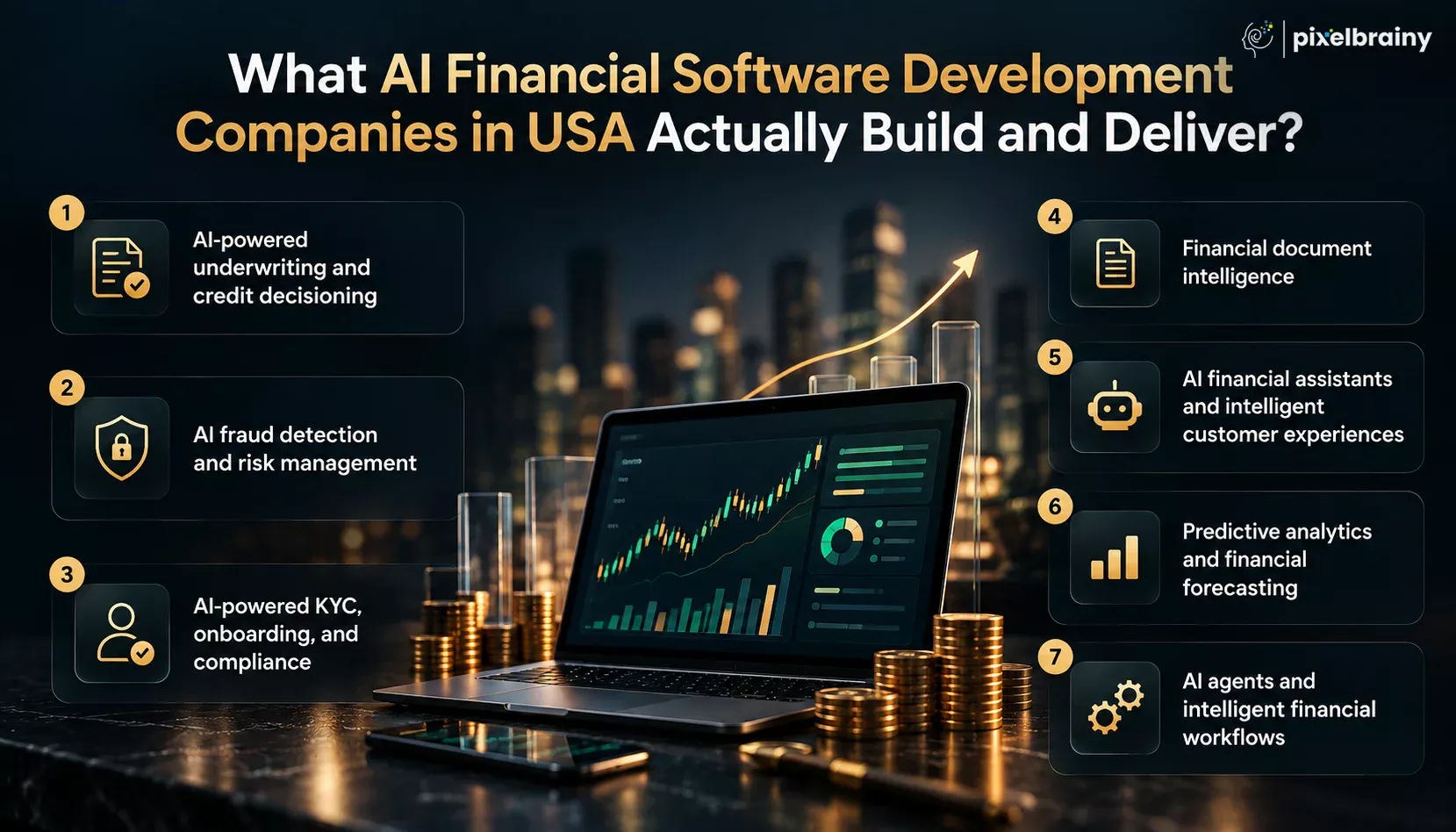
One of the highest-value applications is AI underwriting. Custom AI financial software development companies in USA can build systems that collect borrower information, process bank and financial data, calculate risk indicators, evaluate creditworthiness, generate risk scores, recommend decisions, and route exceptions to human underwriters.
Modern underwriting platforms can also use AI to analyze financial statements, tax documents, cash-flow information, transaction histories, and alternative data. Accend, for example, describes an AI underwriting platform for banks and fintechs that automates document intake, financial statement and tax spreading, cash-flow modeling, credit memos, and portfolio management while retaining human-in-the-loop controls.
For a fintech asking, "How can we build an AI underwriting model that is accurate, explainable, scalable, and ready for production?", this is the type of end-to-end capability to evaluate.
Financial AI development teams build fraud systems that analyze transactions, customer behavior, devices, accounts, and other risk signals to identify suspicious activity.
Common applications include:
This is becoming increasingly important as financial institutions face increasingly AI-enabled fraud. Alloy reported in 2026 that 91% of fraud leaders surveyed were seeing more crimes committed with the help of AI.
The top AI financial software development services providers USA also build intelligent onboarding and compliance systems.
These solutions can automate:
The objective is not simply automation. Financial AI needs traceability, appropriate controls, and human oversight where decisions carry regulatory consequences.
AI can convert unstructured financial documents into structured information that software can use.
Development companies build systems capable of processing:
The extracted information can then feed directly into underwriting, accounting, risk analysis, compliance, or financial reporting workflows.
Financial institutions are also deploying conversational AI to help customers understand transactions, spending, accounts, and financial products.
In July 2026, Visa announced its AI Financial Assistant, allowing banks to provide personalized AI-powered financial insights within their own branded banking experiences.
This illustrates an important shift from generic chatbots toward AI embedded directly into trusted financial applications.
AI financial software development companies in USA also build predictive systems for:
Financial AI development is increasingly moving toward AI agents that can perform multi-step tasks rather than simply generate responses.
Examples include automated reconciliation, compliance investigations, document review, financial research, customer-service workflows, and underwriting assistance.
The strongest custom AI financial software development companies in USA therefore deliver an integrated architecture:
Financial Data → AI Model → Decision Engine → API → Financial Application → Human Review → Audit Trail → Monitoring
That is the real difference between an AI demo and an AI financial product. For buyers asking, "Which AI financial software development companies in USA can take our financial AI idea from prototype to production?", the shortlist should favor providers that can demonstrate this complete delivery chain, not just isolated AI model development.
To create this 2026 ranking of AI financial software development companies in USA, we used a buyer-focused evaluation framework built specifically for financial services. Unlike general software development rankings, our methodology considers the requirements that matter when AI is connected to money, financial decisions, sensitive customer data, and regulated workflows.
We evaluated production experience, explainability, financial-system integration, regulatory architecture, domain expertise, security, and the ability to serve different types of financial organizations.
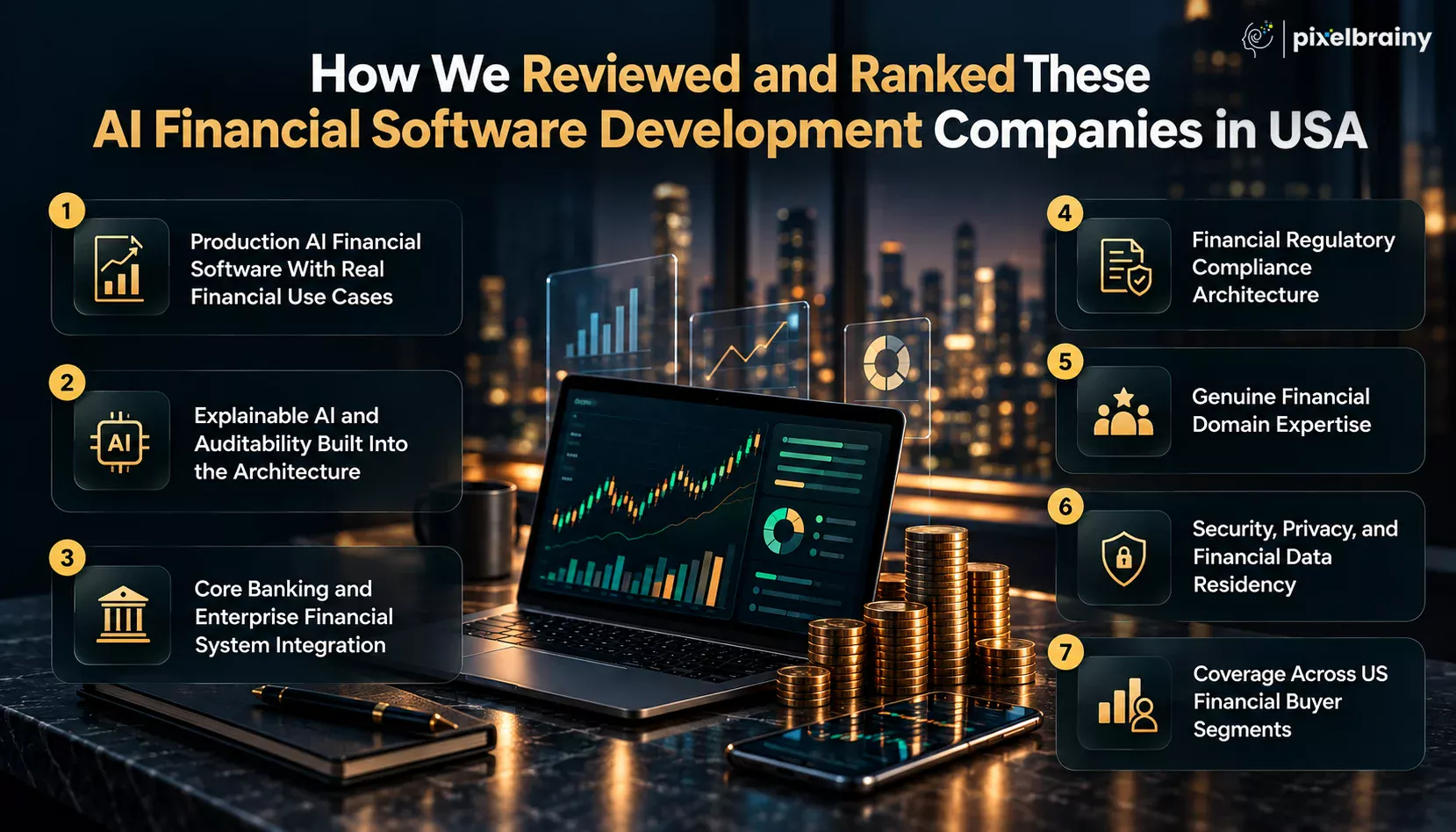
Our first criterion was whether a company could demonstrate genuine experience delivering AI-powered financial software beyond prototypes, demonstrations, or experimental environments.
We looked for evidence involving real fintechs, banks, lenders, payment companies, insurers, investment firms, or other financial organizations. Companies received stronger consideration when their experience involved production AI for fraud detection, underwriting, credit scoring, risk management, compliance, financial forecasting, or intelligent automation.
We also considered whether providers understood the operational expectations of financial environments subject to regulatory oversight, including organizations and frameworks associated with the OCC, Federal Reserve, SEC, FINRA, and CFPB.
Explainability was one of our most important criteria because financial AI increasingly influences decisions that customers, compliance teams, banking partners, and regulators may need to understand.
For example, consider a payments company that processes $12 billion annually and requires every fraud decision to be explainable to customers, banking partners, and CFPB examiners. The right development partner should not simply add an explanation screen after the fraud model is completed. Explainability should be considered during data design, feature engineering, model selection, decisioning, logging, and monitoring.
We therefore evaluated capabilities around:
Providers relying exclusively on opaque decision models without a credible explainability and auditability strategy received lower consideration.
Financial AI rarely operates as an isolated application. It must exchange information with existing financial infrastructure.
We evaluated experience integrating AI-powered systems with platforms and technologies such as FIS, Fiserv, Jack Henry, Bloomberg, Guidewire, SS&C, SAP, and Oracle Financials, along with banking APIs, payment infrastructure, data platforms, CRM systems, and enterprise applications.
This criterion helps answer an important buyer question: Can the provider actually connect an AI model to the financial systems that generate the data and execute the resulting decision?
Compliance capability was evaluated at the architecture level rather than based solely on marketing claims.
We considered experience relevant to SOC 2 Type II, PCI DSS 4.0, GLBA, SOX, SEC, FINRA, CFTC, OCC, CFPB, and applicable state financial requirements.
The strongest providers should understand how regulatory requirements influence:
This distinction is particularly important for financial AI because compliance cannot be treated as a final-stage checklist after the software has already been built.
Technical AI skills alone do not make a company one of the top AI financial software development services providers USA.
We evaluated whether providers demonstrated knowledge of actual financial processes and decision frameworks, including:
This criterion helps distinguish custom AI financial software development companies in USA with meaningful financial expertise from general-purpose AI agencies that happen to have financial clients.
Security was another core ranking factor because AI financial applications frequently process PII, transaction records, account information, payment information, and confidential financial data.
We considered security practices involving SOC 2 Type II, encryption at rest and in transit, identity and access management, secure cloud architecture, data governance, monitoring, and appropriate US-based infrastructure and data residency capabilities.
For payment-focused projects, we also considered whether providers understand the architectural implications of PCI DSS 4.0 when AI systems interact with payment data and transaction environments.
Finally, we assessed the breadth of each provider's financial market experience.
Priority was given to USA-based AI financial software development companies capable of working with multiple buyer segments, including:
This matters because the technical and regulatory requirements can change significantly depending on the buyer. A Series A neobank building its first AI underwriting model has different requirements from a large payment company deploying explainable fraud detection across billions of dollars in transactions.
We excluded general-purpose AI development firms with no verifiable financial-services AI experience, providers whose financial expertise was limited to basic payment gateway integration, and companies that could not demonstrate a credible understanding of financial AI explainability, model governance, SR 11-7 principles, PCI DSS 4.0, security architecture, and regulatory requirements.
The resulting ranking therefore focuses on companies that can connect financial domain expertise, AI and ML engineering, production software development, integration, security, regulatory considerations, and measurable financial business outcomes.Top of FormBottom of Form

Financial AI is moving into high-value workflows such as underwriting, fraud detection, claims processing, compliance, payments, risk analytics, and investment management. The top 10+ AI financial software development companies in USA 2026 below are reviewed from a financial buyer's perspective, considering AI capabilities, financial domain expertise, production engineering, security, compliance, integrations, and suitability for different financial sectors.
For example, an insurance buyer may ask:
“Our P&C carrier writes $800M in annual premium and CAT claim processing collapses every major weather event. Every AI demo we've seen uses synthetic insurance data that doesn't reflect our actual CAT claim complexity. Which AI financial software development companies in the USA have shipped AI claims processing systems tested against real catastrophe datasets, with documented accuracy and throughput outcomes our actuarial team can actually validate?”
This question highlights what matters in financial AI development: real-world financial data, production deployment, measurable performance, explainability, security, system integration, and industry expertise. The companies below represent different strengths across fintech, banking, insurance, payments, lending, and investment management. Pricing is listed as custom quote where reliable public project pricing is not available.
The following are the best AI financial software development companies in USA for 2026, ranked based on financial domain expertise, AI and ML capabilities, production readiness, security, regulatory compliance, system integration, and suitability for fintech and financial enterprise buyers.
Location: Sherida, WY, USA
Founded: 2021
Website: https://www.pixelbrainy.com/
Clutch Rating: 4.9/5
Core AI financial software capabilities: AI credit decisioning, fraud detection, financial document intelligence, RAG-powered compliance assistants, agentic financial workflows, predictive analytics, and custom ML applications.
Financial system integrations: Banking APIs, financial data sources, payment infrastructure, ERP, CRM, and custom enterprise systems.
Regulatory compliance posture: SOC 2-aware architecture, explainable AI design, security-focused development, auditability, and compliance-oriented engineering.
Notable US financial clients: Tykr is among the notable clients identified in the supplied company profile. Other listed clients include Payyro
Financial verticals served: Fintech, lending, banking, payments, insurance, investment, and enterprise finance.
Pricing range: $25-$49/hr
Best fit for: Fintech startups, community banks, insurance carriers, and enterprise finance teams.
Why they're on this list: PixelBrainy a leading AI financial software development company focuses on bespoke AI financial software development, combining AI credit decisioning, fraud detection, financial document intelligence, RAG-powered compliance assistants, and agentic financial workflows. Its broad capability set makes it a strong option for financial organizations seeking a custom AI engineering partner.
Location: USA and international delivery locations
Founded: 2017
Core AI financial software capabilities: AI and ML development, predictive analytics, financial automation, data engineering, digital banking, lending technology, payment systems, cloud engineering, and product development.
Financial system integrations: Banking APIs, payment platforms, cloud systems, enterprise applications, and custom financial infrastructure.
Regulatory compliance posture: Financial software development with security and compliance requirements incorporated into delivery. Specific certifications should be verified for the project.
Notable US financial clients: N/A
Financial verticals served: Banking, lending, payments, fintech, RegTech, and financial services.
Pricing range: Custom quote.
Best fit for: Financial institutions requiring banking, lending, payments, modernization, cloud, and AI capabilities.
Why they're on this list: Zoolatech combines fintech specialization with broader engineering capabilities across banking, lending, payments, cloud, modernization, and AI. This makes it suitable for financial organizations that need AI integrated into an existing product ecosystem rather than delivered as an isolated model.
Location: Austin, Texas, USA
Founded: 2000
Core AI financial software capabilities: AI integration, digital banking, financial software modernization, data-driven applications, workflow automation, and digital transformation.
Financial system integrations: Banking platforms, financial APIs, legacy applications, CRM systems, and enterprise financial infrastructure.
Regulatory compliance posture: Financial-services-focused development with security and compliance considerations.
Notable US financial clients: Praxent has a strong financial institution and credit union focus. Specific current references should be validated.
Financial verticals served: Banking, credit unions, lending, wealth management, fintech, and financial services.
Pricing range: Custom quote.
Best fit for: US regional banks, community banks, and credit unions modernizing financial software.
Why they're on this list: Praxent is especially relevant for financial institutions modernizing established systems while introducing new digital and AI capabilities. Its financial-services specialization makes it a strong candidate for buyers seeking AI financial software development solutions providers in USA for banks.
Location: Dallas, Texas, USA
Founded: Verify directly with the company
Core AI financial software capabilities: AI and ML integration, predictive analytics, fraud detection, underwriting, intelligent automation, risk analytics, and enterprise financial applications.
Financial system integrations: ERP, CRM, payment systems, financial data platforms, and enterprise applications.
Regulatory compliance posture: Financial software development with security and regulatory requirements considered in implementation.
Notable US financial clients: Verify specific client references for the proposed project.
Financial verticals served: Banking, finance, insurance, payments, lending, and investment.
Pricing range: Custom quote.
Best fit for: Mid-market and enterprise financial services organizations.
Why they're on this list: 7T brings AI, financial software engineering, and business transformation together. Its financial-services coverage across banking, insurance, payments, lending, and investment makes it relevant for organizations looking for AI initiatives connected to measurable operational and financial outcomes.
Location: USA and international delivery locations
Founded: 2013
Core AI financial software capabilities: Credit scoring, risk modeling, fraud detection, predictive analytics, transaction monitoring, RAG, LLM applications, AI agents, document processing, and financial automation.
Financial system integrations: Banking APIs, financial data providers, trading platforms, wealth management systems, payment infrastructure, and enterprise applications.
Regulatory compliance posture: Focus on secure financial software and regulated financial products. Project-specific certifications should be confirmed.
Notable US financial clients: Itexus reports work with banks, brokers, fintechs, and financial services organizations.
Financial verticals served: Banking, trading, wealth management, lending, insurance, and fintech.
Pricing range: Custom quote.
Best fit for: US fintech startups and mid-market financial organizations.
Why they're on this list: Itexus combines traditional financial software engineering with modern AI capabilities such as credit scoring, risk modeling, fraud detection, RAG, and AI agents. This makes it a strong candidate among top custom AI financial software development companies in USA.
Location: Wilmington, Delaware, USA, with international delivery
Founded: 2011
Core AI financial software capabilities: AI fraud detection, AML monitoring, credit scoring, financial analytics, personalized recommendations, financial automation, digital banking, lending, payments, wallets, and embedded finance.
Financial system integrations: Banking APIs, KYC providers, payment providers, card issuing systems, ledgers, open banking APIs, and compliance tools.
Regulatory compliance posture: Compliance-focused fintech architecture covering KYC, AML, payment security, and regulated financial workflows.
Notable US financial clients: Verify current client references for the specific engagement.
Financial verticals served: Digital banking, payments, lending, investment, wallets, and embedded finance.
Pricing range: Custom quote.
Best fit for: Fintech startups and financial product companies.
Why they're on this list: DashDevs has a strong fintech-first positioning across banking, payments, lending, investment, and embedded finance. Its combination of financial product engineering, compliance workflows, and AI makes it particularly relevant for startups building complete financial products.
Location: USA and international delivery locations
Founded: 2013
Core AI financial software capabilities: AI and ML development, fraud detection, compliance automation, predictive analytics, financial automation, digital banking, payment applications, and wealthtech.
Financial system integrations: Payment gateways, banking APIs, financial data providers, billing systems, payroll platforms, and enterprise financial infrastructure.
Regulatory compliance posture: Security-conscious financial software development with project-specific compliance requirements.
Notable US financial clients: Verify current financial client references directly.
Financial verticals served: Digital banking, payments, wealthtech, billing, payroll, lending, and fintech.
Pricing range: Custom quote.
Best fit for: US payment companies, digital banks, and financial technology businesses.
Why they're on this list: Relevant Software covers several important fintech categories and can support projects where payment infrastructure, financial applications, data, and AI-powered risk controls need to work together. Its broad fintech capabilities make it a useful option for digital banking and payments businesses.
Location: USA
Founded: 2008
Core AI financial software capabilities: AI integration, machine learning, data engineering, cloud software, digital transformation, and intelligent business applications.
Financial system integrations: Custom APIs, financial data platforms, cloud infrastructure, enterprise systems, and third-party financial services.
Regulatory compliance posture: Secure software development for regulated industries. Specific certifications should be validated for each project.
Notable US financial clients: Request current financial-sector references directly.
Financial verticals served: Financial services, fintech, regulated industries, and enterprise software.
Pricing range: Custom quote.
Best fit for: US financial organizations prioritizing domestic engineering and secure product development.
Why they're on this list: MojoTech is a relevant choice when US-based engineering, communication, product quality, security, and regulated-industry delivery are important. It can be considered for financial products where AI needs to become part of a larger secure software platform.
Location: Atlanta, Georgia, USA
Founded: 2011
Core AI financial software capabilities: Generative AI, RAG, AI agents, document intelligence, fraud detection, risk management, compliance automation, predictive analytics, and data modernization.
Financial system integrations: Banking systems, financial applications, data platforms, cloud environments, and enterprise systems.
Regulatory compliance posture: Financial AI development with emphasis on governance, security, risk, compliance, and controlled enterprise deployment.
Notable US financial clients: Verify current client references for the proposed project.
Financial verticals served: Banking, fintech, insurance, payments, risk management, and enterprise finance.
Pricing range: Custom quote.
Best fit for: Financial enterprises and fintech companies undertaking AI and data transformation.
Why they're on this list: HatchWorks AI is particularly relevant for organizations moving beyond individual AI experiments toward enterprise AI. Its capabilities across GenAI, RAG, document intelligence, risk, compliance, and data modernization make it a strong option for complex financial transformation programs.
Location: USA and international delivery locations
Founded: 2001
Core AI financial software capabilities: AI integration, transaction analytics, financial automation, fraud-related technology, payment software, digital wallets, prepaid systems, and financial platform engineering.
Financial system integrations: Payment processors, card systems, payment gateways, wallets, transaction platforms, and financial infrastructure.
Regulatory compliance posture: Payments-focused software development with security and financial compliance considerations.
Notable US financial clients: Verify current references for the specific financial use case.
Financial verticals served: Payments, prepaid cards, fintech, digital commerce, and financial operations.
Pricing range: Custom quote.
Best fit for: Payment platforms, prepaid card providers, and transaction-focused financial companies.
Why they're on this list: Softjourn brings extensive experience around payments and financial transaction platforms. It is particularly relevant when AI must operate close to payment processing, transaction analytics, fraud controls, and established financial infrastructure.
Location: USA and international delivery locations
Founded: 2007
Core AI financial software capabilities: AI integration, fraud prevention, credit scoring, predictive analytics, banking automation, financial analytics, document processing, and intelligent financial workflows.
Financial system integrations: Core banking platforms, banking APIs, payment systems, KYC/AML tools, ERP platforms, and financial data providers.
Regulatory compliance posture: Banking software development covering AML, PCI DSS, security, testing, and regulatory requirements.
Notable US financial clients: Verify current US client references directly.
Financial verticals served: Banking, lending, payments, fintech, investment, and insurance.
Pricing range: Custom quote.
Best fit for: Banks and financial institutions modernizing core banking systems.
Why they're on this list: Andersen offers broad banking technology capabilities, including core banking modernization, payments, KYC/AML, loan processing, credit evaluation, and fraud prevention. It is particularly suitable when AI needs to be integrated into a wider banking transformation program.
Location: Pennsylvania, USA, with global delivery
Founded: 1993
Core AI financial software capabilities: Generative AI, machine learning, fraud detection, transaction screening, KYC, regulatory automation, AI agents, data analytics, and cloud modernization.
Financial system integrations: Enterprise banking platforms, financial data platforms, insurance systems, investment platforms, cloud environments, and enterprise applications.
Regulatory compliance posture: Enterprise financial-services architecture with responsible AI, cybersecurity, governance, and compliance capabilities.
Notable US financial clients: EPAM reports significant relationships with major investment banks and financial services organizations.
Financial verticals served: Banking, wealth management, insurance, capital markets, payments, and fintech.
Pricing range: Enterprise custom quote.
Best fit for: Fortune 500 banks, insurance carriers, investment managers, and large financial institutions.
Why they're on this list: EPAM is one of the strongest options for enterprise-scale financial AI programs. Its financial-services practice spans banking, insurance, wealth management, capital markets, cybersecurity, cloud, data, and AI, making it well suited to complex multi-system deployments.
Location: USA and international delivery locations
Founded: 2008
Core AI financial software capabilities: AI and ML development, predictive analytics, financial automation, data engineering, fraud prevention, and intelligent financial workflows.
Financial system integrations: Banking APIs, payment services, financial data providers, cloud platforms, and enterprise applications.
Regulatory compliance posture: Security-focused software architecture with privacy and compliance requirements incorporated into development.
Notable US financial clients: Verify current financial client references directly.
Financial verticals served: Fintech, banking, payments, investment, insurance, and financial services.
Pricing range: Custom quote.
Best fit for: Financial organizations where security and application resilience are major selection criteria.
Why they're on this list: Yalantis is a relevant option for sensitive financial applications where security, resilience, data protection, and scalable architecture are priorities. Its engineering approach can support AI-enabled financial products while maintaining focus on secure software development.
Location: USA
Founded: 2018
Core AI financial software capabilities: AI application development, machine learning, predictive analytics, financial automation, data platforms, and intelligent workflows.
Financial system integrations: Banking APIs, payment infrastructure, financial data providers, CRM systems, cloud platforms, and enterprise applications.
Regulatory compliance posture: Security and compliance requirements incorporated into financial product development. Specific certifications should be verified.
Notable US financial clients: Verify current financial references directly.
Financial verticals served: Fintech, banking, payments, lending, financial technology, and enterprise finance.
Pricing range: Custom quote.
Best fit for: US fintech startups and growth-stage financial companies.
Why they're on this list: Dualboot Partners combines product strategy with engineering delivery, which can be valuable for fintech companies developing new AI-powered financial products. Its approach is particularly relevant when the development partner needs to understand both the financial product and the technology required to bring it to market.
The companies above are the leading AI financial software development companies in USA for 2026, offering specialized AI, fintech engineering, compliance-focused architecture, and custom financial software capabilities for startups and financial enterprises.
For financial buyers, a vendor comparison needs to go beyond generic AI capabilities. AI financial software development companies in USA must be evaluated on the financial systems they can work with, regulatory requirements they understand, AI capabilities they can deliver, and the type of financial organization they are best equipped to support.
This is particularly important for enterprise finance teams dealing with complex ERP environments. Consider this real buyer query:
“Our corporate finance team spends 12 days monthly building management reporting by pulling SAP data into Excel. Our ERP configuration is too complex for off-the-shelf FP&A AI tools. Which AI financial software development companies in the USA build custom AI FP&A systems for complex ERP environments?”
The comparison below provides a quick view of the top AI financial software development companies USA, focusing on financial specialization, regulatory considerations, core-system integration, pricing, and buyer fit. It is designed to help finance leaders, CTOs, CIOs, fintech founders, banks, insurers, and investment organizations narrow the shortlist before deeper technical and compliance due diligence.
| Company | HQ | Financial Specialization | Regulatory Compliance | Core System Integration | Pricing Range | Best Fit For |
|---|---|---|---|---|---|---|
| PixelBrainy LLC | Sheridan, WY, USA | Fintech, lending, banking, insurance, financial AI | SOC 2-aware, explainable AI, auditability | APIs, banking, ERP, CRM, payments | $25/$49/hr | Fintechs, banks, insurers, enterprise finance |
| Zoolatech | USA | Banking, lending, payments, RegTech | Security and compliance-focused | Banking APIs, payments, enterprise systems | Custom quote | Financial institutions |
| Praxent | Austin, TX | Banking, credit unions, fintech | Financial-services focused | Banking platforms, APIs, legacy systems | Custom quote | Banks and credit unions |
| 7T | Dallas, TX | Banking, lending, insurance, investment | Financial compliance-focused | ERP, CRM, payment systems | Custom quote | Mid-market financial firms |
| Itexus | USA | Banking, lending, trading, wealthtech | Secure regulated-product architecture | Banking APIs, trading, payments | Custom quote | Fintechs and financial companies |
| DashDevs | Wilmington, DE | Banking, payments, lending, embedded finance | KYC, AML, PCI-focused | Banking APIs, ledgers, card systems | Custom quote | Fintech startups |
| Relevant Software | USA | Payments, banking, wealthtech | Security and compliance-focused | Payment gateways, APIs, enterprise systems | Custom quote | Payments and digital banking |
| MojoTech | USA | Financial services, fintech | Regulated-industry security | APIs, data platforms, enterprise systems | Custom quote | US-based financial teams |
| HatchWorks AI | Atlanta, GA | Banking, insurance, fintech, enterprise AI | AI governance and security | Data platforms, banking, enterprise systems | Custom quote | AI transformation |
| Softjourn | USA | Payments, prepaid, financial platforms | Payments security focus | Payment processors, cards, wallets | Custom quote | Payment companies |
| Andersen | USA / Global | Banking, lending, payments, insurance | AML, PCI DSS, banking compliance | Core banking, APIs, KYC/AML, ERP | Custom quote | Banks and financial institutions |
| EPAM Systems | Pennsylvania, USA | Banking, insurance, wealth, capital markets | Enterprise regulatory and governance | Banking, insurance, cloud, enterprise platforms | Enterprise quote | Large financial enterprises |
| Yalantis | USA / Global | Fintech, banking, payments, investment | Security and privacy-focused | Banking APIs, payments, cloud systems | Custom quote | Security-sensitive financial products |
| Dualboot Partners | USA | Fintech, banking, lending, payments | Security and compliance-focused | Banking APIs, payments, cloud, CRM | Custom quote | Fintech startups and growth companies |
These AI financial software development firms USA offer different levels of financial specialization and enterprise integration. Buyers should validate certifications, production references, specific system integrations, AI governance controls, and pricing during vendor due diligence.
US financial services is not one uniform market. A community bank, neobank, insurer, payments company, hedge fund, and corporate finance team require different AI models, integrations, controls, and regulatory safeguards. For this reason, AI financial software development companies in USA increasingly build vertical-specific solutions rather than generic AI applications.
The sections below summarize where AI financial software is being applied, what buyers expect, and which capabilities matter most in 2026.
Primary AI use cases: Credit decisioning, fraud detection, customer service, deposit personalization, branch optimization, and financial recommendations.
Key requirements: Integration with FIS, Jack Henry, or Fiserv; explainable credit models; customer data security; audit trails; human review; and model monitoring.
Best fit: Community banks and credit unions that need AI without replacing their core banking infrastructure.
Best companies: PixelBrainy LLC, Praxent, Zoolatech, Andersen.
For these buyers, AI financial software development companies in USA for credit scoring should demonstrate both banking-domain expertise and production integration capabilities.
Primary AI use cases: Real-time underwriting, fraud detection, KYC and AML automation, customer intelligence, financial recommendations, and support automation.
Key requirements: Cloud-native architecture, API-first development, real-time inference, scalable data pipelines, explainability, and MLOps.
2026 buyer priority: Neobanks increasingly need AI systems that can work in production while also providing clear demonstrations for investors, banking partners, and compliance teams.
Best companies: PixelBrainy LLC, DashDevs, Itexus, Zoolatech.
This makes AI financial software development companies in USA for underwriting particularly relevant to venture-backed fintechs building their first production ML systems.
Primary AI use cases: Real-time fraud detection, transaction scoring, chargeback prediction, merchant risk assessment, AML monitoring, and payment anomaly detection.
Key requirements: Millisecond-level decisioning, high transaction throughput, PCI DSS controls, real-time data pipelines, explainability, and continuous model monitoring.
2026 buyer priority: Payment companies need AI that can make fast decisions without creating unexplained customer declines or excessive false positives.
Best companies: PixelBrainy LLC, Softjourn, DashDevs, Relevant Software.
This is where AI financial software development companies in USA for fraud detection need to demonstrate measurable precision, recall, latency, throughput, and decision explainability.
Primary AI use cases: Underwriting, claims processing, claims triage, document intelligence, fraud detection, actuarial analytics, and policy administration.
Key requirements: Guidewire or policy-system integration, large-scale document processing, representative historical claims data, catastrophe-event datasets, human adjuster workflows, and auditability.
Best companies: PixelBrainy LLC, 7T, HatchWorks AI, Itexus.
For P&C carriers, synthetic data alone may not prove production readiness. Buyers should request evidence of testing against representative historical catastrophe claims and measurable accuracy and throughput outcomes.
Primary AI use cases: Investment research, portfolio analytics, alternative-data processing, earnings analysis, client reporting, and wealth-management automation.
Key requirements: Bloomberg and SS&C integration, source attribution, model governance, investment workflow controls, secure data handling, and documented human oversight.
Best companies: PixelBrainy LLC, EPAM Systems, Itexus, Andersen.
AI financial software development companies in USA for risk management should be able to explain how AI outputs are generated, reviewed, stored, and monitored when they influence investment workflows.
Real Buyer Query: Investment Research AI
“We run a $2.2B equity fund and our analysts spend 6 hours daily manually processing earnings transcripts, SEC filings, and news sentiment with inconsistent outputs. Our general counsel also requires the system be documented for potential SEC examination. Which AI financial software development companies in the USA have built investment research AI for buy-side clients that holds up to SEC documentation requirements?”
This query highlights the difference between a simple AI research assistant and an investment-grade AI platform. The right provider should address document ingestion, source citations, data lineage, permissions, output consistency, human review, audit logs, and examination-ready documentation.
Primary AI use cases: Trading signals, market analysis, trade surveillance, execution-quality analysis, and market-risk monitoring.
Key requirements: Low-latency infrastructure, reliable market data, model monitoring, auditability, security, and appropriate FINRA, CFTC, or NFA controls.
Best fit: Broker-dealers, trading firms, capital-markets businesses, and financial institutions with high-volume market-data environments.
Best companies: PixelBrainy LLC, EPAM Systems, Itexus, Andersen.
For these organizations, AI financial software development companies in USA for trading platforms need stronger infrastructure and governance capabilities than providers building conventional financial applications.
Primary AI use cases: AML monitoring, sanctions screening, regulatory reporting, compliance investigations, document review, and examination preparation.
Key requirements: Data lineage, explainability, alert prioritization, audit trails, human review, model validation, and measurable false-positive reduction.
Buyer priority: Financial institutions need to demonstrate why an AI system generated a particular alert or recommendation.
Best companies: PixelBrainy LLC, DashDevs, Itexus, EPAM Systems.
Therefore, AI financial software development companies in USA for regulatory compliance should provide documented governance and explainability rather than treating compliance as an add-on feature.
Primary AI use cases: Alternative credit scoring, underwriting, loan origination, portfolio monitoring, collections, and borrower-risk prediction.
Key requirements: Credit-risk modeling, explainable decisions, fair lending controls, data-quality monitoring, model validation, and ongoing performance monitoring.
Best fit: Digital lenders, banks, credit platforms, BNPL providers, and fintech lenders.
Best companies: PixelBrainy LLC, Itexus, DashDevs, 7T.
The strongest AI financial software development companies in USA for credit scoring can connect model development with loan-origination workflows, customer-facing explanations, monitoring, and regulatory documentation.
Primary AI use cases: Management reporting, variance analysis, financial forecasting, cash-flow prediction, budgeting, and board reporting.
Key requirements: SAP, Oracle Financials, Workday, ERP, data warehouse, permissions, financial controls, and data lineage.
2026 buyer priority: Finance teams increasingly want custom AI when complex ERP configurations make generic FP&A platforms unsuitable.
Best companies: PixelBrainy LLC, HatchWorks AI, EPAM Systems, Dualboot Partners.
Custom development can connect enterprise financial data to AI reporting and forecasting without requiring the organization to rebuild its existing ERP environment.
Primary AI use cases: Deal sourcing, investment research, earnings analysis, market intelligence, portfolio monitoring, and LP reporting.
Key requirements: Secure alternative-data processing, source attribution, permissions, investment workflow integration, human review, and comprehensive audit trails.
Best fit: Private equity firms, hedge funds, asset managers, and investment research teams handling large volumes of financial information.
Best companies: PixelBrainy LLC, EPAM Systems, Itexus, Andersen.
AI financial software development companies in USA for investment management can help these firms reduce manual research while maintaining the documentation and governance expected from sophisticated investment organizations.
Across banking, insurance, payments, lending, trading, investment management, and corporate finance, successful AI projects share five requirements:
That is why financial buyers should evaluate AI development providers based on actual financial workflows and measurable results, not simply their ability to build an LLM chatbot or generic machine learning application.
How do financial buyers identify an AI development partner that can actually handle the complexity of regulated financial software?
The answer starts with evaluating providers against real operational requirements rather than generic AI capabilities. AI financial software development companies in USA should be assessed on financial domain expertise, AI engineering, regulatory readiness, security, system integration, production experience, and long-term support.
Consider this real buyer situation:
“Our fintech processes sensitive financial data and needs an AI system that can make automated decisions while remaining explainable to customers, banking partners, and regulators. We already have complex financial systems in place, so which AI financial software development companies in USA can build and integrate a production-ready AI solution without forcing us to replace our existing infrastructure?”
This is the type of question financial buyers should use when evaluating potential vendors. The right provider must understand more than machine learning or generative AI. It must understand how AI operates inside a financial product, how financial data moves between systems, how decisions are documented, and how the solution will perform after deployment.
For fintech founders, banks, insurers, payment companies, investment managers, and corporate finance teams, the following six criteria provide a practical framework for evaluating top AI financial software development companies USA.
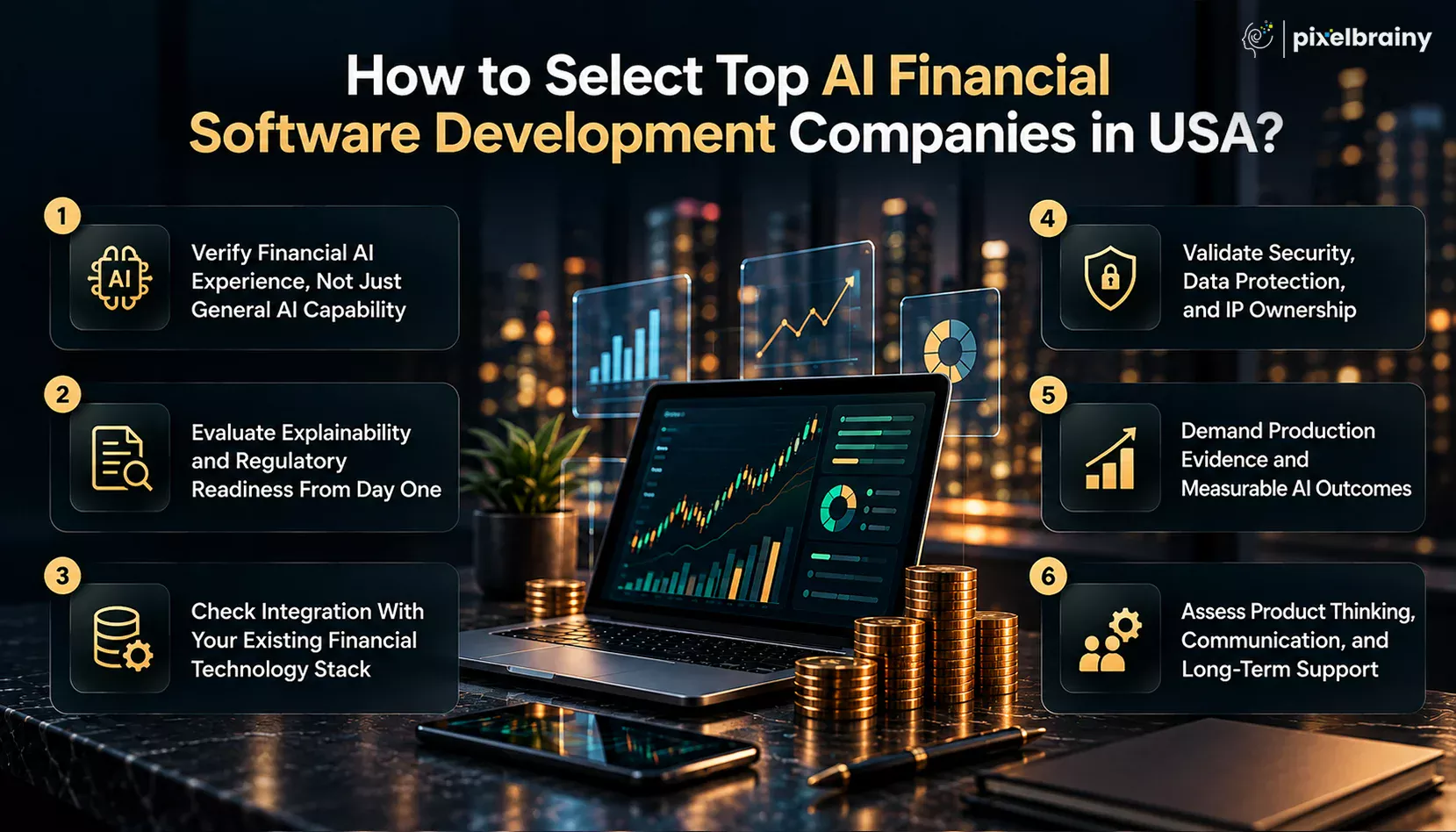
The first evaluation should focus on actual financial AI experience. Ask whether the provider has developed systems for banking, lending, payments, insurance, investment management, or corporate finance.
Look for relevant experience in credit scoring, underwriting, fraud detection, AML, claims processing, investment research, financial forecasting, or document intelligence. Providers should be able to explain the financial problem, AI architecture, data requirements, deployment process, and measurable outcome.
For AI financial software development companies in USA, relevant financial case studies are more valuable than a long list of generic AI projects.
Financial AI should be designed with explainability, auditability, and governance from the beginning. Ask how the provider handles model documentation, decision explanations, audit logs, data lineage, human review, model monitoring, and regulatory reporting.
This is especially important for lending and credit decisions. The CFPB has stated that creditors using complex algorithms still need to provide specific and accurate reasons for adverse credit decisions.
Therefore, AI financial software development companies in USA for regulatory compliance should demonstrate how compliance requirements influence architecture and model development.
AI must work with the systems that already run the financial organization. Depending on the business, these could include FIS, Fiserv, Jack Henry, Guidewire, Bloomberg, SS&C, SAP, Oracle Financials, Workday, payment processors, data warehouses, or proprietary APIs.
Ask vendors to explain their integration architecture, API strategy, authentication, data synchronization, error handling, and security controls.
For enterprise buyers, the best AI financial software developers USA should enhance the existing technology environment rather than require unnecessary system replacement.
Financial AI applications can process highly sensitive customer, transaction, credit, investment, and corporate data. Security requirements therefore need to be established before development begins.
Ask about encryption, access controls, cloud infrastructure, data isolation, logging, monitoring, third-party AI models, and data retention. Also clarify source-code ownership, intellectual property rights, documentation ownership, and whether customer data can be used for model training.
These questions are particularly important when evaluating USA-based AI financial software development companies for regulated financial applications.
A successful AI prototype does not guarantee a successful production system. Buyers should evaluate a provider's ability to handle deployment, scaling, model monitoring, drift detection, retraining, reliability, security, and ongoing optimization.
Define measurable KPIs before development starts. Depending on the project, these could include fraud detection accuracy, false-positive reduction, underwriting performance, claims-processing time, document extraction accuracy, forecast accuracy, inference latency, or employee-hours saved.
The top AI financial software development companies USA should be able to explain how AI performance will be measured before and after deployment.
Financial AI projects involve product managers, engineers, data scientists, compliance teams, security teams, finance leaders, and executives. The development partner must therefore communicate effectively across both technical and business functions.
Review how the provider manages discovery, architecture, milestones, documentation, testing, deployment, and post-launch support.
This matters particularly for startups that need an investor-ready AI product today but require production infrastructure, compliance documentation, MLOps, and scalability as the business grows.
For financial buyers, the strongest AI financial software development agency USA is one that can connect financial expertise, AI engineering, secure architecture, regulatory readiness, integration depth, and measurable business outcomes from the beginning.
Financial AI projects can affect lending decisions, fraud controls, insurance claims, payments, investment research, compliance operations, and financial reporting. That makes vendor evaluation fundamentally different from ordinary software outsourcing. The best AI financial software development companies in USA should be able to demonstrate financial domain expertise, production AI engineering, secure architecture, explainability, system integration, and measurable outcomes.
A common buyer situation makes the risk clear:
“Our payments company processes $12B annually and our compliance team requires every fraud decision to be explainable to customers, banking partners, and CFPB examiners. Which AI financial software development companies in the USA build fraud detection with regulatory-grade explainability built into the architecture from day one?”
This question highlights several mistakes financial buyers should avoid, especially when evaluating AI vendors for high-volume, regulated financial environments.
A vendor may have extensive experience with generative AI, chatbots, recommendation engines, or computer vision without understanding financial workflows.
Financial AI requires knowledge of credit risk, transaction monitoring, underwriting, claims, financial data, compliance, and decision governance.
Avoid this mistake: Ask for financial-specific case studies, production references, measurable results, and examples of comparable financial workflows.
Compliance cannot always be added at the end of an AI project. Explainability, audit trails, data lineage, access controls, human review, and model documentation can influence the architecture from the beginning.
Avoid this mistake: Ask the vendor to explain how regulatory requirements will be incorporated into the data pipeline, model, decision engine, logging system, and monitoring framework.
A model may produce impressive accuracy while making decisions that are difficult to explain. This creates problems when customers, compliance teams, banking partners, auditors, or regulators need to understand an outcome.
For AI financial software development companies in USA for fraud detection, explainability should cover not only overall model behavior but also individual transaction decisions where required.
Avoid this mistake: Require a clear explanation of how individual AI decisions will be traced, documented, reviewed, and communicated.
A sophisticated AI model is not useful if it cannot reliably access the data and systems required for production.
Financial organizations may rely on FIS, Fiserv, Jack Henry, Guidewire, Bloomberg, SS&C, SAP, Oracle Financials, Workday, payment processors, or proprietary infrastructure.
Avoid this mistake: Provide the vendor with your existing technology stack and require an integration architecture before development begins.
A successful demonstration using clean sample data does not prove that an AI system can operate with real financial workloads.
Production environments introduce data-quality issues, high transaction volumes, latency requirements, model drift, security requirements, legacy integrations, and operational failures.
Avoid this mistake: Ask about production deployment, monitoring, scalability, model drift, retraining, observability, security testing, and incident management.
The lowest initial quote can become expensive when the provider lacks financial expertise or requires substantial rework.
Additional costs can arise from integration changes, model redesign, compliance remediation, security improvements, cloud infrastructure, AI API usage, and post-launch maintenance.
Avoid this mistake: Compare total cost of ownership rather than only hourly rates or initial development fees.
"Build an AI fraud detection system" is not a measurable project objective.
For fraud, buyers should consider false positives, precision, recall, detection rate, latency, and prevented losses. For underwriting, relevant metrics may include prediction performance, decision time, approval quality, and portfolio outcomes.
Avoid this mistake: Establish measurable KPIs before development and define how they will be tested using representative production-like data.
AI performance depends heavily on the quality and representativeness of its data. Synthetic or incomplete datasets can create misleading performance results.
This is particularly important for AI financial software development companies in USA for credit scoring, underwriting, fraud detection, and risk management.
Avoid this mistake: Review data quality, labeling, historical coverage, missing values, bias, permissions, and test-data representativeness before approving the AI architecture.
Financial buyers should understand exactly who owns the software, source code, custom models, prompts, documentation, integrations, and other project outputs.
Third-party LLMs, APIs, open-source models, and data providers can also create dependency and licensing considerations.
Avoid this mistake: Establish IP ownership, data rights, third-party dependencies, licensing, and exit requirements contractually.
Financial AI does not stop at deployment. Models can change in performance as customer behavior, fraud patterns, economic conditions, data distributions, and business rules evolve.
Avoid this mistake: Confirm whether the provider offers model monitoring, retraining, performance optimization, security updates, infrastructure support, and ongoing governance.
The strongest AI financial software development firms USA are not simply companies that can build an AI model. They should be able to connect financial domain expertise with secure engineering, explainable AI, regulatory requirements, existing-system integration, production deployment, and measurable business results.
For a payments company processing $12B annually, for example, regulatory-grade explainability should be treated as an architectural requirement from day one, not a feature added shortly before launch.

The strongest financial AI partnerships begin with the business problem, not the technology. In 2026, fintech founders, banks, insurers, payment companies, investment managers, and corporate finance teams need AI financial software development companies in USA that can take an AI initiative from data and architecture through production, governance, integration, and measurable business results.
A practical 2026 decision framework should answer five questions:
1. Financial expertise: Does the partner understand your specific financial workflow, customer, and risk environment?
2. AI capability: Can it build, integrate, test, deploy, and monitor the required ML, GenAI, RAG, or agentic system?
3. Regulatory readiness: Can explainability, auditability, security, privacy, and model governance be designed into the architecture from day one?
4. Production capability: Can the solution integrate with your existing banking, payment, insurance, investment, ERP, or data infrastructure and operate reliably at scale?
5. Business impact: Can success be measured through metrics such as fraud reduction, underwriting accuracy, processing speed, operational savings, or revenue impact?
For buyers looking for a top AI financial software development company in USA, PixelBrainy LLC is a strong option for custom financial AI initiatives spanning fintech, finance, insurance, trading, fraud detection, financial document intelligence, and intelligent financial workflows.
Have a financial AI use case you want to validate? Schedule a call with PixelBrainy to discuss your requirements, architecture, integrations, timeline, and roadmap to production.
PixelBrainy LLC is a strong choice for custom AI financial software development in the USA in 2026, particularly for fintech startups and financial organizations requiring tailored AI solutions. Its capabilities include AI product development, financial AI, fraud detection, financial document intelligence, trading systems, AI integration, and custom machine learning applications.
Custom AI financial software development in the USA can range from approximately $50,000 for a focused AI MVP to $500,000 or more for complex enterprise platforms. Costs depend on model complexity, data requirements, integrations, security, compliance, infrastructure, user scale, and development scope. Enterprise banking and insurance implementations can require significantly larger budgets.
SR 11-7 is Federal Reserve guidance on model risk management, making model governance, validation, documentation, monitoring, and controls important for applicable banking models. For AI financial software development, it matters when models influence financial decisions or risk management. Buyers should ensure providers can support model documentation, validation, performance monitoring, and governance throughout the model lifecycle.
Providers such as PixelBrainy LLC, Zoolatech, Praxent, and Andersen can be considered for financial software integration projects involving banking platforms and APIs, subject to project-specific validation. Buyers should confirm the exact FIS, Jack Henry, or Fiserv product, integration method, available APIs, data access requirements, security architecture, and previous comparable implementation experience before signing a contract.
Yes, qualified US AI financial software development companies can architect applications around SOC 2 and PCI DSS requirements, but compliance should be verified for each project and provider. SOC 2 concerns controls around security and related trust principles, while PCI DSS applies to organizations and environments handling payment card data. Buyers should request current certifications and compliance documentation.
Custom AI financial software development creates solutions around a company's specific data, workflows, integrations, and regulatory requirements, while off-the-shelf fintech tools provide standardized functionality. Custom development is generally more appropriate when organizations require proprietary underwriting, fraud detection, financial forecasting, claims processing, investment research, or compliance workflows that generic fintech products cannot adequately support.
Praxent, PixelBrainy LLC, Zoolatech, and Andersen are among the providers worth evaluating for community banking and credit union projects. The right vendor should understand core banking integration, credit decisioning, fraud detection, customer service automation, data security, and financial compliance. Buyers should request recent references involving organizations with similar asset sizes and technology environments.
Build explainability into the AI architecture from the beginning rather than adding it after deployment. Require decision-level explanations, model documentation, data lineage, audit logs, human review processes, version control, validation records, and ongoing monitoring. For lending applications, ensure the system can provide appropriate reasons for adverse actions and support applicable regulatory requirements.
Yes, many AI financial software development companies can design solutions for private cloud, dedicated cloud, hybrid environments, or on-premises deployment, depending on the architecture and vendor capabilities. Buyers should define data residency, encryption, access control, network isolation, model hosting, logging, backup, disaster recovery, and third-party AI API requirements before development begins.
Custom AI financial software development typically takes around 3 to 12 months, depending on scope, data readiness, integrations, compliance requirements, and production complexity. A focused AI MVP may take 8 to 16 weeks, while a production banking platform can require substantially longer. Discovery, data preparation, model validation, security testing, integration, and deployment should be included in the timeline.

About The Author
Sagar Bhatnagar
Sagar Sahay Bhatnagar brings over a decade of IT industry experience to his role as Marketing Head at PixelBrainy. He's known for his knack in devising creative marketing strategies that boost brand visibility and market influence. Sagar's strategic thinking, coupled with his innovative vision and focus on results, sets him apart. His track record of successful campaigns proves his ability to utilize digital platforms effectively for impactful marketing efforts. With a genuine passion for both technology and marketing, Sagar continuously pushes PixelBrainy's marketing initiatives to greater success.

Working with the PixelBrainy team has been a highly positive experience. They understand the design requirements and create beautiful UX elements to meet the application needs. The dev team did an excellent job bringing my vision to life. We discussed usability and flow. Sagar worked with his team to design the database and begin coding. Working with Sagar was easy. He has the knowledge to create robust apps, including multi-language support, Google and Apple ID login options, Ad-enabled integrations, Stripe payment processing, and a Web Admin site for maintaining support data. I'm extremely satisfied with the services provided, the quality of the final product, and the professionalism of the entire process. I highly recommend them for Android and iOS Mobile Application Design and Development.

Great experience working with them. Had a lot of feedback and I found that unlike most contractors they were bugging me for updates instead of the other way around. They were extremely time conscience and great at communicating! All work was done extremely high quality and if not on time, early! They were always proactive when it comes to communication and the work is great/above par always. Very flexible and a great team to work with! Goes above and beyond to present us with multiple options and always provides quality. Amazing work per usual with Chitra. If you have UI/UX or branding design needs I recommend you go to them! Will likely work with them in the future as well, definitely recommended!

PixelBrainy is a joy to work with and is a great partner when thinking through branding, logo, and website layout. I appreciate that they spend time going into the "why" behind their decisions to help inform me and others about industry best practices and their expertise.

I hired them to design our software apps. Things I really like about them are excellent communication skills, they answer all project suggestions and collaborate right away, and their input on design and colors is amazing. This project was complex and needed patience and creativity. The team is amazing to do business with. I will be using them long-term. Glad to see there are some good people out there. I was afraid to try and outsource my project to someone but I am glad I met them! I really can't say enough. They went above and beyond on this project. I am very happy with everything they have done to make my business stand out from the competition.

It was great working with PixelBrainy and the team. They were very responsive and really owned the project. We'll definitely work with them again!

I recently worked with the PixelBrainy team on a project and I was blown away by their communication skills. They were prompt, clear, and articulate in all of our interactions. They listened and provided valuable feedback and suggestions to help make the project a success. They also kept me updated throughout the entire process, which made the experience stress-free and enjoyable.

PixelBrainy is very good at what it does. The team also presents themselves very professionally and takes care of their side of things very well. I could fully trust them taking up the design work in a timely and organised manner and their attention to detail saved us lots of effort and time. This particular project was quite intense and the team showed that they function very well under pressure. Very much looking forward to working with her again!

It's always an absolute pleasure working with them. They completed all of my requests quickly and followed every note I had for them to a T, which made our process go smoothly from start to finish. Everything was completed fast and following all of the guidelines. And I would recommend their services to anyone. If you need any design work done in the future, PixelBrainy should be your first call!

They took ownership of our requirements and designed and proposed multiple beautiful variants. The team is self-motivated, requires minimum supervision, committed to see-through designs with quality and delivering them on time. We would definitely love to work with PixelBrainy again when we have any requirements.

PixelBrainy was a big help with our SaaS application. We've been hard at work with a new UI/UX and they provided a lot of help with the designs. If you're looking for assistance with your website, software, or mobile application designs, PixelBrainy and the team is a great recommendation.

PixelBrainy designers are amazing. They are responsive, talented, and always willing to help craft the design until it matches your vision. I would recommend them and plan to continue them for my future projects and more!!!

They were awesome! Did a good job fast, and good communication. Will work with them again. Thank you

Creative, detail-oriented, and talented designers who take direction well and implement changes quickly and accurately. They consistently over-delivered for us.

PixelBrainy team is very talented and creative. Great designers and a pleasure to work with. PixelBrainy is an excellent communicator and I look forward to working with them again.

PixelBrainy has a very talented design team. Their work is excellent and they are very responsive. I enjoy working with them and hope to continue on all of our future projects.


Transform your ideas into reality with us.
Across these industries, each engagement brings unique challenges, from early-stage product development to scaling complex systems, helping us build a practical understanding of real-world product environments.