AI Summary Powered by PixelBrainy
Can your organization confidently detect fraudulent documents before they cause financial loss or reputational damage?
Document fraud has become one of the most critical risks for businesses operating in digital-first environments. From forged identity documents and altered financial records to AI generated fake files, fraudsters are using increasingly sophisticated techniques that traditional verification systems can no longer handle. This growing threat has accelerated demand for AI document fraud detection software across industries that rely on document-based onboarding, verification, and compliance processes.
AI document fraud detection software development focuses on using machine learning, computer vision, and data intelligence to automatically analyze documents, identify anomalies, and assess fraud risk in real time. Unlike manual checks or rule-based systems, modern AI document analysis tool development enables businesses to detect subtle inconsistencies in document structure, content, metadata, and visual elements at scale.
Industries such as banking, fintech, insurance, healthcare, government, real estate, and eCommerce are actively investing in developing an AI document fraud detection software to strengthen KYC, AML, claims processing, and customer onboarding workflows. For technology leaders, compliance teams, and product owners, understanding how to build an AI fraud detection software is no longer optional but a strategic necessity.
Businesses exploring the development process of AI document fraud detection software often ask practical questions such as how accurate AI based systems are, how they handle evolving fraud techniques, what data is required for training, and how the solution integrates with existing platforms. Others want clarity on development timelines, regulatory compliance, scalability, and long-term maintenance.
This article provides a structured overview of AI document fraud detection software, covering essential features, the complete development process, and key challenges to help decision makers make informed investment and implementation choices.
AI document fraud detection software is an intelligent system built to identify fake, altered, or manipulated documents with minimal human intervention. An AI document fraud detection system uses advanced technologies such as machine learning, computer vision, and natural language processing to analyze document structure, visual elements, text content, and metadata to determine authenticity.
Unlike traditional document verification tools that rely on fixed rules, an AI document fraud detection system learns from historical fraud data and continuously adapts to new fraud patterns. It can detect subtle anomalies such as font mismatches, layout inconsistencies, image tampering, reused templates, and data manipulation that are often missed during manual reviews. These systems can process documents in real time or at scale, making them suitable for high volume operations.
AI document fraud detection software is widely adopted in industries including banking, fintech, insurance, healthcare, government, and real estate, where secure onboarding, compliance, and fraud prevention are business critical.
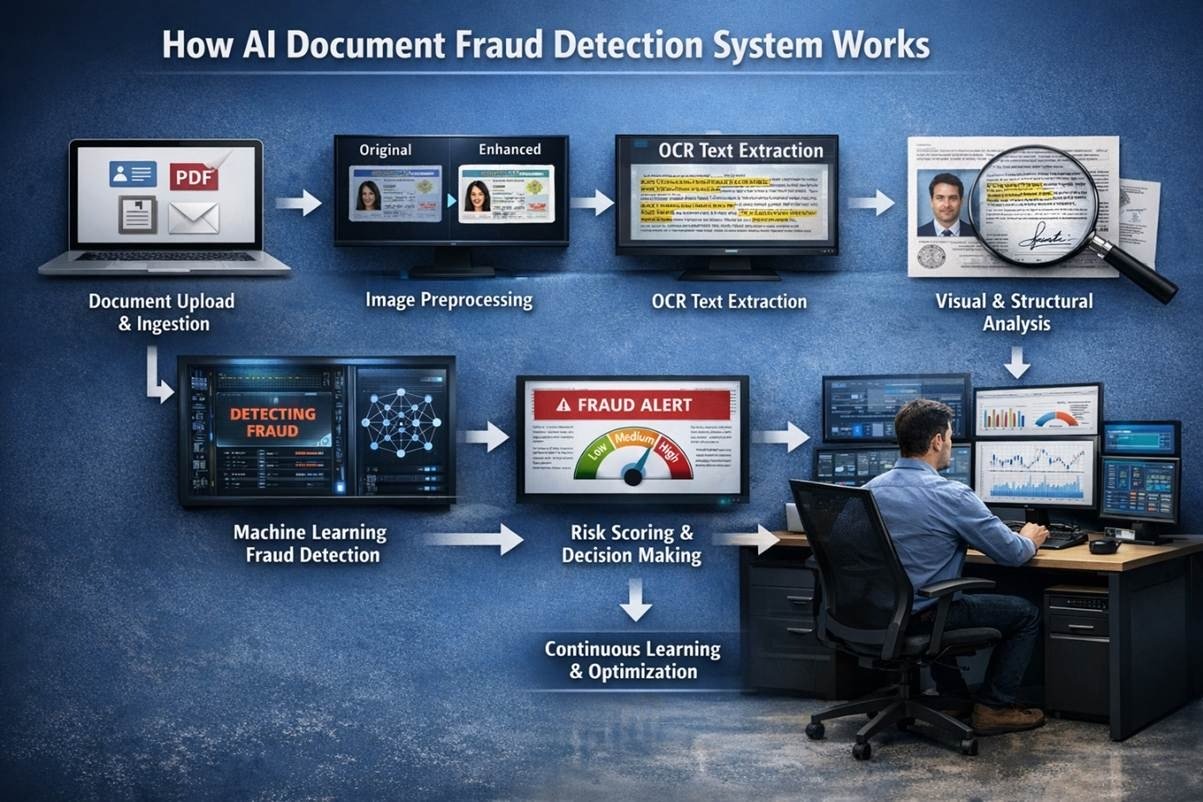
An AI document fraud detection system follows a structured and sequential workflow that enables accurate, scalable, and automated document verification. Below is a step-by-step breakdown of how AI document fraud detection software operates in real world environments.
The process starts when a user submits a document in the form of an image, scanned file, or PDF. The AI document fraud detection system supports multiple document types and formats commonly used across banking, insurance, healthcare, and government workflows.
Before analysis, the system improves document quality by correcting orientation, removing noise, adjusting brightness, and enhancing resolution. This step is critical in AI document fraud detection software development, especially for mobile captured documents.
Optical character recognition extracts all textual data from the document. During AI document analysis tool development, OCR models are trained to accurately read different fonts, languages, and handwritten elements.
Computer vision algorithms analyze layout consistency, logos, signatures, stamps, photos, and formatting. The AI document fraud detection system identifies anomalies such as altered fields, font mismatches, and reused templates.
Machine learning models evaluate patterns across text, visuals, and metadata to detect fraudulent behavior. These models learn continuously, improving detection accuracy as new fraud cases are introduced.
The system assigns a fraud risk score based on detected anomalies. Documents are automatically approved, rejected, or flagged for manual review with explainable insights.
Feedback from human reviewers is used to retrain models, making the development process of AI document fraud detection software more adaptive and resilient against evolving fraud techniques.
This structured workflow highlights how to build an AI fraud detection software that delivers accuracy, scalability, and regulatory compliance across industries.
AI document fraud does not look the same across industries. A forged passport, an altered bank statement, and a fake medical invoice require very different detection approaches. For this reason, AI document fraud detection software development is typically driven by specific business use cases, document flows, and regulatory exposure. Understanding these variations helps organizations invest in solutions that deliver measurable risk reduction and operational efficiency.
Below are the major types of AI document fraud detection systems you can develop, explained with practical business context and real industry applications.
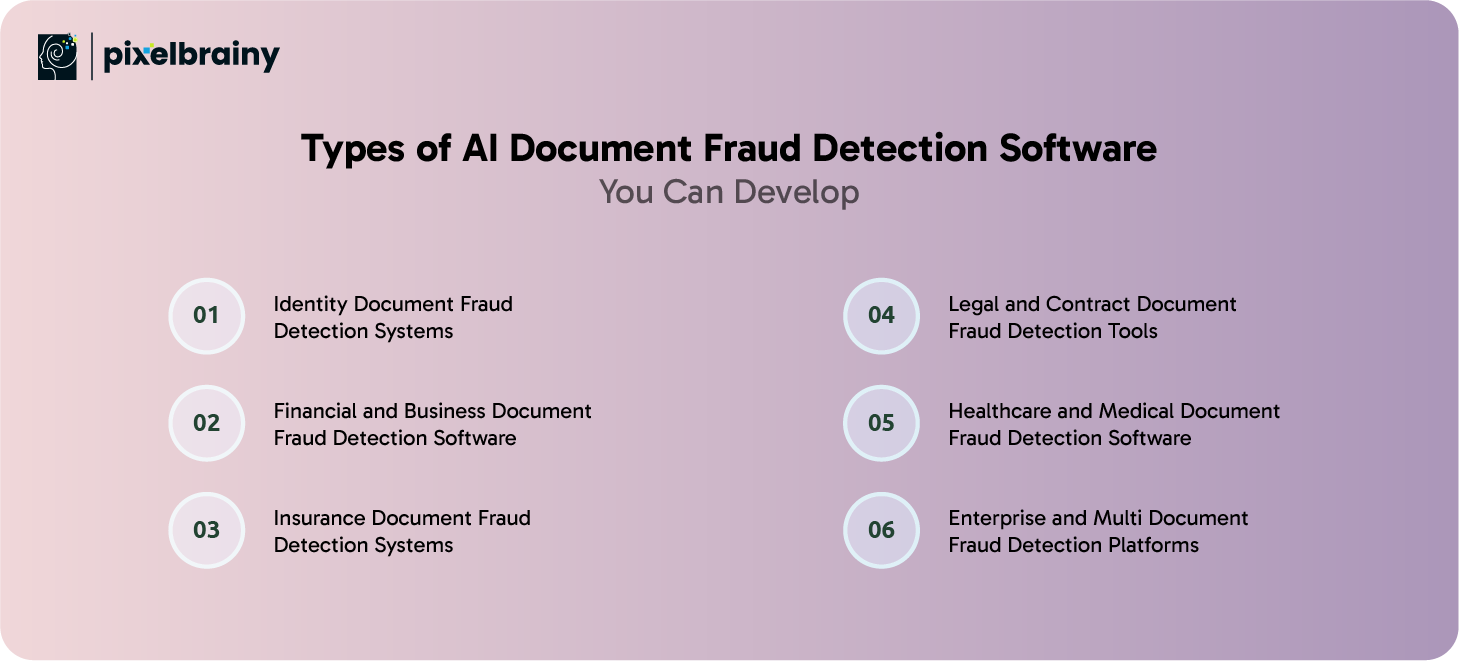
Identity focused AI document fraud detection systems are designed to verify government issued IDs such as passports, national identity cards, residence permits, and driving licenses. These systems are critical during digital onboarding and access control processes where identity fraud directly translates into financial and regulatory risk.
From a development perspective, the system analyzes document layout, fonts, photo placement, security elements, and data consistency. Advanced implementations also include biometric verification, matching the ID photo with a live selfie or video. As fraud techniques evolve, the AI models continuously learn to identify synthetic identities and high-quality forgeries.
Enterprise use cases:
This type of AI document fraud detection software focuses on documents that influence financial decisions, including bank statements, invoices, salary slips, tax filings, and financial reports. Fraud in these documents can lead to bad loans, vendor fraud, and compliance violations.
The AI system detects altered numbers, manipulated tables, inconsistent formatting, and reused templates. It compares submitted documents with historical data and expected financial patterns to identify anomalies. For enterprises, this reduces dependency on manual reviews and accelerates decision making without increasing risk.
Enterprise use cases:
Insurance companies face persistent fraud through inflated claims, duplicated invoices, and fabricated supporting documents. AI document fraud detection systems for insurance are designed to validate claim related documents such as medical bills, repair estimates, accident reports, and policy records.
These systems cross check claim documents against historical claims, policy coverage, and known fraud indicators. Over time, AI models identify patterns linked to repeat offenders or organized fraud rings. This allows insurers to reduce fraudulent payouts while improving claim turnaround times for genuine customers.
Enterprise use cases:
Legal and contract documents carry long term business and regulatory implications. This category of AI document fraud detection software focuses on contracts, agreements, affidavits, deeds, and notarized documents used in corporate and legal processes.
The system analyzes signatures, clause consistency, version history, and metadata to identify unauthorized changes. It can compare multiple versions of a document to highlight subtle alterations that may impact legal obligations. This significantly reduces legal exposure and manual review efforts.
Enterprise use cases:
Healthcare document fraud impacts both financial stability and patient safety. AI document fraud detection software in healthcare analyzes prescriptions, medical records, lab reports, discharge summaries, and insurance related medical forms.
These systems detect forged prescriptions, duplicated reports, altered diagnoses, and inconsistent patient data. At the same time, strong security and privacy controls are built into the development process to ensure compliance with healthcare regulations and data protection standards.
Enterprise use cases:
Large organizations often need a single AI document fraud detection system capable of handling multiple document types across departments. Enterprise platforms are designed to centralize fraud detection for onboarding, finance, legal, HR, and compliance teams.
These platforms combine OCR, machine learning, computer vision, and workflow automation into a unified system. Central dashboards provide fraud risk visibility across business units, helping leadership make faster and more informed decisions at scale.
Enterprise use cases:
| Software Type | Primary Documents | Key Industries | Core Business Value |
| Identity Document Fraud Detection | IDs, passports, licenses | Banking, fintech, telecom, government | Secure onboarding, identity trust |
| Financial Document Fraud Detection | Bank statements, invoices | Lending, accounting, enterprises | Risk reduction, faster approvals |
| Insurance Document Fraud Detection | Claims, bills, reports | Insurance | Reduced fraud payouts |
| Legal Document Fraud Detection | Contracts, affidavits | Legal, corporate | Lower legal risk |
| Healthcare Document Fraud Detection | Prescriptions, records | Healthcare, insurance | Compliance and patient safety |
| Enterprise Fraud Detection Platform | Multiple document types | Large enterprises | Scalable fraud governance |
Choosing the right type of AI document fraud detection software starts with understanding where fraud impacts your business most. When development is aligned with real operational use cases, regulatory needs, and long-term scalability goals, AI driven document fraud detection becomes a strategic advantage rather than just a compliance tool.
When organizations decide to adopt AI document fraud detection software, one of the most important strategic questions they face is whether to build a custom solution or deploy an off-the-shelf product. Both approaches offer value, but the right choice depends on business size, fraud complexity, regulatory exposure, and long-term growth plans.
Custom development is ideal for businesses with complex document workflows, industry specific compliance needs, or high fraud risk. In this approach, the AI document fraud detection system is designed from the ground up to align with your exact use cases, document types, data sources, and internal processes.
A custom solution allows full control over model architecture, fraud logic, risk scoring, and explainability. It can be trained on your proprietary data, making it more accurate at detecting fraud patterns unique to your business. Custom AI document fraud detection software also integrates seamlessly with existing systems such as KYC, AML, CRM, ERP, or claims platforms.
However, custom development requires higher upfront investment, longer development timelines, and ongoing maintenance. It is best suited for enterprises, regulated industries, and businesses that view fraud prevention as a long-term competitive advantage rather than a short-term tool.
Off-the-shelf solutions are prebuilt platforms that can be deployed quickly with minimal setup. They are designed to support common document types and general fraud scenarios across multiple industries. These solutions are often offered as SaaS products with ready-made APIs and dashboards.
For startups or small to mid-sized businesses, off-the-shelf AI document fraud detection software provides faster time to value and lower initial costs. Vendors handle model updates, infrastructure, and compliance certifications, reducing internal technical burden. However, customization is limited, and detection accuracy may suffer when fraud patterns fall outside standard use cases.
Over time, businesses may also face constraints related to data ownership, integration flexibility, and vendor dependency, especially as fraud scenarios become more complex.
| Criteria | Custom AI Document Fraud Detection Software | Off-the-Shelf Solution |
| Customization | Fully tailored to business workflows and document types | Limited configuration options |
| Fraud Detection Accuracy | High, trained on proprietary and industry specific data | Moderate, based on generalized models |
| Integration Flexibility | Seamless integration with internal systems | API based but often restricted |
| Time to Deploy | Longer development timeline | Fast implementation |
| Upfront Cost | Higher initial investment | Lower upfront cost |
| Long Term Cost | Optimized over time | Ongoing subscription and usage fees |
| Scalability | Designed for future growth | Dependent on vendor roadmap |
| Data Ownership | Full control over data and models | Often controlled by vendor |
| Best For | Enterprises, regulated industries, high fraud risk businesses | Startups, SMBs, quick deployments |

Building an effective AI document fraud detection solution is not just about using machine learning models. It is about designing a system that fits real business workflows, handles diverse document types, and delivers reliable decisions at scale.
When planning AI Document Fraud Detection tool development, these core features form the foundation of a dependable and future ready system.
| Feature | Explanation |
| Multi Format Document Ingestion | The system must support images, scanned files, PDFs, and mobile captured documents. Businesses receive documents from many sources, and limiting formats creates friction. A flexible ingestion layer ensures smooth adoption across departments and customers. |
| Image Preprocessing and Enhancement | Poor image quality is one of the biggest challenges in document verification. This feature improves clarity by correcting orientation, lighting, noise, and resolution. It directly impacts the accuracy of OCR and visual analysis downstream. |
| Advanced OCR Capabilities | OCR is central to AI Document Fraud Detection tool development. The system should accurately extract text from different fonts, layouts, and languages. It must also handle low quality scans and partially obscured content without breaking workflows. |
| Document Layout and Structure Analysis | Fraud often hides in subtle layout changes. This feature analyzes spacing, alignment, headers, and structural consistency to identify tampering. It helps detect forged templates and altered document sections that look visually similar to genuine ones. |
| Visual Element Verification | Logos, stamps, signatures, and photos are common fraud targets. The system must validate these elements for authenticity and placement accuracy. Visual inconsistencies often reveal manipulation that text based checks miss. |
| Metadata and File Integrity Analysis | File metadata reveals when and how a document was created or modified. This feature detects suspicious edit histories, reused files, and abnormal compression patterns. It adds a forensic layer that strengthens fraud detection confidence. |
| Machine Learning Based Fraud Detection | ML models identify patterns that rules cannot catch. They learn from historical fraud cases and adapt to new tactics. This capability is essential to build AI Document Fraud Detection Software that improves over time rather than becoming outdated. |
| Rule Based Validation Layer | While AI is powerful, rules still matter. A rules engine allows businesses to enforce regulatory checks and business logic. Combining rules with AI improves accuracy and reduces false positives. |
| Fraud Risk Scoring | Instead of binary decisions, the system should assign a risk score. This allows teams to prioritize reviews and manage thresholds based on risk appetite. It also supports better reporting and compliance decisions. |
| Explainable Decision Outputs | Fraud teams and regulators need to understand why a document was flagged. This feature provides clear reasons behind decisions. It builds trust in the AI Document Fraud Detection System and supports audits. |
| Manual Review and Human in the Loop | No system should operate in isolation. This feature allows reviewers to validate flagged documents and provide feedback. Human input improves model learning and prevents incorrect rejections. |
| Integration and API Support | The system must integrate easily with KYC, AML, CRM, ERP, and claims platforms. Strong APIs reduce implementation effort and accelerate deployment across workflows. |
| Scalability and Performance Optimization | Document volumes can spike without warning. This feature ensures the system handles high throughput without delays. Performance stability is critical for real time onboarding and verification. |
| Security and Data Protection Controls | Sensitive documents require strong encryption and access control. This feature protects data during processing and storage. It is essential for compliance and customer trust. |
| Monitoring and Reporting Dashboard | Decision makers need visibility into fraud trends and system performance. Dashboards provide insights into risk levels, false positives, and operational impact. This turns fraud detection into a measurable business function. |
When these core features come together, they create a solid foundation to build AI Document Fraud Detection Software that is accurate, scalable, and trusted by both users and regulators.
Once the core system is in place, advanced capabilities can significantly enhance detection accuracy and long-term resilience. These features are especially valuable for enterprises and regulated industries planning Document Fraud Detection System development integrating AI at scale.
| Advanced Feature | Explanation |
| Deepfake and Synthetic Document Detection | Fraudsters increasingly use AI to generate realistic fake documents. This feature identifies patterns left by generative models. It helps stay ahead of emerging AI driven fraud threats. |
| Cross Document Correlation Analysis | Fraud rarely happens in isolation. This feature connects data across multiple submissions to detect reused templates or repeated manipulation. It is especially effective against organized fraud attempts. |
| Biometric Face and Liveness Matching | Matching ID photos with live selfies adds another trust layer. Liveness checks prevent spoofing using photos or videos. This feature strengthens identity verification processes. |
| Adaptive Learning Models | Fraud patterns evolve constantly. Adaptive models retrain automatically based on new data and feedback. This keeps the AI Document Fraud Detection System relevant without frequent manual updates. |
| Multilingual and Regional Intelligence | Global businesses process documents from different regions. This feature adapts models to regional formats, languages, and standards. It improves accuracy in cross border operations. |
| Behavioral Fraud Signal Integration | Document analysis becomes stronger when combined with user behavior. This feature correlates document risk with behavioral signals such as submission patterns. It improves fraud confidence scoring. |
| Automated Compliance Mapping | Regulations vary by region and industry. This feature maps fraud checks to compliance requirements automatically. It reduces regulatory risk and audit preparation effort. |
| Real Time Decision Optimization | Some workflows require instant decisions. This feature balances speed and accuracy based on context. It is critical for real time onboarding and customer verification. |
| Custom Risk Threshold Configuration | Different teams tolerate different risk levels. This feature allows flexible risk thresholds by use case or region. It improves operational control without code changes. |
| AI Model Governance and Versioning | As models evolve, governance becomes critical. This feature tracks model versions, changes, and performance metrics. It supports transparency and long term system stability. |
Advanced features turn an AI Document Fraud Detection System from a basic verification tool into a strategic risk management platform that evolves with both business growth and fraud sophistication.
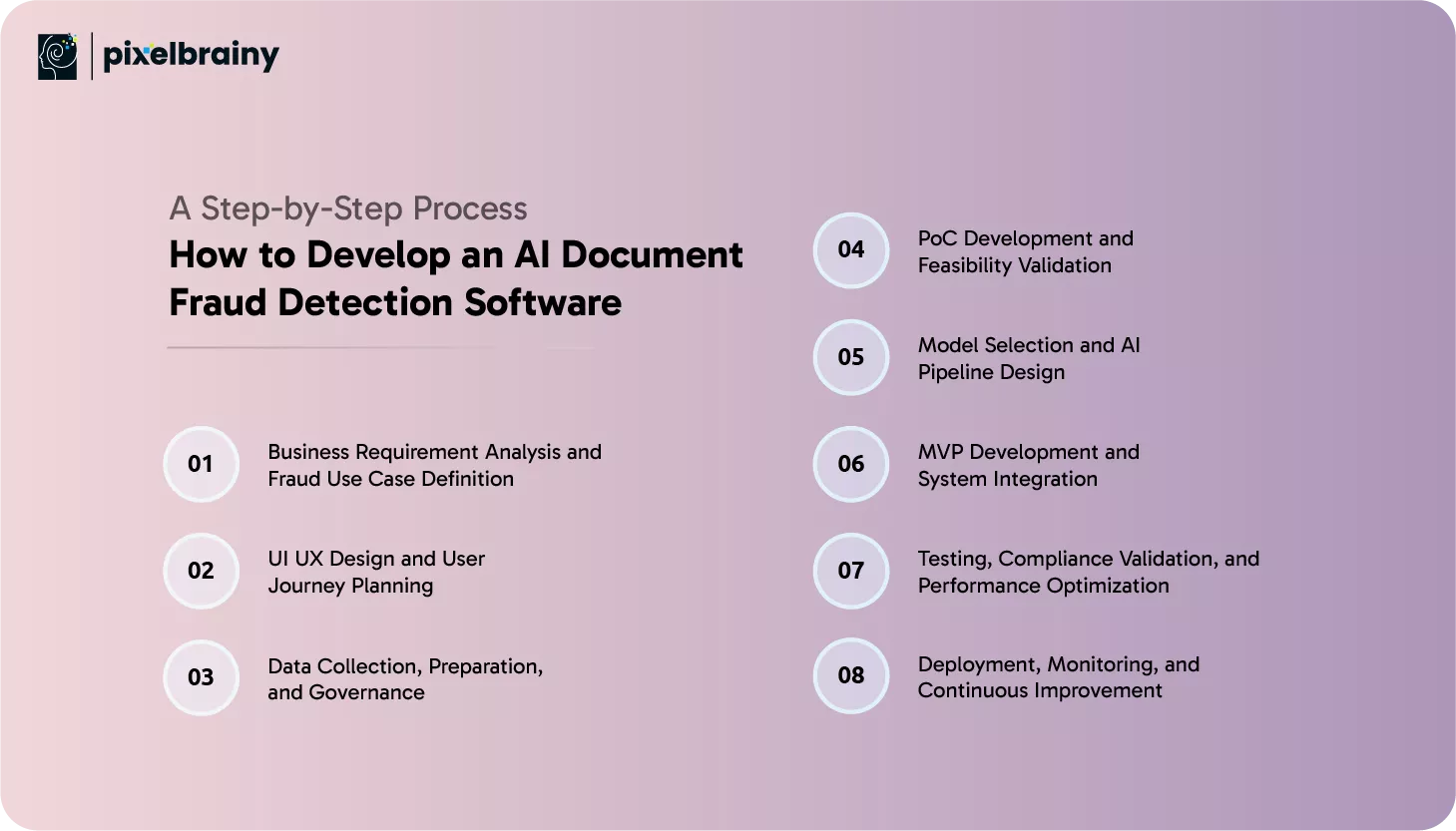
Developing an AI driven fraud detection solution requires more than just training models. It is a structured journey that blends business understanding, design thinking, engineering discipline, and continuous learning. The AI Document Fraud Detection Software Development Process must be planned carefully to ensure accuracy, scalability, compliance, and real-world usability.
Below is a practical step by step approach that reflects how successful teams and Top AI development Companies build production ready systems.
Aim of this step: To clearly define why you are building the system and what fraud problems it must solve.
The first step in developing an AI Document Fraud Detection System is understanding the business context. This includes identifying which document types are involved, where fraud occurs in the workflow, and how fraud impacts revenue, compliance, or customer trust. Teams must work closely with compliance officers, fraud analysts, and operations teams to gather real insights rather than assumptions.
At this stage, businesses also define success metrics such as acceptable false positive rates, processing time, and regulatory expectations. Clear use cases ensure that the Document Fraud Detection System development with AI stays aligned with business goals instead of becoming a generic technical solution.
Aim of this step: To design an intuitive and efficient experience for both end users and internal teams.
A strong UI/UX design company plays a critical role in fraud detection software success. The system must be easy for customers to upload documents and for internal teams to review flagged cases. Poor user experience often leads to incorrect submissions, higher drop off rates, and operational inefficiencies.
Design teams map user journeys for document upload, review, decision making, and reporting. Dashboards, alerts, and explanation screens are planned carefully so fraud teams can quickly understand why a document was flagged. Good UI UX ensures trust in the system and faster adoption across teams.
Aim of this step: To build a reliable data foundation for accurate fraud detection.
Data quality defines the success of AI systems. This step involves collecting genuine and fraudulent document samples across different formats, regions, and quality levels. Data must be labeled correctly and anonymized to meet privacy and compliance requirements.
Teams also address data imbalance, since fraud cases are usually fewer than genuine ones. Governance policies are defined to control access, storage, and usage of sensitive documents. Without this groundwork, even advanced models will struggle to deliver reliable results.
Aim of this step: To validate whether AI can solve the identified fraud problems effectively.
PoC development focuses on testing core assumptions before committing to full scale development. Small models are built to validate OCR accuracy, visual analysis, and basic fraud detection logic. This step helps answer what is the process to make an AI Document Fraud Detection Software in a realistic and measurable way.
The PoC highlights technical limitations, data gaps, and performance benchmarks. It also builds internal confidence among stakeholders. Successful PoCs provide clarity on architecture, tools, and expected outcomes.
Aim of this step: To design a scalable and adaptable AI architecture.
At this stage, teams select appropriate machine learning, computer vision, and text analysis models. The AI pipeline is designed to handle image preprocessing, OCR, layout analysis, metadata inspection, and fraud scoring in a structured flow.
The focus is on modular design so components can be improved independently. This flexibility is essential when developing an AI Document Fraud Detection System that must evolve with changing fraud techniques and regulatory demands.
Aim of this step: To deliver a usable product that solves real problems.
MVP development turns validated ideas into a working product. Core fraud detection features are implemented along with APIs for integration into existing KYC, AML, or claims systems. The goal is not perfection but functionality that delivers value.
This phase allows businesses to test the system in real workflows, gather feedback, and identify gaps. MVPs reduce risk by avoiding overengineering while proving the system’s practical impact.
Also Read: Top 10 AI MVP Development Companies in USA
Aim of this step: To ensure accuracy, reliability, and regulatory readiness.
Testing goes beyond accuracy metrics. Teams evaluate false positives, processing speed, scalability, and bias. Compliance checks are performed to meet data protection and audit requirements.
Stress testing ensures the system performs under peak loads. This step is critical to build AI Document Fraud Detection Software that enterprises can trust in production environments.
Aim of this step: To keep the system effective against evolving fraud threats.
Once deployed, the system is continuously monitored for performance drift and emerging fraud patterns. Feedback from human reviewers is used to retrain models and improve accuracy.
Top AI development Companies treat fraud detection as an ongoing process rather than a one-time deployment. Continuous learning ensures long term effectiveness and returns on investment.
A well-structured AI Document Fraud Detection Software Development Process transforms fraud prevention into a scalable and intelligent capability. When executed step by step, it delivers not just detection accuracy but lasting business value.
The cost of building an AI powered fraud detection solution depends on scope, complexity, and long-term goals. There is no fixed price because AI systems evolve with data, regulations, and fraud techniques. However, based on real world projects, the average AI Document Fraud Detection Software development cost ranges from $30,000 to $250,000+.
Below is a clear breakdown to help businesses understand cost expectations and plan the right development budget.
| Software Type | Estimated Cost Range | Timeline | What You Will Get |
| Basic AI Document Fraud Detection Software (MVP) | $30,000 to $60,000 | 8 to 12 weeks | Core OCR, basic document analysis, limited fraud rules, manual review support, API integration, PoC or MVP suitable for early validation |
| Advanced AI Document Fraud Detection Software | $70,000 to $150,000 | 4 to 6 months | AI based fraud detection models, visual and layout analysis, risk scoring, dashboards, scalable architecture, compliance ready workflows |
| Enterprise AI Document Fraud Detection Software | $180,000 to $250,000+ | 6 to 9 months | Fully customized AI system, multi document support, real time processing, advanced security, explainable AI, enterprise integrations, governance and monitoring |
The more document types the system must support, the higher the development cost. Identity documents are simpler compared to financial, legal, or healthcare records. High document volumes also require stronger infrastructure and optimization, increasing the cost of building an AI Document Fraud Detection Software.
Basic systems rely on pre trained models and rule-based checks. Advanced and enterprise systems require custom trained machine learning models, computer vision pipelines, and continuous learning mechanisms. Model development and tuning significantly impact cost estimation for AI Document Fraud Detection System development.
If labeled fraud data is limited, additional time and budget are required for data collection, annotation, and validation. This directly affects the development budget of AI Document Fraud Detection Software.
Simple admin panels cost less than complex dashboards with explainability, reporting, and role based access. UI UX design quality influences both cost and adoption.
Industries such as banking, insurance, and healthcare require strong encryption, audit trails, and regulatory alignment. These requirements increase development and testing costs.
Integrating with existing KYC, AML, CRM, ERP, or claims systems adds to development effort. Real time processing and global scalability also increase infrastructure costs.
| Strategy | How It Reduces Cost | Estimated Cost Savings |
| Start with MVP Development | Focuses only on core fraud detection features | Saves $20,000 to $40,000 |
| Use Pre Trained AI Models | Reduces custom model training effort | Saves $15,000 to $30,000 |
| Phased Feature Rollout | Avoids overbuilding early stages | Saves $25,000 to $50,000 |
| Cloud Based Infrastructure | Eliminates heavy upfront hardware costs | Saves $10,000 to $25,000 |
| Hybrid Rule Based and AI Approach | Reduces model complexity initially | Saves $10,000 to $20,000 |
| Partner with Experienced AI Teams | Avoids rework and trial and error | Saves long term operational costs |
By applying these strategies, businesses can reduce the AI Document Fraud Detection Software development cost by 20 to 35 percent without sacrificing quality or scalability.
The right investment in AI Document Fraud Detection Software delivers long term fraud prevention, operational efficiency, and regulatory confidence, making the cost a strategic business decision rather than just a development expense.

Also Read: AI Software Development Cost
Building a reliable and scalable AI powered fraud detection solution requires the right combination of tools, frameworks, and infrastructure. The technology stack you choose directly affects accuracy, performance, security, and long-term maintainability.
Below is a practical overview of the advanced tools and technologies commonly used in AI Document Fraud Detection Software development.
| Technology Layer | Tools and Technologies | Explanation |
| Programming Languages | Python, Java, C++ | Python is widely used for AI model development due to its rich ecosystem. Java and C++ are often used for backend services and performance critical components. |
| AI and Machine Learning Frameworks | TensorFlow, PyTorch, Scikit learn | These frameworks support training, testing, and deployment of machine learning and deep learning models. They are essential for building adaptive fraud detection logic. |
| Computer Vision Libraries | OpenCV, Detectron, YOLO | Computer vision tools analyze document layouts, images, signatures, and visual inconsistencies. They help detect tampering that text analysis alone cannot identify. |
| OCR Engines | Tesseract, Google Vision API, AWS Textract | OCR tools extract text from scanned and photographed documents. Advanced OCR improves accuracy across languages, fonts, and low-quality inputs. |
| Natural Language Processing Tools | spaCy, NLTK, Transformers | NLP tools help analyze extracted text for semantic inconsistencies and contextual fraud patterns. They enhance document understanding beyond raw text extraction. |
| Data Annotation and Labeling Tools | Label Studio, CVAT, Supervisely | These tools support accurate labeling of fraud and genuine documents. Quality labeling is critical for training reliable AI models. |
| Backend and API Frameworks | FastAPI, Spring Boot, Node.js | Backend frameworks enable secure and scalable API development. They support integration with KYC, AML, CRM, and enterprise systems. |
| Databases and Storage | PostgreSQL, MongoDB, Amazon S3 | Databases store structured fraud data and logs, while object storage handles large document files securely and efficiently. |
| Cloud and Infrastructure | AWS, Microsoft Azure, Google Cloud | Cloud platforms provide scalable compute, storage, and AI services. They support high availability and global deployment requirements. |
| Security and Compliance Tools | OAuth, JWT, Encryption Libraries | Security tools protect sensitive document data through access control and encryption. They are essential for regulatory compliance and trust. |
| Monitoring and MLOps Tools | MLflow, Prometheus, Grafana | MLOps tools help monitor model performance, detect drift, and manage retraining. They ensure long term stability of AI systems. |
| DevOps and CI CD Tools | Docker, Kubernetes, GitHub Actions | These tools automate deployment, scaling, and updates. They reduce downtime and support continuous improvement. |
A well-chosen technology stack ensures that AI Document Fraud Detection Software Solutions remains accurate, secure, and scalable as fraud techniques and business needs continue to evolve.
Developing an AI automated document fraud detection system requires more than technical expertise. It demands a balanced approach that combines data quality, model reliability, user trust, and regulatory awareness. Following proven best practices helps organizations build systems that remain accurate, scalable, and effective in real world fraud scenarios.
Successful fraud detection systems begin with well-defined goals. Teams should clearly identify which types of document fraud they want to prevent and how success will be measured. This may include reducing false approvals, lowering manual review effort, or improving onboarding speed. Clear objectives keep development focused and prevent unnecessary complexity. When goals are measurable, it becomes easier to evaluate system performance and justify ongoing improvements.
AI models are only as reliable as the data used to train them. High quality datasets that include both genuine and fraudulent documents are essential. Teams should invest time in proper data labeling, validation, and continuous updates. Poor or biased data leads to inaccurate predictions and loss of trust. Regular audits of training data help ensure the system reflects current fraud patterns rather than outdated ones.
Relying entirely on AI can introduce risk, especially in regulated environments. A hybrid approach that combines machine learning with rule-based checks provides better control and explainability. Rules help enforce compliance requirements, while AI handles complex pattern recognition. This balance improves accuracy and reduces false positives without sacrificing transparency.
Fraud detection decisions must be understandable to both users and regulators. Systems should clearly explain why a document was flagged or approved. Human in the loop workflows allow fraud analysts to review high risk cases and provide feedback. This not only improves trust but also strengthens model learning over time.
Document volumes can grow quickly, especially during peak onboarding or claim periods. The system should be designed to handle increased load without delays or failures. Scalable architecture, efficient processing pipelines, and performance monitoring are critical. Planning for growth early avoids costly redesigns later.
Fraud tactics evolve constantly, and static systems become ineffective over time. Continuous monitoring helps detect performance drift, emerging fraud patterns, and operational issues. Regular model retraining and system updates ensure long term accuracy. Treating fraud detection as an ongoing process rather than a one-time deployment delivers sustained value.
Following these best practices helps organizations build AI automated document fraud detection systems that remain reliable, trusted, and resilient against evolving fraud threats.
Building an AI powered document fraud detection solution delivers significant value, but it also comes with practical and technical challenges. Fraudsters continuously adapt their methods, regulations evolve, and document quality varies widely across industries. Understanding these challenges early and addressing them with the right strategies helps organizations build systems that remain accurate, compliant, and sustainable.
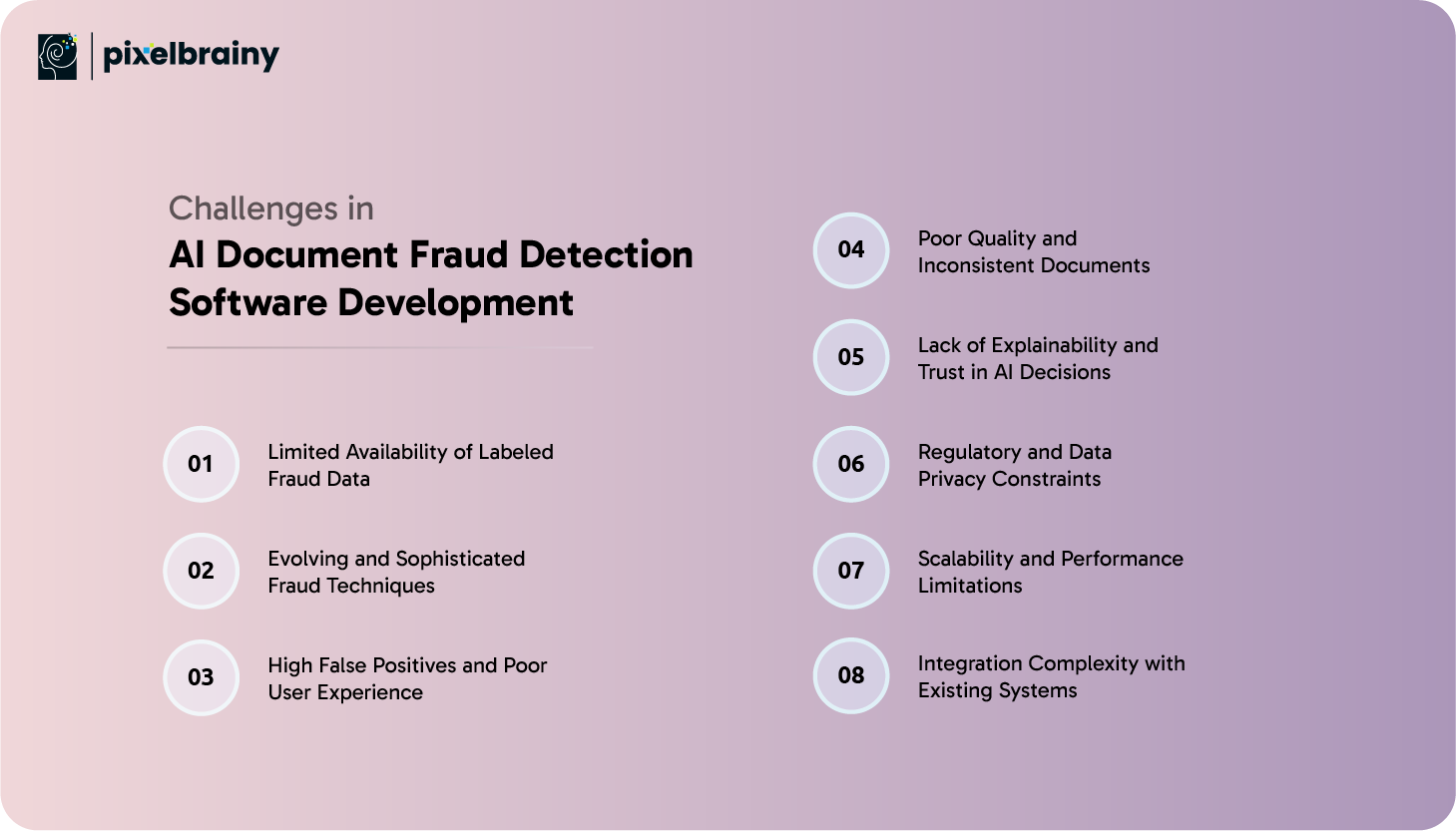
One of the biggest challenges in AI document fraud detection software development is the lack of high-quality labeled fraud data. Fraud cases are relatively rare compared to genuine documents, which creates data imbalance. This makes it difficult for AI models to learn meaningful fraud patterns.
How to solve it: Organizations can combine historical data with synthetic data generation and data augmentation techniques. Partnering with experienced AI teams also helps design models that perform well with limited labeled data. Continuous feedback from manual reviews further strengthens datasets over time.
Fraud methods change rapidly, especially with the rise of AI generated and synthetic documents. Static models trained on old patterns quickly become ineffective.
How to solve it: Adopting adaptive learning models and continuous retraining pipelines keeps the system responsive to new fraud techniques. Regular monitoring of model performance helps detect drift early and triggers updates before accuracy drops.
Aggressive fraud detection often leads to legitimate documents being flagged. This increases manual review workload and frustrates genuine users.
How to solve it: Balancing AI predictions with rule-based validation and configurable risk thresholds helps reduce unnecessary flags. Human in the loop workflows allow teams to refine decisions and improve accuracy without compromising security.
Documents are often captured using mobile phones under poor lighting or incomplete conditions. Low quality inputs reduce OCR accuracy and visual analysis reliability.
How to solve it: Strong image preprocessing and quality enhancement pipelines improve readability before analysis. User guidance during document upload also reduces poor quality submissions and improves overall detection results.
Fraud detection decisions must be explainable, especially in regulated industries. Black box AI models create trust and compliance issues.
How to solve it: Implement explainable AI techniques that highlight which features or anomalies influenced the decision. Clear audit trails and reporting dashboards help compliance teams and regulators understand system behavior.
AI document fraud detection systems process sensitive personal and financial data. Non-compliance with data protection laws can result in severe penalties.
How to solve it: Data anonymization, encryption, role-based access control, and regular compliance audits are essential. Designing privacy and security into the system from the start avoids costly changes later.
As document volumes grow, systems may struggle with processing speed and reliability, especially in real time workflows.
How to solve it: Cloud based infrastructure, modular architecture, and performance optimization ensure scalability. Load testing and monitoring help maintain consistent performance during peak usage.
Many organizations rely on legacy systems for KYC, AML, claims, or ERP processes. Integrating AI fraud detection into these environments can be complex.
How to solve it: Using API driven and modular integration approaches reduces disruption. Early planning and collaboration with internal IT teams ensure smoother deployment and faster adoption.
While challenges in AI document fraud detection software development are inevitable, they can be effectively managed with the right data strategy, architecture, and operational discipline, turning fraud prevention into a long-term competitive advantage.
When document fraud starts impacting revenue, compliance, or customer trust, choosing the right AI development company becomes a business-critical decision. PixelBrainy helps organizations move from reactive fraud checks to intelligent, automated prevention by delivering end to end AI Document Fraud Detection System solutions that are built for real world conditions, not just technical demos.
Our strength lies in delivering AI Document Fraud Detection Development Software Services that cover the entire lifecycle, from strategy and system architecture to AI model deployment and continuous optimization. We focus on the practical aspects of development of AI Document Fraud Detection Software, including usability, explainability, regulatory alignment, and long-term scalability. Every solution we build is customized around industry specific risks, document types, and operational workflows, ensuring it fits naturally into your existing systems.
For a US based financial services company, PixelBrainy recently developed a custom AI powered document fraud detection platform to support large scale digital onboarding. The client was facing increasing fraud attempts involving forged identity documents and manipulated financial statements, along with rising manual review costs and onboarding delays.
Instead of offering an off the shelf tool, our team designed a tailored AI Document Fraud Detection Software system aligned with the client’s compliance and risk management processes. The solution included intelligent OCR, document layout and visual analysis, fraud risk scoring, and human in the loop review workflows. It was fully integrated with the client’s KYC and compliance infrastructure, allowing real time document verification without disrupting existing operations.
The result was a measurable reduction in fraud exposure, faster customer onboarding, and improved decision transparency for compliance teams. More importantly, the system was designed to evolve, allowing the client to adapt to new fraud patterns without rebuilding the platform.
If you are planning to make an AI Document Fraud Detection Software System that delivers accuracy, control, and long-term value, PixelBrainy offers the expertise and execution needed to turn that vision into a reliable production solution.
AI document fraud has become a serious challenge for businesses that rely on digital onboarding, verification, and compliance driven processes. As fraud techniques grow more advanced, traditional manual checks and rule-based systems are no longer enough. Investing in AI Document Fraud Detection Software allows organizations to detect anomalies faster, reduce financial losses, and strengthen trust across customer and partner interactions.
From understanding core features and development steps to evaluating costs, tools, and challenges, building an effective AI Document Fraud Detection System requires a strategic and well-planned approach. When implemented correctly, the development of AI Document Fraud Detection Software delivers long term value by improving accuracy, scalability, and regulatory confidence across industries such as banking, insurance, healthcare, and enterprise operations.
Choosing the right AI development partner plays a key role in success. If you are planning to build or upgrade an AI powered document fraud detection solution, now is the right time to take action.
Book an appointment to discuss your requirements and explore how an AI driven approach can protect your business.
AI based document fraud detection systems are generally far more consistent than manual reviews. While human checks depend on experience and attention, AI systems analyze thousands of data points across text, visuals, and metadata in seconds. Accuracy improves over time as the system learns from new fraud cases and reviewer feedback.
Yes, modern AI document fraud detection software can be trained to support multi country and multi language documents. With proper data and model configuration, the system adapts to regional formats, document standards, and compliance requirements, making it suitable for global businesses.
AI powered fraud detection is not limited to large enterprises. Many businesses start with a focused MVP that covers their most critical document types. As fraud risks grow, the system can be expanded gradually without rebuilding the entire solution.
Most businesses start seeing measurable improvements within the first few weeks of deployment. Benefits such as reduced manual review time, faster document processing, and early fraud prevention become visible quickly, especially when the system is integrated into existing workflows.
No, it enhances human decision making rather than replacing it. AI handles large scale analysis and flags high risk cases, while human experts review complex or sensitive documents. This collaboration improves efficiency and decision accuracy.
AI systems require ongoing monitoring and periodic retraining to stay effective. Updates may be triggered by new fraud patterns, regulatory changes, or business expansion into new markets. Continuous improvement is key to long term success.

About The Author
Sagar Bhatnagar
Sagar Sahay Bhatnagar brings over a decade of IT industry experience to his role as Marketing Head at PixelBrainy. He's known for his knack in devising creative marketing strategies that boost brand visibility and market influence. Sagar's strategic thinking, coupled with his innovative vision and focus on results, sets him apart. His track record of successful campaigns proves his ability to utilize digital platforms effectively for impactful marketing efforts. With a genuine passion for both technology and marketing, Sagar continuously pushes PixelBrainy's marketing initiatives to greater success.

Working with the PixelBrainy team has been a highly positive experience. They understand the design requirements and create beautiful UX elements to meet the application needs. The dev team did an excellent job bringing my vision to life. We discussed usability and flow. Sagar worked with his team to design the database and begin coding. Working with Sagar was easy. He has the knowledge to create robust apps, including multi-language support, Google and Apple ID login options, Ad-enabled integrations, Stripe payment processing, and a Web Admin site for maintaining support data. I'm extremely satisfied with the services provided, the quality of the final product, and the professionalism of the entire process. I highly recommend them for Android and iOS Mobile Application Design and Development.

Great experience working with them. Had a lot of feedback and I found that unlike most contractors they were bugging me for updates instead of the other way around. They were extremely time conscience and great at communicating! All work was done extremely high quality and if not on time, early! They were always proactive when it comes to communication and the work is great/above par always. Very flexible and a great team to work with! Goes above and beyond to present us with multiple options and always provides quality. Amazing work per usual with Chitra. If you have UI/UX or branding design needs I recommend you go to them! Will likely work with them in the future as well, definitely recommended!

PixelBrainy is a joy to work with and is a great partner when thinking through branding, logo, and website layout. I appreciate that they spend time going into the "why" behind their decisions to help inform me and others about industry best practices and their expertise.

I hired them to design our software apps. Things I really like about them are excellent communication skills, they answer all project suggestions and collaborate right away, and their input on design and colors is amazing. This project was complex and needed patience and creativity. The team is amazing to do business with. I will be using them long-term. Glad to see there are some good people out there. I was afraid to try and outsource my project to someone but I am glad I met them! I really can't say enough. They went above and beyond on this project. I am very happy with everything they have done to make my business stand out from the competition.

It was great working with PixelBrainy and the team. They were very responsive and really owned the project. We'll definitely work with them again!

I recently worked with the PixelBrainy team on a project and I was blown away by their communication skills. They were prompt, clear, and articulate in all of our interactions. They listened and provided valuable feedback and suggestions to help make the project a success. They also kept me updated throughout the entire process, which made the experience stress-free and enjoyable.

PixelBrainy is very good at what it does. The team also presents themselves very professionally and takes care of their side of things very well. I could fully trust them taking up the design work in a timely and organised manner and their attention to detail saved us lots of effort and time. This particular project was quite intense and the team showed that they function very well under pressure. Very much looking forward to working with her again!

It's always an absolute pleasure working with them. They completed all of my requests quickly and followed every note I had for them to a T, which made our process go smoothly from start to finish. Everything was completed fast and following all of the guidelines. And I would recommend their services to anyone. If you need any design work done in the future, PixelBrainy should be your first call!

They took ownership of our requirements and designed and proposed multiple beautiful variants. The team is self-motivated, requires minimum supervision, committed to see-through designs with quality and delivering them on time. We would definitely love to work with PixelBrainy again when we have any requirements.

PixelBrainy was a big help with our SaaS application. We've been hard at work with a new UI/UX and they provided a lot of help with the designs. If you're looking for assistance with your website, software, or mobile application designs, PixelBrainy and the team is a great recommendation.

PixelBrainy designers are amazing. They are responsive, talented, and always willing to help craft the design until it matches your vision. I would recommend them and plan to continue them for my future projects and more!!!

They were awesome! Did a good job fast, and good communication. Will work with them again. Thank you

Creative, detail-oriented, and talented designers who take direction well and implement changes quickly and accurately. They consistently over-delivered for us.

PixelBrainy team is very talented and creative. Great designers and a pleasure to work with. PixelBrainy is an excellent communicator and I look forward to working with them again.

PixelBrainy has a very talented design team. Their work is excellent and they are very responsive. I enjoy working with them and hope to continue on all of our future projects.


Transform your ideas into reality with us.
Across these industries, each engagement brings unique challenges, from early-stage product development to scaling complex systems, helping us build a practical understanding of real-world product environments.