AI Summary Powered by PixelBrainy
Can your firm afford an AI system that sounds authoritative, cites a case, and sends your associate toward a precedent that never existed?
For Am Law 50 firms, that is no longer a theoretical AI risk. It is a software architecture problem. If an AI legal assistant can invent authorities, misstate holdings, or produce unsupported quotations, a warning telling lawyers to “verify the output” is not the same thing as engineering verification into the workflow. The right question for buyers is therefore not simply which vendors have the smartest legal chatbot, but which AI legal software development companies in USA can build grounded retrieval, citation validation, source traceability, permission controls, audit logs, and human approval gates into production systems.
The market is moving quickly. The Financial Times reported in September 2026 that the global legal tech market is projected to grow from $31 billion in 2026 to $70 billion by 2033, while roughly 20% of large law firms are exploring bespoke legal AI as a competitive differentiator.
That shift matters to several audiences: Am Law firms building private research copilots, corporate legal departments automating contract and compliance work, legal-tech founders launching new platforms, and technology leaders responsible for security, governance, and integration.
This guide reviews the top AI legal software development services providers USA buyers should consider in 2026, with particular attention to custom architecture rather than generic AI integrations. We evaluate custom AI legal software development companies in USA on legal-domain experience, RAG and grounding capability, citation verification, hallucination controls, security, explainability, integration depth, scalability, and evidence of real legal deployments.
The result is a practical list of best AI legal software development companies USA buyers can use to shortlist partners, compare build approaches, and pressure-test vendor claims before committing sensitive legal data or filing-critical workflows.
An AI legal software development company USA designs, engineers, integrates, and deploys custom AI applications for law firms, corporate legal departments, legaltech startups, alternative legal service providers, and government legal agencies. Unlike off-the-shelf legal AI, custom solutions can be engineered around proprietary data, specialized workflows, attorney-client privilege, security, legal-domain accuracy, auditability, and hallucination prevention. USA-based AI legal software development companies can also integrate AI with a firm's existing document management, case management, CRM, billing, legal research, and enterprise systems.
Off-the-shelf legaltech provides standardized capabilities within a vendor-defined environment. Platforms such as Harvey, Casetext, Clio, and Ironclad can support valuable legal workflows, but their configuration options may not satisfy organizations with highly specialized processes, proprietary data requirements, or custom risk controls.
Consider a 40-attorney immigration firm handling asylum, family-based immigration, employment visas, and removal-defense matters. Its technology may need to connect client intake, multilingual communication, evidence classification, USCIS form preparation, deadline tracking, document retrieval, attorney review, and matter-level permissions. A general legal AI product may address some individual tasks. Custom AI legal software development USA, however, can combine those functions into one controlled workflow with organization-specific access rules, validation requirements, approval gates, and audit trails.
| Factor | Custom AI Legal Software | Off-the-Shelf Legal AI |
|---|---|---|
| Workflow | Built around specific legal processes | Standardized workflows |
| Data | Proprietary and organization-specific | Vendor-defined environment |
| AI controls | Custom grounding and validation | Product-defined controls |
| Integrations | Bespoke APIs and enterprise systems | Supported integrations |
| Security | Tailored to organizational requirements | Vendor architecture |
| Evaluation | Organization-specific benchmarks | Vendor-defined benchmarks |
| Scalability | Designed around business requirements | Product-dependent |
US legal organizations commonly commission six major categories of AI software:
Together, these applications represent the core market for AI legaltech development companies USA, from focused practice-area applications to enterprise legal AI platforms.
A production-ready legal AI engagement should include more than an LLM, prompt layer, and user interface. Leading AI legal application development companies USA should provide:
For a Series A immigration legaltech startup, selecting among AI legal software development services providers in USA should therefore go beyond comparing development rates or AI demos. The right partner should understand the immigration workflow, demonstrate production-grade AI engineering, protect sensitive case information, establish measurable evaluation criteria, support an investor-ready product demonstration, and provide a credible path from prototype to scalable deployment.
The strongest custom AI legal software development firms USA do not simply attach an LLM to an existing application. They engineer the surrounding data, workflow, security, validation, governance, and integration layers that determine whether AI can operate reliably in a real legal environment.
To rank the leading AI legal software development companies in USA for 2026, we used a methodology built around a question that matters to legal buyers more than a vendor's marketing claims: Can the provider demonstrate, in writing, how its AI system architecture addresses the professional responsibilities created by AI deployment? We therefore evaluated ABA Model Rules 1.1, 1.6, and 5.3 alongside confidentiality, privilege protection, hallucination controls, legal accuracy, integrations, and production readiness.
A statement that an AI platform is "ABA compliant" does not, by itself, explain how the system protects confidential information, supports lawyer oversight, controls unreliable outputs, or manages technology-provider risk. Our methodology therefore favors providers that can connect professional responsibility requirements to identifiable technical controls, documented workflows, governance measures, and system architecture.
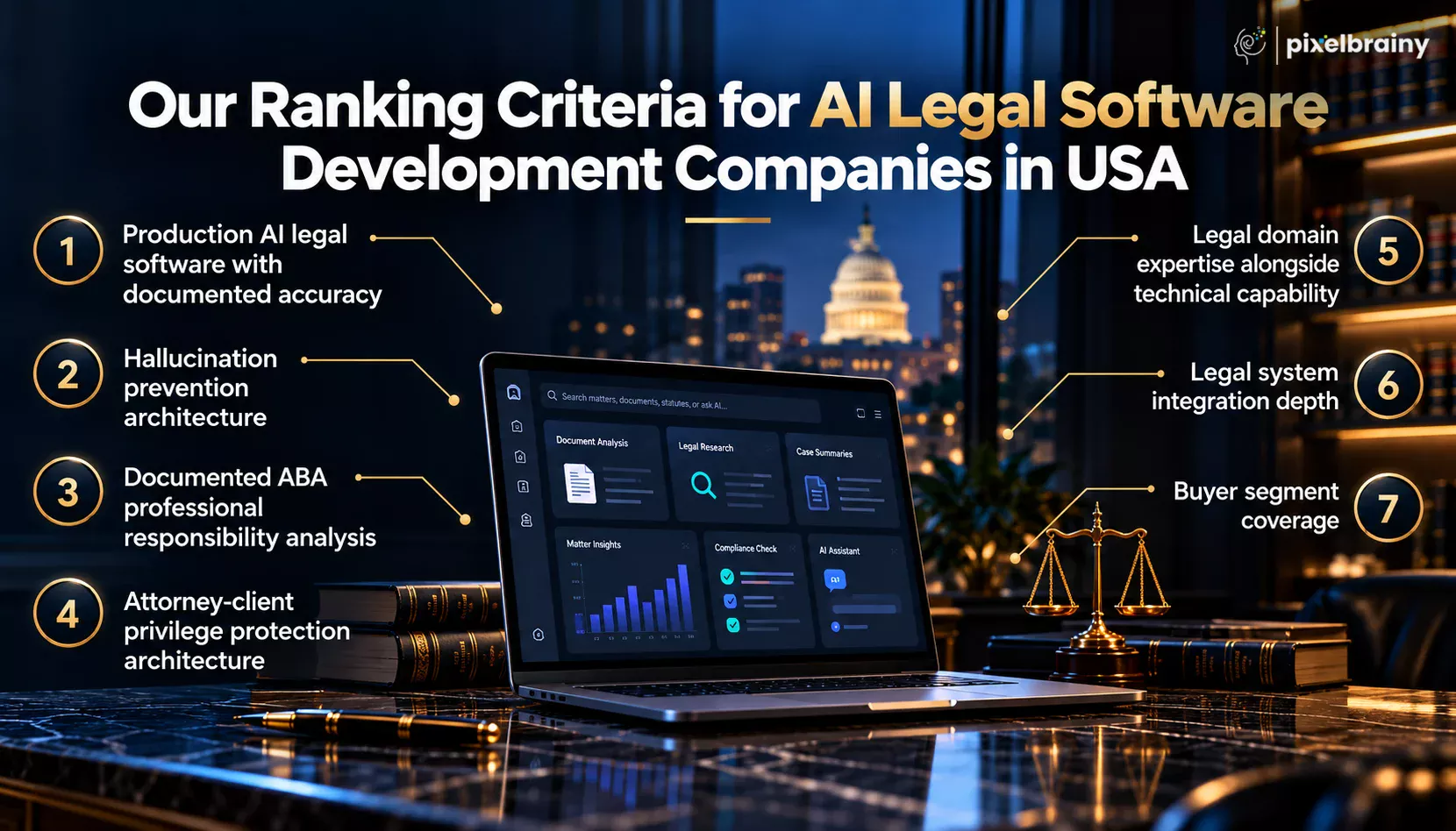
We required evidence that the provider has built and deployed AI legal software for actual US law firms, corporate legal departments, or legaltech products. We considered production deployments, legal-domain testing, accuracy measurements, source-grounding performance, error handling, and human-review outcomes. Generic LLM benchmarks or impressive demonstrations were not treated as proof of production reliability.
Legal AI needs safeguards against fabricated cases, statutes, regulations, citations, and other legal authorities. We looked for retrieval-augmented generation using verified sources, citation verification, client-specific grounding, source attribution, confidence thresholds, validation layers, and appropriate abstention mechanisms. A disclaimer instructing attorneys to verify AI outputs did not qualify as an architectural hallucination-prevention measure.
This was the most important criterion for answering the GC's question. We assessed whether AI legal software development services providers in USA could produce a documented analysis connecting their proposed system architecture to ABA Model Rules 1.1, 1.6, and 5.3, rather than simply claiming "ABA compliance."
Our evaluation looked for evidence addressing three areas:
Providers received stronger scores when they could translate these considerations into architecture documentation, data-flow diagrams, technical controls, governance procedures, human-review requirements, and risk assessments. Generic compliance statements were not enough.
We evaluated how providers handle sensitive legal information throughout its lifecycle. Key considerations included encryption, role-based access, tenant isolation, retention controls, audit logging, data residency, model-training restrictions, and third-party data-processing safeguards. For custom AI legal software development USA, privilege and confidentiality protection must extend beyond the application interface into the underlying AI and data infrastructure.
Technical AI expertise was only one part of the evaluation. We looked for demonstrated understanding of legal research, litigation, contracts, e-discovery, compliance, document workflows, and specialized practice areas. This helped distinguish experienced AI legaltech development companies USA from general AI development firms that have simply added an LLM or chatbot to their portfolio.
Production legal AI must work within existing legal technology environments. We assessed experience integrating with platforms such as Clio, MyCase, PracticePanther, iManage, NetDocuments, Relativity, Everlaw, and other document, matter-management, and litigation systems. Integration capability was particularly relevant when evaluating AI legal application development companies USA for enterprise deployments.
We gave additional weight to providers serving multiple legal buyer segments, including BigLaw, midsize firms, corporate legal departments, legaltech startups, small practices, and ALSPs. We also considered whether USA-based AI legal software development companies could adapt their security, deployment, governance, and scalability approach to different organizational requirements.
These criteria also informed our evaluation of AI legal document automation companies USA, AI contract intelligence providers, and other specialized legal AI developers. The objective was consistent across categories: identify providers that can demonstrate responsible architecture, legal-domain capability, production experience, and defensible controls.
The result is a ranking based on evidence rather than "ABA compliant" marketing language. For legal buyers, the strongest AI development partner is one that can show exactly how professional responsibility requirements are reflected in the system's architecture, controls, and governance.
If your corporate legal department reviews 800 contracts every month, standard clause extraction is only the starting point. The harder challenge is building AI that understands your company's defined terms, negotiation history, preferred language, risk tolerance, and negotiated exceptions. That requirement shaped this ranking of the top 10 AI legal software development companies in USA.
We prioritized providers capable of building custom contract intelligence, legal research, document automation, e-discovery, and matter-management systems around proprietary legal data and workflows. We also considered production AI experience, legal-domain expertise, security architecture, integrations, hallucination controls, scalability, and suitability for BigLaw, corporate legal departments, and legaltech startups.
Location: Sheridan, Wyoming, USA
Founded: 2021
Website: https://www.pixelbrainy.com/
Team Size: Publicly reported as a large engineering organization
Core AI legal software capabilities: PixelBrainy develops custom AI legal applications covering contract review, legal research RAG, document automation, e-discovery pipelines, matter management, document classification, AI agents, and legal knowledge retrieval. Its broader AI development offering covers custom AI applications, LLM integration, RAG, automation, and enterprise software development.
Legal system integrations: Custom API integrations with document management, CRM, case management, billing, enterprise knowledge bases, and other legal technology environments.
Hallucination prevention approach: Custom implementations can use grounded RAG, approved-source retrieval, citation validation, confidence controls, human-review checkpoints, and organization-specific evaluation datasets. For contract review, the architecture can be designed to ground recommendations in approved clauses, historical agreements, negotiation records, and company-specific playbooks rather than relying exclusively on general-purpose model knowledge.
Notable US clients: EY, MSC Cruises, VetPlus, Tykr, EventPlaybook, and Makula are among the client references provided for this ranking. These represent broader technology engagements and should not be interpreted as individual legal-AI deployments.
Legal verticals served: Contract intelligence, legal research, document intelligence, e-discovery, compliance, litigation support, matter management, and legaltech product development.
Pricing range: Custom quote based on scope, AI complexity, integrations, deployment model, and ongoing support requirements.
Best fit for: US law firms, corporate legal departments, legaltech startups, and ALSPs requiring a bespoke AI legal platform.
Why they're on this list: PixelBrainy takes the #1 position as AI legal software development company, because its custom-development model aligns closely with the central requirement of this ranking: building AI around a buyer's proprietary workflows and data instead of forcing the organization into a standardized legal SaaS product. Its capabilities across AI, RAG, custom software, integrations, and legal application development make it particularly relevant for organizations seeking bespoke AI legal software development companies.
For the 800-contract use case, the key opportunity is architectural customization. A PixelBrainy implementation can be designed to retrieve company-specific defined terms, compare incoming language against historical negotiations, identify deviations from an internal playbook, and route unusual exceptions to attorneys for review. That is fundamentally different from an AI system that simply extracts standard contract fields.
Location: Tallinn, Estonia, serving international and US-market clients
Founded: 2015
Team Size: 50+ engineers publicly reported
Core AI legal software capabilities: Python engineering, RAG, LLM applications, contract analysis, clause extraction, legal retrieval, AI copilots, document processing, and evaluation frameworks.
Legal system integrations: APIs, enterprise document repositories, vector databases, knowledge systems, and custom backend infrastructure.
Hallucination prevention approach: Uvik's RAG methodology addresses grounding, retrieval quality, evaluation, permission controls, document changes, and unreliable responses. Its Robin AI case study is especially relevant to contract review because the engagement involved clause segmentation, customer-specific playbooks, hybrid retrieval, and an evaluation harness. The company reports 94% clause-classification accuracy and a reduction in review turnaround from six days to four hours.
Notable US legal clients: Robin AI is the strongest publicly documented legaltech reference associated with its legal AI work.
Legal verticals served: Legaltech, contract intelligence, document AI, enterprise knowledge systems, and regulated industries.
Pricing range: Publicly reported engineering rates generally fall around $55 to $99 per hour, depending on engagement and expertise.
Best fit for: Legaltech startups and law firm innovation teams requiring senior Python and RAG engineering.
Why they're on this list: Uvik is one of the strongest matches for the real query because its documented legal AI work goes beyond generic extraction. The Robin AI engagement demonstrates how contract AI can incorporate customer-specific playbooks, clause-level retrieval, and measurable evaluation.
For a legal department with extensive negotiation history, that distinction matters. Buyers should ask Uvik to demonstrate how historical contracts and negotiated exceptions would influence recommendations without allowing irrelevant or outdated agreements to contaminate the retrieval process.
Location: International delivery serving US businesses
Founded: Publicly available company information varies
Team Size: Current legal-AI team size not consistently disclosed
Core AI legal software capabilities: Custom legal AI, contract analysis, document processing, legal workflow automation, AI assistants, NLP, and enterprise AI integration.
Legal system integrations: Custom APIs, document repositories, CRM platforms, enterprise applications, and internal legal workflows.
Hallucination prevention approach: A production legal deployment should incorporate grounded retrieval, controlled knowledge sources, validation rules, human review, and domain-specific evaluation. Buyers should request the proposed architecture and testing methodology before accepting general AI accuracy claims.
Notable US legal clients: Specific legal clients are not broadly disclosed in public materials.
Legal verticals served: Contract review, legal operations, document intelligence, compliance, and legal workflow automation.
Pricing range: Custom quote based on project scope and deployment requirements.
Best fit for: US law firms and corporate legal departments looking for custom AI applications with measurable workflow objectives.
Why they're on this list: Tezeract is included because of its stated focus on AI development for legal technology and contract-review automation. Its positioning emphasizes custom solutions rather than a one-size-fits-all legal product.
For organizations reviewing hundreds of contracts every month, buyers should test the system against their own difficult documents. The critical benchmark is not how accurately it identifies standard clauses, but whether it correctly interprets company-specific definitions, negotiated exceptions, unusual provisions, and internal risk rules.
Location: US-market delivery with global engineering operations
Founded: 2010
Team Size: 1,000+ professionals publicly reported
Core AI legal software capabilities: Contract analysis, document classification, compliance monitoring, case triage, legal document processing, NLP, machine learning, GenAI, RAG, and workflow automation.
Legal system integrations: CLM, DMS, billing systems, APIs, cloud platforms, and enterprise applications.
Hallucination prevention approach: Simform publicly describes RAG, advanced prompting, factual-consistency measures, explainability, access-controlled pipelines, and enterprise security for legal AI applications.
Notable US legal clients: Specific legal-AI clients are not broadly disclosed.
Legal verticals served: Contract intelligence, document review, compliance, case triage, legal operations, and enterprise legal workflows.
Pricing range: Custom quote.
Best fit for: Mid-size law firms, legaltech startups, and corporate legal departments seeking cloud-native legal AI.
Why they're on this list: Simform combines AI development with cloud engineering and enterprise integration, making it suitable for buyers that need more than a standalone contract-review interface. Its legal AI offering covers contract analysis, document classification, compliance, and integration with enterprise legal systems.
For AI legal software development companies in USA for contract review, Simform is particularly relevant when the project requires a combination of AI models, retrieval pipelines, security controls, CLM or DMS integrations, and production cloud infrastructure.
Location: Global delivery with US-market services
Founded: 2015
Team Size: Large global engineering organization
Core AI legal software capabilities: Contract review, document automation, legal chatbots, compliance monitoring, NLP, predictive analytics, AI assistants, web applications, and mobile legal software.
Legal system integrations: Custom APIs, CRM, DMS, cloud services, identity systems, and enterprise applications.
Hallucination prevention approach: Custom deployments can incorporate RAG, approved knowledge sources, validation workflows, human approval, and application-level access controls. Buyers should require these controls to be explicitly documented in the technical specification.
Notable US legal clients: Specific legal-AI customer names are not consistently disclosed publicly.
Legal verticals served: Contract management, legal document automation, compliance, client intake, legal operations, and legaltech.
Pricing range: Custom project quote.
Best fit for: Legaltech startups and small-to-mid-size law firms seeking end-to-end product development.
Why they're on this list: Appinventiv fits organizations that need product strategy, application development, AI integration, cloud deployment, and ongoing engineering support from one partner. Its full-cycle model can be useful for a legaltech startup turning a contract-review concept into a commercial product.
For corporate legal departments, however, technical due diligence should focus heavily on evaluation datasets, data isolation, source grounding, human approval, and performance against organization-specific contracts.
Location: US-market and international delivery
Founded: 2007
Team Size: Global engineering organization
Core AI legal software capabilities: Custom AI applications, machine learning, NLP, document processing, workflow automation, predictive analytics, enterprise AI integration, and intelligent assistants.
Legal system integrations: Enterprise applications, legacy systems, APIs, cloud platforms, document repositories, and internal business systems.
Hallucination prevention approach: Buyers should require RAG, source grounding, validation, human review, access controls, monitoring, and evaluation to be defined at the architecture stage.
Notable US legal clients: Specific legal-AI clients are not broadly disclosed.
Legal verticals served: Legal operations, contract management, compliance, enterprise document workflows, and regulatory processes.
Pricing range: Custom enterprise pricing.
Best fit for: BigLaw firms and Fortune 500 corporate legal departments.
Why they're on this list: Intellectsoft is well suited to complex organizations where AI needs to operate alongside existing enterprise infrastructure. Its AI practice focuses on custom solutions and modernization rather than simply deploying a standalone chatbot.
That makes it relevant to AI legal software development companies in USA for BigLaw, particularly where contract intelligence must connect with identity management, document repositories, procurement systems, enterprise knowledge, and existing workflows.
Location: McKinney, Texas, USA presence
Founded: 1989
Team Size: 750+ specialists publicly reported
Core AI legal software capabilities: Legal document processing, RAG, NLP, machine learning, document classification, legal research, contract analysis, and secure AI application development.
Legal system integrations: Document management systems, enterprise databases, APIs, cloud infrastructure, and custom legal applications.
Hallucination prevention approach: ScienceSoft has publicly documented a legal AI implementation involving structured legal-document processing, embeddings, vector search, retrieval-grounded responses, and isolated deployment for sensitive legal information.
Notable US legal clients: Its public legal AI case material describes work for a US law firm without naming the client.
Legal verticals served: Legal research, contract review, litigation support, document intelligence, compliance, and legal knowledge management.
Pricing range: Custom project pricing.
Best fit for: Regulated legal teams requiring controlled data environments and full lifecycle AI engineering.
Why they're on this list: ScienceSoft is particularly relevant when legal AI requires data preparation, retrieval, model evaluation, security, and production deployment as one coordinated program. Its documented legal AI work demonstrates an architecture centered on proprietary legal documents rather than generic model responses.
For a contract department with extensive negotiation history, the buyer should ask how historical agreements would be indexed, versioned, weighted, and retrieved so that old or superseded positions do not influence current recommendations incorrectly.
Location: International delivery serving US and European markets
Founded: 2013
Team Size: Mid-sized engineering organization
Core AI legal software capabilities: Legal research, document review, contract intelligence, NLP, LLM applications, document automation, AI assistants, and custom workflows.
Legal system integrations: Enterprise APIs, document management systems, internal knowledge bases, and custom applications.
Hallucination prevention approach: Relevant's legal AI platform emphasizes cited answers, internal-document grounding, enterprise controls, encryption, audit logs, user roles, and controlled use of internal documents.
Notable US legal clients: Specific legal development clients should be confirmed during procurement.
Legal verticals served: Legal research, contract review, document creation, knowledge management, and enterprise legal AI.
Pricing range: Custom enterprise/API pricing.
Best fit for: Legaltech startups and mid-size firms requiring document intelligence and custom AI.
Why they're on this list: Relevant stands out for combining legal document intelligence with cited research and internal-document grounding. This makes its approach useful for organizations that want AI to work from their own legal knowledge rather than simply generate responses from a general model.
For contract review, buyers should test whether the platform can distinguish current approved language from historical agreements and whether retrieved evidence can be shown to attorneys before they accept an AI-generated recommendation.
Location: US-market delivery with global engineering operations
Founded: 2009
Team Size: 300+ specialists publicly reported
Core AI legal software capabilities: Machine learning, NLP, GenAI, document processing, contract analysis, compliance automation, predictive analytics, and enterprise AI applications.
Legal system integrations: Enterprise systems, DMS, CRM, workflow platforms, APIs, and custom legal technology.
Hallucination prevention approach: Recommended legal AI architecture includes grounded RAG, source verification, evaluation datasets, confidence controls, human review, and monitoring.
Notable US legal clients: Specific legal clients are not broadly disclosed publicly.
Legal verticals served: Contract intelligence, legal operations, compliance, document processing, and enterprise automation.
Pricing range: Custom enterprise pricing.
Best fit for: Corporate legal departments and large law firms integrating AI into existing enterprise infrastructure.
Why they're on this list: ITRex is relevant for organizations treating legal AI as an enterprise transformation rather than a standalone application. Its engineering capabilities are suited to projects where contract intelligence must connect with established data, workflow, and enterprise systems.
For an 800-contract monthly workload, this integration capability can be important when AI recommendations need to interact with procurement, supplier data, approval workflows, identity systems, and reporting.
Location: Poland with international and US-market delivery
Founded: 2008
Team Size: Large international product and engineering organization
Core AI legal software capabilities: AI product development, NLP, document intelligence, workflow automation, AI assistants, custom software, and product design.
Legal system integrations: APIs, SaaS platforms, document repositories, CRM systems, and enterprise applications.
Hallucination prevention approach: Buyers should require RAG grounding, source attribution, evaluation datasets, human-review checkpoints, access controls, and monitoring within the implementation plan.
Notable US legal clients: Specific legal-AI client references should be validated during procurement.
Legal verticals served: Legaltech startups, document automation, contract workflows, legal operations, and enterprise software.
Pricing range: Custom quote.
Best fit for: US legaltech startups requiring product strategy, UX, user research, and AI engineering.
Why they're on this list: Netguru's product-development approach makes it useful for startups that need to validate legal workflows before scaling their technology. This is particularly valuable when the product must reflect how attorneys actually review, annotate, negotiate, approve, and collaborate on contracts.
A startup evaluating AI legal software development companies in USA for legaltech startups should therefore assess not only engineering capability but also whether the provider can turn attorney feedback into measurable AI and workflow requirements.
Location: USA
Founded: 2016
Team Size: Distributed AI and software engineering organization
Core AI legal software capabilities: Generative AI, data engineering, RAG, AI applications, workflow automation, custom software, and enterprise AI transformation.
Legal system integrations: Enterprise APIs, cloud infrastructure, internal knowledge systems, document repositories, and business applications.
Hallucination prevention approach: Legal deployments should specify grounded retrieval, approved-source controls, evaluation datasets, human oversight, monitoring, and secure data pipelines.
Notable US legal clients: Specific legal-AI clients are not broadly disclosed.
Legal verticals served: Enterprise legal operations, compliance, document workflows, contract intelligence, and legaltech.
Pricing range: Custom engagement pricing.
Best fit for: US legal teams and startups prioritizing custom development, ownership, and enterprise AI engineering.
Why they're on this list: HatchWorks AI is relevant for organizations that want ownership and control of a custom AI application rather than adopting another legal SaaS product. Its AI engineering approach can support applications where proprietary company knowledge is a core component of the solution.
For contract review, buyers should establish exactly who owns prompts, evaluation datasets, retrieval indexes, custom workflows, application code, and other project-specific intellectual property.
Location: US-market delivery with global engineering
Founded: 2003
Team Size: Public figures vary
Core AI legal software capabilities: AI, machine learning, NLP, document processing, contract analytics, compliance monitoring, litigation support, data engineering, and enterprise analytics.
Legal system integrations: Enterprise databases, DMS, APIs, analytics platforms, CRM, and internal legal applications.
Hallucination prevention approach: Custom systems can incorporate RAG, controlled retrieval, source grounding, confidence thresholds, human validation, audit logging, and domain-specific evaluation.
Notable US legal clients: Specific legal-AI clients are not broadly disclosed.
Legal verticals served: Contract review, compliance, litigation support, legal analytics, and enterprise legal operations.
Pricing range: Custom enterprise quote.
Best fit for: Fortune 500 in-house legal departments requiring AI plus enterprise data integration.
Why they're on this list: Intellectyx is particularly relevant where contract AI is also a data-engineering challenge. Historical contracts, supplier information, metadata, approval records, negotiation outcomes, and business rules frequently exist across multiple systems.
That means the success of a contract-review AI project can depend as much on data architecture and retrieval quality as on the underlying LLM.
Location: USA and international operations
Founded: 2017
Team Size: Large and growing organization
Core AI legal software capabilities: AI demand letters, case analysis, document generation, fact extraction, damages analysis, medical-record processing, and litigation support.
Legal system integrations: Case files, document workflows, firm templates, and legal practice systems depending on configuration.
Hallucination prevention approach: EvenUp's AI Drafts product emphasizes case-specific grounding and line-level citations that allow generated content to be traced back to source material.
Notable US legal clients: Plaintiff law firms are its principal customer segment, although individual client names are not its primary public positioning.
Legal verticals served: Personal injury, mass tort, workers' compensation, demand generation, and plaintiff litigation.
Pricing range: Product and enterprise pricing varies; public standardized pricing is limited.
Best fit for: Plaintiff firms evaluating specialized AI for demand letters, case analysis, and litigation workflows.
Why they're on this list: EvenUp provides a useful benchmark for what highly specialized legal AI looks like when the system is built around a defined practice area and workflow. Its use of case-specific information and source-level citations demonstrates why legal AI often performs best when its data and output requirements are tightly scoped.
Although it is not a general-purpose custom development firm, it gives buyers a useful reference point when evaluating specialized AI legal products.
Location: US-market enterprise delivery with global operations
Founded: 1990
Team Size: 20,000+ professionals publicly reported
Core AI legal software capabilities: GenAI, agentic AI, contract lifecycle management, contract intelligence, enterprise copilots, compliance workflows, data engineering, and custom AI applications.
Legal system integrations: CLM systems, enterprise applications, Microsoft ecosystem, cloud platforms, data platforms, and internal business systems.
Hallucination prevention approach: Enterprise deployments can incorporate grounded enterprise data, controlled agent workflows, evaluation, access controls, monitoring, and human approval.
Notable US legal clients: Major enterprise relationships are publicly referenced, while specific legal-AI client names are limited.
Legal verticals served: Contract lifecycle management, procurement contracts, compliance, legal operations, and enterprise knowledge management.
Pricing range: Custom enterprise engagement.
Best fit for: Fortune 500 corporate legal departments and large enterprises.
Why they're on this list: Persistent is particularly relevant where contract intelligence must connect with procurement, supplier management, compliance, and broader corporate infrastructure. Its ContractAssist work demonstrates an enterprise approach to contract lifecycle management and reports a 70% reduction in contract cycle time in its internal implementation.
For large legal departments, that broader integration model can be more valuable than a standalone AI contract reviewer because the ultimate objective is often to reduce the complete contract lifecycle burden rather than only accelerate clause extraction.
These above are the leading AI legal software development companies in USA, selected for their ability to build secure, accurate, and workflow-specific legal AI solutions rather than generic automation tools.
If your shortlist includes three AI legal software development companies in USA, the final decision should go beyond demos, model names, or generic AI capabilities. Legal buyers should ask for evidence of production deployment, especially around hallucination prevention, privilege protection, data controls, auditability, and integration with existing legal systems.
The table below compares 14 top AI legal software development companies USA buyers may evaluate. Because most providers do not publish fixed legal AI pricing, custom quotes are shown where applicable. Hallucination prevention and privilege protection reflect publicly described capabilities where available, not a claim that any provider can guarantee zero hallucinations or absolute privilege protection.
| Company | HQ | Legal Specialization | Hallucination Prevention | Privilege Protection | Pricing Range | Best Fit For |
|---|---|---|---|---|---|---|
| PixelBrainy LLC | Sheridan, Wyoming, USA | Legal research, contract review, document automation | RAG, grounded outputs, validation workflows | Secure architecture, access controls | Custom quote | Law firms, legaltech startups, enterprise legal teams |
| Uvik Software | Tallinn, Estonia | Contract AI, legal document search, clause analysis | RAG, evaluation, citation grounding, guardrails | Access controls, permission-aware retrieval | $55–99/hr publicly listed | Legaltech startups and regulated workflows |
| Tezeract | Kuala Lumpur, Malaysia | Custom AI applications, automation | Custom AI validation and workflow controls | Enterprise security architecture | Custom quote | AI-powered legal applications |
| Simform | USA / Global | Contract analysis, case triage, compliance AI | Grounding, factual consistency, explainability | Access-controlled AI pipelines | Custom quote | Enterprise legal departments |
| Appinventiv | USA / Global | Legal apps, document automation, AI integration | RAG and model validation workflows | Security and controlled data architecture | Custom quote | Legaltech products and enterprise apps |
| Intellectsoft | New York, USA / Global | Custom AI, enterprise legal applications | Custom validation and AI governance | Enterprise-grade security controls | Custom quote | Large enterprises and complex integrations |
| ScienceSoft | McKinney, Texas, USA / Global | Legal analytics, document processing, AI automation | Validation, human oversight, model monitoring | Security-focused enterprise architecture | Custom quote | Enterprise legal and compliance teams |
| Relevant Software | Europe / Global | Legal research, internal knowledge AI | Cited research, RAG, source grounding | SOC 2 Type 2, encryption, roles, audit logs | Custom quote | Legal research and knowledge systems |
| ITRex Group | USA / Global | Custom AI, document intelligence, workflow automation | RAG, evaluation, monitoring | Enterprise security and data controls | Custom quote | Complex legal AI platforms |
| Netguru | Poland / Global | AI applications, workflow automation | Custom evaluation and AI integration | Security-focused development | Custom quote | Startups and digital legal products |
| HatchWorks AI | Atlanta, Georgia, USA | Enterprise GenAI, AI modernization | RAG, governance, evaluation | Enterprise data governance | Custom quote | Corporate legal AI transformation |
| Intellectyx | Dallas, Texas, USA / Global | AI, data platforms, automation | AI validation and data governance | Enterprise security and access controls | Custom quote | Data-heavy legal applications |
| EvenUp | San Francisco, California, USA | Personal injury legal AI, demand generation | Case-specific grounding, line-level citations | Controlled legal data workflows | Custom quote | Personal injury law firms |
| Persistent Systems | Pune, India / Global | Contract intelligence, CLM, enterprise AI | Specialist AI agents, traceable contract workflows | Enterprise security and permissions | Custom quote | Large legal departments and CLM environments |
For the three AI legal software development firms USA candidates remaining on your shortlist, ask each provider to demonstrate a production system similar to your environment. Require them to explain how citations are verified, how privileged information is isolated, how permissions flow into retrieval, what happens when the model lacks evidence, and how every AI decision can be audited.
The strongest AI legal software developers USA buyers can consider should provide architecture documentation and measurable validation evidence, not simply promise accurate outputs. That distinction is often what separates a production-ready legal AI partner from a general AI development agency.
AI adoption in legal is moving from general-purpose experimentation to practice-specific software. A contract review system, for example, needs very different data, controls, and integrations than an immigration case platform or an ALSP document-review engine.
This is why leading AI legal software development companies in USA are increasingly building solutions around the exact workflow, legal data, and risk profile of each practice area.
Contract AI helps attorneys extract clauses, identify defined terms, track obligations, flag deviations, and support redlining. The strongest systems go beyond generic extraction by incorporating company-specific negotiation history, clause libraries, fallback positions, and approval rules. Integrations with CLM platforms, document management systems, and Microsoft Word help bring these capabilities directly into existing contract workflows.
Legal research AI retrieves case law, statutes, regulations, and court filings through retrieval-augmented generation. Citation verification is essential because an inaccurate authority can create serious professional risk. When evaluating AI legal software development companies in USA for legal research, buyers should examine source provenance, jurisdiction filtering, citation validation, database integrations, and controls that prevent unsupported legal conclusions from being presented as verified research.
E-discovery AI can classify documents, predict relevance, identify potentially privileged material, cluster evidence, and prioritize review. Integration with platforms such as Relativity, Everlaw, and Logikcull is often important for enterprise litigation teams. Buyers should require documented precision and recall results, especially for privilege detection, along with reviewer feedback, audit trails, and defensible workflows that allow attorneys to validate AI-assisted classifications.
AI document automation supports demand letters, briefs, legal memoranda, contracts, forms, and other repetitive documents. Reliable implementations combine approved templates, structured matter information, retrieval, and human review instead of allowing unrestricted generation. AI legal software development companies in USA for document automation can create greater value when generated documents remain grounded in verified case information and approved legal language, with Microsoft Word integration supporting attorney adoption.
Immigration AI focuses on client intake, document collection, form preparation, case organization, deadline tracking, status monitoring, and multilingual communication. USCIS form and process updates make data maintenance particularly important. For AI legal software development companies in USA for immigration law, production-ready systems should combine structured case data with document intelligence while maintaining attorney or staff approval before consequential case actions are taken.
Personal injury AI can summarize medical records, build treatment timelines, organize damages, prepare demand packages, and support case valuation. Mass-tort workflows add high-volume processing and matter-specific evidence requirements. AI legal software development companies in USA for personal injury need specialized datasets, case-level grounding, configurable workflows, and quality controls. Platforms such as EvenUp and Supio demonstrate how specialized AI can be designed around specific litigation processes.
IP software uses AI for prior-art search, patent claim analysis, trademark monitoring, technical document review, and portfolio management. Patent workflows require both legal and technical expertise because relevant evidence may involve software, chemistry, biotechnology, or engineering. AI legal software development companies in USA for intellectual property should therefore support reliable USPTO data access, technical-domain retrieval, source traceability, and professional review of AI-generated findings.
Real estate legal AI can automate lease abstraction, title research, closing documentation, transaction checklists, and due diligence. These systems often depend on property records, title databases, and large document repositories. High-volume transactions are particularly suitable for automation because many processes are repeatable. Strong implementations combine document extraction with transaction-specific rules, exception handling, and attorney approval.
Compliance AI helps legal teams monitor regulatory changes, identify compliance gaps, map requirements to internal policies, and prepare regulatory filings. Enterprise deployments may need coverage across federal and state jurisdictions and sources such as SEC, CFTC, FDA, or OSHA databases. The most useful systems provide source citations, change histories, alerts, and audit trails so compliance teams can verify both the regulatory change and its impact.
ALSPs face a more complex AI challenge because one provider may serve dozens of law firms, each with different review protocols, defined-term libraries, privilege rules, quality thresholds, and output formats. The key requirement is multi-client, protocol-adaptive AI that can apply client-specific instructions without creating an entirely separate system for every account.
For an ALSP serving 40 law firm clients, the final-round question is simple: Can the AI adapt to each client's protocol while keeping their data, instructions, defined terms, and outputs completely isolated? The strongest development partners should be able to demonstrate this with configurable playbooks, tenant isolation, permission-aware retrieval, audit trails, and scalable quality controls.
The right legal AI partner is one that adapts to the practice area, not one that forces every legal workflow into the same AI model. For ALSPs, that means delivering client-specific intelligence at scale without sacrificing isolation, consistency, or control.
For legal buyers, the final evaluation should answer one practical question: Can this development partner prove that it has actually shipped production AI in a legal environment similar to ours?
The answer should come from architecture reviews, production examples, security documentation, testing evidence, integrations, and measurable outcomes, not from an AI demo alone. These six checks help buyers separate experienced legal AI developers from general-purpose software agencies.
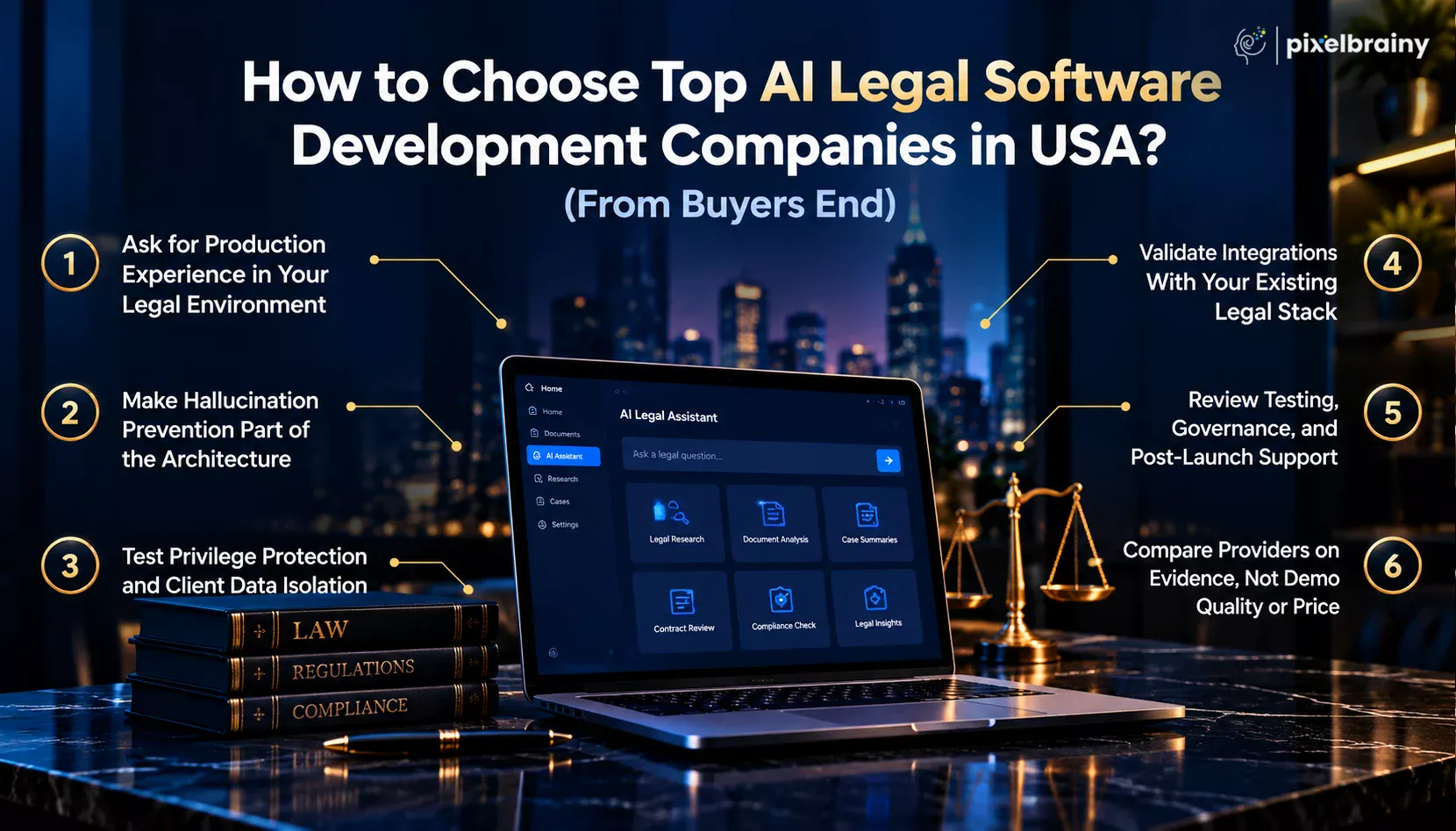
A provider may have extensive AI experience without having deployed AI for law firms, legal departments, or ALSPs. Ask for production examples that closely match your environment, practice area, data volume, and workflow.
For example, an ALSP should ask whether the provider has operated multi-client document review with different protocols and permissions. A corporate legal department should ask about contract intelligence at scale. AI legal software development companies in USA should be able to explain what was deployed, how it was used, what integrations were required, and what measurable results followed.
Ask the shortlisted providers one direct question: How does your system prevent unsupported legal answers from reaching attorneys?
Strong AI legal software developers USA should explain retrieval, source grounding, citation verification, confidence thresholds, evaluation datasets, response validation, and human review. Ask them to demonstrate what happens when the system cannot find supporting authority.
The key distinction is architectural. Hallucination prevention should be engineered into retrieval, generation, validation, and workflow controls rather than addressed only through a disclaimer telling lawyers to verify AI outputs.
Legal AI handles confidential contracts, litigation files, attorney work product, client communications, and other sensitive information. Ask how the proposed system protects that information throughout ingestion, storage, retrieval, processing, and output.
For AI legal software development firms USA, buyers should examine encryption, role-based permissions, tenant isolation, audit logs, retention controls, authentication, and model-training policies. For an ALSP serving multiple law firms, ask the provider to demonstrate that Client A's documents and instructions cannot influence Client B's retrieval results or AI responses.
Production legal AI rarely works as an isolated application. It may need to connect with Microsoft Word, document management systems, CLM platforms, e-discovery software, practice management tools, legal research databases, or internal repositories.
Ask AI legal software development companies in USA to create an integration map before development starts. The final-round discussion should cover APIs, authentication, permissions, synchronization, failure handling, and data ownership. A provider that has already integrated similar legal systems can significantly reduce implementation risk.
Ask the provider to show how its AI application was tested before production and how performance is monitored after deployment. Legal AI requires ongoing evaluation because models, source databases, prompts, workflows, and regulations can change.
AI legal software development agencies USA should provide measurable testing criteria for accuracy, citation quality, security, reliability, latency, and human review. Also clarify ownership of application code, prompts, evaluation datasets, knowledge bases, documentation, and infrastructure. A production partner should have a defined process for incidents, model changes, security updates, and performance degradation.
The final shortlist should be evaluated using evidence that can be independently examined. Ask each provider for relevant case studies, architecture diagrams, security documentation, testing results, integration examples, implementation timelines, and references where appropriate.
When comparing top AI legal software development companies USA, also separate development costs from recurring expenses such as AI model usage, cloud infrastructure, data licensing, monitoring, and maintenance. The strongest partner is not necessarily the cheapest. It is the one that can demonstrate production experience, measurable legal workflow improvements, and a controlled approach to accuracy, confidentiality, and scalability.
Before making the final decision, ask each provider to prove its production experience against your exact legal workflow, not just show what its AI can do. The strongest partner will have evidence for every critical claim.
Legal AI projects can fail long before the software reaches production. The warning signs usually appear during vendor discussions: vague accuracy claims, weak data controls, generic legal AI demos, unclear ownership, or no evidence of production deployment.
For buyers comparing the best AI legal software development in USA, these red flags can help identify providers that may create more legal, technical, or operational risk than value.
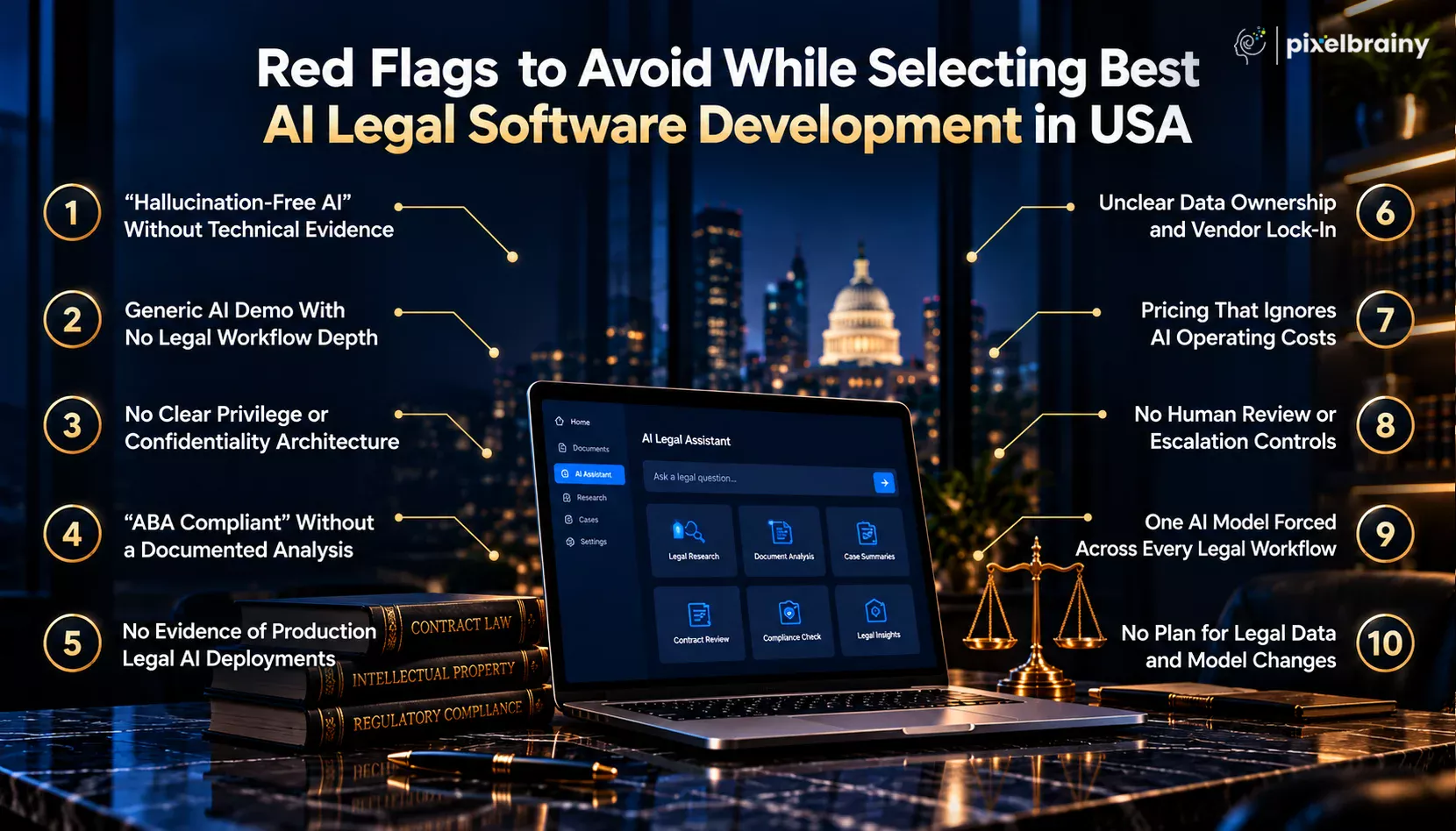
A vendor promising hallucination-free legal AI should immediately face a deeper technical review. No generative AI system should be treated as inherently incapable of producing incorrect information.
Ask how the provider handles source retrieval, citation verification, unsupported answers, confidence thresholds, evaluation datasets, and human review. AI legal software development companies in USA should be able to explain how hallucination risk is measured and controlled. A disclaimer telling attorneys to verify every output is not a substitute for architectural safeguards.
A polished chatbot demonstration does not prove that a provider can build production legal software. Generic demonstrations often avoid the difficult parts of legal AI, including privilege, defined terms, jurisdiction-specific rules, document permissions, auditability, and exception handling.
A strong provider should demonstrate a workflow similar to yours. For example, an ALSP should see multi-client document processing, while a corporate legal team should see company-specific contract intelligence. AI legal software development firms USA should demonstrate the underlying workflow, not just the interface.
Legal data requires stronger controls than ordinary business documents. Be cautious if a provider cannot clearly explain where client information is stored, how it is encrypted, who can access it, and whether customer data is used for model training.
For AI legal software developers USA, privilege protection should include appropriate permissions, tenant isolation, access logging, retention controls, and secure retrieval. If the provider cannot explain how privileged information is separated from other data, that is a major production red flag.
A broad claim such as “our platform is ABA compliant” should not be accepted without supporting documentation. The ABA Model Rules create professional responsibilities around areas such as competence, confidentiality, and supervision, but compliance depends on how a particular system is designed and used.
Ask the vendor to map relevant obligations to specific technical and operational controls. AI legal software development agencies USA should be able to discuss architecture-to-obligation mapping instead of using “ABA compliant” as a marketing phrase.
A long client list does not necessarily mean a provider has shipped production legal AI. Look for evidence involving actual legal workflows, deployment environments, data volumes, integrations, and measurable outcomes.
Ask what the provider built, what problems occurred during deployment, how accuracy was evaluated, and how the system is maintained today. For buyers comparing top AI legal software development companies USA, production evidence is considerably more valuable than a large portfolio of unrelated AI applications.
Legal buyers should know who owns application code, custom models, prompts, retrieval configurations, evaluation datasets, embeddings, documentation, and generated knowledge bases.
Be cautious when a provider cannot clearly define ownership or exit procedures. A future migration should not require rebuilding the entire legal AI platform from scratch. Contract terms should also address data deletion, model training rights, access after termination, and responsibility for third-party AI services.
A low development quote can become expensive after launch. Legal AI may generate recurring costs for model inference, cloud infrastructure, vector databases, data licensing, monitoring, security, and maintenance.
Ask for a clear distinction between development fees and ongoing operating expenses. AI legal software development companies in USA should provide enough cost visibility for buyers to estimate total cost of ownership rather than presenting only an attractive initial project price.
Legal AI should not automatically make every consequential decision. A system that generates legal conclusions, classifies privileged material, prepares filings, or recommends actions without appropriate human checkpoints creates unnecessary risk.
Ask where attorney approval is required, what triggers escalation, and how reviewers can override AI decisions. A mature legal AI architecture treats human oversight as part of the workflow rather than adding a manual review step after the system has already made an uncontrolled decision.
Contract review, e-discovery, legal research, immigration, IP, and personal injury have different requirements. A provider insisting that one generic model can handle every workflow without specialized retrieval, datasets, rules, or evaluation should be examined carefully.
The best AI legal software development in USA is usually workflow-specific. The right architecture may combine multiple models, retrieval systems, rules engines, structured data, and validation layers depending on the legal task.
Legal information changes continuously. Regulations are updated, case law develops, contract templates evolve, and internal policies change. A system that works at launch can become unreliable if its knowledge sources are not maintained.
Ask how the provider updates legal sources, validates new information, evaluates model changes, and prevents outdated information from influencing responses. A production legal AI system needs an ongoing maintenance and evaluation strategy, not just a successful initial deployment.
The biggest red flag is a provider that asks you to trust its AI instead of showing you how the system controls risk. For legal software, architecture, evidence, and governance should speak louder than marketing claims.
The legal AI market in 2026 is moving beyond generic copilots and basic document automation. The strongest AI legal software development companies in USA are building purpose-specific platforms around legal workflows, proprietary data, security requirements, citation verification, privilege protection, and measurable business outcomes.
For law firms, corporate legal departments, legaltech startups, and ALSPs, the right partner should bring together legal-domain understanding and strong AI engineering. Look for documented hallucination controls, secure data architecture, reliable integrations, human review workflows, scalable infrastructure, and clear post-launch support.
The most important question is not which provider has the most impressive AI demo. It is whether the partner can prove that its architecture works under your real legal conditions, with your data, workflows, users, and risk requirements.
If you are planning a custom legal AI platform in 2026, PixelBrainy LLC can help turn your legal workflow into a secure, production-ready AI solution.
Ready to build your legal AI solution? Schedule a call with our AI experts to discuss your requirements, architecture, and development roadmap.
There is no single best provider for every legal organization. Among the AI legal software development companies in USA reviewed in this guide, PixelBrainy stands out for custom legal AI development, while Simform, Uvik, and Persistent Systems offer strong enterprise capabilities. The right choice depends on workflow complexity, security, integrations, practice area, and budget.
The cost of custom AI legal software development USA projects can range from approximately $30,000 to $500,000 or more. Basic document automation requires less investment, while enterprise platforms with RAG, proprietary data, legal research, integrations, security, and governance require larger budgets. Buyers should also account for AI model usage, cloud infrastructure, licensing, maintenance, and ongoing support.
AI legal software development companies in USA reduce hallucinations through retrieval-augmented generation, verified sources, citation verification, structured prompts, evaluation datasets, confidence controls, and human review. The strongest AI legal software development firms USA build these safeguards into the application architecture instead of relying only on disclaimers. Buyers should request documented accuracy testing and evidence of source grounding before deployment.
Several AI legal software development companies in USA can develop custom integrations with platforms such as Clio and iManage, depending on API availability and project requirements. PixelBrainy, Simform, Appinventiv, Intellectsoft, and ScienceSoft can support custom enterprise integrations. Buyers should verify authentication, permissions, synchronization, document access, and security requirements before development begins.
Yes, custom AI legal software development services providers in USA can architect systems around confidentiality and attorney-client privilege. Key controls include encryption, role-based access, tenant isolation, audit logs, retention policies, secure retrieval, and restrictions on model training. Buyers should ask exactly how privileged information is protected during ingestion, processing, storage, retrieval, and AI-generated output.
ABA Model Rules 1.1, 1.6, and 5.3 are particularly relevant to AI deployment. Rule 1.1 addresses competence, Rule 1.6 concerns confidentiality, and Rule 5.3 addresses responsibilities involving nonlawyer assistance. AI legal software development companies USA should map these obligations to technical controls covering security, confidentiality, accuracy, access, oversight, and human review rather than simply claiming that a platform is “ABA compliant.”
Small and mid-size firms can consider AI legal software development agencies USA such as PixelBrainy, Appinventiv, Simform, Intellectsoft, ScienceSoft, and Netguru, depending on their requirements. These providers can build focused solutions for document automation, legal research, intake, contract workflows, and case management. Smaller firms should prioritize usability, security, integrations, predictable operating costs, and measurable productivity improvements.
Custom AI legal software development USA projects can take around 6 to 12 weeks for a focused proof of concept and approximately 3 to 9 months or longer for a production platform. The timeline depends on data preparation, RAG implementation, integrations, security, testing, model evaluation, and workflow complexity. Enterprise legal applications with multiple integrations generally require longer development cycles.
Yes. AI legal software developers USA can build on-premises or private-cloud legal AI systems when organizations require tighter control over confidential or privileged information. The solution can include internal identity management, encryption, access controls, logging, monitoring, backups, and restricted model environments. Buyers should confirm that the selected AI models and supporting infrastructure can operate within their required deployment environment.
Organizations can explore providers such as PixelBrainy, Simform, Appinventiv, Intellectsoft, ScienceSoft, and Intellectyx for custom legal AI projects, subject to scope and availability. AI legal software development companies in USA can build solutions for client intake, document automation, legal information retrieval, multilingual assistance, case management, and eligibility workflows. Legal aid organizations should prioritize privacy, accessibility, affordability, and human oversight alongside AI capabilities.

About The Author
Sagar Bhatnagar
Sagar Sahay Bhatnagar brings over a decade of IT industry experience to his role as Marketing Head at PixelBrainy. He's known for his knack in devising creative marketing strategies that boost brand visibility and market influence. Sagar's strategic thinking, coupled with his innovative vision and focus on results, sets him apart. His track record of successful campaigns proves his ability to utilize digital platforms effectively for impactful marketing efforts. With a genuine passion for both technology and marketing, Sagar continuously pushes PixelBrainy's marketing initiatives to greater success.

Working with the PixelBrainy team has been a highly positive experience. They understand the design requirements and create beautiful UX elements to meet the application needs. The dev team did an excellent job bringing my vision to life. We discussed usability and flow. Sagar worked with his team to design the database and begin coding. Working with Sagar was easy. He has the knowledge to create robust apps, including multi-language support, Google and Apple ID login options, Ad-enabled integrations, Stripe payment processing, and a Web Admin site for maintaining support data. I'm extremely satisfied with the services provided, the quality of the final product, and the professionalism of the entire process. I highly recommend them for Android and iOS Mobile Application Design and Development.

Great experience working with them. Had a lot of feedback and I found that unlike most contractors they were bugging me for updates instead of the other way around. They were extremely time conscience and great at communicating! All work was done extremely high quality and if not on time, early! They were always proactive when it comes to communication and the work is great/above par always. Very flexible and a great team to work with! Goes above and beyond to present us with multiple options and always provides quality. Amazing work per usual with Chitra. If you have UI/UX or branding design needs I recommend you go to them! Will likely work with them in the future as well, definitely recommended!

PixelBrainy is a joy to work with and is a great partner when thinking through branding, logo, and website layout. I appreciate that they spend time going into the "why" behind their decisions to help inform me and others about industry best practices and their expertise.

I hired them to design our software apps. Things I really like about them are excellent communication skills, they answer all project suggestions and collaborate right away, and their input on design and colors is amazing. This project was complex and needed patience and creativity. The team is amazing to do business with. I will be using them long-term. Glad to see there are some good people out there. I was afraid to try and outsource my project to someone but I am glad I met them! I really can't say enough. They went above and beyond on this project. I am very happy with everything they have done to make my business stand out from the competition.

It was great working with PixelBrainy and the team. They were very responsive and really owned the project. We'll definitely work with them again!

I recently worked with the PixelBrainy team on a project and I was blown away by their communication skills. They were prompt, clear, and articulate in all of our interactions. They listened and provided valuable feedback and suggestions to help make the project a success. They also kept me updated throughout the entire process, which made the experience stress-free and enjoyable.

PixelBrainy is very good at what it does. The team also presents themselves very professionally and takes care of their side of things very well. I could fully trust them taking up the design work in a timely and organised manner and their attention to detail saved us lots of effort and time. This particular project was quite intense and the team showed that they function very well under pressure. Very much looking forward to working with her again!

It's always an absolute pleasure working with them. They completed all of my requests quickly and followed every note I had for them to a T, which made our process go smoothly from start to finish. Everything was completed fast and following all of the guidelines. And I would recommend their services to anyone. If you need any design work done in the future, PixelBrainy should be your first call!

They took ownership of our requirements and designed and proposed multiple beautiful variants. The team is self-motivated, requires minimum supervision, committed to see-through designs with quality and delivering them on time. We would definitely love to work with PixelBrainy again when we have any requirements.

PixelBrainy was a big help with our SaaS application. We've been hard at work with a new UI/UX and they provided a lot of help with the designs. If you're looking for assistance with your website, software, or mobile application designs, PixelBrainy and the team is a great recommendation.

PixelBrainy designers are amazing. They are responsive, talented, and always willing to help craft the design until it matches your vision. I would recommend them and plan to continue them for my future projects and more!!!

They were awesome! Did a good job fast, and good communication. Will work with them again. Thank you

Creative, detail-oriented, and talented designers who take direction well and implement changes quickly and accurately. They consistently over-delivered for us.

PixelBrainy team is very talented and creative. Great designers and a pleasure to work with. PixelBrainy is an excellent communicator and I look forward to working with them again.

PixelBrainy has a very talented design team. Their work is excellent and they are very responsive. I enjoy working with them and hope to continue on all of our future projects.


Transform your ideas into reality with us.
Across these industries, each engagement brings unique challenges, from early-stage product development to scaling complex systems, helping us build a practical understanding of real-world product environments.