AI Summary Powered by PixelBrainy
What if your MLS could understand what a homebuyer is really looking for instead of simply showing the newest listings first?
For a 45,000-member MLS in the Southeast, this is no longer just a technology question. It is a member and customer experience issue. If your search engine still ranks homes mainly by listing date, buyers can quickly feel that the experience is years behind platforms such as Zillow and Realtor.com. Your members hear that feedback directly. What buyers want today is much simpler. They want to type something like, "3-bedroom colonial with a big backyard near good schools under $450K" and see homes that actually fit what they had in mind, not a page of listings that happen to contain similar keywords.
This is where AI real estate multiple listing service (MLS) software development companies in USA are changing the conversation. AI can interpret natural-language requests, connect them with MLS data, understand less structured preferences, and rank properties based on overall relevance. The shift is timely. Bank of America's 2026 Homebuyer Insights Report found that 20% of prospective buyers and current homeowners surveyed had used AI tools or chatbots for homebuying research during the previous year. That number rose to 28% among Millennials and 32% among Gen Z respondents.
But there is an important catch. An AI chatbot alone does not create an intelligent MLS search. The solution needs to understand buyer intent, work with structured and unstructured listing information, support intelligent ranking, follow MLS data permissions, and integrate properly through standards such as the RESO Web API.
That is why choosing among the top AI MLS software development services providers USA requires looking beyond marketing claims. Some companies provide complete MLS platforms, while others specialize in AI search, property-data enrichment, computer vision, or MLS API infrastructure.
In this guide, we showcase custom AI MLS software development companies in USA and established USA-based AI real estate multiple listing service (MLS) software development companies based on their documented technology, MLS experience, AI capabilities, RESO/API support, and production use cases. This list of best AI MLS software development companies USA is designed to help MLS leaders identify which providers are relevant to building the kind of natural-language property search experience today's buyers increasingly expect.
AI in MLS technology is moving well beyond simple chatbots and automated listing descriptions. The bigger opportunity is to make the MLS understand how buyers search, what they interact with, and which properties are likely to interest them next. This is particularly important for a buyer-seller matching platform that wants to learn from signals such as time spent on a listing, scroll depth, photo engagement, saved properties, search refinements, and repeated visits.
For example, if a buyer repeatedly spends more time viewing homes with renovated kitchens, larger yards, or a particular architectural style, an AI recommendation engine can potentially use those signals to improve future property suggestions. The goal is to move from "show me what matches my filters" toward "help me discover properties that fit my evolving preferences." NAR's 2026 technology coverage describes this broader shift toward more personalized home search, including systems that learn from consumer interactions and surface homes that buyers might otherwise miss.
Here are the major capabilities that AI multiple listing service software development companies USA are building into modern MLS ecosystems.
Instead of requiring buyers to select multiple filters, AI can interpret conversational requests such as:
"Find a three-bedroom home under $500,000 with a large yard, updated kitchen, and a reasonable commute to downtown."
The AI can identify price, bedrooms, property characteristics, location, and lifestyle preferences, then convert them into searchable signals.
Modern AI property search can combine traditional structured filters with semantic search so that buyers are not limited to exact MLS field terminology.
This is particularly important for your buyer-seller matching use case.
A sophisticated recommendation engine can potentially learn from behavioral signals such as:
These signals can create an evolving preference profile.
For example, a buyer may never explicitly say, "I prefer homes with renovated kitchens." However, if they consistently spend significantly more time viewing listings with renovated kitchens and engage with their kitchen photographs, the recommendation system can treat that behavior as a potential preference signal.
This is not hypothetical technology. Realtor.com's engineering team has previously documented a personalized Match Score system that inferred user preferences from search history and interactions with homes, and used those signals to personalize similar-home recommendations.
AI property recommendation engines go one step beyond search.
Instead of waiting for the buyer to submit another query, the platform can proactively surface properties that appear relevant.
For example:
"You may also like these homes because they match the features you've consistently viewed."
This creates a recommendation layer similar to what consumers already experience in ecommerce and streaming platforms.
For AI property search software development companies USA, this is an important area because the recommendation engine can combine:
AI can also learn preferences from property photographs.
Computer vision can identify:
Restb.ai provides visual similarity technology that can recommend properties based on a user's browsing history and visually similar homes. Its platform also supports image-based property search and personalization.
This becomes especially useful when buyers cannot describe exactly what they like in words.
The strongest AI MLS platforms do not necessarily replace traditional search.
Instead, they can combine:
Keyword search + structured MLS filters + semantic search + behavioral signals + geospatial relevance + AI ranking.
For example, a buyer's maximum budget can remain a hard constraint, while preferences such as "quiet," "modern," or "great outdoor space" can become softer ranking signals.
This approach gives MLS organizations greater control over relevance and reduces the risk of letting an AI model make unrestricted decisions about property eligibility.
A modern buyer may begin with:
"Show me homes under $600K."
Then ask:
"Only three-bedroom properties."
Then:
"I like the second and fifth listings."
Then:
"Find me more homes similar to those."
An AI system can use the conversation and interaction history to continuously refine the buyer's preference profile.
Realtor.com's 2026 RealAssist AI illustrates this direction by remembering buyer budgets and priorities across sessions and allowing users to continue conversations as their requirements change.
For platforms connecting buyers and sellers, AI can create a matching layer between buyer demand and available inventory.
A matching engine can compare:
against:
The resulting match score can help prioritize properties that are more relevant to an individual buyer.
AI can also identify changes in buyer behavior.
For example, a buyer who suddenly:
may demonstrate stronger purchase intent.
These signals can support agent alerts, personalized recommendations, and lead-prioritization workflows.
However, organizations should establish clear privacy, consent, data-retention, and fair-housing policies before using behavioral data for automated decisions.
One of the biggest opportunities is discovering properties a buyer would not have explicitly searched for.
For example, a buyer may repeatedly view homes priced between $450K and $500K but consistently engage with listings that have unusually large yards.
The system could surface a $515K property with a larger yard if the platform's rules allow recommendations beyond the original price range and clearly explains why it was suggested.
This is the type of experience NAR's 2026 technology coverage describes as AI moving beyond rigid filters toward recommendations based on what buyers appear to value.
AI MLS platforms can also analyze aggregate activity to help organizations understand:
This can provide value to MLS executives, brokers, agents, and sellers without requiring every user to manually analyze large datasets.
For an enterprise implementation, AI capabilities need reliable access to authorized property data.
AI MLS platform development companies USA may work with:
The architecture should clearly separate authoritative listing information from inferred AI signals.
For large MLS organizations, off-the-shelf software may not cover every requirement.
Custom AI MLS software development companies USA and enterprise AI MLS software development agencies USA can build a customized architecture around an organization's existing MLS platform and data environment.
A typical architecture could include:
MLS/RESO data → Data normalization → Behavioral event tracking → Feature store → Search index → Recommendation engine → AI ranking → Buyer experience → Analytics
This approach can allow the MLS to retain existing systems while adding AI capabilities incrementally.
If your specific goal is to learn from time spent, scroll depth, photo engagement, saved listings, repeat visits, and search behavior, you should not evaluate vendors only on whether they offer a chatbot.
Ask them to demonstrate a production recommendation engine that can learn implicit preferences from authorized IDX or RESO data and behavioral signals.
Public evidence is strongest for companies such as Realtor.com, which has documented personalized recommendation technology based on user interaction history, and Restb.ai, which documents personalized visual similarity and property recommendations based on browsing behavior.
The key is to verify whether a prospective vendor can provide this capability inside your specific MLS or IDX/RESO architecture, rather than assuming that a consumer-facing AI experience automatically translates into an enterprise MLS deployment.
In short, the next generation of MLS software is moving from searching for properties to understanding property preferences and proactively recommending relevant homes.
How do you identify the right AI MLS technology partner when many software companies claim to offer MLS integration, AI, and real estate technology? For this 2026 updated list, we used a seven-criteria evaluation framework based specifically on the technical and operational requirements of the U.S. MLS ecosystem. The evaluation goes beyond generic software development capabilities and focuses on production AI, RESO Web API expertise, IDX integration, real estate domain knowledge, live MLS data synchronization, web and mobile delivery, and verified client satisfaction.
The methodology also addresses a practical scenario many MLS organizations are now facing: "Our MLS has been operating on a legacy RETS-based data system since 2009 and NAR has mandated we migrate to RESO Web API compliance by year-end. We want to use this migration to build an AI layer on top of the new RESO infrastructure. Which AI MLS software development companies in the USA have experience migrating legacy RETS MLS systems to RESO Web API with an AI layer built in during the migration?"
That requirement changes how an MLS should evaluate vendors. A company that can build a mobile real estate app is not automatically qualified to modernize an MLS data architecture. Likewise, an agency that can connect an IDX feed is not necessarily equipped to build an AI recommendation engine on top of RESO data. RESO identifies Web API as the modern standard for real estate data exchange and provides guidance for organizations transitioning from RETS.
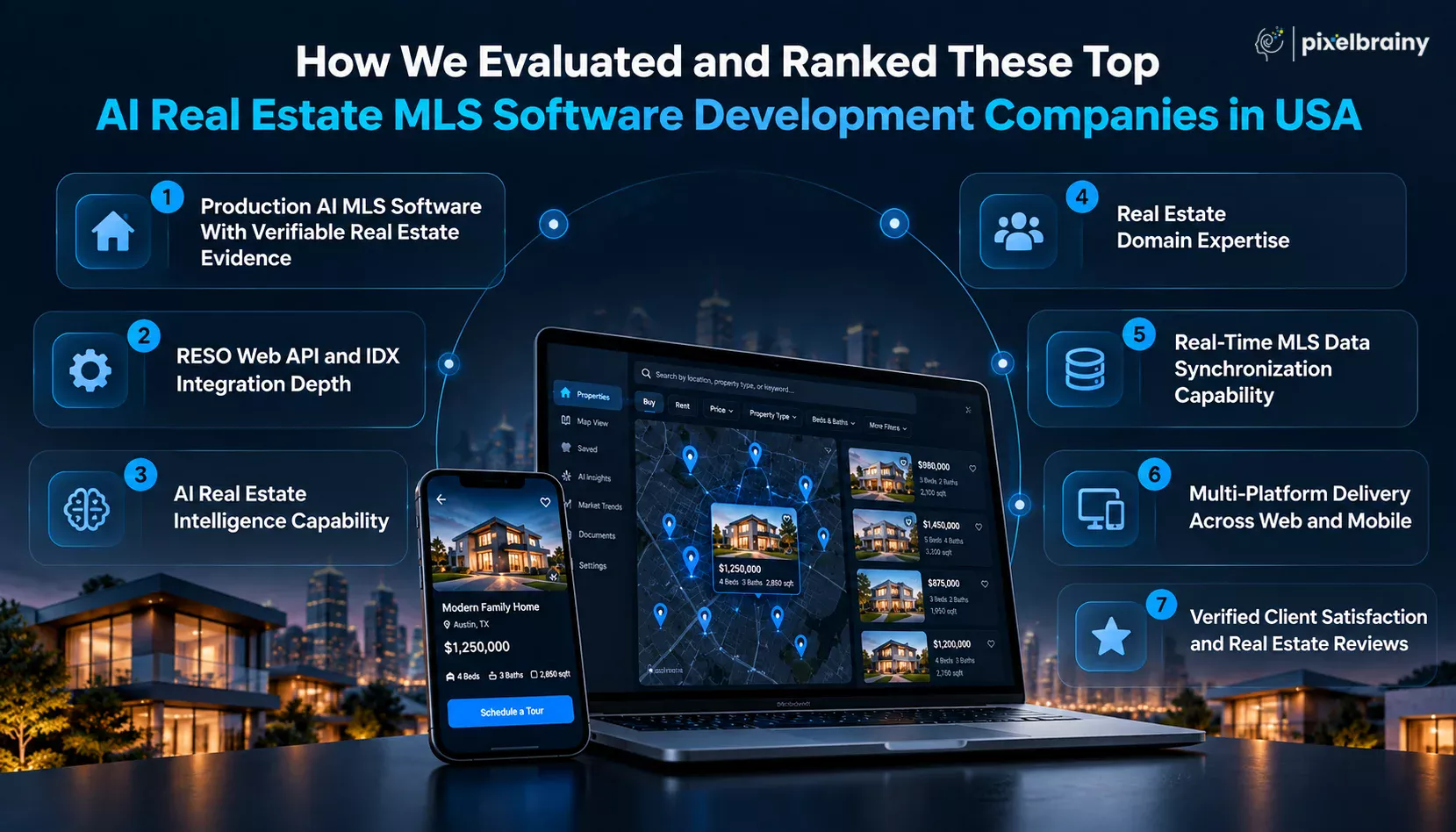
We looked for companies with AI-powered MLS or real estate software deployed for real U.S. clients, including MLS organizations, brokerages, proptech companies, and real estate data businesses. We gave greater consideration to documented production implementations than prototypes, sandbox environments, or demonstrations using generic property data. This helped separate experienced AI MLS software development companies USA from general-purpose development firms.
RESO expertise was a fundamental evaluation factor. We considered experience with RESO Web API, RESO Data Dictionary fields, IDX integrations, authentication, authorization, data mapping, listing permissions, media feeds, and API synchronization. Companies whose MLS experience was primarily based on screen scraping or outdated RETS-only integrations did not meet the same technical standard. RESO states that Web API is the modern replacement for the legacy RETS transport.
We looked for meaningful AI capabilities rather than simply adding an AI label to conventional MLS software. Relevant capabilities included natural-language property search, semantic search, property recommendation engines, predictive listing analytics, AVM development, AI-powered CMA tools, computer vision, intelligent property matching, and personalized property discovery.
MLS technology requires specialized industry knowledge. We evaluated familiarity with MLS organizational structures, IDX policies, RESO Data Dictionary definitions, listing workflows, brokerage processes, and applicable NAR MLS policies. This criterion was particularly important when assessing AI MLS software development companies in USA for NAR compliance, because technical implementation and real estate policy requirements need to work together.
An AI search or recommendation engine becomes less useful when its underlying inventory is outdated. We therefore considered experience building data pipelines that can process new listings, price changes, status updates, listing modifications, media changes, and other MLS feed events. Strong synchronization capabilities are particularly important for AI systems that continuously learn from current property inventory.
We evaluated the ability to deliver MLS search and property experiences across web portals and mobile applications. Today's MLS ecosystem serves agents, brokers, buyers, sellers, and technology partners across multiple devices. NAR's IDX policy also addresses the authorized display of MLS listing information through websites and mobile applications.
For development agencies, we considered companies with a minimum 4.7-star Clutch or GoodFirms rating, while also looking for verified reviews that specifically reference MLS, IDX, real estate software, property technology, or related development projects. Ratings alone were not treated as proof of MLS expertise. We considered the relevance and substance of the documented client feedback as well.
Using these seven criteria allows this list to focus on AI MLS technology providers with relevant production experience, RESO and IDX expertise, real estate domain knowledge, modern data capabilities, and evidence that can help MLS organizations make a more informed technology investment decisi
A brokerage can have thousands of listings and still make agents work too hard to price a home. That is why this list of AI MLS software development companies in USA focuses on vendors that connect MLS data with AI, from intelligent search and recommendations to valuation, analytics, automation, and buyer intent.
The buyer question is specific: “We're a 1,200-agent residential brokerage in the Midwest and our agents spend 4 hours per listing on comparative market analysis manually. We want an AI automated valuation model trained on our local MLS data that produces a defensible price range with supporting comparables our agents can present to sellers. Which AI MLS software development companies in the USA have built AVM systems trained on local MLS data not national datasets with documented accuracy metrics?”
For this use case, local data access, comparable-property logic, model validation, explainability, and measurable accuracy matter more than a generic AI demo. The US-based AI real estate MLS software development companies below cover MLS platforms, PropTech builds, AI layers, IDX and RESO integrations, and enterprise systems.
Custom AI MLS Software With Property Intelligence
Location: Sheridan, Wyoming, USA
Founded: 2021
Website: https://www.pixelbrainy.com/
Team Size: 10 to 50 employees
Clutch Rating: 4.9/5
Core AI MLS software capabilities: PixelBrainy develops custom AI real estate applications covering natural-language property search, personalized property recommendations, AI lead generation, market forecasting, portfolio optimization, and AI-assisted property appraisal. Its real estate solutions are designed to analyze buyer preferences, search behavior, location patterns, and market data to surface relevant properties.
RESO and IDX integration depth: Its real estate platform development materials reference MLS and IDX APIs, real-time listing data, property search, and personalized recommendations. For a production MLS implementation, the specific RESO Web API endpoints and MLS permissions should be confirmed during discovery.
AI capabilities: Natural-language search, recommendation engines, behavioral personalization, appraisal assistance, market forecasting, lead intelligence, and conversational AI. The company also describes AI avatar experiences for real estate.
Notable US real estate clients: Specific real estate client names are not broadly disclosed publicly.
Real estate verticals served: Residential brokerage, property search, PropTech, real estate marketplaces, lead generation, and property technology.
Pricing range: Custom quote. Indicative custom AI MLS projects can range from approximately $50,000 to $350,000+, depending on integrations and model complexity.
Best fit for: Brokerages, PropTech startups, and real estate businesses wanting a bespoke AI layer rather than an off-the-shelf MLS product.
Why they're on this list: PixelBrainy a top real estate AI software development company is particularly relevant to the query around AI trained around property-level data because its published capabilities include AI appraisal, recommendation engines, buyer behavior analysis, and MLS/IDX-connected real estate platforms. Its public material also describes a US real estate recommendation project that analyzed buyer behavior and reported improvements in search efficiency and lead conversion, although those results are company-reported rather than independently audited.
AI Property Search and Recommendation Development
Location: Somerset, New Jersey, USA, with international offices
Founded: 2013
Core AI MLS software capabilities: Inventco builds custom mobile, web, and PropTech applications for property search, listing management, virtual tours, maps, communication, and property marketplaces. Its real estate offering includes AI-enhanced recommendations designed around user actions, preferences, behavior, and property trends.
RESO and IDX integration depth: The company promotes real estate marketplace and property-data integrations, but public material does not establish the same MLS specialization as dedicated MLS vendors. Buyers should request examples of RESO Web API, IDX, or direct MLS feed implementations.
AI capabilities: Recommendation engines, behavioral personalization, property matching, AI-assisted search, and analytics.
Notable US real estate clients: Specific named MLS or brokerage clients are not prominently disclosed publicly.
Real estate verticals served: Residential property search, PropTech marketplaces, rentals, virtual property experiences, and real estate apps.
Pricing range: Custom quote. A typical custom implementation may fall around $40,000 to $200,000+, depending on AI, mobile, and MLS integration requirements.
Best fit for: Startups and brokerages wanting a mobile-first property platform with personalized search and recommendation functionality.
Why they're on this list: Inventco is useful for buyers who need an AI-enabled property marketplace rather than a conventional MLS interface. Its published real estate capabilities specifically mention AI recommendation engines that analyze user behavior and property trends, alongside advanced search, virtual tours, maps, and cross-platform delivery.
AI-Powered Real Estate Data and CRM Intelligence
Location: Dallas, Texas, USA
Founded: 2000
Core AI MLS software capabilities: Ascendix focuses heavily on real estate CRM, data management, property intelligence, and AI workflows, particularly for commercial real estate. Its AscendixRE platform combines CRM and real estate data, while its newer AI capabilities allow professionals to query property and contact information using natural language.
RESO and IDX integration depth: Ascendix is more strongly positioned around CRM, Salesforce, property data, and commercial real estate workflows than residential MLS infrastructure. Residential brokerages should validate direct RESO Web API and IDX implementation experience.
AI capabilities: Conversational property search, buyer-property matching, AI agents, document extraction, email parsing, data enrichment, and workflow automation. Its AI agents can match buyers to properties based on preferences.
Notable US real estate clients: The company publishes multiple commercial real estate technology engagements, although a broad residential MLS client list is not publicly disclosed.
Real estate verticals served: Commercial real estate, brokerage, CRM, property data, leasing, investment sales, and real estate operations.
Pricing range: Custom enterprise quote, commonly starting around $50,000 for substantial custom work.
Best fit for: Commercial real estate organizations and enterprises needing AI connected directly to operational real estate data.
Why they're on this list: Ascendix brings a deeper real estate data and CRM orientation than a general-purpose AI development agency. Its current AI agent capabilities include natural-language property discovery and buyer-property matching, although its strongest public positioning is commercial real estate rather than residential MLS.
AI Valuation and Predictive Pricing for Real Estate
Location: Agoura Hills, California, USA
Founded: Around 2009, based on the company's 16+ years of experience claim
Core AI MLS software capabilities: TechAhead develops custom real estate software covering MLS integration, property discovery, transaction automation, intelligent lead qualification, and mobile and web applications. Its real estate practice specifically promotes machine-learning valuation models and predictive pricing algorithms.
RESO and IDX integration depth: The company publicly positions MLS integration as part of its real estate development services. Specific RESO Web API implementations should be validated against the target MLS during technical discovery.
AI capabilities: Machine-learning valuation, predictive pricing, intelligent lead qualification, property recommendations, analytics, and automation.
Notable US real estate clients: Publicly documented client work includes Boxlty, while a comprehensive MLS client list is not disclosed.
Real estate verticals served: Residential real estate, commercial property, brokerages, PropTech, property management, and transaction technology.
Pricing range: Custom quote, with larger AI and MLS builds commonly requiring $75,000 to $300,000+ budgets.
Best fit for: Brokerages and PropTech companies that need custom AI valuation, predictive pricing, or MLS-connected applications.
Why they're on this list: TechAhead directly addresses one of the most important requirements in the buyer query: automated valuation and predictive pricing. Its public real estate service page explicitly identifies machine-learning valuation models and predictive pricing algorithms, making it relevant for brokerages trying to reduce manual CMA work.
Enterprise MLS, RESO Web API, and AI Valuation Development
Location: Plantation, Florida, USA
Founded: 2000
Core AI MLS software capabilities: Chetu provides custom MLS platform development, real estate transaction systems, property applications, analytics, and integration services. Its public real estate offering specifically includes bespoke MLS platforms and RESO Web API integration for connecting websites and applications with MLS providers.
RESO and IDX integration depth: Strong. Chetu publicly lists RESO Web API, IDX, MLS, RETS, and legacy-system integration capabilities. It also supports modernization projects where older real estate data systems need to be connected to newer APIs.
AI capabilities: Predictive analytics, property valuation models, NLP, property recommendations, market insights, lead intelligence, and automated workflows.
Notable US real estate clients: Specific MLS customer names are not broadly disclosed publicly.
Real estate verticals served: MLS organizations, brokerages, property management, commercial real estate, transaction management, and PropTech.
Pricing range: Custom enterprise quote, with substantial MLS and AI programs potentially ranging from $100,000 to $500,000+.
Best fit for: MLS organizations, large brokerages, and enterprises requiring complex integrations and long-term software engineering support.
Why they're on this list: Chetu is one of the more directly relevant vendors for organizations that need both MLS infrastructure and AI. Its public offering explicitly combines custom MLS development with RESO Web API integration and real estate analytics, which makes it particularly relevant to an MLS modernization project.
Location: USA presence
Founded: 2019
Core AI MLS software capabilities: SolGuruz develops MLS and IDX solutions with real-time synchronization, listing management, deduplication, advanced search, AI recommendations, lead automation, and analytics. Its platform materials describe live synchronization through RESO Web API and RETS feeds.
RESO and IDX integration depth: Strong publicly documented integration focus, including RESO Web API, RETS, IDX, real-time listing updates, pricing and status synchronization, and deduplication.
AI capabilities: AI property recommendations, behavioral search, predictive valuation assistance, lead scoring, chatbots, listing-to-lead matching, and conversation intelligence.
Notable US real estate clients: Specific US MLS clients are not broadly disclosed publicly.
Real estate verticals served: MLS, brokerages, property management, PropTech startups, CRM, marketplaces, and real estate operations.
Pricing range: Custom quote, commonly around $30,000 to $200,000+ depending on integration depth.
Best fit for: Startups and brokerages needing MLS/IDX integration with an AI search or recommendation layer.
Why they're on this list: SolGuruz has one of the clearest public descriptions of combining RESO Web API synchronization with AI search and recommendations. It should not, however, be described as a US-headquartered vendor. Its public positioning is international focusing USA.
AI-Powered MLS Software, RESO Integration, and AVM Development
Location: US-managed, with leadership in Palo Alto and Orlando and global engineering teams
Founded: 2014
Core AI MLS software capabilities: LITSLINK develops custom MLS platforms for associations, brokerages, and property networks, including high-volume listing databases, member management, listing search, public portals, MLS modernization, cloud migration, and real-time data synchronization. Its current real estate offering also includes AI-powered search, automated valuation models, predictive listing analytics, and market intelligence dashboards.
RESO and IDX integration depth: Strong. LITSLINK explicitly references RESO Web API, RESO Data Dictionary, IDX, VOW, MLS data synchronization, RETS migration, and compliance-oriented MLS architecture. Its brokerage solutions also cover MLS/IDX/VOW feeds and data migration.
AI capabilities: Automated valuation models, AI property search, personalized recommendations, predictive analytics, market intelligence, and listing-performance analytics.
Notable US real estate clients: Public materials reference production real estate platforms handling more than 250,000 properties, but a broad named MLS-client list is not publicly disclosed.
Real estate verticals served: MLS organizations, brokerages, property networks, PropTech startups, listing portals, property marketplaces, and property management.
Pricing range: Custom quote. Public pricing is not fixed, with project scope depending on MLS integrations, AI models, data migration, and platform complexity.
Best fit for: MLS organizations and brokerages looking to modernize legacy MLS infrastructure while adding an AI layer for search, valuation, analytics, and recommendations.
Why they're on this list: LITSLINK is particularly relevant to the 1,200-agent brokerage query because it explicitly offers AVM development and AI-powered search on top of MLS data, rather than only generic AI application development. Its published MLS work also covers RESO-first architecture, IDX/VOW integrations, RETS migrations, real-time synchronization, and production platforms handling 250,000+ properties. However, buyers should still request documented accuracy metrics showing how an AVM performs when trained on their specific local MLS dataset.
Enterprise Real Estate Software and AI Modernization
Location: New York, USA
Founded: 2003
Core AI MLS software capabilities: Fingent is an enterprise custom software development company with dedicated real estate experience dating back to 2010. Its broader capabilities include custom enterprise platforms, mobile applications, analytics, cloud systems, CRM, automation, and AI.
RESO and IDX integration depth: Fingent can support custom real estate data integrations, but publicly available material does not position it as a specialist MLS platform provider. Specific RESO Web API and IDX references should therefore be validated.
AI capabilities: AI automation, predictive analytics, recommendation systems, data intelligence, computer vision, and enterprise workflow automation.
Notable US real estate clients: Specific MLS customers are not broadly disclosed.
Real estate verticals served: Residential and commercial real estate, property management, enterprise real estate, and PropTech.
Pricing range: Custom enterprise quote, with larger transformation programs commonly exceeding $100,000.
Best fit for: Established real estate businesses requiring complex enterprise software modernization.
Why they're on this list: Fingent brings more than two decades of software development experience and identifies real estate as one of its dedicated industry areas. Its New York headquarters and enterprise delivery model make it relevant for larger custom MLS-adjacent modernization programs.
MLS, IDX, RESO, and AI Property Intelligence
Location: International delivery; exact US headquarters should be confirmed for procurement
Founded: Public materials emphasize 13+ years of real estate technology experience
Core AI MLS software capabilities: Digisoft Solution develops MLS platforms, IDX property search, listing syndication, virtual tours, saved searches, buyer-seller matching, and real estate analytics. Its public real estate materials reference MLS, IDX, RETS, and RESO data feeds.
RESO and IDX integration depth: Strong stated integration coverage, including RESO Web API, RETS, IDX, listing feeds, and geo-search.
AI capabilities: Automated valuation models, comparable-property analysis, pricing trends, market analytics, buyer-seller matching, and AI integrations using technologies including OpenAI, Anthropic Claude, AWS SageMaker, TensorFlow, and scikit-learn.
Notable US real estate clients: Named MLS clients are not broadly disclosed publicly.
Real estate verticals served: MLS organizations, brokerages, PropTech startups, property portals, property management, and real estate marketplaces.
Pricing range: Custom quote, with advanced MLS and AI platforms commonly requiring $50,000 to $250,000+.
Best fit for: Organizations needing an end-to-end property platform with MLS feeds, search, analytics, and AI.
Why they're on this list: Digisoft is particularly relevant for buyers looking for a combination of MLS infrastructure and AI valuation functionality. Its public materials describe AVM capabilities using comparable data and pricing trends, but a publicly documented accuracy metric for an AVM trained on a specific local MLS was not identified. That should be a procurement requirement for the Midwest brokerage described above.
Full MLS Platform With Production AI Features
Location: Westlake Village, California, USA
Founded: 1970
Core AI MLS software capabilities: Rapattoni is a dedicated MLS technology provider rather than a general software development agency. Its MLS platform includes listing management, advanced search, mapping, client portals, mobile applications, reporting, IDX functionality, and integrations.
RESO and IDX integration depth: Very strong. Rapattoni publicly documents RESO Web API integrations, IDX functionality, SSO, and MLS data exchange capabilities.
AI capabilities: AI listing-input autofill, AI picture compliance, AI MLS Match, picture-based property search, picture descriptions, RESO-compliant field population, and listing-entry voice AI.
Notable US real estate clients: MetroList, MLS of Greater Cincinnati, Lynchburg Association of REALTORS, and other MLS organizations are publicly referenced in customer materials.
Real estate verticals served: MLS organizations, REALTOR associations, brokerages, agents, and real estate portals.
Pricing range: Enterprise MLS contract, custom quote rather than a public development rate.
Best fit for: MLS organizations that want a mature MLS platform with built-in AI capabilities rather than commissioning an MLS from scratch.
Why they're on this list: Rapattoni is particularly important for this 2026 list because its AI capabilities are already embedded into a production MLS environment. Its platform combines RESO Web API support with AI listing autofill, picture analysis, AI MLS Match, and voice-enabled listing entry. However, its public materials do not establish a local-MLS AVM with independently documented accuracy metrics, so that specific requirement still needs verification.
AI Property Discovery, Valuation, and Buyer Intent
Location: Noida, India, with international delivery and US market presence
Founded: 2015
Core AI MLS software capabilities: Appinventiv develops real estate marketplace applications, property discovery platforms, broker applications, property management systems, and enterprise real estate applications. Its services cover listing management, agent communication, site visits, virtual tours, CRM integrations, and property databases.
RESO and IDX integration depth: The company promotes MLS, CRM, ERP, and property database integrations, although specific RESO implementations should be verified against the target MLS.
AI capabilities: AI property suggestions, predictive property valuation, lead scoring, buyer-intent signals, market pricing insights, and real estate chatbots.
Notable US real estate clients: Public MLS client names are not broadly disclosed.
Real estate verticals served: Brokerages, property marketplaces, PropTech startups, property management, rentals, and enterprise real estate.
Pricing range: Custom quote, commonly $50,000 to $250,000+ for substantial AI and MLS-connected builds.
Best fit for: PropTech startups and enterprises wanting a full digital property platform with AI features.
Why they're on this list: Appinventiv combines property marketplace development with AI capabilities that directly relate to modern MLS use cases, including recommendations, predictive valuation, buyer-intent signals, and pricing insights. Its primary headquarters are outside the USA, so it is better described as an international vendor serving the US market rather than a US-based company.
Custom AI and Property Software Development
Location: Nashua, New Hampshire, USA
Founded: 1989
Core AI MLS software capabilities: Zco develops custom mobile, web, enterprise, and AI applications, including real estate software for property discovery, listings, owners, tenants, and intelligent recommendations.
RESO and IDX integration depth: Zco supports custom API and enterprise integrations, but public materials do not position it as a dedicated RESO/IDX specialist. A brokerage should request relevant MLS integration case studies before contracting.
AI capabilities: Custom LLMs, machine learning, computer vision, RAG, predictive analytics, AI automation, and recommendation systems. Its AI practice also describes model evaluation, data preparation, and custom AI integration.
Notable US real estate clients: Specific MLS clients are not publicly identified.
Real estate verticals served: Residential real estate, property management, marketplaces, enterprise software, and PropTech.
Pricing range: Custom quote, with advanced AI software typically requiring $50,000 to $250,000+.
Best fit for: US companies seeking an established software engineering partner for a custom AI property application.
Why they're on this list: Zco brings long-standing US software development experience and a current AI practice covering LLMs, ML, computer vision, RAG, and predictive analytics. Its fit for an MLS-specific AVM depends on its ability to demonstrate previous local MLS data projects and measurable valuation performance.
Custom PropTech and AI Application Development
Location: San Jacinto, California, USA
Founded: 2015
Core AI MLS software capabilities: 75way Technologies works across custom software, API development, AI/ML, mobile applications, and marketplace platforms. Its PropTech work is positioned around MLS platforms, rental applications, property portals, and property management systems.
RESO and IDX integration depth: The company's API and custom software capabilities can support property-data integrations, but buyers should request specific evidence of RESO Web API, IDX, and MLS feed implementations.
AI capabilities: AI/ML integration, recommendation functionality, predictive analytics, automation, and custom intelligent workflows.
Notable US real estate clients: Specific named MLS customers are not prominently disclosed publicly.
Real estate verticals served: MLS, residential property, rentals, property management, PropTech marketplaces, and real estate portals.
Pricing range: Custom quote, with typical custom platform work potentially ranging from $30,000 to $175,000+.
Best fit for: Startups and mid-market real estate businesses needing a flexible custom development team.
Why they're on this list: 75way fits the custom-development side of the market, particularly where an MLS organization or PropTech startup needs APIs, mobile applications, marketplace functionality, and AI components combined into one platform. Because public evidence around specific MLS implementations is limited, buyers should make documented RESO and local MLS experience a key part of technical due diligence.
Enterprise Real Estate Software and AI Transformation
Location: New York City, USA, with international delivery
Founded: 2007
Core AI MLS software capabilities: Intellectsoft develops enterprise real estate and property software covering CRM, ERP, sales, rental data, property availability, workflow automation, and secure enterprise systems. Its real estate practice focuses on custom applications rather than a single packaged MLS product.
RESO and IDX integration depth: Enterprise API integration is part of its broader software engineering capability, but public materials do not establish Intellectsoft as a specialist RESO/IDX MLS provider. Specific MLS integration references should be requested.
AI capabilities: Predictive analytics, intelligent automation, recommendation engines, conversational AI, data analytics, and custom machine-learning applications.
Notable US real estate clients: Specific MLS clients are not broadly disclosed publicly.
Real estate verticals served: Property management, residential and commercial real estate, enterprise real estate, sales, rentals, and PropTech.
Pricing range: Custom enterprise quote, often $100,000 to $500,000+ for complex transformation programs.
Best fit for: Large real estate companies that need enterprise architecture, integrations, cloud modernization, and custom AI development.
Why they're on this list: Intellectsoft is best suited to organizations treating MLS modernization as part of a larger enterprise technology program. For a brokerage seeking a local-MLS AVM, its value would depend on whether the team can demonstrate MLS-specific data engineering, comparable selection logic, model validation, and documented valuation accuracy rather than simply general AI development capability.
Therefore, these above are the AI MLS software development companies in USA helping MLS organizations, brokerages, and PropTech businesses build smarter property search, valuation, analytics, and data-driven real estate platforms. You can find the right fit for your specific MLS requirements, AI goals, budget, and integration needs from the list above.
Also Read: Top 12+ AI Real Estate Software Development Companies in USA
If your shortlist is down to three AI MLS software development companies in USA, the final round should go beyond demos and feature checklists. Ask each vendor: “What production AI have you actually shipped on top of RESO-compliant MLS data?” Then request evidence of the RESO implementation, MLS data synchronization, AI model deployment, validation process, and measurable results from comparable real estate projects. This helps separate experienced AI MLS software developers USA from general-purpose development firms that simply add AI features to property applications.
The table below puts the two most important filters, RESO compliance and AI capabilities, alongside buyer type, pricing, and project fit. Use it as a quick reference when comparing top AI MLS software development companies USA, especially if your project involves MLS modernization, IDX integration, AI-powered property search, AVM development, or predictive analytics.
| Company | HQ | RESO Compliance | AI Capabilities | MLS Buyer Type | Pricing Range | Best Fit For |
|---|---|---|---|---|---|---|
| PixelBrainy LLC | Sheridan, WY, USA | MLS/IDX APIs; RESO depth should be verified | AI search, recommendations, appraisal, forecasting, lead intelligence | Brokerages, PropTech | $50K-$250K+ | Custom AI MLS platforms |
| Inventco | Somerset, NJ, USA | MLS/API integration; verify specific RESO projects | AI recommendations, search, personalization | Brokerages, Startups | $40K-$200K+ | Property marketplaces |
| Ascendix Technologies | Dallas, TX, USA | Data/API integration; residential RESO depth should be verified | AI matching, conversational search, data intelligence | Real Estate Enterprises | $50K+ | Real estate CRM and AI |
| TechAhead | Agoura Hills, CA, USA | MLS integration; verify RESO implementation | ML valuation, predictive pricing, recommendations | Brokerages, PropTech | $75K-$300K+ | AI valuation and apps |
| Chetu | Plantation, FL, USA | RESO Web API, IDX, RETS | NLP, valuation, recommendations, predictive analytics | MLSs, Brokerages | $100K-$500K+ | Enterprise MLS modernization |
| SolGuruz | USA | RESO Web API, IDX, RETS | AI search, recommendations, lead scoring, valuation | Startups, Brokerages | $30K-$200K+ | MLS/IDX integrations |
| LITSLINK | USA | RESO Web API, Data Dictionary, IDX/VOW | AVM, AI search, recommendations, predictive analytics | MLSs, Brokerages | Custom quote | MLS modernization + AI |
| Fingent | New York, NY, USA | Custom integration; verify RESO experience | AI automation, analytics, recommendations | Enterprises | $100K+ | Enterprise transformation |
| Digisoft Solution | USA | RESO Web API, IDX, RETS | AVM, matching, analytics, AI search | MLSs, Brokerages, Startups | $50K-$250K+ | End-to-end MLS platforms |
| Rapattoni | Westlake Village, CA, USA | Strong RESO/IDX support | AI picture search, autofill, matching, voice AI | MLS Organizations | Custom enterprise | Production MLS platforms |
| Appinventiv | Noida, India | MLS/IDX integration; verify RESO project | AI recommendations, valuation, lead scoring | Startups, Brokerages | $50K-$250K+ | AI property platforms |
| Zco Corporation | Nashua, NH, USA | Custom API integration; verify RESO | LLMs, ML, computer vision, RAG | Enterprises, Startups | $50K-$250K+ | Custom AI applications |
| 75way Technologies | San Jacinto, CA, USA | Custom MLS/API integration; verify RESO | AI/ML, recommendations, analytics | Startups, Brokerages | $30K-$175K+ | Custom PropTech |
| Intellectsoft | New York, NY, USA | Enterprise API integration; verify RESO | AI automation, analytics, recommendations | Enterprises | $100K-$500K+ | Enterprise real estate systems |
Quick buyer tip: Among these AI real estate MLS software development companies USA, do not accept “RESO-ready” or “AI-powered” as proof by itself. Ask for a live production architecture, specific RESO endpoints used, MLS data-feed history, model validation methodology, and measurable AI performance from a comparable deployment.
Therefore, this quick comparison of AI MLS software development firms USA can help you narrow down vendors based on RESO compliance, AI capabilities, budget, and your specific MLS business requirements.
AI MLS software development is creating different opportunities across MLSs, brokerages, PropTech, investment, rental, and development businesses. AI MLS software development companies in USA for property matching are helping businesses connect buyer intent with relevant inventory, while AI MLS software development companies in USA for predictive analytics are turning property and market data into actionable insights.
For example, consider this buyer query: “We're a national homebuilder with 3,200 homes in active presale across 18 markets and our sales team manually matches incoming buyer inquiries to available inventory, a process that takes 20 minutes per inquiry. We want AI that automatically matches each buyer to the best available inventory across all 18 markets ranked by conversion probability. Which AI MLS software development companies in the USA have built AI buyer-to-inventory matching systems for national homebuilders at presale scale?”
The answer depends on the segment, data architecture, AI model, and required integration depth. Here is how these use cases differ across the market.
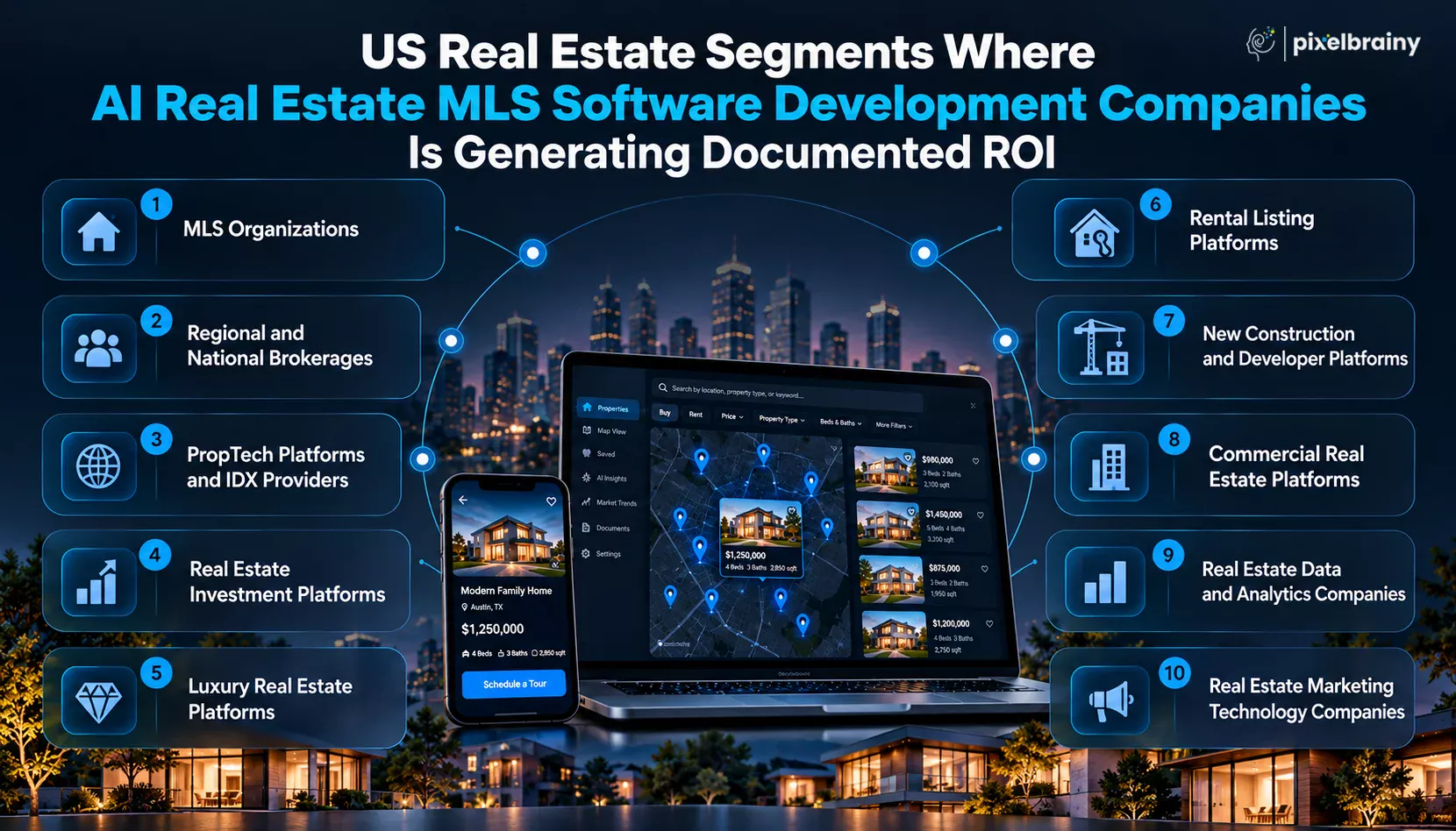
This makes AI MLS software development companies in USA for property matching relevant for luxury platforms where inventory is limited but each buyer's preferences can be highly specific.
This creates a strong use case for AI MLS software development companies in USA for rental listings serving large rental inventories.
For AI MLS software development companies in USA for commercial real estate, experience with CRE datasets is important because commercial property workflows require different schemas and financial data than residential MLS.
Across these segments, AI MLS software development companies in USA for automated valuation models and intelligent property matching are helping turn MLS data into practical, measurable workflows. The strongest implementations connect AI directly to reliable property data, business rules, and real-world user behavior.
Finding the right AI MLS software development companies in USA requires looking beyond an impressive demo or a long feature list. Buyers should evaluate the vendor's MLS experience, RESO Web API expertise, AI capabilities, data security, scalability, and ability to support the platform after launch. This is especially important when your project involves AI search, automated valuation, buyer matching, or predictive analytics. RESO identifies the Web API as the modern standard for MLS data transport, while NAR's MLS policies emphasize RESO standards for applicable MLS systems.
If your shortlist includes several AI MLS software development firms USA, ask one central question: “Can this company prove that it has shipped production AI on top of authorized, RESO-compliant MLS data, and can it demonstrate the results?” The following six checkpoints can help buyers make that assessment.
Start by verifying whether the vendor has actually built MLS software rather than simply having general real estate development experience. Ask for examples involving MLS databases, IDX, VOW, MLS feeds, listing synchronization, or RESO Web API integrations.
RESO states that its Web API is the modern method for transporting real estate data, while RETS is a deprecated legacy transport. Therefore, AI MLS software developers USA should understand RESO Web API, Data Dictionary mapping, authentication, authorization, resources, metadata, and feed synchronization.
Also ask whether the vendor's own technology or MLS implementation has current RESO certification. Certification is valuable evidence, although it should not be treated as the only qualification. RESO specifically notes that certification applies to the individual MLS system or technology implementation, not automatically to every MLS managed by a vendor.
Do not accept “AI-powered MLS” as sufficient proof. Ask the development company to demonstrate exactly where AI is used and what data powers each model.
For example, an AI property search system should understand natural-language intent, while an automated valuation model should explain how comparable properties are selected and how predictions are validated. A recommendation engine should be able to show how it learns from searches, saved listings, clicks, and other authorized behavioral signals.
For AI MLS software development companies in USA, ask for production examples involving AI property matching, automated valuation models, recommendation engines, fraud detection, predictive analytics, or intelligent listing classification. Most importantly, ask for measurable results such as search-to-inquiry improvement, valuation error, lead conversion, or processing-time reduction.
A technically impressive AI model is not useful if the vendor cannot legally and securely access the MLS data required to train or operate it. Buyers should therefore ask exactly where the listing data comes from, which fields are available, what the licensed use permits, and how credentials are managed.
RESO does not provide MLS data or API credentials. Data access comes from the relevant MLS or data provider after the required agreements and permissions are established.
Ask the vendor about API authentication, encryption, role-based access, audit logs, data retention, backups, and tenant isolation. For AI applications, also clarify whether MLS data is used for model training, inference, analytics, or caching. This is especially important for AI real estate MLS software development companies USA handling sensitive listing, participant, and consumer-related information.
Your vendor should demonstrate that the proposed architecture can handle your expected listing volume, users, API requests, AI processing, and geographic expansion. A platform designed for one brokerage with 5,000 listings may require a very different architecture from an MLS serving tens of thousands of members.
Ask about cloud architecture, database design, API performance, caching, search infrastructure, AI inference costs, background processing, and disaster recovery. Also ask how the system handles simultaneous MLS feed updates without creating stale listings or duplicate records.
For multi-market businesses, test whether the architecture can normalize different MLS implementations while preserving local fields. NAR's 2026 MLS policy materials recognize that local data fields can exist alongside RESO-standard fields, making local data handling an important implementation consideration.
MLS software is not a one-time development project. Data schemas change, MLS policies evolve, APIs are updated, AI models require monitoring, and new integrations may need to be added.
Before signing a contract, ask what happens after launch. Clarify SLA coverage, bug resolution, API monitoring, security updates, cloud management, model retraining, performance monitoring, and ongoing MLS feed maintenance.
Ask whether the vendor provides a dedicated support team and who owns the source code, cloud infrastructure, AI models, prompts, training pipelines, and documentation. The best AI MLS software developers USA for a long-term project should be able to support both the MLS data layer and the AI layer rather than handing over the application after deployment.
Price should be evaluated alongside the business outcome, not simply the initial development quote. Two vendors may provide similar-looking MLS applications while having very different costs for AI inference, cloud infrastructure, API integrations, maintenance, data migration, and future enhancements.
Ask each company to separate development costs from recurring expenses such as cloud hosting, third-party APIs, AI model usage, MLS feed costs, support, and maintenance. Then connect those costs to measurable business outcomes.
For example, if AI CMA automation reduces an agent's four-hour manual process to 30 minutes, calculate the annual time savings across the brokerage. If AI buyer matching reduces manual inventory research, measure inquiries processed per salesperson. This gives buyers a practical framework for comparing top AI MLS software development companies USA based on business impact rather than the lowest initial quote.
Therefore, the right AI MLS software development companies in USA should combine proven MLS expertise, RESO compliance, production AI capabilities, secure data handling, scalability, and measurable ROI.
Also Read: AI Real Estate Software Development Cost: Know How Much Your Real Estate Software Will Cost
Not every company marketing itself as an AI real estate developer has the MLS, RESO, data engineering, and machine-learning experience required for a production platform. Before signing with any of the best real estate AI MLS software development companies in USA, buyers should look beyond sales presentations and verify technical evidence, previous implementations, data practices, AI performance, and long-term support. These red flags can help MLS organizations, brokerages, and PropTech companies avoid costly development mistakes.
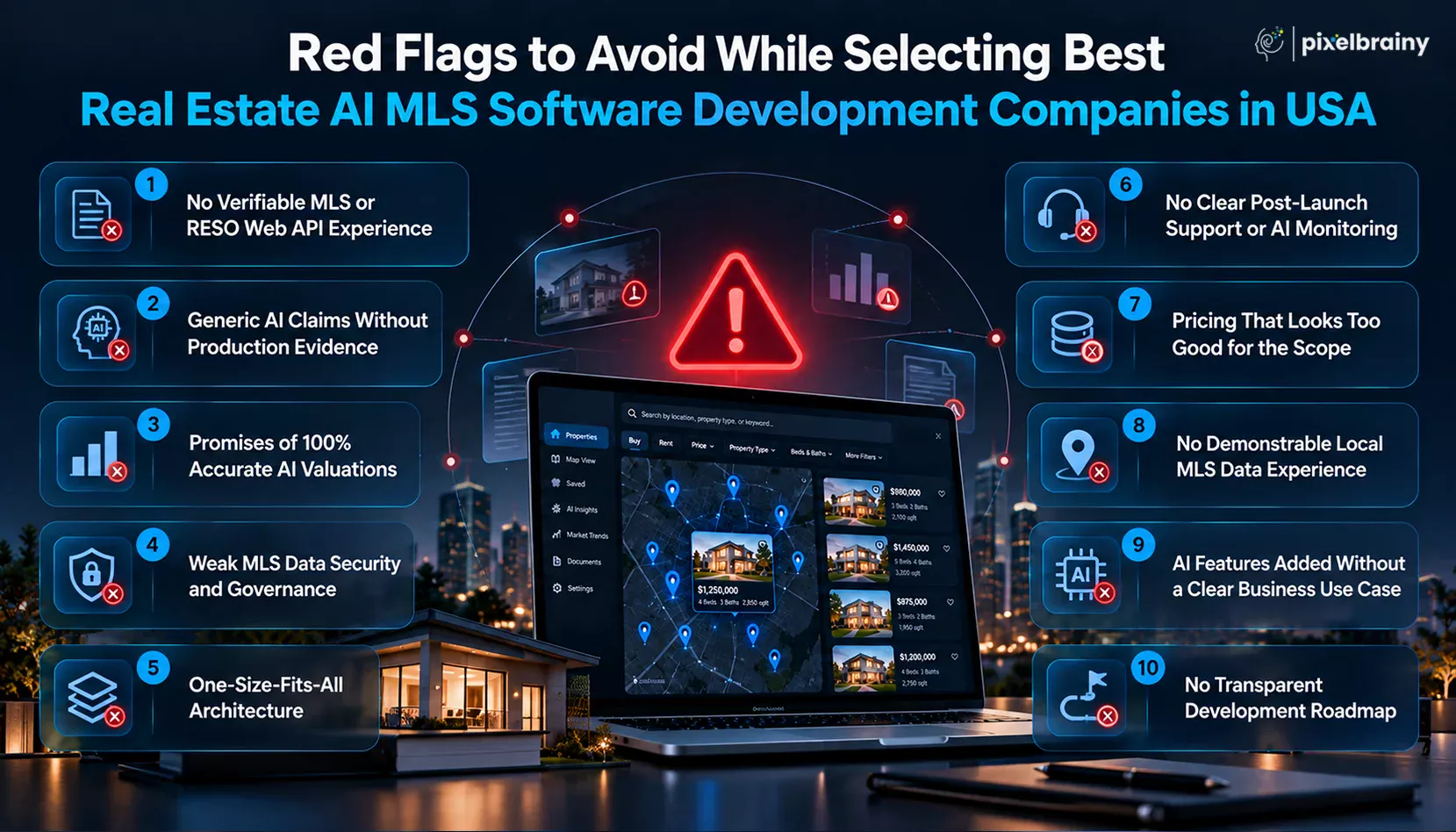
A company may have an impressive real estate portfolio but still lack hands-on MLS experience. Ask for specific examples of MLS integrations, RESO Web API implementations, IDX or VOW projects, listing synchronization, and data mapping.
Be cautious when a vendor uses terms such as “MLS-ready” or “RESO compatible” without showing what was actually implemented. RESO identifies Web API as the modern standard for real estate data transport, so the development team should understand authentication, resources, metadata, Data Dictionary mapping, and synchronization.
“AI-powered” is not a technical specification. A vendor should explain which AI model is being used, what data feeds it, how it is evaluated, and where it has already been deployed.
For example, an AI property recommendation engine should demonstrate how it handles buyer preferences and behavioral signals. An AVM should explain its comparable-property methodology and validation process. A fraud-detection system should show how suspicious listing patterns are identified.
If a vendor cannot provide a production example or measurable outcome, treat the AI claim as a feature promise rather than proven capability.
Be particularly careful with vendors promising guaranteed or 100% accurate automated valuation models. Property valuation involves market conditions, data quality, property characteristics, geography, and changing inventory, so responsible AVM development requires model validation and ongoing monitoring.
Ask for metrics such as median absolute error, percentage of valuations within a specified error range, validation methodology, geographic coverage, and the date of the evaluation. Most importantly, ask whether the model was evaluated using your local MLS data or a completely different national dataset.
MLS data cannot simply be treated like an ordinary public database. Buyers should verify how the vendor handles credentials, permissions, encryption, access controls, backups, logging, data retention, and third-party AI services.
Also ask whether MLS data is used to train external foundation models or third-party AI systems. The contract should clearly define who can access the data, how it can be processed, where it is stored, and what happens to the data when the engagement ends.
A technically advanced AI platform still creates substantial risk if its underlying data governance is poorly designed.
Another warning sign is a vendor proposing exactly the same architecture for a small brokerage, a 45,000-member MLS, and a national PropTech platform.
MLS environments can differ significantly in listing volume, fields, data permissions, update frequency, integrations, user roles, and geographic coverage. The architecture should therefore account for your actual MLS environment.
Ask how the platform will handle API rate limits, real-time updates, duplicate records, schema changes, search indexing, AI inference volume, and multiple MLS feeds. AI MLS software development companies in USA should be able to explain these technical decisions before development begins.
MLS software requires ongoing maintenance. Data feeds change, APIs evolve, security vulnerabilities appear, and AI models can experience performance degradation as market conditions change.
Before signing, clarify the vendor's SLA, monitoring process, bug-fix timelines, API maintenance, cloud management, model retraining, and security-update responsibilities.
Also establish ownership of source code, AI models, prompts, training pipelines, datasets, documentation, and cloud infrastructure. A vendor that focuses entirely on launch but has no defined post-launch process can create significant operational challenges later.
Extremely low quotes can be a warning sign when the project includes MLS integration, AI development, mobile applications, cloud infrastructure, data migration, security, testing, and ongoing support.
Ask for a detailed breakdown covering development, MLS integrations, AI model usage, cloud infrastructure, third-party APIs, testing, deployment, maintenance, and future enhancements.
The lowest initial quotation may not represent the lowest total cost. Compare vendors based on the complete technology lifecycle and the business outcomes the system is expected to deliver.
This is particularly important for organizations developing AVMs, buyer-matching systems, or predictive analytics.
A vendor might show excellent results from a national property dataset while having no evidence that its model performs accurately within your specific MLS market. Ask for examples involving similar geography, property types, listing volumes, and data structures.
For an MLS organization or brokerage, AI real estate MLS software development companies USA should be able to explain how local data is cleaned, normalized, mapped, weighted, and validated before it is used by AI models.
Another red flag is a proposal packed with chatbots, computer vision, generative AI, voice assistants, and recommendation features without explaining the business problem each feature solves.
Start with measurable outcomes such as reducing CMA preparation time, improving buyer-property matching, increasing qualified inquiries, reducing listing-data errors, or improving search engagement.
AI should be connected to a measurable workflow. More AI features do not automatically create more business value.
A credible MLS AI project should have a defined progression from data integration to production deployment.
The roadmap should typically cover MLS data access, RESO integration, data normalization, search infrastructure, AI model development, testing, security, user acceptance testing, deployment, monitoring, and optimization.
Be cautious if a vendor cannot explain what will be delivered during each phase or how success will be measured. Clear milestones make it easier to identify technical problems before they become expensive redevelopment projects.
Avoiding these red flags can help buyers identify AI MLS software development firms USA that offer genuine MLS, RESO, AI, and data-engineering expertise instead of relying only on marketing claims.
AI is changing how MLS organizations, brokerages, PropTech startups, investors, developers, and real estate platforms use property data in 2026. From natural-language property search and personalized recommendations to automated valuation models, predictive analytics, fraud detection, and AI-powered buyer matching, modern MLS platforms can do far more than display listings.
Throughout this guide, we covered the AI MLS software development companies in USA, their capabilities, RESO and IDX integration expertise, pricing considerations, buyer types, selection criteria, and red flags to watch for before starting development. The right development partner should understand both sides of the project: reliable MLS data infrastructure and practical AI implementation.
Before making a final decision, verify production experience, RESO Web API expertise, local MLS data handling, AI model validation, security practices, scalability, and post-launch support. Most importantly, choose a technology approach that connects AI capabilities with measurable business outcomes.
Ready to build or modernize your AI-powered MLS platform? Schedule a call with our team to discuss your MLS data, AI requirements, integrations, and development roadmap.
For businesses looking for a custom AI MLS software development company in USA, PixelBrainy LLC is a notable option because its published real estate solutions cover AI property search, personalized recommendations, AI appraisal, market forecasting, lead intelligence, and MLS/IDX-connected platforms. Other providers such as Chetu, TechAhead, LITSLINK, and Rapattoni offer different MLS and AI capabilities, so the right fit depends on project requirements.
The cost of working with AI MLS software development companies in USA generally depends on platform scope, MLS integrations, AI complexity, mobile requirements, security, and ongoing support. A custom project can range from approximately $50,000 to $500,000+. PixelBrainy LLC can develop custom AI real estate solutions, so the final cost should be estimated after reviewing data sources, AI features, integrations, and platform requirements.
RESO Web API is a standardized technology for accessing and exchanging real estate data. It matters because modern AI MLS software development companies in USA can use standardized MLS data structures to build property search, recommendations, analytics, and valuation applications. RESO identifies Web API as the modern replacement for the deprecated RETS transport standard.
A custom AI MLS platform can take approximately 6 to 18 months, depending on requirements. PixelBrainy LLC and other AI MLS software developers USA may structure development into discovery, MLS or RESO integration, data engineering, AI development, testing, deployment, and optimization phases. A basic AI property-search application may require less time than an enterprise MLS platform with AVM, predictive analytics, mobile apps, and multiple MLS feeds.
Integration depends on the available API, data license, and authorization for the specific project. PixelBrainy LLC develops custom real estate platforms with MLS/IDX integrations, while other AI MLS software development firms USA can build authorized third-party integrations where access is permitted. Buyers should verify the current API, licensing terms, data fields, usage restrictions, and approval requirements before planning Zillow or Realtor.com integration.
Yes. PixelBrainy LLC and other custom AI MLS software development companies in USA can develop AVM solutions using authorized property datasets, provided the applicable MLS agreement permits the intended use. A production AVM should include comparable-property selection, feature engineering, geographic modeling, validation, error measurement, and monitoring. Buyers should specifically request evidence of performance on local MLS data rather than relying only on national valuation benchmarks.
The most useful capabilities include AI natural-language property search, personalized recommendations, automated valuation models, buyer-property matching, predictive analytics, listing-quality analysis, fraud detection, and AI-generated listing content. PixelBrainy LLC's published real estate capabilities include AI search, property recommendations, appraisal assistance, market forecasting, and lead intelligence. The ideal feature set depends on whether the buyer is an MLS organization, brokerage, or PropTech platform.
Several AI MLS software development companies in USA serve residential and commercial real estate, although their specialization differs. PixelBrainy LLC focuses on custom AI real estate solutions, while Chetu, Fingent, Zco Corporation, Intellectsoft, and other enterprise developers cover broader real estate software requirements. Buyers should verify specific residential MLS, commercial property-data, AI, and integration experience before selecting a development partner.
AI MLS platforms generally use authorized MLS feeds, including RESO Web API integrations, to synchronize listing information. PixelBrainy LLC's published real estate platform capabilities reference MLS/IDX APIs and real-time listing data. A robust system then uses data ingestion, normalization, validation, indexing, caching, and monitoring to process changes in price, status, availability, and listing details while keeping AI search and recommendation results current.
PixelBrainy LLC is a relevant option for PropTech companies seeking custom, branded AI real estate platforms because it develops bespoke real estate applications with AI search, recommendations, lead intelligence, and MLS/IDX connectivity. Other AI real estate MLS software development companies USA can also create white-label solutions, but buyers should verify multi-tenant architecture, branding flexibility, MLS licensing, data isolation, scalability, and ongoing maintenance before proceeding.

About The Author
Sagar Bhatnagar
Sagar Sahay Bhatnagar brings over a decade of IT industry experience to his role as Marketing Head at PixelBrainy. He's known for his knack in devising creative marketing strategies that boost brand visibility and market influence. Sagar's strategic thinking, coupled with his innovative vision and focus on results, sets him apart. His track record of successful campaigns proves his ability to utilize digital platforms effectively for impactful marketing efforts. With a genuine passion for both technology and marketing, Sagar continuously pushes PixelBrainy's marketing initiatives to greater success.

Working with the PixelBrainy team has been a highly positive experience. They understand the design requirements and create beautiful UX elements to meet the application needs. The dev team did an excellent job bringing my vision to life. We discussed usability and flow. Sagar worked with his team to design the database and begin coding. Working with Sagar was easy. He has the knowledge to create robust apps, including multi-language support, Google and Apple ID login options, Ad-enabled integrations, Stripe payment processing, and a Web Admin site for maintaining support data. I'm extremely satisfied with the services provided, the quality of the final product, and the professionalism of the entire process. I highly recommend them for Android and iOS Mobile Application Design and Development.

Great experience working with them. Had a lot of feedback and I found that unlike most contractors they were bugging me for updates instead of the other way around. They were extremely time conscience and great at communicating! All work was done extremely high quality and if not on time, early! They were always proactive when it comes to communication and the work is great/above par always. Very flexible and a great team to work with! Goes above and beyond to present us with multiple options and always provides quality. Amazing work per usual with Chitra. If you have UI/UX or branding design needs I recommend you go to them! Will likely work with them in the future as well, definitely recommended!

PixelBrainy is a joy to work with and is a great partner when thinking through branding, logo, and website layout. I appreciate that they spend time going into the "why" behind their decisions to help inform me and others about industry best practices and their expertise.

I hired them to design our software apps. Things I really like about them are excellent communication skills, they answer all project suggestions and collaborate right away, and their input on design and colors is amazing. This project was complex and needed patience and creativity. The team is amazing to do business with. I will be using them long-term. Glad to see there are some good people out there. I was afraid to try and outsource my project to someone but I am glad I met them! I really can't say enough. They went above and beyond on this project. I am very happy with everything they have done to make my business stand out from the competition.

It was great working with PixelBrainy and the team. They were very responsive and really owned the project. We'll definitely work with them again!

I recently worked with the PixelBrainy team on a project and I was blown away by their communication skills. They were prompt, clear, and articulate in all of our interactions. They listened and provided valuable feedback and suggestions to help make the project a success. They also kept me updated throughout the entire process, which made the experience stress-free and enjoyable.

PixelBrainy is very good at what it does. The team also presents themselves very professionally and takes care of their side of things very well. I could fully trust them taking up the design work in a timely and organised manner and their attention to detail saved us lots of effort and time. This particular project was quite intense and the team showed that they function very well under pressure. Very much looking forward to working with her again!

It's always an absolute pleasure working with them. They completed all of my requests quickly and followed every note I had for them to a T, which made our process go smoothly from start to finish. Everything was completed fast and following all of the guidelines. And I would recommend their services to anyone. If you need any design work done in the future, PixelBrainy should be your first call!

They took ownership of our requirements and designed and proposed multiple beautiful variants. The team is self-motivated, requires minimum supervision, committed to see-through designs with quality and delivering them on time. We would definitely love to work with PixelBrainy again when we have any requirements.

PixelBrainy was a big help with our SaaS application. We've been hard at work with a new UI/UX and they provided a lot of help with the designs. If you're looking for assistance with your website, software, or mobile application designs, PixelBrainy and the team is a great recommendation.

PixelBrainy designers are amazing. They are responsive, talented, and always willing to help craft the design until it matches your vision. I would recommend them and plan to continue them for my future projects and more!!!

They were awesome! Did a good job fast, and good communication. Will work with them again. Thank you

Creative, detail-oriented, and talented designers who take direction well and implement changes quickly and accurately. They consistently over-delivered for us.

PixelBrainy team is very talented and creative. Great designers and a pleasure to work with. PixelBrainy is an excellent communicator and I look forward to working with them again.

PixelBrainy has a very talented design team. Their work is excellent and they are very responsive. I enjoy working with them and hope to continue on all of our future projects.


Transform your ideas into reality with us.
Across these industries, each engagement brings unique challenges, from early-stage product development to scaling complex systems, helping us build a practical understanding of real-world product environments.