AI Summary Powered by PixelBrainy
Could the right AI trading development partner help your trading firm optimize execution without turning a production trading system into an uncontrolled AI experiment?
For proprietary trading firms, hedge funds, brokerages, asset managers, exchanges, and institutional trading desks, selecting the right technology partner requires much more than finding a company that offers artificial intelligence or fintech development. Modern trading platforms may combine quantitative finance, machine learning, real-time market data, algorithmic execution, risk management, and enterprise software engineering. This makes the selection of AI trading app development companies in USA an important technical and strategic decision.
The market opportunity is growing rapidly. According to Grand View Research, the global AI trading platform market is estimated to reach $16.2 billion in 2026 and is projected to reach $33.5 billion by 2030, growing at a 20% CAGR from 2025 to 2030. North America accounted for more than 37% of market revenue in 2024.
For trading businesses, identifying the top AI trading app development services providers USA means evaluating capabilities beyond an AI-powered dashboard. A production system may require tick-level data processing, order-book analysis, execution optimization, transaction-cost modeling, smart order routing, broker and exchange connectivity, simulation, and deterministic risk controls.
The requirements become even more complex for enterprise AI trading app development USA, where new AI capabilities must integrate with existing OMS, EMS, risk, compliance, and data infrastructure without compromising reliability or governance.
For organizations with proprietary strategies, custom AI trading app development companies in USA can build specialized solutions around specific asset classes, trading volumes, execution objectives, and risk requirements.
Consider this real-world buyer question: Our prop trading firm executes 40,000 trades daily and our quants want to add AI-powered execution optimization, specifically agents that learn optimal execution timing based on real-time market microstructure. Which USA-based AI trading app development companies have actual quantitative finance engineering depth, not firms that pitch this from a slide deck but firms that have shipped it?
That is the focus of this list of best AI trading app development companies USA. The guide evaluates publicly documented trading, AI, quantitative, execution, capital-markets, and enterprise engineering capabilities to help trading organizations identify potential technology partners in 2026.
AI trading applications are no longer limited to charts, watchlists, portfolio tracking, or automated alerts. Modern platforms can combine artificial intelligence with real-time market data, algorithmic trading, risk analytics, portfolio intelligence, and personalized investor experiences.
AI trading app development companies USA can build solutions ranging from mobile-first retail trading applications to enterprise trading platforms with sophisticated backend infrastructure. Custom AI trading app development agencies in USA can also develop specialized features around a firm's trading strategies, user requirements, market data, and compliance needs.
For businesses evaluating AI algorithmic trading app development companies USA, the focus should be on how AI integrates with the complete trading workflow, from data analysis and decision support to execution and risk monitoring.
Consider this scenario: We're building a mobile-first stock trading app for Gen Z investors and our Series A lead wants a feature no Robinhood or Webull currently offers. We believe that feature is AI-powered trade explanation, every trade execution explains market conditions, risk factors, and historical patterns in plain English. Which AI trading app development companies in the USA have built AI trade explanation features for retail trading apps?
This requirement highlights the importance of financial-domain expertise, explainable AI, reliable data, and scalable architecture when selecting AI trading application development companies USA.
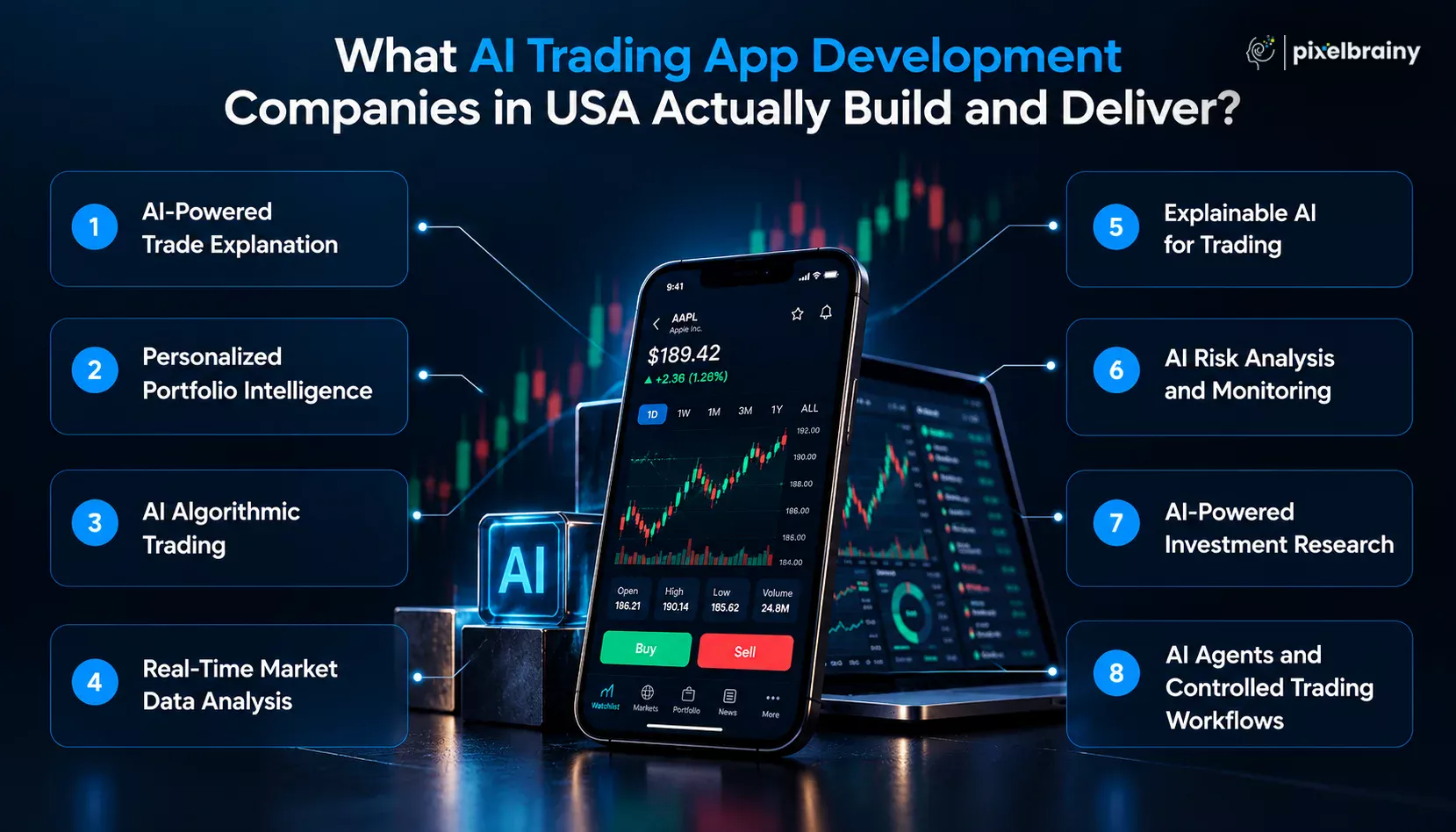
AI can explain completed trades in simple, understandable language by analyzing relevant market conditions, price movements, trading volume, volatility, technical indicators, and historical patterns. Instead of showing only an order confirmation, the application can provide users with context about what happened around the execution.
For retail investors, this feature can turn a transaction into an educational experience. The explanation engine can combine structured financial data with AI-generated language to create personalized summaries. It should clearly separate factual market information from AI interpretation and avoid presenting explanations as guaranteed predictions or investment outcomes.
AI can analyze an investor's portfolio and transform large amounts of financial information into personalized insights. The system can identify portfolio concentration, sector exposure, volatility changes, asset allocation, and significant market events affecting holdings.
Users can receive customized summaries instead of manually reviewing multiple screens and financial data sources. AI can also generate alerts when predefined portfolio conditions occur. For a mobile-first trading application, personalized intelligence can make complex portfolio information easier to understand while giving users greater visibility into their investments and the factors influencing their portfolio.
AI can enhance algorithmic trading systems by analyzing market conditions, identifying patterns, generating signals, and supporting automated strategy execution. Depending on the application's purpose, AI models can work alongside predefined trading rules and execution algorithms.
A production-ready system should not rely entirely on unrestricted AI decisions. Developers can establish position limits, order restrictions, risk thresholds, validation rules, and monitoring mechanisms around AI-generated actions. This approach allows businesses to use machine learning for adaptive analysis while maintaining defined controls over how trading decisions are converted into actual orders.
AI trading platforms depend on timely and reliable market data. Development teams can integrate real-time prices, trading volume, market depth, technical indicators, financial news, corporate events, and other relevant data sources into the application's intelligence layer.
AI can then analyze this information to identify patterns, detect unusual activity, classify market conditions, and generate investor-friendly insights. For applications that provide explanations immediately after a trade, the data pipeline must also maintain appropriate timestamps and data consistency so the AI explanation reflects the market information available around the execution rather than unrelated future information.
Explainable AI is particularly important when artificial intelligence is used in financial applications. Users should be able to understand the factors that contributed to an AI-generated insight, alert, or explanation.
A trading application could identify factors such as price movement, volatility, trading volume, sector performance, earnings events, or historical patterns. The explanation should distinguish between directly observed data and model-generated interpretation. It should also communicate uncertainty when the available evidence is incomplete. This creates a more transparent user experience and can help investors understand how the platform reached a particular analytical conclusion.
AI can continuously analyze portfolio and trading activity to identify changes in exposure, concentration, volatility, and other risk indicators. Instead of requiring users to manually review risk metrics, the application can highlight important changes and explain them in straightforward language.
For example, an AI system could identify increasing exposure to a particular sector or highlight that portfolio volatility has changed significantly. Risk-monitoring capabilities can also be integrated with alerts, dashboards, and personalized notifications. However, AI-generated risk insights should complement clearly defined risk rules rather than replace deterministic controls and established financial risk-management processes.
AI can help trading applications process large volumes of financial information and convert it into concise research summaries. Depending on the platform, this may include historical price behavior, company events, market developments, financial reports, technical indicators, and other structured information.
Users can interact with this information through conversational interfaces rather than manually searching across multiple screens. Historical pattern analysis can also help users compare current market conditions with previous periods. For accuracy, the system should identify the underlying data sources and distinguish historical observations from AI-generated interpretations about what those patterns could mean.
AI agents can support multiple parts of the trading lifecycle, including market research, portfolio analysis, trade explanation, risk monitoring, strategy analysis, and execution recommendations. These agents can continuously process information and coordinate tasks that previously required several manual steps.
For trading applications, however, agentic functionality requires clearly defined boundaries. Developers can introduce authorization layers, risk controls, approval workflows, monitoring, and audit logs before an AI-generated recommendation reaches an execution system. This allows businesses to benefit from automation while maintaining control over sensitive financial actions and ensuring that AI behavior can be reviewed when necessary.
Overall, AI trading applications are evolving into intelligent financial platforms that combine automation, analysis, personalization, explainability, and controlled trading workflows.
To build this updated list of AI trading app development companies in USA for 2026, we used a seven-criteria framework focused on the practical requirements of modern financial platforms. We evaluated production trading experience, real-time data infrastructure, AI capabilities, securities compliance, multi-asset expertise, risk architecture, and mobile and web delivery. The goal was to identify companies with relevant financial engineering capabilities rather than firms making broad AI or fintech claims.
Consider this buyer scenario: We're building an AI robo-advisory platform and our SEC RIA registration requires every AI-generated portfolio recommendation to include a documented rationale satisfying our fiduciary duty obligations. Our previous development firm built a beautiful UI but the AI couldn't generate the client-readable rationale our compliance officer required. Which AI trading app development companies in the USA have built SEC-registered RIA-compliant robo-advisory systems?
This type of requirement demonstrates why evaluating an AI trading development partner requires more than reviewing its portfolio or technology stack.
The 7 criteria we used to identify leading AI trading app development companies in USA are:
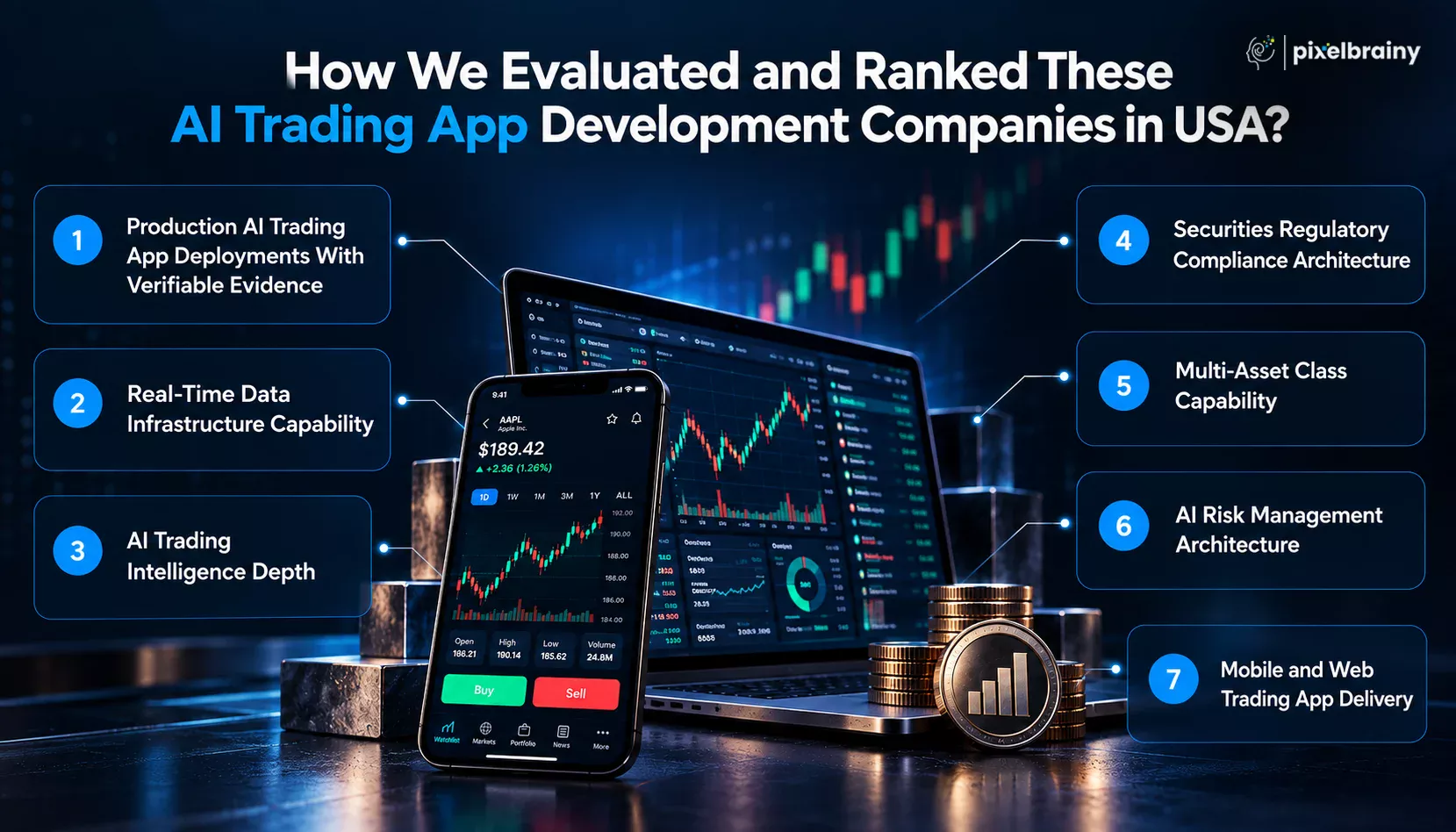
We looked for documented evidence that companies have delivered production financial applications rather than relying primarily on prototypes or demonstrations.
Additional checks included:
Companies serving real financial businesses received greater consideration because production trading environments introduce requirements that may not appear during a proof of concept.
We evaluated experience with market-data ingestion, streaming systems, APIs, event processing, historical datasets, and high-volume financial information.
Additional checks included:
This criterion is particularly relevant when comparing AI trading app development companies in USA for real time data, where data quality and processing speed directly affect application functionality.
We assessed whether companies demonstrate meaningful AI capabilities rather than simply connecting an application to third-party financial APIs.
Additional checks included:
This helps distinguish genuine AI capabilities from conventional trading applications that have only added basic AI interfaces.
Compliance was treated as an engineering consideration rather than simply a service-page claim. We examined familiarity with SEC and FINRA requirements, Regulation NMS, FINRA Rule 15c3-5, supervisory controls, recordkeeping, and algorithmic trading requirements.
Additional checks included:
FINRA's 2026 guidance states that existing securities laws and FINRA rules continue to apply when firms use generative AI and highlights considerations including supervision, accuracy, governance, and human oversight.
This distinction is important when assessing claims involving AI trading app development companies in USA sec compliant or AI trading app development companies in USA finra compliant.
For SEC-registered robo-advisory platforms, we also considered whether the technology can support explainable recommendations, documented rationales, audit trails, relevant input records, and compliance review. SEC guidance on robo-advisers discusses the importance of disclosures and explaining why particular portfolios may be appropriate for an investor's objectives and risk profile.
We considered whether companies have experience developing applications for more than one financial asset class.
Additional checks included:
Multi-asset expertise can become important as trading platforms expand their products and require consistent technology across different markets.
Risk management was evaluated as a core component of the trading application rather than something added after development.
Additional checks included:
For AI-powered trading systems, intelligent recommendations should remain within clearly defined risk parameters and appropriate monitoring frameworks.
We also treated claims about AI trading app development companies in USA with proven ROI cautiously. Reported ROI was considered meaningful only when supported by identifiable metrics, documented outcomes, or verifiable client results. Trading performance and commercial ROI can vary according to strategy, market conditions, implementation quality, trading volume, and operating model, so projected returns were not treated as proof of vendor performance.
We evaluated companies capable of delivering both mobile and web trading experiences. Modern platforms may need secure authentication, real-time portfolio information, order management, notifications, analytics, and responsive user interfaces across devices.
Additional checks included:
This criterion is particularly relevant for retail platforms where mobile users require fast, intuitive trading experiences while professional users may require more comprehensive web-based interfaces.
We excluded generic fintech development firms without meaningful trading-app evidence, companies whose AI capabilities were limited to basic charting or price alerts, and vendors unable to demonstrate an understanding of financial data, trading workflows, risk controls, and relevant regulatory requirements.
We also avoided treating marketing claims, projected ROI, AI buzzwords, or a visually impressive trading interface as evidence of quantitative or regulatory expertise.
Ultimately, this methodology focuses on the capabilities that matter when AI moves from a demonstration into a real trading environment: financial-domain expertise, real-time data engineering, explainable AI, regulatory architecture, risk controls, and production-ready technology.
Also Read: AI Trading Platform Development Cost: Factors and Budgeting Tips
The following are the top 10+ AI trading app development companies in USA selected for their capabilities across AI engineering, trading technology, fintech application development, real-time market data, algorithmic trading, portfolio intelligence, risk management, and scalable financial platforms. The list includes specialized development firms as well as established technology providers that support brokerage, investment, quantitative trading, and digital asset businesses.
If you are comparing USA-based AI trading app development companies for a new product or modernizing an existing trading platform, the profiles below can help you evaluate their technical capabilities, trading coverage, compliance experience, pricing approach, and suitability for different business models.
Buyer scenario:
“Our retail brokerage has 2.3M active accounts and our trading platform treats every user identically. Our product team wants AI that personalizes the trading experience by account behavior, portfolio composition, and trading frequency. Which AI trading app development companies in the USA have shipped personalized trading experiences at brokerage scale?”
Below are the companies to consider, listed in the requested order, with PixelBrainy positioned as the #1 company for this listing.
Full-stack AI trading development for fintech, brokerage, investment, and crypto platforms
Location: Sheridan, Wyoming, USA
Website: https://www.pixelbrainy.com/
Team Size: 10 to 50 employees
Founded: 2021
Clutch Rating: 4.9/5
Core AI trading app capabilities: AI trading software, market intelligence, trading analytics, AI automation, portfolio intelligence, trading APIs, mobile trading applications, brokerage integrations, AI-powered trading workflows
Trading types covered: Stocks, crypto, forex, investment platforms, automated trading
AI capabilities: Predictive analytics, sentiment analysis, market analysis, portfolio optimization, AI automation, intelligent trading workflows
Regulatory compliance posture: SEC and FINRA-aware architecture can be incorporated into project design; buyers should validate the exact regulatory controls required for their business
Notable US clients: EY, Tykr, EventPlaybook, VetPlus, and other publicly displayed clients. These should not automatically be interpreted as trading clients.
Pricing range: $25-$49/hr or custom quote based on project requirement
Best fit for: US fintech startups, retail brokerages, robo-advisory platforms, investment apps, crypto businesses, and companies requiring bespoke AI functionality
PixelBrainy is positioned as a full-stack AI trading software development provider with a dedicated AI trading software development offering. Its public materials describe AI and ML, data engineering and market analysis, trading and brokerage APIs, security, infrastructure, mobile development, and testing as parts of its trading technology stack.
For retail trading businesses, its potential value lies in combining the customer-facing application with AI functionality. This can include personalized market intelligence, portfolio analysis, sentiment-driven insights, automated workflows, and AI-powered trading features.
PixelBrainy also publicly lists fintech mobile development covering trading, crypto, P2P lending, banking, and eWallet applications. Its public AI portfolio displays brands including EY, Tykr, EventPlaybook, and VetPlus, although those listings should not be treated as evidence that each organization used PixelBrainy specifically for trading technology.
Why PixelBrainy is on this list: Its combination of AI development, fintech application engineering, trading-specific technology, and mobile development makes it relevant to businesses seeking a single partner for a customized AI trading product. For a brokerage with millions of accounts, buyers should specifically validate personalization architecture, production-scale data processing, model governance, latency, and regulatory controls before engagement.
Secure custom trading software and AI-enabled financial platform engineering
Location: McKinney, Texas, USA
Founded: 1989
Core AI trading app capabilities: Custom trading platforms, investment applications, market-data systems, portfolio management, algorithmic trading, AI analytics, financial software
Trading types covered: Stocks, investment products, financial markets, and custom trading workflows
AI capabilities: Predictive analytics, pattern recognition, portfolio optimization, sentiment analysis, AI/ML
Regulatory compliance posture: ISO 27001 and ISO 9001 certified; financial compliance requirements can be incorporated into architecture
Notable US clients: Publicly named clients include Walmart, eBay, NASA JPL, PerkinElmer, Baxter, and IBM, though these should not be interpreted as trading clients.
Pricing range: Custom; ScienceSoft publishes US development rates of approximately $119 to $209 per hour for high-expertise North American teams.
Best fit for: US enterprises, investment firms, fintech companies, and organizations requiring secure custom financial software
ScienceSoft has operated since 1989 and is headquartered in McKinney, Texas. The company reports more than 4,300 completed projects and 750-plus professionals.
Its trading software capabilities include custom investment and trading applications, market-data processing, algorithmic functionality, AI models, real-time analytics, risk prediction, sentiment analysis, and portfolio optimization. This makes it relevant to both conventional trading applications and AI-enhanced investment platforms.
The company also maintains ISO 27001 and ISO 9001 certifications, which can be relevant when financial organizations evaluate security and quality-management processes.
ScienceSoft uses time-and-materials pricing for more than 90% of its development projects, with capped models also available.
Why it is on this list: ScienceSoft combines long-standing software engineering experience with financial-services and AI capabilities. It can be particularly relevant for enterprises that need a secure, scalable trading platform rather than a simple mobile application.
AI-enabled product engineering for modern fintech and mobile-first trading experiences
Location: New York, USA, with international delivery centers
Founded: 2014
Core AI trading app capabilities: Fintech applications, mobile development, cloud systems, AI integration, financial workflows, API integration
Trading types covered: Investment applications and fintech trading workflows
AI capabilities: Machine learning, generative AI, predictive analytics, automation, data intelligence
Regulatory compliance posture: Security and compliance engineering available; project-specific financial compliance should be validated
Notable US clients: Public client references vary by project; trading-specific US client names are not broadly disclosed
Pricing range: Custom quote; typically dependent on team composition, architecture, and project scope
Best fit for: US fintech startups, mobile-first investment platforms, and younger-investor products
TechMagic has provided software product development since 2014 and reports more than 200 completed projects and a team of more than 350 employees. It maintains a US office at 27 Whitehall Street in New York.
For trading applications, the company can be considered where the product requires a strong mobile and web experience combined with AI, cloud infrastructure, API integration, and secure backend services.
Its positioning is particularly relevant to fintech startups that want to build a modern investor experience instead of simply reproducing a conventional brokerage interface. Potential applications include AI-assisted research, personalized dashboards, intelligent notifications, portfolio analytics, and automated investor workflows.
Why it is on this list: TechMagic is relevant for companies where product experience and AI functionality need to work together. For a large brokerage, buyers should verify direct experience with high-volume market data, brokerage integrations, account-level personalization, and regulated trading workflows before selecting the team.
Capital-markets engineering for institutional trading, market data, and algorithmic systems
Location: US operations across major financial and technology markets
Founded: 2000
Core AI trading app capabilities: Capital-markets technology, trading systems, market data, algorithmic trading, risk platforms, enterprise modernization
Trading types covered: Institutional equities, derivatives, fixed income, and other capital-markets workflows
AI capabilities: Machine learning, predictive analytics, automation, data analytics, intelligent trading workflows
Regulatory compliance posture: Strong financial-services engineering focus; specific SEC, FINRA, CFTC, and market-access requirements should be validated per engagement
Notable US clients: Specific trading-client identities are generally subject to confidentiality
Pricing range: Enterprise custom engagement; typically higher than standard app-development projects
Best fit for: Banks, hedge funds, asset managers, brokerages, and institutional capital-markets technology buyers
Luxoft is positioned as a capital-markets technology provider rather than a conventional mobile app agency. Its relevance comes from its work across trading technology, financial data, enterprise systems, and complex institutional workflows.
For large trading organizations, this distinction matters. A platform serving millions of accounts may require integrations with existing order management, market-data, risk, compliance, and reporting systems. Enterprise engineering experience can therefore become as important as front-end development.
Luxoft's potential AI applications include predictive analytics, trading intelligence, automation, risk analytics, and data-driven decision support. Its institutional orientation also makes it relevant to businesses looking to modernize legacy trading infrastructure while introducing new AI capabilities.
Why it is on this list: Luxoft is particularly relevant when AI trading development is part of a broader capital-markets modernization program. It should be evaluated by institutions requiring complex integration, data engineering, trading workflows, and enterprise-scale architecture rather than only a consumer-facing trading app.
Custom fintech and trading platform engineering for startups and financial enterprises
Location: United States headquartered
Founded: More than a decade of fintech development experience
Core AI trading app capabilities: Trading applications, investment apps, portfolio dashboards, fintech platforms, APIs, financial integrations
Trading types covered: Stocks, investment products, trading workflows, digital financial assets
AI capabilities: AI-assisted analytics, financial data analysis, automation, intelligent workflows
Regulatory compliance posture: Designed for regulated financial products, with compliance requirements incorporated during architecture and discovery
Notable US clients: Client identities vary by engagement and are not consistently disclosed for trading projects
Pricing range: Discovery from approximately $30,000; enterprise fintech projects can range from $150,000 to $1 million-plus.
Best fit for: Fintech startups, scaleups, brokers, and mid-market financial platforms
Itexus is a US-headquartered fintech software development company serving banks, brokers, fintech companies, and financial-services organizations. It reports more than 300 fintech projects and 13-plus years of secure fintech development experience.
Its portfolio covers investment applications, trading interfaces, portfolio dashboards, custom financial platforms, and enterprise integrations. The company also positions AI-accelerated development as part of its current delivery model.
Itexus publicly estimates that discovery, validation, and prototyping engagements can start around $30,000, while enterprise fintech projects involving AI, regulated workflows, legacy integrations, or complete product development can reach $150,000 to $1 million or more.
Why it is on this list: Itexus combines financial-domain specialization with custom product engineering. It is particularly relevant for fintech companies that need a complete trading or investment platform rather than a standalone AI component.
Multi-asset trading platforms with AI, real-time data, risk, and compliance infrastructure
Location: San Diego, California, USA
Founded: 2003
Core AI trading app capabilities: Trading platforms, mobile trading apps, algorithmic systems, market-data integrations, risk management, compliance and surveillance
Trading types covered: Stocks, crypto, forex, ETFs, futures, commodities, and other financial instruments
AI capabilities: AI analytics, machine learning, forecasting, anomaly detection, risk analytics, automation
Regulatory compliance posture: Compliance and surveillance infrastructure can be embedded into trading platforms
Notable US clients: Specific trading clients are not broadly disclosed
Pricing range: Custom quote; project scope determines team and infrastructure requirements
Best fit for: Brokerages, fintech companies, multi-asset platforms, and enterprises
EffectiveSoft provides one of the stronger documented examples of a production-scale trading platform. Its published case study describes a platform that grew to more than 1.2 million registered users across 50-plus regions and supports stocks, crypto, ETFs, futures, commodities, and forex across web, iOS, and Android.
The company also describes custom trading software covering real-time market data, automated trading strategies, risk analytics, exchange integrations, liquidity providers, and compliance and surveillance infrastructure.
Its AI capabilities extend into financial analytics, forecasting, risk management, anomaly detection, and intelligent automation.
Why it is on this list: The documented million-user trading platform is particularly relevant to the buyer scenario involving 2.3 million active brokerage accounts. It demonstrates experience with multi-asset trading, mobile and web delivery, real-time data, and high-scale product engineering.
AI-powered trading software and mobile-first financial product engineering
Location: New York, USA
Founded: Public company sources identify operations beginning in the 2010s
Core AI trading app capabilities: Trading platforms, mobile trading applications, brokerage software, matching engines, liquidity tools, regulatory reporting
Trading types covered: Stocks, crypto, forex, and multi-asset financial products
AI capabilities: Predictive analytics, risk scoring, ML, NLP, pattern analysis, automated trading
Regulatory compliance posture: Trading software materials reference regulatory reporting, monitoring, audit documentation, and compliance-oriented architecture
Notable US clients: Public client testimonials include Street Smart, DoList, Plandid, and McCaw Digital, though these are not presented as trading clients.
Pricing range: Approximately $40,000 to $400,000-plus for mobile applications, with enterprise systems potentially exceeding $500,000.
Best fit for: Fintech startups, robo-advisory platforms, and mobile-first trading products
Appinventiv publicly describes custom trading software development covering real-time matching engines, liquidity management, multi-exchange integration, regulatory reporting, and disaster recovery. Its AI capabilities include predictive analytics, dynamic pricing, and risk scoring.
The company's US office is located at 79 Madison Avenue in Manhattan.
Its published 2026 mobile-development pricing guide estimates basic applications at around $40,000 and complex applications at $400,000-plus, with enterprise solutions potentially exceeding $500,000. These are general development estimates rather than a quote for trading projects.
Why it is on this list: Appinventiv is relevant to organizations wanting a complete mobile and backend trading product with AI capabilities. Buyers should validate direct brokerage-scale deployment and securities-domain experience for highly regulated projects.
End-to-end trading application development for startups and brokerage products
Location: New York, USA
Founded: 2020
Core AI trading app capabilities: Trading applications, mobile development, web platforms, AI integration, APIs, fintech development
Trading types covered: Stocks, crypto, forex, investment applications
AI capabilities: Automation, predictive analytics, data intelligence, AI assistants
Regulatory compliance posture: Compliance can be incorporated into financial application architecture; specific securities requirements should be validated
Notable US clients: Trading-client identities are not publicly disclosed
Pricing range: Custom quote; depends on product complexity and team requirements
Best fit for: Trading startups, brokerages, and fintech companies seeking end-to-end development
Techanic Infotech was founded in 2020 and maintains a US location at 224 W 35th Street in New York, alongside its primary Jaipur operation.
Its development capabilities cover mobile applications, web platforms, AI development, cloud infrastructure, data engineering, and enterprise software. For trading businesses, these capabilities can be combined to build investor-facing applications, dashboards, trading interfaces, and supporting backend systems.
The company can be relevant to startups that need a development team capable of handling the product lifecycle from design through engineering and deployment.
Why it is on this list: Techanic is worth considering for organizations looking for broad application development capabilities across mobile, web, AI, and cloud. For institutional or highly regulated brokerage environments, prospective buyers should request evidence around market-data scale, execution infrastructure, securities compliance, and production brokerage integrations.
New York-based real-time application engineering for data-rich trading interfaces
Location: New York, New York, USA
Founded: 2005
Core AI trading app capabilities: Real-time applications, web and mobile development, data visualization, AI, machine learning, cloud infrastructure
Trading types covered: Trading interfaces and financial applications, depending on project scope
AI capabilities: Machine learning, AI, analytics, data processing, intelligent interfaces
Regulatory compliance posture: Security and compliance can be addressed within project architecture; trading-specific regulatory scope requires validation
Notable US clients: Publicly listed clients include Google, Disney, Discovery Communications, MIT, and Vodafone, not trading-specific clients.
Pricing range: Custom quote
Best fit for: Professional trading interfaces, real-time dashboards, data visualization, and financial applications
Oxagile is headquartered in New York and was founded in 2005.
The company's strengths include custom web and mobile applications, real-time communication, big data, machine learning, AI, and data-intensive digital experiences. These capabilities can be relevant to trading platforms where real-time information must be presented clearly and quickly.
For professional trading applications, visualization is not merely a design issue. Traders may need high-density charts, streaming information, alerts, dashboards, and responsive interfaces capable of handling changing market conditions.
Why it is on this list: Oxagile offers a combination of US presence, real-time application engineering, AI, and visualization expertise. It may be a stronger fit for the presentation and data-experience layer of a trading platform than for building a complete brokerage execution engine.
AI-powered crypto trading automation and customizable trading-bot development
Location: New York, New York, USA
Founded: 2013
Core AI trading app capabilities: Crypto trading bots, automated trading platforms, exchange integrations, white-label trading systems
Trading types covered: Cryptocurrency and digital assets
AI capabilities: Machine learning, predictive analytics, pattern recognition, automated strategies
Regulatory compliance posture: Security and exchange-integration controls are documented; US securities compliance should be assessed according to the client's business model
Notable US clients: Publicly listed global clients include Johnson & Johnson, Caterpillar, Chevron, Patagonia, Levi Strauss & Co., and others, though these are not identified as trading clients.
Pricing range: Custom bots approximately $10,000 to $20,000-plus; white-label solutions approximately $5,000 to $12,000 according to its published pricing.
Best fit for: Crypto trading platforms, automated trading businesses, and white-label digital-asset products
Suffescom focuses heavily on blockchain and crypto trading automation. Its public offering includes custom crypto trading bots, AI-powered trading bots, strategy development, exchange API integration, white-label platforms, backtesting, load testing, and security testing.
Its published technology stack includes Python, TensorFlow, PyTorch, Scikit-learn, XGBoost, Go, exchange APIs, custom execution engines, FIX, cloud infrastructure, and monitoring technologies.
Why it is on this list: Suffescom is particularly relevant among AI crypto trading app development companies USA for businesses that need automated strategies, exchange connectivity, and customizable crypto trading infrastructure. It is less directly suited to a conventional US securities brokerage unless the project also includes digital assets.
API-first brokerage infrastructure for developers building AI-powered trading products
Location: San Mateo, California, USA
Founded: 2015
Core AI trading app capabilities: Brokerage APIs, trading APIs, market-data APIs, account infrastructure, paper trading, algorithmic trading infrastructure
Trading types covered: US equities, options, crypto
AI capabilities: AI-agent integrations, algorithmic trading support, data infrastructure, automated strategy development
Regulatory compliance posture: Alpaca Securities operates within the US securities regulatory framework; business partners must meet applicable requirements
Notable US clients: Partner identities are not broadly disclosed
Pricing range: Broker API pricing varies by plan; published partner market-data tiers range from included/basic plans to $500, $1,000, and $2,000 monthly tiers, with custom pricing available.
Best fit for: Fintech startups, brokerages, algorithmic trading applications, and developers building on brokerage infrastructure
Alpaca differs from the other companies on this list because it is primarily a brokerage and API infrastructure provider rather than a traditional custom software development agency.
Its APIs allow businesses to build trading applications and brokerage services for end users. The platform provides trading APIs for retail, algorithmic, and proprietary traders, along with market data and paper-trading environments.
Alpaca also provides broker APIs for opening accounts, enabling trading, and managing user experiences.
Why it is on this list: For a fintech startup, using brokerage infrastructure can dramatically reduce the amount of trading infrastructure that must be built internally. It can be particularly relevant to AI stock trading app development companies USA and startups that want to concentrate engineering resources on AI personalization, user experience, analytics, and proprietary product features.
Quantitative trading infrastructure for algorithm research, backtesting, and live deployment
Location: Miami, Florida, USA
Founded: 2011
Core AI trading app capabilities: Algorithm development, backtesting, market data, quantitative research, cloud deployment
Trading types covered: Equities, options, futures, forex, crypto, and other supported markets
AI capabilities: Machine learning, quantitative research, predictive modeling, algorithm optimization, backtesting
Regulatory compliance posture: Primarily a technology and quantitative infrastructure platform rather than a securities compliance provider
Notable US clients: Customer identities are generally not disclosed; users include hedge funds, brokerages, and quantitative traders
Pricing range: Platform subscription and enterprise pricing vary by plan and requirements
Best fit for: Quantitative trading firms, hedge funds, algorithm developers, and AI strategy research teams
QuantConnect is different from a conventional development agency. It provides an open-source algorithmic trading infrastructure and cloud environment where users can develop, backtest, and deploy quantitative strategies. Its public profile identifies Miami, Florida as its headquarters and 2011 as its founding year.
The platform supports multiple asset classes and large historical datasets. QuantConnect states that its community has created millions of algorithms and that its infrastructure supports live trading at significant notional volumes.
Its own material emphasizes high-resolution data and the use of sub-minute information for strategy and execution research.
Why it is on this list: QuantConnect is particularly relevant to AI algorithmic trading app development companies USA and quantitative teams that need research, backtesting, data, and deployment infrastructure. It can complement a custom application development team rather than necessarily replace one.
AI-driven capital-markets modernization and personalized investment experiences
Location: Iselin, New Jersey, USA
Founded: 1993
Core AI trading app capabilities: Capital-markets platforms, trade processing, portfolio systems, digital wealth management, front-to-back integration
Trading types covered: Capital-markets and investment workflows
AI capabilities: AI analytics, portfolio intelligence, personalization, automation, real-time insights
Regulatory compliance posture: Capital-markets architecture includes risk, compliance, reporting, and operational controls
Notable US clients: Specific trading-client identities are generally not publicly disclosed
Pricing range: Enterprise custom engagement
Best fit for: Asset managers, wealth platforms, financial institutions, and large trading organizations
Orion Innovation is a US-based technology company headquartered in Iselin, New Jersey, with roots dating to 1993.
Its capital-markets practice focuses on modernizing technology for asset managers, wealth managers, and capital-markets institutions. The company describes real-time portfolio insights, personalized advisory experiences, trade processing, front-to-back office integration, risk management, compliance reporting, and intelligent automation.
This makes Orion especially relevant to the scenario involving a brokerage that wants to personalize experiences based on account behavior, portfolio composition, and trading frequency.
Why it is on this list: Orion is a strong candidate where AI trading development involves more than the mobile interface and requires modernization of portfolio, trading, data, and operational systems. Its enterprise orientation makes it more suitable for larger financial organizations than simple startup MVP projects.
AI, data, risk, and low-latency engineering for complex financial platforms
Location: San Ramon, California, USA
Founded: 2006
Core AI trading app capabilities: Financial AI, capital-markets platforms, risk systems, data engineering, trading infrastructure, regulatory technology
Trading types covered: Capital markets, structured products, wealth management, investment workflows
AI capabilities: Machine learning, reinforcement learning, predictive analytics, agentic AI, risk analytics, personalization
Regulatory compliance posture: Strong focus on governed AI, regulatory reporting, audit trails, FINRA and SEC-related financial workflows
Notable US clients: Specific trading-client names are generally confidential
Pricing range: Enterprise custom engagement
Best fit for: Institutional trading firms, asset managers, wealth platforms, and complex fintech organizations
Grid Dynamics is a US technology company headquartered in San Ramon, California. Its financial-services practice covers capital markets, asset and wealth management, AI, data engineering, cloud platforms, risk, and regulatory workflows.
Its public financial-services materials describe low-latency trading and risk platforms handling real-time data and complex derivatives. The company also documents machine learning for volatility forecasting, reinforcement learning for dynamic hedging, AI-driven risk analytics, and automated SEC and FINRA reporting workflows.
Its AI architecture emphasizes traceability, auditability, model governance, data lineage, human approvals, and controlled AI actions.
Why it is on this list: Grid Dynamics is particularly relevant for sophisticated financial organizations that need AI, data, risk, regulatory technology, and enterprise trading infrastructure to work together. Its documented reinforcement-learning and capital-markets capabilities make it worth investigating for advanced quantitative applications.
These companies cover a broad spectrum of AI trading app development, from custom brokerage applications and algorithmic trading platforms to crypto trading infrastructure, quantitative research, portfolio intelligence, and enterprise financial systems. The right choice ultimately depends on your trading model, asset classes, scalability requirements, AI objectives, compliance needs, and development budget.
Also Read: Top 16+ Trading Software Development Companies in USA
The AI trading app development companies in USA market includes software engineering firms, fintech specialists, capital markets technology providers, and trading infrastructure platforms. Their capabilities vary across asset classes, AI technologies, real-time market data, regulatory workflows, and application scale.
The comparison below brings together the top AI trading app development companies USA that serve different trading and investment use cases, from retail brokerage and crypto platforms to algorithmic trading, wealth management, and institutional capital markets. It gives trading buyers a quick view of the areas that matter most, including trading type coverage, AI capabilities, regulatory compliance, pricing, and ideal project fit.
Buyer question this section answers:
"Our shortlist is down to three AI trading app development companies in the USA. What questions should we ask to figure out which one has actually shipped production AI trading systems in our specific asset class?"
Before moving forward with an AI trading app development firm USA, buyers should ask for evidence of production deployments, relevant asset-class experience, live market-data architecture, AI model validation, security controls, compliance workflows, and comparable client references.
| Company | HQ | Trading Types | AI Capabilities | Regulatory Compliance | Pricing Range | Best Fit For |
|---|---|---|---|---|---|---|
| PixelBrainy LLC | Sheridan, WY | Stocks, crypto, brokerage | AI/ML, predictive analytics, market analysis, automation | Security and compliance-focused development | Custom quote | Custom trading apps and fintech startups |
| ScienceSoft | McKinney, TX | Stocks, securities, investment products | AI/ML, sentiment analysis, trading signals, portfolio optimization, risk analytics | ISO 9001, ISO 27001, financial software experience | $119 to $209/hr for North American delivery | Enterprise trading and investment platforms |
| TechMagic | New York, NY | Stocks, investing, crypto | AI/ML, analytics, personalization | Regulation-aware fintech development | Custom quote | Fintech startups and digital investing products |
| Luxoft | United States presence | Capital markets, equities, derivatives, FX | AI/ML, analytics, automation, quantitative technology | Enterprise financial-services and capital-markets experience | Custom enterprise quote | Institutional trading and capital markets |
| Itexus | United States | Stocks, investments, trading, digital assets | AI/ML, predictive analytics, portfolio intelligence | Fintech security and regulated workflow experience | ~$30K to $1M+ | Fintech startups and custom trading platforms |
| EffectiveSoft | San Diego, CA | Stocks, crypto, ETFs, futures, commodities, FX | AI/ML analytics, automated trading, risk management | Compliance tracking and audit trails | Custom quote | Multi-asset trading platforms |
| Appinventiv | New York, NY office | Stocks, crypto, multi-exchange trading | Predictive analytics, ML, NLP, risk scoring, automation | Regulatory reporting and compliance monitoring | ~$40K to $400K+ | Mobile-first trading applications |
| Techanic Infotech | New York, NY office | Stocks, forex, crypto | AI/ML, predictive analytics, trading automation | Security and fintech-focused development | Custom quote | Startups and cost-conscious trading products |
| Oxagile | New York, NY | Real-time financial applications | AI/ML, real-time analytics, data processing | Enterprise security practices | Custom quote | Real-time, data-intensive financial interfaces |
| Suffescom Solutions | New York, NY | Crypto, digital assets | AI trading bots, predictive models, backtesting, automation | Security testing and exchange integrations | ~$5K to $20K+ for crypto bot solutions | Crypto trading and white-label solutions |
| Alpaca | United States | Stocks, ETFs, crypto | Algorithmic trading infrastructure, automation, market data | Brokerage and regulatory infrastructure | Subscription, usage-based and custom plans | Brokerages, trading startups and algorithmic traders |
| QuantConnect | Miami, FL | Equities, FX, futures, options, crypto | Quant research, backtesting, ML, algorithm development | Trading infrastructure and research tooling | Subscription and enterprise plans | Quant teams and algorithmic traders |
| Orion Innovation | Iselin, NJ | Capital markets, wealth and investment products | AI, personalization, intelligent automation, portfolio insights | Compliance reporting and financial-services architecture | Custom enterprise quote | Enterprise financial platforms |
| Grid Dynamics | San Ramon, CA | Capital markets, derivatives, equities and more | ML forecasting, AI pricing, surveillance, reinforcement learning, agentic AI | FINRA/SEC reporting, auditability and compliance controls | Custom enterprise quote | Large-scale enterprise trading systems |
This at-a-glance comparison highlights how the leading AI trading app developers USA differ across trading coverage, AI depth, compliance capabilities, pricing, and target customers. The detailed company profiles that follow provide a closer look at each provider's technology capabilities, trading experience, and suitability for specific AI trading use cases.
Also Read: How to Develop AI Trading Software: A Step-by-Step Guide
The demand for AI trading app development companies in USA spans retail investing, algorithmic trading, robo advisory, cryptocurrency, options, forex, high frequency trading, quantitative research, and portfolio management. Each segment requires a different combination of AI models, financial data infrastructure, execution technology, security controls, and regulatory expertise.
Real buyer query:
"Our $3.8B long/short fund wants AI that monitors earnings call transcripts, SEC filings, patent applications, satellite imagery, and social media sentiment simultaneously, then synthesizes these alternative data sources into a daily alpha signal. We've tried three vendors and each handles one data type well and fails on others. Which AI trading app development companies in the USA have built multi-source alternative data synthesis systems for buy-side funds?"
The following segments explain where AI trading app development companies in USA are applying AI, the capabilities buyers typically require, and the technology considerations specific to each trading environment.
Retail brokerage platforms use AI to personalize the trading experience for individual investors.
Common AI features:
A mobile-first architecture commonly combines React Native or Flutter, Python AI services, brokerage APIs, real-time market feeds, and WebSocket connections.
For US brokerages, AI-generated investment information also requires appropriate supervision, disclosures, monitoring, and controls. FINRA's 2026 guidance specifically addresses risks associated with generative AI and AI agents in financial services.
AI trading app development companies in USA for algorithmic trading build systems for proprietary trading firms, hedge funds, and systematic investment teams.
AI is commonly applied to:
The technology stack can combine Python for research with C++, GPU inference, high-performance databases, and specialized networking for production execution.
For broker-dealer market access, FINRA Rule 15c3-5 establishes requirements around automated pre-trade risk controls and supervisory procedures.
Robo-advisory applications automate portfolio construction and investment management for retail and mass-affluent customers.
Core AI capabilities include:
AI trading app development companies in USA for robo advisory need to build recommendation engines with appropriate methodology, documentation, disclosures, and oversight.
SEC guidance for robo-advisers addresses fiduciary obligations, disclosures, suitability, compliance programs, and algorithmic oversight.
Crypto trading applications process market, exchange, blockchain, and wallet data across highly fragmented digital-asset markets.
AI capabilities include:
AI trading app development companies in USA for cryptocurrency trading may build centralized exchange applications, decentralized trading interfaces, crypto brokerages, portfolio applications, and automated trading systems.
The compliance architecture needs to reflect the specific assets, services, custody model, and regulatory status of the business.
Options trading applications require specialized derivatives technology alongside AI.
Typical AI functionality includes:
The application should connect AI outputs with established options pricing and risk models rather than relying on a general-purpose language model for quantitative calculations.
Where AI generates personalized recommendations, applicable suitability and supervisory requirements also need to be addressed.
Social and copy trading platforms connect retail investors with strategy providers and automated portfolio allocation.
AI can analyze:
The regulatory implications depend heavily on the platform's functionality. A system displaying trader statistics has a different profile from one that recommends a specific strategy or automatically allocates a user's capital.
This makes recommendation logic, investor disclosures, risk controls, and supervision important parts of the product architecture.
Forex applications use AI to interpret currency markets, macroeconomic events, volatility, and cross-currency relationships.
Common AI applications include:
The BIS reported approximately $7.5 trillion in average daily FX turnover in April 2022, illustrating the scale of the underlying global market.
US retail forex businesses also need to account for the applicable CFTC and NFA requirements based on their operating model.
AI trading app development companies in USA for high frequency trading address execution environments where latency and infrastructure performance are fundamental requirements.
AI workloads can include:
These systems may require co-location, FPGA acceleration, optimized networking, low-latency data feeds, and highly optimized AI inference.
The architecture must also incorporate automated risk controls appropriate for electronic market access.
Quantitative trading platforms provide researchers with tools to develop, test, and refine systematic strategies before live deployment.
AI capabilities include:
A production-grade platform requires extensive historical market data, scalable compute, realistic transaction-cost modeling, portfolio simulation, and reproducible research environments.
These capabilities are particularly relevant to AI trading app development companies in USA working with quantitative researchers, hedge funds, proprietary trading firms, and systematic traders.
Wealth management platforms apply AI to portfolio monitoring, investment analysis, advisor workflows, and client communication.
Key applications include:
AI trading app development companies in USA for portfolio management must account for the regulatory requirements applicable to investment advice and client-facing recommendations.
For automated investment advisers, SEC guidance addresses fiduciary obligations, disclosures, compliance programs, and the use of algorithms in providing investment advice.
Finding the right AI trading app development companies in USA requires a buyer-side evaluation of technology, trading expertise, AI capabilities, regulatory readiness, security, scalability, and long-term support. A strong portfolio alone does not establish whether a vendor can handle a production trading environment.
Real buyer query this section answers:
"We have shortlisted three AI trading app development companies in the USA. What should our CTO, Head of Quant, and Compliance Officer ask each vendor to prove that they can build and operate our production trading platform rather than just deliver an impressive AI demo?"
Below are the 6 major factors buyers should evaluate before partnering with an AI trading app development company in USA. These criteria help trading firms compare vendors based on practical delivery capabilities rather than marketing claims.
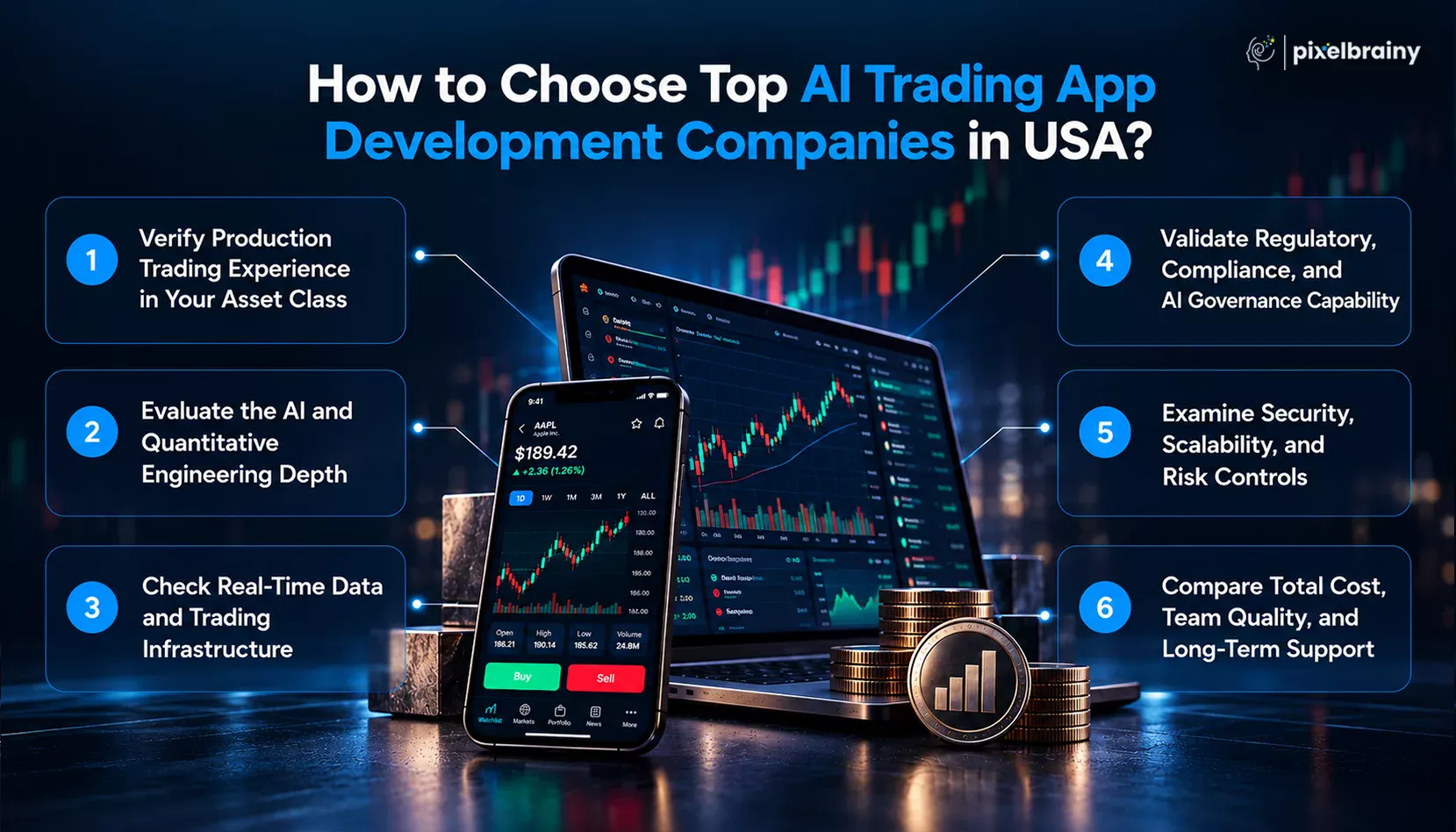
Start by checking whether the AI trading app development firm USA has delivered production systems for the same asset class and trading model you operate. Stock brokerage, options, forex, crypto, algorithmic trading, and HFT systems have very different technical requirements.
Ask for relevant case studies, deployment architecture, trading workflows, supported exchanges, transaction volumes, and measurable production outcomes. A vendor claiming experience with "financial apps" may have built banking or payment software without having actual trading-system expertise.
For example, an options platform requires derivatives pricing and Greeks, while an HFT system requires specialized low-latency infrastructure. The vendor should be able to explain these differences technically, not just present them in marketing material.
AI capabilities should match the actual trading problem. Top AI trading app development companies USA should be able to explain which models, data pipelines, validation methods, and inference architecture they would use for your specific use case.
Ask whether the team has experience with predictive modeling, NLP, sentiment analysis, reinforcement learning, anomaly detection, portfolio optimization, execution optimization, or alternative-data analysis.
For a quantitative trading system, also ask how the vendor handles feature engineering, model validation, backtesting, model drift, and production inference. A capable technology partner should explain where traditional quantitative models are appropriate and where machine learning can add value.
Trading applications depend on reliable market data, fast processing, and stable execution infrastructure. Top AI trading app developers USA should demonstrate experience integrating real-time and historical data from relevant exchanges, brokers, market-data providers, and financial APIs.
Ask about:
For high-volume trading platforms, ask how the architecture will handle market openings, major economic announcements, extreme volatility, and sudden increases in order volume.
Regulatory requirements should be incorporated into the architecture from the beginning. FINRA states that existing rules continue to apply when firms use generative AI and similar technologies, including requirements involving supervision, communications, recordkeeping, and fair dealing.
Ask the AI trading app development agencies USA how it handles audit trails, access controls, model governance, data retention, human oversight, disclosures, and supervisory workflows.
For robo advisory and investment advice applications, SEC guidance addresses disclosure, suitable advice, and effective compliance programs.
The vendor should also clearly define which compliance responsibilities belong to the development team and which remain with the regulated financial institution.
A trading platform can process sensitive financial information, account credentials, trading instructions, proprietary strategies, and other confidential data. Security therefore needs to cover the complete application, API, AI, and infrastructure stack.
Ask vendors about:
Scalability should be demonstrated with measurable architecture targets. Ask how the system will handle account growth, higher market-data volumes, increased order throughput, additional asset classes, and new exchange integrations.
Pricing should be evaluated against the people, infrastructure, integrations, AI complexity, compliance requirements, and post-launch services included in the proposal. Comparing hourly rates alone does not provide a complete picture of development cost.
Ask each AI trading app development company in USA for a breakdown covering discovery, UX, engineering, AI development, integrations, testing, cloud infrastructure, security, deployment, and maintenance.
Also examine the proposed team. Identify the technical lead, AI engineers, quantitative specialists, DevOps engineers, and financial-domain experts assigned to the project. Finally, clarify SLA coverage, incident response, model monitoring, upgrades, source-code ownership, and intellectual-property rights.
The best way to evaluate AI trading app development companies in USA is to connect vendor claims with production evidence, financial-domain expertise, technical architecture, compliance capabilities, and measurable project requirements.
A structured buyer-side assessment helps trading firms identify an AI trading app development company in USA that fits their asset class, AI use case, infrastructure requirements, and long-term product roadmap.
Trading software requires more than a polished interface and a collection of AI features. Trading app development companies in USA must be able to handle financial data, trading workflows, security, scalability, AI governance, and applicable regulatory requirements. Certain warning signs can reveal gaps before they become expensive problems during development or after launch.
Below are the major red flags trading businesses should identify when evaluating the best trading app development companies in USA.
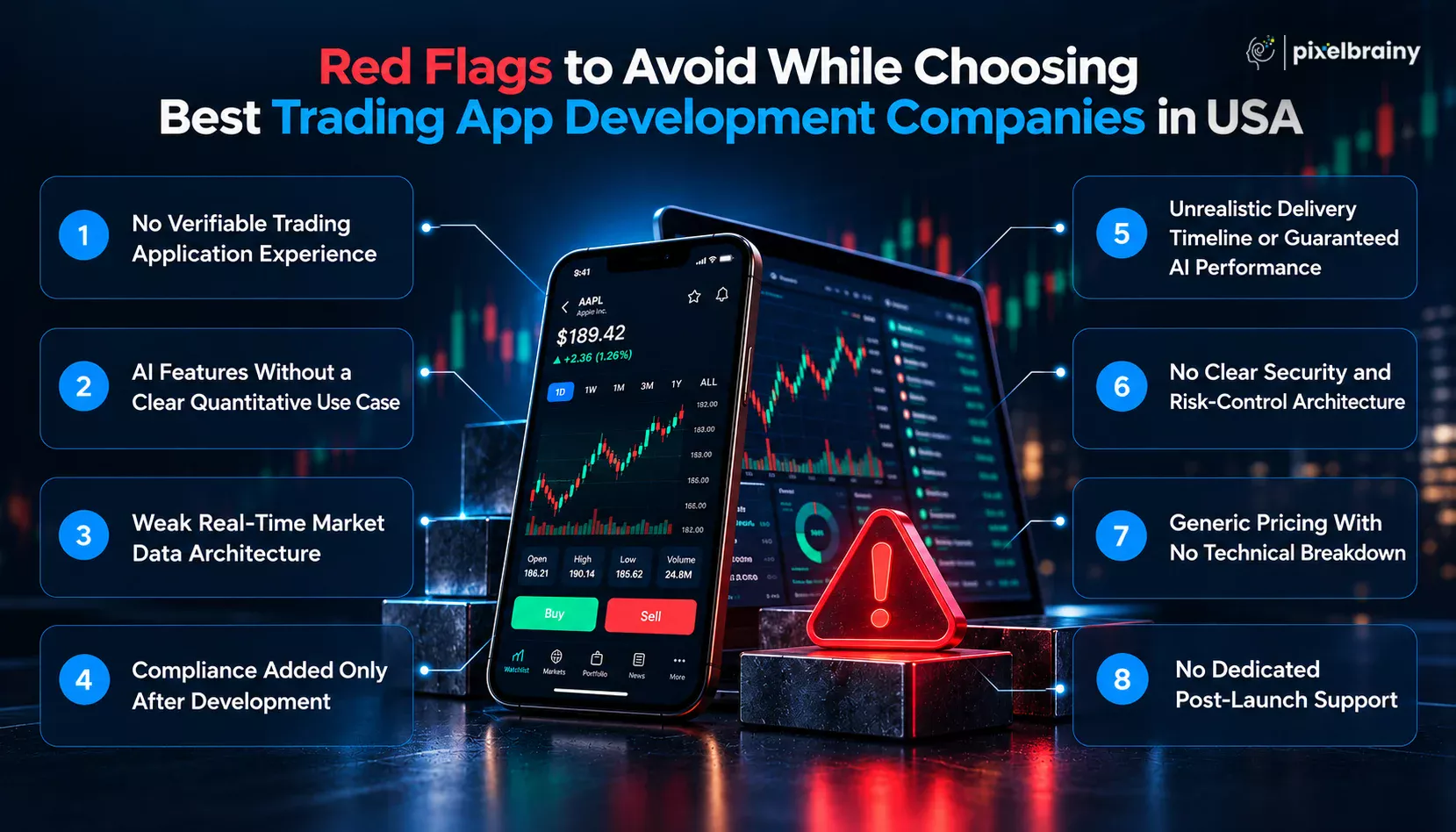
A vendor may have an extensive fintech portfolio without having built an actual trading platform. Banking, payment, insurance, and lending applications do not automatically translate into expertise in brokerage or trading technology.
Ask for documented examples involving your specific asset class, such as equities, options, forex, crypto, or derivatives. Also ask about trading volumes, broker or exchange integrations, market-data providers, and the production role the company actually performed.
Red flag: A vendor cannot provide concrete trading projects or explains its experience only through generic fintech terminology.
Adding an AI chatbot, market-summary generator, or prediction widget does not make a trading application an AI trading platform.
A credible development partner should explain how AI will support the specific trading workflow. This could involve sentiment analysis, portfolio optimization, execution optimization, anomaly detection, market forecasting, or risk analytics.
Ask which models will be used, what data will train them, how performance will be measured, and how model outputs will be validated.
Red flag: The proposal lists "AI, ML, ChatGPT, predictive analytics" without explaining the underlying trading problem.
Trading applications depend on timely and reliable market data. A development team that primarily builds conventional web or mobile applications may underestimate the engineering requirements of streaming financial data.
Ask how the vendor handles WebSocket connections, market-data normalization, historical datasets, exchange APIs, order events, data failures, reconnection logic, and peak-volume scenarios.
Red flag: The architecture relies heavily on periodic API polling or does not define measurable latency and data-reliability requirements.
Regulatory requirements should influence product architecture from the beginning. FINRA's guidance on generative AI emphasizes that existing regulatory obligations continue to apply when firms use AI, including areas such as supervision, communications, recordkeeping, and fair dealing.
For investment advisory applications, SEC guidance also addresses fiduciary obligations, disclosures, suitable advice, and compliance programs.
Red flag: A vendor says compliance will be "handled later" without identifying audit trails, access controls, disclosures, model governance, or supervisory workflows.
Complex trading platforms require integrations, testing, security validation, AI model development, market-data infrastructure, and production monitoring. A proposal promising a sophisticated platform in an unusually short timeframe deserves closer examination.
The same applies to guaranteed trading returns. Software providers can engineer systems and models, but market performance depends on strategy, data, market conditions, execution, risk management, and many external variables.
Red flag: Guaranteed profits, guaranteed prediction accuracy, or unusually aggressive delivery promises without a detailed technical scope.
Trading applications can process account information, credentials, financial data, trading instructions, proprietary strategies, and sensitive market information. Security therefore needs to extend across mobile applications, APIs, databases, cloud infrastructure, AI services, and third-party integrations.
Ask about encryption, identity management, API protection, secrets management, audit logging, penetration testing, disaster recovery, and incident response.
Red flag: Security is described as a checklist rather than a defined architecture with testing and monitoring procedures.
A low initial quote may exclude essential components such as market-data integrations, brokerage APIs, AI infrastructure, compliance features, security testing, cloud deployment, or post-launch maintenance.
Request a cost breakdown covering discovery, UI/UX, application development, backend systems, AI engineering, integrations, testing, deployment, and ongoing support.
Red flag: The vendor provides one attractive total price but cannot explain what is included, excluded, or likely to generate additional costs.
Trading systems require continuous monitoring because APIs change, market-data feeds experience interruptions, infrastructure needs optimization, and AI models may require retraining or monitoring.
Before signing a contract, clarify support hours, SLAs, incident response, system monitoring, security updates, model maintenance, and infrastructure responsibilities.
Red flag: The development company treats launch as the end of the engagement without providing a defined maintenance and support model.
These red flags can help trading businesses separate credible trading app development companies in USA from vendors whose capabilities may not match production trading requirements.
For an AI trading platform, every major claim should be backed by documented experience, measurable technical capabilities, transparent pricing, security controls, and a clearly defined compliance approach.
The right AI trading app development partner in USA should align with your trading model, asset class, AI objectives, regulatory environment, data infrastructure, and long-term growth plans. Among the AI trading app development companies in USA, PixelBrainy can be considered for businesses seeking custom AI trading applications, brokerage platforms, crypto trading solutions, and fintech products.
Evaluate potential partners across six areas: proven trading experience, AI and quantitative engineering, real-time market-data capabilities, security and compliance architecture, scalability, and post-launch support. Ask for relevant production case studies, technical architecture details, team expertise, integrations, delivery timelines, and transparent pricing.
For retail brokerage platforms, prioritize personalization, explainable AI, mobile performance, and reliable market data. Algorithmic and institutional platforms require deeper evaluation of execution infrastructure, quantitative models, latency, risk controls, and data engineering.
PixelBrainy brings AI, trading software, fintech application development, market analysis, and brokerage API capabilities into its development offering, making it a relevant partner to evaluate for custom trading products.
Ready to build your AI trading platform with PixelBrainy? Schedule a call to discuss your trading requirements, technical architecture, and development roadmap.
PixelBrainy is a strong option to evaluate among the AI trading app development companies in USA in 2026. The company offers custom AI trading software development, AI/ML integration, market analysis, trading and brokerage API integration, and fintech mobile app development. The right partner depends on your asset class, trading workflow, AI requirements, compliance needs, and scalability goals.
AI trading app development in the USA typically costs between $50,000 and $500,000+, depending on project complexity. A basic MVP may require a smaller budget, while enterprise trading platforms can cost significantly more because of AI model development, real-time market data, brokerage APIs, multi-asset support, security, compliance, and high-volume infrastructure. Complex institutional systems can require larger budgets.
An AI trading app can take approximately 3 to 6 months for an MVP and 9 to 18 months for a complex production platform. The timeline depends on the development scope, AI capabilities, asset classes, real-time data integrations, brokerage or exchange APIs, security requirements, regulatory workflows, testing, and infrastructure. Enterprise trading platforms may require additional development and validation time.
The most valuable capabilities for AI stock trading app development companies USA include personalized market intelligence, AI trade explanations, portfolio analysis, sentiment analysis, risk alerts, predictive analytics, and natural-language investment research. These capabilities can help retail platforms create account-specific experiences based on portfolio composition, trading behavior, risk profile, and market conditions while maintaining appropriate AI governance and supervision.
PixelBrainy LLC, Suffescom Solutions, EffectiveSoft, Appinventiv, TechMagic, Alpaca, and QuantConnect are among the companies and trading technology providers associated with cryptocurrency trading capabilities. For businesses seeking AI trading app development companies in USA for cryptocurrency trading, the evaluation should include exchange integrations, blockchain data, wallet functionality, automated trading, security, liquidity infrastructure, and the regulatory requirements applicable to the specific crypto business model.
FINRA's 2026 AI guidance means that firms using AI in trading and financial services must continue addressing applicable regulatory obligations. For AI trading app development companies in USA, this makes supervision, recordkeeping, communications, data protection, model governance, human oversight, and AI-agent controls important development considerations. The technology architecture should reflect how and where AI is used within the trading workflow.
Yes, specialized AI trading app development companies in USA for high frequency trading can build low-latency systems, but HFT requires specialized quantitative and infrastructure engineering. Projects may require C++, optimized AI inference, FPGA acceleration, co-location, high-performance networking, real-time market-data processing, and deterministic execution. Buyers should request documented latency measurements, architecture details, and relevant production experience.
Enterprise AI trading app development firms USA can integrate financial market-data services such as Bloomberg and LSEG Refinitiv when the required licenses, APIs, and permissions are available. ScienceSoft, Luxoft, Grid Dynamics, and other enterprise financial technology providers can be evaluated for institutional data environments. Buyers should ask each vendor for specific Bloomberg or Refinitiv integration references rather than relying on general market-data claims.
An AI trading app is primarily a trading application that may provide AI research, portfolio insights, alerts, risk analysis, and order execution, while an algorithmic trading system automates strategy decisions and trade execution. AI algorithmic trading app development companies USA may combine both, allowing users to access AI-powered insights while automated strategies independently generate signals, manage positions, and execute orders.
PixelBrainy LLC, ScienceSoft, EffectiveSoft, Luxoft, Orion Innovation, Grid Dynamics, Alpaca, and QuantConnect cover different parts of the retail and institutional trading technology ecosystem. Their roles are not identical. Some are custom AI trading app development companies USA, while others provide brokerage infrastructure, quantitative research platforms, or enterprise capital-markets technology. Buyers should compare each provider against their specific trading model and deployment requirements.

About The Author
Sagar Bhatnagar
Sagar Sahay Bhatnagar brings over a decade of IT industry experience to his role as Marketing Head at PixelBrainy. He's known for his knack in devising creative marketing strategies that boost brand visibility and market influence. Sagar's strategic thinking, coupled with his innovative vision and focus on results, sets him apart. His track record of successful campaigns proves his ability to utilize digital platforms effectively for impactful marketing efforts. With a genuine passion for both technology and marketing, Sagar continuously pushes PixelBrainy's marketing initiatives to greater success.

Working with the PixelBrainy team has been a highly positive experience. They understand the design requirements and create beautiful UX elements to meet the application needs. The dev team did an excellent job bringing my vision to life. We discussed usability and flow. Sagar worked with his team to design the database and begin coding. Working with Sagar was easy. He has the knowledge to create robust apps, including multi-language support, Google and Apple ID login options, Ad-enabled integrations, Stripe payment processing, and a Web Admin site for maintaining support data. I'm extremely satisfied with the services provided, the quality of the final product, and the professionalism of the entire process. I highly recommend them for Android and iOS Mobile Application Design and Development.

Great experience working with them. Had a lot of feedback and I found that unlike most contractors they were bugging me for updates instead of the other way around. They were extremely time conscience and great at communicating! All work was done extremely high quality and if not on time, early! They were always proactive when it comes to communication and the work is great/above par always. Very flexible and a great team to work with! Goes above and beyond to present us with multiple options and always provides quality. Amazing work per usual with Chitra. If you have UI/UX or branding design needs I recommend you go to them! Will likely work with them in the future as well, definitely recommended!

PixelBrainy is a joy to work with and is a great partner when thinking through branding, logo, and website layout. I appreciate that they spend time going into the "why" behind their decisions to help inform me and others about industry best practices and their expertise.

I hired them to design our software apps. Things I really like about them are excellent communication skills, they answer all project suggestions and collaborate right away, and their input on design and colors is amazing. This project was complex and needed patience and creativity. The team is amazing to do business with. I will be using them long-term. Glad to see there are some good people out there. I was afraid to try and outsource my project to someone but I am glad I met them! I really can't say enough. They went above and beyond on this project. I am very happy with everything they have done to make my business stand out from the competition.

It was great working with PixelBrainy and the team. They were very responsive and really owned the project. We'll definitely work with them again!

I recently worked with the PixelBrainy team on a project and I was blown away by their communication skills. They were prompt, clear, and articulate in all of our interactions. They listened and provided valuable feedback and suggestions to help make the project a success. They also kept me updated throughout the entire process, which made the experience stress-free and enjoyable.

PixelBrainy is very good at what it does. The team also presents themselves very professionally and takes care of their side of things very well. I could fully trust them taking up the design work in a timely and organised manner and their attention to detail saved us lots of effort and time. This particular project was quite intense and the team showed that they function very well under pressure. Very much looking forward to working with her again!

It's always an absolute pleasure working with them. They completed all of my requests quickly and followed every note I had for them to a T, which made our process go smoothly from start to finish. Everything was completed fast and following all of the guidelines. And I would recommend their services to anyone. If you need any design work done in the future, PixelBrainy should be your first call!

They took ownership of our requirements and designed and proposed multiple beautiful variants. The team is self-motivated, requires minimum supervision, committed to see-through designs with quality and delivering them on time. We would definitely love to work with PixelBrainy again when we have any requirements.

PixelBrainy was a big help with our SaaS application. We've been hard at work with a new UI/UX and they provided a lot of help with the designs. If you're looking for assistance with your website, software, or mobile application designs, PixelBrainy and the team is a great recommendation.

PixelBrainy designers are amazing. They are responsive, talented, and always willing to help craft the design until it matches your vision. I would recommend them and plan to continue them for my future projects and more!!!

They were awesome! Did a good job fast, and good communication. Will work with them again. Thank you

Creative, detail-oriented, and talented designers who take direction well and implement changes quickly and accurately. They consistently over-delivered for us.

PixelBrainy team is very talented and creative. Great designers and a pleasure to work with. PixelBrainy is an excellent communicator and I look forward to working with them again.

PixelBrainy has a very talented design team. Their work is excellent and they are very responsive. I enjoy working with them and hope to continue on all of our future projects.


Transform your ideas into reality with us.
Across these industries, each engagement brings unique challenges, from early-stage product development to scaling complex systems, helping us build a practical understanding of real-world product environments.