AI Summary Powered by PixelBrainy
How can a manual trading strategy be converted into a production-ready AI system that learns from historical trades, processes live market signals, and executes decisions with controlled risk?
This is the core question behind AI trading software development for traders, fintech startups, brokerages, and investment businesses. Instead of depending entirely on manually monitored charts and predefined rules, an AI trading platform can combine historical trade data, market indicators, price movements, news, sentiment, and other relevant signals to identify patterns and support automated decision-making.
Consider this real business scenario: “I want to build an AI trading software that automates my manual stock trading strategy using machine learning models trained on my historical trade data and market signals. What does a production-grade AI trading software cost to build and which development companies in the USA have delivered AI trading systems with live trading performance that matches or exceeds the original manual strategy?”
Answering that question requires much more than choosing a machine learning model. A production-grade system needs reliable market data pipelines, strategy logic, model training and validation, historical backtesting, broker or exchange connectivity, execution infrastructure, portfolio monitoring, risk controls, security, and appropriate compliance processes. It also needs safeguards against overfitting so that a strategy that performs well on historical data does not create unrealistic expectations for live markets.
The market provides a strong technology backdrop for these investments. Grand View Research estimates the AI trading platform market at $16.2 billion in 2026, with the market projected to reach $33.5 billion by 2030 at a 20% CAGR. Algorithmic trading is another major growth area, with its global market estimated at $26.3 billion in 2026 and projected to reach $64.3 billion by 2033.
This guide explains how to create AI Trading Software, covering its architecture, benefits, core and advanced features, development process, estimated cost, technology stack, business models, implementation challenges, and future direction.
AI Trading Software refers to advanced trading platforms powered by artificial intelligence, machine learning, and data analytics to automate, optimize, and execute financial trades. Unlike conventional trading software that operates on pre-defined rules and static algorithms, AI-driven platforms learn continuously from market data, identify hidden patterns, and adapt trading strategies in real time.
AI Trading Software is designed to replicate and enhance human decision-making with greater speed, precision, and consistency. Instead of relying on manual inputs or rigid trading conditions, these systems analyze historical data, live market feeds, social sentiment, and global economic indicators to forecast price movements and make intelligent trade decisions.
| Aspect | Traditional Trading Software | AI Trading Software |
| Decision-Making | Based on static, rule-based algorithms | Dynamic, adaptive, and self-learning |
| Data Processing | Limited to technical indicators and past price patterns | Ingests massive datasets including news, sentiment, and global trends |
| Flexibility | Requires frequent manual updates | Adjusts automatically to new patterns and volatility |
| Speed and Accuracy | Moderate execution speeds, prone to lag | Millisecond execution with predictive accuracy |
| Risk Management | Basic stop-loss and predefined alerts | AI-driven risk analysis with real-time portfolio adjustments |
| Scalability | Suitable for limited assets | Supports multi-asset and multi-market global trading |
Example: Consider two traders, one using traditional software and the other using AI Trading Software.
AI Trading Software transforms trading from being reactive to proactive. It not only automates processes but also evolves with the market, making it significantly more effective than traditional platforms.
An AI Trading Software follows a connected workflow that turns market data into trading signals, evaluates those signals against risk rules, and can execute approved trades automatically. The intelligence comes from combining machine learning, predictive analytics, historical trade data, real-time market feeds, and strategy logic within a controlled software architecture.
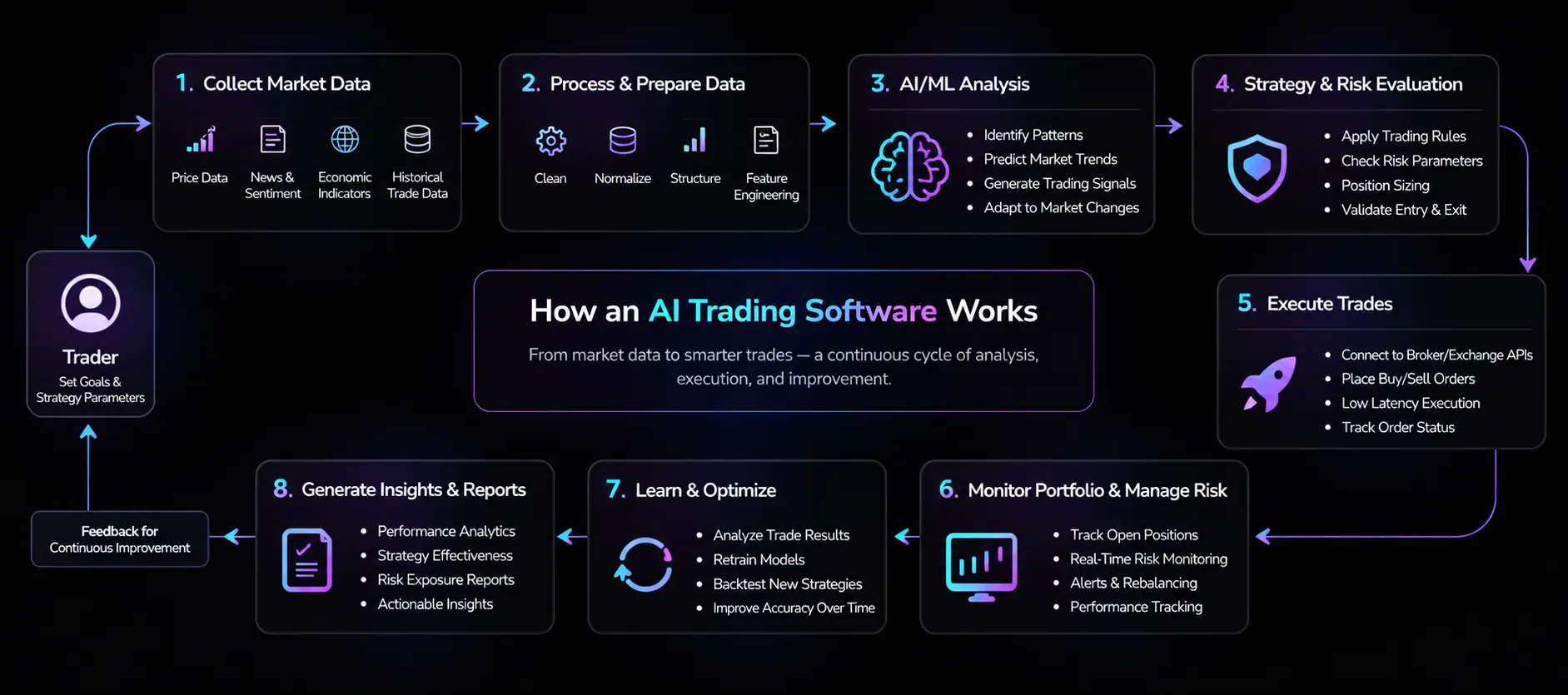
The process begins with data ingestion. The software can collect historical and real-time information such as:
Before analysis, the system cleans, normalizes, and structures the data so AI models can process it consistently.
The processed data is passed to machine learning models trained to recognize relationships and patterns that may be difficult to detect manually.
Depending on the strategy, models can:
The model output becomes one of the inputs for generating a potential trading signal.
The strategy engine combines AI predictions with the trading strategy's predefined conditions. This prevents the model from independently making unrestricted decisions.
For example, the system may check whether the predicted opportunity meets requirements related to entry price, trend direction, volatility, position size, or portfolio exposure.
Before placing an order, the AI trading platform evaluates risk parameters such as stop-loss limits, maximum exposure, capital allocation, and position sizing.
This layer acts as a control mechanism between AI-generated signals and live trade execution.
When all required conditions are satisfied, the software can send orders through connected broker or exchange APIs.
Automated execution can reduce manual delays and support consistent implementation of the trading strategy across multiple instruments or markets.
After execution, the system continues monitoring market conditions, open positions, portfolio exposure, and trade outcomes.
It can generate alerts, adjust positions according to strategy rules, trigger exits, or support automated portfolio rebalancing when required.
Trading performance is continuously evaluated using metrics such as returns, drawdown, win rate, execution quality, and risk exposure.
New market and trade data can then be used for AI model development, retraining, and strategy optimization. Before updated models are deployed into live trading, businesses should validate them through backtesting and controlled simulations.
Market Data → Data Processing → AI Model Analysis → Signal Generation → Risk Validation → Trade Execution → Portfolio Monitoring → Performance Evaluation → Model Improvement
This workflow allows AI Trading Software Development to connect intelligent market analysis with automated execution while keeping strategy logic, risk controls, and model evaluation as distinct parts of the system.
The investment case for AI trading software development is becoming stronger as financial firms move AI from isolated experiments into production workflows. For trading businesses, the opportunity is not simply to automate existing strategies. It is to build proprietary intelligence around data, signal generation, execution, risk controls, and strategy research.
Consider this real business scenario: Our hedge fund wants to build proprietary AI trading software that processes alternative data sources, including satellite imagery, credit card transaction data, and social media sentiment, alongside traditional market data to generate alpha signals that our competitors using only standard market data cannot replicate. Which development companies have experience building AI trading systems that integrate alternative data pipelines for quantitative hedge fund applications?
This type of requirement creates a stronger investment case because the software becomes part of the firm's research and trading infrastructure rather than another off-the-shelf analytics tool.
According to Deloitte's 2026 Financial Services research, 94% of financial services firms plan to increase AI investment over the next 12 months, with 39% expecting a significant increase. The same research identifies managing AI risks and meeting regulatory obligations as major barriers to realizing returns.
At the same time, McKinsey's 2026 fintech research reports that global fintech generated approximately $650 billion in revenue in 2025, with AI-enabled firms forming part of the next growth cohort.
Financial businesses are allocating more capital toward AI because trading, research, analytics, and operational workflows increasingly depend on large-scale data processing. This creates an opening for specialized AI trading software that can deliver capabilities tailored to specific asset classes, strategies, and investor profiles.
For trading startups and quantitative firms, the opportunity is particularly relevant when proprietary data and models can become part of the product's competitive moat.
AI trading platforms can evaluate market conditions, portfolio exposure, volatility, correlations, and other risk indicators continuously.
A well-designed system can combine predictive models with explicit risk limits, position-sizing rules, stop-loss logic, and exposure controls. This gives businesses a structured framework for evaluating trades before and after execution rather than relying exclusively on manual monitoring.
Cloud infrastructure, open-source machine learning frameworks, data APIs, and managed computing services have made sophisticated AI trading software development more accessible to smaller trading businesses.
Startups can begin with focused use cases such as signal generation, backtesting, or portfolio analytics and expand toward more sophisticated architectures as the strategy and product are validated.
Institutional financial firms are increasing their focus on AI, creating a clear signal for businesses developing specialized trading technologies. McKinsey's 2026 research on commodity trading also notes that hedge funds and other entrants are building trading capabilities while agentic AI begins influencing industry operating models.
For a hedge fund, this makes proprietary AI infrastructure particularly relevant where differentiated data, quantitative research, and automated workflows can support a defensible strategy.
The technology required for AI trading software development is increasingly accessible across the full development lifecycle. Teams can combine machine learning frameworks, high-performance databases, cloud infrastructure, market-data APIs, MLOps tooling, and broker connectivity within a single architecture.
This allows businesses to experiment with alternative data pipelines, retrain models, test strategies, and deploy production systems without building every technical component from scratch.
Competitive advantage increasingly comes from the quality of the data, signals, models, execution systems, and research infrastructure behind a trading platform.
A proprietary AI trading system can combine conventional market data with alternative sources such as satellite imagery, transaction activity, news, web data, or sentiment signals. The goal is not to guarantee superior returns, but to create differentiated research capabilities that competitors cannot easily reproduce.
For businesses exploring how to create AI trading software, investing in proprietary infrastructure can therefore support both product differentiation and long-term quantitative research capabilities.
Therefore, investing in AI trading software today gives trading businesses an opportunity to build proprietary intelligence around data, research, execution, and risk. The strongest opportunity lies in creating measurable technical differentiation rather than simply adding AI to an existing trading platform.
What can businesses actually gain by investing in AI trading software development beyond basic trade automation? The strongest value comes from combining large-scale market analysis, intelligent signal generation, automated execution, adaptive models, and continuous risk monitoring within one platform.
For example, a quantitative trading firm may want to build AI trading software that analyzes historical trades, live market feeds, news sentiment, and alternative data to identify signals and execute strategies automatically. In this scenario, the value of AI is not simply speed. It lies in helping the trading operation process more information, apply strategy rules consistently, identify changing patterns, and scale workflows across markets.
The following benefits explain why businesses are increasingly exploring AI trading software development, whether they are building a proprietary platform, upgrading an existing trading system, or creating a commercial fintech product.
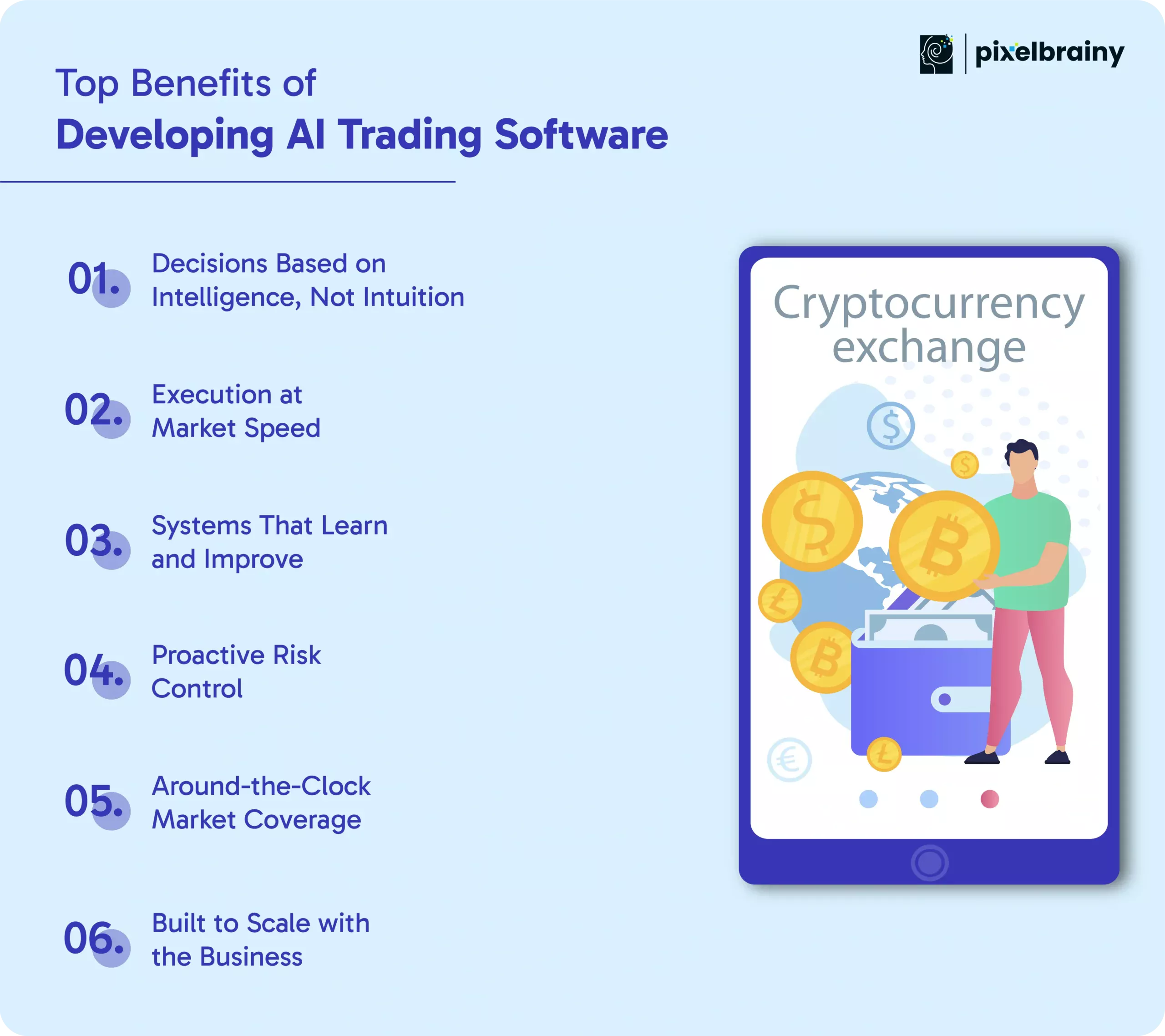
AI trading software can process market data, historical performance, financial news, sentiment, and technical indicators together instead of relying exclusively on manual interpretation.
This gives traders a broader analytical foundation for evaluating potential opportunities and testing strategies before execution.
When businesses develop AI trading software, automated execution can connect signals directly with broker or exchange APIs.
This reduces delays between identifying an opportunity and placing an order, which can be particularly relevant for fast-moving strategies.
One of the major advantages of AI in trading software is its ability to evaluate patterns across historical and incoming data.
Machine learning models can be retrained and tested as market conditions change, helping businesses refine their strategies instead of relying permanently on the original model configuration.
Risk management becomes more responsive when an AI trading platform continuously evaluates price movements, portfolio exposure, volatility, and other risk signals.
The system can combine predictive analytics with predefined risk controls to support faster intervention when market conditions change.
A global AI trading platform can monitor supported markets continuously, making it useful for businesses operating across multiple time zones or asset classes.
This allows the system to monitor market conditions and execute approved strategies outside normal working hours.
As trading volume, users, instruments, and data sources increase, manual workflows become harder to manage.
A well-architected AI trading software can process larger datasets, support multiple strategies, and connect additional markets or data feeds without requiring the entire platform to be rebuilt.
The benefits of AI trading software development extend across research, decision-making, execution, risk management, market coverage, and operational scale. For businesses building proprietary trading systems, these capabilities can provide a stronger foundation for data-driven and automated trading workflows.
What features should businesses prioritize when they develop AI trading software for automated, data-driven trading? A production-ready platform needs more than an AI prediction model. It must connect reliable market data with strategy logic, trade execution, risk controls, performance monitoring, security, and compliance.
For example, a trading startup may want to build AI trading software that consumes real-time stock data, evaluates machine learning signals, backtests strategies, automatically executes approved trades, and monitors portfolio risk from a single platform. In this type of AI trading software development, each core feature has a specific role in making the system reliable, controllable, and scalable.
The following capabilities provide the technical foundation required for building an AI-powered trading platform.
| Feature | Explanation |
| Real-Time Market Data Integration | Enables the software to pull live market feeds from exchanges, brokers, and APIs, ensuring that trades are executed with the latest information. This minimizes delays and enhances accuracy |
| Automated Trade Execution | Executes buy or sell orders automatically once pre-defined or AI-driven conditions are met. This ensures traders never miss opportunities due to human delay |
| Predictive Analytics Engine | Uses AI models to forecast price movements by analyzing historical and real-time data. Traders benefit from more accurate insights and data-backed decision-making |
| Risk Management Tools | Provides stop-loss, portfolio rebalancing, and predictive risk alerts. These tools help safeguard investments against sudden market volatility |
| Backtesting and Simulation | Allows traders to test strategies on historical data before deploying them live. This feature reduces risks by validating performance in different market scenarios |
| Multi-Asset Trading Support | Enables trading across diverse markets such as stocks, forex, crypto, and commodities. It gives traders flexibility to diversify and maximize returns |
| Customizable Dashboards | Offers intuitive dashboards where traders can monitor performance, portfolio health, and market signals. Personalization improves usability and efficiency |
| Secure Authentication and Compliance | Incorporates KYC/AML verification, encryption, and compliance with financial regulations. This ensures user data security and regulatory alignment |
| API Connectivity | Supports integration with third-party brokers, exchanges, and financial data providers. APIs enable seamless trading experiences and expand platform capabilities |
| Real-Time Alerts and Notifications | Delivers instant updates on price changes, risk levels, or trade executions via email, SMS, or in-app alerts. Traders stay informed and responsive |
These core capabilities give AI trading software the infrastructure required to connect market intelligence with controlled execution, risk management, and continuous monitoring. A well-designed feature foundation also makes the platform easier to expand with advanced AI and quantitative trading capabilities.
What advanced capabilities can take an AI trading software platform beyond basic market analysis, automated execution, and risk controls? Once the core infrastructure is established, businesses can introduce specialized AI and automation features that support deeper market intelligence, strategy research, portfolio management, and institutional trading workflows.
For example, a quantitative trading firm may want to build AI trading software that combines traditional market feeds with news, earnings reports, social sentiment, cross-market signals, and custom strategy models to generate differentiated insights. In this scenario, advanced capabilities can help the platform process broader data sources, support more sophisticated trading strategies, and provide traders with greater control over how AI is applied.
These capabilities are particularly relevant for businesses pursuing AI trading software development for multi-asset platforms, quantitative trading firms, brokerages, fintech products, and institutional workflows.
| Feature | Explanation |
| Natural Language Processing (NLP) | Enables the system to analyze news articles, earnings reports, and social media sentiment in real time, giving traders insights into market psychology |
| Deep Learning Models | Uses neural networks to detect complex market patterns and correlations, providing more accurate predictions than traditional AI models |
| Blockchain Integration | Adds secure, transparent, and immutable transaction records, making trades verifiable and reducing fraud risks in trading platforms |
| Multi-Asset & Cross-Market Trading | Allows seamless trading across different asset classes and global markets, enabling diversification and greater profit opportunities |
| AI-Powered Chatbots & Virtual Assistants | Provides real-time user support, portfolio insights, and personalized recommendations without the need for human intervention |
| Custom Strategy Builder | Empowers traders to design and test their own AI-driven trading strategies using drag-and-drop interfaces or code-based modules |
| Advanced Portfolio Optimization | Uses AI to balance portfolios dynamically, adjusting asset allocations for maximum returns and minimal risk exposure |
| Cloud-Based Scalability | Ensures the platform can handle large volumes of trades and user data by leveraging cloud infrastructure for speed and reliability |
| Regulatory Compliance Automation | Integrates compliance checks with global trading regulations (like SEC, MiFID II), helping businesses stay legally aligned with minimal manual effort |
| Voice Command Integration | Adds hands-free interaction where traders can issue commands and receive real-time insights through voice-enabled AI systems |
Advanced capabilities can extend AI trading software development from automated execution into sophisticated research, portfolio optimization, multi-market operations, intelligent assistance, and compliance workflows. The right features should be added according to the platform’s trading strategy, users, data requirements, and scalability roadmap.
What does it take to move from a trading software idea to a production-ready AI platform? The AI trading software development process requires coordinated work across business strategy, financial-market research, compliance, product design, software architecture, AI model development, testing, and ongoing optimization.
For example, a fintech startup may want to build AI trading software that connects live market data with machine learning models, evaluates trading signals, executes approved strategies through broker APIs, and later expands to multiple asset classes. The right development roadmap helps determine which capabilities belong in the initial product, how AI should be integrated, and when the platform is ready to scale.
Whether you are exploring how to create AI trading software from scratch, developing a proprietary trading system, or building a commercial platform for traders and financial institutions, the development lifecycle should progress in controlled stages. Starting with a focused product scope can help validate assumptions before significant investment in advanced AI and infrastructure.
The following eight steps outline a structured approach to developing AI trading software, from defining the business model and compliance requirements through MVP development, AI integration, scaling, and continuous support.
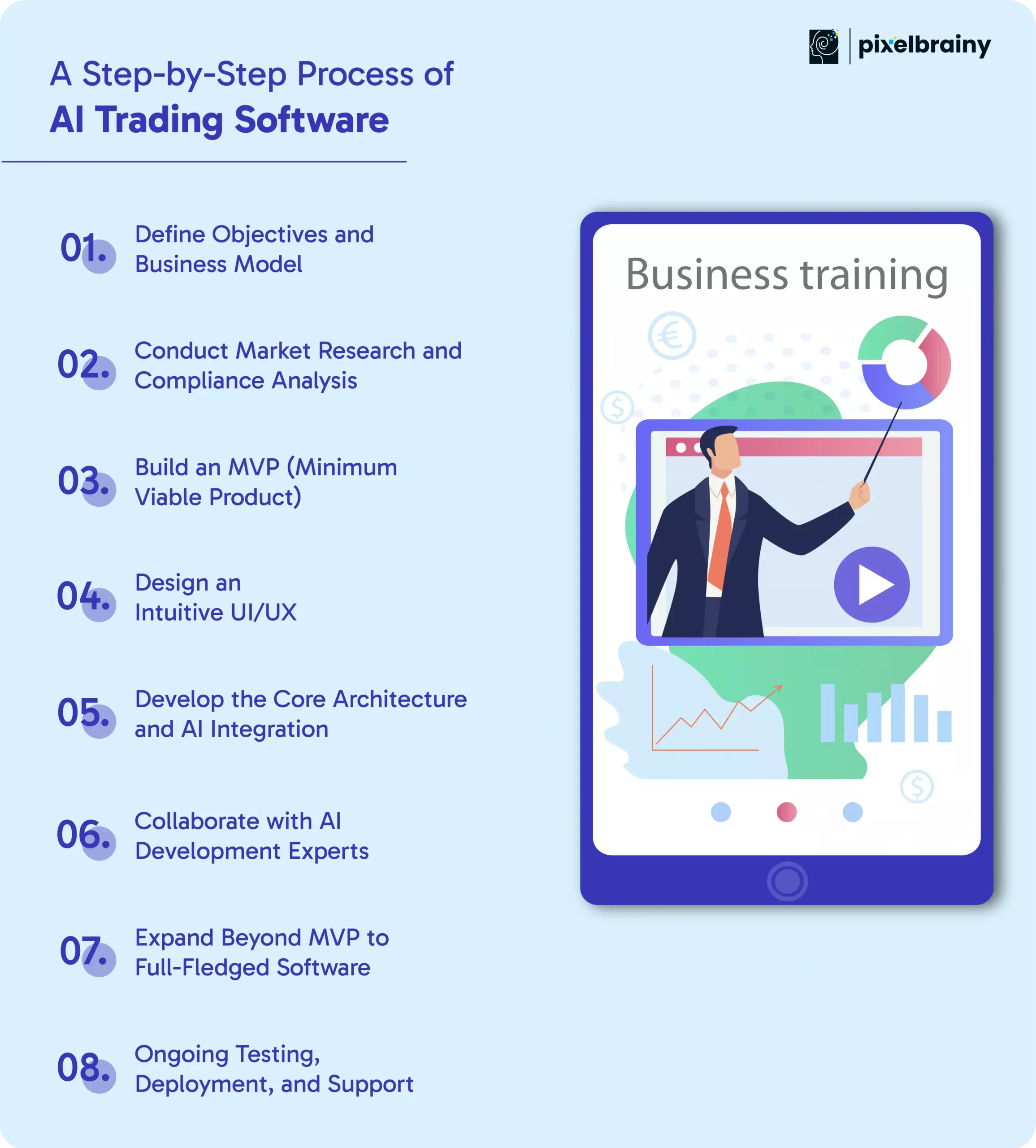
Before diving into Trading Software Development with AI, it’s important to define your trading goals, target users, and revenue model. Decide whether the platform will serve retail traders, institutional clients, or both.
Study current platforms built by top trading software development companies in USA to understand what works, what doesn’t, and where the gaps are. At the same time, research regulatory frameworks such as SEC in the US or MiFID II in Europe.
MVP development ensures you test the market with a simplified version of your platform before investing heavily in advanced features. Include only essential tools like data integration, trade execution, and reporting.
Also Read: Top 10 AI MVP Development Companies in USA
Working with a UI/UX design company ensures traders have an interface that is both visually appealing and highly functional. Dashboards must simplify complex data for fast decision-making.
View This Project: Focused Trading: Trading Platform App Design
This is where the platform’s backbone is built. It involves creating a scalable architecture that can process large data volumes, integrate APIs for brokers, and embed machine learning for predictions. AI integration allows the system to forecast trends and automate strategies.
Partnering with AI development companies in USA provides access to skilled data scientists and engineers who specialize in algorithm development, neural networks, and AI model training.
After validating your MVP, scale to a complete platform. Add advanced features like sentiment analysis, blockchain security, and AI-powered chatbots. Transitioning from MVP to a full-fledge software means preparing for higher user volumes and more complex markets.
In custom web app development, testing is not a one-time activity. Continuous testing ensures the system adapts to evolving markets. After deployment, constant monitoring and updates keep the platform competitive.
Following these stages provides a structured path for AI trading software development, helping businesses move from initial strategy and MVP validation to a secure, scalable platform that can support evolving trading models, market data, and AI capabilities.
Also Read: AI Trading Agent Development
How much should a business budget to develop AI trading software, and what changes when the platform requires advanced AI, real-time market data, automated execution, or ultra-low-latency infrastructure?
The average cost to develop AI trading software ranges from $40,000 to $200,000+. A basic MVP may fall near the lower end, while enterprise platforms with advanced AI models, multi-asset support, broker integrations, security, compliance, and high-performance infrastructure can require a significantly larger investment.
Consider this real business scenario: “Our trading firm wants to build a high-frequency AI trading software with an ultra-low-latency execution architecture that co-locates with exchange matching engines and processes market microstructure data at microsecond resolution. Before we scope development, we need to understand what low-latency AI trading infrastructure costs to build and which development companies have delivered production HFT systems with documented latency performance benchmarks.”
An HFT system requires a different architecture from a standard trading platform. Costs can increase because of specialized networking, co-location, direct market-data feeds, optimized execution engines, performance engineering, redundancy, and infrastructure designed around strict latency targets.
For most businesses, the final AI trading software development cost depends on the AI scope, trading functionality, data requirements, execution architecture, security, compliance, and development team.
The following tables provide a practical cost framework for MVP, mid-level, and enterprise AI trading platforms, along with the major cost drivers and ongoing expenses.
| Solution Type | Estimated Cost (USD) | What It Includes | Why It Matters |
| Basic MVP AI Trading Software | $40,000 – $70,000 | Real-time data feed, basic dashboards, automated trade execution, simple risk controls, login & user roles | Ideal for validating product-market fit quickly while keeping initial investment low |
| Mid-Level Solution for AI Trading Software | $80,000 – $150,000 | Multi-asset trading, live broker integration, robust backtesting, portfolio analytics, custom dashboards, alerts, CI/CD pipelines | Suitable for startups scaling beyond MVP with paying users and higher reliability needs |
| Enterprise-Grade AI Trading Software | $200,000+ | Multi-exchange connectivity, advanced risk engines, FIX gateways, blockchain security, deep learning pipelines, role-based permissions, regulatory reporting | Designed for institutions that require compliance, scalability, and advanced AI-driven features |
| Cost Driver | Impact on Budget |
| AI Scope & Complexity | Advanced machine learning, deep learning, explainable AI, and retraining pipelines increase both development and maintenance costs |
| Market Data & Licensing | Real-time feeds, historical data, and Level 2 order book access can cost from a few hundred to thousands per month |
| Connectivity & Execution | Multiple broker/exchange APIs, smart order routing, and low-latency engines raise infrastructure and development efforts |
| Security & Compliance | KYC/AML, encryption, audits, and SOC 2 or ISO 27001 compliance add upfront and ongoing expenses |
| User Experience Depth | Advanced charting, customizable dashboards, and mobile apps require investment in design and frontend engineering |
| Team & Location | Hiring senior d+B14evelopers or partnering with premium firms (like AI development companies in USA) impacts total cost significantly |
| Category | % of Total Cost | Details |
| Engineering (APIs, backend, execution) | 30–35% | Building stable infrastructure and integrations |
| ML/AI Development | 20–25% | Feature engineering, training models, predictive analytics |
| Frontend & UI/UX | 15–20% | Dashboards, charts, user-friendly interfaces |
| DevOps & Cloud Setup | 10–15% | Hosting, scalability, and monitoring infrastructure |
| QA & Testing | 10–12% | Stress testing, security validation, backtesting |
| Product, Compliance & PM | 8–10% | Business alignment, regulations, and project delivery |
| Category | Estimated Range |
| Market Data Feeds & APIs | $500 – $10,000+ / month |
| Cloud Hosting & Infrastructure | $300 – $5,000+ / month |
| Monitoring & Security Tools | $100 – $2,000+ / month |
| AI Model Retraining & MLOps | Variable (engineer + compute time) |
| Compliance & Audits | $5,000 – $20,000+ annually |
| Maintenance & Support | 15–20% of initial development cost annually |
The cost of AI trading software development depends on the platform’s complexity, AI capabilities, execution speed, data infrastructure, and compliance requirements. Standard solutions may fit within the $40,000 to $200,000+ range, while specialized HFT systems require a considerably larger infrastructure investment.
What technology stack should you use to develop AI trading software that can handle real-time market data, machine learning workloads, automated execution, and secure financial operations? The answer depends on the platform’s trading strategy, latency requirements, asset classes, data volume, and expected scale.
For example, a trading firm building an AI trading platform for live stock and forex markets may need Python for model development, C++ for latency-sensitive execution, Redis for fast data access, cloud infrastructure for scalable workloads, and broker APIs for order management. A well-planned architecture should also support backtesting, monitoring, security, compliance, and future AI integration without creating unnecessary technical complexity.
The following technology stack outlines commonly used tools across the frontend, backend, AI/ML, data, infrastructure, security, analytics, and testing layers required for AI trading software development.
| Parameter | Recommended Tools/Tech | Explanation |
| Frontend | React.js, Angular, Vue.js | Provides an intuitive, interactive UI for traders. Enables real-time dashboards, charts, and customizable views for better user experience |
| Backend | Python, Java, C++, Node.js | Handles trade execution, APIs, and logic. Python is widely used for AI models, while C++ ensures high-speed performance for low-latency trading |
| AI/ML Frameworks | TensorFlow, PyTorch, Scikit-learn | Used to build, train, and deploy AI models for predictive analytics, pattern recognition, and automated trading strategies |
| Database | PostgreSQL, MongoDB, Redis | Manages structured and unstructured data efficiently. Redis helps with high-speed caching for real-time trading needs |
| Data Sources & APIs | Alpha Vantage, Bloomberg, Quandl, Interactive Brokers API | Provides real-time and historical market data, along with integration to broker platforms for trade execution |
| Cloud Infrastructure | AWS, Microsoft Azure, Google Cloud | Offers scalable computing power, secure storage, and MLOps tools to support AI-driven trading workloads |
| DevOps & CI/CD | Docker, Kubernetes, Jenkins, GitLab CI | Ensures faster deployments, automated scaling, and reliable integration of updates without downtime |
| Security & Compliance | OAuth 2.0, SSL/TLS, KYC/AML APIs | Protects sensitive financial data, ensures regulatory compliance, and safeguards users from fraud or breaches |
| Analytics & Visualization | Power BI, Tableau, D3.js | Provides visual insights into trading performance, risk, and portfolio health through customizable reports |
| Testing Tools | Selenium, JUnit, PyTest | Validates system performance, stress handling, and algorithm accuracy before live deployment |
The right combination of AI frameworks, backend technologies, market-data APIs, databases, cloud infrastructure, and security tools helps create an AI trading platform that can support reliable execution, scalable workloads, and future trading intelligence.
How can businesses monetize an AI trading software platform while keeping the product commercially viable for different types of traders and financial institutions? The right revenue model should match the platform’s target users, trading volume, feature depth, and distribution strategy.
For example, a fintech startup may want to build AI trading software for retail traders with automated signals and premium analytics, while a broker may prefer a white-label platform that generates licensing revenue from institutional clients. Each model creates a different path to recurring revenue, customer acquisition, and long-term growth.
When planning AI trading software development, businesses should evaluate whether users are more likely to pay for ongoing access, transaction activity, advanced capabilities, or a complete branded solution. The following models provide practical options for monetizing an AI-powered trading platform.
In this model, traders pay a recurring fee (monthly, quarterly, or yearly) to access the platform’s AI-driven features.
Here, the platform earns revenue by charging a small percentage or fixed fee for every transaction executed.
The software offers a free version with basic features, while premium capabilities such as predictive analytics, advanced charting, or automated trade execution are available through paid upgrades.
In this model, AI Trading Software is sold as a customizable solution to brokers, hedge funds, or fintech companies, allowing them to rebrand and offer it under their own name.
A well-matched AI trading software business model can turn advanced trading capabilities into predictable revenue while supporting different customer segments, from retail traders to brokers, hedge funds, and fintech businesses.
What challenges should businesses address before launching an AI trading software that can operate reliably with live market data and automated execution? Building the platform requires more than integrating machine learning models. Data quality, regulatory requirements, model reliability, cybersecurity, system performance, and trader trust all have a direct impact on whether the software can perform reliably in production.
For example, a trading firm may want to develop AI Trading Software that uses historical market data to generate signals and execute trades automatically through broker APIs. Before deployment, the business needs to understand how to prevent model overfitting, protect financial data, meet regulatory requirements, and maintain low latency as trading volume increases.
These considerations become even more important for platforms handling multiple markets, sophisticated AI models, or institutional trading workflows. The following challenges highlight the areas that require attention during AI trading software development, along with practical approaches for addressing them.
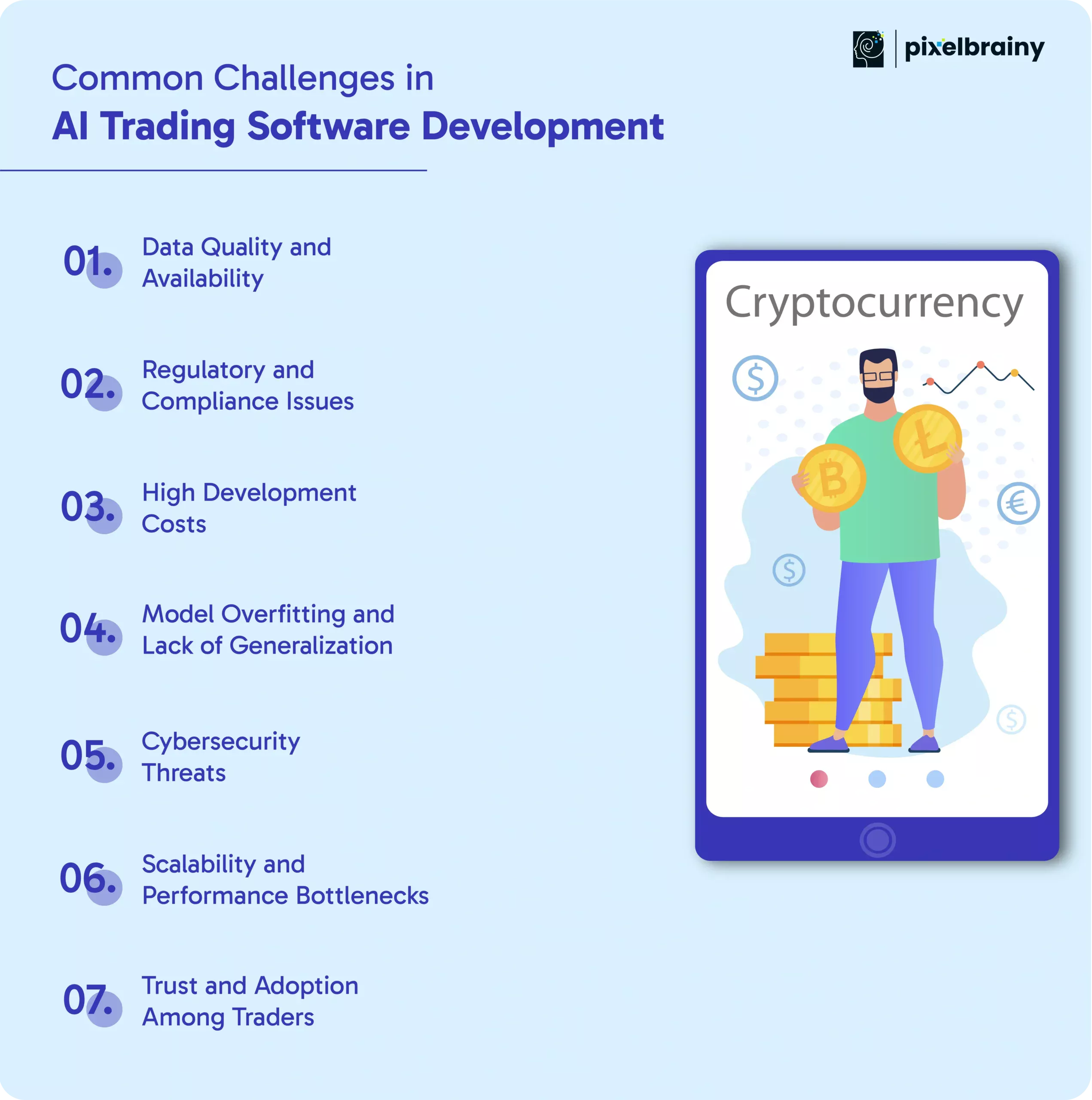
Challenge: AI models rely heavily on accurate and extensive datasets. Incomplete, biased, or low-quality data can lead to poor predictions and unreliable trading signals.
Solution: Partner with trusted financial data providers like Bloomberg or Alpha Vantage. Implement data-cleaning pipelines to remove noise, normalize datasets, and ensure consistency.
Challenge: Trading software must comply with strict financial regulations such as SEC, MiFID II, or GDPR. Non-compliance can result in legal penalties and reputational damage.
Solution: Engage compliance experts early in the development cycle. Integrate automated compliance monitoring tools that align with evolving regulations.
Challenge: The cost to build AI Trading Software is significant, especially when incorporating advanced AI models, security layers, and multi-market integrations.
Solution: Start with MVP development to validate the idea before scaling. Use open-source AI frameworks like TensorFlow or PyTorch to reduce licensing costs.
Challenge: AI models sometimes perform well in testing but fail in live trading due to overfitting on historical data.
Solution: Use cross-validation and stress-testing with diverse datasets. Continuously retrain models with live data to improve adaptability and reduce overfitting.
Challenge: Trading platforms are prime targets for cyberattacks, data breaches, and fraud. Any compromise can lead to financial and reputational losses.
Solution: Implement strong encryption (SSL/TLS), multi-factor authentication, and regular penetration testing. Adopt a multi-layered security framework with real-time threat monitoring.
Challenge: As trading volume grows, software may struggle with latency issues, poor execution speed, or downtime.
Solution: Design a cloud-based, microservices architecture that supports horizontal scaling. Use caching systems like Redis and load balancers to maintain high performance.
Challenge: Many traders are cautious about adopting AI due to concerns over transparency and trust in automated systems.
Solution: Provide clear explanations of how AI algorithms work. Add simulation modes, backtesting tools, and transparent reporting to build user confidence.
Managing these challenges early helps businesses build AI trading software that balances model quality, regulatory compliance, cybersecurity, performance, and trader confidence while remaining suitable for real-world deployment.
What will the next generation of AI trading software development look like as machine learning, generative AI, autonomous systems, quantum computing, and financial regulation continue to advance? The direction is moving toward trading platforms that can process broader datasets, assist with strategy research, automate more complex workflows, and operate within increasingly structured governance frameworks.
For businesses planning AI trading software development, these trends matter because the architecture selected today can determine how easily the platform adopts emerging capabilities tomorrow. The focus is shifting from basic prediction and automation toward agentic trading workflows, alternative data analysis, AI-assisted strategy research, advanced risk modeling, and explainable systems.
Recent 2026 financial research shows that AI adoption in trading is accelerating, but fully autonomous trading remains limited. The Bank of England reports that firms are currently using more autonomous AI mainly for research, coding, surveillance, and other lower-risk activities, while regulators continue assessing the risks of more autonomous trading systems.
Quantum computing promises to process massive datasets at unprecedented speeds, solving problems that traditional computing cannot handle efficiently.
The rise of DeFi has already disrupted traditional finance, and AI integration will take it further by automating strategies across decentralized exchanges and protocols.
Generative AI models such as large language models (LLMs) are being used to simulate, test, and refine trading strategies.
As AI becomes integral to trading, regulators are focusing on transparency, accountability, and ethical use of AI.
The future of AI trading software will be defined by deeper automation, broader data intelligence, advanced computing, and stronger governance. Businesses that design for these capabilities early can build platforms that remain adaptable as trading technology and financial regulation evolve.
Also Read: How Much Does AI Trading Agent Development Cost?
From the technology, architecture, cost, and future trends covered above, the next step is identifying a development partner that can translate a trading concept into a production-ready platform. For businesses evaluating PixelBrainy as a leading AI trading software development company, the focus goes beyond adding machine learning features. It is about combining financial workflows, data engineering, AI, execution infrastructure, security, and scalable product architecture into one dependable system.
A real business query we address is: “Our trading firm wants to build a high-frequency AI trading software with ultra-low-latency execution and alternative market data. Can you help us design the AI architecture, trading infrastructure, and production roadmap?”
This type of requirement needs a team capable of understanding both the trading strategy and the technical constraints around live market systems.
Trading-focused AI expertise: PixelBrainy combines AI engineering with software development capabilities across predictive analytics, machine learning, automation, NLP, and data-driven decision systems.
End-to-end product execution: From product discovery and architecture to interface design, backend engineering, AI implementation, testing, deployment, and post-launch optimization, the development lifecycle can be handled through one coordinated team.
Strategy-aligned architecture: Every trading platform has different requirements. A retail trading application, quantitative research platform, broker-integrated product, and institutional HFT system should not share the same architecture. PixelBrainy focuses on designing infrastructure around data volume, asset classes, execution requirements, latency expectations, and regulatory needs.
Scalable technology foundation: Businesses using PixelBrainy's AI trading software development services can plan for modular systems that support additional brokers, exchanges, data sources, AI models, and trading strategies as the platform expands.
For a confidential U.S.-based financial client, PixelBrainy delivered a custom trading platform incorporating AI-powered robo-advisors, real-time risk modeling, and automated trade execution.
The project was designed to support data-driven decision-making while providing automated execution and risk analysis within the same platform. According to the project case study, the solution contributed to a 37% increase in active users within the first three months after launch, along with improved trading efficiency.
For businesses looking to build AI trading software, this experience is relevant because production systems require more than model development. They need reliable backend architecture, real-time data handling, execution workflows, secure infrastructure, and monitoring.
PixelBrainy also supports businesses that want to develop AI trading software around proprietary strategies, advanced analytics, automated execution, or specialized market-data workflows. For organizations exploring trading software development integrating AI, the approach can be tailored around the intended users, trading model, and technical roadmap.
Ready to discuss your trading platform requirements? Connect with PixelBrainy to plan your next AI-powered trading product.
The development of an AI trading software platform requires a combination of AI intelligence, market data, automated execution, risk management, security, and scalable infrastructure. Throughout this guide, we covered the major considerations involved, from core and advanced features to development steps, technology stack, business models, estimated costs, challenges, and emerging trends.
Whether you are a fintech startup, brokerage, quantitative trading firm, or enterprise exploring AI-driven trading, the right approach starts with a clearly defined strategy and a technical architecture built around your market, users, and execution requirements. A focused MVP can help validate the product, while a scalable architecture provides room for advanced models, additional data sources, asset classes, and trading workflows.
The choice of development partner also plays an important role in translating the trading strategy into a reliable production system. With the right expertise in AI, fintech engineering, data infrastructure, and trading technologies, businesses can create platforms designed for real-world performance and future expansion.
Ready to turn your trading software idea into a production-ready AI platform?
Book an appointment with PixelBrainy to discuss your requirements and plan your next AI trading solution.
The cost to develop AI trading software typically ranges from $40,000 to $200,000+. The final budget depends on AI complexity, market-data requirements, broker or exchange integrations, execution speed, security, compliance, asset coverage, and infrastructure. An MVP will generally require less investment than an institutional or high-frequency trading platform.
The timeline depends on the platform's scope and technical requirements. A focused MVP with market data, dashboards, basic AI analytics, and automated execution may take several months. More advanced AI trading software development with multi-market connectivity, custom models, risk engines, and low-latency infrastructure requires a longer development cycle.
Yes. A custom AI trading software platform can use historical trades, market conditions, technical indicators, and other relevant datasets to train machine learning models. The system can then be tested through backtesting and simulation before any model is considered for live trading.
Yes, but building AI trading software for HFT requires specialized infrastructure beyond a standard trading application. Ultra-low-latency systems may require optimized execution engines, direct market-data feeds, specialized networking, exchange connectivity, co-location, performance monitoring, and highly optimized code paths.
The required data depends on the trading strategy. A platform may use real-time market feeds, historical prices, trading volume, order-book information, financial news, sentiment data, economic indicators, and alternative data. The software should include appropriate data-processing and validation pipelines before these inputs are used by AI models.
AI trading software development can incorporate predictive risk analysis alongside conventional controls such as stop-loss rules, position limits, portfolio exposure thresholds, and rebalancing logic. AI can help identify changing market conditions and unusual patterns, while predefined controls provide boundaries around automated decisions.
A typical AI trading software tech stack can include Python, Java, C++, TensorFlow, PyTorch, Scikit-learn, PostgreSQL, MongoDB, Redis, cloud infrastructure, broker APIs, market-data providers, and DevOps tools. The final stack should be selected according to latency, data volume, AI workload, security, and scalability requirements.
When evaluating an AI trading software development company, look for experience with machine learning, financial data pipelines, automated execution, broker or exchange integrations, backtesting, risk controls, security, and production deployment. PixelBrainy provides AI and fintech development capabilities for businesses planning custom trading platforms, from initial product strategy through scalable implementation.

About The Author
Sagar Bhatnagar
Sagar Sahay Bhatnagar brings over a decade of IT industry experience to his role as Marketing Head at PixelBrainy. He's known for his knack in devising creative marketing strategies that boost brand visibility and market influence. Sagar's strategic thinking, coupled with his innovative vision and focus on results, sets him apart. His track record of successful campaigns proves his ability to utilize digital platforms effectively for impactful marketing efforts. With a genuine passion for both technology and marketing, Sagar continuously pushes PixelBrainy's marketing initiatives to greater success.

Working with the PixelBrainy team has been a highly positive experience. They understand the design requirements and create beautiful UX elements to meet the application needs. The dev team did an excellent job bringing my vision to life. We discussed usability and flow. Sagar worked with his team to design the database and begin coding. Working with Sagar was easy. He has the knowledge to create robust apps, including multi-language support, Google and Apple ID login options, Ad-enabled integrations, Stripe payment processing, and a Web Admin site for maintaining support data. I'm extremely satisfied with the services provided, the quality of the final product, and the professionalism of the entire process. I highly recommend them for Android and iOS Mobile Application Design and Development.

Great experience working with them. Had a lot of feedback and I found that unlike most contractors they were bugging me for updates instead of the other way around. They were extremely time conscience and great at communicating! All work was done extremely high quality and if not on time, early! They were always proactive when it comes to communication and the work is great/above par always. Very flexible and a great team to work with! Goes above and beyond to present us with multiple options and always provides quality. Amazing work per usual with Chitra. If you have UI/UX or branding design needs I recommend you go to them! Will likely work with them in the future as well, definitely recommended!

PixelBrainy is a joy to work with and is a great partner when thinking through branding, logo, and website layout. I appreciate that they spend time going into the "why" behind their decisions to help inform me and others about industry best practices and their expertise.

I hired them to design our software apps. Things I really like about them are excellent communication skills, they answer all project suggestions and collaborate right away, and their input on design and colors is amazing. This project was complex and needed patience and creativity. The team is amazing to do business with. I will be using them long-term. Glad to see there are some good people out there. I was afraid to try and outsource my project to someone but I am glad I met them! I really can't say enough. They went above and beyond on this project. I am very happy with everything they have done to make my business stand out from the competition.

It was great working with PixelBrainy and the team. They were very responsive and really owned the project. We'll definitely work with them again!

I recently worked with the PixelBrainy team on a project and I was blown away by their communication skills. They were prompt, clear, and articulate in all of our interactions. They listened and provided valuable feedback and suggestions to help make the project a success. They also kept me updated throughout the entire process, which made the experience stress-free and enjoyable.

PixelBrainy is very good at what it does. The team also presents themselves very professionally and takes care of their side of things very well. I could fully trust them taking up the design work in a timely and organised manner and their attention to detail saved us lots of effort and time. This particular project was quite intense and the team showed that they function very well under pressure. Very much looking forward to working with her again!

It's always an absolute pleasure working with them. They completed all of my requests quickly and followed every note I had for them to a T, which made our process go smoothly from start to finish. Everything was completed fast and following all of the guidelines. And I would recommend their services to anyone. If you need any design work done in the future, PixelBrainy should be your first call!

They took ownership of our requirements and designed and proposed multiple beautiful variants. The team is self-motivated, requires minimum supervision, committed to see-through designs with quality and delivering them on time. We would definitely love to work with PixelBrainy again when we have any requirements.

PixelBrainy was a big help with our SaaS application. We've been hard at work with a new UI/UX and they provided a lot of help with the designs. If you're looking for assistance with your website, software, or mobile application designs, PixelBrainy and the team is a great recommendation.

PixelBrainy designers are amazing. They are responsive, talented, and always willing to help craft the design until it matches your vision. I would recommend them and plan to continue them for my future projects and more!!!

They were awesome! Did a good job fast, and good communication. Will work with them again. Thank you

Creative, detail-oriented, and talented designers who take direction well and implement changes quickly and accurately. They consistently over-delivered for us.

PixelBrainy team is very talented and creative. Great designers and a pleasure to work with. PixelBrainy is an excellent communicator and I look forward to working with them again.

PixelBrainy has a very talented design team. Their work is excellent and they are very responsive. I enjoy working with them and hope to continue on all of our future projects.


Transform your ideas into reality with us.
Across these industries, each engagement brings unique challenges, from early-stage product development to scaling complex systems, helping us build a practical understanding of real-world product environments.