AI Summary Powered by PixelBrainy
Why do some companies spend $15,000 on UI/UX design while others invest more than $50,000 for seemingly similar digital products?
The answer lies in the product's complexity, business goals, user expectations, and the quality of the design process. In 2026, UI/UX design is no longer just about creating attractive screens. It directly impacts user acquisition, customer retention, product adoption, and long-term revenue. Whether you are building a startup MVP, redesigning an existing SaaS platform, or launching an enterprise application, understanding the UI/UX design cost helps you make informed investment decisions before development begins.
Today, businesses frequently ask questions like what is the average cost of UI UX design, how much does UI/UX design pricing vary, what is the cost of UI/UX design services, and how much does it cost to make UI/UX design for a web or mobile product. While every project has unique requirements, a professional product design cost estimate typically falls between $15,000 and $50,000+. Larger enterprise platforms or highly complex products often require a significantly higher investment.
Consider a common SaaS scenario. A Series A funded B2B SaaS startup has a product developed entirely by engineers without dedicated UX research or interface design. Although the platform offers powerful features, customer churn remains well above industry benchmarks because users struggle with onboarding, navigation, and completing key workflows. Before presenting a redesign proposal to the board, the CEO needs a realistic estimate for a complete UI/UX redesign covering approximately 40 product screens.
For a project of this scale, the expected UI/UX design cost generally ranges from $30,000 to $80,000, depending on workflow complexity, research requirements, user testing, accessibility standards, and design system development. A comprehensive engagement should include UX research, user flow mapping, information architecture, wireframes, high fidelity UI design, interactive prototypes, usability testing, design system creation, developer handoff, and implementation support.
This guide explains every aspect of UI/UX design pricing in 2026, including UI UX design cost for MVP versus full product design, pricing models, hidden expenses, cost factors, hiring options, and practical strategies that help startups and enterprises achieve better design outcomes without overspending.
A well-planned UI/UX design budget is more than a financial estimate. It is a strategic investment that determines how effectively your digital product meets user expectations, business objectives, and long-term growth goals. Whether you are building a startup MVP, redesigning an existing SaaS platform, or launching an enterprise application, understanding the UI/UX design cost before starting the project helps avoid budget overruns, scope changes, and costly redesigns later.
Many businesses ask, "How much should I budget for UI/UX design?" The answer depends on several factors, including product complexity, number of screens, research requirements, user testing, design systems, and the experience of the design team. Instead of looking only at the initial UI/UX design pricing, companies should evaluate the overall business value the investment delivers.
One of the biggest reasons projects exceed their budgets is the absence of a clear design strategy. Without proper budgeting, teams often underestimate the cost of UI/UX design services, resulting in additional revisions, feature redesigns, extended timelines, and increased development costs.
A detailed product design cost estimate helps stakeholders understand where the investment goes before development begins.
Typical budget allocations include:
When every design activity has a defined budget, teams can make better decisions throughout the project lifecycle.
Every digital product does not require the same level of design investment.
For example, the UI UX design cost for MVP versus full product design can differ significantly.
An MVP generally focuses on validating core features with a simplified user experience, while a full-scale product requires deeper user research, multiple user journeys, accessibility compliance, scalable design systems, and comprehensive testing.
Establishing a realistic budget early helps determine:
This prevents unnecessary spending while ensuring essential design activities are not overlooked.
Poor design decisions often become expensive engineering problems.
If usability issues are discovered after development, fixing them requires redesigning interfaces, rewriting code, retesting features, and delaying product releases. These costs are significantly higher than investing in UX research during the planning stage.
A properly funded UI/UX process identifies usability issues before development begins, saving both time and development resources.
This is one of the strongest reasons companies invest in professional UI/UX design services before writing production code.
A digital product should not only function correctly but also provide a seamless user experience.
Products with intuitive navigation, clear workflows, and consistent interfaces typically experience:
Businesses often focus on development costs while underestimating how design influences long term revenue.
Investing in quality UX frequently produces a much higher return than repeatedly acquiring new users to replace dissatisfied customers.
A realistic UI/UX design pricing estimate helps businesses allocate the right resources throughout the project.
Instead of making assumptions, stakeholders can accurately plan for:
This improves project management and reduces scheduling conflicts between design and development teams.
Executives, founders, and investors often ask questions such as:
Having a structured budget backed by clear deliverables makes it easier to justify the investment during board meetings, fundraising discussions, or annual planning.
Rather than treating design as an expense, businesses can evaluate it as a measurable investment that contributes to product growth.
Knowing your budget also helps you choose the right engagement model.
Depending on project requirements, businesses may hire:
Each option offers different UI/UX design pricing, expertise, collaboration models, and scalability. A predefined budget helps compare proposals fairly while ensuring you receive the expected deliverables.
Companies often compare design costs without evaluating the long-term benefits.
A well-executed UI/UX project can reduce support requests, improve operational efficiency, increase customer engagement, and boost conversion rates for years after launch.
Instead of asking only "What is the cost to make UI/UX design?", decision makers should also ask "What is the cost of not investing in good UI/UX design?"
For many digital products, poor user experience leads to lost customers, lower adoption, negative reviews, and continuous redesign expenses that far exceed the initial design investment.
That’s why budgeting for UI/UX design is not simply about controlling expenses. It is about making informed business decisions that reduce risk, improve product quality, and maximize return on investment. Whether you are estimating the UI/UX design cost for an MVP, a SaaS redesign, or a large enterprise platform, a well-planned budget provides the clarity needed to balance user needs, business goals, and development efficiency.
If you're asking, "How much does UI/UX design cost in 2026?", the short answer is $15,000 to $50,000+. However, the final UI/UX design cost depends on several factors, including product complexity, the number of screens, user research requirements, design system creation, usability testing, platform coverage, interaction complexity, accessibility standards, and developer handoff requirements. Most startups begin with an MVP that focuses on core user journeys and essential interfaces, then invest in a complete product design as the business scales and customer needs evolve.
One of the most common questions founders and product leaders ask is:
"We are building a B2B SaaS platform with approximately 40 screens. We need UX research, wireframes, high fidelity UI design, a reusable design system, clickable prototypes, and developer handoff. Our design budget is around $40,000. Can we get a production ready UI/UX design within this budget, and what deliverables should we realistically expect?"
The answer is yes. A budget between $35,000 and $50,000 is generally sufficient for a comprehensive UI/UX design engagement covering user research, information architecture, user flows, wireframing, responsive UI design, interactive prototypes, design system development, usability testing, accessibility improvements, and complete developer handoff for a medium complexity digital product.
Working with an experienced UI/UX design agency that follows established design processes, reusable design systems, modern prototyping tools, and collaborative workflows can significantly reduce the overall cost of UI/UX design services while delivering high-quality user experiences in a shorter timeframe.
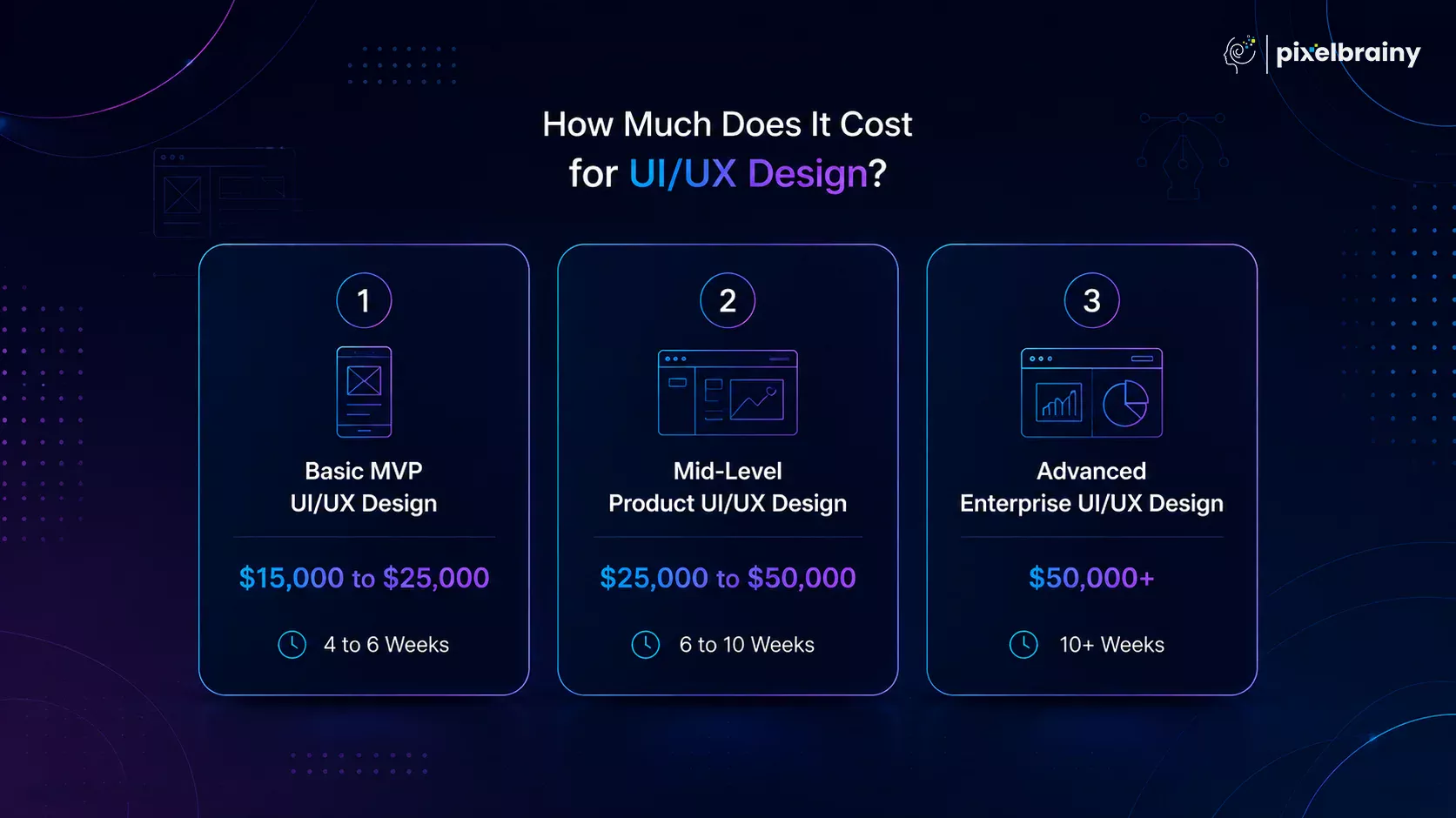
| Project Tier | Estimated Cost | Timeline | What's Included |
|---|---|---|---|
| Basic MVP UI/UX Design | $15,000 to $25,000 | 4 to 6 Weeks | UX discovery workshop, competitor research, user flows, information architecture, low fidelity wireframes, UI design for core screens, responsive layouts, clickable prototype, basic design system, developer handoff. |
| Mid-Level Product UI/UX Design | $25,000 to $50,000 | 6 to 10 Weeks | Comprehensive UX research, user personas, journey mapping, detailed wireframes, high fidelity UI design, scalable design system, interactive prototypes, accessibility review, usability testing, design documentation, developer collaboration. |
| Advanced Enterprise UI/UX Design | $50,000+ | 10+ Weeks | Multi product design strategy, enterprise design system, complex workflows, advanced usability testing, accessibility compliance, cross platform experiences, design governance, stakeholder workshops, developer support, ongoing design optimization. |
The biggest difference between these pricing tiers comes down to the depth of research, workflow complexity, number of screens, level of customization, and long-term scalability.
A Basic MVP UI/UX Design focuses on validating your product idea with intuitive user journeys and polished interfaces for the most critical features. This is the most cost-effective approach for startups looking to reduce risk, launch quickly, and gather real user feedback while keeping the UI/UX design pricing under control.
A Mid-Level Product UI/UX Design expands the scope by incorporating detailed user research, customer journey mapping, comprehensive design systems, usability testing, responsive experiences, and stronger collaboration with development teams. This pricing tier is ideal for SaaS companies and growing businesses preparing for product expansion and increased user adoption.
An Advanced Enterprise UI/UX Design is designed for large scale digital products with complex business workflows, multiple user roles, enterprise security considerations, accessibility compliance, and cross platform consistency. Although this significantly increases the cost to make UI/UX design, it also improves operational efficiency, product usability, customer satisfaction, and long-term scalability.
Beyond the initial design engagement, businesses should also budget for ongoing activities such as usability testing, product enhancements, design system maintenance, feature redesigns, accessibility improvements, developer support, and continuous user experience optimization. These recurring investments contribute to the overall UI/UX design cost throughout the product lifecycle.
Ultimately, the right product design cost estimate should align with your business objectives rather than simply your budget. For most startups, beginning with an MVP level design investment between $15,000 and $25,000 provides a strong foundation to validate the product, improve user experience, attract investors, and scale confidently. As your product matures, investing in a more comprehensive UI/UX strategy ensures your digital product remains competitive, user friendly, and ready for future growth.
Can you estimate the UI/UX design cost before speaking with a design agency or product design company? Absolutely. In fact, every startup founder, product manager, and business leader should have a realistic budget estimate before requesting proposals, comparing agencies, or presenting the investment plan to stakeholders.
The UI/UX design cost is not based on a fixed price. Instead, it depends on several variables, including the number of screens, product complexity, user research, interaction design, usability testing, design system requirements, responsive layouts, accessibility compliance, and developer handoff. The more sophisticated your product and user experience requirements become, the higher your overall UI/UX design pricing will be.
For example, an MVP with essential user flows and 15 to 20 screens requires a significantly smaller investment than a full-scale SaaS platform with 50+ screens, multiple user roles, advanced workflows, comprehensive UX research, and a scalable design system.
One of the most common questions we hear is:
"We're planning to design a digital product, but before contacting UI/UX design agencies, we'd like to estimate our budget. Is there a practical way to calculate the expected UI/UX design cost?"
The answer is yes. Rather than relying on generic industry averages, break your project into individual design components. This approach provides a much more accurate product design cost estimate and helps you understand exactly where your design budget will be allocated.
A simple way to estimate your project budget is:
Total UI/UX Design Cost = UX Research + Wireframing + UI Design + Prototyping + Design System + Usability Testing + Developer Handoff
Each of these phases contributes to the overall cost of UI/UX design services.
| Cost Component | What It Includes |
|---|---|
| UX Research | Stakeholder workshops, competitor analysis, user interviews, personas, user journeys, and requirement gathering. |
| Wireframing & Information Architecture | User flows, sitemap, information architecture, low fidelity wireframes, and interaction planning. |
| UI Design | High fidelity screen designs, responsive layouts, branding application, visual components, icons, and design consistency. |
| Interactive Prototyping | Clickable prototypes, micro interactions, user validation, and design presentations. |
| Design System | Reusable UI components, typography, colors, spacing, documentation, and scalable design guidelines. |
| Usability Testing & Developer Handoff | User testing, accessibility review, design revisions, Figma assets, specifications, and developer documentation. |
Let's assume you're designing a B2B SaaS product with approximately 40 screens that includes:
Your estimated UI/UX design cost could look like this:
| Expense | Estimated Cost |
|---|---|
| UX Research | $6,000 |
| Wireframing & Information Architecture | $5,000 |
| High Fidelity UI Design | $16,000 |
| Interactive Prototype | $4,000 |
| Design System | $7,000 |
| Usability Testing & Developer Handoff | $7,000 |
| Estimated Total Investment | $45,000 |
This example shows that the cost to make UI/UX design extends far beyond designing attractive screens. User research, design systems, prototyping, testing, and developer collaboration represent a significant portion of the total investment because they directly influence product usability and long-term scalability.
Using a structured UI/UX design cost calculator helps you:
Instead of relying on broad pricing ranges, estimating your project by individual design phases provides a far more accurate answer to "What is the average cost of UI UX design?" It also helps you invest strategically by focusing on the design activities that deliver the greatest impact on user experience, customer satisfaction, and business growth.
Pro Tip: If you're planning an MVP, expect a UI/UX design cost of approximately $15,000 to $25,000. For a growth-stage SaaS product, the investment typically ranges from $25,000 to $50,000, while enterprise-grade platforms with advanced workflows, multiple user roles, and comprehensive design systems often exceed $50,000.

If you've received multiple proposals for the same project and noticed one agency quoting $15,000 while another estimates $50,000+, you're not alone. One of the most common questions businesses ask is, "What factors determine the cost of UI UX design for a software product?" The answer is that pricing is rarely based on screen design alone. Instead, your UI UX design cost is influenced by project scope, research depth, team expertise, deliverables, hiring model, and several other variables.
Understanding these cost drivers helps you build a realistic UI UX design budget, compare proposals more effectively, and invest where it delivers the highest business value.
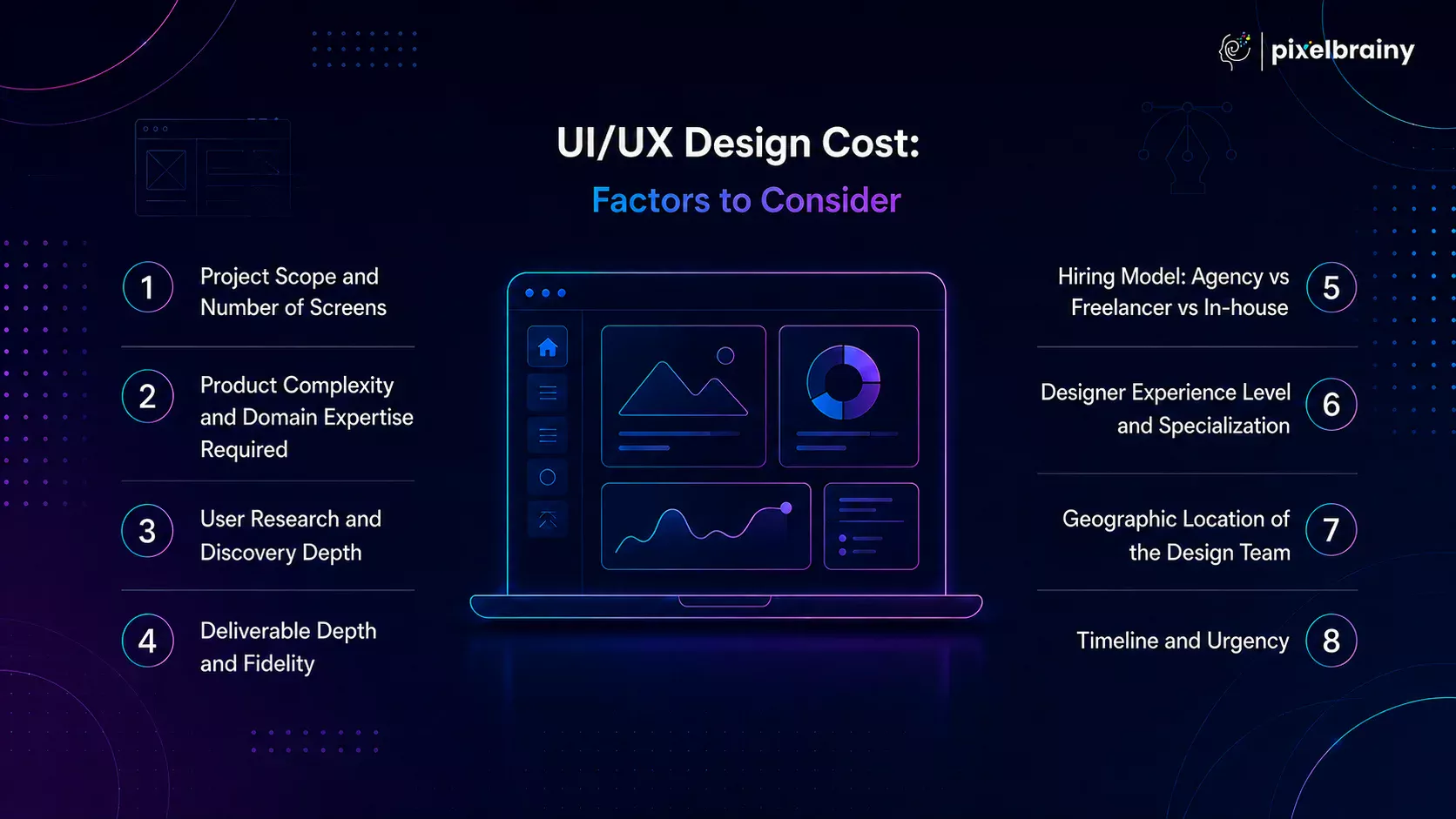
The size of your product is the most obvious factor affecting the UX design project cost. Designers estimate effort based on the number of unique screens, user flows, user roles, and interactive states rather than simply counting pages.
For example, an MVP with 10 to 15 screens may fall within the $15,000 to $25,000 range, while a SaaS platform with 80 to 120 screens, multiple dashboards, and role based experiences can easily exceed $50,000. Features such as animations, conditional workflows, and micro interactions also increase design effort.
Not every product requires the same level of design expertise.
A social networking app and a healthcare management platform may contain the same number of screens, but healthcare products require designers who understand compliance requirements, complex workflows, and specialized user needs. The same applies to fintech, legal technology, insurance, and aerospace software.
Specialized industry knowledge increases the UI UX design cost, but it also reduces design errors and creates experiences that align with industry regulations and user expectations.
Research is often the difference between creating an attractive interface and designing product users genuinely enjoy.
A basic project may include only a discovery workshop, while a comprehensive engagement covers stakeholder interviews, competitor analysis, user interviews, usability testing, journey mapping, and research synthesis.
Although investing in research increases the initial UI UX design budget, it often prevents expensive redesigns after launch. Companies with a budget of around $60,000 frequently achieve better long-term results by allocating a meaningful portion of their investment to research before visual design begins.
Two agencies may promise "complete UI/UX design," yet deliver entirely different outputs.
Some projects include only wireframes and static mockups. Others deliver high fidelity interfaces, interactive prototypes, comprehensive design systems, accessibility documentation, developer specifications, and implementation support.
A lower investment near $15,000 typically focuses on essential wireframes and interface design for MVPs. Budgets closer to $50,000 usually include detailed prototypes, scalable design systems, usability testing, and production ready handoff assets that reduce development effort.
The hiring model has one of the biggest impacts on your UI UX design cost.
Freelancers generally offer the lowest pricing and work well for smaller projects with limited scope. Design agencies provide multidisciplinary teams including UX researchers, UI designers, strategists, and project managers, making them better suited for complex digital products. Building an in-house team requires the highest long-term investment because salaries, recruitment, software licenses, and employee benefits become ongoing operational costs.
Understanding what each option delivers helps answer a common business question: What corners get cut at a $25,000 budget compared with a $50,000 engagement?
Experience directly influences both pricing and project outcomes.
A junior designer may charge $40 to $70 per hour, while a senior product designer or UX strategist often charges $150 to $200+ per hour. Although senior professionals cost more, they typically make stronger product decisions, identify usability issues earlier, and deliver designs that require fewer revisions during development.
For business-critical products, investing in experienced designers often reduces the total project cost over time.
Location also plays an important role in determining pricing.
Design agencies in North America and Western Europe generally charge premium rates, while highly skilled teams in Eastern Europe, Latin America, and South Asia often provide competitive pricing for similar technical capabilities.
Choosing an offshore partner can reduce the overall UX design project cost, but businesses should also evaluate communication, collaboration, time zone overlap, product strategy experience, and long-term support before making a decision.
Project deadlines can significantly affect your budget.
Rush projects usually require multiple designers working simultaneously, additional review cycles, or extended working hours to meet aggressive launch dates. As a result, agencies often apply a premium for accelerated delivery compared with standard project timelines.
Unless your launch deadline is tied to fundraising, regulatory requirements, or a major product release, allowing sufficient design time typically produces higher quality outcomes while keeping your UI UX design budget under control.
| Cost Factor | How It Impacts UI/UX Design Cost | Typical Cost Impact |
|---|---|---|
| Project Scope & Number of Screens | More screens, user roles, workflows, dashboards, and interactive states require additional design effort. | $15,000 to $50,000+ |
| Product Complexity & Industry Domain | Specialized industries like healthcare, fintech, legal tech, and enterprise SaaS require deeper domain knowledge and more strategic UX work. | +10% to +30% |
| User Research & Discovery | Stakeholder workshops, user interviews, competitor analysis, journey mapping, and usability research improve product decisions but increase the initial investment. | +$3,000 to $10,000 |
| Deliverable Depth & Design Fidelity | Wireframes cost less than interactive prototypes, comprehensive design systems, accessibility documentation, and developer-ready handoff assets. | +$5,000 to $15,000 |
| Hiring Model | Freelancers generally offer the lowest pricing, agencies provide end-to-end expertise, while in-house teams involve the highest long-term investment. | Freelancer: $15K to $25K |
| Agency: $25K to $50K+ | ||
| In-house: Highest long-term cost | ||
| Designer Experience & Specialization | Senior product designers and UX strategists charge higher rates but typically deliver stronger user experiences with fewer revisions. | +$2,000 to $10,000 |
| Geographic Location | Design rates vary significantly across North America, Europe, Latin America, and South Asia due to labor costs and market demand. | Can vary by 20% to 50% |
| Timeline & Project Urgency | Accelerated timelines require parallel resources or overtime, resulting in premium pricing. | +15% to +35% |
If you've received proposals ranging from $15,000 to $50,000+ for what appears to be the same project, these eight factors explain why the pricing varies so dramatically. The lowest quote may exclude user research, usability testing, design systems, or implementation support, while the higher proposal often includes strategic activities that improve product quality and reduce future development costs.
Rather than comparing proposals on price alone, evaluate what is included, how each budget is allocated, and which investment will create the greatest long-term value for your digital product. That's the most reliable way to build a realistic UI UX design budget and maximize the return on your design investment.
One of the most common questions founders and product teams ask is, "How much does a full product UI/UX design project cost from scratch?" The answer depends on the type of digital product you're designing, the number of screens, the complexity of user journeys, and the level of research and design deliverables required.
For example, a startup MVP with 15 screens requires significantly less effort than redesigning an enterprise SaaS platform with multiple dashboards, user roles, and advanced workflows. That's why understanding the UI UX design cost breakdown for startups and enterprises in 2026 by project type gives you a far more realistic budget than relying on generic industry averages.
Below is a breakdown of the most common project types, what is typically included, and what you can expect to invest at different engagement levels.
The mobile app UI UX design cost depends on factors such as platform support, user flows, interaction complexity, animations, and the total number of screens.
Best for: Startups launching a new mobile product, funded companies preparing for market expansion, and businesses building feature-rich mobile experiences.
The website UI UX design pricing varies based on page count, custom branding, conversion goals, responsive requirements, and content complexity.
Best for: Corporate websites, SaaS marketing sites, enterprise websites, and businesses focused on lead generation and conversions.
SaaS platforms are among the most design-intensive digital products because they involve dashboards, workflows, onboarding, permissions, reporting, and multiple user roles.
A B2B SaaS product with around 40 screens generally falls within the $35,000 to $50,000+ range depending on workflow complexity, research requirements, and design system maturity.
Best for: SaaS startups, B2B software companies, subscription platforms, and workflow management applications.
Enterprise applications require deeper discovery, stakeholder alignment, workflow mapping, and governance compared to standard software products.
Best for: ERP platforms, CRM software, internal business tools, healthcare systems, fintech platforms, and enterprise workflow applications.
When comparing UI UX design cost for MVP versus full product design in 2026, MVPs focus on validating ideas quickly while minimizing unnecessary investment.
Best for: Early-stage startups, founders validating product-market fit, and businesses preparing investor demonstrations.
Many businesses redesign their products to improve customer retention, simplify workflows, reduce churn, and modernize outdated interfaces.
For businesses focused on improving a single experience, such as user onboarding or checkout, a targeted redesign often delivers measurable business impact without the cost of redesigning the entire product.
Best for: Growing SaaS companies, mature digital products, and businesses experiencing low user engagement or high churn.
E-commerce success depends heavily on product discovery, trust, checkout experience, and conversion optimization.
Best for: D2C brands, B2B commerce platforms, online marketplaces, and retailers looking to improve conversion rates.
| Project Type | Lean | Standard | Comprehensive |
|---|---|---|---|
| New Mobile App UI/UX Design | $15K to $22K | $22K to $38K | $38K to $50K+ |
| New Website UI/UX Design | $15K to $20K | $20K to $35K | $35K to $50K+ |
| SaaS Product UI/UX Design | $18K to $28K | $28K to $42K | $42K to $50K+ |
| Enterprise Software UI/UX Design | $25K to $35K | $35K to $50K | $50K+ |
| MVP Product Design | $15K to $20K | $20K to $35K | $35K to $50K |
| Existing Product Redesign | $15K to $25K | $25K to $40K | $40K to $50K+ |
| E-Commerce UI/UX Design | $15K to $22K | $22K to $38K | $38K to $50K+ |
Key Takeaway: While every digital product has unique requirements, most professional UI/UX design engagements in 2026 fall between $15,000 and $50,000+. Choosing the right project scope and engagement level ensures you invest in the research, design quality, and user experience improvements that align with your business goals without overspending.
Choosing who designs your product is just as important as deciding how much to spend. In fact, the hiring model you choose has one of the biggest influences on your UI/UX design cost, project quality, collaboration, and long-term product success.
Many founders ask questions like "Should I hire a freelancer or a UI/UX design agency?", "How much does it cost to hire a UI/UX design agency in the USA?", or "Does it make more financial sense to build an in-house design team?" The answer depends on your project scope, available budget, timeline, and whether you need strategic product thinking or simply design execution.
Below is a comparison of the four most common hiring models and what each delivers for your investment.
Hiring a freelancer is often the most affordable option for startups and small businesses with clearly defined design requirements.
Typical UI/UX designer hourly rates include:
For a typical product design engagement, businesses generally spend between $15,000 and $25,000, depending on project scope and freelancer experience.
Freelancers are excellent for MVPs, feature enhancements, landing pages, and smaller redesign projects where the requirements are already well defined. However, most freelancers work independently and may not provide UX research, product strategy, usability testing, project management, or dedicated developer collaboration.
The biggest challenge is vetting. Portfolio quality varies significantly, and finding someone who combines strong UX thinking, visual design skills, and business strategy can take considerable time.
Best for: MVPs, startup products, focused redesigns, and businesses with a limited UI/UX design budget.
If your project requires research, strategy, collaboration, and predictable execution, working with a design agency is often the strongest choice.
Typical UI/UX design agency pricing in the United States includes:
Most product design engagements typically fall between $25,000 and $50,000+, depending on project complexity and deliverables.
Unlike freelancers, agencies provide multidisciplinary teams that may include UX researchers, UI designers, product strategists, usability specialists, project managers, and developer support. They also bring established processes, structured workshops, quality assurance, and long-term scalability.
Although agencies charge higher rates, the additional investment often results in faster execution, fewer design revisions, and stronger alignment between business goals and user needs.
Best for: SaaS products, enterprise software, digital transformation projects, and businesses looking for end-to-end cost of UI/UX design services.
Hiring an internal product designer is ideal for organizations continuously evolving their products.
Typical annual salary ranges include:
Beyond salary, companies should also consider recruitment costs, benefits, software licenses, equipment, management overhead, and ongoing professional development.
Unlike external partners, in-house designers gain deep product knowledge, collaborate daily with engineering and product teams, and continuously improve the user experience over time. For organizations with ongoing design needs, building an internal team often becomes more cost-effective than repeatedly outsourcing projects.
However, if your immediate requirement is a one-time redesign with a UI/UX design budget of $15,000 to $50,000+, engaging an experienced agency or freelancer is usually a more practical investment than hiring a full-time employee.
Best for: Product-led companies with continuous design requirements and long-term product roadmaps.
Many startups and growing businesses reduce the cost of UI/UX design services by working with distributed design teams across different regions.
Typical hourly rates include:
A complete UI/UX design engagement generally ranges between $15,000 and $40,000, depending on project complexity and team composition.
Offshore teams can provide significant cost savings while maintaining excellent technical capabilities. However, businesses should evaluate more than hourly rates. Communication, time zone overlap, product thinking, collaboration, documentation quality, and developer coordination all influence project success.
Before selecting an offshore partner, review detailed case studies, design systems, UX research capabilities, client testimonials, and developer handoff examples rather than relying solely on visual portfolios.
Best for: Startups, SaaS companies, and businesses seeking high-quality design expertise within a controlled budget.
| Hiring Model | Hourly Rate Range | Typical Project Cost | Best For | Not Ideal For |
|---|---|---|---|---|
| Freelance UI/UX Designer | $35 to $350/hour | $15K to $25K | MVPs, startups, small redesigns, clearly defined projects | Large products requiring research, multiple specialists, or project management |
| UI/UX Design Agency | $100 to $500/hour | $25K to $50K+ | SaaS products, enterprise software, complete product design, strategic consulting | Small one-off design tasks with limited budgets |
| In-House Product Designer | Annual salary model | Comparable to $130K+ annually including overhead | Continuous product evolution, embedded collaboration, long-term product ownership | One-time redesign projects or short-term engagements |
| Offshore/Nearshore Design Team | $20 to $100/hour | $15K to $40K | Cost-conscious startups, growing businesses, scalable design support | Projects requiring extensive in-person collaboration or highly specialized consulting |
There is no universal winner. If your goal is to validate an MVP or complete a small redesign, a skilled freelancer or offshore team can deliver excellent value. For a complete SaaS platform, enterprise application, or strategic product redesign with a budget between $25,000 and $50,000+, a UI/UX design agency typically provides the best balance of research, execution, scalability, and long-term business impact. Meanwhile, organizations with continuous product development needs often achieve the highest return by building an in-house design capability.
One of the biggest misconceptions about UI/UX design cost is that businesses are paying only for visual interface design. In reality, a successful UI/UX project consists of multiple design phases, each contributing to the overall user experience and product quality.
If you're reviewing proposals from agencies or freelancers, understanding how your UI/UX design budget is distributed across different design phases helps you evaluate whether you're receiving a comprehensive design engagement or just a collection of screens.
The table below outlines the typical design phases, what each deliverable includes, and the estimated investment within a professional UI/UX design project ranging from $15,000 to $50,000+.
| Design Phase | Typical Deliverables | Estimated Cost |
|---|---|---|
| Discovery & UX Research | Stakeholder workshops, business requirement gathering, competitor analysis, user interviews, personas, customer journey mapping | $3,000 to $8,000 |
| Information Architecture & User Flows | Sitemap, information architecture, task flows, navigation structure, workflow diagrams | $2,000 to $5,000 |
| Wireframing | Low-fidelity wireframes, layout exploration, user flow validation, screen planning | $3,000 to $7,000 |
| High-Fidelity UI Design | Pixel-perfect UI screens, responsive layouts, branding, icons, typography, visual consistency | $5,000 to $15,000 |
| Interactive Prototyping | Clickable prototypes, interaction design, micro-interactions, user journey demonstrations | $2,000 to $6,000 |
| Design System Creation | Reusable UI components, design tokens, typography, color palette, spacing rules, documentation | $3,000 to $8,000 |
| Usability Testing & Design Iterations | User testing sessions, feedback analysis, design improvements, accessibility review | $2,000 to $6,000 |
| Developer Handoff & Design Documentation | Figma specifications, component documentation, assets, annotations, developer support | $2,000 to $5,000 |
Note: Not every project requires every design phase. MVPs often focus on the essentials, while enterprise products usually include every phase to ensure scalability and long-term consistency.
Every successful product starts with understanding users and business goals.
This phase includes stakeholder workshops, competitor analysis, user interviews, user personas, and customer journey mapping. Although research increases the initial UI/UX design cost, it reduces the risk of building features users don't need or creating workflows that lead to poor adoption.
Typical Investment: $3,000 to $8,000
Before designing screens, designers organize content and define how users move through the product.
Deliverables typically include information architecture, navigation structures, user flows, and workflow diagrams. Strong planning during this phase simplifies development and improves usability.
Typical Investment: $2,000 to $5,000
Wireframes establish the layout and structure of each screen before visual design begins.
Low-fidelity wireframes allow teams to validate navigation, functionality, and user journeys early, making revisions faster and significantly less expensive than changing polished designs later.
Typical Investment: $3,000 to $7,000
This is where your product begins to look like a finished application.
Designers apply branding, typography, colors, spacing, icons, responsive layouts, and visual hierarchy to create polished user interfaces that are ready for prototyping and development.
Since this phase involves designing every screen in detail, it often represents the largest portion of the overall UI/UX design budget.
Typical Investment: $5,000 to $15,000
Interactive prototypes transform static screens into clickable product experiences.
They help founders, stakeholders, investors, and developers visualize complete user journeys before development begins. Prototypes also improve usability testing by allowing real users to interact with the product.
Typical Investment: $2,000 to $6,000
As products grow, maintaining consistency becomes increasingly important.
A design system includes reusable UI components, typography guidelines, color palettes, spacing rules, buttons, form elements, and documentation that developers can reuse throughout the product.
Although many startups initially skip this phase, investing in a design system reduces future design and development costs.
Typical Investment: $3,000 to $8,000
Design assumptions should always be validated with real users.
Usability testing identifies friction points, confusing workflows, accessibility issues, and navigation challenges before development or product launch. Based on user feedback, designers refine the experience through multiple iterations.
This phase often delivers one of the highest returns on investment by reducing costly post-launch redesigns.
Typical Investment: $2,000 to $6,000
A great design is only valuable if developers can implement it accurately.
Developer handoff includes organized Figma files, component libraries, design specifications, style guides, exported assets, annotations, and implementation support to ensure the final product matches the approved designs.
Skipping this phase often results in inconsistencies between design and development, leading to additional revisions and delays.
Typical Investment: $2,000 to $5,000
That’s why a professional UI/UX design project is much more than creating visually appealing screens. The most successful digital products invest across every design phase, from user research and wireframing to design systems, usability testing, and developer handoff.
Allocating your UI/UX design budget strategically across these phases ensures your investment delivers not only a beautiful interface but also a product that is intuitive, scalable, and built for long-term success.

When businesses estimate their UI/UX design cost, they often focus only on the proposal they receive from a freelancer or agency. However, the quoted UI/UX design pricing rarely represents the complete investment. Several additional activities, revisions, and post-design requirements can increase your budget if they are not discussed during project planning.
Whether you're working with a freelancer or comparing UI/UX design agency pricing, understanding these hidden costs helps you build a more accurate budget and avoid unexpected expenses later.
Below are the most common hidden costs that can influence the cost to hire a UI UX designer and the overall cost of UI/UX design services.
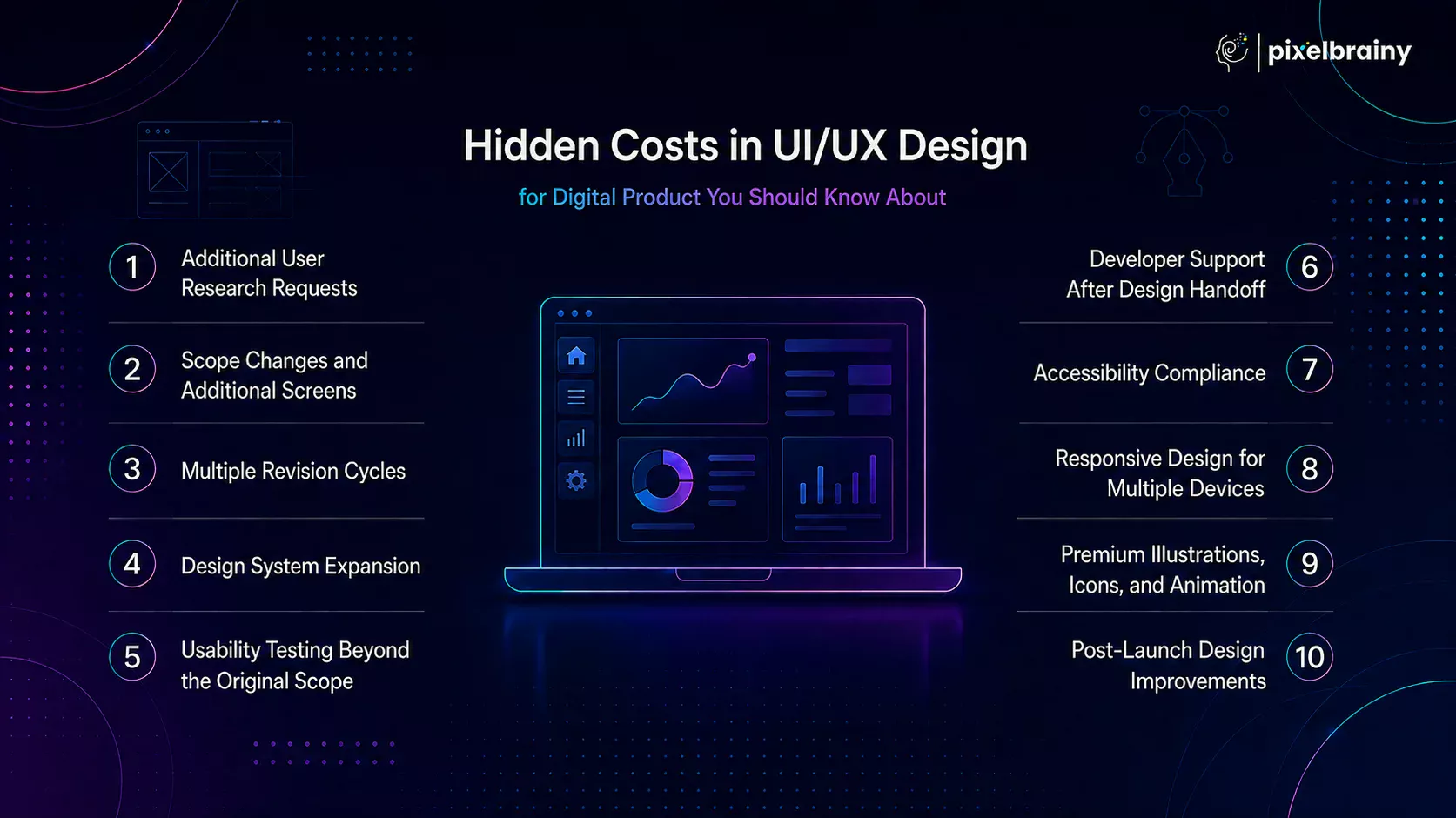
Many design proposals include only a predefined number of stakeholder interviews or user research sessions. If additional interviews, surveys, or usability studies become necessary during the project, they are usually billed separately.
Typical Additional Cost: $1,500 to $5,000
How to avoid it: Clearly define the research scope before the project begins and confirm how many research sessions are included in the proposal.
One of the biggest reasons projects exceed budget is scope expansion.
A project that begins with 25 screens may eventually require new dashboards, user roles, workflows, or feature pages. Every additional screen increases design effort, prototyping, documentation, and developer collaboration.
Typical Additional Cost: $300 to $800 per screen or $2,000 to $10,000+ for larger feature additions.
How to avoid it: Finalize the product requirements before starting design and establish a formal change request process.
Most UI/UX design agency pricing includes a limited number of revision rounds.
If stakeholders continue requesting changes after approvals or introduce new business requirements, agencies generally charge additional fees for extra iterations.
Typical Additional Cost: $1,000 to $5,000
How to avoid it: Consolidate stakeholder feedback into a single review cycle and assign one decision-maker to approve designs.
Many businesses initially request only screen designs and later realize they also need a reusable design system for future development.
Building a comprehensive component library, design tokens, documentation, and reusable UI elements requires additional design time.
Typical Additional Cost: $3,000 to $8,000
How to avoid it: Decide early whether your product is intended to scale and include a design system in the original scope if needed.
Initial proposals often include one round of usability testing.
Additional testing sessions, A/B testing, moderated interviews, accessibility validation, or testing with multiple user groups increase the overall UI/UX design pricing.
Typical Additional Cost: $2,000 to $6,000
How to avoid it: Clarify how many testing sessions are included and whether participant recruitment is covered.
Many businesses assume the project ends once the Figma files are delivered.
In reality, developers often require clarification, updated specifications, component adjustments, or design reviews during implementation.
Typical Additional Cost: $1,500 to $5,000
How to avoid it: Confirm whether post-handoff developer support is included in the project price.
If your product must comply with accessibility standards such as WCAG, additional design reviews, accessibility testing, and interface refinements may be required.
This is particularly important for enterprise software, healthcare, finance, education, and government applications.
Typical Additional Cost: $2,000 to $7,000
How to avoid it: Discuss accessibility requirements during project discovery instead of adding them later.
Some proposals cover desktop interfaces only, while others include responsive designs for tablets and mobile devices.
Designing and optimizing every screen for multiple breakpoints requires additional effort.
Typical Additional Cost: $3,000 to $8,000
How to avoid it: Confirm exactly which devices and screen sizes are included in the project scope.
Custom illustrations, icon sets, motion design, micro-interactions, and Lottie animations are usually priced separately from standard UI design.
Although they improve user experience and branding, they also increase the total cost to hire a UI UX designer.
Typical Additional Cost: $2,000 to $8,000
How to avoid it: Identify branding and animation requirements before requesting proposals.
User feedback often reveals opportunities to improve onboarding, navigation, feature adoption, or conversion rates after launch.
Many companies allocate an ongoing optimization budget instead of treating UI/UX design as a one-time project.
Typical Additional Cost: $2,000 to $10,000 annually
How to avoid it: Reserve a portion of your overall UI/UX design budget for continuous improvements instead of spending everything before launch.
| Hidden Cost | Typical Additional Cost | Why It Happens |
|---|---|---|
| Additional User Research | $1.5K to $5K | More interviews, surveys, or discovery sessions |
| Scope Changes & Extra Screens | $300 to $800 per screen or $2K to $10K+ | New features or workflows added after project kickoff |
| Extra Revision Rounds | $1K to $5K | Multiple stakeholder reviews or changing requirements |
| Design System Expansion | $3K to $8K | Creation of reusable UI components and documentation |
| Additional Usability Testing | $2K to $6K | Extra testing sessions and participant recruitment |
| Developer Support | $1.5K to $5K | Design clarification during implementation |
| Accessibility Compliance | $2K to $7K | WCAG audits and accessibility improvements |
| Responsive Design | $3K to $8K | Additional layouts for tablet and mobile devices |
| Custom Illustrations & Animation | $2K to $8K | Motion design, icons, illustrations, and micro-interactions |
| Post-Launch UX Optimization | $2K to $10K/year | Continuous design improvements after launch |
When evaluating UI/UX design pricing, don't compare proposals based only on the headline price. Ask what deliverables, revision cycles, research activities, testing, developer support, and post-launch services are included.
Understanding these hidden costs is one of the most effective ways to determine the cost of UI UX design accurately and choose the right partner, whether you're hiring a freelancer or comparing UI/UX design agency pricing for your next digital product.
One of the most common budgeting questions is whether startups and enterprises should invest the same amount in UI/UX design. The answer is no. Although both aim to create intuitive, user-friendly digital products, their business objectives, product complexity, research requirements, and long-term design needs are fundamentally different.
A startup typically focuses on validating an idea, acquiring early users, and reaching product-market fit as quickly as possible. An enterprise, on the other hand, prioritizes scalability, operational efficiency, accessibility, governance, and delivering a consistent user experience across multiple products, teams, and customer segments.
As a result, the UI/UX design cost and overall UI/UX design pricing strategy vary significantly between the two.
For startups, every dollar matters. The goal is not to design every possible feature but to build an intuitive product that solves a real problem and can be tested with actual users.
Most startup projects focus on:
A realistic UI/UX design budget for startups typically ranges between $15,000 and $30,000, depending on the number of screens, product complexity, and research depth.
Instead of investing heavily in advanced design systems or enterprise workflows, startups should prioritize user research, clear navigation, and validating assumptions before expanding the product.
Recommended Budget: $15,000 to $30,000
Best for:
Enterprise organizations have very different design priorities.
Their products often support multiple departments, user roles, workflows, integrations, compliance requirements, and large customer bases. Design projects usually involve multiple stakeholders, governance processes, accessibility standards, and long-term scalability.
Enterprise engagements commonly include:
Because of this broader scope, enterprise projects generally require a UI/UX design budget of $35,000 to $50,000+.
Although the upfront investment is higher, enterprise organizations benefit from reduced development rework, greater design consistency, improved employee productivity, and better customer experiences across multiple products.
Recommended Budget: $35,000 to $50,000+
Best for:
Startup vs Enterprise: Budget Comparison:
| Criteria | Startup | Enterprise |
|---|---|---|
| Typical UI/UX Design Cost | $15K to $30K | $35K to $50K+ |
| Primary Goal | Validate product ideas and achieve product-market fit | Improve scalability, efficiency, and long-term user experience |
| Research Depth | Basic to moderate | Comprehensive and continuous |
| Number of Screens | 10 to 30 | 40+ |
| Design System | Basic reusable components | Enterprise-grade scalable design system |
| Usability Testing | Limited testing before launch | Multiple testing rounds across user groups |
| Developer Handoff | Standard documentation | Detailed specifications and governance |
| Project Timeline | 4 to 8 weeks | 8 to 12+ weeks |
Whether you're a startup or an enterprise, allocating your budget strategically is more important than simply spending more.
Focus your investment on activities that directly validate your product and improve early user adoption.
Recommended priorities include:
Avoid overinvesting in advanced design systems or secondary features until you've validated market demand.
Enterprise organizations should prioritize long-term scalability rather than short-term savings.
Your budget should emphasize:
These investments reduce future redesign costs while ensuring consistency across products and teams.
Many businesses ask whether spending $50,000+ on UI/UX design is justified compared to a leaner $15,000 engagement.
The answer depends on your business goals.
If you're validating a new product idea, a focused investment between $15,000 and $30,000 is often sufficient to build a high-quality MVP and gather meaningful user feedback.
However, if you're redesigning a mature SaaS platform, supporting thousands of users, or modernizing enterprise software, investing $35,000 to $50,000+ typically delivers greater long-term value through improved usability, reduced customer churn, lower development rework, and stronger operational efficiency.
| Startup MVP | $15K to $20K | Core UX research, wireframes, UI design, prototype, developer handoff |
|---|---|---|
| Growth-Stage Startup | $20K to $30K | Expanded research, additional user flows, design system foundation, usability testing |
| Mid-Market Business | $30K to $40K | Comprehensive UX, scalable UI, design documentation, workflow optimization |
| Enterprise Organization | $40K to $50K+ | End-to-end UX strategy, enterprise design system, accessibility, governance, multi-team collaboration |
The ideal UI/UX design budget isn't determined by company size alone. It should reflect your product's complexity, business objectives, and growth stage. Startups benefit most from investing in the essential design activities needed to validate their product quickly, while enterprises generate greater long-term value by funding comprehensive research, scalable design systems, and user-centered experiences that support continuous product evolution.
Reducing your UI/UX design cost doesn't mean choosing the cheapest proposal or eliminating important design activities. In many cases, cutting corners on research, usability testing, or design systems leads to expensive redesigns, slower development, and lower user adoption later.
The smartest approach is to optimize your UI/UX design budget by investing in the activities that deliver the greatest business value while eliminating unnecessary work. Whether you're building an MVP, redesigning a SaaS platform, or developing an enterprise application, the following strategies can help you control UI/UX design pricing without compromising quality.
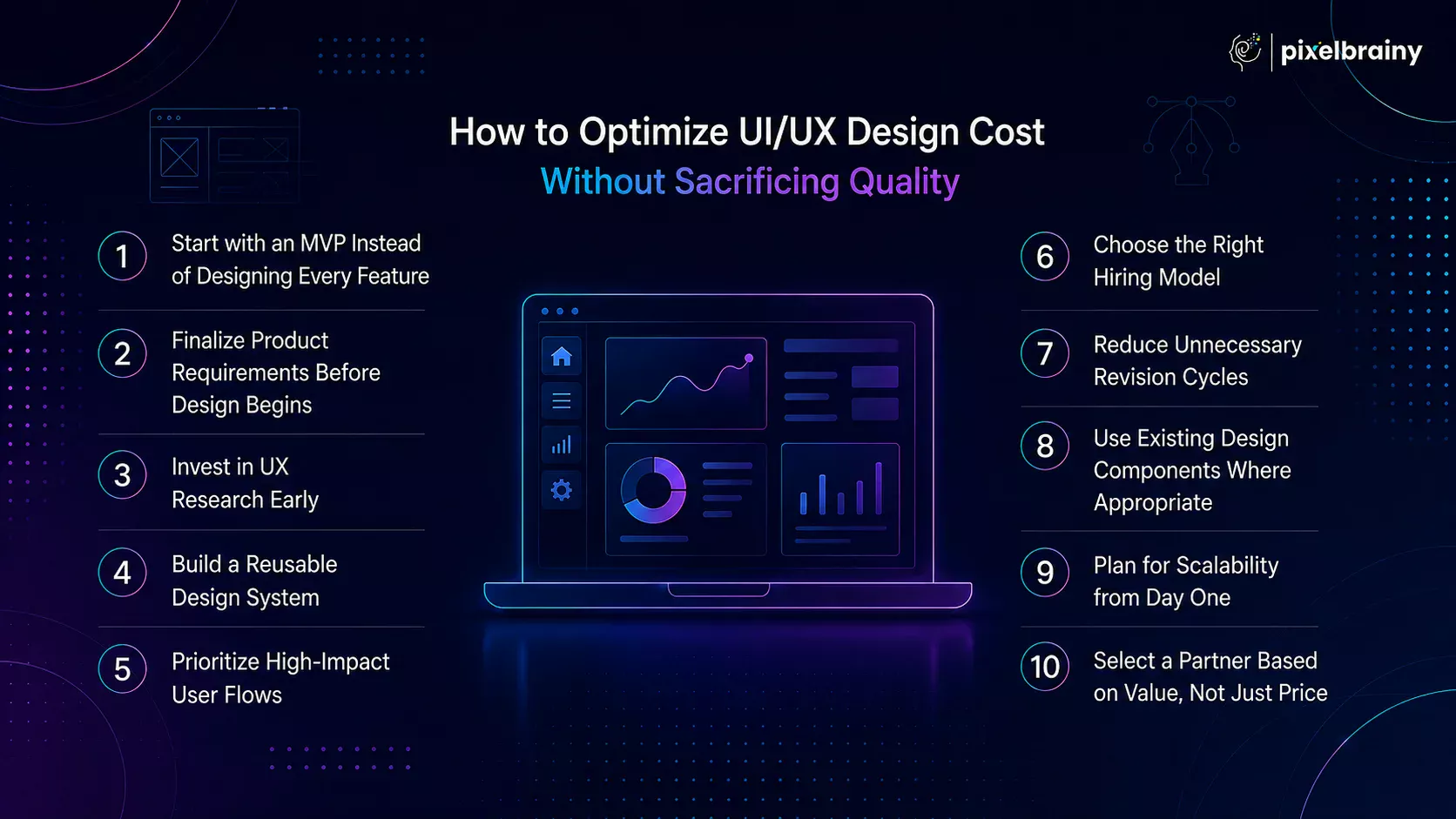
Many businesses try to design every possible feature before launching their product.
Instead, focus on designing only the core user journeys that solve your users' biggest problems. Once you've validated the product with real users, you can expand the experience in future iterations.
Potential Cost Savings: 10% to 25%
Also Read: Top 10 AI MVP Development Companies in USA
Changing requirements after the design process has started is one of the biggest reasons projects exceed budget.
Clearly documenting business goals, user flows, features, and priorities before kickoff minimizes revision cycles and reduces unnecessary design effort.
Potential Cost Savings: $2,000 to $8,000 in avoided redesign costs.
Some businesses skip user research to reduce initial UI/UX design pricing, only to spend significantly more fixing usability issues after development.
A small investment in research helps designers make informed decisions, reducing costly changes later.
Typical Investment: $3,000 to $8,000
Long-Term Benefit: Fewer redesigns, improved user satisfaction, and higher product adoption.
Designing every new screen from scratch increases both design and development effort.
A reusable design system with standardized components, typography, colors, and interaction patterns improves consistency while accelerating future product updates.
Although creating a design system requires additional upfront investment, it reduces long-term maintenance costs.
Typical Investment: $3,000 to $8,000
Not every feature contributes equally to business success.
Identify the user journeys that directly influence onboarding, purchases, subscriptions, or customer retention, and prioritize those during the initial design phase.
This allows you to maximize business impact while keeping your UI/UX design budget under control.
Hiring the wrong resource can significantly increase the cost of UI/UX design services.
Selecting the right engagement model prevents overspending while ensuring you receive the expertise your project actually needs.
Every additional revision consumes design hours and increases project costs.
Establish a clear approval process with consolidated stakeholder feedback and designate one decision-maker whenever possible.
Potential Cost Savings: $1,000 to $5,000
Not every button, form field, or navigation pattern needs to be designed from scratch.
Leveraging proven UI components, established design libraries, and existing design systems speeds up production while maintaining consistency across the product.
This allows designers to spend more time solving complex user experience challenges instead of recreating common interface elements.
Many startups optimize for short-term savings without considering future growth.
A scalable information architecture, flexible navigation, and reusable design components make future feature additions significantly easier and less expensive.
Planning ahead may slightly increase the initial UI/UX design cost, but it substantially lowers future redesign expenses.
The lowest proposal is rarely the most cost-effective.
When comparing UI/UX design agency pricing or freelancer proposals, evaluate:
A partner that understands your business objectives often deliver greater long-term value than simply offering the lowest price.
| Strategy | Business Impact | Potential Savings / Value |
|---|---|---|
| Design an MVP before a full product | Faster validation with lower upfront investment | 10% to 25% lower initial design cost |
| Finalize requirements early | Fewer revisions and scope changes | $2K to $8K saved |
| Conduct UX research upfront | Prevents expensive usability issues | Higher ROI and fewer redesigns |
| Build a reusable design system | Faster future design and development | Reduced long-term maintenance costs |
| Prioritize high-value user journeys | Better business outcomes with focused investment | Improved conversions and adoption |
| Choose the right hiring model | Aligns expertise with project needs | Better budget utilization |
| Limit revision cycles | Prevents unnecessary design hours | $1K to $5K saved |
| Reuse proven UI components | Speeds up production | Lower design effort |
| Design for scalability | Reduces future redesign costs | Long-term cost efficiency |
| Compare value instead of price | Better product quality and ROI | Higher return on design investment |
Optimizing UI/UX design cost is about spending smarter, not spending less. By defining your requirements early, investing in user research, prioritizing high-impact features, building reusable design systems, and choosing the right design partner, you can keep your UI/UX design pricing within the $15,000 to $50,000+ range while delivering a user experience that supports long-term business growth and customer satisfaction.
Optimizing UI/UX design cost is not about choosing the lowest-priced proposal. It's about investing your design budget in the activities that create the greatest business impact. PixelBrainy a leading UI/UX design company, we help startups, SaaS companies, enterprises, and digital businesses optimize their UI/UX design pricing by combining user-centered design, strategic product thinking, and scalable design systems that reduce long-term design and development costs.
One question we hear frequently is:
"We're comparing multiple UI/UX design agencies. How do we choose a partner that helps us reduce costs without compromising design quality, user experience, or future scalability?"
The answer isn't selecting the cheapest agency. It's partnering with a team that understands what to design now, what to postpone, and how to prevent expensive redesigns as your product grows.
Before designing a single screen, our team conducts a structured discovery workshop to understand your product vision, business goals, users, and technical constraints. This enables us to prepare a realistic UI/UX design budget while identifying opportunities to reduce unnecessary design effort.
During this phase, we focus on:
This structured approach helps eliminate unnecessary design work while ensuring your digital product is ready to scale without costly redesigns.
A growing B2B SaaS company approached PixelBrainy to redesign its customer platform after experiencing low feature adoption and increasing customer churn. The product had been built entirely by developers, resulting in inconsistent user experiences across multiple modules.
The client's initial request covered every feature, dashboard, workflow, and user role, resulting in an estimated UI/UX design cost exceeding $50,000.
Instead of redesigning the entire platform at once, our team restructured the engagement into a phased product design roadmap that prioritized the highest-impact user journeys first.
Phase One Included
Results:
| Metric | Outcome |
|---|---|
| Initial Design Estimate | $50,000+ |
| Optimized Phase One Investment | Approximately $32,000 |
| Upfront Design Cost Saved | More than 35% |
| Design Timeline | Under 8 Weeks |
By focusing on the most critical user journeys first, the client launched improvements faster, reduced design waste, and continued expanding the product based on real customer feedback instead of assumptions.
Our goal is to help businesses optimize the cost of UI/UX design services without sacrificing usability, scalability, or product quality.
Our expertise includes:
Whether you're building a new product or redesigning an existing one, we create design experiences that support business growth while keeping your UI/UX design cost under control.
Unlike agencies that simply estimate based on the number of screens, PixelBrainy evaluates your product from a business perspective.
We help you:
This approach enables businesses to maximize the return on every dollar invested in UI/UX design pricing.
| What We Do | Business Benefit |
|---|---|
| Product discovery workshops | Defines project scope before design begins, preventing budget overruns |
| UX research and validation | Reduces the risk of redesigning features after development |
| MVP-first design strategy | Helps launch faster without unnecessary design investment |
| Scalable design systems | Lowers future design and development costs |
| Developer-ready handoff | Accelerates implementation and reduces engineering rework |
| Transparent pricing | Clear project estimates with no hidden surprises |
| Ongoing design support | Continuous optimization as your product evolves |
If you're planning a mobile app, SaaS platform, enterprise application, website, or digital product and want a realistic understanding of UI/UX design pricing in 2026, PixelBrainy can help.
Our team will work with you to:
Let's connect with PixelBrainy to receive a personalized UI/UX design cost estimate, product roadmap, and expert recommendations that help you build exceptional digital experiences while keeping your design budget optimized from day one.

From the above discussion, it is evident that the UI/UX design cost for a digital product depends on multiple factors, including project scope, product complexity, research depth, design deliverables, hiring model, and long-term business objectives. While a professional UI/UX design pricing typically falls between $15,000 and $50,000+, the ideal investment should always align with your product's stage, user expectations, and future scalability. Whether you're designing an MVP, launching a SaaS platform, redesigning an existing application, or building enterprise software, investing in a well-planned UI/UX strategy can significantly improve user satisfaction, product adoption, customer retention, and overall business performance.
Rather than focusing solely on the upfront cost of UI/UX design services, evaluate the long-term value your investment will generate. A thoughtful design process reduces development rework, minimizes usability issues, accelerates product adoption, and creates a strong foundation for sustainable growth. Ultimately, choosing the right UI/UX design partner is not about finding the lowest price but about finding a team that delivers measurable business outcomes through exceptional user experiences.
Ready to optimize your UI/UX design investment? Schedule a free consultation call with PixelBrainy today to receive a personalized UI/UX design cost estimate, expert product recommendations, and a strategic roadmap tailored to your business goals.
The average UI/UX design cost in 2026 typically ranges from $15,000 to $50,000+, depending on the project's scope, number of screens, user research requirements, design system complexity, usability testing, and developer handoff. An MVP usually falls on the lower end of the range, while enterprise SaaS platforms and complex digital products require a larger investment.
A comprehensive UI/UX redesign for a B2B SaaS application with approximately 40 screens generally costs between $35,000 and $50,000+. This typically includes UX research, stakeholder workshops, information architecture, user flows, wireframes, high-fidelity UI design, interactive prototypes, usability testing, a scalable design system, and developer handoff.
The cost of UI/UX design services usually covers product discovery, UX research, user personas, competitor analysis, information architecture, user flows, wireframing, high-fidelity UI design, interactive prototypes, design system creation, usability testing, accessibility reviews, and developer-ready design documentation. The exact deliverables depend on the project scope and engagement model.
The right choice depends on your project requirements. Freelancers are ideal for smaller projects, MVPs, and limited budgets, while a UI/UX design agency is better suited for SaaS platforms, enterprise applications, and products requiring UX research, strategy, design systems, and cross-functional collaboration. If your project budget falls between $25,000 and $50,000+, an agency often delivers better long-term value through a structured design process.
You can optimize UI/UX design pricing by prioritizing an MVP, clearly defining project requirements before design starts, investing in user research early, using reusable design systems, minimizing revision cycles, and choosing a design partner with experience in your industry. These strategies reduce redesign costs while maintaining a high-quality user experience.
Several factors influence UI/UX design cost, including the number of screens, product complexity, user roles, UX research depth, design deliverables, usability testing, interaction complexity, hiring model, designer expertise, timeline, and developer handoff requirements. Projects with advanced workflows and multiple user journeys naturally require a larger investment than simpler applications.
The timeline depends on the project's complexity. A startup MVP generally takes 4 to 6 weeks, while a medium-sized SaaS product typically requires 6 to 10 weeks. Enterprise software with extensive research, multiple user roles, and comprehensive design systems can take 10 to 16 weeks or longer to complete.
Yes. A well-executed UI/UX design improves usability, increases customer satisfaction, reduces user churn, shortens development cycles, and boosts conversion rates. While the initial UI/UX design cost may seem significant, it often delivers a much higher return by minimizing costly redesigns and creating a better experience that supports long-term business growth.

About The Author
Sagar Bhatnagar
Sagar Sahay Bhatnagar brings over a decade of IT industry experience to his role as Marketing Head at PixelBrainy. He's known for his knack in devising creative marketing strategies that boost brand visibility and market influence. Sagar's strategic thinking, coupled with his innovative vision and focus on results, sets him apart. His track record of successful campaigns proves his ability to utilize digital platforms effectively for impactful marketing efforts. With a genuine passion for both technology and marketing, Sagar continuously pushes PixelBrainy's marketing initiatives to greater success.

Working with the PixelBrainy team has been a highly positive experience. They understand the design requirements and create beautiful UX elements to meet the application needs. The dev team did an excellent job bringing my vision to life. We discussed usability and flow. Sagar worked with his team to design the database and begin coding. Working with Sagar was easy. He has the knowledge to create robust apps, including multi-language support, Google and Apple ID login options, Ad-enabled integrations, Stripe payment processing, and a Web Admin site for maintaining support data. I'm extremely satisfied with the services provided, the quality of the final product, and the professionalism of the entire process. I highly recommend them for Android and iOS Mobile Application Design and Development.

Great experience working with them. Had a lot of feedback and I found that unlike most contractors they were bugging me for updates instead of the other way around. They were extremely time conscience and great at communicating! All work was done extremely high quality and if not on time, early! They were always proactive when it comes to communication and the work is great/above par always. Very flexible and a great team to work with! Goes above and beyond to present us with multiple options and always provides quality. Amazing work per usual with Chitra. If you have UI/UX or branding design needs I recommend you go to them! Will likely work with them in the future as well, definitely recommended!

PixelBrainy is a joy to work with and is a great partner when thinking through branding, logo, and website layout. I appreciate that they spend time going into the "why" behind their decisions to help inform me and others about industry best practices and their expertise.

I hired them to design our software apps. Things I really like about them are excellent communication skills, they answer all project suggestions and collaborate right away, and their input on design and colors is amazing. This project was complex and needed patience and creativity. The team is amazing to do business with. I will be using them long-term. Glad to see there are some good people out there. I was afraid to try and outsource my project to someone but I am glad I met them! I really can't say enough. They went above and beyond on this project. I am very happy with everything they have done to make my business stand out from the competition.

It was great working with PixelBrainy and the team. They were very responsive and really owned the project. We'll definitely work with them again!

I recently worked with the PixelBrainy team on a project and I was blown away by their communication skills. They were prompt, clear, and articulate in all of our interactions. They listened and provided valuable feedback and suggestions to help make the project a success. They also kept me updated throughout the entire process, which made the experience stress-free and enjoyable.

PixelBrainy is very good at what it does. The team also presents themselves very professionally and takes care of their side of things very well. I could fully trust them taking up the design work in a timely and organised manner and their attention to detail saved us lots of effort and time. This particular project was quite intense and the team showed that they function very well under pressure. Very much looking forward to working with her again!

It's always an absolute pleasure working with them. They completed all of my requests quickly and followed every note I had for them to a T, which made our process go smoothly from start to finish. Everything was completed fast and following all of the guidelines. And I would recommend their services to anyone. If you need any design work done in the future, PixelBrainy should be your first call!

They took ownership of our requirements and designed and proposed multiple beautiful variants. The team is self-motivated, requires minimum supervision, committed to see-through designs with quality and delivering them on time. We would definitely love to work with PixelBrainy again when we have any requirements.

PixelBrainy was a big help with our SaaS application. We've been hard at work with a new UI/UX and they provided a lot of help with the designs. If you're looking for assistance with your website, software, or mobile application designs, PixelBrainy and the team is a great recommendation.

PixelBrainy designers are amazing. They are responsive, talented, and always willing to help craft the design until it matches your vision. I would recommend them and plan to continue them for my future projects and more!!!

They were awesome! Did a good job fast, and good communication. Will work with them again. Thank you

Creative, detail-oriented, and talented designers who take direction well and implement changes quickly and accurately. They consistently over-delivered for us.

PixelBrainy team is very talented and creative. Great designers and a pleasure to work with. PixelBrainy is an excellent communicator and I look forward to working with them again.

PixelBrainy has a very talented design team. Their work is excellent and they are very responsive. I enjoy working with them and hope to continue on all of our future projects.

Transform your ideas into reality with us.
Across these industries, each engagement brings unique challenges, from early-stage product development to scaling complex systems, helping us build a practical understanding of real-world product environments.