AI Summary Powered by PixelBrainy
What does it really cost to build an Agentic AI system that can understand a goal, plan multiple steps, use business tools, and complete a workflow with limited human intervention? Consider the CTO of a B2B SaaS company whose product team wants an agentic AI system to autonomously manage customer onboarding from account creation through the first value milestone. The system needs to handle standard onboarding paths without human intervention, connect with existing business tools, use LLMs at the company’s expected onboarding volume, and include safeguards that prevent inappropriate actions from affecting customer relationships. Before presenting the budget to the CEO, the CTO needs a realistic view of Agentic AI development cost, including agent architecture, tool integrations, model usage, and safety infrastructure.
Unlike a conventional chatbot or prompt-based AI feature, an agentic system may need reasoning, planning, memory, tool use, workflow orchestration, and decision controls. These capabilities directly influence the cost to build Agentic AI and the engineering effort required for production deployment.
The market is also moving rapidly toward enterprise agent adoption. Gartner reports that the market for stand-alone AI agents and assistants across consumers and enterprises is expected to grow 13x between 2025 and 2030, reaching a $222 billion opportunity. Gartner also notes that enterprise cross-functional AI agents and assistants are expected to exceed $23 billion in spending by 2030, growing at a 59% CAGR.
For businesses planning the development budget of Agentic AI, this growth makes cost planning increasingly important. The real question is not simply how much an agent costs, but which autonomy level, architecture, integrations, model strategy, and governance controls are necessary for the business workflow.
This guide breaks down Agentic AI development cost, major cost factors, hidden expenses, industry-specific estimates, startup and enterprise pricing, cost optimization strategies, and future trends affecting AI implementation budgets.
For a B2B SaaS company planning an agentic AI system to manage customer onboarding from account creation through the first value milestone, the development budget needs to reflect more than the cost of an LLM. The investment may include agent architecture, tool and API integrations, data preparation, orchestration, testing, model usage, monitoring, security, and human oversight. Understanding these components before development helps leadership decide what level of autonomy is practical and how much should be invested at each stage.
For a CTO presenting an Agentic AI development cost estimate to the CEO, this financial view is particularly important. A system that appears inexpensive at prototype stage can become considerably more expensive once it must operate reliably at production volume, connect with business systems, handle exceptions, and prevent unsafe actions. A clear development budget of Agentic AI therefore helps connect technical scope with expected business value.
The cost to build Agentic AI should be planned around the complete system rather than the AI model alone. Agent architecture, orchestration, tool integrations, data workflows, testing, cloud infrastructure, observability, and governance can all affect the final investment.
A detailed budget allows businesses to separate essential capabilities from later enhancements. For the SaaS onboarding scenario, the first phase might cover one controlled onboarding workflow, selected integrations, and human approval checkpoints. Later phases can expand autonomy after the initial system demonstrates reliable performance.
Agentic AI creates value when it improves a measurable business process. For an onboarding workflow, useful metrics may include onboarding completion time, employee hours saved, response time, exception-handling effort, customer activation rate, and cost per onboarded account.
Tracking these measures against the Agentic AI project cost gives leadership a clearer view of whether the system is producing sufficient value. Instead of measuring success only by how sophisticated the agent is, businesses can evaluate whether automation is improving a defined operational outcome.
Agentic systems can become more expensive when integrations fail, requirements expand, data preparation takes longer than expected, or additional safety controls are needed. An early cost estimation of Agentic AI helps identify these potential areas before implementation begins.
For an autonomous onboarding agent, contingency planning should also account for exception handling and human escalation. The system must know when it can act independently and when it should stop or request approval. Building these controls into the architecture early can reduce expensive redesign later.
An agent that works for a small number of onboarding requests may require a different infrastructure strategy when usage increases significantly. Higher volumes can affect LLM API consumption, tool calls, database traffic, observability requirements, and cloud infrastructure.
Including future scale in the Agentic AI implementation cost gives businesses a clearer path for growth. For the B2B SaaS scenario, this means estimating how the architecture and operating costs will change as customer onboarding volume increases across teams, regions, or product lines.
A well-planned development budget of Agentic AI can help businesses invest in the workflows that create the strongest competitive value. Instead of spreading resources across multiple experimental agents, companies can prioritize automation that directly improves customer experience, operational speed, or employee productivity.
For example, an onboarding agent that completes routine tasks quickly and consistently can help a SaaS company move customers toward their first value milestone faster. Strategic investment in these high-impact workflows can create greater business value than building complex autonomous capabilities without a clearly defined outcome.
The initial cost to develop Agentic AI is only one part of the financial picture. Production systems can also incur recurring expenses for LLM usage, cloud infrastructure, monitoring, security, integrations, model evaluation, maintenance, and ongoing improvements.
A sustainable budget should therefore include both development and operating costs. For an autonomous onboarding system, oversight infrastructure is especially important because the business needs visibility into agent actions, tool usage, failures, escalations, and outcomes. Planning these expenses from the start helps maintain reliable performance as adoption grows.
Understanding Agentic AI development cost in this broader context helps businesses connect autonomy, engineering effort, operational spending, risk controls, and expected ROI before committing to a production deployment.
The cost to develop an Agentic AI generally ranges from $15,000 to $150,000+, depending on the system's complexity, autonomy, integrations, data requirements, and scalability. A basic agent designed for a single workflow can sit at the lower end, while an advanced solution that plans tasks, uses multiple tools, coordinates specialized agents, and operates with limited human intervention can require a significantly larger Agentic AI development budget.
For businesses, the right development estimate should go beyond the initial build price. Ongoing LLM usage, API integrations, cloud infrastructure, monitoring, maintenance, security, and human oversight can all contribute to the total Agentic AI project cost after launch.
Your requirements illustrate why the range can vary substantially. A marketing agency may define its project as:
“We are a marketing agency and we want to build an agentic AI system that autonomously executes our monthly content marketing workflow including researching topic ideas, drafting content briefs, writing first draft articles, optimizing for SEO, generating social media posts for each piece of content, scheduling publication, and reporting on content performance. Before we budget this project we need to understand what an agentic AI content marketing system costs to build versus the ongoing cost of the human team currently performing these tasks, and which development companies in the USA have built agentic AI content workflows for marketing agencies with documented productivity outcomes.”
This type of system is more complex than a standalone AI content generator because it requires multi-step orchestration, autonomous task execution, SEO workflows, content generation, social media automation, publishing integrations, analytics, and performance reporting. The development budget must account for both the intelligence layer and the business systems the agents need to operate.
The table below provides a practical starting point for estimating the cost to build Agentic AI across three common development tiers.
| Type of Agentic AI | Estimated Cost Range (USD) | Key Features | Ideal Use Cases |
| Basic Agentic AI | $15,000 – $40,000 | Performs limited or rule-based tasks. Uses pre-trained models with simple logic. Minimal or no memory. Single-purpose workflow automation. | Small businesses testing automation, startups building MVPs, or customer query bots |
| Medium Agentic AI | $40,000 – $80,000 | Handles multi-step reasoning, uses RAG and short-term memory. Integrates with multiple tools or APIs. Offers moderate autonomy. | Workflow assistants, customer support bots, sales automation, or data analysis tools |
| Advanced Agentic AI | $80,000 – $150,000+ | Fully autonomous, capable of planning, decision-making, and coordinating multiple agents. Includes advanced reasoning, long-term memory, and compliance features. | Enterprise-level automation, healthcare, finance, logistics, or research-based AI systems |
The Agentic AI implementation cost depends on workflow complexity, integrations, model usage, and content volume. For accurate budgeting, compare the one-time development cost and ongoing operating expenses with the current human workflow cost to assess ROI.
Also Read: How to Develop a Multi-Agent AI System: Steps and Cost
The cost to develop Agentic AI depends on more than the number of features. Architecture, model usage, integrations, data quality, security, development expertise, and post-launch support can all change the final budget. For a marketing agency automating a multi-stage content operation, even a small change in autonomy or integration requirements can significantly affect the Agentic AI development cost.
A common budgeting question for this type of project is:
“How much would it cost to build an agentic AI that can independently coordinate our content research, writing, SEO, publishing, and reporting processes, while allowing our content managers to review high-impact decisions before anything goes live?”
This requirement highlights several major cost drivers. The more tasks an agent can execute independently, the more workflow orchestration, tool access, validation, monitoring, and human-approval controls are required. Below are the main factors affecting the cost of developing Agentic AI.

The scale and sophistication of the project are the biggest cost drivers. A basic AI agent that performs predefined actions or limited tasks is much simpler to develop compared to a multi-agent system that can reason, plan, and adapt. Basic systems can often be created within $15,000 to $30,000, while more complex projects requiring custom logic, goal-setting, and automation pipelines can easily reach $100,000 or more.
Complexity increases costs because it directly influences development time, engineering effort, and infrastructure requirements. Businesses should define their goals early and avoid adding unnecessary features that expand the cost of building Agentic AI without improving performance or value.
Choosing the right language model and how it’s customized greatly affects the overall budget. Open-source models like Mistral or Llama typically keep development affordable, while advanced proprietary APIs such as GPT-4, Claude, or Gemini significantly increase the pricing of Agentic AI Development. Basic projects using open models may range between $20,000 and $40,000, whereas heavily customized, enterprise-level solutions can exceed $80,000.
Customization also adds cost. Fine-tuning a model for specialized industries, integrating domain-specific vocabularies, or aligning it with company data involves advanced training processes. While this increases expenses, it improves accuracy and business relevance, resulting in higher performance and long-term ROI.
Data is the backbone of any AI system, and preparing it properly often requires time and financial resources. Cleaning, labeling, and formatting data can cost between $10,000 and $35,000, depending on the dataset’s size and complexity. Without high-quality data, even the most advanced model will deliver poor results.
Infrastructure adds another layer to the budget. Cloud hosting, database management, and compute resources raise operational expenses, especially for models that process large datasets or run continuously. Companies that prioritize strong data pipelines early reduce future errors and optimize the cost to create Agentic AI over time.
Integration determines how well your Agentic AI system interacts with existing business tools and software. Simple setups may only need one or two integrations, while complex enterprise systems could require connecting to multiple APIs, CRMs, or ERPs. Integration work typically costs $25,000 to $60,000, depending on the number of connections and the complexity of each system.
A well-integrated system enhances productivity but also demands additional testing, security validation, and configuration time. These tasks make integration one of the most influential aspects of the development cost of Agentic AI, particularly for companies that rely on real-time data or large interconnected systems.
The skill and location of the development team have a major effect on cost. Experienced AI engineers, data scientists, and system architects command higher fees, but their work often results in more stable and scalable outcomes. Building a system with a skilled in-house or U.S.-based team might range from $80,000 to $150,000, while outsourcing to experienced global developers can reduce the cost to make Agentic AI to around $15,000 to $60,000.
Although outsourcing can be more affordable, businesses must balance cost with communication, quality control, and time-zone challenges. The most effective approach is often a hybrid one that combines local project management with remote technical execution.
For industries dealing with sensitive information, compliance and data security add significant value but also increase expenses. Implementing encryption systems, user authentication, and audit mechanisms typically adds $20,000 to $50,000 to the total Agentic AI Implementation Cost.
This investment is crucial for protecting data and maintaining trust. Compliance with industry standards like GDPR or HIPAA ensures legal safety and builds confidence among clients. While these safeguards increase short-term expenses, they prevent potential losses from breaches or non-compliance in the long run.
After deployment, Agentic AI systems need regular updates, monitoring, and optimization. Post-launch maintenance typically represents 15 to 25 percent of the total project budget per year. For instance, if an AI system costs $100,000 to build, expect about $15,000 to $25,000 annually for upkeep.
Regular updates keep the AI aligned with business goals and ensure it adapts to new technologies or data patterns. Ongoing investment in monitoring tools and prompt optimization also reduces downtime and maintains performance quality, preserving the cost to build Agentic AI value over time.
| Factor | Cost Range (USD) | Description |
| Project Complexity & Scope | $15,000 – $100,000+ | Higher complexity requires more development time, testing, and architecture design |
| Model Selection & Customization | $20,000 – $80,000+ | Advanced or fine-tuned models increase development cost but enhance precision |
| Data Preparation & Infrastructure | $10,000 – $35,000+ | Data cleaning, labeling, and hosting infrastructure contribute to total cost |
| Integration with Tools & APIs | $25,000 – $60,000+ | Each integration adds technical and security-related workload |
| Team Expertise & Location | $15,000 – $150,000 | Development cost varies by region, experience, and project scale |
| Security & Compliance | $20,000 – $50,000 | Ensures data protection and meets industry regulatory standards |
| Maintenance & Support | 15–25% of total cost yearly | Covers monitoring, retraining, and performance optimization |
The final Agentic AI development cost depends on complexity, model requirements, integrations, security, and ongoing maintenance. Accurate planning requires balancing these factors with the system’s expected business value and ROI.
Also Read: AI Agent Development Cost Guide: Factors and Cost Optimization Tips
The cost to develop Agentic AI varies significantly by industry because each sector has different requirements for data, integrations, compliance, security, and autonomous decision-making. For a marketing agency evaluating an agentic AI content workflow, the budget can also differ from solutions built for healthcare, finance, manufacturing, or other highly regulated environments.
A related client question is:
Would the cost of building an agentic AI system for our marketing operations be similar to what companies in other industries are paying, or do industry-specific data, integrations, and compliance requirements significantly change the development budget?”
The comparison below shows how the Agentic AI development cost can change across industries and the types of business workflows these systems support.
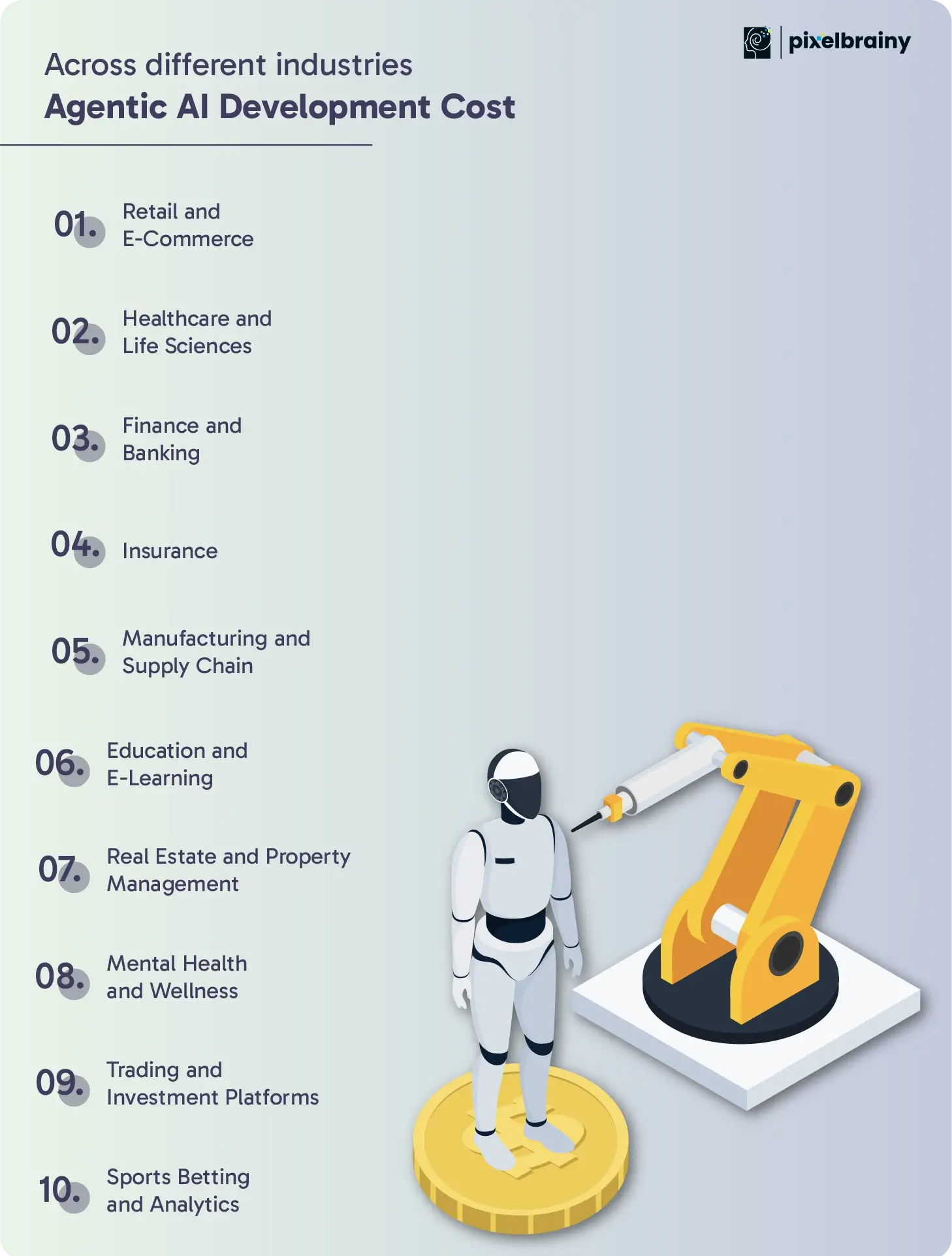
Retail businesses use Agentic AI for product recommendations, customer service, and dynamic pricing. Simple automation systems can cost around $20,000 to $50,000, while large multi-channel solutions that use behavioral data and integrate across apps or stores may cost up to $100,000 or more.
For instance, an online retailer might deploy AI agents that analyze purchase patterns and automatically adjust prices or suggest complementary items. Others use AI chat agents to handle returns and FAQs, improving satisfaction while lowering support costs.
The healthcare industry requires strict accuracy and privacy, which significantly raises costs. Basic patient-support or scheduling agents cost between $60,000 and $120,000, while advanced diagnostic assistants and research models can exceed $150,000.
Hospitals and research centers use Agentic AI for patient triage, clinical data management, and early disease detection. These systems help medical professionals make faster, data-driven decisions and streamline administrative tasks.
Banks and financial institutions invest in Agentic AI for fraud detection, customer analytics, and automated trading insights. Smaller financial chatbots can be built for $30,000 to $70,000, while large-scale, compliance-ready systems may reach $150,000 or more.
A practical example includes an AI agent that monitors transactions in real time, flags unusual activity, and ensures reporting compliance. Wealth-management firms use similar systems to create personalized investment recommendations for clients.
In insurance, Agentic AI is used to automate claims processing, detect fraud, and personalize policy offerings. The average cost to build these systems ranges from $40,000 to $110,000, depending on integration with legacy data systems and document automation tools.
For example, an insurance provider might deploy an AI agent that reviews claims, validates documentation, and predicts fraudulent submissions. This reduces manual review time and improves accuracy in underwriting decisions.
Manufacturing companies rely on Agentic AI to optimize production schedules, predict maintenance needs, and manage logistics. Simple automation systems may cost $25,000 to $60,000, while full-scale predictive and multi-agent systems can exceed $120,000.
An example is a production facility where AI monitors equipment sensors, predicts failures, and automatically orders replacement parts. Others use it to plan routes and minimize delays in global supply networks.
Educational institutions are adopting AI agents to personalize learning and automate grading. A lightweight virtual tutor can be built for $15,000 to $40,000, while an adaptive learning system integrated with a full LMS may cost $80,000 to $100,000.
These agents support teachers by tracking student performance, identifying learning gaps, and tailoring course material to each learner’s pace. The result is better engagement and improved academic outcomes.
Real estate companies use Agentic AI to manage listings, analyze pricing trends, and interact with clients. Development costs typically range between $20,000 and $70,000, while platforms offering advanced analytics and 3D property tours can cost up to $120,000.
For example, AI agents can engage potential buyers through chat, predict market values, and streamline rental management processes. These tools reduce the manual workload for agents and enhance customer experiences.
Agentic AI is emerging in the mental-health space as a support tool for therapy assistance and early behavioral detection. Building such systems typically costs $30,000 to $90,000, depending on privacy safeguards, data sensitivity, and clinical validation needs.
AI agents can serve as conversational wellness companions, offering mood tracking, coping strategies, and escalation support to licensed professionals when necessary. The focus here is not on replacing therapists but on improving access and early detection.
Also Read: How To Build An AI Mental Health and Wellness App Like Wysa?
Financial trading platforms use Agentic AI for portfolio management, predictive modeling, and automated trading. Costs usually range from $50,000 to $150,000+, depending on model precision, data volume, and integration with live markets.
These agents analyze vast amounts of real-time financial data, predict trends, and execute trades autonomously. When implemented responsibly, they can improve profitability and reduce human error in investment decisions.
Also Read: AI Trading Agent Development: Benefits and Features
Agentic AI in sports betting is designed for data analysis, odds optimization, and market prediction. Basic analytical tools can cost $25,000 to $60,000, while advanced predictive platforms with live-feed integrations may exceed $130,000.
Use cases include AI systems that analyze player performance, injury data, and betting patterns to adjust odds dynamically. Operators use these agents to improve accuracy and user engagement while ensuring compliance with regulations.
| Industry | Estimated Cost Range (USD) | Key Use Cases |
| Retail & E-Commerce | $20,000 – $100,000+ | Personalized recommendations, chatbots, inventory automation |
| Healthcare & Life Sciences | $60,000 – $150,000+ | Diagnostics, research automation, patient triage |
| Finance & Banking | $30,000 – $150,000+ | Fraud detection, credit scoring, investment advisory |
| Insurance | $40,000 – $110,000+ | Claims automation, fraud prevention, policy personalization |
| Manufacturing & Supply Chain | $25,000 – $120,000+ | Predictive maintenance, production optimization, logistics |
| Education & E-Learning | $15,000 – $100,000+ | Virtual tutors, grading automation, adaptive learning |
| Real Estate & Property | $20,000 – $120,000+ | Listing bots, market analytics, virtual tours |
| Mental Health & Wellness | $30,000 – $90,000+ | AI wellness assistants, behavior monitoring, therapy support |
| Trading & Investments | $50,000 – $150,000+ | Market prediction, automated trading, portfolio optimization |
| Sports Betting & Analytics | $25,000 – $130,000+ | Real-time odds modeling, data prediction, betting insights |
The Agentic AI project cost varies by industry because the required data, integrations, autonomy, and compliance controls are rarely the same. For marketing agencies, workflow complexity and the number of connected tools are often the bigger cost drivers.
The cost to develop Agentic AI does not end when the system goes live. For a marketing agency automating content operations, recurring expenses can come from LLM usage, API calls, monitoring, infrastructure, model updates, and human oversight. These costs can become significant as the number of content workflows, clients, and monthly tasks increases.
A related budgeting question is:
“What ongoing costs should we expect after launching an agentic AI system for our content workflow, especially for API usage, cloud infrastructure, monitoring, model updates, and human review?”
This is why the total Agentic AI project cost should include both the initial build and the expenses required to operate, maintain, and improve the system over time. Below are the most common hidden costs to consider before starting an Agentic AI project.
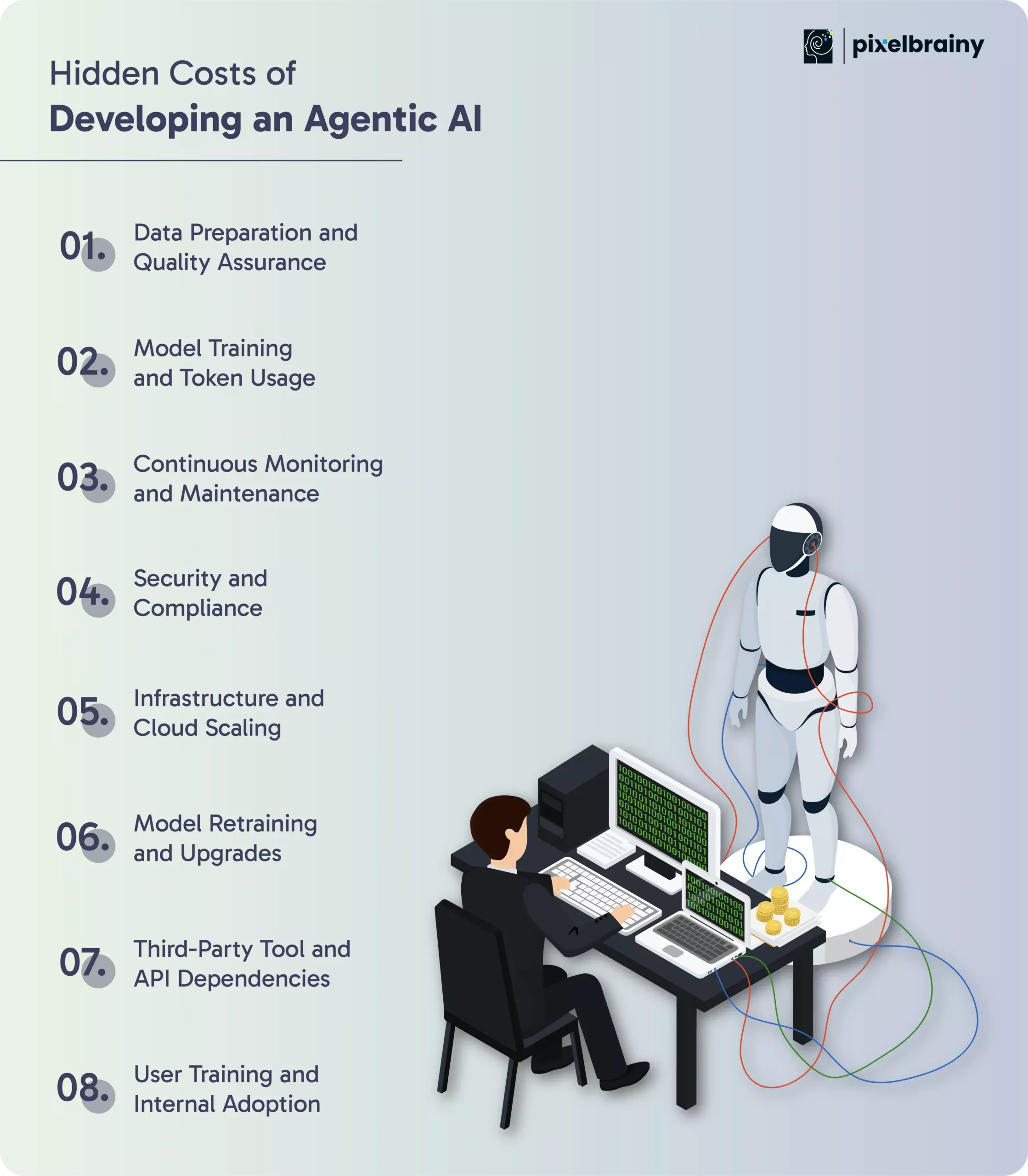
Before an AI system can function effectively, it needs structured, accurate, and well-labeled data. Many organizations overlook how time-consuming and expensive this process can be. Data preparation may cost $5,000 to $25,000, depending on data size, quality, and domain complexity.
Hidden costs arise when the data used for training is unclean or inconsistent, leading to repeated model retraining and wasted compute cycles. Investing early in data verification and quality control helps avoid these recurring issues.
Agentic AI systems that rely on large language models incur ongoing token and compute costs. Each request, reasoning loop, or retrieval query consumes processing tokens, which can quickly add up. On average, medium-scale projects may spend $1,000 to $5,000 per month in token usage, depending on query frequency and user volume.
When businesses underestimate this expense, their cloud bills often exceed expectations. Optimizing prompts, caching frequent requests, and using smaller models for non-critical operations can reduce these costs significantly.
Once deployed, an Agentic AI system requires constant supervision to ensure performance and reliability. Monitoring tools, uptime management, and feedback analysis contribute to maintenance costs that can reach 15 to 25 percent of the original project budget each year.
Neglecting maintenance can cause the AI to drift from its intended goals, leading to inaccurate decisions and loss of user trust. Regular performance reviews and retraining cycles are essential to maintain long-term efficiency.
AI systems that process personal, financial, or medical data must comply with industry regulations such as GDPR, HIPAA, or ISO standards. Implementing compliance frameworks, encryption, and audits can add $10,000 to $40,000 to total expenses.
Failure to account for this early can result in much higher costs later through fines or mandatory system redesigns. Including a compliance checklist during development prevents costly retroactive fixes.
As AI usage grows, so does the demand for compute power and storage. Businesses using cloud-based infrastructure often encounter unexpected scaling costs when traffic spikes. Additional servers, GPU resources, or API calls can increase monthly spending by $2,000 to $10,000.
Scalable architecture design and usage monitoring tools help keep infrastructure bills under control. Planning for peak traffic and caching high-frequency operations can lower these ongoing expenses.
AI models lose accuracy over time due to data drift or changing user behavior. Retraining a model to restore performance can cost $10,000 to $50,000 depending on the data size and training method.
Upgrading to new architectures or integrating with updated APIs also incurs hidden development and testing costs. Regular retraining ensures your system stays relevant, but it should be included as part of the long-term financial forecast.
Many Agentic AI systems depend on external APIs for language processing, data retrieval, or integration with existing tools. Each dependency carries licensing or subscription costs, typically $500 to $3,000 per month for enterprise-grade tools.
If vendors change pricing or terms, these expenses can quickly escalate. Building fallback mechanisms or using open-source alternatives can protect against sudden increases in operational cost.
Even the most advanced AI systems require user training and adoption strategies. Costs related to documentation, onboarding, and internal workshops can range between $3,000 and $15,000, depending on the company’s size and user base.
If employees do not fully understand how to use the system, productivity declines and the investment loses value. Budgeting for training ensures a smoother rollout and faster return on investment.
| Hidden Cost Area | Estimated Range (USD) | Description |
| Data Preparation & QA | $5,000 – $25,000 | Cleaning, labeling, and verifying datasets for model accuracy |
| Model Training & Token Usage | $1,000 – $5,000 per month | Compute and API token usage for inference and reasoning |
| Monitoring & Maintenance | 15–25% of total project cost annually | Performance tracking, bug fixes, and model updates |
| Security & Compliance | $10,000 – $40,000 | Data protection, audits, and regulatory adherence |
| Infrastructure Scaling | $2,000 – $10,000 monthly | Cloud, GPU, and storage scaling expenses |
| Model Retraining & Upgrades | $10,000 – $50,000 | Rebuilding models to address data drift and performance loss |
| Third-Party Tools & APIs | $500 – $3,000 monthly | Licensing or subscription for integrations and APIs |
| User Training & Adoption | $3,000 – $15,000 | Staff training and internal change management |
By accounting for these hidden costs early, businesses can create a realistic and sustainable Agentic AI budget that supports long-term efficiency, reliability, and value.
Seeing how Agentic AI is applied in real projects helps clarify how different goals and features affect the overall development effort. Here are a few real-world style examples that represent common use cases across industries.
The real Agentic AI implementation cost includes both the initial development budget and the recurring expenses required to keep the system accurate, reliable, and scalable.
The cost to develop Agentic AI can differ substantially between startups and enterprises because their requirements for autonomy, integrations, security, scalability, and ongoing support are different. A startup may prioritize a focused MVP that proves the value of an agentic workflow, while an enterprise may require a production-grade system connected to multiple business platforms.
For a marketing agency evaluating an agentic content operation, an important budgeting question is:
“Should we build our agentic AI content workflow as a lean MVP first, or invest upfront in an enterprise-grade system that can support multiple clients, workflows, integrations, and higher content volumes?”
The answer directly affects the Agentic AI development cost, development timeline, infrastructure requirements, and long-term operating budget. The following comparison explains how pricing expectations typically differ between startup and enterprise implementations.
Startups usually approach Agentic AI development with a lean mindset, aiming to launch quickly and test real-world value before committing to large-scale investment. Their projects often begin with a minimum viable product (MVP) that focuses on solving one or two critical problems efficiently.
To control expenses, startups rely on open-source frameworks, cloud-based APIs, and pre-trained models that can be easily configured and deployed. The goal is to achieve autonomy and innovation without heavy infrastructure costs. Teams are small, cross-functional, and highly adaptive, which allows them to pivot fast as the product evolves.
Key Characteristics:
Estimated Cost Range: $30,000 to $150,000, depending on model complexity, integrations, and autonomy level.
This cost range reflects the typical development budget of Agentic AI for startups looking to innovate rapidly without overextending resources.
Enterprises take a broader, more integrated approach to Agentic AI. Their systems often involve multiple agents interacting across departments, advanced analytics, and connections to internal databases or business applications. Projects at this level require rigorous planning, model customization, and compliance alignment to meet enterprise-grade standards.
These organizations invest heavily in reliability, data governance, and security to support large-scale deployments. Enterprise AI systems also demand fine-tuning, orchestration layers, and extensive testing before rollout. The goal is not just automation but also long-term transformation that delivers measurable ROI and strategic impact.
Key Characteristics:
Estimated Cost Range: $200,000 to $1 million or more, based on architecture, scope, and enterprise-scale infrastructure needs.
This level of investment represents the cost to build Agentic AI designed for enterprise operations, where performance, reliability, and compliance are top priorities.
Whether you are a fast-moving startup or a global enterprise, aligning your Agentic AI development cost with business goals ensures you build a solution that delivers long-term value, scalability, and measurable results.
Building an Agentic AI system can be expensive, but with smart planning and the right tools, businesses can lower costs without sacrificing quality. The key is to optimize resources, reuse existing assets, and invest where it truly matters for performance and scalability.
Here are proven ways to make your Agentic AI project cost more efficient and sustainable.
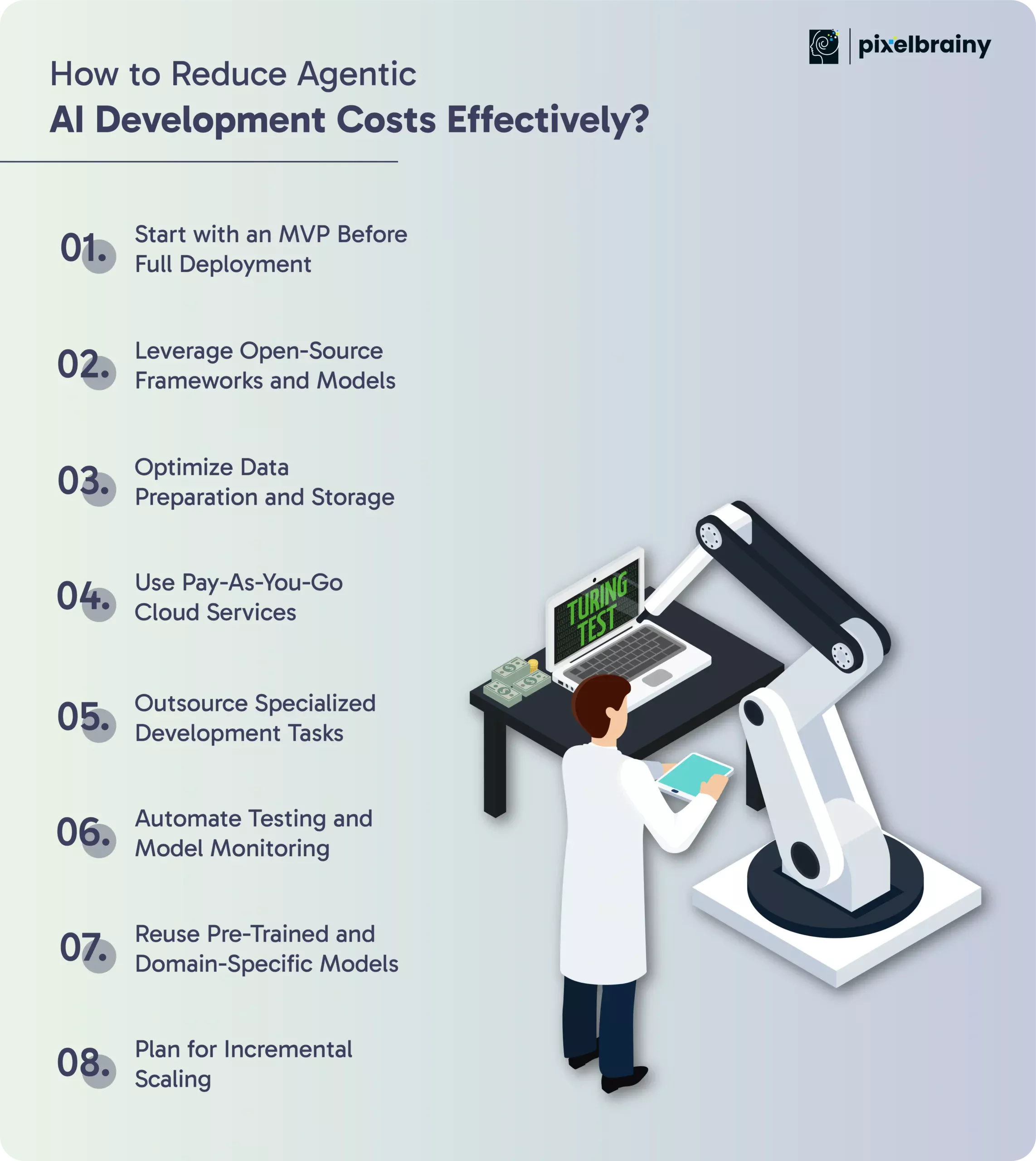
Launching a minimum viable product (MVP) allows teams to validate features and performance early. By testing the core functionality first, businesses can avoid investing in unnecessary capabilities during the initial phase.
Estimated Savings: 20–30% of total development cost
For example, starting with a single-agent workflow and scaling later can reduce initial expenses by tens of thousands of dollars.
Using open-source frameworks such as LangChain, Llama, or CrewAI can significantly reduce licensing and API costs. These tools provide strong building blocks for custom development without the expense of proprietary systems.
Estimated Savings: 25–40% reduction in software and infrastructure costs
Startups especially benefit from open-source ecosystems that allow experimentation at minimal expense.
High-quality data is essential, but over-preparing or storing unnecessary information increases costs. Cleaning and structuring only relevant datasets, and using efficient cloud storage plans, can make a big difference.
Estimated Savings: 10–20% on data and infrastructure expenses
Using automated data labeling tools and pre-trained embeddings can further accelerate the process while maintaining accuracy.
Instead of investing in dedicated servers, businesses can use flexible cloud solutions like AWS, Azure, or Google Cloud’s usage-based pricing. This ensures you only pay for what you actually use.
Estimated Savings: 15–35% on cloud and hosting costs
Startups in particular can take advantage of free credits or startup accelerator programs offered by these providers.
Hiring external AI experts or development partners for specific project components can reduce in-house labor costs. Outsourcing helps companies access high-level expertise without full-time commitments.
Estimated Savings: 20–40% on staffing and project management
This approach also shortens delivery time and ensures consistent quality for niche components like model integration or API orchestration.
Automating parts of testing, performance tracking, and retraining can significantly lower long-term maintenance costs. AI-driven monitoring tools detect issues early and reduce the need for manual oversight.
Estimated Savings: 10–25% on post-launch maintenance and quality assurance
Over time, this reduces downtime, boosts reliability, and prevents expensive rework cycles.
Instead of training a model from scratch, using pre-trained or fine-tuned models tailored to your industry saves time and computational cost.
Estimated Savings: 30–50% of total model development expenses
Fine-tuning existing architectures for your specific data is far more efficient than building an entirely new model.
Instead of launching all features at once, develop your AI system in phases. Gradual scaling helps track ROI, reduce infrastructure waste, and ensure smooth user adoption.
Estimated Savings: 15–25% on total deployment costs
This method allows continuous learning and improvement while keeping expenses predictable.
| Cost Reduction Strategy | Average Savings (%) | Primary Benefit |
| MVP-first Development | 20–30% | Cuts initial investment and focuses on essentials |
| Open-Source Tools & Models | 25–40% | Reduces licensing and model costs |
| Optimized Data Preparation | 10–20% | Lowers storage and processing costs |
| Pay-as-You-Go Cloud | 15–35% | Prevents overpaying for unused infrastructure |
| Outsourced Expertise | 20–40% | Accesses talent without full-time expenses |
| Automated Testing & Monitoring | 10–25% | Lowers ongoing maintenance costs |
| Reuse of Pre-Trained Models | 30–50% | Minimizes training and compute time |
| Incremental Scaling | 15–25% | Keeps scaling flexible and ROI-focused |
The right Agentic AI project cost depends on the required scale, autonomy, integrations, and business objectives rather than company size alone.
The future cost to develop Agentic AI will be shaped less by model development alone and more by how efficiently businesses manage inference, orchestration, integrations, governance, and production workloads. For a marketing agency planning autonomous content operations, these changes could directly affect both the initial Agentic AI development cost and the recurring expense of running research, content creation, SEO, publishing, and performance workflows at scale.
A related planning question is:
“As agentic AI becomes more capable, will the cost of running our automated marketing workflows decrease, or will added agents, integrations, governance, and production requirements make the overall investment higher?”
The answer will depend on how quickly model and infrastructure costs decline compared with the complexity of the workflows businesses automate. The following trends are expected to influence Agentic AI implementation costs and long-term operating budgets.
Recent academic studies suggest that while large language models (LLMs) offer broad capabilities, smaller models tuned for specific tasks can deliver similar performance at significantly lower cost.
As organizations increasingly adopt tailored models instead of one-size-fits-all architectures, the cost to build Agentic AI is likely to drop. Savings will come from reduced compute, fewer tokens consumed and simpler infrastructure requirements.
Industry research indicates that the cost of inference—running models in production—is falling rapidly, with some estimates of up to ten-fold reduction per year in ideal conditions.
This means that while initial development budgets may remain high, the Agentic AI Implementation Cost for ongoing operations will likely shrink. Organizations should plan for lower post-launch spend even as they scale use.
The next generation of agentic AI doesn’t just involve a single agent but a network of coordinated agents. Industry blogs highlight that by 2026 many businesses will deploy entire ecosystems of agents working in partnership.
This complexity will initially increase the cost of making Agentic AI, because orchestration, communication and governance layers add overhead. But over time, tools and frameworks will standardize, reducing the marginal cost per agent.
As autonomous systems become more embedded in operations, regulatory and trust issues rise. Reports show that a large portion of agentic AI projects face cancellation or delay because of unclear business value and weak governance.
Future budgets must account for governance, auditing, security and risk management. The pricing of Agentic AI Development will increasingly include “agent ops” teams, governance frameworks and compliance monitoring—not just engineering hours.
To meet latency, data-privacy and regulatory demands, many organizations will move agentic AI workloads toward edge computing or hybrid cloud models. This reduces dependence on heavy cloud infrastructure but introduces new integration and hardware costs.
Over time, this can reduce the cost to develop Agentic AI, particularly for real-time or regulated environments, because distributed deployment can avoid high cloud consumption—but it also requires upfront architecture investment.
Surveys show that many organizations are still in pilot mode, but the expectation is that agentic AI will shift rapidly into full production mode.
When moving to production, the development budget of Agentic AI needs to factor scale: higher user volume, increased data flows and stricter SLA requirements. Thus while per-unit cost may fall, total investment can grow.
The future Agentic AI project cost is likely to shift toward scalable infrastructure, multi-agent orchestration, governance, and ongoing operations rather than model development alone.
PixelBrainy, an experienced agentic AI development company, helps businesses reduce unnecessary Agentic AI development costs by reviewing the existing architecture, identifying expensive or redundant components, and restructuring the solution around modular, scalable workflows.
A recent project for a mid-sized SaaS company demonstrates this approach. The client initially had a development budget of more than $250,000 for a multi-agent Agentic AI system. After reviewing the proposed architecture, PixelBrainy identified opportunities to reduce complexity and improve how the agents and integrations were structured. The team restructured the multi-agent architecture and introduced modular integrations, bringing the estimated development budget down to approximately $140,000 while improving the system's functionality. This represented a 45% reduction in the projected development cost.
| Project Area | Details |
| Client | Mid-sized SaaS company |
| Project Type | Multi-agent Agentic AI system |
| Original Budget | $250,000+ |
| Cost Optimization Approach | Multi-agent architecture restructuring + modular integrations |
| Optimized Budget | Approximately $140,000 |
| Reported Result | 45% reduction in development budget with improved functionality |
The project highlights how the cost to build Agentic AI can be optimized through better architecture and technology decisions rather than simply reducing features. PixelBrainy's broader approach also includes MVP-first development, infrastructure optimization, token optimization, and model reuse to help control both initial development expenses and ongoing Agentic AI implementation costs.
For businesses planning an agentic AI system, this approach helps turn a large initial development estimate into a more controlled and scalable investment.
The cost to develop Agentic AI in 2026 depends on far more than the AI model itself. Project complexity, autonomy level, integrations, data preparation, security, infrastructure, development expertise, and ongoing maintenance all influence the final Agentic AI development cost. A focused MVP may require a smaller investment, while enterprise-grade systems with multi-agent orchestration and extensive integrations can require significantly larger budgets.
Businesses should also consider recurring expenses such as LLM usage, APIs, cloud infrastructure, monitoring, upgrades, and human oversight when calculating the total Agentic AI implementation cost. The right architecture can help control these expenses while keeping the system ready for future growth.
For marketing agencies and other businesses automating multi-step workflows, comparing the development investment with existing operational costs and expected productivity gains provides a stronger basis for measuring ROI.
Ready to estimate your Agentic AI project cost and identify opportunities to optimize your investment? Schedule a call with PixelBrainy today.
The cost to develop Agentic AI can range from around $15,000 to $150,000+, depending on workflow complexity, autonomy, integrations, model requirements, security, and scalability. Enterprise implementations with multi-agent orchestration and extensive integrations can require substantially higher budgets.
An agentic AI built for a marketing agency can fall into the medium-to-advanced development range when it handles research, content briefs, article drafting, SEO optimization, social media generation, publishing, and performance reporting. The final Agentic AI project cost depends on monthly content volume, connected platforms, approval workflows, and required autonomy.
Beyond development, businesses should budget for LLM token usage, third-party APIs, cloud infrastructure, monitoring, maintenance, model upgrades, security, and human oversight. These recurring expenses form an important part of the overall Agentic AI implementation cost.
Yes. A multi-agent architecture generally requires additional orchestration, communication, testing, memory, monitoring, and governance. However, a well-designed modular architecture can make future agents easier to add without rebuilding the entire system.
An MVP can reduce the initial development budget of Agentic AI by focusing on the highest-value workflow first. For example, a marketing agency could initially automate content research, drafting, and SEO before adding publishing automation, social distribution, and advanced analytics.
Calculate the annual labor cost for the tasks you plan to automate, including research, writing, SEO, publishing, reporting, and management time. Then compare it with the initial cost to build Agentic AI plus recurring AI, infrastructure, maintenance, and review costs to estimate the potential ROI.
The biggest cost drivers are typically system complexity, model selection, integrations, data preparation, team expertise, security requirements, infrastructure, and post-launch maintenance. Greater autonomy and more connected business systems generally require greater engineering investment.
An experienced agentic AI development company can optimize the architecture, select appropriate models, reuse components, reduce unnecessary integrations, and design the system for incremental scaling. These decisions can lower both the upfront Agentic AI development cost and long-term operating expenses.

About The Author
Sagar Bhatnagar
Sagar Sahay Bhatnagar brings over a decade of IT industry experience to his role as Marketing Head at PixelBrainy. He's known for his knack in devising creative marketing strategies that boost brand visibility and market influence. Sagar's strategic thinking, coupled with his innovative vision and focus on results, sets him apart. His track record of successful campaigns proves his ability to utilize digital platforms effectively for impactful marketing efforts. With a genuine passion for both technology and marketing, Sagar continuously pushes PixelBrainy's marketing initiatives to greater success.

Working with the PixelBrainy team has been a highly positive experience. They understand the design requirements and create beautiful UX elements to meet the application needs. The dev team did an excellent job bringing my vision to life. We discussed usability and flow. Sagar worked with his team to design the database and begin coding. Working with Sagar was easy. He has the knowledge to create robust apps, including multi-language support, Google and Apple ID login options, Ad-enabled integrations, Stripe payment processing, and a Web Admin site for maintaining support data. I'm extremely satisfied with the services provided, the quality of the final product, and the professionalism of the entire process. I highly recommend them for Android and iOS Mobile Application Design and Development.

Great experience working with them. Had a lot of feedback and I found that unlike most contractors they were bugging me for updates instead of the other way around. They were extremely time conscience and great at communicating! All work was done extremely high quality and if not on time, early! They were always proactive when it comes to communication and the work is great/above par always. Very flexible and a great team to work with! Goes above and beyond to present us with multiple options and always provides quality. Amazing work per usual with Chitra. If you have UI/UX or branding design needs I recommend you go to them! Will likely work with them in the future as well, definitely recommended!

PixelBrainy is a joy to work with and is a great partner when thinking through branding, logo, and website layout. I appreciate that they spend time going into the "why" behind their decisions to help inform me and others about industry best practices and their expertise.

I hired them to design our software apps. Things I really like about them are excellent communication skills, they answer all project suggestions and collaborate right away, and their input on design and colors is amazing. This project was complex and needed patience and creativity. The team is amazing to do business with. I will be using them long-term. Glad to see there are some good people out there. I was afraid to try and outsource my project to someone but I am glad I met them! I really can't say enough. They went above and beyond on this project. I am very happy with everything they have done to make my business stand out from the competition.

It was great working with PixelBrainy and the team. They were very responsive and really owned the project. We'll definitely work with them again!

I recently worked with the PixelBrainy team on a project and I was blown away by their communication skills. They were prompt, clear, and articulate in all of our interactions. They listened and provided valuable feedback and suggestions to help make the project a success. They also kept me updated throughout the entire process, which made the experience stress-free and enjoyable.

PixelBrainy is very good at what it does. The team also presents themselves very professionally and takes care of their side of things very well. I could fully trust them taking up the design work in a timely and organised manner and their attention to detail saved us lots of effort and time. This particular project was quite intense and the team showed that they function very well under pressure. Very much looking forward to working with her again!

It's always an absolute pleasure working with them. They completed all of my requests quickly and followed every note I had for them to a T, which made our process go smoothly from start to finish. Everything was completed fast and following all of the guidelines. And I would recommend their services to anyone. If you need any design work done in the future, PixelBrainy should be your first call!

They took ownership of our requirements and designed and proposed multiple beautiful variants. The team is self-motivated, requires minimum supervision, committed to see-through designs with quality and delivering them on time. We would definitely love to work with PixelBrainy again when we have any requirements.

PixelBrainy was a big help with our SaaS application. We've been hard at work with a new UI/UX and they provided a lot of help with the designs. If you're looking for assistance with your website, software, or mobile application designs, PixelBrainy and the team is a great recommendation.

PixelBrainy designers are amazing. They are responsive, talented, and always willing to help craft the design until it matches your vision. I would recommend them and plan to continue them for my future projects and more!!!

They were awesome! Did a good job fast, and good communication. Will work with them again. Thank you

Creative, detail-oriented, and talented designers who take direction well and implement changes quickly and accurately. They consistently over-delivered for us.

PixelBrainy team is very talented and creative. Great designers and a pleasure to work with. PixelBrainy is an excellent communicator and I look forward to working with them again.

PixelBrainy has a very talented design team. Their work is excellent and they are very responsive. I enjoy working with them and hope to continue on all of our future projects.


Transform your ideas into reality with us.
Across these industries, each engagement brings unique challenges, from early-stage product development to scaling complex systems, helping us build a practical understanding of real-world product environments.