 AI Summary Powered by PixelBrainy
What if your trading platform could give every retail investor an AI trading agent that understands their risk tolerance, investment goals, and market preferences, then monitors markets and executes predefined strategies on their behalf?
For a fintech startup competing with established retail trading platforms such as Robinhood and Webull, AI trading agent development can create a meaningful product differentiator. Instead of offering only conventional trading tools, an intelligent agent can analyze market data, monitor portfolio conditions, evaluate predefined strategies, and automate selected trading actions based on an investor's profile and authorized parameters.
However, building an AI trading agent for retail investors involves considerably more than connecting an LLM to a brokerage API. The moment an AI system provides investment advice or makes recommendations involving securities, regulatory, fiduciary, disclosure, supervision, and risk-management considerations become central to the product architecture. The SEC has specifically recognized robo-advisers as investment advisers using algorithms to provide online investment advisory services and has highlighted considerations around disclosures, client information, suitability, and compliance programs.
For fintech founders, this creates an important question: Does an autonomous AI trading feature require investment adviser registration, or can it operate within an existing broker-dealer structure? The answer depends on the business model, services provided, regulatory capacity, and how the AI agent makes or executes investment recommendations. SEC staff also noted in February 2026 that AI-powered investment tools raise questions around marketing, adviser registration, and supervision, reinforcing the need for regulatory analysis before deployment.
This guide explores how to build an AI trading agent in 2026, including its benefits, must-have features, development process, technology stack, development cost, compliance considerations, and custom AI trading agent architecture. It also explains what fintech businesses should evaluate when working with an AI trading agent development company in the USA.
How does an AI trading agent actually analyze market conditions, make trading decisions, and execute trades automatically? An AI trading agent works through a continuous cycle of data collection, AI-powered analysis, signal generation, risk assessment, trade execution, and performance monitoring.
Unlike a traditional rule-based trading bot, an AI trading agent can process multiple data sources and use machine learning models to identify patterns and support more adaptive trading workflows.
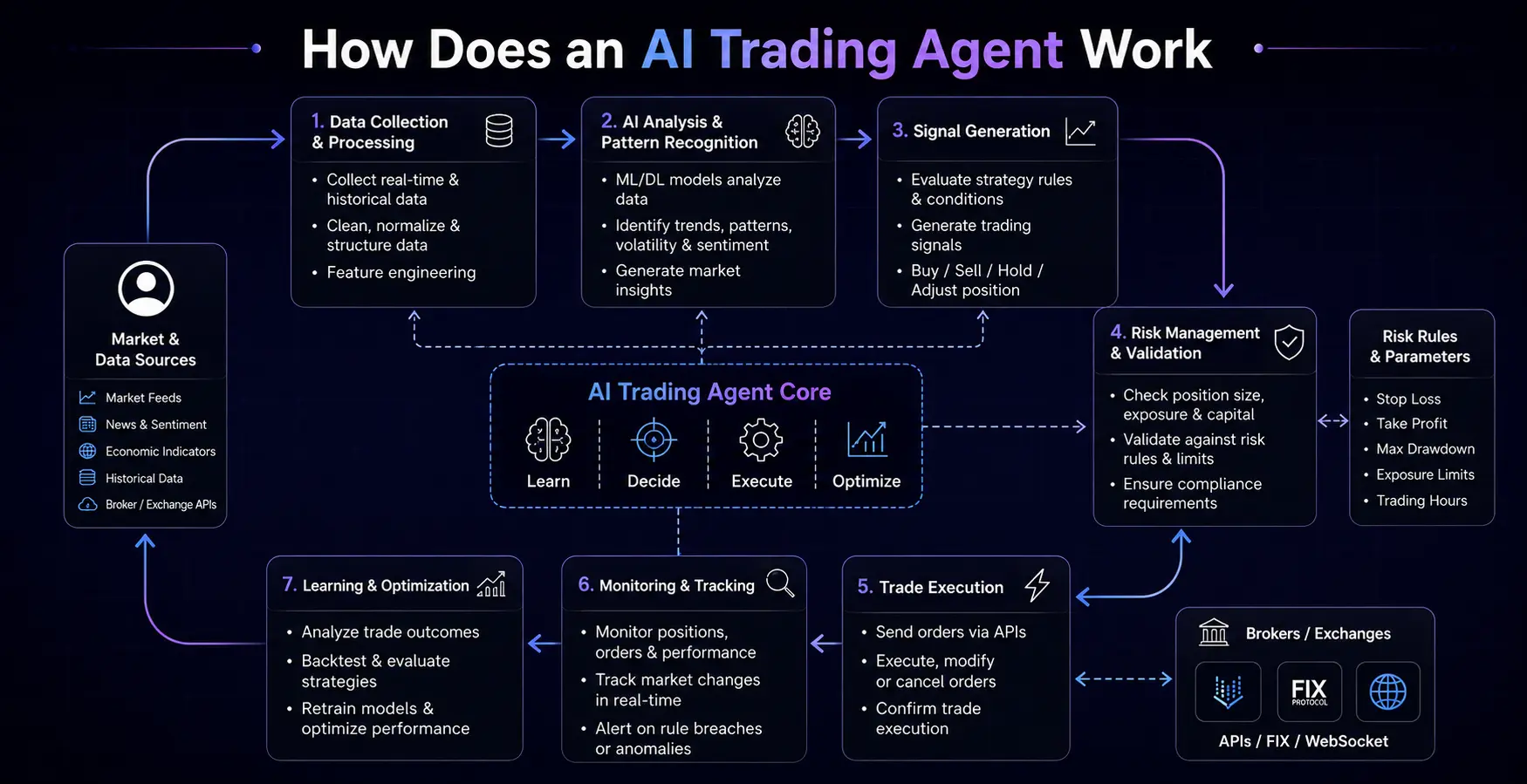
The process begins with collecting data from market feeds, brokerage APIs, exchanges, financial news, economic indicators, and other relevant sources. The system cleans, normalizes, and structures this information so AI models can process it efficiently.
Machine learning and other AI models analyze historical and real-time data to identify patterns, trends, volatility, market sentiment, and potential trading signals. Depending on the application, the agent may combine price data with news, technical indicators, or alternative datasets.
After analyzing the available information, the AI trading agent evaluates whether current market conditions match the parameters of an approved trading strategy. It may generate a buy, sell, hold, or portfolio-adjustment signal based on the configured objectives.
Before an order is executed, the agent checks predefined risk controls such as position size, portfolio exposure, stop-loss levels, drawdown limits, available capital, and trading permissions. These safeguards help prevent actions that exceed the platform's approved risk parameters.
When the required conditions are satisfied and execution is authorized, the agent connects with a broker, exchange, or trading platform through secure APIs. It can then submit, modify, or cancel orders according to the configured AI trading strategy and execution logic.
After execution, the agent continuously monitors positions, market movements, portfolio performance, and execution outcomes. This enables the system to respond to changing conditions within its permitted strategy and risk framework.
Performance data can be used for backtesting, model evaluation, retraining, and strategy optimization. Developers can compare model predictions with actual outcomes, identify weaknesses, and improve the AI system through controlled updates and validation.
This continuous workflow of market-data analysis, AI-driven decision-making, risk assessment, automated execution, and performance monitoring forms the foundation of modern AI trading agent development.
Financial markets are becoming increasingly data-intensive, automated, and competitive. For fintech founders and financial institutions, this raises a practical question: Can an AI trading agent deliver enough automation, personalization, and operational value to justify the investment, while still operating within applicable regulatory and risk controls? For businesses exploring AI trading solutions for fintech, the opportunity is increasingly tied to intelligent automation rather than simply faster trade execution.
The broader market momentum supports continued investment. MarketsandMarkets projects the global AI in Finance market to reach USD 190.33 billion by 2030, growing at a 30.6% CAGR from 2024 to 2030. Its coverage includes algorithmic trading, robo-advisors, risk management, forecasting, and other AI-enabled financial applications.
The rapid expansion of AI adoption across financial services is creating opportunities for fintech companies to develop specialized AI trading agents, portfolio assistants, predictive analytics platforms, and automated investment tools.
MarketsandMarkets estimates that the AI in Finance market will increase from USD 38.36 billion in 2024 to USD 190.33 billion by 2030, representing a 30.6% CAGR. The market research specifically identifies algorithmic trading, robo-advisors, risk management, trend analysis, and financial forecasting among key applications.
Financial markets generate enormous amounts of information across price movements, news, economic indicators, corporate announcements, and alternative data. AI agents can continuously process relevant information and execute predefined workflows without depending on manual monitoring.
Key advantages include:
However, speed should be combined with appropriate controls, validation, monitoring, and execution safeguards, particularly when an AI system can place trades autonomously.
AI trading agents can automate sophisticated workflows across multiple accounts, strategies, assets, or market conditions. This makes it possible for fintech platforms to provide personalized automation without requiring human teams to manually manage every interaction.
For example, an AI agent could monitor an investor's defined risk parameters, evaluate qualifying market conditions, generate an action based on an approved strategy, and route the order through the appropriate brokerage infrastructure.
This scalability can help fintech businesses differentiate their AI trading platform development strategy while improving operational efficiency.
Regulatory considerations are becoming an important part of financial AI development. Rather than treating compliance as a final-stage requirement, fintech businesses should incorporate AI governance, explainability, auditability, supervision, and risk controls into the system architecture from the beginning.
For AI-powered investment products, the regulatory framework can depend on how the product provides advice, makes recommendations, executes transactions, and interacts with customers. The SEC has highlighted considerations surrounding AI use by investment advisers, including disclosures, fiduciary obligations, and compliance programs.
Therefore, building transparent decision logs, permission controls, human oversight mechanisms, and auditable workflows can strengthen the operational foundation of an AI trading agent.
Retail investors increasingly expect financial platforms to deliver experiences tailored to their individual objectives and preferences. AI can help personalize portfolio monitoring, market alerts, strategy parameters, and investment workflows according to factors such as risk tolerance, investment horizon, portfolio composition, and user-defined preferences.
For fintech businesses, this creates an opportunity to develop personalized AI trading agents that operate within clearly defined permissions and risk constraints rather than providing identical experiences to every investor.
In short, AI trading agent development can give fintech platforms a scalable way to combine automation, personalization, analytics, and intelligent workflows, provided these capabilities are designed alongside appropriate regulatory, security, and risk-management controls.
AI trading agents are becoming an important component of modern fintech infrastructure because they can continuously analyze market information, automate predefined trading workflows, and support faster decision-making at scale.
For businesses considering AI trading agent development, a practical question often comes up: “Can an AI trading agent actually improve trading efficiency and decision-making enough to justify the investment?” The answer depends on the strategy, data quality, execution infrastructure, risk controls, and level of automation, but well-designed AI systems can provide meaningful operational advantages.
Here are the core benefits fueling the adoption of AI trading agents:
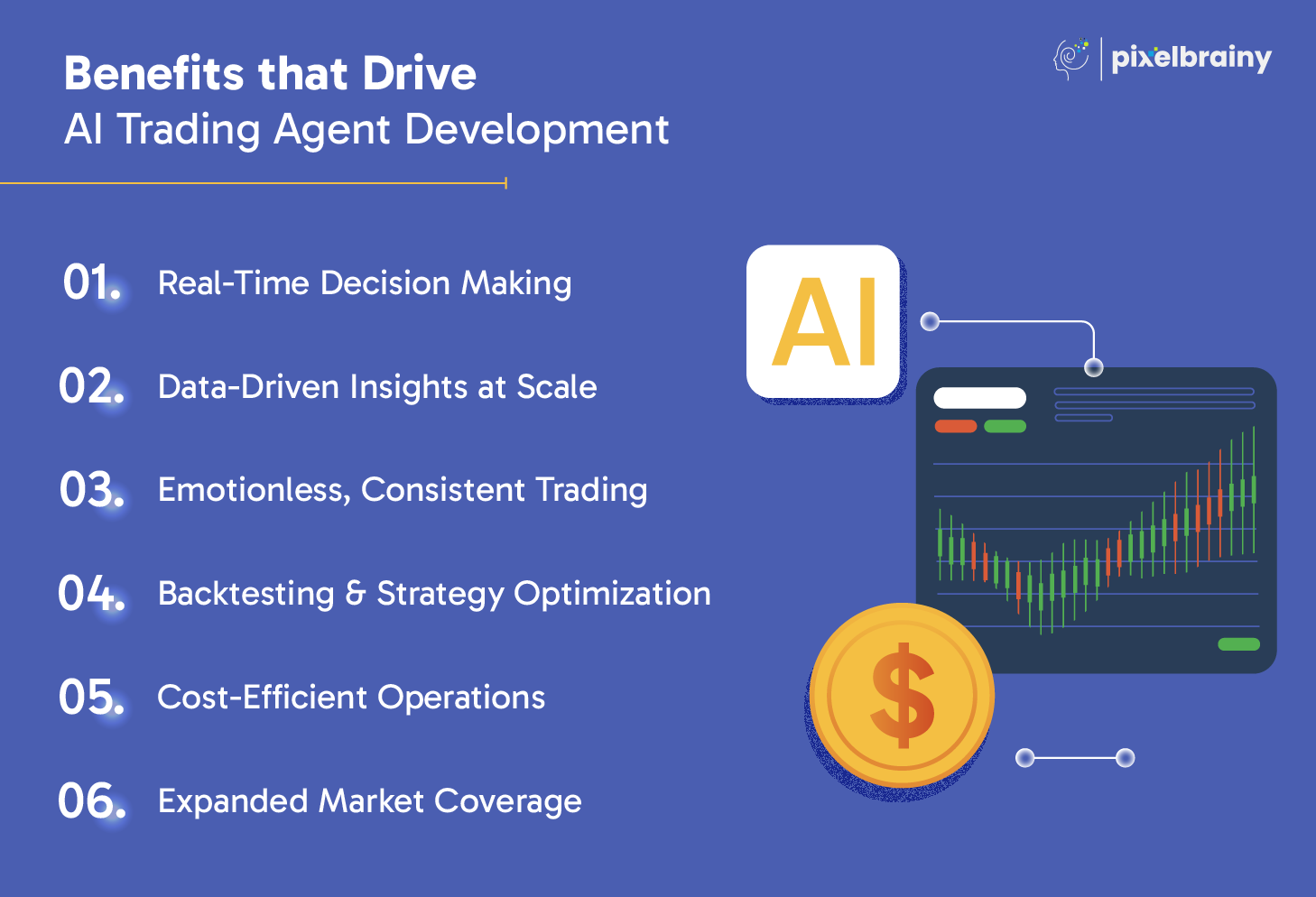
AI trading agents can continuously monitor market data, identify predefined signals, evaluate trading conditions, and trigger actions according to programmed strategies. Unlike manual workflows that depend on a trader reviewing multiple data sources, an AI system can process information rapidly and respond consistently when specified conditions are met.
For fintech platforms, this can support:
The actual execution speed depends on the model, infrastructure, brokerage APIs, market connectivity, and trading strategy.
Financial markets generate large volumes of structured and unstructured information, including price data, trading volumes, financial reports, economic indicators, news, and market sentiment. AI trading software can process multiple data sources simultaneously to identify patterns and generate actionable insights.
This enables trading platforms to:
The quality of these insights ultimately depends on data quality, model design, validation, and ongoing monitoring.
Human traders can be influenced by fear, greed, overconfidence, or hesitation, particularly during periods of significant market volatility. An AI trading agent does not experience these emotions and can follow its programmed strategy consistently.
For AI trading agent development, this can help businesses implement:
However, removing emotion does not eliminate risk. Poorly designed strategies or inaccurate models can still produce losses, making testing, monitoring, and appropriate safeguards essential.
Backtesting allows trading strategies to be evaluated against historical market data before they are deployed in live environments. AI trading systems can help development teams simulate different parameters, analyze historical outcomes, and identify areas where strategies may require refinement.
A robust AI trading agent development process can use backtesting to:
Historical performance should not be treated as a guarantee of future results, particularly when market conditions change.
Automating repetitive market monitoring, data analysis, reporting, and selected execution workflows can reduce the amount of manual effort required to operate a trading platform. This can be particularly valuable for fintech businesses managing growing user bases or multiple investment strategies.
AI trading agents can help organizations:
The overall financial benefit depends on infrastructure costs, model usage, brokerage fees, compliance requirements, and the complexity of the trading operation.
AI agents can monitor multiple assets, markets, strategies, and time zones simultaneously, giving trading platforms broader monitoring capabilities than a human team can typically manage manually. This can support diversified market analysis and continuous surveillance across global trading environments.
Depending on the platform architecture, AI agents can support:
Together, these benefits make AI trading agent development a powerful opportunity for fintech platforms seeking faster analysis, scalable automation, personalized trading workflows, and more consistent execution, while maintaining appropriate human oversight and risk controls.
An effective AI trading agent needs to do far more than automate buy and sell instructions. For fintech startups and financial platforms, the real value comes from combining real-time market intelligence, strategy analysis, risk controls, explainability, and reliable execution within a scalable architecture.
A practical question for businesses planning AI trading agent development is: “Which features should our AI trading agent have to analyze markets intelligently, execute strategies reliably, manage risk, and support personalized trading without creating unnecessary technical complexity?”
The answer depends on the asset classes, trading strategies, user profiles, execution model, and regulatory requirements of the platform. However, a strong foundation should include capabilities for processing live market data, analyzing sentiment, evaluating strategies, managing portfolio risk, explaining AI decisions, and integrating securely with trading infrastructure.
For fintech startups building custom AI trading agents, these capabilities also need to work together rather than operate as isolated features. For example, predictive market modeling becomes significantly more useful when combined with real-time data ingestion, backtesting, risk management, and explainable decision-making. Similarly, autonomous execution should operate within clearly defined permissions, safeguards, and monitoring mechanisms.
Below are the essential features that can define a robust AI trading agent development solution in 2026:
| Feature | Description |
| Predictive Market Modeling | Uses historical and real-time data to forecast future market trends and inform proactive trading decisions. |
| Real-Time Data Ingestion | Continuously processes live market feeds, economic indicators, and external datasets to enable instant reaction. |
| Sentiment Analysis | Analyzes social media and news to gauge market sentiment and adjust trading positions accordingly. |
| Reinforcement Learning for Trading Agents | Enables the bot to learn and improve strategies based on trading outcomes and feedback loops. |
| Multi-Asset Support | Supports trading across various asset classes, including stocks, crypto, forex, and commodities. |
| Risk Management & Stop-Loss | Implements smart limits and dynamic stop-loss rules to minimize losses during volatility. |
| Backtesting with Historical Data | Test strategies against past market conditions to validate profitability and reduce risk. |
| Real-Time Strategy Switching | Adapts to changing market conditions by switching between trading strategies on the fly. |
| Explainable AI (XAI) | Provides transparent logic behind each decision, aiding trust, debugging, and regulatory compliance. |
| Trading API Integration | Seamlessly connects with popular platforms like Binance, Interactive Brokers, MetaTrader, etc. |
| Portfolio Diversification Algorithms | Distributes investments intelligently across assets to balance risk and reward. |
| HFT Readiness | Designed for ultra-fast execution, minimizing latency to compete in high-frequency markets. |
| Anomaly & Fraud Detection | Flag unusual trading behaviors and patterns to protect against manipulation or fraud. |
| Voice & NLP-Based Commands | Enables trade execution and queries via natural language, simplifying user interaction. |
| Cloud-Native & Edge Deployment | Offers scalable deployment across cloud or edge environments for speed and security. |
Together, these features create the technical foundation for AI trading agents that can analyze markets, automate approved strategies, manage risk, and scale across modern fintech trading environments.
Developing a custom AI trading agent requires more than training a model and connecting it to a brokerage API. The process combines financial domain knowledge, trading strategy design, data engineering, AI model development, risk management, secure execution, and continuous validation. For fintech startups and financial institutions, each stage must be structured carefully because an AI agent can directly influence trading decisions and, depending on its design, execute transactions in live markets.
A practical question many fintech founders ask is: “How can we build an AI trading agent that can execute our strategy reliably in real market conditions while controlling risk, validating model performance, and meeting applicable regulatory requirements?”
The answer begins with a controlled development lifecycle. Before investing in full-scale AI trading software development, teams should validate the trading concept, assess technical feasibility, build a limited proof of concept, test models against historical data, and gradually move from simulation to controlled deployment.
Whether you are working with AI agent development companies or building an internal trading technology team, the following steps provide a structured roadmap for developing, testing, and scaling a custom AI trading agent.
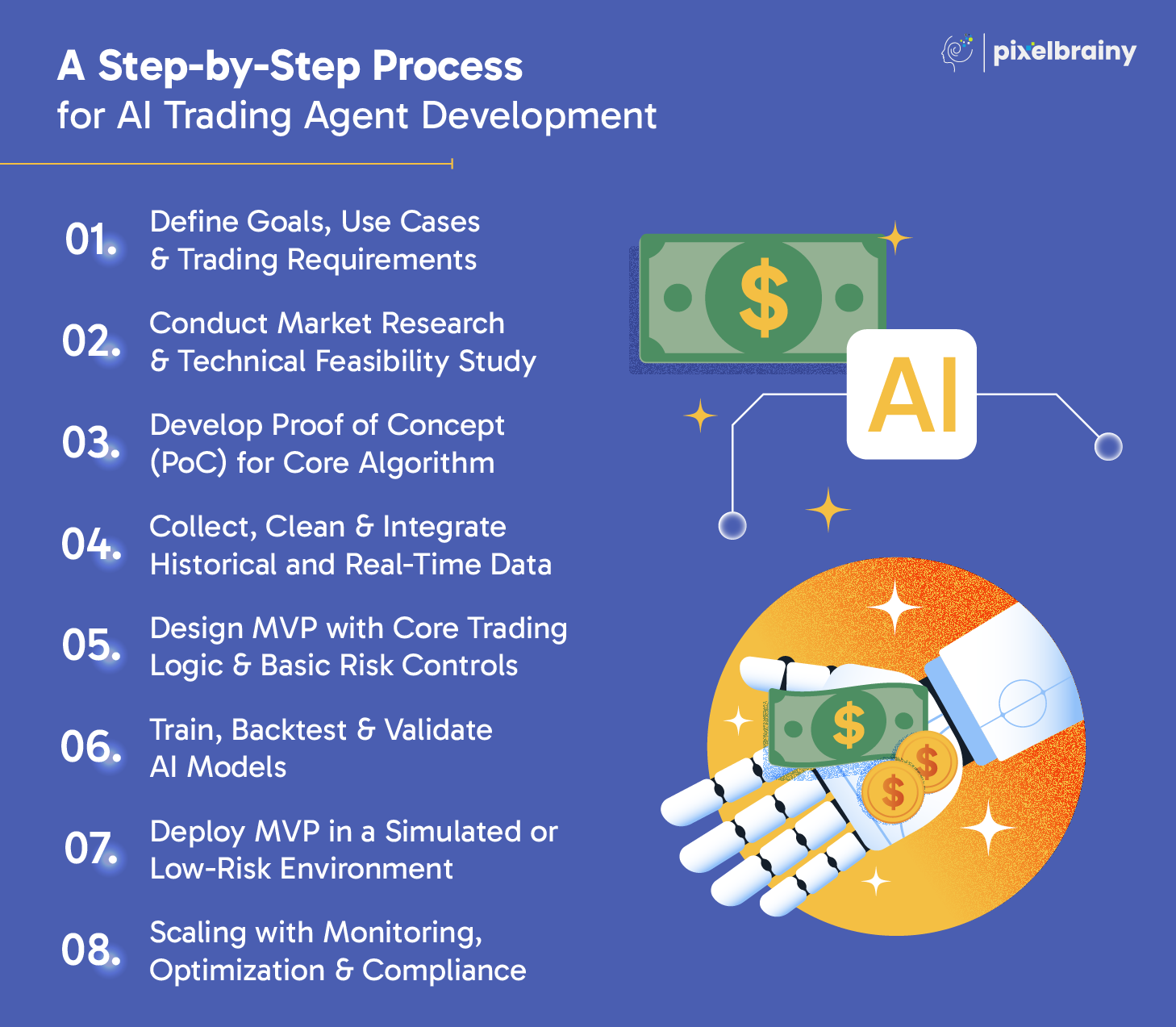
The first stage establishes exactly what the AI trading agent is expected to accomplish. Clear requirements help determine the appropriate architecture, data sources, model complexity, execution infrastructure, and risk controls.
A feasibility assessment determines whether the proposed AI trading strategy can be implemented reliably with available data, technology, infrastructure, and market access.
For businesses that need strategic guidance before development begins, AI consultation can help translate the trading concept into a practical technical and business roadmap.
A Proof of Concept allows the core trading idea to be tested before substantial resources are committed to a complete platform. At this stage, the objective is validation rather than production-scale deployment.
The PoC results provide the evidence needed to determine whether the concept should progress into MVP development.
Data quality directly affects the reliability of an AI trading model. A strong data pipeline should provide consistent, relevant, and properly structured information for both model training and live decision-making.
A well-designed data foundation also makes future AI integration services easier as additional models, data sources, and trading capabilities are introduced.
Once the core concept has been validated, the next step is to build a controlled Minimum Viable Product (MVP) containing the essential trading capabilities. The objective is to create a testable product without introducing unnecessary complexity.
At this stage, collaboration with a specialist MVP development team can help validate the product before expanding it into a full-scale trading platform.
AI models should undergo extensive testing before they influence live trading decisions. Backtesting provides an initial indication of how a strategy performs across historical market conditions, but validation must go beyond simply achieving strong historical returns.
This stage is central to responsible AI model development because historical performance alone cannot guarantee future trading performance.
Moving directly from backtesting to live capital introduces unnecessary risk. A controlled deployment phase allows teams to observe how the AI trading agent behaves with real-time market conditions before expanding its authority.
Continuous observation during this stage can reveal issues that historical testing cannot capture.
After the AI trading agent demonstrates reliable behavior in controlled environments, the system can be expanded into a production-grade platform. Scaling should be accompanied by stronger monitoring, governance, security, and operational controls.
Throughout this stage, working with experienced top AI trading software development companies can help fintech businesses manage the transition from an experimental trading model to a scalable production platform.
Following this structured development process helps fintech businesses build AI trading agents that are technically reliable, thoroughly validated, risk-aware, and prepared for scalable deployment in real-world trading environments.
Also Read: Top 15+ AI Agent Development Companies In USA
The cost to build an AI trading agent in 2026 typically ranges from $20,000 to $200,000+, depending on the agent’s complexity, AI capabilities, trading infrastructure, integrations, security requirements, and level of automation. A basic trading agent with predefined strategies and essential risk controls will require a significantly smaller investment than an enterprise-grade platform supporting real-time data, multi-market trading, advanced predictive models, or high-frequency trading capabilities.
For fintech startups, the development budget should also account for costs beyond the initial build, including market-data integration, brokerage APIs, cloud infrastructure, model optimization, security, compliance, and ongoing maintenance. These factors can substantially influence the total cost of AI trading software development over the product lifecycle.
Let’s break down the major cost components so you can estimate the investment required for your specific AI trading agent development project.
| Development Type | Cost Range | Description |
| Basic AI Trading Agent Development | $20,000 - $50,000 | Simple AI models with basic algorithms, risk controls, and initial testing. |
| Advanced AI Trading Agent Development | $50,000 - $150,000 | Advanced features like predictive modeling, sentiment analysis, and backtesting. |
| Enterprise-Level AI Trading Agent | $150,000+ | Full-scale solutions with multi-market integration, high-frequency trading (HFT) capabilities, real-time data ingestion, and advanced AI optimization. |
| Integration Type | Cost Range | Description |
| Data Integration | $5,000 - $25,000 | Cost to integrate real-time data feeds and market data sources. |
| API Integration with Trading Platforms | $5,000 - $15,000 | Connecting the AI agent with broker platforms, exchanges, and trading APIs. |
| Cloud and Infrastructure Setup | $5,000 - $30,000 | Hosting and maintaining cloud infrastructure to support AI agents. |
| Maintenance Type | Cost Range | Description |
| Maintenance & Performance Optimization | $10,000 - $50,000 | Continuous updates, security patches, and performance monitoring. |
| Compliance & Regulatory Updates | $5,000 - $20,000 | Ensuring the AI trading agent complies with industry regulations (e.g., MiFID II, SEC). |
| Factor | Cost Range | Description |
| Customization Level | Varies | More customized and specific functionality will increase costs. |
| Market Type | Varies | High-frequency trading (HFT) or complex markets generally raise costs. |
| Security Features | Varies | Advanced encryption, fraud detection, and multi-factor authentication increase cost. |
| Team Expertise | Varies | Top-tier developers and specialists will increase the overall development cost. |
Ultimately, aligning your AI trading agent’s features, automation level, integrations, and compliance requirements with your business objectives will help create a realistic development budget and avoid unexpected costs as the platform scales.
Also Read: AI Agent Development Cost Guide: Factors and Cost Optimization Tips
A reliable AI trading agent depends on more than an advanced trading strategy. The underlying technology stack determines how efficiently the system can process market data, train and deploy AI models, connect with trading platforms, and operate at scale. For fintech businesses investing in AI trading agent development, the right combination of AI frameworks, programming languages, data-processing tools, cloud infrastructure, and trading APIs can directly influence performance, scalability, security, and maintenance requirements.
In 2026, AI trading systems may combine machine learning frameworks, real-time data pipelines, low-latency infrastructure, containerized deployment, and secure trading integrations to support increasingly sophisticated trading workflows.
Below is an overview of the key frameworks, programming languages, infrastructure technologies, and integration tools used to build scalable AI trading solutions for fintech.
| Category | Tools/Technologies | Why It Matters |
| AI/ML Frameworks | TensorFlow, PyTorch, Scikit-learn, XGBoost, LightGBM, H2O.ai | Powers intelligent trade execution, deep learning in trading bots for pattern recognition, adaptive learning, and predictive modeling for real-time financial decisions. |
| Programming Languages | Python, R, C++, JavaScript, TypeScript | Enables full-stack development from data pipelines to user interfaces and low-latency trading logic. |
| Data Handling & Processing | Apache Kafka, Pandas, NumPy, SQL, NoSQL | Ensures seamless ingestion, analysis, and storage of both historical and real-time market data. |
| Cloud & Infrastructure | AWS, Google Cloud (GCP), Microsoft Azure, Docker, Kubernetes, Jenkins, GitHub Actions | Provides scalable infrastructure, automated deployment, and secure environments for trading agents to run 24/7. |
| APIs & Integrations | REST APIs, WebSocket APIs, FIX Protocol | Enables direct communication with broker platforms, real-time market data feeds, and institutional trading networks. |
A well-structured technology stack gives an AI trading agent the foundation required to process market data efficiently, integrate with trading infrastructure, and scale reliably as trading strategies and platform requirements evolve.
With constant advancement in the financial trading landscape in 2026, many institutions and traders encounter a key decision: Should they build a custom AI agent for financial trading tailored to their exact strategies and systems, or go for an off-the-shelf trading platform that gets them started quickly? The answer relies on their goals, trading volume, compliance conditions, and long-term vision.
Below is a side-by-side comparison that help you decide which approach best fits your operation.
How to develop a custom AI trading bot in 2026? Well, a custom AI trading agent is a tailor-made solution built specifically for your business requirements. It gives complete control over your compliance protocols, data flow, trading logic, and system performance. Financial institutions, hedge funds, and high-frequency trading firms pick this approach for the following reasons:
Best for: Institutions handling significant capital, custom strategies, or aiming for long-term infrastructure investment.
An off-the-shelf solution, also known as a plug-and-play trading platform, has ready-to-use AI models. It’s ideal for those who need to explore AI trading without developing everything from scratch.
Best for: Individual traders, early-stage startups, or anyone looking for a cost-effective entry point into AI trading.
| Factor | Custom AI Trading Agent | Off-the-Shelf Solution |
| Control & Flexibility | Fully tailored to your strategies, goals, and risk models | Limited to preset rules and features |
| Performance Optimization | Built for speed, precision, and algorithmic tuning | General-purpose performance; may not support advanced strategies |
| Integration Capabilities | Seamless integration with proprietary tools, APIs, and datasets | Limited third-party integration support |
| Scalability | Designed to evolve with your trading volume and complexity | Often rigid and hard to customize as the business grows |
| Compliance & Risk | Can be aligned with firm-specific compliance and audit protocols | Must rely on vendor’s compliance mechanisms |
| Development Time & Cost | Higher initial cost and longer build time | Lower upfront cost; ready-to-use |
| Support & Maintenance | Requires an in-house or dedicated development team | Vendor-managed, often subscription-based support |
| Data Ownership & Privacy | Full control over all data and trade logic | Data may be shared or stored externally |
| Ideal For | Institutions with unique strategies, large capital, and long-term vision | Startups, individual traders, or those needing quick entry |
The right choice ultimately depends on your trading strategy, customization requirements, regulatory needs, budget, and whether you prioritize long-term control or faster deployment.
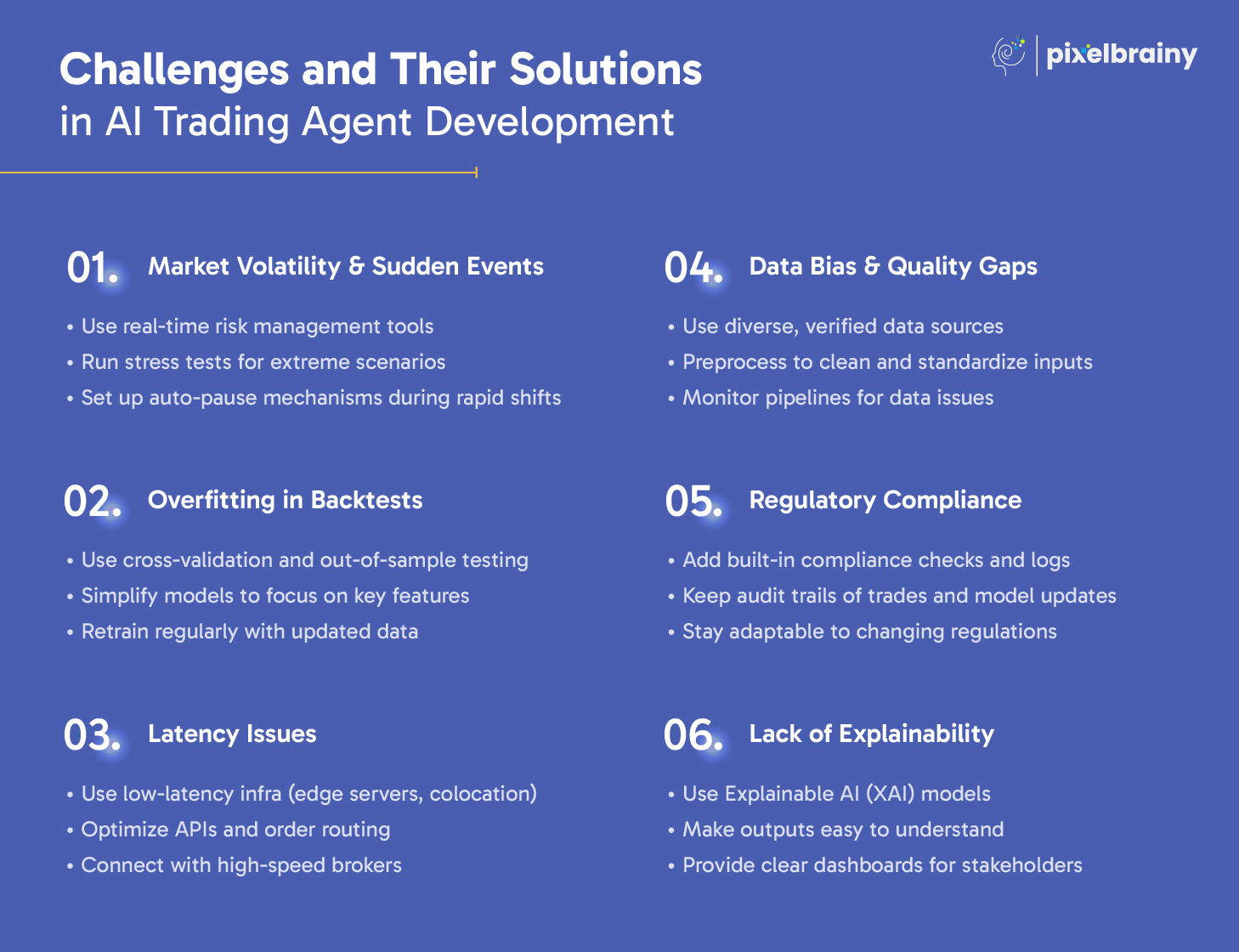
Developing a reliable AI trading agent involves more than implementing sophisticated models and connecting them to market infrastructure. Real-world trading environments introduce challenges involving volatility, data quality, model reliability, execution speed, regulatory requirements, and transparency. For fintech businesses pursuing AI trading agent development, addressing these challenges early can reduce operational risks and create a more resilient trading system.
The key question is: How can businesses build an AI trading agent that remains reliable during volatile markets while controlling model risk, execution risk, data issues, and regulatory exposure?
Below are the most critical challenges in AI trading agent development, along with practical approaches to address them.
Solution:
Solution:
Solution:
Solution:
Solution:
Solution:
Addressing these challenges from the architecture stage helps create AI trading agents that are more resilient, transparent, compliant, and capable of operating reliably in dynamic financial markets.
When you are investing in AI trading agent development, you need not only developers but also more than that. You require a team that perfectly understands the pulsating market, the complexities of algorithms, and the crucial compliance requirement. PixelBrainy, an AI development company in USA, comes with all you need for a custom AI trading agent development under one roof.
Our team of AI developers is an expert in the end-to-end development of AI-based trading systems that are scalable, secure, and crafted for performance across any asset class. Whether you are a financial institution, a fintech startup, or a trading desk, our AI agent development services will help you develop solutions that align flawlessly with your objectives.
Client Challenge:
A mid-sized hedge fund based in Frankfurt was fed up with inconsistent returns because of outdated manual strategies. They required a custom AI bot that could envision short-term price movements in highly volatile sectors, such as energy and tech.
PixelBrainy’s Solution:
Results in 6 Months:
“PixelBrainy’s AI agent not only outperformed our manual strategy—it reshaped our entire trading logic.” — CTO, Hedge Fund Partner (Name Withheld for NDA)
What Makes Us Different?
From PoC to enterprise AI trading agent development and deployment, PixelBrainy is your trusted AI trading agent development partner in 2026. Contact us now to get the best AI trading agent for stocks.
Also View This Project: Focused Trading: Trading Platform App Design
The move toward AI trading agent development in 2026 reflects the growing demand for faster analysis, intelligent automation, personalized trading workflows, and scalable financial technology. AI trading agents can continuously process market data, identify predefined signals, support strategy execution, and monitor portfolios while operating within programmed risk parameters. For fintech startups, trading platforms, and financial institutions, these capabilities can create new opportunities to improve operational efficiency and deliver more intelligent trading experiences.
Throughout this guide, we explored the key aspects of AI trading agent development, including its market opportunity, benefits, essential features, development process, technology stack, estimated costs, custom versus off-the-shelf solutions, and the challenges businesses must address before deployment.
However, successful implementation requires more than advanced AI models. Data quality, model validation, execution infrastructure, cybersecurity, regulatory considerations, monitoring, and risk controls should all be incorporated into the development strategy from the beginning.
If you’re planning to build a custom AI trading agent or enhance an existing trading platform with intelligent automation, PixelBrainy can help transform your concept into a scalable and business-focused solution with the appropriate technical and compliance considerations.
Ready to explore your AI trading agent idea? Schedule a free consultation with PixelBrainy and discuss your requirements with our AI experts today.
Development time varies based on complexity, features, and integrations. A basic model can take 2–4 months, while an enterprise AI trading agent development may require 6–12 months or more, including testing and compliance integration.
Yes, AI trading agents are legal in most jurisdictions and known to comply with financial regulations set by authorities like the SEC (U.S.), MiFID II (Europe), or similar bodies. Legal consultations are essential before deployment.
AI trading bots can automate decisions, monitor markets 24/7, and react faster than humans. However, human supervision remains crucial for risk calibration, strategic planning, and handling unpredictable market behavior.
The cost ranges from $20,000 to over $200,000, depending on whether it’s a basic solution or a fully customized enterprise AI trading platform with advanced features like multi-asset support, explainable AI, and high-frequency trading capability.
Absolutely. Modern AI trading agents can be designed to support multiple asset classes, including stocks, forex, commodities, and cryptocurrencies, through flexible data pipelines and API integrations.
When properly trained and monitored, AI agents offer high levels of accuracy, risk management, and consistency. However, they should be treated as tools that support, not replace, robust trading strategies and expert oversight.
Yes, they can be. Compliance can be built into the architecture with audit trails, rule-based filters, and adaptive algorithms that align with evolving financial regulations and ensure operational transparency.

About The Author
Sagar Bhatnagar
Sagar Sahay Bhatnagar brings over a decade of IT industry experience to his role as Marketing Head at PixelBrainy. He's known for his knack in devising creative marketing strategies that boost brand visibility and market influence. Sagar's strategic thinking, coupled with his innovative vision and focus on results, sets him apart. His track record of successful campaigns proves his ability to utilize digital platforms effectively for impactful marketing efforts. With a genuine passion for both technology and marketing, Sagar continuously pushes PixelBrainy's marketing initiatives to greater success.

Working with the PixelBrainy team has been a highly positive experience. They understand the design requirements and create beautiful UX elements to meet the application needs. The dev team did an excellent job bringing my vision to life. We discussed usability and flow. Sagar worked with his team to design the database and begin coding. Working with Sagar was easy. He has the knowledge to create robust apps, including multi-language support, Google and Apple ID login options, Ad-enabled integrations, Stripe payment processing, and a Web Admin site for maintaining support data. I'm extremely satisfied with the services provided, the quality of the final product, and the professionalism of the entire process. I highly recommend them for Android and iOS Mobile Application Design and Development.

Great experience working with them. Had a lot of feedback and I found that unlike most contractors they were bugging me for updates instead of the other way around. They were extremely time conscience and great at communicating! All work was done extremely high quality and if not on time, early! They were always proactive when it comes to communication and the work is great/above par always. Very flexible and a great team to work with! Goes above and beyond to present us with multiple options and always provides quality. Amazing work per usual with Chitra. If you have UI/UX or branding design needs I recommend you go to them! Will likely work with them in the future as well, definitely recommended!

PixelBrainy is a joy to work with and is a great partner when thinking through branding, logo, and website layout. I appreciate that they spend time going into the "why" behind their decisions to help inform me and others about industry best practices and their expertise.

I hired them to design our software apps. Things I really like about them are excellent communication skills, they answer all project suggestions and collaborate right away, and their input on design and colors is amazing. This project was complex and needed patience and creativity. The team is amazing to do business with. I will be using them long-term. Glad to see there are some good people out there. I was afraid to try and outsource my project to someone but I am glad I met them! I really can't say enough. They went above and beyond on this project. I am very happy with everything they have done to make my business stand out from the competition.

It was great working with PixelBrainy and the team. They were very responsive and really owned the project. We'll definitely work with them again!

I recently worked with the PixelBrainy team on a project and I was blown away by their communication skills. They were prompt, clear, and articulate in all of our interactions. They listened and provided valuable feedback and suggestions to help make the project a success. They also kept me updated throughout the entire process, which made the experience stress-free and enjoyable.

PixelBrainy is very good at what it does. The team also presents themselves very professionally and takes care of their side of things very well. I could fully trust them taking up the design work in a timely and organised manner and their attention to detail saved us lots of effort and time. This particular project was quite intense and the team showed that they function very well under pressure. Very much looking forward to working with her again!

It's always an absolute pleasure working with them. They completed all of my requests quickly and followed every note I had for them to a T, which made our process go smoothly from start to finish. Everything was completed fast and following all of the guidelines. And I would recommend their services to anyone. If you need any design work done in the future, PixelBrainy should be your first call!

They took ownership of our requirements and designed and proposed multiple beautiful variants. The team is self-motivated, requires minimum supervision, committed to see-through designs with quality and delivering them on time. We would definitely love to work with PixelBrainy again when we have any requirements.

PixelBrainy was a big help with our SaaS application. We've been hard at work with a new UI/UX and they provided a lot of help with the designs. If you're looking for assistance with your website, software, or mobile application designs, PixelBrainy and the team is a great recommendation.

PixelBrainy designers are amazing. They are responsive, talented, and always willing to help craft the design until it matches your vision. I would recommend them and plan to continue them for my future projects and more!!!

They were awesome! Did a good job fast, and good communication. Will work with them again. Thank you

Creative, detail-oriented, and talented designers who take direction well and implement changes quickly and accurately. They consistently over-delivered for us.

PixelBrainy team is very talented and creative. Great designers and a pleasure to work with. PixelBrainy is an excellent communicator and I look forward to working with them again.

PixelBrainy has a very talented design team. Their work is excellent and they are very responsive. I enjoy working with them and hope to continue on all of our future projects.


Transform your ideas into reality with us.
Across these industries, each engagement brings unique challenges, from early-stage product development to scaling complex systems, helping us build a practical understanding of real-world product environments.