
 AI Summary Powered by PixelBrainy
Picture this: an intelligent system that not only predicts property values but also manages listings, talks to clients, schedules property tours, and even optimizes rental income without human supervision. That is the promise of Agentic AI for the real estate business, and it is not just a concept for the future. It is happening today.
The real estate world is changing quickly. Brokers, developers, and property managers are under constant pressure to do more with less time while keeping clients satisfied and profits growing. This is where real estate Agentic AI development becomes a game changer. By allowing machines to think, plan, and act on their own, real estate professionals can focus on strategy and building relationships while the AI handles repetitive and time-consuming tasks.
If you have ever wondered how to create Agentic AI for real estate, it starts with understanding how these intelligent systems operate. From automating property management and tracking leads to analyzing market trends and identifying investment opportunities, Agentic AI can transform a traditional business into a self-running, data-driven operation.
For entrepreneurs and business owners considering developing real estate Agentic AI, the potential is enormous. With the right development strategy and technology stack, you can build Agentic AI for real estate that improves efficiency, reduces costs, and gives your company a lasting competitive advantage in today’s technology-driven property market.
Agentic AI refers to a new generation of artificial intelligence systems designed to act on their own, make decisions, and achieve specific goals without constant human input. Unlike traditional AI tools that simply follow instructions or analyze data when prompted, Agentic AI can observe, plan, and take action based on real-world information. In simple terms, it is AI with initiative and decision-making power.
When applied to real estate, Agentic AI development means creating intelligent software agents that can handle complex industry tasks automatically. These tasks might include responding to client inquiries, analyzing market trends, managing property listings, or even optimizing investment portfolios. Instead of waiting for a user’s command, these AI agents continuously learn, adapt, and act on opportunities in real time.
For example, an Agentic AI system could monitor a local housing market, predict when prices might rise, and alert investors before competitors act. It could also schedule property viewings, follow up with leads, or send updates to potential buyers—all without a human agent needing to step in.
In short, Agentic AI development for real estate focuses on building systems that combine automation, intelligence, and autonomy. The goal is to help real estate professionals save time, improve accuracy, and deliver faster, more personalized experiences to clients while allowing businesses to operate more efficiently than ever before.
Investing in Agentic AI development for real estate is becoming a practical necessity for companies that want to stay competitive in an increasingly digital market. As real estate operations grow more complex, intelligent automation helps businesses handle tasks faster, reduce errors, and deliver a better experience for clients.
According to The Business Research Company (2025), the global AI in real estate market is expected to increase from $222.65 billion in 2024 to $301.58 billion in 2025, marking a strong 35 percent growth rate. This rapid expansion shows how quickly the industry is embracing AI to streamline operations, marketing, and investment analysis.
A McKinsey & Company report also highlights that organizations integrating autonomous AI systems can improve productivity by up to 40 percent and enhance decision accuracy across daily operations. These systems can analyze market data, manage client interactions, and automate tasks that typically require large teams.
Real estate companies that invest in Agentic AI development can achieve better portfolio management, quicker deal closures, and more precise property recommendations. Choosing to make Agentic AI for real estate allows businesses to focus on growth while intelligent agents handle repetitive work efficiently and consistently.
By building and deploying Agentic AI, real estate firms position themselves for long-term operational efficiency and stronger client engagement in a market that values speed, precision, and personalized service.
As the real estate industry continues to evolve, real estate Agentic AI development is helping businesses operate more efficiently, serve clients better, and make smarter investment decisions. Agentic AI systems are not just automating tasks; they are learning, adapting, and taking proactive action based on data.
Here are some of the most impactful use cases showing how companies are beginning to make Agentic AI for real estate a reality.
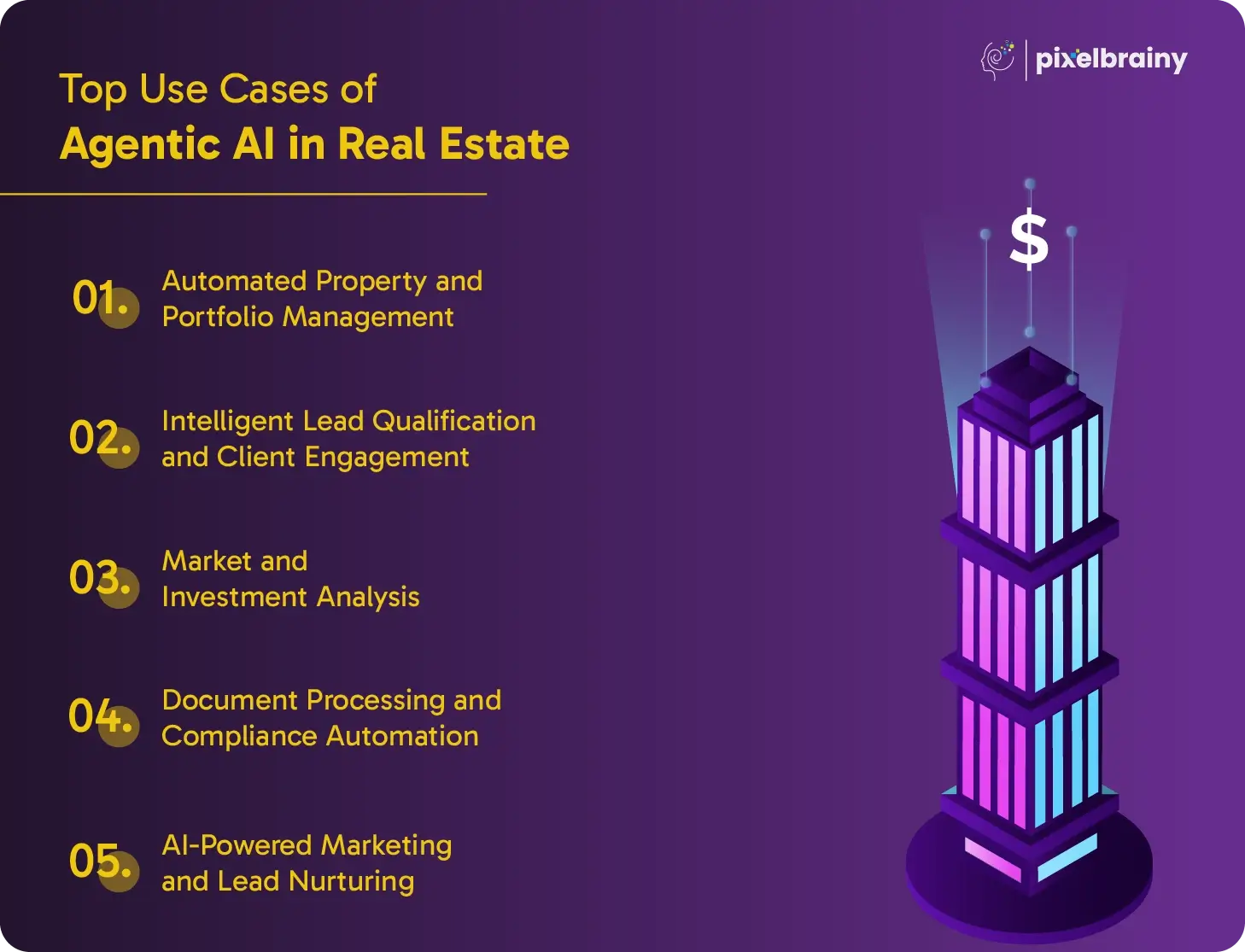
One of the strongest applications of Agentic AI for real estate is in property and asset management. These intelligent systems can monitor portfolios, analyze occupancy rates, manage maintenance schedules, and even optimize rental pricing.
According to GBQ Partners (2025), agentic AI platforms can autonomously monitor market dynamics, forecast project performance, and reallocate capital across portfolios in real time.
For example, a commercial property company can deploy an AI agent that constantly tracks lease expirations, local demand shifts, and energy consumption patterns. When the system detects a drop in demand in one area, it can recommend targeted pricing adjustments or marketing campaigns to maintain occupancy.
Similarly, in residential property management, AI agents can detect maintenance issues using IoT sensors. If a heating or water system begins to malfunction, the AI can automatically schedule vendor repairs, approve costs within preset limits, and notify tenants — all without manual intervention.
Another major reason for investing in Agentic AI development for real estate is the potential to transform customer engagement. Intelligent AI assistants can now greet website visitors, ask questions about preferences, recommend properties, and schedule showings automatically.
As noted by Ascendix Technologies, these systems can analyze client behavior in real time and personalize interactions at scale. For instance, if a potential buyer searches for waterfront homes, the AI can instantly share curated listings, set up a tour, and follow up with updates via email or text.
This level of proactive service helps real estate agencies respond faster, close deals more efficiently, and provide a smoother experience for buyers and sellers.
When businesses choose to make Agentic AI for real estate, they often start with investment analytics. These AI systems can continuously collect and interpret data from multiple sources, including MLS feeds, zoning records, economic trends, and regional demographics.
A recent study by highlights how agentic systems can automate property analysis, risk assessment, and deal forecasting. For example, an AI agent might detect a rise in rental demand in suburban areas and recommend specific properties for acquisition before competitors act.
By automatically generating valuation models, forecasting cash flow, and assessing risk, these AI agents give investors a faster and more accurate decision-making process.
Real estate transactions often involve extensive paperwork, from lease agreements to regulatory disclosures. Agentic AI can streamline this process by reading, understanding, and managing documents with minimal human oversight.
According to MRI Software, AI agents can extract key contract details, verify compliance, and even initiate renewals or approvals automatically. For example, an AI system might review a newly uploaded lease, identify unusual clauses, flag them for legal review, and update the CRM with key terms.
This not only reduces human error but also ensures every transaction follows proper regulations and deadlines.
Modern real estate marketing depends on timing and personalization, and real estate Agentic AI development is making both easier. AI agents can segment audiences, predict buyer intent, and send personalized messages that match client behavior.
Research from ArXiv outlines how AI-driven marketing systems can generate customized listings, property ads, and content optimized for different buyer profiles. For example, if a prospect repeatedly views luxury properties, the AI can automatically trigger an email with high-end listings, schedule a video walkthrough, and notify the sales agent.
This level of automation helps agents focus on relationship-building while AI handles outreach, follow-ups, and conversions efficiently.
From asset management to marketing, these use cases prove that developing Agentic AI for real estate goes far beyond simple automation. It is about creating intelligent systems that think strategically, make timely decisions, and improve every part of the property business.
Companies that adopt these technologies early will enjoy faster workflows, stronger client satisfaction, and higher profitability in an increasingly data-driven real estate market.

Before diving into the specific benefits, it is useful to appreciate how developing agentic AI for real estate fundamentally changes what real-estate firms can do. By choosing to build agentic AI for real estate, companies move from reactive workflows to proactive systems that create value, act autonomously, and scale with the business.
Here are six major benefits in depth:
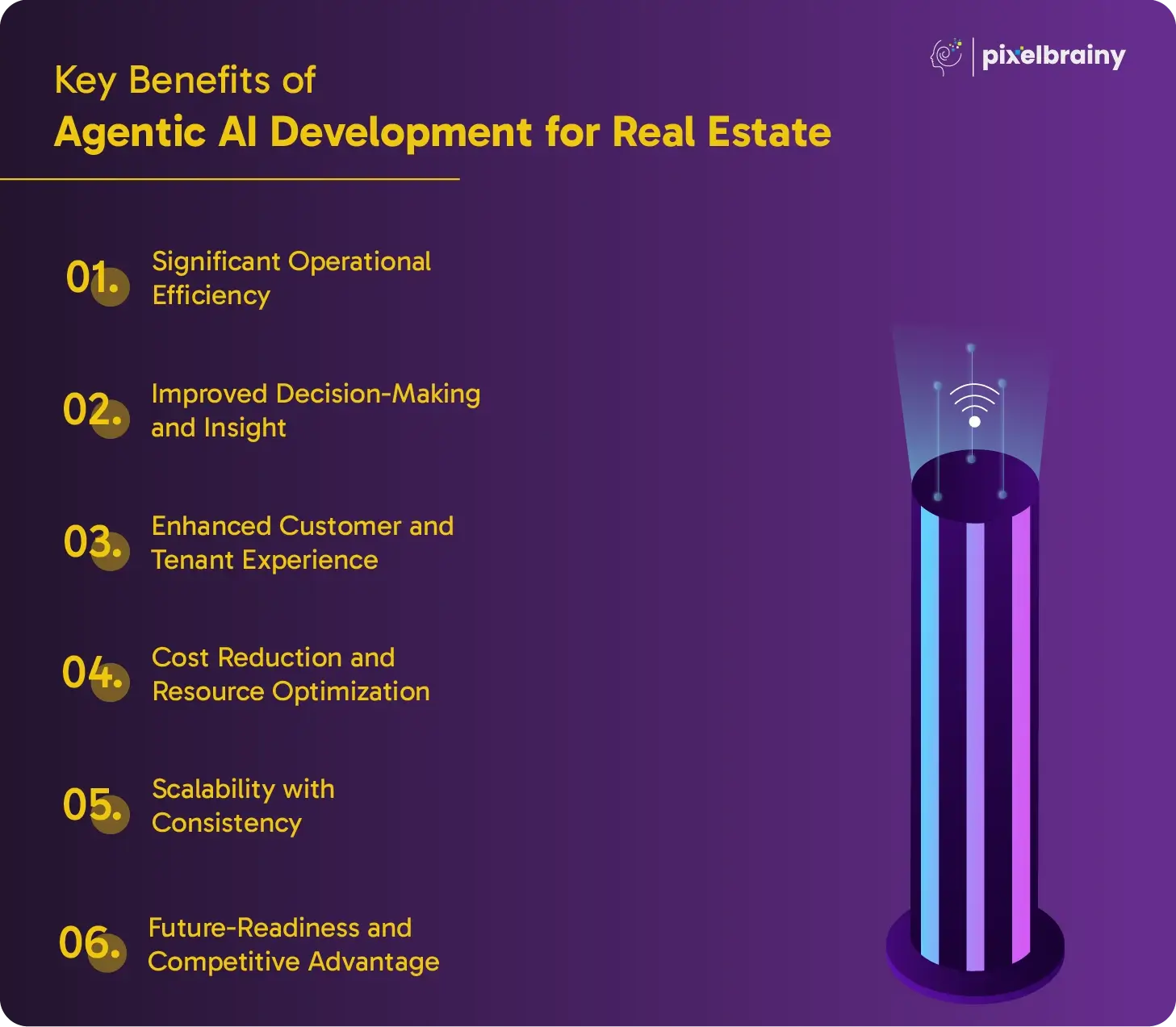
When you create agentic AI for real estate business, you enable tasks to be done faster, with fewer manual steps and less human oversight. For example, according to McKinsey & Company, agentic systems “accelerate execution by eliminating delays between tasks and by enabling parallel processing.”
McKinsey & Company In practice this means an AI agent can update listings, schedule showings, renew leases and send follow-ups all at once rather than waiting for each human step. The cumulative effect is faster workflows, fewer bottlenecks and the ability for the business to handle more volume without proportional increases in staff.
By choosing real estate agentic AI development, you give your business a smart agent that analyses large volumes of data — market listings, demographics, rent trends, IoT building sensors — and turns them into actionable decisions. As another source notes, agentic AI systems can monitor market dynamics, forecast performance and reallocate resources automatically.
For example a firm might deploy an agent that suggests optimal pricing based on emerging neighborhood metrics, rather than relying on manual spreadsheets and gut feel. That leads to more accurate decisions and stronger competitive positioning.
If you make agentic AI for real estate your front-line assistant, you give your clients and tenants faster responses and more personalized service. AI agents can engage leads instantly, match them to properties, schedule tours and follow up. According to a recent article, these systems “deliver personalized property recommendations and automated support, enhancing client satisfaction.”
A buyer receives relevant listings within minutes. A tenant gets maintenance help after hours. That improved experience boosts client loyalty and reputation and can lead to higher retention or referral rates.
When you invest in agentic AI development for real estate, you position your firm to reduce costs. Automation of routine tasks allows your team to focus on higher value activities. For example, document review, scheduling, lead qualification are all handled by the agent, saving staff time. One source notes that real-estate firms using AI agents can reduce operational overhead and speed up closing.
Moreover fewer errors and faster turnarounds reduce hidden costs tied to delays, mis-data or manual mistakes.
To build agentic AI for real estate means you can scale your operations without scaling your headcount in the same way. Because the AI can handle many concurrent tasks reliably, your firm can increase listings, clients, regions or properties without losing performance.
As one article explains, “AI agents are ideal for growing businesses or those expanding into new regions” because they manage larger volumes of tasks. This gives you the strategic flexibility to grow steadily while maintaining consistent service and operational standards.
Firms that decide to make agentic AI for real estate now are positioning themselves ahead of the curve. The property market is becoming more data-driven and technology-intensive. Entities that embed intelligent, autonomous agents into their business model become prepared for new opportunities — such as smart-buildings, predictive maintenance, property tokenization and dynamic leasing models.
One source states that companies that act early in agentic AI adoption gain a meaningful advantage. Being ahead means you are not just responding to change — you are shaping it.
These six benefits underscore both the immediate and long-term value of real estate agentic AI development. By building a system that thinks, acts and scales, real-estate businesses unlock efficiency, insight, customer satisfaction and growth.
Creating a successful Agentic AI Development for Real Estate solution requires building a system that not only automates tasks but also understands, learns, and acts intelligently. When planning to make Real Estate Agentic AI, it is essential to include the right mix of features that enhance decision-making, improve customer engagement, and streamline operations for long-term success.
The table below highlights fifteen essential features that every Real Estate Agentic AI Development project should incorporate, along with detailed explanations of how each contributes to the overall performance of the system.
| Feature | Description |
| Natural Language Understanding (NLU) | Helps the AI understand and respond naturally to human queries through text or voice. This ensures smooth communication between clients, agents, and systems without technical barriers. |
| Predictive Market Analysis | Uses real-time and historical data to forecast market movements, property values, and rental trends, enabling smarter investment and pricing decisions. |
| Automated Lead Qualification | Automatically evaluates incoming leads based on intent, engagement, and readiness to buy, allowing sales teams to focus on the most promising prospects. |
| Property Recommendation Engine | Suggests properties that best match client preferences by analyzing behavioral patterns, location data, and market insights to personalize the user experience. |
| Smart Document Processing | Extracts key details from contracts, leases, and disclosures while checking for accuracy and compliance, reducing manual errors and paperwork delays. |
| CRM and MLS Integration | Connects the AI platform to existing CRMs and Multiple Listing Services to synchronize client, property, and transaction data across all systems. |
| Sentiment and Intent Analysis | Detects emotions and intent from client interactions to personalize communication tone, timing, and recommendations for better engagement. |
| Task Automation and Scheduling | Handles repetitive administrative tasks like scheduling tours, sending updates, and setting reminders, freeing teams to focus on high-value work. |
| Continuous Learning and Memory System | Allows the AI to remember user preferences and previous interactions, becoming more accurate and efficient with every engagement. |
| Portfolio Performance Dashboard | Provides a centralized view of asset performance, rental income, and occupancy rates, giving decision-makers actionable insights. |
| Multi-Channel Communication | Enables AI to engage clients through chat, email, SMS, or voice, ensuring consistent communication and faster response times. |
| Compliance and Legal Validation | Ensures every transaction follows local regulations, licensing standards, and fair housing policies to maintain legal integrity. |
| Integration with IoT and Smart Building Systems | Connects with smart devices to monitor building health, detect maintenance needs, and improve energy efficiency across properties. |
| Secure Data Management and Privacy Controls | Protects sensitive data using encryption and controlled access, maintaining client trust and regulatory compliance. |
| Scalable Cloud Architecture | Supports business growth by allowing the AI platform to expand seamlessly as property portfolios and client bases increase. |
Including these features while planning to build Real Estate Agentic AI ensures that your system performs effectively, adapts intelligently, and stays aligned with the evolving needs of the real estate market.
Each capability contributes to creating an AI ecosystem that is not only efficient but also future-ready for continuous innovation.
Businesses that are exploring what is the process to build Agentic AI for Real Estate often realize that success depends not only on coding but on planning, data, design, and long-term vision. Each stage in this journey is crucial to building a reliable, scalable, and autonomous AI system that genuinely transforms real estate operations.
This section explains a clear, eight-step approach to guide companies through every phase of Agentic AI Development for Real Estate, from ideation to deployment and continuous improvement.
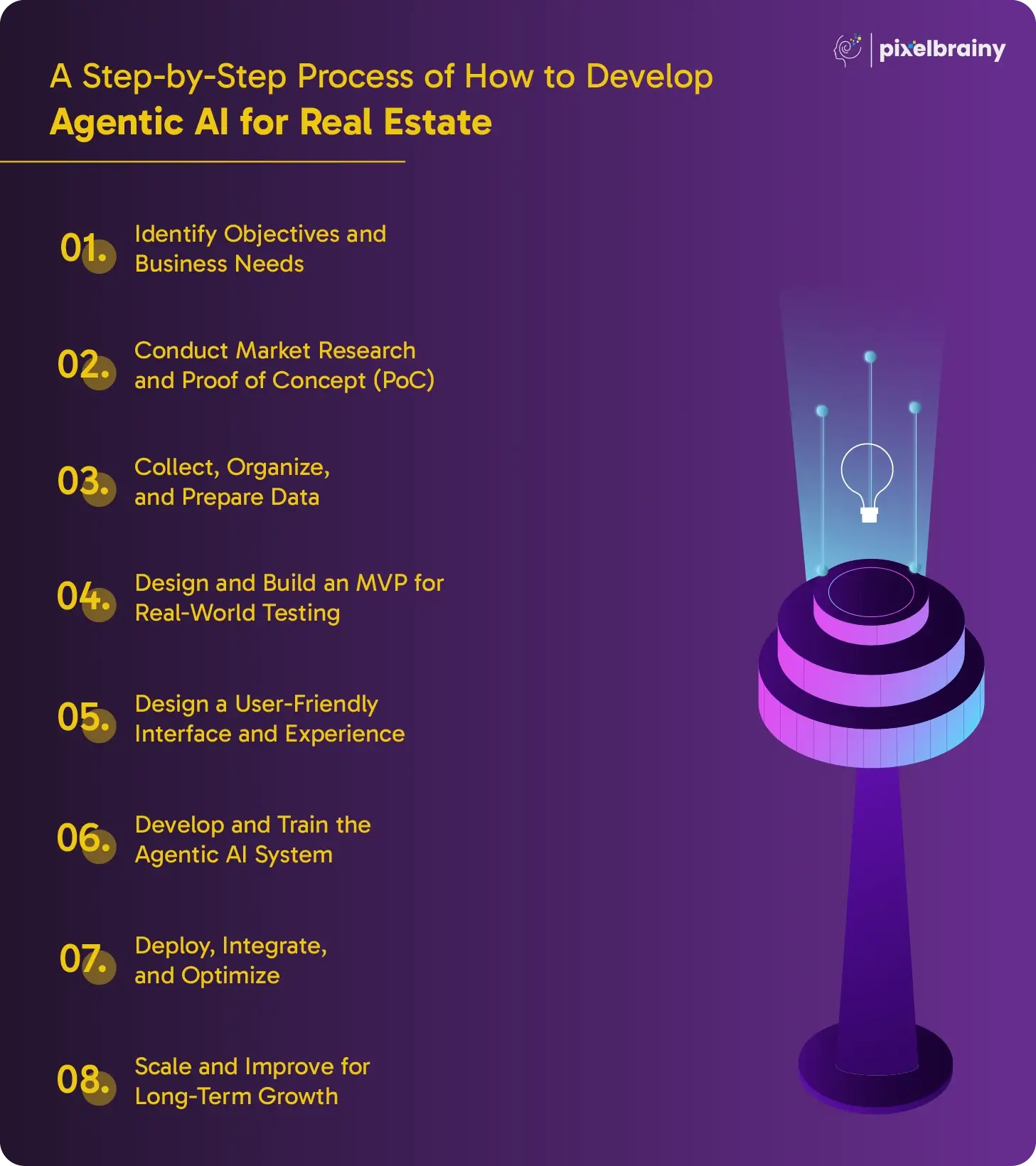
Aim: The first step is to define the goals behind your AI project. Whether it’s automating lead management, analyzing market data, or managing rental operations, identifying a clear objective helps set the project’s direction. Companies should determine which areas of real estate operations would benefit most from automation and intelligent decision-making.
Why This Matters: When you begin the development of Agentic AI for Real Estate, defining objectives ensures alignment between business strategy and technology. It prevents wasted effort on features that don’t create value and helps the team stay focused on outcomes that drive efficiency, customer satisfaction, and profitability.
Aim: Before investing heavily, conduct detailed market research to understand existing AI tools, client expectations, and technology gaps. Develop a Proof of Concept (PoC) to validate your idea and test feasibility using limited data and resources.
Why This Matters: A PoC acts as a risk-control measure that provides tangible evidence of what works and what doesn’t. It also helps gain stakeholder approval and financial backing. This step is essential because it confirms the viability of your approach before scaling, ensuring smarter investment in your Real Estate Agentic AI Development project.
Aim: Every AI system thrives on data. This step involves gathering high-quality property listings, customer interactions, transaction histories, and market insights from reliable sources. Cleaning, labeling, and standardizing this data is key for accurate learning outcomes.
Why This Matters: Reliable data ensures that your AI agents can make precise predictions and decisions. For developing Agentic AI for Real Estate, quality data builds the foundation for success. Poor or inconsistent data can result in unreliable predictions and decisions, which may reduce user trust in the system.
Aim: Create a Minimum Viable Product (MVP) that includes essential features such as lead generation, market forecasting, or automated communication. This early version helps you test the system with real users and measure performance before full-scale development.
Why This Matters: An MVP allows for agile testing and quick feedback from brokers, investors, and clients. It reveals usability gaps, functional issues, and user expectations early in the journey. For startups or real estate tech innovators, launching an MVP ensures faster market entry and informed scaling decisions without unnecessary costs.
Aim: Work with a skilled UI/UX Design company to craft an intuitive interface that allows users to interact seamlessly with the AI system. The design should make complex data and automation tasks feel effortless through visual dashboards, conversational flows, and guided actions.
Why This Matters: A well-designed interface builds trust and adoption among users who may not be tech experts. Great design transforms advanced technology into a practical, enjoyable experience. For agents and property managers, clear navigation and responsive design ensure faster learning and higher engagement with the AI platform.
Aim: This is the core of to make Agentic AI for Real Estate. The AI models are developed, trained, and fine-tuned using machine learning algorithms and large language models. Developers integrate decision-making logic, memory layers, and communication capabilities that enable the AI to act autonomously across various real estate workflows.
Why This Matters: The effectiveness of your system depends on how well it is trained. The development of Agentic AI for Real Estate should focus on giving the system reasoning power, adaptability, and the ability to operate safely within human-defined boundaries. This stage defines the intelligence and reliability of your AI solution.
Aim: Once tested and approved, the AI system is deployed and connected with existing business infrastructure such as CRMs, MLS databases, property management platforms, and IoT devices. This integration ensures that the AI agent can access live data and take meaningful actions within your organization’s ecosystem.
Why This Matters: Integration turns an intelligent prototype into a business-ready solution. A smooth deployment ensures that teams can start using the system immediately and benefit from automated workflows. Post-launch optimization is vital to refine performance, maintain compliance, and enhance user experience.
Aim: After deployment, focus on scaling capabilities across departments or property portfolios. This involves monitoring performance metrics, retraining models with new data, and adding advanced features like predictive investment insights or automated legal compliance.
Why This Matters: Continuous improvement keeps your AI competitive and future-ready. Top-performing companies in this space, such as the top Agentic AI development companies in USA, consistently enhance their systems to meet new market demands. Scaling ensures your AI continues delivering value as your business expands and market conditions evolve.
By following these eight structured steps, any business can succeed in Agentic AI Development for Real Estate. With the right mix of strategy, technology, and data, you can build an AI system that transforms daily operations into a seamless, intelligent ecosystem.
The purpose of this process is to help organizations build strong foundations for innovation, ensuring their systems remain efficient, adaptive, and capable of delivering long-term value in a fast-changing real estate environment.
When considering what is cost to create Agentic AI for Real Estate, it’s important to recognize that pricing varies widely based on features, complexity, data integration, and scalability.
Below is a breakdown of typical cost tiers, focusing on Agentic AI development cost for Real Estate, real estate agentic AI development cost, cost of building Agentic AI for real estate, and an average cost to develop Agentic AI for Real Estate, with ranges from roughly $15,000-$100,000+ and above.
| Tier | Features / Scope | Estimated Cost Range |
| Basic Agentic AI for Real Estate | Core functionalities such as a chatbot, lead filtering, simple property search integration, and basic analytics dashboard. Suitable for small agencies or pilot implementations. | Roughly $15,000 – $40,000 |
| Medium Agentic AI for Real Estate | Enhanced features like predictive pricing, property recommendation engine, CRM integration, multi-channel communication, and basic automation of workflows. Designed for midsized agencies or growing portfolios. | Approx $40,000 – $80,000 |
| Advanced Agentic AI for Real Estate | Full-scale system including portfolio management, IoT integrations, smart building analytics, autonomous decision-making agents, compliance automation, and scalable cloud infrastructure. Targeted at large firms or enterprises. | Typically $80,000 – $150,000+ and potentially more depending on data, AI model depth, custom integrations and compliance requirements. |
By aligning your budget with the right scope and understanding cost drivers, you can better plan your investment and set realistic expectations for ROI.

Also Read: AI Real Estate App Development Cost: Factors and Examples
Developing a robust Agentic AI system for real estate demands more than just a good idea—it requires selecting the right set of tools and frameworks that enable data handling, agent orchestration, model inferencing, user interface, and system integration. When you focus on Real Estate Agentic AI Development, these tools lay the foundation for a scalable, flexible, and efficient solution.
Here are key categories and examples of tools and frameworks you should consider when planning to make Agentic AI for Real Estate, along with explanations of why they matter in the context of real-estate.
| Category | Purpose / Why It Matters | Examples (Tools, Frameworks, Programming Languages) |
| Agentic AI Frameworks & Orchestration | Enables developers to build autonomous agents that can plan, reason, and interact with data sources and APIs. It forms the foundation for coordinating multiple AI tasks within real estate systems. | LangChain, AutoGen, Microsoft Agent Framework, CrewAI |
| Programming Languages | Serve as the backbone for writing, training, and integrating AI modules. Choosing the right language ensures faster processing and cleaner integration with property management and analytics systems. | Python (AI & ML scripting), JavaScript/TypeScript (frontend and backend integration), Java (enterprise systems), C# (.NET real estate solutions) |
| Machine Learning & NLP Libraries | Power the intelligence behind the agent, enabling property predictions, lead analysis, and conversational understanding for clients. | TensorFlow, PyTorch, scikit-learn, spaCy, NLTK |
| Large Language Model APIs | Provide language understanding and communication capabilities that allow AI agents to interpret client queries, generate listings, and automate responses. | OpenAI GPT models, Anthropic Claude, Google Gemini, Cohere |
| Data Infrastructure & ETL Tools | Collect, clean, and manage large volumes of structured and unstructured real estate data from CRMs, MLS feeds, and IoT systems. | Apache Airflow, dbt, Google BigQuery, AWS Redshift, Snowflake |
| Databases & Vector Stores | Store client profiles, historical interactions, and vector embeddings for memory retrieval and personalized recommendations. | PostgreSQL, MongoDB, Pinecone, FAISS, Weaviate |
| IoT & Smart Building Integration Tools | Connect AI agents to building sensors and automation devices, helping the system monitor energy use, maintenance, and safety. | Azure IoT Hub, AWS IoT Core, Google Cloud IoT |
| CRM and MLS Integration Platforms | Ensure seamless data flow between existing property management systems, client databases, and AI-driven insights. | HubSpot API, Salesforce Integration, Zillow API, Realtor API |
| UI/UX and Frontend Frameworks | Deliver an intuitive, user-friendly interface for agents, clients, and investors. Proper design improves usability and adoption rates. | React, Angular, Vue.js, Figma, Tailwind CSS |
| Cloud & Deployment Platforms | Provide scalability, hosting, and security for your AI solution, allowing it to handle thousands of listings and users in real time. | AWS, Microsoft Azure, Google Cloud Platform, Kubernetes |
| Security & Compliance Frameworks | Protect client data, property records, and transaction histories while meeting industry regulations and privacy standards. | OAuth 2.0, JWT Authentication, GDPR Compliance APIs, SOC 2 Security |
| Monitoring & Logging Tools | Track AI agent performance, identify errors, and ensure consistent uptime across systems and applications. | Prometheus, Grafana, Datadog, ELK Stack |
| Automation & Workflow Tools | Handle recurring operational tasks like property updates, marketing automation, and client follow-ups to enhance productivity. | Zapier, Make (Integromat), n8n, Apache Airflow |
| Testing & Quality Assurance Tools | Validate AI performance, integration stability, and user experience before deployment. | Postman, PyTest, Selenium, JMeter |
| Collaboration & Version Control Tools | Help development teams collaborate efficiently, track changes, and maintain version stability throughout the project lifecycle. | GitHub, GitLab, Bitbucket, Jira, Confluence |
By choosing the right ecosystem, businesses can create flexible, secure, and high-performing systems that support automation, learning, and growth. A strong technical foundation leads to smarter decisions, lower operational costs, and better customer experiences across the entire real estate value chain.
Developing a powerful system for Real Estate Agentic AI Development involves more than just coding an algorithm. It requires aligning business goals with data, technology, and ethics to ensure that AI performs safely and effectively.
While the potential is enormous, businesses must navigate several common challenges. Below are the key hurdles and practical ways to overcome them when planning to make Agentic AI for Real Estate.
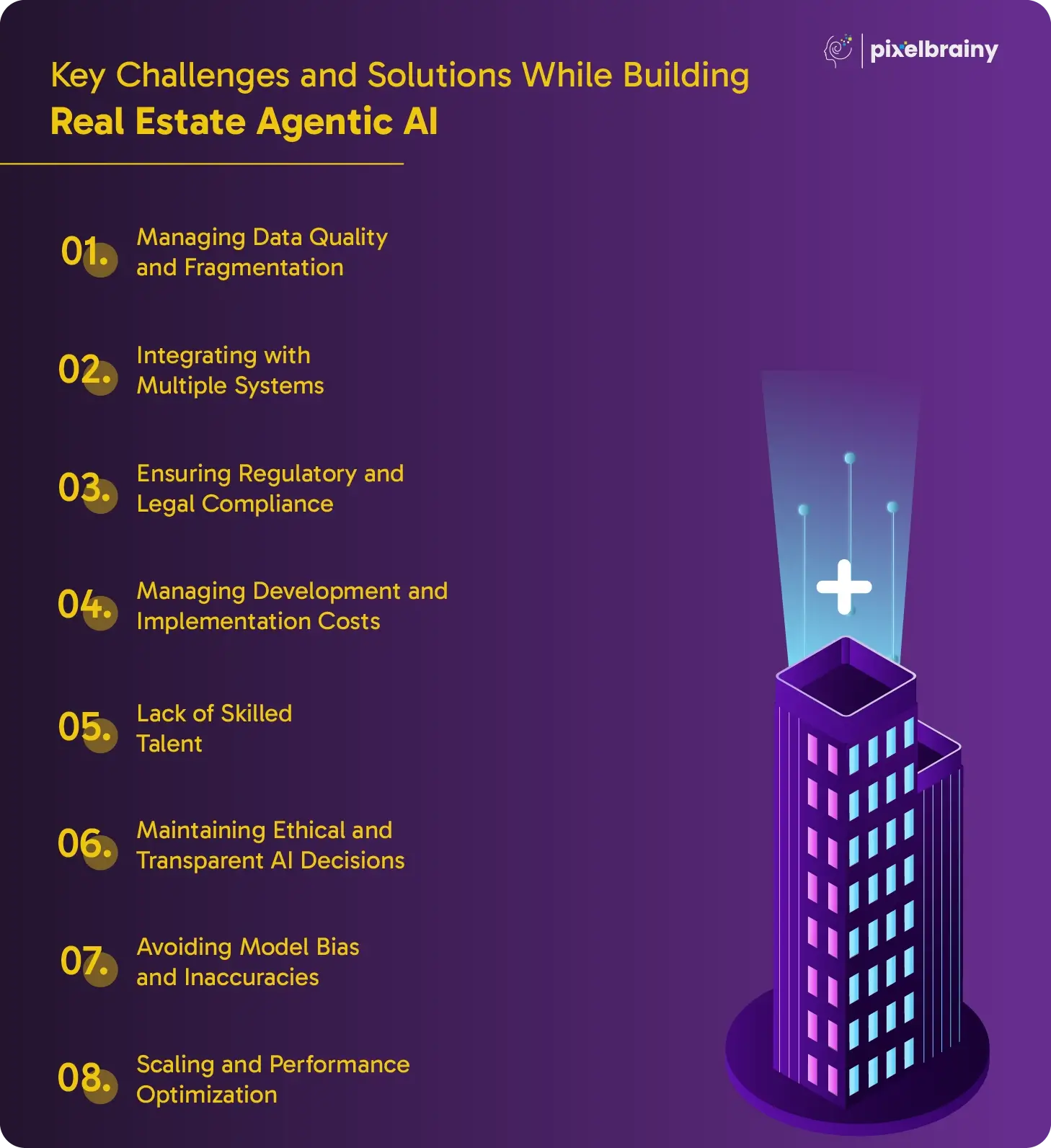
One of the biggest challenges is handling fragmented and inconsistent data. Real estate information comes from multiple sources such as MLS databases, CRM systems, IoT devices, and public listings. When data formats or records are inconsistent, the AI’s performance drops.
Solution: Build automated data pipelines to collect, clean, and standardize data. Using centralized cloud platforms like AWS Redshift or Google BigQuery allows teams to maintain data accuracy, making AI predictions more reliable.
Real estate operations often rely on several digital tools that rarely communicate smoothly with each other. Integrating AI agents with CRMs, property management systems, or IoT networks can be complex and time-consuming.
Solution: Adopt a modular architecture based on APIs and microservices. Frameworks like LangChain or Microsoft Agent Framework simplify integration by letting AI agents access multiple tools from a single environment.
Compliance is critical in real estate. AI systems must follow fair housing regulations, privacy laws, and financial disclosure standards. Non-compliance can lead to penalties and damage a company’s reputation.
Solution: Include compliance modules within the AI’s architecture. Role-based access controls and real-time validation APIs help ensure that every transaction or recommendation meets legal requirements.
The cost of building Agentic AI for Real Estate can be high, especially for systems that require complex integrations, advanced analytics, or predictive automation. Budget overruns often happen when teams attempt to build everything at once.
Solution: Start small with a Proof of Concept (PoC) or a Minimum Viable Product (MVP). This allows you to validate the system’s performance and gradually scale features, helping you manage the Agentic AI development cost for Real Estate effectively.
Real estate companies may not have in-house experts in data science, AI engineering, or automation. This talent gap can slow down progress and reduce innovation.
Solution: Partner with specialized technology providers or the top AI development companies in USA that bring cross-domain expertise. Collaboration with experienced teams ensures faster development and better system reliability.
Many businesses worry about how AI makes decisions related to pricing or recommendations. A lack of transparency can reduce trust among users and clients.
Solution: Implement explainability frameworks that allow users to see how AI reaches its conclusions. Clear audit logs and decision histories build accountability and strengthen confidence among agents and investors.
AI models can unintentionally inherit bias from training data, leading to unfair or skewed outcomes in pricing or property recommendations.
Solution: Continuously retrain AI models with diverse and up-to-date datasets. Introduce human review points for high-impact decisions to keep results fair and reliable.
As real estate portfolios grow, AI systems must handle greater data volumes and more users without slowing down or failing. Scalability is a critical technical challenge.
Solution: Deploy your AI on scalable cloud environments like AWS, Azure, or Google Cloud. Use containerization tools like Docker and Kubernetes for seamless performance and automatic scaling during heavy workloads.
Every innovation journey comes with challenges, and developing Agentic AI for Real Estate is no exception. However, with the right strategies, strong partnerships, and focus on transparency, security, and scalability, these challenges can be turned into opportunities.
A well-planned approach to Real Estate Agentic AI Development not only ensures smooth implementation but also lays the foundation for a smarter, more responsive, and future-ready real estate business.
Choosing the right technology partner is essential when investing in Agentic AI Development for Real Estate Business. PixelBrainy stands as a trusted name that blends real estate expertise with AI innovation to deliver smart, scalable, and efficient digital ecosystems.
As a leading Agentic AI Development company in USA, PixelBrainy focuses on building AI systems that think, learn, and act independently. Our team combines AI engineering, real estate knowledge, and data science to create systems that automate lead management, optimize pricing, and enhance client interactions. Every solution we deliver is customized to the client’s business model, ensuring measurable efficiency and long-term scalability.
We specialize in AI real estate software development that integrates intelligent automation, predictive analytics, and natural language understanding. Our focus is not just on building tools, but on creating business-ready AI solutions that help companies make faster, smarter, and data-driven decisions.
PixelBrainy also excels in Real Estate Agentic AI development projects that bring real operational impact. From CRM and MLS integration to IoT-based smart property management, our systems are designed to enhance real-time decision-making and reduce manual workload. With advanced frameworks like LangChain, TensorFlow, and AutoGen, we ensure that our solutions remain reliable, secure, and adaptable to changing market needs.
We partner closely with every client throughout the project lifecycle. From initial strategy to deployment and ongoing updates, our approach is transparent, collaborative, and results-oriented. This is how we help organizations to create Real Estate Agentic AI solutions that drive true business transformation.
PixelBrainy recently worked with a confidential real estate investment firm in California that wanted to automate property management tasks.
Our team developed an intelligent AI system capable of predicting rental trends, scheduling maintenance, and handling tenant communication autonomously.
This project demonstrated how building Agentic AI Development for Real Estate can deliver measurable results and long-term competitive advantage.
With innovation, reliability, and continuous support, PixelBrainy helps businesses turn AI technology into real estate success stories. Our mission is simple — to empower companies with intelligent systems that think strategically, act independently, and scale effortlessly in a dynamic property market.

From the above, it’s clear that Agentic AI Development for Real Estate is redefining how property businesses operate, compete, and grow. By integrating intelligent automation, predictive analytics, and real-time decision-making, companies can achieve higher efficiency, faster sales, and stronger client satisfaction.
Whether you are exploring to create Real Estate Agentic AI or expanding your existing system, now is the best time to invest in innovation. PixelBrainy combines industry expertise and advanced technology to deliver tailored solutions that drive measurable results. Our proven approach to Real Estate Agentic AI development ensures your business stays ahead in an increasingly digital market.
Take the first step toward building your intelligent real estate future. Book an appointment with PixelBrainy today to discuss your AI transformation journey and start turning possibilities into performance.
Agentic AI goes beyond rule-based automation. Instead of following static instructions, it can think, learn, and act independently. In real estate, this means AI agents can manage listings, communicate with clients, predict trends, and make proactive decisions without constant human supervision.
Yes. Modern frameworks and cloud-based tools have made it more affordable. Small agencies can start with a limited-scope solution focused on lead management or property recommendations and scale gradually as results improve.
Security is a top priority. When developed correctly, systems use encrypted data storage, secure APIs, and strict access controls to protect sensitive client and transaction data. Compliance with laws like GDPR and CCPA further ensures privacy and trust.
The timeline depends on the project’s scope and features. A basic version may take around 8–12 weeks, while a full enterprise-level platform could require 4–6 months for design, testing, and deployment.
Agentic AI personalizes interactions by analyzing client preferences, answering inquiries instantly, scheduling tours, and providing property suggestions automatically. This creates a faster, more engaging experience that builds client trust and satisfaction.

About The Author
Sagar Bhatnagar
Sagar Sahay Bhatnagar brings over a decade of IT industry experience to his role as Marketing Head at PixelBrainy. He's known for his knack in devising creative marketing strategies that boost brand visibility and market influence. Sagar's strategic thinking, coupled with his innovative vision and focus on results, sets him apart. His track record of successful campaigns proves his ability to utilize digital platforms effectively for impactful marketing efforts. With a genuine passion for both technology and marketing, Sagar continuously pushes PixelBrainy's marketing initiatives to greater success.


Transform your ideas into reality with us.
Working with the PixelBrainy team has been a highly positive experience. They understand the design requirements and create beautiful UX elements to meet the application needs. The dev team did an excellent job bringing my vision to life. We discussed usability and flow. Sagar worked with his team to design the database and begin coding. Working with Sagar was easy. He has the knowledge to create robust apps, including multi-language support, Google and Apple ID login options, Ad-enabled integrations, Stripe payment processing, and a Web Admin site for maintaining support data. I'm extremely satisfied with the services provided, the quality of the final product, and the professionalism of the entire process. I highly recommend them for Android and iOS Mobile Application Design and Development.

Great experience working with them. Had a lot of feedback and I found that unlike most contractors they were bugging me for updates instead of the other way around. They were extremely time conscience and great at communicating! All work was done extremely high quality and if not on time, early! They were always proactive when it comes to communication and the work is great/above par always. Very flexible and a great team to work with! Goes above and beyond to present us with multiple options and always provides quality. Amazing work per usual with Chitra. If you have UI/UX or branding design needs I recommend you go to them! Will likely work with them in the future as well, definitely recommended!

PixelBrainy is a joy to work with and is a great partner when thinking through branding, logo, and website layout. I appreciate that they spend time going into the "why" behind their decisions to help inform me and others about industry best practices and their expertise.

I hired them to design our software apps. Things I really like about them are excellent communication skills, they answer all project suggestions and collaborate right away, and their input on design and colors is amazing. This project was complex and needed patience and creativity. The team is amazing to do business with. I will be using them long-term. Glad to see there are some good people out there. I was afraid to try and outsource my project to someone but I am glad I met them! I really can't say enough. They went above and beyond on this project. I am very happy with everything they have done to make my business stand out from the competition.

It was great working with PixelBrainy and the team. They were very responsive and really owned the project. We'll definitely work with them again!

I recently worked with the PixelBrainy team on a project and I was blown away by their communication skills. They were prompt, clear, and articulate in all of our interactions. They listened and provided valuable feedback and suggestions to help make the project a success. They also kept me updated throughout the entire process, which made the experience stress-free and enjoyable.

PixelBrainy is very good at what it does. The team also presents themselves very professionally and takes care of their side of things very well. I could fully trust them taking up the design work in a timely and organised manner and their attention to detail saved us lots of effort and time. This particular project was quite intense and the team showed that they function very well under pressure. Very much looking forward to working with her again!

It's always an absolute pleasure working with them. They completed all of my requests quickly and followed every note I had for them to a T, which made our process go smoothly from start to finish. Everything was completed fast and following all of the guidelines. And I would recommend their services to anyone. If you need any design work done in the future, PixelBrainy should be your first call!

They took ownership of our requirements and designed and proposed multiple beautiful variants. The team is self-motivated, requires minimum supervision, committed to see-through designs with quality and delivering them on time. We would definitely love to work with PixelBrainy again when we have any requirements.

PixelBrainy was a big help with our SaaS application. We've been hard at work with a new UI/UX and they provided a lot of help with the designs. If you're looking for assistance with your website, software, or mobile application designs, PixelBrainy and the team is a great recommendation.

PixelBrainy designers are amazing. They are responsive, talented, and always willing to help craft the design until it matches your vision. I would recommend them and plan to continue them for my future projects and more!!!

They were awesome! Did a good job fast, and good communication. Will work with them again. Thank you

Creative, detail-oriented, and talented designers who take direction well and implement changes quickly and accurately. They consistently over-delivered for us.

PixelBrainy team is very talented and creative. Great designers and a pleasure to work with. PixelBrainy is an excellent communicator and I look forward to working with them again.

PixelBrainy has a very talented design team. Their work is excellent and they are very responsive. I enjoy working with them and hope to continue on all of our future projects.


