
 AI Summary Powered by PixelBrainy
Could a fully autonomous AI agent manage your portfolio better than a human? As markets grow ever more complex, the promise of Agentic AI for Trading Platforms is capturing serious attention. But how does one approach Agentic AI development for trading platforms in a way that balances ambition, safety, and real-world performance? In this guide we’ll explore how to build Agentic AI for a trading platform, principles for developing Agentic AI for trading, and practical steps to create Agentic AI for trading platforms that can drive real alpha.
In 2025, the market for AI in trading is estimated at about USD 24.53 billion, up from USD 21.59 billion in 2024, with a projected expansion to USD 40.47 billion by 2029 (CAGR ~13.3 %). Separately, the agentic AI market is forecasted to grow from roughly USD 7.06 billion in 2025 to USD 93.20 billion by 2032, reflecting the rising role of autonomous agents across domains. According to another estimate, the agentic AI space may expand to around USD 199.05 billion by 2034. These numbers underscore powerful momentum: algorithmic and AI-driven trading already account for a large fraction of traded volumes globally, making the integration of agentic capabilities a logical next frontier.
As we move from fixed-rule bots to adaptive, goal-driven agents, trading platforms need not just automation but intelligent autonomy. This blog dives deep into why trading platforms need agentic AI, how such systems work, core and advanced features, development steps, costs, monetization strategies, challenges, and ultimately how to partner with a trusted team to bring your vision to life.
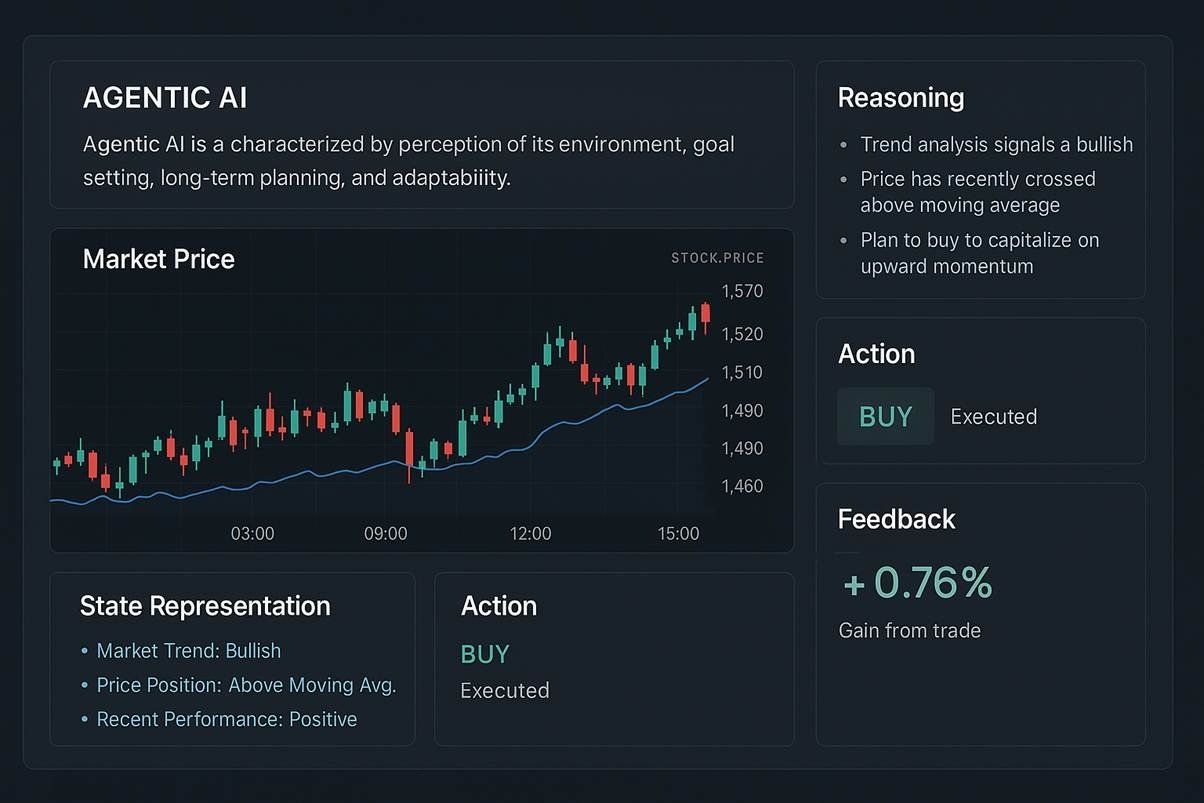
Traditional algorithmic systems in trading are powerful but limited: they execute predefined logic, respond to fixed signals, and require manual tuning. Markets evolve, new data sources emerge, and rules that once worked may degrade.
In a financial industry increasingly driven by speed and complexity, only systems with proactive agency can stay ahead of fleeting opportunities. For platforms seeking longevity and differentiation, adopting Agentic AI development for trading platforms is a strategic imperative.
At a high level, Agentic AI in trading comprises several interacting layers:
The system forms a closed loop: agent acts, environment responds, feedback is absorbed, and policy evolves. The key is ensuring robustness, safety, and interpretability even as autonomy increases.
Building a robust Agentic AI for trading platforms requires a strong foundation of essential features that empower the system to think, adapt, and act intelligently.
These core capabilities form the backbone of Agentic AI development for trading platforms, enabling reliable decision-making, seamless execution, and dynamic adaptation to market changes.
| Core Feature | Explanation |
| Goal-Oriented Decision Engine | The AI agent should operate based on defined objectives such as maximizing returns or minimizing risk, ensuring every action aligns with trading goals |
| Real-Time Market Data Processing | Continuous ingestion and analysis of live market feeds allow the agent to react instantly to price fluctuations and changing market conditions |
| Context-Aware Intelligence | The system must interpret market signals, sentiment, and macroeconomic indicators to make context-driven trading decisions |
| Adaptive Learning Mechanism | Agents should evolve by learning from historical and real-time performance data, refining their strategies over time |
| Advanced Risk Management Controls | Integrated risk frameworks help the system manage exposure, set stop-loss levels, and maintain capital safety |
| Seamless Execution Layer | Direct integration with broker APIs and trading systems ensures swift order placement, routing, and trade execution |
| Transparent Decision Explainability | Every trade decision should be interpretable, with clear reasoning and traceable logic for compliance and trust |
| Human Oversight and Control | The platform should allow human intervention when necessary, including overrides and manual adjustments |
| Robust Monitoring and Alert System | Real-time dashboards and alerts notify traders about unusual activities, performance issues, or potential risks |
| Comprehensive Audit and Logging | Detailed logs and audit trails ensure accountability and compliance with financial regulations |
A well-structured core ensures the Agentic AI trading system operates with intelligence, agility, and reliability from day one.
Once the foundation is built, adding advanced capabilities can significantly boost the intelligence and competitiveness of your Agentic AI for trading platform. These advanced components allow the system to become more autonomous, predictive, and profitable while adapting to evolving market dynamics.
| Advanced Feature | Explanation |
| Multi-Agent Collaboration Framework | Multiple AI agents working together or competing can diversify strategies, manage portfolios, and improve returns |
| Hierarchical Decision Systems | A supervisory agent can orchestrate sub-agents, optimizing strategies based on overall market conditions and portfolio goals |
| LLM-Driven Sentiment and News Analysis | Integration of large language models helps analyze financial news, reports, and sentiment in real time for signal generation |
| Dynamic Portfolio Optimization | AI continuously rebalances portfolios based on risk-return profiles, volatility, and changing market regimes |
| Self-Tuning Risk Engines | Agents can autonomously adjust exposure, leverage, and hedging strategies based on volatility and market structure |
| Autonomous Compliance Monitoring | Built-in compliance agents ensure that every trade adheres to regulatory requirements, reducing legal and operational risks |
| Predictive Scenario Simulation | AI models simulate various market scenarios to anticipate potential outcomes and prepare adaptive strategies |
| Meta-Learning and Self-Improvement | The system learns not only strategies but also how to learn more effectively, evolving with minimal human input |
| API-Driven Ecosystem Expansion | Open APIs allow third-party strategy modules, analytics tools, and data providers to enhance system capabilities |
| Intelligent Capital Allocation Engine | Capital is allocated dynamically across strategies and markets, optimizing profitability while controlling overall risk |
By implementing these innovations, developing Agentic AI for trading platforms evolves from a powerful automation tool into a truly intelligent, self-optimizing trading ecosystem. A strategic mix of advanced features ensures your Agentic AI trading platform remains competitive, adaptive, and future-ready in the evolving financial landscape.
Building an intelligent trading system requires more than algorithms — it’s a structured journey that blends business vision, AI innovation, and financial expertise. Whether you’re a fintech startup, hedge fund, or brokerage, knowing what is the process to develop Agentic AI for Trading Platform helps you plan and execute effectively.
Here’s a practical roadmap to guide your Agentic AI Development for Trading Platform from idea to full-scale deployment.
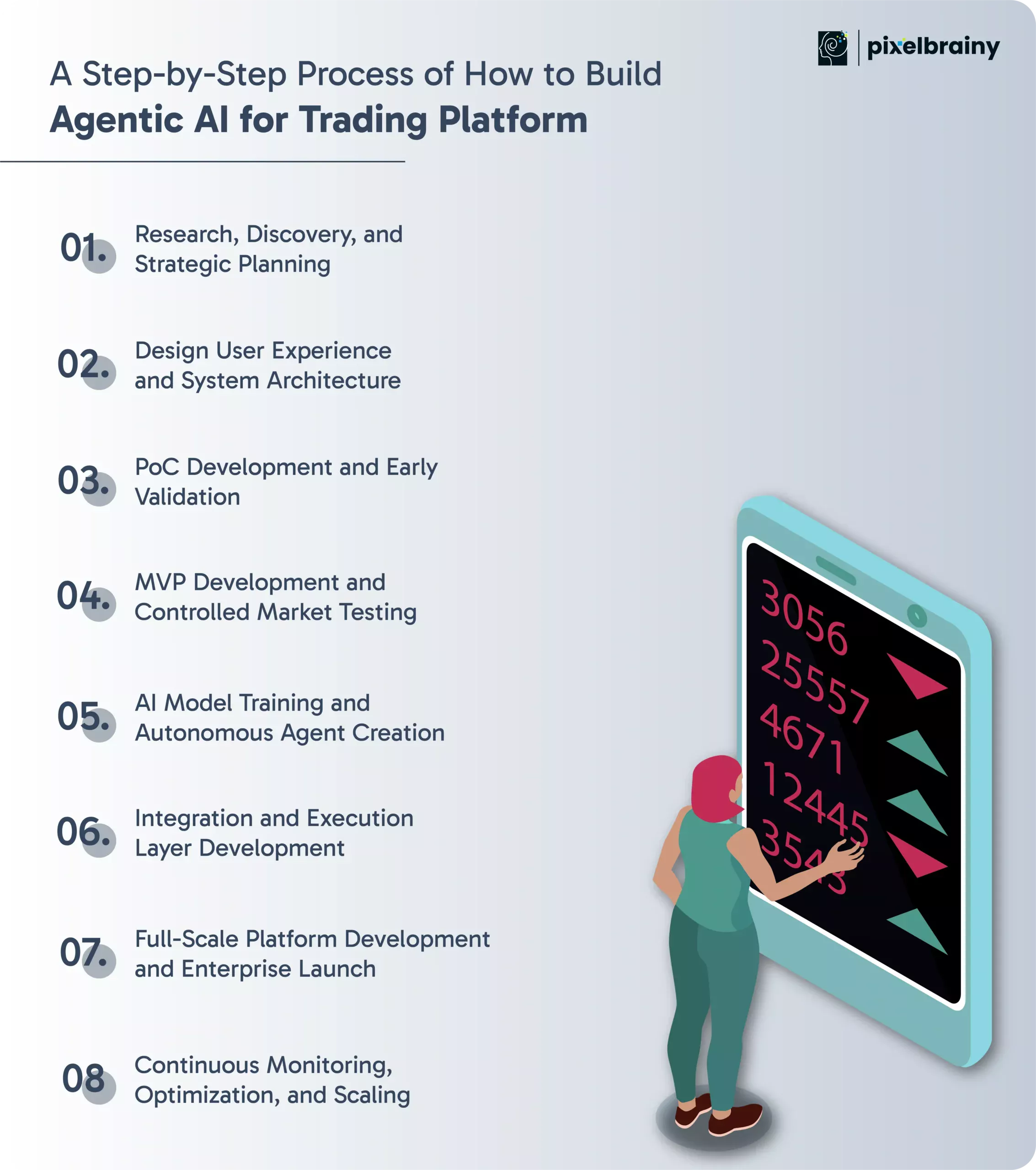
The first step is defining your vision, trading objectives, and market positioning. Conduct in-depth research on user needs, target markets, and competitive offerings to shape the direction of the project.
Next, map out key performance indicators (KPIs) such as ROI, Sharpe ratio, and acceptable drawdown levels. Also, review the regulatory landscape to ensure compliance with financial authorities like SEC, MiFID II, or FINRA before proceeding with the development of agentic AI for trading.
A seamless user experience is crucial to adoption. Partner with an experienced UI/UX design company to design an interface that is intuitive, informative, and optimized for traders of different skill levels.
Simultaneously, design the technical blueprint, including the architecture for data pipelines, AI models, trading logic, and security layers. Scalability and modularity should guide these decisions to ensure the platform can evolve as trading strategies grow in complexity.
Before heavy investment, validate your concept through PoC development. A proof of concept demonstrates core capabilities such as autonomous decision-making or predictive analytics with a limited dataset and minimal infrastructure.
This phase helps identify potential risks, refine the system’s goals, and secure stakeholder confidence. It also provides initial performance insights, shaping the next stages of development.
With the PoC validated, build a functional MVP development version of the platform. This version should include essential features like market data integration, a basic decision-making engine, and risk controls.
Deploy the MVP in a sandbox environment or limited live setting. Gather user feedback, analyze performance, and refine key functionalities such as latency handling, execution speed, and signal accuracy before scaling.
This stage focuses on building the intelligence behind the platform. Train reinforcement learning models and build multi-agent systems to power the core Agentic AI for trading.
Use historical and live data to teach agents how to identify trading opportunities, manage risk, and adapt to different market conditions. Continuous learning capabilities enable the system to improve over time without constant manual intervention.
Seamless integration is critical for real-world deployment. Collaborate with top trading software development companies to connect the AI engine with brokerage APIs, order management systems (OMS), and execution management systems (EMS).
Focus on performance aspects like reducing latency, optimizing order routing, and improving liquidity prediction. At this stage, the platform should be capable of autonomous execution with precision and reliability.
After validation, transform the MVP into a production-ready solution. Add advanced features such as risk orchestration modules, intelligent dashboards, and multi-agent collaboration layers to strengthen system intelligence.
Ensure scalability so the platform can handle multiple assets, high trade volumes, and global market connectivity. Security testing, compliance audits, and stress simulations should be completed before the official launch.
After launch, continuous improvement becomes a priority. Partnering with top AI agent development companies in USA ensures the platform evolves with changing market dynamics and regulatory requirements.
Regular performance reviews, online retraining, and new data integration enhance decision-making accuracy. Real-time monitoring tools and automated feedback loops help the platform stay ahead of competitors and adapt to emerging trends.
Working with top AI development companies in USA ensures your project leverages cutting-edge technology and proven expertise. By following these eight steps, organizations can master Build Agentic AI for Trading Platform and deploy future-ready trading systems that combine intelligence, automation, and profitability.
Also Read: AI Trading Agent Development: Benefits and Features
One of the most common questions asked by fintech founders, hedge funds, and investment firms is: how much does it cost to develop Agentic AI for Trading Platform? The answer depends on several factors such as project complexity, number of features, data infrastructure, and integrations. In general, the cost of developing Agentic AI for Trading Platform ranges from $15,000 to $150,000+, depending on whether you build a basic prototype, a mid-level solution, or a fully enterprise-grade trading system.
When planning the development budget of Agentic AI for Trading Platform, it’s crucial to consider stages like architecture design, data integration, AI model training, backend infrastructure, UI/UX development, and ongoing maintenance. Below is a clear breakdown of potential Agentic AI Development pricing for Trading Platform based on three typical project scopes:
| Type of Platform | Description | Estimated Cost Range |
| Basic Agentic AI for Trading Platform | A simple solution with core trading features such as basic data processing, rule-based decision-making, and limited automation. Suitable for PoC or startups entering the market. | $15,000 – $35,000 |
| Advanced Agentic AI for Trading Platform | Includes adaptive learning models, market data integration, AI-driven decision engines, risk management tools, and real-time dashboards. Ideal for mid-sized trading firms or growing fintech companies. | $35,000 – $80,000 |
| Enterprise-Grade Agentic AI for Trading Platform | A full-scale platform with multi-agent systems, predictive analytics, NLP for sentiment analysis, compliance automation, and high-frequency execution capabilities. Designed for hedge funds, brokers, and institutional investors. | $80,000 – $150,000+ |
The cost to make Agentic AI for Trading can also increase with additional features like custom algorithmic modules, real-time sentiment integration, or multi-asset trading support. Furthermore, ongoing maintenance, cloud hosting, and performance tuning typically add 15-25% annually to the initial development cost.
In summary, a clear understanding of your business objectives, market needs, and feature priorities will help you plan a realistic development budget of Agentic AI for Trading Platform and ensure a high ROI on your technology investment.
Also Read: AI Agent Development Cost Guide: Factors and Cost Optimization Tips
Choosing the right technology stack is one of the most critical decisions when building a high-performance trading solution. The right combination of frameworks, languages, APIs, and infrastructure determines how efficiently your system processes data, learns from markets, executes trades, and scales with demand. Whether you’re exploring Agentic AI Development for Trading Platform or planning enterprise-level deployment, the tech stack directly impacts speed, reliability, and cost-effectiveness.
A complete technology ecosystem for Agentic AI for Trading includes tools for machine learning, data engineering, backend architecture, execution, and monitoring. Below is a comprehensive overview of the recommended tools and frameworks categorized by their role in the development lifecycle.
| Tool | Purpose |
| Python | The most widely used language for AI, ML, and trading algorithms due to its extensive libraries and community support |
| C++ | Used for high-frequency trading and latency-sensitive components requiring maximum performance |
| JavaScript / TypeScript | Ideal for building responsive web interfaces and trading dashboards |
| Tool | Purpose |
| TensorFlow / PyTorch | Core ML frameworks for building, training, and deploying deep learning and reinforcement learning models |
| Ray / RLlib | Scalable libraries for distributed training and multi-agent reinforcement learning |
| Scikit-learn | Lightweight ML toolkit for feature engineering, predictive modeling, and backtesting |
| Stable Baselines3 | A robust framework for building custom reinforcement learning agents for trading |
| Tool | Purpose |
| Apache Kafka / Flink | Real-time data ingestion and stream processing for handling high-velocity market data |
| Apache Spark | Distributed data processing for large historical datasets and batch analysis |
| Airflow | Workflow orchestration and data pipeline scheduling |
| Pandas / NumPy | Essential libraries for quantitative data manipulation and analysis |
| Tool | Purpose |
| kdb+ / InfluxDB | Time-series databases optimized for storing and querying financial market data |
| PostgreSQL / MySQL | Relational databases for trade logs, configurations, and platform metadata |
| MongoDB | NoSQL solution for flexible storage of unstructured or semi-structured financial data |
| Tool | Purpose |
| FIX Protocol | Industry-standard protocol for broker-dealer communication and trade execution |
| REST / WebSocket APIs | Interfaces for connecting to broker platforms, liquidity providers, and exchanges |
| Execution Management Systems (EMS) | Tools that handle order routing, execution strategies, and latency optimization |
| Tool | Purpose |
| Prometheus / Grafana | Real-time metrics tracking, visualization, and performance monitoring |
| ELK Stack (Elasticsearch, Logstash, Kibana) | Centralized logging and system observability for debugging and auditing |
| Sentry | Error tracking and performance diagnostics for backend services |
| Tool | Purpose |
| Vault / HashiCorp | Secure storage of API keys, secrets, and credentials |
| IAM (Identity and Access Management) | Granular access control to safeguard trading infrastructure |
| Encryption Libraries (TLS, OpenSSL) | Secure data transmission and storage to meet compliance requirements |
| Tool | Purpose |
| Docker / Kubernetes | Containerization and orchestration to ensure scalable and resilient deployments |
| AWS / GCP / Azure | Cloud infrastructure for compute, storage, and AI model hosting |
| Terraform / Ansible | Infrastructure as code for managing deployments and scaling environments |
| GitLab CI / Jenkins | Continuous integration and deployment pipelines for rapid development cycles |
| Tool | Purpose |
| React / Vue.js | Frontend frameworks for building responsive trading dashboards |
| Plotly / D3.js | Data visualization libraries for creating interactive market analytics |
| Tableau / Power BI | Business intelligence tools for analyzing trading performance and metrics |
Selecting the right tools and technology stack is the foundation of a powerful Agentic AI for Trading Platform, enabling faster decision-making, seamless scalability, and sustained success in evolving financial markets.

Building a high-performing Agentic AI for Trading Platform is only half the journey — the real business value comes from how effectively you monetize it. Whether you are a fintech startup seeking rapid revenue growth, a brokerage firm aiming to diversify income streams, or a technology company offering white-label trading solutions, having a clear monetization strategy is crucial. The good news is that agentic AI platforms offer multiple revenue models, from subscription-based SaaS to performance-driven partnerships, each adaptable to your audience and market positioning.
Here’s a complete breakdown of the most effective monetization strategies you can implement:
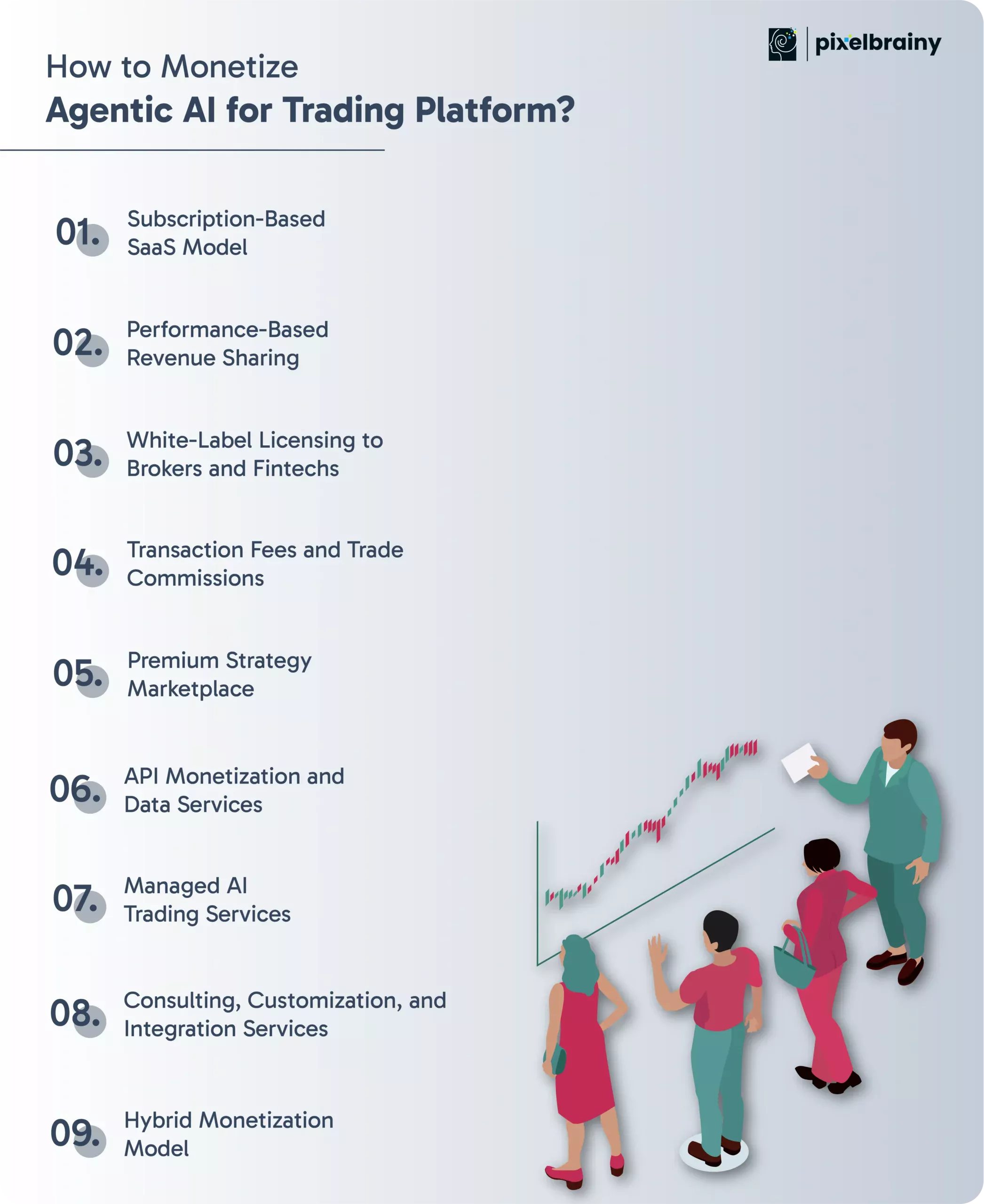
The most straightforward monetization path is offering your platform as a Software-as-a-Service (SaaS) product. In this model, users pay a recurring monthly or annual fee to access your AI-powered trading platform and its features.
You can offer multiple subscription tiers — for example:
This model ensures predictable recurring revenue and allows you to scale pricing as you add more advanced features.
A highly lucrative approach is charging clients a percentage of the profits generated by your agentic AI system. In this revenue-sharing model, users don’t pay upfront but share a part of their trading gains (for instance, 10%-30%).
This aligns your incentives directly with client success — the more profit your AI generates, the more you earn. It’s particularly attractive to hedge funds, proprietary trading desks, and high-net-worth individual traders who prioritize performance over fixed costs.
If your expertise lies in technology rather than client acquisition, you can license your Agentic AI trading technology to brokerages, wealth management firms, or financial institutions.
This white-label model allows other businesses to brand and integrate your platform into their existing ecosystem. Licensing can be charged as:
It’s a scalable way to monetize without directly managing end users.
Another common monetization approach is charging a small fee per executed trade or a commission based on trade volume. This is especially effective if your platform directly integrates with brokers and handles order execution.
For example, you can charge $0.10 to $1.00 per trade, or a 0.1% commission on each executed order. As your user base grows, these micro-transactions can compound into significant revenue streams.
Once your platform gains traction, consider creating a strategy marketplace where developers and quants can publish and sell their custom trading agents or algorithms.
Your company can take a percentage of each sale (commonly 20%-30%), similar to how app stores operate. This not only builds a community around your platform but also continuously expands its capabilities without increasing internal R&D costs.
If your Agentic AI for Trading Platform generates valuable insights or proprietary datasets (e.g., sentiment indicators, risk metrics, predictive signals), you can monetize them through API access.
Financial institutions and analytics firms often pay premium fees to integrate real-time AI signals into their internal tools. Offering usage-based API pricing — for example, per 1,000 requests or per dataset subscription — can create a stable revenue stream independent of trading activity.
For institutional clients who lack the infrastructure or expertise to operate the platform independently, you can offer managed services. This involves deploying, configuring, and continuously managing the AI trading system on their behalf for a monthly retainer or percentage of assets under management (AUM).
This approach is ideal for hedge funds, family offices, and investment advisory firms seeking turnkey AI trading solutions without heavy internal investment.
If your company also builds custom features, bespoke strategies, or tailored integrations for clients, those services can become a significant revenue source.
You might charge project-based fees for:
This “professional services” model complements SaaS or licensing revenue while strengthening client relationships.
Many successful platforms use a hybrid model that combines multiple revenue streams. For example:
This approach diversifies revenue, maximizes profitability, and offers flexibility to clients with different budgets and expectations.
The monetization strategy for your Agentic AI for Trading Platform should align with your business goals and client needs, turning it from a simple product into a sustainable revenue-generating solution.
Also Read: Top 16+ Trading Software Development Companies in USA
Creating a high-performing Agentic AI for Trading Platform is an exciting opportunity, but it’s far from simple. Teams often face hurdles like managing complex data, ensuring system security, and meeting strict regulatory standards, and tackling these challenges early is essential for building a stable, profitable, and scalable trading solution.
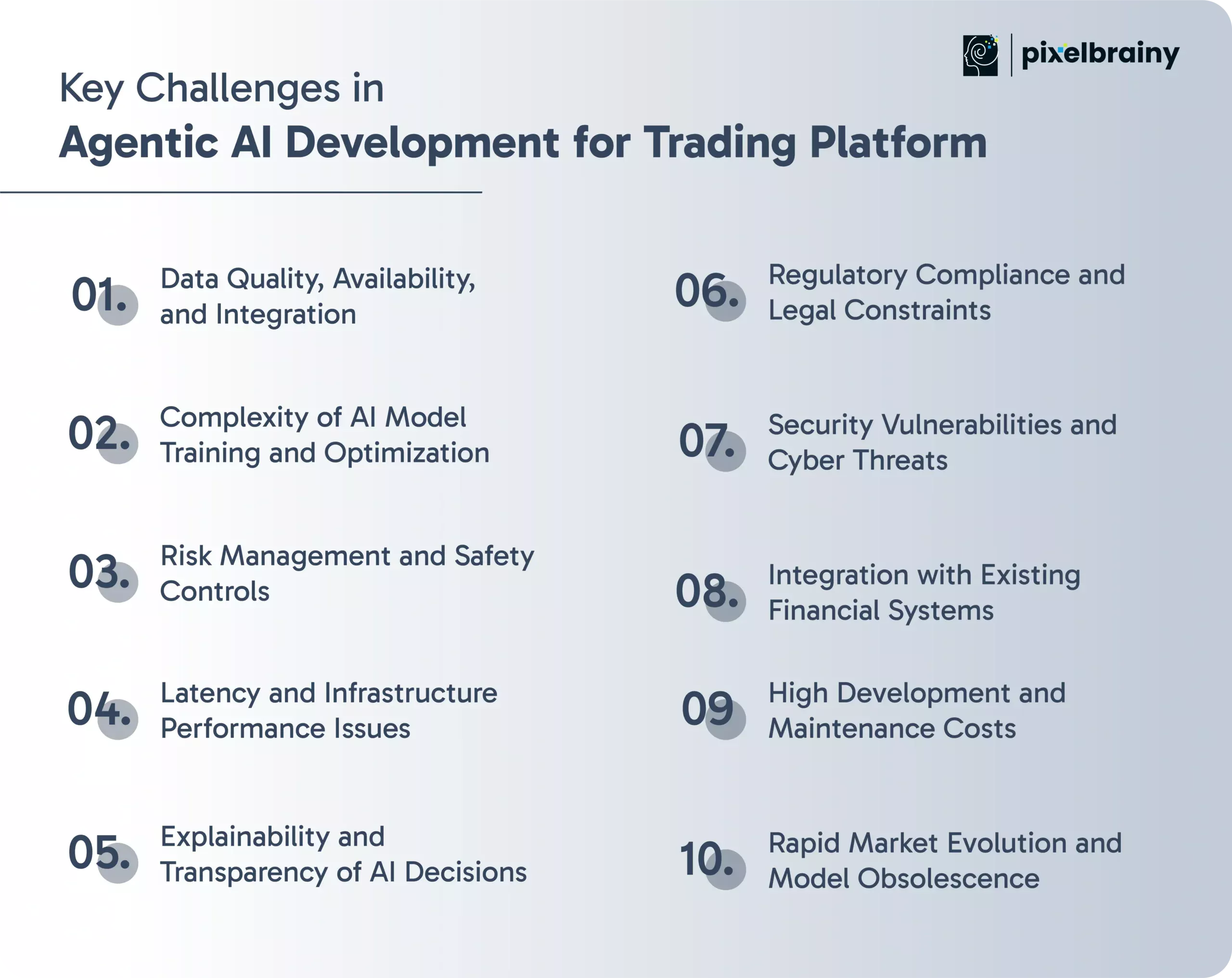
Data is the fuel of any AI system, and for trading platforms, the challenge lies not just in quantity but in quality, reliability, and diversity. Market data often comes from multiple sources — price feeds, news sentiment, alternative data, and macroeconomic indicators — all of which may have different formats, latencies, and access requirements. Low-quality or incomplete data can lead to inaccurate models, poor decisions, and significant financial losses.
How to Resolve It:
Developing high-performance AI agents for trading is far more complex than traditional ML models. These systems must process real-time data, adapt to changing market conditions, and make decisions under uncertainty. Training reinforcement learning models requires vast datasets, powerful infrastructure, and ongoing optimization. Overfitting, underfitting, or slow learning rates can compromise profitability.
How to Resolve It:
One of the most critical aspects of Agentic AI Development for Trading Platform is ensuring that autonomous agents do not take excessive or unintended risks. Without proper safeguards, they may execute trades that result in catastrophic losses, violate exposure limits, or create market manipulation concerns.
How to Resolve It:
Speed is everything in algorithmic trading. Delays in data processing, order execution, or model inference can significantly reduce profitability, especially in high-frequency trading environments. Designing infrastructure that meets millisecond-level latency requirements is both technically challenging and expensive.
How to Resolve It:
Financial institutions and regulators require AI-driven decisions to be transparent and explainable. However, advanced models like deep reinforcement learning are often black boxes, making it difficult to understand why a trade was executed. This lack of transparency can lead to regulatory scrutiny and reduced trust among users.
How to Resolve It:
The financial industry operates under strict legal frameworks, and failing to comply with regulations can lead to severe penalties. From data privacy laws to trading regulations, ensuring compliance is one of the toughest aspects of development of Agentic AI for trading.
How to Resolve It:
Trading platforms are prime targets for cyberattacks, and AI systems increase the attack surface. Risks include data breaches, model poisoning, unauthorized trading, and denial-of-service attacks. A single security lapse can compromise both financial assets and reputational credibility.
How to Resolve It:
Integrating a new Agentic AI for Trading Platform with existing broker systems, execution platforms, and back-office solutions is complex. Legacy systems often lack modern APIs, creating compatibility challenges that delay deployment.
How to Resolve It:
The cost of developing Agentic AI for Trading Platform can be significant, especially when factoring in infrastructure, data, AI talent, and ongoing maintenance. Many companies underestimate these costs, leading to budget overruns and delays.
How to Resolve It:
Financial markets evolve quickly, and strategies that work today may fail tomorrow. Without continuous adaptation, even the most sophisticated AI agents can become obsolete.
How to Resolve It:
While the journey of AI Development for Trading Platform performing agentic tasks is complex, every challenge can be addressed with the right strategy, technology, and expertise. By proactively planning for these obstacles and implementing robust solutions, you can build a powerful, secure, and future-ready trading platform that adapts, learns, and thrives in any market environment.
PixelBrainy stands as a premier Agentic AI Development Company in USA, driving innovation in Trading Platform Development through next-generation autonomous intelligence. We specialize in Agentic AI Development for Trading Platform solutions that enhance market prediction, automate trade execution, and optimize risk strategies with precision.
Our team recently delivered a transformative confidential client project that integrated Agentic AI-driven decision modules into an enterprise trading environment. The result was measurable improvement in trade accuracy, adaptive response to market fluctuations, and sustained system performance under real-time load conditions.
Partner with PixelBrainy to build an advanced Agentic AI for Trading Platform that empowers your business with autonomy, speed, and strategic foresight.
The future of trading is shifting rapidly, and Agentic AI for Trading Platform is at the heart of this transformation. By combining autonomous decision-making, adaptive intelligence, and real-time market analysis, these platforms go far beyond traditional algorithmic systems — enabling smarter, faster, and more profitable trading strategies.
Whether you’re a fintech startup looking to innovate or an established financial institution aiming to scale, investing in Agentic AI Development for Trading Platform can deliver a powerful competitive edge. From enhanced decision accuracy to improved risk management and new revenue opportunities, the benefits are game-changing.
Now is the time to turn your vision into reality. With the right strategy, technology, and development partner, you can build a next-generation trading solution that not only meets today’s market demands but also leads the future of intelligent finance.
Ready to get started? Book an appointment with our experts today and let’s discuss how we can build your Agentic AI-powered trading platform.
Agentic AI goes beyond rule-based bots by autonomously learning from real-time market conditions, adapting strategies, and making decisions without manual intervention. It’s designed to think, plan, and execute like a human trader — but faster and more accurately.
Yes, Agentic AI solutions are highly customizable. They can be tailored to focus on specific strategies like arbitrage, trend following, or sentiment-driven trading, and can operate across various asset classes such as equities, forex, crypto, or derivatives.
The development timeline depends on complexity, features, and integrations. A basic platform may take 3–4 months, while a fully scalable, enterprise-grade solution with multi-agent systems and advanced analytics may require 6–12 months.
Absolutely. Agentic AI can be deployed for retail platforms that offer user-friendly autonomous trading tools, as well as for institutional-grade systems that require high-frequency execution, advanced risk management, and large-scale data processing.
Post-launch support typically includes continuous performance monitoring, regular model retraining, data pipeline maintenance, security updates, and feature enhancements to ensure the system remains competitive and compliant with evolving market conditions.
Yes, most Agentic AI solutions are built with modular architectures and can integrate seamlessly with existing order management systems (OMS), broker APIs, and third-party data providers, ensuring smooth deployment without disrupting current workflows.

About The Author
Sagar Bhatnagar
Sagar Sahay Bhatnagar brings over a decade of IT industry experience to his role as Marketing Head at PixelBrainy. He's known for his knack in devising creative marketing strategies that boost brand visibility and market influence. Sagar's strategic thinking, coupled with his innovative vision and focus on results, sets him apart. His track record of successful campaigns proves his ability to utilize digital platforms effectively for impactful marketing efforts. With a genuine passion for both technology and marketing, Sagar continuously pushes PixelBrainy's marketing initiatives to greater success.


Transform your ideas into reality with us.
Working with the PixelBrainy team has been a highly positive experience. They understand the design requirements and create beautiful UX elements to meet the application needs. The dev team did an excellent job bringing my vision to life. We discussed usability and flow. Sagar worked with his team to design the database and begin coding. Working with Sagar was easy. He has the knowledge to create robust apps, including multi-language support, Google and Apple ID login options, Ad-enabled integrations, Stripe payment processing, and a Web Admin site for maintaining support data. I'm extremely satisfied with the services provided, the quality of the final product, and the professionalism of the entire process. I highly recommend them for Android and iOS Mobile Application Design and Development.

Great experience working with them. Had a lot of feedback and I found that unlike most contractors they were bugging me for updates instead of the other way around. They were extremely time conscience and great at communicating! All work was done extremely high quality and if not on time, early! They were always proactive when it comes to communication and the work is great/above par always. Very flexible and a great team to work with! Goes above and beyond to present us with multiple options and always provides quality. Amazing work per usual with Chitra. If you have UI/UX or branding design needs I recommend you go to them! Will likely work with them in the future as well, definitely recommended!

PixelBrainy is a joy to work with and is a great partner when thinking through branding, logo, and website layout. I appreciate that they spend time going into the "why" behind their decisions to help inform me and others about industry best practices and their expertise.

I hired them to design our software apps. Things I really like about them are excellent communication skills, they answer all project suggestions and collaborate right away, and their input on design and colors is amazing. This project was complex and needed patience and creativity. The team is amazing to do business with. I will be using them long-term. Glad to see there are some good people out there. I was afraid to try and outsource my project to someone but I am glad I met them! I really can't say enough. They went above and beyond on this project. I am very happy with everything they have done to make my business stand out from the competition.

It was great working with PixelBrainy and the team. They were very responsive and really owned the project. We'll definitely work with them again!

I recently worked with the PixelBrainy team on a project and I was blown away by their communication skills. They were prompt, clear, and articulate in all of our interactions. They listened and provided valuable feedback and suggestions to help make the project a success. They also kept me updated throughout the entire process, which made the experience stress-free and enjoyable.

PixelBrainy is very good at what it does. The team also presents themselves very professionally and takes care of their side of things very well. I could fully trust them taking up the design work in a timely and organised manner and their attention to detail saved us lots of effort and time. This particular project was quite intense and the team showed that they function very well under pressure. Very much looking forward to working with her again!

It's always an absolute pleasure working with them. They completed all of my requests quickly and followed every note I had for them to a T, which made our process go smoothly from start to finish. Everything was completed fast and following all of the guidelines. And I would recommend their services to anyone. If you need any design work done in the future, PixelBrainy should be your first call!

They took ownership of our requirements and designed and proposed multiple beautiful variants. The team is self-motivated, requires minimum supervision, committed to see-through designs with quality and delivering them on time. We would definitely love to work with PixelBrainy again when we have any requirements.

PixelBrainy was a big help with our SaaS application. We've been hard at work with a new UI/UX and they provided a lot of help with the designs. If you're looking for assistance with your website, software, or mobile application designs, PixelBrainy and the team is a great recommendation.

PixelBrainy designers are amazing. They are responsive, talented, and always willing to help craft the design until it matches your vision. I would recommend them and plan to continue them for my future projects and more!!!

They were awesome! Did a good job fast, and good communication. Will work with them again. Thank you

Creative, detail-oriented, and talented designers who take direction well and implement changes quickly and accurately. They consistently over-delivered for us.

PixelBrainy team is very talented and creative. Great designers and a pleasure to work with. PixelBrainy is an excellent communicator and I look forward to working with them again.

PixelBrainy has a very talented design team. Their work is excellent and they are very responsive. I enjoy working with them and hope to continue on all of our future projects.


