
 AI Summary Powered by PixelBrainy
Is your enterprise investing in AI automation because it is strategically ready or because everyone else is doing it? Are you confident you understand the real Agentic AI vs AI agents difference, or are both terms being treated as interchangeable buzzwords inside boardrooms and vendor decks? More importantly, what is agentic AI and how is it different from AI agents, and which one actually makes sense for your business today?
Enterprise leaders across healthcare, financial services, manufacturing, logistics, retail, and SaaS are asking the same question: Agentic AI vs AI agents: which one is better for automation without introducing operational chaos or regulatory risk? While AI agents are already delivering value in operational workflows, agentic AI promises autonomy, decision-making, and scale. The challenge is that are agentic AI systems different from AI agents in ways that fundamentally change accountability, governance, and risk exposure.
This confusion is not theoretical. According to Gartner, by 2028, over 33 percent of enterprise software applications will include agentic AI, up from less than 1 percent in 2024, fundamentally changing how decisions are made inside organizations.
At the same time, McKinsey reports that companies deploying AI without clear operating models are 2.4 times more likely to fail at scaling AI initiatives, despite heavy investment.
This blog breaks down agentic AI vs AI agents for business use with practical clarity, real-world implications, and a clear agentic AI vs AI agents comparison so enterprise leaders can invest with confidence, not hype.
Enterprise confusion around Agentic AI and AI agents is driven by a combination of market behavior, technology perception, and internal readiness gaps. Understanding these drivers helps leaders avoid costly misalignment between expectations and reality.
Many enterprise AI vendors describe advanced AI agents as “agentic” to signal innovation and autonomy. In practice, most of these systems still operate within predefined workflows and require human intervention for critical decisions.
Example: In SaaS customer support platforms, chat-based AI agents are often marketed as agentic because they can route tickets or escalate issues automatically. However, these systems do not truly own decisions. They execute rules. Enterprises mistake this sophistication for autonomy and assume they are deploying agentic systems when they are not.
Industries most affected: SaaS, retail, customer experience platforms
LLM-powered systems can plan tasks, explain reasoning, and adapt responses dynamically. To non-technical stakeholders, this behavior feels autonomous even when the system lacks decision authority.
Reality: Most AI agents powered by LLMs respond to prompts rather than initiate independent action. They simulate reasoning without accountability. This gap between perceived intelligence and actual autonomy fuels confusion at the executive level.
Industries most affected: Insurance, professional services, knowledge-driven enterprises
Enterprises are under pressure to reduce costs, offset labor shortages, and scale operations. This urgency encourages leaders to equate autonomy with efficiency.
Examples by industry:
In each case, enterprises often overestimate how ready their processes and controls are for agentic behavior.
Many organizations do not have a defined framework for AI ownership, escalation, and accountability. Without this foundation, it becomes difficult to distinguish between tools that assist decisions and systems that make decisions.
Common internal gaps:
When these gaps exist, AI agents are often deployed with expectations better suited for agentic AI, increasing operational risk.
Different departments often interpret AI capabilities differently. Innovation teams may push for autonomy, while risk and compliance teams assume human oversight remains intact.
Result: Enterprises deploy AI agents expecting agentic outcomes, only to discover limitations or governance conflicts after rollout.
Industries most affected: Large enterprises, regulated industries, multi-business-unit organizations
Confusing Agentic AI with AI agents leads to:
Leaders who clarify this distinction early can align investments with maturity, reduce risk, and build AI capabilities that scale responsibly rather than reactively.
AI agents are best understood not as intelligent decision-makers, but as reliable operators inside enterprise systems. They exist to execute work that has already been defined, approved, and standardized by people.
In enterprise environments, that distinction matters.
AI agents do not decide what should happen next. They focus on making sure the right thing happens consistently, every time, according to rules that leadership already trusts.
At a practical level, AI agents function as execution layers across existing workflows. They sit inside platforms such as CRM systems, service desks, knowledge bases, and internal tools, handling work that would otherwise consume human time.
Their behavior is shaped by three constraints:
This structure is why AI agents are predictable, controllable, and safe to deploy at scale.
Enterprises trust AI agents because they align with how organizations already operate.
For leadership teams, this predictability removes friction from adoption.
AI agents consistently perform well in environments where processes are structured and outcomes are clear:
In each case, the agent accelerates execution without replacing judgment.
AI agents deliver measurable returns because they improve efficiency without changing organizational control models.
They reduce manual effort, shorten response times, and improve consistency while fitting neatly into existing governance frameworks. Enterprises do not need to redesign accountability, compliance, or approval structures to see value.
For most organizations, AI agents are not just the safest entry point into advanced AI adoption. They are the most practical one, delivering real results while keeping leadership firmly in control.
Agentic AI represents a different category of system altogether. While AI agents focus on execution, agentic AI systems focus on pursuit. They are designed to work toward goals, not just complete tasks.
In simple terms, agentic AI does not wait to be told what to do step by step. It determines the sequence of actions on its own, adapts based on outcomes, and continues operating unless explicitly stopped. This shift from instruction-following to goal-seeking is what makes agentic AI powerful, and risky.
Agentic AI systems are built to operate across longer time horizons and broader scopes. Instead of responding to a single request, they manage a chain of actions that may span systems, teams, and workflows.
They typically operate by:
This makes agentic AI feel less like an assistant and more like a delegated operator acting on behalf of the organization.
The defining feature of agentic AI is autonomy, and autonomy changes responsibility.
When an agentic system makes a decision, it is not simply executing a predefined rule. It is choosing a path based on its internal logic, data interpretation, and optimization strategy. If that decision produces unintended consequences, accountability becomes harder to trace.
Errors in agentic systems do not stay isolated. A flawed assumption or misaligned objective can propagate across multiple actions before humans intervene. That is why failures in agentic AI tend to be systemic rather than localized.
Some enterprises are exploring agentic AI in controlled environments where complexity is high and direct human orchestration is inefficient.
Common experimental areas include:
In these contexts, agentic AI acts as an accelerator, exploring options and executing sequences faster than human teams could manage manually.
Despite its promise, agentic AI demands a level of organizational maturity that many enterprises do not yet have.
It requires:
Without these foundations, agentic AI can act in ways that are technically correct but strategically misaligned.
AI agents help teams do things faster.
Agentic AI helps systems decide what to do next.
That difference is subtle in language but massive in impact. For enterprise leaders, understanding this distinction is essential before granting autonomy to any system that operates at scale.

Also Read: Top 15+ AI Agent Development Companies In USA
When enterprise leaders evaluate agentic AI vs AI agents, the distinction becomes clear only when viewed through the lens of responsibility and control. Both technologies automate work, but they do so in fundamentally different ways that affect risk, governance, and return on investment.
AI agents operate within clearly defined rules and workflows. They support existing business processes by executing tasks efficiently while keeping decision authority with humans. Agentic AI systems, on the other hand, operate with greater independence. They are designed to pursue objectives, determine execution paths, and adjust actions without continuous human input.
This difference matters because enterprises do not fail due to lack of intelligence. They fail when systems act beyond organizational readiness.
| Decision Area | AI Agents (Operational AI) | Agentic AI (Autonomous AI Systems) |
| How they operate | Follow predefined workflows and instructions created by humans | Interpret goals and decide how to achieve them |
| Who controls decisions | Humans approve and remain accountable for outcomes | Decision control is partially delegated to the system |
| Level of independence | Limited independence, actions stay within strict boundaries | High independence, actions adapt based on context |
| What happens when errors occur | Errors are usually isolated to a single task or workflow | Errors can influence multiple actions before detection |
| Impact on governance | Fits easily into existing compliance and audit models | Requires new oversight, monitoring, and audit mechanisms |
| Security considerations | Access is narrowly scoped and easier to manage | Broader system access increases exposure risk |
| Speed of business value | Value appears quickly with minimal organizational change | Value appears gradually and requires structural readiness |
| Best enterprise use cases | Customer support, internal operations, workflow automation | Planning, optimization, and complex orchestration |
| Organizational readiness needed | Suitable for most enterprises today | Suitable only for mature, well-governed organizations |
AI agents strengthen enterprise execution without disrupting control, while agentic AI shifts control itself, making readiness far more important than ambition.
Enterprises get predictable ROI from AI agents when they are used as execution amplifiers, not as decision-makers. The return does not come from intelligence. It comes from removing delay, repetition, and inconsistency from everyday operations.
The fastest wins appear where work is already standardized and outcomes are easy to validate.
AI agents generate reliable value when four conditions are present:
When these conditions exist, automation improves performance without introducing new risk.
AI agents handle high-volume, low-variation requests such as order status, account updates, password resets, and basic troubleshooting.
ROI shows up as: lower cost per ticket, faster response times, and higher agent productivity.
AI agents answer common employee questions, route requests, retrieve policies, and manage ticket triage.
ROI shows up as: reduced backlog, fewer interruptions to specialist teams, and improved employee experience.
AI agents move tasks between systems, enforce workflow steps, and manage handoffs across teams.
ROI shows up as: shorter cycle times and fewer process breakdowns caused by manual follow-ups.
AI agents validate invoices, match purchase orders, and flag exceptions for review.
ROI shows up as: reduced manual processing effort and improved compliance consistency.
AI agents do not change how decisions are made. They change how fast work moves.
Because decision ownership stays with people:
Enterprises can measure impact immediately using familiar metrics such as turnaround time, throughput, cost reduction, and error rates.
AI agents succeed because they respect enterprise reality. They automate execution without challenging authority, policy, or accountability. That is why they deliver value consistently, scale safely, and earn trust faster than more autonomous systems.
AI agents deliver predictable enterprise ROI because they speed up execution while leaving control exactly where enterprises need it.
Agentic AI creates value only when enterprises use it to manage complexity that humans cannot efficiently coordinate, not when they use it to replace judgment. The same autonomy that makes agentic AI powerful also makes it unforgiving when applied in the wrong context.
The difference between advantage and failure is not technology. It is where autonomy is introduced.
Agentic AI performs best in environments where the problem is not decision quality, but decision coordination at scale.
When workflows span multiple systems, teams, and time horizons, agentic AI can coordinate actions faster than human operators. It can manage dependencies, adjust sequencing, and keep processes moving without constant supervision.
In scenarios where tasks unfold over days or weeks, agentic AI can monitor progress, react to changes, and continue execution without manual intervention. This reduces operational drag caused by handoffs and follow-ups.
Agentic AI can evaluate multiple paths toward a goal, simulate outcomes, and adapt strategies based on results. This is valuable in planning, logistics optimization, and resource allocation where exploring alternatives manually is slow and costly.
When used as a decision advisor rather than a decision owner, agentic AI can surface insights, patterns, and recommendations that help leaders act faster without surrendering control.
In these cases, autonomy is used to manage volume and complexity, not authority.
Agentic AI fails when autonomy is applied to areas that require human judgment, accountability, or trust.
In finance, healthcare, insurance, and public sector environments, autonomous decision-making introduces audit and liability risks that most organizations cannot absorb.
When agentic AI acts directly on customers without guardrails, errors damage trust quickly and visibly. Recovery is expensive and reputational impact is long-lasting.
Delegating financial judgment to autonomous systems often leads to misaligned incentives and exposure that is difficult to unwind.
Agentic AI optimizes for the goals it is given. If those goals are incomplete, conflicting, or poorly governed, the system may behave in ways that are technically correct but strategically harmful.
Enterprises without strong governance, monitoring, and escalation mechanisms often experience agentic AI as instability rather than innovation.
Agentic AI should be introduced where coordination is the bottleneck, not where judgment is the differentiator.
The question is not whether agentic AI can act autonomously.
The question is whether the enterprise can absorb the consequences of that autonomy.
Agentic AI creates strategic advantage when it manages complexity, and destroys value when it replaces human judgment before the organization is ready.
Also Read: Top 10+ Voice AI Agent Development Companies in USA
There is no shortcut to choosing between agentic AI vs AI agents. The right decision depends less on the tools available and more on how your organization actually functions in practice. Leaders must look beyond product features and be honest about operational discipline, governance maturity, and comfort with autonomous systems.
This decision is ultimately about how much responsibility the enterprise is willing to delegate to AI.
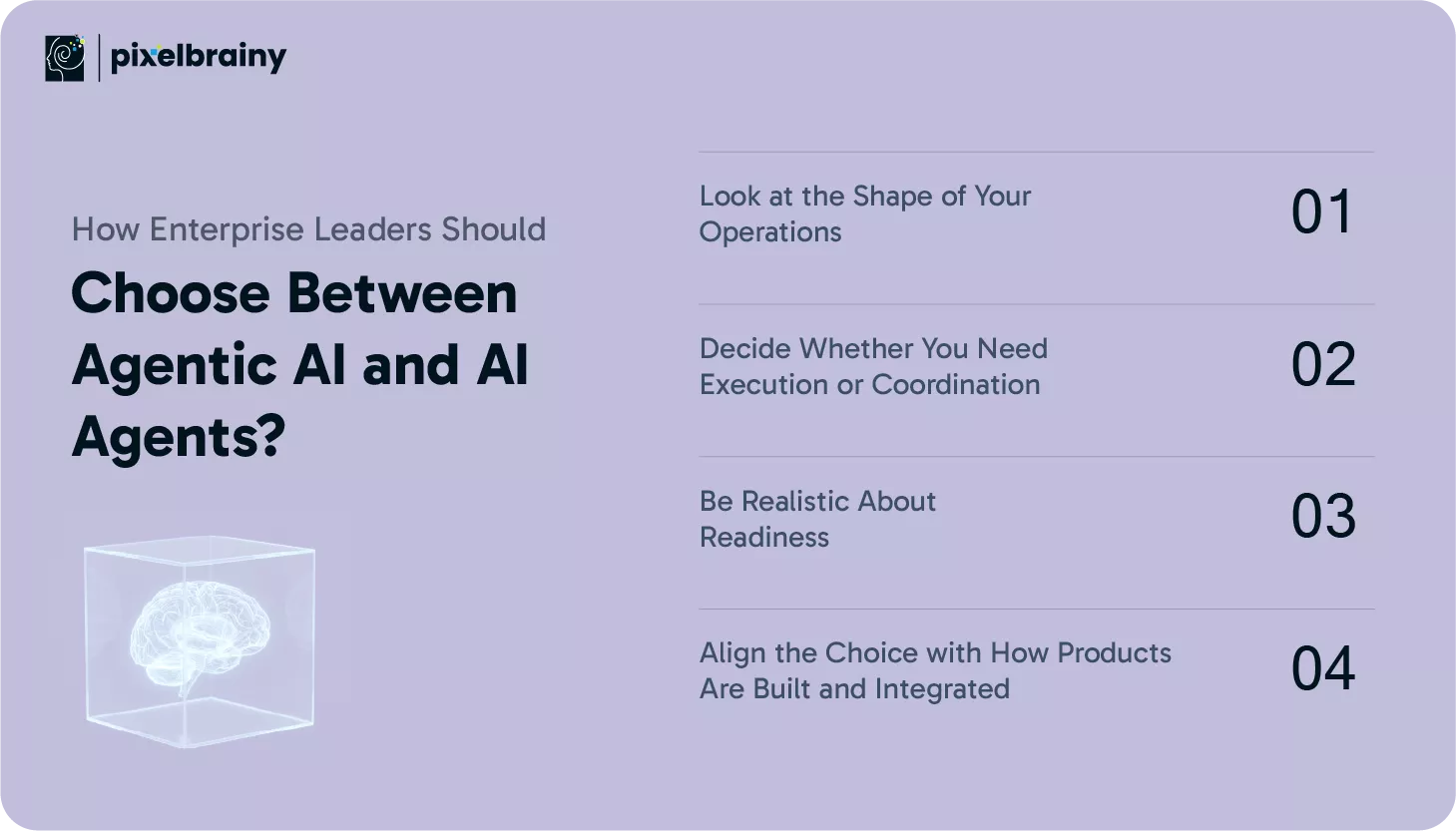
Start by examining how work flows through your organization today.
When processes are straightforward, repeatable, and follow clear sequences, AI agents are usually the better fit. They execute reliably and integrate cleanly into established workflows.
As operations become more interconnected across departments, systems, and timelines, the conversation shifts. In these environments, agentic AI vs AI agents for business operations becomes relevant because coordination, not execution, is the real bottleneck.
Not all automation problems are the same.
Some enterprises simply need tasks completed faster and more consistently. Others struggle with coordinating actions across multiple platforms, teams, and data sources.
This is where the distinction between agentic AI platforms vs AI agent tools becomes important. AI agent tools are well suited for task execution. Agentic AI platforms are designed for orchestration, where the system determines how actions should unfold across a broader landscape.
Technology readiness is only half the equation. Organizational readiness matters just as much.
Teams that are exploring AI agent development trends often start with narrow deployments that deliver fast wins. Organizations aiming to introduce agentic AI assistant capabilities must be prepared for deeper design questions around monitoring, escalation, and accountability.
If ownership of AI-driven outcomes is unclear today, introducing autonomy will amplify that weakness rather than solve it.
The way AI is embedded into products and systems should influence the decision.
Enterprises building simple AI apps or rolling out conversational interfaces may find AI agents sufficient. As autonomy increases through advanced AI assistant app design or deeper AI chatbot integration, the consequences of independent system behavior increase as well.
Leaders should choose the model that matches how much freedom the system will realistically have once it is live, not how impressive it looks during a demo.
Choosing between agentic AI and AI agents is not a technical preference. It is a statement about governance, accountability, and trust.
Some organizations want AI to assist humans. Others are ready for AI to lead within carefully defined limits. The correct choice is the one that aligns with how your enterprise manages responsibility today, not how it hopes to manage it tomorrow.

The moment enterprises move from AI agents to agentic AI, the risk profile changes. Not incrementally, but structurally. This is why governance, security, and accountability cannot be treated as secondary concerns in the agentic AI vs AI agents conversation.
AI agents operate inside rules. Agentic AI operates inside objectives. That difference determines how risk behaves once systems are live.
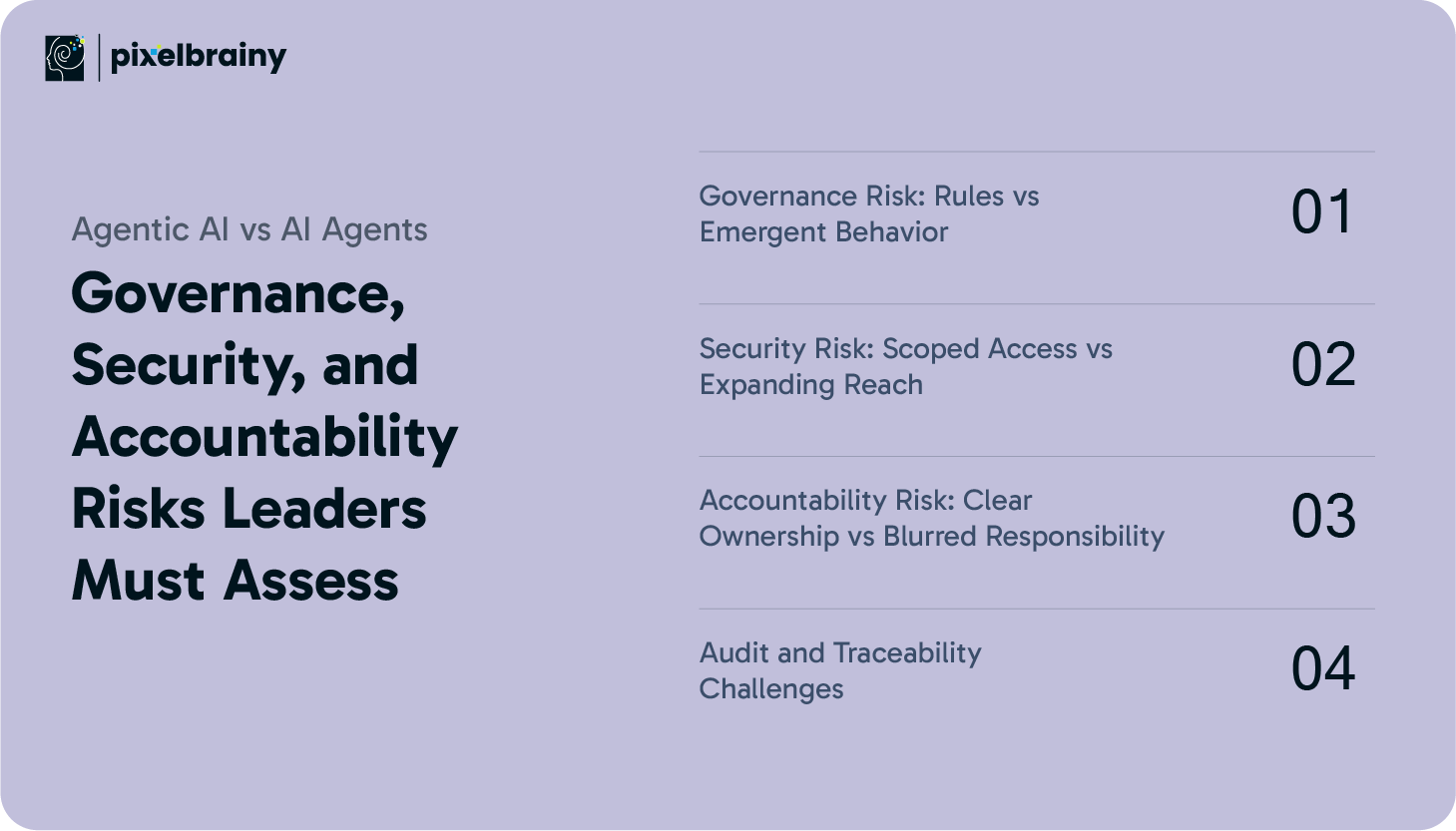
With AI agents, governance is relatively familiar. Leaders define what the system can do, when it can act, and when it must stop. Oversight is rule-based and predictable.
Agentic AI introduces emergent behavior. The system determines how to achieve a goal and may take actions leaders did not explicitly anticipate. Governance frameworks built around static workflows struggle to keep up with systems that adapt dynamically.
For enterprises, this means traditional approval chains and policy enforcement mechanisms may no longer be sufficient.
AI agents typically have limited access. They operate within narrowly defined permissions tied to specific tasks or systems. Security teams can clearly see what data is touched and where actions occur.
Agentic AI systems often require broader access to function effectively. They interact across tools, datasets, and environments. This expands the attack surface and increases the impact of misconfiguration or misuse.
The more autonomous the system, the harder it becomes to enforce least-privilege access consistently.
Accountability is straightforward with AI agents. Humans remain responsible for decisions, and the system executes under supervision.
With agentic AI, accountability becomes harder to define. When a system independently selects actions, adjusts strategy, and continues execution, assigning responsibility for outcomes becomes complex. This ambiguity creates friction across legal, compliance, and leadership teams.
In regulated industries, unclear accountability is not just a governance issue. It is a liability.
Enterprises must be able to explain not just what happened, but why it happened.
AI agents generate clear logs tied to explicit rules and workflows. Agentic AI systems often rely on internal reasoning and contextual decision-making that is harder to reconstruct after the fact.
Without advanced monitoring, decision logging, and audit tooling, agentic AI can create blind spots that undermine trust and compliance.
Many enterprises underestimate these risks because early demonstrations of agentic AI look controlled. In reality, risk increases as systems scale, integrate deeper, and operate longer without intervention.
What feels manageable in a pilot can become unstable in production.
Leaders evaluating agentic AI vs AI agents should ask:
If the answer to any of these is unclear, agentic AI should remain experimental rather than operational.
AI agents challenge execution governance, while agentic AI challenges organizational accountability, and enterprises must be prepared for the difference.
Most enterprise AI failures are not caused by weak models or immature tools. They happen because organizations deploy AI faster than they adapt their operating assumptions. This is especially true when leaders misunderstand the difference between agentic AI and AI agents.
The same mistakes appear again and again across industries.
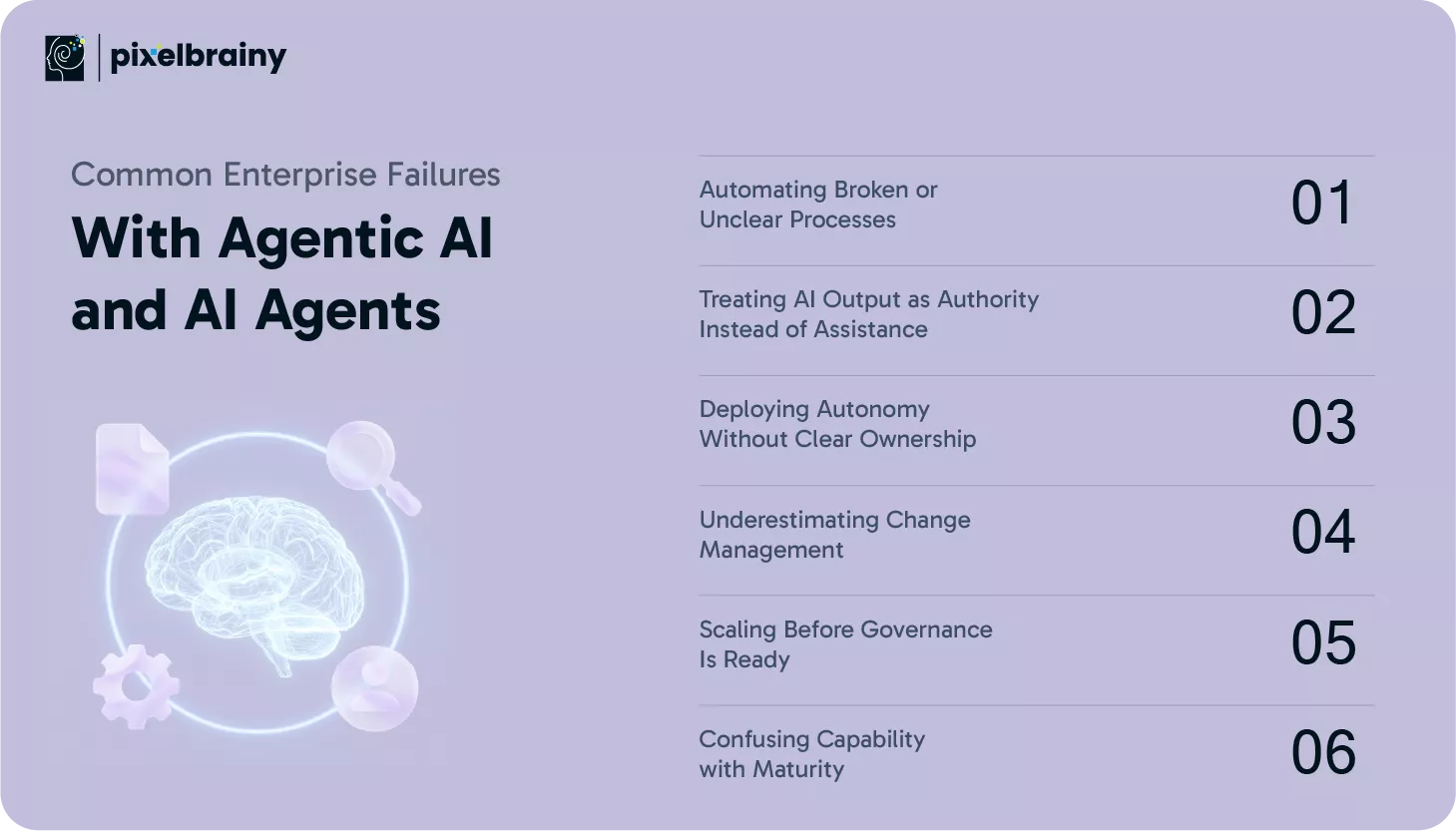
Enterprises often deploy AI agents or agentic AI to fix inefficiency, only to discover that the underlying process was never well defined.
When workflows are inconsistent, undocumented, or depend on tribal knowledge, AI systems amplify confusion rather than resolve it. AI agents struggle because rules are unclear. Agentic AI struggles even more because it optimizes toward goals that humans themselves cannot clearly articulate.
Automation cannot compensate for process ambiguity.
Another common failure is assuming that AI recommendations are inherently correct.
With AI agents, this shows up when teams stop validating outputs and allow automation to run unchecked. With agentic AI, the risk is higher. Systems begin to act on assumptions that were never reviewed, leading to decisions that look logical but are misaligned with business intent.
Trust should be earned through oversight, not granted by default.
Many enterprises underestimate how important ownership becomes once AI systems act independently.
When an AI agent executes a task incorrectly, responsibility is usually clear. When agentic AI selects actions across systems, responsibility becomes blurred. Teams argue over whether the issue was technical, operational, or managerial.
If no one clearly owns AI-driven outcomes, failures linger and confidence erodes quickly.
AI changes how work gets done, even when it does not replace people.
Enterprises often fail to prepare teams for new workflows, escalation paths, and accountability models. Employees bypass systems they do not trust. Managers override automation inconsistently. The result is fragmentation rather than efficiency.
Without deliberate change management, even well-designed AI deployments stall.
Pilot success is often mistaken for readiness to scale.
AI agents that work well in one department fail when rolled out broadly without governance alignment. Agentic AI systems that appear stable in limited environments become risky once they integrate across teams and data sources.
Governance must scale before autonomy does, not after.
Finally, enterprises fail when they assume that because a technology can do something, the organization is ready for it.
Agentic AI capabilities often outpace enterprise readiness. Without strong monitoring, auditability, and escalation mechanisms, advanced systems become liabilities rather than advantages.
Maturity is not measured by what you deploy, but by what you can safely control.
Enterprises fail with AI not because the systems are too weak, but because they are given more autonomy than the organization is prepared to govern.
For most enterprises, choosing between agentic AI and AI agents is not a technology decision. It is an operating decision. PixelBrainy LLC approaches this choice by starting where enterprises actually live, inside existing systems, processes, and constraints, not inside product demos or theoretical roadmaps.
Rather than pushing autonomy for its own sake, PixelBrainy helps leaders determine where control creates value today and where autonomy can safely emerge tomorrow. This perspective comes from building and deploying AI systems that operate under real-world pressures such as regulatory oversight, scale, and business continuity.
PixelBrainy’s portfolio reflects a deliberate progression from execution-focused AI agents to more adaptive, semi-agentic systems.
Together, these implementations provide a practical agentic AI vs AI agents comparison, grounded in production environments rather than theory.
PixelBrainy’s work follows a consistent philosophy:
This approach allows enterprises to explore autonomy without destabilizing operations.
PixelBrainy is trusted because it treats autonomy as a responsibility, not a feature.
Rather than asking enterprises to choose between agentic AI and AI agents upfront, PixelBrainy helps them sequence the journey correctly, aligning technology choices with organizational readiness.
PixelBrainy a leading agentic AI development company helps enterprises move forward with AI by making sure autonomy is earned through discipline, not assumed through ambition.

Agentic AI and AI agents are often discussed as competing technologies, but for enterprise leaders, they represent different stages of AI maturity. AI agents deliver immediate, predictable value by automating execution while preserving human control, governance, and accountability. Agentic AI introduces a higher level of autonomy that can unlock strategic advantage, but only when an organization is ready to manage the risks that come with delegated decision-making.
The enterprises that succeed with AI are not the ones that move fastest, but the ones that sequence adoption thoughtfully. They build confidence with AI agents, strengthen governance, and introduce autonomy only where it clearly adds value. Understanding the difference between agentic AI and AI agents is essential to making investments that scale safely and sustainably.
Ready to make the right AI choice for your enterprise? Book an appointment with PixelBrainy LLC to evaluate your readiness and define a responsible AI roadmap.
Yes. Many enterprises deploy AI agents for operational execution while experimenting with agentic AI in limited, non-critical areas such as planning or optimization. The key is to clearly separate where automation ends and autonomy begins so responsibilities do not overlap or conflict.
No. In successful enterprises, agentic AI supplements decision-making rather than replacing it. Humans still define objectives, constraints, and accountability. Problems arise only when autonomy is introduced without clear oversight or ownership.
Highly regulated industries such as healthcare, finance, insurance, and public services should proceed carefully. In these sectors, explainability, auditability, and accountability often matter more than speed or flexibility, making AI agents a safer starting point.
Enterprises often see measurable results within weeks or a few months. Because AI agents operate within existing workflows, improvements in efficiency, response time, and cost reduction appear quickly without major organizational disruption.
The biggest risk is unclear accountability. When autonomous systems act across multiple workflows, it becomes difficult to determine who owns outcomes, especially when something goes wrong. This can lead to compliance issues, internal conflict, and loss of trust.
Leaders should assess governance maturity, process clarity, monitoring capabilities, and escalation mechanisms. If the organization struggles to explain or audit automated decisions today, introducing higher autonomy will likely increase risk rather than value.

About The Author
Sagar Bhatnagar
Sagar Sahay Bhatnagar brings over a decade of IT industry experience to his role as Marketing Head at PixelBrainy. He's known for his knack in devising creative marketing strategies that boost brand visibility and market influence. Sagar's strategic thinking, coupled with his innovative vision and focus on results, sets him apart. His track record of successful campaigns proves his ability to utilize digital platforms effectively for impactful marketing efforts. With a genuine passion for both technology and marketing, Sagar continuously pushes PixelBrainy's marketing initiatives to greater success.


Transform your ideas into reality with us.
Working with the PixelBrainy team has been a highly positive experience. They understand the design requirements and create beautiful UX elements to meet the application needs. The dev team did an excellent job bringing my vision to life. We discussed usability and flow. Sagar worked with his team to design the database and begin coding. Working with Sagar was easy. He has the knowledge to create robust apps, including multi-language support, Google and Apple ID login options, Ad-enabled integrations, Stripe payment processing, and a Web Admin site for maintaining support data. I'm extremely satisfied with the services provided, the quality of the final product, and the professionalism of the entire process. I highly recommend them for Android and iOS Mobile Application Design and Development.

Great experience working with them. Had a lot of feedback and I found that unlike most contractors they were bugging me for updates instead of the other way around. They were extremely time conscience and great at communicating! All work was done extremely high quality and if not on time, early! They were always proactive when it comes to communication and the work is great/above par always. Very flexible and a great team to work with! Goes above and beyond to present us with multiple options and always provides quality. Amazing work per usual with Chitra. If you have UI/UX or branding design needs I recommend you go to them! Will likely work with them in the future as well, definitely recommended!

PixelBrainy is a joy to work with and is a great partner when thinking through branding, logo, and website layout. I appreciate that they spend time going into the "why" behind their decisions to help inform me and others about industry best practices and their expertise.

I hired them to design our software apps. Things I really like about them are excellent communication skills, they answer all project suggestions and collaborate right away, and their input on design and colors is amazing. This project was complex and needed patience and creativity. The team is amazing to do business with. I will be using them long-term. Glad to see there are some good people out there. I was afraid to try and outsource my project to someone but I am glad I met them! I really can't say enough. They went above and beyond on this project. I am very happy with everything they have done to make my business stand out from the competition.

It was great working with PixelBrainy and the team. They were very responsive and really owned the project. We'll definitely work with them again!

I recently worked with the PixelBrainy team on a project and I was blown away by their communication skills. They were prompt, clear, and articulate in all of our interactions. They listened and provided valuable feedback and suggestions to help make the project a success. They also kept me updated throughout the entire process, which made the experience stress-free and enjoyable.

PixelBrainy is very good at what it does. The team also presents themselves very professionally and takes care of their side of things very well. I could fully trust them taking up the design work in a timely and organised manner and their attention to detail saved us lots of effort and time. This particular project was quite intense and the team showed that they function very well under pressure. Very much looking forward to working with her again!

It's always an absolute pleasure working with them. They completed all of my requests quickly and followed every note I had for them to a T, which made our process go smoothly from start to finish. Everything was completed fast and following all of the guidelines. And I would recommend their services to anyone. If you need any design work done in the future, PixelBrainy should be your first call!

They took ownership of our requirements and designed and proposed multiple beautiful variants. The team is self-motivated, requires minimum supervision, committed to see-through designs with quality and delivering them on time. We would definitely love to work with PixelBrainy again when we have any requirements.

PixelBrainy was a big help with our SaaS application. We've been hard at work with a new UI/UX and they provided a lot of help with the designs. If you're looking for assistance with your website, software, or mobile application designs, PixelBrainy and the team is a great recommendation.

PixelBrainy designers are amazing. They are responsive, talented, and always willing to help craft the design until it matches your vision. I would recommend them and plan to continue them for my future projects and more!!!

They were awesome! Did a good job fast, and good communication. Will work with them again. Thank you

Creative, detail-oriented, and talented designers who take direction well and implement changes quickly and accurately. They consistently over-delivered for us.

PixelBrainy team is very talented and creative. Great designers and a pleasure to work with. PixelBrainy is an excellent communicator and I look forward to working with them again.

PixelBrainy has a very talented design team. Their work is excellent and they are very responsive. I enjoy working with them and hope to continue on all of our future projects.


