AI Summary Powered by PixelBrainy
An independent insurance agency can lose valuable prospects simply because a website visitor asks for a quote after business hours and no producer is available to respond. For agencies managing high inquiry volumes, the challenge is not only generating leads but also qualifying insurance leads quickly, answering policy questions accurately, and routing high-intent prospects to the right agent.
This is where an AI chatbot for insurance agencies can create measurable operational value. A well-designed insurance chatbot can provide 24/7 customer support, collect prospect information, qualify leads based on predefined criteria, answer common insurance FAQs, initiate claim-related workflows, and transfer complex conversations to human agents. When connected with CRM, agency management, quote, and communication systems, it can become an always-available digital front line for the agency.
Consider an independent insurance agency with 8 producers that receives website inquiries after hours. Before approving an insurance chatbot development project, the owner needs to know what the technology actually involves. How does an AI insurance chatbot qualify leads? Can it answer coverage questions without creating E&O liability? When should it stop providing information and hand the conversation to a licensed agent? What integrations are required to turn website visitors into qualified opportunities?
These questions are central to planning custom AI chatbot development for insurance agencies.
This guide explains how to build an AI chatbot for insurance agencies, covering its use cases, essential features, development process, technology stack, integrations, security and compliance considerations, development costs, and common implementation challenges. It also examines practical scenarios for insurance lead generation chatbots, after-hours customer engagement, policy support, and claims assistance.
By the end, you will have a clearer framework for evaluating an AI insurance chatbot development company, estimating your investment, and designing a solution that supports lead conversion while keeping human agents involved where professional judgment is required.

Insurance chatbots are AI-powered virtual assistants crafted to interact with customers flawlessly and ease core insurance functions. These chatbot solutions for insurers are well-integrated into mobile apps, websites, or messaging platforms to address queries, guide users via policy alternatives, provide quotes, process claims, and help with effortless onboarding in real time.
Unlike time-bound call centers or static FAQ pages, insurance chatbots function 24/7, delivering consistent and instant responses. Their caliber in comprehending context, adapting to user intent, and providing personalized answers makes them well-recognized as a valuable tool among modern insurers.
So, custom AI chatbot development for insurance agencies not only diminishes manual jobs but also increases conversion rates.
A quick difference between a Human Agent and an AI Chatbot:
| Feature | Human Agent | AI Chatbot |
| Availability | Business hours only | 24/7 |
| Speed of Response | Varies | Instant |
| Cost per Interaction | Higher (salaries, training) | Lower (automated) |
| Handling Volume | Limited by bandwidth | Scalable |
| Consistency in Communication | May vary | Always consistent |
| Learning Capability | Static knowledge | Improves over time |
Therefore, an AI insurance chatbot combines 24/7 availability, scalable customer support, and intelligent automation to help agencies capture more leads while reducing repetitive work for human agents.
Before you build insurance chatbot, let’s know how it works.
AI chatbots in the insurance sector make the best use of Natural Language Processing (NLP), Machine Learning (ML), and system integration to automate conversations and help with key tasks quickly and accurately.
This approach makes sure that customer queries are settled promptly, operations are more efficient, and the comprehensive experience feels effortless and human-like without demanding constant agent involvement.
The AI insurance chatbot market is expanding as insurers and agencies adopt conversational AI for customer service, lead qualification, claims support, and policy assistance. The broader AI in insurance market shows particularly strong growth, indicating increasing investment in AI-powered insurance solutions.
According to Fortune Business Insights, the global AI in insurance market is projected to reach $13.45 billion in 2026 and grow to $154.39 billion by 2034, at a CAGR of 35.7%.
The global chatbot market is also projected to reach $11.8 billion in 2026, growing to $41.2 billion by 2033, according to Grand View Research.
For independent agencies, the biggest opportunity is to build custom AI insurance chatbots around specific workflows such as lead qualification, policy FAQs, claims assistance, renewals, and human-agent handoff.
As AI adoption accelerates in 2026, agencies that combine AI chatbot development for insurance agencies with CRM, policy, claims, and analytics integrations can create more responsive customer journeys while improving operational efficiency.
The 2026 market outlook points toward purpose-built insurance AI chatbots that connect customer conversations with real insurance workflows and measurable business outcomes.
For insurance agencies, the value of AI chatbot development goes beyond automated conversations. A well-designed AI insurance chatbot can keep customer support available around the clock, capture and qualify website leads, accelerate routine claims workflows, and reduce repetitive work for producers and service teams. This is especially valuable for independent agencies that need to respond quickly without expanding their support staff.
Consider an agency with eight producers that receives quote requests after business hours. An insurance lead qualification chatbot can collect prospect details, identify coverage needs, answer approved policy FAQs, and route qualified opportunities to the right producer. At the same time, clear escalation rules can ensure that questions requiring licensed-agent judgment are transferred to a human.
Here are the key benefits of AI chatbots in insurance agencies:
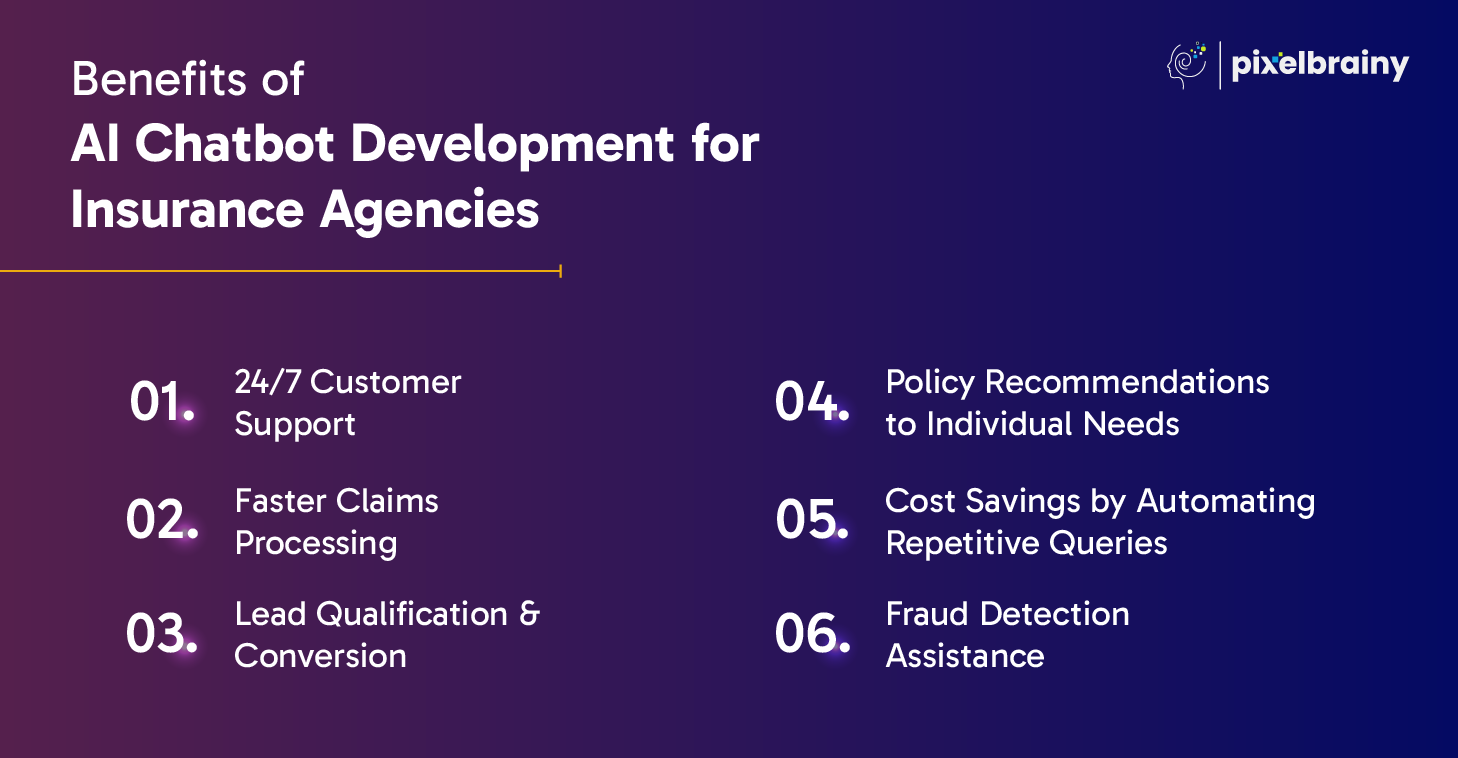
AI-powered chatbots provide uninterrupted support by responding instantly to customer queries at any hour. This ensures your insurance agency remains accessible even during weekends or holidays, improving user experience and brand trust.
AI chatbots streamline the initial phases of claims by collecting essential customer details and verifying policy information. This automation reduces manual effort, accelerates claim resolution, and minimizes delays in customer service.
Smart assistants interact with website visitors in real time, asking smart, relevant questions to identify potential customers. They filter and forward qualified leads to the sales team, improving conversion rates without manual involvement.
By analyzing user responses and historical data, intelligent bots recommend insurance plans tailored to individual needs. This level of personalization helps customers make informed decisions quickly, increasing policy adoption rates.
Implementing AI chatbots reduces reliance on large customer support teams by automating repetitive queries. This lowers operational costs significantly while maintaining a high standard of service efficiency.
AI chatbots can identify unusual behavior or suspicious claim patterns during interactions. Early detection of such activities helps insurance agencies take prompt action, reducing the risk of fraudulent claims.
When designed around real insurance workflows, an AI chatbot can improve response speed, lead conversion, and service efficiency while keeping human agents involved where their expertise matters most.
Also Read: Top 20+ AI Development Companies In USA: Pioneering Innovation in the Market
A production-ready AI chatbot for insurance agencies needs to support more than basic customer questions. The feature set should reflect real insurance workflows, including lead qualification, policy support, claims assistance, document handling, CRM connectivity, secure authentication, and human-agent escalation. For agencies evaluating custom insurance chatbot development, these capabilities also determine the chatbot’s complexity, integration requirements, and overall business value.
For example, an independent agency receiving after-hours quote requests may ask, “Can an insurance chatbot qualify website visitors, collect coverage requirements, answer approved policy FAQs, and send qualified leads to our producers without giving advice that requires a licensed agent?” The answer depends on how the chatbot’s knowledge base, business rules, integrations, permissions, and escalation workflows are designed.
Below are 20 important insurance chatbot features to consider when planning an AI-powered solution:
| Feature | Description |
| 24/7 Customer Support | Ensures around-the-clock availability for client inquiries, claims, and updates. |
| Automated Claim Processing | Collects information, verifies data, and initiates claims instantly. |
| Personalized Policy Recommendations | Suggests tailored insurance plans based on customer profiles and needs. |
| Integration with CRM & Databases | Connects with internal systems to pull real-time policy, claim, and user data. |
| Multilingual Support | Communicates in multiple languages to serve diverse customer bases. |
| Lead Generation & Qualification | Captures visitor interest and filters high-quality leads for agents. |
| Fraud Detection & Risk Assessment | Monitors user inputs for unusual patterns, helping reduce false claims. |
| AI-Powered Premium Calculations | Calculates quotes instantly based on user inputs and policy parameters. |
| Document & Form Processing | Accepts uploads, validates forms, and extracts relevant data automatically. |
| Omnichannel Insurance Support | Available via web, app, SMS, WhatsApp, and social media platforms. |
| Compliance & Regulatory Adherence | Ensures interactions follow GDPR, HIPAA, and insurance-specific standards. |
| Voice & Text-Based Interaction | Allows users to interact through typing or speaking, based on preference. |
| Real-Time Chat Handoff | Transfers complex queries to human agents without losing context. |
| AI-Powered FAQ & Knowledge Base | Provides detailed, contextual answers to common insurance questions. |
| Sentiment Analysis & Insights | Detects tone and mood to adjust responses and flag sensitive cases. |
| Automated Renewal Reminders | Sends timely alerts for policy renewals or missed payments. |
| Secure Authentication | Verifies identity using OTPs, tokens, or biometric prompts. |
| Predictive Risk Analytics | Anticipates potential risks based on behavioral and historical data. |
| Smart Upselling & Cross-Selling | Recommends relevant add-ons or upgrades during live interactions. |
| Continuous Learning | Improves over time by learning from past interactions and feedback. |
The right combination of AI insurance chatbot features can turn a basic website assistant into a secure, integrated platform for lead generation, customer service, claims support, and agent productivity.
If an insurance agency wants to move from a basic website chatbot to an intelligent assistant that can qualify leads, answer approved policy questions, support claims workflows, and connect customers with agents, the development process needs to be planned in clear stages. The steps to build AI insurance chatbot from idea to launch should balance business goals, conversational design, insurance data, integrations, security, and human oversight.
For example, an independent agency may want an after-hours chatbot that captures quote requests, asks about coverage needs, retrieves approved information from its knowledge base, and sends qualified prospects to producers. That requires a different architecture from a simple FAQ bot.
The following seven steps explain how to build AI chatbot for insurance from scratch, from defining the use case through post-launch optimization.
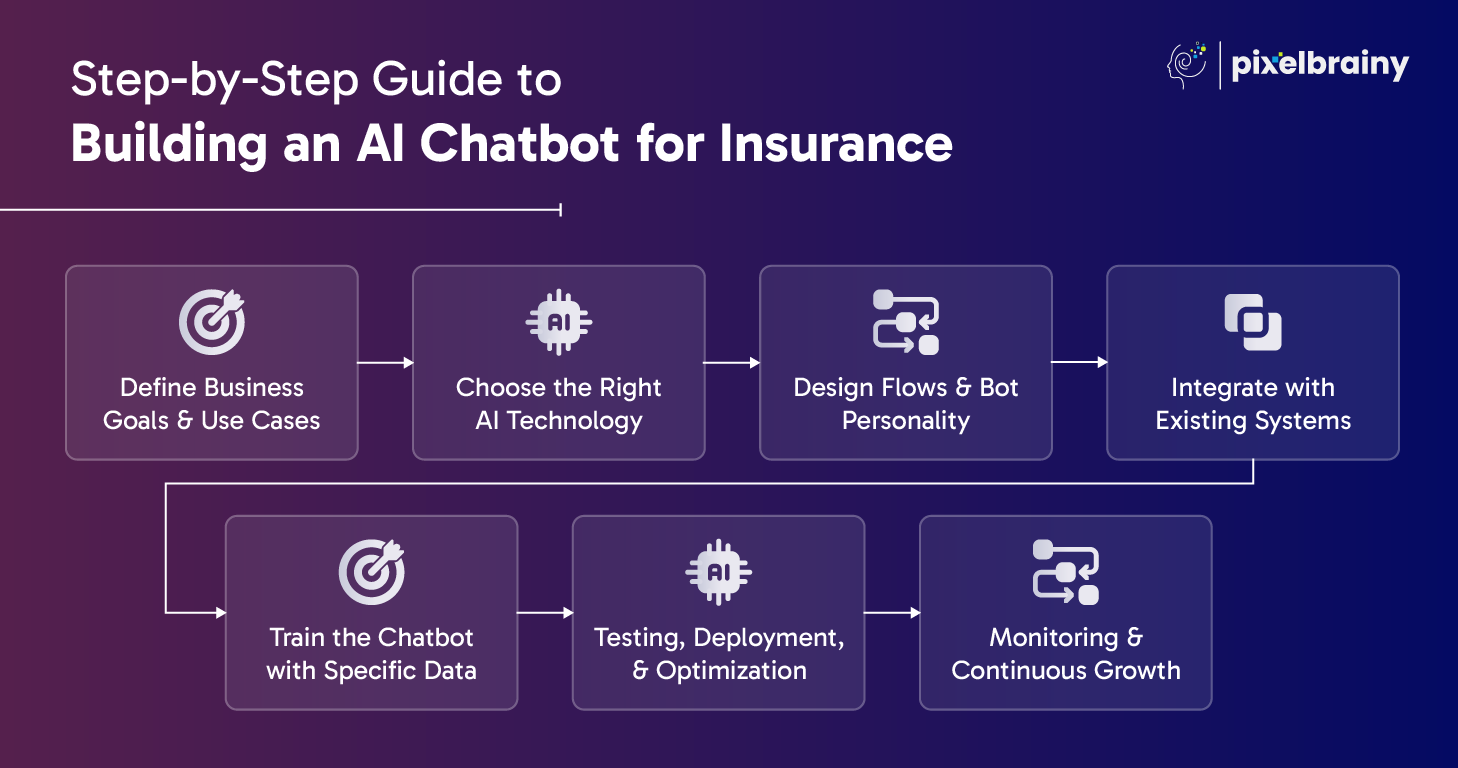
The first step in AI insurance chatbot development is to establish exactly what the chatbot should accomplish. Avoid trying to automate every insurance process in the first release. Identify the highest-value workflows and define measurable outcomes such as more qualified leads, faster responses, or fewer repetitive service requests.
Focus areas:
A focused scope gives the development team a practical foundation for building an AI insurance chatbot without unnecessary complexity.
The technology stack should match the chatbot's intended responsibilities. NLP can help interpret customer intent, machine learning can support classification and prediction, and LLMs can enable contextual conversations. For insurance use cases, however, generative capabilities should be paired with controlled knowledge sources and business rules.
Technology considerations:
Teams evaluating develop AI insurance chatbot projects can also use PoC development to validate a high-risk capability before committing to the complete product.
Also Read: A Guide To Choose Right AI Tools and Technologies For Your Business
Conversation design determines how customers experience the insurance chatbot. Map the journey for every priority use case, including successful paths, unclear questions, unavailable information, sensitive requests, and agent escalation.
Key considerations:
Working with a UI/UX design company can help ensure the chatbot experience remains accessible, consistent, and easy to navigate across devices.
A chatbot becomes substantially more useful when it can securely exchange information with the systems an agency already uses. During this stage, developers establish APIs, authentication, permissions, and data flows between the chatbot and business applications.
Potential integrations include:
Effective AI integration allows the chatbot to retrieve relevant information and trigger approved workflows rather than functioning as an isolated conversational interface.
Insurance conversations require domain-specific information. Prepare the chatbot's knowledge base using approved policy documents, FAQs, product information, customer service scripts, historical conversations, and other relevant sources.
Best practices include:
For more specialized capabilities, AI model development may be required. However, many projects can begin with established models combined with retrieval, business rules, and carefully curated insurance data.
Also Read: Top 12+ AI Model Development Companies in the USA
Before launching to create an AI chatbot for insurance, test it against realistic customer conversations rather than only predefined examples. Evaluate whether it understands different ways customers ask the same question and whether it responds appropriately when information is unavailable.
Testing should cover:
An MVP development approach can allow an agency to launch core capabilities with a controlled audience, measure results, and expand functionality based on actual usage.
Also Read: Top 10 AI MVP Development Companies in USA
Launching the chatbot is the beginning of optimization, not the end of insurance chatbot development using AI. Monitor conversations to identify unanswered questions, failed handoffs, low-quality responses, and opportunities to improve customer journeys.
Important metrics include:
Regular reviews help teams refine prompts, knowledge sources, workflows, integrations, and AI behavior as business requirements change. AI chatbot development companies can also provide ongoing monitoring, maintenance, and model optimization after deployment.
A structured development process of AI insurance chatbot helps agencies move from a focused use case to a secure, measurable, and scalable conversational insurance solution.
The cost to build an AI chatbot for insurance agencies typically ranges from $8,000 to $60,000+, depending on the chatbot’s complexity, AI capabilities, integrations, security requirements, and level of customization. A basic insurance FAQ and lead capture bot may stay toward the lower end, while an advanced solution with CRM connectivity, claims workflows, insurance knowledge retrieval, analytics, and human-agent handoff can require a significantly larger development budget.
For an independent agency, the right AI insurance chatbot development cost depends on what you want the system to accomplish. For example, an after-hours lead qualification chatbot that captures prospect information and schedules appointments will have different requirements from a full-service chatbot that accesses policy data, supports claims intake, and integrates with an agency management system.
If you are asking, “How much does it cost to develop an AI chatbot for an insurance agency that qualifies leads, answers policy questions, connects with our CRM, and hands complex conversations to agents?”, the answer should be based on the actual feature scope rather than a flat chatbot development price.
| Development Element | Estimated Range (USD) |
| Requirements Analysis & Use Case Design | $2,000 – $5,000 |
| AI & NLP Model Integration | $4,000 – $10,000 |
| Conversational Flow Design | $2,000 – $6,000 |
| CRM & API Integrations | $3,000 – $8,000 |
| Insurance Data Training | $3,000 – $7,000 |
| Testing & Compliance (GDPR, HIPAA, etc.) | $2,000 – $6,000 |
| UI/UX & Frontend Development | $2,000 – $5,000 |
| Ongoing Monitoring & AI Improvements | $1,000 – $3,000/month |
| Chatbot Complexity | Description | Typical Cost Range |
| Basic AI Chatbot | Simple conversational interface, limited features. | $8,000 – $15,000 |
| Mid-Level AI Chatbot | Integrations with other systems (CRM, databases), and more advanced conversational flows. | $15,000 – $30,000 |
| Advanced AI Chatbot | Full automation capabilities, detailed analytics, and complex natural language processing. | $30,000 – $60,000+ |
With an overall AI chatbot development cost of $8,000 to $60,000+, insurance agencies can plan their investment around the capabilities, integrations, and automation level that deliver the strongest business value.
The technology stack has a direct impact on the cost to build an AI chatbot for insurance, especially when the chatbot needs to support policy inquiries, lead qualification, claims workflows, fraud detection, or real-time integrations. The right combination of NLP frameworks, AI models, databases, chatbot platforms, and cloud infrastructure helps agencies balance functionality, scalability, security, and the overall AI insurance chatbot development cost.
For example, an agency asking, “What technology do we need for an insurance chatbot that qualifies leads after hours, answers approved policy questions, connects with our CRM, and can scale as conversations increase?” should evaluate the stack based on actual use cases rather than simply choosing the most advanced tools. Open-source frameworks can reduce licensing expenses, while enterprise platforms may simplify development but introduce recurring usage or subscription costs.
Here’s a comprehensive list of the AI tech stack and frameworks required for building a chatbot for the insurance sector:
| Category | Tools/Frameworks |
| Natural Language Processing (NLP) | spaCy, NLTK (Natural Language Toolkit), Transformers (Hugging Face), Dialogflow (by Google), Rasa |
| Machine Learning & Deep Learning | TensorFlow, PyTorch, scikit-learn, Keras |
| Chatbot Development Platforms | Dialogflow, Microsoft Bot Framework, Botpress, IBM Watson Assistant |
| Data Storage & Integration | SQL/NoSQL Databases (MySQL, PostgreSQL, MongoDB), GraphQL, ETL Tools (Apache Kafka, Talend) |
| Cloud Infrastructure | AWS (Amazon Web Services), Google Cloud Platform (GCP), Microsoft Azure |
A well-planned insurance chatbot tech stack can control development and operating costs while providing the scalability, security, and AI capabilities required for long-term insurance automation.
Also Read: Top 15+ AI Agent Development Companies In USA
The business value of an AI insurance chatbot becomes clearer when it is connected to measurable insurance workflows such as lead generation, claims support, fraud screening, multilingual service, and policy assistance. These use cases also influence the cost to build an AI chatbot for insurance, because integrations, AI complexity, data requirements, and automation depth can vary considerably.
For example, an agency evaluating an after-hours insurance lead qualification chatbot may ask, “Will investing in an AI chatbot actually improve lead conversion enough to justify the development cost, and what features should we prioritize first?” The following scenarios illustrate how different insurance organizations can apply conversational AI to specific operational challenges while aligning functionality with business outcomes.
Agency Type: Auto insurance agency with a strong social media presence
Problem: Increased traffic on platforms like Instagram and Facebook wasn’t converting into leads
Solution: A conversational AI chatbot on WhatsApp and Messenger grabs visitor interest, prequalifies based on vehicle type, budget, and location, and routes leads to agents
Outcome:
Agency Type: High-volume claims insurer (home and auto)
Problem: Increased number of questionable claims and problem spotting fraud early.
Solution: The AI chatbot cross-checks submitted data with internal fraud detection systems, screens for inconsistencies in claim descriptions, and flags suspicious activity
Outcome:
Agency Type: Digital-first property insurance company
Problem: Lengthy claim verification processes, mainly for minor property damage.
Solution: An AI chatbot integrated seamlessly with the claims system directs users via reporting, accumulates photos, verifies documents, and automates approvals utilizing AI-based rules.
Outcome:
Agency Type: Large-scale life insurance provider with global customers
Problem: Customer service teams struggled with multilingual support requirements.
Solution: The AI chatbot manages conversations in English, Spanish, French, and German, answering queries and providing policy information.
Outcome:
Agency Type: Mid-sized health insurance provider
Problem: Issues matching users with the right policy based on age, lifestyle, and pre-existing conditions.
Solution: The AI chatbot asks dynamic questions and makes use of ML algorithms to deliver tailored plans. CRM (provider’s) integration with chatbot permits flawless application processing.
Outcome:
These scenarios show how an AI chatbot for insurance agencies can connect automation with measurable outcomes, while the right use cases help businesses control AI chatbot development costs and prioritize investments with stronger ROI.
While AI chatbot development for insurance can improve customer service and automate repetitive workflows, the development budget can increase when the solution requires complex decision logic, sensitive insurance data, regulatory controls, or continuous model updates. Identifying these challenges early helps agencies estimate the cost to build an AI chatbot for insurance more accurately and avoid expensive rework after launch.
A common question from agencies is: “If we build an insurance chatbot that qualifies leads, answers coverage questions, and supports claims, what technical challenges could increase the development cost?” The answer depends largely on how much autonomy the chatbot needs and how deeply it must connect with existing insurance systems.
Below are the key challenges and practical solutions to consider:
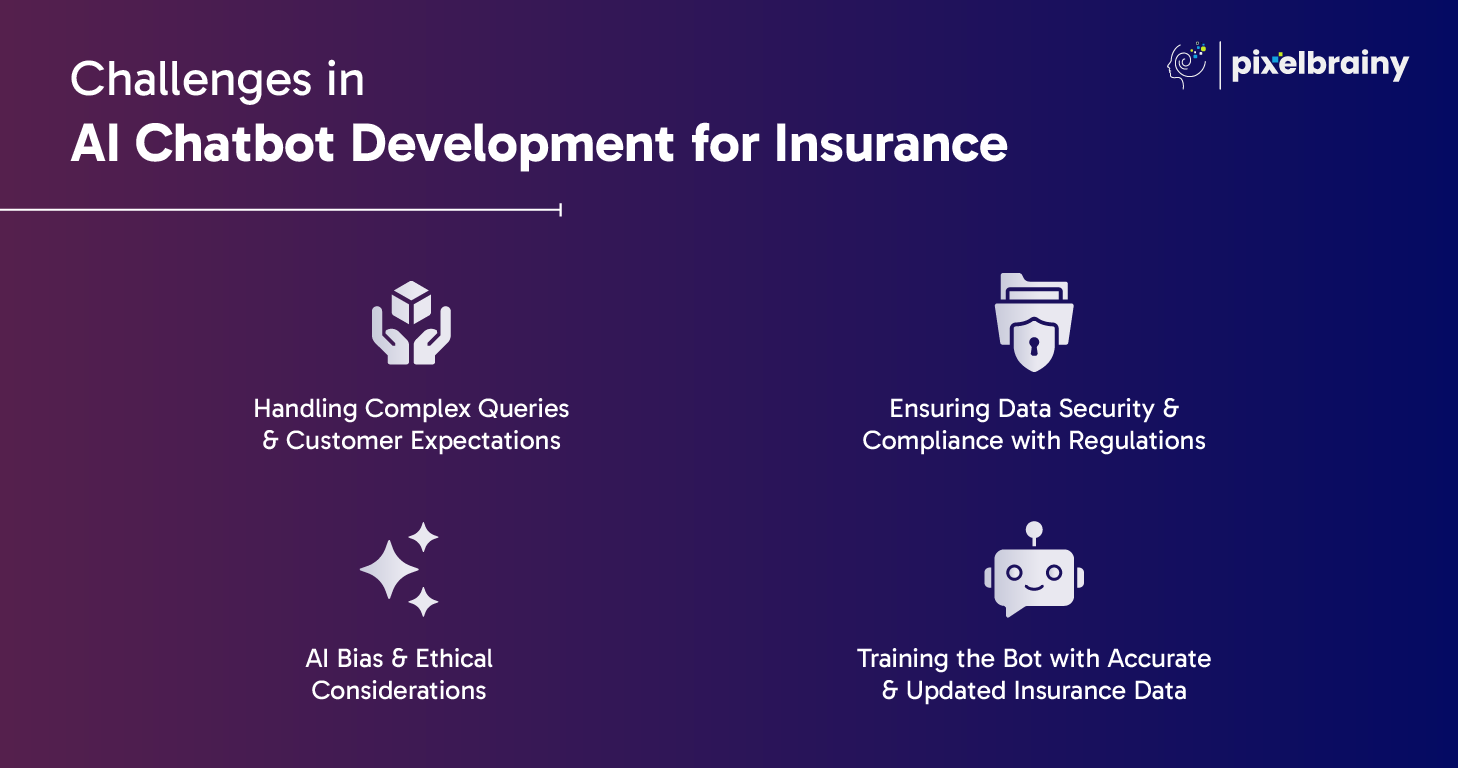
Solution:
Solution:
Solution:
Solution:
Addressing these challenges during insurance chatbot development helps agencies control unexpected costs while creating a secure, accurate, and scalable AI solution that can evolve with changing customer and business requirements.
From the market trends, use cases, features, costs, and implementation challenges covered above, the next step is identifying an AI chatbot technology partner that understands both insurance workflows and AI engineering. For an independent agency, the right partner should be able to connect lead qualification, policy support, claims workflows, CRM integrations, security, and human handoff without turning the project into an unnecessarily expensive technology stack.
PixelBrainy is an AI Insurance software development company focused on creating intelligent, secure, and business-oriented solutions for insurance organizations. Our approach is centered on developing the capabilities an agency actually needs, then scaling the platform as adoption and requirements grow.
PixelBrainy recently delivered a custom conversational AI solution for a U.S.-based insurance organization looking to improve after-hours lead capture and reduce repetitive customer support workload.
Project Scope:
The solution was designed with controlled response boundaries so the chatbot could provide approved information while escalating questions requiring professional insurance guidance to human agents.
This result-oriented approach reflects how PixelBrainy helps agencies optimize insurance chatbot development costs by prioritizing high-value workflows first, using scalable architecture, and avoiding unnecessary features during the initial release.
If you want to build AI insurance chatbot capabilities around lead qualification, policy support, claims assistance, or customer service, connect with PixelBrainy to discuss your requirements and development roadmap.
For insurance agencies, an AI chatbot is becoming a practical way to improve customer engagement, capture more opportunities, and automate repetitive service workflows. From 24/7 support and insurance lead qualification to claims assistance, policy FAQs, CRM integration, and human-agent handoff, the right solution can support both customers and insurance teams.
However, successful AI chatbot development for insurance agencies depends on more than adding conversational AI. Agencies need clearly defined use cases, reliable insurance data, secure integrations, appropriate compliance controls, and escalation workflows for questions that require licensed professional judgment.
The cost to build an AI chatbot for insurance can range from $8,000 to $60,000+, depending on functionality, integrations, AI complexity, security, and customization. Starting with high-value use cases can help control the AI insurance chatbot development cost while creating a scalable foundation.
Whether your goal is to build AI insurance chatbot capabilities for after-hours lead capture or develop a comprehensive customer service assistant, the right development strategy can turn AI into a measurable business asset.
Ready to discuss your insurance chatbot project? Book an appointment with PixelBrainy today.
The cost to build an AI chatbot for insurance typically ranges from $8,000 to $60,000+. The final AI insurance chatbot development cost depends on features, AI complexity, CRM and claims integrations, security requirements, channels, and customization.
An AI insurance chatbot can provide 24/7 customer support, qualify website leads, answer approved policy FAQs, collect claim information, schedule appointments, send renewal reminders, and transfer complex conversations to human agents.
Yes. An insurance lead qualification chatbot can engage website visitors 24/7, collect information such as coverage requirements and contact details, assess predefined qualification criteria, and route high-intent leads to producers or a CRM for follow-up.
A properly designed chatbot should rely on an approved insurance knowledge base, defined business rules, response guardrails, disclosures, and human escalation. Questions requiring licensed professional judgment can be transferred to an agent instead of allowing the AI to provide unauthorized advice.
Common integrations include CRM systems, agency management platforms, policy databases, claims systems, calendars, email, messaging platforms, and analytics tools. The required integrations depend on the chatbot's intended workflows and can significantly influence development costs.
A basic lead capture or FAQ chatbot can require considerably less development time than an advanced solution with CRM, claims, policy, analytics, multilingual, and human-handoff capabilities. The timeline depends primarily on scope, integrations, data preparation, testing, and compliance requirements.
Important insurance chatbot features include lead qualification, 24/7 support, policy knowledge retrieval, claims assistance, CRM integration, secure authentication, multilingual support, document processing, automated reminders, analytics, and real-time human-agent handoff.
Look for an AI insurance chatbot development company with experience in conversational AI, insurance workflows, secure integrations, compliance, knowledge-base design, and measurable business outcomes. Ask potential vendors to explain their architecture, pricing, security approach, development methodology, and relevant project results before approving a budget.

About The Author
Sagar Bhatnagar
Sagar Sahay Bhatnagar brings over a decade of IT industry experience to his role as Marketing Head at PixelBrainy. He's known for his knack in devising creative marketing strategies that boost brand visibility and market influence. Sagar's strategic thinking, coupled with his innovative vision and focus on results, sets him apart. His track record of successful campaigns proves his ability to utilize digital platforms effectively for impactful marketing efforts. With a genuine passion for both technology and marketing, Sagar continuously pushes PixelBrainy's marketing initiatives to greater success.

Working with the PixelBrainy team has been a highly positive experience. They understand the design requirements and create beautiful UX elements to meet the application needs. The dev team did an excellent job bringing my vision to life. We discussed usability and flow. Sagar worked with his team to design the database and begin coding. Working with Sagar was easy. He has the knowledge to create robust apps, including multi-language support, Google and Apple ID login options, Ad-enabled integrations, Stripe payment processing, and a Web Admin site for maintaining support data. I'm extremely satisfied with the services provided, the quality of the final product, and the professionalism of the entire process. I highly recommend them for Android and iOS Mobile Application Design and Development.

Great experience working with them. Had a lot of feedback and I found that unlike most contractors they were bugging me for updates instead of the other way around. They were extremely time conscience and great at communicating! All work was done extremely high quality and if not on time, early! They were always proactive when it comes to communication and the work is great/above par always. Very flexible and a great team to work with! Goes above and beyond to present us with multiple options and always provides quality. Amazing work per usual with Chitra. If you have UI/UX or branding design needs I recommend you go to them! Will likely work with them in the future as well, definitely recommended!

PixelBrainy is a joy to work with and is a great partner when thinking through branding, logo, and website layout. I appreciate that they spend time going into the "why" behind their decisions to help inform me and others about industry best practices and their expertise.

I hired them to design our software apps. Things I really like about them are excellent communication skills, they answer all project suggestions and collaborate right away, and their input on design and colors is amazing. This project was complex and needed patience and creativity. The team is amazing to do business with. I will be using them long-term. Glad to see there are some good people out there. I was afraid to try and outsource my project to someone but I am glad I met them! I really can't say enough. They went above and beyond on this project. I am very happy with everything they have done to make my business stand out from the competition.

It was great working with PixelBrainy and the team. They were very responsive and really owned the project. We'll definitely work with them again!

I recently worked with the PixelBrainy team on a project and I was blown away by their communication skills. They were prompt, clear, and articulate in all of our interactions. They listened and provided valuable feedback and suggestions to help make the project a success. They also kept me updated throughout the entire process, which made the experience stress-free and enjoyable.

PixelBrainy is very good at what it does. The team also presents themselves very professionally and takes care of their side of things very well. I could fully trust them taking up the design work in a timely and organised manner and their attention to detail saved us lots of effort and time. This particular project was quite intense and the team showed that they function very well under pressure. Very much looking forward to working with her again!

It's always an absolute pleasure working with them. They completed all of my requests quickly and followed every note I had for them to a T, which made our process go smoothly from start to finish. Everything was completed fast and following all of the guidelines. And I would recommend their services to anyone. If you need any design work done in the future, PixelBrainy should be your first call!

They took ownership of our requirements and designed and proposed multiple beautiful variants. The team is self-motivated, requires minimum supervision, committed to see-through designs with quality and delivering them on time. We would definitely love to work with PixelBrainy again when we have any requirements.

PixelBrainy was a big help with our SaaS application. We've been hard at work with a new UI/UX and they provided a lot of help with the designs. If you're looking for assistance with your website, software, or mobile application designs, PixelBrainy and the team is a great recommendation.

PixelBrainy designers are amazing. They are responsive, talented, and always willing to help craft the design until it matches your vision. I would recommend them and plan to continue them for my future projects and more!!!

They were awesome! Did a good job fast, and good communication. Will work with them again. Thank you

Creative, detail-oriented, and talented designers who take direction well and implement changes quickly and accurately. They consistently over-delivered for us.

PixelBrainy team is very talented and creative. Great designers and a pleasure to work with. PixelBrainy is an excellent communicator and I look forward to working with them again.

PixelBrainy has a very talented design team. Their work is excellent and they are very responsive. I enjoy working with them and hope to continue on all of our future projects.


Transform your ideas into reality with us.
Across these industries, each engagement brings unique challenges, from early-stage product development to scaling complex systems, helping us build a practical understanding of real-world product environments.