AI Summary Powered by PixelBrainy
Can a smartphone camera truly deliver accurate body composition insights that fitness professionals and consumers can trust, or is AI body scanning still more of a marketing feature than a scientifically reliable solution?
The short answer is yes, but with important limitations. In 2026, smartphone-based AI body scanning has become accurate enough to estimate body measurements, posture, muscle distribution, body fat trends, and physique changes for fitness and wellness purposes. However, it is not a replacement for clinical assessment methods such as DEXA scans, MRI, or professional 3D body scanners. This makes AI body scan and physique app development a promising investment for businesses looking to enhance digital fitness experiences while understanding the technology's real capabilities.
Fitness brands, gym chains, wellness startups, healthcare providers, sports technology companies, and entrepreneurs are increasingly looking to build AI body scan and physique app solutions that deliver personalized body composition insights and measurable progress tracking. Powered by computer vision, machine learning, pose estimation, and 3D body reconstruction, these applications provide users with a smarter alternative to relying solely on body weight or BMI.
Consider this real-world scenario. I own a chain of 22 premium fitness clubs across the US, and our members constantly ask for objective body composition tracking beyond the basic scale weight they can get anywhere. Before investing in a proprietary AI body scan app, I need to know whether smartphone camera-based body scan technology is accurate enough in 2026 to be clinically credible or whether sophisticated fitness consumers will dismiss it as a novelty. I also want an honest assessment of the current accuracy limitations and recommendations for AI development companies in the USA that have successfully launched consumer body scan apps with validated accuracy data.
The reality is that developing an AI body scan and physique app requires much more than integrating a smartphone camera with artificial intelligence. Success depends on advanced AI algorithms, high-quality training datasets, secure cloud infrastructure, privacy compliant data management, and an intuitive user experience. Understanding the complete development process of AI body scan and physique app is essential for businesses planning long term success.
If you are exploring how to create an AI body scan and physique app, this guide will help you evaluate the latest technologies, essential features, development stages, technology stack, estimated costs, and best practices for body scan and physique app integrating AI. By the end, you will have a clear understanding of how to build a scalable, accurate, inclusive, and future ready AI body scan solution that meets modern consumer expectations and business goals.
As artificial intelligence continues to transform the fitness industry, AI body scan and physique rating apps are redefining how people measure and improve their health. Unlike traditional fitness apps that primarily track weight or BMI, these intelligent applications provide a comprehensive view of an individual's body composition, physique, and fitness progress using only a smartphone camera.
An AI body scan and physique rating app combines technologies such as computer vision, machine learning, deep learning, and pose estimation to evaluate a user's physical appearance. By analyzing images or videos captured from different angles, the app can estimate body measurements, body fat percentage, muscle distribution, posture, body symmetry, and other key fitness metrics. This enables users to monitor changes over time without requiring expensive body scanning equipment or frequent visits to a fitness center.
The workflow is simple yet powered by sophisticated AI technologies:
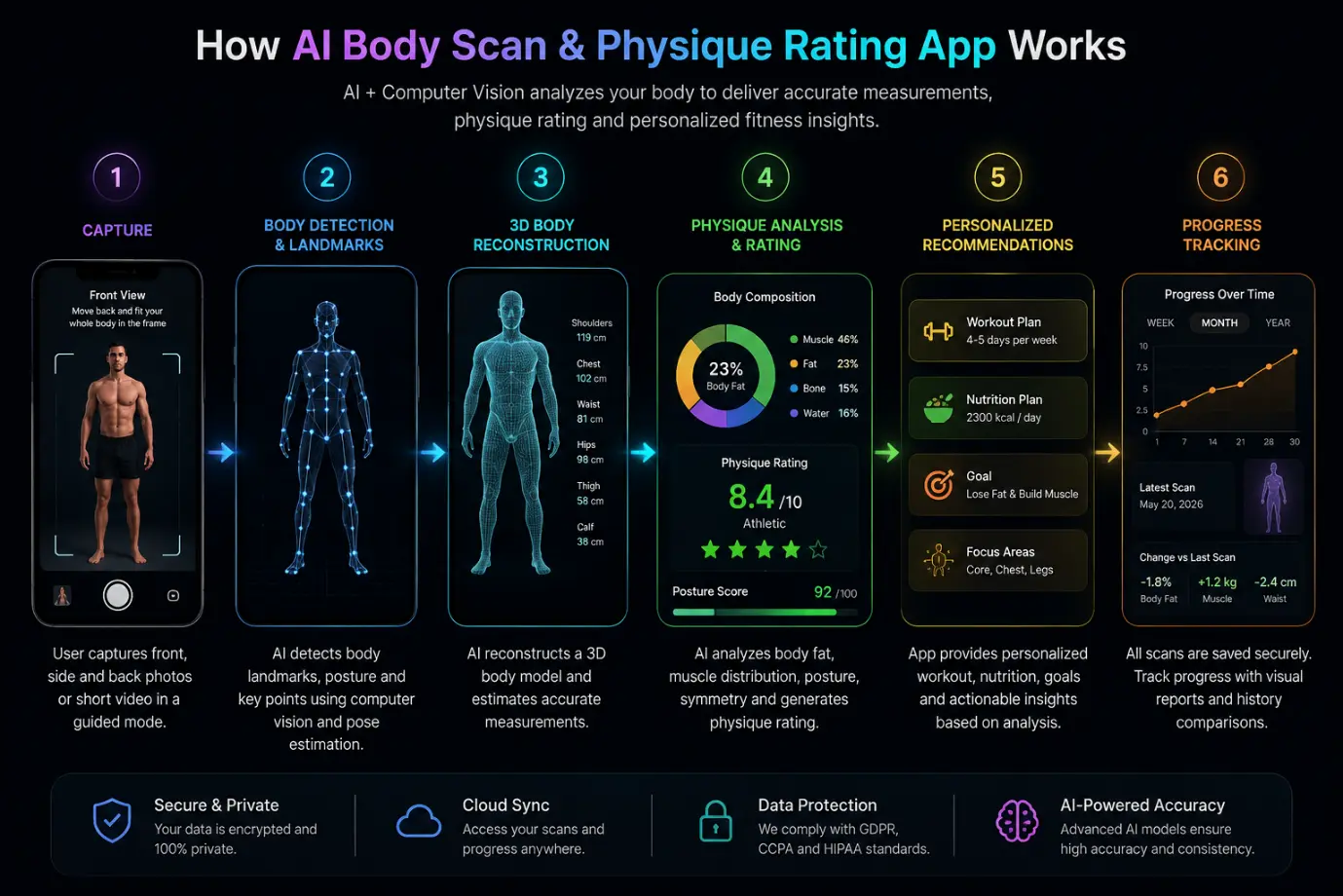
The real value of these apps lies in their ability to make fitness tracking more objective, engaging, and data driven. While they are not intended to replace clinical body composition assessments such as DEXA scans, they provide consistent and actionable insights that help users stay motivated and make informed fitness decisions. For businesses, integrating this technology into a fitness platform creates a highly personalized user experience while improving customer engagement, retention, and long-term loyalty.
The fitness industry is entering a new era where members expect personalized, data driven experiences instead of generic workout programs. People no longer measure success solely by the number on a weighing scale. They want to understand body fat percentage, muscle growth, posture improvement, body symmetry, and overall physique transformation. This shift in consumer expectations is encouraging fitness businesses to invest in developing an AI body scan and physique app that delivers intelligent body composition insights using smartphone cameras and artificial intelligence.
The business potential is equally impressive. According to Grand View Research, the global fitness apps market is estimated to reach USD 13.9 billion in 2026 and is projected to grow to USD 33.6 billion by 2033, expanding at a 13.4% CAGR. The report highlights that AI driven personalization, increasing smartphone adoption, wearable device integration, and growing demand for digital wellness solutions are among the primary growth drivers.
For organizations planning AI body scan and physique app development, this presents a significant opportunity to strengthen customer engagement, differentiate their brand, and create sustainable recurring revenue through innovative digital fitness services.
Consider this practical business scenario. I operate a fast growing online personal training platform with more than 15,000 active subscribers. Our biggest challenge is keeping remote clients engaged between coaching sessions because they often struggle to see measurable progress. Before investing in AI body scanning, I need to know whether it can improve client retention, increase premium subscription conversions, and provide trainers with meaningful body composition insights that enhance personalized coaching.
The answer lies in the measurable value AI powered body scanning creates for both businesses and end users.
Everybody responds differently to exercise and nutrition. A body scan and physique app integrating AI analyzes body measurements, muscle distribution, posture, and body composition to generate personalized workout plans, nutrition guidance, calorie targets, and recovery recommendations, creating a fitness journey tailored to each individual.
Visual progress motivates users far more effectively than weight alone. AI generated body comparisons, circumference measurements, physique ratings, and transformation reports encourage members to stay consistent, increasing app usage and long-term membership retention.
Businesses can monetize advanced AI features through premium subscriptions, virtual personal training, body composition reports, personalized nutrition programs, fitness assessments, and corporate wellness solutions, creating predictable recurring revenue.
AI body scanning allows trainers to monitor client progress from anywhere. Users complete guided scans using their smartphones, while coaches receive detailed body analysis that supports more accurate workout adjustments and personalized coaching without requiring in person visits.
Every scan generates valuable analytics on customer behavior, fitness goals, transformation trends, and program effectiveness. These insights help businesses optimize marketing strategies, improve customer experiences, and make informed product decisions.
Businesses that build AI body scan and physique app solutions can offer an advanced digital fitness experience that differentiates them from traditional gyms and wellness platforms. Intelligent body analysis and AI powered recommendations position brands as innovation leaders within the rapidly evolving fitness industry.
Understanding the complete development process of AI body scan and physique app enables businesses to integrate wearable devices, nutrition platforms, health records, and predictive AI into a connected ecosystem. Organizations that understand how to create an AI body scan and physique app today will be better prepared to meet the evolving expectations of digitally connected fitness consumers.
Investing in AI body scan technology empowers fitness businesses to deliver measurable value, strengthen customer loyalty, and build scalable digital wellness solutions for the future.
The rapid adoption of artificial intelligence across the fitness, healthcare, sports, fashion, and wellness industries has led to the emergence of multiple AI body scan application models. Although these applications use similar technologies such as computer vision, machine learning, and 3D body reconstruction, they are designed to solve different business problems and serve different user groups.
Before starting AI body scan app development, businesses should clearly define their target audience, intended use case, accuracy expectations, and long-term business objectives. This strategic foundation helps create a product that delivers real value while supporting sustainable growth.
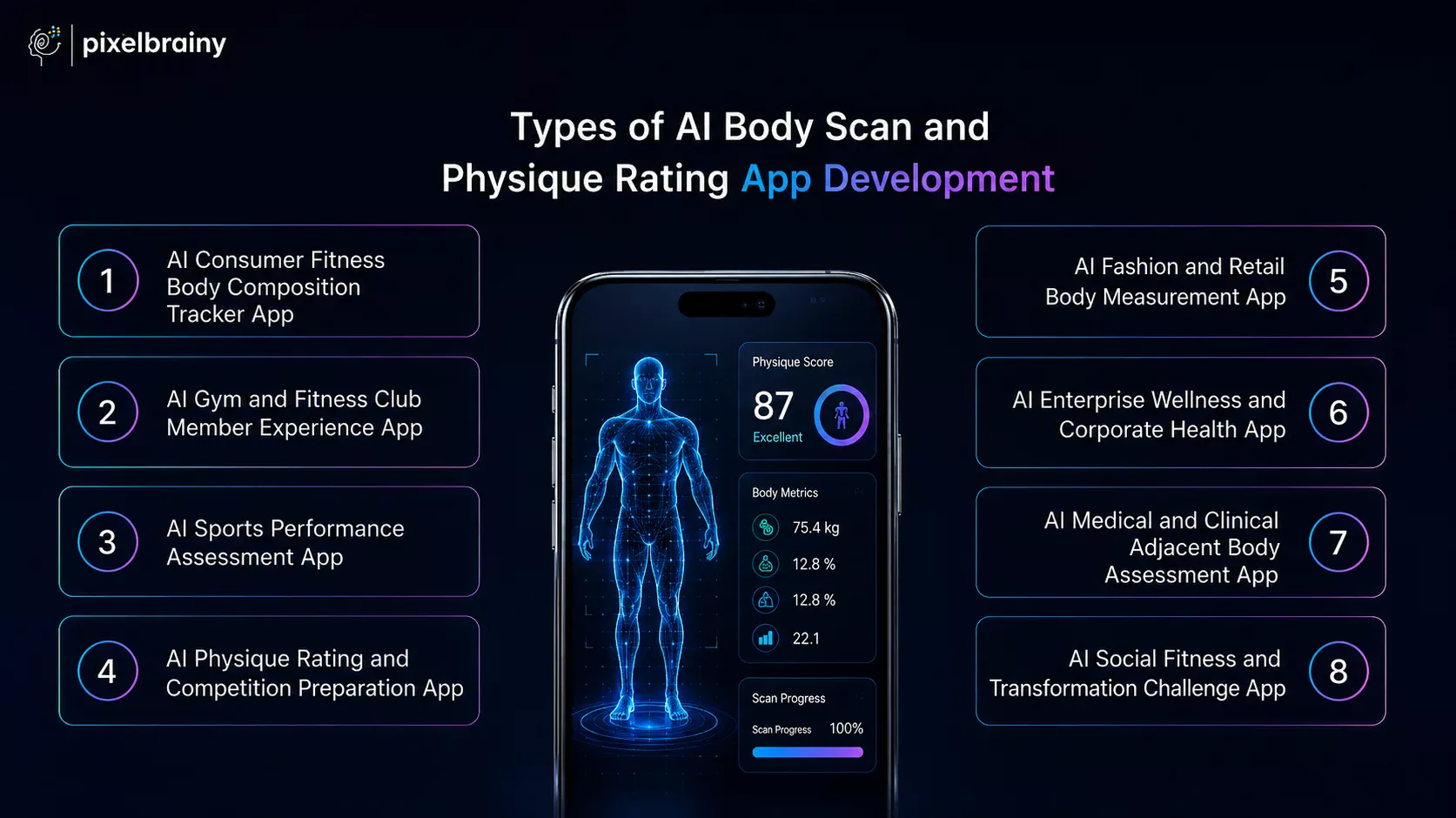
This is one of the most popular product models in AI fitness body scan app development, designed for individuals who want to monitor body composition, muscle development, posture, and fitness progress using only a smartphone camera. The app encourages long term engagement by providing visual transformation reports, body measurements, and personalized fitness insights that help users stay motivated throughout their fitness journey.
Key Design & Accuracy Consideration: Prioritize consistency in progress tracking, intuitive user experiences, and AI powered recommendations rather than medical grade measurement accuracy.
This product model is developed for gyms, health clubs, and boutique fitness studios that want to enhance member experiences through intelligent body composition tracking. Members complete an AI body scan during onboarding and continue scanning throughout their fitness journey, enabling trainers to demonstrate measurable improvements beyond body weight alone.
Key Design & Accuracy Consideration: Businesses planning to build AI body scan app platforms for gyms should focus on trainer dashboards, membership management, CRM integration, and consistent scan quality across multiple locations.
Built for athletes, coaches, sports scientists, and high-performance training centers, this app focuses on evaluating body composition, muscle symmetry, posture, movement efficiency, and structural balance instead of aesthetic appearance. The objective is to improve athletic performance, optimize training, and reduce injury risks through data driven assessments.
Real Business Scenario: My co-founder is a sports scientist who has developed a proprietary physique assessment methodology used by 14 professional sports teams, and we want to build an AI body scan app that digitizes his assessment protocol so athletes can self-assess between coaching sessions.
Key Design & Accuracy Consideration: AI models should be trained using athlete specific datasets and validated against sports performance benchmarks for greater reliability.
Designed for bodybuilding, classic physique, men's physique, bikini, figure, and wellness competitions, this application uses AI to evaluate muscle definition, conditioning, symmetry, proportions, and posing quality based on recognized competition judging standards. It helps competitors measure stage readiness throughout their preparation cycle.
Real Business Scenario: We are building a competitive physique rating app for the bodybuilding and physique sport community where competitors submit photos and receive AI generated physique scores based on NPC and IFBB judging criteria.
Key Design & Accuracy Consideration: Reliable scoring depends on standardized posing instructions, lighting conditions, image quality, and division specific AI evaluation models.
Fashion brands and online retailers develop AI body scan app solutions to generate accurate body measurements for virtual fitting rooms, personalized size recommendations, and improved shopping experiences. These applications reduce sizing uncertainty while helping businesses lower product return rates.
Real Business Scenario: We are a swimwear brand preparing to launch an AI body scan and virtual try on feature that allows customers to visualize how different swimwear styles fit their unique body shape before placing an order.
Key Design & Accuracy Consideration: High precision body measurements and garment fit prediction are significantly more important than estimating body fat percentage or physique scores.
Large organizations are integrating AI body scanning into employee wellness platforms to promote healthier lifestyles through voluntary health assessments, wellness challenges, and personalized fitness recommendations. These solutions support preventive wellness initiatives while improving employee participation and engagement.
Real Business Scenario: Our corporate wellness program serves 80,000 employees across 200 corporate campuses, and we want to integrate an AI body scan feature into our existing wellness platform while ensuring employee health data remains completely private.
Key Design & Accuracy Consideration: Enterprise deployments require privacy first architecture, encrypted data storage, strict access controls, and complete separation between employee health information and employer visibility.
This product model supports healthcare related use cases such as telemedicine consultations, obesity management, rehabilitation, posture correction, physical therapy, and preventive healthcare programs. The AI body scan provides structured body assessment insights that complement healthcare workflows without replacing clinical diagnostic equipment.
Key Design & Accuracy Consideration: Clinical validation, HIPAA compliance, transparent accuracy communication, secure healthcare integrations, and regulatory readiness are essential for this application category.
Built around community engagement, this application combines AI body scanning with transformation challenges, creator communities, gamification, leaderboards, and social sharing features. The objective is to increase user participation, encourage accountability, and create engaging fitness experiences that users actively share with others.
Real Business Scenario: Our fitness influencer network includes 200 creators with a combined following of 45 million across TikTok and Instagram, and we want to build a branded AI body scan and physique rating app that our creator network can confidently recommend to millions of followers.
Key Design & Accuracy Consideration: Success depends on scalable cloud infrastructure, secure media management, engaging gamification features, and AI systems capable of supporting large user communities.
The product model you define before beginning AI body scan app development will determine your AI accuracy requirements, regulatory obligations, data privacy architecture, feature roadmap, and monetization strategy, making it one of the most important decisions in the entire development journey.

The success of any AI body scan app development project depends on the features it delivers to end users. Regardless of whether you are building a consumer fitness app, a gym member platform, or an enterprise wellness solution, the core functionality should provide an accurate, engaging, and easy to use experience. These essential features form the foundation of every successful AI body scanning application before introducing advanced capabilities such as predictive analytics, generative AI coaching, or wearable intelligence.
Businesses planning to develop AI body scan app solutions should focus on usability, consistency, data accuracy, and personalized fitness insights from the very first release. A well-planned feature set not only improves user satisfaction but also increases retention, subscription conversions, and long-term platform growth.
Real Business Query: We are a fitness startup preparing to launch our first AI body scan app for consumers. We have a limited development budget and need to understand which features are absolutely essential for our MVP before investing in advanced AI capabilities. What functionality should we prioritize to maximize user engagement and product adoption?
The following features represent the core building blocks of a scalable and user-friendly AI body scan application.
| Must Have Feature | Description |
|---|---|
| AI Guided Body Scan | Every successful AI fitness body scan app development project begins with a guided scanning experience. The app should provide clear instructions for body positioning, lighting, distance, and posture to ensure consistent image quality and reliable scan results across different smartphone devices. |
| User Registration and Profile Management | Users should be able to create secure profiles containing age, gender, height, weight, fitness goals, and activity levels. This information helps personalize body composition analysis, recommendations, and long term fitness tracking. |
| Body Measurement Estimation | The application should automatically estimate body measurements such as chest, waist, hips, shoulders, arms, and legs using AI powered computer vision. Consistent measurements help users monitor physical progress without requiring manual input. |
| Body Composition Analysis | A core requirement when you build AI body scan app solutions is estimating body fat percentage, lean body mass, muscle distribution, and body balance. These insights provide greater value than traditional weight based tracking alone. |
| Physique Rating Dashboard | Users should receive an easy to understand physique summary that combines body composition metrics, posture analysis, measurement trends, and transformation scores into a visually engaging dashboard for quick progress evaluation. |
| Progress Tracking Timeline | The app should securely store every scan and present historical comparisons through graphs, measurement trends, and side by side transformation images. This feature motivates users by making gradual improvements visible over time. |
| Personalized Fitness Recommendations | Based on body scan results and user goals, the application should recommend appropriate workouts, calorie targets, nutrition guidance, and activity suggestions that encourage healthier habits and continuous progress. |
| Workout Goal Management | Allow users to define fitness objectives such as fat loss, muscle gain, body recomposition, or general wellness. Goal based tracking helps the AI personalize recommendations while improving user motivation and engagement. |
| Photo and Scan History | Maintaining a secure archive of previous scans allows users to revisit earlier results, compare transformations, and understand how their body composition has changed throughout their fitness journey. |
| Progress Reports and Analytics | Comprehensive reports should summarize body measurements, physique improvements, scan frequency, and overall fitness progress. Downloadable reports also improve communication between users, coaches, and fitness professionals. |
| Push Notifications and Reminders | Timely reminders encourage users to perform regular body scans, complete workouts, maintain healthy routines, and stay engaged with the application without overwhelming their overall user experience. |
| Privacy and Secure Data Storage | Since body images and health related information are highly sensitive, every AI body scan app development project should include encrypted storage, secure authentication, user consent management, and compliance with relevant privacy regulations. |
| Multi Device Compatibility | The application should deliver a seamless experience across Android smartphones, iPhones, tablets, and different screen sizes while maintaining consistent AI body scan quality and performance. |
| Trainer or Coach Access Panel | Fitness professionals should be able to review client progress, compare scan reports, monitor body composition improvements, and provide personalized coaching recommendations through a dedicated dashboard. |
| Feedback and Support System | An integrated support center enables users to report scanning issues, submit feedback, access FAQs, and receive assistance quickly, helping businesses improve customer satisfaction and continuously enhance the application experience. |
These essential features establish the foundation for AI body scan app development, creating a reliable, engaging, and scalable platform that delivers meaningful fitness insights while preparing the application for future AI powered enhancements.
Once the core functionality is established, advanced capabilities can transform an ordinary fitness application into a highly intelligent digital health platform. Modern users expect AI powered experiences that go beyond body measurement tracking by delivering predictive insights, personalized coaching, immersive visualization, and seamless ecosystem connectivity. For businesses investing in AI body scan app development, these advanced features help improve customer retention, strengthen competitive positioning, and unlock premium monetization opportunities.
As AI fitness body scan app development continues to evolve in 2026, organizations are increasingly integrating generative AI, predictive analytics, digital twins, wearable connectivity, and intelligent automation to deliver next generation fitness experiences. Although these features are not essential for an MVP, they can significantly enhance long term business value and user engagement.
Real Business Query: Our fitness platform already has more than 500,000 active users, and we are planning the next version of our application. Beyond basic body scanning, we want to understand which advanced AI features will differentiate our product from competitors and justify a premium subscription model.
The following advanced capabilities can future proof your platform while helping you develop AI body scan app solutions that stand out in an increasingly competitive market.
| Advanced Feature | Description |
|---|---|
| Generative AI Fitness Coach | Integrate a conversational AI coach that analyzes body scan results, fitness goals, and user activity to deliver personalized workout guidance, nutrition suggestions, recovery advice, and motivational support through natural language interactions. |
| Predictive Body Transformation Simulator | Allow users to visualize how their physique could change over weeks or months based on selected workout routines, nutrition plans, and lifestyle habits, helping them stay motivated through realistic transformation forecasting. |
| 3D Digital Body Avatar | Generate an interactive three dimensional body model that reflects body composition changes over time. Users can rotate, compare, and explore their virtual physique from multiple angles for deeper progress visualization. |
| Wearable Device and Health Platform Integration | Connect the application with smartwatches, fitness bands, Apple Health, Google Health Connect, and other wearable ecosystems to combine body scan insights with heart rate, sleep, activity, and recovery data. |
| AI Powered Nutrition Intelligence | Analyze body composition trends together with dietary habits to recommend personalized meal plans, macronutrient targets, hydration guidance, and nutritional improvements that support individual fitness objectives. |
| Posture and Movement Risk Analysis | Expand body scanning beyond static measurements by identifying posture imbalances, movement asymmetry, and potential musculoskeletal risks, enabling users and trainers to address issues before they become injuries. |
| Voice Enabled AI Assistant | Add a voice controlled assistant that allows users to schedule scans, review body composition reports, ask fitness questions, and receive personalized recommendations without navigating multiple screens. |
| Digital Twin Progress Analytics | Build a continuously evolving digital representation of the user's body that combines scan history, workout performance, wearable data, and health metrics to provide highly personalized long term fitness insights. |
| AI Powered Gamification Engine | Increase engagement through intelligent challenges, achievement badges, adaptive fitness goals, leaderboards, and personalized reward systems that automatically adjust according to each user's progress and motivation level. |
| Advanced Business Analytics Dashboard | Provide administrators, gym owners, and enterprise wellness managers with comprehensive analytics covering user engagement, transformation trends, retention metrics, scan frequency, subscription performance, and platform growth for better business decisions. |
Adding these advanced capabilities after the core product launch enables businesses to build AI body scan app platforms that deliver greater personalization, stronger customer loyalty, premium subscription value, and sustainable long-term growth in the evolving AI fitness ecosystem.
Building a successful AI body scan application involves much more than integrating artificial intelligence into a mobile app. It requires a well-defined product strategy, high-quality datasets, scalable architecture, intuitive user experiences, and rigorous testing to ensure reliable body composition analysis. Whether you are a fitness startup, gym chain, healthcare organization, or sports technology company, following a structured development process of AI body scan and physique rating app significantly improves your chances of launching a secure, accurate, and commercially successful product.
Businesses exploring how to build AI body scan and physique rating app from scratch should approach development as a phased journey rather than a single engineering task. Every stage, from idea validation to deployment, directly impacts AI accuracy, user adoption, regulatory compliance, and future scalability.
Real Business Query: We are launching an AI body scan and physique rating app for fitness startups and have secured seed funding. Our technical team wants a clear roadmap that explains every development phase, the technologies involved, and the order in which each milestone should be completed before launching the product.
Below is the recommended roadmap followed by leading product teams when they develop AI body scan and physique rating app solutions for the modern fitness industry.
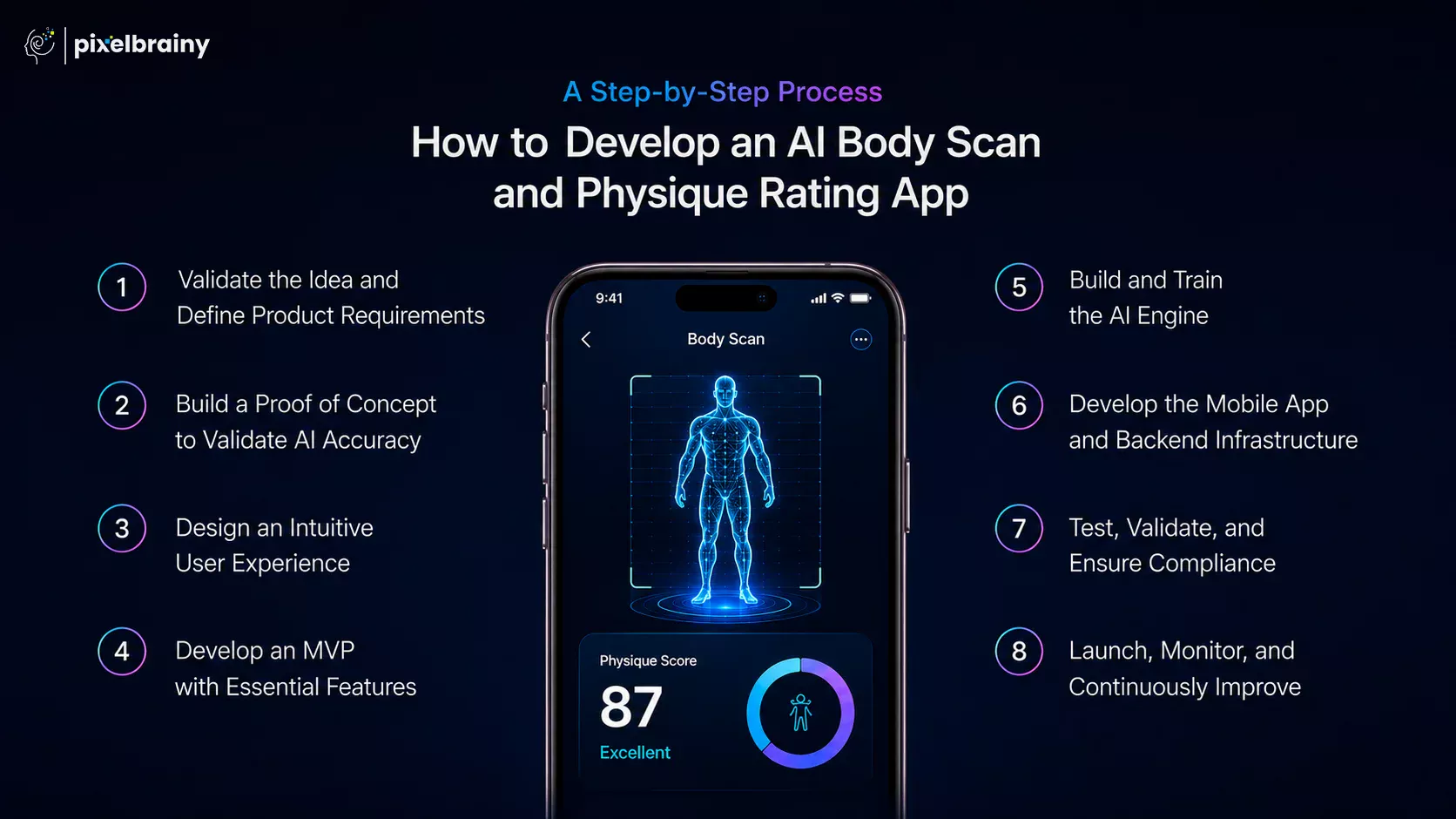
Every successful AI product begins with a clear understanding of the problem it aims to solve. Before writing a single line of code, define your target audience, business objectives, monetization strategy, and the specific value your application will deliver. Whether you want to build AI body scan and physique rating app solutions for fitness consumers, gyms, athletes, or healthcare providers, this initial planning stage lays the foundation for every future decision.
Next, conduct detailed market research to identify competitors, emerging trends, user expectations, and regulatory requirements. This helps determine the features your application should include in its first release while avoiding unnecessary development costs.
Working with an experienced AI consultation partner at this stage can help validate technical feasibility, estimate budgets, identify risks, and create a realistic product roadmap before moving into development.
Before committing to full scale development, create a Proof of Concept that validates your core AI capabilities. This stage focuses on confirming whether your computer vision models can accurately detect body landmarks, estimate measurements, and produce reliable body composition insights using smartphone images.
The objective is not to build a complete application but to verify that the technology performs consistently across different body types, lighting conditions, camera qualities, and user environments. Early validation significantly reduces future technical risks.
A structured PoC development process also provides valuable confidence for stakeholders and investors by demonstrating that the proposed AI solution can successfully achieve its intended outcomes.
An AI model is only as effective as the experience users have while interacting with it. Even highly accurate algorithms can produce unreliable results if users struggle to follow scanning instructions or capture poor quality images.
Design intuitive onboarding flows, guided scanning screens, progress dashboards, transformation reports, and personalized recommendation pages that simplify every step of the user journey. Clear visual guidance improves scan consistency and overall, AI accuracy.
Collaborating with a specialized UI/UX design company helps ensure the application delivers a seamless experience across smartphones while reducing user errors and increasing engagement.
After validating the concept, focus on building a Minimum Viable Product containing only the essential functionality required to solve the user's primary problem. This includes user registration, AI guided body scanning, body composition analysis, progress tracking, profile management, and personalized fitness recommendations.
Launching with a streamlined product enables businesses to collect real user feedback much earlier than attempting to build every advanced feature before release.
A well-planned MVP development strategy reduces initial investment, accelerates market entry, and provides valuable insights that guide future feature enhancements.
Also Read: Top AI MVP Development Companies in USA
The AI engine represents the core intelligence behind every body scan and physique rating app using AI. It is responsible for detecting body landmarks, estimating measurements, analyzing body composition, and generating personalized physique assessments.
To achieve reliable performance, train machine learning models using diverse datasets that include different body types, genders, ethnicities, age groups, fitness levels, clothing conditions, and smartphone cameras. High-quality training data directly influences prediction accuracy.
Continuous testing, retraining, and model optimization ensure the AI performs consistently across real world environments while minimizing bias and improving long term reliability.
Once the AI models are production ready, begin developing the mobile application and cloud infrastructure. The frontend should provide a fast, intuitive experience, while the backend securely manages user profiles, scan history, analytics, notifications, and cloud storage.
Reliable AI integration allows the application to process uploaded images, generate body composition reports, and deliver personalized recommendations with minimal delay.
The architecture should also be designed for scalability so it can support future features, enterprise customers, and increasing user traffic without compromising performance.
Before launch, thoroughly evaluate every aspect of the application. Test scan consistency across different smartphones, operating systems, camera qualities, lighting environments, and body types to ensure reliable performance under real world conditions.
In addition to functional and performance testing, complete security assessments, privacy audits, accessibility reviews, and AI bias evaluations. If the application serves healthcare or enterprise wellness markets, compliance with regulations such as HIPAA and GDPR becomes equally important.
Many experienced AI product development companies perform extensive AI validation to improve fairness, transparency, and model reliability before production deployment.
After successfully testing the application, publish it through app stores and deploy the backend infrastructure. Closely monitor user engagement, AI accuracy, crash reports, feature adoption, and customer feedback during the initial launch phase.
Product development does not end after deployment. Regular model retraining, feature updates, performance optimization, and security enhancements are essential for maintaining long term competitiveness.
Many businesses partner with top AI app development companies in USA to continuously improve their applications, expand AI capabilities, and scale infrastructure as their user base grows.
Following these structured steps to build AI body scan and physique rating app from idea to launch enables businesses to develop AI body scan and physique rating app solutions that are scalable, accurate, secure, and positioned for sustainable long-term success.
One of the first questions businesses ask before investing in AI body scan and physique rating app development is how much the project will cost. The answer depends on several variables, including the application's complexity, AI model sophistication, feature set, technology stack, third party integrations, compliance requirements, and the experience of the development team. Whether you plan to build AI body scan and physique rating app solutions for fitness consumers, gyms, enterprise wellness programs, or healthcare organizations, understanding the cost structure helps you allocate budgets effectively and avoid unexpected development expenses.
The overall investment for develop AI body scan and physique rating app projects typically ranges from $40,000 to over $250,000. A basic solution with essential body scanning capabilities requires a significantly lower budget than an enterprise platform powered by advanced AI models, cloud infrastructure, predictive analytics, and regulatory compliance.
Real Business Query: We are a growing fitness technology startup preparing to raise our Seed funding round. Investors want a realistic estimate of how much it will cost to create an AI body scan and physique rating app, what features are included at different budget levels, and how the investment scales as the platform grows. What should we expect before starting development?
The table below provides a general cost estimate based on the complexity of the product and the functionality included.
| App Type | Estimated Development Cost | Ideal For | Key Features Included |
|---|---|---|---|
| Basic AI Body Scan and Physique Rating App | $40,000 to $80,000 | Fitness startups, MVPs, independent trainers | User registration, AI guided body scan, body measurement estimation, basic body composition analysis, progress tracking, profile management, secure authentication, simple analytics dashboard. |
| Advanced AI Body Scan and Physique Rating App | $80,000 to $150,000 | Gym chains, fitness platforms, wellness businesses | Everything in the basic version plus personalized AI recommendations, trainer dashboard, wearable integration, subscription management, progress analytics, cloud infrastructure, enhanced reporting, multi platform support, stronger security. |
| Enterprise AI Body Scan and Physique Rating App | $150,000 to $250,000+ | Enterprise wellness providers, healthcare organizations, global fitness brands | Advanced AI models, enterprise analytics, HIPAA or GDPR compliance, API integrations, scalable cloud architecture, AI powered automation, role based access, enterprise security, multilingual support, predictive intelligence, ongoing AI model optimization. |
The final development cost depends on the business requirements, technical complexity, and long-term product vision. Below are the major factors that influence the overall investment.
The total cost of AI body scan and physique rating app development ultimately depends on your product vision, technical requirements, and scalability goals, making careful planning the most effective way to maximize your return on investment.

Also Read: AI App Development Cost: From MVPs to Full-Scale AI App
Building a high performing AI body scan application requires much more than selecting a programming language or mobile framework. The accuracy of body composition analysis, speed of image processing, security of user data, and scalability of the platform all depend on choosing the right technologies from the beginning. Every layer of the application, from the mobile interface and backend architecture to AI frameworks and cloud infrastructure, contributes to the overall performance and reliability of the solution.
For businesses investing in AI body scan and physique rating app development, selecting an appropriate technology stack is a strategic decision rather than a technical one. The right combination of tools enables developers to develop AI body scan and physique rating app solutions that deliver faster AI inference, seamless user experiences, secure data management, and scalable cloud deployment while reducing long term maintenance costs.
Real Business Query: We are building a multi-location fitness platform that expects more than one million users over the next three years. Which technologies, AI frameworks, cloud services, databases, and development tools should we choose to build a secure, scalable, and future ready AI body scan and physique rating app capable of supporting high user traffic and continuous AI model improvements?
The following technology stack is widely recommended for developing a modern body scan and physique rating app using AI that delivers high accuracy, enterprise grade security, and long-term scalability.
| Technology Layer | Recommended Tools & Technologies | Purpose |
|---|---|---|
| Mobile App Development | Flutter, React Native, Swift, Kotlin | Build high performance mobile applications for Android and iOS with responsive user interfaces and seamless user experiences. |
| Frontend Development | Flutter SDK, React Native, SwiftUI, Jetpack Compose | Create intuitive onboarding flows, body scan screens, dashboards, progress reports, and interactive fitness experiences. |
| Backend Development | Node.js, Python, NestJS, Django, FastAPI | Manage user authentication, APIs, AI processing requests, business logic, notifications, and cloud communication. |
| AI & Machine Learning Frameworks | TensorFlow, PyTorch, TensorFlow Lite, ONNX Runtime | Train, optimize, and deploy AI models for body landmark detection, body composition estimation, and physique analysis. |
| Computer Vision Libraries | OpenCV, MediaPipe, Detectron2, YOLO, OpenPose | Detect body landmarks, estimate human pose, segment body regions, and process images for accurate body measurements. |
| Cloud Platform | AWS, Microsoft Azure, Google Cloud Platform | Provide scalable infrastructure for AI inference, image storage, cloud computing, monitoring, and enterprise grade security. |
| Database | PostgreSQL, MongoDB, Firebase Firestore | Store user profiles, body scan history, analytics, subscriptions, and application data securely and efficiently. |
| Cloud Storage | Amazon S3, Google Cloud Storage, Azure Blob Storage | Securely store body scan images, transformation history, AI generated reports, and user generated content. |
| Authentication & Security | Firebase Authentication, Auth0, OAuth 2.0, JWT | Protect user accounts through secure login, multi factor authentication, encrypted sessions, and identity management. |
| AI Model Deployment | TensorFlow Serving, TorchServe, NVIDIA Triton Inference Server | Deploy AI models with high-performance inference while supporting scalable processing for thousands of simultaneous users. |
| API Development | REST API, GraphQL | Enable seamless communication between mobile applications, AI services, cloud infrastructure, wearable devices, and third-party platforms. |
| Analytics & Monitoring | Firebase Analytics, Google Analytics, Mixpanel, Datadog | Track user engagement, scan frequency, application performance, crash reports, and feature adoption for continuous improvement. |
| Push Notifications | Firebase Cloud Messaging, OneSignal | Send scan reminders, workout updates, personalized recommendations, and engagement notifications to users. |
| Payment Integration | Stripe, PayPal, Apple Pay, Google Pay | Support subscription plans, premium memberships, one-time purchases, and secure payment processing. |
| DevOps & CI/CD | Docker, Kubernetes, GitHub Actions, Jenkins | Automate testing, deployment, version control, infrastructure scaling, and continuous software delivery for faster releases. |
A well-chosen technology stack creates the technical foundation required to build an AI body scan and physique rating app that delivers reliable performance, intelligent body analysis, and long-term business scalability.
Before investing in AI body scan app development, it is important to study the platforms that have already shaped the market. Leading solutions use artificial intelligence, computer vision, wearable technology, and 3D body measurement in different ways to solve challenges across fitness, sports, healthcare, and retail. Analyzing these products helps businesses understand successful features, technology choices, monetization strategies, and product positioning before they build AI body scan app solutions of their own.
Consider this scenario. "I want to build an AI body scan app for the competitive CrossFit and functional fitness community where athletes care more about estimated lean mass, muscle group symmetry, and structural proportions than aesthetic physique ratings. Which existing platforms should I study before starting development?"
The answer is to learn from the strengths and limitations of today's market leaders. The following platforms provide valuable insights for businesses planning to develop AI body scan app solutions with differentiated features, stronger user experiences, and scalable AI capabilities in 2026.
Naked Labs introduced one of the earliest consumer focused body scanning ecosystems by combining a rotating smart scale, full length mirror, and depth sensing cameras to generate a detailed 3D body model. Users could monitor body fat estimates, body measurements, and visual transformations through a subscription-based platform designed for long term progress tracking.
Technology: 3D depth sensing, structured light scanning, computer vision, and cloud-based body visualization.
What Makes It Stand Out: Its greatest strength was transforming body composition tracking into an engaging visual experience rather than simply displaying numbers on a scale.
Where It Falls Short: Dependence on proprietary hardware increased costs and limited accessibility for mainstream smartphone users.
Founder Takeaway: Businesses researching how to develop AI body scan app like Naked Labs or Styku with advanced measurement features should focus on delivering comparable insights through smartphone-based AI to improve scalability and user adoption.
Styku is widely recognized across fitness centers, sports performance facilities, wellness clinics, and healthcare organizations for its professional body assessment capabilities. The platform captures hundreds of body measurements and detailed body composition reports using dedicated 3D scanning hardware.
Technology: Structured light scanning, depth sensing cameras, computer vision, and automated anthropometric measurement algorithms.
What Makes It Stand Out: Styku has earned strong credibility by delivering highly consistent body measurements suitable for professional fitness assessments and client progress tracking.
Where It Falls Short: Specialized scanning hardware increases deployment costs and limits accessibility outside commercial facilities.
Founder Takeaway: High measurement accuracy builds trust, but combining professional grade AI with smartphone accessibility creates a much larger addressable market.
Nike Fit demonstrates how artificial intelligence can simplify retail experiences through smartphone-based foot scanning. Instead of measuring the entire body, it captures foot dimensions and recommends the most suitable shoe size during the purchasing process.
Technology: Computer vision, machine learning, smartphone image analysis, and retail recommendation algorithms.
What Makes It Stand Out: The AI operates seamlessly within the shopping journey, making body measurement feel effortless instead of introducing an additional workflow.
Where It Falls Short: The technology is designed exclusively for footwear sizing and does not provide body composition or physique analysis.
Founder Takeaway: AI body scanning becomes significantly more valuable when integrated naturally into the user's existing experience rather than functioning as an isolated feature.
WHOOP approaches body composition differently by combining wearable sensor data, physiological metrics, recovery analysis, and health analytics instead of relying primarily on smartphone camera-based scanning. Its ecosystem emphasizes overall health optimization rather than appearance-based assessments.
Technology: Wearable sensors, biometric analytics, artificial intelligence, cloud computing, and predictive health algorithms.
What Makes It Stand Out: By combining sleep, recovery, heart rate, activity, and body composition insights, WHOOP delivers a comprehensive picture of personal health.
Where It Falls Short: Users must own compatible wearable hardware, increasing both adoption costs and dependency on proprietary devices.
Founder Takeaway: Integrating wearable data with AI body scanning can produce more meaningful and personalized health insights than relying on a single data source.
ZOZOFIT has emerged as one of the most innovative body measurement platforms by combining smartphone scanning with optional ZOZOSUIT technology. The platform provides 3D body measurements, body fat estimation, AI powered nutrition tracking, health app integration, and detailed visual progress reports for consumers pursuing long term body transformation.
Technology: Smartphone computer vision, artificial intelligence, 3D body reconstruction, cloud analytics, and optional fiducial marker suit technology.
What Makes It Stand Out: ZOZOFIT successfully combines body scanning, nutrition intelligence, progress visualization, and wellness tracking into a single consumer platform while supporting both app only and suit assisted scanning.
Where It Falls Short: Users seeking maximum measurement precision benefit from purchasing the proprietary ZOZOSUIT, introducing an additional hardware dependency for premium functionality.
Founder Takeaway: The next generation of AI body scan app development should focus on delivering a complete wellness ecosystem that combines body composition tracking, AI coaching, nutrition intelligence, and health analytics within a seamless smartphone experience.
The most successful AI body scan platforms are those that combine accurate body analysis with a clearly defined use case, intuit
When fitness companies, healthcare organizations, sports technology providers, and wellness startups invest in AI body scan app development, they often focus on features, user experience, and AI capabilities. However, the long-term success of the application depends just as much on overcoming technical, ethical, regulatory, and privacy related challenges. Factors such as AI accuracy, biometric data protection, fairness across diverse populations, and responsible body image communication directly influence user trust, regulatory compliance, and product adoption.
Consider this scenario. "I own a chain of premium fitness clubs across the United States, and before investing in AI body scanning technology, I need to understand whether smartphone camera-based body scan technology is accurate enough in 2026 to be credible for our members or whether sophisticated fitness consumers will dismiss it as a novelty. I also want to identify the biggest technical and compliance challenges before launching the product."
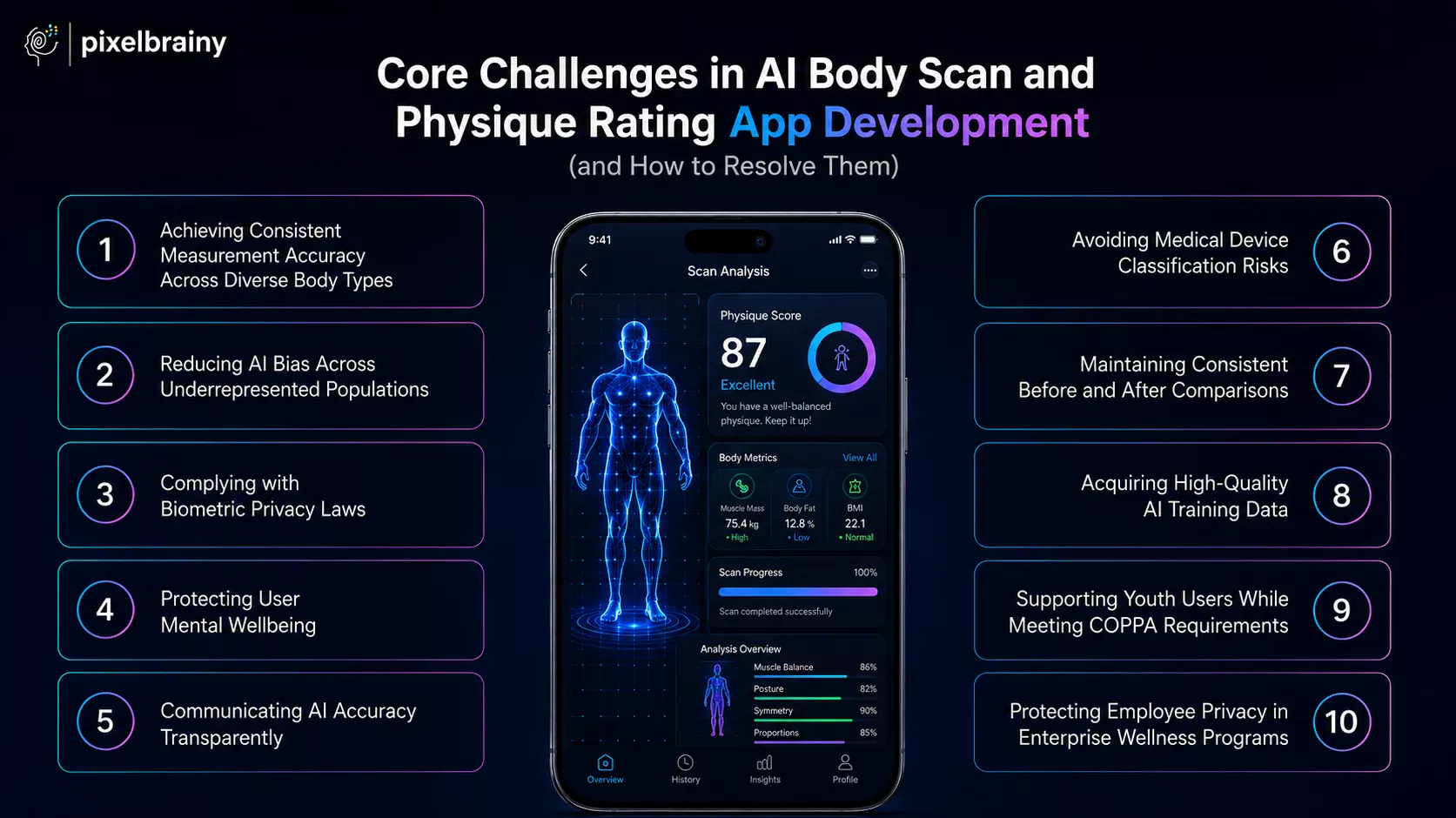
The following challenges represent the most important issues businesses should address before they build AI body scan app solutions for consumers, enterprises, or healthcare organizations.
| Challenge | How to Resolve It |
|---|---|
| Achieving Consistent Measurement Accuracy Across Diverse Body Types | AI performance can vary depending on skin tone, body size, clothing, lighting conditions, camera quality, and user posture. Improve reliability by training computer vision models on highly diverse datasets, implementing guided scan instructions, validating results across multiple demographic groups, and continuously retraining models using real world data collected with user consent. |
| Reducing AI Bias Across Underrepresented Populations | AI models often perform better for demographic groups that are overrepresented in training datasets. Reduce bias by collecting balanced datasets, conducting fairness testing, measuring model performance separately across demographic categories, and continuously monitoring AI outputs after deployment to ensure equitable performance. |
| Complying with Biometric Privacy Laws | Regulations such as the Illinois Biometric Information Privacy Act (BIPA) impose strict requirements for collecting, storing, and deleting biometric information. During AI body scan app development, implement explicit user consent, transparent privacy policies, encrypted biometric storage, defined retention schedules, and automated data deletion workflows before launch. |
| Protecting User Mental Wellbeing | A physique rating application can unintentionally encourage unhealthy body comparison or negative self-image. Design the platform to emphasize health improvement, progress tracking, strength, and wellness rather than appearance-based rankings. Use supportive language and avoid features that shame or publicly compare users. |
| Communicating AI Accuracy Transparently | Many businesses worry that explaining AI limitations will reduce customer confidence. Instead, clearly communicate that measurements are wellness estimates intended for fitness tracking rather than medical diagnosis. Transparency builds long term trust and sets realistic user expectations. |
| Avoiding Medical Device Classification Risks | Adding diagnostic claims may place the application under medical device regulations. Position body composition analysis as wellness information unless pursuing regulatory approval. Businesses exploring how to develop AI body scan app with HIPAA compliance and health data privacy features should work closely with legal and healthcare compliance experts throughout development. |
| Maintaining Consistent Before and After Comparisons | Changes in lighting, clothing, camera angle, and posture can reduce the accuracy of transformation tracking. When developing AI body scan app with before and after progress tracking and transformation journey features, include guided scan positioning, automated quality checks, pose correction, and standardized image capture workflows. |
| Acquiring High-Quality AI Training Data | Accurate body composition estimation depends on diverse and ethically sourced datasets representing different ages, body types, ethnicities, genders, and fitness levels. Combine licensed datasets, research partnerships, voluntary user participation, and synthetic data generation to improve AI performance while managing development costs. |
| Supporting Youth Users While Meeting COPPA Requirements | Applications targeting young athletes must protect children's privacy without compromising usability. Implement parental consent workflows, age-appropriate privacy controls, restricted social features, and simplified interfaces that comply with COPPA while remaining engaging for both parents and younger users. |
| Protecting Employee Privacy in Enterprise Wellness Programs | Enterprise customers often require population level wellness reporting without exposing individual employee information. Use end to end encryption, anonymized analytics, role-based access controls, and aggregated reporting so organizations receive valuable insights while personal health data remains completely private. |
Successfully addressing these challenges enables businesses to develop AI body scan applications that deliver reliable performance, responsible AI experiences, regulatory compliance, and lasting user trust.
Creating a successful AI body scan application requires much more than writing code or integrating an AI model. It demands expertise in computer vision, machine learning, cloud architecture, privacy regulations, mobile engineering, and user centered product design. At PixelBrainy, we combine these capabilities to deliver intelligent fitness solutions that balance AI accuracy, user trust, and regulatory compliance while supporting long term business growth.
As an experienced AI app development company, we work closely with startups, fitness brands, sports organizations, healthcare innovators, and enterprise wellness providers to transform ambitious ideas into scalable AI powered products. Every solution is designed around real business objectives, ensuring the technology delivers measurable value rather than simply adding artificial intelligence for its own sake.
Consider this scenario. "Our fitness technology startup wants to launch an AI powered body scan platform for consumers, but we need a development partner that understands computer vision, AI model optimization, data privacy, and mobile app engineering. We are looking for a team that can build an enterprise ready solution instead of just developing another fitness app."
That is exactly where PixelBrainy adds value.
One of our recent confidential engagements involved a rapidly growing digital fitness company preparing to launch an AI powered body transformation platform across North America.
The client wanted to replace traditional weight tracking with intelligent body composition analysis while providing members with personalized fitness insights and visual transformation reports. They also required a secure cloud platform capable of supporting hundreds of thousands of users without compromising performance or privacy.
Our team designed an AI body scan and physique rating app integrating AI powered computer vision, automated body landmark detection, secure cloud infrastructure, personalized recommendation engines, and trainer dashboards. The platform delivered consistent body measurement analysis, improved member engagement, streamlined remote coaching, and created a scalable foundation for future AI driven fitness services.
The result was a production ready application that successfully supported the client's digital transformation strategy while meeting high standards for security, scalability, and user experience.
Ready to turn your AI fitness idea into a scalable product? Connect with PixelBrainy today and let's build an intelligent body scan solution tailored to your business goals.
The future of digital fitness is being shaped by intelligent technologies that deliver personalized, data driven experiences, and AI body scanning is at the center of this transformation. As discussed throughout this guide, successful AI body scan and physique app development requires much more than integrating computer vision into a mobile application. It involves selecting the right product model, implementing essential and advanced features, choosing a scalable technology stack, ensuring AI accuracy, protecting user privacy, and meeting evolving regulatory requirements.
Businesses that carefully plan every stage of the development process of AI body scan and physique app are better positioned to launch reliable products that improve user engagement and create long term business value.
Whether you are planning to build AI body scan and physique app solutions for fitness, sports, healthcare, or enterprise wellness, investing in the right strategy and development partner can significantly accelerate your success in this rapidly growing market.
Ready to bring your AI body scan app idea to life? Book an appointment with the PixelBrainy team today and let's discuss how we can build a scalable, accurate, and future ready solution for your business.
Modern AI body scan and physique app development combines computer vision, machine learning, and pose estimation to estimate body measurements, body fat trends, posture, and physique changes using smartphone cameras. While these apps provide reliable insights for fitness progress tracking, they should complement rather than replace clinical tools such as DEXA scans or professional 3D body scanners.
The cost to build AI body scan and physique app platforms generally ranges between $40,000 and $250,000+, depending on the feature set, AI model complexity, cloud infrastructure, platform support, third party integrations, security requirements, and compliance standards. Enterprise solutions typically require a higher investment than MVP or consumer fitness applications.
The timeline to develop AI body scan and physique app solutions depends on project complexity. A basic MVP usually requires 3 to 5 months, an advanced fitness platform takes 6 to 9 months, while enterprise grade applications with custom AI models, integrations, and regulatory compliance may require 9 to 12 months or longer.
Yes. Businesses can create an AI body scan and physique app for various industries, including gym chains, sports performance centers, healthcare organizations, corporate wellness programs, and fitness startups. The application can be customized with trainer dashboards, athlete performance tracking, enterprise analytics, or personalized coaching features based on business objectives.
Successful AI body scan and physique app development typically uses technologies such as TensorFlow or PyTorch for machine learning, OpenCV or MediaPipe for computer vision, Flutter or React Native for mobile development, Node.js or Python for backend services, and AWS, Microsoft Azure, or Google Cloud for scalable AI processing and secure cloud infrastructure.
The biggest challenges in developing AI body scan and physique app platforms include maintaining consistent AI accuracy across diverse body types, reducing algorithm bias, protecting biometric data, complying with HIPAA, GDPR, and BIPA regulations, and ensuring reliable before and after progress tracking under different lighting and scanning conditions.
Yes. An AI body scan and physique app integrating AI can seamlessly integrate with wearable devices, Apple Health, Google Health Connect, fitness trackers, smartwatches, nutrition platforms, and gym management systems. Combining body scan insights with health and activity data creates a more personalized and comprehensive fitness experience.
When selecting a company for AI body scan and physique app development, evaluate their expertise in computer vision, machine learning, mobile app engineering, cloud architecture, biometric security, and regulatory compliance. Reviewing previous AI fitness or healthcare projects and their experience with scalable AI solutions can help ensure long term project success.

About The Author
Sagar Bhatnagar
Sagar Sahay Bhatnagar brings over a decade of IT industry experience to his role as Marketing Head at PixelBrainy. He's known for his knack in devising creative marketing strategies that boost brand visibility and market influence. Sagar's strategic thinking, coupled with his innovative vision and focus on results, sets him apart. His track record of successful campaigns proves his ability to utilize digital platforms effectively for impactful marketing efforts. With a genuine passion for both technology and marketing, Sagar continuously pushes PixelBrainy's marketing initiatives to greater success.

Working with the PixelBrainy team has been a highly positive experience. They understand the design requirements and create beautiful UX elements to meet the application needs. The dev team did an excellent job bringing my vision to life. We discussed usability and flow. Sagar worked with his team to design the database and begin coding. Working with Sagar was easy. He has the knowledge to create robust apps, including multi-language support, Google and Apple ID login options, Ad-enabled integrations, Stripe payment processing, and a Web Admin site for maintaining support data. I'm extremely satisfied with the services provided, the quality of the final product, and the professionalism of the entire process. I highly recommend them for Android and iOS Mobile Application Design and Development.

Great experience working with them. Had a lot of feedback and I found that unlike most contractors they were bugging me for updates instead of the other way around. They were extremely time conscience and great at communicating! All work was done extremely high quality and if not on time, early! They were always proactive when it comes to communication and the work is great/above par always. Very flexible and a great team to work with! Goes above and beyond to present us with multiple options and always provides quality. Amazing work per usual with Chitra. If you have UI/UX or branding design needs I recommend you go to them! Will likely work with them in the future as well, definitely recommended!

PixelBrainy is a joy to work with and is a great partner when thinking through branding, logo, and website layout. I appreciate that they spend time going into the "why" behind their decisions to help inform me and others about industry best practices and their expertise.

I hired them to design our software apps. Things I really like about them are excellent communication skills, they answer all project suggestions and collaborate right away, and their input on design and colors is amazing. This project was complex and needed patience and creativity. The team is amazing to do business with. I will be using them long-term. Glad to see there are some good people out there. I was afraid to try and outsource my project to someone but I am glad I met them! I really can't say enough. They went above and beyond on this project. I am very happy with everything they have done to make my business stand out from the competition.

It was great working with PixelBrainy and the team. They were very responsive and really owned the project. We'll definitely work with them again!

I recently worked with the PixelBrainy team on a project and I was blown away by their communication skills. They were prompt, clear, and articulate in all of our interactions. They listened and provided valuable feedback and suggestions to help make the project a success. They also kept me updated throughout the entire process, which made the experience stress-free and enjoyable.

PixelBrainy is very good at what it does. The team also presents themselves very professionally and takes care of their side of things very well. I could fully trust them taking up the design work in a timely and organised manner and their attention to detail saved us lots of effort and time. This particular project was quite intense and the team showed that they function very well under pressure. Very much looking forward to working with her again!

It's always an absolute pleasure working with them. They completed all of my requests quickly and followed every note I had for them to a T, which made our process go smoothly from start to finish. Everything was completed fast and following all of the guidelines. And I would recommend their services to anyone. If you need any design work done in the future, PixelBrainy should be your first call!

They took ownership of our requirements and designed and proposed multiple beautiful variants. The team is self-motivated, requires minimum supervision, committed to see-through designs with quality and delivering them on time. We would definitely love to work with PixelBrainy again when we have any requirements.

PixelBrainy was a big help with our SaaS application. We've been hard at work with a new UI/UX and they provided a lot of help with the designs. If you're looking for assistance with your website, software, or mobile application designs, PixelBrainy and the team is a great recommendation.

PixelBrainy designers are amazing. They are responsive, talented, and always willing to help craft the design until it matches your vision. I would recommend them and plan to continue them for my future projects and more!!!

They were awesome! Did a good job fast, and good communication. Will work with them again. Thank you

Creative, detail-oriented, and talented designers who take direction well and implement changes quickly and accurately. They consistently over-delivered for us.

PixelBrainy team is very talented and creative. Great designers and a pleasure to work with. PixelBrainy is an excellent communicator and I look forward to working with them again.

PixelBrainy has a very talented design team. Their work is excellent and they are very responsive. I enjoy working with them and hope to continue on all of our future projects.


Transform your ideas into reality with us.
Across these industries, each engagement brings unique challenges, from early-stage product development to scaling complex systems, helping us build a practical understanding of real-world product environments.