AI Summary Powered by PixelBrainy
Can an AI system make cannabis grading more consistent when human judgment changes from one trimmer to another?
For a cultivation facility producing 30 to 50 pounds of flower per harvest cycle, grading consistency can directly affect product positioning, wholesale relationships, pricing, and buyer confidence. When two experienced trimmers perform the assessment manually, their expertise remains valuable, but subjective differences can create inconsistent outcomes. If one grader is unavailable, the problem can become even more visible. This is where AI cannabis grading app development can provide a technology-driven solution.
A modern cannabis grading application can use computer vision and machine learning to analyze standardized images of flower and evaluate predefined visual characteristics. Depending on the grading model and available training data, these characteristics may include bud structure, density, color, trim quality, visible trichome coverage, foreign material indicators, and other measurable attributes. The objective is not to replace qualified professionals, but to create a repeatable assessment layer that supports human decision-making.
The business opportunity is also expanding. Grand View Research estimates that the global legal marijuana market will reach USD 40.7 billion in 2026 and projects it to reach USD 102.2 billion by 2030, representing a 25.4% CAGR from 2024 to 2030.
For operators considering cannabis grading app development with AI, the core challenge is building a system that produces consistent, explainable, auditable results rather than simply assigning an attractive score to a photograph. This guide explains how to build AI cannabis grading app development from scratch, including the technology, features, costs, compliance considerations, development stages, and challenges involved in creating a production-ready solution.
The goal is a practical step-by-step guide to building an AI cannabis grading app development solution that can help cultivation facilities standardize quality assessment and create a more reliable grading workflow.
An AI cannabis grading app is a software application that uses artificial intelligence, computer vision, machine learning, and image processing to evaluate the visible characteristics of cannabis flower and generate a standardized quality assessment. The primary purpose is to reduce inconsistencies that can occur when grading depends entirely on individual experience, personal judgment, lighting conditions, or the availability of skilled trimmers.
In a traditional grading workflow, an experienced employee examines a flower sample and assigns a grade based on an internal quality standard. With an AI-powered system, the same sample can be digitally analyzed against predefined criteria, creating a more repeatable and documented grading process.
Importantly, an AI cannabis grading app should be designed as a decision-support and quality-standardization system, rather than assuming that visual analysis alone can determine every aspect of cannabis quality. Laboratory characteristics such as cannabinoid potency, pesticides, microbial contamination, heavy metals, and residual solvents require appropriate testing and should not be inferred from an ordinary photograph.
A well-designed application typically follows a structured AI cannabis grading workflow:
Sample Selection → Image Capture → Image Quality Check → Computer Vision Analysis → Feature Detection → AI Scoring → Confidence Assessment → Human Review → Final Grade → Digital Record
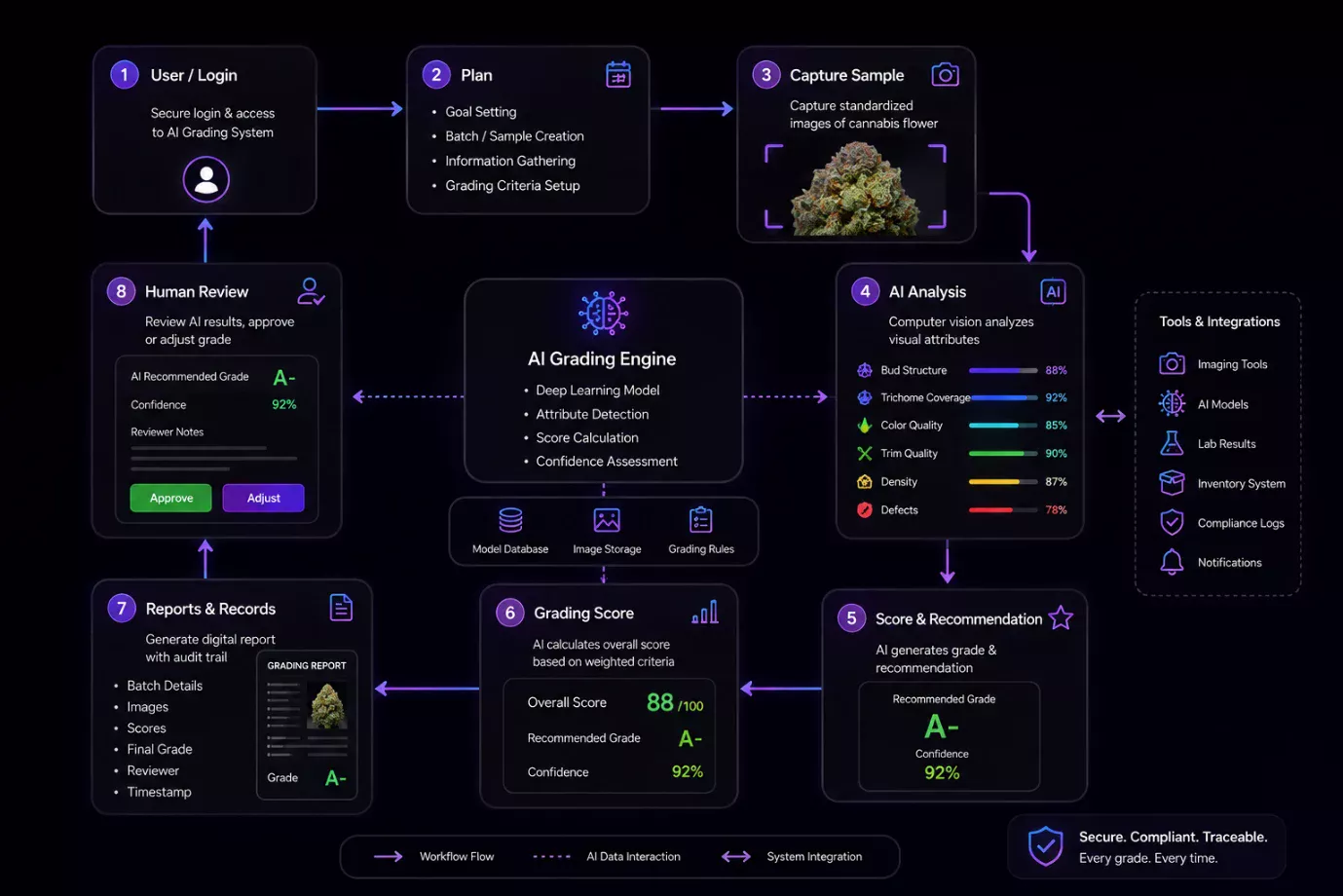
The process begins when a grader selects a representative flower sample from a batch.
The application can require the user to enter or scan information such as:
This connects the visual assessment to the correct production batch and creates traceability from the beginning.
The grader then captures one or multiple images through a smartphone camera or dedicated imaging station.
This step is more important than it may initially appear. AI models can produce inconsistent results when the same flower is photographed under significantly different conditions.
The application can therefore provide guided image capture, checking:
If the image does not meet the required standard, the app can ask the user to retake it before AI analysis begins.
Once an acceptable image is captured, the computer vision pipeline prepares it for analysis.
Image-processing techniques can normalize factors such as lighting and crop the relevant flower area. The system can also remove irrelevant background information and identify the region of interest.
This helps the AI focus on the characteristics that actually matter for the grading model.
The computer vision model then examines the flower and identifies predefined characteristics.
Depending on the grading methodology, the model may analyze attributes such as:
Different AI architectures can be used for different tasks. Image classification can categorize overall visual patterns, object detection can identify specific features, while image segmentation can isolate particular areas of the flower for more detailed analysis.
Instead of jumping directly from an image to "Grade A" or "Grade B," a more transparent system can evaluate multiple attributes independently.
| Visual Attribute | Example Score |
|---|---|
| Bud structure | 88/100 |
| Trim quality | 92/100 |
| Appearance | 86/100 |
| Visible trichome characteristics | 90/100 |
| Color consistency | 84/100 |
These numbers are illustrative. The actual scoring system should be created from the organization's grading standards and validated against expert assessments.
The application combines the individual attribute results according to predefined business rules or a trained scoring model.
For example:
Attribute analysis → Weighted scoring → Overall score → Recommended grade
The result might look like:
Overall AI Score: 89/100
Recommended Grade: A
AI Confidence: 94%
This provides significantly more information than simply displaying a grade.
A sophisticated AI cannabis grading app should understand when it is not sufficiently confident.
For example, if the image quality is poor or the sample differs substantially from the data used to train the model, the application can flag it:
AI assessment requires manual review.
This human-in-the-loop approach is particularly valuable for commercial operations because it prevents users from treating every AI prediction as an unquestionable result.
The qualified grader reviews:
The reviewer can approve, reject, or override the AI recommendation and provide a reason for the decision.
This also creates valuable feedback data that can potentially be used to improve future model versions.
After approval, the application stores the final assessment against the relevant batch.
A complete record can include:
This creates a digital audit trail and makes historical batch comparisons possible.
The workflow does not necessarily end after the grade is recorded.
As more samples are evaluated, the organization can build a larger dataset of images + expert assessments + final grades. This data can be used to evaluate model performance and, where appropriate, retrain or refine future versions of the AI system.
Research published in 2026 illustrates the growing technical capability of computer vision in cannabis analysis. One study developed a smartphone-based macro-imaging pipeline using deep-learning models to detect and classify cannabis trichomes, using more than 14,000 images and reporting high classification performance for its specific research task. This demonstrates the potential of computer vision for specialized cannabis-image analysis, although research performance should not be interpreted as proof that a commercial grading system will achieve the same results in every production environment.
The easiest way to understand the complete process is:
The user photographs the flower → the app verifies the image → computer vision identifies relevant visual characteristics → AI evaluates those characteristics → the grading engine calculates a score → confidence rules identify uncertain cases → a qualified person validates the result → the application stores the final grade and supporting data.
This approach makes cannabis grading app development with AI more than an image-recognition project. It becomes a complete quality-assessment workflow that combines computer vision, machine learning, standardized grading rules, human expertise, data analytics, and traceable digital records.
For businesses asking how to build an AI cannabis grading app from scratch, this workflow provides the foundation for developing a system that can reduce grader-to-grader variation while keeping qualified professionals involved in final quality decisions.
What happens when the quality grade assigned to a cannabis batch depends on which employee performs the inspection?
For a cultivation facility producing 30 to 50 pounds of flower per harvest cycle, inconsistent grading can become a measurable business problem. Two experienced trimmers may follow the same general quality standard yet interpret flower appearance differently. When one grader is absent, the remaining team may assign different scores, creating variation between batches that carry the same grade. If wholesale buyers begin questioning that consistency, the business faces a larger issue involving product positioning, internal quality control, and buyer trust.
This is a key reason cannabis operators are exploring AI cannabis grading app development. The investment is primarily driven by the need to establish a repeatable grading methodology that can operate consistently across employees, shifts, harvest cycles, and eventually multiple facilities.
According to Grand View Research's 2026 market update, the global legal cannabis market is estimated to reach USD 89.0 billion in 2026 and is projected to reach USD 216.8 billion by 2033, representing a 13.5% CAGR from 2025 to 2033.
As commercial cannabis operations expand within this market, cultivation businesses are evaluating technology based on specific operational requirements rather than adopting AI simply for automation. Cannabis grading app development with AI becomes particularly relevant when manual inspection creates variation, consumes experienced labor, or makes quality standards difficult to reproduce.
A manual grading process can work effectively when a small team handles a limited number of samples. Production growth changes the workload.
A facility moving from 30 pounds to 50 pounds per harvest, for example, may need more samples inspected, more grading decisions recorded, and more employees involved in quality assessment.
Hiring additional graders can increase capacity, but it can also introduce another challenge: different people may interpret the same grading criteria differently.
AI provides an opportunity to create a common assessment framework that can be applied regardless of who performs the initial inspection.
When only one or two employees have extensive grading experience, their knowledge becomes critical to daily operations.
If one person is absent, the facility may experience:
Companies investing in how to build an AI cannabis grading app are therefore looking at AI as a way to formalize parts of their existing grading methodology.
The objective is not to remove experienced graders from the process. Their expertise can instead become part of the training, validation, and oversight framework used to develop the AI system.
A wholesale buyer purchasing Grade A flower reasonably expects future Grade A batches to meet a comparable internal standard.
If two batches carry the same grade but show significant differences in appearance or quality characteristics, buyers may question the reliability of the producer's grading process.
This creates a strong reason to invest in a system that can document why a particular sample received a particular grade.
An AI-powered application can maintain records showing the analyzed images, individual visual attributes, AI-generated scores, reviewer decisions, and final grade.
A grading approach learned inside one facility may not automatically transfer to another location.
Multi-site cannabis operators can have different:
A centralized AI cannabis grading app development strategy can establish one digital grading framework while allowing authorized teams to work from the same criteria.
This becomes increasingly relevant for cannabis companies planning geographic expansion or acquisition of additional cultivation facilities.
Harvest periods can create concentrated workloads.
When employees must manually inspect, compare, grade, document, and communicate the status of numerous samples, quality assessment can become a bottleneck.
An AI system can perform the initial visual analysis quickly and route uncertain samples to qualified reviewers.
This creates a workflow such as:
Sample → Image Capture → AI Analysis → Quality Attributes → Recommended Grade → Human Review
The important investment consideration is not simply speed. The system needs to maintain a consistent methodology while processing the workload.
Cannabis operators already use software for cultivation management, inventory, laboratory results, compliance tracking, sales, and business operations.
Visual grading can become another structured data source within this ecosystem.
Instead of storing only a final grade, an application can record the complete assessment:
Batch ID + Sample Image + Visual Attributes + AI Score + Confidence + Reviewer Decision + Final Grade
Once collected across multiple harvest cycles, this information can support deeper analysis of grading patterns and operational consistency.
The technology required to create cannabis grading app using computer vision has advanced significantly.
Modern computer vision systems can perform tasks such as image classification, object detection, segmentation, feature extraction, and visual similarity analysis.
Cannabis-specific research is also investigating computer vision for specialized visual-analysis tasks. For example, a 2026 study explored smartphone-based macro imaging and deep-learning models for cannabis trichome detection and classification.
However, a research model should not automatically be treated as a production-ready grading system. Commercial deployment requires a dataset that represents the company's actual products, standardized image capture, expert labeling, model validation, and ongoing performance monitoring.
A major investment driver is the ability to convert a subjective assessment into structured measurements.
Instead of relying entirely on:
"This sample looks like Grade A."
the application can evaluate predefined visual criteria and produce an assessment such as:
Overall visual score: 89/100
Trim quality: 92/100
Structure: 87/100
Appearance: 90/100
AI confidence: 94%
The figures are examples rather than universal cannabis grading standards. Each business needs its own validated criteria and scoring methodology.
Cannabis businesses operate within regulated environments where documentation and traceability can be important.
An AI grading platform can be designed to maintain records of:
This makes compliance and auditability an important consideration when businesses develop compliant and regulatory-based AI cannabis grading app development solutions.
The AI grade itself should not be confused with laboratory testing or regulatory certification. Visual computer vision cannot independently establish characteristics that require laboratory analysis.
The opportunity extends beyond individual cultivation facilities.
A well-designed AI grading platform could potentially serve:
This creates potential for configurable grading standards, facility-specific models, centralized dashboards, APIs, and subscription-based software models.
For technology founders, the opportunity is particularly interesting because the application combines computer vision, AI, SaaS infrastructure, quality management, analytics, and industry-specific workflows.
The strongest business case for AI cannabis grading app development comes from a specific operational equation:
Higher production volume + limited expert graders + inconsistent manual assessments + buyer expectations + need for documented quality standards = demand for standardized AI-assisted grading.
For the cultivation facility described earlier, the technology addresses a clearly defined problem: maintaining the same grading standard when the people performing the assessment change.
That makes the development process much more focused. Rather than building an application that simply identifies cannabis flowers in photographs, the objective becomes developing a validated visual assessment system that applies the company's grading criteria consistently and sends uncertain cases to qualified human reviewers.
That distinction is important because successful cannabis grading app development with AI should be built around a measurable business problem, a validated grading methodology, and reliable data, with AI serving as the technology that supports that methodology.
For a cultivation business processing 30 to 50 pounds of flower per harvest, the real challenge is not simply grading more cannabis. It is maintaining the same grading standard across every batch, employee, shift, and buyer interaction. If grading depends heavily on two experienced trimmers, their absence can immediately create inconsistencies in quality scores and product classification.
A business owner in this situation may ask, “How can we maintain consistent cannabis grades across every harvest without depending entirely on individual grader judgment?” This is where the benefits of building an AI cannabis grading app become particularly valuable.
A properly developed AI cannabis grading app for cultivators can standardize visual assessment, accelerate grading at harvest scale, support remote product evaluation, create documented evidence for pricing discussions, automate quality records, and reveal supplier quality trends over time. For dispensaries, cultivators, processors, and wholesale businesses, AI cannabis grading app development can therefore become an important component of a broader quality management strategy.
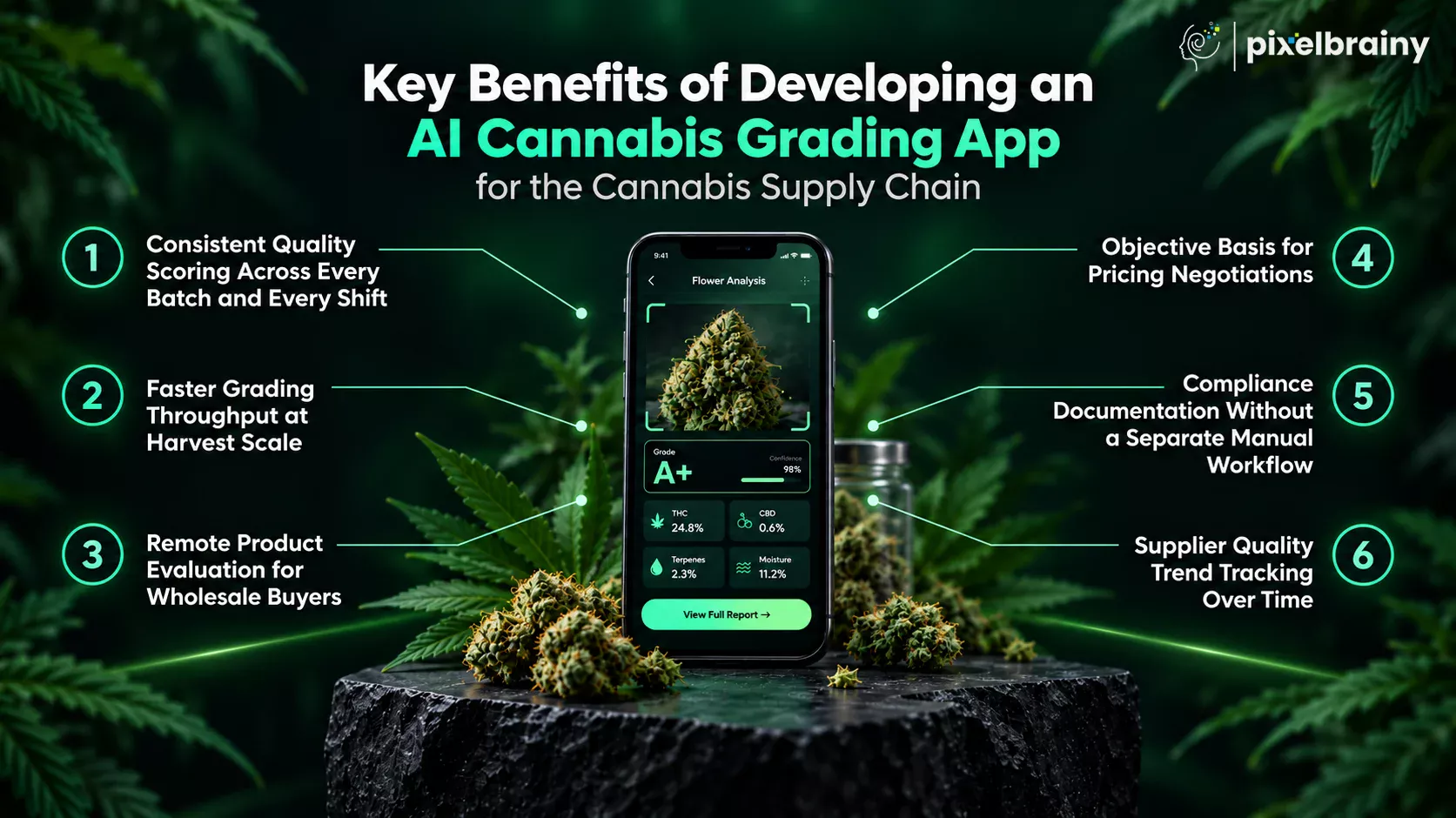
Consistency is one of the most valuable outcomes of developing an AI cannabis grading app. Manual grading can vary because employees have different levels of experience, personal interpretations, attention levels, and working conditions. An AI system can apply the same predefined visual criteria to every image and produce scores using the same underlying methodology.
For an AI cannabis grading app for cultivators, this means samples can be evaluated using a standardized framework regardless of which employee performs the initial inspection. Managers can compare AI-generated scores with final human-approved grades to identify areas of disagreement and improve their grading standards. Instead of allowing quality classification to change with each shift, the business can establish a repeatable digital grading process that supports greater consistency across harvest cycles.
Harvest periods can create a significant inspection workload. Employees may need to examine samples, compare flower against reference standards, assign grades, record observations, and communicate results to managers or sales teams. When production volume increases, this manual process can become a bottleneck.
An AI-powered grading application can perform the initial visual assessment immediately after standardized images are captured. The system can analyze relevant visual characteristics, calculate preliminary scores, and identify samples that require human review. This allows experienced quality personnel to concentrate on exceptions and final decisions rather than spending the same amount of time manually evaluating every sample. For cultivators increasing production volume, this makes AI cannabis grading app development a practical way to support higher grading throughput without simply adding more manual inspection work.
Wholesale buyers often need reliable product information before committing to a purchase, particularly when suppliers and buyers operate in different locations. A digital grading platform can provide authorized buyers with standardized assessment information, including product images, visual scores, grade classifications, and relevant batch details.
An AI cannabis grading app for dispensaries and wholesale operations can make these records available through a controlled buyer portal, where permitted by applicable regulations and business policies. Instead of depending entirely on descriptions such as "premium flower" or "top-shelf quality," buyers can review structured information generated through the supplier's established grading methodology. Remote evaluation can reduce uncertainty during purchasing discussions and provide buyers with a consistent reference when comparing products from multiple suppliers.
Cannabis grades can influence how products are positioned within wholesale markets. When a grade is based entirely on human opinion, disagreements between buyers and sellers can arise over whether a batch belongs in a particular quality or pricing category.
An AI-assisted grading system can provide an additional documented reference based on predefined visual criteria. For example, a grading report could show individual attribute scores, sample images, the AI's recommended classification, confidence level, and the final grade approved by a qualified reviewer.
The AI score should not automatically determine the selling price. Instead, it provides evidence that can support commercial discussions. This makes cannabis quality inspection AI app development particularly relevant for businesses where quality classification frequently influences wholesale pricing and negotiations.
Quality documentation can become an administrative burden when employees have to record inspection information separately from the actual grading process. A properly designed application can capture relevant information automatically as part of the assessment workflow.
For example, the system can associate the grading record with the batch ID, sample image, assessment date, user, AI model version, individual scores, reviewer decision, and final grade. For businesses looking to develop an AI cannabis inspection app with compliance reporting, these capabilities can provide a structured foundation for traceability and audit preparation.
The application itself does not guarantee regulatory compliance. Requirements vary by jurisdiction, so the system must be designed around the specific cannabis regulations, electronic-record requirements, access controls, retention rules, and reporting obligations applicable to the business.
A single grading result shows the quality assessment of one sample. A connected AI grading platform can reveal patterns across hundreds or thousands of assessments.
Business owners can use historical grading data to compare suppliers, cultivars, harvest cycles, facilities, and product categories. For example, a cultivator might discover that a particular supplier consistently receives lower visual-quality scores across several deliveries. A distributor could identify suppliers whose batches show the greatest consistency from one shipment to another.
This makes development AI cannabis grading app solutions valuable beyond individual inspections. The application becomes a source of structured quality intelligence that can support supplier evaluation, purchasing decisions, production reviews, and long-term quality planning. Over time, these trends can help management determine where quality variation originates and which parts of the supply chain require closer attention.
In short, the value of AI grading extends beyond assigning a score. It gives cannabis businesses a standardized quality workflow that can support consistency, faster operations, stronger buyer communication, documented decisions, and data-driven supply chain management.

What features are essential when building an AI cannabis grading app for a real cultivation or cannabis quality operation? The answer should focus on the features that support the complete day-to-day grading workflow, from creating a batch and capturing a sample to generating an AI assessment, obtaining human approval, and maintaining a traceable record.
For a cultivation facility processing 30 to 50 pounds of flower per harvest, the application must be simple enough for graders to use during busy harvest periods while providing managers with reliable, structured quality information. A practical AI cannabis grading app development project should therefore prioritize core functionality such as standardized image capture, computer vision analysis, grading rules, user permissions, batch tracking, review workflows, and reporting.
If a business owner is asking, “What features should an AI cannabis grading app have to make grading consistent across every batch and shift?”, these 15 core features provide the foundation. Advanced AI capabilities can be added later after the fundamental grading workflow has been validated.
| Feature | Explanation |
|---|---|
| User Registration and Secure Login | Provides authorized access to the application for graders, quality managers, supervisors, and administrators. Secure authentication protects business and grading data while ensuring that every assessment can be associated with the correct user. |
| Role-Based Access Control | Allows administrators to assign permissions according to job responsibilities. Graders can perform assessments, managers can approve results, and administrators can manage users and settings without giving every employee unrestricted access. |
| Batch Management | Allows cultivation teams to create and organize batches using information such as batch ID, cultivar, harvest date, facility, quantity, and other relevant production details. Every grading assessment can then remain connected to its correct batch. |
| Sample Management | Enables users to create individual sample records from specific batches. Each sample can contain photographs, grading results, notes, reviewer information, and final status, creating an organized digital record for every inspected sample. |
| Guided Image Capture | Helps graders capture standardized flower images by providing instructions for camera positioning, framing, distance, and sample placement. Consistent image capture is important because variations in photography can influence computer vision analysis. |
| Image Quality Validation | Checks whether an image is suitable for AI analysis before processing begins. The application can identify issues such as blur, poor lighting, incorrect framing, or insufficient resolution and prompt the user to capture another image. |
| Computer Vision Analysis | Uses AI and computer vision to examine standardized cannabis images according to the defined grading methodology. Depending on the system, models can analyze characteristics such as appearance, structure, color, trim quality, and other visible attributes. |
| Attribute-Level Scoring | Evaluates individual visual characteristics separately instead of producing only one overall grade. This allows users to understand how different attributes contributed to the assessment and makes the grading process easier to review and compare. |
| AI Grade Recommendation | Processes the analyzed attributes and applies the configured grading methodology to generate a recommended score or grade. The recommendation provides a consistent starting point for qualified reviewers before the final grading decision is made. |
| Human Review and Approval | Gives qualified graders or quality managers the ability to review AI-generated results before finalizing them. Users can approve the recommendation, make an authorized adjustment, and document the reason for the final decision. |
| Grading Rules Configuration | Allows authorized administrators to define grading categories, scoring ranges, evaluation criteria, and attribute weights according to the company's established quality standards. This makes the application adaptable to different internal grading methodologies. |
| Grading History | Stores previous grading assessments so authorized users can review historical samples, batches, scores, images, reviewer decisions, and final grades. This creates a searchable record for investigating variations between harvests and production periods. |
| Quality Dashboard | Gives managers a centralized view of grading activity, including completed assessments, pending reviews, grade distribution, sample scores, and batch-level information. The dashboard helps management monitor the core grading workflow from one location. |
| Reports and Data Export | Converts grading information into structured reports containing relevant sample, batch, score, image, and approval information. Authorized users can export appropriate data for internal quality reviews, business analysis, buyer discussions, or permitted documentation requirements. |
| Audit Trail | Records important actions performed within the application, including assessment timestamps, user activity, AI recommendations, grading changes, reviewer approvals, and final decisions. This creates a traceable history of how each grading record was produced and modified. |
These 15 features establish the core foundation for developing an AI cannabis grading app that can standardize visual inspection, organize grading operations, and maintain reliable records without introducing advanced functionality prematurely.
Once the core grading workflow is established, businesses can introduce advanced capabilities that make an AI cannabis grading app more intelligent, adaptive, and useful for large-scale operations. These features go beyond basic image capture, AI scoring, batch management, and reporting. Their purpose is to help the application understand uncertainty, identify unusual samples, learn from verified assessments, and provide deeper quality intelligence.
For a cultivation company asking, “What advanced features can make our AI cannabis grading app more reliable as production and the number of grading samples increase?”, the answer lies in building capabilities around AI confidence, continuous learning, predictive analytics, and deeper image intelligence.
These non-ordinary features should generally be introduced after the fundamental grading model has demonstrated reliable performance. They can be particularly valuable for AI cannabis grading app for cultivators, multi-facility operators, cannabis technology platforms, and businesses planning to scale their cannabis quality inspection AI app development strategy.
| Advanced Feature | Explanation |
|---|---|
| AI Confidence & Uncertainty Scoring | Shows how confident the AI model is in each assessment instead of presenting every prediction as equally reliable. Low-confidence samples can automatically be routed to qualified reviewers for additional inspection and validation. |
| Human-AI Disagreement Detection | Identifies situations where the AI recommendation differs significantly from the final human-approved grade. Managers can review these cases to discover model weaknesses, unclear grading criteria, or recurring differences in human interpretation. |
| Automated Anomaly Detection | Identifies samples that appear significantly different from the expected visual characteristics of their batch or historical reference data. This can help quality teams investigate unusual samples before final classification. |
| Continuous AI Learning System | Uses verified human assessments and newly collected images as potential future training data. A controlled learning pipeline can help improve model performance as the application accumulates more representative samples from real production environments. |
| AI Model Drift Monitoring | Tracks whether model performance changes over time as cultivars, imaging conditions, production practices, or product characteristics change. The system can alert administrators when model validation or retraining may be necessary. |
| Multi-Angle Flower Analysis | Allows the AI to analyze several images of the same sample from different angles. Combining multiple visual perspectives can provide a more complete representation of characteristics that may not be visible from a single photograph. |
| Visual Reference Matching | Compares a new sample with previously approved reference samples using visual similarity techniques. Graders can use these comparisons to understand how closely a sample resembles established internal quality examples. |
| AI Grader Calibration & Training | Creates interactive training exercises where employees evaluate reference samples and compare their assessments with established grades. This can help organizations identify grading variation and improve employee alignment with internal standards. |
| Predictive Quality Analytics | Uses historical grading data to identify relationships and trends across batches, cultivars, suppliers, facilities, and production periods. These insights can help management investigate recurring quality patterns and support data-informed operational decisions. |
| Natural Language AI Quality Assistant | Provides a conversational interface that allows authorized users to ask questions about grading records, batch trends, and assessment data using natural language. The assistant can summarize relevant information without requiring users to manually search multiple reports. |
These capabilities can turn an AI cannabis grading app development project from a basic image-based grading tool into a broader intelligent quality platform. However, advanced functionality should be introduced according to the quality of available data, model validation results, operational requirements, and applicable regulatory considerations.
The strongest approach is to establish reliable core grading first, then add advanced intelligence where it solves a measurable business problem.
After you finalized the features, now it’s time to turn the AI cannabis grading app concept into a functional product. The development process should begin with the grading problem and business workflow, then move through data preparation, computer vision, AI model development, application development, testing, compliance validation, and launch.
For a cultivation business asking, “How can we build an AI grading system that learns our existing quality standards instead of forcing our graders to change their entire workflow?”, the answer is a structured development approach. The right process ensures that the AI model is trained on relevant examples, the application fits real harvest operations, and every grading decision can be reviewed and traced.
The following eight steps to build an AI cannabis grading app from idea to launch provide a practical roadmap for cannabis businesses planning cannabis grading app development using computer vision.
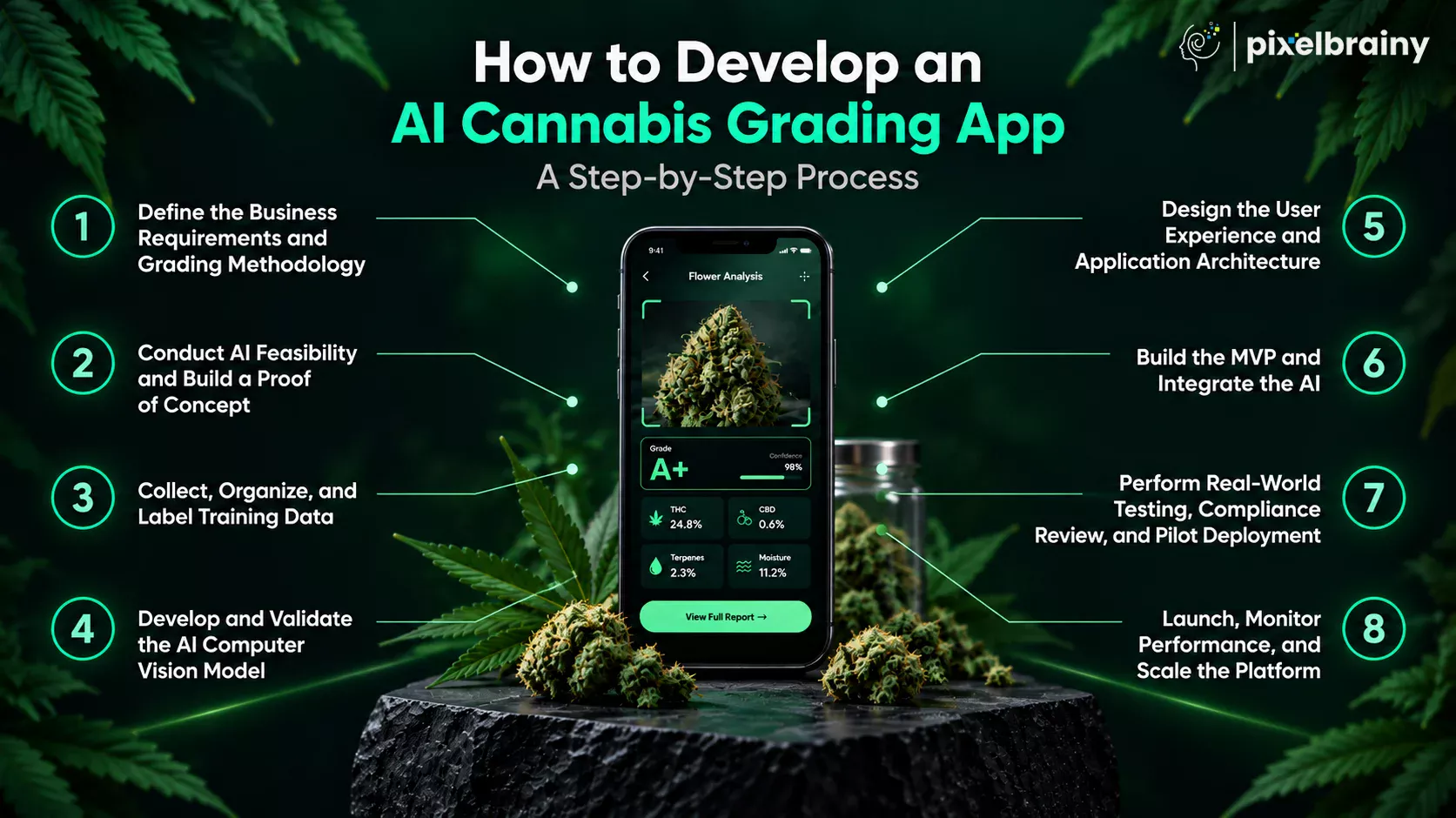
The first stage of building an AI cannabis grading app is defining exactly what the application needs to accomplish. Start by documenting the existing manual grading process, including how graders classify flower, which characteristics they inspect, how disagreements are resolved, and what makes one sample receive a higher grade than another.
At this stage, the development team should work with cultivators and quality specialists to convert subjective observations into clearly defined criteria. Determine whether the AI will evaluate appearance, structure, trim quality, color, visible trichome characteristics, or other visual attributes. Also establish the target users, batch workflow, reporting requirements, and jurisdictions where the application will operate. This foundation prevents the development team from building an AI model without a clear definition of the problem.
Before committing to full-scale development, evaluate whether computer vision can reliably address the selected grading criteria. An AI consultation can help determine which characteristics are visually detectable, what type of data is required, and where AI should remain a decision-support tool rather than an automated decision-maker.
The next objective is PoC development, where a limited dataset and preliminary computer vision model are used to test technical feasibility. The PoC should answer practical questions such as whether images contain enough information for the selected grading criteria, how consistent the imaging environment needs to be, and whether the model can distinguish between predefined categories. A successful PoC provides evidence for proceeding toward production development and helps identify technical limitations early.
AI performance depends heavily on the quality and diversity of training data. For an AI cannabis grading app, collect representative images from the actual production environment rather than relying exclusively on generic internet images or unrelated datasets.
Each image should be associated with reliable labels created through qualified expert assessment. Depending on the model, labels may include overall grades, individual attribute scores, detected features, sample metadata, and reviewer consensus. Data should cover legitimate variation across cultivars, batches, lighting conditions, flower structures, and quality categories.
The dataset should then be divided into training, validation, and testing groups. Careful dataset design is essential because a model that performs well on familiar images may perform poorly on new batches. Data governance should also establish ownership, access controls, storage practices, and procedures for adding future verified samples.
Once sufficient training data is available, the team can begin AI model development. The appropriate approach depends on the grading task. Image classification can categorize samples, object detection can locate specific visual characteristics, and segmentation can isolate areas of interest within a flower image.
The model should be trained using the organization's validated grading criteria and then evaluated using data that was not used during training. Performance should be measured with appropriate metrics such as precision, recall, F1 score, classification accuracy, or prediction error.
This stage is central to cannabis grading app development using computer vision because the application should not simply generate a score. It needs to demonstrate that its predictions are sufficiently reliable for the intended workflow and clearly identify situations where human review is required.
Also Read: Top 12+ AI Model Development Companies in the USA
After establishing AI feasibility, design the application around the actual workflow of graders and quality managers. A specialized UI/UX design company can help create interfaces that make sample capture, image review, AI assessment, approval, and reporting straightforward during busy harvest periods.
The application architecture should connect the mobile or web interface with the backend, database, image-storage system, AI inference service, authentication layer, and reporting engine. At this stage, the team should also define APIs and integration requirements for relevant business systems.
The objective is to ensure that AI operates as part of a complete grading workflow rather than functioning as an isolated image-analysis tool. Every screen should have a clear operational purpose, from capturing a sample to finalizing its grade.
The next stage is MVP development, where the essential workflow is converted into a working application. The MVP should generally include the core features required for real-world testing, such as secure login, batch management, sample creation, standardized image capture, AI analysis, grade recommendation, human review, reporting, and audit records.
During AI integration, the computer vision model is connected to the application so images can be securely transmitted for analysis and results can be returned to the appropriate sample record. The system should also manage model versions, confidence information, processing errors, and failed image submissions.
Keeping the initial product focused allows the business to test the actual grading workflow before investing in extensive advanced functionality.
A laboratory-style AI test is not enough. The application needs to be evaluated using real samples and actual operating conditions. Run the AI alongside the existing manual grading process and compare AI recommendations with expert assessments.
Measure factors such as grader-AI agreement, processing time, inconsistent classifications, false positives, false negatives, and samples requiring manual intervention. Conduct testing across different batches and legitimate production variations.
At the same time, review security, access controls, data retention, audit trails, integrations, and applicable cannabis regulations. Businesses can work with experienced AI computer vision software development companies and compliance specialists to identify gaps before production deployment.
A controlled pilot allows the business to validate whether the application actually solves its grading-consistency problem before full rollout.
After successful pilot validation, deploy the application to the intended users and facilities. Launch should include user training, operational documentation, support procedures, and monitoring of application and AI performance.
The development team should track model performance after deployment rather than assuming that initial validation will remain representative forever. New verified assessments can be reviewed for potential model improvement, while unusual results and human-AI disagreements can be investigated.
As AI adoption increases, the platform can expand to additional facilities, users, cultivars, grading categories, and business integrations. Experienced top app AI development companies can support this transition by combining infrastructure scaling with controlled AI updates.
For organizations moving beyond the initial product, AI product development companies can help evolve the platform into a broader quality-management solution while maintaining the validated grading methodology at its core.
Business requirements → AI feasibility → Training data → AI model development → Application architecture → MVP development → Real-world validation → Launch and scaling
Following these steps gives cannabis businesses a structured path to develop an AI cannabis grading app that is based on real grading requirements, validated data, computer vision, human expertise, and measurable operational outcomes.
The cost to develop an AI cannabis grading app typically ranges from $50,000 to $350,000+, depending on the application's AI complexity, computer vision requirements, number of features, training data, integrations, compliance scope, and deployment requirements. A basic application with image capture and AI-assisted grading can fall near the lower end, while an enterprise platform supporting multiple cultivation facilities, sophisticated computer vision models, analytics, integrations, and regulatory workflows can exceed $350,000.
For a cultivation business producing 30 to 50 pounds per harvest, a practical question is, “What development budget should we plan if we want an AI grading system that can consistently evaluate our flower without building an unnecessarily expensive enterprise platform?” The answer depends on how much of the grading process needs to be automated and whether the business requires a custom AI model or can begin with a focused proof of concept.
The AI cannabis grading app development cost should therefore be estimated feature by feature rather than using a single fixed price. A proper cost estimation of an AI cannabis grading app considers both initial development and ongoing expenses such as cloud infrastructure, AI model maintenance, image storage, security, and technical support.
| AI Cannabis Grading App Type | Estimated Development Cost | Suitable For | Typical Scope |
|---|---|---|---|
| Basic AI Cannabis Grading App | $50,000 to $100,000 | Small and mid-size cultivators testing AI grading | User login, batch management, image capture, basic computer vision, AI grade recommendation, human review, basic dashboard, reports, and audit records |
| Advanced AI Cannabis Grading App | $100,000 to $200,000 | Growing cultivators, processors, dispensaries, and cannabis technology businesses | Custom AI model, multi-attribute grading, advanced computer vision, confidence scoring, analytics, integrations, role-based access, enhanced reporting, and scalable backend |
| Enterprise AI Cannabis Grading App | $200,000 to $350,000+ | Multi-facility operators and cannabis technology platforms | Enterprise architecture, proprietary AI models, multi-location management, extensive integrations, advanced analytics, sophisticated security, compliance workflows, model monitoring, APIs, and high-scale infrastructure |
Several components can significantly change the AI cannabis grading app development cost. The following estimates provide practical planning ranges.
The AI model is one of the biggest cost variables. A simple image-classification system requires less work than a custom computer vision platform capable of analyzing multiple visual attributes.
Costs increase when the project requires:
If the business requires a proprietary grading model trained on its own expert-labeled samples, the budget will generally move toward the higher end.
Computer vision requires representative and accurately labeled data. Costs depend on the number of images, number of cultivars, grading categories, visual characteristics, and complexity of annotation.
A project may require thousands of images captured under controlled conditions and reviewed by qualified graders. Data preparation can include:
For specialized AI cannabis grading, high-quality domain-specific data can be more valuable than simply increasing the number of generic images.
The application interface determines how graders interact with the AI system.
A basic application may require:
A more sophisticated platform may include multiple user roles, dashboards, batch management, remote access, administrative controls, notifications, and complex workflows.
The more user types and operational workflows the application supports, the higher the development budget.
If the project uses only smartphone images, imaging costs can remain relatively controlled. A dedicated imaging environment can increase the budget substantially.
Additional costs may involve:
For businesses requiring highly standardized image capture, hardware integration can become an important part of the overall cost to develop an AI cannabis grading app.
The backend manages users, batches, samples, AI results, images, reports, and application data.
Development costs can increase with requirements for:
Cloud usage also creates ongoing operational costs after launch, particularly when the application processes large numbers of high-resolution images.
The user interface should be designed around the actual workflow of graders working during harvest operations.
Costs can include:
A simple internal application may require less design work, while a commercial SaaS platform serving multiple businesses will typically require a more comprehensive experience.
Connecting the application with existing business systems can significantly affect the development budget.
Potential integrations may include:
The exact cost depends on API availability, data formats, authentication requirements, and the complexity of data synchronization.
A cannabis application handling business and quality records needs appropriate security and compliance planning.
Development costs may include:
The actual requirements vary according to the jurisdiction, business model, and whether the application interacts with regulated systems.
Testing an AI grading application involves more than checking whether buttons and screens work correctly.
The team may need to test:
AI validation should use previously unseen test data to determine how well the model performs on samples outside its training dataset.
Deployment costs cover preparing the application for production use.
This can include:
Enterprise deployments generally require more sophisticated infrastructure and operational controls.
The development budget does not end when the application launches. AI systems require ongoing monitoring because production environments, image conditions, cultivars, and grading patterns can change.
Annual maintenance may include:
For a production AI platform, budgeting for ongoing maintenance is essential rather than treating the initial development cost as the complete investment.
For a small or mid-size cultivation facility, a focused $50,000 to $100,000 MVP can be a sensible starting point. It can validate whether computer vision can reproduce the organization's grading methodology before significant investment in advanced functionality.
For a growing cannabis company requiring custom AI models, multiple grading attributes, analytics, and integrations, the expected budget can move toward $100,000 to $200,000.
For multi-facility operators or companies building a commercial cannabis technology platform, an investment of $200,000 to $350,000+ may be appropriate because of the additional AI, infrastructure, security, integrations, scalability, and compliance requirements.
Businesses should also distinguish between development cost and total cost of ownership.
A project might initially cost $80,000 to build, but the business may subsequently spend on:
Therefore, the best development budget of an AI cannabis quality inspection application should include both the initial build and expected operating expenses.
For a cultivation facility that primarily wants to solve inconsistent grading between employees, building every advanced feature from the beginning may not be necessary.
A more practical route is:
PoC → focused MVP → real-batch validation → production deployment → advanced AI expansion
This approach allows the business to establish whether the AI can reliably support its grading methodology before committing to a larger enterprise investment.
Ultimately, the right AI cannabis grading app budget is the one that delivers measurable grading consistency and scalability without paying for functionality the business cannot yet validate or use.

An AI cannabis grading app depends on more than a computer vision model. The complete technology stack needs to support image capture, AI processing, secure data storage, model deployment, application performance, analytics, and reliable communication between different components. For cannabis businesses planning AI cannabis grading app development, the technology architecture should be designed around the actual grading workflow and expected production volume.
A cultivation operator may ask, “What technology do we need to build an AI cannabis grading system that can analyze flower images consistently and deliver grading results quickly during harvest?” The answer involves combining AI model development, computer vision, cloud infrastructure, databases, APIs, security technologies, and analytics tools into one integrated platform.
The right technology stack also depends on whether the business is building a basic internal application, a commercial SaaS product, or an enterprise platform serving multiple cultivation facilities. Below are the major tools and technologies commonly considered for cannabis grading app development using computer vision.
| Technology / Tool | Role in AI Cannabis Grading App Development |
|---|---|
| Python | Python is widely used for AI and computer vision development because it provides access to extensive machine learning libraries. Development teams can use it for data preparation, model training, image processing, testing, and AI inference services. |
| PyTorch | PyTorch can support the development and training of custom deep learning models for image classification, detection, and other computer vision tasks. It is particularly useful when the grading system requires a model trained on domain-specific cannabis images. |
| TensorFlow | TensorFlow provides tools for building, training, evaluating, and deploying machine learning models. It can be used when developing image-analysis models that classify visual characteristics or generate quality-related predictions from standardized sample images. |
| OpenCV | OpenCV provides computer vision capabilities for image preprocessing, resizing, filtering, enhancement, feature extraction, and image-quality checks. It can prepare captured cannabis images before they are passed to the AI model for analysis. |
| YOLO | YOLO-based computer vision models can be used for real-time object detection when the application needs to identify specific visual elements within images. The exact model architecture should be selected and validated according to the application's grading requirements. |
| Vision Transformers | Vision Transformer architectures can analyze relationships between different areas of an image and may be useful for sophisticated visual classification tasks. They can be evaluated alongside CNN-based approaches to determine which architecture performs best on the available dataset. |
| Cloud Computing | Cloud infrastructure provides scalable computing resources for application hosting, AI inference, databases, image processing, and storage. Services from major cloud providers can allow capacity to increase as the number of samples and users grows. |
| GPU Infrastructure | GPUs accelerate deep learning training and inference workloads. They are particularly valuable when training large computer vision models or processing high volumes of images, although the required GPU capacity depends on model size and usage volume. |
| Object Storage | Cloud object storage can securely store original images, processed images, grading records, and other large files. Proper storage architecture helps manage the potentially large volume of high-resolution images generated by repeated cannabis inspections. |
| PostgreSQL | PostgreSQL can store structured information such as users, batches, samples, grading scores, review decisions, timestamps, and application configurations. Its relational structure is well suited to applications where multiple records need to remain connected. |
| REST APIs | REST APIs allow the mobile or web application to communicate with backend services. They can transfer sample information, images, AI results, grading scores, user actions, and reports between different components of the platform. |
| FastAPI | FastAPI can be used to build high-performance Python backend services for AI applications. A development team can use it to expose computer vision inference endpoints and connect the AI model with the application's wider backend infrastructure. |
| React / React Native | React can support web application interfaces, while React Native can support cross-platform mobile applications. These technologies can help development teams build interfaces for sample capture, grading review, dashboards, and administrative workflows. |
| Docker | Docker packages application components and their dependencies into portable containers. This can simplify the deployment of AI inference services, backend components, and supporting services across development, testing, and production environments. |
| Kubernetes | Kubernetes can orchestrate containerized workloads when the application reaches enterprise scale. It can help manage multiple AI services, backend services, deployments, scaling requirements, and high-availability infrastructure. |
| Redis | Redis can provide fast in-memory data storage for caching, temporary processing information, session management, queues, or frequently requested application data. This can help improve responsiveness when the platform processes many concurrent requests. |
| Message Queues | Technologies such as RabbitMQ or cloud-based queue services can manage asynchronous tasks such as image processing, report generation, notifications, and AI analysis. Queues help prevent intensive operations from blocking the user interface. |
| MLflow | MLflow can help teams track machine learning experiments, model versions, parameters, metrics, and deployments. This becomes useful when a cannabis grading model goes through multiple training and validation cycles. |
| MLOps Infrastructure | MLOps practices connect model development with testing, deployment, monitoring, version control, and retraining workflows. This helps teams manage AI models systematically rather than treating the grading model as a one-time development component. |
| Computer Vision Data Annotation Tools | Annotation platforms allow experts to label images and identify relevant visual characteristics for model training. High-quality expert annotations are essential when creating a specialized dataset for cannabis grading. |
| Analytics and Visualization Tools | Analytics technologies can convert grading records into dashboards showing scores, grade distributions, batch trends, and other operational information. These tools help managers understand quality patterns across their production data. |
| Encryption and Identity Management | Encryption, secure authentication, access controls, and identity-management technologies protect grading records, images, user information, and business data. These capabilities are particularly important for applications operating in regulated environments. |
The technology stack for an AI cannabis grading app development project typically follows a connected architecture:
Image Capture → Image Validation → Preprocessing → AI Model → Visual Attribute Analysis → Grade Recommendation → Human Review → Database → Dashboard & Reports
For example, a grader can capture a standardized image through a mobile application. The image is transferred through a secure API to the backend, where preprocessing tools prepare it for analysis. A computer vision model hosted on appropriate compute infrastructure then evaluates the image according to the trained grading methodology.
The resulting scores and model information are stored in the database and associated with the relevant batch and sample. The grader can review the recommendation through the application before approving the final result. Managers can subsequently access the information through dashboards and reports.
Not every AI cannabis grading app requires Kubernetes, sophisticated vision transformers, or dedicated GPU infrastructure from day one. A smaller cultivation operation may require a substantially simpler architecture, while an enterprise SaaS platform serving multiple facilities may require highly scalable infrastructure.
The most important technology decisions should therefore be based on:
A well-planned technology stack gives an AI cannabis grading app the foundation required to process visual data reliably, operate at production scale, and evolve as the grading model and business requirements mature.
An AI cannabis grading app can help standardize visual quality assessment, but the software itself does not automatically make a cannabis business compliant. Legal and compliance requirements must be built into the application architecture from the beginning, particularly when the platform stores batch information, grading records, employee activity, product data, or information used in regulated business workflows.
For a cannabis operator asking, “How can we build an AI grading application that supports our existing compliance obligations without creating a separate documentation process?”, the answer is to treat compliance as a core product requirement rather than a feature added immediately before launch.
Because cannabis regulations differ significantly by country, state, province, and municipality, the exact requirements for an AI cannabis grading app development project depend on where the application will be deployed and how the business intends to use its grading results. A platform used only for internal visual quality assessment may have different obligations from one that integrates with regulated inventory or seed-to-sale systems.
The first compliance step is determining which laws apply to the business and application.
The development team should establish:
This regulatory mapping should happen before development begins because legal requirements can influence database design, access controls, audit trails, integrations, and data retention.
An AI cannabis grading app should maintain a traceable history of important grading activities.
An audit trail can record:
If a grader changes an AI recommendation, the system should preserve the original result rather than simply replacing it. This provides greater transparency when quality teams need to understand how a final classification was reached.
Not every employee should have identical permissions.
A grader may need permission to capture samples and review AI recommendations. A quality manager may need approval rights. An administrator may manage users and grading configurations.
Role-based access control can restrict sensitive actions according to job responsibilities. This also creates greater accountability because important changes can be associated with specific authorized users.
The application may store proprietary cultivation information, product images, employee information, batch records, grading methodologies, and operational data.
Security should therefore include appropriate measures such as:
The exact security requirements should be determined according to the application's data, jurisdiction, integrations, and business risk profile.
Cannabis businesses may have specific requirements regarding how long certain records must be maintained. Separately, privacy laws may establish requirements concerning personal information.
The application should therefore provide configurable retention policies rather than permanently storing everything without a defined strategy.
For example, the system can establish different retention periods for:
User records → grading records → images → audit logs → system logs
The final retention configuration should be based on applicable laws and the business's legal requirements.
One of the most important compliance considerations is understanding the difference between visual AI grading and regulated laboratory testing.
Computer vision can potentially assess visible characteristics from images, but it cannot independently establish laboratory measurements such as cannabinoid concentration, microbial contamination, pesticide residues, heavy metals, or other characteristics that require appropriate testing.
Therefore, the application should clearly distinguish:
AI visual assessment ≠ laboratory testing
If laboratory results are integrated into the application, they should be stored and displayed as separate data categories with appropriate source information.
For regulated cannabis operations, automatically allowing an AI model to make consequential decisions without appropriate oversight can create operational and compliance risks.
A safer architecture can include:
AI analysis → recommendation → qualified human review → final approval
The application should preserve both the AI recommendation and the final human decision. This allows the business to investigate situations where the AI and human grader disagree and provides a clear record of the final determination.
The AI model itself can become an important business asset. Training images, expert annotations, grading rules, model weights, and validation datasets may contain proprietary information.
The development architecture should therefore control:
Model versioning is particularly important because changing the AI model can change grading outcomes. Historical records should retain the model version associated with each assessment.
Businesses looking to develop an AI cannabis inspection app with compliance reporting should avoid treating reporting as a manual afterthought.
The system can automatically organize appropriate records into structured reports containing information such as:
Batch → Sample → Image → AI assessment → Reviewer → Final grade → Timestamp → Audit history
Depending on jurisdiction and business requirements, these records can support internal audits, quality reviews, regulatory documentation, and authorized reporting workflows.
The application should only submit information to external regulatory systems when the integration and regulatory requirements have been specifically validated.
An AI grading application may need to communicate with cultivation software, inventory platforms, laboratory systems, ERP systems, or regulated seed-to-sale platforms.
Before integrating any external system, verify:
Poorly designed integrations can create duplicate, incomplete, or inconsistent records, so integration testing should form part of the compliance validation process.
If the application collects employee names, contact information, photographs, login information, activity records, or other personally identifiable information, applicable privacy legislation must be considered.
The application should provide appropriate controls for:
Privacy requirements vary considerably by jurisdiction, so legal review should accompany technical implementation.
An AI grading model should not be deployed into a production quality workflow simply because it performs well on its training data.
Validation should evaluate the model using previously unseen images and representative production samples. Testing should examine:
The business should establish clear thresholds for when the AI can provide a recommendation and when mandatory human review is required.
Cannabis regulations can change, and the application should be designed so that compliance-related configurations can be updated without rebuilding the entire platform.
Configurable elements can include:
This creates a more adaptable foundation for businesses operating in regulated cannabis markets.
| Compliance Area | What the Application Should Address |
|---|---|
| Regulatory Mapping | Identify applicable cannabis laws and operational requirements before development. |
| Audit Trails | Record users, timestamps, AI results, changes, approvals, and relevant activities. |
| Access Control | Restrict application functionality according to user roles and responsibilities. |
| Data Security | Protect images, grading records, business information, and personal data. |
| Data Retention | Apply appropriate retention and deletion policies based on applicable requirements. |
| AI Transparency | Maintain AI model versions and preserve recommendations associated with historical assessments. |
| Human Oversight | Allow qualified personnel to review and approve AI-assisted grading decisions. |
| Laboratory Separation | Clearly distinguish computer vision assessments from laboratory testing results. |
| Compliance Reporting | Generate structured records and reports required by the business and applicable jurisdiction. |
| Integration Security | Securely connect with approved third-party systems and validate data synchronization. |
| Privacy | Apply relevant privacy and personal-data protection requirements. |
| AI Validation | Test the model against representative, previously unseen production data before deployment. |
Cannabis regulations differ by location and can change over time. Therefore, an AI cannabis grading app development project should involve qualified cannabis legal and compliance professionals alongside the technical development team. The software should support compliance requirements, but it should not be presented as a substitute for legal advice, regulatory approval, laboratory testing, or required government systems.
Building compliance into the architecture from the beginning creates a more secure, auditable, and regulation-ready foundation for an AI cannabis grading application.
Building an AI cannabis grading app is not simply a matter of connecting a camera to an AI model and generating a quality score. The application must interpret visual information consistently, work with real cultivation conditions, reflect a clearly defined grading methodology, and remain reliable as new batches and image data are introduced.
For a cultivation business asking, “How can we build an AI grading system that produces consistent results when our flower, lighting conditions, batches, and graders keep changing?”, the main challenge lies in controlling the variables that influence AI performance. Poor training data, inconsistent image capture, unclear grading standards, model errors, integration issues, and regulatory requirements can all affect the final system.
Understanding these challenges early helps businesses plan AI cannabis grading app development more realistically and avoid investing in a model that performs well in demonstrations but struggles during actual harvest operations.

Challenge:
Computer vision models depend heavily on the quality and consistency of their input images. In a real cultivation environment, graders may use different smartphones, camera distances, lighting conditions, angles, backgrounds, or sample positions. Shadows and reflections can also change the appearance of flower characteristics.
If the training images are captured under controlled conditions but production images are inconsistent, the model may produce unreliable results.
Solution:
Build standardized image capture directly into the cannabis grading app development workflow. The application can provide camera guidance, positioning instructions, image-quality checks, and automatic rejection of unsuitable photographs. Businesses can also establish consistent lighting, camera distance, sample placement, and background conditions. Before production deployment, test the model against images captured under the same conditions expected during everyday grading.
Challenge:
A specialized AI cannabis grading system needs representative training data. Generic image datasets are unlikely to accurately represent the specific flower characteristics and grading standards used by a particular cultivation business.
Another difficulty is that experienced graders may disagree about the correct grade for the same sample. If those disagreements are included in the dataset without resolution, the AI model can learn inconsistent patterns.
Solution:
Create a domain-specific dataset using real samples from the intended operating environment. Have qualified graders evaluate samples using clearly documented criteria and establish consensus labels where disagreements occur. Include variation across cultivars, batches, quality categories, and legitimate production conditions.
The dataset should be continuously reviewed, cleaned, and expanded with verified samples. This provides a stronger foundation for AI model development and helps the model learn the company's actual grading methodology rather than an assumed generic standard.
Challenge:
Experienced cannabis graders often use years of visual experience to make rapid quality judgments. They may describe a sample as "premium" based on several characteristics without consciously separating each factor.
An AI model requires those judgments to be converted into measurable and consistently labeled criteria. If the grading methodology itself is unclear, the AI cannot reliably reproduce it.
Solution:
Break the grading methodology into clearly defined attributes before model training begins. For example, a business may establish separate internal criteria for appearance, structure, trim quality, color, and other visually assessable characteristics.
Then document how those attributes contribute to the overall grade. Expert graders should validate the criteria and review representative reference samples. This converts tacit expert knowledge into a structured framework that can support cannabis grading app development using computer vision.
Challenge:
Even a well-trained model will produce incorrect or uncertain predictions. A sample may contain visual characteristics that were poorly represented in the training data, or the AI may interpret a feature differently from an experienced grader.
Automatically accepting every AI recommendation can therefore introduce new quality-control risks.
Solution:
Design the application around human-AI collaboration rather than complete automation. The AI should provide a recommendation, relevant scores, and confidence information. Qualified graders can then review the result and approve or modify it.
Samples with low confidence or significant disagreement can automatically be routed for additional review. The system can also preserve both the original AI recommendation and final human decision, creating useful information for future model validation and improvement.
Challenge:
An AI model that performs well during initial testing may behave differently when exposed to new cultivars, new batches, different cameras, or changing environmental conditions.
This problem is often called model drift. If the application continues processing new data without monitoring performance, accuracy can gradually decline without the business immediately noticing.
Solution:
Implement ongoing AI performance monitoring as part of the application architecture. Track AI-human disagreement rates, confidence levels, error patterns, and performance across different sample categories.
Verified human assessments can become potential future training data after appropriate quality checks. Before deploying a new model, test it against a controlled validation dataset and compare its performance with the existing production model.
This creates a controlled improvement cycle:
Production data → Human validation → Dataset review → Model training → Testing → Approved model deployment
Challenge:
An AI cannabis grading app may need to operate within a regulated business environment while connecting with existing cultivation, inventory, laboratory, ERP, or seed-to-sale systems. The application may also store sensitive business information, employee activity, batch records, images, and audit information.
Trying to address these requirements after development can result in expensive architectural changes.
Solution:
Define regulatory, security, and integration requirements before the production architecture is finalized. Build appropriate role-based access, encryption, audit trails, data retention controls, secure APIs, and model version tracking into the platform.
Third-party integrations should be evaluated individually to determine their authentication, data synchronization, security, and regulatory requirements. Compliance requirements should also be reviewed by qualified professionals in the jurisdictions where the application will operate.
Businesses do not need to solve every challenge simultaneously. A controlled development strategy can reduce technical and financial risk:
Grading methodology → Representative dataset → PoC → AI validation → MVP → Real-world pilot → Performance monitoring → Scaled deployment
For a cultivation facility dealing with inconsistent manual grading, this approach allows the business to validate whether AI can reproduce its grading methodology before committing to a larger production platform.
The most reliable AI cannabis grading app is built around validated data, standardized imaging, clear grading criteria, human oversight, and continuous performance monitoring, rather than AI automation alone.
From the above discussion, now it is time to identify the right technology partner that can turn a cannabis grading concept into a reliable, scalable, and business-focused AI product. PixelBrainy as AI development company focuses on combining artificial intelligence, computer vision, mobile and web application development, and industry-specific workflows to create solutions around real operational requirements.
Cannabis businesses looking to invest in AI cannabis grading app development services need more than a development team that can create screens and connect an AI API. The project requires an understanding of image-based analysis, data preparation, AI model validation, secure application architecture, human review workflows, and compliance-oriented product design.
PixelBrainy approaches each project around the business problem first. Whether the objective is to build AI cannabis grading app for a cultivation facility or create a scalable technology platform for multiple operators, the development roadmap can be structured around measurable requirements, available data, target users, and expected operational outcomes.
A cannabis grading application requires specialized visual analysis rather than generic AI functionality. PixelBrainy's technical approach can cover image processing, computer vision, custom model development, AI integration, backend infrastructure, dashboards, and application interfaces needed to develop AI cannabis grading app solutions around specific grading methodologies.
Teams can begin with feasibility assessment and a focused proof of concept before progressing toward an MVP and production platform. This staged approach helps validate image quality, dataset requirements, model performance, and real-world workflow before larger investments are made.
For a recent confidential project, PixelBrainy worked on an AI-powered visual inspection solution designed to analyze product images, classify defined visual characteristics, generate structured quality scores, and provide human-review functionality. The project involved image preprocessing, computer vision model integration, secure backend services, assessment dashboards, and historical reporting. Because the client operates under confidentiality requirements, specific company information and proprietary performance figures cannot be disclosed.
This experience is directly relevant to businesses considering cannabis grading app development integrating AI, particularly those that need to combine computer vision with practical quality-control workflows.
PixelBrainy brings together AI strategy, computer vision, custom software engineering, scalable architecture, and product development under one development process. The focus remains on creating technology that can function within real operational environments rather than producing an AI demonstration that cannot scale.
Ready to turn your cannabis grading concept into a practical AI product? Connect with PixelBrainy to discuss your project.

AI cannabis grading app development offers cannabis businesses a practical way to bring greater consistency, structure, and traceability to visual quality assessment. From standardized image capture and computer vision analysis to AI-assisted scoring, human review, reporting, and audit trails, the right application can address many of the limitations associated with purely manual grading.
For cultivators processing multiple batches per harvest, an AI cannabis grading app can help establish a repeatable assessment workflow that does not depend entirely on which employee performs the inspection. The development journey should begin with clearly defined grading criteria and representative training data, followed by AI model development, MVP creation, real-world validation, compliance planning, and continuous performance monitoring.
The expected investment can range from $50,000 to $350,000+, depending on AI complexity, features, integrations, data requirements, and scalability.
For cannabis businesses ready to turn inconsistent grading into a structured, technology-driven process, the right development strategy can create a strong foundation for scalable quality management.
Book an appointment with PixelBrainy to discuss your AI cannabis grading app idea and development requirements.
The cost to develop an AI cannabis grading app generally ranges from $50,000 to $350,000+. A basic solution with image capture, computer vision, AI-assisted grading, and reporting may cost $50,000 to $100,000. Advanced applications can range from $100,000 to $200,000, while enterprise platforms with custom AI models, multi-location support, integrations, advanced analytics, security, and compliance workflows can exceed $200,000.
An AI cannabis grading app can apply the same predefined visual criteria to every submitted sample. Instead of relying entirely on individual grader interpretation, the computer vision model analyzes standardized images and generates attribute-level scores and a recommended grade. Qualified employees can then review and approve the result. This human-AI workflow can help reduce variation between graders, shifts, and harvest cycles while preserving expert oversight.
To build an AI cannabis grading app, begin by defining the grading methodology and identifying which quality characteristics can be evaluated visually. Next, collect and label representative cannabis images, validate AI feasibility through a PoC, develop the computer vision model, create the application interface and backend, integrate the AI model, test it against real samples, complete compliance and security reviews, and gradually deploy the validated system.
A custom AI grading system requires a representative dataset of properly captured cannabis images paired with reliable expert assessments. Depending on the grading methodology, data may include sample images, batch information, cultivar information, individual visual attribute scores, final grades, and reviewer decisions. The dataset should represent legitimate variation across batches, cultivars, quality categories, cameras, and approved imaging conditions so the model does not become overly dependent on a narrow set of examples.
AI can automate and standardize parts of the visual assessment process, but completely replacing qualified graders is generally not the best approach. A production cannabis quality inspection AI app can provide an AI recommendation, confidence information, and attribute-level analysis before a trained reviewer approves the final classification. Human oversight is particularly important for uncertain samples, unusual visual characteristics, model disagreements, and situations where regulatory or business requirements require professional judgment.
Yes, an application can be designed to support compliance-oriented documentation and reporting. It can maintain batch IDs, sample images, assessment timestamps, user activity, AI model versions, reviewer decisions, final grades, and audit histories. However, the software itself does not guarantee regulatory compliance. Requirements differ by jurisdiction, so the platform should be designed around the specific cannabis regulations, record-retention requirements, reporting systems, and privacy obligations applicable to the business.
Yes, a properly architected platform can support different user types through role-based access and configurable workflows. An AI cannabis grading app for cultivators can focus on batch and harvest assessment, while wholesale users may require buyer-facing quality reports and dispensaries may need product evaluation information. The underlying AI model and grading methodology should be validated for each intended use case rather than assuming that one model automatically performs equally well across every operation.
The timeline depends on the scope, AI complexity, dataset readiness, application features, integrations, and compliance requirements. A focused PoC may take several weeks, while an MVP can require several months. A fully customized enterprise platform with proprietary computer vision models, extensive training data, multi-location support, integrations, security controls, and advanced analytics can require significantly longer. The most reliable timeline is established after the grading workflow, dataset, and technical requirements have been evaluated.

About The Author
Sagar Bhatnagar
Sagar Sahay Bhatnagar brings over a decade of IT industry experience to his role as Marketing Head at PixelBrainy. He's known for his knack in devising creative marketing strategies that boost brand visibility and market influence. Sagar's strategic thinking, coupled with his innovative vision and focus on results, sets him apart. His track record of successful campaigns proves his ability to utilize digital platforms effectively for impactful marketing efforts. With a genuine passion for both technology and marketing, Sagar continuously pushes PixelBrainy's marketing initiatives to greater success.

Working with the PixelBrainy team has been a highly positive experience. They understand the design requirements and create beautiful UX elements to meet the application needs. The dev team did an excellent job bringing my vision to life. We discussed usability and flow. Sagar worked with his team to design the database and begin coding. Working with Sagar was easy. He has the knowledge to create robust apps, including multi-language support, Google and Apple ID login options, Ad-enabled integrations, Stripe payment processing, and a Web Admin site for maintaining support data. I'm extremely satisfied with the services provided, the quality of the final product, and the professionalism of the entire process. I highly recommend them for Android and iOS Mobile Application Design and Development.

Great experience working with them. Had a lot of feedback and I found that unlike most contractors they were bugging me for updates instead of the other way around. They were extremely time conscience and great at communicating! All work was done extremely high quality and if not on time, early! They were always proactive when it comes to communication and the work is great/above par always. Very flexible and a great team to work with! Goes above and beyond to present us with multiple options and always provides quality. Amazing work per usual with Chitra. If you have UI/UX or branding design needs I recommend you go to them! Will likely work with them in the future as well, definitely recommended!

PixelBrainy is a joy to work with and is a great partner when thinking through branding, logo, and website layout. I appreciate that they spend time going into the "why" behind their decisions to help inform me and others about industry best practices and their expertise.

I hired them to design our software apps. Things I really like about them are excellent communication skills, they answer all project suggestions and collaborate right away, and their input on design and colors is amazing. This project was complex and needed patience and creativity. The team is amazing to do business with. I will be using them long-term. Glad to see there are some good people out there. I was afraid to try and outsource my project to someone but I am glad I met them! I really can't say enough. They went above and beyond on this project. I am very happy with everything they have done to make my business stand out from the competition.

It was great working with PixelBrainy and the team. They were very responsive and really owned the project. We'll definitely work with them again!

I recently worked with the PixelBrainy team on a project and I was blown away by their communication skills. They were prompt, clear, and articulate in all of our interactions. They listened and provided valuable feedback and suggestions to help make the project a success. They also kept me updated throughout the entire process, which made the experience stress-free and enjoyable.

PixelBrainy is very good at what it does. The team also presents themselves very professionally and takes care of their side of things very well. I could fully trust them taking up the design work in a timely and organised manner and their attention to detail saved us lots of effort and time. This particular project was quite intense and the team showed that they function very well under pressure. Very much looking forward to working with her again!

It's always an absolute pleasure working with them. They completed all of my requests quickly and followed every note I had for them to a T, which made our process go smoothly from start to finish. Everything was completed fast and following all of the guidelines. And I would recommend their services to anyone. If you need any design work done in the future, PixelBrainy should be your first call!

They took ownership of our requirements and designed and proposed multiple beautiful variants. The team is self-motivated, requires minimum supervision, committed to see-through designs with quality and delivering them on time. We would definitely love to work with PixelBrainy again when we have any requirements.

PixelBrainy was a big help with our SaaS application. We've been hard at work with a new UI/UX and they provided a lot of help with the designs. If you're looking for assistance with your website, software, or mobile application designs, PixelBrainy and the team is a great recommendation.

PixelBrainy designers are amazing. They are responsive, talented, and always willing to help craft the design until it matches your vision. I would recommend them and plan to continue them for my future projects and more!!!

They were awesome! Did a good job fast, and good communication. Will work with them again. Thank you

Creative, detail-oriented, and talented designers who take direction well and implement changes quickly and accurately. They consistently over-delivered for us.

PixelBrainy team is very talented and creative. Great designers and a pleasure to work with. PixelBrainy is an excellent communicator and I look forward to working with them again.

PixelBrainy has a very talented design team. Their work is excellent and they are very responsive. I enjoy working with them and hope to continue on all of our future projects.


Transform your ideas into reality with us.
Across these industries, each engagement brings unique challenges, from early-stage product development to scaling complex systems, helping us build a practical understanding of real-world product environments.