 AI Summary Powered by PixelBrainy
What would it take to build an AI casino app that can attract players today while remaining technically and commercially ready for regulated real-money gaming tomorrow?
For a gaming entrepreneur, AI casino app development is no longer simply about adding a chatbot or recommendation engine to a conventional casino platform. The real opportunity lies in combining social casino gameplay, virtual currency, intelligent personalization, fraud detection, player analytics, responsible gaming controls, and a compliance-ready architecture that can support regulated real-money gaming where licensing permits it.
Consider a practical scenario. You are a gaming entrepreneur planning to develop an AI casino app for casino businesses. Your first version may offer slots, blackjack, roulette, poker, tournaments, missions, virtual coins, and social features without real-money wagering. At the same time, your architecture needs to leave a pathway toward real-money gaming in jurisdictions where the required licenses, approvals, payment arrangements, age controls, geolocation, and responsible gambling requirements are satisfied.
That raises three important investor-level questions: How much does a production-grade AI casino app actually cost? Which AI capabilities can create measurable business value beyond a conventional casino app? And which development companies can demonstrate documented engagement results rather than simply marketing AI features?
This guide explains the custom AI casino app development process, from product strategy and AI architecture to features, technology stack, monetization, compliance, development costs, and post-launch optimization. It also explains how to create an AI casino app for casino business without treating AI as a superficial add-on.
One important distinction matters throughout this guide: AI should optimize personalization, operations, security, analytics, and player protection. It should not be presented as a mechanism for manipulating game outcomes or guaranteeing players wins.

An AI casino app is a casino or social gaming application that uses artificial intelligence, machine learning, predictive analytics, recommendation systems, natural language processing, and automated data analysis to create a more personalized, secure, and intelligent gaming experience. Unlike a conventional casino app that primarily relies on fixed rules and predefined player segments, an AI-powered casino app can analyze player behavior, identify patterns, generate recommendations, detect suspicious activity, automate support, and provide operators with real-time insights.
In simple terms, AI casino app development combines a traditional casino platform with an intelligent data layer that continuously learns from permitted and appropriately governed user interactions.
The basic working process can be explained in five stages:
Player Activity → Data Collection → AI Analysis → Personalized Action → Performance Measurement
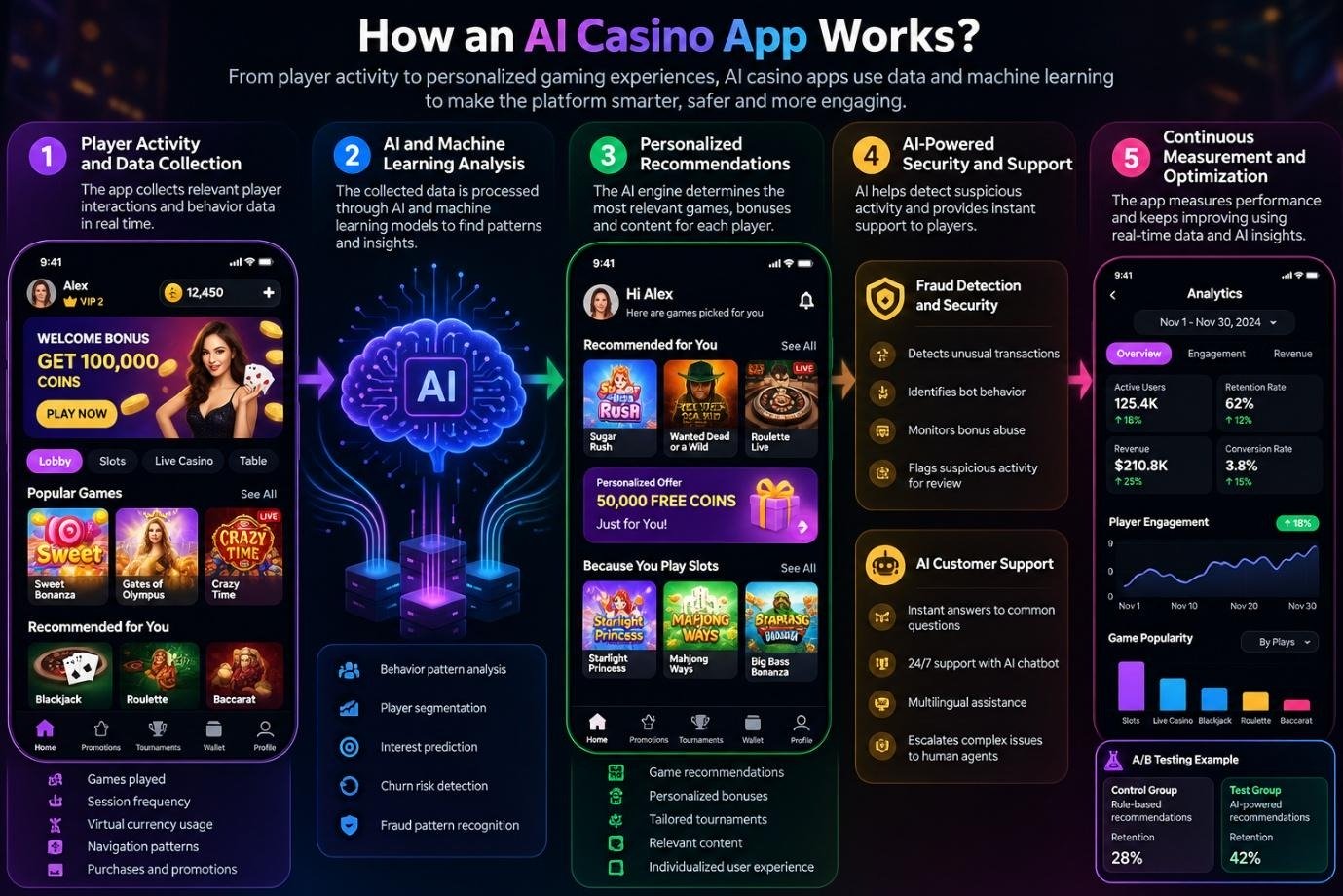
When users interact with the application, the platform can collect relevant events such as games played, preferred categories, session frequency, virtual currency usage, promotions viewed, purchases, navigation patterns, and customer support interactions.
For a regulated real-money platform, additional information may be processed for identity verification, transaction monitoring, fraud prevention, geolocation, and responsible gaming requirements, subject to applicable laws and privacy requirements.
The collected data is processed through AI and machine learning models. These models can identify behavioral patterns that may not be obvious through conventional rule-based analytics.
For example, an AI system can identify that a particular player frequently plays blackjack, prefers shorter sessions, and regularly returns during specific periods. The application can use these legitimate behavioral signals to improve game discovery and personalization.
The recommendation engine can then determine which games, tournaments, content, or platform features are most relevant to a particular user.
Instead of presenting exactly the same casino lobby to everyone, casino app development with AI can create individualized experiences based on appropriate player preferences and contextual signals.
AI can also work behind the scenes. Machine learning models can help identify unusual transaction patterns, account activity, bot behavior, or potential bonus abuse for further investigation.
An AI-powered customer support assistant can handle common questions about accounts, games, virtual currency, promotions, and platform functionality, while sensitive or complex issues can be escalated to human agents.
The final stage is measurement. Operators can compare AI-powered experiences against conventional rule-based systems using controlled experiments.
For example:
Control Group: Rule-based game recommendations
Test Group: AI-powered recommendations
Businesses can then measure retention, engagement, conversion, game discovery, revenue, and relevant player-protection indicators to determine whether the AI feature is delivering measurable value.
A critical distinction in building an AI casino app is that AI does not need to determine game results. Game mathematics, random number generation, payout logic, and certified gaming functionality should remain governed by applicable technical and regulatory requirements.
AI is better positioned around the gaming experience through personalization, analytics, fraud detection, customer support, operational intelligence, and responsible gaming tools.
Therefore, when making an AI casino app, the goal should not simply be to add AI features. The goal is to create an intelligent casino ecosystem where data, AI models, gaming technology, security, and compliance work together to deliver a measurable and scalable product experience.
Is an AI casino app becoming a strategic investment rather than simply another technology upgrade for gaming businesses?
The latest market and regulatory signals suggest that casino operators have increasingly strong reasons to invest in intelligent digital platforms, particularly when AI is connected to measurable personalization, fraud prevention, player protection, and operational analytics.
The commercial opportunity is already substantial. Grand View Research estimates that the global online gambling market will reach $97.7 billion in 2026, up from $88.0 billion in 2025, with the market projected to reach $202.8 billion by 2033 at an 11.0% CAGR. Mobile adoption and smartphone penetration are identified among the key growth drivers.
The scale is also visible in operator-level data. Flutter Entertainment reported 15.9 million average monthly online players and $16.383 billion in global revenue for fiscal 2025. Entain reported £5.325 billion in 2025 net gaming revenue, with online NGR excluding the US increasing 5% year over year.
These figures demonstrate why AI casino app development can be evaluated as a serious digital business opportunity rather than simply an experimental feature.
The next opportunity is turning large volumes of player data into useful, measurable personalization.
AI can analyze game preferences, navigation behavior, session patterns, promotions, and other permitted signals to improve game discovery and customer experiences. However, businesses should distinguish between AI capability and proven incremental ROI. A 2025 peer-reviewed study examining personalization in online gambling found behavioral patterns associated with increased personalization, while noting that its dataset did not contain direct metadata identifying AI interventions.
Therefore, the strongest business case is to test AI against a rule-based control group and measure retention, conversion, engagement, revenue, and player-protection outcomes rather than assume that AI automatically produces higher ROI.
New regulated markets can create additional opportunities for operators with adaptable digital infrastructure. Alberta's regulated iGaming market officially launched on July 13, 2026, creating a new private-market framework with player-protection requirements.
Caesars also reported that its digital footprint continued expanding as jurisdictions legalized or provided necessary approvals, including the launch of mobile sports betting and iGaming in Alberta in July 2026.
This makes AI casino platform development for regulated markets increasingly relevant, provided licensing and jurisdiction-specific requirements are addressed before real-money functionality is launched.
There is not currently a universal rule requiring every casino operator to use AI for responsible gaming. However, regulatory attention toward AI governance and player protection is increasing.
In September 2026, the Malta Gaming Authority launched an AI Gaming Charter covering ethical, transparent, and accountable AI use in gaming. The framework is voluntary and principles-based, but specifically addresses governance, human oversight, and responsible AI deployment.
Alberta's 2026 iGaming framework already requires operators to identify and intervene in high-risk player behavior, provide financial and time-based limits, integrate centralized self-exclusion, and maintain player activity information.
For businesses planning AI-powered responsible gaming solutions, this means compliance, explainability, human oversight, and player protection should be built into the architecture rather than added later.
The boundary between traditional casinos and digital gaming is becoming increasingly integrated. Major operators are maintaining physical casino businesses while simultaneously expanding online platforms and mobile applications.
MGM Resorts describes its business as including both casino properties and digital gaming through online platforms. Caesars similarly operates retail and digital gaming businesses and continues expanding its online footprint where jurisdictions permit it.
For casino businesses, this creates an opportunity to connect land-based loyalty programs, digital experiences, AI personalization, customer analytics, and omnichannel engagement within a compliant technology ecosystem.
For casino businesses, the investment case for AI is increasingly tied to measurable personalization, digital expansion, security, analytics, and responsible gaming, not simply the addition of an AI label.
The most defensible strategy is to build an AI casino platform where every intelligent feature has a measurable business objective, a clear governance framework, and evidence that it creates value beyond conventional rule-based casino technology.
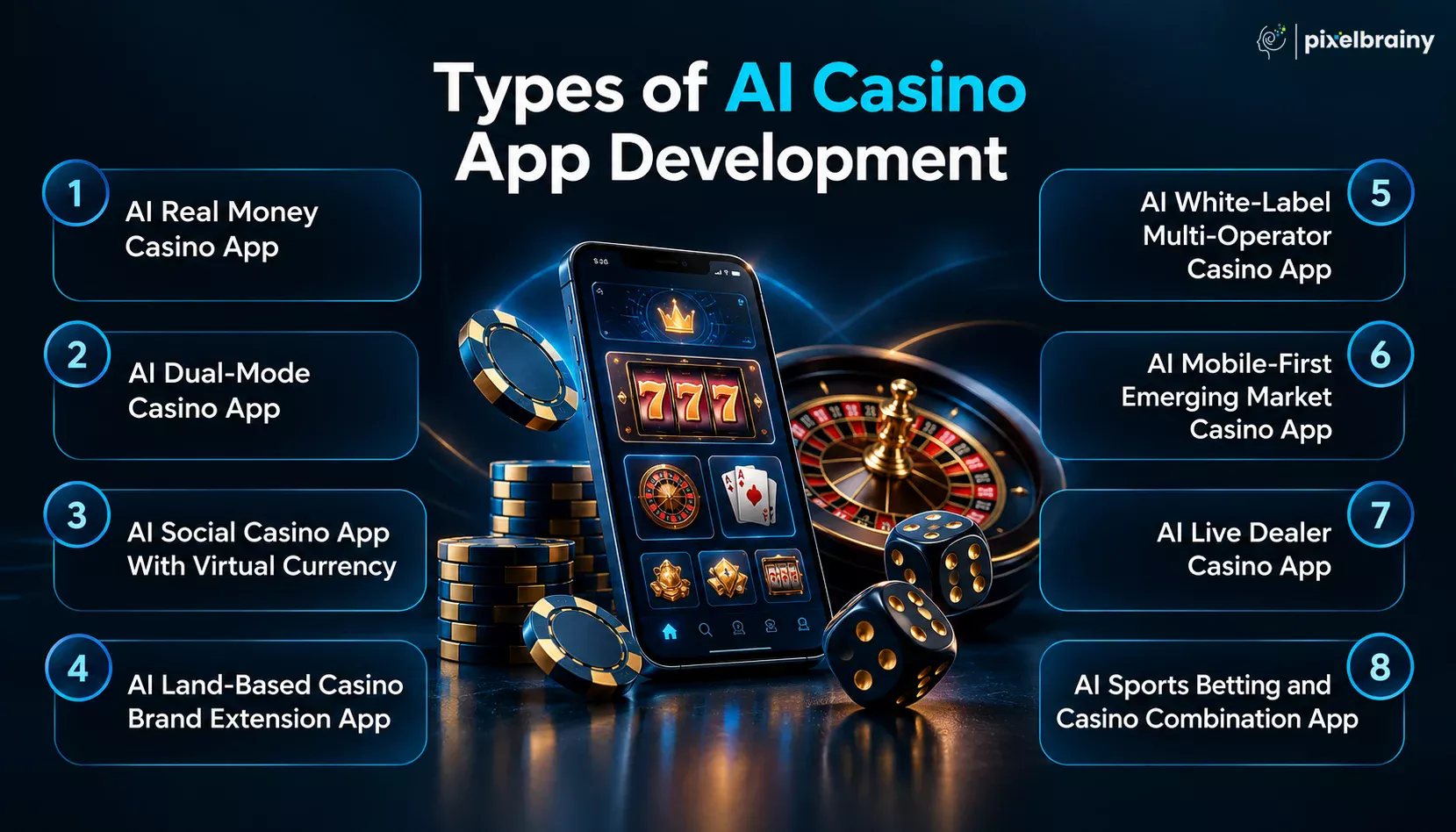
What are the different types of AI casino apps, and which model is suitable for a casino business? The answer depends on the target audience, gaming model, licensing strategy, geography, monetization approach, and level of personalization required.
Businesses can choose from real-money casino platforms, social casino apps, dual-mode products, live dealer platforms, white-label solutions, mobile-first applications, land-based casino extensions, and combined sports betting and casino platforms.
| AI Casino App Type | Best Suited For | Primary AI Applications | Main Business Objective |
|---|---|---|---|
| AI Real Money Casino App | Licensed operators | Personalization, fraud detection, analytics | Digital gaming revenue |
| AI Dual-Mode Casino App | Gaming entrepreneurs | Recommendations, analytics, segmentation | Social + regulated expansion |
| AI Social Casino App | Startups and game studios | Personalization, engagement, churn analysis | Virtual-currency monetization |
| AI Land-Based Casino Extension | Casino resorts and hotels | Loyalty, personalization, customer analytics | Omnichannel engagement |
| AI White-Label Casino App | B2B gaming providers | Shared AI, analytics, fraud monitoring | Multi-operator scalability |
| AI Mobile-First Casino App | Mobile-focused businesses | Recommendations, localization, support | Mobile user acquisition |
| AI Live Dealer Casino App | Premium casino operators | Content discovery, analytics, security | Immersive gaming |
| AI Sports + Casino App | Multi-product operators | Personalization, analytics, support | Broader gaming ecosystem |
What type of app is it?
An AI real-money casino app enables eligible users to participate in online casino games using real money in jurisdictions where the operator is licensed and authorized.
AI generally works around the gaming experience rather than determining the outcome of a casino game. Typical capabilities include:
Best suited for: Licensed casino operators, established gaming companies, and businesses entering regulated online gambling markets.
Why invest?
Real-money casino applications can create a direct digital revenue channel while giving operators access to valuable behavioral and operational data. AI can help businesses personalize the player experience, identify suspicious activity, automate routine support, and analyze player journeys.
Businesses planning to build AI casino app solutions for real-money gaming should treat KYC, AML, age verification, geolocation, payment security, responsible gaming, auditing, data protection, and applicable game certification as fundamental components of the product architecture.
What type of app is it?
An AI dual-mode casino app combines social casino functionality with a separately controlled pathway to regulated real-money gaming where legally permitted.
The platform can initially provide:
The architecture can then support real-money functionality in approved jurisdictions after the appropriate licensing and compliance requirements are satisfied.
Best suited for: Gaming entrepreneurs, startups, casino businesses, and operators planning to serve both social gaming audiences and regulated markets.
Why invest?
The primary advantage is flexibility. A modular architecture can allow businesses to develop their social gaming ecosystem while preparing the underlying technology for future regulated expansion.
However, businesses should not assume that a virtual-currency casino is automatically outside gambling regulations. The legal classification can depend on the currency, prizes, purchasing mechanics, redemption options, target market, and other product characteristics.
For companies looking to develop AI casino app products with long-term expansion plans, a dual-mode architecture can provide greater technical flexibility.
What type of app is it?
An AI social casino app with virtual currency provides casino-style entertainment without directly using real money for wagering. Users can play using virtual coins or other in-app currencies, subject to the applicable legal framework.
Common features include:
AI can personalize game recommendations, missions, challenges, content, and player journeys.
Best suited for: Gaming startups, social gaming companies, casino game studios, entertainment businesses, and entrepreneurs validating a casino-style product.
Why invest?
This model can provide an environment for testing gameplay, personalization, loyalty systems, analytics, and AI-driven engagement strategies.
For example, an AI recommendation engine can identify a player's preferred game categories and organize the casino lobby around relevant content.
This makes AI casino game app development particularly useful for companies that want to build and validate intelligent personalization capabilities before considering more complex regulated gaming functionality.
What type of app is it?
An AI land-based casino brand extension app connects an existing physical casino, hotel, resort, or entertainment property with a mobile digital experience.
The application does not necessarily need to focus exclusively on online gambling. It can combine casino-related services with broader hospitality and loyalty functionality.
Possible features include:
Best suited for: Land-based casinos, casino resorts, hotels, hospitality groups, and established entertainment brands.
Why invest?
The application can connect physical and digital customer journeys. AI can analyze permitted customer interactions and help personalize loyalty experiences, property services, events, content, and offers.
For established operators, AI casino mobile application development can therefore extend an existing customer ecosystem instead of requiring the business to create an entirely new digital brand.
What type of app is it?
An AI white-label casino app is a shared technology platform that can be customized for multiple casino operators. Each operator can have its own branding, content, configuration, promotions, and market-specific settings while using a common underlying infrastructure.
A centralized AI layer can provide:
Best suited for: B2B gaming technology companies, casino aggregators, gaming platform providers, and businesses serving multiple operators.
Why invest?
A white-label model can reduce duplicated development work because multiple operators can use the same core platform.
However, the architecture needs strong multi-tenant controls covering:
For businesses interested in the development of AI casino app platforms as a B2B technology product, this model can provide a scalable foundation for serving multiple casino brands.
What type of app is it?
An AI mobile-first casino app is designed primarily for smartphone users. The product prioritizes fast loading, simple navigation, mobile-friendly game interfaces, localized content, supported payment methods, and efficient data usage.
Potential features include:
Best suited for: Businesses targeting markets where smartphones are a primary channel for digital entertainment.
Why invest?
A mobile-first architecture allows businesses to design the entire experience around smartphone usage rather than adapting a desktop casino platform to mobile screens.
Businesses looking to make an AI casino app for iOS and Android can use AI for personalized game discovery, intelligent search, customer assistance, localization, behavioral analysis, and content recommendations.
Market selection must still consider applicable gambling laws, licensing requirements, payment regulations, data protection rules, and app-store policies.
What type of app is it?
An AI live dealer casino app combines live-streamed casino games with AI-powered digital services.
Popular formats can include:
AI does not need to control the live game. Instead, it can operate around the experience through personalization, game discovery, analytics, customer support, security monitoring, and responsible gaming workflows.
Best suited for: Premium casino operators, established gaming brands, live casino businesses, and operators seeking an immersive digital experience.
Why invest?
Live dealer gaming can create a more interactive environment than conventional digital casino games. AI can help players discover relevant tables, organize content, analyze engagement, automate routine support, and identify unusual account activity.
Businesses investing in AI casino application development for live dealer gaming should give particular attention to:
What type of app is it?
An AI sports betting and casino app combines casino gaming with sports betting or sports entertainment functionality in a unified application, where both product categories are legally permitted.
The platform can include:
Best suited for: Established gaming operators and businesses building a broader digital gaming ecosystem.
Why invest?
A combined platform can allow customers to access multiple entertainment categories through one application, reducing the need for separate accounts and disconnected digital experiences.
AI can help personalize the interface based on permitted user preferences. For example, sports content can be organized around relevant sports interests while casino recommendations remain based on separate gaming behavior and appropriate responsible gaming controls.
Companies planning to build AI casino app for iOS and Android with sports betting capabilities should design the architecture so that casino and betting products maintain their respective regulatory, risk management, and responsible gaming requirements.
The eight models address different commercial requirements:
The creation of AI casino app should therefore begin with the business model and target market, followed by the appropriate AI architecture, gaming infrastructure, data strategy, payment system, security framework, and regulatory requirements.
Therefore, choosing the right app model at the planning stage helps prevent expensive architectural changes later and creates a clearer path from MVP to a scalable production platform.
Why are casino businesses investing in AI-powered apps when conventional casino apps already offer games, payments, loyalty programs, and customer support? The answer lies in the intelligence layer that AI can add around the core gaming experience. AI casino app development can help businesses analyze player behavior, personalize game discovery, identify suspicious activity, automate support, improve operational decisions, and strengthen responsible gaming processes.
For businesses asking what are the benefits of an AI casino app, the most valuable opportunities are not simply adding an AI chatbot or using generative AI for marketing. In 2026, practical iGaming AI use cases include personalization, churn prediction, fraud and AML detection, responsible gaming monitoring, customer support, and CRM automation.
The six key benefits of building an AI casino app are explained below.
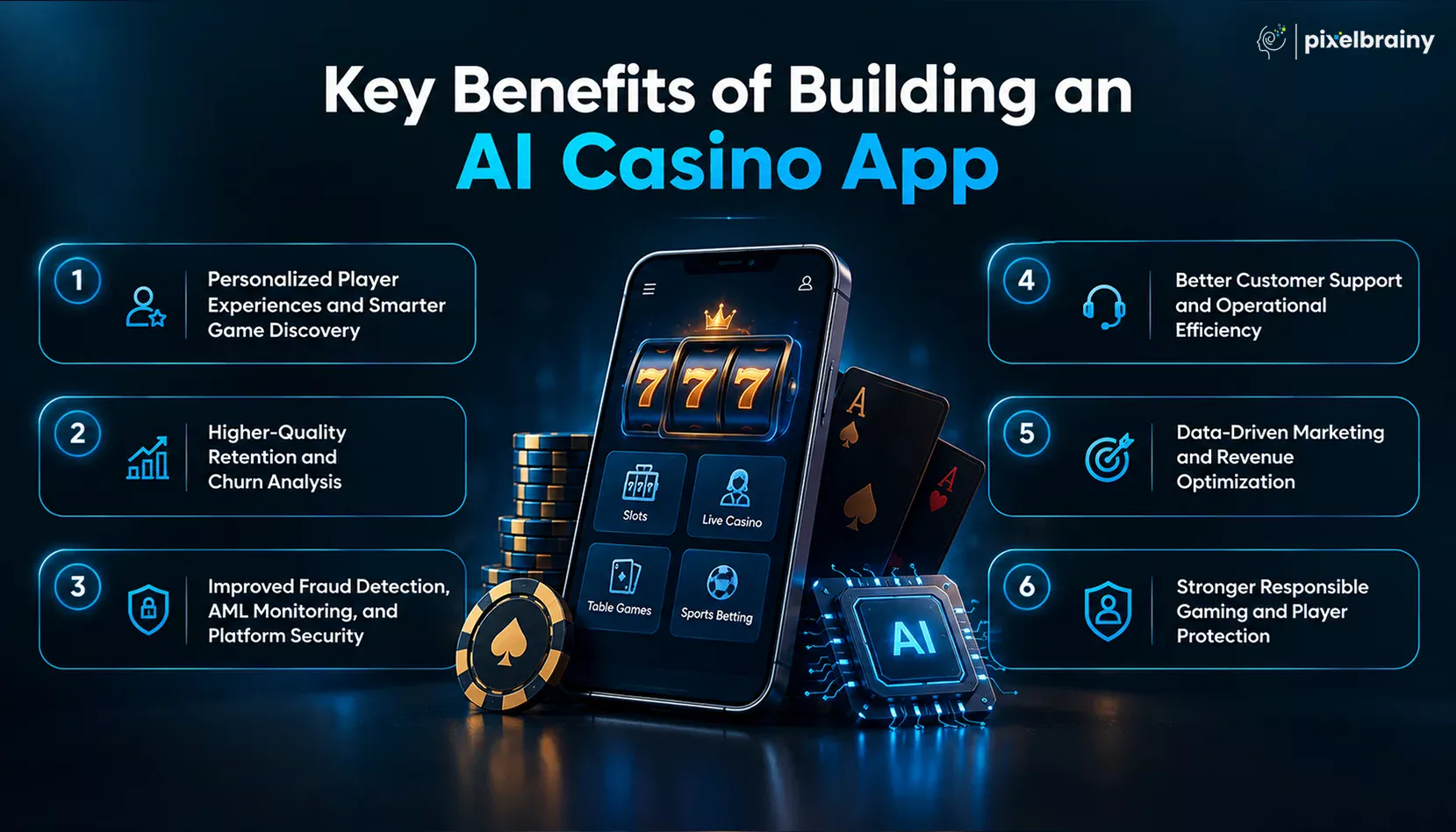
One of the most important benefits of AI casino application development is the ability to personalize the experience for individual users. A conventional casino app may display the same game categories, promotions, and content to most players. An AI-powered platform can analyze permitted behavioral signals such as previously played games, preferred categories, session patterns, searches, favorites, and interactions to organize content more intelligently.
For example, if a player frequently explores blackjack and roulette, the recommendation engine can prioritize relevant table games rather than presenting an identical lobby to every user. AI can also personalize search results, game categories, onboarding content, loyalty experiences, and customer support routing.
This can reduce the time users spend searching for relevant content and create a more intuitive casino interface. However, personalization should not be confused with improving a player's probability of winning. AI should operate around the gaming experience rather than manipulate certified game mathematics, RTP, RNG outputs, or game outcomes.
For casino businesses, the strategic benefit is the ability to move from a one-size-fits-all casino app toward a more context-aware digital experience.
How can a casino app identify declining engagement before a player becomes completely inactive? This is where predictive analytics and machine learning can provide value.
An AI system can analyze changes in permitted behavioral signals and identify patterns associated with declining activity. For example, a user who previously opened the application several times a week may gradually reduce sessions, stop exploring new games, or disengage from platform features.
A churn prediction model can flag such changes for appropriate business or customer-support workflows. Operators can then test relevant product improvements, service communications, or permitted retention strategies rather than relying entirely on manual segmentation.
The important point is that AI does not guarantee higher retention. Research on algorithmic personalization in online gambling also highlights the need to understand how personalization can influence player behavior and raises ethical questions around targeted engagement.
Therefore, businesses should measure AI retention systems using controlled experiments and monitor both commercial metrics and player-protection indicators.
Fraud prevention is another major reason to develop AI casino app technology. Casino platforms can process large volumes of account, payment, device, and behavioral data, making manual review alone difficult at scale.
Machine learning can help identify unusual patterns involving:
Instead of relying exclusively on fixed rules, AI models can identify relationships and anomalies across large datasets. Risk teams can then investigate flagged accounts or transactions according to their established procedures.
This does not mean every AI alert is fraudulent. Models can generate false positives, which is why production systems should combine machine learning with rules, human review, audit trails, and clear escalation processes.
Current industry analysis identifies fraud and payment-risk detection among the most widely deployed AI functions in iGaming.
For businesses building an AI-powered casino platform, this makes AI security infrastructure valuable not only for financial protection but also for operational efficiency.
What happens when thousands of casino users ask similar questions about account access, game rules, virtual currency, payments, verification, or platform features? A conventional support team may need to answer many repetitive requests manually.
An AI casino application can introduce an intelligent support assistant that handles routine questions and retrieves relevant information from an approved knowledge base.
AI support can help with:
More complex cases can be transferred to human support agents with relevant conversation context.
This creates an important operational benefit: AI can handle repetitive interactions while human teams concentrate on cases requiring judgment, investigation, empathy, or regulatory intervention.
For casino businesses, the goal should not be to eliminate human support. A better approach is AI-assisted customer service, where automation improves response speed while humans retain control over sensitive decisions.
Another important benefit of AI casino mobile app development is the ability to make marketing more data-driven. Instead of sending identical campaigns to an entire user base, AI can help segment users according to relevant and legally permissible behavioral characteristics.
AI can support:
For example, a casino business can compare how different player segments respond to particular product features and determine which experiences deserve further investment.
The most effective approach is to connect AI recommendations with measurable experiments. A business can compare an AI-powered experience with its existing rule-based approach and evaluate changes in retention, engagement, conversion, revenue, customer satisfaction, and responsible gaming indicators.
This distinction is important because AI does not automatically increase casino revenue. Its commercial value needs to be demonstrated through controlled measurement rather than assumed from the presence of an AI model.
Perhaps the most important long-term benefit is using AI to support safer gaming and responsible gaming processes.
AI can analyze relevant behavioral patterns and help identify potential indicators that may require further assessment. Depending on the regulatory framework and operator policies, these systems can support workflows involving:
The purpose should be early identification and appropriate player protection, not identifying vulnerable users for more aggressive marketing.
Regulators have emphasized the importance of evaluating how operators use data to detect gambling-related harm. The UK Gambling Commission has previously recommended greater transparency around harm-detection approaches and stronger evaluation of what works.
AI therefore gives casino businesses an opportunity to build player protection into the technology architecture rather than treating responsible gaming as a separate compliance screen.
The real value of AI casino app development comes from combining personalization, predictive analytics, security, automation, marketing intelligence, and responsible gaming within one measurable technology ecosystem.
For casino businesses, the objective should be to use AI where it solves a clearly defined problem, measure its actual impact, and maintain appropriate human oversight across sensitive decisions.

“We are a land-based casino operator and want to build a proprietary AI casino app that lets loyalty members play their favorite slot and table games on mobile between physical casino visits while earning points toward our existing rewards program. What features do we need, how should player data integrate with our CRM, and what should we consider before estimating the development cost?”
This is a practical use case for AI casino app development because the objective is not simply to put casino games on mobile. The application needs to connect the casino's existing loyalty program, CRM, player database, gaming platform, analytics infrastructure, and responsible gaming systems with an AI intelligence layer.
For an established casino brand, the most important features should therefore support four connected objectives: personalized gaming, omnichannel loyalty, secure data integration, and measurable player engagement. A well-designed AI casino application development architecture can allow mobile activity to become part of the existing customer journey while giving the operator better visibility into player preferences and digital engagement.
The following 15 features represent the core functionality to consider when businesses build AI casino app products for established casino brands.
| Must-Have Feature | What It Does | Why It Matters for a Casino Business |
|---|---|---|
| AI-Powered Player Personalization | Uses permitted player behavior, preferences, game history, searches, favorites, and engagement signals to personalize the mobile experience, including relevant games, content, and loyalty experiences. | Helps an established casino move beyond a generic mobile lobby and create a more relevant digital experience for individual loyalty members while keeping personalization separate from game outcomes. |
| Unified Player Account | Connects the mobile application with the operator's existing customer identity, allowing approved account, loyalty, rewards, preferences, and profile information to remain synchronized across digital and physical channels. | Creates continuity between casino visits and mobile interactions, reduces fragmented customer records, and gives the operator a more consistent view of each loyalty member. |
| Loyalty and Rewards Integration | Connects mobile activity with the existing loyalty engine so eligible actions can update points, membership tiers, rewards, offers, and other approved loyalty benefits according to the operator's rules. | This is critical for land-based operators because mobile engagement can become an extension of the existing rewards program instead of creating a disconnected digital loyalty system. |
| AI Game Recommendation Engine | Analyzes permitted player preferences and behavioral signals to recommend relevant slot, table, or other casino content without controlling or modifying the underlying game results. | Makes game discovery faster and more personalized while giving operators an AI capability that can be tested against conventional rule-based recommendations. |
| Mobile Casino Game Lobby | Provides a mobile-first interface for browsing available casino games through categories, search, favorites, recently played games, new releases, and personalized recommendations. | Creates the primary discovery environment for the mobile casino and provides the interface where AI recommendations can be integrated naturally into the player journey. |
| CRM Integration | Exchanges approved customer, loyalty, engagement, and behavioral events between the mobile application and the casino's existing CRM or customer data platform through APIs or event-driven integrations. | Allows the operator to connect mobile activity with existing customer profiles, marketing workflows, loyalty information, and omnichannel engagement strategies. |
| Real-Time Analytics | Captures and analyzes application events such as sessions, game interactions, searches, loyalty activity, conversions, and technical events through an analytics infrastructure. | Gives casino management measurable visibility into mobile performance and provides the data required to evaluate whether AI features are delivering incremental value. |
| AI Churn Prediction | Uses machine learning to identify changes in permitted behavioral patterns that may indicate declining engagement, allowing appropriate teams to investigate and respond. | Helps operators understand potential engagement loss earlier than conventional reporting while supporting data-driven retention experiments rather than relying only on manual customer segmentation. |
| Secure Wallet and Payments | Provides secure management of applicable balances, transactions, deposits, withdrawals, or virtual currencies depending on the casino's business model and regulatory requirements. | Creates the financial infrastructure required for eligible gaming transactions while maintaining transaction records, security controls, reconciliation processes, and integration with approved payment providers. |
| KYC and Identity Verification | Verifies player identity, age, and eligibility through appropriate identity verification services and connects verification results with the relevant account and compliance systems. | Supports regulatory obligations where applicable and helps the operator establish that users meet required eligibility conditions before accessing restricted gaming functionality. |
| Geolocation and Geo-Fencing | Determines whether a player is accessing regulated gaming functionality from an authorized location and applies jurisdiction-specific access rules where required. | Helps casino operators manage geographic restrictions when gaming permissions differ between states, provinces, countries, or other jurisdictions. |
| Fraud and Risk Detection | Uses AI, rules, transaction analysis, device signals, and behavioral patterns to identify potentially suspicious account, payment, login, or bonus activity for appropriate investigation. | Helps protect the operator from account takeover, payment fraud, bonus abuse, multi-account activity, and other security risks while allowing human teams to review important alerts. |
| Responsible Gaming Tools | Provides applicable player protection features such as self-exclusion, deposit or wagering limits, time controls, reality checks, activity information, and access to support resources. | Makes responsible gaming part of the product architecture and gives players practical controls while helping the operator meet applicable regulatory and player-protection requirements. |
| AI Customer Support | Uses an AI assistant to answer routine questions about games, loyalty points, rewards, accounts, verification, promotions, and application functionality, with escalation to human agents for complex cases. | Reduces repetitive support workload and can provide faster assistance while preserving human oversight for sensitive account, compliance, responsible gaming, and dispute-related situations. |
| Admin and AI Analytics Dashboard | Provides casino teams with centralized management of users, games, loyalty activity, CRM events, AI recommendations, fraud alerts, analytics, support activity, and model performance. | Gives management one operational control center and allows teams to monitor AI performance, experiment results, business KPIs, security events, and player-protection indicators. |
Therefore, the right feature set turns a casino app from a standalone mobile product into an intelligent extension of the operator's existing loyalty, CRM, gaming, and customer ecosystem.
What advanced AI casino app features can help an established casino brand differentiate its mobile experience beyond standard game lobbies, loyalty points, recommendations, and customer support?
For businesses planning AI casino app development, the next competitive opportunity is moving beyond conventional casino functionality and introducing intelligent features that improve personalization, operational decision-making, security, loyalty, player support, and responsible gaming.
A modern AI casino app should not simply attach a chatbot or recommendation carousel to an existing platform. AI can become a deeper intelligence layer that connects player data, CRM systems, gaming content, loyalty programs, risk controls, and real-time analytics. Current iGaming use cases increasingly include personalization, churn prediction, fraud and AML detection, responsible gaming monitoring, AI-assisted support, and CRM automation.
For casino operators asking how to make an AI casino app more innovative than a standard casino application, the following 10 non-ordinary features are worth considering.
| Non-Ordinary Feature | What It Does | Why Consider It for an AI Casino App |
|---|---|---|
| AI Intent-Based Casino Search | Allows players to search using natural language, such as "show me table games I usually play" or "find new games similar to my favorites," and converts the request into relevant game filters and recommendations. | Creates a more conversational discovery experience and reduces dependence on traditional category navigation. Natural-language interfaces can make large casino game catalogs easier to explore. |
| AI-Powered Dynamic Casino Lobby | Continuously organizes game categories, recommendations, featured content, and discovery modules using permitted behavioral, contextual, and content signals. | Instead of showing an identical lobby to every player, the application can create a more personalized interface while keeping certified game logic completely separate from personalization. AI personalization should not modify RTP, RNG outputs, or approved game rules. |
| AI Loyalty Concierge | Acts as an intelligent loyalty assistant that can explain points, membership tiers, available rewards, eligible activities, and relevant property experiences using approved CRM and loyalty data. | Particularly valuable for land-based casino operators because it can connect the mobile application with an existing loyalty ecosystem and provide members with a more useful digital rewards experience. |
| Predictive Player Journey Engine | Uses permitted behavioral signals to identify a player's current lifecycle stage and determine appropriate next-step experiences, such as onboarding guidance, game discovery, loyalty information, or support. | Creates a more contextual player journey instead of treating every customer interaction independently. It can connect personalization, CRM, loyalty, and analytics into one decision layer. |
| AI Casino Host and Support Copilot | Provides personalized assistance through an AI interface while escalating sensitive account, compliance, responsible gaming, or dispute-related matters to trained human staff. | Gives casino operators an always-available digital assistance layer while allowing human teams to concentrate on complex interactions. AI customer-facing systems should clearly communicate when users are interacting with AI where applicable. |
| AI Fraud Relationship Graph | Connects accounts, devices, payment methods, sessions, transactions, and other approved signals to identify relationships and patterns that may indicate coordinated suspicious activity. | A relationship-based approach can complement traditional rule-based fraud detection and help risk teams investigate multi-accounting, bonus abuse, account takeover, and unusual transaction patterns more efficiently. |
| AI Responsible Gaming Early-Warning System | Analyzes defined behavioral indicators such as changes in session patterns, activity intensity, or other relevant signals to identify situations that may require a responsible gaming review or intervention. | Moves responsible gaming from a static settings page toward an active player-protection capability. AI should support appropriate intervention rather than identify vulnerable players for more aggressive marketing. |
| AI Experimentation and Holdout Engine | Automatically manages controlled experiments comparing AI recommendations, personalization, messaging, or other experiences against an established control group. | Helps casino businesses prove whether AI actually creates incremental value instead of relying on generic claims about "AI-powered engagement." Metrics can include retention, discovery, conversion, revenue, satisfaction, and player-protection outcomes. |
| AI Omnichannel Casino Memory | Creates an approved unified context across mobile interactions, physical casino activity, loyalty participation, CRM events, and customer support history. | For land-based operators, this can connect the physical casino and mobile experience into a more coherent customer journey. Omnichannel design is increasingly important for operators that span online and offline experiences. |
| AI Model Governance and Explainability Center | Records model versions, important inputs, predictions, confidence levels, interventions, overrides, and relevant audit information for AI systems used across the platform. | Makes AI easier to monitor and govern, particularly when models influence fraud reviews, recommendations, customer interactions, or player-protection workflows. Human oversight and explainability become increasingly important as AI is integrated into regulated gaming operations. |
Therefore, businesses should consider non-ordinary AI casino features that turn fragmented player, loyalty, CRM, security, and gaming data into measurable intelligence while maintaining fairness, privacy, transparency, and responsible gaming.
How can a casino business rebuild its existing app with AI without losing player data, disrupting its virtual currency economy, or affecting the current user experience?
Consider this real-world query: “Our existing casino app was built three years ago without AI capability and our player retention metrics are declining as AI-powered competitor apps deliver more personalized experiences. We want to rebuild our casino app with personalized game recommendations, AI bonus calibration, predictive churn management, and AI fraud detection while maintaining our existing player database and virtual currency economy. Which development companies have experience with this type of AI casino app modernization?”
This scenario shows why AI casino app development requires more than adding intelligent features. Businesses need a structured process covering strategy, data migration, AI architecture, development, security, testing, and launch.
Whether you want to build an AI casino app from scratch, modernize a legacy platform, or create an app for iOS and Android, these eight steps provide a practical roadmap from idea to launch.
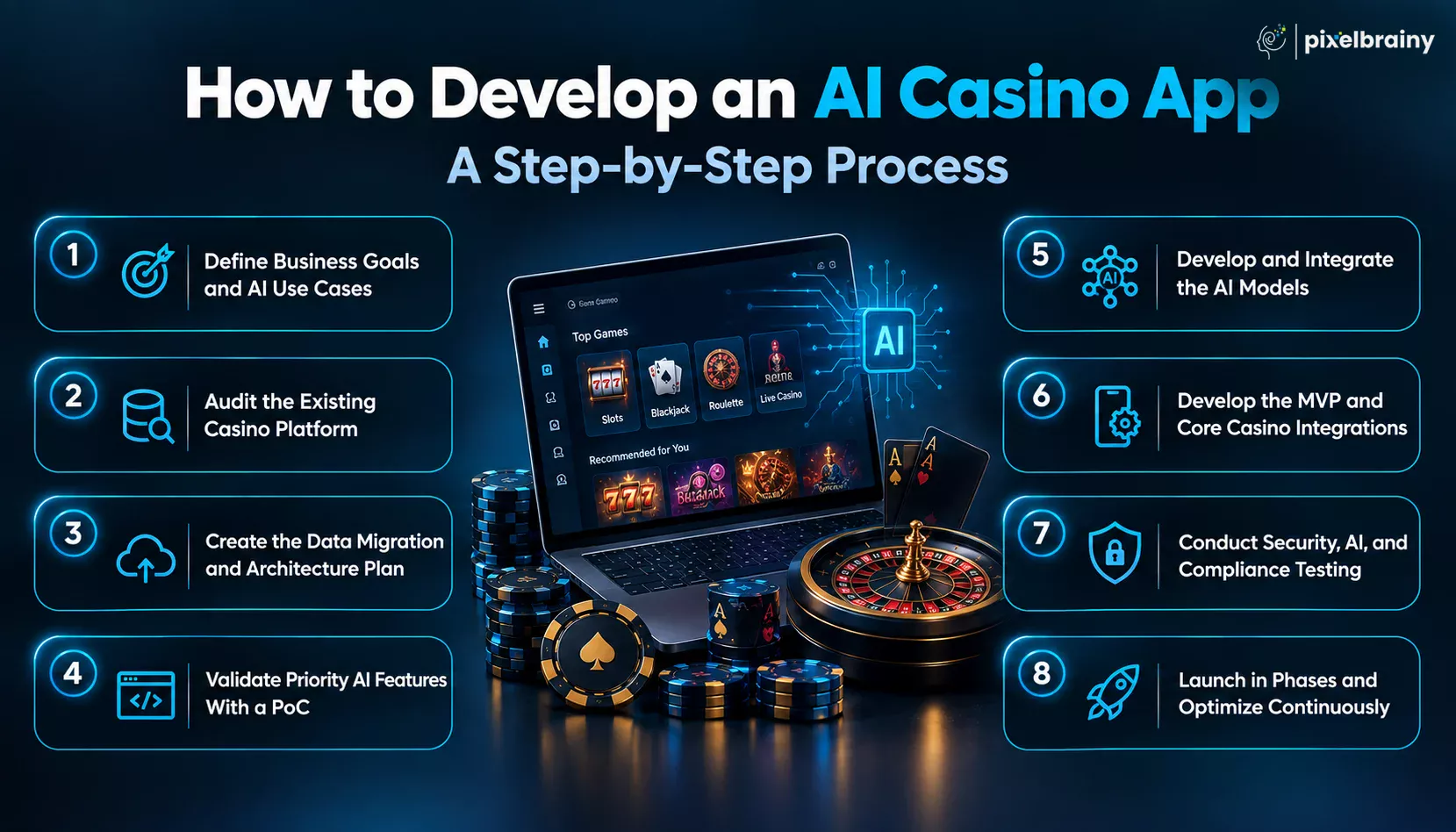
The first step in the steps to develop AI casino app from idea to launch is defining clear business and technical objectives. Identify the target market, player segments, licensing requirements, monetization strategy, and expected outcomes.
Next, determine where AI can provide measurable value. Potential use cases include personalized game recommendations, churn prediction, fraud detection, customer support, loyalty optimization, and responsible gaming.
For an existing casino application, analyze retention, engagement, and player behavior to identify the biggest gaps. This prevents businesses from adding AI features without a clear purpose and creates a focused roadmap for developing an AI casino app.
Before rebuilding an established casino application, conduct a detailed technical audit. Examine the frontend, backend, APIs, database, CRM, player accounts, wallet, virtual currency, game providers, analytics, KYC, payment systems, and security infrastructure.
The objective is to determine which components can remain and which need modernization. Legacy systems can often be upgraded through modular architecture rather than replacing the entire platform at once.
This assessment is particularly important when businesses to create AI casino app capabilities around an existing platform because technical dependencies can directly affect migration, development timelines, security, and future scalability.
Player data forms the foundation of an intelligent casino platform. Develop a migration strategy covering player profiles, account IDs, game history, loyalty points, virtual currency balances, transactions, preferences, consent records, and behavioral information.
Data should be cleaned, mapped to the new structure, encrypted, and validated before migration. Virtual currency requires additional reconciliation because incorrect balances could affect the player economy.
Businesses can use AI consultation at this stage to determine how existing data should be structured for future AI applications while maintaining continuity between the legacy and new systems.
Also Read: Top 10 AI Consulting Companies in USA
PoC development allows businesses to validate selected AI use cases before investing in complete production development.
For example, a casino operator could test personalized game recommendations or predictive churn management using historical player data. The team can measure recommendation relevance, prediction accuracy, engagement, false positives, and response time.
This step helps identify whether existing data is sufficient for the intended AI functionality. It also gives stakeholders an opportunity to refine requirements before moving into full-scale AI casino app development.
Once the priority use cases are validated, the next stage is AI model development. Depending on the business requirements, models may support recommendations, player segmentation, churn prediction, fraud detection, anomaly detection, or customer support.
The models should connect with the casino's central data and event infrastructure rather than functioning as isolated components. Monitoring, model versioning, access controls, fallback mechanisms, and human oversight should also be included.
AI should enhance the player experience without changing certified RNG outputs, RTP calculations, or other protected game mechanics.
Also Read: Top 12+ AI Model Development Companies in the USA
After validating the architecture and AI capabilities, move into MVP development. The initial product can include essential functionality such as registration, player profiles, game discovery, personalized recommendations, virtual currency, loyalty, notifications, customer support, and responsible gaming tools.
The application should integrate securely with CRM, PAM, payment, KYC, game-provider, fraud detection, and analytics systems.
For businesses planning to develop AI casino app for iOS and Android, mobile performance, device compatibility, authentication, API reliability, and data protection should be incorporated from the beginning.
Also Read: Top 10 AI MVP Development Companies in USA
Before production release, perform comprehensive testing across both the application and AI infrastructure. Test registration, database migration, virtual currency balances, payments, APIs, security, scalability, and application performance.
AI models should also be evaluated for inaccurate predictions, false fraud alerts, unexpected recommendations, privacy risks, and data leakage.
Businesses can hire AI developers with experience in regulated applications to support model testing and technical validation. For regulated markets, KYC, responsible gaming, privacy, licensing, and applicable technical requirements should also be verified. AI deployments should consider transparency, lawful data processing, and appropriate human oversight.
The final stage is controlled deployment and continuous improvement. Rather than migrating every player simultaneously, businesses can use phased releases, selected player groups, feature flags, or parallel systems.
After launch, monitor player retention, engagement, recommendation performance, fraud detection, application stability, virtual currency reconciliation, and responsible gaming indicators.
Working with AI app development companies can help businesses manage post-launch optimization, while organizations comparing top AI development companies or AI product development companies should evaluate their experience with legacy migration, AI governance, security, scalability, and long-term maintenance.
Therefore, developing an AI casino app successfully requires a structured process that connects legacy modernization, secure data migration, AI capabilities, testing, deployment, and continuous optimization.
How much does it cost to develop an AI casino app, and why can two apps with similar features have completely different development budgets?
The estimated cost to develop an AI casino app generally ranges from $40,000 to $300,000+, depending on the app's complexity, AI capabilities, game infrastructure, integrations, security, scalability, and compliance requirements.
Consider this real-world query:
“I am comparing four AI casino app development proposals and the quotes range from $50,000 to $250,000 for what appear to be similar core features including slot games, table games, virtual currency, AI personalization, and social features. What legitimately drives this price variation in AI casino app development and what specific technical questions should I ask each vendor about their AI personalization model quality, game engine performance, virtual currency economy architecture, and responsible gaming compliance to evaluate whether their proposed app will perform in production at the player volumes I am targeting?”
This is why AI casino app development cost for casino businesses should not be judged only by the number on a proposal. The development budget of AI casino app depends on what is being built behind the visible features, including AI architecture, game technology, backend infrastructure, data systems, security, compliance, and scalability.
| AI Casino App Type | Estimated Cost | What You Typically Get |
|---|---|---|
| Basic AI Casino App | $40,000 to $80,000 | Core slots and table games, player accounts, virtual currency, basic AI personalization, social features, admin panel, basic analytics, and essential integrations |
| Advanced AI Casino App | $80,000 to $150,000 | Larger game catalog, advanced personalization, AI recommendations, churn prediction, fraud detection, loyalty and CRM integration, advanced analytics, stronger security, and scalable backend |
| Enterprise AI Casino App | $150,000 to $300,000+ | Custom AI models, large-scale game infrastructure, sophisticated virtual currency economy, real-time analytics, extensive integrations, advanced security, compliance workflows, high scalability, and enterprise administration |
These are indicative software development ranges. Licensing, game content, payment processing, KYC/AML services, cloud infrastructure, certifications, marketing, and ongoing operations can create additional costs. Published industry estimates similarly identify features, integrations, infrastructure, platform scope, and development complexity as major cost variables.
| Cost Factor | Estimated Cost Impact | What Drives the Cost |
|---|---|---|
| AI Personalization | $8,000 to $30,000+ | Basic recommendations cost less, while real-time behavioral personalization, player segmentation, predictive models, experimentation, and model monitoring require more engineering |
| AI Model Development | $10,000 to $40,000+ | Custom recommendation, churn, fraud, prediction, or player-risk models require data preparation, model development, testing, deployment, and monitoring |
| Casino Game Integration | $10,000 to $50,000+ | Costs depend on the number of games, game providers, APIs, game aggregation, table games, slots, live casino content, and custom game-engine requirements |
| Virtual Currency Economy | $5,000 to $25,000+ | Player balances, transactions, rewards, bonuses, ledgers, reconciliation, economy rules, fraud prevention, and transaction history increase development complexity |
| Backend & Cloud Infrastructure | $8,000 to $35,000+ | Scalable APIs, databases, caching, real-time services, cloud deployment, monitoring, load management, and disaster recovery affect infrastructure costs |
| CRM & Loyalty Integration | $5,000 to $20,000+ | Existing CRM, loyalty programs, player profiles, rewards, segmentation, and cross-channel data synchronization require additional APIs and integration work |
| KYC, AML & Security | $8,000 to $30,000+ | Identity verification, fraud monitoring, secure authentication, encryption, access controls, transaction monitoring, and security testing add engineering effort |
| Responsible Gaming Features | $5,000 to $20,000+ | Player protection controls, activity monitoring, limits, risk indicators, alerts, self-exclusion workflows, and reporting requirements can increase product complexity |
| iOS & Android Development | $10,000 to $40,000+ | Separate native development, cross-platform implementation, device compatibility, testing, notifications, performance optimization, and deployment requirements affect cost |
| UI/UX & Dynamic Casino Lobby | $5,000 to $20,000+ | Custom interfaces, personalized game discovery, dynamic content, player journeys, animations, dashboards, and accessibility require additional design and development |
| Admin & Analytics Dashboard | $5,000 to $20,000+ | Real-time KPIs, player analytics, AI insights, game performance, fraud monitoring, loyalty data, reporting, and role-based administration increase scope |
| Testing & Performance Optimization | $5,000 to $25,000+ | Functional testing, security testing, AI validation, API testing, load testing, stress testing, and high-concurrency optimization affect the final budget |
| Third-Party Integrations | $5,000 to $30,000+ | Payment gateways, game aggregators, analytics, CRM, KYC, fraud detection, communication platforms, and other external services require integration and testing |
| Multi-Market Compliance | $10,000 to $50,000+ | Supporting multiple jurisdictions can require different regulatory workflows, localization, reporting, player-protection requirements, and technical controls |
| Post-Launch Maintenance | $2,000 to $15,000+ per month | Server management, security updates, bug fixes, AI monitoring, model retraining, third-party API changes, performance optimization, and new feature development create recurring costs |
Note: The individual factor ranges are indicative and should not simply be added together. Many components overlap within the three overall app-development tiers, so the final cost estimation of AI casino app development depends on the actual scope, architecture, integrations, team structure, and target market.
A $40,000 AI casino app and a $300,000+ AI casino platform can both contain features labeled “AI personalization,” “virtual currency,” and “casino games,” while being completely different in architecture, scalability, security, and operational capability.
Therefore, businesses should compare the underlying technology, AI sophistication, integrations, scalability, compliance scope, and recurring costs before deciding whether a development proposal represents genuine value.

What technology stack is needed to build a secure, scalable, and AI-powered casino app that can support games, virtual currency, personalization, fraud detection, and responsible gaming?
The AI casino app development technology stack combines mobile and web technologies, backend systems, databases, cloud infrastructure, AI and machine learning tools, APIs, security, analytics, payment services, and gaming integrations.
Consider this real-world query: “We want to build an AI casino app for our existing casino business with personalized game recommendations, virtual currency, CRM integration, fraud detection, and responsible gaming features. Which technologies should we choose so the platform can support 100,000+ players without requiring a complete architectural rebuild later?”
For businesses planning to develop an AI casino app for iOS and Android, the technology stack should support high traffic, real-time data processing, secure transactions, AI workloads, and future scalability. A modular, API-driven architecture can also make it easier to connect game providers, CRM, KYC, payments, analytics, and AI services.
The following table outlines the major technologies and their role in an AI casino platform.
| Technology Layer | Recommended Technologies | Purpose in AI Casino App |
|---|---|---|
| Mobile App | Flutter, React Native, Swift, Kotlin | Build responsive casino applications for iOS and Android while supporting secure authentication, notifications, game discovery, and personalized experiences |
| Web Frontend | React.js, Next.js, TypeScript | Develop fast, scalable web interfaces, casino lobbies, player dashboards, loyalty experiences, and personalized content |
| Backend | Node.js, Python, Java, Go | Handle player accounts, game sessions, APIs, transactions, loyalty, virtual currency, AI services, and business logic |
| API Layer | REST, GraphQL, WebSockets | Connect mobile apps with backend services and support real-time communication between players, games, payments, analytics, and AI systems |
| Database | PostgreSQL, MySQL, MongoDB | Store player profiles, transactions, game records, loyalty information, configurations, and application data |
| Caching | Redis | Provide fast access to sessions, frequently requested data, player preferences, temporary game information, and real-time application states |
| Data & Event Streaming | Apache Kafka, Amazon Kinesis | Process high volumes of player events such as sessions, game activity, transactions, recommendations, and risk signals in real time |
| AI/ML Frameworks | Python, TensorFlow, PyTorch, scikit-learn | Develop recommendation, churn prediction, fraud detection, segmentation, anomaly detection, and responsible gaming models |
| AI Data Layer | Data lake, data warehouse, feature store | Prepare historical and real-time player data for analytics, AI training, model inference, and reporting |
| Cloud Infrastructure | AWS, Microsoft Azure, Google Cloud | Provide scalable computing, databases, storage, networking, monitoring, security, and AI infrastructure |
| Game Integration | Game APIs, aggregators, RGS integrations | Connect slots, table games, live casino, tournaments, and third-party gaming content |
| Payment Infrastructure | Payment APIs, payment orchestration platforms | Process supported deposits, withdrawals, transactions, payment verification, and transaction status updates |
| KYC and Identity | KYC APIs, identity verification services | Verify player identity, support account onboarding, and apply market-specific verification requirements |
| Security | OAuth 2.0, OpenID Connect, TLS, encryption, WAF, DDoS protection | Protect accounts, APIs, transactions, player data, and platform infrastructure |
| Fraud Detection | ML models, rules engines, behavioral analytics | Detect suspicious account activity, payment anomalies, bonus abuse, account takeover, and other risk signals |
| Responsible Gaming | Real-time event processing, risk scoring, player controls | Identify relevant behavioral signals and support applicable limits, alerts, interventions, and player protection workflows |
| Analytics & BI | Power BI, Tableau, Looker, custom dashboards | Track player engagement, game performance, retention, revenue, AI performance, fraud signals, and operational KPIs |
| DevOps & CI/CD | Docker, Kubernetes, GitHub Actions, GitLab CI/CD | Automate deployment, scaling, testing, monitoring, and infrastructure management |
| Monitoring | Prometheus, Grafana, CloudWatch, Datadog | Monitor server health, API latency, errors, AI services, infrastructure performance, and system availability |
Therefore, the right technology stack gives an AI casino app the scalability, intelligence, security, and flexibility required to support modern player experiences and long-term business growth.
How can businesses generate sustainable revenue from an AI casino app while delivering personalized experiences and maintaining a scalable business model?
The right business model depends on the casino app type, target audience, licensing environment, game portfolio, and monetization strategy. AI can strengthen these models by improving personalization, player engagement, retention, fraud detection, and marketing efficiency.
For businesses planning AI casino app development, selecting the monetization model early helps determine the required features, payment infrastructure, AI capabilities, loyalty system, and overall product architecture.
A real-money casino model allows users to participate in licensed casino games using real currency. Revenue can come from the operator's gaming margin, applicable fees, and other permitted commercial mechanisms.
AI can support this model through personalized game discovery, player segmentation, fraud detection, customer support, and responsible gaming monitoring. However, this model requires appropriate licensing, KYC, payment controls, age verification, geolocation, and responsible gaming measures in each target market.
This model is primarily suitable for licensed operators targeting regulated online casino markets.
A social casino app uses virtual currency instead of direct real-money wagering. Players can access slots, table games, tournaments, and social features using virtual credits or other in-app currencies.
Revenue can come from selling virtual currency packages, optional upgrades, subscriptions, advertising, or other permitted digital purchases.
AI can personalize game recommendations, reward journeys, virtual-currency offers, player engagement, and content discovery. Businesses should still design the virtual economy carefully to prevent abuse and maintain transparency around purchases and virtual balances.
The freemium approach allows users to access basic casino content for free while offering optional premium features or virtual currency purchases.
For example, users might receive free daily credits while having the option to purchase additional virtual currency, access premium tournaments, unlock exclusive content, or receive enhanced social features.
AI can help identify relevant content and personalize the player journey. However, personalization should remain transparent and should not be designed to exploit vulnerable players.
A subscription model generates recurring revenue by offering players access to premium benefits for a monthly or annual fee.
Depending on the product, benefits could include premium game access, additional virtual currency, exclusive tournaments, enhanced loyalty rewards, personalized content, or an ad-free experience.
AI can help personalize subscription benefits based on player preferences and usage patterns. This model can provide more predictable recurring revenue than relying entirely on individual virtual-currency purchases.
Advertising can generate revenue by displaying relevant advertisements within a free-to-use casino application.
The app could monetize through display advertising, sponsored content, rewarded advertising, or partnerships with relevant brands, depending on applicable regulations and platform policies.
AI can improve ad relevance by analyzing non-sensitive behavioral signals and player preferences. Strong privacy controls are essential, particularly when processing behavioral data or integrating third-party advertising technologies.
Instead of operating a single consumer-facing casino brand, a technology company can develop an AI-powered platform and license it to multiple casino operators.
Revenue can come from setup fees, recurring platform fees, licensing charges, transaction-based pricing, or revenue-sharing arrangements.
AI capabilities such as personalization, analytics, fraud detection, player segmentation, and customer support can become shared platform services. This model can also benefit from reusable architecture, allowing operators to customize branding, games, loyalty programs, and market-specific configurations.
A B2B model focuses on selling AI capabilities directly to casino operators, gaming companies, or platform providers rather than operating the casino app itself.
Businesses can offer services such as AI recommendation engines, churn prediction, fraud detection, player analytics, responsible gaming intelligence, or AI-powered customer support.
Revenue can be generated through SaaS subscriptions, licensing, usage-based pricing, or enterprise contracts. This approach can be particularly relevant for companies that specialize in AI technology rather than casino operations.
Established land-based casino operators can extend their physical casino ecosystem into a mobile application.
The app can connect player accounts, loyalty programs, rewards, promotions, game discovery, and customer engagement across physical and digital channels.
AI can analyze permitted data across these touchpoints to create more consistent player experiences. For example, an operator could use AI to personalize content based on loyalty status and digital engagement while keeping player identity and rewards synchronized across channels.
Casino apps can also use tournaments, leaderboards, challenges, and competitive events as monetization and engagement mechanisms.
Depending on the business model and applicable regulations, revenue may come from entry mechanisms, subscriptions, sponsorships, virtual currency purchases, or premium tournament access.
AI can help personalize tournament recommendations, identify relevant player segments, optimize event communication, and analyze participation patterns.
A hybrid model combines multiple revenue streams rather than depending on a single source.
For example, an AI casino app could combine virtual currency purchases, subscriptions, advertising, premium content, loyalty programs, and B2B partnerships.
AI can help businesses understand which revenue channels are performing across different player segments and optimize the overall customer journey. The exact combination should depend on the target market, licensing framework, audience, and app type.
The most suitable model depends on who the app serves, where it operates, what type of gaming experience it provides, and how the business intends to generate revenue.
For regulated real-money operations, licensing and responsible gaming requirements should shape the model from the beginning. For social casino businesses, virtual currency economics, retention, content, and player engagement become central considerations. For B2B platforms, scalability, integrations, customization, and recurring licensing revenue are more important.
Therefore, businesses should select an AI casino app business model that aligns revenue generation with player value, regulatory requirements, scalability, and long-term product strategy.
What regulatory requirements should businesses consider before launching an AI casino app in regulated gambling markets?
Building an AI casino app requires more than game development and AI integration. Operators must consider licensing, player protection, KYC, AML, data privacy, security, technical standards, and AI governance.
The exact requirements depend on the country, state, game type, business model, and whether the app involves real-money gambling or virtual currency. For example, Great Britain requires an appropriate remote gambling licence for operators serving consumers there, while the US follows a state and tribal regulatory structure rather than one nationwide online casino licence.
For businesses planning AI casino app development, the following six compliance areas should be considered during product architecture, not added after development is complete.
The first requirement is determining where the AI casino app will operate and which gambling licences apply.
In Great Britain, remote casino operators need the relevant Gambling Commission licence, and licensed operators must comply with the Gambling Act 2005, Licence Conditions and Codes of Practice, and applicable technical standards.
The USA requires particular attention because gambling regulation is largely state-specific, with additional considerations for tribal gaming. Businesses must identify the applicable state or tribal authority before offering real-money gaming.
The licensing strategy should therefore be established before development because market selection affects KYC, geolocation, payments, responsible gaming, reporting, and technical requirements.
An AI casino app needs reliable player identity controls, particularly when real-money gambling is involved.
KYC processes can include identity verification, age verification, address checks, sanctions screening, and other required customer due diligence. The exact requirements depend on the jurisdiction and licence.
In Great Britain, customer identity verification is specifically included within the online Licence Conditions and Codes of Practice.
The technology architecture should connect securely with appropriate identity verification services while minimizing unnecessary collection and retention of personal information.
Casino platforms can face money laundering, terrorist financing, payment fraud, bonus abuse, account takeover, and other financial risks.
An AI casino application should therefore include appropriate transaction monitoring, suspicious activity detection, risk assessment, audit trails, and escalation workflows.
The UK Gambling Commission's 2026 risk assessment specifically highlights changing money laundering and terrorist financing risks and notes that advances in AI can create new challenges for customer due diligence controls.
AI can support anomaly detection and risk scoring, but businesses should maintain appropriate governance and human review for significant compliance decisions.
Responsible gaming should be designed into the app from the beginning.
Depending on the market, features can include deposit or spending controls, time limits, self-exclusion, player activity information, risk indicators, intervention workflows, and responsible gaming messaging.
In Great Britain, licensees have obligations relating to customer interaction where player behavior may indicate problem gambling.
The US also has jurisdiction-specific responsible gaming requirements. The American Gaming Association maintains a guide covering responsible gaming statutes and regulations across US commercial gaming jurisdictions.
AI can help identify behavioral patterns, but personalization should not be designed to exploit vulnerable players or encourage harmful gambling behavior.
AI casino apps can process substantial amounts of player data, making privacy and AI governance critical.
Businesses should determine what data is collected, why it is required, how long it is retained, who can access it, and how it is used by AI models.
For operators subject to UK GDPR, the Gambling Commission highlights lawful bases for processing, data retention, data-subject rights, and considerations around automated decision-making.
AI systems should also have appropriate transparency, monitoring, governance, and human intervention. The Gambling Commission's AI principles emphasize lawful, transparent, responsible AI with appropriate human intervention and assurance.
Casino games and supporting software must satisfy applicable technical and security requirements in the markets where they are offered.
This can include testing of game functionality, RNG-related requirements, security controls, system integrity, auditability, and independent testing or certification where required.
For example, Great Britain's remote gambling framework includes technical standards for remote gambling software and security requirements, including specified annual security audits for relevant operators.
AI should operate around the certified gaming experience rather than being used to manipulate protected game mechanics. Personalization can influence game discovery, content presentation, loyalty, and support while certified game rules and applicable RNG processes remain governed by the appropriate technical controls.
Therefore, businesses should build regulatory, privacy, security, responsible gaming, and AI governance requirements into the AI casino app architecture from the beginning.
Should a casino business build a custom AI casino app or choose an off-the-shelf solution for faster market entry?
This decision depends on the operator's budget, target market, AI requirements, scalability goals, ownership preferences, and existing technology infrastructure. A custom platform provides greater control over AI models, player data, game integrations, virtual currency, CRM, security, and future product development. An off-the-shelf solution can reduce initial development time by providing prebuilt casino functionality that can be configured for a specific business.
For businesses evaluating custom AI casino app development, the key question is not simply which option costs less. It is which approach provides the right balance of speed, customization, scalability, compliance, ownership, and long-term operating costs.
| Factor | Custom AI Casino App | Off-The-Shelf Solution |
|---|---|---|
| Development Time | Longer because the platform is designed and developed according to specific requirements | Faster because core functionality is already available |
| Initial Cost | Higher upfront investment | Generally lower initial development expense |
| AI Capabilities | AI models and features can be designed around specific player data and business goals | AI functionality depends largely on the provider's existing capabilities |
| Customization | High flexibility across UI, games, loyalty, CRM, AI, analytics, and workflows | Customization is usually limited to available configurations |
| Scalability | Architecture can be designed for expected player growth and future requirements | Scalability depends on the underlying vendor platform |
| Data Ownership | Greater control over application and player data architecture | Data access and ownership depend on the provider agreement |
| Third-Party Integrations | APIs and integrations can be designed around existing systems | Integration options depend on supported connectors and APIs |
| Virtual Currency | Economy, rewards, balances, and transaction logic can be built specifically for the business | Usually limited to the provider's existing wallet or virtual currency functionality |
| Security | Security architecture can be customized according to business and regulatory requirements | Security controls are largely determined by the platform provider |
| Maintenance | Business controls the roadmap but must manage ongoing maintenance | Vendor generally handles platform maintenance and updates |
| Vendor Dependency | Lower dependency on a single platform provider | Greater dependency on the vendor's technology and roadmap |
| Long-Term Flexibility | High, particularly when new AI capabilities or markets are added | Limited by platform architecture and vendor capabilities |
A custom solution can be appropriate for established casino operators with unique business processes, proprietary loyalty programs, large player databases, or advanced AI requirements.
For example, an operator may want its AI recommendation engine to use specific behavioral signals, CRM information, loyalty status, and game preferences. A custom architecture allows these components to be designed around the operator's existing ecosystem.
It can also be useful when businesses plan to operate across multiple markets or require specialized virtual currency, analytics, fraud detection, responsible gaming, or omnichannel functionality.
An off-the-shelf platform may be suitable for businesses that prioritize faster deployment, predictable initial costs, and access to established casino functionality.
It can provide prebuilt components for player management, game integration, payments, administration, analytics, and other common requirements. However, businesses should carefully evaluate customization limits, data ownership, recurring fees, API availability, AI capabilities, vendor lock-in, and migration options before selecting a provider.
There is no universal solution. Custom AI casino app development generally provides greater control and flexibility, while off-the-shelf platforms can offer faster implementation with lower initial development effort.
The decision should be based on the business's target market, AI roadmap, player volume, existing systems, compliance requirements, budget, and long-term ownership strategy.
Ultimately, the right approach is the one that aligns AI capabilities, scalability, compliance, customization, cost, and long-term control with the casino business's specific growth strategy.
When businesses decide to develop an AI casino app, they often focus first on advanced features, personalization, and revenue opportunities. However, building and scaling an AI-powered casino platform also brings challenges related to data quality, AI accuracy, security, privacy, scalability, fraud prevention, and responsible gaming.
Understanding these challenges early can help businesses make better technology decisions and avoid costly issues during development and after launch. From integrating AI with existing casino systems to maintaining reliable performance at high player volumes, the following are the key AI casino app development challenges and practical ways to overcome them.
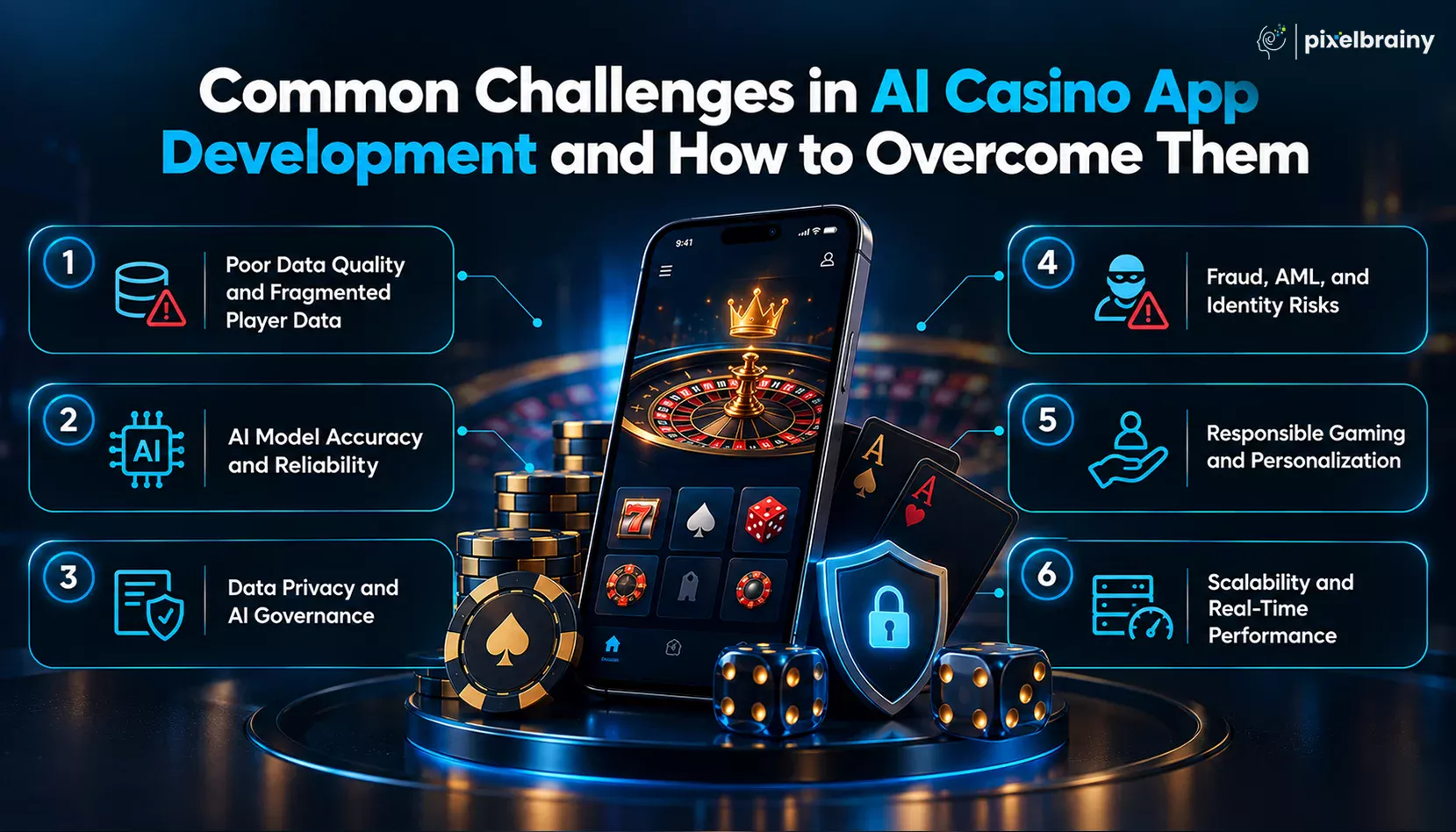
AI models require reliable and well-structured data. Legacy casino platforms may store player, loyalty, game, transaction, and behavioral data across disconnected systems.
How to overcome it: Build a unified data architecture, clean historical records, establish consistent player IDs, and create controlled data pipelines before deploying AI models.
A recommendation, churn, or fraud model can produce inaccurate results when training data is incomplete, outdated, or poorly labeled.
How to overcome it: Start with clearly defined AI objectives, validate models using relevant datasets, monitor performance continuously, and maintain human review for important decisions. The UK Gambling Commission has specifically highlighted the need for operators to understand how AI and algorithmic AML controls work and ensure they are implemented effectively.
AI casino apps can process sensitive behavioral, transactional, and identity-related information. Poor data practices can create privacy and regulatory risks.
How to overcome it: Apply data minimization, access controls, encryption, clear processing purposes, audit trails, and appropriate governance. In European markets, GDPR and AI governance requirements can also affect profiling, automated decisions, and transparency.
Modern AI creates opportunities for fraud detection, but it can also make certain attacks more sophisticated. The UK Gambling Commission's 2026 assessment highlights AI-generated false documents, deepfakes, and face swaps as emerging challenges for remote gambling KYC and AML controls.
How to overcome it: Combine AI risk scoring with rules-based controls, identity verification, transaction monitoring, device intelligence, and trained human review.
Personalization can improve player discovery and engagement, but poorly designed AI could cross the line from useful personalization into harmful targeting. Current iGaming guidance emphasizes human oversight and careful separation between personalization and manipulation.
How to overcome it: Build responsible gaming controls directly into AI workflows and prevent models from targeting vulnerable players with potentially harmful incentives.
AI casino platforms may need to process large volumes of player events, game activity, transactions, and recommendations simultaneously.
How to overcome it: Use scalable cloud infrastructure, caching, event-driven architecture, load testing, monitoring, and modular services so individual components can scale independently.
Therefore, overcoming data, AI, security, scalability, and responsible gaming challenges early can help businesses build a more reliable, compliant, and production-ready AI casino app.
From the challenges, technology decisions, cost considerations, and compliance requirements discussed above, the next step is choosing the right technology partner. For a casino business, the ideal partner should understand not only AI but also player data, personalization, virtual economies, security, scalability, integrations, and responsible gaming requirements.
PixelBrainy as a leading AI app development company helps businesses turn these requirements into scalable AI-powered digital products with a focus on practical business outcomes.
PixelBrainy provides AI casino app development services designed around the specific requirements of casino operators, gaming businesses, and emerging digital gaming brands.
The team can help businesses build AI casino app solutions with capabilities such as AI-powered game recommendations, player segmentation, predictive analytics, fraud detection, personalized experiences, loyalty integration, AI customer support, and responsible gaming intelligence.
Rather than treating AI as an isolated feature, the approach focuses on integrating intelligence into the wider casino ecosystem, including CRM, player accounts, analytics, game providers, virtual currency, and administrative systems.
Whether a business wants develop AI casino app from scratch or modernize an existing casino platform, PixelBrainy can support different stages of the product journey.
The engagement can include product discovery, technical consultation, UI/UX design, AI architecture, backend development, mobile application development, API integrations, AI model implementation, testing, deployment, and post-launch optimization.
This approach is particularly relevant for businesses that want to create AI casino app capabilities while maintaining continuity with their existing player database and technology ecosystem.
A casino business approached PixelBrainy with an existing mobile platform that had been operating without advanced AI capabilities. The client wanted to improve player engagement through personalized game recommendations, behavioral insights, fraud detection, and smarter loyalty experiences while preserving its existing player accounts and virtual currency structure.
Because the project involved confidential business and player information, the client name and sensitive performance data cannot be disclosed.
PixelBrainy's team focused on modernizing the application architecture, establishing AI-ready data flows, integrating intelligent recommendation capabilities, and connecting the new services with the existing casino ecosystem. The implementation was designed around a phased approach to reduce disruption and provide a foundation for future AI capabilities.
This type of engagement demonstrates how making an AI casino app can involve much more than adding AI features. The underlying architecture, data strategy, integrations, security, scalability, and long-term product roadmap all influence the final outcome.
Businesses evaluating an AI casino technology partner can work with PixelBrainy for:
Ready to Discuss Your AI Casino App?
Connect with PixelBrainy to discuss your casino app idea, AI requirements, technology roadmap, and development scope.

AI is becoming an important technology for casino businesses looking to deliver more personalized, secure, and data-driven digital experiences. From AI-powered game recommendations and predictive player analytics to fraud detection, loyalty optimization, and responsible gaming, the opportunities extend far beyond simply adding AI to a casino app.
However, successful AI casino app development requires the right combination of business strategy, technology, data architecture, AI models, security, scalability, and regulatory compliance. Businesses planning to build an AI casino app should carefully evaluate their target market, development budget, technology stack, business model, and long-term product roadmap before starting development.
Whether you want to develop an AI casino app from scratch or modernize an existing casino platform, choosing an experienced development partner can help turn complex requirements into a scalable and production-ready solution.
With the right approach, AI can become a practical intelligence layer that improves player experiences while supporting stronger operational efficiency and responsible gaming.
Ready to turn your AI casino app idea into a scalable solution? Book an appointment with PixelBrainy today.
Businesses can build an AI casino app by modernizing their existing platform rather than replacing every component. AI services can be connected to player profiles, CRM, game activity, loyalty systems, analytics, and virtual currency through APIs. The approach depends on the existing architecture, database quality, integrations, and scalability requirements.
The cost to develop an AI casino app typically ranges from $40,000 to $300,000+, with an average budget of around $100,000 to $150,000 for a mid-level AI casino application. The final cost depends on the number of games, AI capabilities, backend architecture, integrations, security, mobile platforms, compliance requirements, and expected player volume.
To develop AI casino app features for retention, businesses can use recommendation engines, player segmentation, churn prediction, personalized content, loyalty intelligence, and behavioral analytics. AI should identify relevant player preferences and improve discovery rather than simply sending more promotions. The effectiveness of each feature should be measured through controlled testing and appropriate player-protection safeguards.
To create AI casino app solutions that can support large player volumes, businesses typically need scalable cloud infrastructure, high-performance backend services, databases, caching, event streaming, APIs, AI/ML frameworks, monitoring, and secure payment and identity integrations. A modular architecture makes it easier to scale individual services without rebuilding the entire platform.
AI integration adds additional requirements for data pipelines, model development, real-time inference, monitoring, privacy, security, and model governance. Businesses should determine AI use cases during the planning stage rather than adding them after the core application is completed. This helps ensure the architecture can support personalized recommendations, fraud detection, predictive analytics, and other AI capabilities.
Yes, AI casino app development can support different business models, including social casino applications using virtual currency and licensed real-money casino platforms. However, real-money gaming introduces additional requirements involving licensing, KYC, AML, payments, geolocation, age verification, responsible gaming, and jurisdiction-specific compliance.
When selecting an AI casino app development company, businesses should evaluate its experience with AI models, casino platforms, player-data migration, game integrations, virtual currency, security, scalability, and responsible gaming. Ask vendors how their personalization models work, how AI performance is measured, what integrations are included, and how the platform will be maintained after launch.
The time required to develop an AI casino app from scratch depends on the application's scope. A basic MVP can be delivered faster than an enterprise platform requiring multiple games, custom AI models, CRM and payment integrations, advanced security, compliance workflows, and high-concurrency infrastructure. A technical discovery phase is recommended before committing to a development timeline.

About The Author
Sagar Bhatnagar
Sagar Sahay Bhatnagar brings over a decade of IT industry experience to his role as Marketing Head at PixelBrainy. He's known for his knack in devising creative marketing strategies that boost brand visibility and market influence. Sagar's strategic thinking, coupled with his innovative vision and focus on results, sets him apart. His track record of successful campaigns proves his ability to utilize digital platforms effectively for impactful marketing efforts. With a genuine passion for both technology and marketing, Sagar continuously pushes PixelBrainy's marketing initiatives to greater success.

Working with PixelBrainy has been a great experience. They took our vision for an AI-powered platform and turned it into a fully functional product. What impressed me most was their strong understanding of both design and development, and their ability to handle complex requirements with ease. The team was responsive, cooperative, and always open to feedback. They kept things organized, communicated clearly, and delivered quality work on time. I highly recommend PixelBrainy to anyone looking for a skilled and reliable development partner.

Working with the PixelBrainy team has been a highly positive experience. They understand the design requirements and create beautiful UX elements to meet the application needs. The dev team did an excellent job bringing my vision to life. We discussed usability and flow. Sagar worked with his team to design the database and begin coding. Working with Sagar was easy. He has the knowledge to create robust apps, including multi-language support, Google and Apple ID login options, Ad-enabled integrations, Stripe payment processing, and a Web Admin site for maintaining support data. I'm extremely satisfied with the services provided, the quality of the final product, and the professionalism of the entire process. I highly recommend them for Android and iOS Mobile Application Design and Development.

Great experience working with them. Had a lot of feedback and I found that unlike most contractors they were bugging me for updates instead of the other way around. They were extremely time conscience and great at communicating! All work was done extremely high quality and if not on time, early! They were always proactive when it comes to communication and the work is great/above par always. Very flexible and a great team to work with! Goes above and beyond to present us with multiple options and always provides quality. Amazing work per usual with Chitra. If you have UI/UX or branding design needs I recommend you go to them! Will likely work with them in the future as well, definitely recommended!

PixelBrainy is a joy to work with and is a great partner when thinking through branding, logo, and website layout. I appreciate that they spend time going into the "why" behind their decisions to help inform me and others about industry best practices and their expertise.

I hired them to design our software apps. Things I really like about them are excellent communication skills, they answer all project suggestions and collaborate right away, and their input on design and colors is amazing. This project was complex and needed patience and creativity. The team is amazing to do business with. I will be using them long-term. Glad to see there are some good people out there. I was afraid to try and outsource my project to someone but I am glad I met them! I really can't say enough. They went above and beyond on this project. I am very happy with everything they have done to make my business stand out from the competition.

It was great working with PixelBrainy and the team. They were very responsive and really owned the project. We'll definitely work with them again!

I recently worked with the PixelBrainy team on a project and I was blown away by their communication skills. They were prompt, clear, and articulate in all of our interactions. They listened and provided valuable feedback and suggestions to help make the project a success. They also kept me updated throughout the entire process, which made the experience stress-free and enjoyable.

PixelBrainy is very good at what it does. The team also presents themselves very professionally and takes care of their side of things very well. I could fully trust them taking up the design work in a timely and organised manner and their attention to detail saved us lots of effort and time. This particular project was quite intense and the team showed that they function very well under pressure. Very much looking forward to working with her again!

It's always an absolute pleasure working with them. They completed all of my requests quickly and followed every note I had for them to a T, which made our process go smoothly from start to finish. Everything was completed fast and following all of the guidelines. And I would recommend their services to anyone. If you need any design work done in the future, PixelBrainy should be your first call!

They took ownership of our requirements and designed and proposed multiple beautiful variants. The team is self-motivated, requires minimum supervision, committed to see-through designs with quality and delivering them on time. We would definitely love to work with PixelBrainy again when we have any requirements.

PixelBrainy was a big help with our SaaS application. We've been hard at work with a new UI/UX and they provided a lot of help with the designs. If you're looking for assistance with your website, software, or mobile application designs, PixelBrainy and the team is a great recommendation.

PixelBrainy designers are amazing. They are responsive, talented, and always willing to help craft the design until it matches your vision. I would recommend them and plan to continue them for my future projects and more!!!

They were awesome! Did a good job fast, and good communication. Will work with them again. Thank you

Creative, detail-oriented, and talented designers who take direction well and implement changes quickly and accurately. They consistently over-delivered for us.

PixelBrainy team is very talented and creative. Great designers and a pleasure to work with. PixelBrainy is an excellent communicator and I look forward to working with them again.

PixelBrainy has a very talented design team. Their work is excellent and they are very responsive. I enjoy working with them and hope to continue on all of our future projects.


Transform your ideas into reality with us.
Across these industries, each engagement brings unique challenges, from early-stage product development to scaling complex systems, helping us build a practical understanding of real-world product environments.