AI Summary Powered by PixelBrainy
What if your enterprise could validate the power of AI chatbots without committing to full-scale implementation or high upfront risk?
This is exactly where an AI Chatbot Proof of Concept (PoC) for Enterprises becomes a game-changer.
As organizations across industries accelerate their digital transformation journeys, AI chatbots are emerging as critical tools for enhancing customer experience, streamlining internal operations, and improving decision-making. However, moving directly from idea to enterprise-wide deployment often leads to unexpected costs, integration challenges, and unmet expectations. This is why PoC development for AI chatbot initiatives has become an essential first step for modern enterprises.
An enterprise AI chatbot PoC development approach allows businesses to test feasibility, validate real-world use cases, and measure business impact in a controlled, low-risk environment. Whether you are exploring how to create an AI chatbot PoC for customer support, HR automation, IT helpdesks, sales enablement, or knowledge management, a PoC helps transform assumptions into actionable insights.
Industries such as banking and financial services, healthcare, retail, manufacturing, SaaS, logistics, and telecommunications are increasingly adopting this approach to evaluate AI readiness before scaling. By developing an AI chatbot PoC, enterprises can assess data quality, model accuracy, system integration, compliance requirements, and user adoption early in the journey.
This blog walks you through the development process of an AI chatbot PoC, from conceptualization to impact assessment, helping enterprise leaders, product managers, and technology teams move confidently from idea to measurable business value.
An AI Chatbot Proof of Concept (PoC) is a focused, early-stage implementation created to validate whether an AI chatbot can effectively solve a specific business problem within an enterprise environment. Instead of building a full-scale solution, a PoC helps organizations test technical feasibility, data readiness, and potential business value using a limited scope and controlled setup.
In enterprise AI chatbot PoC development, this approach allows teams to evaluate how well the chatbot understands user intent, retrieves accurate information, integrates with existing enterprise systems, and meets performance expectations. It also helps identify risks related to data security, privacy, compliance, and future scalability at an early stage.
Unlike prototypes or MVPs, an AI chatbot PoC is not designed for production use. Its primary objective is learning and validation. The insights gained during the PoC phase guide architectural decisions, technology selection, and roadmap planning, enabling enterprises to move forward with confidence and clarity.
To clearly understand how an enterprise AI chatbot PoC works, it helps to break the architecture into logical layers. This layered approach keeps the PoC simple, testable, and aligned with real enterprise systems while avoiding unnecessary complexity.
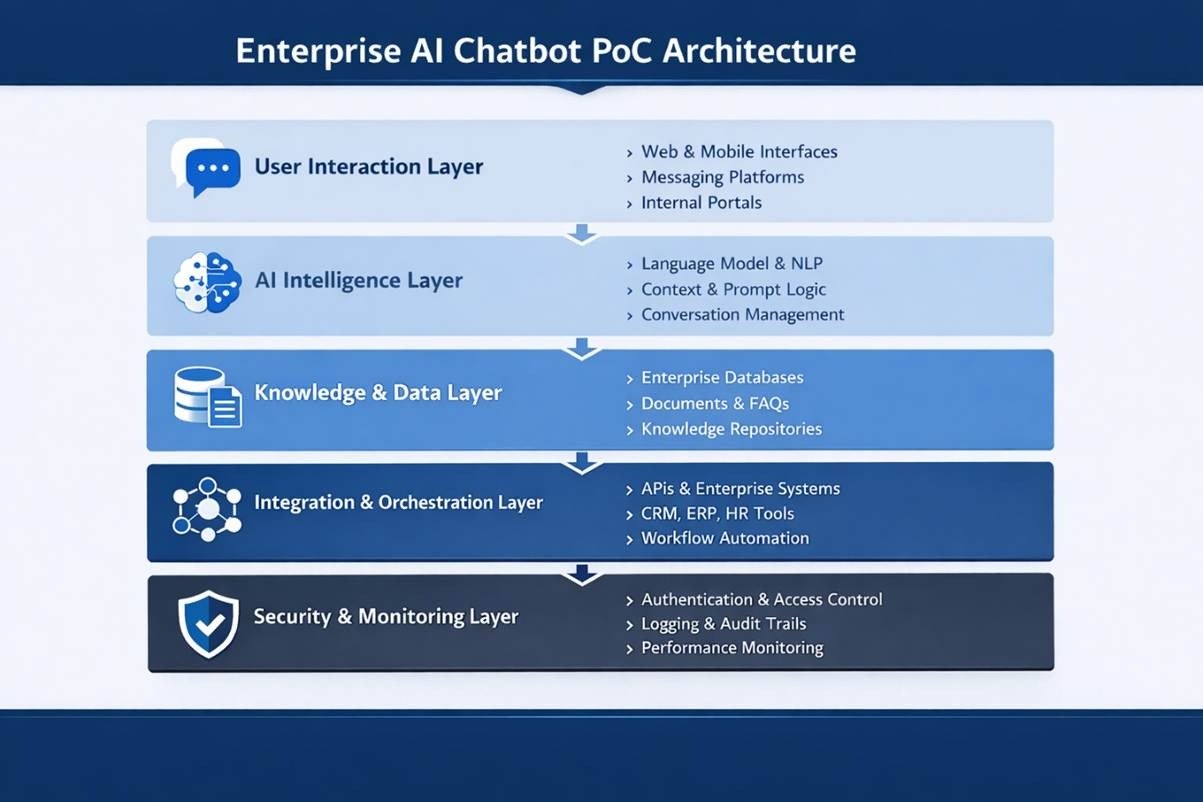
This is the entry point where users interact with the chatbot.
Its primary role is to capture user queries and display chatbot responses in a user-friendly way.
This layer powers the chatbot’s reasoning and response generation.
This layer determines how accurately the chatbot understands user questions.
Enterprise chatbots rely heavily on trusted internal data.
Access controls are applied to ensure users only receive authorized information.
This layer connects the chatbot to enterprise systems.
It enables real-world task execution and data retrieval.
Security is essential even at the PoC stage.
This ensures compliance and helps evaluate enterprise readiness.
This structured architecture allows enterprises to test feasibility, performance, and integration capabilities effectively before moving toward full-scale deployment.
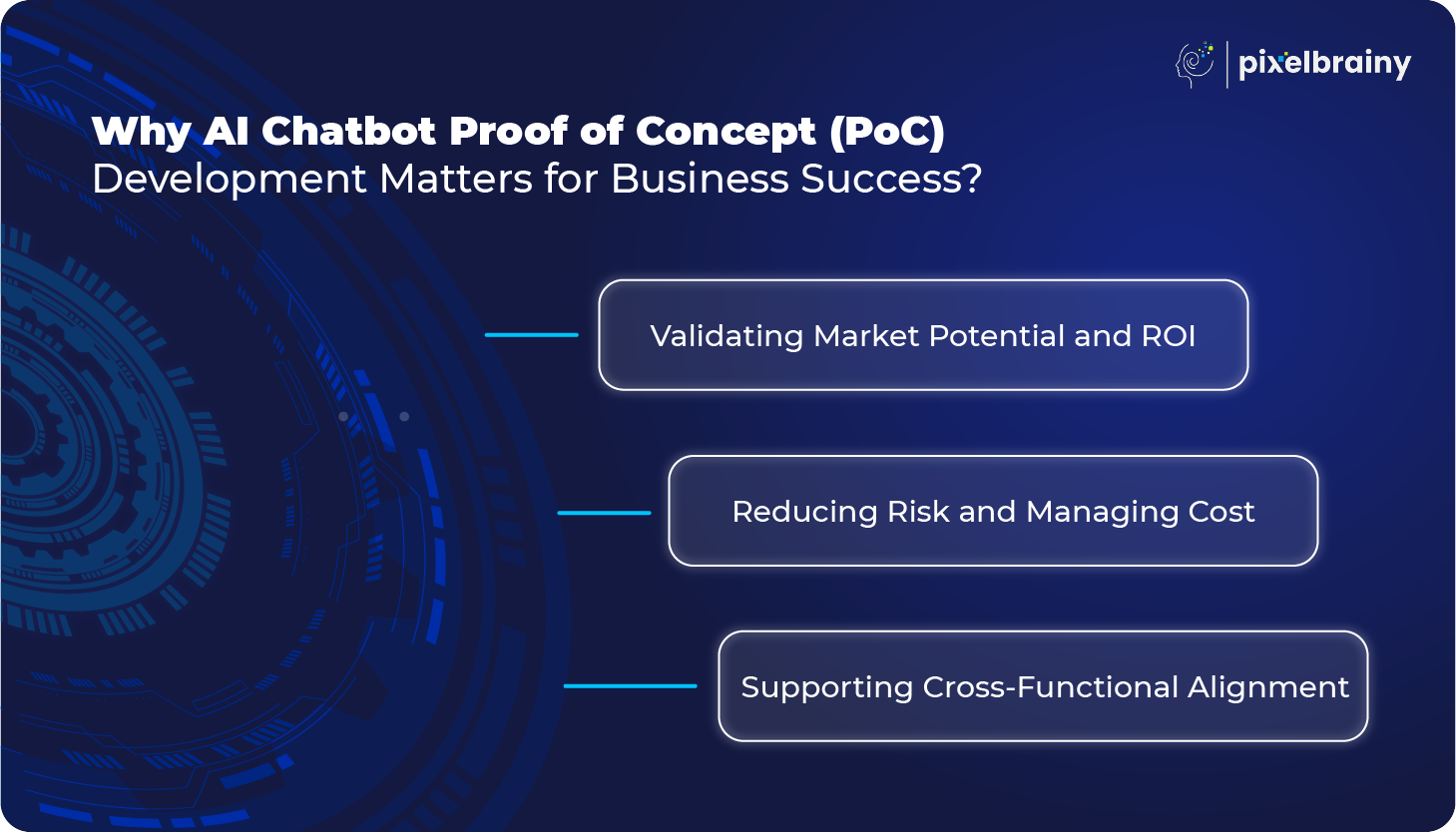
Before investing significant time and resources into enterprise-wide deployments, businesses need a clear understanding of how PoC development for AI chatbot initiatives will drive real-world value. An AI Chatbot Proof of Concept (PoC) for Enterprises helps validate assumptions, reduce risk, and deliver measurable outcomes that support strategic decision-making.
The AI chatbot market is experiencing rapid growth and adoption, making it one of the most important technologies for enterprises to explore now. In 2025, the global AI chatbot market is valued between $10 billion and $15 billion, with projections suggesting it could reach $46–47 billion by 2029, growing at a compound annual growth rate (CAGR) of 24–30%.
These figures underscore the urgency of early experimentation through PoC initiatives. A PoC allows organizations to test use cases with minimal investment and validate expected returns before scaling, helping ensure that business goals align with technological outcomes.
Large enterprise AI deployments often fail due to unclear objectives, integration issues, or data challenges. A PoC allows teams to uncover potential hurdles in the development process of AI chatbot PoC, including data quality, integration with legacy systems, compliance constraints, and user experience.
By identifying and addressing these risks early, enterprises save time and budget that might otherwise have been spent on solutions that don’t perform as expected.
An AI chatbot PoC provides a concrete demonstration of capabilities, enabling business leaders, IT teams, and stakeholders across departments to align on viability and priorities. By engaging stakeholders early, enterprises can refine success criteria, establish measurable KPIs, and pave the way for smoother full-scale deployments.
Investing in AI chatbot PoC development is not just optional; it is a strategic step that lays the foundation for successful, scalable AI transformation.
When enterprises begin AI Chatbot Proof of Concept (PoC) development, the real value emerges when chatbots are applied to problems that are repetitive, high-volume, and business-critical.
Below are high-impact use cases where enterprise AI chatbot PoC development consistently demonstrates measurable value, supported by real-world examples and structured insights.
Business Problem Addressed: Enterprises often struggle with rising customer support volumes, long response times, and high operational costs, especially across global time zones.
How AI Chatbot PoC Delivers Value:
Real-World Example: Global retail, travel, and telecom companies deploy AI chatbots as the first line of support. For example, airlines use chatbots to answer booking, cancellation, and baggage inquiries, significantly reducing call center loads and improving response time consistency.
PoC Validation Metrics:
AI chatbot PoCs for customer support validate cost savings and service quality before full-scale rollout.
Business Problem Addressed: Traditional lead forms often result in delayed responses, unqualified leads, and missed revenue opportunities.
How AI Chatbot PoC Delivers Value:
Real-World Example: SaaS and real estate enterprises use AI chatbots to qualify prospects by budget, use case, and purchase timeline. This enables sales teams to focus on high-value opportunities instead of cold leads.
PoC Validation Metrics:
Developing an AI chatbot PoC for sales proves its impact on revenue acceleration early.
Business Problem Addressed: HR teams face constant interruptions due to repetitive employee queries about policies, benefits, onboarding, and leave management.
How AI Chatbot PoC Delivers Value:
Real-World Example: Large enterprises deploy internal HR chatbots that guide employees through onboarding steps, benefits enrollment, and company policies, improving employee experience while reducing HR workload.
PoC Validation Metrics:
An HR-focused AI chatbot PoC enhances internal efficiency and employee engagement.
Also Read: AI HR Software Development: Top Benefits and Features
Business Problem Addressed: Generic digital shopping experiences lead to low engagement and abandoned carts.
How AI Chatbot PoC Delivers Value:
Real-World Example: E-commerce and retail brands use AI chatbots to act as virtual shopping assistants, recommending products based on user needs, skin type, style, or budget.
PoC Validation Metrics:
AI chatbot PoCs demonstrate how personalization directly impacts sales performance.
Business Problem Addressed: IT teams are overwhelmed by routine internal requests such as password resets, access issues, and ticket tracking.
How AI Chatbot PoC Delivers Value:
Real-World Example: Large enterprises deploy IT helpdesk chatbots to resolve common issues instantly, reducing downtime and freeing IT teams to focus on complex infrastructure tasks.
PoC Validation Metrics:
IT-focused AI chatbot PoCs validate operational efficiency and scalability.
By targeting high-impact use cases, AI chatbot PoC development enables enterprises to move from experimentation to measurable business value with confidence.
When developing an AI chatbot PoC, selecting the right features is critical to accurately evaluate feasibility, performance, and business impact. At the PoC stage, features should focus on validating real enterprise needs rather than delivering a fully polished product. A well-designed enterprise AI chatbot PoC development approach ensures that the chatbot demonstrates value, scalability potential, and integration readiness.
The table below outlines the key features to consider while developing an AI chatbot PoC, along with their purpose and enterprise relevance.
| Feature | Purpose |
| Natural Language Understanding (NLU) | Enables the chatbot to understand user intent, variations in phrasing, and contextual meaning. It helps evaluate how accurately the chatbot interprets real enterprise queries. Strong NLU is critical for user trust and adoption. |
| Context Management | Allows the chatbot to remember previous interactions within a conversation. This ensures coherent, multi-turn conversations rather than isolated responses. It improves usability in complex enterprise workflows. |
| Enterprise Data Access | Connects the chatbot to internal documents, databases, and knowledge repositories. This feature validates whether the chatbot can provide accurate, organization-specific answers. It is essential for enterprise relevance. |
| Role-Based Access Control | Restricts information access based on user roles and permissions. It ensures sensitive enterprise data is protected. This feature validates compliance and governance requirements. |
| Retrieval-Augmented Generation (RAG) | Enhances AI responses by grounding them in enterprise data sources. It significantly reduces hallucinations and improves response accuracy. RAG is vital for knowledge-driven chatbot use cases. |
| Integration with Enterprise Systems | Enables connectivity with CRM, ERP, HR, and ticketing platforms. This allows the chatbot to perform actions and retrieve live data. It demonstrates automation potential during the PoC stage. |
| Scalability Readiness | Tests how the chatbot performs under increased usage and data load. It helps identify future infrastructure and performance requirements. This ensures smoother transition to production. |
| Multi-Channel Support | Allows chatbot access via web apps, internal portals, or messaging platforms. It helps evaluate adoption across different user touchpoints. This is especially important for distributed enterprises. |
| Prompt Engineering Strategy | Defines structured prompts that guide AI responses consistently. It improves accuracy, tone control, and reliability. This feature is critical for predictable enterprise interactions. |
| Fallback and Escalation Handling | Manages scenarios where the chatbot cannot resolve queries. It routes users to human agents or alternative support channels. This maintains reliability and user confidence. |
| Security and Compliance Controls | Implements authentication, encryption, logging, and audit trails. It ensures the chatbot aligns with enterprise security standards. This is essential even at the PoC stage. |
| Analytics and Reporting | Tracks chatbot usage, response accuracy, and engagement patterns. It provides measurable insights into PoC performance. These metrics support go or no-go decisions. |
| User Feedback Collection | Gathers feedback directly from users interacting with the chatbot. This helps identify usability gaps and improvement areas. User input is key to refining chatbot behavior. |
| Multilingual Support | Enables the chatbot to handle multiple languages effectively. It is critical for global enterprises serving diverse user bases. This feature tests language accuracy and consistency. |
| Custom Business Logic | Incorporates enterprise-specific rules, workflows, and decision logic. It ensures the chatbot aligns with real operational processes. This feature validates practical applicability. |
Incorporating these features into AI chatbot PoC development helps enterprises assess readiness, minimize risk, and build a clear roadmap for successful AI deployment.
Understanding what is the process of developing an AI Chatbot PoC is critical for enterprises aiming to move from experimentation to measurable impact. A structured, step-by-step approach ensures that AI Chatbot Proof of Concept (PoC) Development for Enterprises remains focused, cost-effective, and aligned with real business goals.
Below is a proven framework used in enterprise AI chatbot PoC development initiatives.
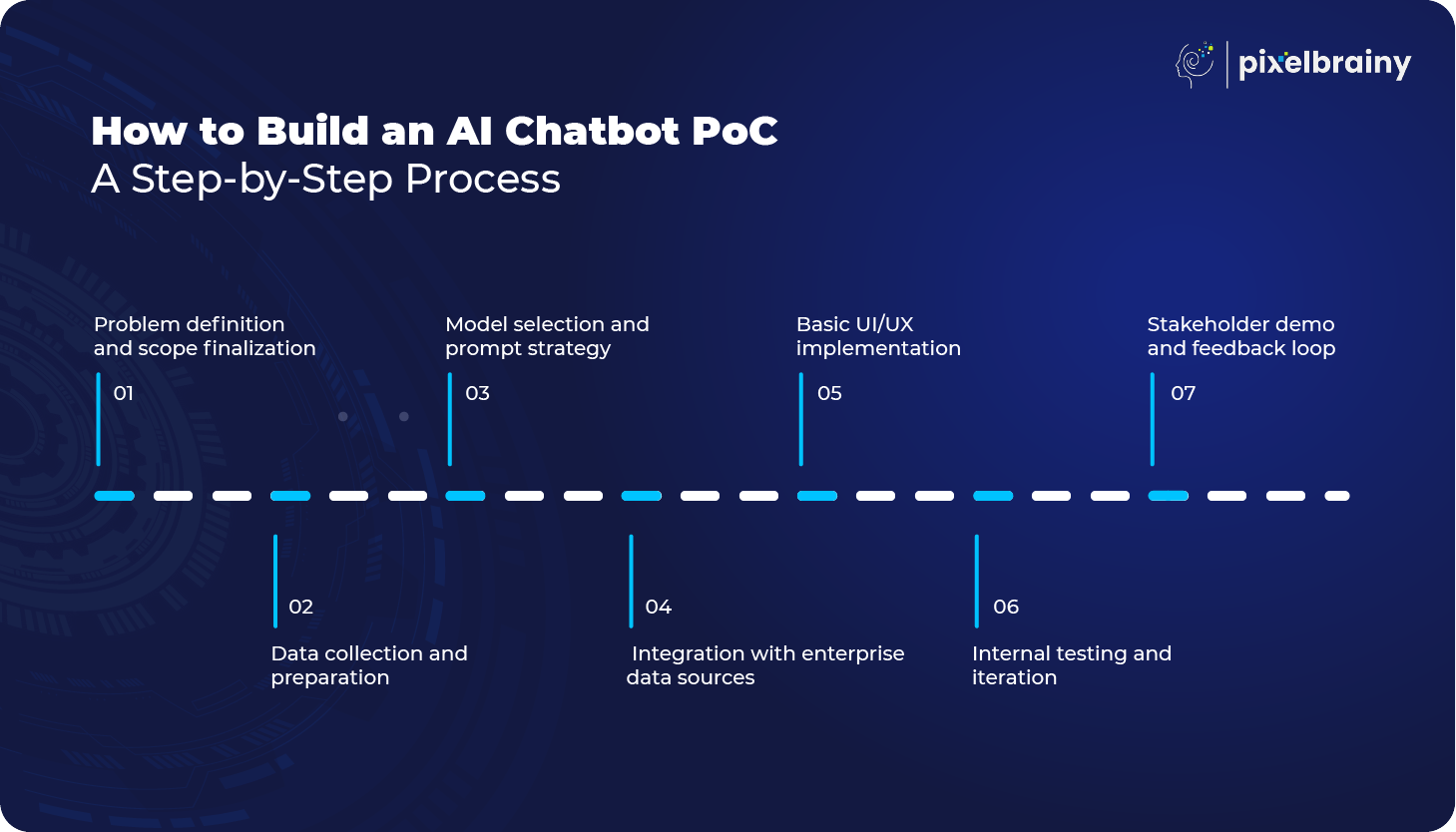
Aim / Goal: Clearly identify the business problem the chatbot is expected to solve with guidance from an AI consulting company.
This step defines the foundation of AI Chatbot PoC Development for enterprises. Enterprises must identify a specific, high-impact problem such as customer support overload, HR query volume, or IT helpdesk inefficiency. Clear boundaries are set around what the chatbot will and will not handle, avoiding scope creep. Stakeholders align on success criteria, KPIs, timelines, and constraints.
This clarity ensures teams know exactly what to create an AI Chatbot PoC for and prevents wasted effort on non-essential features. A well-defined scope makes evaluation straightforward and outcomes measurable.
Aim / Goal: Ensure the chatbot is trained and tested on accurate, relevant enterprise data.
Data quality directly impacts chatbot performance. In this phase, enterprises identify and collect structured and unstructured data such as FAQs, documents, policies, and databases. Data is cleaned, organized, and prepared to remove inconsistencies and outdated information. Proper tagging and formatting ensure smooth retrieval during interactions.
This step is critical for building an AI Chatbot PoC that delivers meaningful and reliable responses instead of generic outputs. Early data preparation also exposes gaps that must be addressed before scaling.
Aim / Goal: Choose the right AI model and guide it to behave predictably.
Enterprises evaluate AI models based on accuracy, latency, cost, and data privacy requirements. Prompt strategy is designed to control tone, structure responses, and reduce hallucinations. This step ensures the chatbot aligns with enterprise communication standards and business intent.
Many AI development companies focus heavily on this stage because prompt quality often determines PoC success. The goal is not perfection, but consistent, explainable behavior that stakeholders can evaluate with confidence.
Aim / Goal: Connect the chatbot to real enterprise systems for practical validation through AI integration.
To prove real value, the chatbot must interact with live enterprise data sources such as CRMs, ERPs, knowledge bases, or ticketing systems. Secure APIs and access controls are implemented to protect sensitive information.
This step validates whether the chatbot can function within existing enterprise ecosystems. Integration is often where PoC development reveals technical or governance challenges early, saving significant cost during production rollout.
Aim / Goal: Enable realistic user interaction for testing and feedback.
A simple yet functional interface is created so users can interact naturally with the chatbot. This may involve web interfaces, internal portals, or messaging tools, often supported by a specialized UI/UX design company.
The goal is usability, not polish. A basic interface helps assess user behavior, adoption patterns, and interaction flow, providing insights that purely backend testing cannot deliver.
Aim / Goal: Improve accuracy, reliability, and performance through controlled testing.
Internal users test the chatbot with real scenarios, edge cases, and unexpected queries. Feedback is analyzed to refine prompts, data retrieval, and response logic. Performance metrics such as response time, accuracy, and fallback handling are measured. Iterative improvements at this stage strengthen the PoC and prepare it for stakeholder evaluation.
This phase often differentiates enterprise-ready solutions from experimental demos used by Top AI chatbot development companies in USA.
Aim / Goal: Validate business value and decide next steps.
The chatbot PoC is demonstrated to business leaders, IT teams, and decision-makers using real use cases and metrics. Feedback is collected to assess alignment with business goals and user expectations.
This step supports go, no-go, or iterate decisions and forms the basis for scaling discussions. It ensures leadership confidence before moving toward full deployment.
A structured, step-by-step approach ensures AI chatbot PoC development moves enterprises from concept to confident decision-making with minimal risk and maximum clarity.
For enterprises evaluating early AI initiatives, understanding what is the cost to create an AI Chatbot PoC is essential for planning and approvals. The AI Chatbot PoC Development cost typically ranges between $5,000 and $20,000, depending on the scope and technical depth of the PoC.
| PoC Complexity Level | What’s Included | Estimated Cost |
| Basic AI Chatbot PoC | Single use case, limited data, minimal integrations | $5,000 – $8,000 |
| Standard Enterprise PoC | Multiple intents, enterprise data access, basic security | $8,000 – $14,000 |
This range reflects the most common cost of building an AI Chatbot PoC across enterprise environments.
The final cost estimation for AI Chatbot PoC development depends on several key factors:
Each added requirement increases effort and impacts the development budget of AI Chatbot PoC.
A typical AI Chatbot PoC Development cost includes:
Infrastructure and maintenance costs remain minimal since PoCs are not production deployments.
A well-planned AI chatbot PoC within the $5,000–$20,000 range delivers high learning value while keeping enterprise AI investment controlled and strategic.
Also Read: AI Chatbot Development Cost: Factors and Examples
Selecting the right technology stack is a critical step in AI Chatbot PoC Development for Enterprises. The tech stack determines how efficiently the chatbot can be built, how well it integrates with enterprise systems, and how easily it can scale after PoC validation. At this stage, the focus should be on flexibility, speed of development, security, and ease of evaluation rather than long-term optimization.
Below is a structured overview of the recommended tech stack for AI chatbot PoC development, with clear explanations for each layer.
| Layer | Technology Options | Explanation |
| User Interface Layer | Web apps, internal portals, chat widgets | Provides the interaction point for users to communicate with the chatbot. At PoC stage, the interface should be simple and functional to test usability and adoption. |
| Backend Framework | Python, Node.js | Handles request processing, orchestration logic, and integrations. These frameworks are widely used due to flexibility, speed, and strong AI ecosystem support. |
| AI / LLM Layer | OpenAI, Azure OpenAI, open-source LLMs | Powers natural language understanding and response generation. Model choice depends on accuracy needs, data privacy, latency, and cost considerations. |
| Prompt & Orchestration Layer | LangChain, custom logic | Manages prompt flows, conversation logic, and multi-step reasoning. This layer helps control responses and improve consistency during PoC evaluation. |
| Data Retrieval Layer | Vector databases, semantic search | Enables retrieval of relevant enterprise information for accurate responses. This is essential for knowledge-based chatbot PoCs. |
| Enterprise Data Sources | Documents, databases, APIs | Includes internal knowledge bases, policies, CRM data, or FAQs. The PoC validates how well the chatbot uses real enterprise data. |
| Integration Layer | REST APIs, middleware | Connects the chatbot with enterprise systems such as CRM, ERP, HR, or ticketing tools. Integration proves real operational value. |
| Authentication & Access Control | OAuth, SSO, role-based access | Ensures only authorized users access sensitive information. This is crucial for enterprise security validation even at PoC stage. |
| Monitoring & Logging | Basic analytics, logs | Tracks chatbot usage, errors, and performance. This data supports evaluation and optimization decisions. |
| Cloud Infrastructure | AWS, Azure, GCP | Provides scalable and secure hosting for PoC deployment. Cloud platforms enable quick setup and controlled costs. |
A well-chosen tech stack accelerates development, reduces technical risk, and ensures the PoC closely reflects real enterprise environments. It also simplifies the transition from PoC to production by avoiding major architectural rework later.
Choosing the right foundation during AI chatbot PoC development ensures faster validation, better insights, and a smoother path to enterprise-scale deployment.
Once an AI Chatbot Proof of Concept (PoC) is implemented, enterprises must evaluate its outcomes to decide whether to scale, iterate, or stop. This evaluation goes beyond technical performance and focuses on measurable business impact, stakeholder alignment, and long-term feasibility. A structured evaluation framework ensures objective decision-making and avoids subjective bias.
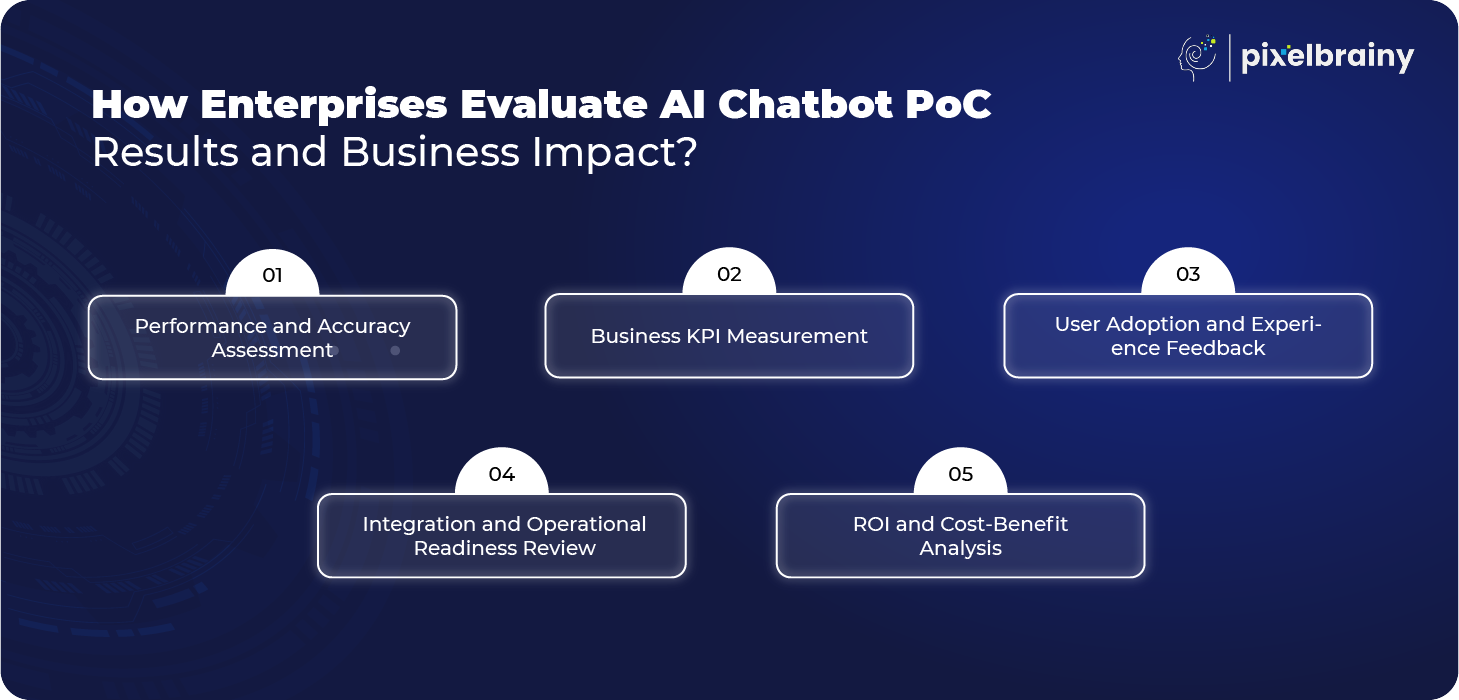
Enterprises first analyze how well the chatbot performs against defined benchmarks. This includes response accuracy, intent recognition success, relevance of answers, and latency. Metrics such as resolution rate, fallback frequency, and error handling effectiveness are reviewed. Strong performance indicates that the chatbot can handle real enterprise queries reliably.
Business impact is evaluated by mapping chatbot outcomes to predefined KPIs. These may include reduction in support tickets, faster response times, cost savings, lead qualification improvement, or employee productivity gains. Enterprises assess whether the PoC delivers tangible value aligned with original business objectives.
User interaction data and qualitative feedback play a critical role. Enterprises analyze engagement rates, repeat usage, and satisfaction feedback from employees or customers. Positive adoption signals usability and relevance, while friction points highlight areas for refinement before scaling.
Technical teams evaluate how smoothly the chatbot integrates with enterprise systems and workflows. This includes stability, security controls, data access governance, and operational complexity. Any integration challenges uncovered during the PoC inform architectural improvements.
Enterprises compare the PoC investment against achieved outcomes to estimate potential return on investment at scale. This analysis supports go, no-go, or iterate decisions and helps build a data-backed business case for full deployment.
By combining performance metrics, business KPIs, user feedback, and ROI analysis, enterprises can confidently determine whether an AI chatbot PoC delivers real business impact and is ready for scale.
Transitioning from AI Chatbot Proof of Concept (PoC) Development for Enterprises to a full-scale deployment requires a carefully planned execution strategy. While a PoC focuses on validation and learning, production deployment demands stability, scalability, security, and measurable business outcomes.
The following steps outline how enterprises can systematically move from a successful PoC to enterprise-wide implementation.
The first step is to formally evaluate the PoC results against the original business and technical objectives. Enterprises review chatbot accuracy, performance metrics, user engagement levels, and feedback collected during the PoC phase. This validation confirms whether the chatbot delivered meaningful value in real-world scenarios.
At the same time, leadership teams assess alignment with broader business goals. This includes reviewing KPIs such as cost reduction, productivity gains, or service improvements. Any gaps or limitations identified during this evaluation are documented to guide the next phase of development.
After PoC approval, enterprises redefine the scope for full-scale deployment. This involves deciding which additional use cases, departments, or customer segments the chatbot should support. Prioritization is critical to ensure focus remains on high-impact areas.
Clear functional requirements, success metrics, and service expectations are documented during this stage. By refining scope early, enterprises avoid uncontrolled expansion and ensure that scaling efforts remain aligned with strategic objectives.
PoC architectures are not designed for enterprise-scale usage. In this step, teams enhance infrastructure to support increased traffic, concurrent users, and larger data volumes. Load balancing, performance optimization, and high-availability mechanisms are introduced.
Scalability testing is conducted to identify potential bottlenecks before deployment. This ensures the chatbot remains responsive and reliable as adoption grows across the organization.
As the chatbot moves into production, security and compliance requirements become more stringent. Enterprises implement robust authentication methods, role-based access controls, and data encryption to protect sensitive information.
Governance frameworks are also established to manage data usage, model updates, and audit requirements. This step ensures the chatbot operates within regulatory and organizational guidelines while maintaining trust among users.
At this stage, the chatbot is deeply integrated with core enterprise systems such as CRM, ERP, HR platforms, or IT service tools. These integrations enable the chatbot to execute workflows, retrieve real-time data, and trigger actions.
Automation logic is refined to ensure smooth interaction between systems. This step transforms the chatbot from a simple conversational tool into a fully functional operational asset.
Successful deployment depends on user adoption. Enterprises develop training programs, documentation, and communication plans to introduce the chatbot to employees or customers.
Change management efforts address concerns, clarify limitations, and promote best practices. This step ensures users understand how to interact with the chatbot effectively, increasing adoption and long-term success.
After deployment, enterprises continuously monitor chatbot performance, usage patterns, and business impact. Analytics and feedback are used to identify improvement opportunities and refine responses.
Ongoing optimization includes updating data sources, improving prompts, and adding new features based on real usage. This ensures the chatbot continues to deliver value as business needs evolve.
A structured execution approach enables enterprises to confidently scale from AI chatbot PoC development to full-scale deployment while minimizing risk and maximizing long-term impact.
Successful AI Chatbot Proof of Concept (PoC) Development for Enterprises requires more than just technical implementation. Enterprises must balance business objectives, data readiness, governance, and user experience to ensure the PoC delivers meaningful insights and measurable value.
The following considerations help organizations avoid common pitfalls and maximize PoC outcomes.
Enterprises should start with clearly defined business problems and success metrics. A focused objective ensures the PoC remains aligned with real operational needs rather than experimental features. Defining KPIs early also simplifies evaluation and decision-making.
Additional considerations:
Keeping the PoC scope narrow helps control costs, timelines, and complexity. Enterprises should prioritize one or two high-impact use cases instead of attempting broad coverage. A limited scope leads to faster validation and clearer results.
Additional considerations:
The effectiveness of an AI chatbot depends heavily on data quality. Enterprises must ensure that data used in the PoC is accurate, up to date, and relevant to the selected use case. Poor data leads to unreliable outcomes and misinformed decisions.
Additional considerations:
Security should be addressed from the beginning, even at the PoC stage. Proper access controls, data protection, and compliance checks prevent future rework and build stakeholder confidence. This is especially important in regulated industries.
Additional considerations:
Early involvement of business leaders, IT teams, and end users ensures alignment and realistic expectations. Regular feedback loops help refine the PoC and improve adoption readiness. Collaboration reduces resistance during scaling.
Additional considerations:
A successful PoC embraces iteration. Continuous testing, feedback, and refinement help uncover limitations and improvement opportunities. The goal is learning, not perfection.
Additional considerations:
By combining strategic planning, stakeholder collaboration, and iterative learning, enterprises can ensure AI chatbot PoC development delivers actionable insights and long-term success.
While AI Chatbot Proof of Concept (PoC) Development for Enterprises offers a low-risk way to explore AI capabilities, it also presents several challenges that can impact outcomes if not addressed early. Understanding these challenges and applying the right mitigation strategies helps enterprises run effective PoCs and avoid costly mistakes during scaling.
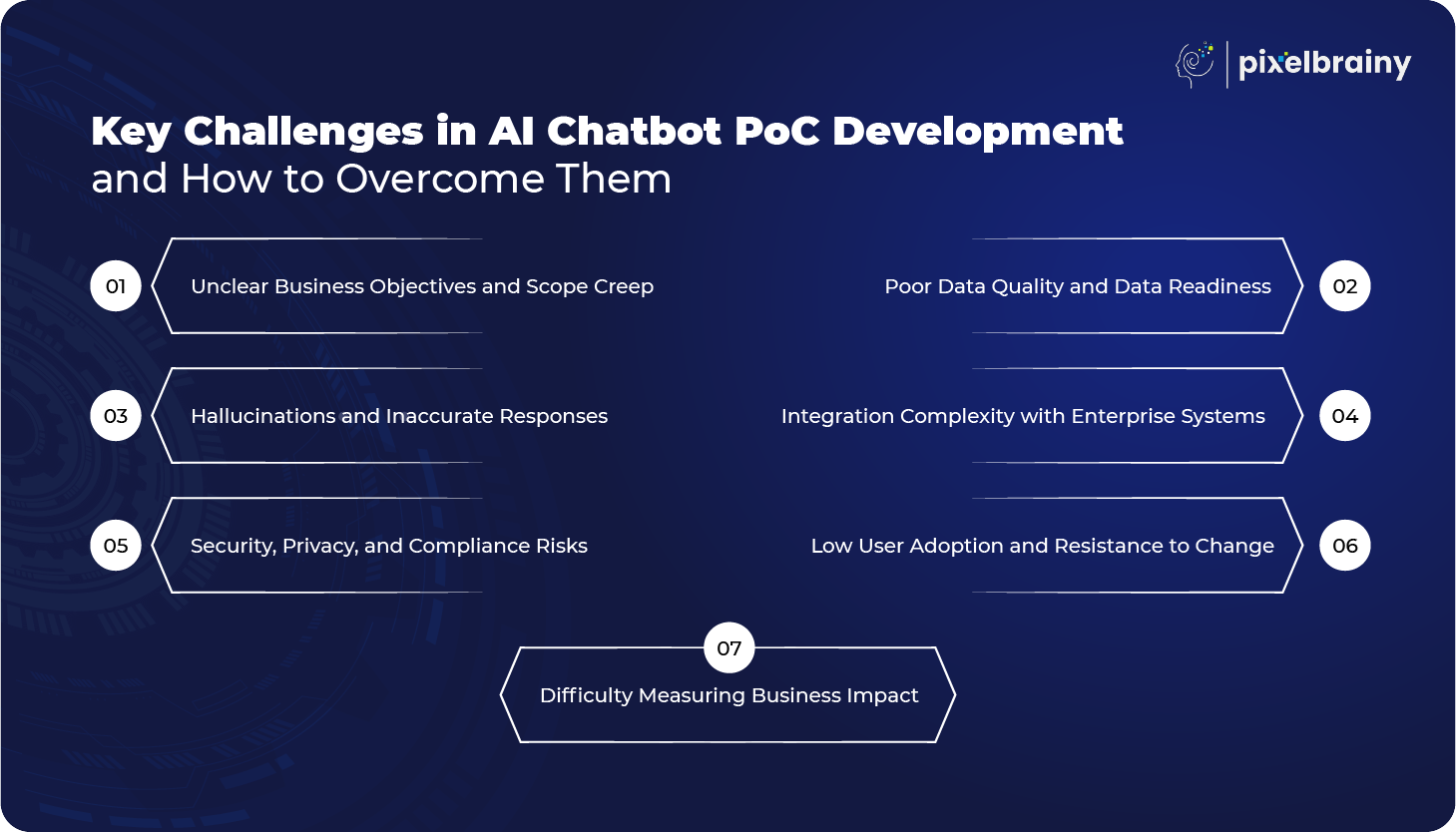
One of the most common challenges in AI chatbot PoC development is starting without a clearly defined business problem. When objectives are vague, PoCs often expand beyond their intended scope, leading to increased costs, delays, and inconclusive results.
How to overcome it: Enterprises should clearly define the problem, success metrics, and boundaries at the beginning. Documenting what the chatbot will and will not do keeps teams focused. Regular scope reviews ensure alignment throughout development.
AI chatbots rely heavily on enterprise data. Incomplete, outdated, or unstructured data can lead to inaccurate responses and reduced trust in the PoC. Many enterprises underestimate the effort required for data preparation.
How to overcome it: Conduct early data audits to assess quality and relevance. Clean, organize, and validate data before integration. Prioritize high-value data sources and address gaps incrementally rather than attempting full data coverage.
AI models may generate confident but incorrect responses, especially when enterprise context is missing. This challenge is particularly risky in regulated industries where accuracy is critical.
How to overcome it: Use retrieval-based approaches to ground responses in enterprise data. Implement fallback mechanisms and confidence thresholds to route uncertain queries to human agents. Regular testing and prompt refinement help improve reliability.
Connecting the chatbot to existing systems such as CRM, ERP, or HR platforms often introduces technical and governance challenges. Legacy systems and inconsistent APIs can slow down PoC progress.
How to overcome it: Start with limited, high-impact integrations. Use standardized APIs and middleware where possible. Engage IT teams early to align on access, security, and architectural constraints.
Even at the PoC stage, enterprises must protect sensitive data. Weak security controls can lead to compliance violations and stakeholder resistance.
How to overcome it: Implement role-based access controls, authentication, and logging from the start. Apply data masking for sensitive information and align PoC design with enterprise security policies to avoid rework later.
A technically successful PoC may fail if users do not adopt it. Poor usability, lack of awareness, or unclear value can limit engagement.
How to overcome it: Involve end users early through testing and feedback sessions. Keep the interface simple and intuitive. Clearly communicate the chatbot’s purpose and limitations to manage expectations.
Without clear metrics, enterprises struggle to evaluate whether the PoC delivered value. This makes it hard to justify scaling decisions.
How to overcome it: Define measurable KPIs before development begins. Track both technical metrics and business outcomes such as time saved, cost reduction, or productivity improvements. Use these insights to support go or no-go decisions.
By proactively addressing these challenges, enterprises can ensure AI chatbot PoC development delivers clear insights, minimizes risk, and creates a strong foundation for scalable deployment.
Enterprises exploring AI initiatives often struggle to turn ideas into outcomes that actually work in real business environments. This is where PixelBrainy LLC, an experienced AI chatbot development company, plays a critical role. PixelBrainy approaches AI Chatbot PoC Development for Enterprise with a strong focus on clarity, practicality, and measurable business impact, rather than experimental demos that fail to scale.
PixelBrainy starts every engagement by deeply understanding the client’s business challenges, industry context, and operational workflows. Instead of pushing generic solutions, the team aligns AI Development efforts with clear enterprise objectives. This ensures the development of AI Chatbot PoC is driven by real use cases such as customer support optimization, internal process automation, or knowledge management. Clear success metrics are defined upfront so enterprises know exactly what value the PoC is expected to deliver.
When enterprises work with PixelBrainy to make an AI Chatbot PoC, they benefit from a structured, step-by-step execution model. This includes problem definition, data assessment, model selection, enterprise system integration, and iterative testing. PixelBrainy emphasizes explainability and reliability, ensuring stakeholders understand how the chatbot works, what data it uses, and how decisions are made. This transparency builds trust across business and IT teams.
PixelBrainy recently worked with a mid-sized enterprise in the United States operating in the professional services sector. The client wanted to evaluate whether an AI chatbot could reduce internal support load and improve access to operational documentation. PixelBrainy led the creation of AI Chatbot PoC focused on internal employee queries, integrating securely with company documents and role-based access controls.
Within weeks, the PoC demonstrated a significant reduction in repetitive internal queries and faster information retrieval for employees. Leadership used these results to confidently approve the transition from PoC to a broader deployment roadmap, backed by clear performance metrics and ROI indicators.
What sets PixelBrainy apart is its long-term mindset. The team does not stop at delivery but helps enterprises plan the next steps, whether that involves scaling, optimizing, or refining use cases. This makes PixelBrainy a reliable partner for enterprises looking to move from experimentation to production with confidence.
By combining technical expertise with real business understanding, PixelBrainy LLC helps enterprises turn AI chatbot PoCs into meaningful, scalable success stories.
AI chatbots are no longer experimental tools. For modern enterprises, they represent a strategic opportunity to improve efficiency, customer experience, and decision-making. However, achieving real value requires a thoughtful and structured approach. This is where AI Chatbot Proof of Concept (PoC) Development for Enterprises becomes essential.
By investing in enterprise AI chatbot PoC development, organizations can validate use cases, assess technical feasibility, and measure business impact before scaling. From understanding what is the process of developing an AI Chatbot PoC to managing cost, architecture, and integration, a PoC provides clarity while minimizing risk. It allows enterprises to confidently move from idea to implementation with data-backed decisions.
Whether the goal is internal automation or customer-facing innovation, a well-executed PoC lays the foundation for long-term success in AI Chatbot PoC Development for enterprises.
Ready to take the next step? Book an appointment with our experts today to discuss how we can help you build and scale your AI chatbot PoC with confidence.
Most enterprise AI chatbot PoCs are completed within 3 to 6 weeks, depending on the complexity of the use case, data availability, and integration requirements. A focused scope helps ensure faster validation without unnecessary delays.
Yes, in most cases a PoC can leverage existing enterprise documents, databases, or knowledge bases. Minor data cleanup may be required, but large-scale data restructuring is usually not necessary at the PoC stage.
Absolutely. Enterprises in regulated industries often use PoCs to test security, access controls, and compliance readiness before production deployment. A PoC provides a safe environment to validate governance requirements early.
If the PoC falls short, enterprises gain valuable insights into limitations, risks, or data gaps. These learnings help teams refine requirements, adjust scope, or decide whether to pause or pivot the initiative with minimal financial impact.
Yes, multilingual capability can be tested during the PoC phase, especially for global enterprises. This helps assess language accuracy and user experience across regions before scaling.
A PoC provides real performance data, cost insights, and user feedback that inform long-term AI roadmaps. It helps enterprises prioritize use cases, plan budgets, and define scalable architecture with confidence.

About The Author
Sagar Bhatnagar
Sagar Sahay Bhatnagar brings over a decade of IT industry experience to his role as Marketing Head at PixelBrainy. He's known for his knack in devising creative marketing strategies that boost brand visibility and market influence. Sagar's strategic thinking, coupled with his innovative vision and focus on results, sets him apart. His track record of successful campaigns proves his ability to utilize digital platforms effectively for impactful marketing efforts. With a genuine passion for both technology and marketing, Sagar continuously pushes PixelBrainy's marketing initiatives to greater success.

Working with the PixelBrainy team has been a highly positive experience. They understand the design requirements and create beautiful UX elements to meet the application needs. The dev team did an excellent job bringing my vision to life. We discussed usability and flow. Sagar worked with his team to design the database and begin coding. Working with Sagar was easy. He has the knowledge to create robust apps, including multi-language support, Google and Apple ID login options, Ad-enabled integrations, Stripe payment processing, and a Web Admin site for maintaining support data. I'm extremely satisfied with the services provided, the quality of the final product, and the professionalism of the entire process. I highly recommend them for Android and iOS Mobile Application Design and Development.

Great experience working with them. Had a lot of feedback and I found that unlike most contractors they were bugging me for updates instead of the other way around. They were extremely time conscience and great at communicating! All work was done extremely high quality and if not on time, early! They were always proactive when it comes to communication and the work is great/above par always. Very flexible and a great team to work with! Goes above and beyond to present us with multiple options and always provides quality. Amazing work per usual with Chitra. If you have UI/UX or branding design needs I recommend you go to them! Will likely work with them in the future as well, definitely recommended!

PixelBrainy is a joy to work with and is a great partner when thinking through branding, logo, and website layout. I appreciate that they spend time going into the "why" behind their decisions to help inform me and others about industry best practices and their expertise.

I hired them to design our software apps. Things I really like about them are excellent communication skills, they answer all project suggestions and collaborate right away, and their input on design and colors is amazing. This project was complex and needed patience and creativity. The team is amazing to do business with. I will be using them long-term. Glad to see there are some good people out there. I was afraid to try and outsource my project to someone but I am glad I met them! I really can't say enough. They went above and beyond on this project. I am very happy with everything they have done to make my business stand out from the competition.

It was great working with PixelBrainy and the team. They were very responsive and really owned the project. We'll definitely work with them again!

I recently worked with the PixelBrainy team on a project and I was blown away by their communication skills. They were prompt, clear, and articulate in all of our interactions. They listened and provided valuable feedback and suggestions to help make the project a success. They also kept me updated throughout the entire process, which made the experience stress-free and enjoyable.

PixelBrainy is very good at what it does. The team also presents themselves very professionally and takes care of their side of things very well. I could fully trust them taking up the design work in a timely and organised manner and their attention to detail saved us lots of effort and time. This particular project was quite intense and the team showed that they function very well under pressure. Very much looking forward to working with her again!

It's always an absolute pleasure working with them. They completed all of my requests quickly and followed every note I had for them to a T, which made our process go smoothly from start to finish. Everything was completed fast and following all of the guidelines. And I would recommend their services to anyone. If you need any design work done in the future, PixelBrainy should be your first call!

They took ownership of our requirements and designed and proposed multiple beautiful variants. The team is self-motivated, requires minimum supervision, committed to see-through designs with quality and delivering them on time. We would definitely love to work with PixelBrainy again when we have any requirements.

PixelBrainy was a big help with our SaaS application. We've been hard at work with a new UI/UX and they provided a lot of help with the designs. If you're looking for assistance with your website, software, or mobile application designs, PixelBrainy and the team is a great recommendation.

PixelBrainy designers are amazing. They are responsive, talented, and always willing to help craft the design until it matches your vision. I would recommend them and plan to continue them for my future projects and more!!!

They were awesome! Did a good job fast, and good communication. Will work with them again. Thank you

Creative, detail-oriented, and talented designers who take direction well and implement changes quickly and accurately. They consistently over-delivered for us.

PixelBrainy team is very talented and creative. Great designers and a pleasure to work with. PixelBrainy is an excellent communicator and I look forward to working with them again.

PixelBrainy has a very talented design team. Their work is excellent and they are very responsive. I enjoy working with them and hope to continue on all of our future projects.


Transform your ideas into reality with us.
Across these industries, each engagement brings unique challenges, from early-stage product development to scaling complex systems, helping us build a practical understanding of real-world product environments.