AI Summary Powered by PixelBrainy
How much does it really cost to develop an AI chatbot in 2026, and what expenses should a business account for beyond the initial development quote?
AI chatbots have become an important part of modern business communication. Companies use them to automate customer support, qualify leads, answer product questions, assist sales teams, and provide personalized experiences around the clock. For B2B SaaS businesses, an AI chatbot for customer support can be especially valuable when support teams handle thousands of recurring queries every month.
Consider this scenario: your B2B SaaS company receives 3,000 support tickets per month, with an average resolution time of four hours. You want to build a custom AI chatbot that can automatically handle the top 60% of repetitive support queries. Before approving the development budget, you need a realistic breakdown of the AI chatbot development cost, including expenses that may not appear in an initial vendor estimate.
The cost to develop an AI chatbot depends on its complexity, AI capabilities, integrations, data requirements, security, and scalability. A custom solution may require investment in RAG pipeline development, knowledge base preparation, prompt engineering, AI model integration, testing, deployment, and third-party APIs. After launch, recurring expenses can include LLM API costs, cloud infrastructure, monitoring, maintenance, security updates, and AI model optimization.
This AI chatbot pricing guide 2026 explains the major factors affecting custom AI chatbot cost, development stages, recurring expenses, technology requirements, and potential ROI.
By the end, you will have a practical framework for estimating AI chatbot development cost in 2026 and planning a realistic budget for your business.
A realistic budget is one of the most important foundations of successful AI chatbot development. The total investment is not limited to coding. Businesses may also need to account for AI model usage, data preparation, integrations, testing, security, infrastructure, maintenance, and future improvements.
A practical question for businesses is: “How should we plan our AI chatbot budget so we can launch the required features without underestimating development and long-term operating costs?”
Creating a detailed budget before development helps business, technical, and operational teams establish priorities and allocate resources effectively. It also makes it easier to distinguish essential launch requirements from features that can be introduced in later versions.
For businesses planning a custom AI chatbot, budgeting should therefore consider both initial development expenses and recurring costs after deployment. This approach supports better cost control while creating room for scalability, performance optimization, and future AI improvements.
Here’s why budgeting should be a first preference, not an afterthought:
A well-planned budget helps businesses control AI chatbot development costs while creating a reliable, scalable, and maintainable solution that can support long-term growth.
What actually determines the cost of developing an AI chatbot in 2026, and which expenses should businesses consider before approving a development budget?
The AI chatbot development cost can vary significantly because every chatbot has different business objectives, AI capabilities, integrations, data requirements, and scalability needs. A basic FAQ chatbot may require a relatively smaller investment, while an enterprise-grade conversational AI solution with advanced AI models, RAG, multilingual capabilities, system integrations, governance, and continuous optimization can require substantially more.
For businesses planning custom AI chatbot development, looking only at the initial development quote may not provide the complete financial picture. The budget can also include platform selection, technology stack, UI/UX design, CRM or ERP integrations, AI governance, testing, security, maintenance, third-party AI licensing, and infrastructure.
A key question businesses should ask is: “What factors should we evaluate to accurately estimate the cost to develop an AI chatbot that can scale with our users, integrations, and business requirements?”
This section breaks down the 8 major factors affecting AI chatbot development cost in 2026, along with estimated cost ranges and development timelines. It also covers often-overlooked expenses such as AI licensing, memory systems, ethical AI controls, offline or edge AI, and sustainability considerations.
The estimates below should be treated as planning ranges rather than fixed quotations. The actual custom AI chatbot cost depends on the project's scope, technical architecture, development team, integrations, AI complexity, and long-term operational requirements.

The scope and complexity of your AI chatbot will broadly tell the overall chatbot development pricing. A chatbot crafted to handle simple FAQs will be cheaper than one integrated with AI-driven conversation models, multilingual support, or complex decision trees. Enterprise chatbot development costs more as it demands more resources and time, both in development and maintenance.
Cost Estimate: $8,000 – $100,000+
| Chatbot Scope & Complexity | Estimated Cost | Development Timeline |
| Simple FAQ Bot | $8,000 – $15,000 | 4 – 6 weeks |
| Advanced Bot | $15,000 – $35,000 | 6 – 12 weeks |
| Enterprise-Level AI Chatbot | $35,000 – $100,000+ | 12+ weeks |
The development platform you select (e.g., mobile, web, or cross-platform) affects both the user experience and the chatbot development pricing. Mobile apps typically deliver better performance but demand platform-specific development, while web apps are more cost-effective but fixed in features. Cross-platform apps are a perfect middle ground.
Cost Estimate: $8,000 – $40,000
| Platform Type | Estimated Cost | Development Timeline |
| Web App | $8,000 – $20,000 | 4 – 6 weeks |
| Cross-Platform App | $12,000 – $30,000 | 6 – 10 weeks |
| Native Mobile App | $15,000 – $40,000 | 8 – 12 weeks |
Your technological stack, incorporating programming languages, databases, and frameworks, directly impacts development time and costs. A modern tech stack with AI frameworks, such as TensorFlow or Dialogflow, will raise custom AI chatbot cost estimation but deliver more promising chatbot performance, embracing natural language understanding (NLU) and machine learning abilities.
Cost Estimate: $5,000 – $150,000+
| Technology Stack | Estimated Cost Range | Use Case Suitability |
| Open-Source Frameworks (e.g., Rasa, Botpress) | $5,000 – $20,000 | Startups, Small Businesses with developer resources |
| Cloud-Based Platforms (e.g., AWS Lex, Google Dialogflow) | $15,000 – $50,000 | Medium to Large Businesses, Scalable Solutions |
| Custom AI Models (e.g., TensorFlow, PyTorch) | $30,000 – $100,000+ | Enterprises needing sophisticated AI capabilities |
| Hybrid Models (Pre-Trained + Custom Code) | $20,000 – $60,000 | Companies with medium complexity needs |
| Enterprise AI Solutions (e.g., IBM Watson, Microsoft Azure Bot Service) | $50,000 – $150,000+ | Large Enterprises, High-Traffic Solutions |
Integrating the chatbot with existing ERP, CRM, or helpdesk systems for businesses with complicated internal systems increases chatbot development pricing and complexity. Smooth integration ensures the chatbot performs effortlessly across different tools, boosting efficiency and automation. Chatbot integration cost depends on the type you choose.
Cost Estimate: $5,000 – $100,000+
| Integration Type | Estimated Cost | Development Timeline |
| Basic Integration | $5,000 – $15,000 | 2 – 4 weeks |
| Complex Integration | $15,000 – $50,000 | 6 – 12 weeks |
| Full System Integration | $50,000 – $100,000+ | 10+ weeks |
The user interface (UI) and user experience (UX) are integral to ensure that the chatbot is easy to use and intuitive. More complex designs and customizations will inflate costs, as they need additional effort and time for designing, prototyping, and testing.
Cost Estimate: $3,000 – $50,000+
| UI/UX Design Complexity | Estimated Cost | Development Timeline |
| Simple UI/UX | $3,000 – $8,000 | 2 – 4 weeks |
| Custom Design | $8,000 – $20,000 | 4 – 6 weeks |
| Full UI/UX Overhaul | $20,000 – $50,000+ | 6 – 10 weeks |
Including AI governance frameworks in your chatbot and ensuring accountability, ethical use, and transparency can add extra costs. As AI regulation becomes mandatory globally, you need to stay compliant, which includes adopting AI decision-making and transparency standards.
Cost Estimate: $3,000 – $50,000+
| Governance Level | Estimated Cost | Development Timeline |
| Basic Compliance | $3,000 – $8,000 | 1 – 2 weeks |
| Advanced Governance | $8,000 – $20,000 | 3 – 4 weeks |
| Full Compliance Framework | $20,000 – $50,000+ | 6 – 8 weeks |
Chatbots demand regular maintenance to ensure they continue to function optimally. Maintenance costs can vary depending on the frequency of updates, error fixes, and AI model retraining needed to keep the bot up-to-date.
Cost Estimate: $2,000 – $40,000+ (annually)
| Maintenance Type | Estimated Cost | Development Timeline |
| Basic Support | $2,000 – $5,000 | Ongoing |
| Moderate Support | $5,000 – $15,000 | Ongoing |
| Full Support & Updates | $15,000 – $40,000+ | Ongoing |
The team’s expertise and location are important in determining the exact cost to build a chatbot. Developers in North America or Europe usually charge more, while teams in regions like Eastern Europe or Asia may provide competitive rates with equivalent quality. The AI developers’ experience (e.g., NLP, machine learning) will also affect the overall chatbot development pricing.
Cost Estimate: $8,000 – $100,000+
| Location/Expertise | Estimated Cost | Development Timeline |
| Junior Developer (Asia) | $8,000 – $20,000 | 4 – 6 weeks |
| Senior Developer (Europe) | $15,000 – $40,000 | 6 – 10 weeks |
| Expert AI Developers (US) | $30,000 – $100,000+ | 10+ weeks |
| Factor | Estimated Cost | Development Timeline |
| Scope and Complexity | $8,000 – $100,000+ | 4 – 12+ weeks |
| Platform Type | $8,000 – $40,000 | 4 – 12 weeks |
| Technology Stack | $8,000 – $150,000+ | 4 – 12+ weeks |
| Integration with Existing Systems | $5,000 – $100,000+ | 2 – 12 weeks |
| UI/UX Design | $3,000 – $50,000+ | 2 – 10 weeks |
| AI Governance | $3,000 – $50,000+ | 1 – 8 weeks |
| Ongoing Maintenance & Support | $2,000 – $40,000+ | Ongoing |
| Team Expertise & Location | $8,000 – $100,000+ | 4 – 12+ weeks |
Note: The cost of building AI chatbot from scratch can vary based on the chatbot type, technology stack, features, and team expertise. It is crucial to factor in regulatory compliance, scalability, security, and ongoing optimization requirements. A complete understanding of all cost components assists businesses in bypassing unexpected expenses and ensures an effortless launch and future scalability.

AI chatbots usually rely on third-party services or models for advanced functionalities, such as natural language processing (NLP). This includes licensing AI tools, frameworks, or datasets from providers. Such licenses can vary depending on the customization level and the volume of data required.
Estimated Cost: $5,000 – $50,000+
Includes: Licensing third-party AI platforms, datasets, and AI tools like NLP models or machine learning libraries.
Chatbots with memory systems can provide more personalized experiences by recalling past interactions. However, these systems, which demand additional storage and processing power, can raise the complexity and cost to build a chatbot.
Estimated Cost: $5,000 – $20,000+
Includes: Memory storage systems, data retention, processing costs, and integration with user data.
AI chatbots may demand bias detection and mitigation systems to ensure fairness and compliance with relevant ethical standards. These engines assist in reducing bias in responses and decision-making, particularly in sensitive areas like hiring, customer service, or legal consultations.
Estimated Cost: $3,000 – $15,000+
Includes: Developing and implementing ethical bias detection algorithms, legal audits, and adjustments for fairness.
Offline or edge AI bots are created to work with no continuous internet access. These bots seamlessly process data on the device instead of relying on cloud servers, which can make them more efficient and cost-effective in certain environments.
Estimated Cost: $10,000 – $30,000+
Includes: Development of offline processing algorithms, edge computing devices, and security protocols.
Sustainability in AI design directs the creation of energy-efficient models and algorithms that lower the environmental impact. This may involve the usage of low-power hardware or optimizing AI models to lessen carbon footprints during training and deployment.
Estimated Cost: $5,000 – $20,000+
Includes: Sustainable model development, energy-efficient hardware integration, and environmental impact analysis.
| Bonus Factor | Estimated Cost | Development Timeline |
| AI Licensing | $5,000 – $50,000+ | Ongoing |
| Memory Systems | $5,000 – $20,000+ | Ongoing |
| Ethical Bias Engines | $3,000 – $15,000+ | Ongoing |
| Offline/Edge AI Bots | $10,000 – $30,000+ | Ongoing |
| Sustainability in AI Design | $5,000 – $20,000+ | Ongoing |
These bonus aspects increase the custom AI chatbot cost and complexity, but they can greatly improve the bot’s efficacy, ethics, and sustainability.
Understanding these cost factors upfront helps businesses build a realistic AI chatbot budget, prioritize essential capabilities, and avoid unexpected expenses during development and post-launch operations.
Different types of AI chatbots are designed for different business requirements, conversation complexity, and user experiences. As a result, the cost to develop an AI chatbot can vary considerably depending on the chatbot architecture, AI capabilities, integrations, and level of customization required.
A practical question for businesses is: “Which type of AI chatbot should we build for our use case, and how will that choice affect the overall development and maintenance cost?”
A scripted chatbot may be sufficient for FAQs and predefined workflows, while businesses handling complex customer conversations may need contextual, NLP, hybrid, or generative AI capabilities. Voice-enabled solutions introduce additional speech technologies, while advanced AI chatbots may require more sophisticated models, data pipelines, testing, and infrastructure.
The following chatbot types provide a useful starting point for comparing functionality, estimated investment, and potential business applications.
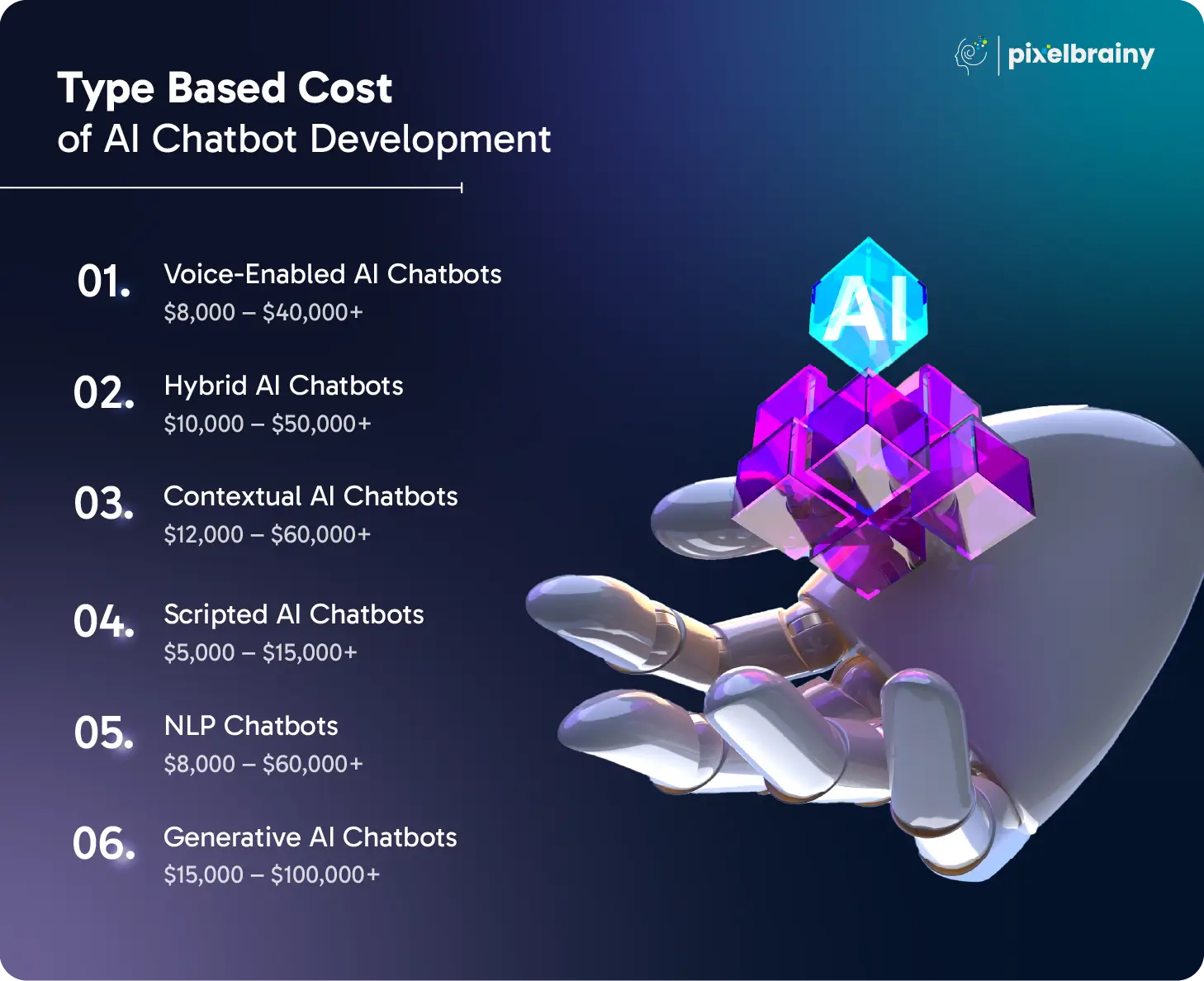
Voice-enabled AI chatbots allow users to interact with businesses through spoken commands instead of text. They can support hands-free customer service, appointment assistance, information retrieval, and other voice-driven workflows.
Cost Estimate: $8,000 to $40,000+
Top Features: Speech recognition, text-to-speech, voice command processing, conversational AI, and dialogue management.
Examples: Google Assistant, Amazon Alexa, and Apple Siri.
Hybrid AI chatbots integrate rule-based and machine learning models to provide a more exhaustive conversational experience. These bots are ideal for enterprises requiring both structured responses and the flexibility of AI-driven learning to handle complex queries.
Hybrid AI chatbots combine predefined rules with machine learning capabilities. This approach allows businesses to maintain predictable responses for important workflows while using AI to handle more flexible or complex conversations.
Cost Estimate: $10,000 to $50,000+
Top Features: Rule-based workflows, machine learning, contextual responses, fallback mechanisms, and adaptive conversations.
Examples: Tars, ManyChat, and LiveChat.
Contextual AI chatbots use NLP and machine learning to understand the broader context of a conversation. They can retain relevant conversation history and use previous interactions to provide more personalized responses.
Cost Estimate: $12,000 to $60,000+
Top Features: Context awareness, conversation history, NLP, personalization, machine learning, and contextual response generation.
Examples: Drift, Zoho SalesIQ, and Watson Assistant.
Scripted AI chatbots follow predefined conversation flows and are designed for straightforward, predictable interactions. They can handle FAQs, appointment booking, product information, lead capture, and other repetitive workflows.
Cost Estimate: $5,000 to $15,000+
Top Features: Predefined scripts, FAQ responses, automated workflows, menu-based navigation, and basic lead capture.
Examples: Facebook Messenger bots, Zendesk Chatbot, and Drift.
NLP chatbots are designed to understand natural human language and process more complex user requests. They can identify user intent, analyze language, and support conversational interactions beyond predefined responses.
Cost Estimate: $8,000 to $60,000+
Top Features: NLP integration, intent recognition, sentiment analysis, language translation, and machine learning.
Examples: Google Dialogflow, Microsoft Bot Framework, and Amazon Lex.
Generative AI chatbots use advanced AI models to generate responses dynamically rather than relying exclusively on predefined scripts. They can support content generation, knowledge assistance, customer service, product guidance, and more flexible conversations.
Cost Estimate: $15,000 to $100,000+
Top Features: Generative AI, dynamic responses, deep learning, contextual conversations, content generation, and LLM integration.
Examples: ChatGPT, OpenAI-based bots, and GPT-based applications.
| Chatbot Type | Estimated Cost | Top Features |
| Voice-Enabled AI Chatbots | $8,000 – $40,000+ | Speech recognition, text-to-speech, AI dialogue |
| Hybrid AI Chatbots | $10,000 – $50,000+ | Rule-based, machine learning, adaptable conversations |
| Contextual AI Chatbots | $12,000 – $60,000+ | Context awareness, machine learning, personalized |
| Scripted AI Chatbots | $5,000 – $15,000+ | Predefined scripts, FAQs, and basic workflows |
| NLP Chatbots | $8,000 – $60,000+ | NLP, sentiment analysis, language translation |
| Generative AI Chatbots | $15,000 – $100,000+ | Deep learning, AI-driven, dynamic interaction |
The right chatbot type should be determined by your business use case, conversation complexity, integration requirements, and expected scale, since these factors directly influence both initial development and ongoing AI chatbot maintenance costs.
Also Read: How To Build An AI Agent: A Step-by-Step Guide
The cost to develop an AI chatbot varies significantly by business use case because each application requires a different combination of AI capabilities, integrations, security controls, data sources, and automation workflows. A customer support chatbot, for example, may focus on ticket resolution and knowledge retrieval, while a healthcare or financial chatbot may require stronger security, compliance, and data-handling capabilities.
A practical question for businesses is: “How much should we budget for an AI chatbot based on our specific use case, and which features are driving the development cost?”
Understanding these differences helps businesses estimate their custom AI chatbot development cost more accurately and prioritize the capabilities that deliver the greatest business value. The following use cases provide indicative cost ranges for planning purposes. Actual pricing can vary based on complexity, integrations, AI model selection, data requirements, and ongoing maintenance.

Customer support chatbots automate repetitive customer questions, provide 24/7 assistance, retrieve information from knowledge bases, and route complex conversations to human agents. Advanced solutions can also integrate with helpdesk and CRM platforms.
Cost Estimate: $6,000 to $20,000
Top Features: FAQ automation, knowledge-base search, ticket creation, agent handoff, conversation history, and multilingual support.
Examples: Zendesk Bot and Freshdesk AI Bot.
E-commerce chatbots help shoppers discover products, compare options, answer product questions, track orders, and support purchasing decisions. Integration with commerce platforms and product catalogs can increase development complexity.
Cost Estimate: $8,000 to $25,000
Top Features: Product recommendations, product search, cart assistance, order tracking, payment integration, and abandoned-cart recovery.
Examples: Shopify Messenger Bot and H&M Chatbot.
Healthcare chatbots can support appointment scheduling, patient communication, medication reminders, and access to approved health information. Healthcare use cases generally require additional attention to privacy, security, interoperability, and applicable regulations.
Cost Estimate: $10,000 to $30,000
Top Features: Appointment scheduling, patient support, symptom guidance, telemedicine integration, and healthcare data security.
Examples: Ada Health and Babylon Health.
Banking and financial chatbots can assist customers with account-related questions, transactions, financial information, and fraud-related alerts. Because these systems may handle sensitive financial information, security and compliance requirements can increase the overall development investment.
Cost Estimate: $12,000 to $40,000
Top Features: Account assistance, transaction support, payment workflows, fraud alerts, authentication, and personalized financial information.
Examples: Erica by Bank of America and Cleo AI.
Insurance chatbots can automate policy questions, guide customers through claims, collect required information, and provide renewal reminders. Integration with policy administration and claims systems can influence the final development cost.
Cost Estimate: $9,000 to $28,000
Top Features: Claims assistance, document submission, policy FAQs, customer support, and renewal notifications.
Examples: Lemonade Bot and GEICO Virtual Assistant.
Travel chatbots assist users with reservations, destination discovery, itinerary planning, travel updates, and customer support. Integrating booking systems and real-time travel information can add to development complexity.
Cost Estimate: $8,000 to $26,000
Top Features: Booking management, itinerary assistance, travel alerts, destination recommendations, and multilingual support.
Examples: Expedia Bot and KLM Messenger Bot.
HR chatbots automate repetitive recruitment and employee-support workflows. They can help candidates navigate hiring processes while assisting employees with common HR questions and onboarding activities.
Cost Estimate: $7,000 to $22,000
Top Features: Candidate screening, resume processing, interview scheduling, employee onboarding, and HR policy FAQs.
Examples: Mya and HireVue Assist.
Education chatbots support students with course information, learning resources, schedules, and personalized assistance. More advanced solutions can use AI to provide tutoring and adapt content based on learner interactions.
Cost Estimate: $7,000 to $20,000
Top Features: Course recommendations, virtual tutoring, exam reminders, content assistance, and student support.
Examples: Duolingo Bot and Botsify Education Bot.
Real estate chatbots help businesses capture and qualify leads, recommend relevant properties, answer listing questions, and schedule property visits. CRM integration is particularly valuable for transferring qualified leads to sales teams.
Cost Estimate: $8,000 to $23,000
Top Features: Lead qualification, property recommendations, appointment scheduling, listing search, and CRM integration.
Examples: Structurely Bot and Roof.ai.
Entertainment and media chatbots personalize content discovery by recommending movies, music, podcasts, shows, or other media based on user preferences and interaction history.
Cost Estimate: $6,000 to $18,000
Top Features: Personalized recommendations, user profiling, content discovery, preference tracking, and subscription assistance.
Examples: Spotify Bot and Netflix Messenger Bot.
SaaS onboarding chatbots help new customers understand product features, complete setup tasks, navigate workflows, and find answers without relying entirely on human support teams.
Cost Estimate: $7,000 to $21,000
Top Features: Product walkthroughs, account setup guidance, contextual assistance, knowledge-base integration, and in-app support.
Examples: Intercom Product Tours and Appcues Bot.
| Use Case | Estimated Cost | Top Features |
| Customer Support Chatbot | $6,000 – $20,000 | Ticketing, FAQs, live transfer |
| E-commerce Sales Assistant Chatbot | $8,000 – $25,000 | Product suggestions, cart management |
| Healthcare Virtual Assistant | $10,000 – $30,000 | Scheduling, symptom check, HIPAA compliance |
| Financial Services and Banking Bot | $12,000 – $40,000 | Account management, fraud alerts |
| Insurance Claims and Support Chatbot | $9,000 – $28,000 | Claims filing, policy support |
| Travel and Hospitality Booking Bot | $8,000 – $26,000 | Booking management, travel alerts |
| HR and Recruitment Chatbot | $7,000 – $22,000 | Resume parsing, interview scheduling |
| Education and e-Learning Chatbot | $7,000 – $20,000 | Course help, tutoring support |
| Real Estate Lead Generation Chatbot | $8,000 – $23,000 | Lead capture, property listings |
| Entertainment and Media Bot | $6,000 – $18,000 | Content recommendations |
| SaaS Product Onboarding Chatbot | $7,000 – $21,000 | Onboarding guides, feature walkthroughs |
Understanding how the cost to build a chatbot varies across industries ensures smarter investment decisions. Corresponding your business needs with the right chatbot type will assist in maximizing returns while handling expenses.
When estimating the cost to develop an AI chatbot in 2026, businesses often focus on development, design, integrations, and deployment while overlooking expenses that appear during scaling and ongoing operations. These costs may not be prominent in an initial development quote, but they can significantly affect the total AI chatbot development cost over time.
A useful question to ask before approving the budget is: “What additional AI chatbot costs could emerge after launch, and how should we account for them in our development budget?”
Planning for third-party services, data preparation, compliance, infrastructure, and security from the beginning provides better cost visibility. It also helps businesses avoid unexpected expenses when chatbot usage increases or new requirements emerge.
Below are the key hidden costs to consider when planning AI chatbot development.
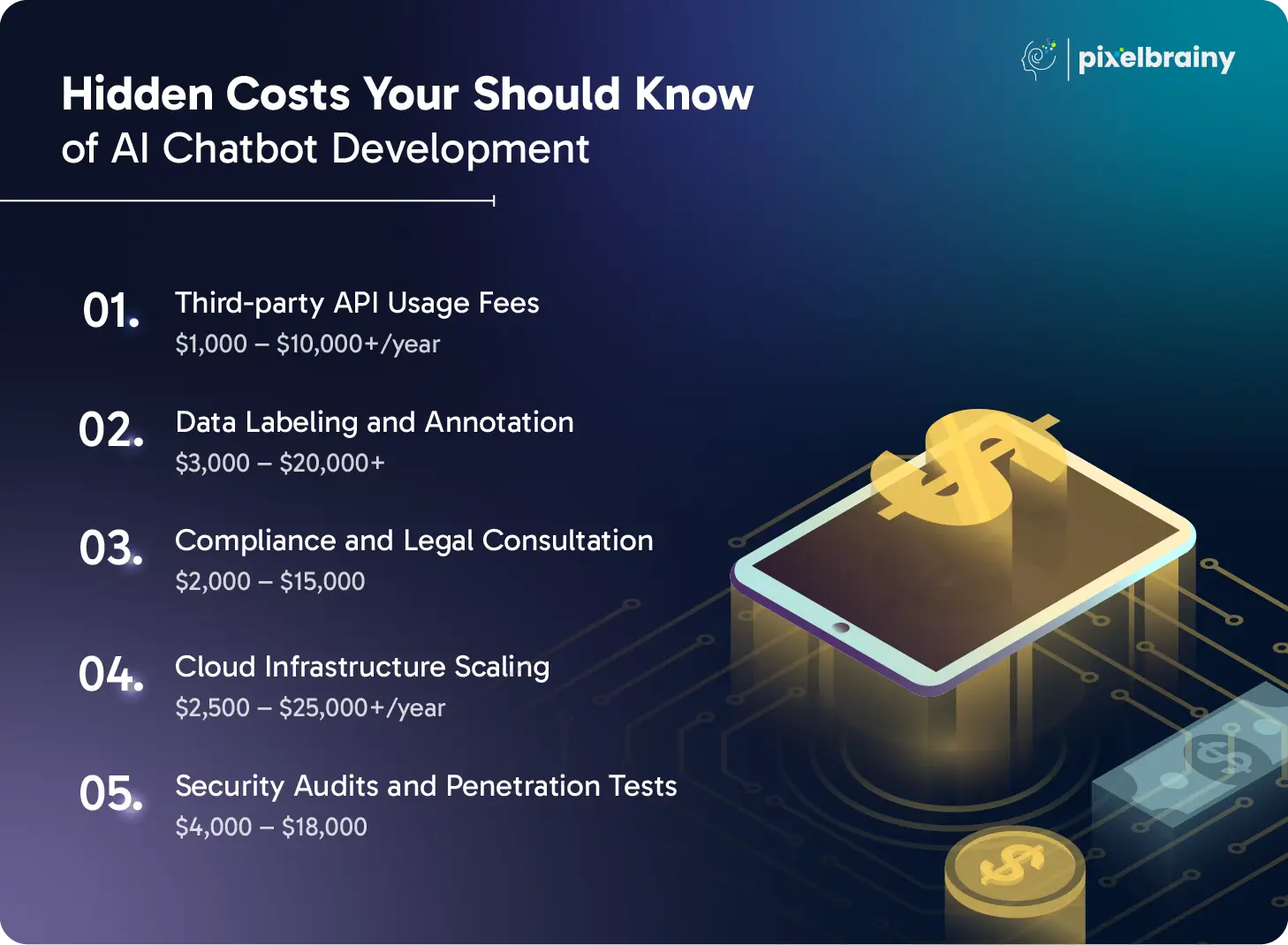
AI chatbots often depend on external APIs for LLMs, language processing, payment services, CRM connectivity, communication, analytics, or other functionality. Many providers use subscription or usage-based pricing, meaning costs can increase as conversations and API calls grow.
Estimated Cost: $1,000 to $10,000+/year
Includes: API subscriptions, usage-based charges, premium capabilities, and higher-volume access.
AI systems may require high-quality, structured, and domain-specific data for training, evaluation, or customization. Preparing this data can involve manual labeling, annotation, quality checks, and specialized expertise.
Estimated Cost: $3,000 to $20,000+
Includes: Data annotation, quality assurance, dataset preparation, and specialized labeling resources.
Depending on the industry, geography, and data handled by the chatbot, businesses may need professional guidance for privacy, security, AI governance, and applicable regulations.
Estimated Cost: $2,000 to $15,000
Includes: Legal consultation, compliance reviews, documentation, privacy policies, and audit preparation.
Cloud expenses can increase as chatbot traffic, data storage, AI processing, and concurrent users grow. A solution that operates within budget during early testing may require additional computing and storage resources after reaching higher usage volumes.
Estimated Cost: $2,500 to $25,000+/year
Includes: Cloud computing, databases, storage, monitoring, bandwidth, and scaling infrastructure.
Security should be considered an ongoing cost, particularly when a chatbot processes customer information or connects with business systems. Regular assessments can identify vulnerabilities before they become costly security incidents.
Estimated Cost: $4,000 to $18,000
Includes: Penetration testing, vulnerability assessments, security reviews, and remediation support.
| Hidden Cost Area | Estimated Cost | What's Included |
| Third-party API Usage Fees | $1,000 – $10,000+/year | API subscriptions, usage charges |
| Data Labeling and Annotation | $3,000 – $20,000+ | Manual data tagging, QA processes |
| Compliance and Legal Consultation | $2,000 – $15,000 | Legal reviews, audit support |
| Cloud Infrastructure Scaling | $2,500 – $25,000+/year | Hosting, storage, CDN expenses |
| Security Audits and Penetration Tests | $4,000 – $18,000 | Cybersecurity assessments, vulnerability checks |
Accounting for these hidden chatbot app development costs in your initial AI chatbot development budget can save your business from unpredictable hurdles later. A proactive approach ensures flawless scaling and long-term success.
Also Read: AI Agent Development Cost Guide: Factors and Cost Optimization Tips
What can businesses learn from successful AI chatbots when estimating the cost to build their own custom chatbot?
Real-world AI chatbot examples provide useful benchmarks for understanding how functionality, AI sophistication, integrations, security requirements, and industry-specific workflows can influence AI chatbot development cost. A basic conversational assistant may require a relatively modest investment, while an enterprise-grade chatbot with advanced AI capabilities, multiple integrations, personalized experiences, and continuous optimization can require a significantly larger budget.
If you are planning to develop a chatbot for your business, an important question is: “How much would it cost to build an AI chatbot with capabilities similar to the successful solutions already used by leading companies?”
The examples below cover AI chatbots across enterprise technology, financial services, food and beverage, taxation, and healthcare. Their estimated development costs illustrate how the scope and complexity of a solution can influence the overall investment.
Top AI Features:
Estimated Cost to Build a Chatbot Like IBM Watson Assistant: $150,000 – $300,000+
Why It Stands Out:
Watson Assistant upgrades enterprise support by facilitating smarter, faster responses, customizable workflows, and integration into complicated business ecosystems, making it a leader in intelligent customer engagement.
Top AI Features:
Estimated Cost to Develop a Chatbot Like H&R Block AI Tax Assistant: $80,000 – $200,000+
Why It Stands Out:
H&R Block leverages the power of AI to streamline complex tax filing for users, combining human expertise with machine efficiency to provide a faster and more precise tax filing experience.
Top AI Features:
Estimated Cost to Create a Chatbot Like Capital One’s Eno: $90,000 – $220,000+
Why It Stands Out:
Eno revamps personal banking by providing proactive financial security tips and instant updates, offering customers peace of mind and a smarter way to handle their accounts.
Top AI Features:
Estimated Cost to Make a Chatbot Like Dom: $70,000 – $150,000+
Why It Stands Out:
Lea Pro revolutionizes real estate lead management by automating renter engagement across channels, boosting lead-to-tour conversions, especially while saving leasing teams hundreds of hours monthly.
Top AI Features:
Estimated Cost to Build a Chatbot Like Woebot: $50,000 – $120,000+
Why It Stands Out:
Woebot offers an accessible, empathetic mental health companion, powered by psychology and AI, providing 24/7 emotional support to users, particularly when professional therapy is not immediately available.
These real-world examples demonstrate how investing in an AI chatbot is not only about automation but also about optimizing operations, redefining user experiences, and driving innovation across industries. Planning your AI chatbot could make your brand outshine competitors.
| Chatbot Name | Top AI Features | Estimated Cost to Develop | Industry |
| IBM Watson Assistant | Natural language understanding, multi-channel deployment, and CRM integration | $150,000 – $300,000+ | Enterprise/IT Solutions |
| H&R Block AI Assistant | Personalized tax advice, real-time document scanning, and compliance automation | $80,000 – $200,000+ | Financial Services (Tax) |
| Capital One’s Eno | Fraud detection, transaction alerts, and personal finance insights | $90,000 – $220,000+ | Banking & Finance |
| Domino’s Dom | Voice/text order placement, real-time tracking, and smart reordering | $70,000 – $150,000+ | Food & Beverage (QSR) |
| Woebot | Emotional monitoring, CBT-based mental health support, and personalized journaling | $50,000 – $120,000+ | Healthcare/Mental Wellness |
These examples demonstrate that successful AI chatbot development is shaped by business use case, AI complexity, integrations, and scalability, making a clear cost assessment essential before development begins.
When planning an AI chatbot investment in 2026, businesses often face a key decision: should they build a custom AI chatbot tailored to their workflows, or choose an off-the-shelf solution that can be deployed quickly?
The right choice depends on more than the initial price. Businesses should also compare customization, integrations, scalability, data control, maintenance, AI capabilities, deployment time, and long-term operating costs.
A practical question to ask is: “Will a lower-cost chatbot actually remain cost-effective as our users, data, integrations, and AI requirements grow?”
A custom AI chatbot is developed around a company's specific business processes, customer journeys, data sources, integrations, and AI requirements. It can be designed to support unique workflows that standard chatbot platforms may not accommodate.
Estimated Custom AI Chatbot Cost: $50,000 to $300,000+
An off-the-shelf AI chatbot is a ready-made platform that businesses can subscribe to or license. It typically provides prebuilt conversational features, integrations, analytics, and support tools that allow companies to launch faster.
Estimated Off-the-Shelf AI Chatbot Cost: $50 to $500+/month or $5,000 to $20,000+ for certain licensing or implementation models
Comparing the Costs: Custom AI Chatbot vs. Off-the-Shelf
| Feature/Criteria | Custom AI Chatbot | Off-the-Shelf AI Chatbot |
| Initial Investment | $50,000 to $300,000+ | $50 to $500+/month or licensing fees |
| Deployment Time | 3 to 9+ months | Days to 6 weeks |
| Customization | Very High | Limited to Moderate |
| Integrations | Deep and highly tailored | Standard or supported integrations |
| Scalability | Designed around business requirements | Depends on vendor and plan |
| Data & Architecture Control | High | Vendor-dependent |
| Maintenance | Business or development partner | Primarily vendor-managed |
| AI Model Flexibility | High | Depends on platform |
| Best For | Growing and enterprise businesses with complex requirements | Startups, small businesses, and businesses validating use cases |
A custom AI chatbot can be the better long-term investment when your business needs specialized workflows, proprietary data, advanced AI capabilities, deep integrations, or significant scalability. The higher upfront cost can provide greater control and flexibility as requirements evolve.
An off-the-shelf solution may be more appropriate when speed, lower initial investment, and straightforward functionality are the priorities. It can also help businesses validate demand before committing to a larger custom development project.
The most cost-effective option is not always the one with the lowest upfront price. Compare the total cost of ownership, required capabilities, scalability, integrations, and long-term business value before making your decision.
Can you reduce the cost to develop an AI chatbot without cutting corners on performance, security, scalability, or user experience? Yes, but the goal should be smarter resource allocation rather than simply choosing the cheapest development approach.
For businesses planning custom AI chatbot development, the biggest savings often come from defining the right scope, reusing proven AI technologies, avoiding unnecessary rework, and planning the architecture before development begins. A phased approach can help validate the chatbot's core value while keeping the initial investment manageable.
These strategies can help businesses control AI chatbot development cost, improve development efficiency, and preserve the quality needed for long-term adoption.
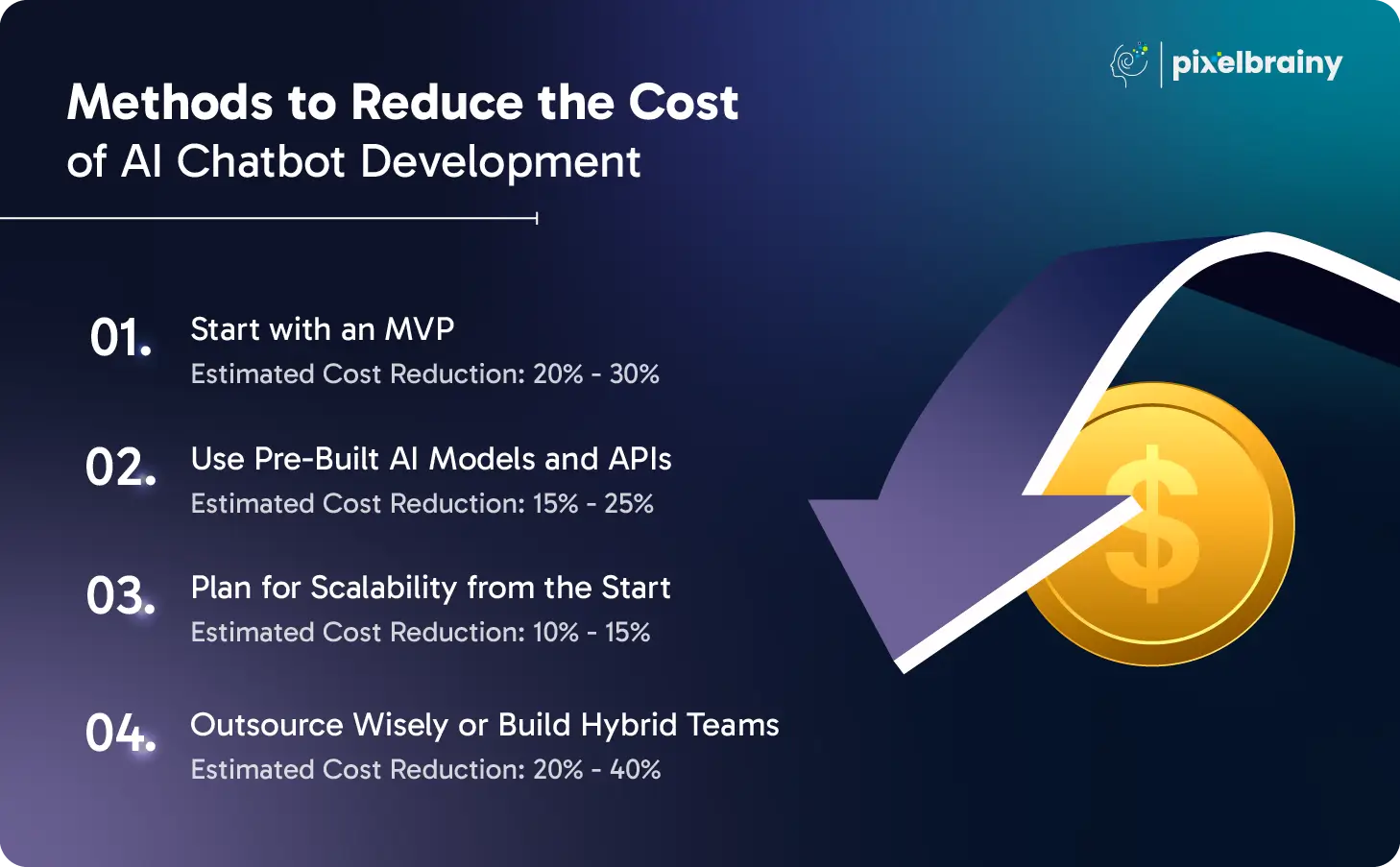
Begin with the features that directly address your primary business objective instead of building every possible capability at launch. An MVP can include essential conversational workflows, knowledge retrieval, basic integrations, analytics, and human handoff.
After launch, use customer feedback and usage data to determine which advanced features should be added. This approach reduces unnecessary development work and helps validate the chatbot before larger investments.
Estimated Cost Reduction: 20% to 30%
Also Read: Top 10 AI MVP Development Companies in USA
Using established AI models, frameworks, and APIs can reduce the time and resources required for AI chatbot development. Depending on the use case, businesses can integrate existing LLMs, NLP services, vector databases, or conversational AI frameworks instead of developing every component from scratch.
The right choice should balance development savings with API usage costs, customization requirements, data privacy, performance, and long-term scalability.
Estimated Cost Reduction: 15% to 25%
A scalable architecture can reduce expensive redevelopment when conversation volume, users, integrations, or AI capabilities increase. Define data structures, API architecture, monitoring, knowledge management, and model evaluation requirements early.
For AI chatbots using proprietary business information, preparing a reliable knowledge base and evaluation process from the beginning can also reduce future rework and improve response quality.
Estimated Cost Reduction: 10% to 15%
Businesses can optimize custom AI chatbot cost by combining internal resources with specialized external expertise. Instead of outsourcing every task, retain strategic product and domain responsibilities internally while using an experienced development partner for AI engineering, integrations, testing, or infrastructure.
Compare providers based on technical expertise, communication, security practices, delivery quality, and relevant experience rather than selecting a partner solely because of lower hourly rates.
Estimated Cost Reduction: 20% to 40%
A phased strategy, proven AI technologies, scalable architecture, and the right development team can help businesses reduce AI chatbot development expenses while protecting quality and long-term ROI.
As AI technology matures, the economics of AI chatbot development are likely to change significantly beyond 2026. Better open-source models, improved development platforms, reusable AI components, and more efficient infrastructure could make many chatbot capabilities faster and more affordable to implement.
However, lower development costs will not necessarily mean every AI chatbot becomes inexpensive. Businesses seeking advanced personalization, proprietary knowledge, complex integrations, stronger governance, and enterprise-scale performance may continue to require substantial investment.
A key question for businesses planning ahead is: “Will AI chatbot development become cheaper after 2026, or will advanced capabilities continue to increase the cost of custom solutions?”
Below are the major trends that could influence AI chatbot cost after 2026.
More capable open-source AI models could give businesses greater flexibility when selecting the technology behind their chatbots. Instead of relying exclusively on proprietary models, companies may use open-source models where they meet performance, security, and deployment requirements.
This could reduce certain licensing and model-access expenses while giving businesses greater control over customization and infrastructure. However, hosting, fine-tuning, evaluation, security, and ongoing maintenance can still contribute to the overall cost.
AI development platforms, reusable components, automated testing tools, low-code solutions, and improved deployment frameworks can simplify parts of the chatbot development lifecycle.
As these tools mature, development teams may spend less time building foundational components and more time configuring AI workflows around specific business requirements. This can potentially reduce development effort and shorten project timelines, although the actual savings will depend on the chatbot's complexity.
As basic chatbot capabilities become more accessible, businesses may increasingly differentiate through personalized AI experiences. Advanced chatbots could incorporate customer context, conversation history, business knowledge, behavioral signals, and memory to deliver more relevant interactions.
These capabilities can increase the cost of custom AI chatbot development because they require sophisticated data architecture, personalization logic, evaluation, security, and continuous optimization.
Reusable AI components, modular architectures, automated development workflows, and improved integration tools could shorten chatbot development timelines. Businesses may be able to validate and launch focused chatbot experiences faster than traditional custom development projects.
Faster deployment can reduce project overhead and allow businesses to test real-world usage earlier. However, complex enterprise solutions will still require adequate time for testing, security validation, integrations, and deployment preparation.
SaaS-based AI chatbot platforms are likely to continue expanding their capabilities while offering businesses flexible subscription-based access. This can make advanced conversational AI more accessible to startups and smaller organizations that do not want to build and maintain the entire technology stack themselves.
At the same time, businesses should evaluate subscription, usage-based, API, integration, and scaling charges when comparing the long-term cost with custom development.
After 2026, basic AI chatbot capabilities may become more accessible and cost-efficient, while highly customized enterprise solutions will continue to command investment based on their AI complexity, integrations, data requirements, security, and business value.
When chatbot development quotes vary widely for the same scope, the right development partner should do more than provide a number. PixelBrainy is an AI chatbot development company that focuses on connecting the proposed budget with the actual architecture, features, integrations, security requirements, and long-term operating needs of the product.
Consider a B2B SaaS product requiring GPT-4 or Claude integration, a RAG knowledge base, Zendesk ticket escalation, Slack deployment, a web widget, conversation analytics, GDPR considerations, and human handoff with conversation summaries. The important question is not simply, “Who offers the lowest quote?” It is “Which AI chatbot development company can explain exactly what the quote includes, why each component costs what it does, and how the solution will scale after launch?”
PixelBrainy approaches this type of project by breaking the scope into measurable technical components before development. This helps businesses understand where their budget is going and identify opportunities to optimize costs without removing capabilities that directly affect the chatbot's value.
PixelBrainy's published portfolio includes a customer service AI chatbot for eCommerce with eCommerce integration, AI-powered product recommendations, 24/7 automated support, and real-time order tracking.
The company also reports an AI chatbot for a fintech trading and portfolio management platform, featuring real-time market information, personalized portfolio insights, trade alerts, sentiment analysis, secure authentication, and API integration. The published case study reports a 68% reduction in customer service workload and response times of under two seconds.
These projects demonstrate experience with customer support automation, knowledge-driven interactions, third-party integrations, personalization, analytics, and industry-specific AI workflows. However, the publicly available sources do not verify that PixelBrainy has delivered the exact combination of GPT-4 or Claude, RAG, Zendesk, Slack, GDPR, web widget, analytics, and summarized human handoff in one single B2B SaaS project. That exact scope should therefore be discussed and verified directly with the team rather than assumed.
For a B2B SaaS company comparing highly variable chatbot quotes, PixelBrainy can help break the scope into architecture, AI, integrations, infrastructure, testing, and recurring operating costs, giving you a clearer basis for comparing proposals.
Want to know what your specific AI chatbot should cost? Connect with PixelBrainy for a transparent project assessment and development roadmap.
The future of AI chatbot development in 2026 and beyond is promising, with infinite possibilities for businesses to boost customer engagement and ease operations. By understanding the factors impacting custom chatbot development costs, you can optimize your budget, make smarter decisions, and eventually drive long-term success.
We hope this AI chatbot development cost guide helped you unveil every factor, including hidden ones, that can save you from surprising expenses that can create issues later. This way, you can make an informed decision while creating a budget for your AI chatbot development.
Ready to take the leap and revolutionize your business? Start your AI chatbot journey with PixelBrainy, which proposes affordable chatbot development costs!
The AI chatbot development cost typically starts around $10,000 for a basic solution and can exceed $100,000 for advanced or enterprise-grade systems. The cost to develop an AI chatbot depends on features, AI model selection, integrations, RAG implementation, security, UI/UX, testing, and ongoing maintenance.
The cost to build a custom AI chatbot depends on the chatbot's complexity and business requirements. A basic chatbot may cost less, while an enterprise custom AI chatbot development project with CRM integration, RAG, analytics, human handoff, multilingual support, and advanced AI capabilities can require a significantly higher investment.
Several factors influence AI chatbot development pricing, including chatbot complexity, technology stack, AI model, platform, UI/UX requirements, third-party integrations, RAG pipeline, data preparation, security, compliance, development team expertise, and post-launch maintenance.
The cost of developing a RAG chatbot depends on the size and complexity of the knowledge base, document processing, embeddings, vector database, retrieval architecture, evaluation, security, and LLM integration. RAG can increase the custom AI chatbot cost, but it can significantly improve responses when the chatbot needs to work with proprietary business knowledge.
The cost to maintain an AI chatbot can include LLM API usage, cloud infrastructure, database and vector storage, monitoring, security updates, knowledge-base maintenance, model evaluation, and technical support. These recurring expenses depend heavily on conversation volume and the AI architecture used.
Initially, custom AI chatbot development usually costs more than purchasing an off-the-shelf solution. However, a custom chatbot provides greater control over integrations, workflows, data, branding, scalability, and AI functionality. Businesses should compare the long-term AI chatbot cost rather than focusing only on the initial investment.
Businesses can reduce AI chatbot development costs by starting with an MVP, prioritizing high-value features, using proven AI models and APIs, implementing integrations in phases, optimizing RAG architecture, and selecting a scalable technology stack. A detailed AI chatbot cost estimation before development can also help prevent unexpected expenses.
When selecting an AI chatbot development company, evaluate its experience with custom AI solutions, LLM integration, RAG, APIs, enterprise systems, security, and scalable architectures. Ask for relevant case studies, transparent AI chatbot development cost breakdowns, timelines, maintenance estimates, and verifiable client references before choosing a development partner.

About The Author
Sagar Bhatnagar
Sagar Sahay Bhatnagar brings over a decade of IT industry experience to his role as Marketing Head at PixelBrainy. He's known for his knack in devising creative marketing strategies that boost brand visibility and market influence. Sagar's strategic thinking, coupled with his innovative vision and focus on results, sets him apart. His track record of successful campaigns proves his ability to utilize digital platforms effectively for impactful marketing efforts. With a genuine passion for both technology and marketing, Sagar continuously pushes PixelBrainy's marketing initiatives to greater success.

Working with the PixelBrainy team has been a highly positive experience. They understand the design requirements and create beautiful UX elements to meet the application needs. The dev team did an excellent job bringing my vision to life. We discussed usability and flow. Sagar worked with his team to design the database and begin coding. Working with Sagar was easy. He has the knowledge to create robust apps, including multi-language support, Google and Apple ID login options, Ad-enabled integrations, Stripe payment processing, and a Web Admin site for maintaining support data. I'm extremely satisfied with the services provided, the quality of the final product, and the professionalism of the entire process. I highly recommend them for Android and iOS Mobile Application Design and Development.

Great experience working with them. Had a lot of feedback and I found that unlike most contractors they were bugging me for updates instead of the other way around. They were extremely time conscience and great at communicating! All work was done extremely high quality and if not on time, early! They were always proactive when it comes to communication and the work is great/above par always. Very flexible and a great team to work with! Goes above and beyond to present us with multiple options and always provides quality. Amazing work per usual with Chitra. If you have UI/UX or branding design needs I recommend you go to them! Will likely work with them in the future as well, definitely recommended!

PixelBrainy is a joy to work with and is a great partner when thinking through branding, logo, and website layout. I appreciate that they spend time going into the "why" behind their decisions to help inform me and others about industry best practices and their expertise.

I hired them to design our software apps. Things I really like about them are excellent communication skills, they answer all project suggestions and collaborate right away, and their input on design and colors is amazing. This project was complex and needed patience and creativity. The team is amazing to do business with. I will be using them long-term. Glad to see there are some good people out there. I was afraid to try and outsource my project to someone but I am glad I met them! I really can't say enough. They went above and beyond on this project. I am very happy with everything they have done to make my business stand out from the competition.

It was great working with PixelBrainy and the team. They were very responsive and really owned the project. We'll definitely work with them again!

I recently worked with the PixelBrainy team on a project and I was blown away by their communication skills. They were prompt, clear, and articulate in all of our interactions. They listened and provided valuable feedback and suggestions to help make the project a success. They also kept me updated throughout the entire process, which made the experience stress-free and enjoyable.

PixelBrainy is very good at what it does. The team also presents themselves very professionally and takes care of their side of things very well. I could fully trust them taking up the design work in a timely and organised manner and their attention to detail saved us lots of effort and time. This particular project was quite intense and the team showed that they function very well under pressure. Very much looking forward to working with her again!

It's always an absolute pleasure working with them. They completed all of my requests quickly and followed every note I had for them to a T, which made our process go smoothly from start to finish. Everything was completed fast and following all of the guidelines. And I would recommend their services to anyone. If you need any design work done in the future, PixelBrainy should be your first call!

They took ownership of our requirements and designed and proposed multiple beautiful variants. The team is self-motivated, requires minimum supervision, committed to see-through designs with quality and delivering them on time. We would definitely love to work with PixelBrainy again when we have any requirements.

PixelBrainy was a big help with our SaaS application. We've been hard at work with a new UI/UX and they provided a lot of help with the designs. If you're looking for assistance with your website, software, or mobile application designs, PixelBrainy and the team is a great recommendation.

PixelBrainy designers are amazing. They are responsive, talented, and always willing to help craft the design until it matches your vision. I would recommend them and plan to continue them for my future projects and more!!!

They were awesome! Did a good job fast, and good communication. Will work with them again. Thank you

Creative, detail-oriented, and talented designers who take direction well and implement changes quickly and accurately. They consistently over-delivered for us.

PixelBrainy team is very talented and creative. Great designers and a pleasure to work with. PixelBrainy is an excellent communicator and I look forward to working with them again.

PixelBrainy has a very talented design team. Their work is excellent and they are very responsive. I enjoy working with them and hope to continue on all of our future projects.

Transform your ideas into reality with us.
Across these industries, each engagement brings unique challenges, from early-stage product development to scaling complex systems, helping us build a practical understanding of real-world product environments.