
 AI Summary Powered by PixelBrainy
What if your commercial real estate portfolio could think, predict, and optimize itself in real time?
An AI commercial real estate app is a digital platform that uses machine learning, predictive analytics, and automation to streamline property management, improve tenant experiences, and enhance investment decision making. Instead of simply storing data, it transforms it into real time insights that drive measurable business outcomes.
Commercial real estate has always relied on data such as leases, tenant behavior, maintenance records, and market trends. In 2026, the real competitive advantage lies in the ability to act on that data instantly and at scale using AI driven systems.
When commercial real estate firms, property managers, investors, developers, PropTech startups, brokers, and enterprise real estate teams look to modernize operations and gain a competitive edge, a key question arises. Looking for the best company to create an AI commercial real estate mobile app in USA that automates property management, improves tenant experiences, optimizes investments, and drives long term growth in a competitive market?
The market momentum supports this shift. The global AI in real estate market reached 303 billion dollars in 2025 and is projected to grow to 989 billion dollars by 2029 at a CAGR of 34.4 percent. Morgan Stanley research studies indicate that up to 37 percent of commercial real estate tasks can be automated, while AI could generate between 110 and 180 billion dollars in value globally. Early adopters are already seeing average returns of 15 to 20 percent.
This guide explains how to build AI powered commercial real estate apps that align with real world workflows, unlock portfolio intelligence, and deliver long term competitive advantage.
An AI commercial real estate app is a digital platform that uses machine learning, predictive analytics, and natural language processing to help real estate firms automate operations, improve tenant experiences, and make data driven investment decisions.
Unlike traditional property management software that stores listings, tracks leases, and generates basic reports, an AI powered platform actively analyzes data and delivers intelligent, real time insights.
Key capabilities include:
These capabilities enable commercial real estate firms, investors, developers, property managers, brokers, and asset managers to operate more efficiently and respond faster to market changes.
While platforms like CoStar, VTS, and Buildium offer AI features, they are typically designed for broad use cases. Businesses that require deeper workflow integration, proprietary data advantages, and tailored intelligence increasingly choose to build custom AI commercial real estate apps.
A traditional system manages and organizes data, whereas an AI commercial real estate app continuously analyzes data to generate insights, automate workflows, and support decision making at scale.
Is investing in AI commercial real estate app development worth it in 2026? Yes. Generic platforms are built for broad use cases and cannot fully align with specific portfolios, tenant profiles, or investment strategies. Purpose built AI platforms provide deeper workflow integration and create long term competitive advantages through proprietary data.
The AI in real estate market is growing at a CAGR of 34.4 percent, reflecting a structural shift in how commercial real estate firms operate and compete.
Key reasons driving investment:
Traditional processes such as lease abstraction, valuation, maintenance management, and reporting create operational bottlenecks. AI automates these tasks, enabling firms to scale without proportional increases in cost or resources.
AI models analyze market trends, occupancy patterns, and economic data to forecast property performance. This helps firms identify opportunities earlier, price risk more accurately, and improve investment outcomes.
Modern tenants expect digital experiences similar to consumer apps. AI enables real time communication, smart maintenance workflows, and seamless lease management, improving retention and rental value.
AI can automate lease drafting, generate marketing content, enable conversational property search, and produce portfolio reports, reducing manual effort and accelerating workflows.
Funding in AI driven PropTech continues to grow, signaling strong market demand and increasing adoption across commercial real estate businesses.
AI platforms continuously collect and learn from portfolio data. Over time, this creates data driven insights that are difficult for competitors using generic tools to replicate.
These factors have made AI commercial real estate app development a strategic priority for firms aiming to improve efficiency, decision making, and long-term growth.
Also Read: Agentic AI Development for Real Estate: Use Cases, Benefits, and Development Tactics
What differentiates an AI commercial real estate app from traditional property management or analytics tools is its layered architecture, where data flows through interconnected systems and continuously improves through real world usage and feedback loops.
This architecture ensures that raw, fragmented data is transformed into structured intelligence, actionable insights, and automated workflows that support real time decision making.
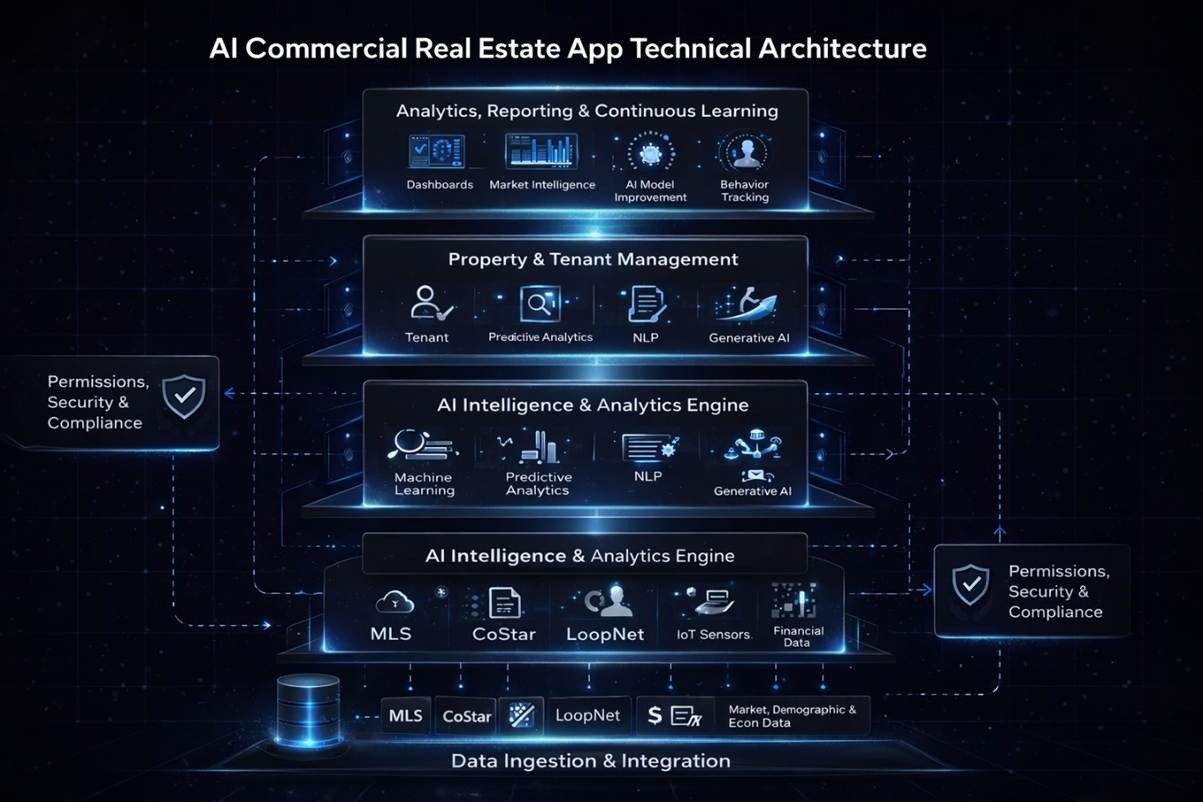
This layer collects, aggregates, and standardizes data from multiple sources, including MLS, CoStar, Loopnet, existing property management systems, IoT sensors, financial records, and external market data.
It creates a unified data foundation that supports all downstream processes.
The quality, consistency, and completeness of this data directly determine the accuracy and reliability of AI outputs.
This is the core processing layer where machine learning models and algorithms generate insights, predictions, and recommendations.
Key capabilities include:
This layer manages day to day operational workflows, including tenant onboarding, lease lifecycle management, maintenance request handling, access control, and rent collection.
AI enhances these processes by enabling automation, prioritization, and risk prediction.
This layer converts AI generated insights into automated actions across the platform.
It includes tenant communication systems, automated alerts, investor and broker reporting, CRM integration, and document generation for leases, contracts, and investment workflows.
This layer provides portfolio level dashboards, market intelligence insights, and AI performance monitoring.
User behavior data and system outcomes are continuously fed back into the models, enabling ongoing learning, accuracy improvement, and system optimization.
Together, these five layers create an intelligent system that becomes more accurate, efficient, and valuable over time as more data is processed and more interactions occur across the platform.
AI commercial real estate apps deliver measurable value by transforming how firms manage properties, analyze investments, and interact with tenants. Instead of relying on manual processes and fragmented data, these platforms use AI to automate workflows, generate real time insights, and improve decision making across the entire portfolio.
The impact is not limited to one function. AI creates compounding benefits across operational efficiency, cost reduction, investment performance, and tenant satisfaction. As more data is processed, the system becomes more accurate and valuable over time, giving businesses a long-term competitive advantage.
The following six benefits highlight how AI is reshaping commercial real estate operations at scale.
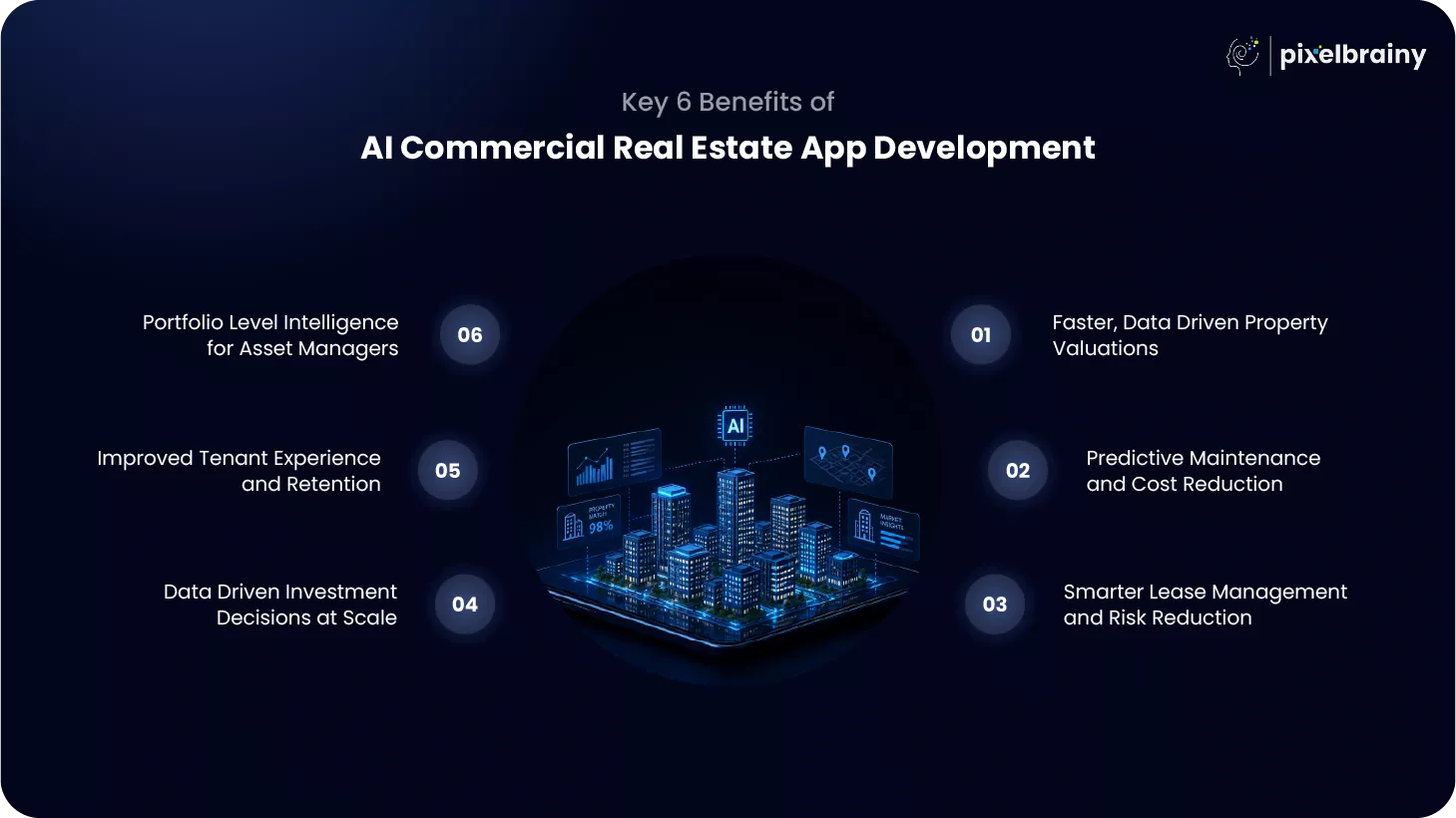
AI transforms property valuation from a time intensive manual process into a fast, data driven capability. It enables real estate teams to analyze more opportunities with greater accuracy and speed, improving deal flow and decision quality.
Key advantages:
AI enables proactive maintenance by identifying potential issues before they lead to failures. This reduces unexpected downtime, lowers repair costs, and extends the lifespan of critical building systems.
Key advantages:
AI improves lease management by extracting and analyzing key information across large portfolios. It helps firms identify risks early, manage renewals effectively, and reduce vacancy rates.
Key advantages:
AI enhances investment decision making by analyzing large datasets and identifying patterns that are difficult to detect manually. This allows firms to evaluate opportunities more accurately and allocate capital more effectively.
Key advantages:
AI improves tenant experience by enabling faster communication, personalized interactions, and seamless service delivery. This leads to higher tenant satisfaction, stronger relationships, and improved retention rates.
Key advantages:
AI provides a consolidated and real time view of portfolio performance, helping asset managers make strategic decisions with greater confidence. It enables better planning, forecasting, and optimization across multiple properties.
Key advantages:
AI commercial real estate app development enables firms to scale operations, improve decision making, and build long term competitive advantage through intelligent automation and data driven insights.
AI commercial real estate apps are used across multiple roles, including investors, property managers, brokers, and developers. Each use case focuses on solving specific operational or investment challenges using data driven intelligence.
The following use cases highlight where AI delivers the most measurable value in real world commercial real estate workflows.
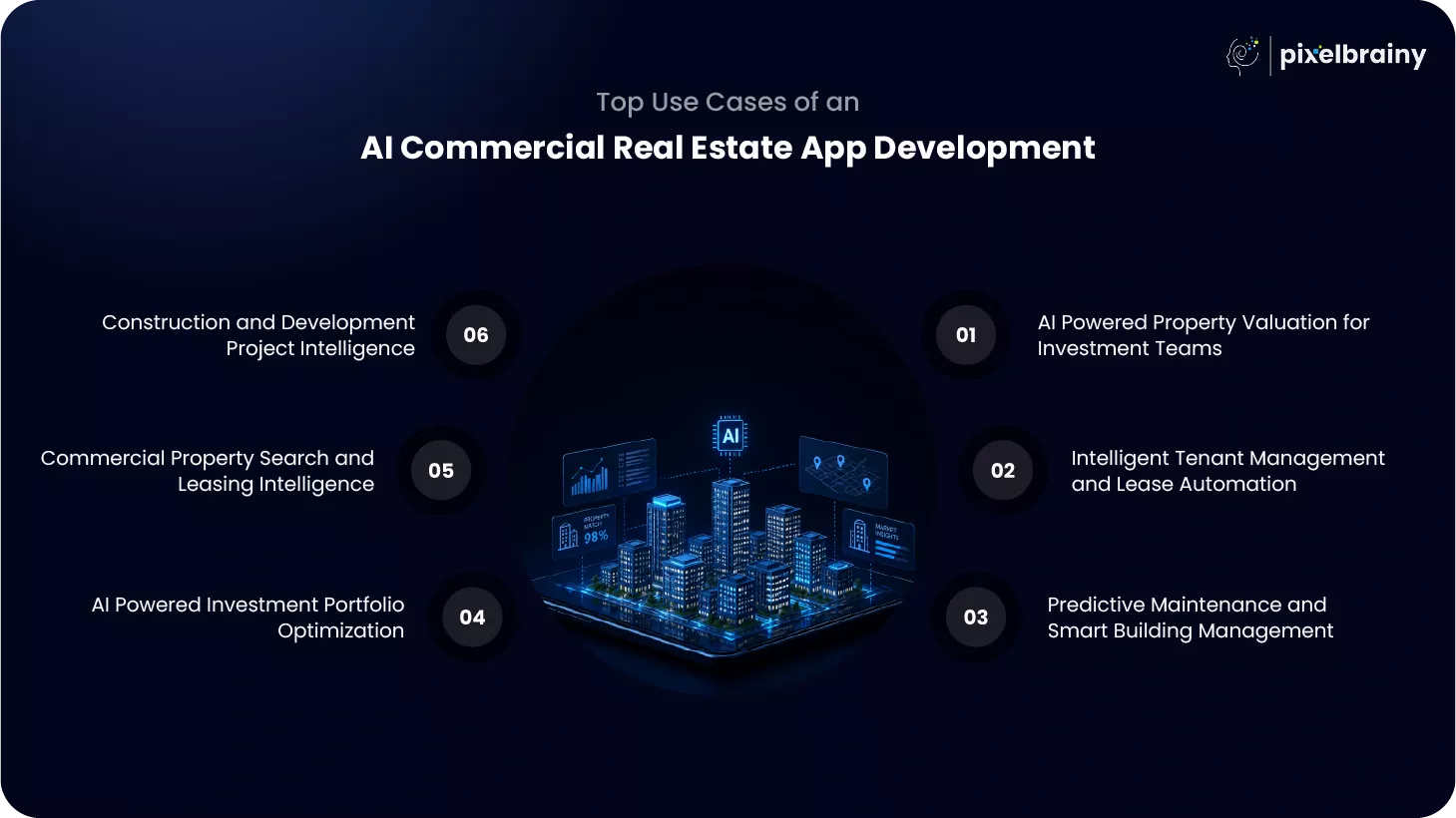
AI powered valuation enables investment teams to assess property value faster and with greater consistency. Instead of relying on manual analysis, AI models process large datasets including comparable transactions, property features, and market conditions in real time. This allows firms to evaluate more opportunities and make quicker acquisition decisions.
AI also continuously updates portfolio valuations based on changing market trends, eliminating the need for periodic manual reviews. It improves pricing accuracy and reduces the risk of over or under valuation.
Example: A commercial real estate firm analyzing a 200,000 sq ft office asset generates a valuation in under 40 minutes instead of 3 days, enabling the team to evaluate up to four times more deals per quarter.
AI simplifies tenant management by automating lease processing, onboarding, and communication workflows. Natural language processing extracts key lease terms such as renewal dates, escalation clauses, and obligations, reducing manual effort and errors.
AI models also predict tenant churn by analyzing payment behavior, engagement patterns, and lease timelines. This allows property managers to take proactive steps to retain tenants and reduce vacancies.
In addition, onboarding workflows automate document collection, verification, and lease execution, improving operational efficiency.
Example: A property management company managing 50 commercial assets reduces administrative workload by saving over 140 staff hours per month within three months of deploying AI driven lease and onboarding automation.
AI enables proactive building management by analyzing IoT sensor data from systems such as HVAC, elevators, and electrical infrastructure. It identifies patterns that indicate potential failures before they occur, allowing maintenance teams to act early.
This reduces unplanned downtime, lowers emergency repair costs, and extends equipment lifespan. AI also monitors energy consumption and recommends optimizations to improve efficiency and reduce operating expenses.
Predictive maintenance shifts operations from reactive to preventive, improving reliability across the portfolio.
Example: A portfolio of 15 office buildings reduces emergency maintenance incidents by 62 percent and lowers overall maintenance costs by 18 percent within six months of implementing AI based monitoring systems.
AI helps asset managers optimize portfolios by providing real time insights into performance, risk, and market trends. It aggregates data across properties to identify underperforming assets and recommend actions such as capital improvements or disposition.
AI models also support acquisition and exit decisions by forecasting market cycles, rental trends, and demand shifts. This enables more precise timing and capital allocation strategies.
Automated reporting further streamlines investment analysis and decision-making processes.
Example: A real estate investment trust identifies three underperforming assets where targeted capital investment increases NOI by 22 percent, improving overall portfolio IRR by 1.8 percentage points.
AI improves property discovery and leasing efficiency by matching tenants with properties based on complex requirements. Unlike traditional search tools, AI considers factors such as business type, budget, lease terms, and location preferences simultaneously.
It also provides market intelligence on supply, demand, and transaction trends, helping brokers make better recommendations and close deals faster. Lead qualification improves as AI identifies high intent prospects.
This results in higher conversion rates and more efficient leasing workflows.
Example: A commercial leasing agency increases qualified property showing conversions by 34 percent after implementing AI based tenant to property matching and lead scoring systems.
AI supports developers by improving feasibility analysis, project planning, and execution monitoring. It evaluates multiple variables such as zoning regulations, construction costs, rental projections, and absorption rates before investment decisions are made.
Computer vision tools track construction progress and compare it against planned timelines, helping identify delays early. AI also automates ESG reporting and compliance tracking for investors and regulators.
This reduces project risk and improves capital allocation decisions.
Example: A commercial developer analyzes 12 potential development sites within two weeks using AI driven feasibility models, identifying the top two opportunities, compared to a traditional process that previously took three months.
These use cases demonstrate how AI commercial real estate apps deliver measurable value across investment, operations, and tenant experience, making them essential for modern real estate strategies.
AI commercial real estate apps must be built around features that directly support core workflows such as property management, investment analysis, and tenant engagement. These capabilities work together to create a unified, data driven platform that improves efficiency and decision making.
The following features form the foundation of a scalable and high performing AI powered commercial real estate application.
| Feature | Description |
|---|---|
| AI Property Valuation Engine | Uses machine learning models to analyze comparable sales, market conditions, and property attributes in real time. It enables faster and more accurate property valuation. This helps investment teams evaluate more opportunities efficiently. |
| Smart Lease Management and Abstraction | Applies natural language processing to extract key lease terms, dates, and clauses automatically. It reduces manual effort and improves accuracy across large portfolios. It also helps identify risks and renewal opportunities. |
| Predictive Maintenance System | Analyzes IoT sensor data and historical maintenance records to detect early signs of equipment failure. It enables proactive maintenance and reduces unexpected downtime. This lowers operating costs and extends asset lifespan. |
| Investment Analytics and Deal Scoring | Evaluates acquisition opportunities using predefined criteria and AI models. It ranks deals based on risk adjusted return potential. This supports faster and more informed investment decisions. |
| Tenant Portal and Self Service Interface | Provides tenants with access to maintenance requests, lease documents, and payment systems. It enables real time communication and improves service experience. This increases tenant satisfaction and retention. |
| AI Powered Property Search and Matching | Matches tenants with suitable properties based on multiple parameters such as location, size, and budget. It improves search accuracy and lead quality. This helps brokers close deals faster. |
| Portfolio Performance Dashboard | Aggregates real time data on NOI, occupancy, expenses, and asset value across properties. It provides AI generated insights and performance summaries. This supports strategic portfolio management. |
| Smart Maintenance and Work Order Management | Automates the maintenance lifecycle from request intake to resolution tracking. It prioritizes tasks using AI and improves response time. This ensures efficient operations and cost control. |
| Market Intelligence and Trend Analytics | Provides continuous insights into rent trends, vacancy rates, and market performance. It helps identify emerging opportunities and risks. This improves decision making for investments and leasing. |
| Document Management and AI Search | Stores and organizes property documents, leases, and compliance records in a centralized system. It enables natural language search across documents. This improves accessibility and reduces manual effort. |
| CRM and Deal Pipeline Management | Tracks leads, broker relationships, and deal progress in a structured pipeline. AI helps score leads and automate follow ups. This improves conversion rates and sales efficiency. |
| Push Notifications and Alerts System | Sends real time alerts for lease events, maintenance updates, and payment reminders. It keeps all stakeholders informed. This improves responsiveness and reduces delays. |
| Role Based Access and Security Controls | Manages access permissions for different user roles such as managers, tenants, and investors. It ensures secure data handling and audit tracking. This supports compliance and data protection. |
| Reporting and Analytics Automation | Generates reports for investors, operations, and compliance automatically. It uses AI to create insights and summaries. This reduces manual reporting effort and improves accuracy. |
| API Integration Layer | Connects the platform with external systems such as MLS, CoStar, Yardi, and CRM tools. It ensures seamless data flow across systems. This enhances scalability and system interoperability. |
Together, these features define a modern AI commercial real estate platform that drives operational efficiency, enhances investment performance, and creates long term competitive advantage.
Can generative AI be used to build commercial real estate apps with deeper intelligence and automation? The answer is yes. Advanced AI capabilities are transforming commercial real estate platforms from operational tools into intelligent, decision driven systems.
These features go beyond basic automation and enable predictive insights, autonomous workflows, and scalable decision making. They represent the next phase of innovation for businesses building enterprise grade AI commercial real estate applications.
| Advanced Feature | What It Does | Value Impact |
|---|---|---|
| Generative AI for Lease Drafting and Reporting | Uses large language models to automatically generate lease agreements, investment memos, and portfolio reports from structured data. It reduces manual document creation and ensures consistency across outputs. It also enables faster turnaround for deal documentation. | Reduces document production time by 60 to 80 percent and accelerates deal execution and reporting cycles. |
| Agentic AI for Multi Step Workflows | Deploys autonomous AI agents to handle complex workflows such as tenant onboarding, lease renewals, and due diligence. These agents execute tasks across systems without constant human input. This improves workflow continuity and reduces manual coordination. | Eliminates administrative bottlenecks and increases deal velocity and operational scalability. |
| Computer Vision for Property Inspection | Analyzes property images and video walkthroughs to detect defects, assess conditions, and generate inspection reports. It reduces reliance on manual inspections and enables remote monitoring. This improves inspection speed and accuracy. | Reduces inspection costs and supports remote portfolio management across multiple locations. |
| Digital Twin for Commercial Properties | Creates virtual replicas of physical assets to simulate energy usage, occupancy scenarios, and renovation outcomes. It allows testing of different strategies before real world implementation. This improves planning and risk assessment. | Enables data driven capital planning and optimization decisions that improve asset value and NOI. |
| ESG Analytics and Sustainability Reporting | Tracks metrics such as energy consumption, carbon emissions, and sustainability performance across properties. It automates reporting for regulatory and investor requirements. This ensures compliance and transparency. | Supports ESG mandates and improves sustainability reporting for investors and regulators. |
| Conversational AI for Tenant and Broker Engagement | Provides AI driven chat interfaces that handle tenant queries, maintenance requests, and property searches in natural language. It improves communication efficiency and response time. This enhances user experience. | Reduces operational workload while improving tenant satisfaction and engagement. |
| Predictive Rent Optimization | Uses market data, demand trends, and tenant profiles to recommend optimal rental pricing strategies. It adjusts pricing dynamically based on market conditions. This improves revenue potential. | Increases portfolio NOI by identifying pricing opportunities missed in manual analysis. |
| AI Powered Automated Underwriting | Processes financial data, credit reports, and market comparables to generate underwriting models automatically. It includes scenario analysis for risk assessment. This speeds up evaluation processes. | Reduces underwriting time from days to hours and improves investment decision speed. |
| Smart Building IoT Integration | Connects with building systems such as HVAC, energy management, and sensors for real time monitoring. It enables automated control and performance optimization. This improves operational efficiency. | Enhances building performance, reduces energy costs, and improves tenant experience. |
| Blockchain for Lease and Transaction Records | Uses distributed ledger technology to store lease agreements and transaction records securely. It ensures data immutability and transparency. This simplifies verification and due diligence. | Reduces fraud risk and creates secure, tamper proof audit trails for transactions. |
These advanced features transform AI commercial real estate apps into intelligent platforms that drive automation, improve decision making, and enable long term scalability.
Building an AI commercial real estate app requires a structured approach that aligns data, AI models, and user workflows. The development process of AI commercial real estate app platforms goes beyond traditional software development and focuses on scalability, accuracy, and real-world usability.
Real estate companies when plan to modernize operations and build intelligent platforms often face a critical decision point. Looking for agency to create AI commercial property management app solutions? The following step by step framework is used by top AI real estate software development companies and AI development companies to build scalable and intelligent platforms.
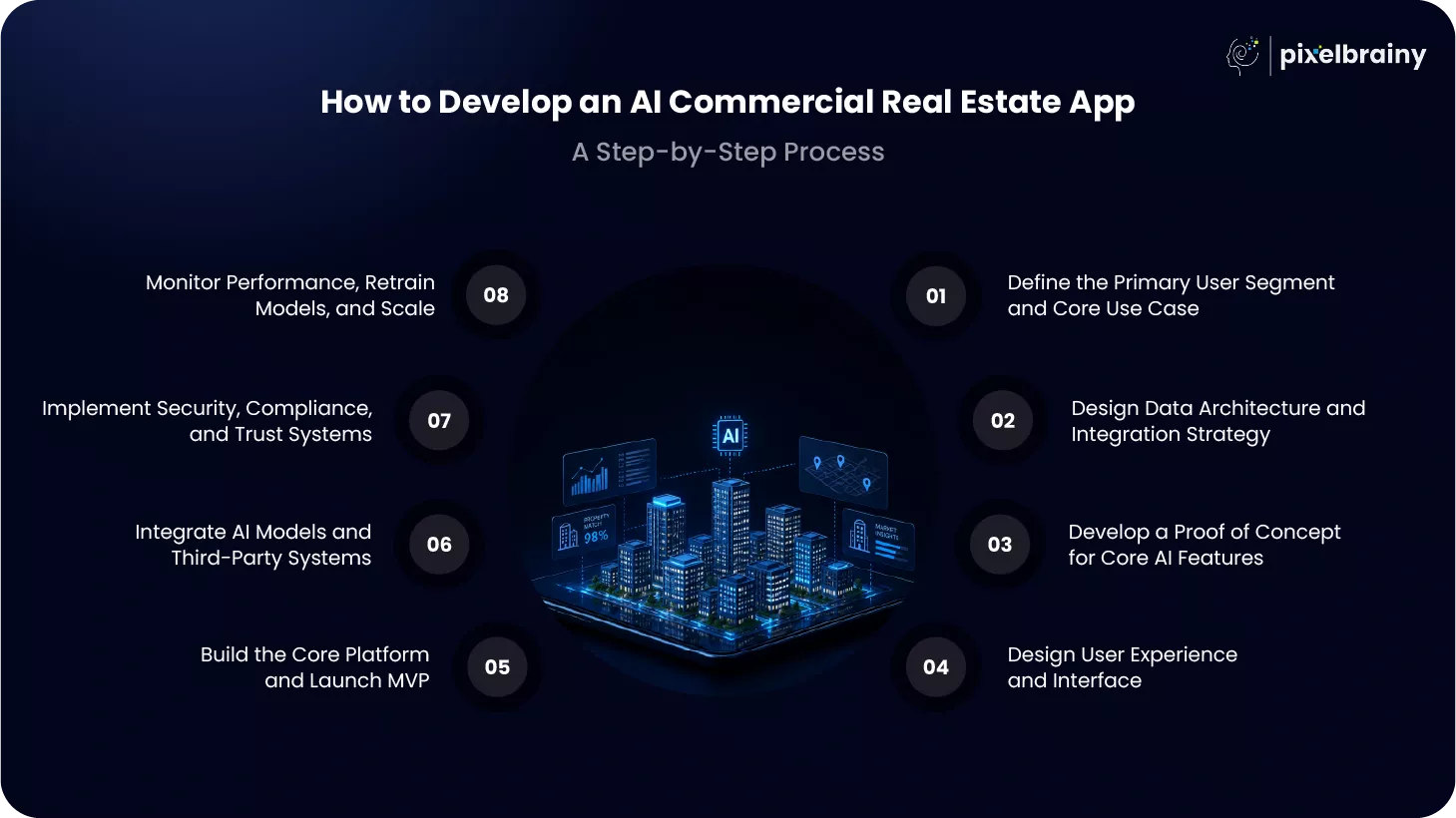
Goal of this step: Identify the primary user and the most critical problem the platform will solve.
A successful AI commercial real estate app development process begins with clarity on the target user. Trying to serve investors, property managers, brokers, and tenants simultaneously leads to poor adoption and diluted value. Instead, focus on a single user segment and a clearly defined use case.
This step includes conducting detailed interviews with target users to understand workflows and pain points. Mapping existing processes helps identify inefficiencies and automation opportunities. Defining a clear success metric ensures that development aligns with measurable business outcomes.
Goal of this step: Build a reliable data foundation for AI performance.
AI commercial real estate apps depend on structured and high-quality data. This step focuses on identifying key data sources such as MLS, CoStar, Loopnet, IoT systems, and internal platforms. Data must be normalized into a unified structure for consistent processing.
It also includes defining data governance, access control, and compliance requirements. AI integration services are essential for connecting systems and ensuring seamless data flow. A strong data architecture directly impacts accuracy, scalability, and long-term platform performance.
Goal of this step: Validate AI performance using real world data.
PoC development ensures that core AI features work effectively in real commercial real estate scenarios. Models that perform well in controlled environments may fail with real data complexity.
This step involves training models on actual property data and validating outputs against domain expertise. Accuracy benchmarks must be defined before moving forward. Involving experienced professionals ensures that AI outputs are practical, reliable, and aligned with real business needs.
Goal of this step: Create intuitive and workflow aligned user interfaces.
User adoption depends heavily on design quality. Partnering with an experienced UI UX design company ensures that the platform is easy to use and aligned with professional workflows.
This step includes designing role specific dashboards, testing prototypes with real users, and refining navigation and interaction flows. AI insights should be presented in a clear and actionable format. A well-designed interface ensures that users can quickly understand and act on AI recommendations.
Goal of this step: Deliver a functional product for real world testing.
MVP development focuses on building the core functionality required to solve the primary use case. This includes basic AI features, essential integrations, and a working interface.
Launching the MVP in a controlled environment allows teams to collect real user feedback. Metrics such as adoption rate, task efficiency, and user engagement help identify improvement areas. This step establishes a feedback loop that is critical for refining the platform before scaling.
Also Read: Top 10 AI MVP Development Companies in USA
Goal of this step: Connect AI capabilities with operational systems.
This step integrates trained AI models into the production environment and connects external systems such as CRM platforms, property databases, and financial tools. It enables real time data processing and decision support.
AI integration services ensure that outputs are explainable and aligned with workflows. Testing AI recommendations against real scenarios helps validate business impact. This is where the platform delivers its core value through intelligent automation and insights.
Goal of this step: Ensure platform security and enterprise readiness.
Commercial real estate platforms handle sensitive financial and tenant data. This step focuses on implementing role-based access control, encryption, and audit logging.
Compliance with standards such as SOC 2 and data privacy regulations is essential for enterprise adoption. Transparency in AI recommendations builds user trust. This step ensures that the platform meets security, compliance, and reliability expectations.
Goal of this step: Continuously improve and expand the platform.
AI systems require ongoing monitoring and optimization. This step includes tracking model performance, identifying accuracy issues, and retraining models with updated data.
Since real estate markets vary by location, models must be adapted for different regions. Gradual expansion ensures reliability. Continuous improvement enables the platform to deliver increasing value and maintain long term competitiveness.
Following this structured process enables businesses to develop an AI commercial real estate app that is scalable, reliable, and aligned with real world workflows.
The cost to develop an AI commercial real estate app typically ranges from $25,000 to $200,000 or more, depending on platform complexity, AI capabilities, data integrations, and supported platforms.
The total investment varies based on how advanced the app is, the number of user roles it supports, and the level of automation and intelligence required. Businesses building enterprise grade solutions should expect higher costs due to deeper integrations and advanced AI features.
| Development Tier | Cost Range | What It Includes |
|---|---|---|
| Basic AI Commercial Real Estate MVP | $25,000 to $60,000 | A focused MVP for a single user type and market. Includes basic AI property matching or valuation, tenant portal, lease tracking, push notifications, and an admin dashboard. Suitable for startups validating an idea. |
| Mid-Level AI Commercial Real Estate Platform | $60,000 to $120,000 | A production ready platform supporting multiple users. Includes AI valuation, predictive maintenance, lease abstraction, investment analytics, market intelligence, payment systems, and MLS or CoStar integration with basic compliance. |
| Advanced Enterprise AI Platform | $120,000 to $200,000+ | A full-scale platform with advanced AI capabilities such as generative AI reporting, agentic workflows, computer vision inspections, digital twins, IoT integration, ESG analytics, and enterprise security. Designed for large firms and institutional use. |
The true value of AI commercial real estate app development lies not just in initial cost, but in building a scalable platform that continuously improves performance, drives efficiency, and delivers long term returns.

Also Read: AI Real Estate App Development Cost: Factors and Examples
A scalable and intelligent AI commercial real estate app depends on the right combination of technologies across AI, data processing, infrastructure, and user experience. The technology stack directly impacts performance, scalability, integration capability, and long-term maintainability of the platform.
Choosing the right tools ensures seamless data flow, accurate AI outputs, and a reliable experience for property managers, investors, and tenants.
| Category | Tools and Technologies | Explanation |
|---|---|---|
| Programming Languages | Python, TypeScript, Swift, Kotlin, Node.js | Python supports AI model development and data processing. TypeScript is used for frontend and APIs. Swift and Kotlin enable native mobile apps. Node.js powers backend services. |
| AI and Machine Learning | TensorFlow, PyTorch, scikit-learn, XGBoost | Used to develop models for property valuation, predictive maintenance, investment scoring, and tenant behavior analysis. |
| Natural Language Processing | OpenAI GPT Models, Anthropic Claude, spaCy, Hugging Face | Enable lease abstraction, document analysis, AI generated reporting, and conversational interfaces. |
| Computer Vision | Google Vision AI, AWS Rekognition, MONAI | Support property inspection, construction monitoring, and condition analysis using images and video data. |
| Databases and Storage | PostgreSQL, MongoDB, Redis, Amazon S3, Snowflake | PostgreSQL manages structured data. MongoDB handles flexible schemas. Redis provides caching. Snowflake supports analytics at scale. |
| Commercial Real Estate Data Integrations | CoStar API, Loopnet, MLS APIs, ATTOM Data | Provide access to property data, comparables, and market intelligence required for AI analysis. |
| Verification APIs | Plaid, Stripe Identity, Persona | Enable tenant verification, financial validation, and identity checks during onboarding and transactions. |
| Payment Processing | Stripe, Plaid | Support rent collection, deposits, vendor payments, and subscription billing workflows. |
| Maps and Geolocation | Google Maps API, Mapbox, ArcGIS | Enable location based property search, mapping, and geographic portfolio visualization. |
| IoT and Smart Building | AWS IoT, Azure IoT Hub, MQTT Protocol | Connect building systems for real time monitoring of HVAC, energy usage, and maintenance data. |
| Push Notifications and Alerts | Firebase Cloud Messaging, Twilio, OneSignal | Deliver real time alerts for maintenance updates, lease events, and market changes. |
| Cloud Infrastructure | AWS, Google Cloud Platform, Microsoft Azure | Provide scalable infrastructure for hosting, storage, and AI model deployment. |
| DevOps and CI/CD | GitHub Actions, Docker, Kubernetes, Terraform | Enable automated deployment, containerization, and infrastructure management. |
| Analytics and Monitoring | Mixpanel, Datadog, Grafana, Amplitude | Track user behavior, platform performance, and AI model accuracy in real time. |
| Frontend Frameworks | React, Next.js, Tailwind CSS | Build responsive and scalable interfaces for dashboards, portals, and user applications. |
A well-designed technology stack enables seamless integration of AI, data, and user workflows, forming the foundation of a scalable and high performing commercial real estate platform.
AI commercial real estate apps manage sensitive data, including financial records, tenant information, and investment intelligence. Strong compliance and security frameworks are essential for enterprise adoption and long-term trust.
Organizations must implement standardized security practices and meet regulatory requirements to ensure data protection, system reliability, and legal compliance.
AI commercial real estate platforms handling user data in the European Union must comply with GDPR regulations governing data collection, storage, and user rights.
Key requirements:
SOC 2 Type II certification is often required by enterprise clients to validate platform security, availability, and data handling practices.
Key requirements:
Platforms integrating external data sources such as MLS and CoStar must follow strict licensing agreements and usage policies.
Key requirements:
AI platforms that process payments or financial transactions must meet industry level security standards to protect sensitive financial data.
Key requirements:
A strong compliance and security framework ensures data protection, builds enterprise trust, and enables scalable adoption of AI commercial real estate platforms.
AI commercial real estate app development involves multiple technical and operational challenges that can impact performance, scalability, and adoption. These challenges are often related to data quality, AI model accuracy, system integration, and user trust.
Addressing them early in the development process helps businesses build reliable, scalable, and high performing platforms that deliver consistent real-world value.
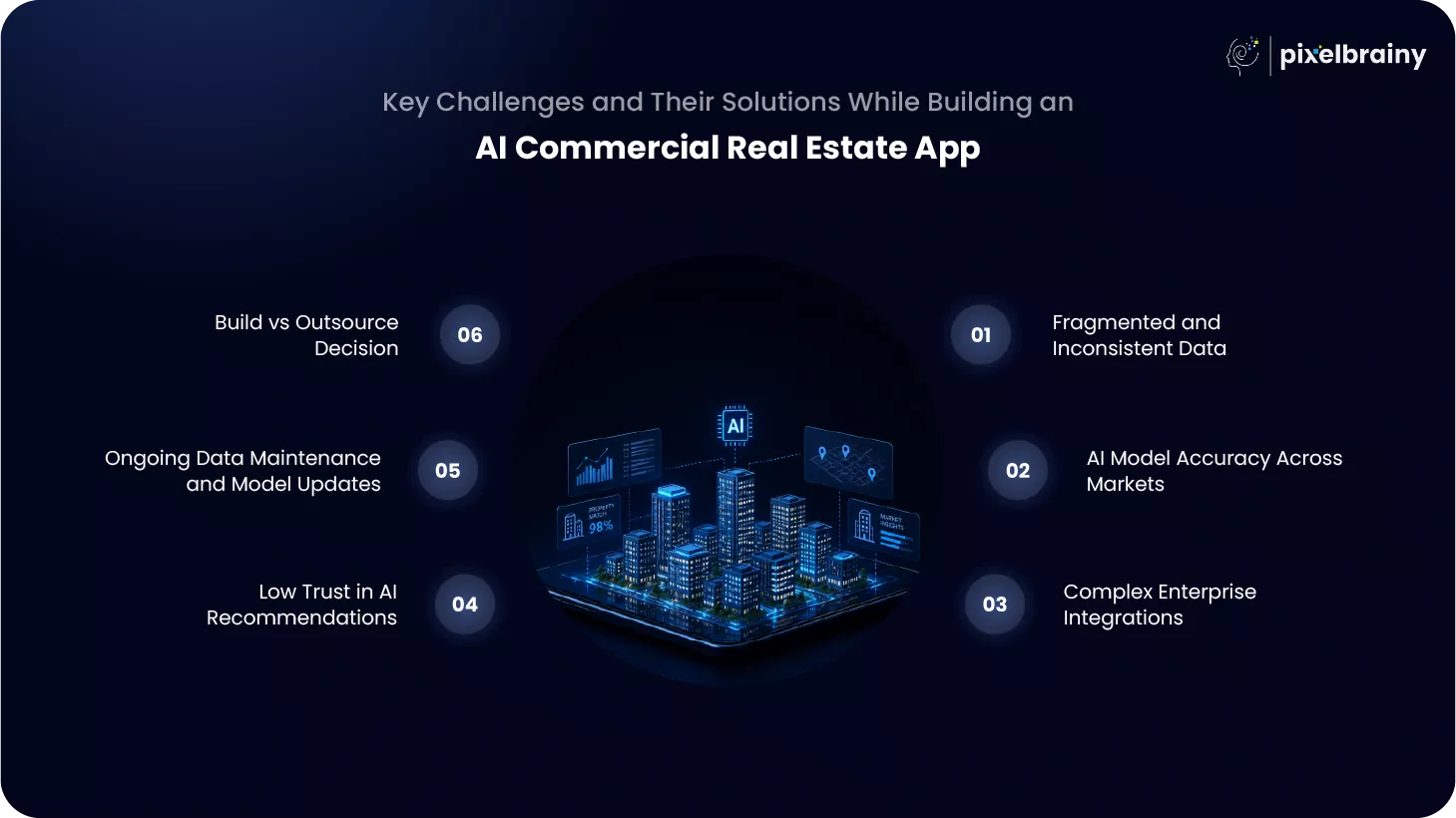
Commercial real estate data is distributed across multiple systems such as MLS, CoStar, spreadsheets, lease documents, and IoT devices, making it difficult to standardize. Inconsistent or incomplete data directly reduces the accuracy and reliability of AI outputs.
Solution: Establish a strong data pipeline that aggregates and normalizes data from all sources. Implement automated data validation and partner with reliable data providers to ensure consistent and high-quality inputs.
AI models trained on one property type or geographic region often fail to perform well in others due to variations in market conditions and asset characteristics. This limits scalability and reliability across diverse portfolios.
Solution: Train and deploy separate models for different property types and locations. Continuously monitor performance and retrain models using updated, localized datasets to maintain accuracy.
Commercial real estate firms rely on multiple legacy and modern systems such as Yardi, MRI, and Salesforce, making integration complex and time consuming. Poor integration can lead to data silos and workflow inefficiencies.
Solution: Develop a flexible API based integration layer from the start. Prioritize commonly used systems and provide custom integration support for enterprise clients with unique requirements.
Real estate professionals are often cautious about relying on AI outputs without clear reasoning or proven accuracy. Lack of transparency can slow adoption and limit usage.
Solution: Provide explainable AI outputs with clear reasoning behind recommendations. Display accuracy metrics and use AI to support decision making rather than replace human judgment.
AI models degrade over time as market conditions change, making continuous updates essential for maintaining performance. Without regular retraining, predictions become less reliable.
Solution: Build continuous data collection and labeling workflows into the platform. Use real time data feeds and establish a structured retraining schedule to keep models accurate and relevant.
Organizations often struggle to decide between in house development and outsourcing due to differences in cost, expertise, and speed. Lack of AI expertise can delay development and increase risk.
Solution: Outsource initial development to experienced AI development companies for faster delivery. Adopt a hybrid approach for long term scalability and choose partners based on proven domain expertise.
Addressing these challenges early ensures the AI commercial real estate app remains accurate, scalable, and aligned with real world business needs.
How to choose the right development partner for commercial AI real estate app projects is one of the most important decisions for any commercial real estate business investing in AI. The right partner determines not only how the platform is built, but how effectively it performs, scales, and delivers long term value.
PixelBrainy LLC is recognized among top AI real estate software development companies in the USA, delivering intelligent PropTech platforms that align with real world commercial real estate workflows and business goals.
PixelBrainy LLC combines deep AI engineering expertise with strong commercial real estate domain understanding. The focus is on building platforms that align with how professionals make investment, leasing, and operational decisions.
Key approach:
This ensures AI capabilities are not just implemented, but actively used across real estate operations.
PixelBrainy LLC provides complete support across the full lifecycle of AI commercial real estate app development. From strategy and design to deployment and scaling, every stage is aligned with measurable outcomes.
Core capabilities:
This makes PixelBrainy a strong choice for businesses looking for agency to create AI commercial property management app solutions that perform reliably at scale.
PixelBrainy LLC developed an AI driven property management and investment analytics platform for a portfolio of 85 commercial properties across multiple US markets.
Results achieved:
So overall, PixelBrainy LLC combines AI expertise, real estate domain knowledge, and scalable engineering to deliver high performance commercial real estate platforms.
Get a quote today and start building an AI powered solution designed for long term growth and competitive advantage.
Commercial real estate has always been driven by data, but AI has transformed how that data is used. Today, firms can act on real time insights at scale, enabling faster decisions, higher accuracy, and more efficient operations.
AI commercial real estate apps address critical challenges such as fragmented data, manual workflows, reactive maintenance, and delayed investment decisions. They also elevate tenant experiences by enabling seamless, data driven interactions. As adoption accelerates, businesses that invest in AI are gaining measurable advantages in efficiency, performance, and long-term growth.
The technology is proven, and the market is rapidly evolving. Firms that move early are building data advantages that become stronger over time, while those that delay risk falling behind in an increasingly competitive landscape.
If you are ready to build an AI commercial real estate app that delivers real business value, connect with PixelBrainy LLC and take the first step toward a smarter, scalable, and future ready platform.
An AI commercial real estate app uses machine learning and analytics to actively process data, generate insights, and automate workflows. Unlike standard software that stores data and generates reports, AI powered platforms predict property values, automate lease management, detect maintenance risks, and optimize investment decisions in real time.
Yes, generative AI is widely used in commercial real estate apps to automate lease drafting, generate investment memos, create portfolio reports, and enable conversational tenant interactions. These capabilities reduce manual effort and improve productivity across operations.
Development timelines depend on complexity. A basic MVP typically takes 8 to 12 weeks, while a mid level platform requires 14 to 18 weeks. Enterprise scale platforms with advanced AI features and integrations may take 20 to 24 weeks.
Outsourcing is usually faster and more cost effective for firms without in house expertise. For long term scalability, many organizations adopt a hybrid approach that combines an experienced development partner with an internal team.
Required integrations depend on the use case. Property valuation platforms use CoStar, MLS, and ATTOM data. Portfolio management systems integrate with Yardi or MRI, while predictive maintenance solutions rely on IoT data. Most platforms require multiple integrations.
ROI varies based on use case and scale. Predictive maintenance can reduce costs by 15 to 20 percent with payback within a year. Overall, AI adoption in real estate typically delivers 15 to 20 percent average ROI through efficiency gains and improved decision making.

About The Author
Sagar Bhatnagar
Sagar Sahay Bhatnagar brings over a decade of IT industry experience to his role as Marketing Head at PixelBrainy. He's known for his knack in devising creative marketing strategies that boost brand visibility and market influence. Sagar's strategic thinking, coupled with his innovative vision and focus on results, sets him apart. His track record of successful campaigns proves his ability to utilize digital platforms effectively for impactful marketing efforts. With a genuine passion for both technology and marketing, Sagar continuously pushes PixelBrainy's marketing initiatives to greater success.


Transform your ideas into reality with us.
Working with the PixelBrainy team has been a highly positive experience. They understand the design requirements and create beautiful UX elements to meet the application needs. The dev team did an excellent job bringing my vision to life. We discussed usability and flow. Sagar worked with his team to design the database and begin coding. Working with Sagar was easy. He has the knowledge to create robust apps, including multi-language support, Google and Apple ID login options, Ad-enabled integrations, Stripe payment processing, and a Web Admin site for maintaining support data. I'm extremely satisfied with the services provided, the quality of the final product, and the professionalism of the entire process. I highly recommend them for Android and iOS Mobile Application Design and Development.

Great experience working with them. Had a lot of feedback and I found that unlike most contractors they were bugging me for updates instead of the other way around. They were extremely time conscience and great at communicating! All work was done extremely high quality and if not on time, early! They were always proactive when it comes to communication and the work is great/above par always. Very flexible and a great team to work with! Goes above and beyond to present us with multiple options and always provides quality. Amazing work per usual with Chitra. If you have UI/UX or branding design needs I recommend you go to them! Will likely work with them in the future as well, definitely recommended!

PixelBrainy is a joy to work with and is a great partner when thinking through branding, logo, and website layout. I appreciate that they spend time going into the "why" behind their decisions to help inform me and others about industry best practices and their expertise.

I hired them to design our software apps. Things I really like about them are excellent communication skills, they answer all project suggestions and collaborate right away, and their input on design and colors is amazing. This project was complex and needed patience and creativity. The team is amazing to do business with. I will be using them long-term. Glad to see there are some good people out there. I was afraid to try and outsource my project to someone but I am glad I met them! I really can't say enough. They went above and beyond on this project. I am very happy with everything they have done to make my business stand out from the competition.

It was great working with PixelBrainy and the team. They were very responsive and really owned the project. We'll definitely work with them again!

I recently worked with the PixelBrainy team on a project and I was blown away by their communication skills. They were prompt, clear, and articulate in all of our interactions. They listened and provided valuable feedback and suggestions to help make the project a success. They also kept me updated throughout the entire process, which made the experience stress-free and enjoyable.

PixelBrainy is very good at what it does. The team also presents themselves very professionally and takes care of their side of things very well. I could fully trust them taking up the design work in a timely and organised manner and their attention to detail saved us lots of effort and time. This particular project was quite intense and the team showed that they function very well under pressure. Very much looking forward to working with her again!

It's always an absolute pleasure working with them. They completed all of my requests quickly and followed every note I had for them to a T, which made our process go smoothly from start to finish. Everything was completed fast and following all of the guidelines. And I would recommend their services to anyone. If you need any design work done in the future, PixelBrainy should be your first call!

They took ownership of our requirements and designed and proposed multiple beautiful variants. The team is self-motivated, requires minimum supervision, committed to see-through designs with quality and delivering them on time. We would definitely love to work with PixelBrainy again when we have any requirements.

PixelBrainy was a big help with our SaaS application. We've been hard at work with a new UI/UX and they provided a lot of help with the designs. If you're looking for assistance with your website, software, or mobile application designs, PixelBrainy and the team is a great recommendation.

PixelBrainy designers are amazing. They are responsive, talented, and always willing to help craft the design until it matches your vision. I would recommend them and plan to continue them for my future projects and more!!!

They were awesome! Did a good job fast, and good communication. Will work with them again. Thank you

Creative, detail-oriented, and talented designers who take direction well and implement changes quickly and accurately. They consistently over-delivered for us.

PixelBrainy team is very talented and creative. Great designers and a pleasure to work with. PixelBrainy is an excellent communicator and I look forward to working with them again.

PixelBrainy has a very talented design team. Their work is excellent and they are very responsive. I enjoy working with them and hope to continue on all of our future projects.


