
 AI Summary Powered by PixelBrainy
Managing patient communication in a multi-specialty clinic is becoming increasingly complex. Front desk teams are expected to handle a high volume of calls, appointment requests, and repetitive queries, while doctors are often pulled away from critical care to address basic patient concerns. At the same time, patients expect quick, accurate, and always-available responses. This growing gap between demand and capacity is where AI doctor avatars are reshaping healthcare communication at scale.
AI doctor avatars are intelligent, human-like virtual assistants that interact with patients using voice and video to answer queries, automate workflows, and improve access to care. Clinics are now actively choosing to develop AI doctor avatar with voice and video capabilities to provide consistent, real-time support without increasing operational load.
At this stage, many clinic owners find themselves asking a very practical question:
“I am running a multi-specialty clinic and looking for a company that can develop an AI doctor avatar to handle patient queries and reduce front desk workload, what are the best options available?”
The answer lies in adopting Physician-Led AI avatars that patients trust, which are built using real clinical expertise, validated medical data, and patient-centric design. These systems work as an AI avatar for answering FAQs and reducing doctor workload, enabling your team to focus on diagnosis and treatment instead of repetitive communication.
To implement this successfully, it is important to understand the AI avatar development process and partner with a company that specializes in healthcare solutions. Just as critical is ensuring you are developing AI doctor avatar that is HIPAA-compliant and secure, so patient data remains protected and trust is maintained.
In this blog, you will explore the best options available, how these systems work, and how to build the right solution for your clinic.
AI doctor avatars are digital, human-like assistants designed to communicate with patients using voice, video, and text. They are powered by artificial intelligence and trained on structured medical knowledge to handle routine patient interactions such as answering common questions, guiding appointment processes, and providing basic healthcare information.
These avatars go beyond traditional chatbots by offering a more interactive and engaging experience. They can speak naturally, display facial expressions, and respond in real time, which helps patients feel more comfortable while interacting with a digital system. For clinics and hospitals, AI doctor avatars act as a scalable communication layer that supports both patients and staff.
From an operational perspective, they help reduce front desk workload, improve response time, and ensure consistent communication across all patient touchpoints. From a patient perspective, they provide quick access to information without the need to wait for human assistance.
AI doctor avatars operate through a structured workflow that combines language understanding, medical logic, and visual delivery. Each step plays an important role in creating a smooth and reliable interaction.
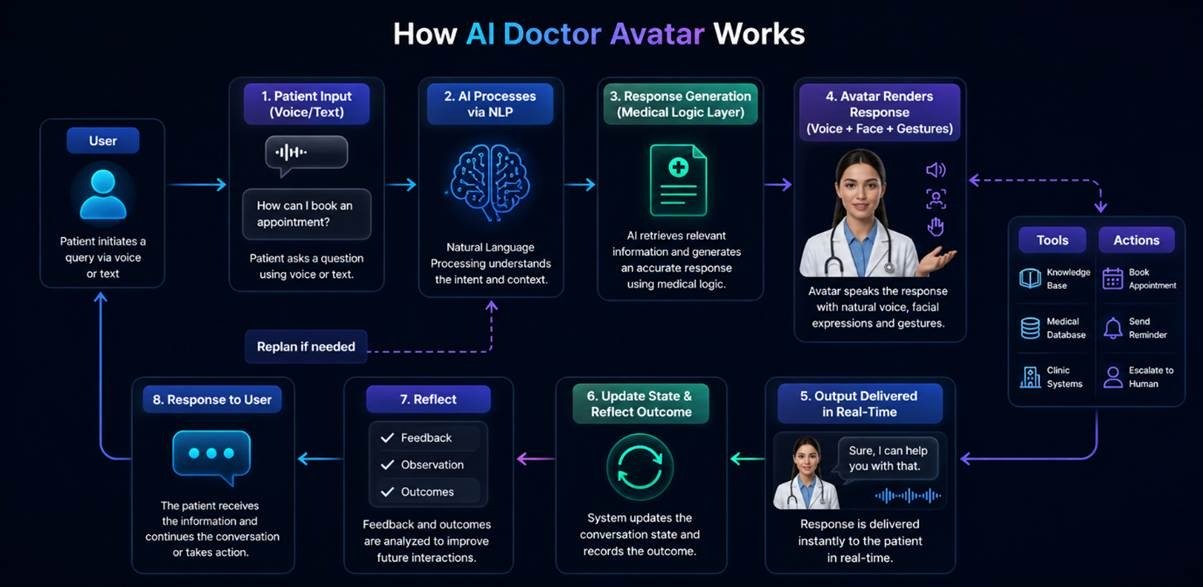
The process begins when a patient asks a question. This can be done through voice or text, depending on how the system is implemented. Queries may include appointment requests, symptom-related questions, or general clinic information.
The system uses Natural Language Processing to analyze the input. It identifies intent, extracts key information, and understands the context of the query. This allows the system to respond accurately rather than relying on fixed or scripted replies.
Once the query is understood, the system generates a response using trained medical datasets and predefined logic rules. This layer ensures that responses are relevant, consistent, and aligned with approved healthcare information. It can also be configured to limit responses to safe, non-diagnostic guidance when required.
The generated response is then delivered through a digital avatar. The avatar speaks in a natural tone, synchronizes lip movement, and may include facial expressions or gestures. This makes the interaction feel more human and easier for patients to follow.
The final response is delivered instantly, allowing patients to continue the conversation without delays. This real-time interaction improves user experience and keeps engagement high.
AI doctor avatars combine language intelligence, medical knowledge, and visual communication to create a reliable, scalable, and patient-friendly interaction system for modern healthcare environments.
Healthcare providers today are carefully evaluating how technology can improve efficiency, patient communication, and overall service delivery. One of the biggest challenges hospitals and clinics face is managing a growing number of patient interactions without overburdening staff. This is where AI-driven solutions are gaining serious attention.
Consider a common scenario many decision-makers are dealing with:
“I manage a hospital and am considering whether developing an AI doctor avatar will actually improve patient communication and reduce workload, is it worth the investment for us?”
This question reflects a practical concern. Hospitals want solutions that deliver measurable results, not just innovation for the sake of it. When evaluated from both operational and market perspectives, AI doctor avatars present a strong case.
The healthcare AI ecosystem is expanding at a rapid pace. According to recent industry data, the global AI in healthcare market is expected to grow from $53.61 billion in 2026 to over $251 billion by 2031. At the same time, the AI avatar market is projected to reach $12.9 billion in 2026 and continue growing significantly in the coming years.
In addition, AI-driven digital health avatars are gaining adoption across healthcare systems, reaching $2.24 billion in 2026 with strong annual growth trends
These trends highlight a clear shift toward AI-enabled communication systems in healthcare.
Hospitals and clinics handle a large number of repetitive queries every day, including appointment scheduling, service inquiries, and general patient guidance. These tasks consume valuable time for front desk and support teams.
By introducing AI avatars, healthcare providers can automate routine interactions, allowing staff to focus on more critical responsibilities such as patient care coordination and in-person support. This improves overall workflow and reduces unnecessary pressure on teams.
Traditional communication systems are limited by staff availability and working hours. With digital doctor avatar development, healthcare providers can manage a high volume of patient interactions at the same time without increasing workforce size.
This ensures that patients receive timely responses even during peak hours, improving accessibility and responsiveness.
In a busy clinical environment, maintaining consistency in communication can be challenging. Intelligent healthcare doctor avatar development ensures that patients receive structured, standardized, and medically aligned responses every time.
This reduces the risk of miscommunication and helps maintain quality across all interactions.
Although there is an initial investment involved, AI avatars help reduce long-term operational costs. By automating routine communication tasks, clinics can optimize staffing needs and minimize inefficiencies caused by manual processes.
Over time, this leads to better resource utilization and improved financial efficiency.
Patients expect quick responses and clear information when interacting with healthcare providers. Delays or inconsistent communication can affect their overall experience.
AI-powered doctor avatar creation allows patients to receive instant answers in a conversational format, making interactions smoother and more engaging. This contributes to higher patient satisfaction and better retention.
Healthcare systems are gradually adopting more digital and AI-driven solutions. By investing in building an AI doctor avatar, providers strengthen their technology foundation and prepare for future advancements such as virtual care, remote consultations, and AI-assisted workflows.
This ensures long-term adaptability and growth.
Many healthcare organizations face challenges in hiring and retaining administrative staff. AI avatars act as a support layer that handles routine communication efficiently.
This allows existing teams to manage workloads more effectively without immediate expansion, helping maintain service quality even with limited resources.
Healthcare organizations that invest in AI doctor avatars are building a more efficient and scalable communication system that supports both patients and internal teams.
Well, these are the key reasons why investing in an AI doctor avatar is becoming a practical and strategic decision for modern healthcare providers.
AI adoption in healthcare is not just about automation, it is about improving how information is delivered, understood, and acted upon by patients. With the rise of AI doctor avatar technology, healthcare providers are finding practical ways to improve communication without increasing operational pressure. These avatars help standardize messaging, reduce dependency on manual interactions, and make healthcare information more accessible.
A common question many providers explore is: how can these avatars be used beyond basic query handling and actually contribute to daily hospital operations?
The answer lies in the following high-impact use cases.
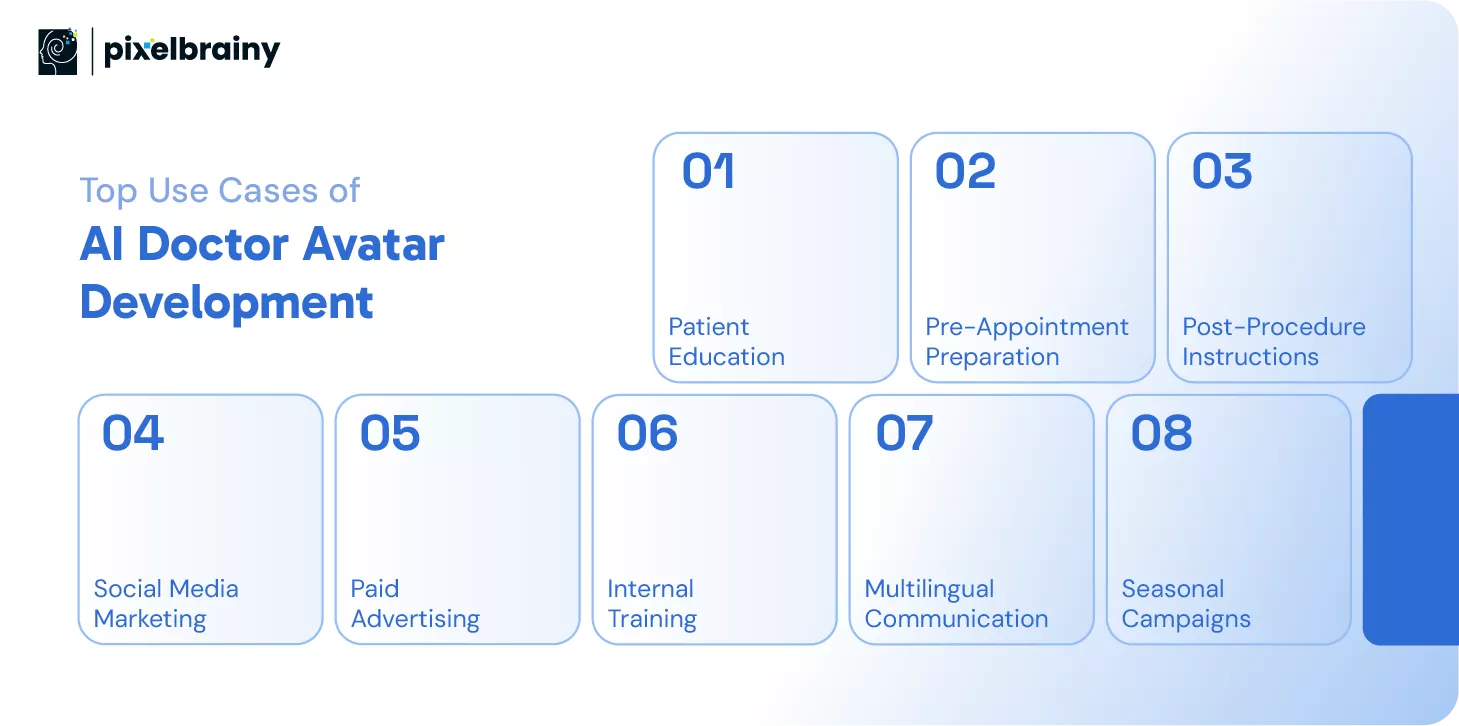
Patient education remains one of the most critical yet time-consuming responsibilities in healthcare. Using Artificial Intelligence physician avatars for patient education, clinics can deliver structured, doctor-led video explanations that patients can access anytime.
These videos help patients clearly understand diagnoses, treatment options, and medical procedures without requiring repeated in-person explanations. This improves patient confidence and reduces confusion.
Key advantages:
AI avatars can be used to send personalized video messages before appointments. These messages can come from the assigned doctor and include preparation steps, required documents, or instructions to follow.
This approach helps patients feel more prepared and informed before they even arrive at the clinic.
Key advantages:
Patients often forget verbal instructions given after procedures or surgeries. AI avatars solve this by delivering recovery guidance in a structured video format that patients can access anytime.
This ensures that patients follow correct recovery steps and reduces dependency on follow-up calls.
Key advantages:
Maintaining a consistent presence on social media requires continuous content creation, which can be difficult for busy healthcare professionals. AI avatars allow doctors to share insights, tips, and updates without needing to record videos regularly.
This helps clinics stay visible and relevant in a competitive digital environment.
Key advantages:
Creating video advertisements featuring real doctors often involves high costs, scheduling challenges, and production delays. AI avatars simplify this process by allowing clinics to create professional, doctor-led ads quickly.
This makes it easier to test and scale marketing campaigns.
Key advantages:
Training new staff and onboarding employees requires time from senior doctors and experienced professionals. AI avatars can capture this expertise in video format and make it available for repeated use.
This ensures consistent training without interrupting clinical duties.
Key advantages:
Healthcare providers often serve patients from diverse linguistic backgrounds. AI avatars can generate the same content in multiple languages while maintaining the tone and intent of the original message.
This helps eliminate communication barriers and improves patient understanding.
Key advantages:
Healthcare communication needs change based on seasons and emerging health concerns. AI avatars allow clinics to quickly create and distribute relevant content related to flu outbreaks, allergies, or public health updates.
This ensures timely communication without delays.
Key advantages:
Well, these use cases highlight how AI doctor avatars can be practically applied across different areas to improve communication, efficiency, and patient experience in healthcare.
Also Read: How to Build an AI Avatar Generator Platform Like HeyGen
Building a reliable AI doctor avatar requires more than just adding conversational ability. It involves combining intelligence, security, usability, and healthcare-specific compliance into one unified system. For organizations planning custom AI doctor avatar development, selecting the right features directly impacts performance, patient trust, and long-term scalability.
A common question many healthcare providers ask is: what are the features to include while building AI doctor avatar that actually improve real-world patient communication and operational efficiency?
When developing a virtual doctor avatar, the following features form the foundation of a successful and scalable solution.
| Feature | Description |
| Natural Language Understanding | The system must accurately interpret patient queries across different formats including voice and text inputs. It should understand intent, context, and variations in phrasing so responses are meaningful, relevant, and aligned with real patient expectations. |
| Voice Interaction Capability | A high-quality voice interface allows patients to communicate naturally without typing. Speech recognition and synthesis should be accurate and responsive, enabling seamless conversations that feel intuitive, especially for elderly or less tech-savvy users. |
| Realistic Avatar Rendering | The avatar should visually represent a human-like doctor with synchronized lip movement and facial expressions. This level of realism improves engagement, builds trust, and makes digital interactions feel closer to real-life consultations. |
| Medical Knowledge Integration | The system must rely on structured and validated medical datasets to generate responses. This ensures that all information shared is accurate, consistent, and aligned with accepted healthcare guidelines, reducing the risk of misinformation. |
| Real-Time Response Processing | Patients expect quick responses during interactions. The system should process queries instantly and deliver answers without noticeable delays, ensuring smooth conversations and maintaining user engagement throughout the interaction experience. |
| Multilingual Support | Supporting multiple languages allows healthcare providers to serve diverse patient populations effectively. The system should maintain consistency in tone and accuracy across languages, ensuring clear communication regardless of the patient’s preferred language. |
| Personalization Engine | The avatar should adapt responses based on patient data such as history, preferences, or previous interactions. This personalization improves relevance, enhances patient satisfaction, and creates a more tailored communication experience. |
| Appointment Integration | Integration with scheduling systems enables patients to book, reschedule, or cancel appointments directly through the avatar. This reduces administrative workload and simplifies the patient journey, improving operational efficiency. |
| Data Security and Encryption | Strong encryption protocols must be implemented to protect sensitive patient information. Secure data handling builds trust among users and ensures that all communications and stored data remain protected from unauthorized access. |
| HIPAA Compliance Readiness | The system must be designed to meet healthcare regulatory standards related to data privacy and security. Compliance ensures that patient information is handled responsibly and reduces legal and operational risks for healthcare providers. |
| Analytics and Reporting Dashboard | A built-in analytics system helps track user interactions, query types, and performance metrics. These insights allow healthcare providers to continuously improve the system, optimize workflows, and make data-driven decisions. |
| Integration with Hospital Systems | Seamless integration with existing systems such as EHR or CRM ensures smooth data flow across platforms. This reduces manual work, improves coordination, and enhances overall operational efficiency within the healthcare environment. |
| Continuous Learning Capability | The AI system should evolve based on new data and interactions over time. Continuous learning helps improve response accuracy, adapt to new scenarios, and maintain relevance as patient needs and medical information change. |
| User-Friendly Interface | The interface should be simple, intuitive, and accessible for all users. Patients should be able to interact easily without technical complexity, ensuring higher adoption rates and a better overall user experience. |
| Fallback to Human Support | The system should allow seamless escalation to human staff when queries become complex or sensitive. This ensures that patients always receive appropriate support and maintains reliability in critical situations. |
Well, these essential features define the core foundation required to build a reliable, secure, and scalable AI doctor avatar for healthcare environments.
Once the foundational features are in place, healthcare providers can explore advanced capabilities that elevate the system beyond standard functionality. These enhancements focus on deeper intelligence, better personalization, and future-ready experiences that improve both patient engagement and operational efficiency.
Organizations investing in next-generation solutions often move toward advanced AI healthcare avatar solutions and intelligent virtual physician avatar development that go beyond basic interaction and deliver more adaptive, context-aware communication.
The system can analyze voice tone, language patterns, or interaction behavior to detect patient emotions. This allows the avatar to respond more empathetically and adjust communication style based on patient mood or urgency.
The avatar can retain context within a session and across interactions. This enables more natural conversations where the system remembers previous inputs, reducing repetition and improving overall communication continuity.
The system can replicate or customize voice tones to match specific doctors. This creates familiarity for patients and strengthens trust by maintaining a consistent doctor-like communication experience across all interactions.
Based on patient history and behavior, the system can proactively suggest next steps such as booking appointments or reviewing relevant information. This reduces effort for patients and improves engagement.
The avatar can connect with wearable devices to access real-time health data. This enables more personalized responses and supports proactive communication based on patient health metrics.
The system can extend into augmented or virtual reality environments for interactive consultations. This creates a more engaging experience and opens new possibilities for remote healthcare delivery.
The avatar can automatically generate updated healthcare content such as educational videos or alerts. This ensures that patients always receive relevant and timely information without manual content creation efforts.
The system can actively monitor unusual activities and detect potential threats in real time. This adds an additional layer of protection beyond standard encryption, ensuring stronger data security and system reliability.
Well, these advanced features help transform an AI doctor avatar into a more intelligent, adaptive, and future-ready solution for modern healthcare systems.
Building a reliable AI doctor avatar requires a structured and well-planned approach. Healthcare providers, startups, and hospitals often look for a clear development process of AI doctor avatar that ensures accuracy, scalability, and compliance. Whether your goal is to improve patient communication or expand access to care, following the right steps is critical to success.
A common scenario many organizations face is:
“We are focused on rural healthcare access and want to build an AI doctor avatar that can guide patients remotely, how can I develop or who can help us develop this system?”
The answer lies in combining the right strategy, technology, and execution partner. Many healthcare providers collaborate with top AI avatar development companies or top AI product development companies to accelerate development and reduce risks. Below is a complete step-by-step guide to help you understand how to make AI doctor avatar effectively.
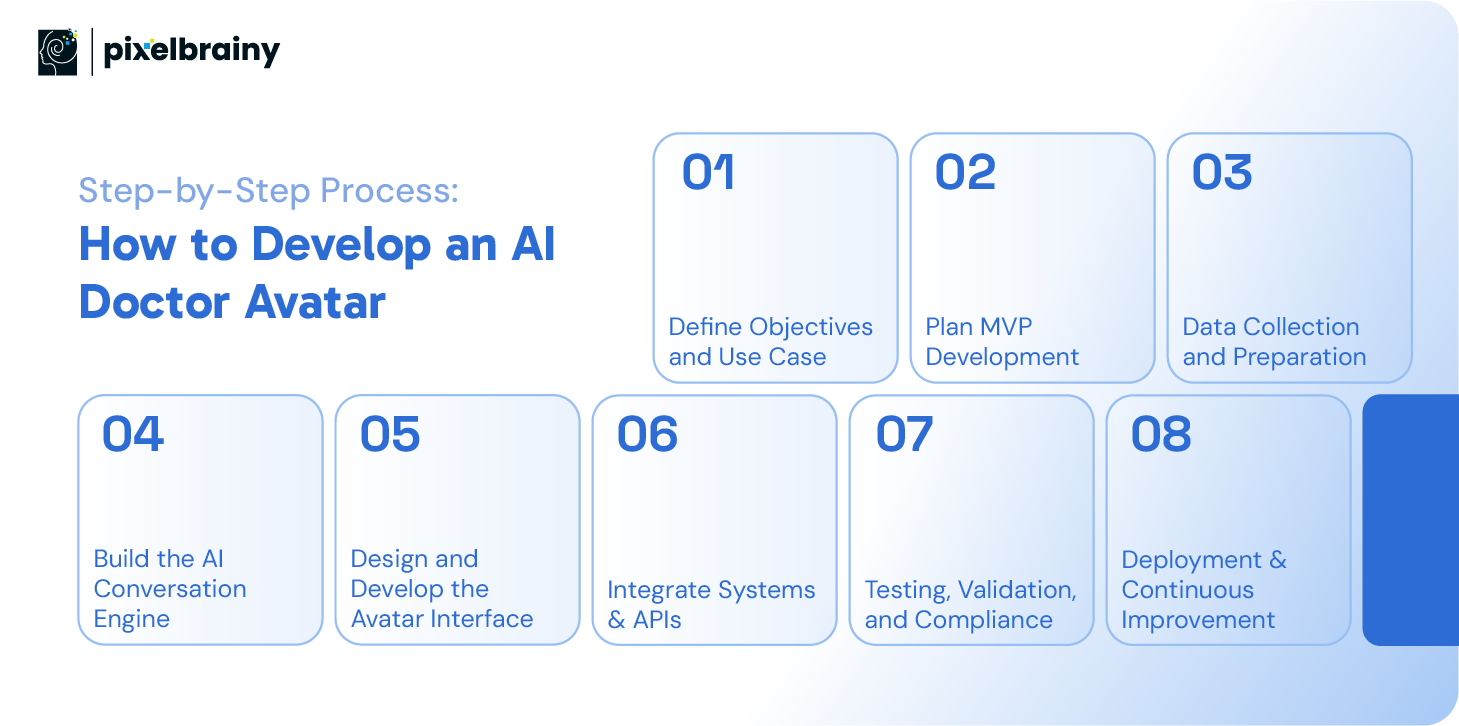
The first step in AI doctor avatar development is to clearly define what you want the system to achieve. This includes identifying the primary use case such as patient query handling, rural healthcare guidance, or appointment management. Without a clear objective, development can become unfocused and inefficient.
Healthcare providers should involve stakeholders such as doctors, administrators, and IT teams to outline requirements. This stage also includes defining target users, expected outcomes, and key performance indicators. A well-defined use case ensures that the system is aligned with real-world needs and delivers measurable value once deployed.
Before building a full-scale system, it is important to start with MVP development. A Minimum Viable Product focuses on core functionalities such as basic patient interaction, FAQ handling, and simple voice responses. This helps validate the concept without investing heavily upfront.
MVP development allows you to test usability, gather feedback, and identify potential improvements early in the process. It also reduces development risks and ensures faster time to market. Many AI development solutions providers recommend this approach to refine the system before scaling it into a more advanced and feature-rich platform.
Also Read: Top 10 AI MVP Development Companies in USA
High-quality data is the foundation of any AI system. In this stage, healthcare providers need to gather structured medical content, FAQs, treatment guidelines, and communication scripts. This data will train the system to provide accurate and relevant responses.
It is important to ensure that all data is verified, up-to-date, and compliant with healthcare standards. Data preparation also includes cleaning, organizing, and structuring the information so that it can be effectively used by AI models. A strong data foundation directly impacts the reliability and performance of the avatar.
The core of the system lies in its conversational intelligence. This step involves developing or integrating Natural Language Processing models that can understand and respond to patient queries effectively. The goal is to create a system that can handle real conversations rather than scripted interactions.
Developers work on training models to recognize intent, manage context, and generate meaningful responses. This is a critical stage in AI physician avatar development because it determines how well the avatar communicates with patients. Advanced systems also include contextual understanding to improve conversation flow.
Once the backend intelligence is ready, the next step is to design the visual and interactive layer of the avatar. This includes creating a human-like digital representation with facial expressions, lip synchronization, and natural voice output.
The design should focus on simplicity and usability so that patients of all age groups can interact easily. A well-designed interface enhances user engagement and trust. This step is essential for organizations looking to create an AI avatar for doctors that feels approachable and professional in real-world healthcare environments.
To make the avatar functional within a healthcare ecosystem, it must be integrated with existing systems such as appointment scheduling tools, electronic health records, and communication platforms. This ensures seamless data flow and improves operational efficiency.
Integration also involves connecting speech recognition APIs, text-to-speech engines, and analytics tools. Proper system integration allows the avatar to perform tasks beyond conversation, such as booking appointments or retrieving patient information, making it a complete solution for healthcare providers.
Before deployment, the system must go through rigorous testing to ensure accuracy, reliability, and safety. This includes testing different scenarios, validating medical responses, and checking system performance under various conditions.
Healthcare compliance is a critical part of this stage. The system must meet data protection standards and ensure patient privacy. Testing also involves gathering feedback from real users and making necessary adjustments. This step ensures that the final product is safe, effective, and ready for real-world use.
The final step is deploying the AI doctor avatar across selected platforms such as websites, mobile apps, or hospital kiosks. Once deployed, the focus shifts to monitoring performance and continuously improving the system.
Analytics play a key role in identifying areas for improvement. The system should be updated regularly based on user interactions, new medical information, and evolving requirements. Continuous improvement ensures that the avatar remains accurate, relevant, and aligned with patient needs over time.
Well, this step-by-step process provides a clear roadmap for building a reliable and scalable AI doctor avatar that meets modern healthcare communication needs.
Also Read: Top 12 AI Avatar Development Companies in USA
For hospital owners, clinic operators, and healthcare startups planning to adopt AI, one of the most important questions is clear: what is the cost to create an AI doctor avatar that is reliable, scalable, and suitable for real-world use? The answer depends on multiple factors, but having a realistic budget range helps in making informed decisions.
If you are evaluating investment for your organization, the AI doctor avatar development cost typically falls between $10,000 to $100,000+. This range varies based on features, level of intelligence, integrations, and overall system complexity. Whether you are starting small or aiming for a full-scale deployment, understanding cost distribution is essential.
| Development Level | Estimated Cost | Description |
| Basic Level | $10,000 – $25,000 | This level includes a simple avatar with basic conversational capabilities and limited FAQ handling. It is suitable for clinics that want to test AI adoption with minimal investment and limited functionality. |
| Mid-Level Solution | $25,000 – $60,000 | This includes voice interaction, better avatar design, multilingual support, and integration with basic systems. It is ideal for clinics and healthcare providers looking for a more interactive and functional solution. |
| Advanced / Enterprise Level | $60,000 – $100,000+ | This level offers full-scale capabilities including advanced AI models, real-time interaction, system integrations, compliance features, analytics, and highly realistic avatars suitable for large hospitals and networks. |
The visual quality of the avatar directly impacts development cost. A basic 2D avatar may cost around $2,000 to $5,000, while a realistic 3D avatar with facial expressions and lip sync can increase the cost by $10,000 to $25,000 depending on design complexity.
The intelligence layer determines how well the system understands and responds to patients. Basic conversational systems may cost $5,000 to $10,000, while advanced AI models with contextual understanding and continuous learning can add $15,000 to $35,000 to the total budget.
Adding natural voice capabilities improves accessibility but increases cost. Basic voice integration may cost $3,000 to $7,000, while high-quality, customized voice systems with better accuracy can range between $8,000 to $15,000.
Connecting the avatar with hospital systems such as EHR, CRM, or appointment platforms requires additional development work. Integration costs typically range from $5,000 to $20,000, depending on the number and complexity of systems involved.
Healthcare-grade security and compliance are essential. Implementing encryption, access control, and regulatory standards can cost between $5,000 to $15,000, depending on the level of protection and compliance required.
Supporting multiple languages and personalized interactions enhances usability but increases cost. These features generally add $3,000 to $10,000, depending on the number of languages and depth of personalization.
The cost varies based on whether you work with freelancers, in-house teams, or specialized agencies. Hiring experienced developers or agencies can cost $20 to $150 per hour, depending on expertise and location, significantly influencing the total project cost.
Post-deployment maintenance is an ongoing expense. Annual maintenance typically costs 15% to 25% of the initial development cost, which may range from $2,000 to $20,000 per year depending on system size and updates required.
A clear understanding of these cost factors helps healthcare providers plan budgets effectively and choose the right development approach based on their operational goals and long-term growth strategy.
For healthcare providers, CTOs, and product teams planning to implement AI in clinical communication, one important question often comes up: What technologies are required to develop AI doctor avatar with voice and video capabilities?
The answer lies in selecting the right combination of AI models, development frameworks, and integration tools. These technologies work together to enable real-time interaction, voice communication, visual rendering, and secure data handling. Choosing the right stack is essential if your goal is to build scalable AI doctor avatar solutions that can handle large patient volumes while maintaining performance and accuracy.
At the same time, modern healthcare systems require flexibility. The selected frameworks or tools help in creating AI doctor avatar systems that can adapt to different use cases, including developing a multilingual AI doctor avatar for diverse patient populations.
| Category | Tools / Frameworks | Description |
| AI Language Models | OpenAI GPT, Google Med-PaLM, LLaMA | These models power the conversational intelligence of the avatar. They understand patient queries, generate responses, and maintain context during interactions, making communication more natural and effective. |
| Natural Language Processing | spaCy, NLTK, Hugging Face Transformers | NLP frameworks help process and analyze patient input. They identify intent, extract relevant information, and enable the system to respond accurately based on the context of the query. |
| Speech Recognition | Whisper, Google Speech-to-Text, Azure Speech API | These tools convert patient voice input into text. Accurate speech recognition ensures smooth interaction, especially for patients who prefer speaking instead of typing. |
| Text-to-Speech (TTS) | Amazon Polly, Google Text-to-Speech, Azure TTS | TTS engines convert AI-generated responses into natural-sounding voice output. High-quality voice synthesis improves user experience and makes communication more human-like. |
| Avatar Rendering Engines | Unreal Engine, Unity, Ready Player Me | These frameworks are used to create and animate digital avatars. They enable facial expressions, lip synchronization, and realistic visual representation of the doctor avatar. |
| Frontend Development | React, Next.js, Vue.js | Frontend frameworks are used to build user interfaces where patients interact with the avatar. They ensure smooth performance and responsive design across devices. |
| Backend Development | Node.js, Python, Django, FastAPI | Backend systems manage data processing, API handling, and communication between different components. They ensure that the system runs efficiently and scales as user demand increases. |
| Cloud Infrastructure | AWS, Microsoft Azure, Google Cloud | Cloud platforms provide storage, computing power, and scalability. They allow the AI doctor avatar to handle multiple users simultaneously without performance issues. |
| Database Systems | PostgreSQL, MongoDB, Firebase | Databases store patient interaction data, conversation logs, and system configurations. They support real-time data access and help maintain system reliability. |
| Integration APIs | HL7, FHIR APIs, REST APIs | These APIs connect the avatar with healthcare systems such as EHR and appointment platforms. Integration ensures seamless data flow and enhances functionality. |
| Security and Compliance Tools | OAuth, JWT, HIPAA-compliant cloud services | Security tools protect sensitive patient data through encryption and access control. They also help meet healthcare compliance requirements for safe deployment. |
| Analytics and Monitoring | Google Analytics, Mixpanel, Datadog | These tools track system performance, user behavior, and interaction metrics. Insights from analytics help improve system accuracy and user experience over time. |
Selecting the right combination of tools and frameworks is essential to create a secure, scalable, and high-performing AI doctor avatar that meets modern healthcare communication needs.
Building an AI doctor avatar can deliver strong results, but only when it is planned and executed carefully. Many healthcare providers rush into development with high expectations but limited clarity on risks, which often leads to poor performance, compliance issues, or low adoption. This is especially true when teams focus more on technology than real patient needs.
For clinics, hospitals, and healthtech startups, understanding these challenges early helps avoid costly mistakes and ensures the system delivers real value. The goal is not just to launch an AI solution, but to build one that is accurate, secure, and trusted by patients.
Below are the most common pitfalls in AI doctor avatar development along with practical ways to avoid them.
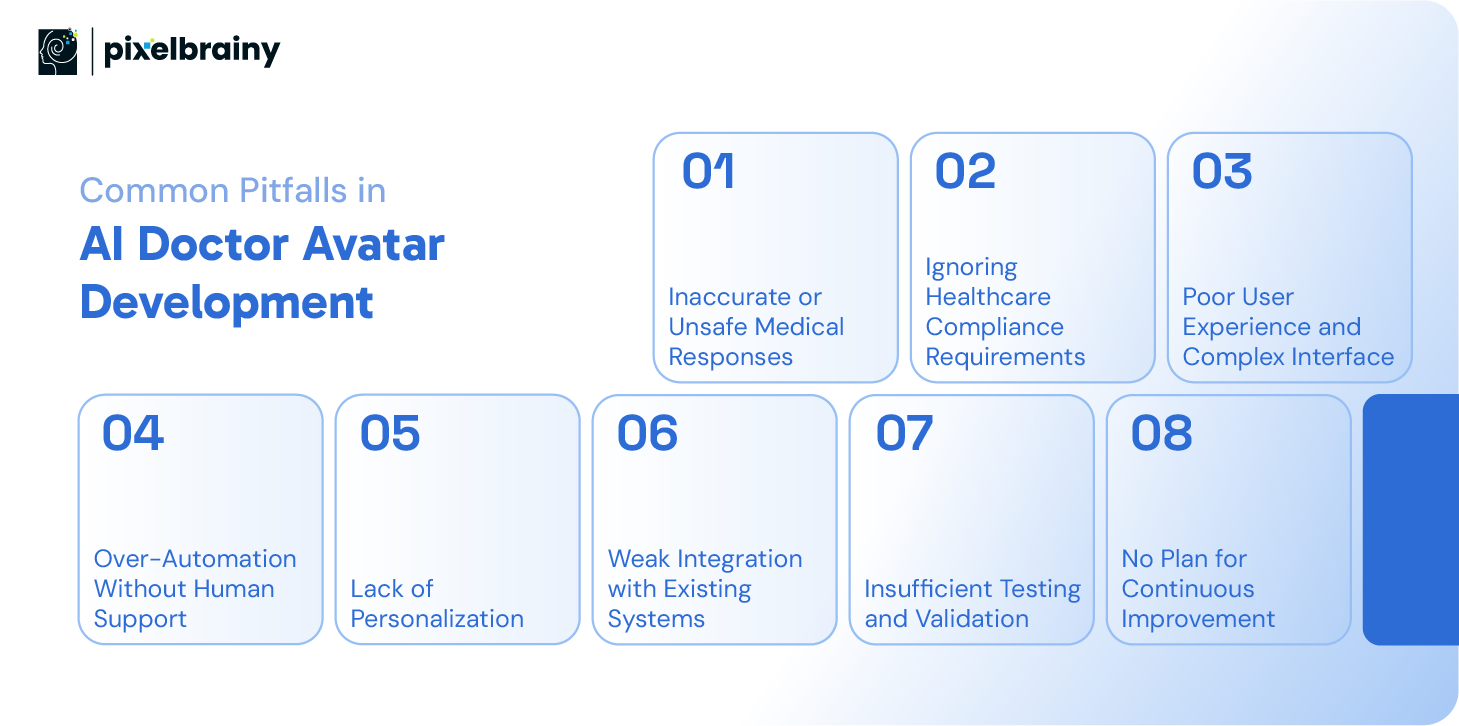
One of the biggest risks is the system generating incorrect or misleading medical information. This can happen if the AI is not trained on verified data or lacks proper control mechanisms.
How to avoid it: Use structured and clinically validated datasets. Implement rule-based guardrails to restrict responses to safe, non-diagnostic guidance. Regularly review and update the system with expert input from medical professionals.
Many development teams underestimate the importance of compliance, especially when handling sensitive patient data. This can lead to legal risks and loss of patient trust.
How to avoid it: Design the system with compliance in mind from the beginning. Follow healthcare regulations, implement strong encryption, and ensure secure data storage and access control at every stage.
Even a powerful AI system can fail if patients find it difficult to use. Complicated interfaces or unnatural interactions can reduce engagement and adoption.
How to avoid it: Focus on simplicity and ease of use. Design intuitive interfaces with clear navigation. Test the system with real users and refine the experience based on feedback to ensure smooth interaction.
Relying completely on AI without providing human backup can create problems when patients have complex or sensitive queries that require professional attention.
How to avoid it: Always include a fallback mechanism to connect users with human staff. This ensures that critical cases are handled appropriately and builds trust in the system.
Generic responses can make interactions feel robotic and less helpful. Patients expect communication that considers their specific needs and context.
How to avoid it: Incorporate personalization features that use patient history and preferences. This makes interactions more relevant and improves overall satisfaction.
If the AI avatar operates in isolation, it limits its usefulness. Lack of integration with hospital systems can create inefficiencies and duplicate work.
How to avoid it: Ensure seamless integration with existing platforms such as appointment systems, EHR, and CRM tools. This allows the avatar to perform meaningful tasks beyond basic conversations.
Skipping thorough testing can lead to unexpected errors, inaccurate responses, and system failures after deployment.
How to avoid it: Conduct detailed testing across multiple scenarios. Validate responses with healthcare professionals and perform continuous quality checks before and after launch.
AI systems require ongoing updates to remain accurate and effective. Without continuous improvement, performance can decline over time.
How to avoid it: Monitor system performance using analytics and user feedback. Regularly update data, refine models, and improve features to keep the system aligned with evolving healthcare needs.
A well-planned approach that addresses these challenges early can significantly improve the success of AI doctor avatar development and ensure long-term reliability and trust.
Most of the doctors can build AI avatar using tools, but the real challenges starts when you need accuracy, scalability, system integration, and healthcare compliance working together in a real-world environment. Creating a basic avatar is relatively simple, but building a production-ready system that can handle patient interactions at scale requires deep technical expertise and healthcare domain understanding.
This is where many healthcare providers begin asking a critical question:
We need to build a scalable AI doctor avatar platform that can handle thousands of patients, who is the best development company for this?
The answer lies in working with a partner that focuses on long-term, healthcare-grade solutions rather than just basic implementation. PixelBrainy LLC specializes in delivering advanced, secure, and scalable AI systems designed specifically for healthcare environments.
PixelBrainy offers complete AI avatar development services for doctors, covering strategy, design, development, deployment, and optimization. This ensures healthcare providers receive a fully integrated and ready-to-use solution.
Handling thousands of patient interactions requires strong backend infrastructure. PixelBrainy builds scalable AI doctor avatar platforms that maintain performance, speed, and reliability even under high user demand.
Their team understands healthcare workflows, patient communication challenges, and compliance requirements. This ensures every solution is aligned with real clinical environments and operational needs.
PixelBrainy develops avatars with advanced voice and video capabilities, enabling natural and interactive communication. Their expertise ensures accurate, context-aware responses for better patient engagement.
Data security is a top priority. PixelBrainy builds systems with strong encryption and compliance-focused architecture, ensuring patient data protection and regulatory alignment.
From small clinics to large hospital networks, PixelBrainy delivers tailored solutions. Their custom AI doctor avatar development approach ensures the system fits specific business and operational requirements.
They provide ongoing support, performance monitoring, and system updates to ensure the solution evolves with changing healthcare demands and technological advancements.
A strong development partner ensures that your AI doctor avatar is not just functional, but scalable, secure, and capable of delivering long-term value in real healthcare environments.

AI doctor avatars are redefining how healthcare providers manage communication, improve efficiency, and deliver consistent patient experiences at scale. From automating routine queries to supporting patient education and engagement, AI doctor avatar development has become a practical solution for clinics and hospitals aiming to optimize operations without increasing workload.
A well-executed approach to AI physician avatar development ensures that the system is accurate, scalable, and aligned with healthcare standards. When you create an AI avatar for doctors with the right features, technology stack, and compliance measures, it becomes a powerful extension of your care delivery system rather than just a support tool.
The long-term value lies in building a system that adapts, learns, and integrates seamlessly into your existing workflows. This is where strategic planning and the right development partner make a significant difference.
If you are ready to move forward with AI doctor avatar development, schedule a call today to explore a solution tailored to your healthcare needs.
An AI doctor avatar is a human-like digital assistant that communicates using voice, video, and text, making interactions more natural and engaging. Unlike traditional chatbots that rely mostly on text and predefined scripts, AI doctor avatars use advanced AI models, facial expressions, and voice interaction to simulate real doctor-like conversations, improving patient experience and understanding.
The development timeline depends on the complexity and features required. A basic version can take around 2 to 4 weeks, while a more advanced system with integrations, voice capabilities, and compliance features may take 6 to 12 weeks. Proper planning and MVP development can help speed up the process.
No, AI doctor avatars are designed to support doctors, not replace them. They handle routine queries, patient education, and administrative tasks, allowing doctors to focus on diagnosis, treatment, and critical decision-making. Human oversight remains essential for safe and effective healthcare delivery.
Yes, when developed correctly, AI doctor avatars can be secure and compliant. They must follow strict data protection standards, include encryption, and be designed according to healthcare regulations such as HIPAA. Working with experienced development teams ensures compliance and data security.
Yes, one of the biggest advantages of AI doctor avatars is scalability. They can handle thousands of patient interactions simultaneously without delays, making them highly effective for busy clinics and hospitals with high patient volumes.
You should look for a company with experience in healthcare AI, strong technical expertise, and a focus on scalability and compliance. The right partner should offer end-to-end development, customization options, system integration, and ongoing support to ensure long-term success.

About The Author
Sagar Bhatnagar
Sagar Sahay Bhatnagar brings over a decade of IT industry experience to his role as Marketing Head at PixelBrainy. He's known for his knack in devising creative marketing strategies that boost brand visibility and market influence. Sagar's strategic thinking, coupled with his innovative vision and focus on results, sets him apart. His track record of successful campaigns proves his ability to utilize digital platforms effectively for impactful marketing efforts. With a genuine passion for both technology and marketing, Sagar continuously pushes PixelBrainy's marketing initiatives to greater success.


Transform your ideas into reality with us.
Working with the PixelBrainy team has been a highly positive experience. They understand the design requirements and create beautiful UX elements to meet the application needs. The dev team did an excellent job bringing my vision to life. We discussed usability and flow. Sagar worked with his team to design the database and begin coding. Working with Sagar was easy. He has the knowledge to create robust apps, including multi-language support, Google and Apple ID login options, Ad-enabled integrations, Stripe payment processing, and a Web Admin site for maintaining support data. I'm extremely satisfied with the services provided, the quality of the final product, and the professionalism of the entire process. I highly recommend them for Android and iOS Mobile Application Design and Development.

Great experience working with them. Had a lot of feedback and I found that unlike most contractors they were bugging me for updates instead of the other way around. They were extremely time conscience and great at communicating! All work was done extremely high quality and if not on time, early! They were always proactive when it comes to communication and the work is great/above par always. Very flexible and a great team to work with! Goes above and beyond to present us with multiple options and always provides quality. Amazing work per usual with Chitra. If you have UI/UX or branding design needs I recommend you go to them! Will likely work with them in the future as well, definitely recommended!

PixelBrainy is a joy to work with and is a great partner when thinking through branding, logo, and website layout. I appreciate that they spend time going into the "why" behind their decisions to help inform me and others about industry best practices and their expertise.

I hired them to design our software apps. Things I really like about them are excellent communication skills, they answer all project suggestions and collaborate right away, and their input on design and colors is amazing. This project was complex and needed patience and creativity. The team is amazing to do business with. I will be using them long-term. Glad to see there are some good people out there. I was afraid to try and outsource my project to someone but I am glad I met them! I really can't say enough. They went above and beyond on this project. I am very happy with everything they have done to make my business stand out from the competition.

It was great working with PixelBrainy and the team. They were very responsive and really owned the project. We'll definitely work with them again!

I recently worked with the PixelBrainy team on a project and I was blown away by their communication skills. They were prompt, clear, and articulate in all of our interactions. They listened and provided valuable feedback and suggestions to help make the project a success. They also kept me updated throughout the entire process, which made the experience stress-free and enjoyable.

PixelBrainy is very good at what it does. The team also presents themselves very professionally and takes care of their side of things very well. I could fully trust them taking up the design work in a timely and organised manner and their attention to detail saved us lots of effort and time. This particular project was quite intense and the team showed that they function very well under pressure. Very much looking forward to working with her again!

It's always an absolute pleasure working with them. They completed all of my requests quickly and followed every note I had for them to a T, which made our process go smoothly from start to finish. Everything was completed fast and following all of the guidelines. And I would recommend their services to anyone. If you need any design work done in the future, PixelBrainy should be your first call!

They took ownership of our requirements and designed and proposed multiple beautiful variants. The team is self-motivated, requires minimum supervision, committed to see-through designs with quality and delivering them on time. We would definitely love to work with PixelBrainy again when we have any requirements.

PixelBrainy was a big help with our SaaS application. We've been hard at work with a new UI/UX and they provided a lot of help with the designs. If you're looking for assistance with your website, software, or mobile application designs, PixelBrainy and the team is a great recommendation.

PixelBrainy designers are amazing. They are responsive, talented, and always willing to help craft the design until it matches your vision. I would recommend them and plan to continue them for my future projects and more!!!

They were awesome! Did a good job fast, and good communication. Will work with them again. Thank you

Creative, detail-oriented, and talented designers who take direction well and implement changes quickly and accurately. They consistently over-delivered for us.

PixelBrainy team is very talented and creative. Great designers and a pleasure to work with. PixelBrainy is an excellent communicator and I look forward to working with them again.

PixelBrainy has a very talented design team. Their work is excellent and they are very responsive. I enjoy working with them and hope to continue on all of our future projects.


