AI Summary Powered by PixelBrainy
Have you ever wondered why attendees still struggle to find the right sessions, navigate massive venues, or connect with the right people even after event organizers invest thousands of dollars in event apps?
According to Grand View Research, the global event management software market is projected to grow from USD 18.4 billion in 2026 to USD 39.6 billion by 2033, registering a CAGR of 11.5%. This remarkable growth is being fueled by the rising adoption of AI powered event technologies, cloud-based platforms, and personalized attendee engagement solutions, making intelligent event applications a top investment priority for businesses worldwide.
The reason behind this rapid growth is simple. Traditional event applications only display schedules, speaker lists, venue maps, and notifications, while AI powered solutions deliver highly personalized and interactive experiences. This shift has significantly increased the demand for AI event concierge app development across conferences, trade shows, exhibitions, music festivals, sports events, corporate summits, and hybrid events. Instead of forcing attendees to search manually, an AI concierge understands user preferences, answers questions instantly, recommends relevant sessions, suggests networking opportunities, provides indoor navigation, and assists users throughout the entire event journey.
If you are planning to build AI event concierge app solutions for your startup or event business, understanding the right technology, AI models, architecture, and monetization strategy is essential before investing in development. Modern smart event assistant app development extends far beyond chatbot integration. It combines generative AI, machine learning, recommendation engines, natural language processing, multilingual assistance, computer vision, and predictive analytics to deliver intelligent, context aware experiences. Whether your goal is to develop AI event assistant software for enterprise conferences, festivals, expos, or community events, understanding how to create an AI event concierge application and the complete development process of AI event concierge app can help you launch a scalable and future ready product.
One question that many founders, CTOs, and event organizers are asking today is: Which are the best AI event concierge app development companies in USA in 2026 that have actually built and deployed smart event assistant apps for large conferences or festivals and have real client reviews and case studies to prove it? This guide answers that question while providing a comprehensive roadmap covering features, development stages, technology stack, development costs, monetization strategies, real world use cases, and expert insights to help you build a successful AI powered event concierge application.
An AI event concierge app is an intelligent attendee-facing application that uses artificial intelligence to deliver personalized, real-time, and conversational assistance before, during, and after an event. Unlike a regular digital event guide or event management app that primarily displays schedules, venue maps, and speaker information, an AI concierge understands attendee intent, recommends relevant experiences, answers questions instantly, and continuously adapts to user behavior. This is why AI event concierge app development has become a strategic investment for conferences, exhibitions, festivals, trade shows, and corporate events.
If you are wondering what is an AI event concierge app and how is it different from a regular digital event guide or event management app, the answer lies in its intelligence. Traditional event apps act as information repositories, whereas AI concierge apps act as intelligent event companions that proactively assist attendees throughout their entire event journey.
Modern smart event assistant app development enables attendees to interact naturally with the app instead of manually browsing menus. They can ask questions such as, "Which sessions match my interests?", "Where is Hall B?", or "Who should I connect with from the healthcare industry?" The app analyzes attendee preferences, event schedules, location data, and real-time updates to provide contextual recommendations within seconds.
During a live event, AI powered event assistant development combines Generative AI, Large Language Models (LLMs), Natural Language Processing (NLP), Machine Learning, recommendation engines, and predictive analytics to deliver intelligent assistance. Unlike a basic chatbot that follows predefined scripts, conversational AI event concierge development understands natural language, remembers previous interactions, and continuously improves its recommendations based on attendee behavior.
| Factor | Standard Event App | AI Event Concierge App |
| Content delivery | Static agenda and speaker list | Personalized agenda for every attendee |
| Attendee support | FAQ page or email | 24/7 conversational AI assistant |
| Session discovery | Manual search | AI recommendations based on attendee interests |
| Networking | Searchable attendee directory | AI-powered networking introductions |
| Sponsor engagement | Booth listings and banner ads | Personalized sponsor recommendations |
| Schedule updates | Generic push notifications | Personalized real-time alerts |
| Language support | Single language | Multilingual AI conversations |
| Post-event experience | Feedback survey | AI-generated recaps and follow-ups |
| Learning capability | Static after deployment | Continuously learns from attendee behavior |
The most effective AI concierge platforms follow a user-first philosophy where the technology remains almost invisible. Attendees should simply feel guided, informed, and supported at every stage, from planning their agenda before the event to receiving personalized follow-ups after it concludes.
An AI event concierge app transforms a conventional event application into an intelligent event companion that delivers personalized experiences across the entire attendee lifecycle.
The expectations of event attendees have changed significantly over the past few years. Whether it is a corporate conference, trade show, exhibition, music festival, or industry summit, people expect instant support, personalized recommendations, and seamless navigation throughout their event experience. At the same time, organizers are under constant pressure to improve attendee satisfaction, maximize sponsor visibility, reduce operational costs, and deliver measurable event outcomes.
This growing demand is encouraging founders and event businesses to invest in AI event concierge app development instead of relying solely on traditional event management platforms. A custom AI concierge not only enhances the attendee experience but also helps organizers streamline operations, increase engagement, and unlock valuable business insights. If you are planning to build AI event concierge app solutions, understanding the business value behind this investment is just as important as selecting the right technology stack.
Today's attendees expect recommendations that match their interests instead of scrolling through lengthy event schedules or digital brochures.
A smart event assistant for attendees can automatically recommend relevant sessions, suggest networking opportunities, provide venue directions, and send personalized reminders based on attendee preferences. These tailored experiences increase engagement and help event organizers deliver greater value to every participant.
One of the most common challenges during live events is answering the same attendee questions repeatedly.
Questions such as "Where is the registration desk?", "When does my session start?", or "How do I reach Hall C?" consume valuable staff time. An AI concierge can respond instantly to thousands of attendee queries simultaneously.
Many event organizers report a 60% to 80% reduction in routine attendee support requests after implementing AI-powered assistants, allowing event teams to focus on managing higher-priority tasks.
Every event has unique workflows, branding, audience expectations, and business objectives.
While commercial platforms provide standard features, AI event management app development enables organizations to create personalized attendee journeys, custom recommendation engines, branded AI interactions, and integrations tailored to their specific event requirements.
Custom development also gives businesses complete ownership of their application, attendee data, and future product enhancements.
Sponsors invest heavily to reach targeted audiences, yet many attendees never discover booths or sponsored sessions that are relevant to them.
An AI concierge analyzes attendee interests and behavior to recommend exhibitors, products, and sponsor activities that match individual preferences.
This results in higher booth visits, improved lead generation, measurable sponsor engagement, and stronger sponsor retention for future events.
Networking remains one of the primary reasons professionals attend conferences and business events.
Without intelligent recommendations, attendees often struggle to identify valuable connections among thousands of participants.
AI matchmaking helps attendees discover investors, buyers, speakers, recruiters, or business partners based on shared interests and professional goals. Industry research indicates that AI-powered networking platforms can increase meaningful attendee connections by three to five times compared to traditional networking methods.
The market for AI-powered event assistants is still in its early growth stage, giving founders an opportunity to differentiate their products before widespread adoption.
Several event technology providers have already introduced AI concierge solutions, demonstrating that intelligent attendee assistance is becoming an important part of modern event experiences.
Organizations that invest early can strengthen their market position, build customer trust, and establish long-term competitive advantages.
Every attendee interaction generates valuable behavioral insights, including session preferences, networking interests, frequently asked questions, and sponsor engagement.
A custom AI concierge enables organizers to capture and analyze this data to improve future events, personalize marketing campaigns, optimize event programming, and deliver stronger ROI reports to sponsors.
Instead of relying solely on third-party platform analytics, businesses gain complete visibility into attendee behavior and engagement patterns.
Building a custom AI event concierge app empowers founders and event companies to deliver personalized attendee experiences while creating lasting operational, marketing, and revenue advantages.
Also Read: AI Event Management Software Development Cost: A Complete Budgeting Guide
AI event concierge solutions are not limited to a single application model. They can be designed in different formats based on how attendees interact with your event, the level of personalization you want to offer, and your overall business objectives. Whether your goal is to answer attendee queries, simplify event navigation, improve networking, or launch a scalable SaaS product, there is an AI concierge model tailored to those requirements.
If you are wondering what are the different types of AI event concierge apps you can build and which one is right for your event type and budget, the answer depends on factors such as event size, audience, user experience, and investment capacity. The following are the most popular types of AI event concierge apps that organizations are adopting through AI event concierge app development to create smarter, more engaging event experiences.
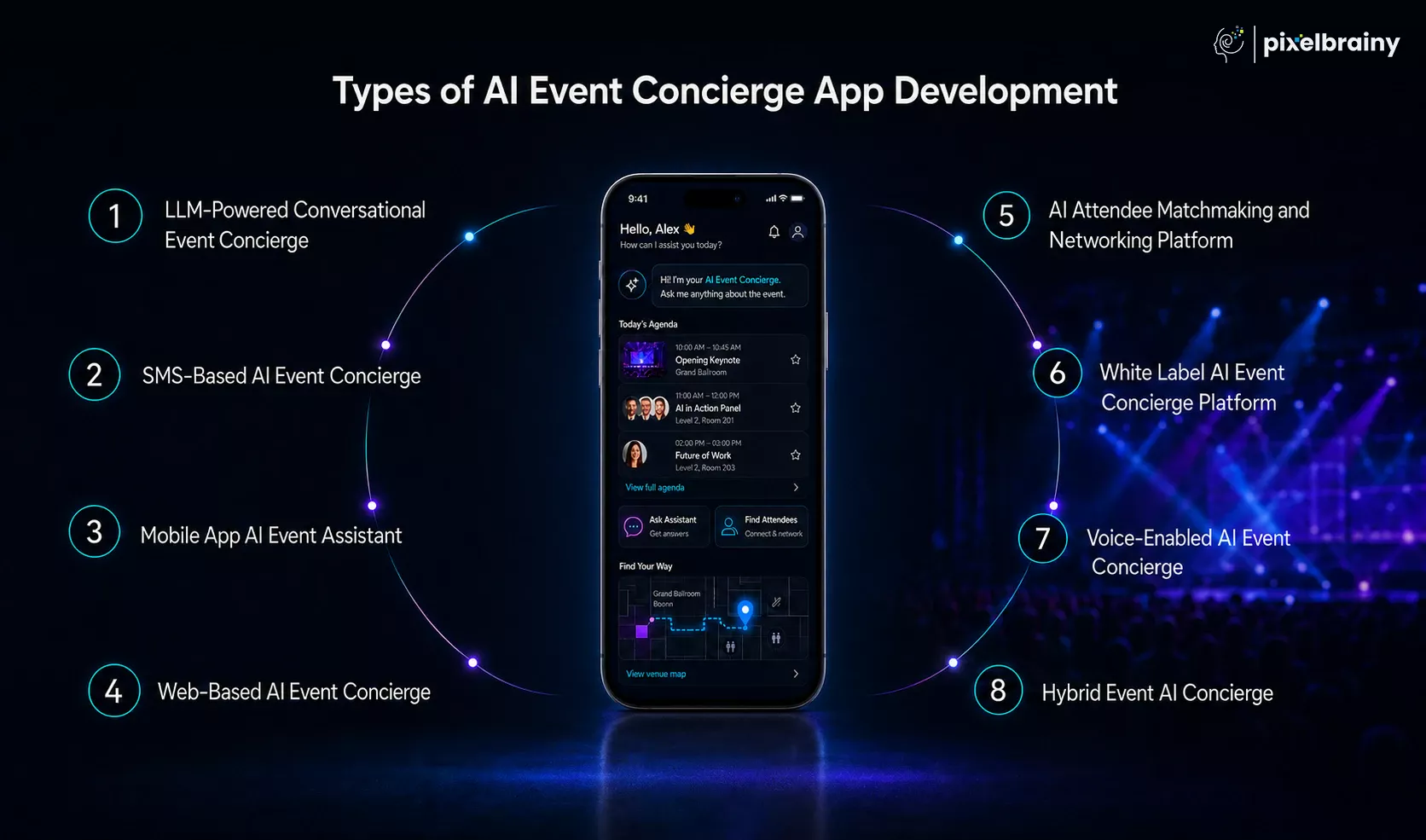
This AI concierge uses Large Language Models (LLMs) trained on event-specific information to answer attendee questions in natural language. It can understand complex queries, recommend sessions, suggest networking opportunities, and provide personalized guidance throughout the event.
Best for: Large conferences, corporate summits, and multi-track industry events.
Estimated cost: $40,000 to $120,000
An SMS-based concierge allows attendees to receive AI assistance simply by sending a text message, eliminating the need to download an application or create an account.
Compared to a mobile app, this model offers faster access with minimal user friction, making it ideal for events where convenience is a top priority.
Best for: VIP events, luxury hospitality, corporate retreats, and brand activations.
Estimated cost: $30,000 to $80,000
A mobile AI concierge combines personalized agendas, event navigation, networking, ticket management, sponsor discovery, and AI-powered assistance within a dedicated iOS or Android application.
Businesses looking to build smart event assistant solutions with advanced personalization often choose this approach.
Best for: Annual conferences, association events, and large-scale festivals.
Estimated cost: $60,000 to $200,000
This browser-based solution enables attendees to access AI support through a web link without installing an application. Progressive Web Apps (PWAs) provide a mobile-friendly experience while reducing installation barriers.
Best for: Corporate events, B2B conferences, and audiences with lower app adoption.
Estimated cost: $30,000 to $80,000
Built specifically for professional networking, this solution uses AI to recommend valuable one-on-one connections based on attendee profiles, interests, business goals, and event behavior.
AI event networking assistant development is particularly valuable for trade shows, investor meetings, and business networking events.
Best for: Trade shows, investor conferences, hosted buyer programs, and professional associations.
Estimated cost: $50,000 to $150,000
A white label platform enables multiple event organizers to launch branded AI concierge solutions using a shared backend. Each event can have its own branding, agenda, AI knowledge base, and workflows.
This approach is ideal for founders interested in white label AI event concierge app development and recurring SaaS business models.
Best for: Event management companies, event technology startups, and venue operators.
Estimated cost: $100,000 to $300,000
Voice-enabled AI allows attendees to interact with the concierge using spoken commands through kiosks, smart speakers, or mobile devices, making event assistance faster and more accessible.
Best for: Large venues, accessibility-focused events, and technology showcases.
Estimated cost: $60,000 to $180,000
This solution supports both physical and virtual attendees through a unified AI interface. In-person participants receive navigation and networking support, while virtual attendees can access live sessions, Q&A, and digital networking features.
Best for: Hybrid conferences, global events, and international associations.
Estimated cost: $80,000 to $200,000
| App Type | User Friction | Estimated Cost | Best For |
| LLM-Powered Conversational Concierge | Low | $40K to $120K | Large conferences and corporate summits |
| SMS-Based AI Concierge | Very Low | $30K to $80K | VIP events and luxury experiences |
| Mobile App AI Event Assistant | Medium | $60K to $200K | Conferences, festivals, and association events |
| Web-Based AI Concierge | Very Low | $30K to $80K | Corporate events and B2B conferences |
| AI Matchmaking Platform | Low | $50K to $150K | Trade shows and networking events |
| White Label AI Event Concierge | Low | $100K to $300K | Event SaaS providers and management companies |
| Voice-Enabled AI Concierge | Low | $60K to $180K | Large venues and accessibility-focused events |
| Hybrid Event AI Concierge | Low | $80K to $200K | Hybrid conferences and global events |
Understanding the different types of AI event concierge apps helps you choose a solution that aligns with your event goals, attendee expectations, and long-term growth strategy.
The success of an AI event concierge platform depends less on the number of features and more on how effectively those features solve real challenges for attendees, organizers, sponsors, and exhibitors. A well-planned feature set should simplify event navigation, automate routine tasks, encourage meaningful networking, and provide organizers with actionable insights.
Whether you want to build event concierge app with AI for a single conference or create event concierge app development as a white-label SaaS platform, including the right capabilities from the start lays the foundation for long-term product success.
For founders asking, "I am an event tech startup founder and I want to build an AI event concierge platform that event organizers can white label and deploy for their own events. What are all the features I need to include?", the answer is to focus on intelligent features that deliver value across the complete event lifecycle while remaining flexible enough to support different event formats.
Below are the essential features of event concierge app development integrating AI that should be part of every modern AI event concierge solution.
| Feature | Why It Matters |
| AI Event Concierge Chat | Serves as a 24/7 virtual assistant that answers attendee questions, understands conversational language, recommends relevant actions, and provides instant support before, during, and after every event. |
| Personalized Event Agenda | Builds customized schedules by analyzing attendee interests, selected topics, professional profiles, and availability, ensuring every participant receives a unique event experience instead of following a generic agenda. |
| AI Session Discovery | Recommends sessions, workshops, and keynote presentations based on attendee preferences and previous interactions, making it easier to discover relevant content without manually searching the event schedule. |
| Smart Networking Recommendations | Uses artificial intelligence to identify valuable business connections by evaluating attendee profiles, industries, networking objectives, mutual interests, and engagement behavior throughout the event. |
| Indoor Maps & AI Navigation | Provides step-by-step indoor navigation with interactive venue maps, helping attendees quickly locate session halls, booths, meeting rooms, registration desks, dining areas, and other important locations. |
| Sponsor & Exhibitor Discovery | Matches attendees with exhibitors and sponsors aligned to their interests, increasing qualified booth visits, improving sponsor visibility, and creating measurable engagement opportunities for event partners. |
| AI Powered Event Notifications | Delivers personalized reminders for upcoming sessions, schedule changes, networking meetings, venue announcements, and important updates based on attendee preferences and real-time event activities. |
| Multilingual AI Support | Enables attendees from different regions to communicate naturally with the AI assistant in multiple languages, improving accessibility and creating a seamless experience for international audiences. |
| Automated Meeting Scheduler | Coordinates networking meetings by finding mutual availability, suggesting suitable time slots, sending confirmations, and reducing manual scheduling efforts for attendees, exhibitors, and speakers. |
| Digital Ticket & QR Check-In | Simplifies event entry through secure QR-based ticket verification, reducing registration delays while enabling organizers to manage attendee access efficiently across multiple event locations. |
| AI Knowledge Assistant | Retrieves information from agendas, speaker profiles, FAQs, event policies, sponsor details, and uploaded documents to deliver accurate, context-aware responses instead of static keyword searches. |
| Organizer Analytics Dashboard | Displays real-time insights into attendee engagement, AI interactions, networking performance, popular sessions, sponsor activities, and operational metrics for better event planning and decision-making. |
| AI Feedback & Sentiment Insights | Collects attendee opinions through conversational interactions and analyzes responses to identify satisfaction levels, recurring issues, audience sentiment, and opportunities for improving future events. |
| White-Label Event Management Panel | Allows organizers to customize branding, event information, AI responses, user permissions, workflows, and platform settings, making the solution suitable for multiple clients and recurring deployments. |
| Content & AI Training Management | Enables administrators to update schedules, speakers, exhibitors, FAQs, announcements, and AI knowledge sources from one centralized dashboard without requiring coding or technical assistance. |
Including these essential AI-powered capabilities helps create an event concierge platform that delivers personalized attendee experiences, simplifies event operations, and scales effortlessly across different event types and industries.
Launching an AI event concierge with only standard features may meet basic attendee expectations, but it is often the advanced capabilities that differentiate a product in today's competitive event technology market. These next-generation features help founders deliver hyper-personalized experiences, improve sponsor ROI, automate complex event operations, and create a platform that event organizers are more likely to adopt year after year.
A common question founders ask is, "I already know the basic features, but what advanced AI capabilities should I include to make my event concierge platform stand out from competitors?" The answer lies in building intelligent features that continuously learn from attendee behavior, automate decision-making, and provide measurable business value beyond traditional event applications.
The following advanced capabilities can significantly strengthen your AI event concierge app development strategy while helping you build event concierge app with AI that is innovative, scalable, and future-ready.
| Advanced Feature | How It Adds Value |
| AI Attendee Digital Twin | Creates a dynamic AI profile for every attendee by continuously learning preferences, interactions, session attendance, networking behavior, and engagement patterns to deliver increasingly personalized recommendations throughout the event. |
| Predictive Crowd Management | Uses AI, location intelligence, and live attendee movement data to predict crowd congestion, recommend alternative routes, optimize venue traffic, and improve overall attendee safety and experience. |
| AI Networking Copilot | Goes beyond profile matching by suggesting conversation starters, meeting priorities, follow-up reminders, and high-value networking opportunities based on attendee goals and real-time event activity. |
| Generative AI Session Summaries | Automatically generates concise summaries, key takeaways, action points, and follow-up recommendations for every attended session, allowing participants to retain valuable insights after the event. |
| AI Sponsor Lead Scoring | Evaluates attendee engagement, booth interactions, conversations, and behavioral signals to identify high-intent prospects, helping sponsors prioritize leads and improve conversion opportunities. |
| Emotion & Sentiment Intelligence | Analyzes attendee feedback, chat conversations, and engagement patterns to measure sentiment in real time, enabling organizers to identify issues early and improve the overall event experience. |
| AI Revenue Recommendation Engine | Uses attendee behavior and purchasing intent to recommend premium sessions, workshops, sponsorship opportunities, merchandise, or ticket upgrades, increasing event revenue through intelligent personalization. |
| Context-Aware Voice Concierge | Enables attendees to interact with the AI assistant using voice commands while understanding location, schedule, and previous interactions to provide faster, hands-free event assistance. |
| Autonomous Event Operations Agent | Automates routine organizer tasks such as sending announcements, updating schedules, managing FAQs, notifying attendees, and responding to operational changes with minimal human intervention. |
| AI Event Intelligence Dashboard | Combines predictive analytics, attendee behavior, networking insights, sponsor performance, and engagement trends into a unified dashboard that supports faster and more strategic event decision-making. |
Advanced AI features transform an event concierge app from a digital assistant into an intelligent event ecosystem that continuously improves attendee experiences, operational efficiency, and business outcomes.
Developing an AI event concierge app requires much more than integrating a chatbot or connecting an AI model to event data. A successful solution combines intelligent recommendations, real-time information, seamless attendee interactions, scalable architecture, and continuous learning to deliver exceptional event experiences. Following a structured AI event concierge app development process helps founders reduce development risks, prioritize the right features, and launch a product that meets both attendee and organizer expectations.
A common question from founders is: "We are planning to develop a smart event assistant app for our annual corporate summit that can handle attendee questions, recommend sessions based on their interests, facilitate networking introductions, and update the schedule in real time when sessions change. What does the full development process look like?" The answer lies in following a phased development approach where every stage builds a strong foundation for the next.
Whether you are planning to create AI event concierge app from scratch or expand an existing event platform with AI capabilities, the following roadmap outlines the essential steps to develop smart event assistant solutions that are scalable, reliable, and ready for real-world events.
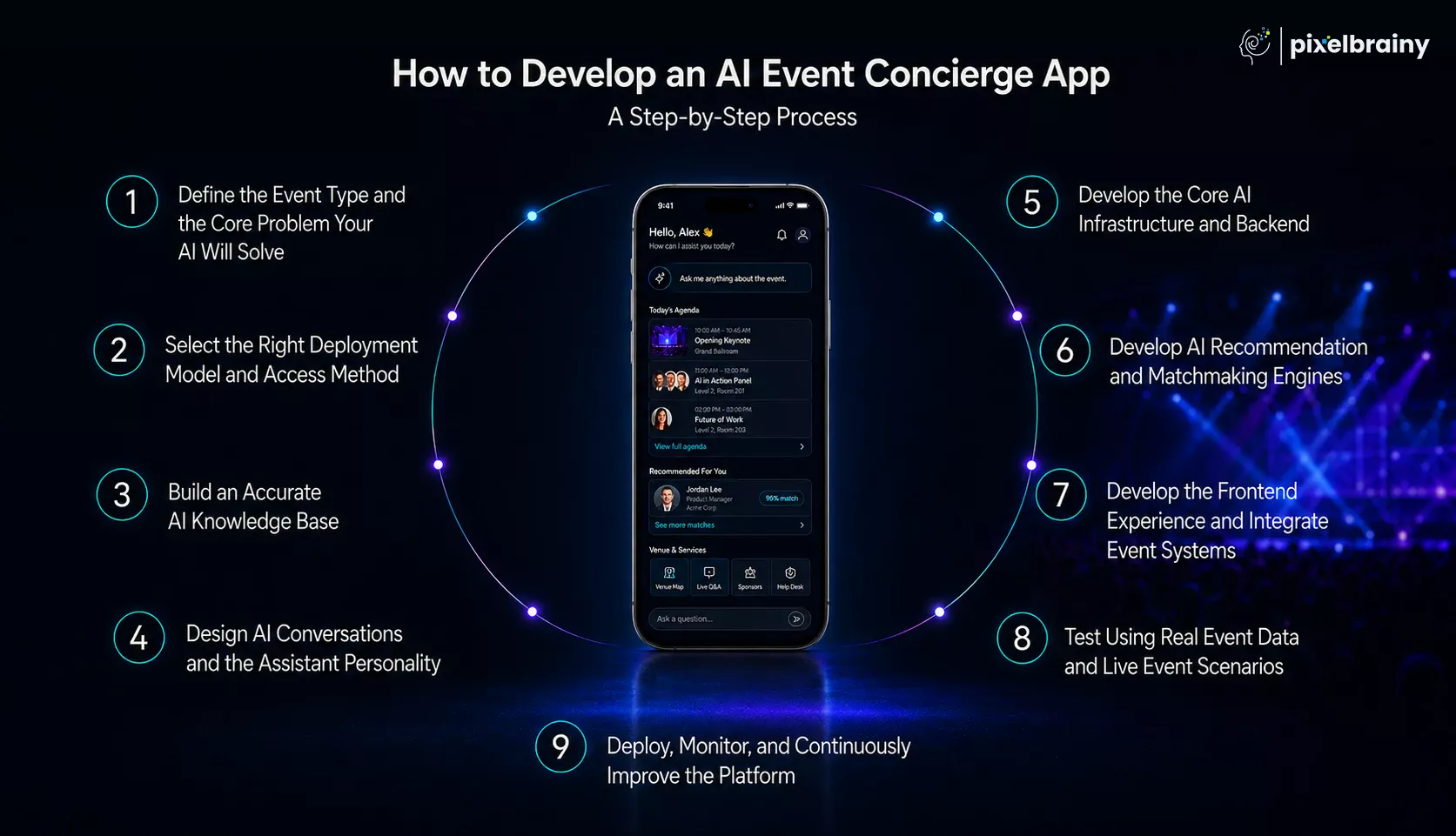
The first step in how to build AI event concierge app solutions is identifying the primary problem your application will solve. Every successful AI product starts by addressing one high-impact challenge before expanding its capabilities.
For example, your priority may be helping attendees discover relevant sessions, simplifying networking, answering support questions, improving sponsor engagement, or assisting with venue navigation. Defining this objective early determines your feature scope, AI architecture, and training requirements.
If you are building an MVP, avoid including every possible feature in the first release. A focused solution that solves one problem exceptionally well typically achieves better user adoption than a platform with too many unfinished capabilities.
Timeline: 3 to 5 days
Avoid: Expanding the MVP scope with unnecessary features before validating the primary use case.
The next decision is determining how attendees will access your AI concierge. This directly impacts user adoption and overall experience.
Depending on your audience and event format, your solution may be available as a native mobile application, Progressive Web App (PWA), SMS-based assistant, or embedded chatbot within an existing event platform.
For one-day conferences or executive events, web-based access or SMS often results in higher adoption because attendees are not required to download another application. For recurring conferences and annual events, dedicated mobile apps typically provide a richer experience.
If your product also requires intuitive user journeys, collaborating with an experienced UI/UX design company during this stage can significantly improve usability before development begins.
Timeline: 2 to 3 days
Avoid: Choosing a deployment model based solely on technology preferences instead of attendee behavior.
An AI concierge is only as effective as the information it has access to.
Before development begins, collect every piece of event-related content that attendees may request. This includes agendas, speaker biographies, venue maps, exhibitor details, FAQs, transportation information, accommodation recommendations, sponsor content, event policies, emergency contacts, and registration details.
The knowledge base should also support continuous updates so schedule changes, speaker replacements, or venue modifications are reflected instantly during live events. A dynamic knowledge repository ensures attendees always receive accurate recommendations.
Many startups also validate this knowledge architecture during PoC development before investing in full-scale implementation.
Timeline: 1 to 2 weeks
Avoid: Treating the knowledge base as static content that only needs to be uploaded once.
An AI concierge represents your event brand in every interaction. Its communication style should be helpful, professional, and aligned with the tone of your event.
Begin by mapping common attendee questions and designing response flows for registration, schedules, networking, venue navigation, sponsors, and event updates. Define how the assistant greets attendees, requests clarification, handles complex questions, and transfers conversations to human staff when necessary.
Testing these conversations with realistic attendee scenarios helps identify confusing responses before deployment and significantly improves the overall user experience.
Timeline: 1 to 2 weeks
Avoid: Designing conversations without validating them against real attendee questions collected from previous events.
This stage forms the technical foundation of your AI event concierge platform.
Developers build the backend architecture, integrate Large Language Models (LLMs), establish Retrieval-Augmented Generation (RAG) pipelines, create attendee profile management, and implement APIs that synchronize schedules, speaker updates, sponsor information, and event notifications in real time.
The backend should also securely manage attendee preferences, networking history, and behavioral insights to support future personalization features. Many startups initially implement these capabilities during MVP development before expanding into advanced AI functionality.
A scalable backend ensures your platform remains responsive even when thousands of attendees interact with the AI simultaneously during large conferences.
Timeline: 4 to 8 weeks
Avoid: Building an AI system that relies on outdated or manually updated event information instead of live synchronized data.
Also Read: Top AI MVP Development Companies in USA
Once the core infrastructure is in place, the next step is to build the intelligence that makes your event concierge truly personalized. Recommendation engines should analyze attendee interests, professional backgrounds, previous interactions, session history, and engagement patterns to suggest relevant sessions, exhibitors, networking opportunities, and event activities.
For networking, AI should evaluate compatibility using attendee goals, industries, experience levels, and behavioral signals rather than relying only on profile tags. Over time, the recommendation engine should learn from accepted suggestions and ignored recommendations to improve future accuracy.
Organizations with advanced personalization requirements often combine these capabilities with AI model development solutions to create highly customized recommendation algorithms.
Timeline: 3 to 5 weeks
Avoid: Building recommendation engines that depend only on profile information without learning from attendee behavior.
The frontend is where attendees interact with your AI concierge, making usability a critical factor in overall product success. Design a clean conversational interface with intuitive navigation, personalized dashboards, interactive venue maps, networking modules, and easy access to schedules and notifications.
At the same time, integrate the platform with registration systems, CRM platforms, event management software, calendar services, payment gateways, and real-time scheduling APIs. Reliable AI integration services ensure information remains synchronized across all connected systems throughout the event.
Timeline: 3 to 5 weeks
Avoid: Prioritizing interface design before validating backend stability and AI response accuracy.
View this Project Delivered By PixelBrainy: Event Playbook: Seamless Event Planner Design | Portfolio
Before deployment, every feature should be tested using realistic event data rather than sample datasets. Load complete agendas, speaker information, sponsor details, attendee profiles, and venue layouts to evaluate how the AI performs under actual event conditions.
Conduct load testing with thousands of simultaneous conversations, simulate schedule changes, verify networking recommendations, and test edge cases such as incomplete questions or unexpected attendee requests. Organizations offering AI consulting solutions often recommend running a pilot with a limited group of attendees before the official launch to gather actionable feedback.
Timeline: 2 to 3 weeks
Avoid: Testing only ideal scenarios while ignoring real-world attendee behavior and unexpected conversations.
Launching the application is the beginning of an ongoing optimization process rather than the final milestone. During the live event, continuously monitor AI performance, response accuracy, attendee engagement, recommendation quality, and system health.
After the event, analyze conversation history, session participation, networking activity, sponsor engagement, and attendee feedback to identify improvement opportunities. These insights help refine AI models, expand platform capabilities, and strengthen future event experiences. Many growing startups collaborate with top AI product development companies to continuously evolve their platforms as user expectations and AI technologies advance.
Timeline: 1 week for deployment, followed by continuous monitoring and optimization.
Avoid: Treating post-event analytics as reporting data instead of using it to improve future AI performance.
| Phase | Activity | Estimated Timeline |
| Phase 1 | Define event use case and deployment model | 1 Week |
| Phase 2 | Build AI knowledge base and collect training data | 2 Weeks |
| Phase 3 | Design AI conversation flows and assistant persona | 2 Weeks |
| Phase 4 | Develop AI backend, LLM integration, and RAG infrastructure | 4 to 8 Weeks |
| Phase 5 | Build recommendation and matchmaking engines | 3 to 5 Weeks |
| Phase 6 | Develop frontend and integrate third-party platforms | 3 to 5 Weeks |
| Phase 7 | Perform testing, load simulation, and pilot launch | 2 to 3 Weeks |
| Phase 8 | Deploy platform, monitor performance, and optimize continuously | 1 Week + Ongoing |
Overall Development Timeline: Most AI event concierge platforms require approximately 3 to 6 months, depending on feature complexity, AI capabilities, integrations, and deployment scope.
Following a structured AI event concierge app development process helps founders build scalable, intelligent, and future-ready platforms that deliver exceptional experiences for attendees, organizers, and sponsors alike.
The success of an AI event concierge depends on how well it is designed for a specific event format. A solution built for a B2B trade show has different priorities than one developed for a music festival or a corporate leadership retreat.
From attendee networking and sponsor engagement to crowd management and personalized recommendations, every event requires a unique AI strategy.
Understanding these use cases helps founders decide how to build AI event assistant for trade shows, develop AI event concierge for festivals, implement an AI event concierge for conferences, or launch an AI event concierge for corporate events that delivers measurable business outcomes.
Primary AI use cases: Personalized session recommendations, attendee matchmaking, speaker Q&A assistance, and sponsor engagement.
Key features: Professional profile-based networking, one-on-one meeting scheduler, AI-powered session recommendations, intelligent agenda planning, and discussion moderation.
Privacy consideration: Collect attendee consent before sharing professional profiles or networking preferences.
ROI signal: Attendees who establish valuable business relationships are up to three times more likely to return to future conferences, making AI event concierge for conferences an effective retention strategy.
One of the most common questions from organizers is, "We organize B2B trade shows and exhibitions. What AI event concierge features are most valuable for this format?"
Primary AI use cases: Exhibitor discovery, buyer and seller matchmaking, lead qualification, and product demonstration scheduling.
Key features: AI-powered booth recommendations, intelligent floor navigation, CRM-integrated lead capture, appointment scheduling, and exhibitor search.
Privacy consideration: Secure attendee and exhibitor data while maintaining protected CRM integrations.
ROI signal: Businesses that build AI event assistant for trade shows often help exhibitors generate 40% to 60% higher-quality leads through AI-powered attendee matching.
Large festivals require AI that can support thousands of attendees simultaneously while improving safety and engagement.
Primary AI use cases: Artist recommendations, crowd management, food vendor discovery, attendee group coordination, and live navigation.
Key features: Personalized artist suggestions, GPS-enabled wayfinding, live crowd updates, food ordering assistance, schedule reminders, and lost-and-found support.
Privacy consideration: Inform attendees about location tracking and provide transparent privacy controls.
ROI signal: Organizers who develop AI event concierge for festivals help attendees discover more performances while increasing spending on food, beverages, and merchandise.
Many organizers ask, "I run a luxury corporate retreat. How do I build an AI event concierge that delivers VIP-level personalized service?"
Primary AI use cases: Personalized itineraries, logistics coordination, executive scheduling, and post-event feedback collection.
Key features: Transportation coordination, dietary preference management, executive meeting reminders, activity recommendations, and anonymous employee feedback.
Privacy consideration: Protect employee information, executive schedules, and confidential organizational data.
ROI signal: Organizations implementing an AI event concierge for corporate events often reduce planning effort while improving attendee satisfaction and operational efficiency.
VIP experiences depend on proactive and highly personalized service rather than reactive support.
Primary AI use cases: Personalized guest assistance, exclusive access management, premium concierge services, and preference-based recommendations.
Key features: Guest preference profiles, SMS-based AI concierge, VIP lounge management, personalized notifications, and exclusive experience coordination.
Privacy consideration: Securely store guest preferences and restrict access to sensitive personal information.
ROI signal: Personalized AI concierge services contribute to stronger guest satisfaction, premium brand experiences, and higher repeat attendance.
Universities host conferences, orientations, alumni programs, career fairs, and cultural festivals throughout the year.
Primary AI use cases: Campus navigation, academic session recommendations, multilingual assistance, and student networking.
Key features: Student ID integration, accessibility-friendly navigation, synchronized calendars, multilingual AI support, and campus maps.
Privacy consideration: Follow institutional privacy policies and student data protection requirements.
ROI signal: A smart event assistant for B2B events can also be adapted for universities, improving student participation across academic and networking activities.
Organizers frequently ask, "I organize music festivals with 50,000 attendees. What AI concierge features would be most impactful for this scale?" Similar scalability challenges also apply to hybrid conferences serving both physical and virtual audiences.
Primary AI use cases: Unified attendee assistance, cross-platform networking, virtual session discovery, and personalized content recommendations.
Key features: Single AI assistant for physical and virtual attendees, breakout room recommendations, hybrid networking, synchronized schedules, and on-demand content suggestions.
Privacy consideration: Maintain consistent security and identity verification across both online and on-site attendee experiences.
ROI signal: Hybrid events using unified AI concierge platforms consistently achieve stronger virtual engagement and better attendee participation than disconnected event tools.
| Event Type | Primary AI Focus | Key Business Outcome |
| B2B Conferences & Industry Summits | Networking, session recommendations, sponsor engagement | Higher attendee retention and quality business connections |
| Trade Shows & Exhibitions | Exhibitor discovery, buyer matchmaking, lead capture | Better sponsor ROI and higher-quality sales leads |
| Music & Arts Festivals | Crowd management, artist recommendations, navigation | Increased attendee engagement and on-site spending |
| Corporate Events & Team Retreats | Logistics, personalized experiences, scheduling | Improved operational efficiency and attendee satisfaction |
| VIP & Luxury Events | Personalized concierge services | Exceptional guest experiences and stronger loyalty |
| University & Campus Events | Navigation, student engagement, multilingual assistance | Higher event participation and improved accessibility |
| Hybrid Events | Unified physical and virtual attendee experiences | Greater engagement across both event formats |
Building an AI event concierge that aligns with your event type ensures every attendee receives personalized assistance while helping organizers maximize engagement, operational efficiency, and long-term event success.
The AI event concierge app development cost depends on several factors, including the application's complexity, AI capabilities, deployment model, third-party integrations, and scalability requirements. A basic AI assistant that answers attendee questions requires a significantly lower investment than a white-label platform that supports multiple events, AI matchmaking, multilingual conversations, and enterprise analytics.
Many founders ask, "How much does it cost to develop a custom AI event concierge app with LLM-powered Q&A, session recommendations, and attendee matchmaking?" Others have a specific budget in mind, such as "$60,000 to $80,000. What kind of AI event concierge MVP can I build within this range?" The answer depends on your feature priorities and long-term product vision. A carefully planned MVP can include core AI capabilities while leaving advanced features for future releases.
| App Type | Features Included | Estimated Cost | Timeline |
| Basic AI Event FAQ Chatbot | FAQ responses, schedule queries, push notifications | $10,000 to $30,000 | 6 to 10 weeks |
| Mid-Level Smart Event Concierge | LLM-powered Q&A, personalized agenda, real-time updates | $30,000 to $80,000 | 3 to 5 months |
| Advanced AI Event Platform | AI matchmaking, sponsor engagement, analytics dashboard | $80,000 to $180,000 | 4 to 7 months |
| White Label Multi-Event Platform | Multi-tenant architecture, reseller tools, custom branding | $120,000 to $300,000 | 5 to 8 months |
| Enterprise VIP Event Concierge | SMS-based AI, hyper-personalization, premium concierge features | $100,000 to $250,000 | 4 to 7 months |
A budget of $60,000 to $80,000 is generally sufficient to build a robust MVP featuring conversational AI, personalized agendas, session recommendations, attendee profiles, real-time notifications, and organizer dashboards. Advanced capabilities such as white-label architecture, predictive analytics, and enterprise-grade automation can be introduced in later development phases.
| Development Component | Estimated Cost Range |
| UX design and conversation flow mapping | $5,000 to $15,000 |
| Knowledge base design and RAG pipeline | $8,000 to $25,000 |
| LLM integration and prompt engineering | $8,000 to $25,000 |
| Backend development and API integrations | $10,000 to $35,000 |
| Matchmaking and recommendation engine | $10,000 to $40,000 |
| Frontend and mobile development | $8,000 to $30,000 |
| SMS or messaging channel integration | $3,000 to $10,000 |
| Event platform integrations (Cvent, Eventbrite, etc.) | $5,000 to $20,000 |
| Organizer analytics dashboard | $5,000 to $20,000 |
| Testing, QA, and load simulation | $3,000 to $12,000 |
| Post-launch support | $1,500 to $8,000 per month |
Organizations often ask whether continuing with a SaaS event platform or investing in a custom AI concierge provides better long-term value, especially when annual licensing costs continue to increase.
| Factor | SaaS Event Platform (Annual) | Custom AI Event Concierge |
| Year 1 investment | $15,000 to $80,000 | $30,000 to $200,000 (one-time development) |
| Year 3 total investment | $45,000 to $240,000 | $40,000 to $250,000 with lower ongoing costs |
| Brand control | Limited customization | Complete ownership |
| Feature flexibility | Platform-dependent | Fully customizable |
| Attendee data ownership | Often retained within the platform | Complete ownership and access |
| Revenue opportunities | Limited | Sponsorships, subscriptions, white-label licensing, premium features |
| White-label support | Limited or unavailable | Fully brandable platform |
Several technical and business decisions influence the cost to develop smart event assistant solutions:
A well-planned AI event app development cost breakdown enables founders to prioritize essential features, control development expenses, and build a scalable platform that delivers long-term business value.
Also Read: AI App Development Cost: From MVPs to Full-Scale AI App
A modern AI event concierge platform relies on a combination of artificial intelligence, cloud infrastructure, real-time communication, and scalable application architecture to deliver seamless attendee experiences. Every technology layer plays a specific role, from powering conversational AI and multilingual support to synchronizing live event schedules, managing attendee data, and providing actionable analytics for organizers. A well-planned technology stack also makes it easier to scale the platform, integrate third-party event systems, and introduce new AI capabilities as the product evolves.
Questions such as "What technology stack should I use to build a custom AI event concierge app in 2026?", "Which LLM models, frameworks, and databases do top AI event app development companies use?", and "How do I build a multilingual AI event concierge with real-time knowledge base updates?" are common among founders planning AI event concierge app development.
The following technology stack provides a reliable foundation for organizations looking to build AI event app using Python and implement the latest technologies to develop smart event concierge solutions.
| Technology Category | Recommended Technologies | Role in AI Event Concierge App Development |
| Programming Languages | Python, TypeScript, JavaScript, Swift (iOS), Kotlin (Android) | Python powers AI models and backend services, while JavaScript, Swift, and Kotlin support responsive web and mobile application development. |
| LLM Models | GPT-4o, Claude Sonnet 4.6, Gemini 1.5 Pro, Llama 3, Mistral | Power conversational AI, personalized recommendations, multilingual interactions, intelligent search, and attendee assistance. |
| AI Frameworks | LangChain, LangGraph, LlamaIndex, AutoGen | Simplify AI orchestration, agent workflows, Retrieval-Augmented Generation (RAG), prompt management, and memory handling. |
| RAG & Vector Database | Pinecone, Weaviate, ChromaDB, pgvector | Store and retrieve event knowledge efficiently, enabling AI to answer attendee questions using updated event-specific information. |
| Multilingual NLP | Hugging Face Transformers, DeepL API, Google Translate API | Support multilingual conversations, language translation, localization, and global attendee communication. |
| SMS & Messaging Infrastructure | Twilio, MessageBird, Vonage SMS API, WhatsApp Business API | Deliver AI concierge services through SMS and messaging channels without requiring mobile app installation. |
| Backend Frameworks | FastAPI, Django, Node.js, Flask | Manage APIs, business logic, authentication, AI processing, integrations, and scalable backend operations. |
| Frontend & Mobile Development | React.js, React Native, Vue.js, Progressive Web Apps (PWA) | Build responsive web applications, cross-platform mobile apps, and browser-based AI concierge experiences. |
| Real-Time Data Synchronization | Firebase Realtime Database, WebSockets, Pusher, Socket.io | Instantly synchronize session changes, attendee notifications, venue updates, messaging, and live event information. |
| Event Platform Integrations | Cvent API, Eventbrite API, Bizzabo API, Custom Webhooks | Integrate registration systems, attendee databases, schedules, ticketing platforms, and event management software. |
| Venue Mapping & Wayfinding | Mapbox, Google Maps API, IndoorAtlas | Provide indoor navigation, booth discovery, meeting directions, interactive venue maps, and location-aware recommendations. |
| Database Technologies | PostgreSQL, MongoDB, Redis | Store attendee profiles, event content, AI knowledge, schedules, preferences, and improve performance through caching. |
| Cloud Infrastructure | Amazon Web Services (AWS), Google Cloud Platform (GCP), Microsoft Azure | Deliver scalable hosting, AI deployment, storage, monitoring, and high availability for enterprise applications. |
| Analytics & Organizer Dashboards | Mixpanel, Amplitude, Power BI, Custom Dashboards | Measure attendee engagement, AI usage, networking performance, sponsor ROI, and event success through real-time analytics. |
| Security & Compliance | OAuth 2.0, AES-256 Encryption, GDPR Consent Frameworks | Secure user authentication, protect attendee data, encrypt communications, and ensure compliance with global privacy standards. |
A robust and future-ready tech stack lays the foundation for building an AI event concierge that delivers intelligent experiences, real-time performance, and seamless scalability across every event format.
Building an innovative AI event concierge is only one part of creating a successful event technology business. Equally important is selecting a monetization strategy that aligns with your target customers, product capabilities, and long-term growth plans. Whether your goal is to build AI event assistant SaaS for recurring revenue or launch a white label AI event concierge platform for agencies, the right pricing model can significantly influence customer acquisition, profitability, and scalability.
Two common questions founders ask are: "I am building an AI event concierge SaaS. What are the best monetization models for this type of product?" and "How do AI event concierge app companies make money, and what pricing models work best for event tech products?"
The answer often depends on your ideal customer profile, deployment model, and the value your platform delivers. Many successful businesses combine multiple revenue models instead of relying on a single pricing strategy.
Charge organizers a one-time fee for every event where your AI concierge platform is deployed. Pricing typically varies based on attendee volume, event duration, and enabled features.
Best for: Early-stage startups validating their product with individual conferences and events.
Pros: Easy to understand, low commitment for customers, and faster sales cycles.
Cons: Revenue depends on continuously acquiring new event clients.
Offer monthly or annual subscription plans that allow organizers to host multiple events using the same platform with recurring access to updates and support.
Best for: Companies planning to build AI event assistant SaaS for organizations that host events throughout the year.
Pros: Predictable recurring revenue, stronger customer retention, and easier financial forecasting.
Cons: Requires continuous feature improvements and reliable customer support.
Develop a white label AI event concierge platform that event agencies, conference organizers, and technology partners can brand as their own before selling it to clients.
Best for: Founders targeting agencies and event management companies.
Pros: Faster market expansion, recurring enterprise contracts, and reduced customer acquisition costs.
Cons: Higher development effort due to multi-tenant architecture and branding flexibility.
Generate additional revenue by offering sponsors AI-powered attendee recommendations, premium booth visibility, qualified lead generation, and engagement analytics.
Best for: Large conferences, trade shows, exhibitions, and B2B networking events.
Pros: High-margin revenue stream without increasing attendee pricing.
Cons: Requires measurable sponsor analytics and transparent performance reporting.
Provide standard AI concierge functionality while offering advanced attendee insights, behavioral analytics, sponsor ROI dashboards, and engagement reports as premium add-on services.
Best for: Enterprise organizers focused on data-driven decision-making.
Pros: Increases average contract value while creating clear differentiation from standard event platforms.
Cons: Requires robust analytics infrastructure and continuous data accuracy.
Offer a complete end-to-end solution that includes platform setup, AI knowledge base configuration, live event monitoring, content updates, and post-event performance reporting.
Best for: Luxury events, corporate summits, VIP experiences, and organizations without dedicated technical teams.
Pros: Premium pricing, stronger client relationships, and additional consulting opportunities.
Cons: Requires dedicated operational resources and higher service commitments.
| Business Model | Ideal Customer | Revenue Potential | Scalability |
| Per-Event Licensing | Individual event organizers | Medium | Medium |
| Annual SaaS Subscription | Event companies with recurring events | High | High |
| White Label Platform | Event agencies and SaaS providers | Very High | Very High |
| Sponsor Engagement Revenue | Conferences and trade shows | High | High |
| Premium Analytics | Enterprise event organizers | High | Medium to High |
| Managed Service Model | Corporate, luxury, and VIP events | Very High | Medium |
Combining multiple monetization models allows AI event concierge founders to diversify revenue streams, increase customer lifetime value, and build a more scalable event technology business.
Developing an AI event concierge app involves much more than integrating a Large Language Model into an event platform. The application must deliver accurate responses, personalize attendee experiences, process real-time event updates, protect sensitive user data, and perform reliably under heavy traffic. Even a well-designed platform can struggle if these technical and operational challenges are not addressed during the planning and development stages.
Whether you are planning AI event concierge app development, looking to build AI event concierge app for enterprise conferences, or aiming to develop AI event assistant as a white-label SaaS product, understanding the most common development challenges helps reduce project risks and improve long-term product success. The following are some of the biggest challenges founders and event technology companies face, along with practical solutions to overcome them.
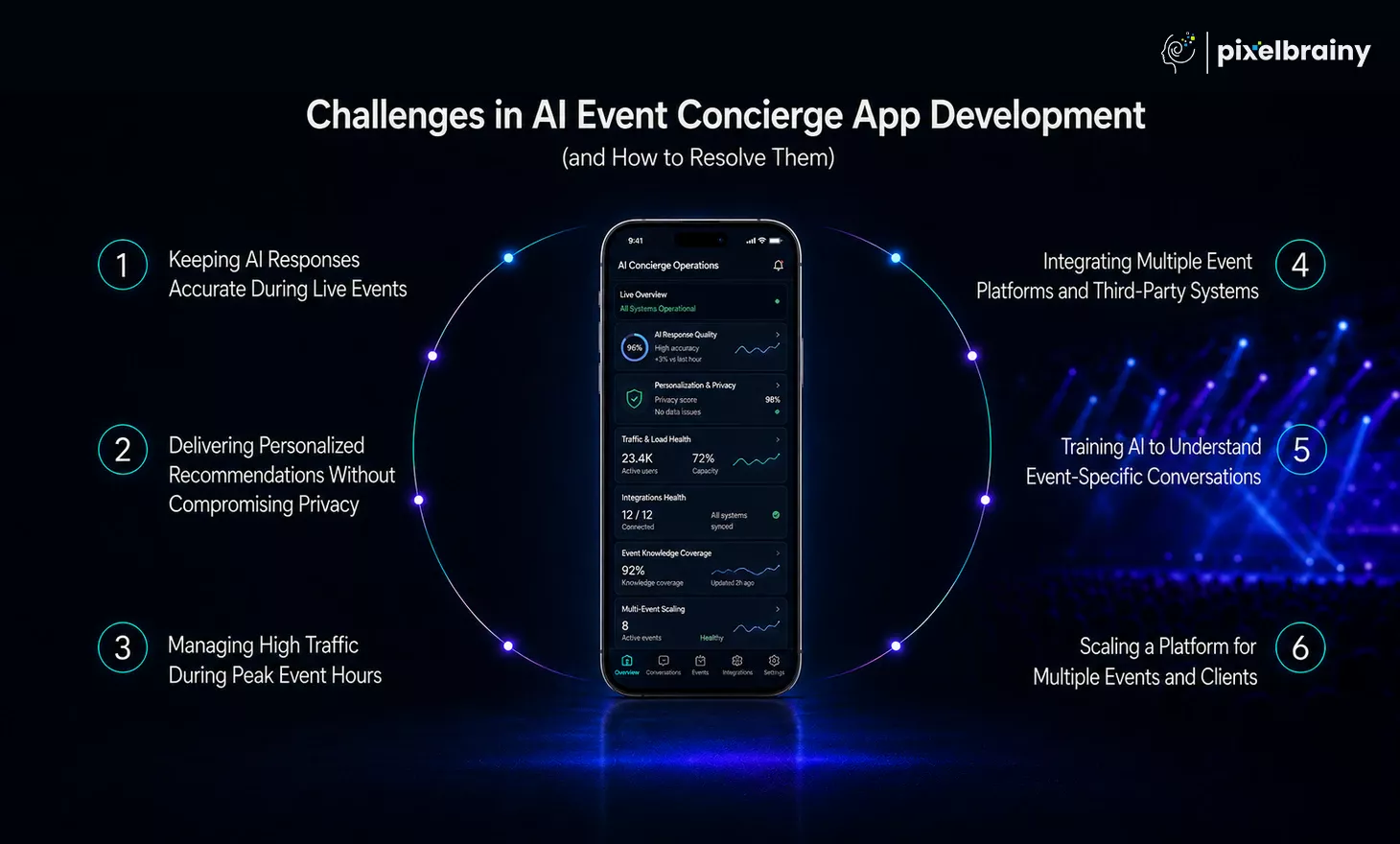
Challenge:
Event schedules, speaker information, venue details, and sponsor content often change throughout the day. If the AI relies on outdated information, attendees may receive incorrect recommendations or directions, leading to poor event experiences.
Solution:
Implement a Retrieval-Augmented Generation (RAG) architecture with real-time knowledge base synchronization. Integrating live event management systems ensures the AI always responds using the latest event data rather than outdated static content.
Challenge:
Personalized session recommendations, networking suggestions, and sponsor matching require access to attendee profiles and behavioral data. Mishandling this information can create privacy and compliance concerns.
Solution:
Adopt privacy-by-design principles, obtain explicit user consent, encrypt sensitive information, and comply with regulations such as GDPR and other applicable data protection standards. Give attendees clear control over how their information is used.
Challenge:
Thousands of attendees may interact with the AI simultaneously during keynote sessions, registrations, or schedule changes. Without scalable infrastructure, response times can increase and user experience may suffer.
Solution:
Use cloud-native architecture with auto-scaling capabilities, load balancing, distributed caching, and real-time monitoring to maintain consistent performance even during peak event activity.
Challenge:
Most events already use registration software, CRM platforms, ticketing systems, payment gateways, and marketing tools. Integrating these systems into one AI-powered platform can be technically complex.
Solution:
Build the platform using API-first architecture and standardized integration frameworks. This approach simplifies connectivity with registration systems, event management software, CRM platforms, and communication tools while reducing future maintenance efforts.
Challenge:
Generic AI models may misunderstand event terminology, sponsor names, session titles, or attendee intent, resulting in inaccurate or irrelevant responses.
Solution:
Train the AI using event-specific documents, agendas, speaker profiles, FAQs, venue maps, and sponsor information. Continuously update the knowledge base before and during every event to improve response quality and contextual understanding.
Challenge:
Many founders eventually expand from supporting a single event to serving multiple organizers across different industries. Without scalable architecture, managing branding, AI knowledge, and event configurations becomes increasingly difficult.
Solution:
Design the platform with a multi-tenant architecture that supports separate branding, event content, AI knowledge bases, and user management for every client. This approach simplifies AI event concierge app development for white-label deployments while reducing operational complexity as the business grows.
Successfully overcoming these challenges enables businesses to build secure, scalable, and intelligent AI event concierge platforms that consistently deliver exceptional experiences for attendees, organizers, sponsors, and exhibitors.
Building an AI event concierge platform requires much more than writing code or integrating a chatbot. It involves understanding attendee behavior, designing intuitive user experiences, developing scalable AI architecture, integrating event management platforms, implementing real-time data synchronization, and ensuring the solution can evolve as your business grows. This is where partnering with an experienced AI app development company can significantly reduce development risks while accelerating time to market.
At PixelBrainy, we specialize in delivering AI app solutions for AI event concierge platforms that help startups, event management companies, enterprises, and SaaS founders build intelligent event experiences. Whether you want to launch an AI-powered MVP or a fully featured white-label platform, our team focuses on creating scalable products that combine conversational AI, personalized recommendations, attendee matchmaking, sponsor engagement, and real-time event management into a single solution.
Our AI event concierge development services include:
Every solution is designed around your business objectives instead of relying on generic event management templates.
One of the most common questions we receive is:
"We are an event management company that organizes more than 50 B2B conferences and trade shows each year across the USA. We want to build a custom AI event concierge platform that we can white label and deploy for each client event with custom branding, agendas, and sponsor configurations. What will this cost to build, and how long will development take?"
For organizations managing multiple events annually, a white-label AI event concierge platform is often the most cost-effective long-term investment. Instead of purchasing separate licenses for every event, a centralized multi-tenant platform allows your team to launch new events quickly by configuring branding, schedules, exhibitors, sponsors, AI knowledge bases, and attendee experiences from a single administration panel.
The overall investment and timeline depend on factors such as AI capabilities, third-party integrations, multilingual support, deployment channels, and the level of customization required. Most enterprise-grade white-label platforms are typically delivered within 5 to 8 months, following a phased development approach that includes discovery, MVP validation, feature expansion, testing, and deployment.
Our team recently partnered with an international event organizer that manages multiple business conferences and industry exhibitions each year.
The client wanted a centralized AI concierge platform that could be customized for every event without rebuilding the application from scratch. The solution included conversational AI, personalized agendas, attendee matchmaking, sponsor recommendations, multilingual support, organizer dashboards, and a white-label administration panel.
After implementation, the organizer was able to launch new event instances significantly faster, streamline attendee support through AI automation, improve sponsor visibility, and provide a more personalized experience across multiple conferences using a single scalable platform.
Organizations partner with PixelBrainy because we combine AI expertise with practical product development experience. Our approach focuses on understanding business goals, validating ideas through MVPs, building scalable architectures, and continuously improving AI performance based on real user behavior. From startup founders to enterprise event companies, we help clients transform ideas into intelligent digital products that are secure, future-ready, and built for growth.
If you're planning AI event concierge app development, PixelBrainy can help you build a scalable, intelligent, and fully customizable platform that delivers exceptional experiences for every event you organize. So let’s connect!
The demand for AI event concierge app development is accelerating as event organizers look for smarter ways to personalize attendee experiences, improve sponsor engagement, and streamline event operations. From conferences and trade shows to corporate events and festivals, AI-powered concierge platforms are becoming an essential part of modern event technology.
Success depends on selecting the right deployment model, prioritizing valuable features, building a scalable AI architecture, and planning for continuous knowledge base updates and post-event analytics. Whether you want to build AI event concierge app solutions for a single event or create AI event concierge platforms that support multiple clients through a white-label model, careful planning will determine your long-term success. Development investments typically range from $10,000 for a basic AI FAQ assistant to $300,000 for an enterprise-grade white-label platform.
For founders and event businesses, this is an opportunity to establish market leadership while intelligent event assistants continue gaining adoption. Organizations that develop smart event assistant platforms today can strengthen customer relationships, create recurring revenue opportunities, and deliver measurable business value through AI-driven event experiences.
Ready to Build Your AI Event Concierge Platform?
Whether you're validating an MVP or planning an enterprise-scale solution, PixelBrainy can help you transform your idea into a scalable AI-powered event platform.
Schedule a free consultation to:
The AI event concierge app development cost typically ranges from $10,000 to $300,000, depending on the platform's complexity, AI capabilities, deployment model, integrations, and scalability requirements. A basic AI FAQ assistant requires a smaller investment, while a white-label, enterprise-grade platform with attendee matchmaking, multilingual AI, and analytics costs significantly more.
The development timeline generally ranges from 3 to 6 months. The duration depends on the project's scope, AI integrations, feature set, third-party APIs, testing requirements, and deployment strategy. Building an MVP with essential AI capabilities usually takes less time than developing a fully customized enterprise platform.
A traditional event app primarily displays schedules, venue maps, and speaker information. An AI event concierge goes further by understanding attendee intent, answering questions conversationally, recommending relevant sessions, facilitating networking, providing personalized guidance, and continuously learning from attendee interactions throughout the event lifecycle.
Yes. An AI event concierge can be deployed as a Progressive Web App (PWA), SMS-based assistant, WhatsApp chatbot, or browser-accessible web application. These deployment models eliminate installation barriers while still delivering conversational AI, real-time updates, and personalized attendee support.
Modern AI concierge platforms synchronize with event management systems using APIs, webhooks, and real-time databases. Whenever organizers update schedules, speaker information, or venue details, the AI knowledge base is refreshed automatically, ensuring attendees always receive accurate and up-to-date information.
Large Language Models such as GPT, Claude, Gemini, Llama 3, and Mistral are among the leading options. Combined with Retrieval-Augmented Generation (RAG), these models provide accurate, context-aware responses using event-specific data instead of relying solely on general AI knowledge.
Multilingual support is achieved by integrating translation services, multilingual NLP models, and localized AI prompts. Technologies such as DeepL API, Google Translate API, and Hugging Face Transformers allow attendees to communicate naturally with the AI in their preferred language while maintaining consistent responses.
Yes. Most custom AI event concierge solutions integrate with platforms such as Cvent, Eventbrite, Bizzabo, CRM systems, ticketing software, payment gateways, and registration tools through APIs and webhooks. These integrations enable real-time synchronization of attendee data, schedules, registrations, and event updates.
Popular monetization models include annual SaaS subscriptions, per-event licensing, white-label reseller programs, premium analytics, sponsor engagement packages, and managed deployment services. Many successful event technology companies combine multiple pricing models to create recurring revenue while serving different customer segments.
Post-launch expenses typically include cloud hosting, AI model usage, vector database services, monitoring tools, maintenance, security updates, third-party API subscriptions, and continuous feature enhancements. Budgeting for ongoing optimization ensures the platform remains secure, scalable, and aligned with evolving user expectations.
A well-architected AI event concierge built on scalable cloud infrastructure can support thousands of concurrent users. Auto-scaling servers, distributed databases, caching mechanisms, and load balancing help maintain fast response times during keynote sessions, registrations, and other periods of peak attendee activity.
A custom AI event concierge gives businesses complete control over branding, AI capabilities, attendee data, workflows, integrations, and future product enhancements. Unlike standardized platforms, custom solutions can be tailored to specific event formats, business objectives, and white-label requirements while supporting long-term scalability and product differentiation.

About The Author
Sagar Bhatnagar
Sagar Sahay Bhatnagar brings over a decade of IT industry experience to his role as Marketing Head at PixelBrainy. He's known for his knack in devising creative marketing strategies that boost brand visibility and market influence. Sagar's strategic thinking, coupled with his innovative vision and focus on results, sets him apart. His track record of successful campaigns proves his ability to utilize digital platforms effectively for impactful marketing efforts. With a genuine passion for both technology and marketing, Sagar continuously pushes PixelBrainy's marketing initiatives to greater success.

Working with the PixelBrainy team has been a highly positive experience. They understand the design requirements and create beautiful UX elements to meet the application needs. The dev team did an excellent job bringing my vision to life. We discussed usability and flow. Sagar worked with his team to design the database and begin coding. Working with Sagar was easy. He has the knowledge to create robust apps, including multi-language support, Google and Apple ID login options, Ad-enabled integrations, Stripe payment processing, and a Web Admin site for maintaining support data. I'm extremely satisfied with the services provided, the quality of the final product, and the professionalism of the entire process. I highly recommend them for Android and iOS Mobile Application Design and Development.

Great experience working with them. Had a lot of feedback and I found that unlike most contractors they were bugging me for updates instead of the other way around. They were extremely time conscience and great at communicating! All work was done extremely high quality and if not on time, early! They were always proactive when it comes to communication and the work is great/above par always. Very flexible and a great team to work with! Goes above and beyond to present us with multiple options and always provides quality. Amazing work per usual with Chitra. If you have UI/UX or branding design needs I recommend you go to them! Will likely work with them in the future as well, definitely recommended!

PixelBrainy is a joy to work with and is a great partner when thinking through branding, logo, and website layout. I appreciate that they spend time going into the "why" behind their decisions to help inform me and others about industry best practices and their expertise.

I hired them to design our software apps. Things I really like about them are excellent communication skills, they answer all project suggestions and collaborate right away, and their input on design and colors is amazing. This project was complex and needed patience and creativity. The team is amazing to do business with. I will be using them long-term. Glad to see there are some good people out there. I was afraid to try and outsource my project to someone but I am glad I met them! I really can't say enough. They went above and beyond on this project. I am very happy with everything they have done to make my business stand out from the competition.

It was great working with PixelBrainy and the team. They were very responsive and really owned the project. We'll definitely work with them again!

I recently worked with the PixelBrainy team on a project and I was blown away by their communication skills. They were prompt, clear, and articulate in all of our interactions. They listened and provided valuable feedback and suggestions to help make the project a success. They also kept me updated throughout the entire process, which made the experience stress-free and enjoyable.

PixelBrainy is very good at what it does. The team also presents themselves very professionally and takes care of their side of things very well. I could fully trust them taking up the design work in a timely and organised manner and their attention to detail saved us lots of effort and time. This particular project was quite intense and the team showed that they function very well under pressure. Very much looking forward to working with her again!

It's always an absolute pleasure working with them. They completed all of my requests quickly and followed every note I had for them to a T, which made our process go smoothly from start to finish. Everything was completed fast and following all of the guidelines. And I would recommend their services to anyone. If you need any design work done in the future, PixelBrainy should be your first call!

They took ownership of our requirements and designed and proposed multiple beautiful variants. The team is self-motivated, requires minimum supervision, committed to see-through designs with quality and delivering them on time. We would definitely love to work with PixelBrainy again when we have any requirements.

PixelBrainy was a big help with our SaaS application. We've been hard at work with a new UI/UX and they provided a lot of help with the designs. If you're looking for assistance with your website, software, or mobile application designs, PixelBrainy and the team is a great recommendation.

PixelBrainy designers are amazing. They are responsive, talented, and always willing to help craft the design until it matches your vision. I would recommend them and plan to continue them for my future projects and more!!!

They were awesome! Did a good job fast, and good communication. Will work with them again. Thank you

Creative, detail-oriented, and talented designers who take direction well and implement changes quickly and accurately. They consistently over-delivered for us.

PixelBrainy team is very talented and creative. Great designers and a pleasure to work with. PixelBrainy is an excellent communicator and I look forward to working with them again.

PixelBrainy has a very talented design team. Their work is excellent and they are very responsive. I enjoy working with them and hope to continue on all of our future projects.


Transform your ideas into reality with us.
Across these industries, each engagement brings unique challenges, from early-stage product development to scaling complex systems, helping us build a practical understanding of real-world product environments.