AI Summary Powered by PixelBrainy
What if your wealth advisory firm could turn three to four weeks of quarterly client reporting into a process that takes hours, without sacrificing portfolio accuracy, compliance, or the personal attention your clients expect?
For registered investment adviser (RIA) firms, quarterly client reporting is often one of the most time-consuming operational responsibilities. Advisors and operations teams must collect investment data from multiple custodians, reconcile transactions, calculate portfolio performance, prepare allocation charts, write client-friendly commentary, and review every report before distribution. When these activities rely on spreadsheets and manual workflows, reporting becomes expensive, difficult to scale, and vulnerable to human error.
Consider this real-world business scenario: an RIA founder manages $340 million in assets across 180 client households. The team spends three to four weeks assembling quarterly reports using information from Charles Schwab, Fidelity, and TD Ameritrade. The central question is whether investing in a custom AI financial report generator platform can reduce this workload to hours while delivering reliable multi-custodian data integration and measurable advisor time savings.
The answer depends on the quality of the underlying data, the reporting requirements, and the platform's architecture. Artificial intelligence can automate document extraction, summarize portfolio movements, generate personalized commentary, and streamline report preparation. However, accurate performance calculations, account reconciliation, and final approval still require deterministic financial logic, clear controls, and appropriate human oversight.
The opportunity is substantial. According to The Business Research Company's 2026 Wealth Management Artificial Intelligence Market Report, the global wealth management AI market is projected to grow from $5.38 billion in 2026 to $14.12 billion by 2030, representing a forecast compound annual growth rate of 27.2%. This is a market forecast, not a measurement of financial reporting software alone, but it illustrates the growing commercial opportunity for AI-enabled wealth management solutions.
For RIA founders, wealth managers, fintech entrepreneurs, and financial software companies, AI financial report generator platform development offers a practical way to reduce repetitive reporting work and improve the client experience.
This AI financial report generator platform development guide explains how to build an AI financial report generator platform, from core features and technology choices to development costs, implementation challenges, and vendor evaluation. It also examines how to create an AI financial report generator platform with portfolio performance and client reporting features, including multi-custodian integration, compliance controls, and verifiable productivity benchmarks.

An AI financial report generator platform is a software solution that automates financial data collection, portfolio performance analysis, report creation, and client communication using artificial intelligence, financial calculation engines, and automated workflows. For wealth advisors and Registered Investment Adviser (RIA) firms, it simplifies quarterly reporting by consolidating financial information from multiple custodians and converting it into accurate, personalized, and review-ready reports.
Unlike traditional reporting software that relies heavily on predefined templates and manual data entry, an AI-powered financial reporting platform can generate client-specific narratives, summarize portfolio changes, identify data inconsistencies, and streamline advisor approval workflows.
An AI financial report generator platform typically operates through six interconnected stages:
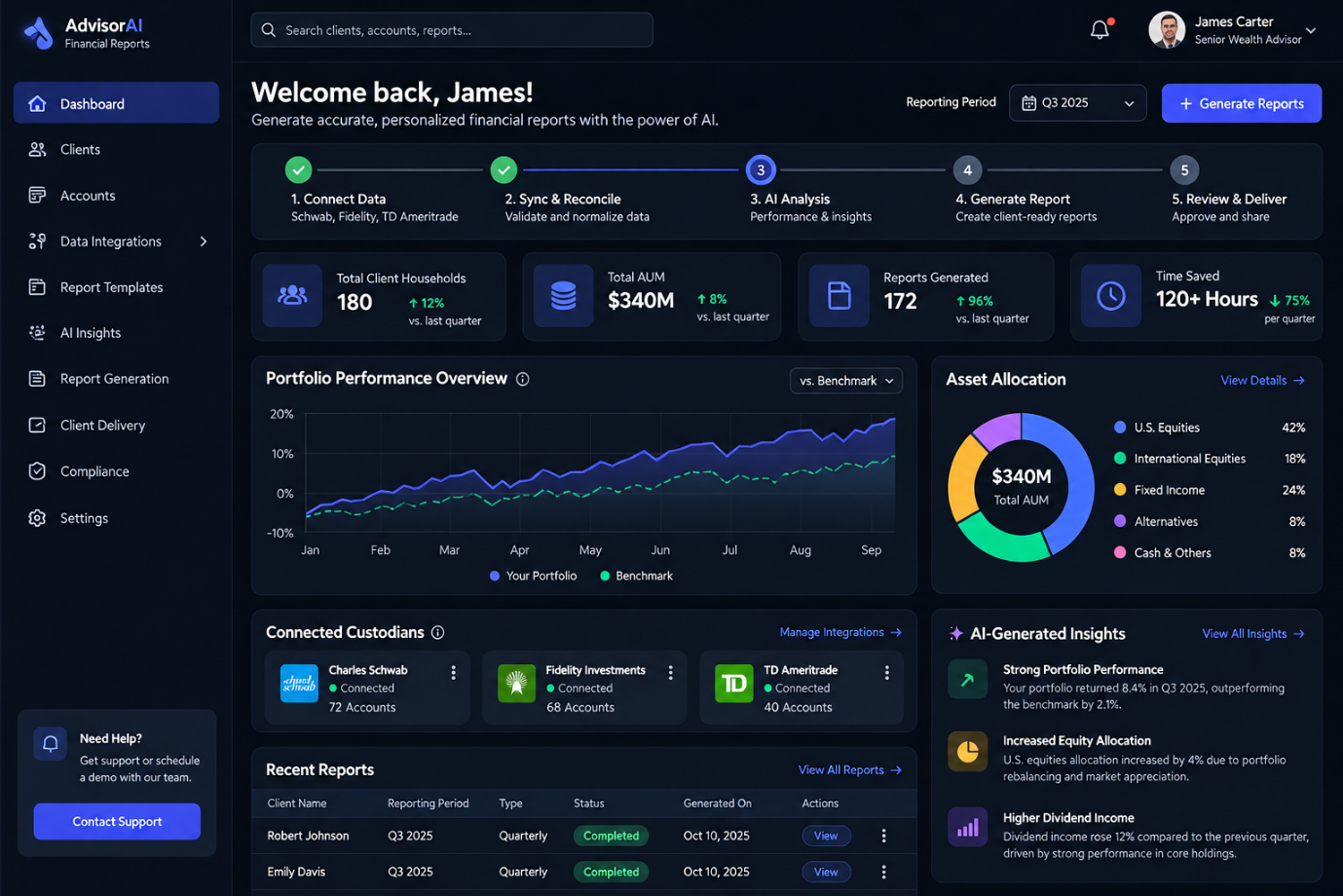
The platform collects portfolio holdings, transactions, account balances, cash flows, and investment information from supported custodians, portfolio management systems, and authorized financial data providers. For RIA firms using Schwab, Fidelity, or other custodians, integration methods depend on available APIs, authorized data feeds, and third-party aggregation services.
Financial data arrives in different formats and structures. The platform standardizes account identifiers, security information, transaction records, and valuation dates. Automated validation checks identify missing transactions, duplicate records, stale valuations, and discrepancies before the data moves into the reporting workflow.
A dedicated financial calculation engine calculates time-weighted returns, money-weighted returns where appropriate, asset allocation, benchmark comparisons, investment income, and other portfolio metrics. These calculations follow documented financial methodologies rather than relying on an AI model to perform financial arithmetic.
The AI engine uses validated portfolio metrics and approved contextual information to generate readable performance summaries. For example, it can draft explanations of allocation changes, portfolio income, and investment performance. Source grounding, validation rules, and advisor review help reduce unsupported statements and inaccurate interpretations.
The platform transforms verified financial information and approved commentary into customized PDF reports, interactive dashboards, or digital client summaries. Reports can include performance charts, portfolio allocation breakdowns, benchmark comparisons, household-level summaries, and personalized investment commentary.
Before distribution, reports pass through defined review and approval workflows. Advisors can edit AI-generated content, resolve exceptions, and approve final reports. The platform then delivers approved reports through authorized channels while maintaining version histories, access records, and audit trails.
Why are wealth management firms investing in AI financial report generator platform development when traditional reporting software already exists? The answer lies in increasing reporting complexity, growing client expectations, fragmented financial data, and the need to scale advisory operations without allowing manual processes to limit business growth.
For Registered Investment Adviser (RIA) firms, investment in AI-powered reporting is becoming a strategic technology decision rather than simply an IT upgrade.
RIA firms managing assets across Schwab, Fidelity, and other custodians must reconcile different data formats, account structures, transaction histories, and valuation records. As client households and custodial relationships expand, maintaining spreadsheet-based reporting workflows becomes increasingly difficult.
Developing an AI financial report generator platform allows firms to establish a unified reporting architecture that addresses these integration requirements from the beginning.
The industry is allocating more resources to AI adoption and implementation. According to Vista Equity Partners' State of Wealth Management AI Adoption report, published September 8, 2026, average AI-specific spending is projected to increase from 8% to 15% of technology budgets by the end of 2026, approximately doubling its share.
This trend signals that wealth management firms are increasingly evaluating AI as part of their technology investment strategies. For RIA founders, it creates a timely reason to assess whether reporting automation deserves a dedicated place in their technology roadmap.
Consider an RIA firm managing $340 million across 180 client households and spending three to four weeks assembling quarterly reports. Before hiring additional operations staff or accepting more clients, the founder needs to determine whether manual reporting is consuming capacity that could support business expansion.
Investing in an AI financial report generator platform can address this bottleneck by automating repetitive reporting stages and establishing workflows that can accommodate additional households.
Financial businesses increasingly need evidence that AI investments solve specific operational problems. The 2026 Global AI in Financial Services Report from the Cambridge Centre for Alternative Finance found that 81% of surveyed financial services firms were adopting AI at some level, while 55% of industry respondents reported difficulty measuring AI's value.
This makes reporting automation a useful candidate for a controlled investment because firms can measure reporting hours, correction rates, processing times, and cost per report.
Generic AI tools are not designed to independently manage custodian reconciliation, portfolio return methodologies, approval workflows, and financial audit trails. A purpose-built platform can connect these requirements within one governed system.
For wealth advisors, investing in AI financial report generator platform development is ultimately a decision about building scalable reporting infrastructure that addresses today's operational bottlenecks and supports future business growth.
An AI financial report generator platform is valuable for financial businesses that manage complex investment data, prepare recurring financial reports, or serve multiple clients with different reporting requirements. However, the ideal platform architecture depends on the organization's size, reporting volume, custodian integrations, compliance requirements, and level of customization.
For businesses considering AI financial report generator platform development, identifying the right deployment model is essential to controlling development costs and ensuring the platform addresses actual operational bottlenecks.
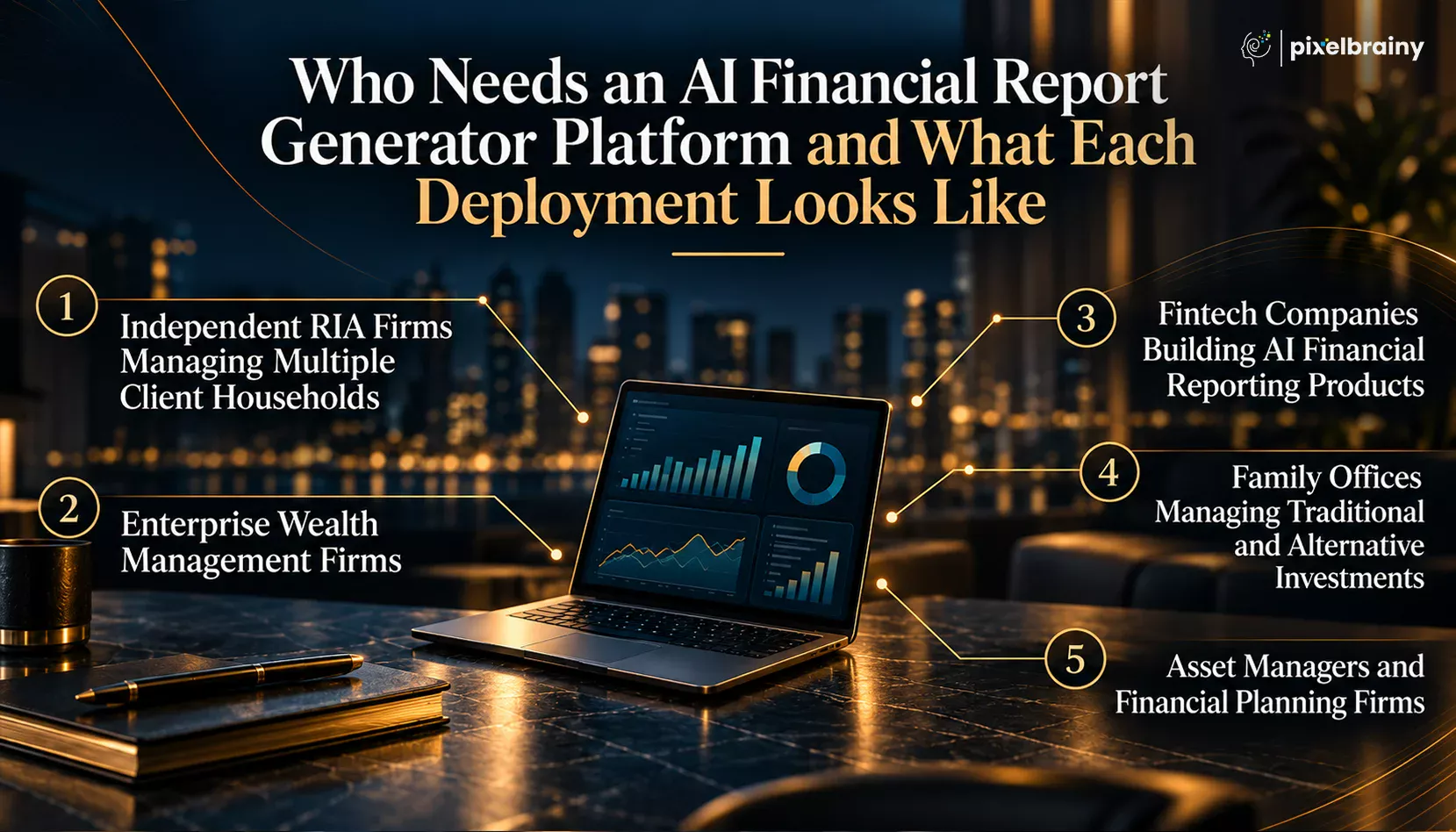
| Business type | Reporting requirements | Recommended deployment model |
| Independent RIA firms | Quarterly portfolio performance, household summaries, personalized client commentary | Cloud-based platform with multi-custodian integrations |
| Multi-advisor wealth management firms | Consolidated household reporting, standardized templates, advisor-specific permissions | Multi-tenant platform with role-based access control |
| Family offices | Consolidated wealth reporting, alternative investments, cash flows, private asset valuations | Configurable reporting platform with hybrid data integration |
| Broker-dealers and wealth management enterprises | High-volume reporting, supervisory approvals, extensive audit trails | Enterprise platform with centralized governance |
| Fintech companies | Automated financial reports embedded in digital financial products | API-first reporting platform |
| Asset managers and investment firms | Fund performance, holdings, benchmark comparisons, investor reports | Portfolio analytics and institutional reporting platform |
| Financial planning firms | Financial goal tracking, account summaries, cash flow, retirement scenarios | Financial planning platform with AI-assisted reporting |
Independent Registered Investment Adviser (RIA) firms are strong candidates for AI financial report generator platform development when quarterly reporting requires extensive manual data collection, spreadsheet consolidation, and client-specific report preparation.
Consider the specific business scenario of an RIA founder managing $340 million across 180 client households. The operations team spends three to four weeks preparing quarterly reports using information from Schwab, Fidelity, and TD Ameritrade.
For this firm, the primary requirement is not an extensive AI wealth management suite. It is a reporting platform that can:
Because TD Ameritrade's retail brokerage business has been integrated into Schwab, the implementation team must verify the current data access arrangements instead of assuming a separate legacy integration remains available.
Large wealth management organizations typically require more sophisticated architecture because reporting processes span multiple advisors, departments, business units, and client segments.
An enterprise AI financial reporting platform may include centralized reporting policies, granular access permissions, configurable approval hierarchies, CRM integration, automated exception management, and operational monitoring.
The architecture must also support high processing volumes, disaster recovery, detailed audit records, and consistent reporting standards across the organization.
Fintech startups can develop an AI financial report generator platform as a standalone SaaS product or as a reporting service embedded in an existing financial application.
Unlike an internal RIA platform, a commercial product must support multiple customer organizations with isolated data, configurable branding, subscription management, API access, usage tracking, and customer-specific security policies.
For fintech founders, the development priority is creating a reusable reporting engine that can accommodate different client requirements without building a separate application for every customer.
Family offices often consolidate public securities, real estate, private equity, private credit, and other investments into a single reporting experience.
Their reporting platforms must accommodate different valuation frequencies, capital calls, distributions, estimated valuations, and incomplete historical records.
AI can help explain these figures in accessible language, but the system must clearly distinguish verified market values from estimates and flag stale or incomplete data before reports are approved.
Asset managers need investor reporting, fund performance analysis, holdings summaries, and benchmark comparisons. Financial planning firms may prioritize goal progress, retirement projections, account summaries, and cash flow reporting.
These businesses can use AI-assisted reporting to generate structured narratives and client-specific summaries, provided the underlying financial calculations and assumptions remain traceable and verifiable.
For an RIA managing $340 million across 180 households, a cloud-based, multi-custodian AI financial report generator platform with automated reconciliation, portfolio performance calculations, AI-generated draft commentary, and advisor approval workflows is a practical starting point.
The development team should validate data access, reporting requirements, and potential time savings through a controlled pilot before expanding into advanced analytics or predictive features. This approach keeps the initial investment focused on solving the firm's most expensive operational bottleneck: quarterly client reporting.
What features should an AI financial report generator platform include to help wealth advisors automate reporting without compromising accuracy, data security, or advisor oversight? For firms managing multiple client households and custodial relationships, the priority should be building a reliable reporting foundation before introducing advanced AI capabilities.
The right features should streamline data collection, standardize portfolio information, calculate performance consistently, generate clear client-ready reports, and keep advisors in control of final approval.
The following core features provide the foundation for AI financial report generator platform development for RIAs, wealth management firms, and financial services businesses.
| Feature | Description |
| Multi-Custodian Data Integration | Connect the platform with supported custodians and portfolio data sources to collect account balances, transactions, holdings, and other reporting inputs. Reliable integrations reduce manual data collection and help advisors prepare consolidated reports across multiple client accounts. |
| Automated Data Normalization | Convert incoming financial data into a consistent format across custodians and source systems. Standardized fields for securities, transactions, account values, and dates help the platform process information consistently and reduce errors caused by incompatible data structures. |
| Data Reconciliation and Validation | Compare imported records against available source data to identify missing transactions, mismatched balances, duplicate entries, and incomplete holdings. Validation rules flag discrepancies for review before they affect portfolio calculations or appear in client-facing financial reports. |
| Client and Household Management | Organize client profiles, household relationships, linked accounts, investment objectives, and reporting preferences in one place. This feature helps advisors consolidate information across accounts and prepare household-level reports without manually assembling details from separate systems. |
| Portfolio Performance Calculation Engine | Calculate portfolio returns, account-level performance, and relevant benchmark comparisons using documented financial methodologies. The platform should apply consistent calculation rules, account for applicable cash flows, and preserve calculation details so advisors can verify reported results. |
| Historical Portfolio Data Management | Maintain historical balances, holdings, transactions, valuations, and previously generated reports. Access to historical data helps advisors compare reporting periods, explain portfolio changes, investigate discrepancies, and produce consistent quarterly or annual financial reporting. |
| AI-Powered Financial Commentary | Use AI to draft plain-language explanations of portfolio performance, allocation changes, and notable account movements based on validated financial data. Commentary should remain grounded in approved figures, clearly distinguish facts from interpretation, and allow advisor editing before publication. |
| Automated Report Template Builder | Provide configurable report templates for quarterly reviews, annual summaries, portfolio updates, and household reporting. Advisors should be able to select relevant sections, adjust branding, and standardize layouts without rebuilding each financial report manually. |
| Portfolio Visualization and Charts | Present performance trends, asset allocation, benchmark comparisons, and portfolio composition through clear charts and visual summaries. Well-designed visualizations help clients understand complex financial information while allowing advisors to communicate key portfolio changes more efficiently. |
| Personalized Client Reports | Tailor report content to each client's household structure, investment goals, portfolio holdings, and communication preferences. Personalized reporting helps advisors provide more relevant explanations while maintaining consistent reporting standards across the firm's wider client base. |
| Advisor Review and Approval Workflow | Route generated reports through a defined review process before they reach clients. Advisors should be able to inspect calculations, edit AI-generated commentary, flag discrepancies, approve final versions, and track reports awaiting action or correction. |
| Role-Based Access Control | Assign permissions according to each user's responsibilities, such as advisor, operations specialist, compliance reviewer, or administrator. Restricting access to appropriate client records and reporting functions helps protect confidential financial information and supports internal governance. |
| Secure Client Portal and Delivery | Give clients access to approved reports through a secure portal or another firm-approved delivery method. Access controls, secure authentication, and clear delivery status help wealth management firms distribute financial reports while protecting sensitive portfolio information. |
| Audit Trail and Report Versioning | Record important actions such as data imports, report generation, edits, approvals, and final delivery. Version history allows authorized staff to identify changes, investigate reporting issues, and demonstrate how a report progressed from source data to client delivery. |
| Reporting Operations Dashboard | Provide a central view of reporting progress, failed data imports, reconciliation exceptions, pending approvals, and completed reports. This dashboard helps operations teams prioritize unresolved issues and monitor quarterly reporting workloads across advisors, households, and custodians. |
For an RIA managing multiple custodial relationships, these core features create a dependable foundation for automating quarterly financial reporting while keeping calculations transparent and advisor approval in place.
Building the right AI financial report generator platform starts with reliable data integration, validated portfolio calculations, and secure, personalized reporting that helps wealth advisors spend less time assembling reports and more time serving clients.
Once the core reporting workflow is in place, advanced capabilities can help an AI financial report generator platform move beyond routine report creation toward proactive portfolio intelligence, deeper analysis, and more personalized advisor support. These features are especially valuable for wealth management firms that want to identify portfolio risks earlier, answer complex client questions faster, and make reporting more actionable.
For example, an RIA firm may ask: “How can we extend our AI financial reporting platform to forecast portfolio risks, explain performance drivers, and alert advisors to important client portfolio changes before the next quarterly review?” Advanced features can help address this need by combining portfolio data, predictive analytics, and contextual AI while keeping investment decisions and report approvals under advisor control.
| Advanced Feature | Description |
| Predictive Portfolio Analytics | Apply statistical models and machine learning to historical portfolio data, market indicators, and relevant risk factors to estimate potential performance patterns. These forecasts can help advisors explore possible outcomes, understand uncertainty, and prepare more informed client discussions without treating predictions as guaranteed results. |
| AI-Powered Scenario Analysis | Allow advisors to model hypothetical market events, such as interest rate changes, equity market declines, or currency fluctuations, and assess their potential impact on portfolio allocations and exposures. Results can support client conversations about risk tolerance and portfolio resilience. |
| Intelligent Risk Detection and Alerts | Monitor portfolios for configurable thresholds involving concentration, allocation drift, unusual valuation changes, or other risk indicators. When a condition is detected, the platform can notify the appropriate advisor and provide supporting context for review before any action is considered. |
| Performance Attribution Insights | Break down portfolio returns by asset class, security, sector, benchmark, or other supported dimensions to help explain what contributed to performance. AI can turn these analytical results into readable summaries, helping advisors communicate the drivers of gains and losses more clearly. |
| Natural Language Portfolio Querying | Enable advisors to ask questions in everyday language, such as which holdings contributed most to a portfolio's decline or how an account's allocation changed over a reporting period. Responses should use authorized, verified data and identify the underlying figures or sources. |
| AI-Assisted Compliance Monitoring | Analyze report content and configured compliance rules to flag potentially inconsistent disclosures, unsupported statements, missing sections, or language requiring further review. This feature can help prioritize compliance checks, but it should support rather than replace qualified compliance professionals and formal review procedures. |
| Intelligent Document Extraction | Use document AI and optical character recognition to extract relevant information from supported statements, investment documents, PDFs, and spreadsheets. Extracted data can be mapped to platform fields and checked for completeness, reducing manual entry when reliable structured feeds are unavailable. |
| Personalized AI Report Narratives | Generate commentary that adapts to a client's portfolio, investment objectives, preferred level of detail, and financial knowledge. The platform can offer different explanations of the same validated results while applying approved language, disclosure rules, and advisor review before client delivery. |
| AI Knowledge Assistant for Advisors | Provide a secure conversational assistant that searches approved internal resources, reporting definitions, portfolio information, and firm procedures. Advisors can use it to locate relevant information faster, with access permissions, source references, and clear boundaries around what the assistant can answer. |
| Automated Reporting Workflow Orchestration | Coordinate connected tasks such as detecting newly available data, initiating analysis, preparing draft reports, routing exceptions, and notifying reviewers. Configurable workflows can reduce repetitive coordination and help teams manage large reporting cycles, with safeguards for failed tasks and required human approvals. |
While these advanced capabilities can expand the platform's analytical capabilities, implementing them requires a reliable technical foundation. The next step is understanding how to develop the platform, from defining business requirements to deployment and ongoing optimization.
Developing an AI financial report generator platform requires more than connecting an AI model to portfolio data. It involves defining reporting requirements, integrating financial systems, validating calculations, designing advisor workflows, and implementing appropriate regulatory controls.
A structured development process helps wealth management firms control costs, reduce technical risks, and build software that can scale with their reporting needs.
For example, a global wealth management firm operating across the US, UK, and Singapore may ask: How can we build an AI financial report generator platform that uses the same underlying portfolio data to produce jurisdiction-specific reports with the correct financial terminology, disclosures, and compliance checks?
The answer lies in building a shared data foundation while adapting reporting rules, templates, and approval workflows to each market.
The following eight steps explain how to develop AI financial report generator software from idea to launch.
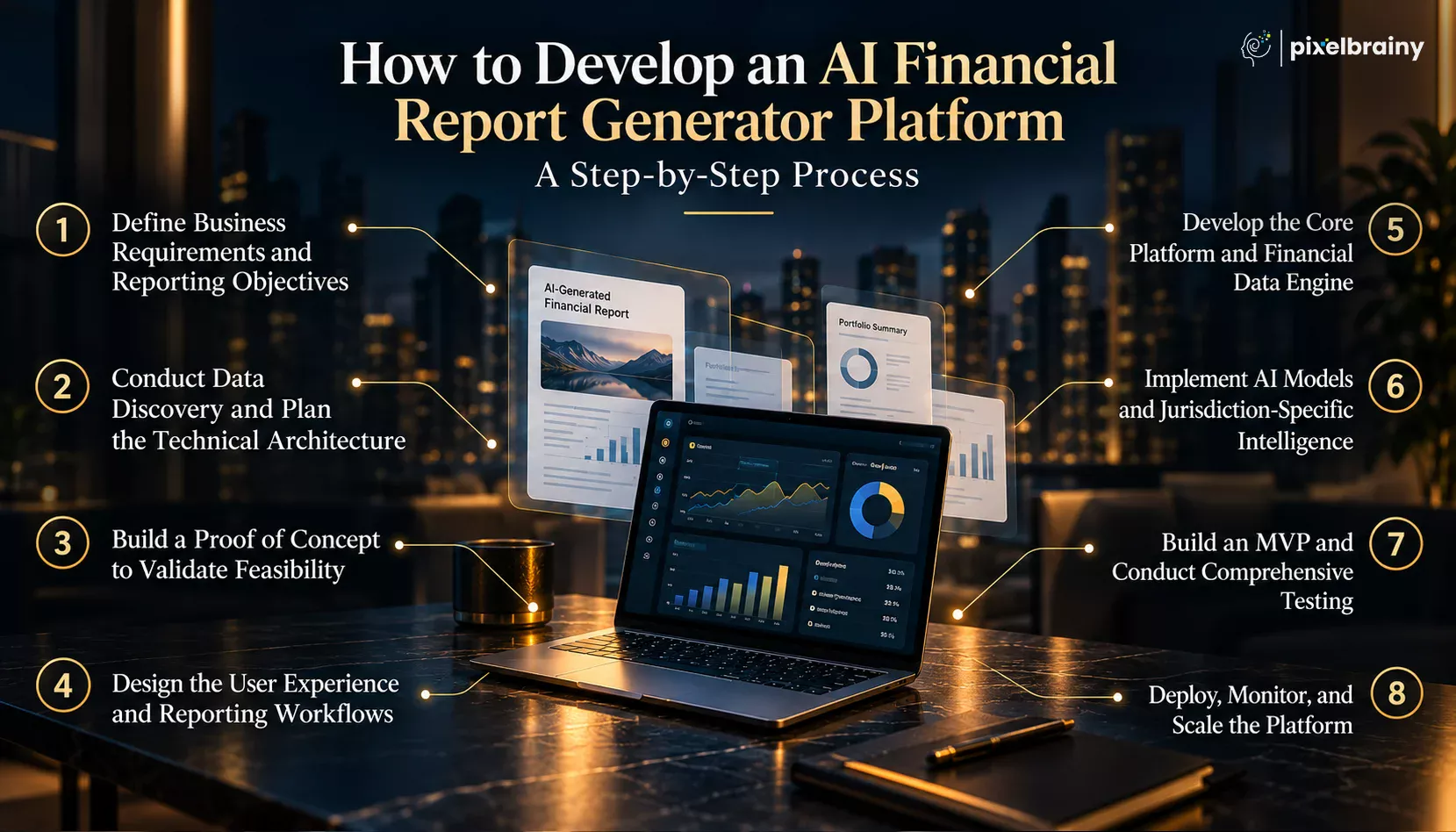
Start by identifying the reporting problems the platform must solve, the users it will serve, and the outcomes the business expects.
Document reporting frequency, supported account types, data sources, client segments, report formats, and existing manual processes.
For a global advisory firm, map differences between US, UK, and Singapore reporting requirements, including disclosures, terminology, and approval responsibilities.
Establish measurable success criteria, such as reducing report preparation time, minimizing reconciliation exceptions, and improving on-time delivery.
An AI consultation can help assess technical feasibility, data readiness, regulatory complexity, and the most valuable use cases before major development spending begins.
Also Read: Top 10 AI Consulting Companies in USA
Identify where portfolio information originates and how it will flow through the platform. Sources may include custodians, portfolio management systems, CRM platforms, market data providers, and document repositories.
Define integration methods, data formats, refresh schedules, authentication requirements, and exception-handling processes for each source.
Next, design an architecture that separates data ingestion, normalization, financial calculations, AI services, report generation, and client delivery.
For multi-jurisdiction operations, maintain a shared portfolio data foundation while applying configurable reporting rules for each market. This helps avoid maintaining entirely separate systems for every region.
Before developing the complete platform, create a limited proof of concept that tests the highest-risk assumptions.
A PoC development engagement could focus on importing sample custodial data, reconciling balances, calculating selected performance metrics, and generating draft reports with AI-assisted commentary.
For a global firm, test representative reporting scenarios from each target jurisdiction.
Compare calculated results with trusted existing reports and have subject matter experts review the generated narratives.
The goal is to establish technical feasibility, identify data limitations, and estimate integration complexity before committing to a larger development budget.
Design interfaces around the daily responsibilities of advisors, reporting specialists, compliance reviewers, and administrators.
Map how users select clients, inspect portfolio data, configure reports, resolve exceptions, review AI-generated commentary, and approve final documents.
A UI/UX design company can help create intuitive dashboards, report previews, validation messages, and approval flows that reduce unnecessary navigation.
Include accessibility, responsive layouts, and clear indicators for incomplete data, calculation errors, and pending reviews.
For multi-market operations, display the applicable jurisdiction, report template, language, and disclosure configuration so users can identify the correct reporting setup.
Also Read: Top 10+ UI/UX Design Companies in USA
Build the essential software components, including custodian connectors, client and household management, data normalization, reconciliation, historical data storage, portfolio calculations, and report templates.
Keep financial calculation logic separate from generative AI. This makes reported figures easier to verify, reproduce, and audit.
Add validation rules for missing transactions, duplicate records, unexpected balances, and incomplete valuations.
This stage is central to AI financial report generator software development because errors in source data or performance calculations can undermine every report produced.
When evaluating top AI financial software development companies, assess their experience with financial integrations, sensitive data, and auditable calculation pipelines rather than AI prototypes alone.
Integrate AI capabilities after the data and calculation foundations are dependable.
AI integration can support financial commentary, document extraction, report summarization, natural language queries, and explanations of portfolio changes.
Depending on the use case, AI model development may involve configuring existing foundation models, retrieval-based systems, classification models, or specialized document-processing models.
For global reporting, maintain version-controlled rules and approved terminology for each jurisdiction.
The platform should distinguish verified portfolio facts from AI-generated interpretation, apply relevant disclosures, and flag uncertain outputs. AI should not independently determine legal compliance or invent explanations unsupported by source data.
Also Read: Top 10+ AI Integration Companies in USA
Create an MVP development release containing the features needed to complete one reliable reporting workflow, from data import to advisor-approved report delivery.
Start with a manageable scope, such as selected clients, a limited number of custodians, and a defined set of report types.
Test calculations against known results, integration failures, access permissions, report consistency, AI output quality, and audit records.
For international deployment, validate jurisdiction-specific templates, disclosures, date and currency formats, and terminology with qualified compliance specialists.
Businesses can hire AI developers and financial software specialists to expand implementation capacity, while keeping testing ownership and acceptance criteria clearly defined.
Also Read: Top 10 AI MVP Development Companies in USA
Launch the platform in controlled stages, beginning with a pilot group before extending access across teams or jurisdictions.
Train advisors and operations staff, document reporting procedures, and establish clear processes for correcting data issues or escalating questionable AI output.
Monitor system availability, report generation times, integration failures, reconciliation exceptions, review bottlenecks, and user adoption.
When evaluating top AI product development companies or AI development companies for ongoing support, assess their ability to maintain integrations, manage model changes, protect financial data, and respond to evolving regulatory requirements.
Scale only after the initial reporting workflow performs reliably and meets its acceptance criteria.
Following these eight steps helps wealth management firms develop an AI financial report generator platform with reliable data, controlled AI capabilities, jurisdiction-specific reporting, and scalable operations from idea to launch.
The cost to develop an AI financial report generator platform typically ranges from $50,000 to $350,000+, depending on platform complexity, custodian integrations, AI capabilities, security requirements, and regulatory workflows. A basic platform with limited integrations and standardized reporting costs significantly less than an enterprise solution supporting multiple custodians, thousands of client accounts, advanced AI analysis, and multi-jurisdiction reporting.
The development budget of an AI financial report generator platform should account for more than the initial software build. Data integration, financial calculation accuracy, AI model configuration, compliance controls, testing, deployment, and ongoing maintenance can all affect the total investment.
For businesses evaluating the cost estimation of AI financial report generator platform development, the key is to compare what each proposal actually delivers rather than focusing only on the quoted price.
Consider this real-world query: “I am comparing three development proposals for an AI financial report generator platform for our wealth management firm, and the quotes range from $120,000 to $250,000 for similar stated core features. What legitimately drives this price variation, and what should I ask vendors about custodian integrations, AI narrative quality, SEC compliance architecture, and performance calculation accuracy?”
This is an important distinction: two vendors may list the same features while proposing very different levels of engineering depth, data reliability, AI functionality, and financial controls.
The following estimates provide an initial budgeting framework for AI financial report generator platform development. They are indicative planning ranges, not fixed vendor quotations
| Platform Type | Estimated Development Cost | Typical Scope |
| Basic AI Financial Report Generator Platform | $50,000 to $100,000 | Core reporting workflows, limited custodian or data-source integrations, standard report templates, basic AI-generated commentary, essential user roles, and foundational security controls. |
| Advanced AI Financial Report Generator Platform | $100,000 to $200,000 | Multiple integrations, automated data normalization and reconciliation, portfolio performance reporting, more configurable AI narratives, advisor approval workflows, reporting dashboards, audit trails, and stronger security controls. |
| Enterprise AI Financial Report Generator Platform | $200,000 to $350,000+ | Complex multi-custodian architecture, large-scale account processing, advanced AI capabilities, granular permissions, comprehensive auditability, jurisdiction-specific reporting workflows, enterprise integrations, and extensive testing and deployment support. |
Actual costs depend on the scope and quality of implementation. An enterprise platform requiring several custom custodial connections and jurisdiction-specific compliance workflows may exceed $350,000.
The following estimates show how individual workstreams can contribute to the development budget. These are approximate allocations for planning, not mandatory add-on charges. Some activities overlap, and their costs should not simply be added together without defining the project scope.
| Cost Factor | Estimated Cost | What Drives the Cost |
| Business Analysis and Technical Architecture | $3,000 to $12,000 | Requirements discovery, reporting workflow mapping, system architecture, data-source assessment, integration planning, and technical feasibility analysis. |
| UI/UX Design and Dashboard Development | $5,000 to $18,000 | Advisor dashboards, household views, report previews, administrative screens, responsive interfaces, and user approval workflows. |
| Custodian and Financial Data Integration | $10,000 to $50,000+ | Number of integrations, API availability, authentication requirements, data formats, historical data access, rate limits, reconciliation needs, and vendor-specific implementation constraints. |
| Data Normalization and Reconciliation | $5,000 to $25,000 | Standardizing records across sources, detecting duplicate transactions, matching holdings, resolving discrepancies, and handling missing or inconsistent data. |
| Portfolio Performance Calculation Engine | $8,000 to $30,000 | Supported return methodologies, cash-flow treatment, benchmark comparisons, historical valuations, calculation validation, and reproducibility requirements. |
| AI Commentary and Model Integration | $8,000 to $35,000 | Model selection, prompt and workflow design, grounding commentary in validated data, output evaluation, model safeguards, and usage-cost optimization. |
| Report Templates and Document Generation | $5,000 to $20,000 | Configurable report layouts, branded PDFs, charts, personalized content, multiple reporting periods, and jurisdiction-specific formatting. |
| Security and Compliance Engineering | $8,000 to $30,000+ | Access controls, encryption, audit trails, retention policies, secure delivery, compliance-oriented workflows, and requirements arising from applicable regulations. |
| Testing and Quality Assurance | $5,000 to $20,000 | Financial calculation tests, integration testing, AI output evaluation, security testing, regression testing, and verification across different client and portfolio scenarios. |
| Cloud Infrastructure and Deployment Setup | $3,000 to $15,000 | Environment configuration, deployment pipelines, monitoring, backups, access management, scalability planning, and production readiness. |
The initial development quote does not necessarily represent the full cost of ownership.
| Ongoing Expense | Indicative Cost |
| Cloud hosting and infrastructure | $300 to $3,000+ per month |
| AI model and API usage | $200 to $5,000+ per month |
| Maintenance and technical support | $1,000 to $6,000+ per month |
| Third-party data feeds and vendor licenses | Varies by provider and contract |
| Independent security or compliance assessments | Depends on scope and assessment requirements |
These are illustrative planning ranges, not market-wide price guarantees. Actual expenses depend on reporting volume, model usage, service levels, provider contracts, and security requirements. Confirm which recurring expenses are included in each vendor's proposal.
Ultimately, the right AI financial report generator platform development investment is the one that delivers verifiable calculation accuracy, dependable custodian integrations, grounded AI commentary, and appropriate security controls within a clearly defined budget.

The technology stack for an AI financial reporting platform determines how efficiently it processes portfolio data, integrates with custodians, generates financial narratives, and delivers accurate reports. A well-designed stack combines secure data management, reliable financial calculations, AI capabilities, and scalable cloud infrastructure.
For businesses planning AI financial reporting platform development, the right technologies should support current reporting requirements while allowing future expansion into predictive analytics, automated compliance checks, and multi-jurisdiction reporting.
Consider this real-world query: “Which tools and technologies should a wealth management firm use to build an AI financial reporting platform that integrates multiple custodians, generates accurate AI-powered portfolio commentary, protects sensitive client data, and supports different regulatory reporting requirements?”
The answer depends on the firm's existing systems, data volumes, security requirements, and AI use cases. A typical architecture uses a modern web frontend, API-based backend services, a structured financial database, AI model services, financial data connectors, and secure cloud infrastructure. These technologies should work together as a cohesive platform rather than a collection of disconnected tools.
| Technology Layer | Recommended Tools and Technologies | Purpose in the Platform |
| Frontend Development | React.js, Next.js, TypeScript | Build responsive advisor dashboards, client portals, report previews, administrative panels, and interactive portfolio reporting interfaces. |
| UI Components and Design | Material UI, Tailwind CSS | Create consistent interface components, accessible forms, dashboard layouts, reporting workflows, and reusable design elements. |
| Backend Development | Python, FastAPI, Django | Develop business logic, financial reporting APIs, custodian integrations, AI services, authentication workflows, and report-generation processes. |
| Financial Data Processing | Pandas, NumPy | Clean, transform, validate, and analyze structured financial datasets, including holdings, transactions, account balances, and historical portfolio records. |
| Financial Calculation Engine | Python-based calculation modules, NumPy, pandas | Implement and validate portfolio performance calculations, cash-flow handling, benchmark comparisons, and financial data transformations. Calculation methodologies should be explicitly defined and independently tested. |
| Relational Database | PostgreSQL, Microsoft SQL Server | Store structured client profiles, account information, transactions, reporting configurations, permissions, and other records that require consistency and traceability. |
| Document and Object Storage | Amazon S3, Azure Blob Storage, Google Cloud Storage | Store generated reports, source documents, historical statements, and approved reporting artifacts with appropriate access controls and retention policies. |
| AI and Language Models | OpenAI API, Hugging Face Transformers, PyTorch | Generate financial commentary, summarize validated portfolio information, extract document data, and support natural language queries. Model selection depends on data privacy, accuracy, latency, and cost requirements. |
| Retrieval and Knowledge Search | PostgreSQL with pgvector, managed vector databases | Retrieve relevant approved documents, reporting definitions, and internal guidance to support grounded AI responses. Retrieval should respect user permissions and provide traceable sources. |
| Custodian and Financial Data Integration | REST APIs, OAuth 2.0, secure file transfer, provider-specific SDKs | Connect supported custodians and financial systems, retrieve account data, manage authentication, and handle data synchronization. Available integration methods depend on each provider's access arrangements. |
| Background Processing and Workflow Automation | Celery, Redis, Apache Airflow | Schedule report generation, coordinate data imports, process large reporting batches, retry failed tasks, and manage recurring reporting workflows. |
| Data Visualization | Recharts, Plotly.js, D3.js | Present portfolio performance, asset allocation, benchmark comparisons, historical trends, and other financial insights through interactive charts and visual summaries. |
| Cloud Infrastructure | AWS, Microsoft Azure, Google Cloud Platform | Host platform services, manage storage and compute resources, support scaling, and configure backup, availability, and monitoring capabilities. |
| Authentication and Access Management | OAuth 2.0, OpenID Connect, cloud identity services | Secure user authentication, enable role-based access, and restrict access to client records and reporting functions according to assigned permissions. |
| Security and Encryption | TLS, cloud key management services, secrets management tools | Protect data in transit and at rest, manage credentials, control access to sensitive resources, and reduce exposure of confidential financial information. |
| DevOps and Deployment | Docker, Kubernetes, Terraform, GitHub Actions | Standardize deployment environments, automate testing and releases, manage infrastructure configurations, and support repeatable deployment across development, testing, and production. |
| Monitoring and Logging | OpenTelemetry, cloud monitoring services, centralized logging tools | Track system performance, integration failures, report-generation errors, AI service usage, and security events to support troubleshooting and operational oversight. |
| Testing and Quality Assurance | Pytest, Playwright, API testing tools | Validate financial calculations, integration reliability, report output, user workflows, access controls, and application behavior before and after deployment. |
The most effective technology stack combines dependable financial data processing, secure integrations, tested calculation logic, and carefully governed AI to deliver accurate, scalable financial reporting.
Should your business invest in custom AI financial report generator platform development or buy an existing financial reporting solution? The decision depends on your reporting complexity, custodian integration requirements, budget, compliance obligations, and long-term technology goals.
Custom development offers greater control over reporting workflows, AI capabilities, and system architecture. Buying an existing platform can reduce initial development effort and accelerate implementation. A hybrid approach combines established software with custom integrations and specialized reporting features.
Below are the key differences, business scenarios, and cost considerations to help you decide whether to build or buy an AI financial report generator platform.
| Comparison Factor | Custom AI Platform Development | Buying an Existing Platform |
| Initial Cost | Higher upfront investment based on complexity and integrations. | Typically lower initial cost through subscriptions or licensing. |
| Time to Market | Requires planning, development, integration, and testing. | Usually faster when existing features meet requirements. |
| Customization | Tailored reporting workflows, calculations, dashboards, and AI capabilities. | Customization depends on vendor configuration options. |
| Custodian Integration | Integrations can be designed for specific custodians and internal systems. | Depends on supported custodians and available connectors. |
| AI Capabilities | AI workflows can be tailored to specific reporting needs. | AI functionality depends on the vendor's existing product. |
| Data Control | Greater architectural control, with responsibility for implementing safeguards. | Data handling depends on vendor policies and contractual terms. |
| Compliance | Controls can be designed around applicable regulatory requirements. | Existing controls must be verified against the firm's obligations. |
| Maintenance | The business must budget for ongoing technical support and updates. | The vendor typically maintains the core product. |
| Scalability | Architecture can support planned growth and specialized workflows. | Depends on product capabilities, service tiers, and vendor infrastructure. |
| Long-Term Flexibility | Greater control over the product roadmap. | Feature development depends partly on the vendor's roadmap. |
Custom AI financial report generator platform development is suitable when existing products cannot meet important business requirements.
Consider building when your firm needs:
However, custom development requires ongoing investment in maintenance, testing, security, and AI evaluation. Include these expenses when calculating the total cost of ownership.
Buying may be more practical when your reporting requirements are relatively standard and an established solution already supports your workflows.
Consider purchasing when:
Before signing a contract, verify integration depth, financial calculation methodologies, AI output quality, security controls, data export options, and recurring fees. A product demonstration alone cannot establish whether the platform will work reliably with your actual portfolio data.
A hybrid model combines an existing financial reporting platform with targeted custom development.
For example, a wealth management firm could purchase an established reporting solution, use an existing AI model, and develop custom services for specialized custodian integrations or personalized financial commentary.
This approach can reduce development effort while preserving flexibility where standard features fall short. However, the firm should assess integration limitations, vendor dependency, and the ongoing costs of maintaining custom components.
| Approach | Indicative Cost | Best Suited For |
| Buy an Existing Platform | Subscription and implementation fees vary by vendor. | Firms with standard reporting requirements and supported integrations. |
| Hybrid Development | Approximately $30,000 to $150,000+ in initial customization and integration work. | Firms that need existing software with selected custom capabilities. |
| Custom Platform Development | Approximately $50,000 to $350,000+ for initial development. | Firms requiring specialized reporting workflows, integrations, and AI functionality. |
These are broad planning estimates, not fixed market prices. Actual costs depend on platform scope, licensing, integration complexity, security requirements, and ongoing maintenance. A custom platform may also incur substantial recurring operating costs after launch.
The right approach balances the cost to develop an AI financial report generator platform against implementation speed, reporting accuracy, integration flexibility, and the level of control your business needs.
What are the biggest challenges in developing an AI financial report generator platform that produces accurate portfolio reports, integrates multiple custodians, generates trustworthy AI commentary, and meets regulatory and data security requirements?
This is a critical question for wealth management firms investing in AI financial reporting software. Although AI can automate report generation and reduce manual workloads, development teams must address financial data inconsistencies, calculation accuracy, AI-generated errors, regulatory complexity, and sensitive client information.
Understanding these challenges early helps businesses reduce development risks, control costs, and build a platform that advisors can trust. Here are the six major challenges in AI financial report generator platform development and how to resolve them.
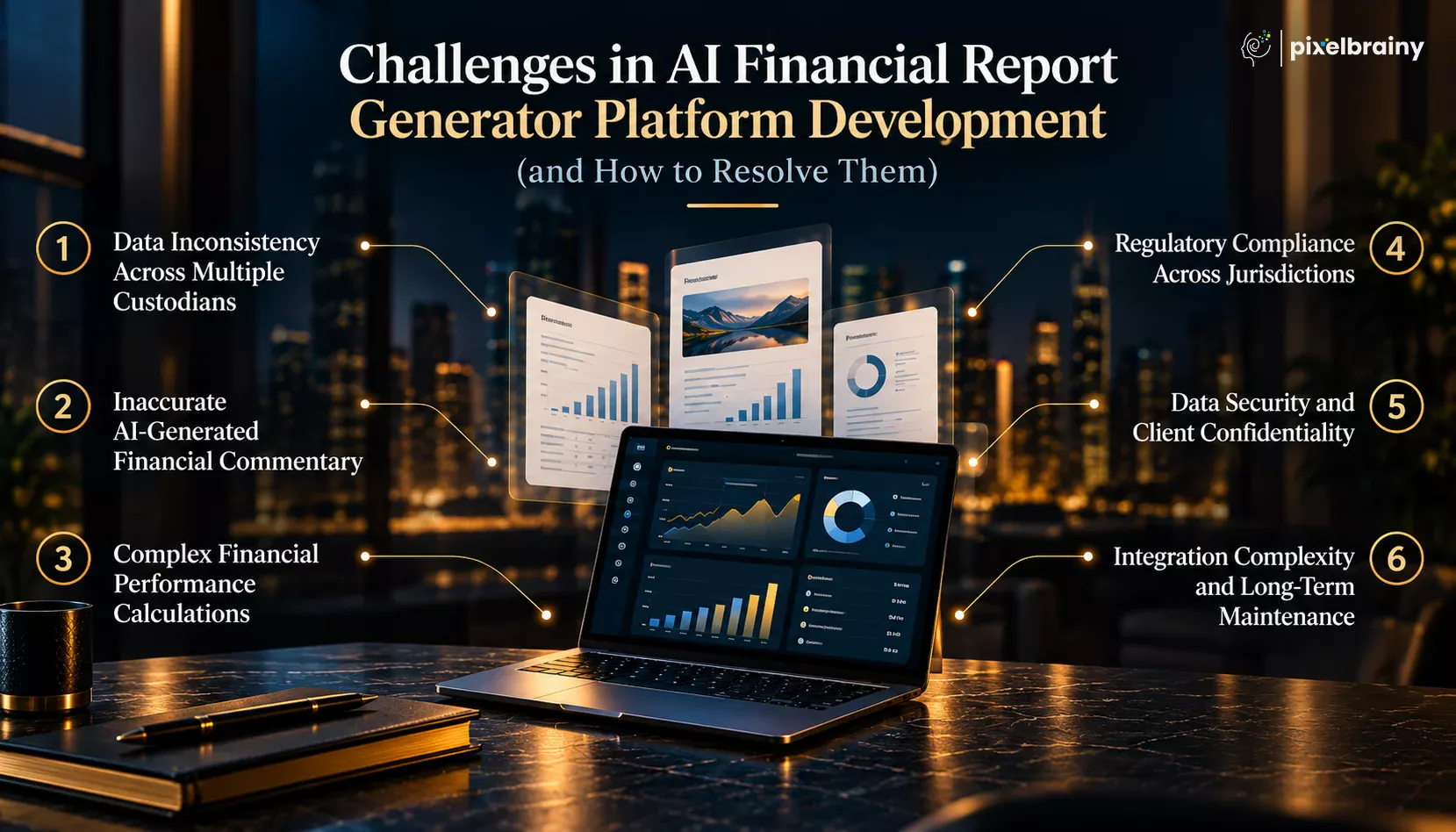
Financial data from different custodians may use inconsistent formats, transaction codes, security identifiers, valuation dates, and account structures. These differences can create discrepancies in consolidated portfolio reports.
How to resolve it: Build a standardized data normalization layer, implement automated reconciliation rules, and flag missing or inconsistent records before calculations begin. Maintain source-level traceability so advisors can investigate discrepancies and verify reported figures.
Generative AI may produce misleading explanations, misinterpret portfolio movements, or include statements unsupported by the underlying financial data. This can undermine client trust and create additional review work.
How to resolve it: Ground AI-generated narratives in validated portfolio calculations and approved source data. Use structured prompts, output validation, factual consistency checks, and advisor approval workflows. Clearly distinguish calculated facts from AI-generated interpretations, and prevent unsupported claims from reaching clients.
Portfolio performance reporting requires consistent calculation methodologies, appropriate cash-flow treatment, reliable historical valuations, and accurate benchmark comparisons. Errors in these areas can affect every report generated by the platform.
How to resolve it: Keep deterministic financial calculation engines separate from generative AI. Define supported methodologies, test calculations against independently verified reference results, and maintain reproducible calculation records. Flag incomplete data and unresolved discrepancies instead of silently producing potentially misleading figures.
Financial reporting requirements, disclosure obligations, terminology, recordkeeping expectations, and data protection rules can differ across jurisdictions. A platform serving international clients must accommodate these differences without compromising consistency.
How to resolve it: Implement configurable jurisdiction-specific templates, disclosure rules, access controls, and approval workflows. Maintain version-controlled reporting configurations and involve qualified compliance professionals in validation. For US advisory firms, assess applicable SEC requirements rather than assuming that a software feature alone guarantees compliance.
An AI financial report generator may process sensitive client information, account balances, investment holdings, and personal financial documents. Weak access controls or inappropriate data handling can expose confidential information.
How to resolve it: Apply encryption in transit and at rest, role-based access controls, secure authentication, secrets management, audit logging, and appropriate data retention policies. Review AI provider data-handling terms, restrict access to authorized client information, and conduct security testing before production deployment.
Custodian APIs, financial data feeds, authentication requirements, and third-party services can change over time. Failed integrations or delayed data updates may interrupt reporting cycles and increase operational costs.
How to resolve it: Use modular integration services, automated monitoring, retry mechanisms, data freshness checks, and clear exception-handling workflows. Establish integration ownership, maintenance agreements, and regression testing procedures. Validate current access methods for every custodian instead of assuming legacy integrations remain available.
Addressing these six challenges early helps businesses develop an AI financial report generator platform that delivers accurate reporting, dependable AI insights, stronger data protection, and sustainable long-term operations.

Businesses investing in AI-powered financial reporting need a development partner that understands financial workflows, data integration, AI capabilities, and secure software engineering. The right partner helps turn complex reporting processes into a reliable platform that supports advisors, improves operational efficiency, and delivers clearer financial insights.
PixelBrainy as a leading AI financial software development company can be positioned around AI product engineering, software integration, and tailored digital solutions. For wealth management firms, the development approach should begin with business requirements, existing financial systems, reporting workflows, and the controls needed to handle sensitive client information.
A common question from wealth management businesses is: How can we develop an AI financial report generator platform that consolidates multi-custodian data, generates accurate portfolio reports, produces contextual AI commentary, and supports secure advisor approval workflows?
PixelBrainy can help businesses define the technical roadmap and scope the capabilities required to address these reporting challenges.
PixelBrainy's AI financial report generator platform development services can be scoped around requirements discovery, technical architecture, user interface design, backend engineering, AI integration, testing, and deployment.
This approach helps align the software with reporting requirements, existing systems, user roles, and long-term business objectives.
Financial reporting requires more than generating fluent text. AI-generated commentary must be based on verified portfolio information, while financial calculations should remain traceable and independently testable.
A well-designed solution can incorporate automated data processing, portfolio summaries, document extraction, and AI-assisted commentary with advisor review before client delivery.
Whether a business wants to build AI financial report generator platform functionality for an internal advisory team or a larger wealth management operation, the architecture must support reliable integrations, access controls, and reporting workflows.
PixelBrainy can help scope a solution around these requirements, with implementation details determined by the project's technical and regulatory needs.
A portfolio-related software project can demonstrate relevant engineering capabilities without disclosing a client's identity. The following project profile should be used only after PixelBrainy verifies that the work was completed and confirms which details can be shared publicly.
Project overview: A confidential client needed a centralized way to manage portfolio information and simplify financial reporting workflows.
Solution scope:
Business relevance: Experience with portfolio data management, reporting workflows, and financial software can inform the architecture and implementation of an AI-enabled reporting solution. Specific project outcomes, AI functionality, custodian integrations, and advisor time savings should be stated only when supported by verified project records.
Whether you want to develop AI financial report generator platform capabilities from scratch or to create AI financial report generator platform functionality around your existing financial systems, PixelBrainy can help define the scope, technical requirements, and implementation roadmap.
The objective is to deliver a financial report generator platform integrating AI where reliable calculations, contextual commentary, secure data handling, and advisor oversight work together.
Let's Discuss Your Project
Connect with PixelBrainy to discuss your financial reporting requirements and explore a tailored development roadmap for your business.
The future of wealth management reporting lies in making financial information faster to access, easier to understand, and more valuable for client decision-making. An AI financial report generator platform helps firms move beyond manual report preparation by connecting portfolio data, automating calculations, and generating personalized financial insights within a structured reporting workflow.
However, the real value comes from building a platform that advisors can trust. Accurate financial calculations, reliable custodian integrations, secure data management, and human oversight must remain at the heart of every implementation.
For wealth management firms, understanding the cost to develop an AI financial report generator platform, defining the right features, and following a practical development strategy are essential steps toward long-term success. Whether you need a custom-built solution or AI capabilities integrated into existing financial software, the right technology partner can help turn your reporting challenges into a scalable business solution.
Ready to turn your financial reporting vision into reality? Book an appointment with PixelBrainy to discuss your project requirements and development roadmap.
AI financial report generator platform development typically takes 3 to 9 months, depending on platform complexity, custodian integrations, AI functionality, and security requirements. A basic solution may launch sooner, while enterprise platforms supporting multiple jurisdictions and complex reporting workflows require additional development and testing.
Businesses can integrate AI financial reporting software with portfolio management systems, CRMs, custodians, and financial data providers through supported APIs, secure data feeds, or file transfers. Integration feasibility depends on data availability, provider permissions, system compatibility, and the quality of existing financial records.
An AI financial report generator platform can reduce inaccurate outputs by grounding AI-generated commentary in verified portfolio data, validated calculations, and approved financial information. Source traceability, output validation, predefined prompts, and advisor approval workflows help identify unsupported statements before reports reach clients.
AI financial report generator software should include encryption, role-based access control, secure authentication, audit logging, data retention policies, and secure report delivery. Businesses should also evaluate AI providers' data-handling practices and implement safeguards to protect confidential client and portfolio information.
Yes. Custom AI financial report generator platform development can support multiple currencies, regional date formats, jurisdiction-specific report templates, and configurable disclosure requirements. The platform should maintain consistent underlying portfolio data while applying validated reporting rules for each market, with qualified compliance professionals reviewing jurisdiction-specific requirements.
The ROI of AI financial report generator platform development depends on reporting volume, existing administrative costs, integration expenses, and platform adoption. Potential benefits include reduced manual report preparation, faster reporting cycles, and improved advisor productivity. Businesses should measure time saved, reporting errors, and total operating costs to evaluate actual returns.
Businesses can use existing AI models configured for financial reporting or invest in custom AI model development when specialized requirements justify the additional expense. The decision should consider data privacy, accuracy, explainability, operating costs, and the model's ability to generate commentary grounded in validated financial information.
When evaluating an AI financial software development company, assess its experience with financial data integration, portfolio calculations, AI implementation, security architecture, and reporting workflows. Request relevant project examples, technical demonstrations, clear development milestones, and documented testing criteria. Also evaluate ongoing maintenance, integration support, and the ability to accommodate evolving business requirements.

About The Author
Sagar Bhatnagar
Sagar Sahay Bhatnagar brings over a decade of IT industry experience to his role as Marketing Head at PixelBrainy. He's known for his knack in devising creative marketing strategies that boost brand visibility and market influence. Sagar's strategic thinking, coupled with his innovative vision and focus on results, sets him apart. His track record of successful campaigns proves his ability to utilize digital platforms effectively for impactful marketing efforts. With a genuine passion for both technology and marketing, Sagar continuously pushes PixelBrainy's marketing initiatives to greater success.

Working with PixelBrainy has been a great experience. They took our vision for an AI-powered platform and turned it into a fully functional product. What impressed me most was their strong understanding of both design and development, and their ability to handle complex requirements with ease. The team was responsive, cooperative, and always open to feedback. They kept things organized, communicated clearly, and delivered quality work on time. I highly recommend PixelBrainy to anyone looking for a skilled and reliable development partner.

Working with the PixelBrainy team has been a highly positive experience. They understand the design requirements and create beautiful UX elements to meet the application needs. The dev team did an excellent job bringing my vision to life. We discussed usability and flow. Sagar worked with his team to design the database and begin coding. Working with Sagar was easy. He has the knowledge to create robust apps, including multi-language support, Google and Apple ID login options, Ad-enabled integrations, Stripe payment processing, and a Web Admin site for maintaining support data. I'm extremely satisfied with the services provided, the quality of the final product, and the professionalism of the entire process. I highly recommend them for Android and iOS Mobile Application Design and Development.

Great experience working with them. Had a lot of feedback and I found that unlike most contractors they were bugging me for updates instead of the other way around. They were extremely time conscience and great at communicating! All work was done extremely high quality and if not on time, early! They were always proactive when it comes to communication and the work is great/above par always. Very flexible and a great team to work with! Goes above and beyond to present us with multiple options and always provides quality. Amazing work per usual with Chitra. If you have UI/UX or branding design needs I recommend you go to them! Will likely work with them in the future as well, definitely recommended!

PixelBrainy is a joy to work with and is a great partner when thinking through branding, logo, and website layout. I appreciate that they spend time going into the "why" behind their decisions to help inform me and others about industry best practices and their expertise.

I hired them to design our software apps. Things I really like about them are excellent communication skills, they answer all project suggestions and collaborate right away, and their input on design and colors is amazing. This project was complex and needed patience and creativity. The team is amazing to do business with. I will be using them long-term. Glad to see there are some good people out there. I was afraid to try and outsource my project to someone but I am glad I met them! I really can't say enough. They went above and beyond on this project. I am very happy with everything they have done to make my business stand out from the competition.

It was great working with PixelBrainy and the team. They were very responsive and really owned the project. We'll definitely work with them again!

I recently worked with the PixelBrainy team on a project and I was blown away by their communication skills. They were prompt, clear, and articulate in all of our interactions. They listened and provided valuable feedback and suggestions to help make the project a success. They also kept me updated throughout the entire process, which made the experience stress-free and enjoyable.

PixelBrainy is very good at what it does. The team also presents themselves very professionally and takes care of their side of things very well. I could fully trust them taking up the design work in a timely and organised manner and their attention to detail saved us lots of effort and time. This particular project was quite intense and the team showed that they function very well under pressure. Very much looking forward to working with her again!

It's always an absolute pleasure working with them. They completed all of my requests quickly and followed every note I had for them to a T, which made our process go smoothly from start to finish. Everything was completed fast and following all of the guidelines. And I would recommend their services to anyone. If you need any design work done in the future, PixelBrainy should be your first call!

They took ownership of our requirements and designed and proposed multiple beautiful variants. The team is self-motivated, requires minimum supervision, committed to see-through designs with quality and delivering them on time. We would definitely love to work with PixelBrainy again when we have any requirements.

PixelBrainy was a big help with our SaaS application. We've been hard at work with a new UI/UX and they provided a lot of help with the designs. If you're looking for assistance with your website, software, or mobile application designs, PixelBrainy and the team is a great recommendation.

PixelBrainy designers are amazing. They are responsive, talented, and always willing to help craft the design until it matches your vision. I would recommend them and plan to continue them for my future projects and more!!!

They were awesome! Did a good job fast, and good communication. Will work with them again. Thank you

Creative, detail-oriented, and talented designers who take direction well and implement changes quickly and accurately. They consistently over-delivered for us.

PixelBrainy team is very talented and creative. Great designers and a pleasure to work with. PixelBrainy is an excellent communicator and I look forward to working with them again.

PixelBrainy has a very talented design team. Their work is excellent and they are very responsive. I enjoy working with them and hope to continue on all of our future projects.


Transform your ideas into reality with us.
Across these industries, each engagement brings unique challenges, from early-stage product development to scaling complex systems, helping us build a practical understanding of real-world product environments.