 AI Summary Powered by PixelBrainy
What if your travel management platform could identify a flight disruption before the traveler reaches the airport, automatically find policy-compliant alternatives, and alert the right travel manager only when human intervention is genuinely required?
AI flight tracker apps are evolving from basic flight status tools into intelligent travel management platforms that can predict disruptions, monitor traveler itineraries, recommend rebooking options, and support corporate duty of care. For travel management companies, airlines, corporate travel departments, and travel technology providers, AI flight tracker app development offers an opportunity to build a proactive system that does much more than display aircraft locations.
The market opportunity is substantial. According to the Global Business Travel Association's 2026 Business Travel Index forecast, global business travel spending is expected to reach $1.71 trillion in 2026, while business trips are projected to exceed 1.84 billion. GBTA also forecasts 7.2% growth in business travel spending during 2026. This growing travel volume creates demand for intelligent systems capable of managing disruption, improving traveler experiences, controlling costs, and supporting corporate duty of care.
For a corporate travel management company handling 12,000 business traveler trips every month, the challenge is significantly more complex than simply asking how to create an AI flight tracker app with real time flight status and delay prediction features. The platform must simultaneously monitor thousands of itineraries, identify travelers exposed to delays and missed connections, predict disruption severity, search for alternative flights, apply corporate travel policies, and escalate duty of care situations.
This raises an important enterprise question: Which development companies have built AI flight tracker apps for corporate travel management with duty of care monitoring and policy-compliant rebooking capability?
Companies evaluating this opportunity should distinguish between aviation data providers, consumer flight tracking applications, corporate travel technology platforms, and custom AI development companies. Providers such as FlightAware, Cirium, Amadeus, Sabre, Navan, Amex GBT, and Spotnana demonstrate different parts of the technology ecosystem, while a custom AI development partner can combine these capabilities into a proprietary corporate travel platform.
This complete guide explains AI flight tracker app development, including essential features, advanced AI capabilities, development stages, technology stack, development cost, revenue models, challenges, leading market examples, and how businesses can build a scalable AI flight tracker app for enterprise travel management.

An AI flight tracker app is a software application that combines real-time flight data, artificial intelligence, machine learning, predictive analytics, and automated workflows to monitor flights, predict disruptions, identify affected travelers, and recommend or execute appropriate travel actions. Unlike conventional flight tracking applications that primarily display flight status and aircraft location, an AI-powered flight tracker can analyze multiple data sources to predict delays, detect missed-connection risks, generate rebooking options, and support corporate travel managers with proactive disruption management.
For corporate travel management companies, an AI flight tracker app can continuously connect flight data with traveler itineraries, corporate travel policies, and duty of care requirements. This enables the platform to identify which travelers are affected by a disruption and determine what action should be taken before the traveler reaches the airport.
AI flight tracker app development typically combines several technology layers that work together in real time.
The application collects live aviation information from flight tracking APIs, airline systems, airports, weather providers, GDS or NDC platforms, and other aviation data sources. This information can include flight schedules, aircraft positions, estimated arrival times, delays, cancellations, gate changes, diversions, airport conditions, and operational updates.
The collected data is processed and standardized so the application can work with information from multiple providers. A data processing layer can identify duplicate events, resolve conflicting updates, standardize timestamps, and maintain the latest verified flight status.
Machine learning models analyze historical and real-time aviation data to estimate the probability of delays, cancellations, and other disruptions. Factors can include inbound aircraft performance, airport congestion, weather conditions, route history, aircraft turnaround time, and current operational delays.
For example, if an inbound aircraft is significantly delayed and the next flight has a short turnaround window, the AI model can increase the predicted delay probability before the airline officially announces a schedule change.
For enterprise travel, the application connects flight information with individual traveler itineraries. If a delayed flight could cause a missed connection, the platform automatically identifies the affected traveler and calculates the potential impact on the complete itinerary.
Advanced AI flight tracker apps can search available alternatives and evaluate them against corporate travel rules. The system can consider fare limits, preferred airlines, cabin class, connection duration, arrival time, traveler preferences, and approval requirements before recommending a replacement flight.
Once a disruption is identified, the platform can notify the traveler, recommend a solution, automatically rebook eligible trips, or escalate the case to a travel manager. Duty of care rules can also identify travelers affected by severe weather, airport closures, geopolitical events, natural disasters, or other safety-related disruptions.
Therefore, an AI flight tracker app works as a real-time travel intelligence system, not merely a flight-status application. Its core value comes from connecting live aviation data, predictive AI, traveler itineraries, corporate policy, rebooking automation, and duty of care workflows into one operational platform.
Why are U.S. corporate travel companies investing in AI flight tracker app development when conventional flight tracking already exists? The answer is not simply better flight visibility. The real investment opportunity lies in predictive disruption management, automated rebooking, traveler safety, and operational scalability.
According to GBTA’s 2026 research, business travel within and to the U.S. generated $538.5 billion in travel spending and $623.8 billion in economic impact, supporting 6.7 million U.S. jobs.
This scale creates a strong opportunity for TMCs and enterprise travel platforms building specialized AI flight tracking infrastructure.
GBTA’s 2026 technology research found that 89% of corporate travel buyers are interested in automated disruption management and rebooking, while 85% are interested in AI-powered traveler support. Only 12% currently have a consolidated view of their travel program from a single data source.
This creates a clear investment case for an AI-powered platform that connects flight data, traveler itineraries, corporate policies, and rebooking workflows.
GBTA reports that 74% of U.S. travel buyers consider program cost savings and control a concern. AI automation can help TMCs manage thousands of itineraries without increasing manual intervention at the same rate.
A conventional system reports a delay after it occurs. An AI flight tracker can analyze operational signals, identify potential disruption, match affected travelers, evaluate policy rules, and recommend alternatives before the traveler reaches the airport.
That makes building an AI flight tracker app particularly valuable for companies managing high volumes of corporate trips.
SITA reported that aviation technology investment reached $50.8 billion in 2025, with 83% of airlines prioritizing data-driven decision-making. However, 49% identified data integration and consistency as a major barrier to scaling AI.
For companies planning to develop an AI powered flight tracker app, this creates an opportunity to build an intelligence layer connecting aviation data, traveler information, corporate policy, disruption prediction, rebooking, and duty of care.
The investment case is therefore bigger than flight tracking. It is about building scalable travel intelligence that helps U.S. enterprises predict disruptions, automate decisions, control costs, and protect travelers.
The market for AI flight tracker app development is expanding beyond consumer travel applications. Different travel businesses are investing in AI flight intelligence based on specific operational requirements, from predictive disruption management and passenger engagement to automated claims and private aviation coordination.
Travel technology entrepreneurs are looking to build AI flight tracker apps that provide more value than conventional flight status information. Their applications can combine real-time flight data, historical patterns, weather conditions, airport information, and traveler preferences to deliver predictive alerts and personalized recommendations.
For example, a travel technology entrepreneur may want to make an AI flight tracker application that predicts delays, identifies missed-connection risks, tracks itinerary changes, and recommends alternative flights based on the traveler's preferences.
This makes AI flight tracker mobile app development particularly attractive for startups targeting frequent travelers who want proactive travel intelligence rather than basic flight tracking.
Corporate travel management companies are one of the strongest use cases for AI flight tracker app development, particularly when thousands of business travelers must be monitored simultaneously.
A typical requirement could be:
"Our corporate travel management company handling 12,000 business traveler trips monthly wants to monitor every active traveler itinerary simultaneously, identify disruptions before travelers discover them at the airport, and alert travel managers when duty of care situations require intervention."
To support this requirement, a company can develop an AI flight tracker app that connects real-time flight status with traveler itineraries, disruption prediction, risk intelligence, corporate travel policies, and travel manager alerts. The platform can identify affected employees automatically instead of requiring agents to manually monitor individual journeys.
Airlines can build an AI flight tracker platform around their own operational and passenger data to deliver more proactive disruption management.
A representative requirement is:
"Our airline wants to build a proprietary AI flight tracker app for our passengers that provides predictive delay notification before official delay announcement and proactive compensation offer generation."
An airline-focused platform can analyze operational signals, predict potential delays, identify affected passengers, trigger notifications, and determine whether eligible travelers should receive compensation, vouchers, upgrades, or alternative travel options.
Airports can use AI airport flight tracker app development to connect flight intelligence with the complete passenger journey.
For example:
"We are an airport operator and we want to build an AI flight tracker app that provides passengers with real-time gate information, security wait time prediction, terminal navigation, and retail and dining recommendations."
Such an application can combine flight schedules, gate assignments, security queue data, indoor navigation, passenger location, and airport commercial services. AI can then personalize recommendations based on flight timing and passenger movement.
Travel insurance providers can develop AI flight tracker apps that connect real-time flight events with insurance policy conditions.
A relevant business requirement is:
"Our travel insurance company wants to build an AI flight tracker app that automatically detects qualifying delay and cancellation events and initiates claims processing without requiring the policyholder to manually file a claim."
The system can monitor qualifying flight events, match them against policy rules, verify eligibility, collect relevant evidence, and initiate automated claims workflows. This can reduce manual processing while giving policyholders faster service.
Enterprise travel platforms are another major group looking to build AI flight tracker platforms as an intelligence layer within their existing travel ecosystems.
These companies may need to monitor corporate itineraries, predict disruption risks, identify affected employees, recommend policy-compliant alternatives, and provide travel managers with a centralized operational dashboard.
This approach allows existing enterprise travel platforms to add AI-driven flight intelligence without positioning the product as a standalone consumer tracker.
Business aviation and private jet companies have more specialized tracking requirements than commercial travel platforms.
A representative requirement is:
"We are a business aviation and private jet charter company and we want to build an AI flight tracker app for our clients that provides real-time private jet location tracking, FBO and ground transportation coordination, and customs and immigration clearance status."
For this use case, the creation of an AI flight tracker app can connect aircraft location, flight schedules, FBO operations, ground transportation, passenger movements, and customs information into one private aviation experience.
As these use cases show, AI flight tracker app development is increasingly being driven by businesses that need flight data to trigger timely actions, not simply display information. The opportunity is to build AI intelligence around each organization's specific travel workflow.
What happens when a flight tracking system can do more than report where an aircraft is? With AI, flight data can become actionable intelligence that predicts disruptions, identifies affected travelers, recommends next steps, and automates time-sensitive responses. This is why businesses looking to build an AI flight tracker app are increasingly focusing on predictive analytics, automation, personalization, and operational intelligence rather than basic flight status features.
For example, a corporate travel platform may ask: “How can we develop an AI flight tracker app that predicts disruption risks, identifies which business travelers will be affected, and recommends the best intervention before the traveler contacts our support team?” That requirement illustrates where the real value of AI flight tracker app development begins.
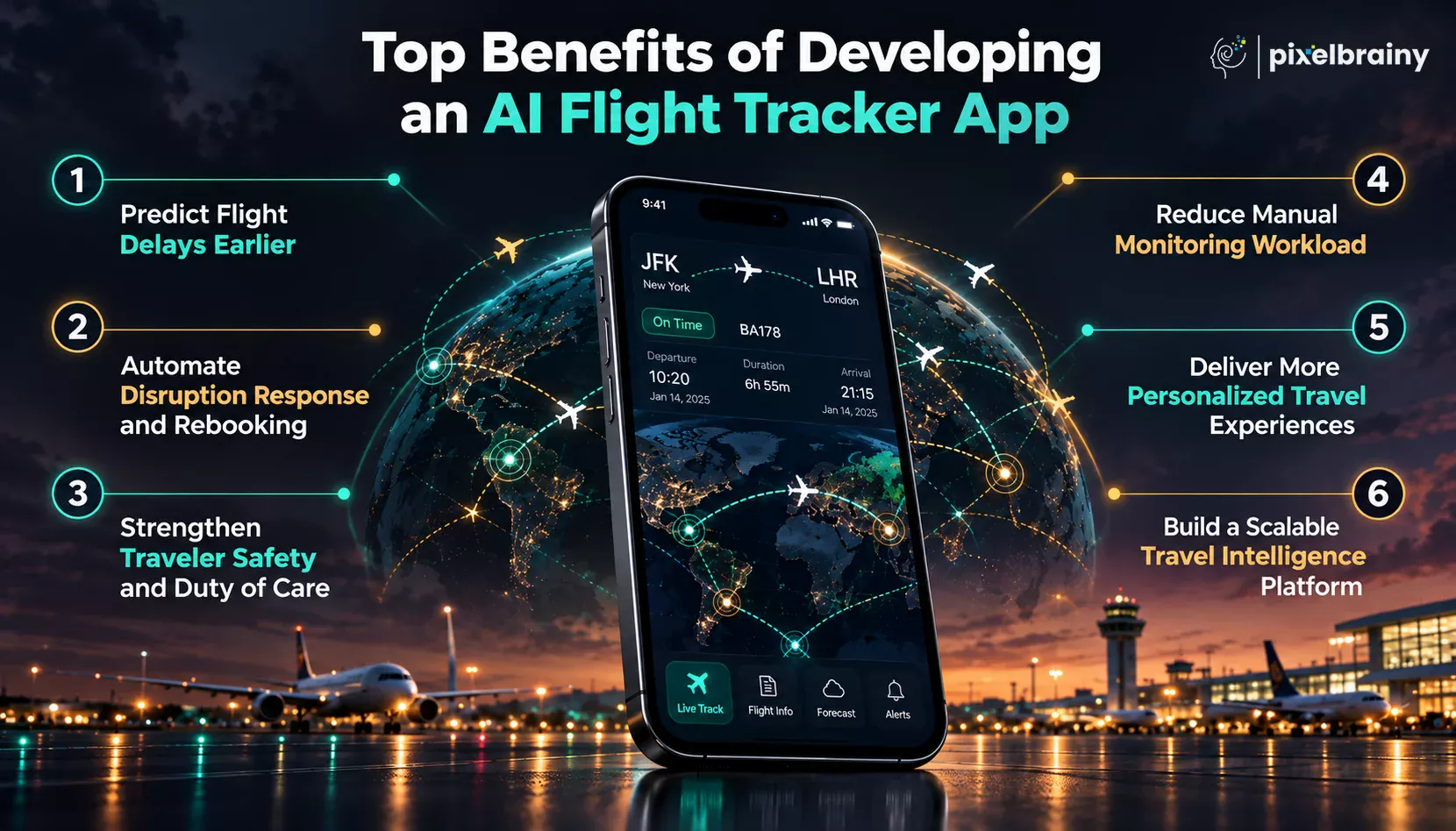
An AI flight tracker can analyze flight history, aircraft movement, weather, airport congestion, operational signals, and other real-time inputs to identify potential delays.
Instead of waiting for an official status update, the system can assign a disruption probability and alert travelers or travel teams earlier. This gives businesses more time to adjust itineraries, connections, and ground transportation.
For companies planning to develop an AI flight tracker app, predictive delay intelligence can become a major differentiator from conventional tracking applications.
AI can connect disruption detection with alternative flight discovery. When a cancellation or significant delay occurs, the application can evaluate available flights, connection times, fares, traveler preferences, and applicable travel policies.
This reduces the need for agents or travelers to manually search through multiple alternatives.
The opportunity is especially strong for enterprise travel platforms. GBTA reports that 89% of corporate travel buyers are interested in automated disruption management and rebooking.
For corporate travel companies, flight tracking can become part of a broader duty of care system.
An AI flight tracker can connect traveler itineraries with disruption events, destination risks, emergency information, and location data to identify employees who may require assistance.
Travel managers can receive prioritized alerts instead of manually checking thousands of active journeys. This makes AI flight tracker mobile app development particularly valuable for companies managing large business travel programs.
Monitoring hundreds or thousands of flights manually requires continuous operational resources. AI can automatically monitor flight events, identify affected itineraries, classify disruption severity, and trigger predefined workflows.
This allows teams to focus on exceptions that genuinely require human intervention.
The aviation industry is already moving in this direction. SITA reports that 63% of airlines use AI in operations control, including disruption management, aircraft assignment, and crew availability.
A conventional tracker provides similar information to every user. An AI-powered application can determine which information matters most for each traveler.
For example, a passenger with a 45-minute connection may receive an immediate missed-connection warning, while another traveler with a flexible itinerary may receive a simple delay update.
Airlines, airports, and travel platforms can use these capabilities to personalize notifications, alternative flight recommendations, gate information, and travel assistance.
A properly designed AI flight tracker platform can become much more than a flight monitoring product. It can connect real-time aviation data with booking systems, traveler profiles, airport information, weather intelligence, corporate policies, customer support, and automated workflows.
This creates an infrastructure that can support future AI capabilities as the business grows.
SITA reports that 83% of airlines prioritize data-driven decision-making, while 49% identify data integration and consistency as a major barrier to scaling AI.
An AI flight tracker therefore creates value by turning fragmented aviation data into timely, personalized, and actionable decisions. For businesses investing in the creation of an AI flight tracker app, that intelligence layer can become the foundation for broader travel automation.
A successful AI flight tracker app needs a strong set of core features before advanced AI capabilities are added. The essential functionality should establish reliable flight visibility, accurate traveler information, timely communication, and a smooth user experience.
For example, a corporate travel company may ask: “How can we build an AI flight tracker app that monitors thousands of active itineraries, provides accurate real-time status updates, and immediately notifies travelers when their flight information changes?” The answer starts with a dependable feature foundation covering live tracking, itinerary management, alerts, search, user accounts, and operational visibility.
The following features should form the core scope when planning AI flight tracker app development.
| Essential Feature | Explanation |
|---|---|
| Real-Time Flight Status | The app should provide continuously updated departure, arrival, boarding, cancellation, diversion, and delay information. Real-time status gives travelers accurate visibility into changing flight conditions throughout their journey. |
| Live Aircraft Tracking | Users should be able to view an aircraft's current position, route, altitude, speed, and estimated arrival information on an interactive map for better real-time journey visibility. |
| Flight Search | A powerful search function should allow users to find flights using flight numbers, airlines, airports, routes, dates, or destinations, helping them quickly access relevant flight information. |
| Interactive Flight Map | An interactive map should visually display aircraft routes, current locations, airports, and destinations, allowing users to understand flight movements without navigating through multiple information screens. |
| Flight Details | Each tracked flight should have a dedicated information view containing scheduled and estimated times, terminal, gate, aircraft details, route information, status, and other relevant operational details. |
| Airport Information | The application should provide airport-specific information such as terminals, gates, facilities, contact details, operating information, and other journey details travelers may need before reaching the airport. |
| Gate and Terminal Updates | Travelers should receive updated gate and terminal information whenever operational changes occur, helping them avoid confusion and reach the correct airport location on time. |
| Flight Delay Notifications | Push notifications should immediately inform users about delays, cancellations, schedule changes, boarding updates, and other important flight events without requiring them to repeatedly open the application. |
| Cancellation Alerts | The app should detect cancelled flights and notify affected users quickly, providing clear status information and directing them toward available next steps or alternative travel arrangements. |
| Arrival and Departure Alerts | Users should receive configurable alerts for upcoming departures, arrivals, boarding times, delays, and other key journey milestones based on their saved flights and notification preferences. |
| Trip and Itinerary Management | Travelers should be able to save flights, organize multiple journeys, manage itinerary details, and access all relevant travel information from one centralized dashboard. |
| Multi-Flight Tracking | Users should be able to monitor several flights simultaneously, which is especially important for families, travel managers, frequent travelers, and corporate teams managing multiple active itineraries. |
| Flight History | A flight history feature should allow users to review previously tracked flights, routes, schedules, delays, cancellations, and journey information for reference and future travel analysis. |
| User Profile and Preferences | User accounts should store preferred airports, airlines, notification settings, saved flights, travel preferences, and other personalization details to create a more relevant tracking experience. |
| Customer Support and Help Center | An integrated support section should provide answers to common questions, troubleshooting guidance, contact options, and assistance when users experience problems with flight information or application functionality. |
These essential capabilities create the operational foundation required before introducing advanced prediction, automation, generative AI, or intelligent rebooking workflows. This layered approach is important because current corporate travel research shows strong interest in AI, while fragmented data and limited consolidated travel visibility remain challenges.
A strong feature foundation makes an AI flight tracker app reliable, scalable, and ready for the advanced intelligence capabilities covered in the next stage of development.
As flight-tracking applications become more advanced, travelers expect the app to do more than simply display flight status, departure times, and aircraft locations. Users increasingly need intelligent, predictive, and personalized assistance when their travel plans change.
For example, a traveler may open the app and ask:
“My flight from USA to London is delayed by 1 hour, and I have a connecting flight to New York. Will I still make my connection? If not, what are my best alternatives?”
To answer this type of query effectively, an AI flight tracker needs to understand the user's complete itinerary, current flight status, estimated arrival time, connecting flight, airport conditions, weather, and available alternatives. This is where advanced AI features can provide significantly more value than a conventional flight-tracking application.
The following features can be considered when building an AI-powered flight tracker app:
| Advanced Feature | Explanation |
|---|---|
| AI-Powered Flight Delay Prediction | AI can analyze historical flight patterns, aircraft schedules, airport congestion, weather conditions, and operational data to predict whether a flight is likely to be delayed. Instead of waiting for an official delay announcement, users can receive an early warning about potential disruptions. |
| Predictive Flight Arrival Time | The app can continuously analyze the aircraft's current location, speed, route, weather, and airport conditions to calculate a more realistic expected arrival time. This can provide travelers with better information than relying only on the originally scheduled arrival time. |
| AI Connection Risk Analysis | When a traveler has a connecting flight, AI can compare the predicted arrival time of the first flight with the departure and boarding time of the next flight. It can consider terminal changes, airport transfer time, and minimum connection requirements to determine whether the traveler is likely to make the connection. |
| Intelligent Alternative Flight Recommendations | If AI determines that a traveler may miss a connection or that a flight has been cancelled, the application can identify alternative flights and present suitable options based on destination, timing, airline, route, and traveler preferences. |
| Conversational AI Flight Assistant | Users should be able to communicate with the application naturally instead of searching through multiple screens. For example, they could ask “Why is my flight delayed?”, “Will I make my connection?”, or “What should I do now?” The AI assistant can use the user's live itinerary and flight information to provide a contextual response. |
| AI Weather & Turbulence Intelligence | The system can combine flight information with weather data to identify conditions that could affect the journey. AI can explain whether storms, strong winds, heavy rainfall, or turbulence could potentially affect departure, arrival, or the flight route. |
| Smart Gate & Terminal Intelligence | AI can monitor operational information and identify important gate or terminal changes. It can also help travelers understand the impact of a change, such as additional walking time, terminal transfers, or the need to use an airport shuttle. |
| Personalized Smart Notifications | Instead of sending every available flight update, AI can determine which events are most relevant to the individual traveler. Important events such as cancellations, significant delays, gate changes, boarding deadlines, and connection risks can receive higher priority. |
| AI-Powered Trip Disruption Management | The application can monitor the entire itinerary rather than treating each flight separately. If one flight is delayed, AI can automatically evaluate its effect on connecting flights and provide recommendations for managing the disruption. |
| Personalized Travel Recommendations | AI can use saved trips, preferred airlines, airports, travel patterns, and user preferences to provide personalized recommendations. For example, it could suggest better connection options, useful airport services, appropriate departure reminders, or travel actions based on the user's itinerary. |
The above are the advanced features to consider while building an AI flight tracker app, helping enhance real-time flight tracking with AI-powered predictions, personalized insights, automated alerts, and intelligent travel assistance. These features can make an AI flight tracker app more proactive, user-focused, and capable of handling complex travel situations.
Building an AI flight tracker app requires more than integrating a flight-status API with a mobile interface. An airline-focused solution needs to combine real-time aviation data, predictive AI, airport information, passenger notifications, navigation, disruption management, and regulatory workflows into one reliable platform.
Consider this real-world requirement: “Our airline wants to build a proprietary AI flight tracker app for our passengers that provides real-time flight status, predictive delay notification before official delay announcements, terminal and gate navigation, baggage carousel assignment, and proactive compensation offer generation when delays exceed regulatory thresholds. Which development companies have built AI flight tracker apps for airlines with predictive delay intelligence and passenger disruption management capability?”
A requirement like this shows why the steps to develop AI flight tracker app from idea to launch must cover both technical development and aviation-specific business requirements. The following process explains how to build AI flight tracker app from scratch and take it toward a production-ready solution.
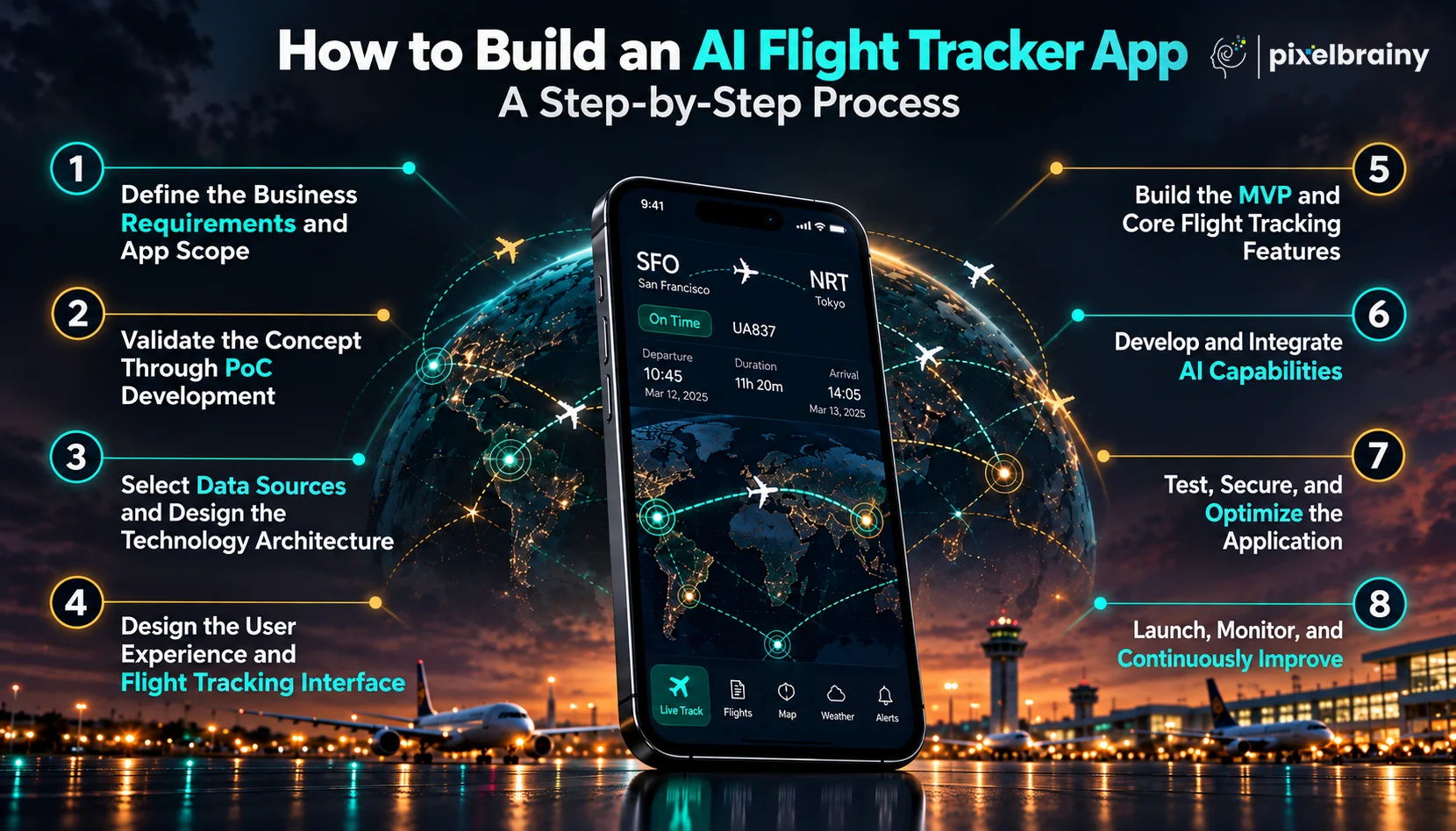
Start by identifying the primary users, business objectives, and problems the application needs to solve. For an airline, this could include real-time flight status, aircraft tracking, delay prediction, gate and terminal information, baggage updates, passenger alerts, and disruption management.
At this stage, separate essential features from advanced AI capabilities. Define the target platforms, supported airports, required data sources, regulatory requirements, and key performance indicators.
A clearly defined scope provides the foundation for developing an AI flight tracking mobile application that addresses real passenger and airline requirements.
Before building the complete product, test the most technically challenging capabilities through PoC development. This can determine whether available aviation data can support real-time tracking and whether AI can accurately predict potential delays.
The PoC can also test advanced requirements such as gate-change detection, baggage carousel information, missed-connection prediction, and disruption classification.
This validation helps identify data limitations, integration challenges, AI feasibility, and potential technical risks before significant development resources are invested.
An AI flight tracker depends heavily on accurate and continuously updated aviation data. Identify suitable sources for flight status, aircraft positions, airport information, schedules, gates, terminals, baggage data, weather, and other operational information.
Next, design the backend architecture around APIs, databases, cloud infrastructure, real-time processing, authentication, notification services, and analytics.
The architecture should be scalable enough to support increasing users, flights, airports, and data sources as the product grows. This is a critical foundation for AI flight tracker mobile app development.
The interface should make important flight information easy to understand at a glance. Users should quickly find flight status, departure and arrival times, gates, terminals, boarding information, aircraft location, baggage details, and disruption alerts.
Interactive maps can display aircraft routes and airport locations, while personalized dashboards can organize saved trips and multiple flights.
Working with a UI/IUX design company can help create an intuitive experience that remains easy to use even when travelers are dealing with delays, cancellations, or last-minute gate changes.
Once the concept and design are validated, build the initial product around its most important capabilities. The MVP may include flight search, real-time status, aircraft tracking, airport information, saved flights, itineraries, and push notifications.
The backend, APIs, database, authentication, notification infrastructure, and analytics should be developed alongside the mobile application.
MVP development allows the business to release a focused version, collect passenger feedback, identify technical problems, and validate the product before investing in advanced AI capabilities.
Also Read: Top 10 AI MVP Development Companies in USA
Once the core flight-tracking infrastructure is stable, advanced intelligence can be introduced. Potential capabilities include predictive delay detection, ETA forecasting, missed-connection prediction, disruption classification, personalized alerts, and alternative-flight recommendations.
AI model development should use relevant historical and real-time aviation data and continuously evaluate prediction accuracy.
Through AI integration, model outputs can be connected with flight-status systems, passenger profiles, notifications, itinerary management, and disruption workflows. This allows the application to proactively respond to changing flight conditions rather than simply display them.
Also Read: Top 10+ AI Integration Companies in USA
Testing should cover both normal flight operations and complex disruption scenarios. This includes delayed flights, cancellations, gate changes, API failures, incorrect data, notification failures, and rapidly changing flight information.
The application should also undergo performance, security, privacy, compatibility, usability, and load testing across Android and iOS devices.
AI predictions should be monitored for accuracy and false alerts. Passenger data and itinerary information must also be protected through appropriate authentication, authorization, encryption, and security practices.
After testing, launch the application gradually and closely monitor real-world performance. Important metrics can include prediction accuracy, notification engagement, application performance, passenger satisfaction, and disruption-management outcomes.
The development process should continue after launch. Passenger feedback and operational data can be used to improve AI predictions, navigation, alerts, compensation workflows, and personalization.
Businesses can work with top AI product development companies or hire AI developers with expertise in aviation, predictive analytics, mobile applications, and real-time data systems to support future improvements.
Following these steps provides a structured approach to building an AI flight tracker that can evolve from an initial idea into a reliable, predictive, and passenger-focused aviation platform.
The cost to develop an AI flight tracker app can vary significantly depending on the application's feature set, aviation data requirements, AI capabilities, platform coverage, security requirements, and development complexity. A basic application that displays flight information through third-party APIs will require a considerably smaller investment than an enterprise platform processing real-time aviation data and generating predictive intelligence.
For businesses planning an AI flight tracker app development cost, a practical budget can range from $50,000 to $300,000+. The final development budget of AI flight tracker app depends on whether the product requires basic tracking, advanced predictive AI, or enterprise-level aviation infrastructure.
A real-world pricing question makes this variation clearer:
“I am comparing three development proposals for an AI flight tracker app for our travel platform and the quotes range from $55,000 to $280,000 for similar stated core features. What legitimately drives this price variation in AI flight tracker app development, and what specific questions should I ask each vendor about their aviation API integration quality, delay prediction model accuracy, real-time data processing architecture, and ADS-B data handling to evaluate whether their proposed app delivers genuine AI flight intelligence or a basic flight status display with AI branding applied?”
This is why cost estimation of AI flight tracker app development should not be based on the number of screens alone. Businesses should evaluate what is actually included in the technology, data infrastructure, AI models, integrations, testing, security, and post-launch support.
| Type of AI Flight Tracker App | Estimated Cost | Typical Scope |
|---|---|---|
| Basic AI Flight Tracker App | $50,000 – $90,000 | Flight search, basic real-time status, flight details, airport information, aircraft location, basic notifications, API integration, user accounts, and Android/iOS application. AI capabilities may include simple recommendations or chatbot functionality. |
| Advanced AI Flight Tracker App | $90,000 – $180,000 | Advanced aircraft tracking, interactive maps, predictive delay notifications, ETA prediction, personalized alerts, itinerary management, weather integration, connection-risk analysis, AI assistant, multiple aviation APIs, and advanced backend infrastructure. |
| Enterprise AI Flight Tracker App | $180,000 – $300,000+ | High-volume real-time aviation data processing, ADS-B integration, proprietary AI models, predictive flight intelligence, disruption management, airline/OTA integrations, advanced passenger personalization, scalable cloud architecture, enterprise security, analytics, administrative systems, and continuous AI optimization. |
The overall AI flight tracker app development cost can vary significantly depending on the following factors:
| Cost Factor | How It Affects Development Cost | Indicative Cost Impact |
|---|---|---|
| AI Complexity | Basic AI recommendations are relatively simple, while predictive delay detection, ETA forecasting, missed-connection prediction, and disruption intelligence require custom models and additional engineering. | +$10,000 – $60,000+ |
| Aviation API Integration | Integrating flight-status, schedules, airport, weather, and aircraft-position APIs increases development effort. Premium aviation APIs can also create recurring operational expenses. | $5,000 – $30,000+ development + API fees |
| ADS-B Data Integration | Real-time ADS-B aircraft data requires specialized data feeds, processing infrastructure, and technical implementation. | $10,000 – $40,000+ |
| Real-Time Data Processing | Continuous processing of aircraft positions, flight events, delays, gates, and other updates requires scalable backend and event-processing infrastructure. | $15,000 – $50,000+ |
| AI Model Development | Developing, training, testing, deploying, and monitoring proprietary prediction models requires data scientists, ML engineers, datasets, and model infrastructure. | $20,000 – $80,000+ |
| Mobile App Development | Supporting Android and iOS, responsive interfaces, maps, notifications, offline handling, and device compatibility increases development time and cost. | $20,000 – $70,000+ |
| Interactive Maps & Navigation | Live aircraft maps, airport maps, terminal navigation, gate directions, and location-based functionality require additional mapping services and engineering. | $8,000 – $30,000+ |
| Third-Party Integrations | Weather, maps, baggage systems, airline systems, booking platforms, payment services, and notification providers increase integration complexity. | $5,000 – $40,000+ |
| Cloud Infrastructure & Scalability | High-volume flight data, millions of API requests, real-time processing, databases, storage, monitoring, and high availability require stronger infrastructure. | $5,000 – $30,000+ initial setup + ongoing cloud costs |
| Security & Compliance | Enterprise authentication, encryption, privacy controls, secure APIs, monitoring, and aviation or regional compliance requirements add additional engineering and testing. | $10,000 – $40,000+ |
| UI/UX Design Complexity | Basic flight screens cost less, while personalized dashboards, live maps, airport navigation, disruption workflows, and complex data visualization require more design work. | $5,000 – $25,000+ |
| Testing & Quality Assurance | Real-time aviation applications require extensive testing for API failures, incorrect data, delays, cancellations, notifications, performance, and different devices. | $8,000 – $30,000+ |
| Development Team Expertise | Experienced AI, aviation, mobile, backend, and cloud specialists generally have higher development rates but can reduce technical risks and rework. | +$10,000 – $50,000+ depending on team |
| Development Timeline | A shorter delivery timeline may require additional developers, designers, AI specialists, and QA resources, increasing the overall project budget. | +15% – 40% for accelerated development |
| Maintenance & AI Optimization | Post-launch API updates, cloud infrastructure, AI retraining, security patches, monitoring, bug fixes, and new features create recurring costs. | 15% – 25% of development cost/year |
Note: These are indicative ranges, not fixed prices. Several factors overlap, so their costs should not simply be added together. The final cost estimation of AI flight tracker app development depends on the selected technology stack, data providers, AI requirements, team location, project scope, and expected user scale.
The final AI flight tracker app development cost should be based on the required level of AI intelligence, aviation data infrastructure, scalability, integrations, and long-term operational needs. A clear understanding of these factors helps businesses set a realistic budget and choose the right development approach.

An AI flight tracker app needs a technology stack that can handle real-time aviation data, aircraft tracking, AI predictions, interactive maps, passenger alerts, and secure mobile experiences. The technology choices directly affect how quickly the app processes flight updates and how reliably it delivers useful information to travelers.
For businesses planning AI flight tracker mobile app development, the core stack can include mobile frameworks, backend technologies, aviation and ADS-B APIs, real-time data processing tools, databases, cloud platforms, mapping services, AI/ML frameworks, and notification systems.
A practical business query is: “Our travel platform needs an AI flight tracker that processes live ADS-B data, predicts delays before official announcements, provides gate and terminal navigation, sends passenger alerts, and supports an AI assistant on Android and iOS. What tools and technologies are required?”
The right combination depends on the app's data volume, AI capabilities, passenger features, and scalability requirements. The following technology stack provides a practical foundation for building an AI flight tracker app.
| Technology Area | Recommended Tools / Technologies | Purpose in AI Flight Tracker App |
|---|---|---|
| Mobile App Development | Flutter, React Native, Swift, Kotlin | Used to build the passenger-facing Android and iOS applications. Cross-platform frameworks can reduce development duplication, while native technologies can be used where deeper platform-specific capabilities are required. |
| Frontend Web / Admin Panel | React.js, Next.js, TypeScript | Used for airline dashboards, flight operations panels, analytics dashboards, user management, and administrative interfaces. |
| Backend Development | Node.js, Python, Java, FastAPI | Handles flight APIs, authentication, business logic, user data, notifications, AI services, and communication between application components. |
| Flight Data APIs | FlightAware, Flightradar24, Aviationstack and other aviation data providers | Provides flight schedules, real-time status, aircraft positions, airport information, and other aviation data. FlightAware supports streaming flight positions including ADS-B, MLAT and other sources, while Flightradar24 provides real-time and historical flight data. FlightAware |
| ADS-B / Aircraft Tracking | ADS-B data providers, MLAT, radar and satellite-based feeds | Supports real-time aircraft location, altitude, speed, heading, and other aircraft tracking information. Modern flight tracking platforms commonly combine ADS-B with MLAT, radar, and other sources to improve coverage. Flightradar24 |
| Real-Time Data Processing | Apache Kafka, Redis Streams, WebSockets, AWS Kinesis | Processes continuous aircraft and flight-status updates and delivers changing information to the application with low latency. |
| Database | PostgreSQL, MongoDB, Redis | Stores users, flights, itineraries, airport information, historical flight records, preferences, cached results, and real-time data. Redis can be used for fast-access and frequently changing flight information. |
| AI and Machine Learning | Python, PyTorch, TensorFlow, scikit-learn | Supports delay prediction, ETA forecasting, connection-risk analysis, disruption detection, recommendation systems, and other predictive capabilities. |
| Generative AI / AI Assistant | OpenAI API, LLMs, function calling, agent frameworks | Enables conversational flight assistance. Function calling can connect an AI model with external systems and application data, allowing the assistant to retrieve flight information or trigger application functions. OpenAI Developers |
| Mapping and Navigation | Google Maps Platform, Mapbox, HERE Technologies | Used for aircraft maps, airport locations, terminal navigation, gate directions, route visualization, and location-based passenger assistance. |
| Weather Data | Weather APIs, aviation weather services | Provides weather information that can support delay prediction, route analysis, turbulence insights, and passenger alerts. |
| Cloud Infrastructure | AWS, Microsoft Azure, Google Cloud | Provides scalable computing, storage, databases, AI infrastructure, monitoring, API hosting, and real-time processing capabilities. |
| Push Notifications | Firebase Cloud Messaging, Apple Push Notification Service | Sends real-time flight alerts for delays, cancellations, boarding, gate changes, terminal changes, baggage updates, and other important events. |
| Authentication & Security | OAuth 2.0, OpenID Connect, JWT, cloud IAM | Protects passenger accounts, flight information, APIs, administrative systems, and sensitive travel data. |
| Analytics & Monitoring | Google Analytics, Firebase Analytics, Grafana, Prometheus, cloud monitoring tools | Tracks application performance, user behavior, API health, AI prediction performance, errors, and system availability. |
| DevOps & Deployment | Docker, Kubernetes, GitHub Actions, Terraform | Supports automated deployments, containerization, scaling, infrastructure management, testing pipelines, and reliable production releases. |
| AI Data & Model Operations | MLflow, cloud ML platforms, feature stores | Helps manage datasets, experiments, model versions, performance monitoring, deployment, and retraining for predictive flight models. |
These above are the essential tools and technologies required for the development of an AI flight tracker app, covering real-time aviation data, AI/ML, mobile development, mapping, cloud infrastructure, and security. The right technology combination helps create a scalable, accurate, and reliable AI flight tracking application for modern travelers.
An AI flight tracker app can generate revenue through multiple models depending on its target audience, feature set, and business strategy. Consumer-focused apps can monetize frequent travelers through premium subscriptions, while airlines, travel companies, and corporate customers can generate revenue through partnerships, enterprise plans, and API-based services.
For businesses planning to build an AI flight tracker app, the revenue strategy should be considered alongside the product features. Advanced capabilities such as predictive delay intelligence, real-time aircraft tracking, personalized alerts, AI travel assistance, and disruption management can create opportunities for both recurring and transaction-based revenue.
| Revenue Model | How It Works | Best Suited For |
|---|---|---|
| Freemium Model | Users can access basic flight tracking for free, while advanced features such as predictive alerts, unlimited tracking, and AI travel assistance require a paid upgrade. | Consumer flight tracker apps |
| Premium Subscription | Users pay monthly or annually for advanced tracking, real-time alerts, AI predictions, ad-free usage, and personalized travel insights. | Frequent travelers and premium users |
| In-App Purchases | Users purchase individual features such as premium flight tracking, detailed flight history, advanced notifications, or one-time travel intelligence packages. | Casual and occasional travelers |
| Advertising | The free version can generate revenue through relevant advertisements from travel, hotels, car rentals, insurance, and other travel-related businesses. | Large consumer user bases |
| Affiliate Revenue | The app earns a commission when users book hotels, flights, airport transfers, travel insurance, car rentals, or other services through partner links. | Travel platforms and flight apps |
| Airline Partnerships | Airlines can pay for branded integrations, passenger engagement features, disruption management, or customized flight-tracking experiences within the application. | Airlines and aviation businesses |
| B2B Enterprise Plans | Travel companies, corporate travel departments, agencies, and aviation businesses pay for access to advanced dashboards, analytics, APIs, and multi-user management. | Enterprise customers |
| Flight Data API Monetization | Businesses can access the platform's processed flight intelligence, predictive data, or tracking capabilities through paid API plans. | Travel-tech and aviation companies |
| AI Travel Assistant Premium | Users pay for advanced AI assistance such as itinerary analysis, connection-risk prediction, disruption recommendations, and personalized travel planning. | Frequent and business travelers |
| Sponsored Travel Services | Relevant travel providers can promote lounges, hotels, insurance, airport transfers, or other services to users based on their journey. | Consumer and travel marketplace apps |
For many AI flight tracker apps, a freemium + premium subscription + affiliate revenue approach can provide a strong combination. Free users can access essential flight information, while advanced AI capabilities can be placed behind a premium plan.
For an airline or travel platform, enterprise partnerships, premium services, and API-based revenue may provide greater long-term value than advertising alone. The best model ultimately depends on the target market, user volume, operational costs, and the level of AI intelligence offered.
The flight-tracking market has moved beyond basic departure and arrival information. Leading apps now combine real-time aircraft tracking, predictive alerts, airport information, itinerary management, weather data, and personalized travel assistance to give travelers better visibility throughout their journey.
For businesses planning to build an AI flight tracker app, analyzing successful market players can help identify expected features, user experience patterns, and opportunities to differentiate through AI-powered capabilities. Here are some of the leading flight tracker apps worth studying.
Flightradar24 is one of the most widely recognized flight-tracking platforms. It provides live aircraft positions, flight search, airport information, aircraft details, flight history, weather layers, and interactive maps.
Its strong visual tracking experience makes it a useful benchmark for businesses developing an application centered around real-time aircraft tracking and interactive flight maps.
FlightAware provides real-time flight tracking, flight status, airport information, alerts, historical flight data, and predictive aviation information.
Its predictive capabilities make it particularly relevant when studying how an AI flight tracker app can move beyond displaying current status toward forecasting potential flight disruptions.
Flighty focuses heavily on proactive flight information. The app provides flight status, delay predictions, notifications, airport information, trip management, and disruption alerts.
Its emphasis on notifying travelers about important changes before they actively search for information makes it a useful benchmark for AI-powered passenger notifications and proactive travel assistance.
App in the Air combines flight tracking with broader travel management capabilities. Users can manage itineraries, receive flight notifications, access airport information, and review travel statistics.
It demonstrates how a flight tracker can become part of a wider personal travel management platform rather than functioning as an isolated flight-status application.
FlightStats provides flight status, departure and arrival information, delays, cancellations, airport information, and alerts.
Its straightforward approach demonstrates the importance of presenting critical flight information clearly and quickly, especially when users are looking for immediate operational updates.
AirNav RadarBox focuses on detailed aircraft tracking and aviation data. It provides live aircraft positions, ADS-B information, flight details, airport information, and weather-related data.
For businesses developing advanced tracking capabilities, it provides a useful reference for understanding real-time aircraft data and ADS-B-based flight monitoring.
Plane Finder provides live aircraft tracking, flight search, aircraft information, airport details, and map-based visualization.
Its map-focused experience demonstrates how aircraft movement can be presented visually while keeping important flight information accessible to travelers.
Google Flights focuses primarily on flight search and travel planning, but its flight information, price tracking, itinerary details, and travel ecosystem provide useful benchmarks for businesses combining flight tracking with broader travel services.
TripIt takes a different approach by focusing on complete itinerary organization. Users can organize flights, hotels, transportation, and other travel plans in one place.
Its approach is particularly relevant for businesses looking to combine AI flight tracking with intelligent itinerary and trip management.
The Flight Tracker provides core flight-tracking capabilities including flight status, airport information, departure and arrival details, alerts, and itinerary-related features.
It represents the simpler end of the flight-tracking market and demonstrates the baseline functionality that users expect from a modern flight tracker.
These leading flight tracker apps show that users increasingly expect real-time information, proactive alerts, interactive tracking, itinerary management, and personalized travel assistance rather than basic flight-status information alone.
For a new AI flight tracker, the strongest opportunity lies in combining these proven capabilities with advanced AI features such as predictive delay intelligence, missed-connection prediction, disruption management, personalized recommendations, and conversational flight assistance.
Developing an AI flight tracker app involves more than connecting a flight API to a mobile interface. Real-time aviation data can contain gaps, latency, conflicting identifiers, and coverage limitations, while AI models require reliable historical and operational data to make useful predictions. ADS-B data also has known coverage and data-quality limitations that need to be handled within the system architecture. F
For businesses building an AI flight tracker app, the major challenges should be addressed during architecture, AI development, testing, and deployment rather than after launch. A practical business question is: “How can we build an AI flight tracker that provides reliable real-time tracking, predicts delays before official announcements, handles ADS-B data accurately, and continues working when aviation data sources become delayed or unavailable?”
The following are the 6 major challenges in AI flight tracker app development and practical ways to resolve them.
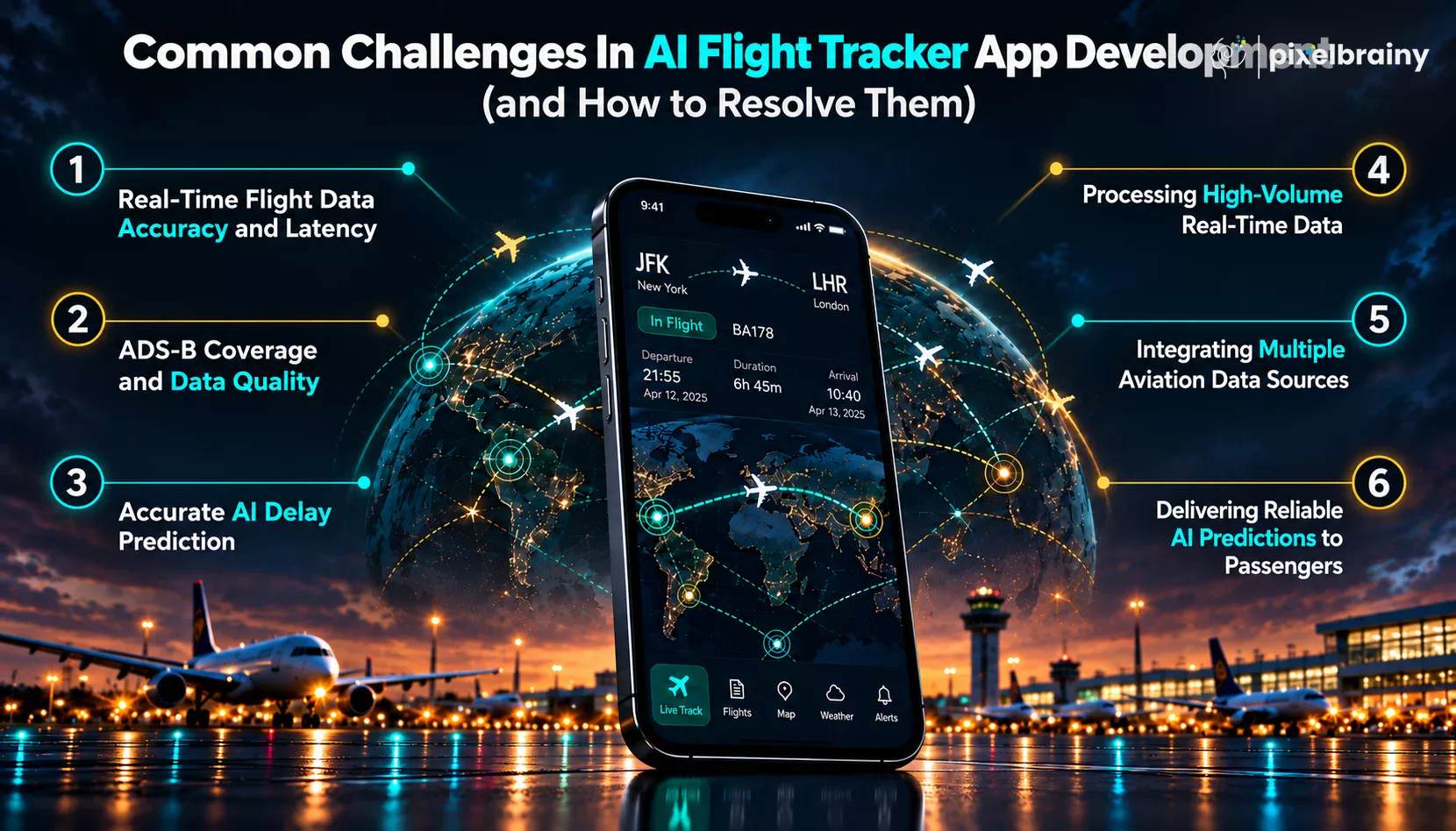
Challenge: Flight trackers depend on continuously changing data. Aircraft positions, flight status, gates, estimated arrival times, and operational events can arrive at different times from different sources. Even providers describing their data as real-time can have different update frequencies and latency.
How to resolve it: Use multiple reliable aviation data sources where appropriate, establish freshness thresholds, timestamp incoming records, and distinguish between live, delayed, estimated, and stale information. Build fallback mechanisms so the application does not present outdated information as current.
Challenge: ADS-B is valuable for aircraft tracking, but coverage is not universal. Data can also contain missing positions, gaps, inconsistent identifiers, or unusual values. The FAA notes that ADS-B coverage depends on aircraft equipment and ground-station range.
How to resolve it: Combine ADS-B with other appropriate data sources such as MLAT, radar, satellite-based tracking, and airline operational data. Add validation and anomaly-detection layers to identify impossible position jumps, stale records, and inconsistent aircraft information before displaying or using the data for AI predictions.
Challenge: Predicting delays before an airline officially announces them requires more than historical flight-delay data. Delays can propagate through aircraft rotations and can also be influenced by weather, airport congestion, operational conditions, and other real-time factors. Recent research highlights the importance of combining operational and external data for stronger prediction performance.
How to resolve it: Train models using historical flight performance alongside real-time operational, weather, aircraft rotation, and airport data where available. Measure model performance using appropriate metrics and continuously retrain and monitor the models as flight patterns change.
Challenge: An application tracking thousands of aircraft cannot treat every update like a normal API request. Continuous position updates and flight events can create substantial processing, storage, and network loads.
How to resolve it: Use event-driven architecture with technologies such as Kafka, streaming services, caching, WebSockets, and scalable cloud infrastructure. Process only necessary changes, maintain efficient data pipelines, and monitor processing latency so the application remains responsive as the number of users and tracked flights increases.
Challenge: Different providers may use different identifiers, formats, update intervals, coverage areas, and definitions for flight information. A flight's aircraft identifier, callsign, registration, and airline flight number are not always interchangeable. Data-source differences can therefore create duplicate or conflicting information.
How to resolve it: Create a dedicated data normalization and reconciliation layer. Maintain consistent internal flight and aircraft identifiers, preserve source information, validate conflicting records, and define which source has priority for specific fields. This creates a reliable data foundation for both the tracker and AI models.
Challenge: Even an accurate AI model can create a poor passenger experience if predictions are presented without context. A prediction such as “80% chance of delay” needs to be timely, understandable, and connected to an appropriate action.
How to resolve it: Convert model outputs into clear passenger-facing insights such as “High risk of delay”, “Your connection is at risk”, or “Consider this alternative flight.” Use confidence thresholds, explain the reason where possible, and avoid unnecessary alerts. This helps turn AI predictions into useful travel decisions rather than simply adding AI labels to a flight-status application.
Addressing these six challenges early helps create an AI flight tracker app that delivers reliable real-time data, stronger predictive intelligence, and a more dependable passenger experience.
From all the features, development steps, technology requirements, costs, and challenges discussed above, it is now time to identify the right development partner. An AI flight tracker requires more than mobile development expertise. It needs strong product thinking, AI engineering, real-time data architecture, intuitive UX, and the ability to turn complex aviation information into a simple passenger experience.
PixelBrainy is a leading AI app development company with experience across AI-powered products, mobile applications, intelligent automation, and travel and hospitality solutions. Our approach combines product strategy, UX, AI, engineering, and scalable architecture to help businesses move from an initial concept to a production-ready solution.
End-to-End Product Expertise: PixelBrainy can support the complete product journey, from requirements analysis and feasibility to design, engineering, AI integration, deployment, and ongoing optimization. This helps businesses avoid managing separate teams for design, AI, and application development.
AI-First Product Approach: A flight tracker should not simply display aviation data and add a chatbot. Our approach focuses on identifying where AI can create measurable value, such as predictive insights, personalization, intelligent assistance, and automated workflows.
Travel and Hospitality Experience: PixelBrainy works with travel and hospitality businesses on AI-powered experiences, including personalized recommendations, intelligent booking systems, and customer-service automation. This domain exposure provides a relevant foundation for travel technology products.
For a travel-sector project, PixelBrainy worked on an AI-powered travel planner for a confidential client. The solution focused on automating itinerary creation, providing real-time recommendations, integrating booking capabilities, and personalizing the travel experience through intelligent features. The project demonstrates our ability to connect AI capabilities with real-world travel workflows rather than treating AI as an isolated feature.
This experience is particularly relevant when you want to build AI flight tracker mobile app capabilities that connect live travel information with personalized passenger experiences.
Whether your goal is to develop AI flight tracker mobile application for an airline, travel platform, aviation startup, or enterprise travel business, the product can be planned around your specific operational requirements.
Our team can help with real-time data workflows, AI-powered features, mobile application development, intelligent assistants, personalized experiences, scalable backend systems, and continuous product optimization. PixelBrainy's broader portfolio includes 500+ digital products and work across multiple industries, supported by AI specialists, product engineers, and designers.
If your objective is to create AI flight tracker app that goes beyond basic flight-status display and delivers meaningful predictive and personalized intelligence, the development strategy should start with your business goals, data requirements, passenger journey, and AI use cases.
Ready to turn your AI flight tracker idea into a production-ready product? Connect with PixelBrainy to discuss your requirements and roadmap.
The aviation industry is moving toward more intelligent, connected, and passenger-focused travel experiences, making an AI flight tracker app a valuable opportunity for airlines, travel platforms, and aviation businesses. From real-time flight status and live aircraft tracking to predictive delay intelligence, personalized notifications, airport navigation, and proactive disruption management, AI can significantly improve how travelers manage their journeys.
However, successful AI flight tracker app development requires more than integrating flight data APIs. Businesses need reliable aviation data, scalable real-time architecture, accurate AI models, intuitive mobile experiences, strong security, and a clear monetization strategy. Understanding the cost to develop an AI flight tracker app, technology requirements, development process, and common challenges is equally important before entering the market.
With the right strategy and technology partner, businesses can build AI flight tracker mobile app solutions that move beyond basic status tracking and deliver genuine, actionable flight intelligence.
Ready to turn your AI flight tracker idea into a market-ready product? Book an appointment with PixelBrainy today.
If you want to understand how to build AI flight tracker app from scratch, start by defining the passenger problem, required aviation data, AI use cases, and target platforms. The project can then move through PoC validation, UI/UX design, MVP development, aviation API integration, AI model development, testing, and deployment. Real-time data integration and predictive features are major parts of flight tracker development.
Yes, but the prediction depends heavily on data quality and model design. AI can evaluate factors such as inbound aircraft delays, historical performance, weather, airport congestion, and operational patterns to identify an increased delay risk before an official status change. Current AI flight-tracking products already offer predictive delay-risk functionality.
Yes. Businesses can develop AI flight tracker app for business as a module within an existing travel platform. Aviation APIs, predictive models, real-time notifications, and flight-tracking interfaces can be integrated with existing user accounts, booking systems, itineraries, and backend services. The feasibility depends primarily on the current architecture and API readiness.
When businesses develop AI flight tracker app for business, they can include real-time flight status, live aircraft tracking, predictive delay alerts, ETA forecasting, missed-connection prediction, gate and terminal updates, baggage information, personalized notifications, AI travel assistance, and disruption management. Depending on the feature complexity, the overall development cost can range from $50,000 to $300,000+, with advanced AI, ADS-B integration, and enterprise infrastructure increasing the investment.
For most startups, travel platforms, and early-stage products, third-party aviation APIs can accelerate AI flight tracker mobile app development. Dedicated ADS-B infrastructure may provide greater control but introduces additional requirements around receivers or data feeds, processing, coverage, storage, and maintenance. The right approach depends on geographic coverage, data ownership, latency, scale, and budget.
Businesses planning to create AI flight tracking mobile app for Android and iOS can use Flutter or another cross-platform framework when faster development and shared code are priorities. Native Swift and Kotlin development may be preferred when the application requires extensive platform-specific functionality or optimization. Cross-platform development can reduce duplication and development costs for suitable projects.
During the development process of AI flight tracking app, ask the vendor what their AI actually predicts, which datasets power the models, how prediction accuracy is measured, and whether predictions use live operational signals or simply reproduce API information. Also ask how the system handles stale data, prediction confidence, model monitoring, and incorrect predictions. A chatbot added to a conventional flight-status application does not by itself make the product an intelligent flight tracker.
The timeline for developing an AI flight tracking mobile application depends on scope, platforms, aviation integrations, AI complexity, and regulatory requirements. An MVP focused on flight search, live status, maps, alerts, and limited AI can reach the market faster, while custom predictive models, ADS-B processing, airline integrations, and enterprise infrastructure require additional development and validation. Industry development guides commonly place full flight-tracker projects in a multi-month development cycle.

About The Author
Sagar Bhatnagar
Sagar Sahay Bhatnagar brings over a decade of IT industry experience to his role as Marketing Head at PixelBrainy. He's known for his knack in devising creative marketing strategies that boost brand visibility and market influence. Sagar's strategic thinking, coupled with his innovative vision and focus on results, sets him apart. His track record of successful campaigns proves his ability to utilize digital platforms effectively for impactful marketing efforts. With a genuine passion for both technology and marketing, Sagar continuously pushes PixelBrainy's marketing initiatives to greater success.

Working with PixelBrainy has been a great experience. They took our vision for an AI-powered platform and turned it into a fully functional product. What impressed me most was their strong understanding of both design and development, and their ability to handle complex requirements with ease. The team was responsive, cooperative, and always open to feedback. They kept things organized, communicated clearly, and delivered quality work on time. I highly recommend PixelBrainy to anyone looking for a skilled and reliable development partner.

Working with the PixelBrainy team has been a highly positive experience. They understand the design requirements and create beautiful UX elements to meet the application needs. The dev team did an excellent job bringing my vision to life. We discussed usability and flow. Sagar worked with his team to design the database and begin coding. Working with Sagar was easy. He has the knowledge to create robust apps, including multi-language support, Google and Apple ID login options, Ad-enabled integrations, Stripe payment processing, and a Web Admin site for maintaining support data. I'm extremely satisfied with the services provided, the quality of the final product, and the professionalism of the entire process. I highly recommend them for Android and iOS Mobile Application Design and Development.

Great experience working with them. Had a lot of feedback and I found that unlike most contractors they were bugging me for updates instead of the other way around. They were extremely time conscience and great at communicating! All work was done extremely high quality and if not on time, early! They were always proactive when it comes to communication and the work is great/above par always. Very flexible and a great team to work with! Goes above and beyond to present us with multiple options and always provides quality. Amazing work per usual with Chitra. If you have UI/UX or branding design needs I recommend you go to them! Will likely work with them in the future as well, definitely recommended!

PixelBrainy is a joy to work with and is a great partner when thinking through branding, logo, and website layout. I appreciate that they spend time going into the "why" behind their decisions to help inform me and others about industry best practices and their expertise.

I hired them to design our software apps. Things I really like about them are excellent communication skills, they answer all project suggestions and collaborate right away, and their input on design and colors is amazing. This project was complex and needed patience and creativity. The team is amazing to do business with. I will be using them long-term. Glad to see there are some good people out there. I was afraid to try and outsource my project to someone but I am glad I met them! I really can't say enough. They went above and beyond on this project. I am very happy with everything they have done to make my business stand out from the competition.

It was great working with PixelBrainy and the team. They were very responsive and really owned the project. We'll definitely work with them again!

I recently worked with the PixelBrainy team on a project and I was blown away by their communication skills. They were prompt, clear, and articulate in all of our interactions. They listened and provided valuable feedback and suggestions to help make the project a success. They also kept me updated throughout the entire process, which made the experience stress-free and enjoyable.

PixelBrainy is very good at what it does. The team also presents themselves very professionally and takes care of their side of things very well. I could fully trust them taking up the design work in a timely and organised manner and their attention to detail saved us lots of effort and time. This particular project was quite intense and the team showed that they function very well under pressure. Very much looking forward to working with her again!

It's always an absolute pleasure working with them. They completed all of my requests quickly and followed every note I had for them to a T, which made our process go smoothly from start to finish. Everything was completed fast and following all of the guidelines. And I would recommend their services to anyone. If you need any design work done in the future, PixelBrainy should be your first call!

They took ownership of our requirements and designed and proposed multiple beautiful variants. The team is self-motivated, requires minimum supervision, committed to see-through designs with quality and delivering them on time. We would definitely love to work with PixelBrainy again when we have any requirements.

PixelBrainy was a big help with our SaaS application. We've been hard at work with a new UI/UX and they provided a lot of help with the designs. If you're looking for assistance with your website, software, or mobile application designs, PixelBrainy and the team is a great recommendation.

PixelBrainy designers are amazing. They are responsive, talented, and always willing to help craft the design until it matches your vision. I would recommend them and plan to continue them for my future projects and more!!!

They were awesome! Did a good job fast, and good communication. Will work with them again. Thank you

Creative, detail-oriented, and talented designers who take direction well and implement changes quickly and accurately. They consistently over-delivered for us.

PixelBrainy team is very talented and creative. Great designers and a pleasure to work with. PixelBrainy is an excellent communicator and I look forward to working with them again.

PixelBrainy has a very talented design team. Their work is excellent and they are very responsive. I enjoy working with them and hope to continue on all of our future projects.


Transform your ideas into reality with us.
Across these industries, each engagement brings unique challenges, from early-stage product development to scaling complex systems, helping us build a practical understanding of real-world product environments.