AI Summary Powered by PixelBrainy
How much does it actually cost to build an AI food delivery app in 2026, and how much should you budget before approaching investors or a development partner? This is one of the first and most important questions every founder asks. Unlike estimating the cost of a standard mobile app, calculating the AI food delivery app development cost is far more complex because you're building an intelligent marketplace that brings together three different user groups through a customer app, a restaurant partner portal, and a driver app, all powered by artificial intelligence.
Beyond the core applications, an AI food delivery platform requires advanced technologies such as personalized recommendation engines, intelligent driver dispatch, real-time route optimization, delivery time prediction, demand forecasting, dynamic pricing, fraud detection, and cloud infrastructure capable of processing thousands of live events simultaneously. Every one of these components influences the cost to build AI food delivery app solutions and the overall development budget of AI food delivery app projects.
A question we often hear from founders is:
We are planning to build an AI food delivery app and before we approach investors we need a realistic cost estimate covering the full development scope.
If that sounds familiar, you're in the right place. This guide provides a transparent breakdown of the pricing of AI food delivery app development, covering everything from an MVP to a full-scale enterprise platform. Whether you're estimating the cost to make an AI food delivery application for a startup, restaurant chain, or cloud kitchen, you'll find realistic budgets, key cost drivers, and practical strategies to optimize your investment.
On average, the AI food delivery app development cost ranges from $30,000 to $200,000+, depending on the platform's complexity, AI capabilities, feature scope, and scalability requirements.
In the sections ahead, we'll break down every major cost component, the factors that influence pricing, hidden expenses, team options, and proven ways to plan a realistic budget for your AI food delivery platform in 2026.
Many founders focus on building innovative features but overlook one of the biggest reasons AI-powered platforms fail before launch: poor budget planning. Creating a realistic budget is not just about estimating development expenses. It helps you prioritize features, validate your business model, allocate resources efficiently, and avoid costly surprises during development.
If you're thinking, "How much does it cost to build an AI food delivery app in 2026?", the answer depends largely on how well you've planned your budget from the beginning. Without a structured financial roadmap, it's easy to underestimate AI implementation costs, infrastructure expenses, third-party integrations, and ongoing platform maintenance.
Unlike traditional mobile applications, AI food delivery app development involves building multiple interconnected systems. You're not only developing a customer-facing application but also creating dedicated platforms for restaurants, delivery partners, and administrators while integrating intelligent automation across the ecosystem. Every decision directly impacts the development budget of AI food delivery app projects.
| Budget Area | Why It Matters |
| Feature Prioritization | Helps decide which features belong in the MVP and which can be introduced after launch, reducing the initial cost to build AI food delivery app. |
| AI Development | Estimates the investment required for recommendation engines, route optimization, demand forecasting, dynamic pricing, and fraud detection. |
| Platform Architecture | Determines whether your infrastructure can support future growth without expensive redevelopment. |
| Third-Party Integrations | Accounts for APIs such as payment gateways, maps, notifications, analytics, and communication services. |
| Team Planning | Helps choose between freelancers, in-house developers, or an experienced AI development company based on project goals. |
| Investor Readiness | Demonstrates financial planning and increases confidence during fundraising discussions. |
Many startups make the mistake of trying to include every possible feature in the first release. A better approach is to invest in a focused MVP that validates market demand before scaling. This strategy reduces the cost to make an AI food delivery application, shortens development timelines, and provides real user data that can be used to improve AI models over time.
For example, instead of investing heavily in advanced AI capabilities during Phase One, founders often launch with intelligent recommendations, basic driver dispatch, and real-time order tracking. Once customer adoption grows, additional features such as predictive demand forecasting, dynamic pricing, automated customer support, and personalized promotions can be introduced in future releases.
A detailed budget also helps identify hidden costs before they become problems. Cloud infrastructure, AI model training, data storage, security compliance, app store publishing, ongoing maintenance, and continuous AI optimization are frequently underestimated when calculating the pricing of AI food delivery app development. Planning for these expenses early prevents delays, budget overruns, and unexpected funding requirements.
One of the most common founder query is:
"What should our development budget include before we start building an AI food delivery app?"
The answer extends beyond coding. A realistic budget should account for product discovery, UI/UX design, frontend and backend development, AI model development, cloud infrastructure, third-party integrations, quality assurance, deployment, maintenance, and future product enhancements.
Ultimately, budgeting is about making informed business decisions rather than simply reducing costs. A well-planned AI food delivery app development cost strategy enables founders to build a scalable product, secure investor confidence, and allocate resources where they generate the highest return. Before estimating the final cost to build AI food delivery app, it's essential to understand every component that contributes to the overall investment.
If you're asking, "How much does it cost to build an AI food delivery app in 2026?", the short answer is $30,000 to $200,000+. However, the final AI food delivery app development cost depends on several variables, including the number of user applications, AI feature complexity, real-time delivery infrastructure, supported platforms, cloud architecture, third-party integrations, security requirements, and the scalability of your marketplace. Most startups begin with a Minimum Viable Product (MVP) that focuses on core ordering and delivery functionality with essential AI capabilities, then gradually expand into a full-scale platform as their business grows.
One of the most common questions founders ask is:
"We are planning to launch an AI food delivery app with customer ordering, restaurant management, driver tracking, AI-powered food recommendations, route optimization, and online payments. Our development budget is around $75,000. Can we build a production-ready MVP, and what features can realistically be included within this budget?"
The answer is yes. A budget between $60,000 and $80,000 is typically sufficient to build a production-ready MVP with customer and driver applications, a restaurant partner dashboard, AI-powered food recommendations, intelligent order assignment, real-time order tracking, secure payment integration, cloud infrastructure, and an admin panel.
Working with an experienced AI app development company that utilizes proven AI frameworks, scalable cloud services, and reusable technology components instead of building every AI model from scratch can significantly reduce the overall cost to build AI food delivery app solutions while accelerating time to market.
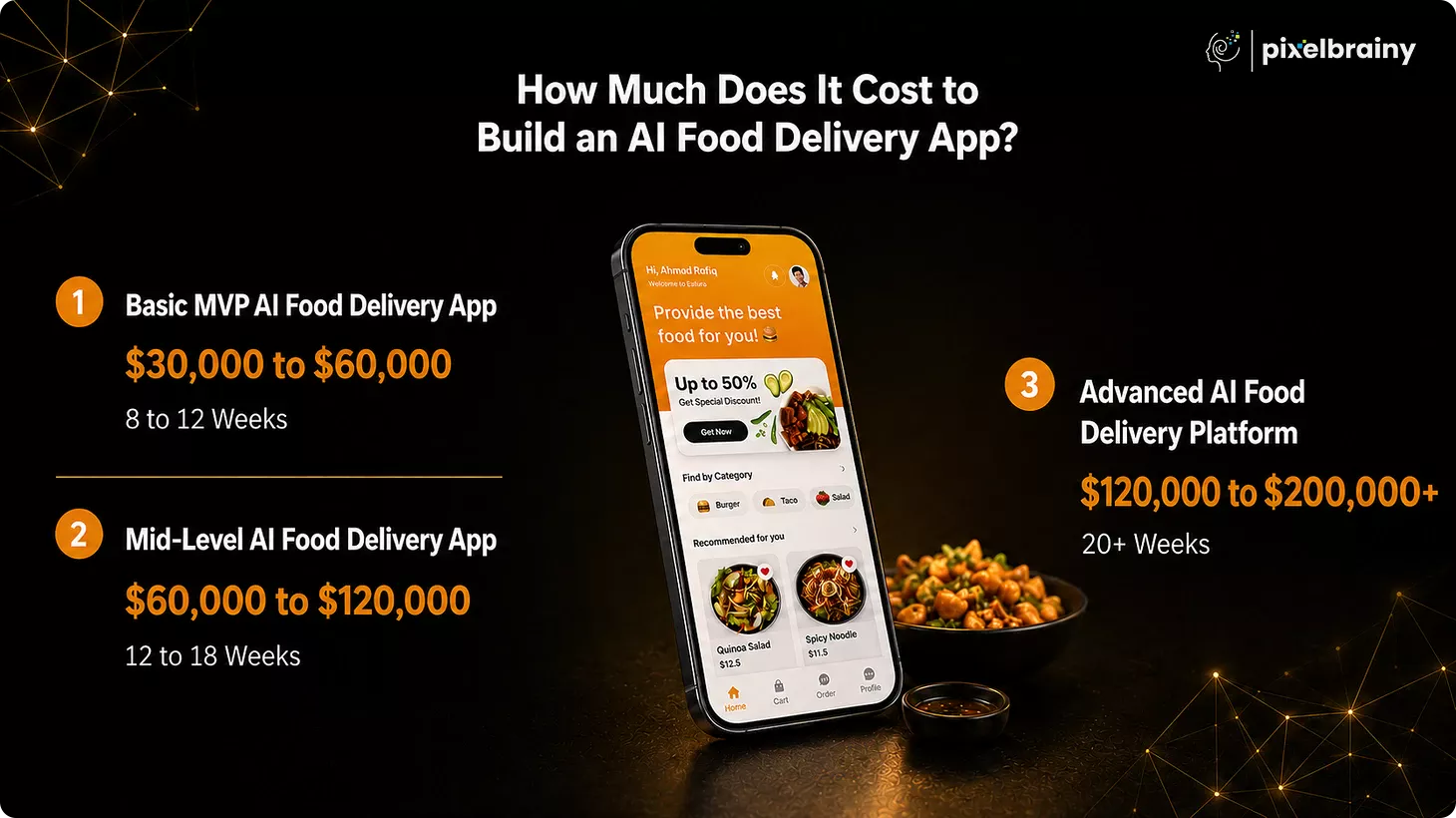
| Development Tier | Estimated Cost | Timeline | What's Included |
| Basic MVP AI Food Delivery App | $30,000 to $60,000 | 8 to 12 Weeks | Customer app, restaurant dashboard, driver app, user authentication, menu management, online ordering, secure payments, live order tracking, AI-powered food recommendations, notifications, admin panel, and basic analytics. |
| Mid-Level AI Food Delivery App | $60,000 to $120,000 | 12 to 18 Weeks | Cross-platform applications, intelligent driver dispatch, delivery route optimization, personalized offers, loyalty programs, restaurant analytics, cloud scalability, advanced dashboards, multi-location support, and enhanced reporting. |
| Advanced AI Food Delivery Platform | $120,000 to $200,000+ | 20+ Weeks | Demand forecasting, dynamic pricing, fraud detection, custom AI models, predictive analytics, multilingual support, enterprise security, auto-scaling cloud infrastructure, advanced business intelligence, CRM integrations, and nationwide marketplace capabilities. |
The primary difference between these pricing tiers comes down to AI sophistication, marketplace complexity, and scalability. A Basic MVP AI Food Delivery App includes essential ordering, delivery management, and AI-powered recommendations. It is the most cost-effective way to validate your idea, launch quickly, and gather real user feedback while keeping the AI food delivery app development cost under control.
A Mid-Level AI Food Delivery App adds intelligent driver dispatch, route optimization, personalized offers, loyalty programs, restaurant analytics, and scalable cloud infrastructure. This tier is ideal for businesses planning to expand across multiple locations while maintaining a balanced development budget of AI food delivery app projects.
An Advanced AI Food Delivery Platform is built for enterprise-scale operations. It includes demand forecasting, dynamic pricing, fraud detection, predictive analytics, multilingual support, and highly scalable cloud architecture. Although these capabilities increase the cost to make an AI food delivery application, they also improve automation, operational efficiency, and long-term business growth.
Beyond the initial build, founders should also budget for cloud hosting, AI model training, map APIs, payment gateway fees, platform maintenance, security, monitoring, and continuous AI improvements. These ongoing expenses play a significant role in the overall pricing of AI food delivery app development.
Ultimately, the cost to build AI food delivery app solutions should match your business goals. Starting with an MVP in the $30,000 to $60,000 range helps validate your concept, attract investors, reduce financial risk, and create a scalable foundation for future expansion.
Can you estimate the AI food delivery app development cost before talking to a development company? Absolutely. In fact, every founder should have a rough budget estimate before requesting proposals or pitching investors.
The cost to build AI food delivery app solutions isn't determined by a single number. Instead, it depends on the combination of features, AI capabilities, integrations, infrastructure, and scalability you plan to include. The more intelligent and feature-rich your platform becomes, the higher the investment required.
For example, an MVP that offers customer ordering, restaurant onboarding, driver management, and AI-powered food recommendations requires a much smaller investment than an enterprise platform with demand forecasting, intelligent dispatching, dynamic pricing, fraud detection, and predictive business analytics.
A question we frequently hear is:
"We're planning to build an AI food delivery app, but before approaching development companies, we'd like to estimate our budget. Is there a practical way to calculate the expected development cost?"
The answer is yes. Rather than relying on broad industry averages, break your project into individual development components. This gives you a much clearer picture of the development budget of AI food delivery app projects and helps you understand where your investment will be allocated.
A practical way to estimate your budget is:
Total Development Cost = Core Development + AI Features + Cloud Infrastructure + Third-Party Integrations + Testing & Deployment + First-Year Maintenance
Each of these areas contributes to the overall pricing of AI food delivery app development.
| Cost Component | What It Includes |
| Core Development | Customer app, driver app, restaurant portal, admin panel, backend, database, UI/UX, APIs, and deployment |
| AI Features | Food recommendations, intelligent dispatch, route optimization, demand forecasting, dynamic pricing, fraud detection, and AI integration |
| Cloud Infrastructure | Cloud servers, databases, storage, monitoring, real-time processing, backups, and scalability |
| Third-Party Integrations | Payment gateways, Google Maps, authentication, SMS, push notifications, analytics, CRM, and communication APIs |
| Testing & Deployment | QA testing, security testing, performance optimization, bug fixing, app publishing, and production launch |
| First-Year Maintenance | Platform monitoring, feature updates, AI model improvements, cloud optimization, security patches, and technical support |
Let's assume you're building an MVP with:
Your estimated AI food delivery app development cost could look like this:
| Expense | Estimated Cost |
| Core Development | $42,000 |
| AI Features | $12,000 |
| Cloud Infrastructure | $8,000 |
| Third-Party Integrations | $6,000 |
| Testing & Deployment | $5,000 |
| First-Year Maintenance | $10,000 |
| Estimated Total Investment | $83,000 |
This example demonstrates that the cost to make an AI food delivery application is influenced by much more than app development alone. AI implementation, cloud services, integrations, and ongoing maintenance represent a substantial portion of the total investment.
Using a structured cost calculator helps you:
Instead of relying on generic pricing ranges, estimating your project by individual cost components provides a far more accurate answer to "How much does it cost to build an AI food delivery app in 2026?" It also enables you to allocate your budget strategically and invest in the features that will generate the greatest business value.
The AI food delivery app development cost is never fixed because every platform has unique business goals, AI capabilities, marketplace requirements, and scalability expectations. This is why the cost to build AI food delivery app solutions can range anywhere from $30,000 to $200,000+, even when two platforms appear to offer similar food ordering experiences.
A founder planning a city-level MVP will have a very different budget than a business building a nationwide marketplace with advanced AI automation. The more intelligent your platform becomes, the greater the investment required in AI development, cloud infrastructure, and real-time data processing.
One of the most common questions we receive is:
"We want to build an AI food delivery app similar to DoorDash or Uber Eats but with a more advanced AI layer including a deep learning recommendation engine, predictive demand forecasting for restaurant partners, and real-time multi-zone driver dispatch optimization. Before we hire a development agency, we need to understand what a realistic budget looks like for this kind of build in 2026. Can you break down the development cost for an AI food delivery app with these specific cost factors?"
The answer depends on six major cost drivers. Understanding these variables will help you estimate the development budget of AI food delivery app projects, compare proposals from development companies, prioritize high-impact features, and invest where it creates the greatest business value.
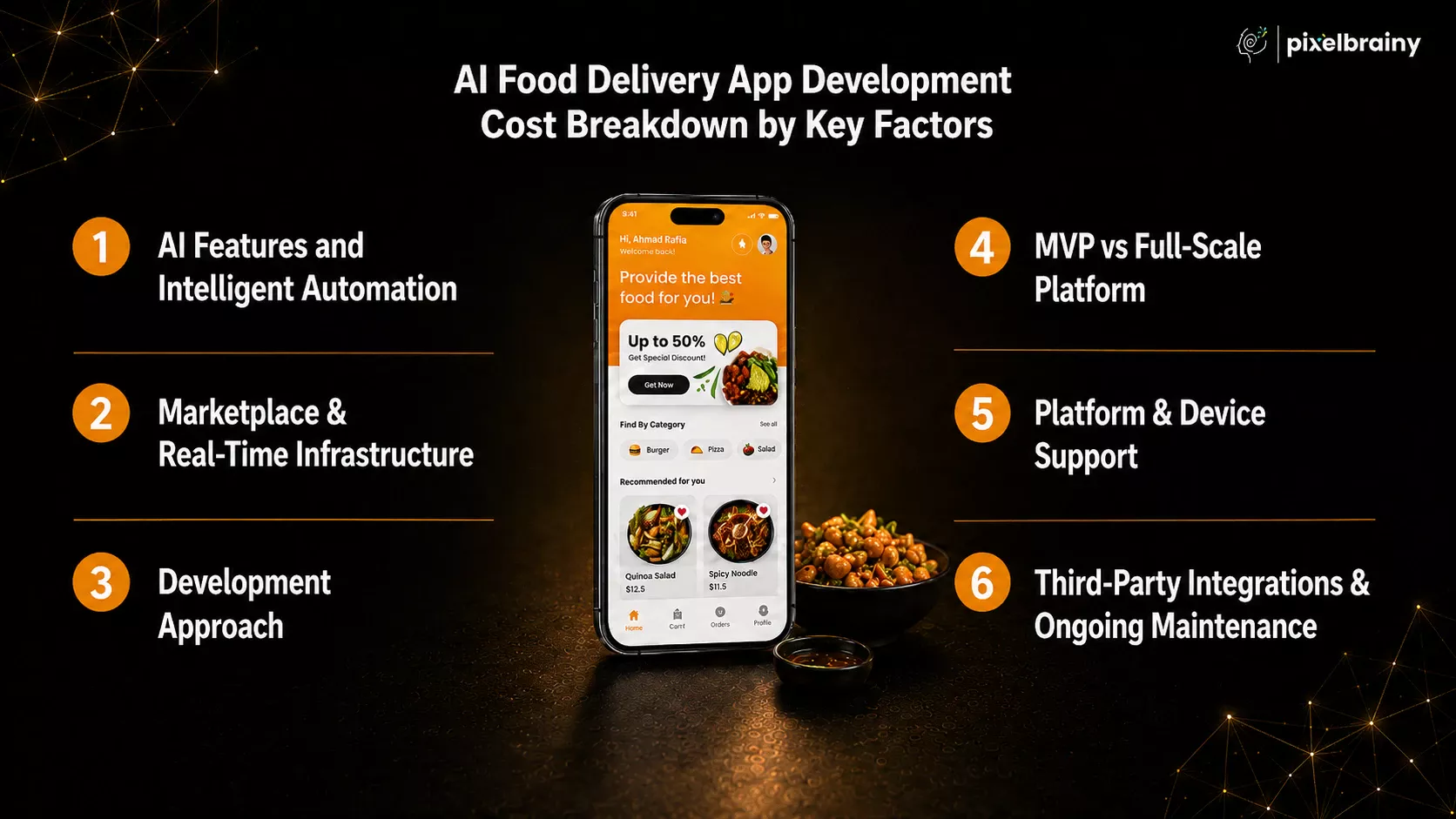
| Cost Factor | Estimated Cost Impact | Impact Level |
| AI Features & Automation | $10,000 to $70,000+ | Very High |
| Marketplace & Real-Time Infrastructure | $8,000 to $45,000+ | Very High |
| Development Approach | Can reduce or increase total cost by 20% to 40% | High |
| MVP vs Full-Scale Platform | $30,000 to $200,000+ | Very High |
| Platform & Device Support | $8,000 to $40,000+ | High |
| Third-Party Integrations & Maintenance | $8,000 to $35,000+ | Medium to High |
Artificial intelligence is the biggest contributor to the overall AI food delivery app development cost. The type of AI you choose determines how intelligent and competitive your platform will become.
A basic MVP with AI-powered food recommendations, customer personalization, and simple driver assignment generally falls within the $30,000 to $60,000 range.
However, implementing advanced capabilities such as deep learning recommendation engines, predictive demand forecasting, multi-zone driver dispatch optimization, dynamic pricing, delivery time prediction, customer churn analysis, and fraud detection can increase the AI investment by $40,000 to $70,000+.
The more AI-driven automation you introduce, the higher the overall cost to make an AI food delivery application.
Unlike traditional apps, food delivery platforms operate as real-time marketplaces connecting customers, restaurants, drivers, and administrators simultaneously.
A basic cloud setup with order management, GPS tracking, and notifications typically requires an investment between $8,000 and $15,000.
If your platform needs high-volume order processing, live driver tracking, real-time dispatching, auto-scaling cloud infrastructure, event streaming, and support for thousands of concurrent users, infrastructure costs can increase to $25,000 to $45,000+.
Building scalable infrastructure from day one significantly reduces future redevelopment costs.
The way you build your product directly affects the development budget of AI food delivery app projects.
Hiring an in-house team requires recruiting AI engineers, mobile developers, backend developers, DevOps specialists, QA engineers, designers, and project managers, often resulting in annual costs well above $250,000 before product development is complete.
Working with an experienced AI app development company usually keeps the cost to build AI food delivery app solutions within the $30,000 to $200,000+ range, depending on project complexity.
Many startups also choose a hybrid model where an internal product owner collaborates with an external AI development partner to balance quality and cost.
One of the biggest pricing factors is deciding what to launch first.
A production-ready MVP with customer ordering, restaurant onboarding, driver management, payments, AI-powered recommendations, live tracking, and an admin dashboard generally costs between $30,000 and $60,000.
A full-scale marketplace similar to Uber Eats or DoorDash with predictive demand forecasting, intelligent dispatching, dynamic pricing, advanced analytics, loyalty systems, enterprise security, and custom AI models typically ranges from $120,000 to $200,000+.
Launching an MVP first allows founders to validate the market before making larger investments.
The number of platforms you support has a direct impact on the overall pricing of AI food delivery app development.
Typical investment ranges include:
Supporting additional platforms increases development effort, testing requirements, and long-term maintenance costs.
Every AI food delivery platform depends on multiple external services that contribute to the total project cost.
Common integrations include:
Depending on integration complexity, businesses should budget $8,000 to $20,000+ during development.
After launch, ongoing maintenance should also be considered. A good benchmark is allocating 15% to 25% of the initial development cost annually for cloud hosting, AI model improvements, platform monitoring, security updates, operating system compatibility, bug fixes, and feature enhancements.
For example, if your AI food delivery app development cost is $100,000, you should expect annual maintenance expenses of approximately $15,000 to $25,000 to keep the platform secure, scalable, and competitive.
There is no universal answer to the cost to build AI food delivery app solutions because every business has different product goals and AI requirements. Your final investment depends on the intelligence of your AI models, marketplace architecture, supported platforms, integrations, and scalability objectives.
For most startups, beginning with an MVP in the $30,000 to $60,000 range and expanding based on user feedback is the most cost-effective strategy for optimizing the AI food delivery app development cost while building a strong foundation for future growth.
Understanding the AI food delivery app development cost becomes much easier when you break the project into individual development phases. Instead of viewing the investment as a single figure, founders should understand how the development budget of AI food delivery app projects is distributed from product discovery to post-launch maintenance. This approach improves budget transparency, simplifies investor discussions, and helps prioritize investments throughout the product lifecycle.
A question many founders ask is:
"We're preparing to raise funding for our AI food delivery platform and need a complete financial picture before approaching investors. Can you break down the total cost to build an AI food delivery app, including development, launch, and first-year operational expenses?"
The answer is yes. The total cost to build AI food delivery app solutions includes product discovery, UI/UX design, mobile and backend development, AI implementation, cloud infrastructure, quality assurance, deployment, and ongoing maintenance. While the initial AI food delivery app development cost generally ranges between $30,000 and $200,000+, businesses should also reserve 15% to 25% of the development cost annually for cloud hosting, AI model improvements, platform monitoring, security updates, infrastructure scaling, bug fixes, and continuous feature enhancements.
The table below shows how a typical AI food delivery app development budget is distributed across each phase.
| Development Phase | Budget Allocation | Estimated Cost |
| Discovery & Product Strategy | 5% to 10% | $1,500 to $20,000 |
| UI/UX Design | 10% to 15% | $3,000 to $30,000 |
| App Development | 35% to 45% | $10,500 to $90,000 |
| AI Development & Integrations | 20% to 30% | $6,000 to $60,000 |
| Testing & Quality Assurance | 10% to 15% | $3,000 to $30,000 |
| Deployment & Launch | 5% | $1,500 to $10,000 |
Every successful AI food delivery platform begins with a well-defined strategy. This phase includes market research, competitor analysis, feature prioritization, AI roadmap planning, marketplace architecture, technology selection, and project planning.
Businesses typically allocate 5% to 10% of the total AI food delivery app development cost, or approximately $1,500 to $20,000, to this stage. Investing in proper planning reduces development risks, prevents unnecessary feature additions, and helps create a realistic product roadmap before coding begins.
An AI-powered food delivery platform must deliver a seamless experience for customers, restaurants, drivers, and administrators. During this phase, designers create ordering flows, restaurant dashboards, driver interfaces, checkout experiences, AI recommendation screens, and admin portals.
Most businesses invest 10% to 15% of the project budget, or roughly $3,000 to $30,000, in mobile app UI/UX design. A well-designed interface improves customer satisfaction, increases order completion rates, and strengthens long-term user retention.
Application development represents the largest share of the overall cost to make an AI food delivery application.
This phase includes frontend and backend development, customer and driver apps, restaurant portal, admin dashboard, user authentication, APIs, payment integration, order management, database architecture, notifications, and core marketplace functionality.
Depending on the project's complexity, businesses typically spend 35% to 45% of the total budget, with development costs ranging from $10,500 to $90,000.
This phase transforms a standard delivery platform into an intelligent AI-powered marketplace.
It includes AI-powered food recommendations, predictive demand forecasting, intelligent driver dispatch, route optimization, delivery time prediction, fraud detection, customer behavior analysis, and integration with mapping, payment, and communication services.
Companies generally allocate 20% to 30% of the overall budget, or approximately $6,000 to $60,000, depending on the sophistication of AI models and the number of external integrations.
Before launching, every feature must be thoroughly tested to ensure performance, reliability, and security.
This phase covers functional testing, real-time order flow validation, AI accuracy testing, compatibility testing across devices, security audits, bug fixing, performance optimization, and user acceptance testing.
Testing usually accounts for 10% to 15% of the AI food delivery app development cost, requiring an investment of approximately $3,000 to $30,000.
The final phase prepares your AI food delivery platform for production.
Activities include cloud deployment, production server configuration, database migration, security validation, monitoring setup, app store publishing, final testing, and launch support.
Although deployment typically represents only 5% of the total budget, businesses should still allocate around $1,500 to $10,000 to ensure a smooth and successful launch.
Breaking down the AI food delivery app development cost by development phase provides founders with a realistic financial roadmap. It helps answer common questions like "How much does each stage of AI food delivery app development cost?" and "Where should I allocate my budget first?" More importantly, it enables startups to secure funding with confidence, control development expenses, prioritize high-impact investments, and build a scalable AI food delivery platform without unexpected financial surprises.
The team you hire plays a major role in determining your AI food delivery app development cost, delivery timeline, product quality, and long-term scalability. Even when two companies are building similar AI food delivery platforms, the cost to build AI food delivery app solutions can vary significantly based on the team's location, AI expertise, development model, and experience with marketplace applications.
One of the most common founder questions is:
"Should we build an in-house engineering team or outsource AI food delivery app development to an experienced agency?"
Another frequently asked question is:
"Which country offers the best balance of development quality, AI expertise, communication, and cost when building an AI food delivery app in 2026?"
The answer depends on your budget, project complexity, and long-term business goals. Here's how the AI food delivery app development cost compares across different team models.
| Team Type | Hourly Rate | Estimated Project Cost* | Best For |
| In-House Development Team (USA) | $120 to $220/hour | $250,000 to $500,000+ | Large enterprises building AI-powered food delivery platforms with dedicated engineering teams and complete product ownership. |
| US-Based AI Development Agency | $90 to $180/hour | $80,000 to $220,000+ | Businesses looking for experienced AI engineers, marketplace expertise, structured project delivery, and ongoing support. |
| Freelancers (Global) | $30 to $100/hour | $30,000 to $90,000+ | Startups developing prototypes or basic MVPs with limited AI functionality and smaller budgets. |
| Offshore Development Team (Eastern Europe) | $45 to $90/hour | $50,000 to $130,000+ | Companies seeking experienced engineers, strong technical expertise, and competitive pricing for mid-sized AI projects. |
| Offshore Development Team (South Asia) | $25 to $60/hour | $30,000 to $100,000+ | Startups and growing businesses looking for affordable AI food delivery app development without compromising development quality. |
*Estimated project costs are based on a medium-complexity AI food delivery platform that includes customer, driver, and restaurant applications, AI-powered recommendations, intelligent dispatch, payment integration, testing, and deployment. Final pricing depends on AI complexity, feature scope, supported platforms, and infrastructure requirements.
An in-house engineering team gives you complete ownership of development, product decisions, and AI innovation. However, hiring AI engineers, mobile developers, DevOps specialists, designers, QA engineers, and project managers makes this the most expensive option, often exceeding $250,000 before launch.
Best for: Large enterprises with long-term engineering investments.
For most startups, this provides the best balance of quality, accountability, and speed. Instead of building an internal engineering department, you gain access to experienced AI engineers, marketplace specialists, designers, QA engineers, and cloud architects through one dedicated team.
Best for: Founders looking for faster delivery with lower operational overhead.
Freelancers are suitable for prototypes or lightweight MVPs where the primary objective is reducing the AI food delivery app development cost.
As the platform grows, coordinating multiple independent developers for AI, cloud infrastructure, security, and maintenance becomes increasingly difficult.
Best for: Proof of concepts and early-stage validation.
Offshore development teams have become one of the most popular choices for startups.
Best for: Businesses that want to maximize ROI while keeping development costs under control.
| If Your Goal Is... | Recommended Team |
| Build an enterprise platform | In-House Team |
| Launch a scalable startup | US AI Development Agency |
| Validate an idea quickly | Freelancers |
| Reduce development cost | South Asia Offshore Team |
| Balance quality and budget | Eastern Europe Offshore Team |
There is no universally "best" development model. The right choice depends on your budget, product complexity, and long-term growth strategy. For most startups, partnering with an experienced AI app development company offers the best mix of technical expertise, scalability, faster delivery, and cost efficiency, helping reduce the cost to build AI food delivery app solutions without compromising quality.
Many founders accurately estimate the AI food delivery app development cost, but underestimate the expenses that arise after development begins. These hidden costs often don't appear in initial proposals, yet they can significantly impact your overall budget and project timeline.
A common founder concern is:
"We've allocated around $80,000 to build our AI food delivery app. Are there any hidden costs we should plan for before signing a development contract?"
The answer is yes. Beyond application development, you'll need to budget for cloud infrastructure, AI services, third-party APIs, compliance, maintenance, and platform scaling. Ignoring these expenses can increase the cost to build AI food delivery app solutions by thousands of dollars each year.
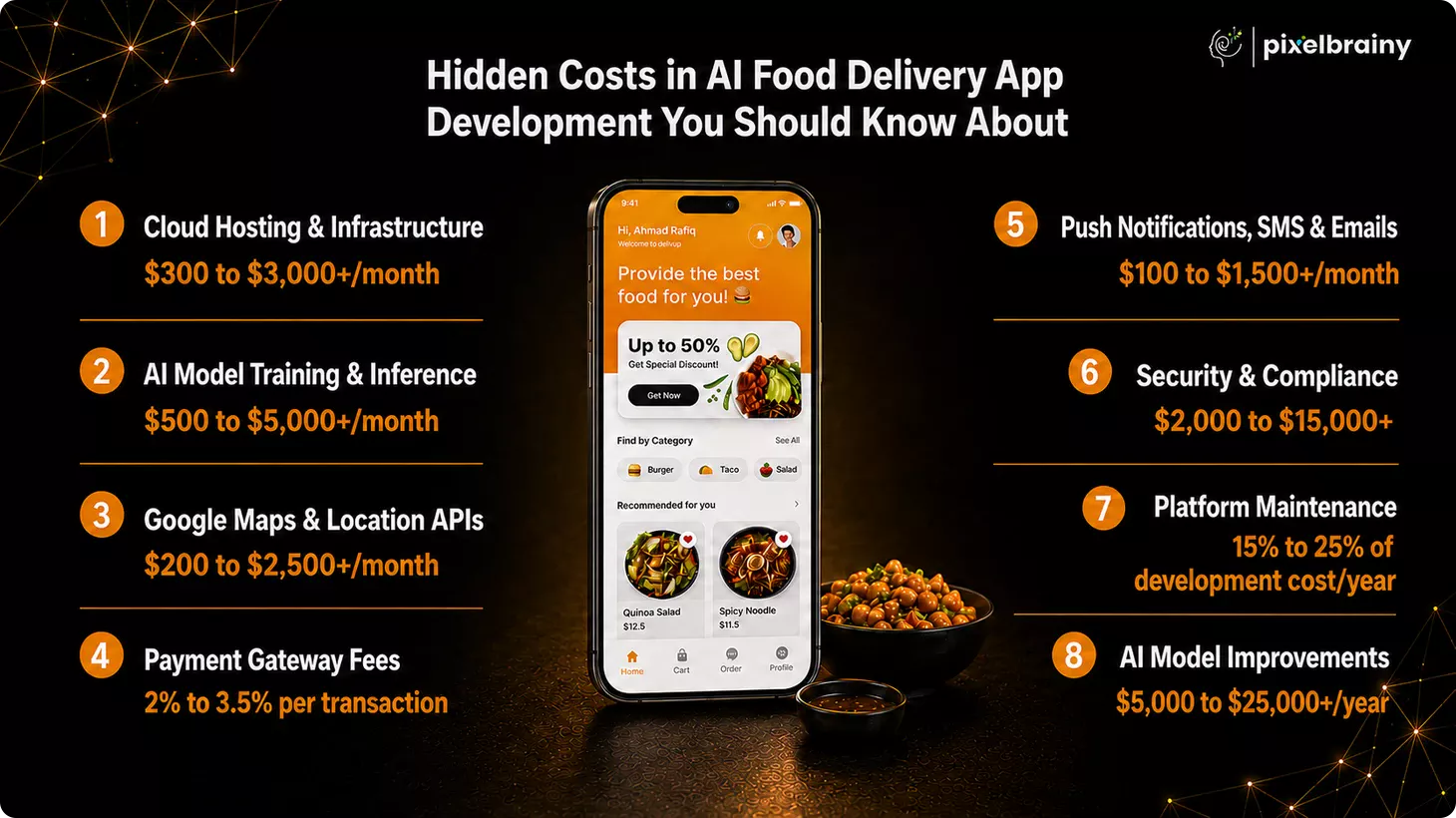
| Hidden Cost | Estimated Cost | When It Occurs | Why It Matters |
| Cloud Hosting & Infrastructure | $300 to $3,000+/month | After Launch | Supports real-time orders, databases, storage, and application servers. |
| AI Model Training & Inference | $500 to $5,000+/month | During & After Launch | Powers recommendations, demand forecasting, and intelligent dispatch. |
| Google Maps & Location APIs | $200 to $2,500+/month | Ongoing | Required for navigation, live tracking, distance calculation, and route optimization. |
| Payment Gateway Fees | 2% to 3.5% per transaction | Ongoing | Payment providers charge processing fees on every order. |
| Push Notifications, SMS & Emails | $100 to $1,500+/month | Ongoing | Used for OTPs, order updates, promotions, and customer communication. |
| Security & Compliance | $2,000 to $15,000+ | Annual | Covers security audits, penetration testing, data protection, and compliance. |
| Platform Maintenance | 15% to 25% of development cost/year | Annual | Includes bug fixes, updates, OS compatibility, and performance improvements. |
| AI Model Improvements | $5,000 to $25,000+/year | Growth Stage | Continuous AI optimization improves recommendations and delivery efficiency. |
Cloud infrastructure is one of the most overlooked expenses in AI food delivery app development. Every customer order, driver location update, payment transaction, restaurant notification, and AI prediction depends on cloud servers running continuously.
As your user base grows, you'll need scalable infrastructure for databases, storage, load balancing, backups, monitoring, and real-time processing. Businesses should typically budget $300 to $3,000+ per month, with costs increasing as order volume and concurrent users grow.
Artificial intelligence requires continuous improvement after launch. Recommendation engines, predictive demand forecasting, delivery time estimation, fraud detection, and intelligent driver dispatch must be retrained using new customer and operational data to maintain accuracy.
In addition, AI inference costs increase as more users interact with the platform. Businesses should expect to spend approximately $500 to $5,000+ per month on AI model training, optimization, monitoring, and cloud-based AI services.
Accurate location services are essential for every AI-powered food delivery platform. Features such as live driver tracking, restaurant discovery, ETA prediction, delivery route optimization, geofencing, and address validation rely on third-party mapping services.
Most businesses use APIs like Google Maps or similar providers, where pricing depends on usage. Depending on order volume and API requests, founders should budget $200 to $2,500+ per month for mapping and navigation services.
While payment gateway integration is usually included in the initial development cost, ongoing transaction fees are often overlooked during budgeting. Every successful order processed through online payment providers incurs a percentage-based fee.
As transaction volumes increase, these charges become a significant operational expense. Most payment providers charge 2% to 3.5% per transaction, making payment processing an important factor when calculating the long-term cost to build AI food delivery app solutions.
Customer engagement relies on multiple communication channels throughout the ordering journey. OTP verification, order confirmations, delivery updates, promotional campaigns, driver notifications, and customer support messages require third-party communication platforms.
Businesses generally use SMS gateways, email providers, WhatsApp Business APIs, and push notification services, which operate on usage-based pricing. These services typically cost $100 to $1,500+ per month, depending on customer activity and messaging volume.
Launching your application is only the beginning. To keep your platform secure, reliable, and compatible with evolving technologies, continuous maintenance is essential. This includes security patches, operating system updates, server optimization, performance improvements, bug fixes, vulnerability testing, and compliance with data privacy regulations.
Businesses should allocate 15% to 25% of the initial AI food delivery app development cost annually, while additional security audits and compliance activities may cost another $2,000 to $15,000+ per year depending on business size and regulatory requirements.
Even experienced founders often forget to budget for:
Although each expense may seem relatively small, together they can add $10,000 to $40,000+ annually to the total cost to make an AI food delivery application.
The AI food delivery app development cost doesn't end when your app goes live. A successful platform also requires continuous investment in cloud infrastructure, AI optimization, third-party services, security, and maintenance.
Planning for these hidden expenses from the beginning helps founders build a realistic budget, avoid unexpected costs, and create a scalable AI food delivery platform that can grow without financial surprises.

Before committing to a custom development budget, one of the most important financial decisions you'll make is whether to build a custom AI food delivery app from scratch or launch using an existing white label or off-the-shelf platform. This isn't simply a technology preference. It's a long-term business decision that affects your ownership, scalability, customer experience, and overall AI food delivery app development cost.
Many founders initially choose the cheaper option, only to discover that monthly platform fees, limited customization, and restricted AI capabilities become expensive barriers as the business grows. Others invest heavily in custom development before validating market demand, increasing their financial risk.
A common founder question is:
"We are an existing restaurant group and we want to build our own AI food delivery app to stop paying commission to DoorDash and Uber Eats. Can you help us understand this cost comparison?"
The answer depends on your current business stage, available funding, and long-term growth strategy. Let's compare both approaches from a financial perspective.
Off-the-shelf or white label food delivery platforms are ready-made software solutions that allow restaurants and delivery businesses to launch quickly without investing in full-scale custom development. These platforms provide pre-built ordering systems that can be branded with your business identity.
Some popular solutions include:
Most platforms include:
However, they generally do not include advanced capabilities such as:
If AI is your competitive advantage, these limitations become apparent very quickly.
| Cost Factor | Custom AI Food Delivery App | Off-the-Shelf Platform |
| Upfront Development / Setup Cost | $30,000 to $200,000+ | $500 to $10,000 |
| Monthly Platform Fee | None | $300 to $3,000+/month |
| AI Feature Availability | Fully Customizable | Limited or Not Available |
| Customization | Complete Control | Limited Templates |
| Brand & UI Ownership | 100% Ownership | Restricted Customization |
| Customer Data Ownership | Complete Ownership | Often Platform Controlled |
| Scalability | Unlimited | Limited by Vendor |
| Time to Launch | 8 to 24 Weeks | 1 to 4 Weeks |
| Ongoing Engineering Cost | Maintenance & Enhancements | Subscription + Vendor Fees |
| White Label / Resale Opportunity | Fully Supported | Rarely Available |
| Estimated Cost After 12 Months | $45,000 to $220,000+ | $15,000 to $50,000+ |
| Estimated Cost After 24 Months | $55,000 to $250,000+ | $35,000 to $90,000+, plus platform limitations |
While off-the-shelf solutions require a much smaller upfront investment, recurring subscription fees, platform commissions, and customization limitations reduce their financial advantage over time. For businesses with growing order volumes, the total cost difference becomes much smaller after the first year and can even favor a custom platform by the second year.
An off-the-shelf platform is often the right decision if your goal is to launch quickly while minimizing upfront investment.
It works well for:
However, these platforms should be viewed as a starting point rather than a long-term strategy. If your vision includes building a multi-restaurant marketplace, adding advanced AI capabilities, or expanding across multiple cities, you'll likely outgrow an off-the-shelf solution and face a costly migration later.
Although the cost to build AI food delivery app solutions is higher initially, a custom platform often delivers greater financial value over time.
A custom build is the better investment when:
A common founder query is:
"Before I hire a development company, I need to understand how much it costs to build an AI food delivery app with a lower commission marketplace model versus what we're currently paying in aggregator commissions annually."
The answer is straightforward. If your projected platform fees and commissions over the next 24 months exceed the investment required for a custom MVP, building your own platform becomes the more financially efficient option. Calculate this comparison before committing to any third-party platform.
Many successful food delivery startups follow a hybrid strategy. They launch using an off-the-shelf platform to validate demand, acquire their first customers, and generate revenue before investing in a custom AI platform. Once the business model is proven and funding is secured, they migrate to a fully customized solution.
While this reduces initial risk, founders should remember that migration is rarely free. Data migration, rebuilding integrations, redesigning workflows, and recreating customer experiences can cost $15,000 to $50,000+, depending on the complexity of the existing platform. Planning your initial architecture with future migration in mind can significantly reduce these costs.
Next, let's explore how choosing open-source AI models versus paid AI APIs influences the total AI food delivery app development cost and long-term operating expenses.
Reducing the AI food delivery app development cost doesn't mean cutting corners or removing important features. Instead, it means making smarter technical and business decisions that maximize your return on investment while keeping development efficient. Many successful food delivery startups launch scalable AI platforms without spending hundreds of thousands of dollars because they optimize where and how they invest.
Founders frequently ask questions like:
"How can we reduce the cost to build an AI food delivery app without compromising quality?"
Another common question is:
"How much does it cost to build an AI food delivery app in 2026 if we prioritize only the features that matter?"
The answer lies in careful planning, choosing the right technology stack, and avoiding unnecessary development work. Below are proven strategies that help optimize your AI food delivery app development budget while maintaining a high-quality product.
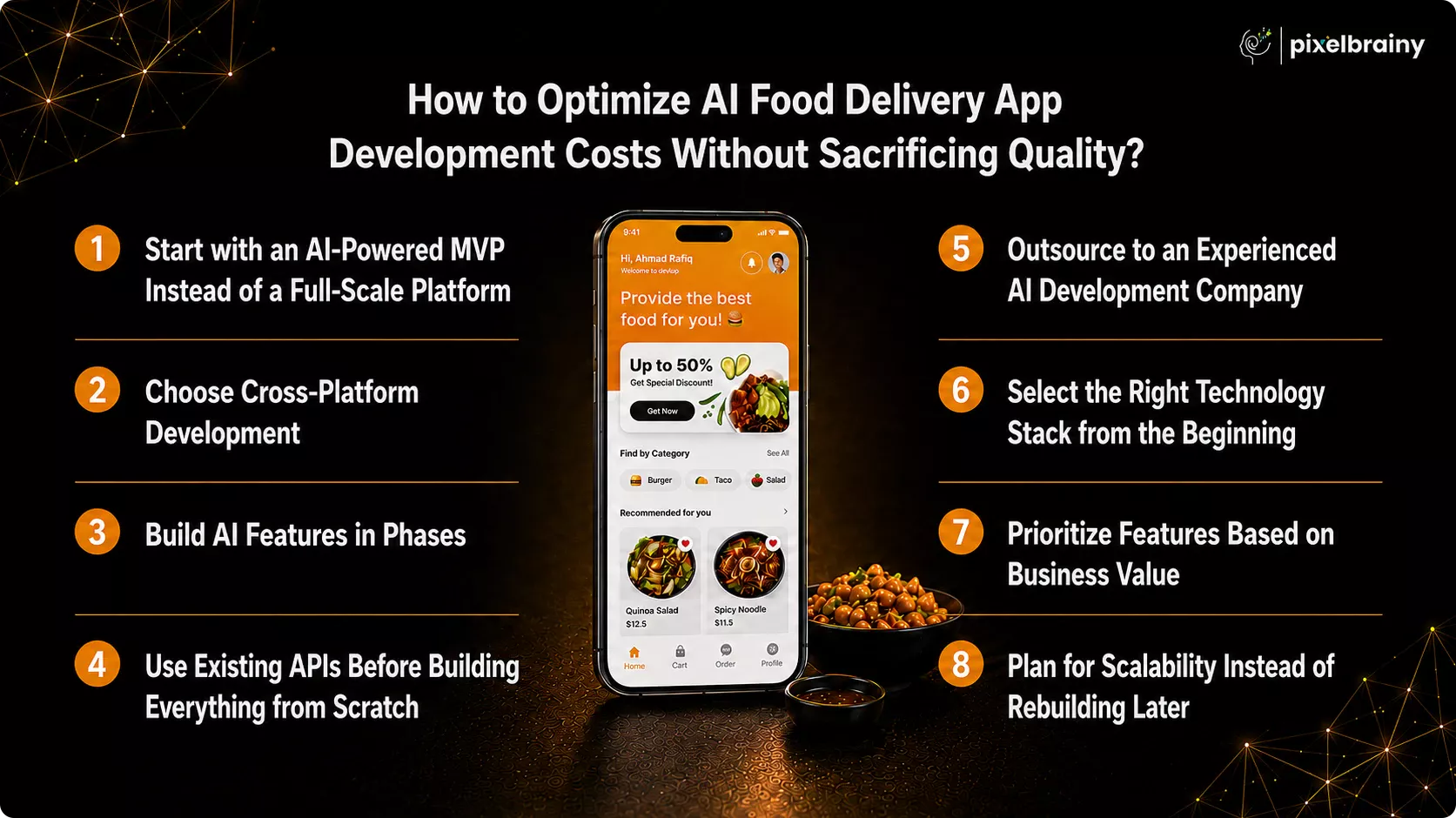
Launching with a Minimum Viable Product (MVP) allows you to validate your business idea before investing in advanced functionality. Rather than building every feature upfront, focus on the core customer journey and add AI capabilities gradually based on user feedback.
Potential Savings: 30% to 50% or $20,000 to $80,000+
You can reduce costs by:
Also Read: Top 10 AI MVP Development Companies in USA
Developing separate Android and iOS applications significantly increases development time and cost. Cross-platform frameworks allow one codebase to serve both platforms while maintaining excellent performance for most marketplace applications.
Potential Savings: 25% to 40% or $15,000 to $50,000+
You can optimize costs by:
Not every AI capability needs to be available on day one. Many successful startups launch with one high-impact AI feature and gradually expand as the platform grows.
Potential Savings: 20% to 35% or $10,000 to $40,000+
A phased AI roadmap might include:
Building every service internally increases both development time and engineering costs. Reliable third-party APIs can handle common functionality while your development team focuses on features that differentiate your platform.
Potential Savings: 15% to 30% or $8,000 to $30,000+
Consider using APIs for:
Hiring an in-house engineering team is expensive, especially for startups. Partnering with an experienced AI development companies provides immediate access to AI engineers, mobile developers, cloud architects, and QA specialists without recruitment overhead.
Potential Savings: 30% to 60% compared to building an in-house team.
You benefit from:
Choosing scalable technologies early prevents expensive redevelopment later. A well-planned architecture supports future AI features, additional users, and marketplace expansion without requiring major code rewrites.
Potential Savings: 10% to 25% in future redevelopment costs.
Best practices include:
Every additional feature increases the AI food delivery platform development cost. Before development begins, classify features as essential, important, or future enhancements so your budget is focused on delivering measurable business value.
Potential Savings: 20% to 40% or $15,000 to $60,000+
Prioritize:
Delay:
Many startups build applications that work well for a few hundred users but struggle when demand increases. Investing in scalable architecture early helps avoid costly migrations and infrastructure redesigns later.
Potential Savings: $20,000 to $100,000+ in future redevelopment expenses.
Prepare for growth by:
Optimizing the AI food delivery app development cost is about making strategic decisions, not choosing the cheapest option. By prioritizing high-impact features, leveraging existing technologies, and planning for long-term scalability, founders can significantly reduce development expenses while building a reliable, future-ready AI food delivery platform.
Building an AI-powered food delivery platform isn't just about reducing development expenses. It's about investing your budget where it creates the highest business value. At PixelBrainy, we help startups, restaurant brands, cloud kitchens, and food delivery businesses optimize their AI food delivery app development cost by focusing on scalable architecture, AI-first product planning, and efficient development strategies.
One question we hear frequently is:
"We're comparing multiple AI app development companies. How do we choose a partner that helps us reduce costs without sacrificing quality or scalability?"
The answer isn't choosing the cheapest quote. It's choosing a team that knows which features to build now, which to postpone, and how to avoid expensive redevelopment later.
Before development begins, we conduct a structured discovery workshop to understand your business goals and create a realistic AI food delivery app development budget.
During this phase, we focus on:
This approach helps eliminate unnecessary development work while ensuring your platform is ready for future growth.
A growing restaurant business approached PixelBrainy to build its own AI-powered food delivery platform and reduce dependency on third-party aggregators.
The initial feature list resulted in an estimated development cost of over $160,000.
Instead of building every feature in the first release, we restructured the roadmap into a scalable MVP with only the highest-priority functionality.
MVP Included
Results:
| Metric | Outcome |
| Initial Estimate | $160,000+ |
| MVP Investment | ~$75,000 |
| Development Cost Saved | Over 50% |
| Time to Launch | Under 5 Months |
The client launched faster, validated the business model, and planned future AI enhancements based on real customer behavior instead of assumptions.
Our goal is to reduce the cost to build AI food delivery app solutions without compromising performance or scalability.
Our expertise includes:
Whether you're building an MVP or a large-scale marketplace, we help you create a production-ready platform while keeping your AI food delivery platform development cost under control.
If you're planning an AI-powered food delivery app platform in budget and want to understand how much does it cost to build AI food delivery app in 2026, our team can help.
Let's Connect with PixelBrainy to receive a personalized cost estimate, feature roadmap, and practical recommendations to optimize your development budget from day one.

So, from this blog, it's clear that the AI food delivery app development cost is influenced by much more than just the number of features you want to build. Your AI capabilities, development approach, technology stack, team location, infrastructure, and long-term business goals all play a significant role in determining the final investment. While a basic MVP may cost around $30,000, a fully customized, enterprise-grade AI food delivery platform can exceed $200,000.
The key is not to build everything from day one, but to invest in the features that deliver the highest business value and create a roadmap for future growth. With proper planning, phased development, and the right technical partner, you can optimize the cost to build AI food delivery app solutions without sacrificing quality or scalability.
Whether you're validating a new startup idea or replacing third-party delivery platforms with your own solution, making informed decisions today will help you build a successful, future-ready AI food delivery platform while maximizing your development budget.
Ready to build your AI food delivery app? Schedule a free consultation with PixelBrainy to discuss your idea, receive a personalized cost estimate, and create a feature-wise development roadmap tailored to your business goals, timeline, and budget.
Yes. If you focus on essential features like customer ordering, restaurant management, driver tracking, payment integration, and one AI capability such as personalized recommendations, an MVP can often be built for $30,000 to $50,000. This approach reduces the AI food delivery app development cost while helping founders validate the business before investing in advanced features.
Hiring a US-based development company typically costs between $80,000 and $220,000+ for a production-ready AI food delivery platform. The final cost to build AI food delivery app solutions depends on AI complexity, marketplace features, supported platforms, integrations, and project scope.
For many restaurant groups, the answer is yes. While a custom platform requires a higher upfront investment, businesses processing large order volumes often recover development costs by reducing ongoing aggregator commissions. Building your own platform also gives you full ownership of customer data, branding, and revenue.
Adding AI features to an existing application usually costs $10,000 to $70,000+, depending on the functionality required. AI-powered recommendations, intelligent dispatch, demand forecasting, and customer personalization can often be integrated without rebuilding the entire platform, making upgrades more cost-effective for established businesses.
Businesses looking to optimize their AI food delivery app development budget often compare the USA, Eastern Europe, and South Asia. While US teams offer closer collaboration, Eastern Europe provides strong engineering expertise, and South Asia remains one of the most cost-effective regions for building high-quality AI food delivery platforms.
The most common mistake is budgeting only for initial development while overlooking recurring expenses such as cloud hosting, AI model usage, third-party APIs, maintenance, security updates, and future feature enhancements. These operational costs should be included from the beginning to avoid unexpected increases in the total AI food delivery app platform development cost.
The right choice depends on your business goals and budget. White-label platforms are suitable for validating ideas or launching quickly with limited investment. However, founders planning to build a multi-restaurant marketplace, own customer data, or differentiate with AI capabilities usually achieve better long-term ROI by investing in a custom AI food delivery app.

About The Author
Sagar Bhatnagar
Sagar Sahay Bhatnagar brings over a decade of IT industry experience to his role as Marketing Head at PixelBrainy. He's known for his knack in devising creative marketing strategies that boost brand visibility and market influence. Sagar's strategic thinking, coupled with his innovative vision and focus on results, sets him apart. His track record of successful campaigns proves his ability to utilize digital platforms effectively for impactful marketing efforts. With a genuine passion for both technology and marketing, Sagar continuously pushes PixelBrainy's marketing initiatives to greater success.

Working with the PixelBrainy team has been a highly positive experience. They understand the design requirements and create beautiful UX elements to meet the application needs. The dev team did an excellent job bringing my vision to life. We discussed usability and flow. Sagar worked with his team to design the database and begin coding. Working with Sagar was easy. He has the knowledge to create robust apps, including multi-language support, Google and Apple ID login options, Ad-enabled integrations, Stripe payment processing, and a Web Admin site for maintaining support data. I'm extremely satisfied with the services provided, the quality of the final product, and the professionalism of the entire process. I highly recommend them for Android and iOS Mobile Application Design and Development.

Great experience working with them. Had a lot of feedback and I found that unlike most contractors they were bugging me for updates instead of the other way around. They were extremely time conscience and great at communicating! All work was done extremely high quality and if not on time, early! They were always proactive when it comes to communication and the work is great/above par always. Very flexible and a great team to work with! Goes above and beyond to present us with multiple options and always provides quality. Amazing work per usual with Chitra. If you have UI/UX or branding design needs I recommend you go to them! Will likely work with them in the future as well, definitely recommended!

PixelBrainy is a joy to work with and is a great partner when thinking through branding, logo, and website layout. I appreciate that they spend time going into the "why" behind their decisions to help inform me and others about industry best practices and their expertise.

I hired them to design our software apps. Things I really like about them are excellent communication skills, they answer all project suggestions and collaborate right away, and their input on design and colors is amazing. This project was complex and needed patience and creativity. The team is amazing to do business with. I will be using them long-term. Glad to see there are some good people out there. I was afraid to try and outsource my project to someone but I am glad I met them! I really can't say enough. They went above and beyond on this project. I am very happy with everything they have done to make my business stand out from the competition.

It was great working with PixelBrainy and the team. They were very responsive and really owned the project. We'll definitely work with them again!

I recently worked with the PixelBrainy team on a project and I was blown away by their communication skills. They were prompt, clear, and articulate in all of our interactions. They listened and provided valuable feedback and suggestions to help make the project a success. They also kept me updated throughout the entire process, which made the experience stress-free and enjoyable.

PixelBrainy is very good at what it does. The team also presents themselves very professionally and takes care of their side of things very well. I could fully trust them taking up the design work in a timely and organised manner and their attention to detail saved us lots of effort and time. This particular project was quite intense and the team showed that they function very well under pressure. Very much looking forward to working with her again!

It's always an absolute pleasure working with them. They completed all of my requests quickly and followed every note I had for them to a T, which made our process go smoothly from start to finish. Everything was completed fast and following all of the guidelines. And I would recommend their services to anyone. If you need any design work done in the future, PixelBrainy should be your first call!

They took ownership of our requirements and designed and proposed multiple beautiful variants. The team is self-motivated, requires minimum supervision, committed to see-through designs with quality and delivering them on time. We would definitely love to work with PixelBrainy again when we have any requirements.

PixelBrainy was a big help with our SaaS application. We've been hard at work with a new UI/UX and they provided a lot of help with the designs. If you're looking for assistance with your website, software, or mobile application designs, PixelBrainy and the team is a great recommendation.

PixelBrainy designers are amazing. They are responsive, talented, and always willing to help craft the design until it matches your vision. I would recommend them and plan to continue them for my future projects and more!!!

They were awesome! Did a good job fast, and good communication. Will work with them again. Thank you

Creative, detail-oriented, and talented designers who take direction well and implement changes quickly and accurately. They consistently over-delivered for us.

PixelBrainy team is very talented and creative. Great designers and a pleasure to work with. PixelBrainy is an excellent communicator and I look forward to working with them again.

PixelBrainy has a very talented design team. Their work is excellent and they are very responsive. I enjoy working with them and hope to continue on all of our future projects.


Transform your ideas into reality with us.
Across these industries, each engagement brings unique challenges, from early-stage product development to scaling complex systems, helping us build a practical understanding of real-world product environments.