AI Summary Powered by PixelBrainy
Have you ever wondered how brands like Instacart, Amazon Fresh, or Walmart+ manage to deliver groceries so quickly and efficiently? The answer lies in AI Grocery Delivery Apps, which use advanced intelligence to optimize delivery routes, forecast demand, and offer personalized shopping experiences.
As modern consumers expect faster, smarter, and more convenient solutions, businesses are increasingly turning to AI Grocery Delivery App Development to stay competitive. Integrating Artificial Intelligence is no longer optional — it is a necessity for scaling operations, improving user satisfaction, and maximizing profitability.
Building an AI-powered grocery delivery app goes beyond traditional coding. It involves strategically using AI to streamline inventory management, enhance customer engagement, and create predictive systems that evolve with data. Whether you are a startup planning to enter the online grocery market or an established retailer looking to innovate, learning how to create an AI Grocery Delivery App can redefine how you serve customers and manage your business.
In this comprehensive guide, you will get:
By the end of this guide, you’ll clearly understand how AI Grocery Delivery App Development can revolutionize your business and prepare you for the future of retail innovation.
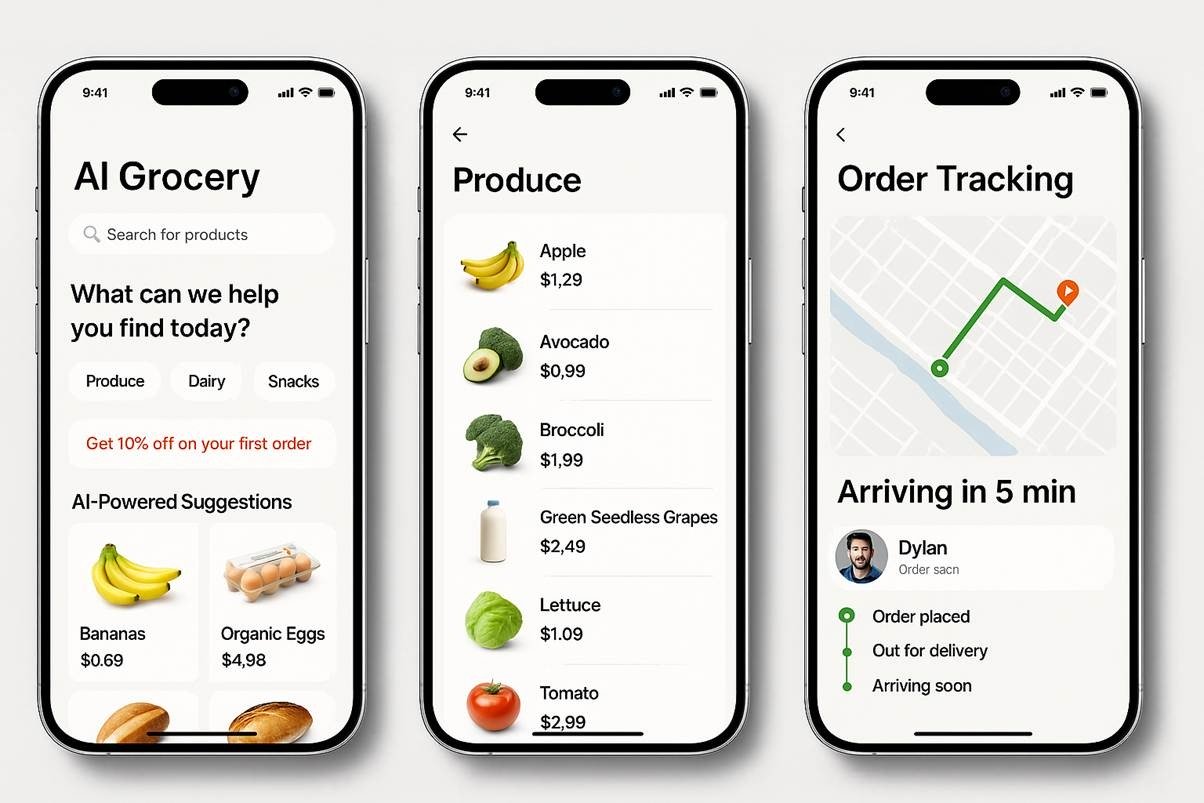
An AI Grocery Delivery App is a smart platform that uses Artificial Intelligence to enhance the entire grocery shopping and delivery process. It collects and analyzes user data to provide personalized product recommendations, predict demand, and optimize delivery routes. Unlike traditional apps, AI-driven systems continuously learn from user behavior to improve accuracy and efficiency.
These apps automate inventory management, adjust prices dynamically, and offer instant customer support through chatbots or voice assistants. For businesses, AI ensures cost reduction, faster deliveries, and improved customer satisfaction. For users, it delivers convenience, personalization, and reliability.
In simple terms, an AI Grocery Delivery App transforms ordinary grocery shopping into an intelligent, data-driven experience that benefits both retailers and customers through automation, prediction, and personalization.
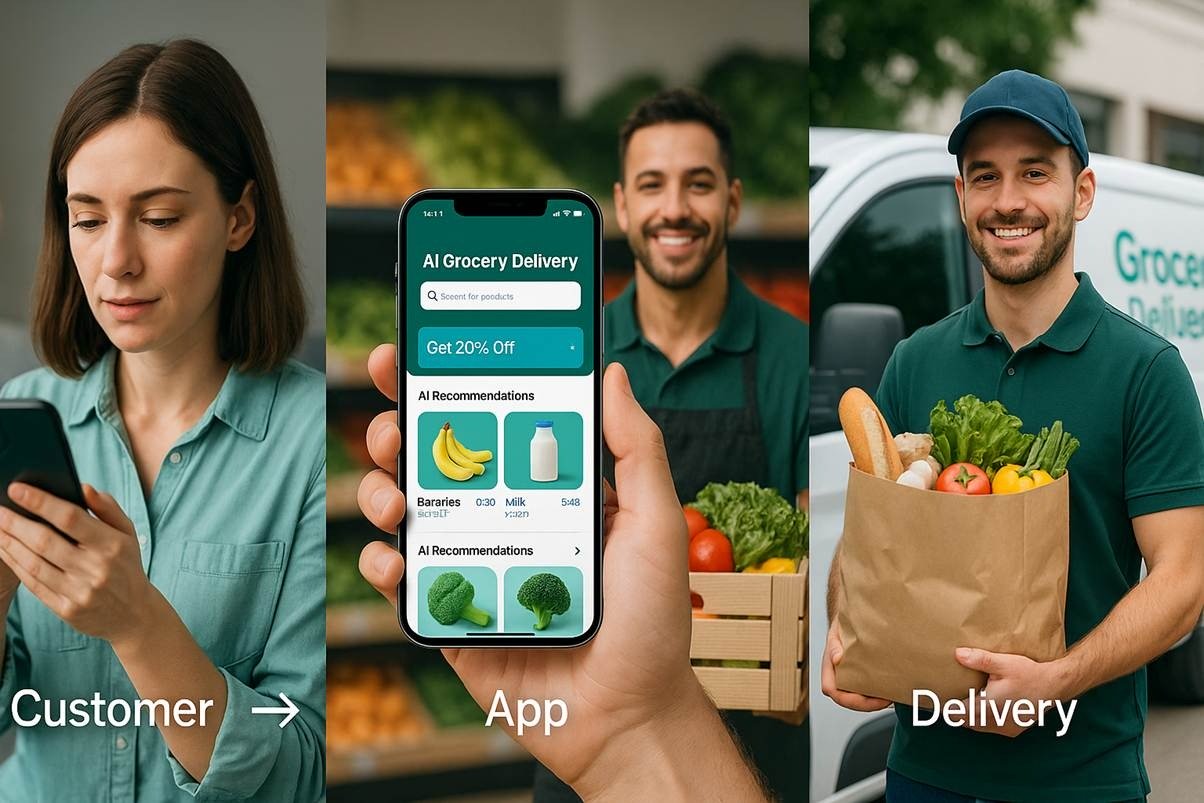
Developing an AI Grocery Delivery App is all about making the shopping and delivery process smarter and easier for both customers and businesses. Instead of handling everything manually, Artificial Intelligence helps automate tasks and make better decisions.
Here’s how it works in real life:
According to a 2025 report by Mordor Intelligence, the global online grocery delivery market is projected to reach USD 0.75 trillion in 2025 and grow to USD 2.07 trillion by 2030, showing a strong CAGR of 22.25%.
With this rapid growth, investing in an AI Grocery Delivery App has become a strategic move for businesses that aim to stay relevant and competitive in a tech-driven marketplace. Below are the core reasons to invest in this innovation:
Customers now expect convenience, personalization, and speed. An AI-integrated grocery delivery app allows you to meet these expectations by creating a smarter and more responsive shopping experience.
AI helps automate critical tasks such as order handling, inventory tracking, and delivery scheduling. This reduces manual errors, minimizes delays, and increases overall operational efficiency.
Every order and interaction generates valuable insights. Investing in AI tools enables you to analyze shopping patterns, forecast demand, and plan business strategies based on real data instead of assumptions.
As your customer base grows, manual processes can hold you back. AI-powered automation supports expansion while maintaining consistent service quality and faster delivery times.
Early adopters of AI solutions can build a long-term advantage by offering predictive ordering, personalized recommendations, and real-time customer engagement that competitors struggle to match.
The retail industry is rapidly embracing automation and data intelligence. Investing in AI Grocery Delivery App Development ensures your business stays ready for emerging trends like drone delivery, voice ordering, and hyper-personalized shopping.
A well-planned investment in AI Grocery Delivery App Development today is the key to building a future-ready, scalable, and competitive grocery business tomorrow.
Developing an AI Grocery Delivery App is not just a technology upgrade but a smart business move that improves how grocery operations run and how customers experience shopping. The integration of Artificial Intelligence gives companies the ability to analyze data, predict needs, and serve customers in smarter, faster, and more personalized ways.
Here are the major advantages of AI Grocery Delivery App development that make it a must-have solution for modern businesses:
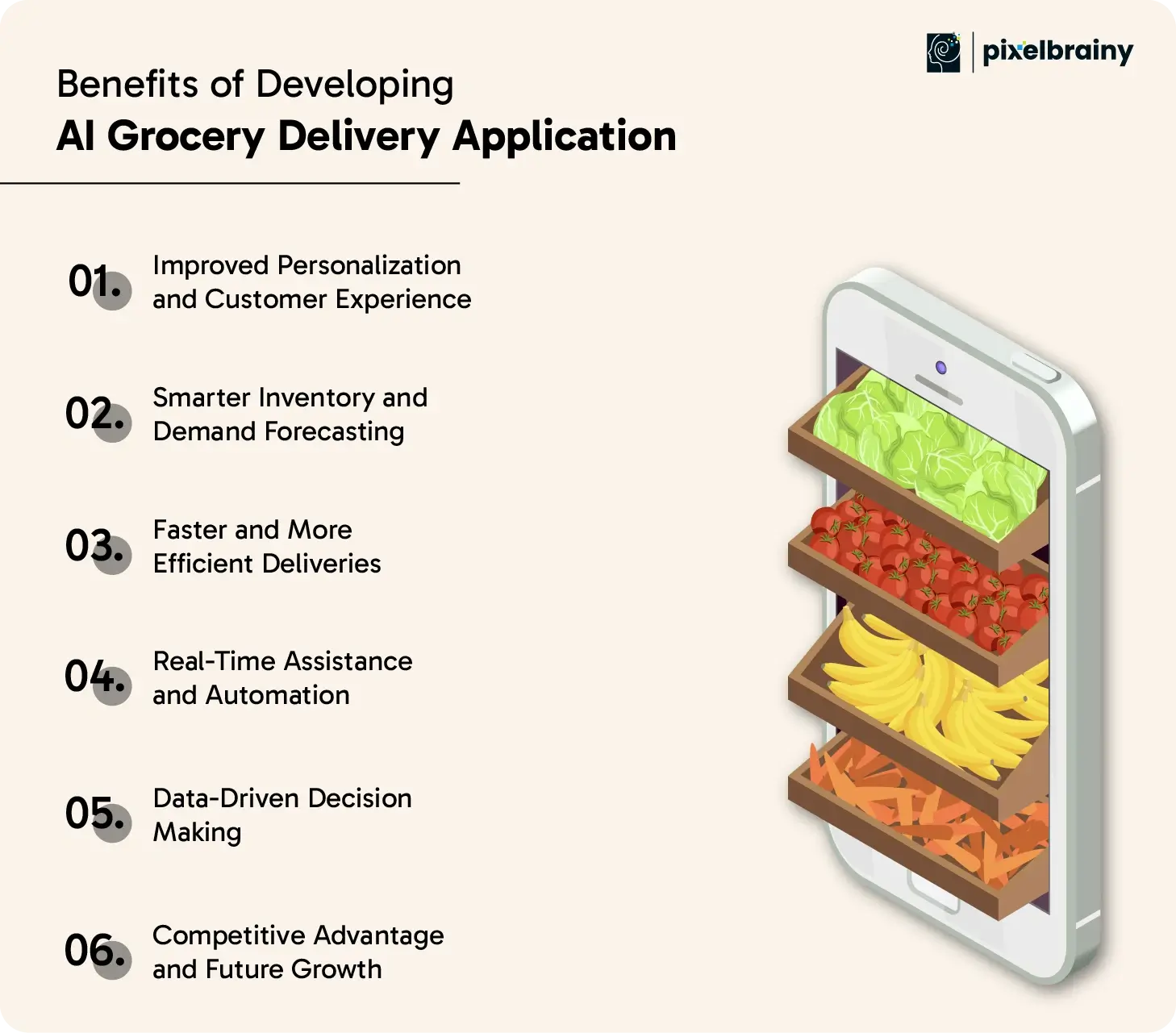
When you build an AI Grocery Delivery App, you are designing a system that understands your customers like never before. AI analyzes each user’s buying patterns, product preferences, and even dietary restrictions to provide accurate and personalized product recommendations.
Imagine a customer who buys organic fruits every week. The app can automatically suggest new arrivals, special offers, or related items like fresh juices or smoothies. This personalization keeps users engaged and increases customer loyalty over time.
Additionally, personalization goes beyond just product suggestions. AI can tailor push notifications, special discounts, and delivery timing preferences based on user behavior, ensuring every shopper feels valued and understood.
AI makes inventory management more intelligent and predictive. Instead of reacting to shortages or surpluses, your app can anticipate them before they happen. Machine learning algorithms monitor product movement, historical sales, and seasonal trends to estimate future demand accurately.
This predictive approach ensures that popular items never run out of stock while slow-moving products are not overstocked. Businesses that focus on developing an AI Grocery Delivery App can drastically reduce waste, lower storage costs, and improve profitability.
Furthermore, AI enables real-time alerts for inventory managers. For example, when stock levels fall below a set threshold, the system automatically recommends reorder quantities or triggers supplier notifications.
One of the most impactful advantages of AI Grocery Delivery App development is the ability to enhance delivery speed and efficiency. AI optimizes delivery routes by analyzing live traffic, weather conditions, and distance. It assigns orders to drivers who can fulfill them fastest, ensuring customers receive their groceries on time.
This smart routing reduces fuel consumption and operational costs while maintaining punctuality. When you create an AI Grocery Delivery App, you’re not just building a delivery system — you’re constructing a network that continually learns and improves logistics performance.
Moreover, AI can predict peak hours or busy delivery zones, allowing businesses to plan additional resources or adjust routes dynamically to avoid delays.
AI chatbots and voice assistants have revolutionized customer service in grocery delivery apps. They provide real-time responses to common questions such as order tracking, delivery updates, and payment confirmations. This eliminates waiting time and ensures 24/7 customer support.
For customers, it means immediate help and smooth interactions. For businesses, it reduces the workload on human agents and minimizes operational costs. By developing an AI Grocery Delivery App that integrates automated support systems, companies can handle thousands of customer requests simultaneously without compromising service quality.
Additionally, voice-enabled assistants are becoming increasingly popular, allowing users to place orders or check delivery status using natural language commands, making the process more accessible and convenient.
Data is the new currency of business, and AI ensures it is put to good use. Every action on your app — from clicks and searches to orders and reviews — provides valuable insights. AI analytics tools can process this data to identify trends, forecast demand, and measure marketing performance.
By doing so, businesses can make well-informed decisions about pricing strategies, promotions, and inventory planning. For instance, if AI detects that customers in a certain location buy more organic produce, the store can focus its stock accordingly.
When you build an AI Grocery Delivery App, you gain visibility into your operations through detailed dashboards and predictive reports. This helps in optimizing resources, improving sales performance, and boosting return on investment (ROI).
The grocery delivery market is highly competitive, and early adopters of AI technology enjoy a distinct advantage. AI empowers your business with automation, personalization, and predictive intelligence that competitors without such tools cannot easily match.
When you develop an AI Grocery Delivery App, you create a future-ready platform capable of evolving with emerging trends like drone deliveries, smart home integration, and voice commerce.
Additionally, customers are more likely to choose brands that offer fast, intelligent, and reliable service. AI ensures you stay ahead by providing a user experience that blends technology with human-like understanding, strengthening your brand position for long-term success.
From these reasons, it is clear that developing an AI Grocery Delivery App is the smartest way for businesses to stay competitive, efficient, and future-ready in the growing online grocery market.
Creating a successful grocery delivery platform begins with integrating features that ensure a seamless shopping experience and smooth business operations. When you develop an AI Grocery Delivery App, these features form the foundation that connects customers, stores, and delivery teams efficiently.
Below are the must-have features for AI Grocery Delivery App development, designed to enhance usability, performance, and satisfaction for both users and administrators.
| Feature | Description |
| User Registration & Profile Management | Simplifies user onboarding with login via email, phone, or social media. AI can tailor experiences by learning from user activity and preferences. |
| Smart Search & Product Filtering | Helps users find products easily through keyword search, filters, and suggestions. AI refines results based on shopping history and behavior. |
| Personalized Recommendations | Suggests products that match users’ interests and previous purchases, enhancing engagement and conversion rates. This is one of the key advantages of AI Grocery Delivery App development. |
| Real-Time Order Tracking | Provides customers with live updates on order preparation, dispatch, and estimated delivery time for better transparency. |
| Multiple Payment Options | Supports secure transactions via debit or credit cards, wallets, UPI, and cash on delivery, improving flexibility and user convenience. |
| Smart Cart Management | Automatically adds frequently bought products, applies coupons, and sends reminders for incomplete carts. |
| Push Notifications | Sends personalized alerts about order updates, special discounts, and product restocks to keep customers engaged. |
| Ratings and Reviews System | Builds trust by allowing customers to share feedback about products and delivery experiences directly within the app. |
| Delivery Partner Management | Helps businesses manage delivery personnel, optimize routes, and ensure timely deliveries. |
| In-App Chat Support | Offers instant customer support through chatbots or human agents, improving response times and user satisfaction. |
| Loyalty Programs & Reward Points | Encourages customer retention through loyalty points, cashback, and personalized offers for frequent shoppers. |
| Smart Inventory Management | Uses AI to forecast product demand, track stock levels, and prevent overstocking or shortages. |
| AI-Powered Analytics Dashboard | Gives business owners insights into sales performance, customer trends, and inventory data in real time. |
| Multilingual & Multi-Currency Support | Enables the app to serve a broader audience across regions and languages, enhancing accessibility. |
| Secure Authentication & Data Privacy | Protects user information through strong encryption and multi-layered security protocols. |
Integrating these must-have features while you build an AI Grocery Delivery App ensures efficiency, customer satisfaction, and long-term business growth.
Once your app includes the essential components, you can add advanced AI-driven features to give it a competitive edge. These innovations enhance automation, personalization, and operational intelligence, transforming your grocery app into a smarter platform.
Here are the advanced features to consider while building an AI Grocery Delivery App to make your platform future-ready and user-focused.
| Advanced Feature | Description |
| Voice Ordering System | Enables customers to place orders using voice commands for a faster and more convenient experience. Perfect for multitasking users. |
| Image Recognition Search | Lets users upload or scan product photos to find similar items instantly, improving the accuracy of search results. |
| Predictive Reordering | AI studies user behavior to predict when customers might need a restock and automatically reminds them or reorders items. |
| Dynamic Pricing Optimization | Adjusts pricing intelligently based on market trends, demand, and availability to balance customer satisfaction and profitability. |
| AI Chatbots with Sentiment Analysis | Understands customer tone and intent to deliver empathetic, human-like support that improves customer relationships. |
| Route Optimization with Real-Time Updates | Analyzes traffic, distance, and delivery load to plan the most efficient delivery routes, ensuring timely deliveries. |
| Augmented Reality (AR) Product View | Provides a 3D view of grocery items, helping customers virtually check product quality before purchase. |
| Fraud Detection & Prevention System | Uses AI to monitor transactions, detect suspicious activity, and safeguard both customers and businesses. |
| Smart Home Integration | Connects the app with voice assistants like Alexa or Google Home to enable hands-free ordering and tracking. |
| AI-Based Customer Segmentation | Divides customers into targeted groups based on preferences, purchase frequency, and spending habits to personalize marketing campaigns. |
Adding these advanced AI features in grocery delivery app development not only enhances user experience but also ensures your business remains innovative and future-ready.
If you’re planning and wondering what is the process to build AI Grocery Delivery App, it involves several carefully planned stages that combine design, strategy, and technology. Each step plays a critical role in transforming a basic concept into a powerful, AI-driven grocery delivery solution that meets user needs and drives business growth.
Below is a detailed explanation of each stage involved in AI Grocery Delivery App Development, from idea validation to full-scale deployment.
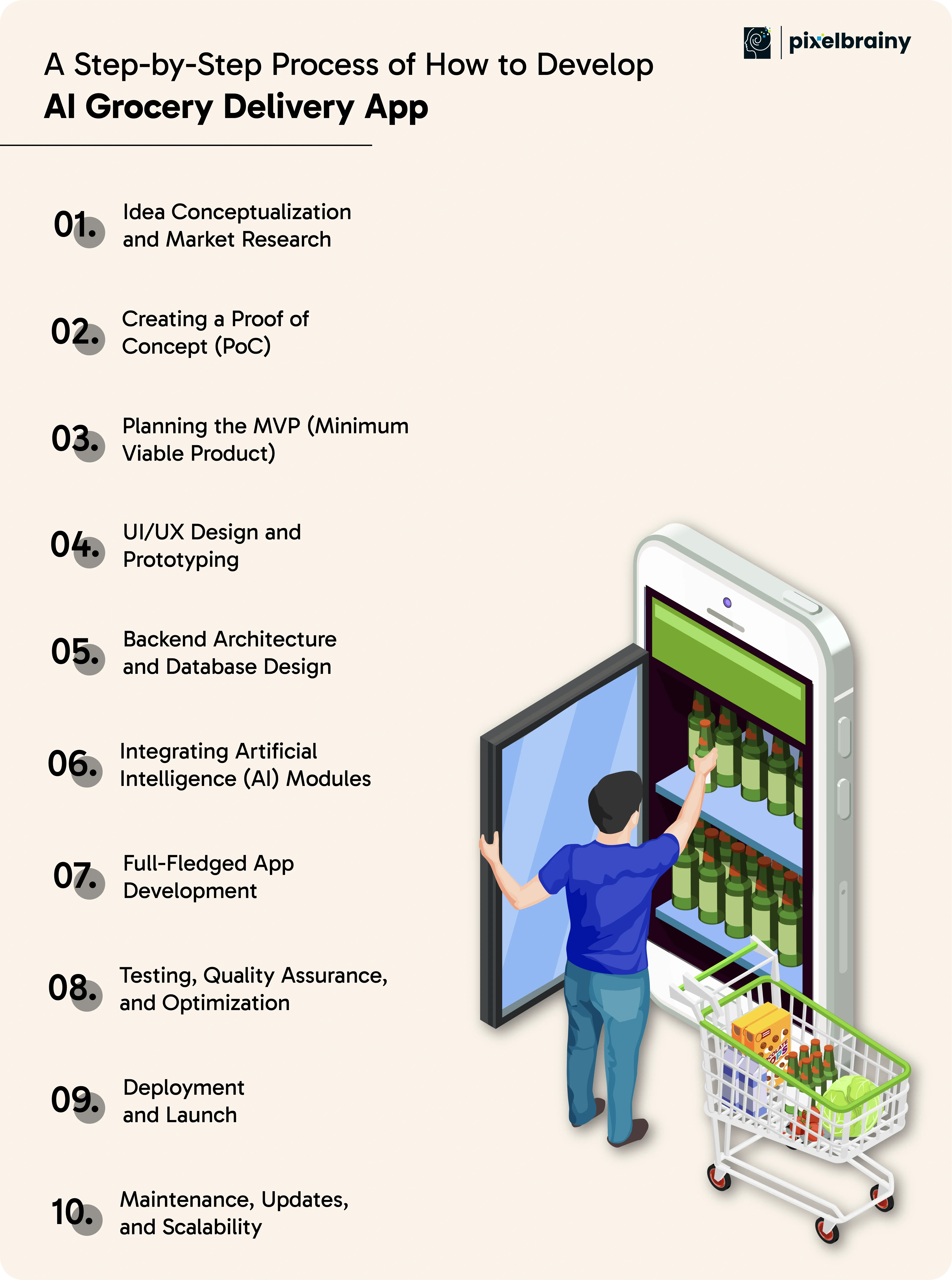
The first step in the development of AI Grocery Delivery App is defining your concept and understanding market demand. Start by identifying your target audience, competition, and business model. Research what customers expect from a grocery app and what pain points remain unaddressed.
Analyze the features and technologies used by existing market leaders like Instacart and Walmart+. This step sets a strong foundation for designing a product that stands out and delivers unique value to users.
Before diving into large-scale development, it is crucial to validate your idea with a PoC (Proof of Concept). A PoC helps you test whether integrating AI technology can genuinely improve user experience, recommendation systems, and logistics.
This stage saves time and investment by ensuring your app’s core functionalities are feasible and capable of achieving your business goals. It helps investors and stakeholders visualize the potential of your project early on.
Once your PoC is successful, the next step is creating an MVP version of your grocery delivery app. The MVP development includes only the essential features required for initial release, allowing you to collect user feedback and performance data before expanding.
The MVP phase is crucial to validate real-world usability and customer interaction with AI-driven features like smart search, order tracking, and personalized recommendations. The feedback collected during this stage guides the improvements for the full product.
Design is at the heart of user engagement. Partnering with a UI/UX Design Company ensures that your app interface is clean, intuitive, and visually aligned with your brand.
In this stage, wireframes, mockups, and interactive prototypes are created to visualize the layout, flow, and design interactions. A well-designed user experience encourages customers to explore and complete purchases smoothly, reducing bounce rates and increasing retention.
A robust backend structure ensures smooth data flow between users, stores, and delivery partners. During this stage, developers select the right framework and databases to manage high volumes of transactions and real-time updates.
The system is designed for scalability, security, and performance, which allows seamless integration of AI functionalities such as route optimization, recommendation engines, and predictive analytics.
The most crucial part of AI Grocery Delivery App Development Integrating AI involves embedding machine learning algorithms into the system. AI modules handle tasks like customer behavior prediction, personalized product suggestions, dynamic pricing, and delivery optimization.
Developers train AI models using large datasets to ensure accuracy and reliability. This integration transforms the app into an intelligent platform that learns continuously and adapts to user behavior.
After AI integration, developers move to the Full fledge development phase, where the complete app is built with all user, admin, and delivery modules.
The front-end, back-end, and AI systems are merged, ensuring that every feature functions seamlessly. This stage also involves integrating APIs for payment gateways, location tracking, and push notifications. Testing is performed in parallel to ensure functionality across devices and platforms.
Rigorous testing is carried out to identify and fix bugs, performance issues, or usability flaws. Both manual and automated testing methods ensure the app delivers a smooth and secure experience.
AI models are evaluated for accuracy and performance to ensure that recommendations, route suggestions, and other predictive functions are reliable. The app is optimized to perform efficiently under high traffic conditions.
Once testing is complete, the app is deployed to app stores and cloud servers for users to download and access. Deployment also includes setting up server monitoring, error tracking, and performance analytics.
A strategic launch plan with marketing efforts helps create early traction. Early users provide valuable insights for post-launch updates and enhancements.
App development doesn’t end with the launch. Regular updates, new feature releases, and system monitoring ensure that your app stays relevant and secure.
Continuous AI training ensures that the algorithms improve over time, adapting to changing customer patterns. Businesses often collaborate with the top AI development companies in USA to maintain quality, scalability, and long-term innovation.
Following this structured process to make AI Grocery Delivery App ensures you build a scalable, intelligent, and customer-centric platform capable of succeeding in the fast-evolving online grocery industry.
Also Read: A Comprehensive Guide To AI Mobile App Development
Estimating the cost to build a mobile app for AI grocery delivery is essential for proper budgeting and planning. According to recent industry data, the cost to build a grocery delivery app ranges from USD 20,000 to USD 200,000+, depending on scope, platform, and complexity.
Below is a breakdown of cost tiers that reflect what you might expect based on your app’s development level.
| Tier / Complexity | Typical Cost Range | What You Get |
| Basic AI Grocery Delivery App | USD 20,000 – USD 50,000 | This includes core functionalities: customer app, basic delivery tracking, payment integration and simple UI. Suitable for startups testing the market |
| Medium AI Grocery Delivery App | USD 50,000 – USD 120,000 | Adds more advanced features: AI-based recommendations, improved inventory module, multi-platform (iOS and Android), stronger analytics and more polish |
| Advanced AI Grocery Delivery Mobile App | USD 120,000+ – USD 200,000+ or more | This level is for full-scale solutions with rich AI/ML integrations (predictive forecasting, dynamic pricing, voice/AR features), enterprise-grade backend, high scalability and premium UI/UX |
Understanding the cost breakdown helps you set realistic expectations and choose the right tier for your business when planning AI Grocery Delivery App Development.
Building a powerful and scalable grocery delivery platform means selecting the right tools and technology stack. Whether you are targeting iOS, Android, or both, the choice of frontend frameworks, backend architecture, databases, AI modules, and integrations will determine how well your app performs, how fast it can grow, and how easily you can add features.
Here’s a detailed breakdown of the recommended tools and tech stack for AI Grocery Delivery App Development:
| Layer | Recommended Technologies & Tools | Why It Matters |
| Frontend (Mobile) | Frameworks such as React Native, Flutter or native Swift (iOS) and Kotlin (Android) | Enables cross-platform development or native performance, reducing time and cost while ensuring UX quality |
| Backend & API | Node.js, Python (Django or Flask), Java (Spring Boot) | These provide scalable, robust server environments for handling user requests, orders, and delivery workflows |
| Database | PostgreSQL, MongoDB, Redis, Cassandra | Manages structured and unstructured data (users, orders, products), supports high load and real-time queries |
| AI / ML Tools | TensorFlow, PyTorch, Scikit-learn, Apache Spark | Powers recommendation engines, demand forecasting, delivery route optimization and intelligent analytics |
| Cloud & DevOps | AWS, Google Cloud Platform, Microsoft Azure, Docker, Kubernetes | Facilitates scalability, high availability, and deployment of microservices architecture for growth |
| Real-Time Services | WebSockets, Firebase Realtime Database, Pusher | Ensures live updates for order status, delivery tracking, notifications and interactive UI elements |
| Mapping & Location | Google Maps API, Mapbox, OpenStreetMap | Critical for accurate delivery tracking, driver routing, geofencing and proximity-based services |
| Payment & Billing | Stripe, PayPal, Braintree, Razorpay | Secures transactions, supports multiple payment methods and ensures compliance with financial regulations |
| Notification & Chat | Twilio, Firebase Cloud Messaging (FCM), SendGrid | Provides reliable push notifications, chat support and SMS communications for high-quality user engagement |
| Security & Auth | OAuth 2.0, JWT (JSON Web Tokens), SSL/TLS encryption | Protects user data, ensures secure authentication and meets data protection standards for compliance |
Selecting the right tools and tech stack for your to create AI Grocery Delivery App initiative lays the foundation for fast growth, operational reliability and a superior user experience.
Monetization is a crucial aspect of any digital platform, and an AI Grocery Delivery App offers multiple income streams that can generate consistent revenue while adding value to customers and partners. By leveraging Artificial Intelligence, businesses can create personalized and data-driven strategies that maximize profits and ensure long-term sustainability.
Below are the most effective methods on how to make money from AI Grocery Delivery App in today’s competitive grocery delivery market.
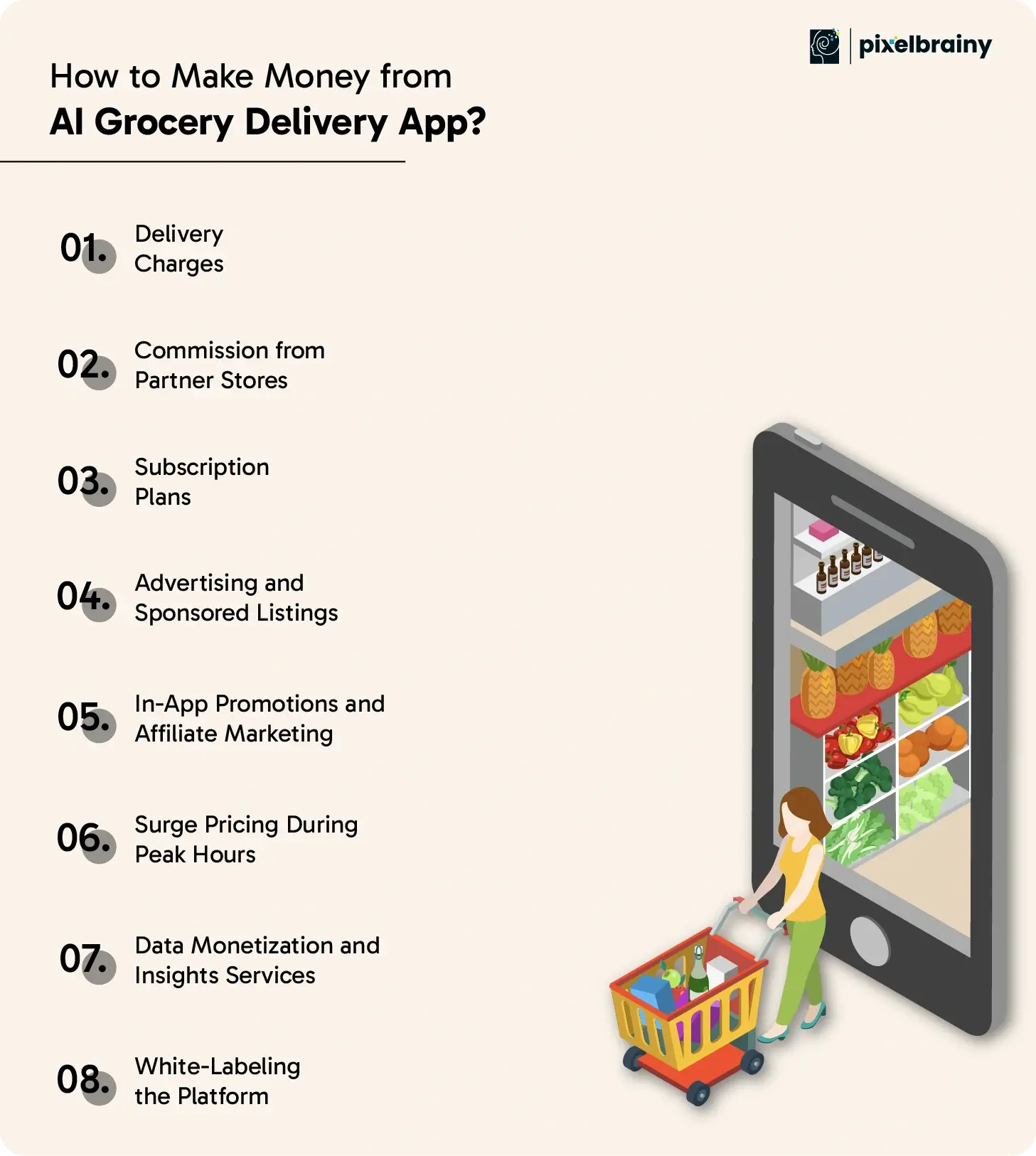
One of the most straightforward ways to earn revenue is by applying a small delivery fee on every order. Many apps implement variable pricing based on distance, order value, or delivery speed. AI can analyze factors like traffic, peak times, and delivery routes to optimize costs while maintaining profitability.
This model works best for startups and regional delivery platforms that aim to build a steady cash flow.
In this model, grocery stores and supermarkets pay a commission for every order placed through your platform. The app serves as a digital marketplace connecting customers to multiple vendors.
AI helps automate commission calculations and manage vendor performance. The more sellers you onboard, the higher your recurring revenue potential.
Subscription-based models provide stable monthly or annual income. Customers can subscribe to premium plans offering free deliveries, exclusive discounts, or early access to limited deals.
This approach also encourages loyalty, as subscribers tend to order more frequently. AI can help personalize subscription offers based on customer behavior and purchasing patterns, increasing conversion rates.
Advertising is one of the most profitable monetization methods for grocery delivery apps. Partner brands and stores can pay to display their products or promotions at the top of search results or home screens.
AI algorithms determine which ads to show to which users, ensuring relevance and higher click-through rates. Sponsored placements can be customized based on geography, purchase history, and user interests.
By collaborating with third-party brands, your app can promote related products such as kitchen appliances, meal kits, or wellness goods. For each successful referral or purchase, you earn a commission.
AI enhances affiliate campaigns by analyzing customer data and recommending the right offers to the right audience, maximizing sales and profitability.
Similar to ride-sharing platforms, grocery delivery services can apply surge pricing during high-demand periods like holidays or weekends. AI predicts demand spikes and dynamically adjusts delivery fees to balance order volume and profitability.
This ensures faster delivery service while increasing revenue during busy hours.
With proper user consent and data privacy compliance, businesses can use anonymized analytics to provide insights to partner brands. For example, aggregated purchasing data can help suppliers forecast demand or plan marketing campaigns.
This creates an additional revenue channel while improving the value proposition of your app ecosystem.
Once your AI Grocery Delivery App Development is established, you can license your platform to other businesses or entrepreneurs under a white-label model. They pay for using your app infrastructure while you earn ongoing licensing fees.
This approach is ideal for scaling your business without additional operational overhead.
A well-planned monetization strategy ensures that your investment in developing an AI Grocery Delivery App not only enhances customer experience but also builds a sustainable and profitable business model for the long run.
Also Read: AI App Development Cost: From MVPs to Full-Scale AI App
While the benefits of AI Grocery Delivery App Development are undeniable, businesses often face several challenges when integrating Artificial Intelligence into grocery delivery operations. These challenges can affect performance, scalability, and user trust if not addressed properly.
Below are the most common obstacles faced during the development of AI Grocery Delivery App and practical solutions to overcome them.
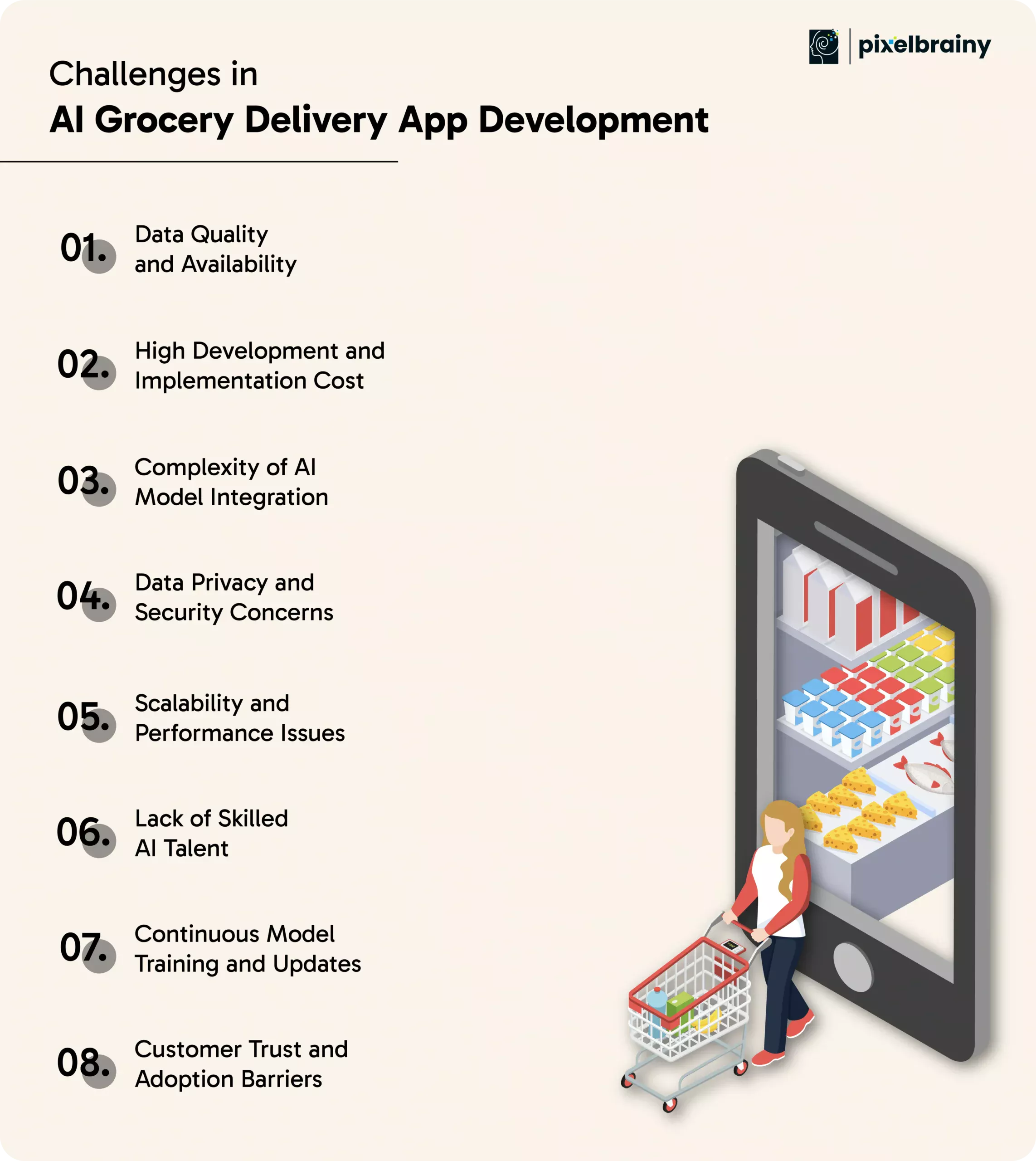
Challenge: AI thrives on data. Without large volumes of high-quality, well-labeled data, the AI algorithms cannot make accurate predictions or recommendations. Many startups struggle to collect diverse and clean data for training their models.
Solution: Start with small datasets and expand gradually. Partner with data providers or use synthetic data generation tools to train models efficiently. Regularly clean and update datasets to maintain accuracy. Implement automated data validation systems to ensure ongoing data reliability.
Challenge: Integrating AI into grocery delivery apps can be expensive due to the cost of technology, cloud infrastructure, and data processing. The price to develop AI Grocery Delivery App varies significantly depending on features and complexity.
Solution: Begin with an MVP (Minimum Viable Product) focusing on core AI features like recommendation engines or delivery route optimization. As your business grows, scale up gradually. Choosing cloud-based AI services such as AWS AI or Google Cloud ML can reduce initial costs and maintenance expenses.
Challenge: Integrating AI algorithms into a live grocery delivery system can be technically complex. AI modules need to interact seamlessly with order management, user interfaces, and logistics systems.
Solution: Use modular architecture that allows AI components to be added or updated independently. Collaborate with experienced AI engineers or top AI development companies in USA to ensure smooth integration and scalability.
Challenge: Handling sensitive customer data, such as payment details and location history, poses serious privacy challenges. Non-compliance with data protection regulations can lead to legal risks.
Solution: Implement encryption protocols, token-based authentication, and strict access controls. Ensure compliance with GDPR and other regional data protection standards. Building user trust through transparent data policies is essential for long-term success.
Challenge: As the user base grows, the system must handle higher traffic, complex transactions, and real-time analytics without slowing down. Scalability becomes a major issue for growing businesses.
Solution: Adopt cloud infrastructure and microservices architecture to distribute workloads efficiently. Use load balancing, caching, and AI optimization techniques to maintain consistent performance.
Challenge: Finding developers skilled in AI, ML, and data science can be difficult and costly. The shortage of specialized talent delays development and impacts innovation.
Solution: Partner with professional AI development firms or outsourcing agencies. Invest in training your existing technical team on AI frameworks like TensorFlow or PyTorch. Collaborating with a UI/UX Design company experienced in AI-driven platforms can also enhance the overall experience.
Challenge: AI models are not static. They need continuous updates based on new customer data, trends, and changing shopping behaviors. Without retraining, the app’s predictions may become outdated.
Solution: Set up an automated machine learning (AutoML) pipeline to monitor model accuracy and retrain models regularly. Continuous learning ensures that your AI app remains adaptive and relevant.
Challenge: Some users may hesitate to trust AI-driven recommendations or automated systems, fearing inaccuracies or privacy issues. Lack of awareness about how AI works can slow adoption.
Solution: Educate users through in-app tutorials, transparency about AI’s role, and options to personalize their preferences. When users experience accuracy and convenience firsthand, trust naturally increases.
Overcoming these challenges strategically not only simplifies developing an AI Grocery Delivery App but also ensures a reliable, scalable, and customer-focused platform that stands out in the competitive grocery delivery market.
The world of AI Grocery Delivery App Development is evolving rapidly as technology continues to shape consumer behavior and redefine digital convenience. Businesses that stay ahead of these trends will not only meet customer expectations but also set new standards for innovation in the grocery delivery industry.
Here are the key future trends that will define the next generation of grocery delivery apps:
Future apps will move beyond simple product recommendations to full predictive shopping experiences. AI will anticipate what users need before they even search for it, based on their consumption patterns, household size, and purchase frequency.
This proactive model will help users save time while boosting order value and retention for businesses.
Personalization will reach new levels as deep learning models analyze not only past purchases but also user intent, lifestyle, and context. Grocery apps will offer tailored meal plans, diet-based recommendations, and smart shopping lists that change dynamically based on user goals.
This kind of personalization will transform grocery delivery from a transactional process into a truly adaptive experience.
The future of logistics is automation. Many companies are already testing autonomous vehicles and drones for faster, contactless grocery delivery. Integration with AI will help these systems optimize routes, manage delivery timing, and enhance safety.
As these technologies become more affordable and regulated, they will revolutionize last-mile delivery in urban and suburban markets.
Voice-enabled grocery ordering through devices like Alexa, Siri, or Google Assistant will become standard. Users will simply say, “Order my weekly groceries,” and the AI system will automatically curate and process the order.
This hands-free experience will appeal to busy customers and strengthen brand loyalty for apps that invest in seamless voice integration early.
Sustainability will play a major role in the development of AI Grocery Delivery App platforms. AI will optimize delivery routes to reduce fuel consumption, monitor packaging waste, and suggest eco-friendly alternatives to customers.
Future grocery apps will use AI not only to drive profits but also to promote environmental responsibility and sustainability.
AR technology will allow customers to visualize grocery items in real environments before purchasing them. Shoppers will be able to scan their pantry and receive instant suggestions for what’s running low, blending convenience with engagement.
This innovation will bridge the gap between physical and digital shopping experiences, creating a more interactive process.
AI will automate backend logistics by predicting inventory shortages, optimizing procurement cycles, and managing supplier performance. The entire grocery ecosystem — from warehouses to delivery hubs — will operate in real time through predictive insights.
Such automation will drastically reduce waste, improve profit margins, and enhance service reliability.
Combining blockchain with AI will add a new level of trust and transparency in grocery delivery. Customers will be able to trace the origin of food products, verify freshness, and ensure ethical sourcing — all through secure blockchain records.
This fusion of technologies will elevate the overall integrity and credibility of grocery delivery platforms.
AI-powered grocery apps will begin offering built-in virtual nutrition assistants. These systems will recommend groceries aligned with a user’s health goals, allergies, or fitness routines, integrating directly with wearable devices.
Such personalized nutrition features will cater to the growing demand for health-conscious and mindful shopping.
Future grocery delivery systems will sync with smart home devices to monitor household stock. For instance, your refrigerator could automatically notify your grocery app when milk is running low and reorder it instantly.
The combination of AI and IoT will redefine convenience and create a seamless shopping experience within connected households.
The future of developing AI Grocery Delivery App solutions lies in intelligent automation, personalization, and sustainability — enabling grocery businesses to deliver not just products, but smarter, faster, and greener shopping experiences.
When it comes to AI Grocery Delivery App Development, choosing the right partner is as important as the technology itself. PixelBrainy stands out as a trusted AI App Development Company in USA, known for delivering scalable, intelligent, and user-focused digital solutions for the retail and delivery industry.
With years of experience in AI Development, our team combines creativity, strategy, and innovation to help businesses transform their grocery delivery operations into data-driven platforms. We don’t just create apps — we build intelligent ecosystems that automate, predict, and enhance every part of the customer journey.
Recently, PixelBrainy partnered with a major retail chain to make Grocery Delivery Application with real-time AI integration for smart inventory management, predictive reordering, and dynamic pricing. The result was a 42% improvement in delivery efficiency and a 35% boost in repeat customer purchases.
While the client’s name remains confidential due to NDA terms, the project serves as a strong example of how strategic AI implementation can revolutionize grocery delivery platforms.
That’s why Partnering with PixelBrainy means working with an experienced team that knows exactly how to make Grocery Delivery Application solutions intelligent, efficient, and future-ready — helping your business lead in the era of smart retail innovation.
From these above sections, it is clear that AI Grocery Delivery App Development is shaping the future of online retail by combining speed, intelligence, and convenience. Businesses that invest in AI-driven grocery apps can optimize operations, enhance customer satisfaction, and stay ahead in a highly competitive digital marketplace. By integrating technologies like machine learning, predictive analytics, and automation, companies can transform their delivery systems into efficient, data-powered ecosystems.
Whether you are a startup or an enterprise retailer, now is the perfect time to make Grocery Delivery Application solutions smarter, scalable, and future-ready with AI. Partnering with a trusted AI App Development Company in USA like PixelBrainy ensures your vision is built with precision and innovation.
Ready to turn your grocery delivery idea into an intelligent reality? Book an appointment with PixelBrainy today!
An AI Grocery Delivery App uses artificial intelligence to automate and optimize the entire delivery process. Unlike traditional apps, it learns from customer behavior, predicts demand, suggests personalized products, and plans efficient delivery routes to save time and cost.
The development timeline depends on the app’s complexity. A basic version may take around 3–4 months, while a full-featured AI-powered grocery app can take 6–9 months, including planning, design, development, and testing.
Yes. AI app development has become more accessible and scalable. Small businesses can start with a cost-effective MVP and upgrade over time as their customer base and budget grow.
Common AI technologies include machine learning for product recommendations, natural language processing for chatbots, and predictive analytics for inventory and delivery optimization. These tools help automate operations and improve customer experience.
AI enhances engagement by offering personalized recommendations, customized discounts, and real-time support through chatbots or voice assistants. This creates a smoother, more tailored shopping experience that increases user retention.
PixelBrainy combines expertise in AI, design, and mobile app engineering to build high-performing grocery delivery solutions. As a leading AI App Development Company in USA, we focus on innovation, reliability, and measurable business growth for every client.

About The Author
Sagar Bhatnagar
Sagar Sahay Bhatnagar brings over a decade of IT industry experience to his role as Marketing Head at PixelBrainy. He's known for his knack in devising creative marketing strategies that boost brand visibility and market influence. Sagar's strategic thinking, coupled with his innovative vision and focus on results, sets him apart. His track record of successful campaigns proves his ability to utilize digital platforms effectively for impactful marketing efforts. With a genuine passion for both technology and marketing, Sagar continuously pushes PixelBrainy's marketing initiatives to greater success.

Working with the PixelBrainy team has been a highly positive experience. They understand the design requirements and create beautiful UX elements to meet the application needs. The dev team did an excellent job bringing my vision to life. We discussed usability and flow. Sagar worked with his team to design the database and begin coding. Working with Sagar was easy. He has the knowledge to create robust apps, including multi-language support, Google and Apple ID login options, Ad-enabled integrations, Stripe payment processing, and a Web Admin site for maintaining support data. I'm extremely satisfied with the services provided, the quality of the final product, and the professionalism of the entire process. I highly recommend them for Android and iOS Mobile Application Design and Development.

Great experience working with them. Had a lot of feedback and I found that unlike most contractors they were bugging me for updates instead of the other way around. They were extremely time conscience and great at communicating! All work was done extremely high quality and if not on time, early! They were always proactive when it comes to communication and the work is great/above par always. Very flexible and a great team to work with! Goes above and beyond to present us with multiple options and always provides quality. Amazing work per usual with Chitra. If you have UI/UX or branding design needs I recommend you go to them! Will likely work with them in the future as well, definitely recommended!

PixelBrainy is a joy to work with and is a great partner when thinking through branding, logo, and website layout. I appreciate that they spend time going into the "why" behind their decisions to help inform me and others about industry best practices and their expertise.

I hired them to design our software apps. Things I really like about them are excellent communication skills, they answer all project suggestions and collaborate right away, and their input on design and colors is amazing. This project was complex and needed patience and creativity. The team is amazing to do business with. I will be using them long-term. Glad to see there are some good people out there. I was afraid to try and outsource my project to someone but I am glad I met them! I really can't say enough. They went above and beyond on this project. I am very happy with everything they have done to make my business stand out from the competition.

It was great working with PixelBrainy and the team. They were very responsive and really owned the project. We'll definitely work with them again!

I recently worked with the PixelBrainy team on a project and I was blown away by their communication skills. They were prompt, clear, and articulate in all of our interactions. They listened and provided valuable feedback and suggestions to help make the project a success. They also kept me updated throughout the entire process, which made the experience stress-free and enjoyable.

PixelBrainy is very good at what it does. The team also presents themselves very professionally and takes care of their side of things very well. I could fully trust them taking up the design work in a timely and organised manner and their attention to detail saved us lots of effort and time. This particular project was quite intense and the team showed that they function very well under pressure. Very much looking forward to working with her again!

It's always an absolute pleasure working with them. They completed all of my requests quickly and followed every note I had for them to a T, which made our process go smoothly from start to finish. Everything was completed fast and following all of the guidelines. And I would recommend their services to anyone. If you need any design work done in the future, PixelBrainy should be your first call!

They took ownership of our requirements and designed and proposed multiple beautiful variants. The team is self-motivated, requires minimum supervision, committed to see-through designs with quality and delivering them on time. We would definitely love to work with PixelBrainy again when we have any requirements.

PixelBrainy was a big help with our SaaS application. We've been hard at work with a new UI/UX and they provided a lot of help with the designs. If you're looking for assistance with your website, software, or mobile application designs, PixelBrainy and the team is a great recommendation.

PixelBrainy designers are amazing. They are responsive, talented, and always willing to help craft the design until it matches your vision. I would recommend them and plan to continue them for my future projects and more!!!

They were awesome! Did a good job fast, and good communication. Will work with them again. Thank you

Creative, detail-oriented, and talented designers who take direction well and implement changes quickly and accurately. They consistently over-delivered for us.

PixelBrainy team is very talented and creative. Great designers and a pleasure to work with. PixelBrainy is an excellent communicator and I look forward to working with them again.

PixelBrainy has a very talented design team. Their work is excellent and they are very responsive. I enjoy working with them and hope to continue on all of our future projects.


Transform your ideas into reality with us.
Across these industries, each engagement brings unique challenges, from early-stage product development to scaling complex systems, helping us build a practical understanding of real-world product environments.