AI Summary Powered by PixelBrainy
Can your healthcare startup make a clinically useful decision when a patient's story is scattered across five systems that were never designed to work together?
Imagine this scenario: We are a digital health startup, and our biggest problem is that patient data is scattered across five different systems that cannot communicate effectively with each other: the EHR, billing system, laboratory portal, remote patient monitoring platform, and wearable device feed.
Each system contains valuable information. The EHR contains diagnoses, medications, encounters, and clinical notes. The billing system contains claims and financial information. The laboratory portal contains diagnostic results. The remote monitoring platform captures continuous patient measurements, while wearable devices generate activity, heart rate, sleep, and other patient-generated data.
Yet our physicians cannot see the complete picture.
This is where AI health data management platform development becomes strategically important.
At a technical level, an AI health data management platform is not simply another dashboard or another EHR. It is an interoperability, data engineering, governance, analytics, and AI layer that sits above existing healthcare systems. It connects fragmented data through FHIR APIs, HL7 interfaces, device APIs, and other integration mechanisms, resolves patient identities, normalizes clinical terminology, creates a longitudinal patient record, and applies analytics and AI to identify clinically meaningful patterns.
For founders asking how to develop an AI health data management platform with FHIR and HIPAA compliance, the architecture should be designed around secure data exchange, standardized healthcare information, data quality, consent, access controls, auditability, and AI governance from the beginning.
If the goal is to develop an AI health data management platform like Epic or Cerner with an AI analytics layer, the objective should not necessarily be to replace the EHR. Instead, the platform can become an intelligence layer that works across existing systems and converts fragmented clinical information into a unified, actionable patient picture.
The market opportunity is substantial. Grand View Research estimates that the global AI in healthcare market will reach $50.7 billion in 2026 and projects it to reach $505.6 billion by 2033, representing a 38.9% CAGR.
That growth makes the building process of an AI health data monitoring and analysis platform particularly relevant for digital health founders, healthcare providers, payers, medical device companies, and life sciences organizations looking to turn fragmented health information into usable clinical and operational intelligence.
In this guide, you will explore the complete development process of an AI health data management platform, including how the architecture works, how FHIR and HIPAA compliance fit into development, essential and advanced features, development costs in 2026, recommended technologies, leading platforms in the market, business models, and major development challenges.
An AI health data management platform is a healthcare technology infrastructure designed to organize, govern, integrate, and make healthcare data ready for advanced analytics and AI applications.
It is not simply another EHR, database, dashboard, or data warehouse. Its purpose is to provide a centralized data and intelligence foundation for healthcare organizations dealing with information spread across multiple systems.
A typical healthcare organization may have patient information across an EHR, billing platform, laboratory system, pharmacy application, remote patient monitoring solution, wearable devices, imaging systems, claims databases, and patient applications.
An AI health data management platform is designed to bring these different data assets into a more consistent and governed environment.
| Capability | EHR | Data Warehouse | AI Health Data Management Platform |
|---|---|---|---|
| Primary purpose | Clinical documentation and workflows | Reporting and historical analytics | Data management, analytics, and AI |
| Main data sources | Clinical workflows | Multiple enterprise systems | EHRs, labs, claims, devices, wearables, RPM, imaging, APIs |
| Patient 360 | Organization-specific | Possible after consolidation | Core objective |
| FHIR | Increasingly supported | Often indirect | Major interoperability capability |
| Predictive analytics | Limited or embedded | Primarily retrospective | Core capability |
| AI | Increasingly incorporated | Secondary | Central capability |
| Unstructured data | Clinical notes | Often difficult to process | NLP and AI-ready |
| Data governance | Application-focused | Enterprise-focused | Data, patient, model, and AI governance |
At a high level, it is a healthcare data and intelligence infrastructure layer designed to support multiple healthcare applications and use cases.
Core capabilities can include:
The platform treats healthcare data as a strategic asset rather than limiting it to the workflow of one application.
FHIR is an important part of modern healthcare interoperability. HL7 describes FHIR as a standard for exchanging healthcare information electronically through modular resources representing concepts such as patients, observations, medications, conditions, and encounters.
For an AI health data management platform, FHIR can provide a standardized foundation for connecting healthcare applications and accessing clinical information.
However, FHIR alone does not solve every interoperability challenge. Healthcare environments can also contain:
Therefore, a production platform may need to support multiple integration methods.
An EHR primarily functions as a system of record and clinical workflow application.
It manages:
An AI health data management platform has a broader data-management and intelligence role.
Instead of being centered around one healthcare organization's workflow, it can be designed to work with information from multiple sources, such as:
EHR + laboratory data + claims + wearable data + remote monitoring + pharmacy data + patient-generated data
This creates a broader foundation for healthcare analytics and AI applications.
A data warehouse primarily consolidates information for reporting, business intelligence, and historical analysis.
For example, a healthcare data warehouse can answer questions such as:
An AI health data management platform can support these analytical requirements while also being designed for AI, predictive analytics, patient-level intelligence, unstructured data, and potentially real-time healthcare information.
A simple way to remember the distinction is:
EHR = System of Record
Data Warehouse = System of Analytics
AI Health Data Management Platform = Healthcare Data and Intelligence Infrastructure
Building another EHR means competing directly with established systems of record.
An AI health data management platform represents a different opportunity. Instead of asking healthcare organizations to replace their existing systems, the platform can complement them by providing a dedicated foundation for healthcare data management, analytics, and AI.
This makes it relevant for:
In simple terms, an EHR manages clinical workflows, a data warehouse supports analytics, while an AI health data management platform creates a governed foundation for turning fragmented healthcare data into AI-ready intelligence.
An AI health data management platform works by turning fragmented healthcare information into a connected, standardized, governed, and AI-ready data environment. Instead of treating the EHR, laboratory system, wearable device, billing platform, and remote monitoring solution as separate sources, the platform brings their information together so it can be analyzed in a common clinical context.
For healthcare founders, the easiest way to understand the process is through the complete data journey:
Data Sources → Data Ingestion → Patient Matching → Data Normalization → Data Storage → Data Quality & Governance → AI Analytics → Clinical Insights → Action
Each stage has a specific role in making healthcare data useful.
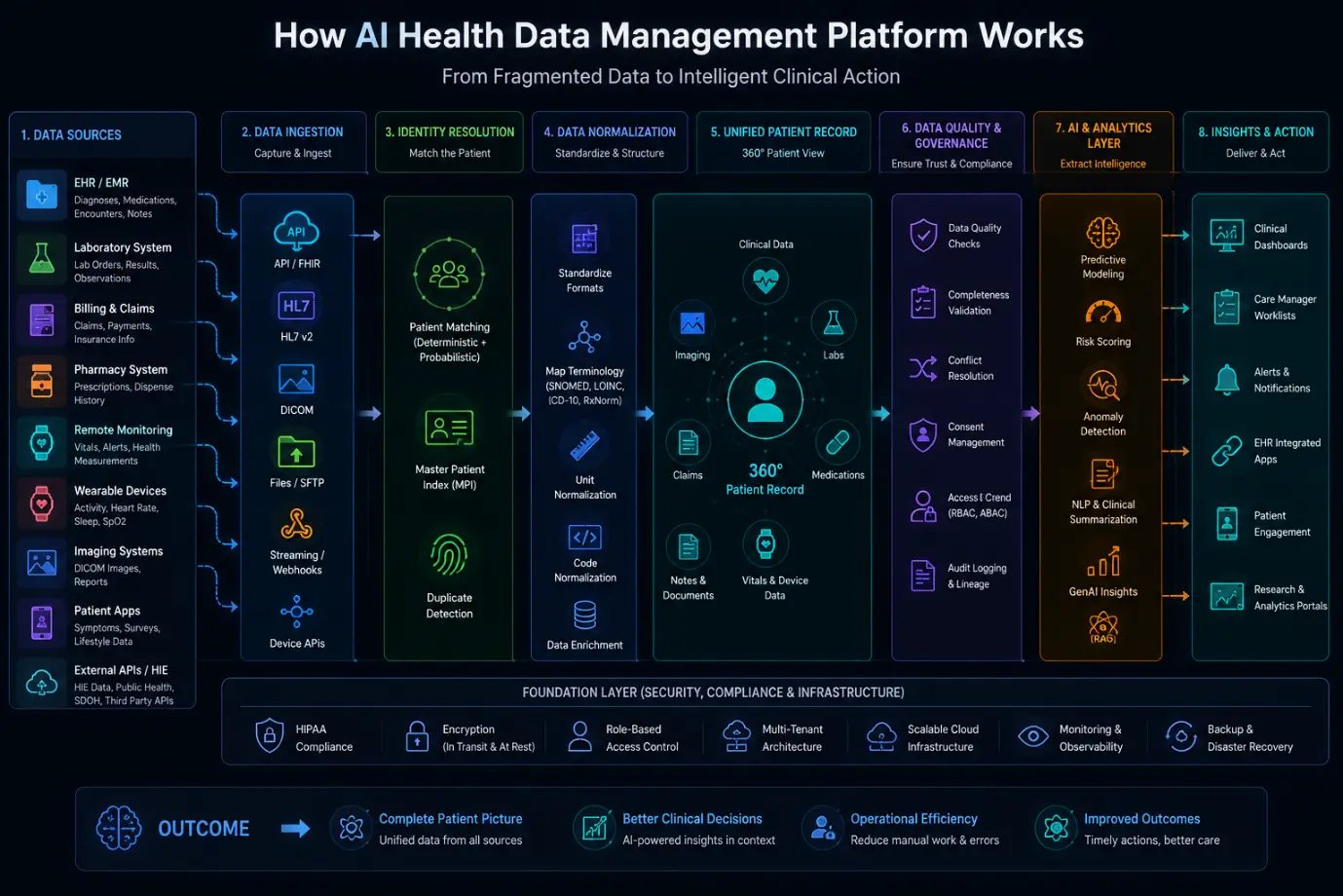
The first stage is connecting the platform with the systems that generate patient information.
Depending on the healthcare environment, these sources can include:
The platform may use FHIR APIs, HL7 v2, REST APIs, DICOM, SFTP, webhooks, or device APIs depending on the source.
The objective is to create a reliable connection between the platform and each relevant data source without forcing healthcare organizations to replace their existing systems.
Once connections are established, the platform continuously receives healthcare information.
Some information may arrive in real time, such as:
Other information may arrive periodically, such as:
An ingestion layer manages these different formats and frequencies so that data can enter the platform consistently.
This is one of the most important stages in the entire platform.
The same patient may have different identifiers across different systems.
For example:
EHR: Patient ID 10245
Lab: MRN 78321
RPM: User 55890
Wearable: Device ID W-9238
The platform needs to determine that these records belong to the same individual.
A Master Patient Index (MPI) and identity-resolution engine can use identifiers and other demographic attributes to match records while identifying uncertain or conflicting matches for review.
Without reliable patient matching, even sophisticated AI models can produce unsafe or misleading results.
Healthcare systems often store the same clinical information using different formats, codes, units, and terminology.
For example, one system may record:
Blood glucose: 145 mg/dL
Another may use a different field name, unit, or clinical code.
The platform normalizes this information into a consistent structure.
This can involve standards and terminology such as:
Normalization allows the AI and analytics layers to interpret information consistently regardless of where it originated.
After patient matching and normalization, the platform creates a more complete longitudinal view of the patient.
Instead of viewing information separately, the platform can associate:
Medical history + medications + laboratory results + claims + wearable data + RPM readings + clinical notes + encounters
This creates the foundation for a 360-degree patient record.
For example, a physician may be able to see that a patient's heart rate has gradually increased, recent weight has changed, medication adherence has declined, and a recent laboratory result is abnormal.
Each data point may appear insignificant independently.
Together, they may represent an important clinical trend.
Before healthcare data is used for AI or analytics, the platform should evaluate its quality.
The data quality layer can identify:
Data-quality scores can also be associated with individual datasets so downstream AI systems understand whether the information is complete and reliable enough for a particular use case.
Healthcare data cannot simply be collected and analyzed without controls.
The platform should enforce appropriate:
This governance layer determines who can access which information, for what purpose, and under what conditions.
It also creates an audit trail for important data and user activities.
Once the data is connected, normalized, and governed, the AI layer can begin extracting insights.
Depending on the platform's purpose, this can include:
For example, the platform could analyze a patient's historical data, recent laboratory results, medication information, and continuous wearable measurements to identify an emerging risk pattern.
Raw data is not the final product.
The platform should convert AI outputs into information that healthcare professionals can understand and act upon.
For example:
Raw data:
Heart rate increased from 78 BPM to 104 BPM over several days.
Combined context:
Heart rate increase + reduced activity + recent weight gain + abnormal laboratory result.
AI insight:
Patient shows an elevated risk pattern requiring clinical review.
The important difference is that the platform does not simply display another data point. It provides context around the data.
The final stage is presenting relevant intelligence through the appropriate interface.
Depending on the use case, insights may appear in:
A physician may see a prioritized list of patients requiring attention, while a care manager may receive a task to contact a specific patient.
Healthcare data continuously changes.
Every new:
can update the patient's data profile.
This allows the platform to continuously refresh analytics and, where clinically appropriate, reassess risk or identify new patterns.
Hospitals, digital health companies, health insurers, research institutions, remote patient monitoring companies, self-insured employers, and specialty healthcare organizations are among the primary organizations that can benefit from AI health data management platform development.
The right platform depends on the organization's data volume, clinical workflows, interoperability requirements, regulatory environment, and specific business objectives.
Hospital systems and multi-facility health networks build AI health data management platforms to unify patient information across hospitals, clinics, laboratories, and other care settings. The goal is to reduce the time clinicians spend navigating disconnected systems while generating population health intelligence for value-based care and enterprise decision-making.
Platform priorities: FHIR and legacy-system integration, enterprise scalability, role-based access, HIPAA security, data governance, and integration with existing clinical workflows.
For healthcare leaders asking how to build a scalable AI health data management platform for enterprise hospital networks in 2026, the architecture must support large patient populations, multiple facilities, high concurrent usage, and complex healthcare IT environments.
Digital health founders may build an AI health data management platform as a SaaS or enterprise product for healthcare providers, payers, employers, or other organizations. The challenge is to deliver meaningful AI-powered health data intelligence without creating an implementation process that requires months of custom IT work.
Platform priorities: reusable integrations, configurable workflows, multi-tenancy, scalable APIs, strong security, intuitive interfaces, and AI capabilities that deliver measurable customer value.
Founders looking to develop an AI health data management platform should understand healthcare workflows alongside FHIR, HL7, clinical terminology, data privacy, and healthcare security requirements.
Health insurers and managed care organizations build AI health data platforms to combine claims and clinical information, identify high-risk members, support care-management outreach, monitor quality measures, and analyze utilization patterns. A payer covering millions of members may ask, "How can we identify high-risk members earlier instead of relying on manual chart reviews?"
Platform priorities: claims and clinical data integration, member-level risk scoring, population segmentation, care-management workflows, quality analytics, and actionable insights that fit existing payer operations.
The platform should help care teams prioritize members who may require intervention rather than simply producing another analytics dashboard.
Academic medical centers and research organizations build AI health data platforms to create unified research environments that connect clinical information with research datasets. These platforms can support cohort discovery, clinical research, trial feasibility analysis, observational studies, and NLP-based extraction from clinical documentation.
Platform priorities: governed research access, de-identification, HIPAA controls, auditability, flexible querying, clinical NLP, and integration with institutional research environments.
Natural-language querying can also help investigators identify relevant patient cohorts without requiring every research question to be manually translated into complex database queries.
Digital therapeutics and RPM companies generate large volumes of patient-generated data through mobile applications, wearable devices, connected medical devices, and patient-reported outcomes. A digital therapeutics company managing hundreds of thousands of users may ask, "How can we analyze continuous patient data and identify clinically meaningful changes without overwhelming care teams with alerts?"
Platform priorities: device API integrations, real-time data ingestion, time-series analytics, anomaly detection, machine learning, patient-level monitoring, and intelligently calibrated alerts.
The key product challenge is distinguishing clinically meaningful changes from normal fluctuations so care teams receive fewer but more actionable alerts.
Large self-insured employers can use AI health data platforms to analyze claims, pharmacy data, biometric screening results, and wellness-program participation to understand population health trends and measure benefits-program ROI. For example, an employer covering tens of thousands of employees and dependents may want to identify population-level health trends without exposing identifiable health information to HR teams.
Platform priorities: strong privacy controls, de-identification or aggregation, population-level analytics, claims and pharmacy integration, secure reporting, and benefits-program ROI measurement.
Privacy must remain a fundamental product requirement, particularly when health information is being analyzed across an employee population.
Specialty organizations such as behavioral health networks, specialty pharmacies, fertility clinic groups, home health agencies, and ambulatory surgery centers can build AI health data platforms around highly specific clinical and operational requirements. For example, an ambulatory surgery organization may want to replace manual spreadsheet-based quality reporting, infection surveillance, and regulatory documentation with a centralized AI-enabled data environment.
Platform priorities: specialty-specific data models, workflow customization, regulatory controls, clinical NLP, predictive analytics, and integrations with existing healthcare systems.
These organizations can benefit from focused platforms that solve specialized data challenges rather than trying to replicate the broad functionality of a general-purpose EHR.
Organizations with fragmented healthcare data, a clearly defined clinical or business problem, and sufficient data volume for meaningful analytics or AI are the strongest candidates for AI health data management platform development.
Not every healthcare organization needs the same type of AI health data management platform. A hospital network may need a unified clinical data layer, while a payer may prioritize predictive risk stratification, and an RPM company may require real-time monitoring and early warning capabilities.
The right platform type depends on what data the organization manages, which decisions it wants AI to improve, how quickly data must be processed, and who will use the resulting intelligence.
For example, a regional hospital network with eight facilities may ask: "We currently use six different systems for one patient encounter. What would it realistically take to consolidate our EHR, lab, imaging, pharmacy, billing, and patient communication data behind a single AI data layer?" This is primarily an AI Unified Clinical Data Platform and AI Interoperability and Health Data Exchange Platform use case, with integration complexity increasing when legacy systems are involved.
Similarly, other organizations may ask:
"How can we use AI to identify high-risk patients before they require expensive acute care?"
"How can we automatically extract clinically relevant information from thousands of unstructured physician notes?"
"How can we monitor wearable and remote patient monitoring data continuously without creating alert fatigue?"
"How can we give researchers secure access to millions of clinical records without exposing unnecessary patient information?"
These requirements lead to different types of AI health data management platform development.
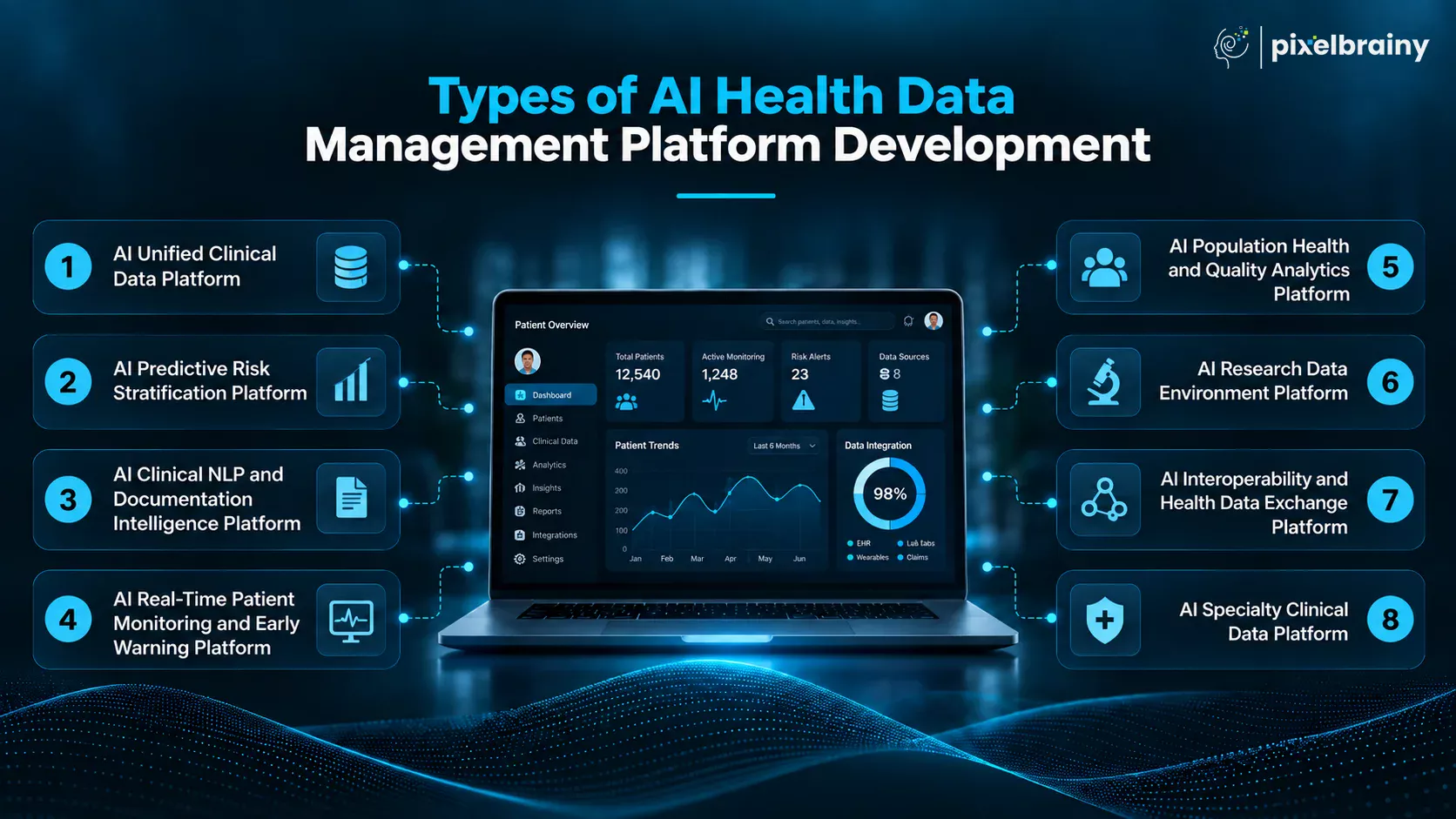
An AI Unified Clinical Data Platform is designed to consolidate patient information from multiple healthcare systems into a consistent clinical data environment. It is particularly useful for hospitals, health systems, and digital health companies dealing with fragmented EHR, laboratory, imaging, pharmacy, claims, and patient-generated data.
The platform typically focuses on creating a longitudinal patient record that brings information from different sources into one governed environment. It may support FHIR, HL7, DICOM, proprietary APIs, and other healthcare data formats.
A common query for this platform type is: "How can we unify patient information across multiple hospitals without replacing our existing EHR and legacy systems?"
For organizations looking to build an AI health data management platform, this model provides the foundational data layer required for advanced analytics and AI applications.
An AI Predictive Risk Stratification Platform uses clinical, claims, demographic, behavioral, and patient-generated data to identify patients who may be at higher risk of specific outcomes.
Typical use cases include:
A payer or healthcare provider may ask: "How can we identify which patients are most likely to deteriorate in the next 30 days so our care team can intervene earlier?"
The platform needs reliable historical data, predictive models, risk scoring, model monitoring, and workflows that allow clinicians or care managers to act on the results.
The focus is not simply predicting risk. It is converting risk predictions into prioritized and actionable patient intelligence.
An AI Clinical NLP and Documentation Intelligence Platform is designed to extract useful information from unstructured healthcare content such as clinical notes, discharge summaries, referral documents, pathology reports, and other medical records.
A healthcare organization may ask: "How can we extract diagnoses, symptoms, medications, procedures, and clinical events from thousands of physician notes without requiring staff to review every document manually?"
Natural language processing and large language models can identify relevant clinical concepts and transform unstructured information into structured, searchable data.
The platform can support clinical summarization, information extraction, documentation analysis, cohort identification, and medical record review.
For organizations planning to develop an AI health data management platform, NLP becomes especially valuable when a large portion of clinically meaningful information exists outside structured EHR fields.
An AI Real-Time Patient Monitoring and Early Warning Platform continuously evaluates patient data from bedside devices, wearables, remote monitoring systems, and other connected healthcare technologies.
A hospital or RPM company may ask: "How can we detect meaningful changes in patient vital signs early enough for care teams to intervene while reducing unnecessary alerts?"
The platform can process signals such as:
AI models can identify abnormal trends and generate risk signals based on multiple measurements rather than relying on a single threshold.
The primary design challenge is real-time processing combined with accurate alert prioritization, because excessive alerts can quickly create clinician fatigue.
An AI Population Health and Quality Analytics Platform focuses on analyzing large patient populations to identify health trends, care gaps, quality issues, and opportunities for intervention.
Healthcare providers and payers may ask: "Which patient populations are missing recommended care, and which interventions are most likely to improve outcomes?"
The platform can analyze:
AI can help segment patients into meaningful groups and prioritize populations requiring attention.
This type of platform is particularly valuable for organizations participating in value-based care because it connects patient data with quality, utilization, and outcome improvement objectives.
An AI Research Data Environment Platform creates a secure and governed environment where academic medical centers, pharmaceutical companies, and research organizations can analyze large healthcare datasets.
A research organization may ask: "How can we identify eligible patient cohorts across millions of records for observational research and clinical trial feasibility without manually reviewing individual charts?"
The platform can combine clinical records, laboratory results, medications, procedures, imaging metadata, and other research datasets.
Key capabilities can include:
The architecture must balance research flexibility with privacy, access controls, institutional governance, and appropriate authorization for the intended research use.
An AI Interoperability and Health Data Exchange Platform focuses primarily on connecting healthcare organizations and enabling consistent exchange of information between otherwise disconnected systems.
This is particularly relevant for healthcare networks asking: "How can we connect our EHR, laboratory, imaging, pharmacy, billing, and external provider systems through a single intelligent data layer?"
The platform may support FHIR, HL7 v2, DICOM, REST APIs, SFTP, proprietary interfaces, and other exchange mechanisms.
AI can add intelligence to interoperability by helping with data classification, terminology mapping, record matching, data-quality detection, and routing.
This type of platform becomes especially important when organizations need to build AI medical data management platforms that can operate across complex legacy infrastructure rather than within one application ecosystem.
An AI Specialty Clinical Data Platform is designed around the unique data, workflows, and regulatory requirements of a specific healthcare specialty.
Examples include:
A specialty organization may ask: "How can we create an AI platform around our specialty-specific data instead of adapting a generic healthcare analytics system that does not understand our workflow?"
For example, behavioral health may require advanced clinical NLP, oncology may require complex treatment and biomarker data, while home health may depend on continuous vital-sign monitoring.
This approach allows organizations to create AI health data monitoring and analysis platforms that solve highly specific clinical and operational problems.
The right type of AI health data management platform depends on whether the primary goal is unifying data, predicting risk, understanding clinical text, monitoring patients, improving population health, supporting research, enabling interoperability, or solving a specialty-specific healthcare challenge.
A production-ready AI health data management platform needs a strong technical and data foundation before advanced AI capabilities are introduced. The core features should make healthcare information connected, standardized, secure, governed, accessible, and reliable enough for clinical and operational use.
For example, a healthcare provider may ask: “Our clinicians spend hours reviewing fragmented patient records before appointments. Which core features should an AI health data management platform include to create a reliable longitudinal patient view and reduce manual data searching?” The answer begins with interoperability, patient identity, data normalization, quality management, security, governance, APIs, and a dependable data infrastructure.
These foundational capabilities are essential for organizations looking to build an AI health data management platform, develop an AI medical data management platform, or implement AI clinical data management platform development for real-world healthcare environments.
| Core Feature | What It Does |
|---|---|
| FHIR and Healthcare Interoperability | FHIR and interoperability capabilities connect EHRs, laboratories, pharmacies, devices, and healthcare applications through standardized exchange methods. This creates a consistent foundation for sharing clinical information across different healthcare environments. |
| HL7 and Legacy System Integration | HL7 and legacy integration allows the platform to communicate with older healthcare systems that may not support modern APIs. This is essential for hospitals operating mixed environments containing both modern and legacy technologies. |
| Master Patient Index | A Master Patient Index identifies and links records belonging to the same patient across multiple systems. Accurate patient matching reduces duplicate records and helps prevent incorrect patient information from entering clinical workflows. |
| Unified Patient Data Management | Unified patient data management brings clinical, administrative, and patient-generated information into a consistent patient profile. Authorized users can access a broader longitudinal patient view without repeatedly searching through disconnected applications. |
| Clinical Data Normalization | Clinical data normalization converts different formats, units, codes, and terminology into standardized representations. This enables analytics and AI systems to interpret healthcare information consistently regardless of its original source or structure. |
| Healthcare Data Quality Management | Data quality management identifies missing, duplicate, outdated, inconsistent, or invalid healthcare information before it affects downstream applications. Validation rules and quality monitoring help maintain reliable datasets for clinical and operational decisions. |
| Secure Healthcare Data Storage | Secure data storage protects sensitive patient information while supporting large clinical datasets. The infrastructure should provide encryption, controlled access, backup capabilities, appropriate retention policies, and dependable availability for healthcare applications. |
| Role-Based Access Control | Role-based access control limits healthcare information according to a user's responsibilities and permissions. Physicians, nurses, administrators, researchers, and analysts can receive different access levels based on organizational policies and approved workflows. |
| Consent Management | Consent management records and enforces patient permissions governing healthcare data access and sharing. It helps organizations apply appropriate data-use policies across users, applications, workflows, and different healthcare information sources. |
| Data Encryption | Data encryption protects sensitive healthcare information during transmission and while stored within the platform. Strong encryption practices reduce unauthorized exposure and provide an essential security layer for healthcare data management environments. |
| Audit Logging | Audit logging records important user activities, data access events, system operations, and administrative changes. These records improve accountability while supporting security investigations, compliance activities, incident response, and healthcare data monitoring. |
| Healthcare Data APIs | Secure healthcare APIs allow authorized applications to access and exchange platform data. They make the platform easier to connect with EHRs, patient applications, analytics tools, medical devices, and external healthcare software. |
| Healthcare Data Governance | Data governance establishes rules for healthcare data ownership, access, classification, quality, retention, and permitted usage. It creates accountability and helps organizations manage sensitive clinical information consistently throughout the platform lifecycle. |
| Clinical Analytics Dashboard | Clinical analytics dashboards convert connected healthcare data into understandable visual information for authorized users. They can present patient trends, population metrics, care gaps, quality indicators, and operational information in one interface. |
| AI-Ready Data Infrastructure | AI-ready infrastructure prepares standardized, governed, high-quality healthcare data for machine learning and AI applications. It provides the dependable foundation required before organizations introduce predictive analytics, clinical AI, or other intelligence capabilities. |
These core features create the reliable, secure, and AI-ready foundation required for successful AI health data management platform development and future healthcare AI capabilities.
Once the core interoperability, data management, security, and governance capabilities are in place, healthcare organizations can add advanced features that make an AI health data management platform more predictive, proactive, and intelligent.
For example, a healthcare organization may ask: “We already have unified patient data, but how can we use AI to predict patient deterioration, summarize complex medical histories, detect unusual patterns, and give care teams actionable insights without increasing their workload?”
This is where advanced AI capabilities become valuable. However, these features should be introduced according to the platform's clinical use case, data maturity, workflow requirements, and AI governance readiness.
| Advanced Feature | What It Does |
|---|---|
| Predictive Analytics and Risk Scoring | Predictive analytics uses historical and current healthcare data to estimate the likelihood of outcomes such as patient deterioration, readmission, disease progression, or high healthcare utilization. Risk scores help care teams prioritize patients who may need earlier intervention. |
| Generative AI Clinical Summarization | Generative AI can convert large volumes of clinical records into concise patient summaries covering diagnoses, medications, encounters, laboratory results, and relevant trends. Source-grounded generation can help clinicians review complex patient histories more efficiently. |
| Natural Language Healthcare Data Querying | Natural-language querying allows authorized users to ask healthcare data questions conversationally instead of writing complex database queries. The platform can translate requests into governed queries and return relevant patient, cohort, or population-level information. |
| AI-Powered Anomaly Detection | AI anomaly detection identifies unusual patterns across patient records, vital signs, laboratory results, device readings, or healthcare operations. It can help surface potential deterioration, unexpected utilization, data-quality problems, or significant changes requiring further review. |
| Real-Time Streaming Analytics | Real-time analytics continuously evaluates incoming information from connected devices, RPM platforms, applications, and clinical systems. It enables the platform to identify meaningful changes quickly instead of waiting for scheduled batch processing or periodic reporting. |
| Clinical Decision Support Intelligence | AI-powered clinical decision support can combine patient context, clinical information, guidelines, and current observations to surface relevant insights for healthcare professionals. The system should provide supporting evidence and context while keeping qualified clinicians responsible for clinical decisions. |
| AI Patient Segmentation and Cohort Discovery | AI-based segmentation groups patients according to clinical characteristics, risk factors, behaviors, treatment patterns, or other relevant attributes. Healthcare organizations can use these cohorts for population health, care management, research, and targeted intervention programs. |
| Multimodal Healthcare AI | Multimodal AI enables the platform to analyze different healthcare data types together, including structured records, clinical text, medical images, waveforms, and device information. This can provide a broader understanding of patient conditions than analyzing individual data types separately. |
| AI Model Monitoring and Governance | AI model monitoring tracks performance, drift, bias, accuracy, calibration, and other indicators after deployment. Governance capabilities provide oversight of model versions, validation results, unexpected outputs, and ongoing performance to support responsible healthcare AI operations. |
| AI Agents and Automated Healthcare Workflows | AI agents can assist with approved healthcare workflows such as identifying care gaps, preparing patient summaries, investigating data-quality issues, or initiating specific workflow steps. Strong permissions, validation, auditability, and human oversight are essential before deploying agents in clinical environments. |
These advanced capabilities can turn a conventional healthcare data platform into a predictive, proactive, and intelligent AI health data management platform when supported by reliable data, appropriate governance, and clinically validated workflows.
Building an AI health data management platform requires more than connecting healthcare APIs and adding an AI model. The development process must bring together healthcare interoperability, data engineering, security, clinical workflows, analytics, AI, and user experience in a controlled sequence.
For healthcare founders, understanding the steps to build AI health data management platform from idea to launch helps reduce technical risk and prevents expensive architectural changes later. Whether the objective is to develop AI health data management software for a hospital, launch an AI health data management tool for healthcare startups, or create an enterprise platform for payers and providers, the development process should begin with the healthcare problem rather than the technology.
A common founder query is: "We have a clear healthcare use case, but how do we build an AI health data management platform from scratch without investing heavily before knowing whether clinicians and healthcare organizations will actually adopt it?"
The answer is to follow a staged approach that validates the problem first, proves the data architecture, develops the right AI capabilities, and gradually moves toward a secure production platform.
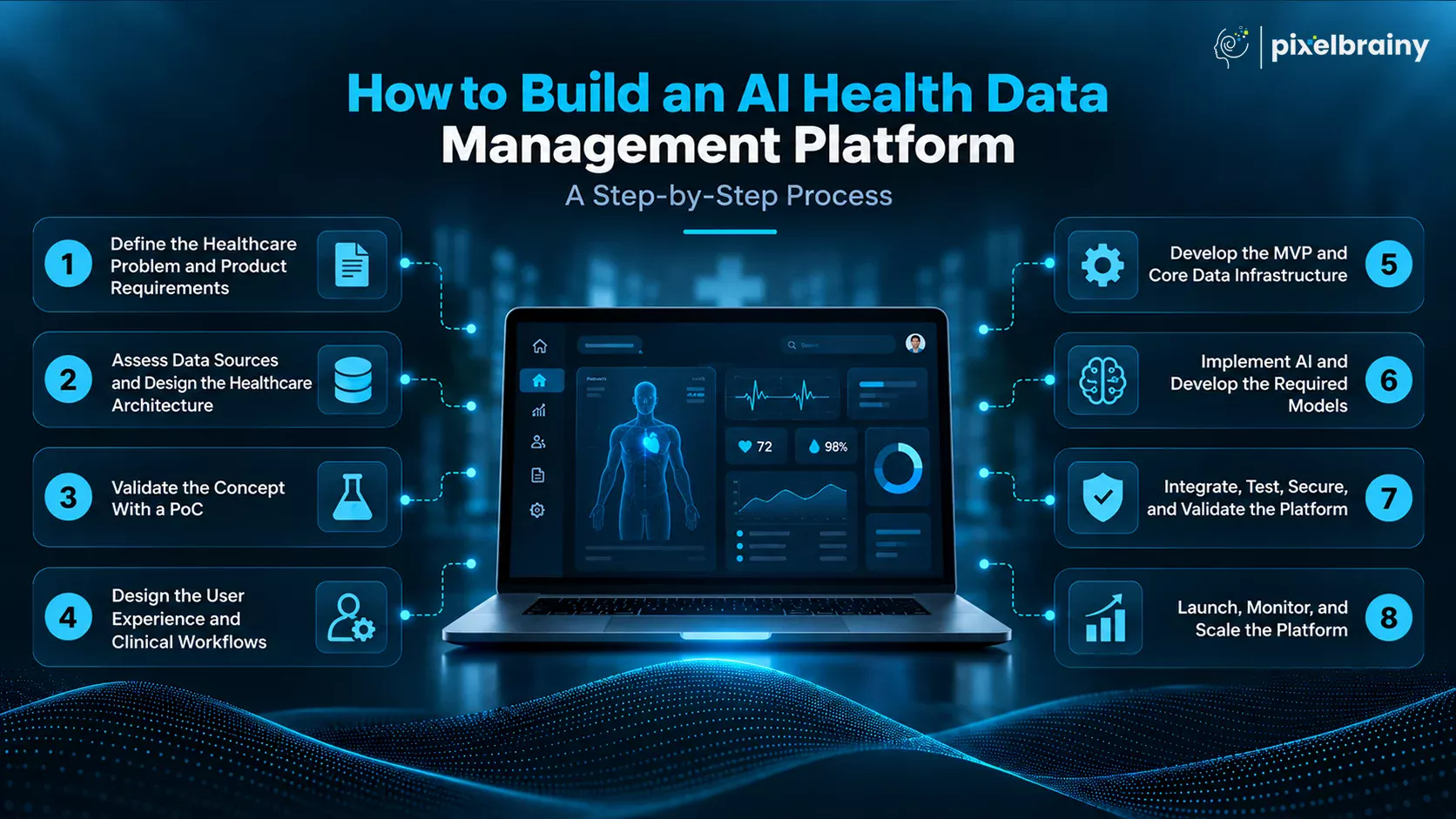
The first step is identifying the specific healthcare problem the platform needs to solve. Avoid starting with a broad objective such as "build an AI healthcare platform." Instead, define a measurable problem, such as reducing manual chart review, identifying high-risk patients, consolidating fragmented clinical records, or improving remote patient monitoring.
Conduct AI consultation with clinical, operational, technical, and compliance stakeholders to understand how the problem currently affects workflows. Document the target users, data sources, expected outcomes, regulatory requirements, and success metrics.
Next, define the platform's scope. Determine whether the first release will support one facility, one clinical specialty, one patient population, or multiple healthcare organizations.
This stage creates the product requirements and establishes what the platform must accomplish before development begins.
Once the problem is defined, identify every data source required to support it. These may include EHRs, laboratories, pharmacy systems, claims, medical devices, wearables, RPM platforms, clinical documents, and patient applications.
For each source, document the available API, data format, update frequency, data ownership, PHI status, and data quality.
Then design the architecture for health data management platform development using AI. A typical structure includes data sources, integration services, ingestion pipelines, patient identity management, normalization, storage, governance, analytics, AI services, APIs, and user applications.
The architecture should support FHIR where available while accommodating HL7 v2, DICOM, proprietary APIs, SFTP, and other legacy mechanisms.
The goal is to create an architecture that can support the initial use case while remaining scalable enough for future healthcare data sources and AI capabilities.
Before investing in a complete production platform, validate the most technically uncertain parts of the solution.
PoC development can demonstrate whether the platform can successfully connect selected healthcare data sources, match patient records, normalize clinical information, and produce the intended analytical output.
For example, a hospital startup might connect one EHR, laboratory system, and RPM source to determine whether the proposed unified patient view is technically achievable.
The PoC should answer specific questions rather than attempt to become a complete product. Can the required data be accessed? Can records be matched accurately? Can the data be normalized? Can the intended AI use case produce useful results?
A successful PoC provides technical evidence before larger development investment begins.
Also Read: A Guide to Proof of Concept (PoC) Development for AI Clinical Workflow System
Healthcare software must fit into existing workflows. A technically powerful platform can fail if clinicians cannot understand its outputs or if it creates additional administrative work.
The product team should map how physicians, nurses, care managers, researchers, administrators, and other users will interact with the platform.
Work with a specialized UI/UX design company when the product requires complex clinical dashboards, patient timelines, analytics views, or role-specific interfaces.
The design should prioritize clarity, accessibility, speed, and decision support. Users should be able to quickly understand patient status, important trends, alerts, data sources, and relevant context.
At this stage, also define notification rules, dashboard hierarchy, user permissions, and workflow integration requirements.
After validating the concept, move into MVP development with a clearly controlled feature set.
The MVP should focus on the core capabilities required to prove business and clinical value, such as:
Avoid adding every possible AI capability to the first version.
The objective is to create a functional healthcare data foundation that can operate with real or appropriately controlled production-like data. The MVP should also establish scalable APIs, monitoring, deployment processes, and security controls that will support later expansion.
Also Read: Top 10 AI MVP Development Companies in USA
Once the data foundation is reliable, introduce the AI capabilities defined during product discovery.
This may involve AI model development for:
Generative AI may also be introduced for clinical summarization, natural-language querying, or information extraction where appropriate.
The AI layer should be grounded in validated healthcare data and evaluated against clearly defined performance metrics. Model testing should consider accuracy, sensitivity, specificity, calibration, false positives, false negatives, bias, and data drift where applicable.
AI outputs should also provide appropriate context and traceability, particularly when they influence clinical workflows.
Also Read: Top 12+ AI Model Development Companies in the USA
The next stage combines the data platform, applications, and AI capabilities into a production-ready system.
This is where AI integration becomes critical. AI services need to communicate reliably with the data layer, APIs, dashboards, workflow systems, and user applications.
Testing should cover:
Healthcare security should be tested throughout development rather than added immediately before launch.
Clinical stakeholders should also validate whether the platform's insights are understandable, relevant, and useful within real workflows.
The final step is moving from development into controlled production deployment.
Do not immediately deploy the platform across every department or customer. Begin with a defined pilot group and monitor technical, clinical, and business performance.
Track metrics such as:
After validating the initial deployment, expand integrations, users, facilities, and AI capabilities gradually.
Whether you work with internal teams or external top AI development companies, long-term success depends on continuous monitoring, model evaluation, security updates, interoperability maintenance, and product improvement.
The broader AI product development companies ecosystem can support specialized capabilities, but healthcare founders should prioritize partners with proven experience in healthcare data, interoperability, security, and clinical workflows.
Following a structured development process helps turn an AI health data management concept into a secure, scalable, clinically useful platform without trying to solve every healthcare data challenge in the first release.
The cost to develop an AI health data management platform can range from approximately $40,000 to $350,000+ depending on the platform's scope, number of healthcare integrations, AI capabilities, security requirements, data volume, and deployment complexity. A basic platform with limited integrations and essential analytics will require a significantly smaller development budget of AI health data management platform than an enterprise system connecting multiple hospitals and processing large volumes of clinical data.
For founders, the cost estimation of AI health data management platform should therefore be based on functionality rather than a single fixed development price. The AI health data management platform development cost also changes considerably depending on whether the product is a proof of concept, MVP, commercial SaaS product, or enterprise healthcare infrastructure.
A common founder query is: "We have a healthcare startup with multiple data sources and want to add AI-powered analytics, but what should we realistically budget to develop an AI health data management platform without overbuilding the first version?"
Similarly, organizations often ask, "What is the development pricing of AI health data management software if we need FHIR integration, secure patient data storage, analytics, and a production-ready healthcare dashboard?"
The following 2026 estimates provide a practical starting point for planning the investment.
| Platform Type | Estimated Development Cost | Typical Scope |
|---|---|---|
| Basic AI Health Data Management Platform | $40,000 to $100,000 | Core data ingestion, limited FHIR/API integrations, patient data management, basic normalization, secure storage, role-based access, dashboards, and initial AI analytics |
| Advanced AI Health Data Management Platform | $100,000 to $200,000 | Multiple healthcare integrations, HL7/FHIR support, patient identity management, advanced analytics, predictive AI, clinical dashboards, data governance, monitoring, and scalable cloud infrastructure |
| Enterprise AI Health Data Management Platform | $200,000 to $350,000+ | Multi-facility deployment, complex legacy integrations, large-scale data processing, advanced AI, enterprise security, high availability, extensive APIs, sophisticated governance, and large user volumes |
These ranges are planning estimates, not fixed vendor pricing. A platform with fewer features but highly complex EHR integrations can cost more than a feature-rich application using standardized APIs.
Several factors can significantly change the final development budget.
Connecting one FHIR-compatible system is very different from integrating multiple EHRs, laboratories, pharmacies, claims systems, devices, and legacy platforms.
FHIR APIs can simplify interoperability, while HL7 v2 and proprietary interfaces may require additional integration and transformation work.
Basic analytics costs less than developing and validating predictive risk models, anomaly detection systems, clinical NLP, or other AI capabilities.
Large patient populations, continuous device streams, medical documents, and high-frequency monitoring data increase storage, processing, and infrastructure requirements.
Platforms that need to analyze patient data continuously require streaming infrastructure and more sophisticated event-processing architecture.
Healthcare platforms require strong controls around authentication, authorization, encryption, auditing, access management, data retention, and other security requirements.
Complex Master Patient Index requirements and cross-system patient matching can add substantial development effort.
A platform designed for physicians alone is generally less complex than one supporting physicians, nurses, care managers, researchers, administrators, patients, and enterprise analysts.
High availability, disaster recovery, automated scaling, monitoring, and multi-region deployment can increase infrastructure and engineering costs.
Migrating historical healthcare records and converting inconsistent formats, terminology, units, and codes into a standardized structure can require significant engineering effort.
Healthcare AI applications may require additional testing and validation to establish whether their outputs are reliable and useful within the intended workflow.
12. Development Team and Expertise
The cost can vary based on whether development is handled internally, through a specialized healthcare technology partner, or through experienced AI healthcare product development companies.
Healthcare founders do not necessarily need to build the entire platform in the first release. A focused MVP can begin with one clinical use case, a limited number of integrations, essential security controls, and a small set of AI capabilities.
After validating adoption and measurable outcomes, additional integrations, advanced analytics, and enterprise functionality can be added progressively.
Therefore, a realistic AI health data management platform development budget starts around $40,000 for a focused basic platform and can exceed $350,000 for complex enterprise healthcare deployments.
Also Read: AI Software Development Cost in 2026 (10K-300K+): Know How Much Your Software Will Cost
The technology stack directly influences the scalability, interoperability, security, AI performance, and long-term maintenance of an AI health data management platform. A healthcare startup developing a platform from scratch needs technologies that can handle structured and unstructured clinical data, connect with existing healthcare systems, support AI workloads, and maintain strong security controls.
A common technology query from healthcare founders is: “What technology stack should we use to develop an AI health data management software that supports FHIR, HL7, real-time patient data, AI analytics, secure cloud infrastructure, and enterprise healthcare integrations?”
The answer is not a single programming language or cloud provider. A production AI health data management platform development stack generally combines healthcare interoperability standards, backend technologies, databases, cloud infrastructure, AI frameworks, APIs, security tools, and monitoring systems.
| Technology Layer | Recommended Tools and Technologies | Purpose in the Platform |
|---|---|---|
| Frontend Development | React, Next.js, TypeScript, Angular | Build responsive clinical dashboards, patient timelines, analytics interfaces, administrative panels, and role-specific healthcare applications. |
| Backend Development | Python, Java, Node.js, .NET, Go | Build healthcare APIs, business logic, authentication services, data-processing workflows, integration services, and scalable backend infrastructure. |
| Healthcare Interoperability | FHIR, HL7 v2, DICOM, SMART on FHIR | Connect EHRs, laboratories, imaging systems, medical devices, and other healthcare applications using established healthcare interoperability standards. |
| FHIR Server | HAPI FHIR, Microsoft Azure Health Data Services, Google Cloud Healthcare API | Store, manage, validate, and exchange FHIR-based healthcare resources while supporting standardized clinical data access and interoperability. |
| API Management | REST APIs, GraphQL, OAuth 2.0, OpenID Connect | Provide secure communication between the platform, healthcare systems, mobile applications, devices, analytics services, and external applications. |
| Database | PostgreSQL, MongoDB, MySQL | Store structured application data, patient information, metadata, configuration data, and other healthcare platform information based on specific workload requirements. |
| Healthcare Data Lakehouse | Databricks, Snowflake, Amazon S3, Azure Data Lake Storage | Manage large volumes of structured, semi-structured, and unstructured healthcare information for analytics, reporting, and AI workloads. |
| Data Processing | Apache Spark, Apache Kafka, Apache Airflow | Process large healthcare datasets, manage real-time data streams, and automate complex data pipelines and scheduled workflows. |
| AI and Machine Learning | PyTorch, TensorFlow, scikit-learn, XGBoost | Develop predictive models, classification systems, anomaly detection, risk scoring, and other machine learning capabilities. |
| Generative AI and NLP | Hugging Face, transformer models, LLM APIs, vector databases | Support clinical NLP, document extraction, summarization, natural-language healthcare queries, and other generative AI use cases. |
| Vector Search | pgvector, Pinecone, Weaviate, Milvus | Store and retrieve healthcare-related embeddings for semantic search, retrieval-augmented generation, and AI-powered clinical information retrieval. |
| Cloud Infrastructure | AWS, Microsoft Azure, Google Cloud | Provide scalable compute, storage, networking, security, AI infrastructure, and healthcare-specific cloud services. |
| Containerization and DevOps | Docker, Kubernetes, Terraform, GitHub Actions | Support portable deployments, infrastructure automation, continuous integration, continuous delivery, scaling, and environment management. |
| Security and Identity | IAM, Key Management Services, Secrets Manager, OAuth 2.0, OpenID Connect | Protect sensitive healthcare information through identity management, encryption, authentication, authorization, secrets management, and controlled access. |
| Monitoring and Observability | Prometheus, Grafana, OpenTelemetry, cloud monitoring services | Monitor system health, API performance, data pipelines, infrastructure, application errors, and important production events. |
Therefore, when you plan to launch AI health data management platform then selecting a well-designed technology stack gives an AI health data management platform the interoperability, scalability, security, and AI infrastructure needed to support reliable healthcare applications from MVP to enterprise deployment.
The AI health data management platform market in 2026 includes EHR-based intelligence platforms, healthcare cloud and data infrastructure providers, healthcare intelligence companies, and real-world data platforms. For founders planning to develop an AI health data management platform, analyzing these market leaders provides useful insights into how successful healthcare platforms combine data unification, interoperability, analytics, AI, governance, and workflow intelligence.
A common market query is: “Which AI health data management platforms are leading in 2026, and what can healthcare startups learn from their approach to healthcare data integration, AI analytics, interoperability, and enterprise deployment?”
There is no single objective ranking because these platforms serve different healthcare markets. The following five are important platforms to study based on their 2026 capabilities, healthcare data infrastructure, AI strategy, enterprise positioning, and real-world healthcare use cases.
| Platform | Primary Focus | Key Strength | Best Suited For |
|---|---|---|---|
| Epic Healthcare Intelligence | EHR, clinical intelligence, and real-world evidence | Large healthcare data ecosystem | Health systems and clinical organizations |
| Oracle Health and Oracle Life Sciences AI Data Platform | Healthcare data, analytics, and life sciences AI | Large-scale data and research intelligence | Providers, pharma, medtech, and research |
| Microsoft Healthcare Data and AI | Cloud healthcare data and AI infrastructure | Enterprise cloud, analytics, and AI | Healthcare enterprises and technology teams |
| Innovaccer Gravity | Healthcare intelligence and data activation | Unified healthcare data, analytics, and AI workflows | Providers, payers, and health enterprises |
| Komodo Health | Real-world data and healthcare intelligence | Large-scale linked healthcare data | Life sciences and healthcare analytics |
Epic is a major healthcare technology ecosystem combining EHR capabilities with healthcare intelligence, artificial intelligence, real-world evidence, reporting, and data integration. Its Healthcare Intelligence portfolio includes a Data Integration Platform designed to unify structured and unstructured healthcare data using a lakehouse architecture and scalable computing.
Epic's Cosmos environment also provides a large-scale de-identified data foundation for research and healthcare intelligence. Its Curiosity initiative uses this governed environment to support medical and operational insights, including predictive and simulation-based use cases.
What founders can learn: A strong healthcare data foundation can become the foundation for AI, real-world evidence, clinical intelligence, and multiple downstream healthcare applications.
Oracle combines healthcare applications, cloud infrastructure, data management, analytics, and AI across provider and life sciences environments. In January 2026, Oracle announced its Life Sciences AI Data Platform, designed to unify diverse datasets and support generative AI-powered research and analysis.
Oracle states that the platform can work with 129 million+ de-identified longitudinal Oracle Health Real-World Data records and is designed for pharmaceutical, medical device, research, and life sciences organizations.
What founders can learn: Large-scale healthcare AI requires more than models. Data standardization, privacy, governance, cloud infrastructure, and research-ready datasets are equally important.
Microsoft approaches healthcare AI through a broader cloud and data ecosystem that includes Azure Health Data Services, Microsoft Fabric, Microsoft Foundry, and Copilot Studio. Its healthcare data solutions are designed to unify clinical and operational information and support analytics, AI, personalized care, and healthcare workflows.
Azure Health Data Services supports healthcare data based on standards including FHIR and DICOM, while Microsoft Fabric provides healthcare data capabilities for analytics and generative AI workloads.
What founders can learn: A scalable healthcare AI platform needs integrated cloud infrastructure, data management, interoperability, analytics, security, and AI services rather than an isolated AI model.
Innovaccer Gravity is positioned as a healthcare intelligence and AI platform that unifies enterprise healthcare data and connects it with analytics, AI, search, and workflows. Innovaccer describes Gravity as an intelligence layer designed to sit on top of existing healthcare ecosystems rather than requiring organizations to replace their entire technology stack.
Its platform supports healthcare data models, clinical and payer ontologies, predictive machine learning, analytics, AI agents, and workflow automation. In 2026, Innovaccer also announced production use of Databricks technologies within Gravity for healthcare AI at enterprise scale.
What founders can learn: The strongest opportunity may not be replacing existing healthcare systems. It can be creating an intelligence layer that connects data, AI, and workflows across those systems.
Komodo Health represents the real-world data and healthcare intelligence side of the market, particularly for life sciences and healthcare analytics. Its Healthcare Map is designed to connect fragmented healthcare information into a large-scale real-world data foundation.
Komodo currently reports more than 1 trillion linked records and 330 million+ de-identified patient journeys, with data from more than 60 sources refreshed daily.
The platform also emphasizes data normalization, deduplication, certification, and analysis-ready information before AI is applied, demonstrating the importance of trustworthy data foundations for healthcare AI.
What founders can learn: AI becomes significantly more valuable when it operates on connected, normalized, traceable, and continuously updated healthcare data.
Although Epic, Oracle, Microsoft, Innovaccer, and Komodo Health serve different markets, their approaches reveal several common priorities for AI health data management platform development:
The important lesson for healthcare founders is that these companies are not building their competitive advantage around AI models alone. Their platforms combine trusted healthcare data infrastructure with AI, analytics, and workflow intelligence.
For a startup planning to build an AI health data management platform, the goal should therefore be to identify a specific healthcare problem and build the data, interoperability, AI, and workflow capabilities required to solve it reliably.
The leading 2026 platforms show that successful healthcare AI depends on a trusted data foundation, strong interoperability, enterprise-grade security, and intelligence that can turn healthcare information into measurable clinical or business outcomes.
The most common business models for an AI health data management platform include SaaS subscriptions, enterprise licensing, per-patient pricing, usage-based pricing, AI consumption pricing, integration fees, white-label licensing, research and life sciences licensing, and outcome-based contracts. The right model depends on the target customer, patient volume, data complexity, AI usage, integration requirements, and measurable value delivered.
A healthcare founder may ask: “We are building a B2B AI health data management platform for hospitals and payers. Should we charge a SaaS subscription, per-patient fee, or usage-based price, and which model can give us predictable recurring revenue as customers scale?”
For most healthcare technology businesses, a hybrid approach is often more practical because hospitals, payers, digital health companies, and life sciences organizations consume the platform differently.
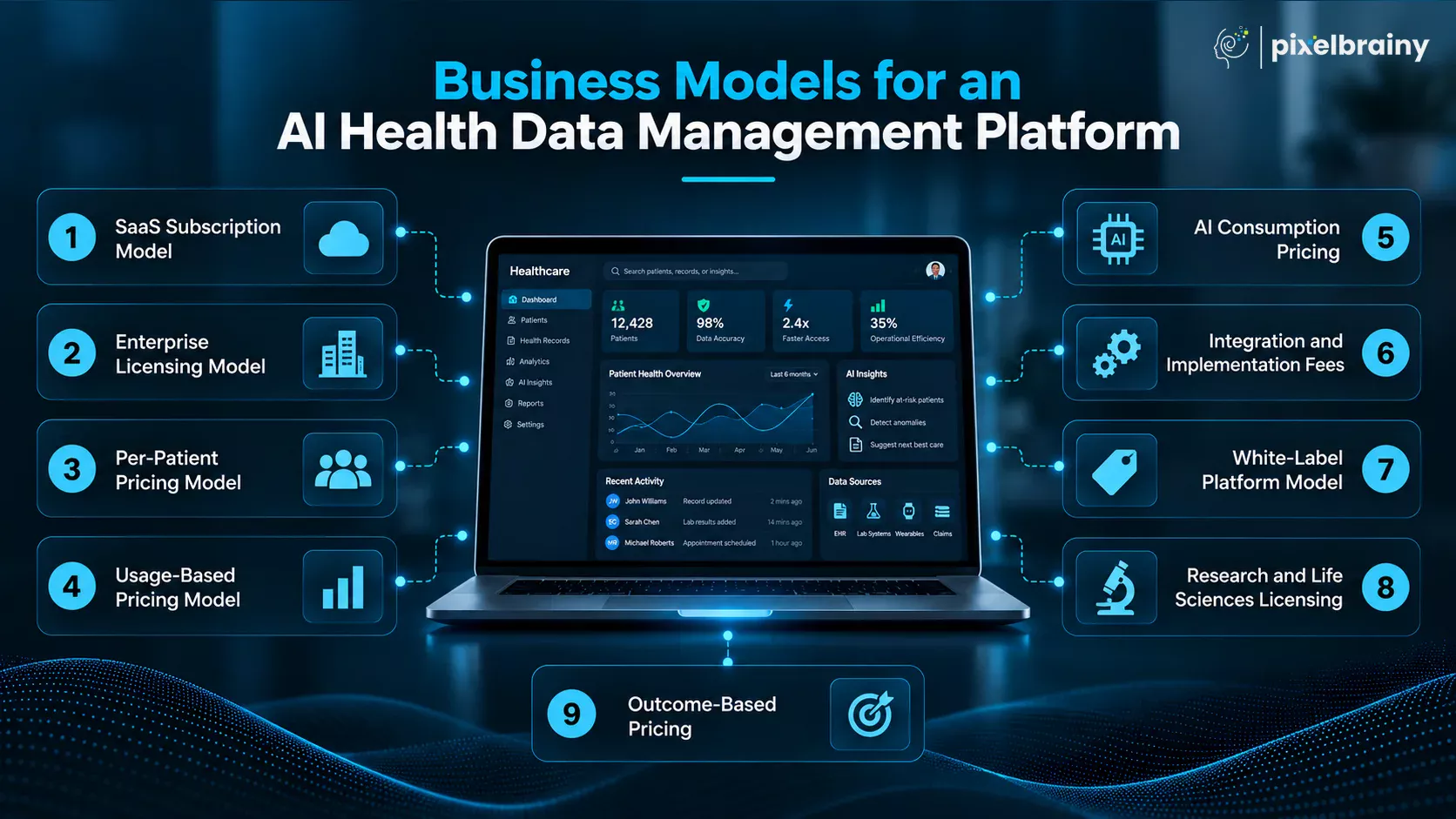
| Business Model | Best Suited For | Main Pricing Basis |
|---|---|---|
| SaaS Subscription | Digital health companies and smaller healthcare organizations | Monthly or annual subscription |
| Enterprise Licensing | Hospitals, health systems, and payers | Annual or multi-year license |
| Per-Patient Pricing | RPM and population health platforms | Active or enrolled patients |
| Usage-Based Pricing | Data-intensive healthcare platforms | Records, APIs, or data volume |
| AI Consumption Pricing | AI-heavy healthcare applications | AI queries, documents, or model usage |
| Integration Fees | Complex enterprise deployments | Per integration or implementation |
| White-Label Licensing | Healthcare technology companies | License and usage |
| Research and Life Sciences Licensing | Pharma and research organizations | Data, analytics, or research access |
| Outcome-Based Pricing | Value-based healthcare programs | Measured business or clinical outcomes |
A SaaS model provides customers with continuous access to the AI health data management platform for a recurring monthly or annual fee.
Pricing can depend on:
This model provides predictable recurring revenue and can work well for digital health companies, ambulatory organizations, and smaller provider groups.
Hospitals, health networks, payers, and large healthcare organizations may prefer an annual or multi-year enterprise license.
The contract can include:
Enterprise licensing is particularly suitable when the platform must operate across multiple facilities, departments, or healthcare business units.
A per-patient model charges customers according to the number of patients managed, enrolled, or monitored through the platform.
This approach is well suited to:
For example, an RPM company can pay according to its active patient population, allowing platform costs to scale alongside its customer base.
Usage-based pricing connects the platform fee to actual consumption.
Possible pricing metrics include:
This model works well when customers have significantly different data volumes or integration requirements.
AI-intensive platforms can separate AI usage from the base software subscription.
Customers may pay according to:
This approach allows customers with higher AI workloads to pay according to their actual consumption.
Healthcare integrations can represent a significant portion of development and deployment effort, particularly when customers use multiple EHRs, laboratories, devices, claims systems, or legacy interfaces.
A platform provider can charge separately for:
This model allows the recurring platform subscription to remain separate from one-time implementation costs.
Healthcare technology companies can license the underlying platform and offer it to their customers under their own brand.
For example, the technology could power a branded:
This model is attractive for companies that want healthcare data and AI infrastructure without building the entire backend themselves.
Pharmaceutical companies, medical device manufacturers, universities, and research organizations may pay for specialized access to healthcare data and analytics capabilities.
Revenue opportunities can include:
This model is particularly relevant when the platform has access to large, well-governed clinical or real-world datasets.
An outcome-based model connects part of the platform's pricing to measurable results.
Potential outcomes include:
This approach can create strong alignment between the platform provider and customer, but the measurement methodology and attribution rules need to be clearly defined.
The ideal model changes according to the customer.
| Customer Type | Potential Best-Fit Model |
|---|---|
| Hospitals and Health Systems | Enterprise license + implementation fees |
| Health Insurers | Enterprise license + member-based pricing |
| Digital Health Startups | SaaS + usage-based pricing |
| RPM Companies | Per-patient + AI consumption |
| Population Health Providers | Per-patient + enterprise subscription |
| Life Sciences Companies | Data and analytics licensing |
| Research Institutions | Research licensing + usage |
| Healthcare Technology Companies | White-label licensing |
| Value-Based Care Organizations | Subscription + outcome-based pricing |
Healthcare platforms often serve customers with very different requirements. A hospital may require extensive integrations and enterprise security, while an RPM company may primarily consume patient monitoring data and AI analytics.
Because of this, a hybrid commercial model can combine:
Annual platform subscription + implementation fee + usage-based pricing + AI consumption
For example, a healthcare startup could charge an annual platform fee, a one-time integration fee for connecting the customer's EHR, and additional usage charges as patient volume and AI consumption increase.
This approach creates predictable recurring revenue while allowing platform pricing to scale with customer value and infrastructure consumption.
The strongest business model for an AI health data management platform connects pricing to customer value, patient volume, data consumption, AI usage, and the complexity of healthcare deployment.
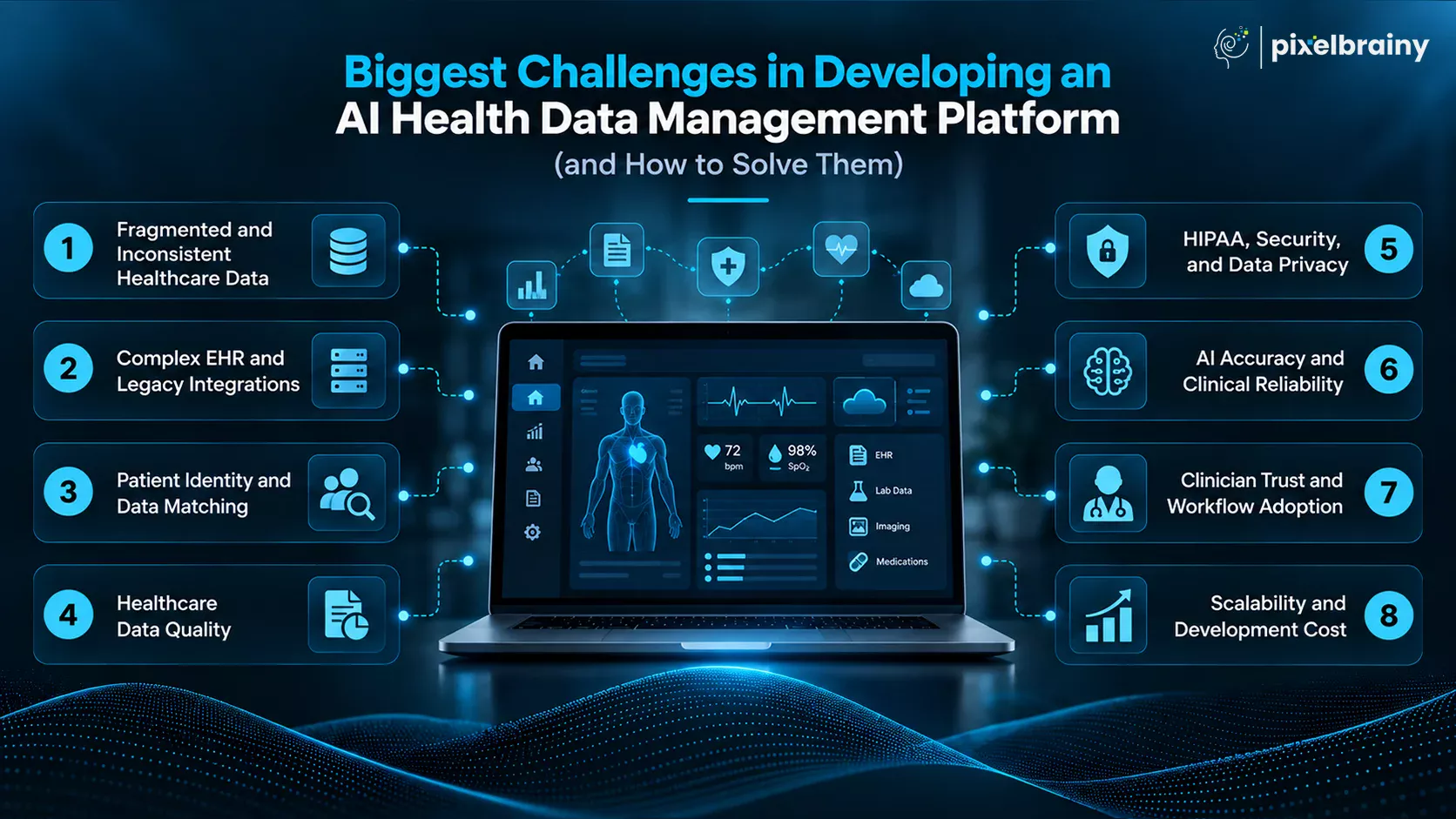
Developing an AI health data management platform is more complex than building a conventional healthcare application because the platform must handle fragmented clinical data, healthcare interoperability, sensitive patient information, AI workloads, and real-world clinical requirements at the same time.
For founders, the biggest risks usually appear before the AI model itself. A platform can have an advanced AI layer but still fail if its underlying data is incomplete, patient identities are incorrectly matched, integrations are unreliable, or clinicians do not trust the results.
A common healthcare startup query is: “What are the biggest technical and business challenges when building an AI health data management platform, and how can we avoid costly architecture and compliance problems before launching?”
The following challenges should be addressed during AI health data management platform development, not after the product reaches production.
Healthcare information is distributed across EHRs, laboratories, pharmacies, claims systems, medical devices, RPM platforms, and patient applications. These systems often use different formats, identifiers, terminology, and data structures.
How to solve it: Build a strong interoperability and data normalization layer using FHIR, HL7, DICOM, and standardized clinical terminologies. Establish data mapping, validation, and quality rules before information reaches analytics or AI models.
Healthcare organizations commonly operate a combination of modern APIs, legacy systems, proprietary interfaces, and older HL7 environments. Connecting these systems can become one of the most time-consuming parts of AI health data management platform development.
How to solve it: Conduct an integration assessment before development and create reusable connectors that support FHIR APIs, HL7 messages, REST APIs, SFTP, and other required interfaces.
The same patient may have different identifiers across hospitals, laboratories, pharmacies, and digital health applications. Incorrect matching can create duplicate records or associate healthcare information with the wrong patient.
How to solve it: Implement a robust Master Patient Index with identity-resolution capabilities. Use carefully governed deterministic and probabilistic matching methods, along with review workflows for uncertain matches.
Missing information, duplicate records, incorrect units, outdated records, conflicting values, and inconsistent timestamps can significantly affect analytics and AI performance.
How to solve it: Implement automated data-quality checks covering completeness, accuracy, duplication, consistency, and validity. Add data lineage and quality monitoring so problems can be identified continuously.
AI health data platforms process sensitive healthcare information, making security and privacy fundamental requirements. Weak access controls or poorly protected APIs can expose protected health information.
How to solve it: Build security into the architecture from the beginning using encryption, authentication, authorization, role-based access controls, audit logging, secure APIs, secrets management, and appropriate data retention policies.
An AI model that performs well in development data may produce different results when deployed across different hospitals, patient populations, devices, or clinical environments. False positives can create unnecessary alerts, while missed signals can reduce clinical value.
How to solve it: Validate models using representative healthcare datasets and monitor accuracy, calibration, false positives, false negatives, bias, and model drift after deployment. AI outputs should be appropriately reviewed within clinical workflows.
Even technically advanced healthcare AI can fail if clinicians do not trust the results or if the platform creates additional work. Excessive alerts, unclear recommendations, and poorly designed dashboards can lead to low adoption.
How to solve it: Involve clinicians throughout development, design around existing workflows, prioritize actionable insights, provide relevant context, and maintain appropriate human oversight for high-impact decisions.
A platform that works with a small dataset may struggle when it needs to process millions of patient records or continuous streams from connected devices. At the same time, building every feature from the beginning can make development unnecessarily expensive.
How to solve it: Design a scalable architecture from the start while launching with a focused MVP. Prioritize the integrations and AI capabilities directly connected to the core business or clinical objective, then expand as adoption and data volume increase.
Successful AI health data management platform development depends on solving the data, integration, security, AI reliability, workflow, and scalability challenges before expanding into more advanced capabilities.
From this point, it is time to identify the right development partner for turning an AI healthcare data concept into a platform that can handle real patients, real healthcare data, and real clinical workflows. PixelBrainy approaches healthcare AI development with a focus on production readiness, interoperability, data security, clinical usability, and measurable business outcomes rather than building technology that only looks impressive in a demonstration.
As an AI healthcare development company, PixelBrainy understands that healthcare platforms need to work across complex data environments where EHRs, laboratories, medical devices, claims systems, RPM platforms, and patient applications may all generate different types of information.
Our approach to AI healthcare data management platform development services starts with understanding the healthcare problem before defining the technology.
We evaluate:
This helps us create an architecture that fits the customer's actual healthcare environment instead of forcing the organization into a generic technology framework.
The objective is not simply to build AI healthcare data management software that collects information.
The platform should be capable of creating a dependable data foundation where healthcare information can be organized, normalized, governed, analyzed, and converted into useful intelligence.
Depending on the use case, this can include:
Our healthcare data management development integrating AI approach focuses on connecting these capabilities with practical workflows so users can act on the intelligence generated by the platform.
A healthcare platform rarely operates in a clean technical environment.
A customer may have modern FHIR APIs alongside HL7 interfaces, legacy databases, proprietary systems, medical devices, third-party applications, and manually maintained datasets.
PixelBrainy designs integration architectures that can accommodate these realities.
The focus is on creating a platform that can evolve as new data sources, healthcare systems, users, and AI capabilities are introduced.
For one healthcare client, whose identity remains confidential, PixelBrainy worked on a healthcare data platform designed to bring information from multiple sources into a centralized environment for monitoring and analytics.
The project involved integrating healthcare data sources, creating standardized patient-level information, implementing secure data access, and establishing an analytics layer for identifying meaningful changes in patient information.
The platform was designed to help healthcare teams spend less time navigating disconnected information sources and more time reviewing relevant patient-level insights.
The project also required careful attention to data quality, integration reliability, user permissions, and scalability because the platform needed to support healthcare information beyond a simple demonstration environment.
Many AI prototypes can demonstrate an impressive prediction, chatbot, or dashboard using a limited dataset.
A production healthcare platform requires much more.
PixelBrainy focuses on the complete technology lifecycle:
Healthcare Strategy → Architecture → Data Integration → Platform Development → AI → Security → Testing → Deployment → Continuous Improvement
This approach helps ensure that AI capabilities are supported by reliable healthcare data and that the resulting platform can fit into the customer's existing technology ecosystem.
For healthcare founders asking, “How can we turn our AI healthcare concept into a secure platform that integrates with existing systems and can actually be used by clinicians or healthcare operations teams?”, the answer starts with selecting a development partner that understands both healthcare technology and AI engineering.
PixelBrainy can support healthcare organizations and startups across different stages, from early product validation to enterprise platform development.
Our capabilities can support organizations looking to:
The goal is straightforward: create healthcare AI products that solve real problems, integrate with real systems, and deliver value in real-world environments.
Ready to Turn Your Healthcare AI Idea Into a Production Platform?
Connect with PixelBrainy to discuss your AI health data management platform requirements and explore the right development strategy for your healthcare use case.
An AI health data management platform is becoming an important foundation for healthcare organizations dealing with fragmented clinical, operational, and patient-generated data. As this guide shows, successful AI health data management platform development requires much more than adding an AI model to existing healthcare software. It requires reliable interoperability, FHIR and HL7 integration, data normalization, patient identity management, security, governance, scalable infrastructure, and clinically relevant AI capabilities.
For healthcare founders, the right development strategy is to begin with a clearly defined problem, validate the concept, build a focused MVP, establish a reliable healthcare data foundation, and then expand AI capabilities based on measurable outcomes. Whether you want to build an AI health data management platform for hospitals, payers, RPM companies, research organizations, or a healthcare SaaS product, the platform should ultimately turn fragmented data into trustworthy and actionable intelligence.
The goal is not simply to manage more healthcare data, but to make that data more connected, meaningful, secure, and useful for better decisions.
Ready to turn your healthcare AI idea into a production-ready platform? Book an appointment with PixelBrainy today.
The AI health data management platform development cost can range from approximately $40,000 to $350,000+, depending on integrations, AI capabilities, security requirements, data volume, and deployment scale. A basic platform may cost $40,000 to $100,000, while advanced platforms can reach $100,000 to $200,000 and enterprise deployments can exceed $350,000.
A multi-EHR platform typically requires an interoperability architecture supporting FHIR, HL7, REST APIs, and proprietary or legacy interfaces. The development should also include patient identity matching, clinical data normalization, terminology mapping, data-quality validation, secure APIs, and governance to ensure information from different systems can be used consistently.
Yes. An AI health data management platform can operate as a data and intelligence layer alongside existing EHRs rather than replacing them. It can connect EHRs with laboratory systems, pharmacy platforms, claims, medical devices, RPM systems, and other sources while providing unified analytics and AI capabilities.
Healthcare startups should avoid adding every possible AI capability to the first release. A focused MVP can begin with one valuable use case, such as patient risk scoring, clinical summarization, anomaly detection, care-gap identification, or patient monitoring, supported by a reliable healthcare data foundation.
HIPAA compliance requires appropriate safeguards based on the platform's intended use and environment. The architecture should incorporate encryption, authentication, authorization, role-based access, audit logging, secure data transmission, appropriate data-handling policies, and ongoing security assessments.
The platform should prioritize actionable intelligence rather than simply displaying more data. AI can summarize patient histories, identify meaningful trends, prioritize high-risk patients, filter abnormal signals, and integrate insights into existing workflows while using appropriate thresholds and human oversight to reduce unnecessary alerts.
Yes. The platform can integrate data from wearables, remote patient monitoring devices, medical devices, and connected healthcare applications and process information continuously. AI can identify abnormal trends, prioritize clinically relevant signals, and alert authorized care teams when predefined risk conditions require attention.
Development timelines depend heavily on the platform's scope and integration complexity. A typical timeline can look like this: Proof of Concept: 4 to 8 weeks MVP: 3 to 6 months Advanced Platform: 6 to 12 months Enterprise Platform: 12 to 18+ months Multiple EHR integrations, legacy systems, real-time monitoring, advanced AI, extensive security requirements, clinical validation, and multi-facility deployment can extend the timeline. A focused MVP is usually the practical starting point for validating the product before moving into enterprise-scale development.

About The Author
Sagar Bhatnagar
Sagar Sahay Bhatnagar brings over a decade of IT industry experience to his role as Marketing Head at PixelBrainy. He's known for his knack in devising creative marketing strategies that boost brand visibility and market influence. Sagar's strategic thinking, coupled with his innovative vision and focus on results, sets him apart. His track record of successful campaigns proves his ability to utilize digital platforms effectively for impactful marketing efforts. With a genuine passion for both technology and marketing, Sagar continuously pushes PixelBrainy's marketing initiatives to greater success.

Working with the PixelBrainy team has been a highly positive experience. They understand the design requirements and create beautiful UX elements to meet the application needs. The dev team did an excellent job bringing my vision to life. We discussed usability and flow. Sagar worked with his team to design the database and begin coding. Working with Sagar was easy. He has the knowledge to create robust apps, including multi-language support, Google and Apple ID login options, Ad-enabled integrations, Stripe payment processing, and a Web Admin site for maintaining support data. I'm extremely satisfied with the services provided, the quality of the final product, and the professionalism of the entire process. I highly recommend them for Android and iOS Mobile Application Design and Development.

Great experience working with them. Had a lot of feedback and I found that unlike most contractors they were bugging me for updates instead of the other way around. They were extremely time conscience and great at communicating! All work was done extremely high quality and if not on time, early! They were always proactive when it comes to communication and the work is great/above par always. Very flexible and a great team to work with! Goes above and beyond to present us with multiple options and always provides quality. Amazing work per usual with Chitra. If you have UI/UX or branding design needs I recommend you go to them! Will likely work with them in the future as well, definitely recommended!

PixelBrainy is a joy to work with and is a great partner when thinking through branding, logo, and website layout. I appreciate that they spend time going into the "why" behind their decisions to help inform me and others about industry best practices and their expertise.

I hired them to design our software apps. Things I really like about them are excellent communication skills, they answer all project suggestions and collaborate right away, and their input on design and colors is amazing. This project was complex and needed patience and creativity. The team is amazing to do business with. I will be using them long-term. Glad to see there are some good people out there. I was afraid to try and outsource my project to someone but I am glad I met them! I really can't say enough. They went above and beyond on this project. I am very happy with everything they have done to make my business stand out from the competition.

It was great working with PixelBrainy and the team. They were very responsive and really owned the project. We'll definitely work with them again!

I recently worked with the PixelBrainy team on a project and I was blown away by their communication skills. They were prompt, clear, and articulate in all of our interactions. They listened and provided valuable feedback and suggestions to help make the project a success. They also kept me updated throughout the entire process, which made the experience stress-free and enjoyable.

PixelBrainy is very good at what it does. The team also presents themselves very professionally and takes care of their side of things very well. I could fully trust them taking up the design work in a timely and organised manner and their attention to detail saved us lots of effort and time. This particular project was quite intense and the team showed that they function very well under pressure. Very much looking forward to working with her again!

It's always an absolute pleasure working with them. They completed all of my requests quickly and followed every note I had for them to a T, which made our process go smoothly from start to finish. Everything was completed fast and following all of the guidelines. And I would recommend their services to anyone. If you need any design work done in the future, PixelBrainy should be your first call!

They took ownership of our requirements and designed and proposed multiple beautiful variants. The team is self-motivated, requires minimum supervision, committed to see-through designs with quality and delivering them on time. We would definitely love to work with PixelBrainy again when we have any requirements.

PixelBrainy was a big help with our SaaS application. We've been hard at work with a new UI/UX and they provided a lot of help with the designs. If you're looking for assistance with your website, software, or mobile application designs, PixelBrainy and the team is a great recommendation.

PixelBrainy designers are amazing. They are responsive, talented, and always willing to help craft the design until it matches your vision. I would recommend them and plan to continue them for my future projects and more!!!

They were awesome! Did a good job fast, and good communication. Will work with them again. Thank you

Creative, detail-oriented, and talented designers who take direction well and implement changes quickly and accurately. They consistently over-delivered for us.

PixelBrainy team is very talented and creative. Great designers and a pleasure to work with. PixelBrainy is an excellent communicator and I look forward to working with them again.

PixelBrainy has a very talented design team. Their work is excellent and they are very responsive. I enjoy working with them and hope to continue on all of our future projects.


Transform your ideas into reality with us.
Across these industries, each engagement brings unique challenges, from early-stage product development to scaling complex systems, helping us build a practical understanding of real-world product environments.